Introduction
The secondary Mg–Al phosphate mineral, aldermanite, was first described by Harrowfield et al. (Reference Harrowfield, Segnit and Watts1981) from Klemm's quarry, Moculta, 60 km. NE of Adelaide, South Australia. The quarry is one of several, including Tom's and St. John's quarries that exploited the rich phosphate deposits of the Kapunda–Angaston area of the Mount Lofty Ranges (Elliott et al., Reference Elliott, Peisley and Mills2014). An ideal formula for aldermanite, obtained from electron microprobe analyses (EMPA) and mass loss on ignition was given as Mg5Al12(PO4)8(OH)22⋅nH2O with n ≈ 32. The mineral occurs as minute, talc-like crystals with a thickness of only 0.1–0.2 μm, that were unsuitable for single-crystal diffraction analysis. An orthorhombic unit cell was obtained by indexing the powder X-ray diffraction (PXRD) pattern, with a = 15.000(7), b = 8.330(6) and c = 26.60(1) Å.
One of the authors (P.E.) collected specimens of aldermanite from Tom's quarry that contained larger crystals of the mineral and we have been able to obtain single-crystal XRD data suitable for a structure analysis. In addition, electron microprobe (EMP) analysis on the Tom's quarry sample showed significant quantities of Na and F that were not analysed for by Harrowfield et al. (Reference Harrowfield, Segnit and Watts1981) although they did report that Na was detected in a qualitative EMP scan. A crystal structure determination revealed that aldermanite contains unusual sawtooth-like layers of octahedrally coordinated Al that can be described as intersecting kagomé layers (Grey, Reference Grey2020). Such layers have been reported recently in the chemically diverse minerals of the walentaite group (Grey et al., Reference Grey, Hochleitner, Rewitzer, Riboldi-Tunnicliffe, Kampf, MacRae, Mumme, Kaliwoda, Friis and Martin2020) and the zirconolite group (Chukanov et al., Reference Chukanov, Zubkova, Pekov, Vigasina, Polekhovsky, Ternes, Schüller and Britvin2019). We report here the new formula and crystal structure of aldermanite and its relationships with the walentaite and zirconolite minerals.
Experimental
Sample and analysis
The sample used in this study was collected from Tom's quarry in the mid 2000s. Aldermanite occurs as aggregates of radiating white crystals lining cavities in a goethite matrix associated with fluellite and minyulite. Crystals are transparent, have a thin, elongated, bladed habit and are typically 0.1 to 0.2 mm long. They are flexible and are frequently bent. The sample analysed has been deposited in the South Australian Museum, registration no. G34943.
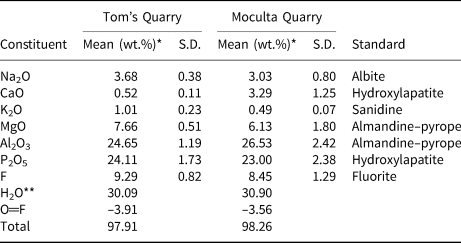
Crystal aggregates of aldermanite were mounted in an epoxy block, polished and carbon-coated. The analyses were conducted in wavelength-dispersive mode using a Cameca SXFive electron microprobe operated at an accelerating voltage of 15 kV, a beam current of 10 nA and a defocused beam of 5 μm. The standards used are as follows: albite (NaKα), almandine–pyrope (AlKα and MgKα), sanidine (KKα), hydroxylapatite (CaKα and PKα) and fluorite (FKα). Data were reduced using the φ(ρZ) method of Pouchou and Pichoir (Reference Pouchou, Pichoir and Armstrong1985). Analyses were also conducted on the type specimen of aldermanite and aldermanite from the Moculta quarry type locality. The type specimen (M34778, Museums Victoria) comprised ultra-thin feathery platelets that were difficult to analyse and gave low (~95%) analysis totals. The mean wt.% analyses, however, agreed to within a S.D. with the analyses for the type locality specimen. The latter had better analysis totals and are reported in Table 1 together with the results for the Tom's quarry specimen.
Analytical data for aldermanite.

*Average of 10 analyses. **H2O from the ideal formula based on the crystal structure.
S.D. – standard deviation.
Crystallography
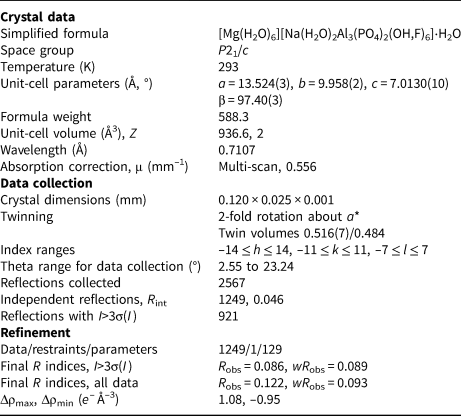
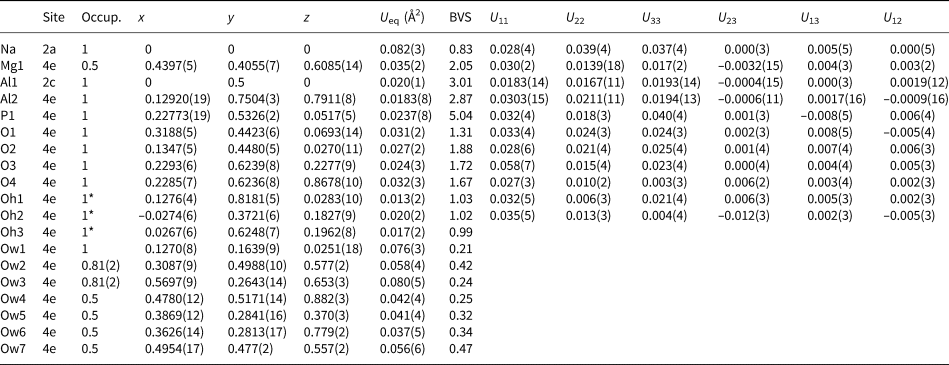
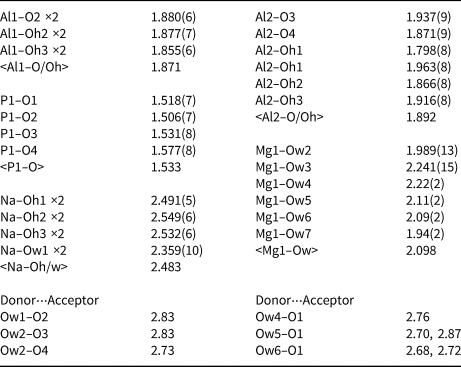
A crystal of dimensions 0.12 mm × 0.025 mm × 0.001 mm was mounted on a glass fibre. X-ray intensity data were collected at room temperature using a Nonius KappaCCD diffractometer utilising monochromatised MoKa radiation. The measured intensities were corrected for Lorentz and polarisation effects (Otwinowski et al., Reference Otwinowski, Borek, Majewski and Minor2003). An absorption correction was applied using the Gaussian integration method (Coppens, Reference Coppens, Ahmed, Hall and Huber1970). A structure solution in space group P21/c was obtained using SHELXS-97 software (Sheldrick Reference Sheldrick2008) implemented in WinGX (Farrugia, Reference Farrugia1999). The structural model comprised heteropolyhedral layers, parallel to (100) of corner-connected Al-centred octahedra and PO4 tetrahedra, with the octahedra forming three- and six-member rings and with 8-coordinated Na located at the centres of the hexagonal rings. The layers were well ordered with sensible polyhedral bond distances, but the R factor was high at 0.29, and difference-Fourier maps showed only disordered, partially occupied sites between the layers, with the highest interlayer peak having a density of 6 e Å–3. This site was surrounded by six further sites having electron densities of ~3–4 e Å–3 that were in octahedral coordination to the atom at the first site. Assignment of Mg and O, with 50% occupation, to these sites lowered the R factor to 0.20. Application of TWINROTMAT in WinGX revealed the presence of twinning about a 2-fold axis parallel to a*. Implementation of the twinning lowered the R factor to 0.14. At this stage the refinement was continued using JANA2006 (Petříček et al., Reference Petříček, Dušek and Palatinus2014) for ease of checking subgroups of P21/c for the possibility of ordering of the half-occupied interlayer Mg-centred octahedra. Checks were made in Pc and P21. For the latter subgroup the Mg atom sites and surrounding anion sites each split into pairs of sites that allowed for ordering in one of the pairs of sites. A problem was encountered, however, in attempting to refine the structure in P21, because all atoms except those of the interlayer Mg(H2O)6 octahedra are related by a centre of symmetry. Refinement resulted in very high correlation factors between the pairs of atoms at x,y,z and –x,–y,–z, and gave some unreasonable bond distances. Because of this we returned to refinement in P21/c and only used the P21 model to illustrate the ordering of the interlayer hydrated polyhedra. The refinement in P21/c, with anisotropic displacement parameters for the layer atoms converged at wR obs = 0.093 for 1249 unique reflections. Other details of the refinement are given in Table 2. The refined coordinates, equivalent isotropic and anisotropic displacement parameters are reported in Table 3, together with bond valence sums (BVS) obtained using the BVS parameters of Gagné and Hawthorne (Reference Gagné and Hawthorne2015). Polyhedral bond distances and probable H-bonded pairs of atoms are reported in Table 4. The crystallographic information file has been deposited with the Principal Editor of Mineralogical Magazine and is available as Supplementary material (see below).
Crystal data and structure refinement for aldermanite.

Refined atomic coordinates, equivalent isotropic displacement parameters (Å2) and bond valence sums (BVS) for aldermanite together with anisotropic displacement parameters for intralayer atoms.

*Occupancy = 0.5OH+0.5F
Polyhedral bond lengths (Å) and probable H-bonded anions in aldermanite.

Results and discussion
The empirical formulae based on 23 anions for aldermanite from Tom's quarry and from the type locality are:
Tom's quarry:
Na0.72K0.13Ca0.06Mg1.15Al2.92(PO4)2.05[(OH)2.92F2.96]Σ5.88⋅8.91H2O
Klemm's quarry:
Na0.59K0.06Ca0.36Mg0.92Al3.16(PO4)1.97[(OH)4.08F2.70]Σ6.78⋅8.36H2O
These show that the Tom's quarry specimen is chemically very similar to that of the type locality, but has a higher F content and greater substitution of Na for Ca. The crystal structure for aldermanite has three univalent anion sites, Oh1 to Oh3, where F could substitute for OH. Allocation of equal amounts of F and OH at these sites gives sensible BVS values for the Tom's quarry specimen as shown in Table 3. The analyses for type locality aldermanite has OH>F. The formula originally reported for aldermanite (Harrowfield et al., Reference Harrowfield, Segnit and Watts1981) did not include F or Na. The Na is important in the crystal chemistry of aldermanite because it is the dominant element in an 8-coordinated site in the crystal structure, along with minor K and Ca.
Description of the structure
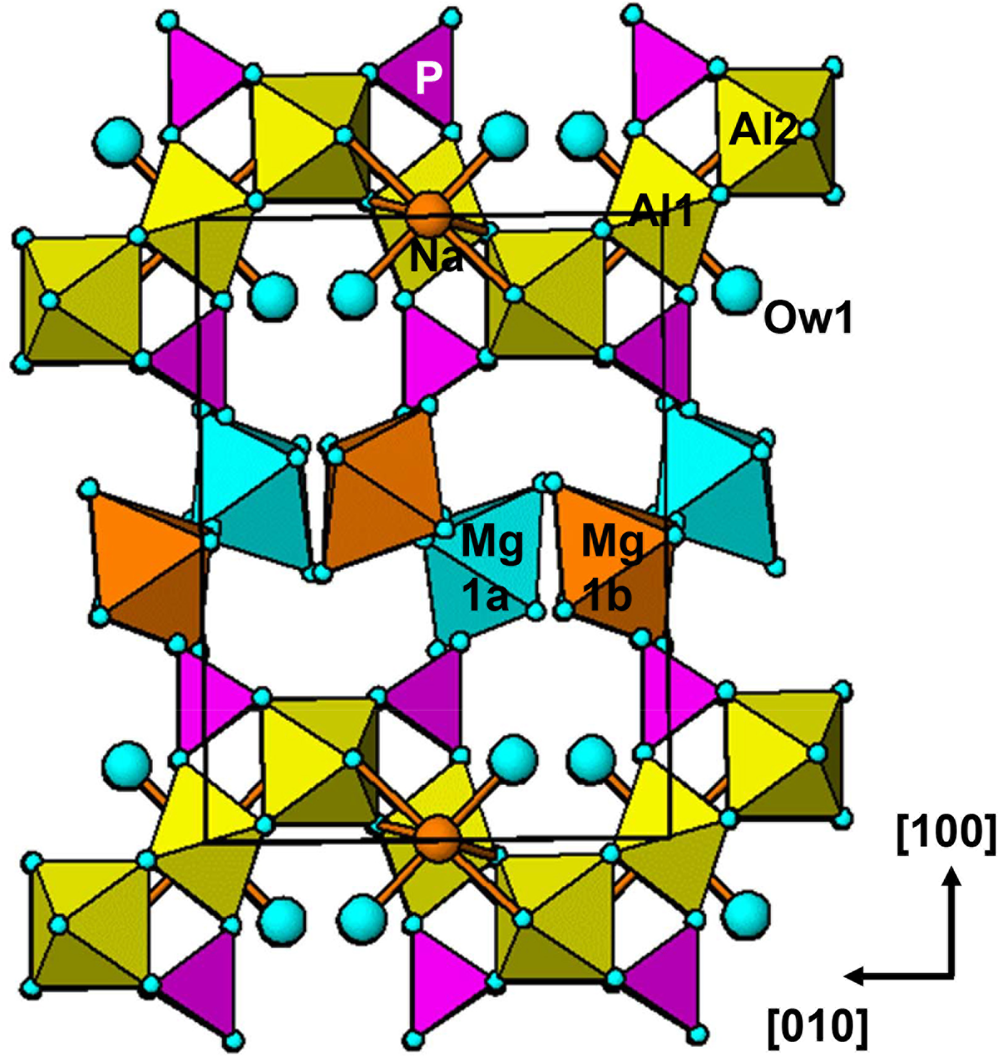
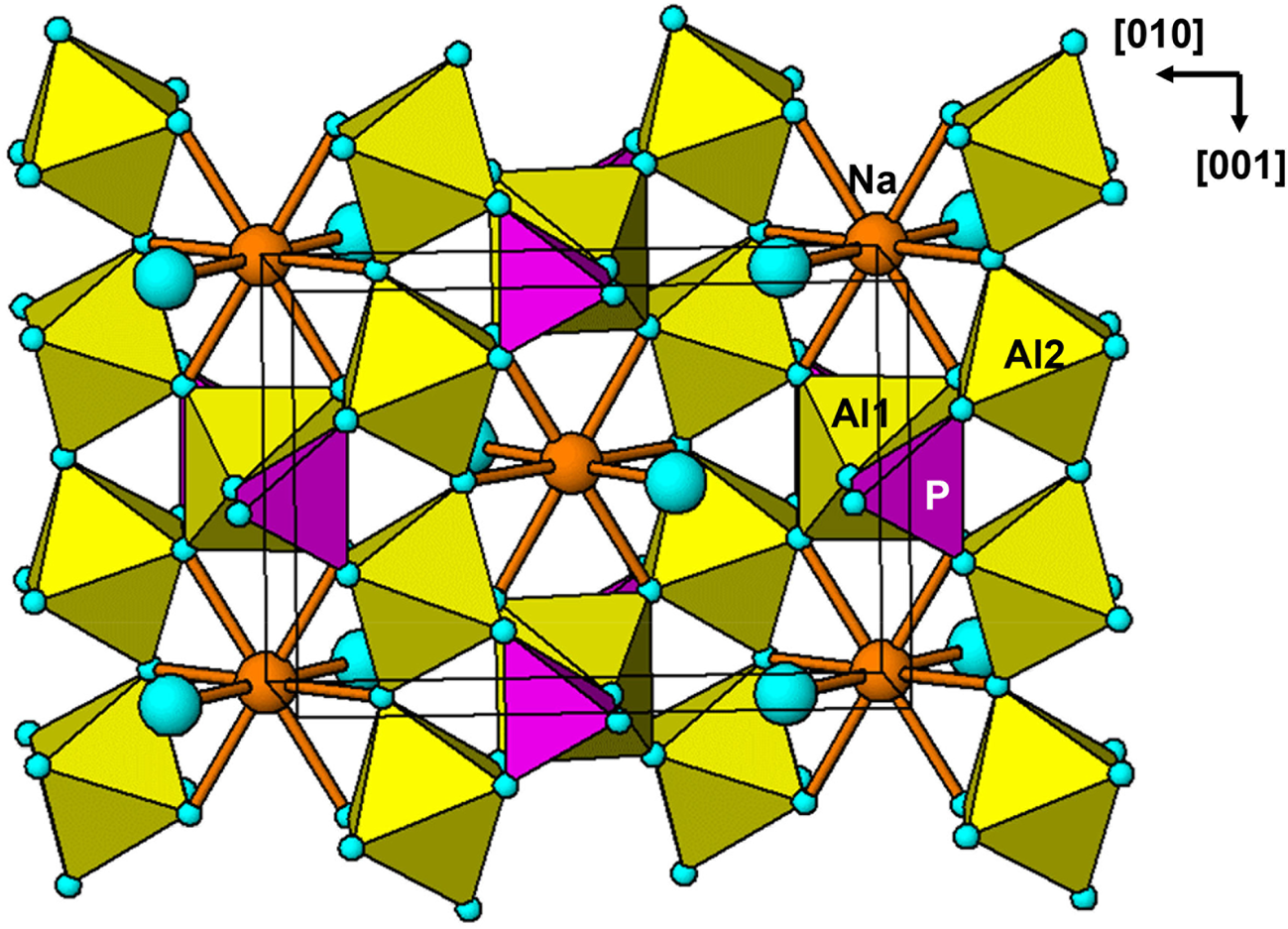
The crystal structure of aldermanite is shown in projection along the 7 Å c axis in Fig. 1. It comprises three-octahedra-wide sawtooth-like layers of corner-connected AlΦ6 octahedra (Φ = O, OH and F) that are decorated with corner-connected PO4 tetrahedra. The heteropolyhedral layers are parallel to (100), with Mg(H2O)6 octahedra located in the interlayer region. Figure 1 shows the splitting of the Mg(H2O)6 octahedra into two independent groups in P21, centred at sites Mg1a and Mg1b. The heteropolyhedral layer is shown projected along [100] in Fig. 2. The linking of the octahedra into three- and six-member rings by cis- and trans- corner sharing has the same topology as a {110} slice of the pyrochlore structure (Subramanian et al., Reference Subramanian, Aravamudan and Subba Rao1983). This analogy is further supported by the location of Na at the centre of the hexagonal rings with scalenohedral coordination in aldermanite, the same as for the A cation in A2B2X6Y pyrochlores (Atencio et al., Reference Atencio, Andrade, Christy, Gieré and Kartashov2010). Figure 2 shows that the PO4 tetrahedra each share three basal anions with triangular groupings of octahedra. This linking of the polyhedra gives layers of composition Al3(PO4)2Φ6, the same as in alunite-supergroup minerals like crandallite, CaHAl3(PO4)2(OH)6 (Blount, Reference Blount1974).
Projection of aldermanite structure along [001]. The Mg1a- and Mg1b-centred octahedra are independent in space group P21.

The (100) heteropolyhedral layer [Al3(PO4)4(OH,F)4] in aldermanite with Na(H4O)4(OH,F)4 scalenohedra at centres of the 6-member rings.

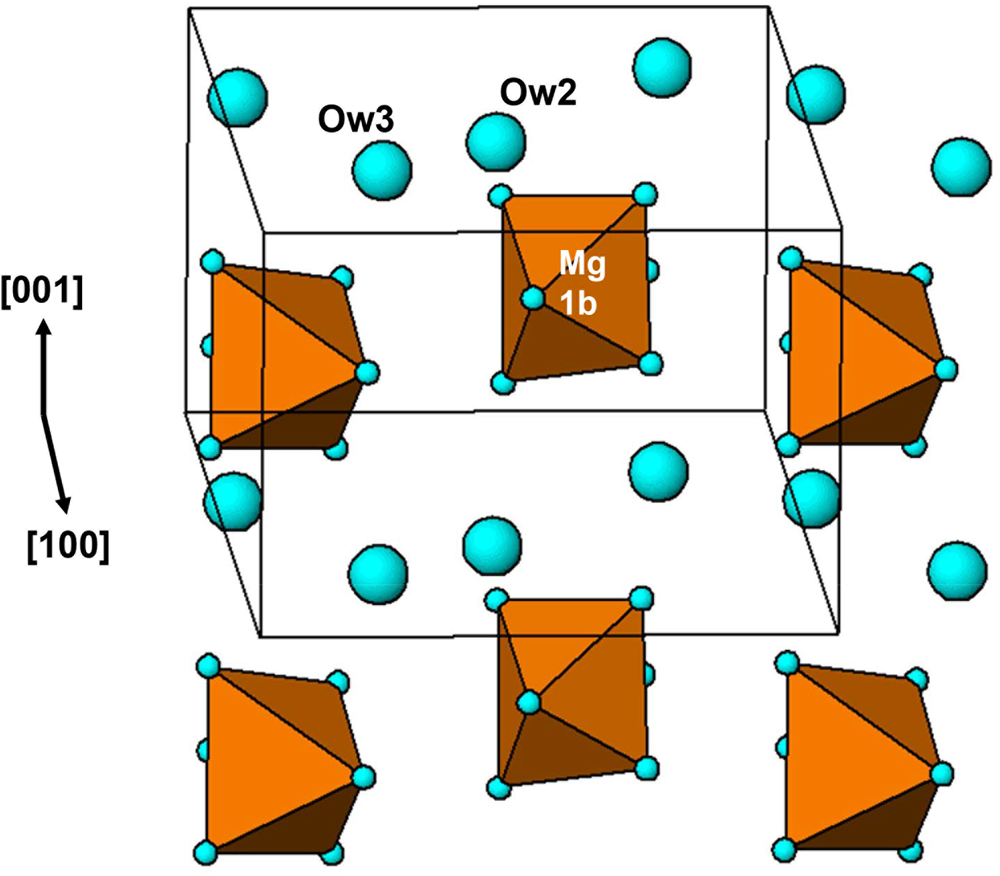
Bond-valence sums are reported in Table 3. They confirm the presence of four oxygen atom sites, three monovalent anion (OH, F) sites and seven sites occupied by H2O groups. The unshared anion of the PO4 tetrahedron, O1, has a low BVS of 1.3, but its valency requirements are met by being a receptor for multiple H bonds from the interlayer H2O groups, see Table 4. The refined site occupancies for two of the H2O molecules, Ow2 and Ow3 coordinated to Mg were 0.81(2), while the Mg occupancy is only 0.5. This can be explained in the P21 model by local ordering; when one Mg site is occupied, two anions associated with the second (vacant) Mg site each have approximately half-occupancy, so the interlayer region contains both Mg(H2O)6 octahedra and isolated H2O groups, as shown in Fig. 3. Taking the occupancies of these interlayer sites into account, the new simplified formula for aldermanite is [Mg(H2O)6][Na(H2O)2Al3(PO4)2(OH,F)6]⋅H2O. We have used the same format for the formula as used for walentaite-group minerals (Grey et al., Reference Grey, Hochleitner, Rewitzer, Riboldi-Tunnicliffe, Kampf, MacRae, Mumme, Kaliwoda, Friis and Martin2020) in which the interlayer hydrated cations are located in the first square brackets and the layer composition is in the second square brackets. The ideal end-member formula is [Mg(H2O)6][Na(H2O)2Al3(PO4)2(OH)6]⋅H2O. A proposal for the redefinition of the aldermanite formula has been approved by the Commission on New Minerals, Nomenclature and Classification of the International Mineralogical Association, proposal 20-I (Miyawaki et al., Reference Miyawaki, Hatert, Pasero and Mills2021).
Interlayer Mg(H4O)4 octahedra and H4O groups, ordering in P21.

Intersecting kagomé nets in aldermanite and related minerals
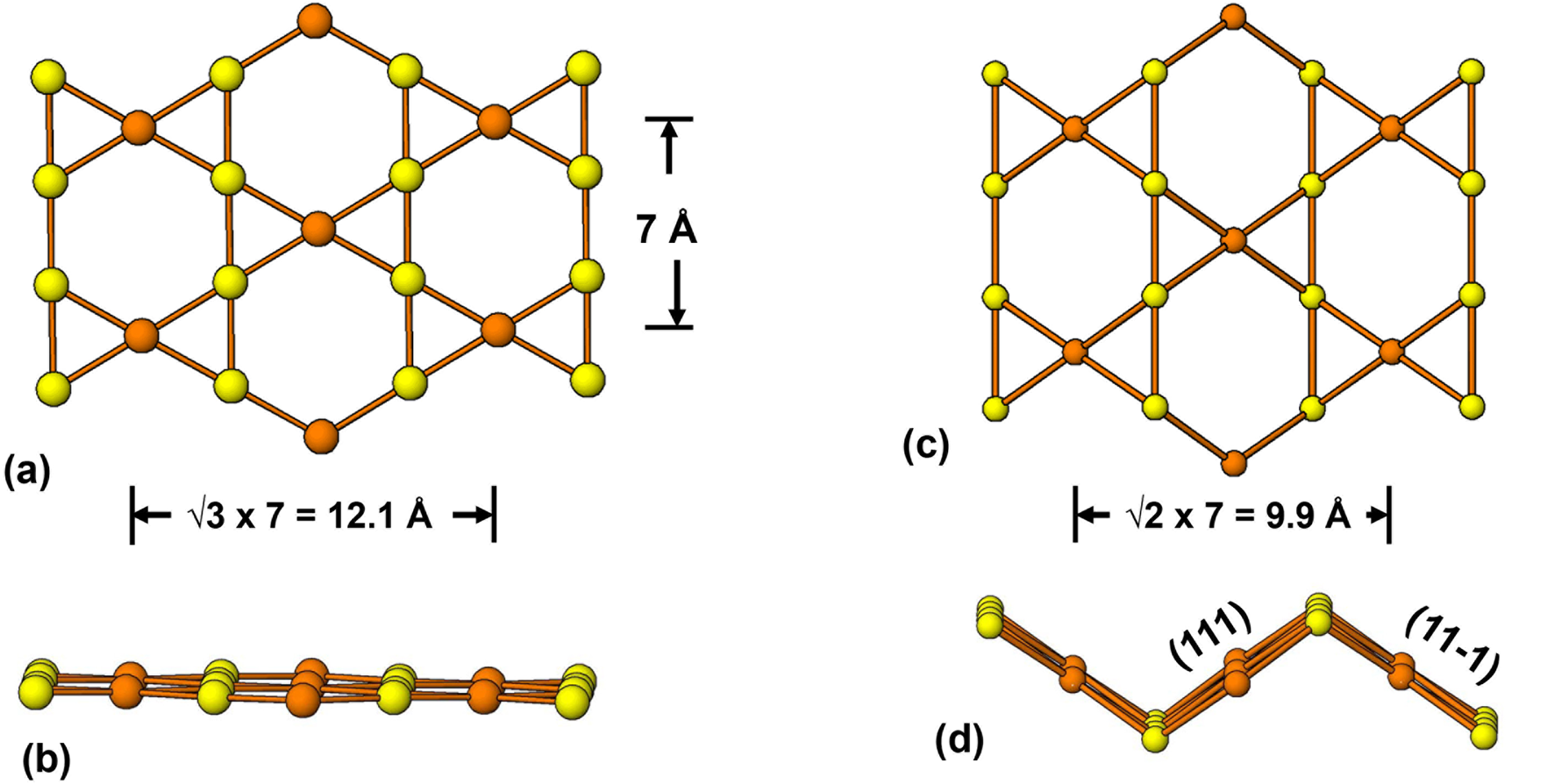
The sawtooth layers of corner-connected octahedra in aldermanite correspond topologically to a {110} slice of pyrochlore-type structure. The structure of A2B2X6Y pyrochlore can be described in terms of face-centred cubic stacking of alternating A3B and B3A metal atom layers parallel to {111}. Both the small B cations and the large A cations form 3D interpenetrating kagomé nets (Syozi, Reference Syôzi1951), where the kagomé net is a planar array of corner-connected triangles forming three-member and six-member rings as shown in Fig. 4a. Octahedral coordination of the B cations gives rise to the hexagonal tungsten bronze (HTB) motif first described in Rb0.27WO3 (Magneli, Reference Magneli1952). The corner-connected octahedra in the HTB layers are in trans-configuration, but where the HTB layers corresponding to different {111} planes intersect in pyrochlore, the octahedra at the intersection of the planes have cis-corner-sharing to adjacent octahedra. This is the situation in a {110} slice of the pyrochlore structure as in aldermanite, where the two intersecting kagomé nets are parallel to (111) and (11$\bar{1}$ ), with an interplanar angle of 109.5°, giving the characteristic sawtooth appearance shown in Fig. 4d.
(a) Planar kagomé net as in {111}pyrochlore; (b) edge-on view of kagomé net; (c) intersecting kagomé nets in {110} slice of pyrochlore; and (d) edge-on view of intersecting nets.

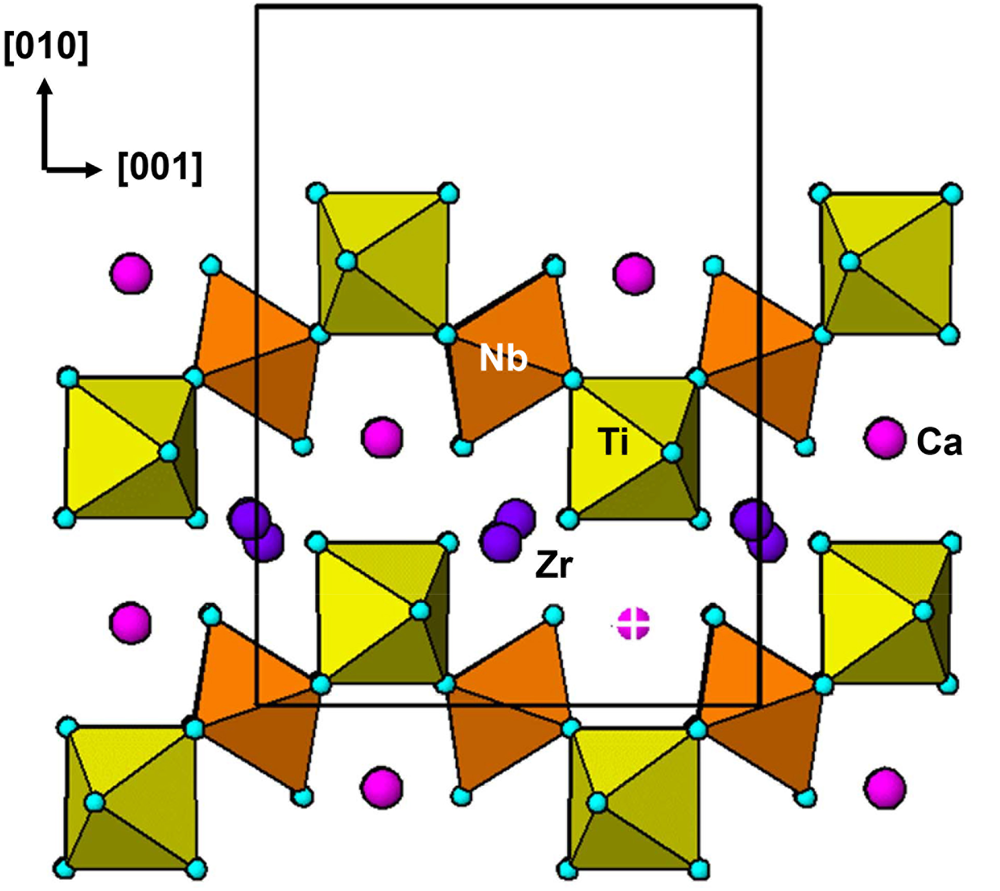
The same type of sawtooth layers of intersecting kagomé nets of small cations occur in the zirconolite-related mineral stefanweissite, (Ca,REE)2Zr2(Nb,Ti)(Ti,Nb)2Fe2+O14 (Chukanov et al., Reference Chukanov, Zubkova, Pekov, Vigasina, Polekhovsky, Ternes, Schüller and Britvin2019). Stefanweissite is isostructural with zirconolite-3O, originally called ‘polymignyte’ (Bayliss et al., Reference Bayliss, Mazzi, Munno and White1989). It is orthorhombic, Cmca, with a = 7.290, b = 14.143 and c = 10.171 Å. The a and c parameters correspond to c and b, respectively, for aldermanite. The [100] projection of the stefanweissite structure in Fig. 5 shows the sawtooth (010) layers of corner-connected octahedra. The cis-connected octahedra at the intersection of the HTB layers are occupied predominantly by Ti4+ while the trans-connected octahedra within the HTB layers have Nb5+ as the dominant cation. In contrast to aldermanite, which has the large 8-coordinated Na+ cation occupying the centres of the hexagonal rings in the HTB layers, the zirconolite-3O minerals have small cations displaced from the centres of the hexagonal rings to take up 4- and 5-coordination. The zirconolite-3O mineral structures, with sawtooth-like intersecting kagomé nets of small cations, are topologically distinct from the structures of other zirconolite minerals, zirconolite-2M and zirconolite-3T, which have planar kagomé nets of small cations (Grey, Reference Grey2020). As a result, it is debatable if zirconolite-3O should be classed as a zirconolite polytype.
[100] projection of the stefanweissite structure showing sawtooth layers of corner-connected octahedra.

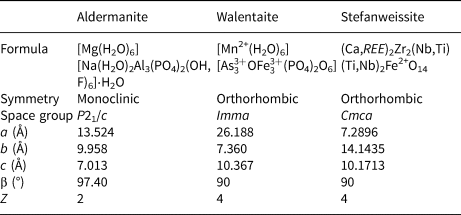
The zirconolite-3O minerals differ markedly from aldermanite in the composition and structure between the sawtooth HTB layers. Whereas in aldermanite the layers are widely separated (13.5 Å) with only H-bonding to interlayer species, in zirconolite-3O minerals the layers are only ~7 Å apart and the large (Ca2+, Zr4+ and REE 3+) interlayer cation polyhedra share edges with the HTB layer octahedra. A much closer match with the aldermanite structure is provided by the walentaite-group minerals (Grey et al., Reference Grey, Hochleitner, Rewitzer, Riboldi-Tunnicliffe, Kampf, MacRae, Mumme, Kaliwoda, Friis and Martin2020). Walentaite, ideally [Mn2+(H2O)6][As3+3OFe3+3(PO4)2O6], is orthorhombic, Imma, with a = 26.188, b = 7.360 and c = 10.367 Å (Grey et al., Reference Grey, Mumme and Hochleitner2019). The intersecting kagomé nets in walentaite are formed from Fe3+ cations, with partial substitution by W6+ and Mo6+ in other walentaite-group minerals. Heteropolyhedral layers parallel to (100) of Fe-centred octahedra decorated with PO4 or AsO4 tetrahedra have the same polyhedral connectivity as in aldermanite. The separation between the layers (=0.5a) is close to that for aldermanite and the interlayer region is occupied by M(H2O)6 polyhedra, where M is Mg, Mn2+, Fe2+ and Fe3+ in different walentaite-group minerals. The only major difference between aldermanite and the walentaite-group minerals is that the latter do not have the centres of the hexagonal rings occupied by a large cation. Instead, As3+O3 groups occupy positions displaced from the centres of the rings, as well as locations on the surface of the heteropolyhedral layers. The crystallographic parameters for aldermanite, walentaite and stefanweissite are compared in Table 5.
Crystallographic parameters for aldermanite, walentaite and stefanweissite.

Supplementary material
To view supplementary material for this article, please visit https://doi.org/10.1180/mgm.2021.36
Acknowledgements
Three anonymous reviewers, the Structural Editor Daniel Atencio and Associate Editor David Hibbs are thanked for their comments. Stuart Mills at Museums Victoria is thanked for providing the type specimen of aldermanite for study.