INTRODUCTION
Research on prosocial behavior has focused mostly on the good that can come from helping others. According to Batson and Powell (Reference Batson and Powell2003), the idea of prosocial behavior was created by social scientists as a way to discuss behaviors that are the opposite of antisocial behaviors. Whereas antisocial acts are hostile, unfriendly, threatening and detrimental to the social order, prosocial behaviors are focused on helping and comforting individuals aggrieved by their circumstances, or protecting people from the harmful or antisocial actions of others. Discussions of prosocial behavior have generally focused on the emotions, motives and effects that caring for others have on the helper and the recipient (Batson, Sager, Garst, Kang, Rubchinsky, & Dawson, Reference Batson, Sager, Garst, Kang, Rubchinsky and Dawson1997; Batson, Reference Batson2010; Aknin et al., Reference Aknin, Barrington-Leigh, Dunn, Helliwell, Burns, Biswas-Diener, Kemeza, Nyende, Ashton-James and Norton2013: 82). Researchers have shown that when people are caring for one another both the helper and the helped are better off (Weinstein & Ryan, Reference Weinstein and Ryan2010).
Studies have also shown that prosocial behaviors can play an important role in assisting in the smooth functioning of social entities (Batson, Reference Batson1990; Keltner, Haidt, & Shioto, Reference Keltner, Haidt and Shioto2006; Schwartz, Reference Schwartz2010). Research on prosocial behavior in organizations (Grant & Berry, Reference Grant and Berry2011) and organizational citizenship behavior has found that prosocial behavior contributes positively to overall effectiveness of organizations (Bolino, Turnley, & Niehoff, Reference Bolino, Turnley and Niehoff2004; Bolino Klotz, Turnley, & Harvey, Reference Bolino, Klotz, Turnley and Harvey2013). Furthermore, when employees believe that organizations care about their well-being (i.e., organizational support), it strengthens their affective commitment to the organization (Rhoades & Eisenberger, Reference Rhoades and Eisenberger2002; Grant, Dutton, & Rosso, Reference Grant, Dutton and Rosso2008). Similar findings seem to suggest that prosocial behaviors can improve the functioning of an organization by the strengthening of its individual component parts, as well as the organization as a whole (Grant, Dutton, & Rosso, Reference Grant, Dutton and Rosso2008; Podsakoff, Whiting, Podsakoff, & Blume, Reference Podsakoff, Whiting, Podsakoff and Blume2009). So whether it is at the individual or organizational level, research has suggested that prosocial behaviors should be viewed in a positive light. What researchers have not examined as extensively are the potential negative effects that prosocial behavior can have on individuals and organizations. The purpose of this paper is to examine the potential negative effects of prosocial behavior. Insights from emotion and justice motive literature and organizational justice theory are combined with findings from attribution theory to introduce a process model of prosocial behavior (PMPB). This model provides a springboard to begin a discussion of situations in which prosocial behavior might have negative consequences for the helper, the helped and the organization at large.
There seems to be general agreement among researchers that prosocial behaviors benefit social order by mitigating suffering and improving the welfare of others (Batson & Oleson, Reference Batson and Oleson1991). However, prosocial literature does not distinguish between whether the suffering is deserved or undeserved (see Batson & Powell, Reference Batson and Powell2003 for a review). In this paper, we argue that in certain situations, blameworthy suffering should be considered prosocial. In these cases, blameworthy suffering is prosocial to the extent that such suffering discourages future antisocial behaviors. Furthermore, research has shown that people distinguish between blameworthy and undeserved suffering (Feather, Reference Feather2006). In this paper, a definition of prosocial behavior is introduced that distinguishes between the effects of blameworthy and undeserved suffering. We offer four contributions to the literature through identifying a Process Model of Prosocial Behavior. First, we add an important attribution – blameworthiness – to the emotional appraisal process that often precedes prosocial action. Second, we explain three potential emotion-related motives for prosocial behavior in organizations. Third, we identify and define three types of prosocial behavior. Fourth, we discuss the positive and negative consequences of prosocial action on a multi-level basis.
In the following section, the PMPB is introduced. In addition, we outline and discuss the roles of emotion and the need for justice as antecedents to attributions and actions relating to prosocial behavior in organizations.
PMPB
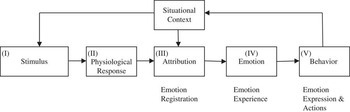
Researchers have suggested that when people see others facing hardship, it triggers an emotion event, which motivates individuals to care for those facing hardships (Goetz, Keltner, & Simon-Thomas, Reference Goetz, Keltner and Simon-Thomas2010). The idea that emotions drive prosocial behavior is not new. People generally tend to ‘devote much time and energy to helping others’ (Batson and Shaw, Reference Batson and Shaw1991: 107). Studies have shown that empathy and compassion play particularly important roles in motivating prosocial behavior (Mikulincer & Shaver, Reference Mikulincer and Shaver2010). Because of the strong link between compassion, empathy and helping behaviors (Eisenberg & Miller, Reference Eisenberg and Miller1987; Goetz, Keltner, & Simon-Thomas, Reference Goetz, Keltner and Simon-Thomas2010), the PMPB draws from process theories of emotions (Schachter & Singer, Reference Schachter and Singer1962; Schachter, Reference Schachter1964; Elfenbein, Reference Elfenbein2007) and related cognitive appraisal processes (Smith & Ellsworth, Reference Smith and Ellsworth1985; Ellsworth & Scherer, Reference Ellsworth and Scherer2003). Figure 1 provides an overview of Schachter’s (Reference Schachter1964) process theory of emotion, which provides a framework for the PMPB model.
Process model of emotion. Adapted from Schachter (Reference Schachter1964) and Elfenbein (Reference Elfenbein2007)

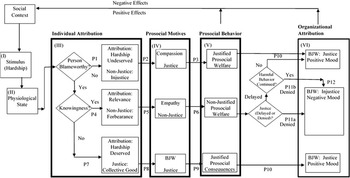
In their famous paper on emotion, Schachter and Singer (Reference Schachter and Singer1962) discussed the important role that situation and cognitive processes play in an emotion event (Ross & Nisbett, Reference Ross and Nisbett1991). Up until that time, emotion was seen as a physiological response to events in the external environment. Process theories recognize that in addition to the physiological reaction, individual cognition (i.e., attributions) provide additional, and necessary, information for individuals to accurately experience an emotion and identify the correct behavioral response (Elfenbein, Reference Elfenbein2007). Specific emotions cannot be determined by physiological responses alone since different emotions can be related to similar physiological reactions. For example, rapid heart rate and fast breathing may be related to anger caused by an insult directed at a person’s mother. The same physiological reaction may be related to the notice of an attractive member of the opposite sex (Ross & Nisbett, Reference Ross and Nisbett1991). Rapid heart rate and fast breathing are consistent with the anger emotion and the attraction emotion. It is when the individual cognitively attributes the rapid heart rate and fast breathing to a sequence of events within a certain situational context that an individual can accurately register the emotion experience (Ross & Nisbett, Reference Ross and Nisbett1991). Emotion events are thus given meaning through emotion–cognition interactions (Izard, Reference Izard2009), which motivate certain action tendencies (Elfenbein, Reference Elfenbein2007). The PMPB, which follows the same basic sequence as process theories of emotion, is illustrated in Figure 2.
Process model of prosocial behavior

The PMPB assumes a prosocial event begins with (I) a stimulus that involves hardship, suffering or need. When observed, this causes a physiological response (II) that calls a person’s attention to the suffering. People try to attribute the cause of the physiological response to a sequence of actions in order to give meaning to the physiological reaction. Researchers have referred to this cognitive appraisal process, in which the physiological response is linked to a cause, as emotional registration (Elfenbein, Reference Elfenbein2007). As part of the attribution process (III), certain judgments are made about the blameworthiness of the sufferer. These attributions determine the nature of the emotion event. Elfenbein (Reference Elfenbein2007) has labeled the stage when feelings begin to emerge, the emotional experience. During this stage, compassion and empathy are felt for those facing hardships or needing protection. The emotion that is experienced motivates the response based on each individual’s emotion schema (Izard, Reference Izard2009), which are the cognitive–emotion interactions that influence behaviors, or action tendencies (Elfenbein, Reference Elfenbein2007). In these situations, compassion and empathy are important determinants of the motivational tendencies (IV) of the person to engage in prosocial behaviors (V). Furthermore, Affective Events Theory (Weiss & Cropanzano, Reference Weiss and Cropanzano1996) indicates that emotion events can impact attitudes and behaviors at work suggesting that emotions can have organizational as well as individual effects (VI).
INDIVIDUAL ATTRIBUTION AND PROSOCIAL BEHAVIOR (III)
Attribution theory ‘examines phenomenal causality, or beliefs about why a particular event or outcome occurs’ (Rudolph, Roesch, Greitemeyer, & Weiner, Reference Rudolph, Roesch, Greitemeyer and Weiner2004: 816). In the case of prosocial behavior, this means attributing a cause to the suffering (e.g., is the suffering undeserved), and determining an appropriate response. Attribution theory is based on three tenets (Ross & Nisbett, Reference Ross and Nisbett1991). First, ‘people care less about what others do than why they do it’ (Gilbert & Malone, Reference Gilbert and Malone1995: 117). Second, when trying to understand why others do the things they do, people look to the character, personality traits and dispositions of others. Finally, when people make these construals, there is the inflated belief in the importance of traits and dispositions and a failure to recognize the importance of situational context (Ross & Nisbett, Reference Ross and Nisbett1991).
This error in attribution has been called the fundamental attribution error (FAE), which suggests that when making attributions about deservedness, people may tend to assume suffering is the result of character deficiency rather than the situation (Ross & Nisbett, Reference Ross and Nisbett1991). As a result, judgments about deservedness can play an important role in an emotion response. The following sections discuss the role of emotions and justice in the prosocial behavior process.
PROSOCIAL MOTIVES: ROLE OF EMOTIONS AND THE NEED FOR JUSTICE (IV)
While research in prosocial behavior has not typically considered the implications of deservedness, emotion research has suggested that blameworthiness has important implications for the emotion experience (Feather, McKee, & Bekker, Reference Feather, McKee and Bekker2011). Research has shown that deservedness is important when determining whether individuals feel compassion toward another’s suffering (Goetz, Keltner, & Simon-Thomas, Reference Goetz, Keltner and Simon-Thomas2010). The appraisal of blameworthiness involves judgments about whether the suffering is a result of the person’s character, the person failed to do all they could to avoid suffering, or the person violated norms, rules or laws, which brought about their suffering (Smith & Ellsworth, Reference Smith and Ellsworth1985; Goetz, Keltner, & Simon-Thomas, Reference Goetz, Keltner and Simon-Thomas2010). Because compassion requires judgment about blame and whether norms or rules have been violated, compassion also acts as a moral barometer (McCullough, Kilpatrick, Emmons, & Larson, Reference McCullough, Kilpatrick, Emmons and Larson2001). Compassion has been referred to as an internal arbiter of justice in terms of whether justified or unjustified harm has occurred (Vasquez, Keltner, Ebenbach, & Banaszynski, Reference Vasquez, Keltner, Ebenbach and Banaszynski2001; Haidt, Reference Haidt2003). This has led researchers to conclude that compassion acts as a ‘guardian’ of justice between deserved and undeserved suffering (Haidt, Reference Haidt2003; Goetz, Keltner, & Simon-Thomas, Reference Goetz, Keltner and Simon-Thomas2010).
The PMPB is unique in that the need for justice is identified as playing an important role in emotion registration and prosocial behavior. Researchers have shown that people have an inherent need for justice (Clark & Chrisman, Reference Clark and Chrisman1994; Lerner, Reference Lerner1996; Opotow, Reference Opotow1996). According to Lerner (Reference Lerner1977, Reference Lerner1980), people have a ‘need for justice, including the need to believe in a just world in which everybody gets what he or she deserves’ (Montada, Reference Montada2003: 537). Justice motive research suggests that perceptions about whether suffering is deserved can influence decisions to engage in prosocial behavior (Lerner, Reference Lerner1977, Reference Lerner1980). The need to see the world as just (Strelan & Sutton, Reference Strelan and Sutton2011) is referred to as the belief in a just world (BJW). Justice motive literature suggests that when BJW is violated, a certain level of cognitive dissonance is created (Strelan & McKee, Reference Strelan and McKee2014). When people see an injustice, they have a need to see justice restored in the real world. If this is not possible, they may compensate cognitively, by rationalizing, reinterpreting reality, or engaging in other coping mechanisms, in order to minimize the effects of the injustice (Montada, Reference Montada2003). Accordingly, when people see others engaged in antisocial behavior, they have a need to see those engaged in harmful behavior ‘suffer the consequences’ of their bad behavior (Strelan, Feather, & McKee, Reference Strelan, Feather and McKee2008). The following section introduces a definition of prosocial behavior, which accounts for the need for justice.
PROSOCIAL BEHAVIOR: EXPANDED DEFINITION (V)
Both justice motive and emotion literature suggest that people distinguish between undeserved and blameworthy suffering. Therefore, it is important to develop a definition of prosocial behavior that recognizes the role of deservedness when considering the effects of helping actions. In order to expand the discussion of prosocial behavior to include the implication of blameworthiness, two new terms are introduced: prosocial welfare and prosocial consequence. Helping actions that mitigate hardships or alleviate suffering are referred to as prosocial welfare. This aspect of prosocial behavior reflects a genuine concern for the welfare of others, especially when the hardship is perceived as undeserved. Prosocial welfare is focused on alleviating the undeserved suffering of others.
However, there are cases when people are responsible for their suffering. Individuals who engage in hurtful behavior, which causes harm to themselves, others or organizations often suffer the consequences of their antisocial behavior. A complete definition of prosocial behavior should also encompass actions that discourage these types of harmful, antisocial behaviors. This second aspect of prosocial behavior is termed prosocial consequence. The term prosocial consequence is used to describe actions that cause, enable or allow negative consequences, or hardship, in order to prevent or discourage future harmful, antisocial actions. These actions are prosocial in the sense that allowing the negative consequences of bad behavior to occur positively impacts organizations by discouraging future harmful and/or antisocial actions. At the individual level, prosocial consequence helps the person who has been harmed by satisfying their need for justice and holding the person who caused the harm accountable. At the collective level, society and organizations benefit because future harmful behaviors are discouraged. Actions that reflect prosocial consequence can range from passive, whereby negative consequences are allowed to continue, to active, whereby consequences are proactively adjudicated and purposely carried out. We suggest that prosocial behavior includes both prosocial welfare and prosocial consequence.
Introducing the concepts of emotion and the need for justice as antecedents to prosocial behavior adds additional dimensions to the discussion of prosocial behavior, which can at times seem contradictory. For example, people engage in helping behaviors toward those facing hardships even though those hardships are caused by harmful behaviors. The next section attempts to reconcile prosocial behavior and the need for justice.
RECONCILING PROSOCIAL BEHAVIOR AND THE NEED FOR JUSTICE
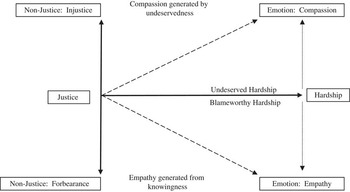
People want to help others, yet at the same time, they need to see justice done whether it is at the individual (Lerner, Reference Lerner1977) or organizational level (Colquitt, Conlon, Wesson, Porter, & Ng, Reference Colquitt, Conlon, Wesson, Porter and Ng2001). In order to reconcile the desire to help with a need for justice, two forms of non-justice are introduced into the model: injustice and forbearance (Sproul, Reference Sproul1986). The two forms of non-justice are shown on the vertical axis in Figure 3.
Effects of non-justice and hardship

Injustice, the ‘bad’ form of non-justice, occurs when someone is truly wronged. In the context of prosocial behavior, these people are suffering undeservedly. The other type of non-justice is forbearance – sometimes deemed ‘good’ non-justice – which is a form of forgiveness (Barnes, Carvallo, Brown, & Osterman, Reference Barnes, Carvallo, Brown and Osterman2010; Strelan et al., Reference Strelan, McKee, Calic, Cook and Shaw2013). An act of forbearance occurs when someone has violated conventions of interactions, norms, rules or laws, but is not subjected to consequences. Forbearance can occur when a person is blameworthy, but the person is forgiven and consequences mitigated. Forbearance can also occur when no immediate judgment is made about deservedness. Studies have linked forgiveness to altruism and prosocial behaviors (Eisenberg & Miller, Reference Eisenberg and Miller1987; McCullough, Worthington, & Rachal, Reference McCullough, Worthington and Rachal1997; Mikulincer & Shaver, Reference Mikulincer and Shaver2010).
PROSOCIAL BEHAVIOR: UNDESERVED SUFFERING, COMPASSION AND JUSTIFIED PROSOCIAL WELFARE
The top half of Figure 3 displays a compassion experience. The strength of a compassion experience is indicated by the arrow moving up and to the right. In general, the higher the degree of undeserved suffering (shown on the horizontal axis), the greater is the feeling of compassion. Compassion is conditional upon judgments about the deservedness of the suffering (Weiner, Reference Weiner1985; Feather, Reference Feather2006). The more suffering is perceived as undeserved (i.e., the greater the injustice done to the sufferer), the greater the feeling of compassion. On the other hand, if the suffering is perceived as deserved, feelings of compassion and the desire to engage in caring acts will decrease as a result of BJW. This is shown as a movement toward justice and down the compassion curve.
According to the PMPB, when individuals become aware, consciously or unconsciously, of a sequence of events in which hardship is present, it will cause a physiological reaction (i.e., an emotion event). Attribution theory suggests that people attempt to explain ‘why’ things are occurring. So rather than just respond to the suffering, individuals will make a judgment about the reason for the hardship. If people perceive that the hardship is undeserved, this will violate their need to see the world as fair (BJW). Because the hardship is unfair, they will perceive that an injustice has occurred:
Proposition 1: Individuals perceive an injustice has been done to the sufferer when a hardship is undeserved.
According to the need for justice, when individuals see an injustice, their BJW will motivate a response. In the case of undeserved suffering, it will generate a compassion response. The relationship between compassion and undeserved suffering has deep, historical roots. For example, ‘Aristotle argued that deserved suffering should lead to blame and reproach, whereas undeserved suffering should elicit compassion’ (Goetz, Keltner, & Simon-Thomas, Reference Goetz, Keltner and Simon-Thomas2010: 357). Recent research has described compassion as a distinct, other-oriented emotion, which focuses attention on the plight and suffering of others (Goetz, Keltner, & Simon-Thomas, Reference Goetz, Keltner and Simon-Thomas2010). One specific area of distinctiveness is the relationship between compassion and undeserved suffering (Smith & Ellsworth, Reference Smith and Ellsworth1985; Haidt, Reference Haidt2003):
Proposition 2: Perceptions of injustice engender feelings of compassion toward the sufferer.
Compassion has been shown to be a particularly important proximal determinant of prosocial behavior (Hoffman, Reference Hoffman1981; Goetz, Keltner, & Simon-Thomas, Reference Goetz, Keltner and Simon-Thomas2010). It is more than a feeling that reflects a concern for the well-being of others, compassion is also a motivator of caring actions (Sprecher & Fehr, Reference Sprecher and Fehr2005). In this context, caring means to look out for, to make provision or to be concerned for another person, to provide for the protection and welfare of others for their sake (Batson, Reference Batson1990). Therefore in cases of injustice, compassion motivates protective and helpful behavior. When another is suffering undeservedly, prosocial welfare is justified in the sense that the prosocial behavior is helping to right a perceived injustice (or unfairness) leading to justified prosocial welfare:
Proposition 3: Feelings of compassion lead to justified acts of prosocial welfare.
PROSOCIAL BEHAVIOR: BLAMEWORTHY SUFFERING, EMPATHY AND NON-JUSTIFIED PROSOCIAL WELFARE
In order to reconcile the fact that caring actions occur even when blame has been attributed to the suffering person, the emotional experience of empathy is introduced into the model. Empathy ‘refers to the attempt by one self-aware self to comprehend unjudgmentally the positive and negative experience of another self’ (Wispe, Reference Wispe1986: 318). It has been linked to altruistic acts (Dovidio, Reference Dovidio1991), which have the ultimate goal of helping others out of a genuine concern for their welfare (Dovidio, Allen, & Schroeder, Reference Dovidio, Allen and Schroeder1990). The effects of empathy are shown on the bottom half of Figure 3 by an arrow moving down and to the right. The greater the amount of blameworthy suffering that occurs, the greater the level of empathy required in order for caring acts to occur. As empathy increases, the caregiver takes the perspective of the sufferer (Hoffman, Reference Hoffman2008), suspends judgment, and is motivated to provide relief to the sufferer. The act of perspective taking enables individuals to behave altruistically and avoid the cognitive dissonance caused by the violation of the BJW motive. Minimizing the cognitive dissonance created by BJW makes it easier to forebear the need for justice and engage in helping acts towards a blameworthy sufferer (Strelan & McKee, Reference Strelan and McKee2014). This may mean consequences are only temporarily suspended or may require actions on the part of the sufferer to justify the care. When individuals do not suspend judgment, the justice motive will move them back along the empathy curve toward ‘justice’ in order to satisfy their BJW.
Empathy is more likely to occur when people have a personal knowledge of the other individual or an understanding of the situation (i.e., knowingness). An example of this can be seen in Steve Jobs’ willingness to help Larry Page, co-founder of Google, one of Apple’s biggest competitors. Jobs was very sick with cancer and Page had asked to see him to get tips on how to be a good CEO. Even though Jobs was furious at Google, ‘he (Jobs) recounted. “But then I thought about it and realized that everybody helped me when I was young, from Bill Hewlett to the guy down the block who worked for HP. So I called him back and said sure.” Page came over’ (Isaacson, Reference Isaacson2011: 552). Jobs was willing to forebear his need for justice (his belief that Google’s competitive actions were sometimes less than honorable) because he knew Page personally, and he knew, based on his own experience, Page’s situation.
This level of knowingness allows individuals to more readily comprehend the experience of the other person and generally takes one of two forms. First, the person may literally know the other person. Attribution theory suggests that when trying to understand why events occur, people make inferences about the character, motives and dispositions of others. When people know the other person, those inferences are made based upon the knowledge the person has about the sufferer. It is generally easier to avoid the effects of the FAE and forebear judgment about the sufferer when the person is known, especially those that are close (Rusbult & Agnew, Reference Rusbult and Agnew2010). The second form of knowingness occurs when the person can relate to the situation of the sufferer (Pavey, Greitemeyer, & Sparks, Reference Pavey, Greitemeyer and Sparks2011). This can best be described by using a variant of the exclamation made by the Protestant martyr John Bradford (circa 1554) as he watched a fellow inmate being marched to the gallows, ‘There, but for the grace of God, go I.’ For example, Hillary Clinton paraphrased Bradford in her 1994 commencement speech at the University of Illinois as she was describing the need for Universal Health Care. In the speech, she encouraged those with health care to see themselves in the situation of those without health care (Clinton, Reference Clinton2003).
According to the FAE, individuals place more importance on character inferences than on the situation. However, in the case of situational knowingness, perspective taking increases the awareness of situational effects, thereby mitigating the effects of the FAE and making it easier to forebear judgments about the sufferer:
Proposition 4: When a sufferer is blameworthy, individuals forebear the need for justice when knowingness exists.
While compassion and empathy are similar in that they motivate prosocial behavior, they are two distinct emotions (Hoffman, Reference Hoffman1981; Wispe, Reference Wispe1986; Batson & Oleson, Reference Batson and Oleson1991). For compassion, caring actions are conditional on the suffering being undeserved. Hence, deserved suffering does not engender a compassion experience. Unlike compassion, empathy does not require an assumption about deservedness in order to motivate caring action (Wispe, Reference Wispe1986). For empathy, knowingness mitigates the need for justice. Specifically, the sufferer, the situation or the emotional state of the sufferer is known (Wispe, Reference Wispe1986; Batson, Reference Batson1990). This knowingness leads to feelings of empathy:
Proposition 5: Knowingness engenders feelings of empathy toward the sufferer.
A number of studies have linked empathy to prosocial behaviors such as caring and helping (Eisenberg & Miller, Reference Eisenberg and Miller1987; Batson, Reference Batson1990; Batson & Oleson, Reference Batson and Oleson1991; Batson & Shaw, Reference Batson and Shaw1991; McCullough, Worthington, & Rachal, Reference McCullough, Worthington and Rachal1997). Because feelings of empathy do not assume judgments about deservedness, empathy can motivate prosocial actions even though the sufferer is blameworthy. Since knowingness can lead to the mitigation of negative consequences, even in situations where the sufferer’s actions have been harmful, justice is delayed or denied. In these cases, forbearance is a form of non-justice. As such, empathy can lead to prosocial welfare irrespective of the need for justice:
Proposition 6: Feelings of empathy lead to acts of non-justified prosocial welfare.
Prosocial Behavior: The Need for Justice and Justified Prosocial Consequences
When the sufferer is blameworthy and knowingness does not exist, neither compassion nor empathy will motivate prosocial welfare as the emotive motivation is neutralized. Without the effects of compassion or empathy, an individual’s need for justice focuses attention on the values of the collective (Lerner, Reference Lerner1980), and motivation shifts from the needs of the individual to a collective duty to ensure justice (i.e., justice motive). When the sufferer is blameworthy for their hardships, especially when their actions have harmed other individuals or the organization, the need for justice drives actions aimed at protecting or enhancing the welfare of others individually and collectively:
Proposition 7: In the event the sufferer is blameworthy and the actor lacks knowingness, the need for justice motivates action.
Due to the need for justice, there is a belief (BJW) that in order to discourage the negative behaviors that caused the consequential suffering, helping actions should not alleviate the suffering. The negative consequences associated with blameworthy suffering act to discourage future harmful, antisocial acts. Additionally, blameworthy suffering satisfies the need for justice. In order to protect others and the organization, BJW would require that the sufferer be subject to the negative consequence resulting from their actions:
Proposition 8: When hardship is deserved, the BJW requires justice is done.
In order to prevent antisocial actions from occurring, prosocial behavior would include actions that discourage the harmful behavior. In these cases, a response consistent with the need for justice would be to allow prosocial consequences. In other words, the individual should suffer the effects of their negative behavior. Should the blameworthy sufferer receive help, it would violate the need for justice. As a result, helping actions that mitigate the consequences of negative behavior would not only violate the need for justice, but would also put individuals and the organization, as well as its culture, at risk. When the sufferer is blameworthy, the justice motive suggests that prosocial consequences are justified:
Proposition 9: BJW requires prosocial consequence.
ORGANIZATIONAL ATTRIBUTION AND PROSOCIAL BEHAVIOR (VI)
Affective Events Theory suggests that emotion experiences (e.g., compassion and empathy) in organizational members affect their attitudes and behaviors (Weiss & Cropanzano, Reference Weiss and Cropanzano1996; Ashton-James & Ashkanasy, Reference Ashton-James and Ashkanasy2008). Similar findings from emotional contagion research (Barsade, Reference Barsade2002) suggest that affective events can have group and organizational level consequences as well. However, the emotion event and each of the three types of prosocial behavior can have different implications for the organization. For example, in instances of non-justified prosocial welfare feelings of empathy and altruistic actions can have a positive impact on an organization particularly when blameworthy sufferers are required to change their behavior. In the case of justified prosocial welfare, prosocial behavior can positively affect group interaction and the organization. In many of these type cases, both the helper and the helped achieve positive outcomes (Weinstein & Ryan, Reference Weinstein and Ryan2010). Those helped realize improved situations when their suffering is alleviated by the helpers. Moreover, the helper’s desire to help is satisfied by engaging in helping actions (Aknin et al., Reference Aknin, Barrington-Leigh, Dunn, Helliwell, Burns, Biswas-Diener, Kemeza, Nyende, Ashton-James and Norton2013). Furthermore, when individuals engage in altruistic actions, it can often lead to positive feelings about themselves and from others. For example, compassion has been found to be a positive trait in cooperative relations among individuals in organizations (Goetz, Keltner, & Simon-Thomas, Reference Goetz, Keltner and Simon-Thomas2010). Similarly, justified prosocial consequence can lead to positive organizational outcomes in at least two ways. First, antisocial behavior is discouraged when people understand that harmful behavior will have assured and predictable negative consequences. As a result, individuals and organizations are less likely to experience the negative fallout that results from antisocial behavior. This is especially true when prosocial consequences break a sequence of harmful behaviors. Second, individuals are advantaged because the need for justice is satisfied (Montada, Reference Montada1994).
When individual situations are improved by prosocial behavior or harmful behavior is discouraged or changed, organizations can realize tangible positive benefits from non-justified prosocial welfare, justified prosocial welfare and justified prosocial consequences. This can be especially important in situations where organizational culture – shared beliefs, norms, and values of organizational members (Schein, Reference Schein1990) – play a role in shaping behavior. Furthermore, justice motive research suggests that justified prosocial welfare and justified prosocial consequences should have positive organizational effects (Montada, Reference Montada2003):
Proposition 10: Justified prosocial welfare, justified prosocial consequence, and non-justified prosocial welfare, when harmful behavior is changed, can have positive effects on the social context of the organization.
As events related to prosocial behavior occur, individual perceptions about fairness could lead to collective shift in perceptions about the justness of the organization. Feelings of injustice can give rise to negative perceptions of the organization. Organizational justice literature (Colquitt et al., Reference Colquitt, Conlon, Wesson, Porter and Ng2001) discusses three types of justice: procedural, distributive and interactional (Greenberg & Folger, Reference Greenberg and Folger1983; Grote & Clark, Reference Grote and Clark1998). Procedural justice refers to the idea that employees perceive organizations as just when the outcomes of decision makers are fair and the process used to determine the outcomes are perceived as fair. The key elements of procedural justice are the process used to make decisions, who was involved in making the decisions and the explanation of the decisions made (Leventhal, Reference Leventhal1980). Interactional justice suggests that employees will perceive that they are treated unfairly if their concerns are not taken into account or they feel they are not treated with dignity or respect (Cropanzano, Prehar, & Chen, Reference Cropanzano, Prehar and Chen2002; Roch & Shanock, Reference Roch and Shanock2006). Perceptions of injustice are most strong when people feel that procedural and interactional justice have impacted the amount and allocation of resources. This is referred to as distributive justice (Colquitt et al., Reference Colquitt, Conlon, Wesson, Porter and Ng2001).
While researchers have identified three different types of organizational justice, each may operate differently depending on the situation or context. In the case of non-justified prosocial welfare, reactions within the organization will depend on the nature or perception of the forbearance. In addition to the helper and the helped, third parties can be affected by non-justified prosocial welfare. For example, mitigating the consequences of harmful behavior can make the harmful behavior more likely to reoccur causing third parties to feel at risk. This can lead to judgments about the fairness of non-justified prosocial welfare. If third parties feel their concerns are not taken into account or the outcomes of decision makers are unfair, it can lead to perceived violations of interactional and procedural justice, which can cause negative perceptions of organizational justice. In these cases, justice can be perceived as either denied or delayed. When the negative consequences of harmful behavior are eliminated undeservedly, justice is denied. However, third parties may also be willing to delay judgment and wait to see whether the blameworthy sufferer changes the behavior that led to the negative consequences. If the harmful behavior continues, justice will be perceived as denied. Perceptions of non-justice can lead to feelings of organizational injustice, which can cause feelings of resentment (Montada, Reference Montada2003), bitterness (Montada, Reference Montada1994) and hostility (Montada & Kirchhoff, Reference Montada and Kirchhoff2000):
Proposition 11: Violations of individual justice lead to a collective sense of the fairness of the organization and perceptions of organizational injustice.
Proposition 11a: Perceptions of non-justice lead to feelings of injustice when justice is perceived as justice denied.
Proposition 11b: Individuals willing to suspend judgment experience feelings of injustice when the harmful behavior that led to negative consequences continues.
Violations of organizational justice can affect employee and organizational outcomes. For example, all three forms of organizational justice are positively correlated to organizational commitment and organizational citizenship behavior (Cohen-Charash & Spector, Reference Cohen-Charash and Spector2001; Colquitt et al., Reference Colquitt, Conlon, Wesson, Porter and Ng2001). Procedural justice has been shown to affect job satisfaction, employee trust, job performance and citizenship behaviors (Colquitt et al., Reference Colquitt, Conlon, Wesson, Porter and Ng2001). Distributive justice has been shown to affect organizational commitment and satisfaction with the allocation of organizational resources (Colquitt et al., Reference Colquitt, Conlon, Wesson, Porter and Ng2001). Perceived violations of procedural and interactional justice at the individual level can affect the collective sense of justice at the organizational level whereby injustice is attributed to the organization (Latham & Pinder, Reference Latham and Pinder2005). For example in his book, ‘Straight from the Gut,’ Jack Welch, former CEO and Chairman of the Board of General Electric (GE), discussed the significant change that he led during the early 1980s. Because of his decisions, 118,000 employees were forced to leave GE from layoffs or businesses being sold or closed. This led to ‘the moniker, “Neutron Jack” the guy who removed people but left the buildings standing’ (Welch & Byrne, Reference Welch and Byrne2001: 125). The nickname Neutron Jack personified the perceived lack of procedural justice. During this same time, GE was building guest houses and fitness clubs for the remaining employees. The juxtaposition of forced exits and building guest houses led to perceived violations of distributive justice. The perceived violations of procedural and distributive justice negatively affected the work environment at GE. The atmosphere was so negative, Welch referred to this period as the neutron years (Welch & Byrne, Reference Welch and Byrne2001). This example is consistent with Affective Events Theory, which suggests that a collective sense of organizational injustice will negatively affect the social context in which future actions occur:
Proposition 12: Negative perceptions of organizational justice negatively impact the social context of the organization and affect organizational and individual outcomes.
DISCUSSION
Drawing on attribution, emotion and justice motive literature, the PMPB was introduced. One interesting suggestion is that in certain situations prosocial behavior can have negative consequences. This idea can have important theoretical and practical implications.
THEORETICAL IMPLICATIONS
This paper has a number of theoretical implications. First, the discussion of prosocial behavior was expanded to include situations in which prosocial behavior might have potential negative implications for groups and organizations. This is particularly important with regards to the distinction between blameworthy and undeserved suffering. This paper expands the discussion of prosocial behavior to look at the different effects of helping actions when hardship and suffering is undeserved as compared with the effects of helping actions when the sufferer is blameworthy for their suffering.
The second implication, also related to blameworthiness, is the inclusion of the need for justice into the model. Specifically, the PMPB expressly adds a justice motive dimension to the discussion of the effects of emotion and the need for justice as antecedents to prosocial behavior. Adding the justice motive to the discussion of prosocial behavior also enabled a more expansive understanding of the effects of prosocial behavior. As part of the discussion, two forms of non-justice were introduced into the model: injustice and forbearance.
The third theoretical implication is related to expanding the discussion of prosocial behavior to include the effects of the need for justice and the implications of blameworthiness, which included the introduction of two new constructs: prosocial welfare and prosocial consequence. The conceptualization of prosocial behavior consisting of two components explicitly recognizes that it is prosocial when individuals and organizations are made better off when consequential outcomes discourage antisocial behavior.
Fourth, and finally, the potential multi-level effects through the inclusion of Affective Events Theory were discussed. The discussion of the effects and implications of prosocial behavior was expanded from an individual-level discussion to the organizational level through the need for justice construct. Typical prosocial behavior research has been focused on the effects of prosocial behavior on the helper and/or the helped. The PMPB suggests that third party individuals, and organizations, can also be affected by non-justice, especially if the perception is that justice has been denied and has put employees and the organization at risk. This expressly brings the discussion of prosocial behavior into organizational justice research.
PRACTICAL IMPLICATIONS
This paper has a number of implications for managers. First, when managers attempt to engage in prosocial behavior, they need to be aware that helping actions can have different implications depending on whether the help is aimed at ameliorating the effects of blameworthy or undeserved hardships. If the help is aimed at ameliorating the effects of undeserved hardships, the effects can be positive. For example, when corporations give to charities that assist people who suffer through no fault of their own, the giving is consistent with the feelings of compassion and justified prosocial welfare. On the other hand, when corporations choose to give to causes in which the people helped are facing hardships caused by their own actions, and the corporation does not engender knowingness, BJW will not be suspended, which may bring about all the negative ramifications associated with denied justice individually and collectively.
Second, managers may need to consider developing different methods of evaluating performance, which should include cognitive and organizational processes that expressly recognize the effects of the FAE, especially as it relates to the effects of prosocial behavior. Furthermore, managers might also consider that by allowing negative behaviors to go unaddressed (i.e., non-justified prosocial welfare), they open a clear avenue for peers and subordinates to make negative attributions towards the organization. An example of this might relate to how managers handle employees who do not meet quality or quantity standards of work or violate behavioral norms. In the name of forgiveness or understanding (or ‘prosocial’ action), managers may choose not to hold the employee accountable. The PMPB would suggest that this may not be the most productive course of action. While the helper (the company) and the helped may perceive they are better off, other employees might recognize the risk to the organization associated with the harmful behavior continuing as well as their sense of BJW being violated. According to the PMPB, this can have negative implications for employees and the organization.
Third, many organizations strongly encourage prosocial behaviors overall. While this may be positive across many aspects of organizational life, it is possible that negative outcomes can occur for both individuals and organizations when appropriate consequences for harmful actions are delayed or denied. For example, the prosocial consequence construct recognizes that when individuals engage in antisocial acts there are often negative consequences to the person engaged in the harmful acts. Helping actions which alleviate the hardship and suffering caused by the negative consequences can have implications for the organization. First, helping actions, which mitigate the effects of blameworthy suffering, increase the likelihood that harmful antisocial acts will be repeated putting employees and the organization at greater risk. Second, helping actions, which mitigate blameworthy suffering, violate the inherent need for justice and BJW. The prosocial consequence concept suggests that not mitigating the effects of the hardship is prosocial since the suffering will prevent the harmful, antisocial actions from occurring in the future as well as satisfy the need for BJW. Thereby choosing prosocial consequence, over ‘helping actions’ aimed at mitigating blameworthy suffering, increases the feelings of a just organization and may increase affective commitment to the organization.
FUTURE DIRECTIONS
In addition to developing laboratory and field experiments to test the propositions offered in this paper (cf. Zhang & Epley, Reference Zhang and Epley2009; Gneezy, Imas, Brown, Nelson, & Norton, Reference Gneezy, Imas, Brown, Nelson and Norton2012), other areas related to the PMPB might be addressed. For example, this paper has mostly focused on situations in which prosocial behavior is influenced by other-focused emotions (compassion and empathy) or situations influenced by the justice motive. However, there may be situations in which prosocial acts are motivated by self-interest or a need for self-realization. An example of how the need for self-realization might affect prosocial acts is costly prosocial behavior (Gneezy et al., Reference Gneezy, Imas, Brown, Nelson and Norton2012), which are actions that benefit others and involve some cost to the helper, usually a contribution of time or money (Lui & Aaker, Reference Lui and Aaker2008). Drawing on self-perception theory (Bem, Reference Bem1972), Gneezy et al. (Reference Gneezy, Imas, Brown, Nelson and Norton2012) suggested that when prosocial behavior is costly it is a signal of a person’s self-perception of prosociality. Using laboratory and field experiments, they were able to show that costly prosocial behavior signals a prosocial identity. Furthermore, individuals act consistent with that self-perception. In these situations, individuals engage in helping actions as a form of prosocial self-realization. Future research might focus on what motivates an individual to desire a ‘prosocial identity.’ It is important to understand these type situations as they might suggest that the attribution process of the PMPB be expanded to include how individuals view themselves, as well as how they view the situation, when engaging in prosocial behavior. For example, the need for a prosocial identity may be motivated by an individual’s desire to see themselves as compassionate or empathetic toward others. This might suggest that situation and attribution play a more comprehensive role than suggested by the PMPB in the prosocial behavior process. Future research might examine the interaction of situation and attribution when ‘self’ is given cognitive primacy.
When considering self-interested prosocial behavior, future research might also include areas such as prosocial reciprocity and impression management. Prosocial reciprocity is the idea that in equitable social relationships prosocial favors require some formal in-kind reciprocity (Zhang & Epley, Reference Zhang and Epley2009). For example, using the idea of norm of reciprocity (Cialdini, Reference Cialdini2000), Zhang and Epley (Reference Zhang and Epley2009) examined how prosocial costs (Lui & Aaker, Reference Lui and Aaker2008) affect perceptions about future prosocial behavior. They found that givers focused more on the costs of extending prosocial behavior; whereas, receivers focused more on the benefits received. As such, in some instances individuals may engage in helping actions as a form of ‘self-centered social exchange’ expecting to be reciprocated on the basis of cost incurred. Another area of research related to self-interested prosocial behavior may be impression management. Specifically, ‘how impression concerns may motivate citizenship behavior’ (Bolino, Reference Bolino1999: 82). Researchers have found that in some situations individuals engage in citizenship behavior in organizations as a way to enhance their image (Yun, Takeuchi, & Liu, Reference Yun, Takeuchi and Liu2007). In these instances, the motivation to engage in prosocial behaviors is a self-serving focus on impression enhancement. It may be important to examine helping actions motivated by self-interest because they suggest situations in which helping acts might not be considered ‘prosocial’ because there is no social aspect to the actions since the focus is on self and not necessarily helping others.
Using laboratory and field experimental studies, future research might examine how self-focused prosocial behavior (e.g., actions based on self-interest or self-realization) might be explained by the PMPB. For example, self-focused prosocial behavior might be examined in the context of non-justified prosocial welfare. The concept of knowingness might be expanded from knowing others to include knowing self. The prosocial behavior is non-justified in the sense that the helping actions occur without the immediate consideration as to the deservedness of the person being helped. This is important since it might directly expand the applicability of the PMPB to include the effects of ‘self’ when examining the implications of prosocial behaviors. On the other hand, self-focused prosocial behavior may suggest potential boundary conditions around the PMPB model.
CONCLUSION
Literature on the effects of prosocial behavior has mostly discussed the positive effects of prosocial behavior for individuals and organizations. There has been relatively little discussion regarding situations in which prosocial behavior might have negative implications. In order to expand the discussion of the effects of prosocial behavior, insights from emotion and justice motive literature and organizational justice theory were combined with research from attribution theory to introduce the PMPB. This model accounts for the effects of emotion and the need for justice on decisions to engage in prosocial actions. In order to account for these effects, it was important to distinguish between blameworthy and undeserved suffering. An expanded definition of prosocial behavior was offered that included the constructs prosocial welfare and prosocial consequence. Three emotion-related motives for prosocial behavior in organizations were discussed and three types of concomitant prosocial behaviors identified. In addition to individual-level discussions, the effects of prosocial welfare and prosocial consequences on organizational outcomes were also discussed. Finally, the theoretical and practical implications for the model were discussed as well as future directions.
Acknowledgement
We would like to thank the anonymous reviewers from JMO for their outstanding comments and suggestions. We would also like to thank Dr. Yuka Fujimoto, Associate Editor JMO, for her helpful comments and guidance.