Introduction
Because of the huge stress imposed by population growth and the understanding of the potential crisis that would be created by a ‘population bomb’ (Hardin, Reference Hardin1968; Greep, Reference Greep1998), China launched a rigorous family planning policy in the 1970s. This structure provides community-based contraceptive delivery services and planned parenthood information, combined with education and motivation activities. Abortion was also made available free of charge, and some doctors serving isolated communities were trained in the necessary techniques (Feng, Reference Feng2004; Liu & Diamond, Reference Liu and Diamond2005). As a result of this policy, China's population growth rate fell to less than 1% per year (China Statistics Bureau, 2006). China's fertility rate in 2003 (1.35 births per woman) and population growth rate in 2003 (0.07%) were the fourth-lowest among fifteen major countries (Cao & Wang, Reference Cao and Wang2009). Since 1978, China's society has changed rapidly because of the country's economic reforms. Public attitudes and values have also changed significantly during this period, leading to increased concern over the one-child aspect of the family planning policy, and this change will have important implications for planners and managers both in China and (because of China's huge population) around the world.
The context of population change must therefore be examined, and understanding the specific relationships between demographics and development requires that researchers examine more than just economic indicators (Sachs, Reference Sachs2002). Unfortunately, there has been insufficient discussion of the policy implications of these relationships. The fertility rate is a function of many factors, including the mother's education, empowerment and labour market opportunities; the availability of contraceptives and of family planning assistance; child mortality rates; and urbanization (Lutz et al., Reference Lutz, Sanderson and Scherbov2001, Wilson Reference Wilson2004). Thus, the interactions among policy options designed to reduce fertility rates and enhance economic development should receive more attention. Although the best mix of policy choices will differ among cultures, the experiences of many countries suggest that a combined emphasis on education of women, female empowerment, market-based reforms and increased access of the poor to primary health care and family planning services can be a powerful and effective package (Ehrlich, Reference Ehrlich2001; Cao et al., Reference Cao, Chen and Liu2009). China offers a useful case study of how government policy affects and is affected by the attitudes of those who are targeted by the policy because high-quality data are maintained on births: government policy requires the maintenance of records of every individual.
With this understanding in mind, in this study a questionnaire was designed to explore Chinese women's attitudes towards childbearing and 4600 women were surveyed from nineteen Chinese provinces in July 2005. The survey findings were used to investigate the relationships between a woman's attitudes towards the desired number of children and the government's family planning policy and her net income, age, education, job and location (urban vs rural). By comparing their attitudes with these demographic factors, is was aimed to expose the complexity and diversity of women's attitudes and the implications for China's future population decline. Based on these relationships, the risks related to the predicted population decline were examine and policy modifications designed to alleviate these risks proposed.
Methods
The survey investigated how responses to China's family planning policy were related to demographic factors (the respondent's age, income, education, location [rural or several urban categories] and employment). To meet this objective, a pre-questionnaire was used to design a questionnaire that would determine the attitudes of Chinese women toward childbearing and allow the impacts of these attitudes on China's future population to be discussed. According to the population of each respondent's community, the respondents were divided into six categories: rural (<10,000) and urban (10 to 200 thousand, defined as a town; 200 to 500 thousand, city; 500 thousand to 1 million, big city; 1 to 5 million, huge city; and >5 million, super city). To ensure that each of these categories was adequately represented in the sample, at least three communities were included in each category, but not more than 50. This sampling was performed by randomly selecting communities in each category from nineteen of China's 31 provinces and autonomous regions in July 2005, for a total of three super cities, four huge cities, five big cities, ten cities, 20 towns and 50 villages. These samples were obtained from the following provinces or autonomous regions: Liaoning, Shanxi, Henan, Jiangxi, Hubei, Beijing, Gansu, Guizhou, Inner Mongolia, Chunqing, Sichuan, Shandong, Fujian, Jiangsu, Guangdong, Guangxi, Zhejiang, Tianjing and Shanghai. A total of 5000 respondents were selected pseudo-randomly based on a single initial discriminatory factor: that they must be married and older than 20 years (the age that defines an ‘adult’ in China). In each community, two blocks of homes were randomly selected. An adult woman was contacted in each household in each of these two blocks when there were fewer than 125 households, versus 125 randomly selected adults in each block when there were more than 125 households per block.
Because the objective was to analyse the demographic factors that affected women's attitudes towards childbearing and China's population policy, the focus was on adult married women of childbearing age as well as older women who had undergone menopause. The latter group was included to explore whether there was a difference in attitudes between women who still had an opportunity to have children, but might not yet have raised children, and those who were no longer able to have children but had actually experienced childbirth and raised children. (These differences are explored in the sections where results for the different age cohorts in this study are reported.) Questionnaires were individually delivered to respondents by a team of 31 students who had been trained in the survey methodology at the China Agriculture University. At each residence, the purpose of the survey was explained to all adult women in the household and the woman responsible for managing the household was investigated individually. Because the respondent's anonymity was preserved in the survey, and the respondent could be convinced of the importance of participating in the survey and was given an opportunity to ask questions or express concerns, these methods greatly increased the response rates. Unfortunately, three students were unable to finish their survey work because they became ill during the work. Therefore, a total of only 4600 responses were obtained. To facilitate the data analysis, only one response to each question was permitted, and surveys with missing responses or more than one response to a question were excluded from the analysis. After excluding erroneous responses (including the selection of more than one response to a question, the omission of one or more responses and refusals to participate), 4208 valid responses were obtained (i.e. n=4208 interviewees) for a response rate of 91.5%.
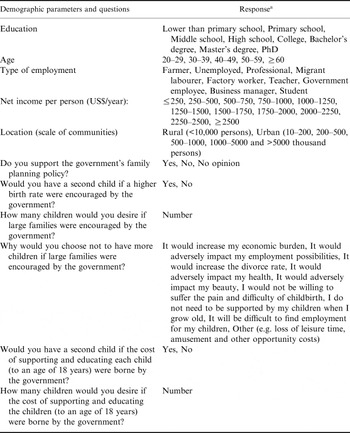
Based on the results of the survey, common themes and differences in attitudes towards childbearing were identified and how these trends were related to a woman's net income, age, education, employment and location (urban vs rural) analysed. There was an attempted to identify any discrepancies between an individual's behaviour and their stated support for policies designed to control population growth. To reduce any pressure that respondents might feel to state support for official policies, the anonymity of all participants was protected. The survey asked whether the respondent supported China's family planning policy, whether they would have an additional child if the government encouraged a higher birth rate and if the cost of supporting and educating each child (to an age of 18 years) were borne by the government, how many children they would have if they answered ‘yes’ (i.e. were willing to have more than one child), and why they might refuse to have more children even if the government encouraged and supported larger families. A complete listing of the survey questions is presented in Table 1.
Questionnaire to investigate the attitudes of women toward childbearing

a Only one answer is permitted per question. To facilitate the analysis, surveys were eliminated where the respondent provided more than one response to a question or did not respond to one or more questions.
Note: In 2005, US$1 was worth approximately 8.27RMB. The currency conversion rate was fixed by the Chinese government and did not change during the study period.
The SPSS software was used (SPSS Inc., Chicago, IL, USA) for statistical analyses. To support the conclusions, the values for each pair of categories for a demographic parameter were compared (e.g. between two age or income groups) to determine whether the pairs differed significantly. Levels of significance were tested using the t-test (p<0.05) to compare the results for the different categories. Bivariate correlation was carried out using the SPSS software (F test, p<0.05) to identify any interaction between the categories for a given demographic parameter (e.g. age, education) and the responses to a given question. To make the results more representative of the actual age structure of China, statistical data (China Statistics Bureau, 2006) from 2005 were used to create age-adjusted regression models and these adjusted values were used in the bivariate analysis.
Results
Childbearing preferences in different demographic categories
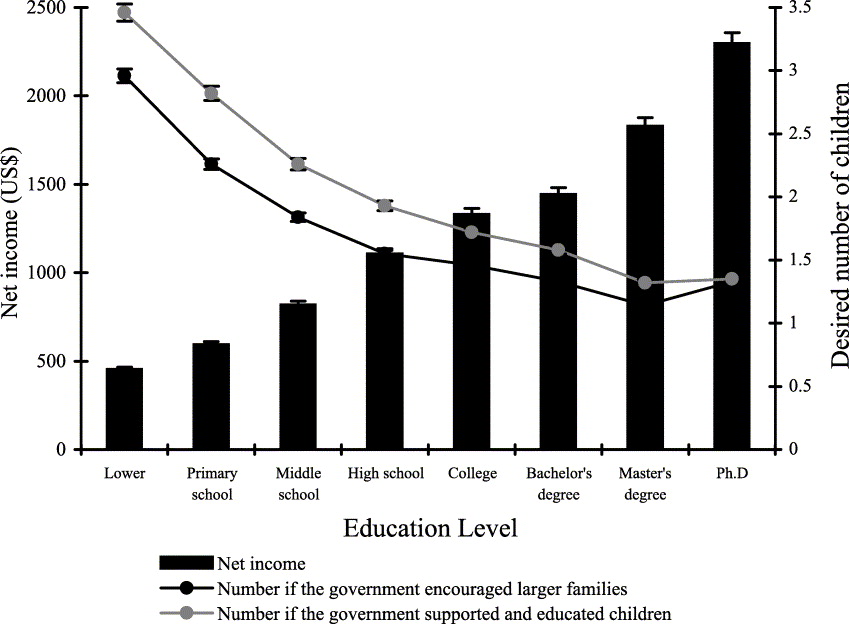
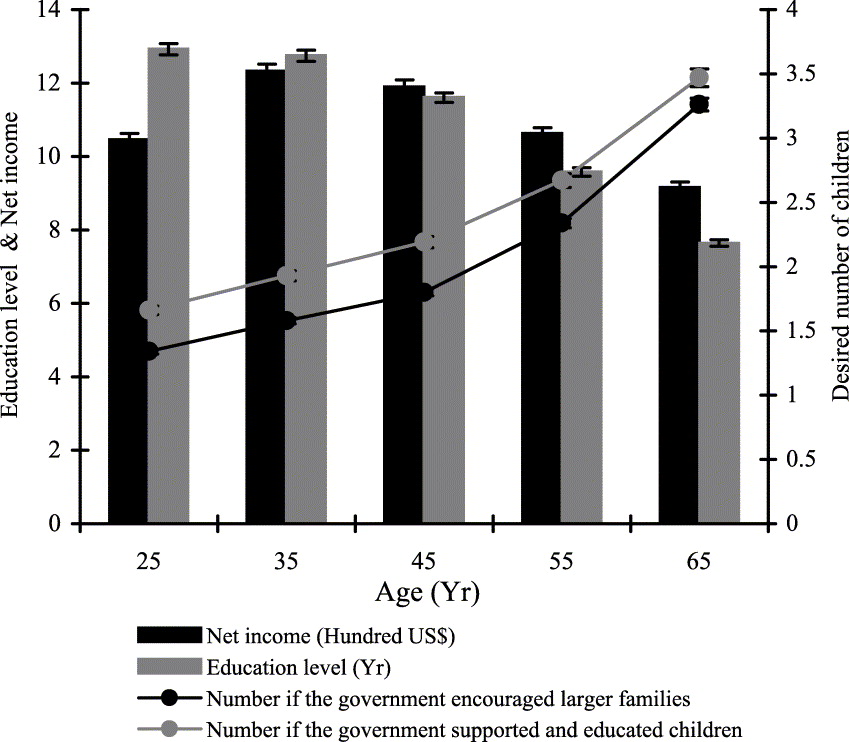
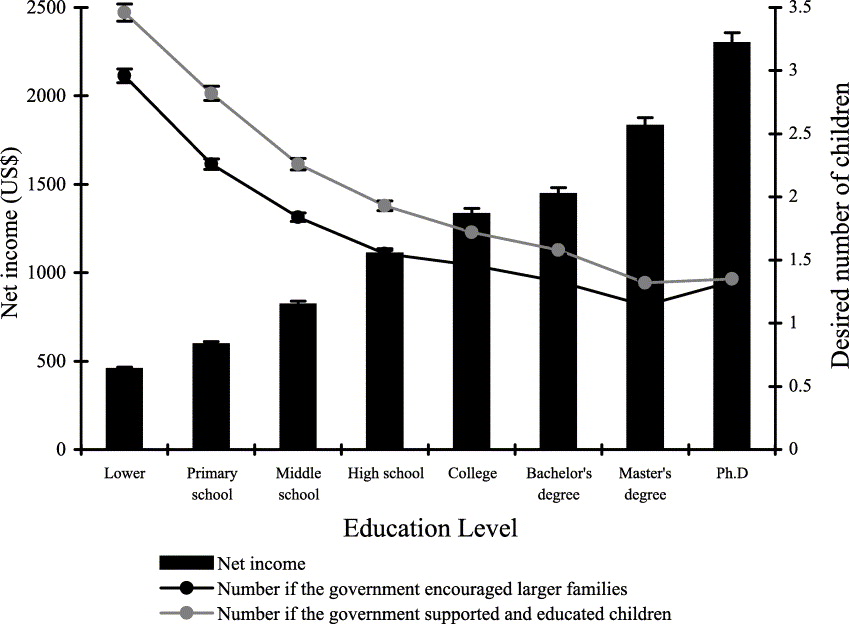
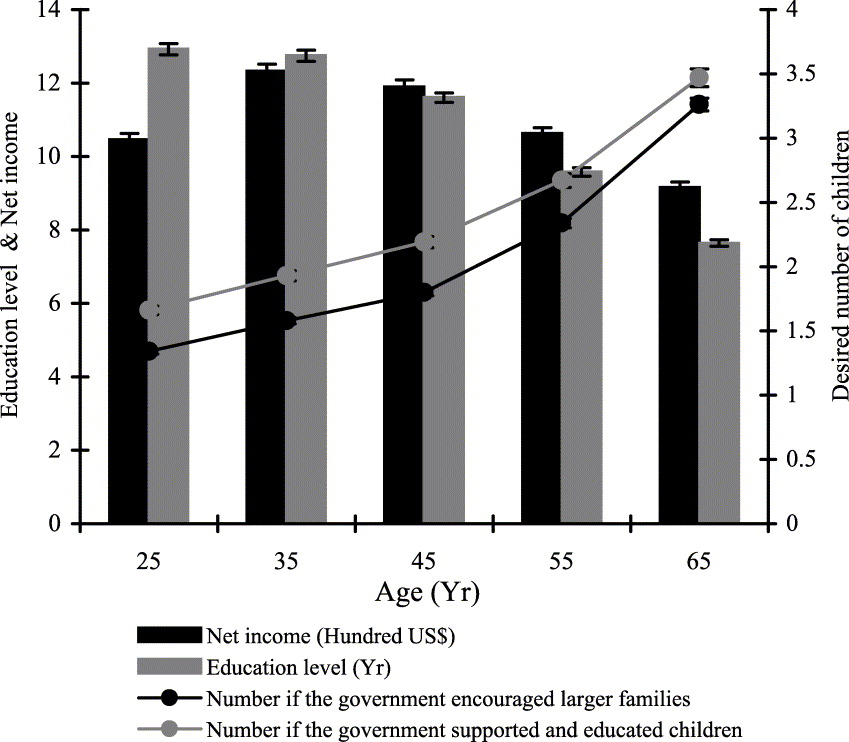
The number of children that women were willing to have increased with decreasing income (p<0.001; Fig. 1). The desired number of children decreased strongly with increasing education level (p<0.001; Fig. 2). The results indicated that women would consider having an average of 1.9 children if larger families were encouraged by the government, versus an average of 2.2 children if the government would also support and educate these children to the age of 18 years. The corresponding values averaged 1.6 and 1.9, respectively, for the age cohort comprising women still young enough to have children (20–49 years old), versus 1.3 and 1.7 for the youngest age cohort (20–29 years old, p<0.001; Fig. 3). As well, 7.2% of respondents said that they would not have any children at all. The youngest (20–29 years old) and oldest (≥60 years) women had the lowest net income, and the differences between their incomes and those of the 30- to 59-year age class were significant (p<0.001; Fig. 3).
Attitudes of women toward childbearing as a function of their net income.

The relationships among the interviewee's net income, education and attitudes toward childbearing.
The relationships among the interviewee's age, net income, education level and the attitudes of women toward childbearing.
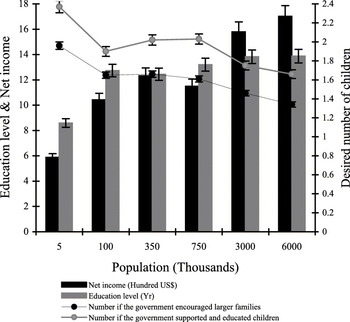
Interviewees in large cities wanted smaller families than those in small cities (p<0.01; Fig. 4). The type of employment was another factor that affected a woman's decision to bear children. Teachers, business managers and government officials had the highest income and education levels (Fig. 5), whereas farmers and the unemployed had the lowest net income and education level (p<0.001). The number of children that women were willing to bear was lowest for students, business managers, teachers and government employees and highest for unemployed women and farm women (Fig. 5).
The relationships among location (community population size), net income, education and the attitudes of women toward childbearing.

The relationships among occupation, net income, education and the attitudes of women toward childbearing.

Reasons why women were unwilling to bear more children
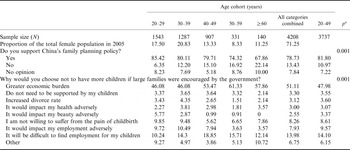
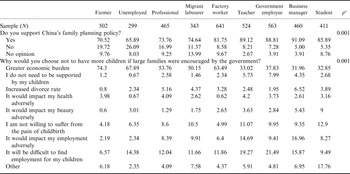
It was found that 78.7% of the interviewees supported China's one-child policy, versus 13.4% who did not, but these proportions differed significantly among age groups (p<0.001; Table 2). Women had different reasons for not wanting to have more children, even if larger families were encouraged by the government (Fig. 6, Table 2): 51.1% indicated they could not afford the cost of supporting and educating additional children, 21.9% indicated a fear of increased difficulty of finding employment for themselves or their children, and 13.8% indicated they were unwilling to risk their health – including the fears that childbearing would impact their health and beauty and the fear of the pain and difficulty of childbirth.
Reasons why women were unwilling to bear more children. ‘Impact employment adversely’ represents employment possibilities for both the mother and child; ‘Impact health adversely’ represents the impact on health and beauty, and the unwillingness to bear the pain of childbirth; ‘Other’ represents a loss of leisure or amusement, and other opportunity costs.

Attitudes of women toward childbearing as a function of age cohort (% of responses)

a p, significance of the difference across age cohorts.
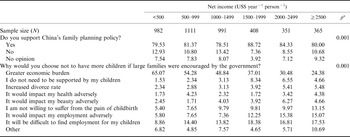
Younger women showed the highest level of support for the family planning policy, with a strongly negative correlation between age and support (R=−0.91, p<0.001; Table 2). The youngest women (20–29 years old) were significantly most concerned with the cost of supporting and educating additional children (46.1%; p<0.001; Table 2). The economic concerns were important factors that negatively affected a woman's decision to bear children. Women with higher net incomes showed greater support for the family planning policy (Table 3), and were least concerned by the increased economic burden (24.4% of respondents, versus 66.8% for women with the lowest incomes).
Attitudes of women toward childbearing as a function of net income (% of responses)

a p, significance of the difference across income levels.
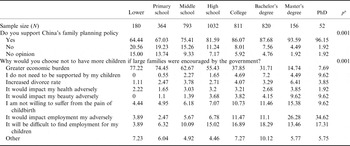
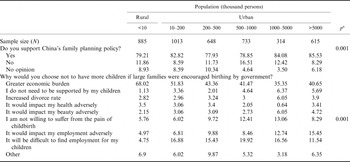
Higher education increased support for the family planning policy (Table 4). Women with no formal education reported that their primary concern was the increased economic burden (77.2%). Women in the largest cities showed greater support for the family planning policy than rural women (85.5 versus 79.2%; p<0.001; Table 5). Women who worked as business managers, teachers and government employees showed greater support for the family planning policy (Table 6). Women who were farmers, unemployed, migrant labourers or factory workers were more likely to cite the greater economic burden to justify their preference for having fewer children, whereas women who were teachers, government employees, business managers or students were much more likely to cite the impact on their employment prospects. With the exception of the students, this can be explained by noting that the incomes of the women who were teachers, government employees and business managers would be much higher than those of the other group (Fig. 5) and therefore, for them, the opportunity costs of having additional children would be higher. In the case of students, it is likely that they are concerned about the impact of children on their expected future income, which is also likely to be relatively high. It is also possible that the better education of these groups of women let them better understand the seriousness of China's overpopulation problem.
Attitudes of women toward childbearing as a function of education level (% of responses)

a p, significance of the difference across income levels.
Attitudes of women toward childbearing as a function of location (community size) (% responses)

a p, significance of the difference among population levels.
Attitudes of women toward childbearing as a function of occupation (% of responses)

a p, significance of the difference among job categories.
Migrant labourers are people who move from rural areas to find work in an urban area.
Discussion
Knowledge of the attitudes and behaviours of citizens is especially important in the development of sustainable management policy, since the success of any social policy is greatly influenced by the attitudes of the citizens who are affected by the policy; however, the attitudes of citizens are also influenced by the social policy (e.g. Cao et al., Reference Cao, Chen and Liu2007). The results of the present study indicated that most Chinese women (78.7%) supported China's family planning policy and would prefer a small family (on average, fewer than 1.9 children). The younger women (Fig. 3), as well as women living in bigger cities and performing ‘knowledge work’ or other skilled jobs, with higher levels of education and higher net incomes (Figs 4 and 5), generally desired smaller families. This result may explain why China's family planning policy has performed well in the last 30 years: educational and income levels have increased as cities have grown during this period. This seems to be a good result of China's policies because Chinese cities have become badly overpopulated, and the population size must be decreased quickly so that the urban infrastructure will be able to cope with the demand (Ehrlich, Reference Ehrlich2000; Zang & Li, Reference Zang and Li2002).
However, this attitude ignores the potentially adverse effects of this ongoing population decline. The desire of Chinese women to participate in the country's rapid economic development, accompanied by increased desire to attain a higher education and live in cities, means that a potentially serious population decline will soon occur in rural areas, and despite the currently rapid influx of workers into large cities and China's rapid urbanization, this decline will eventually begin to affect urban areas of China (Cao & Wang, Reference Cao and Wang2009). Urban populations will stabilize at some point in the future, and at that point, the declining birth rate will lead to decreasing urban populations. This result suggests that the likelihood of a large impending population decline in China will lead to dramatic demographic changes that will challenge China's current family planning policy.
Fears about the consequences of a Malthusian population bomb and changes in attitudes towards raising children have been accompanied by population declines in many parts of the developed world, leading to major problems for some nations that will become more serious in the future (Bongaarts, Reference Bongaarts1998; Chu & Ching, Reference Chu and Ching2001). In the Chinese educational system, those with at least a middle-school education receive sufficient instruction in the risk of the population bomb, but are not taught about the risks posed by a population decline. Better-educated women earn more money than those with less education, therefore, the opportunity costs imposed by having additional children are higher than for groups with less education. This may explain why lower education and lower income were both linked to an increased probability of preferring a larger number of children (Fig. 2). The results suggest that if women were allowed to have more than one child, it would be mainly the poor, rural, less-well-educated women who would want more, whereas the affluent, urban, well-educated women would not. Based on these results, governments should cover the costs of childbirth and provide ongoing economic and other support throughout the youth of a child (i.e. to age 18) to encourage women to raise more children. Particularly in developed areas, additional powerful social safeguards must be provided, such as protecting the right of women to advance their careers despite the additional burdens of childbirth and raising children.
The results of this study provide an example of how modern policy development in China sometimes ignores long-term risk in favour of short-term gains, and illustrate how this short-sighted emphasis may sometimes lead to policy and programme failures. The risk posed by rapid population declines has been obscured until recently by the time lag created by increasing lifespans and potentially excessive fears of overpopulation. Based on the results of this study, China's government will need to devote more attention to the risks that will arise from a population decline and provide research funding to allow researchers to obtain the information required to support the development of a more suitable population policy that will better deal with the future challenges. Geographic factors can exert large and significant influences on differences in sources of income among regions (Hibbs & Olsson, Reference Hibbs and Olsson2004). Understanding the demographics of populations affected by a project and their relationship with population levels and other factors such as sources of income may help planners to develop more effective policies and projects (Johnson-Hanks, Reference Johnson-Hanks2004). Unfortunately, China's family planning policy has applied the same standard to family size in all regions and for all demographic groups.
The development and evolution of a market economy in China has created a system that inherently provides strong disincentives to have large families (Wang, Reference Wang2002). Greater age, poverty, a lack of education and living in rural areas or smaller cities were positively correlated with the fear that the economic burden of children would be too great (Tables 2–5), whereas all these factors were strongly and negatively correlated with the fear of adverse impacts on employment, health and the divorce rate, and with the belief that the woman would not need to be supported by her children. These results demonstrate that if China wants to reduce the risks that accompany a future population decline, it will be necessary to increase employment security and medical support and provide measures to help maintain family stability. Although childbirth is an undeniably painful experience, both Western medicine and traditional Chinese medicine provide many tools for managing this pain and mitigating the negative health effects of pregnancy and childbirth. As a result, educating young women about these options will help to remove their fear of childbirth.
Acknowledgments
The authors thank the 31 students at China Agriculture University who helped make this investigation possible by delivering the surveys to the chosen respondents. They also thank Professor Richard Dawson of the China Agriculture University and Geoffrey Hart for their help in writing this paper. This work was supported by the Science & Technology Innovation Project of Beijing Forestry University (BLJC200908).