Introduction
Haemonchus contortus and Teladorsagia circumcincta are the main gastrointestinal nematodes (GIN) of small ruminants, causing severe pathological damage (González-Ruíz et al., Reference González-Ruíz, López-Arellano, Olazarán-Jenkins, Liébano-Hernández, Mendoza-de-Gives, Vega-Murillo, Vázquez-Prats and Calderón-Robles2008). Generally, H. contortus and T. circumcincta are localized in tropical and temperate regions, respectively (Sargison et al., Reference Sargison, Wilson, Bartley, Penny and Jackson2007). These nematodes are considered to be the parasites mostly responsible for important economic problems in small ruminants (Jacobson et al., 2009). On the other hand, anthelmintic resistance is a worldwide problem that is increasing in H. contortus and T. circumcincta isolates from domestic ruminants (Demeler et al., Reference Demeler, Van Zeveren, Kleinschmidt, Vercruysse, Höglund, Koopmann, Cabaret, Claerebout, Areskog and von Samson-Himmelstjerna2009).
Benzimidazole (BZ)-based compounds are potent drugs that have been associated with ultrastructural alterations in intestinal cells of nematodes (Borgers & De Nollin, Reference Borgers and De Nollin1975). They have been used for many decades since they showed a high nematicide efficacy (Brown et al., Reference Brown, Matzuk, Ilves, Peterson, Harris, Sarett, Egerton, Yakstis, Campbell and Cuckler1961). However, the increasing use of BZ-based compounds creates anthelmintic resistance within different nematode populations, thereby threatening the success of drug treatments. Preservation of BZ nematode lethal activity is important for the control of the parasitic nematodes of animals. Currently, a series of diagnostic methods, such as the faecal egg count reduction test (FECRT), in vitro assays, as well as molecular techniques, are useful tools to prevent anthelmintic resistance spreading in grazing animals exposed to GIN (Coles et al., Reference Coles, Jackson, Pomroy, Prichard, von Samson-Himmelstjerna, Silvestre, Taylor and Vercruysse2006). So far, the FECRT method has been adequately implemented in a number of tropical and temperate regions around the world. However, this method is only reliable if more than 25% of the worm population under study is resistant (Martin et al., Reference Martin, Anderson and Jarrett1989). So, false-negative cases of anthelmintic resistance could be easily spread (Dobson et al., Reference Dobson, Hosking, Jacobson, Cotter, Besier, Stein and Reid2012). Results of different methods of diagnosis of anthelmintic resistance, such as in vitro and molecular techniques, might be used to identify and prevent the dissemination of anthelmintic resistance.
Chiapas and Pelibuey sheep are the main source of animal production used by farmers of Tzotzil and Tzeltal ethnicity because of their natural adaptation to the temperate and tropical regions of Chiapas, Mexico. Recently, some problems associated with GIN in Chiapas and Pelibuey breeds have gained the attention of researchers (Sánchez et al., Reference Sánchez, Hernández, Peralta, Oliva, Reyes and Cuellar2008, Peralta et al., Reference Peralta, Reyes, Méndez, Sánchez and Díaz2012) and the presence of BZ resistance could severely affect sheep production. The aim of the present study, therefore, is to identify the presence of GIN resistant to BZ-based compounds in Chiapas and Pelibuey sheep breeds from two main regions of Chiapas, in order to establish good anthelmintic practices.
Materials and methods
Experimental sheep breeds
Each of two groups of 20 adult sheep, comprising 11 females and 9 males in the Chiapas group and 12 females and 8 males in the Pelibuey group, were obtained from the Tzotzil-Tzetzal and Tapachula temperate and tropical regions of Chiapas, Mexico. All sheep were naturally infected with GIN.
Tzolzil and Tzetzal ethnic communities, in collaboration with the academic personnel of the University of Chiapas, Mexico, carried out flock husbandry management during the experiment. The Chiapas sheep breed is mainly used for wool production for clothing purposes and the Pelibuey breed is used for meat production. Farms are managed semi-intensively and animals become infected with parasitic nematodes during the grazing period. Sheep producers regularly use albendazole (ABZ) and febendazole (FBZ) anthelmintics as a method of nematode control. However, the deworming system is variable on each farm and the current parasite situation for each region is, so far, unknown.
Coprological examinations and bioassays
Estimation of the number of GIN eggs eliminated per g sheep faeces and the identification of infective larvae (L3) were carried out using the McMaster and coproculture techniques (Liébano-Hernández et al., 2011). To establish pure cultures of nematodes from both the Chiapas and Pelibuey breeds, a number of L3 were collected from faecal cultures and two donor sheep were infected using a dose of 350 L3/kg body weight, including a H. contortus BZ-resistant strain as the control isolate (Centro Nacional de Investigacion Disciplinaria en Parasitologia Veterinaria, INIFAP, Morelos, Mexico; Campos et al., Reference Campos, Herrera, Quiroz and Olazarán1990). Once sheep started to eliminate eggs, faecal material was collected in order to obtain faecal cultures that would eventually provide fresh larvae to be used for carrying out in vitro assays and analysis using the allele-specific polymerase chain reaction (AS-PCR) technique.
Three BZ-based compounds were used in the study: FBZ (Intervet Laboratories, Mexico, S.A. de C.V.); tiabendazole (TBZ, Sigma-Aldrich, St Louis, Missouri, USA) and ABZ (Valbazen 2.5, Bayer, Edo. de México, Mexico). Stock solutions of FBZ and TBZ were prepared by dissolving the pure compound in 0.1 n chloride acid (hydrochloric acid 37%, Sigma-Aldrich). Final concentrations of suspensions were obtained by adding 15 μl of the corresponding drug (FBZ or TBZ) into 5 ml of water. Anthelmintic concentrations were prepared at 1, 0.5, 0.25, 0.125, 0.062 and 0.03 mg/ml for each drug. Distilled water was used as the control, without anthelmintic. Plates of 96 wells (Nunc, Denmark) were used to incubate 100 L3 with each anthelmintic dose. Data collection was carried out after 2, 18 and 42 h of nematode and anthelmintic assays at room temperature (25–28°C). Bioassays were performed with three replicates for each drug and dose. Lethal dose (LD)50, LD90 and LD99 values were analysed statistically by Probit Polo-Plus (LeOra Software Company, Petaluma, California, USA, 2002–2003).
A volume of 100 μl of the proper anthelmintic suspension containing an average of 60 H. contortus (Pelibuey isolate) and H. contortus/T. circumcincta (Chiapas isolate) L3 was deposited in a well of a 96-well culture plate. This procedure was followed by each anthelmintic dilution and each GIN isolate.
Molecular analysis
Genomic DNA (gDNA) from Chiapas and Pelibuey nematode isolates and from a H. contortus BZ-resistant strain (CENID-PAVET, INIFAP, Morelos, Mexico; Campos et al., Reference Campos, Herrera, Quiroz and Olazarán1990) was used to carry out the AS-PCR. Numerous L3 were treated with 40% sucrose and 0.187% sodium hypochlorite (Cloralex, Sta. Catarina, Nuevo León, Mexico) to remove detritus and the second larval moult from the L3. First, in order to separate and to discard and remove detritus from larval suspension, one larval volume with three parts 40% sucrose solution in 10-ml assay tubes were spun for 10 min at 3500 rpm. After this period, a white ring corresponding to the larvae was formed at the upper part of the tubes. Larvae were recovered from the white ring with a Pasteur pipette and transferred into tubes with ultrapure water and spun to settle the larvae. Larvae were recovered from the sediment and the process was repeated twice in order to discard the entire sucrose residue.
After this step, larval exsheathing was achieved by exposure of sheathed larvae to 0.187% sodium hypochlorite for 5–10 min. Exsheathed larvae were immediately washed with ultrapure water and spun to discard the sodium hypochlorite residues. Approximately 20 exsheathed L3 were collected and digested overnight at 65°C with 50 μl of digestion buffer, which consisted of 50 mm KCl, 10 mm Tris (pH 8.3), 2.5 mm MgCl2 and 100 μl proteinase K. Following the incubation, the DNA was centrifuged at 700 g in 100 μl buffer (10 mm Tris–HCl, 0.5 mm EDTA, pH 9.0). Then larvae were treated with a commercial DNA kit (DNAeasy, QIAGEN, Hilden, Germany).
The AS-PCR technique was carried out following the method cited by both Silvestre & Humbert (Reference Silvestre and Humbert2000) and Winterrowd et al. (Reference Winterrowd, Pomroy, Sangster, Johnson and Geary2003). All primers were designed using bioinformatics IDT software (http://www.idt.com). Two sets of primer sequences were designed and are shown in table 1 (general and specific). The optimal AS-PCR reaction was determined as follows: commercial PCR master mix was used (GoTaq® Green Master Mix, Promega, Madison, New York, USA) with 20 μ m of primers (Pn1 and Pn2), 100 ng gDNA and nuclease-free water. A second nested PCR was carried out using the first PCR product (Pn1 and Pn2) as a template with specific primers at 20 μ m (P1, P2, P3) and 20 μ m (P1, P2, P4) to determine resistance or susceptibility to the BZ drug, respectively. Samples were visualized using 4% agarose gel with ethidium bromide (Sigma-Aldrich). Subsequently the PCR template was cleaned with a commercial kit (QIquick, Gel Extraction kit, QIAGEN) and sequences were used to analyse mutations in codons 198 and 200 on isotype 1 of the β-tubulin gene. Sequence data were obtained from a Genetic Analyzer 3130XL (Applied Biosystems, Carlsbad, California, USA).
The use of general (Pn1 and Pn2), specific (P1, P2, P3R and P4S) and genotyping primers (HcFw, HcRv, TcFw and TcRv) to identify Haemonchus contortus and Teladorsagia circumcincta genes associated with benzimidazole resistance and susceptibility in naturally infected sheepa.

HcFw, H. contortus forward; HcRv, H. contortus reverse; TcFw, T. circumcincta forward; TcRv, T. circumcincta reverse.
a By allele-specific polymerase chain reaction.
Data analysis
Data obtained from the in vitro assay were individually analysed for each of the three BZ derivatives (FBZ, TBZ and ABZ) and also for control and LD assessment. A linear model (SAS Inc., Cary, North Carolina, USA) and the fixed effects included interactions between the model groups (Pelibuey, Chiapas and control) during the incubation periods of 18 and 42 h. Data were transformed to the arcsine square root of the proportion and Tukey's multiple comparisons were performed when necessary. The individual effectiveness percentage of each drug was estimated as follows:
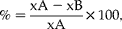 $$\begin{eqnarray} \% = \frac {xA - xB}{xA}\times 100, \end{eqnarray}$$
where xA is the mean of the control group and xB is the mean of the treated group.
Results
Two main nematode species were identified in the Chiapas sheep (H. contortus and T. circumcincta), but only H. contortus was found in the Pelibuey breed. BZ global in vitro anthelmintic activity against L3 was 68.6% and 71.8% for GIN obtained from the Chiapas and Pelibuey sheep breeds, respectively (P>0.05). On the other hand, BZ showed 42.8% anthelmintic efficacy against the control isolate H. contortus BZ-resistant strain (P< 0.05). Also, high variability in lethal effect was observed when BZ derivatives were compared (table 2). FBZ showed more than 90% toxicity against H. contortus and T. circumcincta, obtained from the Chiapas and Pelibuey sheep breeds. In contrast, TBZ and ABZ showed a lethal effect ranging from 51.1% to 61.7% against the same nematode species.
Percentage toxicity effects (mean values±standard deviation) of three derivatives of benzimidazole (BZ) against infective larvae (L3) of gastrointestinal nematode isolates from sheep breeds, compared with Haemonchus contortus BZ-resistant larvae.

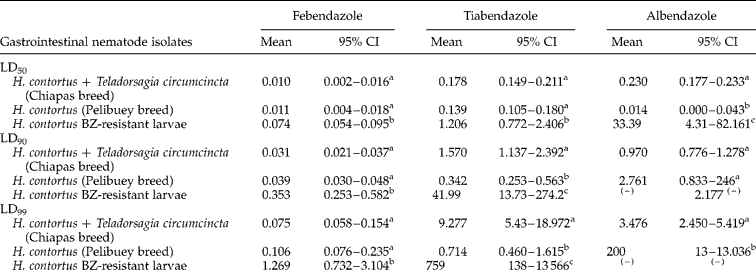
The LD50, LD90 and LD99 values for BZ drugs against GIN L3 were estimated from the Chiapas and Pelibuey sheep breeds and these values were compared with the results obtained with the H. contortus BZ-resistant strain of reference (table 3). Chiapas and Pelibuey nematode isolates showed similar LD50, LD90 and LD99 values (P>0.05) after 42 h interaction, ranging from 0.01 to 2.7 mg/ml. In contrast, the H. contortus BZ-resistant strain of reference showed high ranges of LD from 0.074 to 759 mg/ml; some data were not provided by probit analysis. On the other hand, high toxicity (99%) was observed with FBZ at LD99.
Lethal dose values (LD50, LD90 and LD99) of three benzimidazole (BZ) derivatives (mg/ml) against gastrointestinal nematodes obtained from sheep breeds for comparison with Haemonchus contortus BZ-resistant larvae (L3).

CI, confidence interval.
a,b,c Mean values within a column with unlike letters were significantly different (5%; probit analysis).
(–) Data not provided by probit analysis.
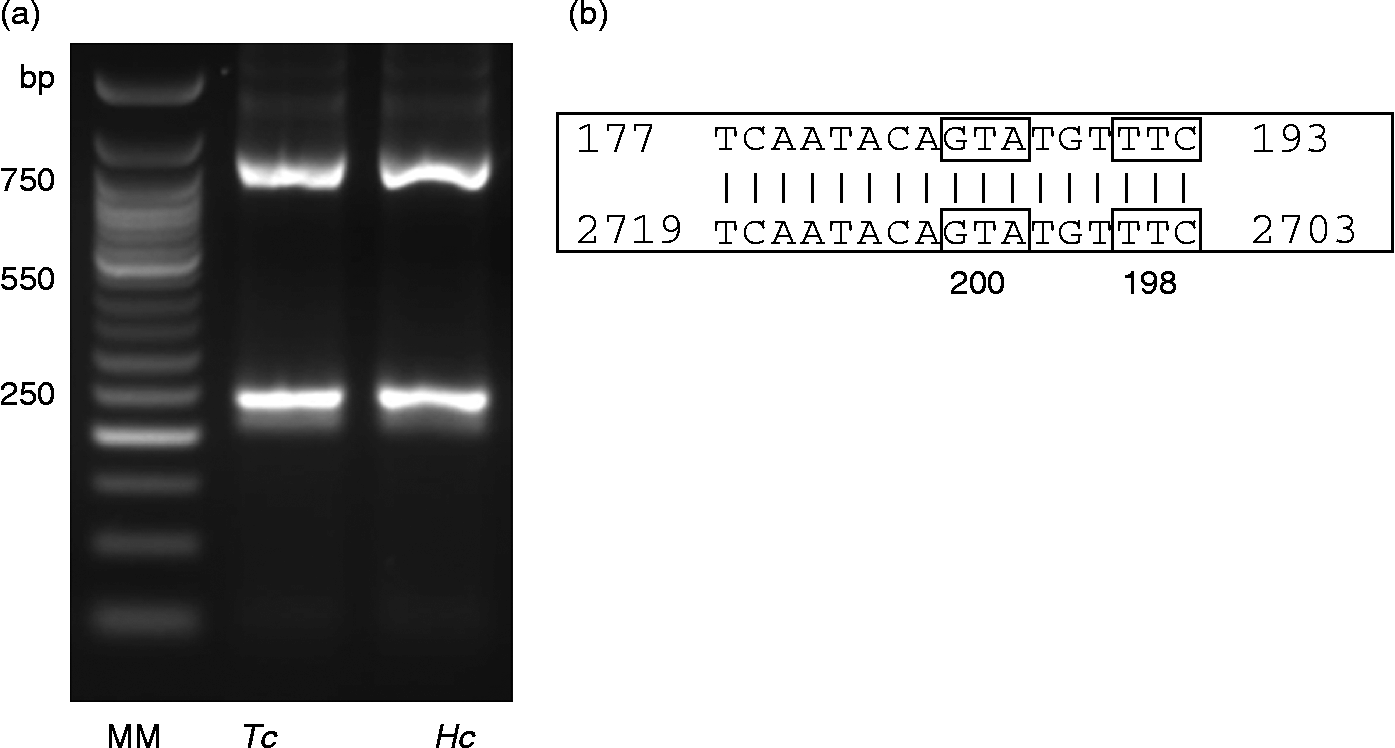
Regarding the genomic organization of the β-tubulin isotype 1 gene in H. contortus and T. circumcincta, gDNA analysis was based on a consensus sequence from 20 L3 H. contortus/T. circumcincta mixtures. A 250 bp fragment was amplified of the BZ resistance-related polymorphism Phe200 (TTC)/Tyr200 (TAC) and a fragment of 550 bp was identified by sequence as non-mutant Phe200 (TTC). Final PCR products of both nematode isolates are shown in 4% agarose gel (fig. 1a and b). Throughout these fragments, mutant regions were aligned with the DNA sequences of β-tubulin from H. contortus and T. circumcincta as noted by Kwa et al. (Reference Kwa, Veenstra and Roos1994) (EMBL accession no. X67489) and Elard et al. (Reference Elard, Cabaret and Humbert1999). On the other hand, H. contortus and T. circumcincta species did not show changes on codon 198 Glu/Ala (GAA/GCA), indicating that nematodes isolated from the Chiapas and Pelibuey sheep presented the Phe200 (TTC)/Tyr200 (TAC) mutation.
(a) Polymerase chain reaction analysis of genomic DNA of Teladorsagia circumcincta (Tc) and Haemonchus contortus (Hc) isolates showing two main fragments of 250 bp and 750 bp identified as resistance and non-specific fragments amplified with specific primers. (b) DNA sequence from 177 to 193 of the Tc and Hc populations identified as benzimidazole resistance at position 200 (GTA = CAT) using a reverse primer. MM, molecular marker.
Discussion
Anthelmintic resistance in ruminant GIN is a worldwide problem affecting animal health. As a consequence, many farmers with limited financial resources are losing their incomes because of low production. For instance, small communities from Chiapas, Mexico, have traditionally reared the local Chiapas and Pelibuey sheep breeds, either using the wool to make clothes for domestic use or selling the meat commercially as a first income. However, profits are decreasing, as endoparasites are becoming a problem due to anthelmintic resistance. For a long time, the detection of parasitic nematode resistance to BZ in small ruminants was noted; however, BZ-based compounds are one of the main products commercialized in the local anthelmintic drug market. In Chiapas, Mexico, one of the main sources of economic income is based on the small-industry rearing of ruminants. Likewise, the control of parasitic nematodes through the use of synthetic drugs is currently under risk due to their inefficacy. Therefore, the use of adequate methods of anthelmintic resistance diagnosis, such as specific bioassays and molecular techniques, for example PCR, are crucial for an early detection of anthelmintic resistance problems in ruminant GIN. The present study has confirmed the presence of BZ resistance in H. contortus and T. circumcincta within Chiapas and Pelibuey sheep breed isolates through bioassays and AS-PCR techniques. Identification of the amino acid changes in the isotype 1 β-tubulin gene at position 198 Glu (GAA)/Ala (GCA) and 200 Phe (TTC – susceptible)/Tyr (TAC – resistance) has been noted in other studies (Kwa et al., Reference Kwa, Veenstra and Roos1994; Ghisi et al., 2007; Hunt, Reference Hunt2011). Although the present study did not show allelic frequency, the presence of BZ-resistant parasitic nematodes in the areas of study was identified. This could be considered a warning to search for anthelmintic strategies different from the use of chemical anthelmintic drugs.
At Teopisca and Tapachula, Chiapas, Mexico, some farmers do not use strategic anthelmintic programmes. In fact, the criteria of farmers of these communities for deciding to deworm their animals are based only on the corporal condition of the animals. Previous to PCR results, different bioassays were carried out with Chiapas and Pelibuey isolates using BZ salts and commercial drugs. The discriminating dose showed that the sensitivity of the test was substantially enhanced, mainly with LD50, which might have indicated the presence of a BZ-susceptible GIN population. Regarding these results, FBZ was the anthelmintic with the highest efficacy; in contrast, TBZ and ABZ showed low lethal damage. However, the AS-PCR technique confirmed that nematodes from both isolates showed BZ resistance. Because of the importance of deworming GIN-infected sheep, selective strategic treatments might be established in these regions.
In conclusion, gastrointestinal parasitic nematodes from the Chiapas and Pelibuey sheep breeds from Tzotzil-Tzetzal and Tapachula showed resistance to BZ drugs. Considering that these sheep breeds are economically important for local sheep producer communities and the growing threat of decreasing sheep productivity, the results of the present experiment suggest that BZ anthelmintic resistance is becoming widespread in these areas of study. Although the bioassays with FBZ showed a high efficacy, preventive actions, such as strategic anthelmintic treatments and use of biological control agents (i.e. trapping fungi), should be taken when farmers from ethnic groups in Chiapas, Mexico, use BZ-based compounds.
Acknowledgements
This paper is dedicated to our friend MSci Liébano-Hernández Enrique.
Financial support
This study was supported by the Programa de Apoyo a Proyectos de Investigación e Innovación Tecnológica (PAPIIT; no. IN205710-3 and IN207707-3) and Fomix-Campeche [El Consejo Nacional de Ciencia y Tecnología (CONACYT) project no. 1235].
Conflict of interest
None.