Camp is a lie that tells the truth.
—Philip Core (1984)
Introduction
To define camp may be the least campy thing in the world. Still, scholars, cultural critics, artists, and camp practitioners have been trying to do precisely that since Christopher Isherwood offered readers a delicious, albeit fleeting, description of “the gay sensibility” in his 1954 novel, The World in the Evening.Footnote 1 In a brief dialogue between two gay friends, Stephen and Charles, Isherwood distinguishes between two types of camp. Low Camp includes “swishy boys with peroxided hair, dressed in a picture hat and a feather boa, pretending to be Marlene Dietrich . . ., but it's an utterly debased form.”Footnote 2 High Camp, he continues, provides
the whole emotional basis of the Ballet, for example, and of course Baroque art. You see, High Camp always has an underlying seriousness. You can't camp about something you don't take seriously. You're not making fun of it; you're making fun out of it. You're expressing what's basically serious to you in terms of fun and artifice and elegance. Baroque art is largely camp about religion. The Ballet is camp about love.Footnote 3
This passage suggests in camp an inherent elasticity, but Isherwood offers a final stroke of definitional clarity:
Actually, it isn't [elastic] at all. But I admit it's terribly hard to define. You have to meditate on it and feel it intuitively, like Lao-tze's Tao. Once you've done that, you'll find yourself wanting to use the word whenever you discuss aesthetics or philosophy or almost anything. I never can understand how critics manage to do without it.Footnote 4
Thus, Isherwood cues camp's entrance onto the stage of literary representation, although Fabio Cleto caught the gay sensibility peeping out from behind the curtain in (at least) two earlier documents. In 1869, “two famous transvestite figures, Lord Arthur Clinton and Frederick Park,” referred to camp in an exchange of letters.Footnote 5 J. Redding Ware included an entry for camp in his 1909 slang dictionary, making it abundantly clear that the term applies to those other Victorians, “persons of exceptional want of character.”Footnote 6 And, of course, camp sparkled in Wildean witticisms such as “I like men who have a future and women who have a past.”
By the 1920s, associations between camp and the dandified—a quaint euphemism for queer—man were firmly in place. As the queer lingua franca, camp lingo drew lines of inclusion, as Cleto puts it, “among those ‘in the know,’ while excluding those whose ‘normality’ couldn't be let into this outlaw, and yet proximate community.” In the conformist world of the 1950s, camp signaled difference from the (hetero) norm.Footnote 7 By the time Susan Sontag wrote her famous “Notes on Camp” in 1964, the sensibility had flitted across vast cultural terrain with enough gusto to make itself both visible to straight culture and available for appropriation by heterosexuals. From Sontag's perspective, camp lost its specifically gay attitude and came to signify a general appreciation for objects of the past: the passé, the démodé, and the obsolete.Footnote 8 Still, its queerness endured in drag communities, in butch-femme lesbian identities, and in gay male culture. Throughout its history, camp has refused to sit still.
Sontag cautions against rigid definitions that threaten to freeze the gay sensibility's essential fluidity, ineffability, and flexibility into something harder—“an idea,” although she cannot resist the camp urge to bestow upon the sensibility the status of a Platonic ideal (Capital-C Camp).Footnote 9 In this essay, therefore, I will not attempt to define camp per se. Instead, I will sketch the parameters of the gay sensibility by looking at one campy piece of music in two different socio-political and historico-cultural moments. The object of my analysis is “Glitter and Be Gay,” Cunégonde's coloratura aria from Act 1 of Leonard Bernstein's Candide (1956). My goals are admittedly modest. First, I will discuss the genesis of Bernstein's musical in the context of U.S. political culture of the 1950s and draw some connections between specific decisions in the composition, stage direction, and performance of “Glitter and Be Gay” that connect the aria to both camp aesthetics and gay life in mid-century America. In Candide, the aria provides Cunégonde with an opportunity to explore and express her feelings about a decidedly un-camp situation. A prisoner of a Sultan and a Marquis, she has been raped repeatedly by the two men and, believing Candide dead, she feels trapped and forlorn. However, Voltaire's satirical text undermines the seriousness of her situation, and Bernstein amplifies this aspect of Cunégonde's dilemma by filling his score with camp idioms perfectly tuned to the pitch of queer ears but nonetheless recognizable as standard musical comedy fare by others. Given Bernstein's own complex sexual self-identity as well as his implication in government-sponsored witch-hunts against “un-Americans Activities,” I hear “Glitter and Be Gay” as a campy form of musical resistance to the oppressive and specifically anti-gay aspects of McCarthyism.
Second, I will catch up with “Glitter and Be Gay” in a recording from the early 1990s by singer, songwriter, author, and AIDS activist Michael Callen (1955–1993). Although gay politics had changed in the thirty-seven years separating the composition of “Glitter and Be Gay” and Callen's recording, camp remained a powerful way to voice and to enact queer resistance. The singer harnessed the aria's camp potential to celebrate gay life at a moment when, as Walter Hughes poignantly noted, “‘night fever,’ ‘the boogie fever,’ the ‘tainted love,’ and the ‘love hangover’ all seemed to be passing into literalism.”Footnote 10 In the 1950s and again the 1980s, gay men used “Glitter and Be Gay”—borrowing David Halperin's pithy phrase—to “suffer in quotation marks.”Footnote 11
Oscar Wilde once quipped, “A man is least himself when he talks in his own person. Give him a mask, and he will tell you the truth.”Footnote 12 Scholars of camp have drawn connections between the gay sensibility and roleplaying. Sontag describes camp as “a vision of the world in quotation marks” that enables us to understand “Being-as-Playing-a Role.”Footnote 13 Despite her emphasis on socially constructed identities, Sontag's critics note that she missed an opportunity to connect camp with queerness (or, for that matter, with any meaningful political project). “It goes without saying,” she writes, “that the Camp sensibility is disengaged, depoliticized—or at least apolitical.”Footnote 14 Later in the essay, she remarks on the relationship between camp and homosexuality:
While it's not true that Camp taste is homosexual taste, there is no doubt a peculiar affinity and overlap. Not all liberals are Jews, but Jews have shown a peculiar affinity for liberal and reformist causes. So, not all homosexuals have Camp taste. But homosexuals, by and large, constitute the vanguard—and the most articulate audience—of Camp.Footnote 15
For Sontag, camp's apolitical stance is prima facie, a well-known fact hardly worth mentioning. Although she briefly acknowledges camp's connections to gay culture and aesthetics (although, of course, not politics), Jack Babuscio argues that Sontag “virtually edited gays out of her otherwise brilliant [essay],” and that in doing so, she proffered the false belief that “camp emerged from out of no intelligent body of sociocultural phenomena.”Footnote 16 The force of Babuscio's rhetoric stems not only from his conviction that camp is inherently political, a notion Sontag flatly refuses by framing it as only an issues of aesthetics, but more importantly, from his belief that it is inherently gay. Babuscio argues that camp “has produced in [gay people] a heightened awareness of the discrepancies that lie between appearance and reality, expression and meaning.”Footnote 17 Richard Dyer concurs that camp has a similar strategic function; it allows gay men to keep at bay “the real awfulness of their situation.”Footnote 18 Moe Meyer responds to Sontag's suggestion that there are multiple kinds of camp (naïve, deliberate, High, Pop) more succinctly. “There are not different kinds of Camp,” he writes. “There is only one. And it is queer.”Footnote 19
A queer aesthetic sensibility and sign system, camp took shape in the crucible of homophobic identity politics. Camp resists compulsory heterosexuality and homophobia, forges distinctly queer culture, and speaks with a queer accent. Building on Judith Butler's insights into performative gender identities, Halperin argues that gay identity is “not just to something you are but also to something you do.”Footnote 20 As a cultural practice, “male homosexuality involves a characteristic way of receiving, reinterpreting, and reusing mainstream culture, of decoding and recoding the heterosexual or heteronormative meanings already encoded in that culture, so that they come to function as vehicles of gay or queer meaning.”Footnote 21 Camp is one of the most powerful tools though which gay communities perform such transformative operations. Its plasticity—camp can function as noun, verb, and adjective—evidences its fundamental role in “doing” queer identities, and as a shared sensibility, camp marks the boundaries of a collective with shared or similar beliefs, ideologies, and political goals. David Caron once said that camp is “social critique at work,” and it is such a notion of camp that I employ throughout this essay.Footnote 22
Glittering and Being Gay in the Age of Anxiety
Banned for its blasphemous and seditious content, Voltaire's Candide (1759) was a succès de scandale, a scathing accusation of the corruption of the Catholic Church and the brutalities of the Inquisition presented as a satire of philosophies of optimism. In the novella, Professor Pangloss maintains his belief that we inhabit “the best of all possible worlds.” Confusing cause and effect, Pangloss argues that “things cannot be otherwise than they are; since everything was made for a purpose, everything is necessarily for the best purpose.”Footnote 23 So firm is his belief in optimism that he finds in the devastating 1755 Lisbon earthquake an opportunity for carpenters and builders, who will have plenty of work now that they must rebuild the city. When Pangloss himself is disfigured from syphilis, he tells Candide that it is “an indispensable element in the best of worlds, because if Columbus, on an American island, had not caught that disease . . . we should have had neither chocolate nor cochineal.”Footnote 24
The United States in the 1950s bore striking resemblances to the Panglossian utopia. Following the chaos of World War II, the United States sought to build its own best possible world. Economic prosperity fueled the development of a middle class, whose members went to college using the G.I. Bill, moved into new suburban housing developments, and purchased cars. The development of vaccines eradicated deadly diseases like polio, and antibiotics turned sexually transmitted infections (including syphilis) into mere nuisances. Increased leisure time and spending money contributed to the rise of a distinctive youth culture centered on sock hops, rock-and-roll dancing, and automobiles. However, “the gleaming surface of postwar prosperity hid the anxieties of the atomic age, when claims of creative freedom were made to serve the purposes of the CIA, and the rhetoric of Americanism was wielded as an instrument of political repression.”Footnote 25 The postwar era saw the beginnings of Civil Rights, feminist, and homophile political activism, which would soon shatter this carefully stage-managed façade.
For most of the twentieth century, homosexuality had been considered a mental illness and was illegal throughout the country. Police raids on gay bars carried the threat of public outing, job loss, and violence. Shame, anxiety, and fear propped up compulsory heterosexuality. Gay communities existed at the margins of culture and maneuvered in the crosshairs of social, political, religious, medical, and legal snipers. To evade detection and assault, gay people cultivated complex social codes or masks—sartorial choices, turns of phrase, gestures, and camp—in order to survive. Thus, two social worlds turned, one inside the other, allowing gay individuals to blend in with the crowd superficially. For instance, a city street or park might seem like just a public space, but to anyone with insider knowledge, a look or a touch, a particular color of cravat, or a vocal inflection could nudge open the closet door just enough to get a peep at the fabulous other world.Footnote 26 Phillip Core links this seeming incongruity between a “desire to conceal something and to reveal it at the same time” to the gay sensibility with a pithy aphorism. “Camp,” he writes, “is a lie that tells the truth.”Footnote 27
One such crack through which gay communities (and heterosexuals “in the know”) could glimpse these queer life-worlds was the performing arts. Vito Russo's study of Hollywood film reveals a century-long history of on-screen representations of gay and lesbian identities.Footnote 28 The theater—especially musical-dramatic genres like opera and the Broadway musical—has also been a haven for queer authors, actors, and musicians as well as a stage upon which queer identities have been acted out. Although the musical is typically “straight,” that is, its protagonists are heterosexuals involved in one of many standard romantic plots, gay audiences—gay men, in particular—discover points of identification with many of the female protagonists and the songs they sing. “The true content of show-tune transcendence,” D. A. Miller writes, is two-fold.Footnote 29 On one hand, show tunes provide gay listeners with “the strength to endure a depressive status quo.”Footnote 30 On the other, Broadway musicals allow them to identify with “those perverse enough to want what isn't provided.”Footnote 31 Gay men put the words of show tunes in “vocal italics,” transforming them into “figure[s] for present-day metropolitan homosexuality, which no lyric has ever cared, or dared, literally to mention.”Footnote 32
On its surface, Candide is not a musical about contemporary politics, homosexuality, or camp.Footnote 33 However, according to Humphrey Burton, “[playwright Lillian] Hellman and [composer Leonard] Bernstein saw in [Candide’s] satirical attacks on the Catholic Church and the bland optimism of the philosopher Leibnitz a way of hitting back at Eisenhower's complacent America.”Footnote 34 Due to his political inclinations, Bernstein fell under the watchful eye of the FBI in the mid-1940s and remained a person of interest to the organization for decades.Footnote 35 At the same time, he was gaining a reputation as the United States’ premier composer and conductor.Footnote 36 Bernstein was also a closeted homosexual. Publically, he played it straight: musical Wunderkind and dashing spokesperson for American music; one half of a glamorous couple and doting father. Privately, he wrestled with his identity and same-sex attractions. Public and private concerns made Voltaire's text especially attractive to the composer who, in a 1956 New York Times op-ed, wrote that Candide
throws light on all the dark places, whether European or American. Of course, it's not an American book, but the matters with which it is concerned are as valid for us as any—and sometimes I think they are especially valid for us in America. Puritanical snobbery, phony moralism, inquisitorial attacks on the individual, brave-new-world optimism, essential superiority—aren't these all the charges leveled against American society by our best thinkers? And they are also the charges made by Voltaire against his own society.Footnote 37
Voltaire's use of the picaresque, characterized by a series of adventurous episodes, and satire provided a thin veneer beneath which he could half-conceal his criticisms of the Church. The plot focuses on the romance between Candide and Cunégonde, but connections are almost nonsensical. Characters die, magically return to life later (“You Were Dead, You Know”), and traverse the globe from Westphalia and Lisbon to Argentina and the mythical city of El Dorado. To capture the essence of the novella in music, Bernstein incorporated a stylistic mélange that includes a French gavotte, an Austrian waltz, German chorale singing, and elements of Italian opera alongside Argentinian tango and various European vernacular styles such as polka, barcarolle, and schottische. Bernstein himself admitted that Candide was an engagement with style, “a kind of personal love letter to European music . . . an American Valentine to Europe . . . a pastiche . . . it's eclectic; that's the whole point of it.”Footnote 38 For Allen Shaw, eclecticism gives the score a “surreal” quality because genres are often “at odds with the locales in which they are placed and sometimes anachronistic in their musical vocabulary.”Footnote 39 But for Bernstein, the border crossing was serious business. The music is difficult, with complex harmonies, intricate rhythms, and abrupt changes in style. It refuses to sit still, and the mixture of high and low idioms, the serious and the frivolous, suggests the flagrantly queer and cheekily camp. Bernstein uses this camp style to address and make fun out of serious socio-political issues.
“Glitter and Be Gay” invites a queer/camp reading through its particular engagement with a series of binaries that characterize what Eve Sedgwick calls “the fundamental feature of [queer] social life”: the closet.Footnote 40 In Act 1, Cunégonde finds herself living in Paris, masquerading as the niece of a sultan and a marquis, although in truth she is their demimondaine. Footnote 41 Having locked herself in her boudoir, Cunégonde refuses to attend a soiree being held in her honor by claiming that she has nothing to wear. The Old Lady arrives bearing a bejeweled set of garters, intent on getting the young woman to join the revelry. After a brief skirmish among the Old Lady, the Sultan, and the Marquis, the Sultan threatens to break down the door to Cunégonde's chamber, but the Marquis and the Old Lady temper his fury.
SULTAN: I'm going to break down the door.
MARQUIS: No, no, cousin. We cannot go into her room unless she invites us.
SULTAN: We pay for this house, you and I, and we've been in that room before.
OLD LADY: That's different. She's not getting undressed. She's getting dressed. (She sweeps into the boudoir.)
SULTAN: I say we do these things better in the East. The girl would have been ready on time, or she'd have been dead.
MARQUIS: Oh, charming women make their own rules. And you know that you have found her charming.
SULTAN: Charming! In one generation you have learned to talk like these people. Such words. Charming. She's a woman. You and I are cousins and so it is sensible to split the expense. We are partners in this woman as we are partners in business. Has nothing to do with charm. So please remember to observe the proper hours and days. And do not fall in love, as you usually do with these women.Footnote 42
In this brief bit of dialogue, the men reveal the circumstances of Cunégonde's life in Paris. They have effectively turned her into a sexual time-share property. Cunégonde is their sexual slave, trapped by powerful forces in a situation she cannot escape. Nevertheless, the audience (which doubtless included both men and women, gay and straight) is meant to laugh at the ridiculousness of her situation. Even by the standards of mid-century “benevolent” misogyny, rape and sexual slavery are not laughing matters, but Candide’s well-known status as satire tempered audience expectations and attitudes toward the show. Cunégonde's dilemma resonates with the “bitter circumstances” faced by gay people in the mid-twentieth century. From her boudoir—a kind of closet—she contemplates her miserable situation, turning to song to express her feelings as she prepares to emerge in a kind of drag. Bejeweling herself to the point of absurdity, Cunégonde creates a glittering mask behind which she can hide her true feelings. In camp style, she makes fun out of her captivity rather than resigning herself to fate.
“Glitter and Be Gay” emerges from the festive waltz that precedes it, and Bernstein transposes the gaiety of the party scene into the key of Cunégonde's sadness, marked tempo di valse lente in the score. As the waltz ends, Cunégonde ponders her gloomy circumstance:
Here I am in Paris. I don't even know how I got here. My heart is broken, yet I am forced to glitter. Forced to be gay.
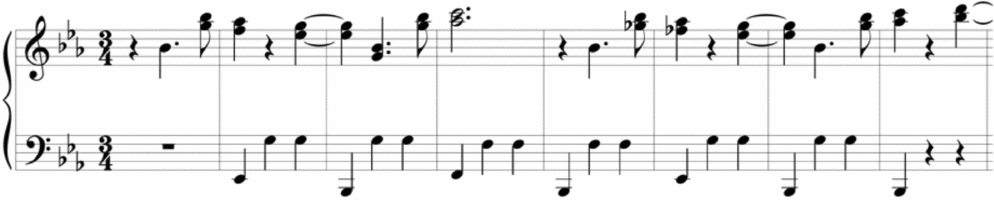
A brief introductory figure signals her despondency. After an orchestral hit on a single unison pitch (B in the original key), an English horn drapes a mournful concert B across three beats of silence (Example 1). A crescendo and decrescendo give the single pitch a moaning quality. Slowly, the English horn reaches up a half step to C and begins to oscillate between the two pitches. The half-step pattern accelerates through increasingly faster note values (quarter, eighth, triplet, sixteenth, and a quintuplet) to become a sighing gesture, retrospectively understood as a trill between the leading tone and tonic, which establishes the key with the arrival of the C-minor triad (m. 5 downbeat). Stretched over four bars of minimal musical materials, the opening trill still manages to be a little too much, almost the musical equivalent of Cunégonde thumbing her nose at the Sultan and the Marquis. Such irreverence in response to deplorable conditions is the essence of camp.
Leonard Bernstein, “Paris Waltz Scene” from Candide (1956), Act I, Scene VI, mm. 1–8. New York: Schirmer Books, 1976. Piano reduction by author.
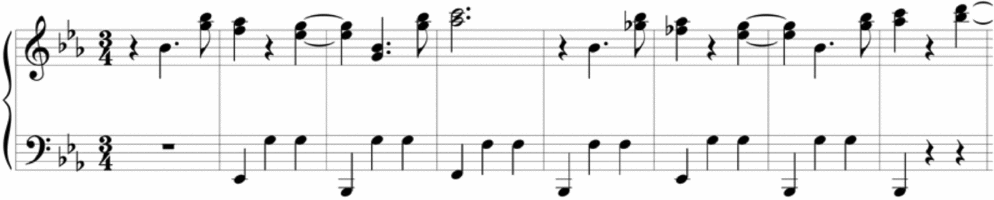
Leonard Bernstein, “Glitter and Be Gay” from Candide (1956), Act I, Scene VII, mm. 1–5. New York: Schirmer Books, 1976. English horn solo transposed to concert pitch.

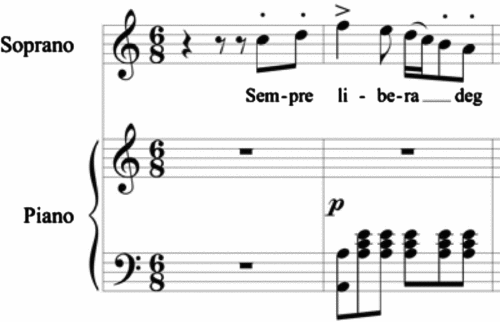
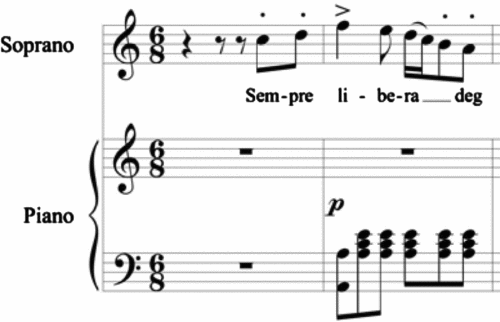
Giuseppe Verdi, “Sempre Libera” from La traviata (1853) Act I, Scene V, m. 144–45. New York: Dover, 1990.
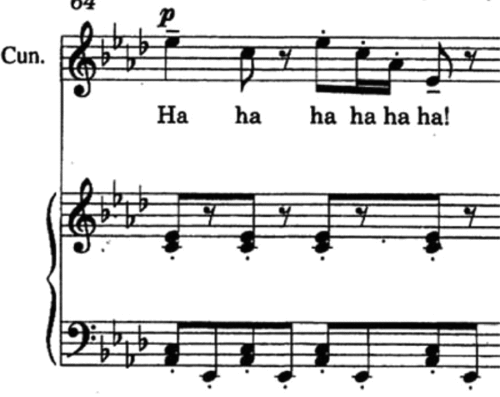
Leonard Bernstein, “Glitter and Be Gay” from Candide (1956), Act I, Scene VII, m. 64. New York: Schirmer Books, 1976.

Three affective zones in “Glitter and Be Gay” map out a trajectory from the private expression of sincere feelings to the public performance of feigned gaiety that corresponds to the contrast between the closet and public life in the 1950s. Sung in the privacy of Cunégonde's chambers, a lugubrious waltz is filled with musical signifiers of pathos that suggest true and sincere feelings. Swirling chromatic lines pull away from the tonic, echoing Cunégonde's desire to escape the “harsh necessity” of her predicament. Half steps in the vocal line and orchestra signify sadness while large gaping intervals (the descending sixth on the word “Paris” (m. 10) and “gilded” (m. 38) echo her sighs. Cunégonde “sobs” as a solo bassoon reiterates the opening
 $\hat{7}$
–
 $\hat{1}$
trill (m. 81). A brief return to the slow waltz finds Cunégonde so despondent that she must abandon singing and, in a brief passage of melodrama, speak her sorrow:
Pearls and ruby rings. Ah, how can worldly things take the place of honor lost? Can they compensate for my fallen state, purchased as they were at such an awful cost? Bracelets, lavalieres, can they dry my tears? Can they blind my eyes to shame? Can the brightest brooch shield me from reproach? Can the purest diamond purify my name?
The turn to speech draws attention to the text, allowing for clear declamation of these particular words, which emphasize lost honor, shame, and a desire for purification or redemption—all feelings familiar to LGBT individuals in a homophobic culture. Bernstein specifically calls for certain musical gestures to render Cunégonde's emotions, for instance a sobbing portamento (m. 44) across an octave descent on the exclamation “Ah!” Likewise, he scores the return to the waltz music by writing “like a sigh” above a brief chromatic descending figure and another large downward leap (m. 80). Singers can exaggerate the emotional content and camp irony by adding expressive slides, variations in vocal timbre, accent, and other effects. In the original cast recording, Barbara Cook adds numerous expressive gestures, feigns an aristocratic accent, and emphasizes specific words (“worldly,” “purchased,” “awful,” and “brightest”) with exaggerated vowels, sighs, “pregnant” pauses, and surprising accents, setting a tradition that persists in subsequent performances and recordings. However, Cunégonde refuses to wallow in her sorrow. A brief melodic turn over a V7 harmony (m. 47) seamlessly links this passage to a bright allegro aria in C-major that corresponds to Cunégonde's “false public face.”Footnote 43
Syncopated textures and dotted rhythms abound, imbuing this section with gaiety and lightness. In each phrase, the melodic arc rises as the underlying harmonies become increasingly chromatic, signaling an intensification of Cunégonde's emotions. In the waltz, chromatic lines signified her real feelings, but here, chromaticism serves a different function. The first five bars cycle through standard harmonic territory [I–V7–vi–V–I] before slipping from diatonic harmonies into diminished and minor chords from remote tonal areas (m. 6). These chromatic departures anticipate a new key, A-flat major (the lowered submediant), later in the aria. Susan McClary characterizes a move into the lowered submediant as “a sudden dramatic shift into what is perceived as an alien region: a realm of fantasy, illusion, nostalgia, unreason, or the sublime, depending on the semiotic context.”Footnote 44 Bernstein indicates a key change to A♭ (m. 56), and over a transitional progression [VI–vii°7–V7], Cunégonde chastises herself for being “basely tearful” and resolves to “show [her] noble stuff by being bright and cheerful” before launching into a lengthy, rhythmically complex, and vocally virtuosic laughing section in A♭. Cunégonde's laugh in the new key (m. 64) functions as a mask that allows her to hide her true feelings behind a fabulous fantasy. While Cunégonde's words reveal very little, her music in this section offers listeners some clues. The melody of the laughing aria parodies that of Verdi's “Sempre Libera” from La Traviata, although Bernstein re-meters from Verdi's 6/8 to 4/4. Bernstein borrows a recognizable bit of Verdi's melody. (Example 4), and vocal similarities continue in the form of virtuosic runs (Example 5).
Giuseppe Verdi, “Sempre Libera” from La traviata (1853), Act I, Scene V, mm. 173–75. New York: Dover, 1990.

Leonard Bernstein, “Glitter and Be Gay” from Candide (1956), Act I, Scene VII, mm. 139–40. New York: Schirmer Books, 1976.

Wayne Koestenbaum includes “Sempre Libera” in his “Pocket Guide to Queer Moments in Opera” at the conclusion of his brilliant meditation on gay men's relationship with opera.Footnote 45 The aria is notable for its juxtaposition of the “sick sad woman” (Violetta), the sentiment of her text (“I'm gay, I'm bursting with joy!”), and the flashy coloratura singing that “Verdi resurrected . . . as a sign of her recidivism—a talent she turns on when pushed to the edge.”Footnote 46 For gay listeners (including Koestenbaum), such moments of operatic excess and contradiction give voice to their own real life experiences of homophobia and the closet. Likewise, for Mitchell Morris, “gay men (and lesbian women) who attend the opera find that it provides a situation where most of their rigidly controlled desires and attitudes may have free rein without social censure.”Footnote 47 Gay listeners can perform the operations of interpretation and identification described by Halperin, Koestenbaum, and Morris, as he puts it, “without disrupting the standard (heterosexual male) cultural productions of meaning.”Footnote 48 Morris connects moments of great emotional revelation (such as Violetta's aria) to camp through juxtapositions between “role-playing and sincerity, public and private; male and female.”Footnote 49 Reading through camp's queer origins, he “put[s] it more bluntly” by likening such moments to the coming out process.Footnote 50 Violetta longs for freedom, and although listeners thrill to the sound of her emancipated voice, her renunciation of bourgeois sexual arrangements leads to her demise. “It kills her to sing, and it kills us to listen.”Footnote 51 In Candide, Cunégonde longs to escape sexual slavery, and Bernstein's parody of Verdi's familiar aria is not incidental. It provided the composer with a well-known template from which he could create his own map through common experiences for mid-century queers: the desire for free expression and the negotiation of the boundaries of the closet.
“Glitter and Be Gay” begins with a minimal musical gesture—just a rise and fall between two pitches—whose oscillation establishes both Cunégonde's sadness and her defiance. Its smallness feels humorously out of proportion to both the dramatic situation and its associated affects. By contrast, the aria closes with operatic excess. The endings of arias often showcase the prowess of the voice. Verdi's “Sempre Libera” demands seven high Cs on its final page. With “Glitter and Be Gay,” Bernstein takes the use of piercing soprano high notes to an almost silly extreme, requiring the soprano to execute ten high Cs in vastly different contexts, some in the middle of rhythmically difficult passages and others as long, sustained notes. As “Glitter and Be Gay” comes to its close, Bernstein outdoes Verdi at his own coloratura game by pushing the soprano voice ever higher to stratospheric high E♭s. In the final bars, dramatic scalar runs, each rising a half-step higher than the one before, culminate in a long orchestral cadential figure over which the soprano holds a high C, D♭, and E♭ (with a fermata!) before falling, exhausted, back to the tonic. Although she has railed against that forces that constrain her, Cunégonde remains imprisoned by the structures of power—the walls of her closet.
Because Candide is an operetta/musical comedy, Cunégonde must reunite with Candide so that the happy hetero couple can “Make Their Garden Grow” in the triumphant finale. Their reunion comes about through Voltaire's fantastical plot. In Act 1, however, Cunégonde sings in the mother tongue of the tragic diva. Wayne Koestenbaum defines “divaspeak” as “the language of vindication and self-defense . . . a way of asserting power, preeminence, and invulnerability through language alone, of speaking strong though one is really weak.”Footnote 52 Cunégonde is trapped by forces she is powerless to control. Still, she defies her captors even as she capitulates to their demands. Rather than succumb to desperation and shame, Cunégonde doubles her resolve to persevere in the face of great adversity through ironic roleplay. How many young queers, D. A. Miller asks, have performed a similar gesture, singing along with their favorite diva or thrilling to the spectacle of her body on stage in order to harness “the strength to endure a depressive status quo” or to “send the whole world packing?”Footnote 53
Camp is strategy for resistance and critique, for making fun out of the serious as a way to relieve oppressive conditions and for saying one thing and meaning quite another. “Glitter and Be Gay” sings in multiple tongues: structural, musical, lyrical, and affective. The song is funny, and Cunégonde's rapidly oscillating moods satirize and make fun out of the complex and contradictory feelings that characterize the closet culture of the 1950s. The aria exposes fissures in the façade of the U.S. cultural imagination. Across the decade, Cold War anxieties, racial tensions, growing discontent among middle class women, and the mobilization of a homophile movement threatened to pull the mask from off of post-war American life. Judith Butler has famously described identity in terms of politics and parody and noted that our subjectivities result from the repetition of stylized acts and gestures.Footnote 54 For queers, moments of rupture, failure, or fissure remind us—as does camp—that subjectivity is indeed subjective. In “Glitter and Be Gay,” Bernstein invites us to consider the masks we all wear and to revel in the act of dressing up.
Glittering and Being Gay in the Age of AIDS
The spirit descends when I sing. I could be sick with a fever and not know whether any sound is going to come out. But when the music starts, it just fills my body with passion and love, and I am able to reach down into what's left of my lungs and my heart and my soul and out it comes. And as soon as I'm done singing, I sort of collapse. But I am singing more joyously than I have at any point in my life because the clock is really ticking for me.
—Michael Callen (Reference Callen1993)Footnote 55
Singer, songwriter, author, and AIDS activist Michael Callen (1955–1993) was one of the first people in the United States to receive an AIDS diagnosis in the summer of 1982. A Midwestern boy who followed the routes of gay migration to the urban metropolises of the East Coast, he arrived in New York City after finishing his undergraduate degree in English literature at Boston University in 1977. Ostensibly, Callen moved to New York in order to pursue a career in music, but he was the first to admit that his real passion was sex. He threw himself into the city's thriving gay sexual culture, and by age twenty-seven, he could count more than three thousand different sexual partners. Inspired by the words of Edmund White, Callen saw himself as a frontline soldier in the gay sexual revolution, one who “wore his sexually transmitted infections like red badges of courage in the war against sex negativity.”Footnote 56 All battles leave their soldiers wounded, and Callen, like many of his peers, had many battle scars.
Beginning in 1980, Callen contracted at least one STD every time he engaged in sexual activity. Because most STDs were treatable with antibiotics, few people (Callen included) gave serious thought to the implications for their overall health. Throughout 1981, he endured mysterious illnesses, rashes, malaise, night sweats, and debilitating, bloody diarrhea. Dehydrated and weak, Callen was hospitalized after collapsing in his apartment, and was then diagnosed with a strain of cryptosporidiosis previously only found in livestock. “With the satisfaction of Miss Marple,” his nurse announced, “‘Well, it's GRID all right. . . . All we can do is try to keep you hydrated and see what happens. Your body will either handle it or . . . it won't.’”Footnote 57 GRID, or Gay-Related Immune Deficiency, was an early name for AIDS. Callen recovered, and when the Centers for Disease Control and Prevention in Atlanta coined the term “Acquired Immune Deficiency Syndrome” in 1982, a maneuver that replaced the overtly homophobic GRID, doctors modified Callen's diagnosis to reflect the change in terminology. From his diagnosis until his death eleven years later, Callen devoted himself to AIDS activism and rekindled his commitment to “make gay music for gay people.”Footnote 58
Through his activist work, Callen did battle on the frontlines of the AIDS crisis. In spite of intense stigma, the possibility of loss of both employment and housing, and the very real threat of antigay and anti-AIDS violence, he publically identified as a Person with AIDS (PWA), a term he helped popularize when he co-authored the AIDS self-empowerment manifesto “The Denver Principles” (1983). A prolific writer, Callen published three AIDS-themed books: How to Have Sex in an Epidemic: One Approach (1983), the two-volume Surviving and Thriving with AIDS (1987), and Surviving AIDS (1990). Through his voluminous writing, which also included hundreds of articles and speeches, Callen popularized the novel idea that gay men should use condoms to prevent the exchange of infectious bodily fluids, a suggestion that continues to save millions of lives.Footnote 59
Callen's visibility as an activist gave him access to important public figures, politicians, scientists, and even celebrities. He worked with Elizabeth Taylor and Dr. Mathlilde Krim, the co-founders of the American Foundation for AIDS Research (AmFar); testified before Congress on behalf of PWAs; and appeared on both local national news programs including Good Morning America, The Phil Donahue Show, and Vito Russo's Our Time.Footnote 60 Later, he remarked that “those of us crazy enough to publicly identify as having the most stigmatized disease of the century agreed that it felt strange to be treated like ‘celebrities.’”Footnote 61 This visibility made Callen something of an AIDS celebrity even as it left him vulnerable to criticism from members of the AIDS community, some of whom accused him of exploiting the health crisis to advance his musical career or of only pretending to have AIDS. In response to these criticisms, he added published copies of his medical reports and lung biopsies to the People with AIDS Coalition, New York Newsline, the official newsletter of an AIDS services organization he co-founded. Looking back at this era in 1993, he described himself as “the Prometheus of the gay movement. I brought back fire to my community—the ability to have sex and not die as a result—and my reward was to be strapped to a rock and have a vulture eat my liver.”Footnote 62
Activism was central to Callen's music. A gifted singer and talented pianist, he had briefly studied music (and was awarded a scholarship) at Boston University. After moving to New York, he started to write original songs, which he performed at cabarets like Snafu, Duplex, and Reno Sweeny. After fronting the short-lived a cappella group Mike & the Headsets, Callen, bassist Pamela Brandt (formerly of ’70s feminist rock band the Deadly Nightshade), guitarist Janet Cleary, and drummer and Callen's lover, Richard Dworkin, formed Low Life, a queer rock-and-roll band, in 1982. After Low Life disbanded, Callen went to work on a solo album. Recorded in 1987, Purple Heart was released on Callen and Dworkin's own Significant Other Records the next year. Upon release, the album was hailed as a masterpiece of gay men's music and remains a classic in the genre. Also in 1987, Callen joined “the world's most famous, openly gay, all male, politically active, doo-wop singing a cappella group: The Flirtations!”Footnote 63 Together, the Flirts (as they were affectionately known) performed at venues throughout New York and around the world, garnering critical acclaim and audience adulation. Callen sang on two records with the group before his declining health forced him into retirement in 1993. His final public appearance was at the Gay and Lesbian March on Washington in April of that year. A final studio album, the double-disc Legacy, appeared posthumously in 1996.
Callen excelled at writing ballads that featured his expressive piano playing to accompany his own singing. His lyrics focus almost exclusively on gay themes, many drawn from personal experiences. An early, unreleased song called “Innocence Dying,” for example, recounts a devastating 1977 fire at the Everard Baths that killed nine gay patrons.Footnote 64 His song texts are frequently wordy, and to accommodate the lyrics, he tends to use expansive song forms. “Nobody's Fool,” for instance, features a large three-part form whose internal dimensions vary considerably (see Table 1).
Form of “Nobody's Fool.” Music and lyrics by Michael Callen, from Purple Heart. Significant Other Records, 1988.

As a pianist, Callen executed a variety of accompaniment styles and textures—most often rhythmic variations on a repeating chord progression—with aplomb. Within each section of “Nobody's Fool,” changes in rhythm, register, and chord voicing suggest the mood of each speaker: gentle block chords in the middle of the piano for the mother; agitated rhythms and booming bass notes for the father; and a shift to the higher register of the instrument and running sixteenth notes for the son.
A tenor with a flexible and nimble instrument, Callen could produce a resonant baritone, a reedy and powerful tenor, and a soaring falsetto soprano. In confessional ballads, he tended to use the baritone and tenor registers, reserving falsetto for special dramatic effect. In “Nobody's Fool,” for example, he sings in falsetto only during the cathartic final verse, as the son rejects the model of stoic masculinity passed down “father to son, now son to lover” and resolves to be the fool his father never could be. As a vocal humorist in solo songs or with The Flirtations, Callen incorporated a variety of falsetto techniques and timbres. Elsewhere, I have written about the ways the Flirts transformed “The Boys From New York City” into a hilarious safe-sex song.Footnote 65 Callen's lead vocal features a wide palette of camp effects: contrasting timbres, shrieks, cries, and moans, effects he used in all of his humorous songs.
Callen's sense of humor manifested itself in both the lyrics and music of original compositions like “How to Have Sex (in an Epidemic).”Footnote
66
A safe-sex jingle in synth-pop drag, the song follows a young man's unsuccessful attempts to “cruise” a crowded gay bar and later to watch a pre-condom-era gay pornographic film in the privacy of his home. In each situation, the “politically-correct safe sex and thought police” thwart his attempts.Footnote
67
Callen's performance is a comedic tour de force. His timing and delivery, vocal declamation, and decisions about the instrumental arrangement recast a serious situation as slapstick comedy to make it less frightening and intimidating. Callen also manages an ingenious rhyme between “epidemic” and “polemic” that would have satisfied Cole Porter. An opening drum roll sets a bouncy bass line into motion, outlining minor-seventh chords with a cheeky ♭
 $\hat{7}$
–
 ${\rm{\hat{1}}}$
wriggle every two bars. Offbeat synth accents sparkle like glints from a mirror ball as Callen begins his tale of sexual frustration. He utilizes vocal effects including dramatic leaps, grunts, and a multi-tracked choir of gospel-influenced background vocals. He even engages in a bit of text painting with organ tremolos to accompany the words “aching, shaking” in the second verse, and during the song's orgiastic coda, a synth bugle call signals a successful and safe orgasm. Over a chorus of grunting and moaning voices, Callen says, “Great sex is healthy sex!” In the end, he reassures gay men that AIDS is not the end of pleasure in one of his most inspired couplets: “Use a rubber, find a lover. In time you will discover it's ok to get laid.”
Callen's candor and humor connect his musical activism to other arts-based activist traditions that sought to “displace [gay men's] anxieties about intimacy, relationships, and AIDS.”Footnote 68 Because camp is simultaneously subversive and reparative (or what Sedgwick calls paranoid and reparative), it functioned as what literary critic Christian Lassen describes as “an efficient deconstructionivist strategy whose aim lies in the denaturalization, demystification, and exposure of (hetero)normativity.”Footnote 69 Among the most visible manifestations of campy AIDS activism were the theatrical antics of the AIDS Coalition to Unleash Power (ACT UP), which staged “die-ins” on Wall Street and outside the National Institutes for Health and produced irreverent visual materials that blended camp, the techniques of advertising, and political critique.Footnote 70 David Halperin finds evidence of camp responses to AIDS in the figures of the Fire Island Widows, a group of men whose friends and lovers died of AIDS in the 1980s, who “dressed in the black frocks and veils donned by Italian peasant women upon the deaths of their husbands.”Footnote 71 The Fire Island Widows’ grief was simultaneously a parodic and sincere performance of “[t]he ridiculousness that attaches to undignified feminine pain in a society of male privilege [and] would have resonated particularly with the experience of gay men during the first fifteen years of the AIDS crisis . . . when AIDS was an invariably fatal condition and straight society routinely dismissed the reality of gay men's suffering, denying them the sympathy it grudgingly accorded the epidemic's ‘innocent victims.’”Footnote 72
Camp, musical performance, and HIV/AIDS were joined through theater, literature, and film. Jonathan Greyson's film Zero Patience (1993, in which Callen starred as “Miss HIV” in Streisand drag), AIDS! The Musical, and the works of performance artists, drag queens, and others use song, drama, and humor as forms of critical resistance to oppressive politics and limited mainstream media portrayals of PWAs. Terrence McNally's play, The Lisbon Traviata (1989), links Verdi's opera to camp practices during the age of AIDS. Two gay friends (Stephen and Mendy) trade campy zingers and listen to Maria Callas singing Violetta in a rare bootleg recording. For Román, Stephen and Mendy use camp to “articulate both singular and collective identities at the same moment that dominant cultural institutions exercised an horrific refusal to recognize any such voices.”Footnote 73 Similarly, Koestenbaum explicitly connects “Sempre Libera” to gay men and AIDS in the 1980s. “The same phobic logic that frames AIDS today,” he writes, “and that framed TB and syphilis yesterday locks Violetta in a jam. By living for pleasure, she commits suicide.”Footnote 74
In January of 1993, Callen entered the recording studio, and in an astounding flurry of work, laid down vocal tracks for more than forty songs, twenty-nine of which would appear on the posthumous Legacy album (Significant Other Records, 1996). Since the winter of 1991, his health had been in decline, and Callen—who often joked that his schedule would kill a healthy person—could no longer deny that he was gravely ill. X-rays revealed that his lungs were completely covered with those “wine-dark kisses of the angel of death,” thick plaques characteristic of Kaposi's sarcoma (KS).Footnote 75 Breathing grew increasingly difficult, and chemotherapy treatments left him so weak that he often could not get out of bed.Footnote 76 Among Legacy’s original songs, covers, and arrangements of the songs of friends like Cris Williamson and John Bucchino, Callen included his version of Bernstein's “Glitter and Be Gay.”
In choosing to record “Glitter and Be Gay,” Callen put his own long-term survival on display and used camp to expose new political and emotional depths in Bernstein's aria. Unlike Violetta (whose music served as Bernstein's model), Cunégonde is neither undone by disease nor destroyed in an act of societal retribution for her transgressions. She is a survivor, a caged bird who, unable to escape, turns to dazzling vocal display. It is not incidental that Callen chose an aria sung by a character who sings to “[ward] off emotional breakdown . . . with a joke.”Footnote 77 In interviews, Callen was often asked about his own long-term survival, which he usually attributed to “luck, Classic Coke, and the love of a good man.”Footnote 78 He knew that Bernstein's camp aria would resonate with gay listeners, who would also be attuned to the layers of signification at work in his recording.
Although it is not the only Broadway show tune Callen recorded, “Glitter and Be Gay” is the most technically difficult piece of music in his repertoire. In its original key, “Glitter and Be Gay” contains a staggering number of high Cs, D♭s, and E♭s, and the complicated running passages require extreme vocal flexibility and a precise ear to execute effectively. Callen lowers the key by a perfect fourth, perhaps to accommodate the limitations on his singing due to his KS, but still, he manages to makes an extraordinary musical feat sound effortless. His execution of the technically difficult running passages is not flawless, but the occasional sloppiness of some of the articulation adds to the camp effect through its evocation of the very “queer art of failure.”Footnote 79 This was not the first time Callen asserted queer strength and pride through vocal display. A lifelong devotee of Barbra Streisand, he included a coded reference to his favorite diva's voice on Purple Heart. Vowing to beat Streisand's record for the longest belted note on a recording, he chose to compete with an excessively campy cover of Connie Francis's “Where the Boys Are.” As the song comes to a close, Callen belts an E4 for a staggering twenty-three seconds on the penultimate word, “for.” By shifting the musical climax to an almost inconsequential word, Callen subtly pokes fun at the cult of diva worship while also paying a sincere and heartfelt tribute to his favorite singer.
In his performance of “Glitter and Be Gay,” Callen utilizes a full range of camp vocal effects and techniques: piercing timbres, precise diction, an aristocratic accent, sibilant esses, nasality, squeals, squawks, portamenti, sighs, and cries to create a general sense of exaggerated affect in his falsetto. Singing this aria enabled him to display his skills as an actor and interpreter in the histrionic tradition of another favorite diva, Bette Midler, and the vocal prowess of his beloved Streisand. By performing the type of out-of-control feminine persona characteristic of Midler's 1970s performances, Callen uses a familiar form of camp histrionics to express the complex emotions of gay men in the age of AIDS. This serves as a musical correlate to both the public displays of gay grief Halperin recognized in the Fire Island Widows and the ironic humor, whose motivations were anger and outrage, used by ACT UP.
Of course, male falsetto singing is not always camp; its meanings vary according to genre, arrangement, and delivery. Some of its meanings and contexts include intimacy (the singer-songwriter), sincerity (boy band pop), male virility (R&B), and spiritual ecstasy (gospel).Footnote 80 Callen turned to camp as a lingua franca among gay listeners, “a lived practice that offers . . . source of emotional support whose insight and understanding provides a different kind of healing.”Footnote 81 Even as his own health was deteriorating, Callen's unbridled joy is audible on the track, and through that joy, he transcended notions of “gay identity as a tragic spectacle of love and loss.”Footnote 82 Cunégonde's laughter, her bejeweled costume, and above all, the titular phrase become statements of queer perseverance, his dedication to an ethic of care, and his own campy elegy: Through whatever means necessary and available, live, exist, and survive. Glitter and Be Gay.
Callen's use of camp is not limited to vocal idioms. He introduces new camp idioms into Bernstein's already campy score. The recording conjures the specter of what it is not by using a synthesized ensemble instead of an actual orchestra. This “falseness” resulted from practical necessity: Callen lacked the funds for a full orchestra. During the year preceding the recording sessions, he mailed out requests for donations to friends, family, and fans whose generosity enabled him to record the album, but he could not hire instrumentalists. The pragmatic synthesized orchestra thus adds another layer of camp critique to the performance. The ensemble of synth strings, oboe, and harpsichord sounds more like the soundtrack for a cartoon or a bad karaoke track than a “serious” performance. This effect is especially audible at about 2:00 in the recording when he sings, “Enough! Enough!” over a synth English horn scale. The clinking sound of the harpsichord, not present in Bernstein's score, imbues the recording with a hint of outdatedness that is part of the general aesthetic of camp. Likewise, a synthesized calliope in the B section exaggerates the carnivalesque aspects of his performance and the irony of the accompanying text.
Performing a coloratura aria in his campy falsetto, Callen dons a kind of vocal drag, effectively occupying the place of the forlorn Cunégonde while at the same time using her dilemma as a metaphor for gay men living in the age of AIDS. Separated or alienated from biological families, ignored by the government, and helpless as friends and lovers perished, gay men turned their mourning into militancy and action. For gay men living in the age of AIDS, camp performances like Callen's assumed a fierce political charge.
Conclusion
Sontag describes camp as a kind of dandyism for the age of mass culture, distinguishing the modern manifestation from its Victorian precursor:
The connoisseur of Camp has found more ingenious pleasures. Not in Latin poetry and rare wines and velvet jackets, but in the coarsest, commonest pleasures, in the arts of the masses. . . . The old-style dandy hated vulgarity. The new-style dandy, the lover of Camp, appreciates vulgarity. Where the dandy would be continually offended or bored, the connoisseur of Camp is continually amused, delighted. The dandy held a perfumed handkerchief to his nostrils and was liable to swoon; the Connoisseur of Camp sniffs the stink and prides himself on his strong nerves.Footnote 83
In the 1950s, Bernstein composed “Glitter and Be Gay” against the stench of the atomic age, the façade of postwar U.S. optimism, McCarthyism, growing unrest among black Americans, and a nascent gay rights/homophile movement. His over-the-top aria staged a dilemma faced by many Americans, especially gay men, namely the divide between private feeling and public performance of social identity, thereby functioning as a critical commentary on the politics of the mid-century closet.
Michael Callen “sniffed his own stink,” so to speak. In many of his essays, speeches, original compositions, and musical performances, he balanced candid discussions of gay sexuality, political activism, his personal sexual history, and his experiences of HIV/AIDS with righteous outrage and satirical, campy humor. With “Glitter and Be Gay,” he pushed back against negative representations of gay men and PWAs in the 1980s and responded to criticisms directed at his own activism and music. In Callen's voice, “Glitter and Be Gay” becomes the epitaph from a man whose life, music, and activism were based in his absolute love of being gay. To the end of his life, Callen believed that in spite of all the personal pain, stress on his family, attacks on his beliefs, and the physical discomforts and damage of living with AIDS, being gay was “the greatest gift.” The frayed edges of his “Glitter and Be Gay” are part of the camp charm of his performance, just as they are part of its strength. “Enough of being basely tearful,” he commands, encouraging future generations of gay men to find joy in their identity and love among their gay brothers and sisters. The titular refrain becomes an injunction, a set of instructions, and the key to a way of life. Glitter and be gay, indeed. Bernstein's aria endures as a mainstay of the musical theater and operatic literature, and other performances will doubtless deploy camp to very different ends. A sensibility, a mode of engagement, a marker of personal identity, and a sign for queer community, camp's polysemy and indeterminacy make it fabulously frustrating and endlessly fascinating.