Introduction
Eels of the genus Anguilla are hosts for gill monogeneans of the genus Pseudodactylogyrus on various continents. The intercontinental transfer of eels may have contributed to the dispersal of a range of parasites, among which Pseudodactylogyrus spp. are prominent pathogens (Taraschewski, Reference Taraschewski2006; Kennedy, Reference Kennedy2007). The first description of P. bini parasitizing Anguilla japonica was given in Japan (Kikuchi, Reference Kikuchi1929) and P. anguillae was later described from China on the same host (Yin & Sproston, Reference Yin and Sproston1948). The Asian origin was further indicated when both species were found to infect Japanese and European eels reared in Japan (Ogawa & Egusa, Reference Ogawa and Egusa1976). In addition, records of these parasites on Australian eels A. reinhardtii caught in Australia were provided by Gussev (Reference Gussev1965), supporting an ancient occurrence of the worms in the Pacific region. Later studies have reported the parasites from the Moscow region in Russia (on both European and Japanese eels) following documented import from Japan of Japanese eels (Golovin, Reference Golovin1977). Later, the two parasite species were reported from Europe on European eels (Molnar, Reference Molnar1983; Lambert et al., Reference Lambert, Le Brun and Pariselle1984; Buchmann et al., Reference Buchmann, Mellergaard and Køie1987; Gelnar et al., Reference Gelnar, Scholz, Matejusova and Konecny1996). The American eel A. rostrata from Canada was later found to be infected with P. anguillae (Cone & Marcogliese, Reference Cone and Marcogliese1995). Even later, both P. anguillae and P. bini were recorded from the USA (Hayward et al., Reference Hayward, Iwashita, Crane and Ogawa2001) and P. anguillae was recently found in South Africa (Christison & Baker, Reference Christison and Baker2006). It has been suggested that both species of parasites were introduced to Europe by import of infected eels from the Pacific area (Buchmann et al., Reference Buchmann, Mellergaard and Køie1987) although Cone & Marcogliese (Reference Cone and Marcogliese1995) could not exclude an ancient colonization of American eels with P. anguillae. Based on molecular studies, Hayward et al. (Reference Hayward, Iwashita, Crane and Ogawa2001) suggested, nonetheless, that the parasites occurring in North America were recently imported. Further, the occurrence of these monogeneans on eels from the island of Reunion east of Madagascar (Sasal et al., Reference Sasal, Taraschewski, Valade, Grondin, Wielgoss and Moravec2008) following import of European eels from France emphasizes that anthropogenic transfer of these gill parasites occurs frequently. Fang et al. (Reference Fang, Shirakashi and Ogawa2008) performed a series of infection experiments which showed that the European eel is significantly more susceptible to both species of Pseudodactylogyrus compared to the Japanese eel. This could be interpreted as the result of co-evolution of the parasites with the Japanese eel having reached a moderate parasite–host relationship. According to this hypothesis, the European eel, which became colonized with the parasites only three decades ago, did not evolve this strong resistance. This supports the hypothesis that these parasites are causing fewer problems in the farming of Japanese eels compared to European eels (Ogawa & Egusa, Reference Ogawa and Egusa1976). However, circumstances concerning the occurrence and dispersal of the two parasite species remain unclear. In order to elucidate this problem we have sampled P. bini parasites from Europe, Asia and Canada and have subsequently performed polymerase chain reaction (PCR) studies and sequenced a part of the ribosomal DNA (ITS1, 5.8S, ITS2) in order to reveal any genetic distance between parasites from the populations in Asia, Europe and Canada.
Materials and methods
Fish
Eels were obtained from local fishermen. Three specimens of the European eel A. anguilla were caught in the River Rhine near Karlsruhe in Germany. Six specimens of the Japanese eel A. japonica were caught in the River Kaoping in Taiwan and three specimens of the American eel A. rostrata were taken from the Rhodenizer Lake, Nova Scotia, in Canada. The fish were killed by a brain incision, the gills were subsequently removed, placed in Petri dishes and examined under a dissection microscope (magnification 7–40x).
Parasites
Parasites (P. bini) (7 from Germany, 16 from Taiwan and 15 from Canada) were collected by pipettes and immediately transferred to 96% ethanol for preservation. They were subsequently cut into two pieces. The opisthaptoral part was used for mounting in glycerine–gelatine (Buchmann, Reference Buchmann2007) on microscope slides and subjected to further morphometric analysis of hamuli and the transverse bar for specific diagnosis. Morphometric criteria given by Ogawa & Egusa (Reference Ogawa and Egusa1976) and Gelnar et al. (Reference Gelnar, Scholz, Matejusova and Konecny1996) were used for diagnosis. The parasite forebody was used for PCR analysis.
DNA isolation
Parasites were lysed by protease treatment as described below. Pseudodactylogyrus parasite forebodies were taken individually from 96% ethanol, dried and placed in 200 μl PCR tubes containing 30 μl lysis buffer (Tween 20 (0.45%), proteinase K (60 μl ml− 1), 10 mm Tris and 1 mm EDTA) at 65°C until complete digestion of tissue (confirmed by microscopy), then whereafter the protease was inactivated at 95°C for 10 min.
Primer design
The software DNASTAR (DNASTAR Inc., Madison, Wisconsin, USA) was used for alignments of 20 fragmented and partially overlapping Pseudodactylogyrus GenBank sequences. Primers targeting highly conserved regions in the 18S and 28S ribosomes were designed on this basis. The forward primer (GTC GTA ACA AGG TTT CCG TAG G) was designed based on the sequences from GenBank accession nos AB060591, AB065113, AJ287567, AJ490162 and AJ490163. The reverse primer (CAA GAC GGG TCT GGT GGA AC) was designed based on the sequence from GenBank accession no. AJ969950.
Polymerase chain reaction (PCR)
The PCR reactions were conducted in 50 μl reaction volumes using 1 μl lysate as template and 1 unit of a Taq polymerase (DNA-Technology, Århus, Denmark) in 1.5 mm MgCl2. Manual hot-start was performed by pre-heating the PCR machine to 95°C, whereafter the samples were placed in the machine. Furthermore, in order to ensure complete denaturation of the genomic DNA, the samples were subjected to 95°C for 2 min prior to 35 cycles of denaturation at 95°C for 30 s, annealing at 52°C for 30 s and elongation at 72°C for 2 min. A final post-elongation step was done at 72°C for 7 min. A Biometra T3 Thermocycler (Fisher Scientific AS, Slangerup, Denmark) was used. Products were analysed by 2% ethidium bromide stained agarose gels. The PCR products were purified by Illustra GFX™ PCR DNA and Gel Band Purification Kit (GE Healthcare, Brøndby, Denmark) according to the manufacturer's instructions.
Sequencing of the ITS region
The purified products (40 ng for each sequence) were sequenced from both ends. The 5′ end was sequenced using the forward primer GTC GTA ACA AGG TTT CCG TAG G and, in order to resolve the 3′ end of ITS2, a reverse primer TCA CGT ACT GTT TAC TC was applied. This provided sequences 1323 bp long. Sequencing was conducted with BigDye 1.1 (Applied Biosystems, Nærum, Denmark) and analysed in an ABI-310 automated sequencer (Applied Biosystems, Foster City, California, USA).
Results
Morphology and morphometrics
The morphometric analysis of P. bini confirmed the species identity of all sequenced specimens as P. bini (data not shown). Two of 15 examined P. bini from Taiwan showed malformation of one of the two opisthaptoral hamuli. In these specimens one in a pair was undeveloped (needle-shaped) although the corresponding hamulus in the same opisthaptor was fully developed. In another parasite, one of the two hamuli showed scoliotic curvature of the hamulus shaft.
rDNA sequences
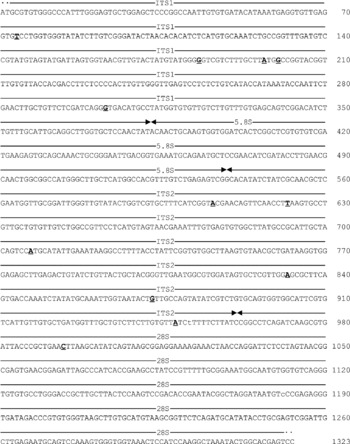
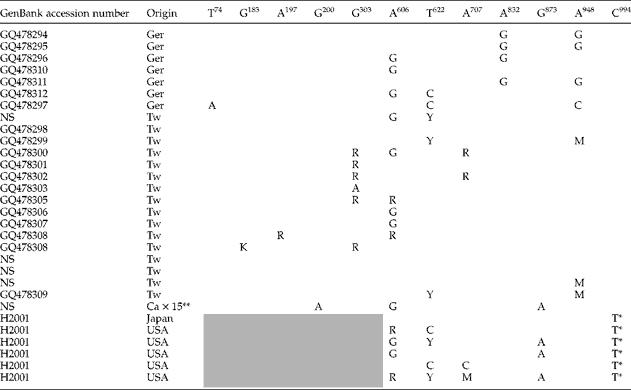
In order to establish the domain structure, one of the products was sequenced with the forward primer and two internal reverse primers (CCGTTACTAGGAGAATCCT and TCACGTACTGTTTACTC), revealing a fragment of 1383 bp spanning from internal transcribed spacer 1 (ITS1) into 28S. It was necessary to include approximately 50 bp of both of the surrounding regions 5.8S and 28S in order to have the annotation tool of the ‘ITS2 Database’ (on the website http://its2.bioapps.biozentrum.uni-wuerzburg.de) to determine the location of the ITS2 region (Eddy, Reference Eddy1998). The ITS2 region was 423 bp long, consisting of base pairs 539–961 inclusive. The boundary between ITS1 and 5.8S was determined by aligning the sequence with the one obtained from GenBank (accession no. AJ490163). The 5.8S region was 156 bp long, consisting of base pairs 383–538 inclusive. Subsequently, by use of the forward primer (GTC GTA ACA AGG TTT CCG TAG G) and the reverse primer (CAA GAC GGG TCT GGT GGA AC) PCR reactions were run and sequences of 1323 bp, including the major part of ITS1, 5.8S and the full ITS2 of P. bini rRNA genes, were obtained. The consensus sequence showing sites of substitutions is presented in fig. 1. The specific substitutions in different isolates are listed in table 1 with GenBank accession numbers where available. Analysis of the P. bini sequences from individual parasites showed high similarity for a few parasites collected in Taiwan and Germany, and at least partly corresponded to the sequence for a Japanese P. bini specimen presented by Hayward et al. (Reference Hayward, Iwashita, Crane and Ogawa2001). No GenBank accession numbers are available for the Hayward isolates that do not cover the entire sequence studied in our study. The common sequence occurred in 11 out of 16 Taiwanese samples, and in 1 out of 7 German samples a slight deviation (a single substitution) was found. Six german parasites showed deviations based on two substitutions. However, the sequence was not obtained from the Canadian parasites. Only one sequence with two unique substitutions (similar in all 15 parasites) occurred in the Canadian samples and this corresponded only partly to one of the products recovered in the USA by Hayward et al. (Reference Hayward, Iwashita, Crane and Ogawa2001). A high degree of variability between other samples from Taiwan and Germany was found (table 1). The sequences from base pair 74 to 948 exhibited individual variation among the German parasites (positions T-074, A-606, T-622, A-832, A-948). The Taiwanese parasites shared only one of these substitutions (A-606). In contrast, the region from base pair 183 to 948 in the Taiwanese individuals showed other substitutions which did not occur in German isolates (positions G-183, A-197, G-303, A-707, A-948). The Canadian sequence, as seen in 15 individual parasites, showed two unique substitutions at positions G-200 and G-873 (table 1).
The 1323 bp long consensus sequence including part of ITS1, 5.8S and of ITS2 of P. bini sequenced and analysed in this study. Underlined and bold letters indicate bases subjected to mutations as outlined in table 1.

Pseudodactylogyrus bini internal transcribed spacer (ITS) sequences. Total length investigated, 1323 bp (ITS1: bp 1–382; 5.8S: bp 383–538; ITS2: bp 539–961; 28S: from 962). Base substitutions in seven German, 16 Taiwanese and 15 Canadian parasites. H2001: Sequence presented in Hayward et al. (Reference Hayward, Iwashita, Crane and Ogawa2001)
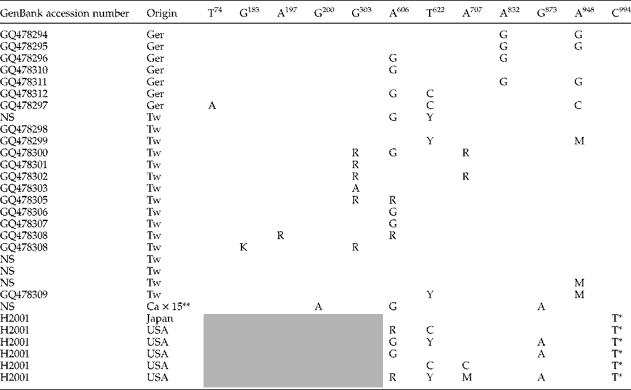
K = G or T; R = A or G; Y = C or T; M = A or C; Ger, Germany; Tw, Taiwan; Ca, Canada; T74 means that base no. 74 in the consensus sequence is a T. Grey shading indicates that Hayward et al. (Reference Hayward, Iwashita, Crane and Ogawa2001) did not present this part of the gene. T*, the nucleotide T in the USA sequences was included in the Hayward et al. (Reference Hayward, Iwashita, Crane and Ogawa2001) PCR primer and may be an artefact. NS, under submission. **, All 15 Canadian sequences were identical.
Discussion
The present report of P. bini from eels in Nova Scotia is the first record of the parasite in Canada. The lack of significant morphometric variation between P. bini parasite samples from Taiwan, Germany and Canada is not surprising as the corresponding measurements of parasite hard structures in parasite species obtained from various geographic regions have been previously reported and compared (Buchmann et al., Reference Buchmann, Mellergaard and Køie1987). Limited size variations of hard structures of worms collected in various geographical regions were found by Hayward et al. (Reference Hayward, Iwashita, Crane and Ogawa2001). Nonetheless, the aberrant morphological development of 2 out of 16 parasites from Taiwan (13%) is noteworthy. Malformed anatomical hard structures in diplectanid monogeneans have previously been reported by Oliver (Reference Oliver1994) and may be more common than reported in the literature. We have at present no causative explanation for erratic development of these hard parts but both genetic and environmental factors could be involved. It is known that aquacultured eels, at least previously (both in Europe and Asia), have been exposed to a number of different chemical treatments (Chan & Wu, Reference Chan and Wu1984; Chung et al., Reference Chung, Lin and Kou1984; Buchmann et al., Reference Buchmann, Mellergaard and Køie1987; Buchmann & Bjerregaard, Reference Buchmann and Bjerregaard1990) but the effects of such chemicals on the development of monogenean hard parts are at present unkown.
Like Hayward et al. (Reference Hayward, Iwashita, Crane and Ogawa2001) we have used molecular data to elucidate affiliations between parasites from various geographical regions. Furthermore, the sequences studied have been expanded to include the ITS1, the 5.8S and the full ITS2 region, thereby enhancing the resolution of this analysis. The ITS sequences occurring most frequently in Taiwanese and (with a single substitution) in German parasites could represent a link to the ancestral parasite population which was recently introduced from Asia to Europe. This sequence could not be differentiated from the partial ITS sequence obtained from a Japanese specimen presented by Hayward et al. (Reference Hayward, Iwashita, Crane and Ogawa2001) (GenBank accession number not available), which supports this hypothesis. The large sequence differences between some of the Taiwanese and German P. bini isolates are, on the other hand, so clear that it is tempting to suggest that the two parasite strains have been separated for some time, or that some factors have accelerated their evolution. It could be suggested that ancestral parasites from a donor population were brought to Europe, possibly from the Pacific region, and since then have developed differently in Europe compared to Taiwan. The North American P. bini sequences (Hayward et al., Reference Hayward, Iwashita, Crane and Ogawa2001) did not show the original consensus found both in Europe and Asia but affiliated with some of the European and Asian variations. The frequency of heterozygous sites found in the ITS regions (found in Asia, Europe and the USA) could indicate that the base substitutions are due to recent events. The repetitive ITS sequences in a parasite are known to be adjusted by concerted evolution over time. The high variability within one single individual could suggest that time has been too short to exert this concerted evolution. The lack of heterozygosity in Canadian samples could then be interpreted as the result of a longer history of the parasite in Canada following an ancient introduction. A second hypothesis of the Asia/Europe link may, of course, be that the parasite sub-populations in these two regions have also been separated for a much longer time due to natural migration and colonization, but in that case one should not necessarily expect almost total sequence similarity (Asia and Europe) as found in this work. A recent molecular study on the nematode Anguillicoloides crassus (Wielgoss et al., Reference Wielgoss, Taraschewski, Meyer and Wirth2008) clearly pointed to the fact that the nematode parasite was introduced into Europe by anthropogenic transfer of infected Japanese eels from Taiwan. The worms from northern Europe were rather similar compared to those from Taiwan and it appeared that the transcontinental introduction was combined with a genetic bottleneck effect, which, to a certain degree, resembles the situation with P. bini.
The present work shows that rDNA variations in individual parasite samples obtained from different geographic regions may be used as an auxiliary tool for elucidation of genetic relationship and may be used to investigate anthropogenic transfer of parasites between continents. In order to obtain a higher resolution, a higher number of specimens should be included not only from Germany, Taiwan and Canada but also from various Pacific areas, from which the two parasites have been suggested to originate. In this context it should be noted that the diagnosis of the Australian samples has been questioned by Hayward et al. (Reference Hayward, Iwashita, Crane and Ogawa2001). Thus, samples from Australia (Gussev, Reference Gussev1965) and the island of Reunion in the Indian Ocean, from other eel species (Sasal et al., Reference Sasal, Taraschewski, Valade, Grondin, Wielgoss and Moravec2008), should be subjected to further molecular investigation. It was suggested by Cone & Marcogliese (Reference Cone and Marcogliese1995) that the congener P. anguillae has had an ancient dispersal history and is naturally occurring in North America, Asia and Europe. Future studies should elucidate the rDNA patterns from individual P. anguillae obtained from these geographic regions in order to test this hypothesis.
Due to an unknown effect of environmental factors in the two regions, it is difficult to date the time for dispersal. It is quite possible that the dispersal history of the two congeners differs. Pseudodactylogyrus bini is stenohaline and does not tolerate high salt concentrations for an extended time (Buchmann et al., Reference Buchmann, Felsing and Slotved1992), which will inhibit spreading by natural migration from continent to continent in the sea. Therefore, transfer of this species could demand human interference for spread between continents. In contrast, P. anguillae tolerates salinities occurring in marine habitats, which will allow some parasite dispersal with natural migration of eels.