1 Introduction
In this paper we study the Furstenberg-entropy realization problem, which we will describe below. We propose a new construction of families of invariant random subgroups, that is of independent interest. For the realization problem, we prove a continuity result of the Furstenberg-entropy along spaces associated with these families.
We apply this construction to free groups and lamplighter groups, generalizing results of Bowen [Reference BowenBow14] and of the first named author with Tamuz [Reference Hartman and TamuzHT15]. In addition, we apply it to the group of finitely supported infinite permutations and to certain extensions of this group, establishing a full realization result for this class of groups. Let us introduce the notions and results precisely.
Let
 $G$
be a countable discrete group and let
 $\unicode[STIX]{x1D707}$
be a probability measure on
 $G$
. We will always assume that
 $\unicode[STIX]{x1D707}$
is generating and of finite entropy; that is, the support of
 $\unicode[STIX]{x1D707}$
generates
 $G$
as a semigroup and the Shannon entropy of
 $\unicode[STIX]{x1D707}$
is finite,
 $H(\unicode[STIX]{x1D707}):=-\sum _{g}\unicode[STIX]{x1D707}(g)\log \unicode[STIX]{x1D707}(g)<\infty$
.
Suppose that
 $G$
acts measurably on a standard probability space
 $(X,\unicode[STIX]{x1D708})$
. This induces an action on the probability measure
 $\unicode[STIX]{x1D708}$
given by
 $g\unicode[STIX]{x1D708}(\cdot )=\unicode[STIX]{x1D708}(g^{-1}\cdot )$
. The action
 $G\curvearrowright (X,\unicode[STIX]{x1D708})$
is called
 $(G,\unicode[STIX]{x1D707})$
-stationary if
 $\sum _{g\in G}\unicode[STIX]{x1D707}(g)g\unicode[STIX]{x1D708}=\unicode[STIX]{x1D708}$
. Thus, the measure
 $\unicode[STIX]{x1D708}$
is not necessarily invariant, but only ‘invariant on average’. An important quantity associated to a stationary space is the Furstenberg-entropy, given by
 $$\begin{eqnarray}h_{\unicode[STIX]{x1D707}}(X,\unicode[STIX]{x1D708}):=-\mathop{\sum }_{g\in G}\unicode[STIX]{x1D707}(g)\int _{X}\log \frac{dg^{-1}\unicode[STIX]{x1D708}}{d\unicode[STIX]{x1D708}}\,d\unicode[STIX]{x1D708}(x).\end{eqnarray}$$
It is easy to see that
 $h_{\unicode[STIX]{x1D707}}(X,\unicode[STIX]{x1D708})\geqslant 0$
and that equality holds if and only if the measure
 $\unicode[STIX]{x1D708}$
is invariant (invariant means
 $g\unicode[STIX]{x1D708}=\unicode[STIX]{x1D708}$
for all
 $g\in G$
). A classical result of Kaimanovich and Vershik [Reference Kaimanovich and VershikKV83] asserts that the Furstenberg-entropy of any
 $(G,\unicode[STIX]{x1D707})$
-stationary space is bounded above by the random walk entropy
 $$\begin{eqnarray}h_{RW}(G,\unicode[STIX]{x1D707}):=\lim _{n\rightarrow \infty }\frac{1}{n}H(\unicode[STIX]{x1D707}^{n}),\end{eqnarray}$$
where
 $\unicode[STIX]{x1D707}^{n}$
denotes the
 $n$
th convolution power of
 $\unicode[STIX]{x1D707}$
. As a first step of classification of the possible
 $(G,\unicode[STIX]{x1D707})$
-stationary actions for a given
 $\unicode[STIX]{x1D707}$
, one may consider the following definitions.
Definition 1.1. We say that
 $(G,\unicode[STIX]{x1D707})$
has an entropy gap if there exists some
 $c>0$
such that whenever
 $h_{\unicode[STIX]{x1D707}}(X,\unicode[STIX]{x1D708})<c$
for an ergodic
 $(G,\unicode[STIX]{x1D707})$
-stationary action
 $(X,\unicode[STIX]{x1D708})$
then
 $h_{\unicode[STIX]{x1D707}}(X,\unicode[STIX]{x1D708})=0$
. Otherwise we say that
 $(G,\unicode[STIX]{x1D707})$
has no-gap.
We say that
 $(G,\unicode[STIX]{x1D707})$
admits a full realization if any number in
 $[0,h_{RW}(G,\unicode[STIX]{x1D707})]$
can be realized as the Furstenberg-entropy of some ergodic
 $(G,\unicode[STIX]{x1D707})$
-stationary space.
Let us remark that choosing only ergodic actions
 $G\curvearrowright (X,\unicode[STIX]{x1D708})$
is important. Otherwise the definitions are non-interesting, since by taking convex combinations one can always realize any value.
The motivation for the gap definition comes from Nevo’s result in [Reference NevoNev03] showing that any discrete group with property (T) admits an entropy gap, for any
 $\unicode[STIX]{x1D707}$
. The converse however is not true (see, for example, [Reference Bowen, Hartman and TamuzBHT17, § 7.2]) and it is interesting to describe the class of groups (and measures) with no-gap.
Our main result is the following.
Theorem 1.2. Let
 $\unicode[STIX]{x1D707}$
be a finitely supported, generating probability measure on the free group
 $\mathbb{F}_{r}$
on
 $2\leqslant r<\infty$
generators. Then
 $(\mathbb{F}_{r},\unicode[STIX]{x1D707})$
admits a full realization.
As will be explained below (see Remark 4.9), the restriction to finitely supported measures
 $\unicode[STIX]{x1D707}$
is technical and it seems that the result should hold in a wider generality. The case where
 $\unicode[STIX]{x1D707}$
is the simple random walk (uniform measure on the standard generators and their inverses) was done by Bowen [Reference BowenBow14]. We elaborate on the similarity and differences with Bowen’s result below.
Our next result provides a solution for lamplighter groups.
Theorem 1.3. Let
 $G=\bigoplus _{B}L\rtimes B$
be a lamplighter group where
 $L$
and
 $B$
are some non-trivial countable discrete groups, and assume that
 $B$
is infinite. Let
 $\unicode[STIX]{x1D707}$
be a generating probability measure with finite entropy on
 $G$
and denote by
 $\bar{\unicode[STIX]{x1D707}}$
the projection of
 $\unicode[STIX]{x1D707}$
onto the quotient
 $B\cong G/(\bigoplus _{B}L\rtimes \{1\})$
.
Then, whenever
 $(B,\bar{\unicode[STIX]{x1D707}})$
is Liouville,
 $(G,\unicode[STIX]{x1D707})$
admits a full realization.
Here, Liouville is just the property that the random walk entropy is zero. For example, if the base group
 $B$
is finitely generated and virtually nilpotent, then
 $B$
is Liouville for any measure
 $\unicode[STIX]{x1D707}$
(see Theorem 2.4 below).
In [Reference Hartman and TamuzHT15], the first-named author and Tamuz prove that a dense set of values can be realized, under an additional technical condition on the random walk.
In addition, our tools apply also to nilpotent extensions of
 $\text{Sym}_{\ast }(X)$
, the group of finitely supported permutations of an infinite countable set
 $X$
. We denote by
 $\text{Sym}(X)$
the group of all permutations of
 $X$
.
Theorem 1.4. Let
 $\unicode[STIX]{x1D6F4}\leqslant \text{Sym}(X)$
be a finitely generated nilpotent group and consider
 $G=\text{Sym}_{\ast }(X)\rtimes \unicode[STIX]{x1D6F4}$
. Let
 $\unicode[STIX]{x1D707}$
be a generating finite entropy probability measure on
 $G$
. Then
 $(G,\unicode[STIX]{x1D707})$
has full realization.
Once the projected measure
 $\bar{\unicode[STIX]{x1D707}}$
on
 $\unicode[STIX]{x1D6F4}\cong G/\text{Sym}_{\ast }(X)$
is transient, we get that
 $h_{RW}(G,\unicode[STIX]{x1D707})>0$
, and this realization result has content. As a concrete example, one can label
 $X$
by
 $\mathbb{Z}^{3}$
, and to take
 $\unicode[STIX]{x1D6F4}\cong \mathbb{Z}^{3}$
to be the group generated by the natural shifts. See § 3.4 for further generalizations. To our knowledge it is an open question whether the group
 $\text{Sym}_{\ast }(X)$
itself is Liouville for any
 $\unicode[STIX]{x1D707}$
(or not). If we were to choose above
 $\unicode[STIX]{x1D6F4}=\{\text{id}\}$
then
 $\text{Sym}_{\ast }(X)\rtimes \unicode[STIX]{x1D6F4}\cong \text{Sym}_{\ast }(X)$
. So a consequence of Theorem 1.4 is that the group
 $\text{Sym}_{\ast }(X)$
itself has full realization for any
 $\unicode[STIX]{x1D707}$
. Of course, this may be a trivial result if
 $(\text{Sym}_{\ast }(X),\unicode[STIX]{x1D707})$
is Liouville, in which case the only possible entropy value is
 $0$
.
Following the basic approach of Bowen in [Reference BowenBow14], our realization results use only a specific type of stationary actions known as Poisson bundles that are constructed out of invariant random subgroups. An invariant random subgroup, or IRS, of
 $G$
, is random subgroup whose law is invariant to the natural
 $G$
-action by conjugation. IRSs serve as a stochastic generalization of a normal subgroup and arise naturally as the stabilizers of probability measure preserving actions. In fact, any IRS is obtained in that way (see [Reference Abért, Glasner and VirágAGV14, Proposition 14] for the discrete case, and [Reference Abert, Bergeron, Biringer, Gelander, Nikolov, Raimbault and SametABB+17] for the general case). Since the term IRS was coined in [Reference Abert, Glasner and ViragAGV16], they have featured in many works and inspired much research.
In this paper we construct explicit families of IRSs for the free group, the lamplighter group and
 $\text{Sym}_{\ast }(X)$
. For further discussion about the structure of IRSs on these groups the reader is referred to the works of Bowen [Reference BowenBow15] for the free group, Bowen et al. [Reference Bowen, Grigorchuk and KravchenkoBGK15] for lamplighter groups and Vershik [Reference VershikVer12] for the
 $\text{Sym}_{\ast }(X)$
case.
Given an ergodic IRS of a group
 $G$
, one can construct an ergodic stationary space which is called a Poisson bundle. These were introduced by Kaimanovich in [Reference KaimanovichKai05] and were further studied by Bowen in [Reference BowenBow14]. In particular, it was shown in [Reference BowenBow14] that the Furstenberg-entropy of a Poisson bundle constructed using an IRS, equals the random walk entropy of the random walk on the associated coset space (this will be made precise below). Hence our main results can be interpreted as realization results for the random walk entropies of coset spaces associated with ergodic IRSs.
Given a subgroup with an infinite conjugacy class, we develop a general tool to construct a family of ergodic IRSs, that we call intersectional IRSs. This family of IRSs is obtained by randomly intersecting subgroups from the conjugacy class (see § 3). Furthermore, we prove that under a certain condition related to the measure
 $\unicode[STIX]{x1D707}$
and the conjugacy class, the random walk entropy varies continuously along this family of IRSs (see § 3.2). In fact, in some cases we may find a specific conjugacy class that satisfies the above mentioned condition for any measure
 $\unicode[STIX]{x1D707}$
. An example of such, is a conjugacy class that we call ‘locally co-nilpotent’. These are conjugacy classes such that their associated Schreier graphs satisfy some geometric condition which we describe in § 4.5.
Using such families of IRSs we get our main tool for constructing a continuum of entropy values.
Proposition 1.5. Let
 $G$
be a countable discrete group. Assume that there exists a conjugacy class of subgroups which is locally co-nilpotent. (See just before Corollary 3.6 and § 4.5 for the precise definition of locally co-nilpotent.) Denote its normal core by
 $N{\vartriangleleft}G$
.
Then, for any finite entropy, generating, probability measure
 $\unicode[STIX]{x1D707}$
on
 $G$
, if
 $G/N$
has positive
 $\unicode[STIX]{x1D707}$
-random walk entropy, then
 $(G,\unicode[STIX]{x1D707})$
has no-gap.
Furthermore, if the normal core
 $N$
is trivial, then
 $(G,\unicode[STIX]{x1D707})$
admits a full realization.
Note that this proposition reveals a structural condition on
 $G$
and its subgroups that allows to conclude realization results for many different measures
 $\unicode[STIX]{x1D707}$
at the same time. Furthermore, these realization results do not depend on the description of the Furstenberg–Poisson boundary.
By constructing conjugacy classes in lamplighter groups and in
 $\text{Sym}_{\ast }(X)$
with the relevant properties, we obtain Theorems 1.3 and 1.4. However, the case of the free group is more complicated. In § 4.3 we show how to construct many subgroups of the free group with a conjugacy class which is locally co-nilpotent, and such that
 $G/N$
has positive random walk entropy where
 $N$
is the normal core of the conjugacy class. This is enough to realize an interval of entropy values around
 $0$
, showing in particular, that the free group admits no-gap for any
 $\unicode[STIX]{x1D707}$
with finite entropy. The fact that the free group admits no-gap for any finite first moment
 $\unicode[STIX]{x1D707}$
was proved in [Reference Hartman and TamuzHT15].
Theorem 1.6. Let
 $\unicode[STIX]{x1D707}$
be a finite entropy generating probability measure on the free group
 $\mathbb{F}_{r}$
on
 $2\leqslant r<\infty$
generators. Then
 $(\mathbb{F}_{r},\unicode[STIX]{x1D707})$
has an interval of the form
 $[0,c]$
of realizable values.
However, there is no single (self-normalizing) subgroup of the free group which has a locally co-nilpotent conjugacy class and a trivial normal core (see Lemma 3.7). The importance of the requirement that the normal core
 $N$
is trivial, is to ensure that the random walk entropy on
 $G/N$
is equal to the full random walk entropy. Hence, to prove a full realization for the free group, we approximate this property. That is, we find a sequence of conjugacy classes which are all locally co-nilpotent, and such that their normal cores satisfy that the random walk entropy on the quotients tends to
 $h_{RW}(G,\unicode[STIX]{x1D707})$
.
Finding such a sequence is quite delicate, and proving it is a bit technical. The difficulty comes from the fact that entropy is semi-continuous, but in the ‘wrong direction’ (see Theorem 2.2 and the discussion after). It is for this analysis that we need to assume that
 $\unicode[STIX]{x1D707}$
is finitely supported, although it is plausible that this condition can be relaxed. By that we mean that the very same conjugacy classes we construct in this paper might satisfy that random walk entropy on the quotients by their normal cores tends to
 $h_{RW}(G,\unicode[STIX]{x1D707})$
, even for infinitely supported
 $\unicode[STIX]{x1D707}$
as well (perhaps under some further regularity conditions, such as some moment conditions).
1.1 Intersectional IRSs
We now explain how to construct intersectional IRSs.
Let
 $K\leqslant G$
be a subgroup with an infinite conjugacy class
 $|K^{G}|=\infty$
(we use the notation
 $K^{g}=g^{-1}Kg$
for conjugation). We may index this conjugacy class by the natural numbers:
 $K^{G}=(K_{m})_{m\in \mathbb{N}}$
. It is readily checked that the
 $G$
-action (by conjugation) on the conjugacy class
 $K^{G}$
is translated to an action by permutations on
 $\mathbb{N}$
. Namely, for
 $g\in G,m\in \mathbb{N}$
, we define
 $g.m$
to be the unique integer such that
 $(K_{m})^{g}=K_{g.m}$
. Thus,
 $G$
also acts on subsets
 $S\subset \mathbb{N}$
element-wise.
Given a non-empty subset
 $S\subset \mathbb{N}$
, we may associate to
 $S$
a subgroup
 $\text{Core}_{S}(K)=\bigcap _{s\in S}K_{s}$
. If
 $S$
is chosen to be random, with a law invariant to the
 $G$
-action, then the random subgroup
 $\text{Core}_{S}(K)$
is an IRS. Moreover, it is quite simple to get such a law: for a parameter
 $p\in (0,1]$
let
 $S$
be
 $p$
-percolation on
 $\mathbb{N}$
; that is, every element
 $m\in \mathbb{N}$
belongs to
 $S$
with probability
 $p$
independently.
There are a few issues with this construction.
∙ It is not immediately clear what should be associated to the ‘empty intersection’ when
 $S=\emptyset$
. In § 3.1 we give an appropriate definition, which follows from a construction of an associated ‘semi-norm’ on the group
$G$
. This will turn out to be a normal subgroup of
$G$
that we denote by
$\text{Core}_{\emptyset }(K)$
.
∙ Note that
$p=1$
corresponds to the non-random subgroup
$\text{Core}_{G}(K)$
, which is just the normal core of the conjugacy class
$K^{G}$
. This is also a normal subgroup, and
$\text{Core}_{G}(K){\vartriangleleft}\text{Core}_{\emptyset }(K)$
.∙ It seems very reasonable that as
$p$
varies, certain quantities related to the IRS should vary continuously. In § 3.2 we provide a condition on the conjugacy class
$K^{G}$
that guarantees that the Furstenberg-entropy is indeed continuous in
$p$
.





After establishing continuity of the Furstenberg-entropy in
 $p$
, one wishes to show that the full interval
 $[0,h_{RW}(G,\unicode[STIX]{x1D707})]$
of possible entropy values is realized. As mentioned above, in the free group we must use a sequence of subgroups
 $K_{n}$
(or conjugacy classes), such that the random walk entropy of the quotient
 $G/\text{Core}_{G}(K_{n})$
is large, and push this quotient entropy all the way up to the full random walk entropy
 $h_{RW}(G,\unicode[STIX]{x1D707})$
.
This leads to a study of
 $\text{Core}_{G}(K_{n})$
, the normal cores of a sequence of subgroups
 $(K_{n})_{n}$
, with the objective of showing that
 $\text{Core}_{G}(K_{n})$
are becoming ‘smaller’ in some sense. As will be discussed below, a naive condition such as having
 $\text{Core}_{G}(K_{n})$
converge to the trivial group does not suffice. In our case it is sufficient to approximate the Furstenberg–Poisson boundary of the random walk on the full group by the boundaries of the quotients. By that we mean that we need to find a sequence such that one can recover the point in the boundary of the random walk on the free group, by observing the projections in the boundaries of the quotients
 $G/\text{Core}_{G}(K_{n})$
. (For a rigorous mathematical statement see Lemma 4.6.)
However, we construct the subgroups
 $K_{n}$
geometrically, by specifying their associated Schreier graphs (and not by specifying the algebraic properties of the subgroup). Hence the structure of
 $\text{Core}_{G}(K_{n})$
and in particular the Furstenberg–Poisson boundary of
 $G/\text{Core}_{G}(K_{n})$
is somewhat mysterious. A further geometric argument using the random walk on the aforementioned Schreier graph (specifically transience of this random walk) allows us to ‘sandwich’ the entropy of
 $G/\text{Core}_{G}(K_{n})$
and thus show that these entropies tend to the correct limiting value. This is done in § 4.
It may be interesting for some readers to note that in the simple random walk case considered by Bowen [Reference BowenBow14], he also shows a full realization by growing intervals of possible entropy values. However, Bowen obtains the intervals of realization differently than us. In fact, he proves that the entropy is continuous when restricting to a specific family of subgroups which are ‘tree-like’. This is a global property of the Schreier graph that enables him to analyze the random walk entropy of the simple random walk and to prove a continuity result. Next, within this class of tree-like subgroups he finds paths of IRSs obtaining realization of intervals of the form
 $[\unicode[STIX]{x1D700}_{n},h_{RW}(G,\unicode[STIX]{x1D707})]$
for
 $\unicode[STIX]{x1D700}_{n}\rightarrow 0$
(‘top down’). While it is enough for a full realization for the simple random walk, the condition of being tree-like is quite restrictive, and difficult to apply to other measures
 $\unicode[STIX]{x1D707}$
on the free group.
In contrast, based on Proposition 1.5, our results provide realization on intervals of the form
 $[0,h_{RW}(G,\unicode[STIX]{x1D707})-\unicode[STIX]{x1D700}_{n}]$
for
 $\unicode[STIX]{x1D700}_{n}\rightarrow 0$
(‘bottom up’). In order to ‘push’ the entropy to the top we also use a geometric condition, related to trees. However, this condition is more ‘local’ in nature, and considers only finite balls in the Scherier graph. In particular, we show in § 4.6 that it is easy to construct many subgroups that satisfy our conditions. Also, it enables us to work with any finitely supported measure.
1.2 Related results
The first realization result is due to Nevo and Zimmer [Reference Nevo and ZimmerNZ00], where they prove that connected semi-simple Lie groups with finite center and
 $\mathbb{R}\text{-rank}$
at least
 $2$
admit only finitely many entropy values under some mixing condition on the action. They also show that this fails for lower rank groups, such as
 $\text{PSL}_{2}(\mathbb{R})$
, by finding infinitely many entropy values. However, no other guarantees are given regarding these values.
The breakthrough of the realization results is the mentioned result of Bowen [Reference BowenBow14], where he makes a use of IRSs for realization purposes. He proves a full realization for simple random walks on free groups
 $\mathbb{F}_{r}$
where
 $2\leqslant r<\infty$
.
In [Reference Hartman and TamuzHT15], the first-named author and Tamuz prove a dense realization for lamplighter groups with Liouville base. Furthermore, it is shown that virtually free groups, such as
 $\text{SL}_{2}(\mathbb{Z})$
, admit no-gap.
In a recent paper [Reference Burton, Lupini and TamuzBLT16], Burton et al. prove that the Furstenberg-entropy is an invariant of weak equivalence of stationary actions.
2 Preliminaries
2.1 Stationary spaces
Throughout the paper we assume that
 $G$
is a discrete countable group and that
 $\unicode[STIX]{x1D707}$
is a generating probability measure on
 $G$
.
A measurable action
 $G\curvearrowright (X,\unicode[STIX]{x1D708})$
where
 $(X,\unicode[STIX]{x1D708})$
is a standard probability spaces is called
 $(G,\unicode[STIX]{x1D707})$
-stationary if
 $\sum _{g\in G}\unicode[STIX]{x1D707}(g)g\unicode[STIX]{x1D708}=\unicode[STIX]{x1D708}$
. The basic example of non-invariant
 $(G,\unicode[STIX]{x1D707})$
-stationary action is the action on the Furstenberg–Poisson boundary,
 $\unicode[STIX]{x1D6F1}(G,\unicode[STIX]{x1D707})$
(the amount of literature on the Furstenberg–Poisson boundary is vast, and we do not attempt to give a comprehensive overview of this topic; see, for example, [Reference FurstenbergFur73, Reference FurstenbergFur71, Reference Furstenberg and GlasnerFG10, Reference FurmanFur02] and references therein for more on this topic).
The Kakutani fixed point theorem implies that whenever
 $G$
acts continuously on a compact space
 $X$
, there is always some
 $\unicode[STIX]{x1D707}$
-stationary measure on
 $X$
. However, there are not many explicit descriptions of stationary measures. One way to construct stationary actions is via the Poisson bundle constructed from an IRS as follows. Denote by
 $\text{Sub}_{G}$
the space of all subgroups of
 $G$
(recall that
 $G$
is discrete). This space admits a topology, induced by the product topology on subsets of
 $G$
, known as the Chabauty topology. Under this topology,
 $\text{Sub}_{G}$
is a compact space, with a natural right action by conjugation (
 $K^{g}=g^{-1}Kg$
where
 $K\in \text{Sub}_{G}$
), which is continuous. An Invariant Random Subgroup (IRS) is a Borel probability measure
 $\unicode[STIX]{x1D706}$
on
 $\text{Sub}_{G}$
which is invariant under this conjugation action. It is useful to think of an IRS also as a random subgroup with a conjugation invariant law
 $\unicode[STIX]{x1D706}$
. For more background regarding IRSs we refer the interested reader to [Reference Abert, Glasner and ViragAGV16, Reference Abért, Glasner and VirágAGV14].
Fix a probability measure
 $\unicode[STIX]{x1D707}$
on
 $G$
. Given an IRS
 $\unicode[STIX]{x1D706}$
of
 $G$
, one can consider the Poisson bundle over
 $\unicode[STIX]{x1D706}$
, denoted by
 $B_{\unicode[STIX]{x1D707}}(\unicode[STIX]{x1D706})$
. This is a probability space with a
 $(G,\unicode[STIX]{x1D707})$
stationary action, and when
 $\unicode[STIX]{x1D706}$
is an ergodic IRS, the action on
 $B_{\unicode[STIX]{x1D707}}(\unicode[STIX]{x1D706})$
is ergodic.
Poisson bundles were introduced in a greater generality by Kaimanovich in [Reference KaimanovichKai05]. In [Reference BowenBow14] Bowen relates Poisson bundles to IRSs. Although the stationary spaces that we construct in this paper are all Poisson bundles, we do not elaborate regarding this correspondence, as this will not be important for understanding our results. Rather, we refer the interested reader to [Reference Hartman and TamuzHT16, Reference BowenBow14, Reference Hartman and TamuzHT15, Reference KaimanovichKai05], and mention here the important features of Poisson bundles that are relevant to our context. To describe these features, we now turn to describe Schreier graphs.
2.2 Schreier graphs
Since we will use Schreier graphs only in the context of the free group, we assume in this section that
 $G$
is a free group. To keep the presentation simple, we consider
 $G=\mathbb{F}_{2}$
the free group on two generators, generated by
 $a$
and
 $b$
. The generalization to higher rank is straightforward.
Let
 $K\in \text{Sub}_{G}$
. The Schreier graph associated with
 $K$
is a rooted oriented graph, with edges labeled by
 $a$
and
 $b$
, which is defined as follows. The set of vertices is the coset space
 $K\backslash G$
and the set of edges is
 $\{(Kg,Kga),(Kg,Kgb):Kg\in K\backslash G\}$
. Edges of the type
 $(Kg,Kga)$
are labeled by
 $a$
and of the type
 $(Kg,Kgb)$
are labeled by
 $b$
. It may be the case that there are multiple edges between vertices, as well as self loops. The root of the graph is defined to be the trivial coset
 $K$
.
From this point on, it is important that we are working with the free group, and not a general group which is generated by two elements. Consider an abstract (connected) rooted graph with oriented edges. Suppose that every vertex has exactly two incoming edges labeled by
 $a$
and
 $b$
, and two outgoing edges labeled by
 $a$
and
 $b$
. We may then consider this graph as a Schreier graph of the free group.
Indeed, given such a graph
 $\unicode[STIX]{x1D6E4}$
one can recover the subgroup
 $K$
as follows. Given any element
 $g=w_{1}\cdots w_{n}$
, of the free group (where
 $w_{1}\cdots w_{n}$
is a reduced word in
 $\{a,a^{-1},b,b^{-1}\}$
) and a vertex
 $v$
in the graph, one can ‘apply the element
 $g$
to the vertex
 $v$
’ to get another vertex denoted
 $v.g$
, as follows.
∙ Given
$w_{i}\in \{a,b\}$
move from
$v$
to the adjacent vertex
$u=v.w_{i}$
such that the oriented edge
$(v,u)$
is labeled by
$w_{i}$
.∙ Given
$w_{i}\in \{a^{-1},b^{-1}\}$
move from
$v$
to the adjacent vertex
$u=v.w_{i}$
such that the oriented edge
$(u,v)$
is labeled
$w_{i}^{-1}$
(that is, follow the label
$w_{i}$
using the reverse orientation).∙ Given
$g=w_{1}\cdots w_{n}$
written as a reduced word in the generators, apply the generators one at a time, to get
$v.g=(\cdots ((v.w_{1}).w_{2})\ldots ).w_{n}$
.






Thus, we arrive at a right action of
 $G$
on the vertex set. Note that this action is not by graph automorphisms, rather only by permutations of the vertex set. We say that
 $g$
preserves
 $v$
if
 $v.g=v$
.
To recover the subgroup
 $K\leqslant \mathbb{F}_{2}$
from a graph
 $\unicode[STIX]{x1D6E4}$
as above, let
 $K$
be the set of all elements of the free group that preserve the root vertex. Moreover, changing the root, that is, recovering the graph which is obtained be taking the same labeled graph but when considering a different vertex as the root, yields a conjugation of
 $K$
as the corresponding subgroup. Namely, if the original root was
 $v$
with a corresponding subgroup
 $K$
, and if the new root is
 $v.g$
for some
 $g$
, then one gets the corresponding subgroup
 $K^{g}$
. Hence when ignoring the root, one can think of the Schreier graph as representing the conjugacy class
 $K^{G}$
. In particular, if
 $K$
is the subgroup associated with a vertex
 $v$
, and
 $g$
is such that when rooting the Schreier graph in
 $v$
and in
 $v.g$
we get two isomorphic labeled graphs, then
 $g$
belongs to the normalizer
 $N_{G}(K)=\{g\in G:K^{g}=K\}$
.
The subgroups of the free group that we will construct will be described by their Schreier graph. In the following section we explain the connection between Schreier graphs and Poisson bundles, which is why using Schreier graphs to construct subgroups is more adapted to our purpose.
2.3 Random walks on Schreier graphs
Fix a generating probability measure
 $\unicode[STIX]{x1D707}$
on a group
 $G$
. Let
 $(X_{t})_{t=1}^{\infty }$
be independent and identically distributed (i.i.d.) random variables taking values in
 $G$
with law
 $\unicode[STIX]{x1D707}$
, and let
 $Z_{t}=X_{1}\cdots X_{t}$
be the position of the
 $\unicode[STIX]{x1D707}$
-random walk at time
 $t$
.
Let
 $K$
be a subgroup. Although this discussion holds for any group, since we defined Schreier graphs in the context of the free group, assume that
 $G=\mathbb{F}_{2}$
.
The Markov chain
 $(KZ_{t})_{t}$
has a natural representation on the Schreier graph associated with
 $K$
, by just considering the position on the graph at time
 $t$
to be
 $v.Z_{t}$
where
 $v$
is a root associated with
 $K$
. (This is the importance of considering left-Schreier graphs and right-random walks.) This is a general correspondence, not special to the free group.
The boundary of the Markov chain
 $KZ_{t}$
where
 $K$
is fixed, is the boundary of the random walk on the graph that starts in
 $v$
, namely, the collection of tail events of this Markov chain. The Poisson bundle is a bundle of such boundaries, or, alternatively, it is the boundary of the Markov chain
 $KZ_{t}$
where
 $K$
is a random subgroup distributed according to
 $\unicode[STIX]{x1D706}$
. This perspective was our intuition behind the construction in § 4.
2.4 Random walk entropy
Recall that we assume throughout that all random walk measures
 $\unicode[STIX]{x1D707}$
have finite entropy, that is
 $H(Z_{1})=-\sum _{g}\mathbb{P}[Z_{1}=g]\log (\mathbb{P}[Z_{1}=g])<\infty$
where
 $Z_{t}$
as usual is the position of the
 $\unicode[STIX]{x1D707}$
-random walk at time
 $t$
. The sequence of numbers
 $H(Z_{t})$
is a sub-additive sequence so the following limit exists and finite.
Definition 2.1. The random walk entropy of
 $(G,\unicode[STIX]{x1D707})$
is given by
 $$\begin{eqnarray}h_{RW}(G,\unicode[STIX]{x1D707})=\lim _{t\rightarrow \infty }\frac{1}{t}H(Z_{t}).\end{eqnarray}$$
The Furstenberg-entropy of a
 $(G,\unicode[STIX]{x1D707})$
-stationary space,
 $(X,\unicode[STIX]{x1D708})$
is given by
 $$\begin{eqnarray}h_{\unicode[STIX]{x1D707}}(X,\unicode[STIX]{x1D708})=-\mathop{\sum }_{g\in G}\unicode[STIX]{x1D707}(g)\int _{X}\log \frac{dg^{-1}\unicode[STIX]{x1D708}}{d\unicode[STIX]{x1D708}}\,d\unicode[STIX]{x1D708}(x).\end{eqnarray}$$
By Jensen’s inequality,
 $h_{\unicode[STIX]{x1D707}}(X,\unicode[STIX]{x1D708})\geqslant 0$
and equality holds if and only if the action is a measure preserving action. Furthermore, Kaimanovich and Vershik proved in [Reference Kaimanovich and VershikKV83] that
 $h_{\unicode[STIX]{x1D707}}(X,\unicode[STIX]{x1D708})\leqslant h_{RW}(G,\unicode[STIX]{x1D707})$
for any stationary action
 $(X,\unicode[STIX]{x1D708})$
, and equality holds for the Furstenberg–Poisson boundary, namely
 $$\begin{eqnarray}\displaystyle h_{\unicode[STIX]{x1D707}}(\unicode[STIX]{x1D6F1}(G,\unicode[STIX]{x1D707}))=h_{RW}(G,\unicode[STIX]{x1D707}), & & \displaystyle\end{eqnarray}$$
where
 $\unicode[STIX]{x1D6F1}(G,\unicode[STIX]{x1D707})$
denotes the Furstenberg–Poisson boundary of
 $(G,\unicode[STIX]{x1D707})$
.
If
 $h_{RW}(G,\unicode[STIX]{x1D707})=0$
the pair
 $(G,\unicode[STIX]{x1D707})$
is called Liouville, which is equivalent to triviality of the Furstenberg–Poisson boundary.
The Furstenberg-entropy realization problem is to find the exact values in the interval
 $[0,h_{RW}(G,\unicode[STIX]{x1D707})]$
which are realized as the Furstenberg entropy of ergodic stationary actions.
In a similar way to the Kaimanovich–Vershik formula (1), Bowen proves the following.
Theorem 2.2 (Bowen, [Reference BowenBow14]).
Let
 $\unicode[STIX]{x1D706}$
be an IRS of
 $G$
. Then
 $$\begin{eqnarray}\displaystyle h_{\unicode[STIX]{x1D707}}(B_{\unicode[STIX]{x1D707}}(\unicode[STIX]{x1D706}))=\lim _{t\rightarrow \infty }\frac{1}{t}\int _{\text{Sub}_{G}}H(KZ_{t})\,d\unicode[STIX]{x1D706}(K)=\inf _{t}\frac{1}{t}\int _{\text{Sub}_{G}}H(KZ_{t})\,d\unicode[STIX]{x1D706}(K). & & \displaystyle\end{eqnarray}$$
Moreover, the
 $(G,\unicode[STIX]{x1D707})$
-stationary space is ergodic if (and only if) the IRS
 $\unicode[STIX]{x1D706}$
is ergodic.
This reduces the problem of finding
 $(G,\unicode[STIX]{x1D707})$
-stationary actions with many Furstenberg-entropy values in
 $[0,h_{RW}(G,\unicode[STIX]{x1D707})]$
, to finding IRSs
 $\unicode[STIX]{x1D706}$
with many different random walk entropy values.
Regarding continuity, recall that the space
 $\text{Sub}_{G}$
is equipped with the Chabauty topology. For finitely generated groups this topology is induced by the natural metric for which two subgroups are close if they share the exact same elements from a large ball in
 $G$
. One concludes that the Shannon entropy as a function on
 $\text{Sub}_{G}$
, namely
 $K\mapsto H(KZ_{1})$
, is a continuous function.
The topology on
 $\text{Sub}_{G}$
induces a weak* topology on,
 $\text{Prob}(\text{Sub}_{G})$
, the space of IRSs of
 $G$
. By the continuity of
 $H$
and the second equality in (2) we get that the Furstenberg-entropy of Poisson bundles of the form
 $B_{\unicode[STIX]{x1D707}}(\unicode[STIX]{x1D706})$
is an upper semi-continuous function of the IRS. Since the entropy is non-negative we conclude the following.
Corollary 2.3 (Bowen, [Reference BowenBow14]).
If
 $\unicode[STIX]{x1D706}_{n}\rightarrow \unicode[STIX]{x1D706}$
in the weak* topology on
 $\text{Prob}(\text{Sub}_{G})$
, such that
 $h_{\unicode[STIX]{x1D707}}(B_{\unicode[STIX]{x1D707}}(\unicode[STIX]{x1D706}))=0$
then
 $h_{\unicode[STIX]{x1D707}}(B_{\unicode[STIX]{x1D707}}(\unicode[STIX]{x1D706}_{n}))\rightarrow 0$
.
However, it is important to notice that the Furstenberg-entropy is far from being a continuous function of the IRS. Indeed, consider the free group, which is residually finite. There exists a sequence of normal subgroups
 $N_{n}$
, such that
 $N_{n}\backslash \mathbb{F}_{2}$
is finite for any
 $n$
, which can be chosen so that, when considered as IRSs
 $\unicode[STIX]{x1D706}_{n}=\unicode[STIX]{x1D6FF}_{N_{n}}$
, we have
 $\unicode[STIX]{x1D706}_{n}\rightarrow \unicode[STIX]{x1D6FF}_{\{e\}}$
. In that case
 $h_{\unicode[STIX]{x1D707}}(B_{\unicode[STIX]{x1D707}}(\unicode[STIX]{x1D706}_{n}))=0$
for all
 $n$
(because
 $H(N_{n}Z_{t})$
is bounded in
 $t$
), but
 $B_{\unicode[STIX]{x1D707}}(\unicode[STIX]{x1D6FF}_{\{e\}})$
is the Furstenberg–Poisson boundary of the free group, and its Furstenberg entropy is positive for any
 $\unicode[STIX]{x1D707}$
(follows for example from the non-amenability of the free group).
We want to point out that this lack of continuity makes it delicate to find conditions on quotients of the free group to have large entropy. In § 4 we will deal with this problem by introducing a tool to prove that the entropy does convergence along a sequence of subgroups which satisfy some geometric conditions.
The free group is also residually nilpotent, so one can replace the finite quotient from the discussion above by infinite nilpotent quotients. We arrive at a similar discontinuity of the entropy function, due to the following classical result. As we will use it later, we quote it here for future reference. The original case of Abelian groups is due to Choquet and Deny [Reference Choquet and DenyCD60] and the nilpotent case was done by Raugi and appears in [Reference RaugiRau04].
Theorem 2.4 (Choquet–Deny).
Let
 $G$
be a nilpotent group. For any probability measure
 $\unicode[STIX]{x1D707}$
on
 $G$
with finite entropy, the pair
 $(G,\unicode[STIX]{x1D707})$
is Liouville (i.e.
 $h_{RW}(G,\unicode[STIX]{x1D707})=0$
).
We mention that the triviality of the Furstenberg–Poisson boundary holds for general
 $\unicode[STIX]{x1D707}$
without any entropy assumption, although in this paper we consider only
 $\unicode[STIX]{x1D707}$
with finite entropy. The proof of the Choquet–Deny Theorem follows from the fact that the center of the group always acts trivially on the Furstenberg–Poisson boundary and hence Abelian groups are always Liouville. An induction argument extends this to nilpotent groups as well.
3 Intersectional IRSs
In this section we show how to construct a family of IRSs, given an infinite conjugacy class.
Let
 $G$
be a countable discrete group, and let
 $K\leqslant G$
be a subgroup with infinitely many different conjugates
 $|K^{G}|=\infty$
. Equivalently, the normalizer
 $N_{G}(K):=\{g\in G:K^{g}=K\}$
is of infinite index in
 $G$
.
Recall that the
 $G$
action on
 $K^{G}$
is the right action
 $K^{g}=g^{-1}Kg$
. Since
 $K^{ng}=g^{-1}n^{-1}Kng=g^{-1}Kg=K^{g}$
for any
 $n\in N_{G}(K)$
, the
 $K$
-conjugation depends only on the coset
 $N_{G}(K)g$
. That is, conjugation
 $K^{\unicode[STIX]{x1D703}}$
for a right coset
 $\unicode[STIX]{x1D703}\in N_{G}(K)\backslash G$
is well defined.
We use
 $2^{N_{G}(K)\backslash G}$
to denote the family of all subsets of
 $N_{G}(K)\backslash G$
. This is identified canonically with
 $\{0,1\}^{N_{G}(K)\backslash G}$
. Note that
 $G$
acts from the right on subsets in
 $2^{N_{G}(K)\backslash G}$
, via
 $\unicode[STIX]{x1D6E9}.g\,=\,\{\unicode[STIX]{x1D703}g\,:\,\unicode[STIX]{x1D703}\,\in \,\unicode[STIX]{x1D6E9}\}$
. Given a non-empty subset
 $\unicode[STIX]{x1D6E9}\subset N_{G}(K)\backslash G$
we define the subgroup
 $$\begin{eqnarray}\text{Core}_{\unicode[STIX]{x1D6E9}}(K)=\mathop{\bigcap }_{\unicode[STIX]{x1D703}\in \unicode[STIX]{x1D6E9}}K^{\unicode[STIX]{x1D703}}.\end{eqnarray}$$
Claim 3.1. The map
 $\unicode[STIX]{x1D711}:2^{N_{G}(K)\backslash G}\rightarrow \text{Sub}_{G}$
defined by
 $\unicode[STIX]{x1D711}(\unicode[STIX]{x1D6E9})=\text{Core}_{\unicode[STIX]{x1D6E9}}(K)$
is
 $G$
-equivariant.
In particular, if we denote by
 $\unicode[STIX]{x1D706}_{p,K}$
the
 $\unicode[STIX]{x1D711}$
-push-forward of the Bernoulli-
 $p$
product measure on
 $2^{N_{G}(K)\backslash G}$
, then
 $\unicode[STIX]{x1D706}_{p,K}$
is an ergodic IRS for any
 $p\in (0,1)$
.
Proof. Note that
 $$\begin{eqnarray}(\text{Core}_{\unicode[STIX]{x1D6E9}}(K))^{g}=\bigg(\mathop{\bigcap }_{\unicode[STIX]{x1D703}\in \unicode[STIX]{x1D6E9}}K^{\unicode[STIX]{x1D703}}\bigg)^{g}=\mathop{\bigcap }_{\unicode[STIX]{x1D703}\in \unicode[STIX]{x1D6E9}}(K^{\unicode[STIX]{x1D703}})^{g}=\mathop{\bigcap }_{\unicode[STIX]{x1D703}^{\prime }\in \unicode[STIX]{x1D6E9}.g}K^{\unicode[STIX]{x1D703}^{\prime }}=\text{Core}_{\unicode[STIX]{x1D6E9}.g}(K).\end{eqnarray}$$
It follows that we can push forward any
 $G$
-invariant measure on
 $2^{N_{G}(K)\backslash G}$
to get IRSs. For any
 $p\in (0,1)$
consider the Bernoulli-
 $p$
product measure on
 $2^{N_{G}(K)\backslash G}\cong \{0,1\}^{N_{G}(K)\backslash G}$
, namely, each element in
 $N_{G}(K)\backslash G$
is chosen to be in
 $\unicode[STIX]{x1D6E9}$
independently with probability
 $p$
. These measures are clearly ergodic invariant measures. It follows that the push-forward measures
 $\unicode[STIX]{x1D706}_{p,K}$
are ergodic invariant measures on
 $\text{Sub}_{G}$
.◻
We continue to determine the limits of
 $\unicode[STIX]{x1D706}_{p,K}$
as
 $p\rightarrow 0$
and
 $p\rightarrow 1$
. When the subgroup
 $K$
is clear from the context, we write
 $\unicode[STIX]{x1D706}_{p}=\unicode[STIX]{x1D706}_{p,K}$
.
Lemma 3.2. Given
 $K\leqslant G$
with
 $|K^{G}|=\infty$
, there exist two normal subgroups,
 $\text{Core}_{\emptyset }(K),\text{Core}_{G}(K)\lhd G$
such that
 $\unicode[STIX]{x1D706}_{p,K}\xrightarrow[{}]{p\rightarrow 0}\unicode[STIX]{x1D6FF}_{\text{Core}_{\emptyset }(K)}$
and
 $\unicode[STIX]{x1D706}_{p,K}\xrightarrow[{}]{p\rightarrow 1}\unicode[STIX]{x1D6FF}_{\text{Core}_{G}(K)}$
, where the convergence is in the weak* topology on
 $\text{Prob}(\text{Sub}_{G})$
.
While the definition of
 $\text{Core}_{G}(K)$
is apparent, it is less obvious how to define
 $\text{Core}_{\emptyset }(K)$
. We now give an intrinsic description of the normal subgroup
 $\text{Core}_{\emptyset }(K)$
.
3.1 The subgroup
$\text{Core}_{\emptyset }(K)$

For any element
 $g\in G$
, let
 $\unicode[STIX]{x1D6FA}_{g}\subset N_{G}(K)\backslash G$
be the set of all cosets, such that
 $g$
belongs to the corresponding conjugation:
 $\unicode[STIX]{x1D6FA}_{g}=\{\unicode[STIX]{x1D703}\in N_{G}(K)\backslash G\mid g\in K^{\unicode[STIX]{x1D703}}\}$
. For example, for
 $g\in K$
we have that
 $N_{G}(K)\in \unicode[STIX]{x1D6FA}_{g}$
.
We observe that:
(i)
$\unicode[STIX]{x1D6FA}_{g}\cap \unicode[STIX]{x1D6FA}_{h}\subset \unicode[STIX]{x1D6FA}_{gh}$
;(ii)
$\unicode[STIX]{x1D6FA}_{g^{-1}}=\unicode[STIX]{x1D6FA}_{g}$
;(iii)
$\unicode[STIX]{x1D6FA}_{g^{\unicode[STIX]{x1D6FE}}}=\unicode[STIX]{x1D6FA}_{g}\unicode[STIX]{x1D6FE}^{-1}$
.


The first two follow from the fact that
 $K^{\unicode[STIX]{x1D703}}$
is a group and the third since
 $\unicode[STIX]{x1D6FE}K^{\unicode[STIX]{x1D703}}\unicode[STIX]{x1D6FE}^{-1}=K^{\unicode[STIX]{x1D703}\unicode[STIX]{x1D6FE}^{-1}}$
.
Let
 ${\mho}_{g}$
be the complement of
 $\unicode[STIX]{x1D6FA}_{g}$
in
 $N_{G}(K)\backslash G$
. That is,
 ${\mho}_{g}=\{\unicode[STIX]{x1D703}\in N_{G}(K)\backslash G:\unicode[STIX]{x1D703}\not \in \unicode[STIX]{x1D6FA}_{g}\}$
. Define
 $\Vert g\Vert _{K}=|{\mho}_{g}|$
. The properties above show that:
(i)
$\Vert gh\Vert _{K}\leqslant \Vert g\Vert _{K}+\Vert h\Vert _{K}$
;(ii)
$\Vert g^{-1}\Vert _{K}=\Vert g\Vert _{K}$
;(iii)
$\Vert g^{\unicode[STIX]{x1D6FE}}\Vert _{K}=\Vert g\Vert _{K}$
.



Two normal subgroups of
 $G$
naturally arise: the subgroup of all elements with zero norm and the subgroup of all elements with finite norm. By (i) and (ii) above, these are indeed subgroups and normality follows from (iii).
The first subgroup is, by definition, the normal core
 $\text{Core}_{G}(K)=\{g\mid \Vert g\Vert _{K}=0\}$
. We claim that the second subgroup is the appropriate definition for
 $\text{Core}_{\emptyset }(K)$
. That is, we define
 $\text{Core}_{\emptyset }(K)=\{g\mid \Vert g\Vert _{K}<\infty \}$
and prove that
 $\unicode[STIX]{x1D706}_{p,K}\rightarrow \unicode[STIX]{x1D6FF}_{\text{Core}_{\emptyset }(K)}$
as
 $p\rightarrow 0$
. Note that
 $\text{Core}_{\emptyset }(K)$
is precisely the set of all elements
 $g$
that appear in every conjugate of
 $K$
except for finitely many.
Proof of Lemma 3.2.
By definition, to show that
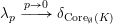 $\unicode[STIX]{x1D706}_{p}\xrightarrow[{}]{p\rightarrow 0}\unicode[STIX]{x1D6FF}_{\text{Core}_{\emptyset }(K)}$
we need to show that for any
 $g\in \text{Core}_{\emptyset }(K)$
, we have
 $\unicode[STIX]{x1D706}_{p}(\{F\in \text{Sub}_{G}\mid g\in F\})\xrightarrow[{}]{p\rightarrow 0}1$
and for any
 $g\notin \text{Core}_{\emptyset }(K)$
, we have
 $\unicode[STIX]{x1D706}_{p}(\{F\in \text{Sub}_{G}\mid g\in F\})\xrightarrow[{}]{p\rightarrow 0}0$
.
Note that for any
 $\unicode[STIX]{x1D6E9}\neq \emptyset$
, by the definition of
 $\text{Core}_{\unicode[STIX]{x1D6E9}}(K)$
, we have that
 $g\in \text{Core}_{\unicode[STIX]{x1D6E9}}(K)$
if and only if
 $\unicode[STIX]{x1D6E9}\cap {\mho}_{g}=\emptyset$
.
Now consider
 $\unicode[STIX]{x1D6E9}$
to be a random subset according to the Bernoulli-
 $p$
product measure on
 $2^{N_{G}(K)\backslash G}$
. By the above, we have equality of the events
 $\{g\in \text{Core}_{\unicode[STIX]{x1D6E9}}(K)\}=\{{\mho}_{g}\cap \unicode[STIX]{x1D6E9}=\emptyset \}$
. The latter (and hence also the former) has probability
 $(1-p)^{|{\mho}_{g}|}=(1-p)^{\Vert g\Vert _{K}}$
. This includes the case where
 $|{\mho}_{g}|=\Vert g\Vert _{K}=\infty$
(whence we have
 $0$
probability for
 $\{{\mho}_{g}\cap \unicode[STIX]{x1D6E9}=\emptyset \}$
). We conclude that for any
 $g\in G$
,
 $$\begin{eqnarray}\unicode[STIX]{x1D706}_{p}(\{F\in \text{Sub}_{G}\mid g\in F\})=(1-p)^{\Vert g\Vert _{K}}=\left\{\begin{array}{@{}ll@{}}0\quad & \text{if }\Vert g\Vert _{K}=\infty ,\\ \rightarrow 1\text{ as }p\rightarrow 0\quad & \text{if }\Vert g\Vert _{K}<\infty .\end{array}\right.\end{eqnarray}$$
It follows that
 $\unicode[STIX]{x1D706}_{p}\rightarrow \unicode[STIX]{x1D6FF}_{\text{Core}_{\emptyset }(K)}$
as
 $p\rightarrow 0$
.
Finally, we show that
 $\unicode[STIX]{x1D706}_{p}\rightarrow \unicode[STIX]{x1D6FF}_{\text{Core}_{G}(K)}$
as
 $p\rightarrow 1$
, where we define
 $\text{Core}_{G}(K)=\bigcap _{g}K^{g}=\text{Core}_{N_{G}(K)\backslash G}(K)$
. Clearly, for any
 $p\in (0,1)$
, we have that
 $\text{Core}_{G}(K)\subset F$
for
 $\unicode[STIX]{x1D706}_{p}$
-almost every
 $F$
, since
 $\text{Core}_{G}(K)\leqslant \text{Core}_{\unicode[STIX]{x1D6E9}}(K)$
for any non-empty subset
 $\unicode[STIX]{x1D6E9}$
.
On the other hand, fix some
 $g\not \in \text{Core}_{G}(K)$
. By definition, there exists some
 $\unicode[STIX]{x1D703}\in N_{G}(K)\backslash G$
such that
 $g\not \in K^{\unicode[STIX]{x1D703}}$
. Whenever
 $\unicode[STIX]{x1D6E9}$
is such that
 $\unicode[STIX]{x1D703}\in \unicode[STIX]{x1D6E9}$
, we have that
 $g\not \in \text{Core}_{\unicode[STIX]{x1D6E9}}(K)$
. The probability that
 $\unicode[STIX]{x1D703}\not \in \unicode[STIX]{x1D6E9}$
is
 $(1-p)$
. Hence, for any
 $g$
with
 $\Vert g\Vert _{K}>0$
,
 $$\begin{eqnarray}\unicode[STIX]{x1D706}_{p}(\{F\in \text{Sub}_{G}\mid g\in F\})\leqslant (1-p)\xrightarrow[{}]{p\rightarrow 1}0.\end{eqnarray}$$
We conclude that
 $\unicode[STIX]{x1D706}_{p}\rightarrow \unicode[STIX]{x1D6FF}_{\text{Core}_{G}(K)}$
as
 $p\rightarrow 1$
.◻
3.2 Continuity of the entropy along intersectional IRSs
Lemma 3.2 above shows that the IRSs
 $\unicode[STIX]{x1D706}_{p,K}$
interpolate between the two Dirac measures concentrated on the normal subgroups
 $\text{Core}_{\emptyset }(K)$
and
 $\text{Core}_{G}(K)$
. In this section we provide a condition under which this interpolation holds for the random walk entropy as well.
Fix a random walk
 $\unicode[STIX]{x1D707}$
on
 $G$
with finite entropy. Let
 $h:[0,1]\rightarrow \mathbb{R}_{+}$
be the entropy map defined by
 $h(p)=h_{\unicode[STIX]{x1D707}}(B_{\unicode[STIX]{x1D707}}(\unicode[STIX]{x1D706}_{p}))$
when
 $p\in (0,1)$
and
 $h(0),h(1)$
defined as the
 $\unicode[STIX]{x1D707}$
-random walk entropies on the quotient groups
 $G/\text{Core}_{\emptyset }(K)$
and
 $G/\text{Core}_{G}(K)$
respectively. In particular, the condition that
 $h(0)=0$
is equivalent to the Liouville property holding for the projected
 $\unicode[STIX]{x1D707}$
-random walk on
 $G/\text{Core}_{\emptyset }(K)$
.
Proposition 3.3. If
 $h(0)=0$
then
 $h$
is continuous.
Proof. Let
 $$\begin{eqnarray}H_{n}(p)=\int _{\text{Sub}_{G}}H(FZ_{n})\,d\unicode[STIX]{x1D706}_{p}(F).\end{eqnarray}$$
So
 $h(p)=\lim _{n\rightarrow \infty }(1/n)H_{n}(p)$
. First, we use a standard coupling argument to prove that when
 $q=p+\unicode[STIX]{x1D700}$
, we have
 $$\begin{eqnarray}0\leqslant H_{n}(q)-H_{n}(p)\leqslant H_{n}(\unicode[STIX]{x1D700}).\end{eqnarray}$$
Indeed, let
 $(U_{\unicode[STIX]{x1D703}})_{\unicode[STIX]{x1D703}\in N_{G}(K)\backslash G}$
be i.i.d. uniform-
 $[0,1]$
random variables, one for each coset of
 $N_{G}(K)$
. We use
 $\mathbb{P},\mathbb{E}$
to denote the probability measure and expectation with respect to these random variables. Define three subsets
 $$\begin{eqnarray}\unicode[STIX]{x1D6E9}_{p}:=\{\unicode[STIX]{x1D703}:U_{\unicode[STIX]{x1D703}}\leqslant p\}\quad \unicode[STIX]{x1D6E9}_{\unicode[STIX]{x1D700}}:=\{\unicode[STIX]{x1D703}:p<U_{\unicode[STIX]{x1D703}}\leqslant q\}\end{eqnarray}$$
and
 $\unicode[STIX]{x1D6E9}_{q}:=\unicode[STIX]{x1D6E9}_{p}\cup \unicode[STIX]{x1D6E9}_{\unicode[STIX]{x1D700}}$
. We shorthand
 $C_{x}:=\text{Core}_{\unicode[STIX]{x1D6E9}_{x}}(K)$
for
 $x\in \{p,\unicode[STIX]{x1D700},q\}$
. Note that for
 $x\in \{p,\unicode[STIX]{x1D700},q\}$
the law of
 $C_{x}$
is
 $\unicode[STIX]{x1D706}_{x}$
. Thus,
 $H_{n}(x)=\mathbb{E}[H(C_{x}Z_{n})]$
(to be clear, the entropy is with respect to the random walk
 $Z_{n}$
, and expectation is with respect to the random subgroup
 $C_{x}$
).
Now, by definition
 $$\begin{eqnarray}C_{q}=\mathop{\bigcap }_{\unicode[STIX]{x1D703}\in \unicode[STIX]{x1D6E9}_{q}}K^{\unicode[STIX]{x1D703}}=\mathop{\bigcap }_{\unicode[STIX]{x1D703}\in \unicode[STIX]{x1D6E9}_{p}}K^{\unicode[STIX]{x1D703}}\cap \mathop{\bigcap }_{\unicode[STIX]{x1D703}\in \unicode[STIX]{x1D6E9}_{\unicode[STIX]{x1D700}}}K^{\unicode[STIX]{x1D703}}=C_{p}\cap C_{\unicode[STIX]{x1D700}}.\end{eqnarray}$$
Since the map
 $(F_{1}g,F_{2}g)\mapsto (F_{1}\cap F_{2})g$
is well defined, we have that
 $C_{q}Z_{n}$
is determined by the pair
 $(C_{p}Z_{n},C_{\unicode[STIX]{x1D700}}Z_{n})$
. Also, since
 $C_{q}\leqslant C_{p}$
, we have that
 $C_{p}Z_{n}$
is determined by
 $C_{q}Z_{n}$
. Thus,
 $\mathbb{P}$
-a.s.,
 $$\begin{eqnarray}H(C_{p}Z_{n})\leqslant H(C_{q}Z_{n})\leqslant H(C_{p}Z_{n})+H(C_{\unicode[STIX]{x1D700}}Z_{n}).\end{eqnarray}$$
Taking expectation (under
 $\mathbb{E}$
) we obtain (3), which then immediately leads to
 $0\leqslant h(q)-h(p)\leqslant h(\unicode[STIX]{x1D700})$
.
Corollary 2.3 asserts that the entropy function is upper semi-continuous. Thus,
 $\limsup _{\unicode[STIX]{x1D700}\rightarrow 0}$
 $h(\unicode[STIX]{x1D700})\leqslant h(0)$
. Thus, if
 $h(0)=0$
we have that
 $\lim _{\unicode[STIX]{x1D700}\rightarrow 0}h(\unicode[STIX]{x1D700})=0$
, and that the entropy function is continuous.
3.3 Applications to entropy realizations
Let
 $\unicode[STIX]{x1D707}$
be a probability measure on a group
 $G$
and
 $N\lhd G$
a normal subgroup. We use
 $\bar{\unicode[STIX]{x1D707}}$
to denote the projected measure on the quotient group
 $G/N$
.
Corollary 3.4. Let
 $\unicode[STIX]{x1D707}$
be a generating finite entropy probability measure on a discrete group
 $G$
. Assume that there exists some
 $K\leqslant G$
such that:
∙
$h_{RW}(G/\text{Core}_{\emptyset }(K),\bar{\unicode[STIX]{x1D707}})=0$
;∙
$h_{RW}(G/\text{Core}_{G}(K),\bar{\unicode[STIX]{x1D707}})=h_{RW}(G,\unicode[STIX]{x1D707})$
.


Then
 $(G,\unicode[STIX]{x1D707})$
has a full realization.
More generally, if only the first condition is satisfied, we get a realization of the interval
 $[0,h_{RW}(G/\text{Core}_{G}(K),\bar{\unicode[STIX]{x1D707}})]$
.
Proof. Consider the path of IRSs
 $\unicode[STIX]{x1D706}_{p,K}$
defined in Claim 3.1. Let
 $h(p)$
be defined as above, before Proposition 3.3. Since
 $h(0)=h_{RW}(G/\text{Core}_{\emptyset }(K),\bar{\unicode[STIX]{x1D707}})=0$
, by Proposition 3.3 we have that
 $h$
is continuous, and thus we have a realization of the interval
 $[h(0),h(1)]=[0,h_{RW}(G/\text{Core}_{G}(K),\bar{\unicode[STIX]{x1D707}})]$
.◻
In the above corollary, the subgroup
 $K$
may depend on the measure
 $\unicode[STIX]{x1D707}$
. However, it is possible in some cases to find a subgroup
 $K$
that provides realization for any measure
 $\unicode[STIX]{x1D707}$
, and we now discuss alternative conditions for the corollary.
The conditions in Corollary 3.4 implies that
 $\text{Core}_{\emptyset }(K)$
is a ‘large’ subgroup and
 $\text{Core}_{G}(K)$
is ‘small’, at least in the sense of the random walk entropy. The best scenario hence is when
 $\text{Core}_{\emptyset }(K)=G$
and
 $\text{Core}_{G}(K)=\{1\}$
. The prototypical example is the following.
Example 3.5. Let
 $\text{Sym}_{\ast }(X)$
denote the group of all finitely supported permutations of some infinite countable set
 $X$
. Fix some
 $x_{0}\in X$
and define
 $K$
to be the subgroup of all the finitely supported permutations of
 $X$
that stabilize
 $x_{0}$
; i.e.
 $K=\text{stab}(x_{0})=\{\unicode[STIX]{x1D70B}\in \text{Sym}_{\ast }(X):\unicode[STIX]{x1D70B}(x_{0})=x_{0}\}$
. Conjugations of
 $K$
are of the form
 $\text{stab}(x)$
for
 $x\in X$
.
It follows that
 $\text{Core}_{G}(K)=\{1\}$
, because
 $\text{Sym}_{\ast }(X)$
acts transitively on
 $X$
and only the trivial permutation stabilizes all points
 $x\in X$
.
Since each element of
 $\text{Sym}_{\ast }(X)$
is a finitely supported permutation, it stabilizes all but finitely many points in
 $X$
. Thus,
 $\text{Core}_{\emptyset }(K)=\text{Sym}_{\ast }(X)$
.
This is actually a proof that
 $(\text{Sym}_{\ast }(X),\unicode[STIX]{x1D707})$
admits full realization for any generating, finite entropy, probability measure
 $\unicode[STIX]{x1D707}$
.
Note that it is not clear that
 $h_{RW}(\text{Sym}_{\ast }(X),\unicode[STIX]{x1D707})\,>\,0$
, and it may very well be that
 $(\text{Sym}_{\ast }(X),\unicode[STIX]{x1D707})$
is Liouville for any
 $\unicode[STIX]{x1D707}$
, making this realization result trivial. However, it is possible to obtain non-trivial examples by modifying the group slightly.
 $\text{Sym}_{\ast }(X)$
is a countable group which is not finitely generated. By adding some elements to it, we can get a finitely generated group. If this is done properly, as we explain below in § 3.4, one obtains a full realization result for any measure on the group.
To continue our discussion, we want to weaken the condition
 $\text{Core}_{\emptyset }(K)=G$
to some algebraic condition that will still guarantee that
 $h_{RW}(G/\text{Core}_{\emptyset }(K),\bar{\unicode[STIX]{x1D707}})=0$
for any
 $\unicode[STIX]{x1D707}$
.
Given a subgroup
 $K$
(or a conjugacy class
 $K^{G}$
) we say that
 $K$
is locally co-nilpotent in
 $G$
if
 $G/\text{Core}_{\emptyset }(K)$
is nilpotent. (The reason for this name will become more apparent in § 4.5.) With this definition, Proposition 1.5 follows immediately, as may be seen by the following.
Corollary 3.6. Assume that
 $G$
admits a subgroup
 $K\leqslant G$
such that
 $G/\text{Core}_{\emptyset }(K)$
is a nilpotent group. Then, for any generating finite entropy probability measure
 $\unicode[STIX]{x1D707}$
, the pair
 $(G,\unicode[STIX]{x1D707})$
admits a realization of the interval
 $[0,h_{RW}(G/\text{Core}_{G}(K),\bar{\unicode[STIX]{x1D707}})]$
.
If, in addition
 $h_{RW}(G/\text{Core}_{G}(K),\bar{\unicode[STIX]{x1D707}})=h_{RW}(G,\unicode[STIX]{x1D707})$
(e.g. if
 $\text{Core}_{G}(K)=\{e\}$
) then
 $(G,\unicode[STIX]{x1D707})$
admits full realization.
Proof. When
 $G/\text{Core}_{\emptyset }(K)$
is nilpotent, the Choquet–Deny theorem (Theorem 2.4) tells us that the first condition of Corollary 3.4 is satisfied.◻
In § 3.4 we apply this to obtain full realizations for a class of lamplighter groups as well as to some extensions of the group of finitely supported permutations. However, one should not expect to find a subgroup satisfying the conditions of Corollary 3.6 in every group. These conditions are quite restrictive; for example we have the following.
Lemma 3.7. If
 $G$
is a group with a self-normalizing subgroup
 $K$
that satisfies the two conditions of Corollaries 3.4 (or 3.6) then
 $G$
is amenable.
Proof. First, observe that
 $h_{RW}(G/\text{Core}_{\emptyset }(K),\bar{\unicode[STIX]{x1D707}})=0$
implies that
 $\text{Core}_{\emptyset }(K)$
is a co-amenable (normal) subgroup in
 $G$
. Indeed, it is well known that a group,
 $G/\text{Core}_{\emptyset }(K)$
in this case, that admits a random walk which is Liouville is amenable.
Next, the condition
 $h_{RW}(G/\text{Core}_{G}(K),\bar{\unicode[STIX]{x1D707}})=h_{RW}(G,\unicode[STIX]{x1D707})$
implies that
 $\text{Core}_{G}(K)$
is an amenable group. This follows from Kaimanovich’s amenable extension theorem [Reference KaimanovichKai02]. Let
 $\unicode[STIX]{x1D707}$
be a random walk on
 $G$
. The Furstenberg–Poisson boundary of
 $G/\text{Core}_{G}(K)$
with the
 $\unicode[STIX]{x1D707}$
-projected random walk is a
 $(G,\unicode[STIX]{x1D707})$
-boundary, or, in other words a
 $G$
-factor of the Furstenberg–Poisson boundary
 $\unicode[STIX]{x1D6F1}(G,\unicode[STIX]{x1D707})$
. Since it has the same entropy as the random walk entropy, this factor is actually isomorphic to
 $\unicode[STIX]{x1D6F1}(G,\unicode[STIX]{x1D707})$
. Now Kaimanovich’s theorem asserts that
 $\text{Core}_{G}(K)$
is an amenable group.
To conclude that
 $G$
is amenable we show that
 $\text{Core}_{\emptyset }(K)/\text{Core}_{G}(K)$
is amenable, showing that the normal subgroup
 $\text{Core}_{G}(K)$
is both amenable and co-amenable in
 $G$
.
In general, we claim that
 $\text{Core}_{\emptyset }(K)/\text{Core}_{G}(N_{G}(K))$
is always an amenable group. This will complete the proof, because we assumed that
 $N_{G}(K)=K$
.
Indeed,
 $G$
acts by permutations on the conjugacy class
 $K^{G}$
. Note that any element in
 $\text{Core}_{\emptyset }(K)$
has finite support as a permutation on
 $K^{G}$
. Also, it may be checked that the elements of
 $\text{Core}_{\emptyset }(K)$
that stabilize every
 $K^{\unicode[STIX]{x1D6FE}}$
are precisely the elements of
 $\text{Core}_{G}(N_{G}(K))$
. Thus,
 $\text{Core}_{\emptyset }(K)/\text{Core}_{G}(N_{G}(K))$
is isomorphic to a subgroup of the amenable group
 $\text{Sym}_{\ast }(X)$
.◻
The subgroups of the free group that we will consider in § 4 (to prove Theorem 1.2) are all self-normalizing. Since the free group is non-amenable, we cannot obtain the conditions of Corollary 3.4 simultaneously in this fashion. For this reason, we approximate the second condition using a sequence of subgroups.
Corollary 3.8. Let
 $\unicode[STIX]{x1D707}$
be a generating finite entropy probability measure on a discrete group
 $G$
. Assume that there exists a sequence of subgroups
 $K_{n}\leqslant G$
such that:
(i)
$h_{RW}(G/\text{Core}_{\emptyset }(K_{n}),\bar{\unicode[STIX]{x1D707}})=0$
(e.g. whenever
$G/\text{Core}_{\emptyset }(K_{n})$
are nilpotent);(ii)
$h_{RW}(G/\text{Core}_{G}(K_{n}),\bar{\unicode[STIX]{x1D707}})\rightarrow h_{RW}(G,\unicode[STIX]{x1D707})$
.



Then
 $(G,\unicode[STIX]{x1D707})$
admits a full realization.
Proof. By the first condition, for any fixed
 $n$
, the entropy along the path
 $\unicode[STIX]{x1D706}_{p,K_{n}}$
gives a realization of the interval
 $[0,h_{RW}(G/\text{Core}_{G}(K_{n}),\bar{\unicode[STIX]{x1D707}})]$
. By the second condition, we conclude that any number in
 $[0,h_{RW}(G,\unicode[STIX]{x1D707})]$
is realized as the entropy some IRS of the form
 $\unicode[STIX]{x1D706}_{p,K_{n}}$
.◻
3.4 Examples: lamplighter groups and permutation groups
We are now ready to apply our tools to get Theorems 1.3 and 1.4.
Proof of Theorem 1.3.
Choose the subgroup
 $K=\bigoplus _{B\backslash \{e\}}L\rtimes \{e\}$
where
 $e$
is the trivial element in the base group
 $B$
. It may be simply verified that
 $\text{Core}_{G}(K)=\{e\}$
and
 $\bigoplus _{B}L\rtimes \{e\}{\vartriangleleft}\text{Core}_{\emptyset }(K)$
.
Whenever
 $(B,\bar{\unicode[STIX]{x1D707}})$
is Liouville, so is
 $(G/\text{Core}_{\emptyset }(K),\bar{\unicode[STIX]{x1D707}})$
. This is because
 $B\cong G/(\bigoplus _{B}L\rtimes \{e\})$
, so
 $G/\text{Core}_{\emptyset }(K)$
is a quotient group of
 $B$
. Thus, we have that
 $h_{RW}(G/\text{Core}_{\emptyset }(K),\bar{\unicode[STIX]{x1D707}})=0$
, and we obtain a realization of the full interval
 $$\begin{eqnarray}[0,h_{RW}(G/\text{Core}_{G}(K),\bar{\unicode[STIX]{x1D707}})]=[0,h_{RW}(G,\unicode[STIX]{x1D707})].\square\end{eqnarray}$$
We now turn to discuss extensions of the group of finitely supported permutations. Let
 $X$
be a countable set, and denote by
 $\text{Sym}(X)$
the group of all permutations of
 $X$
. Recall that
 $\text{Sym}_{\ast }(X)$
is its subgroup of all finitely supported permutations. While
 $\text{Sym}_{\ast }(X)$
is not finitely generated, one can add elements from
 $\text{Sym}(X)$
to get a finitely generated group. A standard example is when adding a ‘shift’ element
 $\unicode[STIX]{x1D70E}\in \text{Sym}(X)$
, that is,
 $\unicode[STIX]{x1D70E}$
acts as a free transitive permutation of
 $X$
. Let
 $\unicode[STIX]{x1D6F4}=\left\langle \unicode[STIX]{x1D70E}\right\rangle$
be the subgroup generated by
 $\unicode[STIX]{x1D70E}$
. Formally the element
 $\unicode[STIX]{x1D70E}$
acts on
 $\text{Sym}_{\ast }(X)$
by conjugation (recall that both groups are subgroups of
 $\text{Sym}(X)$
) and we get a finitely generated group
 $\text{Sym}_{\ast }(X)\rtimes \unicode[STIX]{x1D6F4}$
.
One can replace
 $\unicode[STIX]{x1D6F4}$
by any other subgroup of
 $\text{Sym}(X)$
. The reason that we want to replace
 $\unicode[STIX]{x1D6F4}$
by a ‘larger’ group is to have a non-Liouville group
 $\text{Sym}_{\ast }(X)\rtimes \unicode[STIX]{x1D6F4}$
.
The following is a generalization of Theorem 1.4.
Theorem 3.9. Let
 $\unicode[STIX]{x1D6F4}\leqslant \text{Sym}(X)$
be finitely generated and consider
 $G=\text{Sym}_{\ast }(X)\rtimes \unicode[STIX]{x1D6F4}$
. Let
 $\unicode[STIX]{x1D707}$
be a generating finite entropy probability measure on
 $G$
, such that the projected measure
 $\bar{\unicode[STIX]{x1D707}}$
on
 $\unicode[STIX]{x1D6F4}\cong G/\text{Sym}_{\ast }(X)\rtimes \{e\}$
is Liouville. Then
 $(G,\unicode[STIX]{x1D707})$
has full realization.
In particular, if
 $\unicode[STIX]{x1D6F4}$
is a nilpotent group,
 $(G,\unicode[STIX]{x1D707})$
admits full realization for any
 $\unicode[STIX]{x1D707}$
.
Proof. Fix some point
 $x_{0}\in X$
and let
 $K=\text{stab}(x_{0})\rtimes \{e\}$
where
 $\text{stab}(x_{0})\leqslant \text{Sym}_{\ast }(X)$
is the stabilizer of
 $x_{0}$
. It is easy to verify that
 $\text{Core}_{G}(K)=\{e\}$
and that
 $\text{Core}_{\emptyset }(K)=\text{Sym}_{\ast }(X)\rtimes \{e\}$
, hence by the assumption
 $h_{RW}(G/\text{Core}_{\emptyset }(K),\bar{\unicode[STIX]{x1D707}})=0$
and by Corollary 3.4 we get a full realization.◻
Remark 3.10. Depending of
 $\unicode[STIX]{x1D6F4}$
and
 $\unicode[STIX]{x1D707}$
, it might be that
 $(G,\unicode[STIX]{x1D707})$
is Liouville where
 $G=\text{Sym}_{\ast }(X)\rtimes \,\unicode[STIX]{x1D6F4}$
. In that case, this result of full realization is trivial as the only realizable value is
 $0$
.
However, it is easy to find nilpotent
 $\unicode[STIX]{x1D6F4}$
such that
 $G$
is finitely generated and that
 $(G,\unicode[STIX]{x1D707})$
is not Liouville (say, for any generating, symmetric, finitely supported
 $\unicode[STIX]{x1D707}$
). As a concrete example, one can consider a labeling of
 $X$
by
 $\mathbb{Z}^{3}$
, and to take
 $\unicode[STIX]{x1D6F4}=\langle \unicode[STIX]{x1D70E}_{1},\unicode[STIX]{x1D70E}_{2},\unicode[STIX]{x1D70E}_{3}\rangle$
where
 $\unicode[STIX]{x1D70E}_{i}\in \text{Sym}(X)$
are the three natural shifts.
4 Full realization for the free group
We now turn to discuss our realization results for
 $G=\mathbb{F}_{r}$
the free group of rank
 $r$
for any
 $r\geqslant 2$
. It suffices to prove that the free group satisfies the conditions of Corollary 3.8. We construct the subgroups
 $K_{n}$
by describing their Schreier graphs. For simplicity of the presentation we describe the result only for the free group on two generators,
 $\mathbb{F}_{2}=\langle a,b\rangle$
. The generalization to higher rank is straightforward.
4.1 Schreier graphs
Recall our notations for Schreier graphs from § 2.2. It will be convenient to use
 $|v|$
to denote the graph distance of a vertex
 $v$
to the root vertex in a fixed Schreier graph.
4.2 Fixing
In this section we describe a condition on Schreier graphs that we call fixing. For the normal core of the associated subgroup, this condition will ensure that the random walk entropy of the quotient approximates the full random walk entropy as required by Condition 2 in Corollary 3.8 (see Proposition 4.7 below).
Let
 $\unicode[STIX]{x1D6EC}$
be a Schreier graph with root
 $o$
.
For a vertex
 $v$
in
 $\unicode[STIX]{x1D6EC}$
, the shadow of
 $v$
, denoted
 $\text{shd}(v)$
is the set of vertices
 $u$
in
 $\unicode[STIX]{x1D6EC}$
such that any path from
 $u$
to the root
 $o$
must pass through
 $v$
.
For an integer
 $n$
define the finite subtree
 $(\mathbb{F}_{2})_{{\leqslant}n}$
to be the induced (labeled) subgraph on
 $\{g\in \mathbb{F}_{2}:|g|\leqslant n\}$
. We say that
 $\unicode[STIX]{x1D6EC}$
is
 $n$
-tree-like if the ball of radius
 $n$
about
 $o$
in
 $\unicode[STIX]{x1D6EC}$
is isomorphic to
 $(\mathbb{F}_{2})_{{\leqslant}n}$
, and if every vertex at distance
 $n$
from
 $o$
has a non-empty shadow. Informally, an
 $n$
-tree-like graph is one that is made up by gluing disjoint graphs to the leaves of a depth-
 $n$
regular tree.
Lemma 4.1. Let
 $C\leqslant K\leqslant \mathbb{F}_{2}$
be subgroups. Let
 $\unicode[STIX]{x1D6EC}_{C},\unicode[STIX]{x1D6EC}_{K}$
be the Schreier graphs of
 $C,K$
respectively.
If
 $\unicode[STIX]{x1D6EC}_{K}$
is
 $n$
-tree-like, then
 $\unicode[STIX]{x1D6EC}_{C}$
is also
 $n$
-tree-like.
Proof. This follows from the fact that
 $C\leqslant K$
implies that
 $\unicode[STIX]{x1D6EC}_{C}$
is a cover of
 $\unicode[STIX]{x1D6EC}_{K}$
(see, for example, [Reference LeemannLee16, Lemma 20]).◻
For an
 $n$
-tree-like
 $\unicode[STIX]{x1D6EC}$
, since every vertex is connected to the root, every vertex at distance greater than
 $n$
from the root
 $o$
is in the shadow of some vertex at distance precisely
 $n$
. For a vertex
 $v$
in
 $\unicode[STIX]{x1D6EC}$
with
 $|v|>n$
, and
 $k\leqslant n$
we define the
 $k$
-prefix of
 $v$
in
 $\unicode[STIX]{x1D6EC}$
to be
 $\text{pref}_{k}(v)=\text{pref}_{k,\unicode[STIX]{x1D6EC}}(v)=u$
for the unique
 $u$
such that both
 $|u|=k$
and
 $v\in \text{shd}(u)$
. If
 $|v|\leqslant k$
then for concreteness we define
 $\text{pref}_{k}(v)=v$
.
Since
 $n$
-tree-like graphs look like
 $\mathbb{F}_{2}$
up to distance
 $n$
, the behavior of
 $\text{pref}_{k}$
on
 $n$
-tree-like graphs where
 $n\geqslant k$
is the same as on
 $\mathbb{F}_{2}$
. This is the content of the next elementary lemma, whose proof is left as an exercise.
Lemma 4.2. Let
 $\unicode[STIX]{x1D6EC}$
be a
 $n$
-tree-like Schreier graph. Let
 $\unicode[STIX]{x1D711}:\unicode[STIX]{x1D6EC}\rightarrow \mathbb{F}_{2}$
be a function mapping the ball of radius
 $n$
in
 $\unicode[STIX]{x1D6EC}$
isomorphically to
 $(\mathbb{F}_{2})_{{\leqslant}n}$
.
Then, for any vertex
 $|v|\leqslant n$
in
 $\unicode[STIX]{x1D6EC}$
we have that
 $$\begin{eqnarray}\text{pref}_{k,\unicode[STIX]{x1D6EC}}(v)=\unicode[STIX]{x1D711}^{-1}\,\text{pref}_{k,\mathbb{F}_{2}}(\unicode[STIX]{x1D711}(v)).\end{eqnarray}$$
We use
 $(Z_{t})_{t}$
to denote the
 $\unicode[STIX]{x1D707}$
-random walk on
 $\mathbb{F}_{2}$
and
 $(\tilde{Z}_{t})_{t}$
the projected walk on a Schreier graph
 $\unicode[STIX]{x1D6EC}$
with root
 $o$
. (So
 $\tilde{Z}_{t}=KZ_{t}$
where
 $K$
is the associated subgroup to the root
 $o$
in the Schreier graph
 $\unicode[STIX]{x1D6EC}$
.)
Another notion we require is the
 $k$
-prefix at infinity. Define the random variable
 $\text{pref}_{k}(\tilde{Z}_{\infty })=\text{pref}_{k,\unicode[STIX]{x1D6EC}}(\tilde{Z}_{\infty })$
, taking values in the set of vertices of distance
 $k$
from
 $o$
in
 $\unicode[STIX]{x1D6EC}$
, as follows. If the sequence
 $\text{pref}_{k}(\tilde{Z}_{t})_{t}$
stabilizes at
 $u$
, that is, if there exists
 $t_{0}$
such that for all
 $t>t_{0}$
we have
 $\text{pref}_{k}(\tilde{Z}_{t})=\text{pref}_{k}(\tilde{Z}_{t-1})=u$
, then define
 $\text{pref}_{k}(\tilde{Z}_{\infty }):=u$
. Otherwise, define
 $\text{pref}_{k}(\tilde{Z}_{\infty })=o$
. Note that for an
 $n$
-tree-like graph with
 $n>0$
we have that
 $\text{pref}_{k}(\tilde{Z}_{\infty })=o$
(almost surely) if and only if the walk
 $(\tilde{Z}_{t})_{t}$
returns to the ball of radius
 $k$
infinitely many times.
Definition 4.3. Let
 $0<k<n$
be natural numbers and
 $\unicode[STIX]{x1D6FC}\in (0,1)$
. We say that
 $\unicode[STIX]{x1D6EC}$
is
 $(k,n,\unicode[STIX]{x1D6FC})$
-fixing if
 $\unicode[STIX]{x1D6EC}$
is
 $n$
-tree-like and for any
 $|v|\geqslant n$
,
 $$\begin{eqnarray}\mathbb{P}[\forall t,\text{pref}_{k}(\tilde{Z}_{t})=\text{pref}_{k}(\tilde{Z}_{0})\mid \tilde{Z}_{0}=v]\geqslant \unicode[STIX]{x1D6FC}.\end{eqnarray}$$
That is, with probability at least
 $\unicode[STIX]{x1D6FC}$
, for any
 $|v|\geqslant n$
, the projected random walk started at
 $v$
never leaves
 $\text{shd}(\text{pref}_{k}(v))$
. Hence, the random walk started at depth
 $n$
in the graph fixes the
 $k$
-prefix with probability at least
 $\unicode[STIX]{x1D6FC}$
. Note that this definition depends on the random walk
 $\unicode[STIX]{x1D707}$
.
A good example of a fixing graph is the Cayley graph of the free group itself.
Lemma 4.4. Let
 $\unicode[STIX]{x1D707}$
be a finitely supported generating probability measure on
 $\mathbb{F}_{2}$
. Then, there exists
 $\unicode[STIX]{x1D6FC}=\unicode[STIX]{x1D6FC}(\unicode[STIX]{x1D707})>0$
such that the Cayley graph of
 $\mathbb{F}_{2}$
is
 $(k,k+1,\unicode[STIX]{x1D6FC})$
-fixing for any
 $k>0$
.
Proof. It is well known that a
 $\unicode[STIX]{x1D707}$
-random walk
 $(Z_{t})_{t}$
on
 $\mathbb{F}_{2}$
is transient (for example, this follows from non-amenability of
 $\mathbb{F}_{2}$
). Let
 $r=\max \{|g|:\unicode[STIX]{x1D707}(g)>0\}$
be the maximal jump possible by the
 $\unicode[STIX]{x1D707}$
-random walk. In order to change the
 $k$
-prefix, the walk must return to distance at most
 $k+r$
from the origin. That is, if
 $|Z_{t}|>k+r$
for all
 $t>t_{0}$
, we have that
 $\text{pref}_{k}(Z_{t})=\text{pref}_{k}(Z_{t_{0}})$
for all
 $t>t_{0}$
.
By forcing finitely many initial steps (depending on
 $r,\unicode[STIX]{x1D707}$
), there exists
 $t_{0}$
and
 $\unicode[STIX]{x1D6FC}>0$
such that
 $\mathbb{P}[A\mid |Z_{0}|=k+1]\geqslant \unicode[STIX]{x1D6FC}$
where
 $$\begin{eqnarray}A=\{\forall 0<t\leqslant t_{0},\text{pref}_{k}(Z_{t})=\text{pref}_{k}(Z_{0})\text{ and }|Z_{t_{0}}|>k+r\}.\end{eqnarray}$$
By perhaps making
 $\unicode[STIX]{x1D6FC}$
smaller, using transience, we also have that
 $$\begin{eqnarray}\mathbb{P}[\forall t>0,|Z_{t}|\geqslant |Z_{0}|]\geqslant \unicode[STIX]{x1D6FC}.\end{eqnarray}$$
Combining these two estimates, with the Markov property at time
 $t_{0}$
,
 $$\begin{eqnarray}\displaystyle \mathbb{P}[\forall t,\text{pref}_{k}(Z_{t})=\text{pref}_{k}(Z_{0})\mid |Z_{0}|=k+1] & {\geqslant} & \displaystyle \mathbb{P}[A\text{ and }\{\forall t>t_{0},|Z_{t}|\geqslant |Z_{t_{0}}|\}]\nonumber\\ \displaystyle & {\geqslant} & \displaystyle \mathbb{P}[A]\cdot \mathbb{P}[\forall t>0,|Z_{t}|\geqslant |Z_{0}|]\geqslant \unicode[STIX]{x1D6FC}^{2}.\nonumber\end{eqnarray}$$
This is the definition of
 $\mathbb{F}_{2}$
being
 $(k,k+1,\unicode[STIX]{x1D6FC})$
-fixing.◻
A very useful property of fixing graphs is that when
 $\unicode[STIX]{x1D6FC}$
is close enough to
 $1$
, there exists a finite random time (the first time the random walk leaves the tree area) on which we can already guess with a high accuracy the
 $k$
-prefix at infinity of the random walk. A precise formulation is the following.
Lemma 4.5. Let
 $\unicode[STIX]{x1D6EC}$
be a
 $(k,n,\unicode[STIX]{x1D6FC})$
-fixing Schreier graph. Let
 $(Z_{t})_{t}$
be a
 $\unicode[STIX]{x1D707}$
-random walk on
 $\mathbb{F}_{2}$
and
 $(\tilde{Z}_{t})_{t}$
the projected walk on
 $\unicode[STIX]{x1D6EC}$
. Define the stopping time
 $$\begin{eqnarray}T=\inf \{t:|\tilde{Z}_{t}|\geqslant n\}.\end{eqnarray}$$
Then,
 $$\begin{eqnarray}|H(Z_{1}\mid \text{pref}_{k}(\tilde{Z}_{T}))-H(Z_{1}\mid \text{pref}_{k}(\tilde{Z}_{\infty }))|\leqslant \unicode[STIX]{x1D700}(\unicode[STIX]{x1D6FC})+2(\log 4)(1-\unicode[STIX]{x1D6FC})k,\end{eqnarray}$$
where
 $0<\unicode[STIX]{x1D700}(\unicode[STIX]{x1D6FC})\rightarrow 0$
as
 $\unicode[STIX]{x1D6FC}\rightarrow 1$
.
Proof. First note that a general entropy inequality is
 $$\begin{eqnarray}\displaystyle H(X\mid A)-H(X\mid B)\leqslant H(A\mid B)+H(B\mid A), & & \displaystyle \nonumber\end{eqnarray}$$
which for us provides the inequality
 $$\begin{eqnarray}\displaystyle & & \displaystyle |H(Z_{1}\mid \text{pref}_{k}(\tilde{Z}_{T}))-H(Z_{1}\mid \text{pref}_{k}(\tilde{Z}_{\infty }))|\nonumber\\ \displaystyle & & \displaystyle \quad \leqslant H(\text{pref}_{k}(\tilde{Z}_{T})\mid \text{pref}_{k}(\tilde{Z}_{\infty }))+H(\text{pref}_{k}(\tilde{Z}_{\infty })\mid \text{pref}_{k}(\tilde{Z}_{T})).\nonumber\end{eqnarray}$$
We now bound this last quantity using Fano’s inequality (see, for example, [Reference Cover and ThomasCT12, § 2.10]). Taking
 $\tilde{\unicode[STIX]{x1D6FC}}=\mathbb{P}[\text{pref}_{k}(\tilde{Z}_{T})=\text{pref}_{k}(\tilde{Z}_{\infty })]$
, since the support of both
 $\text{pref}_{k}(\tilde{Z}_{\infty }),\text{pref}_{k}(\tilde{Z}_{T})$
is of size
 $4\cdot 3^{k-1}<4^{k}$
,
 $$\begin{eqnarray}\displaystyle H(\text{pref}_{k}(\tilde{Z}_{\infty })\mid \text{pref}_{k}(\tilde{Z}_{T})) & {\leqslant} & \displaystyle H(\tilde{\unicode[STIX]{x1D6FC}},1-\tilde{\unicode[STIX]{x1D6FC}})+(1-\tilde{\unicode[STIX]{x1D6FC}})\log 4^{k},\nonumber\\ \displaystyle H(\text{pref}_{k}(\tilde{Z}_{T})\mid \text{pref}_{k}(\tilde{Z}_{\infty })) & {\leqslant} & \displaystyle H(\tilde{\unicode[STIX]{x1D6FC}},1-\tilde{\unicode[STIX]{x1D6FC}})+(1-\tilde{\unicode[STIX]{x1D6FC}})\log 4^{k},\nonumber\end{eqnarray}$$
where here we use the usual notation
 $H(\tilde{\unicode[STIX]{x1D6FC}},1-\tilde{\unicode[STIX]{x1D6FC}})$
to denote the Shannon entropy of the probability vector
 $(\tilde{\unicode[STIX]{x1D6FC}},1-\tilde{\unicode[STIX]{x1D6FC}})$
.
Since
 $p\mapsto H(p,1-p)$
decreases for
 $p\geqslant {\textstyle \frac{1}{2}}$
, it suffices to prove that
 $\tilde{\unicode[STIX]{x1D6FC}}=\mathbb{P}[\text{pref}_{k}(\tilde{Z}_{T})=\text{pref}_{k}(\tilde{Z}_{\infty })]\geqslant \unicode[STIX]{x1D6FC}$
.
But now, the very definition of
 $(k,n,\unicode[STIX]{x1D6FC})$
-fixing implies that for any relevant
 $u$
,
 $$\begin{eqnarray}\displaystyle & & \displaystyle \mathbb{P}[\text{pref}_{k}(\tilde{Z}_{\infty })=u\mid \text{pref}_{k}(Z_{T})=u]\nonumber\\ \displaystyle & & \displaystyle \quad \geqslant \mathbb{P}[\forall t>0,\text{pref}_{k}(\tilde{Z}_{T+t})\in \text{shd}(\text{pref}_{k}(u))\mid \text{pref}_{k}(Z_{T})=u]\geqslant \unicode[STIX]{x1D6FC},\nonumber\end{eqnarray}$$
where we have used the strong Markov property at the stopping time
 $T$
. Averaging over the relevant
 $u$
implies that
 $\tilde{\unicode[STIX]{x1D6FC}}\geqslant \unicode[STIX]{x1D6FC}$
.◻
The following is the main technical estimate of this subsection.
Lemma 4.6. Fix a generating probability measure
 $\unicode[STIX]{x1D707}$
on
 $\mathbb{F}_{2}$
with finite support. Let
 $(\unicode[STIX]{x1D6E4}_{j})_{j}$
be a sequence of Schreier graphs such that
 $\unicode[STIX]{x1D6E4}_{j}$
is
 $(k_{j},n_{j},\unicode[STIX]{x1D6FC}_{j})$
-fixing. Let
 $K_{j}$
be the subgroup corresponding to
 $\unicode[STIX]{x1D6E4}_{j}$
.
Suppose that
 $k_{j}\rightarrow \infty$
,
 $n_{j}-k_{j}\rightarrow \infty$
and
 $(1-\unicode[STIX]{x1D6FC}_{j})k_{j}\rightarrow 0$
as
 $j\rightarrow \infty$
. Then,
 $$\begin{eqnarray}\limsup _{j\rightarrow \infty }h_{RW}(\mathbb{F}_{2}/\text{Core}_{\mathbb{F}_{2}}(K_{j}),\bar{\unicode[STIX]{x1D707}})=h_{RW}(\mathbb{F}_{2},\unicode[STIX]{x1D707}).\end{eqnarray}$$
Proof. Let
 $(Z_{t})_{t}$
be a
 $\unicode[STIX]{x1D707}$
-random walk on
 $\mathbb{F}_{2}$
.
Take
 $j$
large enough so that
 $n_{j}-k_{j}$
is much larger that
 $r=\max \{|g|:\unicode[STIX]{x1D707}(g)>0\}$
. To simplify the presentation we use
 $\unicode[STIX]{x1D6E4}_{j}=\unicode[STIX]{x1D6E4},K=K_{j},C=C_{j}=\text{Core}_{\mathbb{F}_{2}}(K_{j})$
and
 $k=k_{j},n=n_{j},\unicode[STIX]{x1D6FC}=\unicode[STIX]{x1D6FC}_{j}$
, omitting the subscript
 $j$
when it is clear from the context. Let
 $\unicode[STIX]{x1D6EC}=\unicode[STIX]{x1D6EC}_{j}$
be the Schreier graph corresponding to
 $C=C_{j}$
.
Let
 ${\mathcal{T}}_{C}=\bigcap _{t}\unicode[STIX]{x1D70E}(CZ_{t},CZ_{t+1},\ldots )$
and
 ${\mathcal{T}}=\bigcap _{t}\unicode[STIX]{x1D70E}(Z_{t},Z_{t+1},\ldots )$
denote that tail
 $\unicode[STIX]{x1D70E}$
-algebras of the random walk on
 $\unicode[STIX]{x1D6EC}$
and on
 $\mathbb{F}_{2}$
respectively. Kaimanovich and Vershik (see [Reference Kaimanovich and VershikKV83, (13) on p. 465]) show that
 $$\begin{eqnarray}h_{RW}(\mathbb{F}_{2}/C,\bar{\unicode[STIX]{x1D707}})=H(CZ_{1})-H(CZ_{1}\mid {\mathcal{T}}_{C})\end{eqnarray}$$
and
 $$\begin{eqnarray}h_{RW}(G,\unicode[STIX]{x1D707})=H(Z_{1})-H(Z_{1}\mid {\mathcal{T}}).\end{eqnarray}$$
Now, since
 $C\leqslant K$
, and since
 $\unicode[STIX]{x1D6E4}$
is
 $n$
-tree-like, also
 $\unicode[STIX]{x1D6EC}$
is (Lemma 4.1). Since
 $\unicode[STIX]{x1D6EC}$
is
 $n$
-tree-like,
 $CZ_{1}$
and
 $Z_{1}$
determine one another (Lemma 4.2), implying
 $H(CZ_{1})=H(Z_{1})$
and
 $H(CZ_{1}\mid {\mathcal{T}}_{C})=H(Z_{1}\mid {\mathcal{T}}_{C})$
. Since
 ${\mathcal{T}}_{C}\subset {\mathcal{T}}$
, the inequality
 $H(Z_{1}\mid {\mathcal{T}}_{C})\geqslant H(Z_{1}\mid {\mathcal{T}})$
is immediate. Hence, we only need to show that
 $\liminf _{j}H(Z_{1}\mid {\mathcal{T}}_{C_{j}})\leqslant H(Z_{1}\mid {\mathcal{T}})$
.
Set
 $T=\inf \{t:|CZ_{t}|\geqslant n\}$
as in Lemma 4.5. Since
 $\unicode[STIX]{x1D6EC}$
is
 $n$
-tree-like,
 $\text{pref}_{k}(CZ_{T-1})$
and
 $\text{pref}_{k}(Z_{T-1})$
determine one another (Lemma 4.2). Also, since
 $n-k$
is much larger than
 $r$
, and specifically much larger than any jump the walk can make in one step, we know that
 $\text{pref}_{k}(CZ_{T})=\text{pref}_{k}(CZ_{T-1})$
and
 $\text{pref}_{k}(Z_{T})=\text{pref}_{k}(Z_{T-1})$
. All in all,
 $H(Z_{1}\mid \text{pref}_{k}(CZ_{T}))=H(Z_{1}\mid \text{pref}_{k}(Z_{T}))$
.
Now, set
 $\unicode[STIX]{x1D700}=\unicode[STIX]{x1D700}(\unicode[STIX]{x1D6FC},k)=2H(\unicode[STIX]{x1D6FC},1-\unicode[STIX]{x1D6FC})+2(\log 4)(1-\unicode[STIX]{x1D6FC})k$
. Since
 $\text{pref}_{k}(CZ_{\infty })$
is measurable with respect to
 ${\mathcal{T}}_{C}$
, by using Lemma 4.5 twice, once for
 $\unicode[STIX]{x1D6EC}$
and once for the tree, we get the bound
 $$\begin{eqnarray}\displaystyle H(Z_{1}\mid {\mathcal{T}}_{C}) & {\leqslant} & \displaystyle H(Z_{1}\mid \text{pref}_{k}(CZ_{\infty }))\leqslant H(Z_{1}\mid \text{pref}_{k}(CZ_{T}))+\unicode[STIX]{x1D700}\nonumber\\ \displaystyle & = & \displaystyle H(Z_{1}\mid \text{pref}_{k}(Z_{T}))+\unicode[STIX]{x1D700}\leqslant H(Z_{1}\mid \text{pref}_{k}(Z_{\infty }))+2\unicode[STIX]{x1D700}.\nonumber\end{eqnarray}$$
Now, under the assumptions of the lemma,
 $\unicode[STIX]{x1D700}\rightarrow 0$
as
 $j\rightarrow \infty$
. Also, since
 $k_{j}\rightarrow \infty$
we have that
 $$\begin{eqnarray}H(Z_{1}\mid \text{pref}_{k_{j}}(Z_{\infty }))\rightarrow H(Z_{1}\mid {\mathcal{T}}).\end{eqnarray}$$
Thus, taking a limit on the above provides us with
 $$\begin{eqnarray}\limsup _{j\rightarrow \infty }H(Z_{1}\mid {\mathcal{T}}_{C_{j}})\leqslant \limsup _{j\rightarrow \infty }H(Z_{1}\mid \text{pref}_{k_{j}}(Z_{\infty }))=H(Z_{1}\mid {\mathcal{T}}).\end{eqnarray}$$
Hence, as mentioned, we conclude that
 $\limsup _{j}H(Z_{1}\mid {\mathcal{T}}_{C_{j}})=H(Z_{1}\mid {\mathcal{T}})$
, and since
 $H(Z_{1})=H(CZ_{1})$
we get that
 $$\begin{eqnarray}\limsup _{j\rightarrow \infty }h_{RW}(\mathbb{F}_{2}/\text{Core}_{\mathbb{F}_{2}}(K_{j}),\bar{\unicode[STIX]{x1D707}})=h_{RW}(\mathbb{F}_{2},\unicode[STIX]{x1D707}).\square\end{eqnarray}$$
To complete the relevance of fixing to convergence of the random walk entropies, we finish with the following.
Proposition 4.7. Fix a generating probability measure
 $\unicode[STIX]{x1D707}$
on
 $\mathbb{F}_{2}$
with finite support. Let
 $(\unicode[STIX]{x1D6E4}_{j})_{j}$
be a sequence of Schreier graphs such that
 $\unicode[STIX]{x1D6E4}_{j}$
is
 $(k_{j},n_{j},\unicode[STIX]{x1D6FC}_{j})$
-fixing. Let
 $K_{j}$
be the subgroup corresponding to
 $\unicode[STIX]{x1D6E4}_{j}$
.
Suppose that
 $k_{j}\rightarrow \infty$
and
 $\unicode[STIX]{x1D6FC}_{j}\rightarrow 1$
as
 $j\rightarrow \infty$
. Then,
 $$\begin{eqnarray}\limsup _{j\rightarrow \infty }h_{RW}(\mathbb{F}_{2}/\text{Core}_{\mathbb{F}_{2}}(K_{j}),\bar{\unicode[STIX]{x1D707}})=h_{RW}(\mathbb{F}_{2},\unicode[STIX]{x1D707}).\end{eqnarray}$$
Proof. Since we are only interested in
 $\limsup$
we may pass to a subsequence and show that the parameters along this subsequence satisfy the assumptions of Lemma 4.6. Notice that the assumption
 $k_{j}\rightarrow \infty$
implies in particular that
 $n_{j}\rightarrow \infty$
.
Note that by definition, if
 $\unicode[STIX]{x1D6EC}$
is
 $(k,n,\unicode[STIX]{x1D6FC})$
-fixing, then it is also
 $(k^{\prime },n^{\prime },\unicode[STIX]{x1D6FC}^{\prime })$
-fixing for any
 $k^{\prime }\leqslant k,n^{\prime }\geqslant n,\unicode[STIX]{x1D6FC}^{\prime }\leqslant \unicode[STIX]{x1D6FC}$
.
For any
 $m$
choose
 $j_{m}$
large enough so that for all
 $i\geqslant j_{m}$
we have both
 $\unicode[STIX]{x1D6FC}_{i}>1-m^{-2}$
and
 $k_{i}>2m$
. The subsequence of graphs
 $(\unicode[STIX]{x1D6E4}_{j_{m}})_{m}$
satisfies that
 $\unicode[STIX]{x1D6E4}_{j_{m}}$
is
 $(m,n_{j_{m}},1-1/m^{2})$
-fixing. Since
 $n_{j_{m}}-m\geqslant k_{j_{m}}-m>m$
, Lemma 4.6 is applicable.
4.3 Gluing graphs
For this section it is instructive to consult Figures 1, 2 and 3. Let
 $\unicode[STIX]{x1D6EC}$
be a Schreier graph of the free group
 $\mathbb{F}_{2}=\langle a,b\rangle$
and let
 $S=\{a,a^{-1},b,b^{-1}\}$
. We say that the pair
 $(\unicode[STIX]{x1D6EC},\unicode[STIX]{x1D716})$
is
 $s$
-marked if
 $\unicode[STIX]{x1D716}$
is a (oriented) edge in
 $\unicode[STIX]{x1D6EC}$
labeled by
 $s\in S$
.
For
 $s\in S$
we define
 ${\mathcal{N}}_{s}$
to be the following graph. The vertices are non-negative the integers
 $\mathbb{N}$
. The edges are given by
 $(x+1,x)$
, each labeled by
 $s$
, and self-loops labeled by
 $\unicode[STIX]{x1D709}\in \{a,b\}\setminus \{s,s^{-1}\}$
at each vertex. In order to be a Schreier graph, this graph is missing one outgoing edge from
 $0$
labeled by
 $s$
.
Given a
 $s$
-marked pair
 $(\unicode[STIX]{x1D6EC},\unicode[STIX]{x1D716})$
and an integer
 $n>0$
, we construct a Schreier graph
 $\unicode[STIX]{x1D6E4}_{n}(\unicode[STIX]{x1D6EC},\unicode[STIX]{x1D716})$
as follows.
The Cayley graph of
 $\mathbb{F}_{2}$
is the
 $4$
-regular tree. Recall that for an integer
 $n$
we defined the finite subtree
 $(\mathbb{F}_{2})_{{\leqslant}n}$
which is the induced subgraph on
 $\{g\in \mathbb{F}_{2}:|g|\leqslant n\}$
, and let
 $(\mathbb{F}_{2})_{n}$
be the set of vertices
 $\{g:|g|=n\}$
. For
 $g\in (\mathbb{F}_{2})_{n}$
there is exactly one outgoing edge incident to
 $g$
in
 $(\mathbb{F}_{2})_{{\leqslant}n}$
. If this edge is labeled by
 $\unicode[STIX]{x1D709}\in S$
we say that
 $g$
is a
 $\unicode[STIX]{x1D709}$
-leaf.
Part of the labeled graph
 ${\mathcal{N}}_{a}$
.

The subgraph
 $(\mathbb{F}_{2})_{{\leqslant}3}$
. Edges labeled
 $a$
are dotted and labeled
 $b$
are solid. The vertices
 $x,y,z,w$
are
 $a,a^{-1},b,b^{-1}$
-leaves respectively.

For a
 $\unicode[STIX]{x1D709}$
-leaf
 $g$
, in order to complete
 $(\mathbb{F}_{2})_{{\leqslant}n}$
into a Schreier graph, we need to specify three more outgoing edges, with the labels
 $\unicode[STIX]{x1D709}^{-1}$
and the two labels from
 $S\setminus \{\unicode[STIX]{x1D709},\unicode[STIX]{x1D709}^{-1}\}$
.
Now, recall our
 $s$
-marked pair
 $(\unicode[STIX]{x1D6EC},\unicode[STIX]{x1D716})$
. Let
 $g$
be a
 $\unicode[STIX]{x1D709}$
-leaf for
 $\unicode[STIX]{x1D709}\not \in \{s,s^{-1}\}$
. Let
 $(\unicode[STIX]{x1D6EC}_{g},\unicode[STIX]{x1D716}_{g})$
be a copy of
 $(\unicode[STIX]{x1D6EC},\unicode[STIX]{x1D716})$
, and suppose that
 $\unicode[STIX]{x1D716}_{g}=(x_{g},y_{g})$
. Connect
 $\unicode[STIX]{x1D6EC}_{g}$
to
 $g$
by deleting the edge
 $\unicode[STIX]{x1D716}_{g}$
from
 $\unicode[STIX]{x1D6EC}_{g}$
and adding the directed edges
 $(x_{g},g),(g,y_{g})$
labeling them both
 $s$
. Also, let
 ${\mathcal{N}}_{g}$
be a copy of
 ${\mathcal{N}}_{\unicode[STIX]{x1D709}}$
above, and connect this copy to
 $g$
by a directed edge
 $(0_{g},g)$
labeled by
 $\unicode[STIX]{x1D709}$
(here
 $0_{g}$
is the copy of
 $0$
in
 ${\mathcal{N}}_{g}$
). This takes care of
 $\unicode[STIX]{x1D709}$
-leaves for
 $\unicode[STIX]{x1D709}\not \in \{s,s^{-1}\}$
.
If
 $\unicode[STIX]{x1D709}\in \{s,s^{-1}\}$
, the construction is simpler. For any
 $\unicode[STIX]{x1D709}$
-leaf
 $\unicode[STIX]{x1D6FE}$
(where
 $\unicode[STIX]{x1D709}\in \{s,s^{-1}\}$
), let
 ${\mathcal{N}}_{\unicode[STIX]{x1D6FE}}$
be a copy of
 ${\mathcal{N}}_{\unicode[STIX]{x1D709}}$
(with
 $0_{\unicode[STIX]{x1D6FE}}$
the copy of
 $0$
as before), and connect
 ${\mathcal{N}}_{\unicode[STIX]{x1D6FE}}$
by an edge
 $(0_{\unicode[STIX]{x1D6FE}},\unicode[STIX]{x1D6FE})$
labeled by
 $\unicode[STIX]{x1D709}$
. Finally add an additional self-loop with the missing labels at
 $\unicode[STIX]{x1D6FE}$
(i.e. the labels in
 $S\setminus \{s,s^{-1}\}$
each in one direction along the loop).
By adding all the above copies to all the leaves in
 $(\mathbb{F}_{2})_{{\leqslant}n}$
, we obtain a Schreier graph, which we denote
 $\unicode[STIX]{x1D6E4}_{n}(\unicode[STIX]{x1D6EC},\unicode[STIX]{x1D716})$
. See Figure 3 for a visualization (which in this case is probably more revealing than the written description). It is immediate from the construction that
 $\unicode[STIX]{x1D6E4}_{n}(\unicode[STIX]{x1D6EC},\unicode[STIX]{x1D716})$
is
 $n$
-tree-like.
A visualization of gluing
 $(\unicode[STIX]{x1D6EC},\unicode[STIX]{x1D716})$
to
 $(\mathbb{F}_{2})_{{\leqslant}3}$
. The dotted edges correspond to the label
 $a$
, and the full edges to
 $b$
. The vertex
 $g$
is an
 $a$
-leaf. Thus, a copy of
 $\unicode[STIX]{x1D6EC}$
, denoted
 $\unicode[STIX]{x1D6EC}_{g}$
is connected by removing the edge
 $\unicode[STIX]{x1D716}$
(dashed) and adding to edges
 $(x_{g},g),(g,y_{g})$
labeled
 $b$
(solid). A copy of
 ${\mathcal{N}}_{a}$
, denoted
 ${\mathcal{N}}_{g}$
, is connected via an edge
 $(0_{g},g)$
labeled
 $a$
(dotted). Also, to the
 $b$
-leaf
 $\unicode[STIX]{x1D6FE}$
, a copy of
 ${\mathcal{N}}_{b}$
, denoted
 ${\mathcal{N}}_{\unicode[STIX]{x1D6FE}}$
is added via an edge
 $(0_{\unicode[STIX]{x1D6FE}},\unicode[STIX]{x1D6FE})$
labeled
 $b$
(full), and an additional self-loop labeled
 $a$
(dotted) is added at
 $\unicode[STIX]{x1D6FE}$
.

4.4 Marked pairs and transience
Recall the definition of a transient random walk (see, for example, [Reference PetePet, Reference Lyons and PeresLP16]). We say that a graph
 $\unicode[STIX]{x1D6EC}$
is
 $\unicode[STIX]{x1D707}$
-transient if for any vertex
 $v$
in
 $\unicode[STIX]{x1D6EC}$
there is some positive probability that the
 $\unicode[STIX]{x1D707}$
-random walk started at
 $v$
will never return to
 $v$
.
We now connect the transience of
 $\unicode[STIX]{x1D6EC}$
above to that of fixing from the previous subsection.
Proposition 4.8. Let
 $\unicode[STIX]{x1D707}$
be a finitely supported generating probability measure on
 $\mathbb{F}_{2}$
. Let
 $(\unicode[STIX]{x1D6EC},\unicode[STIX]{x1D716})$
be a
 $\unicode[STIX]{x1D707}$
-transient
 $s$
-marked pair.
Then, for any
 $\unicode[STIX]{x1D700}>0$
and
 $k$
, there exist
 $n>k$
such that the graph
 $\unicode[STIX]{x1D6E4}_{n}(\unicode[STIX]{x1D6EC},\unicode[STIX]{x1D716})$
is
 $(k,n,1-\unicode[STIX]{x1D700})$
-fixing.
The proof of this proposition is quite technical. For the benefit of the reader, before proving the proposition we first provide a rough sketch, outlining the main idea of the proof.
Proof Sketch
Consider the graph
 $\unicode[STIX]{x1D6E4}_{n}(\unicode[STIX]{x1D6EC},\unicode[STIX]{x1D716})$
. This is essentially a finite tree with copies of
 $\unicode[STIX]{x1D6EC}$
and copies of
 $\mathbb{N}$
glued to the (appropriate) leaves. At any vertex
 $v$
with
 $|v|>k$
, there is a fixed positive probability
 $\unicode[STIX]{x1D6FC}$
of escaping to the leaves without changing the
 $k$
-prefix (because
 $\mathbb{F}_{2}$
is
 $(k,k+1,\unicode[STIX]{x1D6FC})$
-fixing).
Once near the leaves, with some fixed probability
 $\unicode[STIX]{x1D6FF}$
the walk reaches a copy of
 $\unicode[STIX]{x1D6EC}$
without going back and changing the
 $k$
-prefix. Note that although there are copies of the recurrent
 ${\mathcal{N}}_{\unicode[STIX]{x1D6FE}}$
(e.g. for symmetric random walks) glued to some leaves, nonetheless, since
 $k$
is much smaller than
 $n$
, there is at least one copy of the transient
 $\unicode[STIX]{x1D6EC}$
in the shadow of
 $v$
.
Finally, once in the copy of
 $\unicode[STIX]{x1D6EC}$
, because of transience, the walk has some positive probability
 $\unicode[STIX]{x1D6FD}$
to escape to infinity without ever leaving
 $\unicode[STIX]{x1D6EC}$
, and thus without ever changing the
 $k$
-prefix.
All together, with probability at least
 $\unicode[STIX]{x1D6FC}\unicode[STIX]{x1D6FF}\unicode[STIX]{x1D6FD}$
the walk will never change the
 $k$
-prefix.
If this event fails, the walk may jump back some distance, but not too much since we assume that
 $\unicode[STIX]{x1D707}$
has finite support. So there is some
 $r$
for which the walk (deterministically) cannot retreat more than distance
 $r$
, even conditioned on the above event failing.
Thus, starting at
 $|v|>k+\ell r$
for large enough
 $\ell$
, there are at least
 $\ell$
attempts to escape to infinity without changing the
 $k$
-prefix, each with a conditional probability of success at least
 $\unicode[STIX]{x1D6FC}\unicode[STIX]{x1D6FF}\unicode[STIX]{x1D6FD}$
. By taking
 $\ell$
large enough, we can make the probability of changing the
 $k$
-prefix as small as desired.
We now proceed with the actual proof.
Proof of Proposition 4.8.
Step I. Let
 $(\tilde{Z}_{t})_{t}$
denote the projected
 $\unicode[STIX]{x1D707}$
-random walk on the Schreier graph
 $\unicode[STIX]{x1D6EC}$
. Assume that
 $\unicode[STIX]{x1D716}=(x,y)$
, and note that since
 $\unicode[STIX]{x1D6EC}$
is
 $\unicode[STIX]{x1D707}$
-transient, then
 $$\begin{eqnarray}\mathbb{P}[\forall t,\tilde{Z}_{t}\neq x\mid \tilde{Z}_{0}=y]+\mathbb{P}[\forall t,\tilde{Z}_{t}\neq y\mid \tilde{Z}_{0}=x]>0.\end{eqnarray}$$
By possibly changing
 $\unicode[STIX]{x1D716}$
to
 $(y,x)$
, without loss of generality we may assume that
 $$\begin{eqnarray}\unicode[STIX]{x1D6FD}:=\mathbb{P}[\forall t,\tilde{Z}_{t}\neq x\mid \tilde{Z}_{0}=y]>0.\end{eqnarray}$$
Let
 $\ell >0$
be large enough, to be chosen below. Set
 $n=k+(\ell +2)r+1$
. We now change notation and use
 $(\tilde{Z}_{t})_{t}$
to denote the projected walk on the Schreier graph
 $\unicode[STIX]{x1D6E4}_{n}(\unicode[STIX]{x1D6EC},\unicode[STIX]{x1D716})$
. Denote
 $r=\max \{|g|:\unicode[STIX]{x1D707}(g)>0\}$
, the maximal possible jump of the
 $\unicode[STIX]{x1D707}$
-random walk. A key fact we will use throughout is that in order to change the
 $k$
-prefix, the walk must at some point reach a vertex
 $u$
with
 $|u|\leqslant k+r$
.
Let
 $\unicode[STIX]{x1D70F}=\inf \{t:n-r\leqslant |\tilde{Z}_{t}|\leqslant n\}$
. If we start from
 $|\tilde{Z}_{0}|\leqslant n$
this is a.s. finite, since the jumps cannot be larger than
 $r$
. Now, by Lemma 4.4,
 $\mathbb{F}_{2}$
is
 $(k,k+1,\unicode[STIX]{x1D702})$
-fixing for all
 $k$
and some
 $\unicode[STIX]{x1D702}=\unicode[STIX]{x1D702}(\unicode[STIX]{x1D707})>0$
. Since
 $\unicode[STIX]{x1D6E4}_{n}(\unicode[STIX]{x1D6EC},\unicode[STIX]{x1D716})$
is
 $n$
-tree-like, if
 $v$
is a vertex in
 $\unicode[STIX]{x1D6E4}_{n}(\unicode[STIX]{x1D6EC},\unicode[STIX]{x1D716})$
with
 $k<|v|<n$
, then
 $$\begin{eqnarray}\displaystyle \mathbb{P}[\text{pref}_{k}(\tilde{Z}_{\unicode[STIX]{x1D70F}})=\text{pref}_{k}(v)\mid \tilde{Z}_{0}=v]\geqslant \unicode[STIX]{x1D702}. & & \displaystyle\end{eqnarray}$$
For
 $s\in S$
let
 $t_{s}$
be the smallest number such that
 $\unicode[STIX]{x1D707}^{t_{s}}(s)>0$
. Let
 $t_{S}=\max \{t_{s}:s\in S\}$
. Let
 $\unicode[STIX]{x1D6FF}=\min \{\unicode[STIX]{x1D707}^{t_{s}}(s):s\in S\}$
. Let
 $v,u$
be two adjacent vertices in
 $\unicode[STIX]{x1D6E4}_{n}(\unicode[STIX]{x1D6EC},\unicode[STIX]{x1D716})$
, and assume that the label of
 $(v,u)$
is
 $s\in S$
. Note that the definitions above ensure that
 $$\begin{eqnarray}\mathbb{P}[\tilde{Z}_{t_{s}}=u\mid \tilde{Z}_{0}=v]\geqslant \unicode[STIX]{x1D6FF}.\end{eqnarray}$$
Thus, when
 $|v|>k+t_{S}r$
, with probability at least
 $\unicode[STIX]{x1D6FF}$
we can move from
 $v$
to
 $u$
in at most
 $t_{S}$
steps without changing the
 $k$
-prefix. This holds specifically for
 $|v|\geqslant n-r>k+t_{S}r$
by our choice of
 $n$
(as long as
 $\ell \geqslant t_{S}$
).
Consider the graph
 $\unicode[STIX]{x1D6E4}_{n}(\unicode[STIX]{x1D6EC},\unicode[STIX]{x1D716})$
. Recall that it contains many copies of
 $\unicode[STIX]{x1D6EC}$
(glued to the appropriate leaves). Let
 $\unicode[STIX]{x1D6EC}_{1},\ldots ,\unicode[STIX]{x1D6EC}_{m}$
be the list of these copies, and denote by
 $\unicode[STIX]{x1D716}_{j}=(x_{j},y_{j})$
the corresponding copies of
 $\unicode[STIX]{x1D716}$
in each. Define
 $Y=\{y_{1},\ldots ,y_{m}\}$
.
Now, define stopping times
 $$\begin{eqnarray}U_{m}=\inf \{t:|\tilde{Z}_{t}|<m\}\quad \text{and}\quad T=\inf \{t:\tilde{Z}_{t}\in Y\}\end{eqnarray}$$
(where
 $\inf \emptyset =\infty$
). Any vertex
 $v$
in
 $\unicode[STIX]{x1D6E4}_{n}(\unicode[STIX]{x1D6EC},\unicode[STIX]{x1D716})$
of depth
 $|v|<n$
must have some copy of
 $(\unicode[STIX]{x1D6EC},\unicode[STIX]{x1D716})$
in its shadow
 $\text{shd}(v)$
. So there exists some path of length at most
 $n-|v|+1$
from
 $v$
into some copy of
 $(\unicode[STIX]{x1D6EC},\unicode[STIX]{x1D716})$
, ending in some vertex in
 $Y$
. If
 $|v|\geqslant n-r$
, then we can use the strong Markov property at the first time the walk gets to some vertex
 $u$
with
 $|u|<n$
. Since this
 $u$
must have
 $|u|\geqslant n-r$
, we obtain that for any
 $|v|\geqslant n-r$
,
 $$\begin{eqnarray}\displaystyle \mathbb{P}[T<U_{n-r}\mid \tilde{Z}_{0}=v]\geqslant \unicode[STIX]{x1D6FF}^{r+1}. & & \displaystyle \nonumber\end{eqnarray}$$
By
 $\unicode[STIX]{x1D707}$
-transience of
 $\unicode[STIX]{x1D6EC}$
, we have that starting from any
 $y_{j}\in Y$
, with probability at least
 $\unicode[STIX]{x1D6FD}$
the walk never crosses
 $(y_{j},x_{j})$
, and so never leaves
 $\unicode[STIX]{x1D6EC}_{j}$
(and thus always stays at distance at least
 $n$
from the root). We conclude that for any
 $|v|\geqslant n-r$
,
 $$\begin{eqnarray}\displaystyle & & \displaystyle \mathbb{P}[\text{pref}_{k}(\tilde{Z}_{\infty })=\text{pref}_{k}(\tilde{Z}_{0})\mid \tilde{Z}_{0}=v]\nonumber\\ \displaystyle & & \displaystyle \geqslant \mathbb{P}[U_{n-r}=\infty \mid \tilde{Z}_{0}=v]\nonumber\\ \displaystyle & & \displaystyle \geqslant \mathbb{P}[T<U_{n-r}\mid \tilde{Z}_{0}=v]\cdot \inf _{y_{j}\in Y}\mathbb{P}[\forall t,\tilde{Z}_{t}\in \unicode[STIX]{x1D6EC}_{j}\mid \tilde{Z}_{0}=y_{j}]\nonumber\\ \displaystyle & & \displaystyle \geqslant \unicode[STIX]{x1D6FF}^{r+1}\unicode[STIX]{x1D6FD}\nonumber\end{eqnarray}$$
(where we have used that
 $k+r<n-r$
). Combining this with (4), using the strong Markov property at time
 $\unicode[STIX]{x1D70F}$
, we obtain that for any
 $|v|>k$
,
 $$\begin{eqnarray}\displaystyle \mathbb{P}[\text{pref}_{k}(\tilde{Z}_{\infty })=\text{pref}_{k}(v)\mid \tilde{Z}_{0}=v]\geqslant \unicode[STIX]{x1D702}\unicode[STIX]{x1D6FF}^{r+1}\unicode[STIX]{x1D6FD}. & & \displaystyle\end{eqnarray}$$
Step II. Now, define the events
 $$\begin{eqnarray}A_{j}=\{\text{pref}_{k}(\tilde{Z}_{\infty })\neq \text{pref}_{k}(\tilde{Z}_{U_{n-jr}})\}.\end{eqnarray}$$
When
 $\tilde{Z}_{0}=v$
for
 $|v|\geqslant n=k+(\ell +2)r+1$
the event
 $\{\text{pref}_{k}(\tilde{Z}_{\infty })\neq \text{pref}_{k}(\tilde{Z}_{0})\}$
implies that
 $$\begin{eqnarray}U_{|v|-r}<U_{|v|-2r}<\cdots <U_{|v|-\ell r}<U_{k+r}<\infty .\end{eqnarray}$$
But, at time
 $U_{|v|-jr}$
we have that
 $$\begin{eqnarray}|\tilde{Z}_{U_{|v|-jr}}|\geqslant |\tilde{Z}_{U_{|v|-jr}-1}|-r\geqslant |v|-(j+1)r>k+r.\end{eqnarray}$$
Thus, we have by (5), using the strong Markov property at time
 $U_{|v|-jr}$
,
 $$\begin{eqnarray}\mathbb{P}[A_{j+1}\mid \tilde{Z}_{0},\ldots ,\tilde{Z}_{U_{|v|-jr}}]\leqslant 1-\unicode[STIX]{x1D702}\unicode[STIX]{x1D6FF}^{r+1}\unicode[STIX]{x1D6FD},\end{eqnarray}$$
implying that
 $$\begin{eqnarray}\mathbb{P}[A_{j+1}\mid (A_{1})^{c}\cap \cdots \cap (A_{j})^{c}]\leqslant 1-\unicode[STIX]{x1D702}\unicode[STIX]{x1D6FF}^{r+1}\unicode[STIX]{x1D6FD}.\end{eqnarray}$$
Thus, as long as
 $|v|\geqslant n$
we have that
 $$\begin{eqnarray}\displaystyle \mathbb{P}[\text{pref}_{k}(\tilde{Z}_{\infty })\neq \text{pref}_{k}(v)\mid \tilde{Z}_{0}=v]\leqslant \mathbb{P}[A_{1}\cup \cdots \cup A_{\ell }\mid \tilde{Z}_{0}=v]\leqslant (1-\unicode[STIX]{x1D702}\unicode[STIX]{x1D6FF}^{r+1}\unicode[STIX]{x1D6FD})^{\ell }. & & \displaystyle \nonumber\end{eqnarray}$$
Choosing
 $\ell$
such that
 $(1-\unicode[STIX]{x1D702}\unicode[STIX]{x1D6FF}^{r}\unicode[STIX]{x1D6FD})^{\ell }<\unicode[STIX]{x1D700}$
, we obtain that for any
 $|v|\geqslant n$
 $$\begin{eqnarray}\mathbb{P}[\text{pref}_{k}(\tilde{Z}_{\infty })\neq \text{pref}_{k}(v)\mid \tilde{Z}_{0}=v]<\unicode[STIX]{x1D700}.\end{eqnarray}$$
That is, the graph
 $\unicode[STIX]{x1D6E4}_{n}(\unicode[STIX]{x1D6EC},\unicode[STIX]{x1D716})$
is
 $(k,n,1-\unicode[STIX]{x1D700})$
-fixing.◻
Remark 4.9. Proposition 4.8 is the only place we require the measure
 $\unicode[STIX]{x1D707}$
to have finite support. Indeed, we believe that the proposition should hold with weaker assumptions on
 $\unicode[STIX]{x1D707}$
, perhaps even only assuming that
 $\unicode[STIX]{x1D707}$
is generating and has finite entropy. If this is the case, we could obtain full realization results for the free group for such measures.
4.5 Local properties
Recall from § 3.1 that given a subgroup
 $K\leqslant \mathbb{F}_{2}$
we define
 $\Vert g\Vert _{K}$
as the number of cosets of the normalizer
 $b\in N_{G}(K)\backslash G$
for which
 $g\not \in K^{b}$
. Recall also that
 $\text{Core}_{\emptyset }(K)=\{g:\Vert g\Vert _{K}<\infty \}$
.
In this subsection we will provide conditions on
 $K$
under which
 $\text{Core}_{\emptyset }(K)$
contains a given subgroup of
 $\mathbb{F}_{2}$
. This will be useful in determining properties of
 $\mathbb{F}_{2}/\text{Core}_{\emptyset }(K)$
(specifically, whether
 $\mathbb{F}_{2}/\text{Core}_{\emptyset }(K)$
is nilpotent).
First, some notation. Let
 $g\in \mathbb{F}_{2}$
. Let
 $g=w_{1}\cdots w_{|g|}$
be a reduced word with
 $w_{i}\in S$
for all
 $i$
. Let
 $\unicode[STIX]{x1D6EC}$
be a Schreier graph with corresponding subgroup
 $K\leqslant \mathbb{F}_{2}$
. Fix a vertex
 $v$
in
 $\unicode[STIX]{x1D6EC}$
. Let
 $v_{0}(g)=v$
and inductively define
 $v_{n+1}(g)$
to be the unique vertex of
 $\unicode[STIX]{x1D6EC}$
such that
 $(v_{n}(g),v_{n+1}(g))$
is labeled by
 $w_{n+1}$
. In other words, if
 $v=K\unicode[STIX]{x1D6FE}$
then
 $v_{i}(g)=K\unicode[STIX]{x1D6FE}w_{1}\cdots w_{i}$
.
Recall that
 $g\in K$
if and only if for
 $v=o$
the root of
 $\unicode[STIX]{x1D6EC}$
. Hence, for any
 $g\in K$
, we have
 $v_{|g|}(g)=v_{0}(g)$
. From this we can deduce that when
 $v=K\unicode[STIX]{x1D6FE}$
, then
 $$\begin{eqnarray}v_{|g|}(g)=v_{0}(g)\;\Longleftrightarrow \;\unicode[STIX]{x1D6FE}g\unicode[STIX]{x1D6FE}^{-1}\in K\;\Longleftrightarrow \;g\in K^{\unicode[STIX]{x1D6FE}}.\end{eqnarray}$$
Definition 4.10. Let
 $\unicode[STIX]{x1D6E4}_{1},\ldots ,\unicode[STIX]{x1D6E4}_{n}$
be some Schreier graphs with roots
 $\unicode[STIX]{x1D70C}_{1},\ldots ,\unicode[STIX]{x1D70C}_{n}$
. Let
 $B_{\unicode[STIX]{x1D6EC}}(v,r)$
be the ball of radius
 $r$
around
 $v$
in the graph
 $\unicode[STIX]{x1D6EC}$
(and similarly for
 $\unicode[STIX]{x1D6E4}_{j}$
). We say that
 $\unicode[STIX]{x1D6EC}$
(or sometimes
 $K$
) is locally-
 $(\unicode[STIX]{x1D6E4}_{1},\ldots ,\unicode[STIX]{x1D6E4}_{n})$
if for any
 $r>0$
there exists
 $R>0$
such that for all vertices
 $v$
in
 $\unicode[STIX]{x1D6EC}$
with
 $|v|>R$
we have that the ball
 $B_{\unicode[STIX]{x1D6EC}}(v,r)$
is isomorphic (as a labeled graph) to at least one of the balls
 $B_{\unicode[STIX]{x1D6E4}_{1}}(\unicode[STIX]{x1D70C}_{1},r),\ldots ,B_{\unicode[STIX]{x1D6E4}_{n}}(\unicode[STIX]{x1D70C}_{n},r)$
.
That is, a subgroup
 $K$
is locally-
 $(\unicode[STIX]{x1D6E4}_{1},\ldots ,\unicode[STIX]{x1D6E4}_{n})$
if, after ignoring some finite area, locally we see one of the graphs
 $\unicode[STIX]{x1D6E4}_{1},\ldots ,\unicode[STIX]{x1D6E4}_{n}$
.
The main purpose of this subsection is to prove the following.
Proposition 4.11. Let
 $K\leqslant \mathbb{F}_{2}$
. Let
 $G_{1},\ldots ,G_{n}\leqslant \mathbb{F}_{2}$
be subgroups with corresponding Schreier graphs
 $\unicode[STIX]{x1D6E4}_{1},\ldots ,\unicode[STIX]{x1D6E4}_{n}$
.
If
 $K$
is locally-
 $(\unicode[STIX]{x1D6E4}_{1},\ldots ,\unicode[STIX]{x1D6E4}_{n})$
then
 $G_{1}\cap \cdots \cap G_{n}\leqslant \text{Core}_{\emptyset }(K)$
.
Proof. Let
 $g\in G_{1}\cap \cdots \cap G_{n}$
. We need to prove that
 $\Vert g\Vert _{K}<\infty$
.
Let
 $\unicode[STIX]{x1D6EC}$
be the Schreier graph of
 $K$
. Let
 $r=|g|$
. Let
 $R$
be large enough so that for
 $|v|>R$
in
 $\unicode[STIX]{x1D6EC}$
the ball
 $B_{\unicode[STIX]{x1D6EC}}(v,r)$
is isomorphic to one of
 $B_{\unicode[STIX]{x1D6E4}_{j}}(\unicode[STIX]{x1D70C}_{j},r)$
(where as before,
 $\unicode[STIX]{x1D70C}_{j}$
is the root vertex of
 $\unicode[STIX]{x1D6E4}_{j}$
).
Let
 $|v|>R$
and let
 $j$
be such that
 $B_{\unicode[STIX]{x1D6EC}}(v,r)$
is isomorphic to
 $B_{\unicode[STIX]{x1D6E4}_{j}}(\unicode[STIX]{x1D70C}_{j},r)$
. Set
 $\unicode[STIX]{x1D6E4}=\unicode[STIX]{x1D6E4}_{j},\unicode[STIX]{x1D70C}=\unicode[STIX]{x1D70C}_{j}$
.
Consider the paths
 $\unicode[STIX]{x1D70C}=\unicode[STIX]{x1D70C}_{0}(g),\ldots ,\unicode[STIX]{x1D70C}_{r}(g)$
in
 $\unicode[STIX]{x1D6E4}$
and
 $v=v_{0}(g),\ldots ,v_{r}(g)$
in
 $\unicode[STIX]{x1D6EC}$
. Since these each sit in
 $B_{\unicode[STIX]{x1D6E4}}(\unicode[STIX]{x1D70C},r)$
and
 $B_{\unicode[STIX]{x1D6EC}}(v,r)$
respectively, we have that
 $\unicode[STIX]{x1D70C}_{r}(g)=\unicode[STIX]{x1D70C}_{0}(g)$
if and only if
 $v_{r}(g)=v_{0}(g)$
. Thus,
 $g\in G_{j}$
implies that
 $g\in K^{\unicode[STIX]{x1D6FE}}$
where
 $v=K\unicode[STIX]{x1D6FE}$
.
In conclusion, we have shown that if
 $\unicode[STIX]{x1D6FE}$
is such that
 $|K\unicode[STIX]{x1D6FE}|>R$
then
 $g\in K^{\unicode[STIX]{x1D6FE}}$
. Hence, there are only finitely many
 $\unicode[STIX]{x1D6FE}\in \mathbb{F}_{2}$
such that
 $g\not \in K^{\unicode[STIX]{x1D6FE}}$
, which implies that
 $\Vert g\Vert _{K}<\infty$
.◻
4.6 Full realization
In this subsection we prove Theorem 1.2.
In light of Corollary 3.8 and Proposition 4.7, in order to prove full realization for
 $\mathbb{F}_{2}$
, we need to find a sequence of subgroups
 $K_{n}$
with Schreier graphs
 $\unicode[STIX]{x1D6E4}_{n}$
such that the following properties hold.
∙ The Schreier graph
$\unicode[STIX]{x1D6E4}_{n}$
is
$(k_{n},k_{n}^{\prime },\unicode[STIX]{x1D6FC}_{n})$
-fixing, with
$k_{n}\rightarrow \infty$
and
$\unicode[STIX]{x1D6FC}_{n}\rightarrow 1$
.∙ The subgroups
$\text{Core}_{\emptyset }(K_{n})$
are co-nilpotent in
$\mathbb{F}_{2}$
.


To show the first property, we will use the gluing construction from Proposition 4.8, by finding a suitable marked pair
 $(\unicode[STIX]{x1D6EC},\unicode[STIX]{x1D716})$
that is
 $\unicode[STIX]{x1D707}$
-transient.
Lemma 4.12. Let
 $N$
be a normal co-nilpotent subgroup in
 $\mathbb{F}_{2}$
, and let
 $\unicode[STIX]{x1D6EC}$
be its associated Schreier graph. Choose some edge
 $\unicode[STIX]{x1D716}$
in
 $\unicode[STIX]{x1D6EC}$
labeled with
 $s\in S$
and consider
 $(\unicode[STIX]{x1D6EC},\unicode[STIX]{x1D716})$
as a marked pair. For any
 $n>0$
let
 $K_{n}\leqslant \mathbb{F}_{2}$
be the subgroup corresponding to the root of the Schreier graph
 $\unicode[STIX]{x1D6E4}_{n}(\unicode[STIX]{x1D6EC},\unicode[STIX]{x1D716})$
.
Then, for any
 $n>0$
, the normal subgroup
 $\text{Core}_{\emptyset }(K_{n})$
is co-nilpotent in
 $\mathbb{F}_{2}$
.
Proof. Let
 $G_{0}=\mathbb{F}_{2},G_{j+1}=[G_{j},\mathbb{F}_{2}]$
be the descending central series of
 $\mathbb{F}_{2}$
. Since
 $N$
is co-nilpotent, there exists
 $m$
such that
 $G_{m}{\vartriangleleft}N$
.
By definition of
 $\unicode[STIX]{x1D6E4}_{n}(\unicode[STIX]{x1D6EC},\unicode[STIX]{x1D716})$
, outside a ball of radius
 $n$
in
 $\unicode[STIX]{x1D6E4}_{n}(\unicode[STIX]{x1D6EC},\unicode[STIX]{x1D716})$
, we only have glued copies of
 $\unicode[STIX]{x1D6EC}$
or of
 ${\mathcal{N}}_{s}$
for
 $s\in S=\{a,a^{-1},b,b^{-1}\}$
(recall § 4.3).
Let
 ${\mathcal{Z}}_{s}$
denote the Schreier graph with vertices in
 $\mathbb{Z}$
, edges
 $(x+1,x)$
labeled by
 $s$
and a self loop with label
 $\unicode[STIX]{x1D709}\not \in \{s,s^{-1}\}$
at each vertex. Let
 $\unicode[STIX]{x1D711}_{s}:\mathbb{F}_{2}\rightarrow \mathbb{Z}$
be the homomorphism defined via
 $s\mapsto -1,s^{-1}\mapsto 1$
and
 $\unicode[STIX]{x1D709}\mapsto 0$
for
 $\unicode[STIX]{x1D709}\not \in \{s,s^{-1}\}$
. Then, the subgroup corresponding to
 ${\mathcal{Z}}_{s}$
is
 $\ker \unicode[STIX]{x1D711}_{s}$
. Since
 $\mathbb{F}_{2}/\ker \unicode[STIX]{x1D711}_{s}$
is abelian, we have that
 $G_{m}{\vartriangleleft}[\mathbb{F}_{2},\mathbb{F}_{2}]{\vartriangleleft}\ker \unicode[STIX]{x1D711}_{s}$
.
It is now immediate that
 $K_{n}$
is locally-
 $(\unicode[STIX]{x1D6EC},{\mathcal{Z}}_{a},{\mathcal{Z}}_{a^{-1}},{\mathcal{Z}}_{b},{\mathcal{Z}}_{b^{-1}})$
. By Proposition 4.11, this implies that
 $$\begin{eqnarray}G_{m}\leqslant N\cap \mathop{\bigcap }_{s\in S}\ker \unicode[STIX]{x1D711}_{s}\leqslant \text{Core}_{\emptyset }(K_{n}).\end{eqnarray}$$
Thus,
 $\text{Core}_{\emptyset }(K_{n})$
is co-nilpotent.◻
We are now ready to prove our main result, Theorem 1.2.
Proof of Theorem 1.2.
By Corollary 3.8, Proposition 4.7 and Lemma 4.12 it suffices to find
 $N{\vartriangleleft}\mathbb{F}_{2}$
such that
 $\mathbb{F}_{2}/N$
is nilpotent and transient. Since any
 $2$
-generated nilpotent group is a quotient of
 $\mathbb{F}_{2}$
, it suffices to find a
 $2$
-generated nilpotent group, whose Cayley graph is transient, and then take
 $N$
to be the corresponding kernel of the canonical projection from
 $\mathbb{F}_{2}$
onto our nilpotent group.
It is well known that recurrent subgroups must have at most quadratic volume growth (this follows for instance from combining the Coulhon and Sallof-Coste inequality [Reference Coulhon and Saloff-CosteCS93] and the method of evolving sets [Reference Morris and PeresMP05], see, for example, [Reference PetePet, chs 5 and 8]). Thus, it suffices to find a
 $2$
-generated nilpotent group that has volume growth larger than quadratic. This is not difficult, and there are many possibilities.
For a concrete example, we may consider take
 $\mathbb{H}_{3}(\mathbb{Z})$
, the Heisenberg group (over
 $\mathbb{Z}$
). This is the group whose elements are
 $3\times 3$
matrices of the form
 $\left[\begin{smallmatrix}1 & a & c\\ 0 & 1 & b\\ 0 & 0 & 1\end{smallmatrix}\right]$
with
 $a,b,c\in \mathbb{Z}$
. It is well known that
 $\mathbb{H}_{3}(\mathbb{Z})$
is two-step nilpotent, with the commutator subgroup
 $[\mathbb{H}_{3}(\mathbb{Z}),\mathbb{H}_{3}(\mathbb{Z})]$
containing matrices of the form
 $\left[\begin{smallmatrix}1 & 0 & c\\ 0 & 1 & 0\\ 0 & 0 & 1\end{smallmatrix}\right]$
. It follows that
 $[[\mathbb{H}_{3}(\mathbb{Z}),\mathbb{H}_{3}(\mathbb{Z})],\mathbb{H}_{3}(\mathbb{Z})]=\{1\}$
and
 $\mathbb{H}_{3}(\mathbb{Z})/[\mathbb{H}_{3}(\mathbb{Z}),\mathbb{H}_{3}(\mathbb{Z})]\cong \mathbb{Z}^{2}$
. This structure shows that
 $\mathbb{H}_{3}(\mathbb{Z})$
has volume growth at least like a degree
 $3$
polynomial (in fact the volume growth is like
 $r^{4}$
), and thus must be transient.
Finally,
 $\mathbb{H}_{3}(\mathbb{Z})$
is generated as a group by two elements
 $\left[\begin{smallmatrix}1 & 1 & 0\\ 0 & 1 & 0\\ 0 & 0 & 1\end{smallmatrix}\right]$
and
 $\left[\begin{smallmatrix}1 & 0 & 0\\ 0 & 1 & 1\\ 0 & 0 & 1\end{smallmatrix}\right]$
, so can be seen as a quotient of
 $\mathbb{F}_{2}$
, i.e.
 $\mathbb{H}_{3}(\mathbb{Z})\cong \mathbb{F}_{2}/N$
for some
 $N$
. This
 $N$
will satisfy our requirements, and this finishes the proof for
 $\mathbb{F}_{2}$
.
Let us note that for
 $\mathbb{F}_{r}$
with
 $r>2$
the construction is even simpler: Since
 $\mathbb{Z}^{r}$
is abelian and transient for any
 $r>2$
, we can just take
 $N$
to be the commutator subgroup of
 $\mathbb{F}_{r}$
.◻
4.7 Proof of Theorem 1.6
Proof of Theorem 1.6.
Let
 $N$
be a normal co-nilpotent subgroup in
 $\mathbb{F}_{2}$
, and let
 $\unicode[STIX]{x1D6EC}$
be its associated Schreier graph. Choose some edge
 $\unicode[STIX]{x1D716}$
in
 $\unicode[STIX]{x1D6EC}$
labeled with
 $s\in S$
and consider
 $(\unicode[STIX]{x1D6EC},\unicode[STIX]{x1D716})$
as a marked pair. For any
 $n>0$
let
 $K_{n}\leqslant \mathbb{F}_{2}$
be the subgroup corresponding to the root of the Schreier graph
 $\unicode[STIX]{x1D6E4}_{n}(\unicode[STIX]{x1D6EC},\unicode[STIX]{x1D716})$
, where
 $\unicode[STIX]{x1D6E4}_{n}(\unicode[STIX]{x1D6EC},\unicode[STIX]{x1D716})$
is defined in § 4.3.
We have already seen in the proof of Lemma 4.12 that
 $\text{Core}_{\emptyset }(K_{n})$
is co-nilpotent in
 $\mathbb{F}_{2}$
, so the entropy function is continuous and the interval of values
 $[0,c]$
is realizable for
 $c=h_{RW}(G/\text{Core}_{G}(K_{n}),\bar{\unicode[STIX]{x1D707}})$
, by Corollary 3.6.
So we only need to prove that
 $h_{RW}(G/\text{Core}_{G}(K_{n}),\bar{\unicode[STIX]{x1D707}})>0$
for some
 $n$
. (Of course we proved that when
 $\unicode[STIX]{x1D707}$
has finite support this converges to the random walk entropy, but here we are dealing with any finite entropy generating probability measure
 $\unicode[STIX]{x1D707}$
, not necessarily with finite support.)
By the well-known Kaimanovich and Vershik entropy criterion [Reference Kaimanovich and VershikKV83], if there exists a non-constant bounded harmonic function on the Schreier graph
 $\unicode[STIX]{x1D6E4}_{n}(\unicode[STIX]{x1D6EC},\unicode[STIX]{x1D716})$
, then the entropy
 $h_{RW}(G/\text{Core}_{G}(K_{n}),\bar{\unicode[STIX]{x1D707}})$
is positive.
If the graph
 $(\unicode[STIX]{x1D6EC},\unicode[STIX]{x1D716})$
is transient, then considering the random walk on
 $\unicode[STIX]{x1D6E4}_{n}(\unicode[STIX]{x1D6EC},\unicode[STIX]{x1D716})$
, for each glued copy of
 $(\unicode[STIX]{x1D6EC},\unicode[STIX]{x1D716})$
the random walk has positive probability to eventually end up in that copy. In other words, there exists
 $0<\unicode[STIX]{x1D6FC}<1$
such that for any
 $|v|=n$
we have
 $$\begin{eqnarray}\mathbb{P}[\exists t_{0}:\forall t>t_{0}~\tilde{Z}_{t}\in \text{shd}(v)]\geqslant \unicode[STIX]{x1D6FC}.\end{eqnarray}$$
Thus, for a fixed
 $|v|=n$
, the function
 $$\begin{eqnarray}h(g)=h_{v}(g):=\mathbb{P}_{g}[\exists t_{0}:\forall t>t_{0}~\tilde{Z}_{t}\in \text{shd}(v)\mid \tilde{Z}_{0}=g]\end{eqnarray}$$
is a non-constant bounded harmonic function on
 $G$
.
Finding a transient Schreier graph
 $(\unicode[STIX]{x1D6EC},\unicode[STIX]{x1D716})$
with corresponding subgroup
 $N{\vartriangleleft}\mathbb{F}_{2}$
which is co-nilpotent, can be done exactly as in the proof of Theorem 1.2.◻