

Two recent and related historiographical developments have prompted historians concerned with the fortunes of the English colony in medieval Ireland to consider their subject in wider geographical and conceptual contexts. The first, the British Isles approach, has deepened understanding of the impulses behind the initial English intervention in the island and the nature of the colonial settlement that resulted from it.Footnote 1 The second, the English world perspective, has sought to include Ireland in an analysis of the various ways in which English power in northwest Europe was expressed in the late Middle Ages.Footnote 2
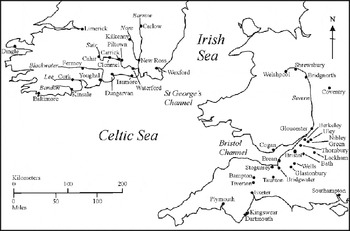
The Celtic Sea region in the Late Middle Ages

The result has been a tendency to question both the extent to which the ties binding Ireland and England together weakened in the fourteenth and fifteenth centuries and the degree to which the English colony was in retreat in the same period in the face of an Irish military and cultural resurgence.Footnote 3 By focusing on the connections between Waterford and Bristol, this article seeks to offer a fresh assessment of the range and strength of the bonds between Ireland and England at this time. By comparing and contrasting the character of the relationship each town enjoyed with its political hinterland, it aims to provide new insights into the nature of the late medieval English world (see fig. 1).
An appropriate point at which to commence consideration of these issues is 1366, the year in which a meeting of the colonial parliament convened by the king’s lieutenant in Ireland, Lionel, duke of Clarence, son of Edward III, was held at Kilkenny. This parliament produced a set of statutes that revealed in the starkest terms the troubles that beset the English settlement two centuries after the conquest of Ireland. Chief among these was the damage to English interests caused by the willingness of certain of the colonists to ally with the native Irish, who were regarded as the king’s enemies, in attacks upon other English lieges.Footnote 4 An example of this phenomenon was provided in the following year when members of the English lineage of Poer launched a damaging assault on the town of Waterford. The fact that the leader of the Poers, Richard “More” (i.e., Mór, meaning “the Great” or “the Elder” in Irish) was so closely aligned with native culture as to have an Irish adjective included in his name, suggests the degree to which he and his family had assimilated to native culture. That he should have launched the attack in coordination with the native Irish family of Ó hEidirsceóil (O’Driscoll) would only have strengthened the belief of those who sponsored the Kilkenny statutes that cultural deviance and political disloyalty went hand in hand.Footnote 5
In the course of the attack on Waterford in 1367 the mayor, several other town officials, and thirty-six citizens lost their lives, as did “four score of loyal people of your land of England of Covyntre of Dartmouth of Brystowe & of other parts of England being at that time there.”Footnote 6 The petition from the king’s lieges of Waterford that contained this information was designed to remind its audience that the fortunes of the town were intertwined with those of the towns in England with which it traded. While the mention of men from Dartmouth in the petition is a reminder that merchants from England’s southern coastal ports traded with Waterford, it was the relationship of the latter town with Bristol that was of the greatest significance in its economic and political development.Footnote 7 Given their geographical proximity, it is not surprising that they should have been in close contact with each other, but this contact was also directed by successive kings of England who since the late twelfth century sought to make the Irish Sea the center of a new urban and commercial zone.Footnote 8 As recently as 1354, in pursuance of such a strategy, Waterford haes of Bristol have this right in their town.”Footnote 10
Knowledge of such desirable rights was transmitted by those who traversed the southern reaches of the Irish Sea. The controller of customs in Waterford in 1304 was Jordan of Bristol, while the presence of Bristol merchants in the town—if not the fate of those who lost their lives in the attack of 1367—was a routine occurrence.Footnote 11 A charter of July 1342 records a grant by William Hook of two shops and a cellar in Wynchstreet in Bristol to Richard de Jerdeleye and Philip de Tilare of Waterford, while a Limerick man, John Toky, was mayor of Bristol in the 1390s.Footnote 12 Joint business ventures by Bristol and Waterford entrepreneurs of the sort recorded in 1348 when William Kent of Bristol and John Bristol of Waterford acknowledged in the court of the mayor of London that they owed the countess of Pembroke £180 appear to have been common.Footnote 13 The inland trading networks of both ports also encouraged economic contact between western England and southern Ireland. The river Severn was navigable as far upstream as Welshpool, enabling Bristol boats to carry wine from Gascony and fish from Ireland to Bridgnorth and Shrewsbury for onward distribution overland.Footnote 14 Waterford lay at the mouth of a river system that provided access to Bristol and its markets to traders from towns as far as thirty kilometers from the sea. In 1357, for instance, merchants from Clonmel and Bristol combined to hire a Waterford ship to transport cloth from Bruges to Plymouth, while a Kilkenny ship was recorded as trading in Bristol in 1403.Footnote 15 Waterford was also the largest of a chain of ports along the southeastern and southern coasts of Ireland, stretching from Wexford in the east to Kinsale in the west. Merchants from these ports traded with Bristol’s littoral hinterland in southwest Britain, which encompassed both the English and Welsh shores of the Bristol Channel.Footnote 16
The trading links forged across the Celtic Sea after the English conquest of Ireland in the early 1170s were strengthened by the acquisition of property in Munster and south Leinster by numerous religious houses located in Bristol and Somerset. The Bristol religious houses of St. Augustine’s and St. Mark’s;Footnote 17 the abbey of St. James’s, Keynsham;Footnote 18 St. Peter’s Abbey, Bath;Footnote 19 Glastonbury Abbey;Footnote 20 and Stogursey abbey to the north of the Quantock hills all gained property in the coastal towns and along the river valleys of southern Ireland.Footnote 21 Such grants paralleled those to laymen from the same parts of England in this period;Footnote 22 in neither instance did the landholding ties thus produced disappear in the late Middle Ages.Footnote 23 If by 1330 Bristol Castle’s role as the center of the crown’s Irish revenue-collecting operations was a thing of the past, the significance to the town of its trading links with Ireland was undiminished, and possibly increasing.Footnote 24 Located in the heart of that part of England, where “corn was king,” Bristol provided the grain to Munster that enabled its landlords to withdraw to a large extent from tillage in favor of pastoral farming.Footnote 25 Waterford merchants such as John Malpas, the mayor of the town killed in the attack of 1367, owned the ships that imported this corn.Footnote 26 Such a change in land use may have been undertaken for sound economic reasons by the English of Munster, but it was also encouraged by the “guerras … contentiones … ac maliciam hominum illius terre,” of which the bishop of Bath and Wells wrote in a letter sympathizing with the monks of Glastonbury Abbey on the devastation of their Munster property in 1332.Footnote 27 Destruction of this sort encouraged migration from Waterford and other southern Irish ports to the west of England, and by the early fifteenth century the scale of the influx had alarmed Bristol’s civic authorities sufficiently to lead to the passing of anti-Irish legislation.Footnote 28 In a period when the town’s population was in steep decline and when all English urban centers depended on migration to maintain population levels, however, the presence in Bristol of a sizable new settlement of people from Ireland was to be a fact of late medieval life.Footnote 29 Jim Bolton has identified many of these migrants from Ireland as skilled workers in the clothing and leatherworking industries, and if such men were disappointed by the coolness of their reception in Bristol, they could and did find employment in those small but growing towns, such as Thornbury and Taunton, which harnessed a thriving textile industry that Bristol coveted but could not control and that powered the economies of late medieval Gloucestershire and Somerset.Footnote 30
Artisan migrants from Ireland were unlikely to have retained their interest in any Irish property they may have owned before sailing to England, and this severing of property-owning ties across the Irish Sea was mirrored at a higher level as English lords with Irish properties bowed to royal demands that they relinquish Irish lands that they were not prepared to defend. Furthermore, some colonial lords in Munster with ancestral lands in Wales, such as David Barry and Robert Cogan, found it increasingly difficult to maintain these transmarine estates and eventually opted for a purely Irish future.Footnote 31 A growing cultural divergence between the two sides of the Irish Sea associated with such developments is suggested by the fact that by the fifteenth century the English being spoken in southeast Ireland sounded old-fashioned to people from England and by contrasts that are evident in the architectural sphere both in terms of what was being built and the construction styles being employed. The design of the fifteenth-century windows at the Cistercian abbey of Holycross in County Tipperary, patronized by the Butler earls of Ormond, for instance, has been described as “the antithesis of the Perpendicular aesthetic current in England.”Footnote 32 More broadly, if the structure that typified the late medieval English West Country was the wool church, its Munster equivalent was the small castle or tower house.Footnote 33
A significant exception to this pattern of divergence in terms of cultural artifacts, however, can be found in Waterford. There the cadaver tomb in the city’s cathedral commissioned in 1483 by the mayor, James Rice, before his departure on pilgrimage to Compostela, is of a style unique in Ireland but typical of monuments of the same date found in southwest England.Footnote 34 In a period when some of the cultural bonds between southwest England and southern Ireland were loosening, those centered on Waterford appear to have remained strong. Its civic and religious rituals, its careful compilation of the records of its rights and history, its petitioning of the king and his council, the early and regular use by its merchants of the English chancery’s equity procedures, the registers kept by its churches of the benefactions of wealthy citizens, even its difficulties in recruiting officeholders and in ensuring that they resided within the town walls, all placed Waterford within the mainstream of urban development in the lands of the kings of England in this period.Footnote 35
How can an argument in favor of Waterford city’s “Englishness” in the late Middle Ages be reconciled with the indisputable fact of its increasing detachment from the administrative structures of the English lordship of Ireland centered in Dublin? Since 1331 its mayor had no longer been required to take his oath of office at the Dublin exchequer, and in 1413 the town was allowed to appoint its own escheator. By the middle of the fifteenth century over half of its annual fee farm (i.e., fixed render to the crown) of 100 marks was diverted from the exchequer to local use, and it rarely hosted sessions of the Irish parliament.Footnote 36 One may take such developments into account and yet remain reluctant to equate the reduction in the level of supervision by and interaction with the Dublin administration to which they testify with a diminution in Waterford’s position as part of the English world.Footnote 37 Such an equation, it is true, is encouraged by the language deployed in the petitions to the king and his council in England that the town itself sponsored: “If all your land of Ireland were gained by your enemies, which God forbid, it might be regained more lightly and more easily by your said city which, like a little castle does not contain in it more than seven acres of land within the walls, than by any other city in your land of Ireland,” read the Waterford petition of 1376.Footnote 38 In 1388 the mayor and citizens successfully appealed to the king and council for financial relief on the grounds of the impoverishment caused by the destruction of the surrounding countryside and the reluctance of shipping to land in the port, while four decades later a Waterford petition declared that “the city is now so enfeebled by poverty [that it] will be abandoned unless the king provides some hasty aid and remedy.”Footnote 39 Even allowing for a degree of exaggeration motivated by a desire to avoid payments to the crown or to extract grants from it, the condition of the town in these decades appears to have been squalid. The cost in the 1370s of repairing the belfry to its cathedral, which had collapsed in a storm, and of rebuilding the town walls that had “all but fallen to earth” was said to have left its mayor and citizens “indigent and poor,”Footnote 40 though perhaps not quite so poor as the French chronicler, Jean Creton, who visited Waterford in the company of King Richard in 1399, would lead us to conclude upon reading his account of how “the wretched and filthy people, some in rags, others girt with a rope, had the one a hole, the other a hut for their dwelling.”Footnote 41
The point is that far from being the result of increasing remoteness from the English world and its interests, Waterford’s troubles arose in part from its participation in the king’s enterprises and, in particular, his French wars. James Lydon has remarked that the Hundred Years’ War turned the Irish Sea “into a battlefield of sorts,” and Waterford was in the vanguard of this conflict.Footnote 42 It was from Waterford in 1418 that ships commissioned from Bristol transported a large Irish force in aid of Henry V’s successful campaign in Normandy.Footnote 43 In like manner, at times when the war went against the English, Waterford suffered the consequences: its quay was damaged by Spanish forces in 1377; in 1430 it complained of attacks by “Brittownes, Skottes and Spaynardes”; and in 1442 it lost cargo worth 4,000 marks to Breton pirates.Footnote 44 The powerful language of isolation and imminent destruction that permeates the petitions of fourteenth- and fifteenth-century Waterford can obscure the reality that their very composition testified to and perpetuated the involvement of the town in the political life of the king’s domain.Footnote 45
In addition, only by standing back from the rhetorical force of such petitions is it possible to recognize that the city remained at the heart of a part of Ireland that continued to experience the influence of royal patronage at the same time as its links with Dublin were becoming looser.Footnote 46 The second half of the reign of Edward III witnessed two chief governors, Thomas Rokeby and William Windsor, acquiring property in Munster and elsewhere in the lordship. Through marriage the royal family itself, in the person of Lionel of Antwerp, husband of Elizabeth de Burgh, heiress of the Ulster earldom, gained a stake in Tipperary and Limerick that lasted until Lionel’s death in 1368.Footnote 47 Richard’s II’s interest in the outlying parts of his realm has been elucidated by Michael Bennett and was experienced by the inhabitants of both Bristol and Waterford.Footnote 48 Whereas in a reign of fifty years Edward III never went to Ireland and visited Bristol only once, Richard II visited both Waterford and Bristol four times each in a reign of twenty-two years.Footnote 49 Richard’s long sojourn in Bristol with his queen in 1386 was concerned with the proposed embarkation from there to Ireland of his favorite, Robert de Vere, marquis of Dublin, and when the king’s enemies were in the ascendant two years later, their punishment of the king’s supporters also had an Irish element.Footnote 50 One of the councillors exiled to Ireland by the Merciless Parliament of 1388 was the former Chief Baron of the Exchequer, Sir John Cary, who was ordered to sail from Bristol the following September for Waterford, where he was to spend the rest of his life.Footnote 51 It is likely that soon after Richard II’s arrival in Waterford in October 1394, which was greeted with great joy by its citizens, the king sought out the company of Cary, who after nearly seven years of exile was to die in Waterford the following May, the same month in which Richard returned to England.Footnote 52 The persistence of Richard’s interest in extending patronage to his favorites in ways that tied England and Ireland together resulted in him granting to his blood relations John and Thomas Holland and Edmund of Langley land and offices in both the English West Country and in Munster.Footnote 53 The interests of the Holland family in both areas were among those recently established transmarine landholding links speedily dismantled by Henry IV after his usurpation.Footnote 54
Richard II’s attempts to forge such links had proven as likely to promote local disruption as fruitful interaction across the Irish Sea. In the hinterland of Bristol the king’s introduction of John Holland into Devon and Somerset was resented by the earl of Devon, while in Gloucestershire the local dominance of the Berkeley family was undermined from 1397 by Sir Thomas Despenser (earl of Gloucester, 1397–99), leading to violence between Berkeley and Despenser at Winterbourne, just north of Bristol.Footnote 55 Across the sea, the rivalries between the comital houses of Ormond and Desmond, which originated much earlier in the fourteenth century and centered on competition for territorial ascendancy in southern Ireland, were particularly noticeable during the latter years of Richard’s reign.Footnote 56 In 1396 the brother of the earl of Ormond was killed in Waterford city by adherents of the earl of Desmond, and in 1399 the latter’s castle of Dungarvan, in west County Waterford, was confiscated by the crown at the suggestion of James Butler, third earl of Ormond, who had Richard’s ear. Desmond responded by attacking the Butler castle of Cahir and by encouraging the Irish king of Leinster, Art MacMurchadha, to raid the Butler lordship.Footnote 57
While it is clear that royal involvement of the sort petitioned for by the citizens of Waterford did not automatically bring peace or strengthen ties between England and Ireland, some of the developments in landholding that occurred in the reign of Richard II did result in the establishment of new tenurial and political bonds that spanned the Irish Sea. Richard Lord Talbot of Goodrich in Herefordshire, whose mother was a Butler of Ormond, for instance, was awarded the Valence-Hastings liberty of Wexford in 1389, and in the fifteenth century the Talbots were to play a crucial political role in both England and Ireland.Footnote 58 James Butler, earl of Ormond, acquired an English bride in 1386 and in the early 1390s was permitted to purchase from the Despensers their portion of the liberty of Kilkenny.Footnote 59 The encouragement Edward III and Richard II gave to English absentees to sell their Irish lands if they were not prepared to defend them was accompanied by declarations, enunciated by Rokeby in 1350, Windsor in 1371, and most explicitly by Thomas Holland in 1398, that land reconquered from the Irish should be colonized by settlers brought in from England.Footnote 60
To acknowledge the variety and strength of the ties that bound Waterford to the late medieval English world, and to recognize the extent to which these connections centered on Bristol, is not to suggest that the historical experiences of the two towns were in all points similar. The impact upon them of supporting the king’s wars in France, for instance, was starkly different: whereas Waterford endured damaging enemy naval assaults and economic disruption, Bristol benefited from the conflict through its ability to provide shipping and loans to English kings and war captains.Footnote 61 The political environments in which each town operated also had little in common. Bristol did indeed cast itself in the role of vulnerable outpost in the late fourteenth century when its members of parliament condemned the liberties of Welsh marcher lords as the breeding ground of a lawlessness from which they suffered;Footnote 62 the town also temporarily assumed a military role in the 1400s as one of the bases for the English armies that defeated the forces of Owain Glyn Dŵr.Footnote 63 It had no cause to fear external attack, however, and while the occasional disputes among the members of its guilds, and the presence of a significant contingent of Bristol Lollards among those who participated in Oldcastle’s rebellion of 1414, are indicative of internal tensions of some intensity, it was not a town afflicted by warfare or large-scale violence in the late fourteenth and early fifteenth centuries.Footnote 64 By contrast, Waterford endured intermittent raids from the early fourteenth century onward conducted by the neighboring English lineage of Poer and was targeted for seaborne assault by the Irish family of Ó hEidirsceóil, based on the west Cork coast at Baltimore.Footnote 65 In their encounters with the Irish, the men of Waterford proved more resourceful than their petitions to the crown might lead one to suspect. In 1413 the mayor led a Christmas Day raid on Baltimore in which the Ó hEidirsceóil chief was captured, and in 1461 an engagement between the two sides at Tramore, to the southwest of the town, saw the Waterford men capture three Irish galleys.Footnote 66
The ability of Waterford and other southern Irish towns to offer resistance to their enemies and survive in such a hostile environment was facilitated by the crown’s willingness to extend their constitutional powers and demand that local settler magnates offer them full military support. From 1345 the men of Waterford were permitted to reach peace agreements with their local enemies—a concession extended to other southern towns over the course of the next sixty years—and from 1447 they were allowed to ride with banners displayed against those local English families, “for a long time traitors and rebels” who constantly attacked them.Footnote 67 The crown also granted to the two great comital families of southern Ireland, the Butlers of Ormond and Geraldines of Desmond, liberties intended to bolster their authority in the expectation that they would in turn offer more effective protection to the king’s urban-dwelling lieges, not least by curbing the lawlessness of local English lineages.Footnote 68 The earls of Desmond responded by acquiring the lands and reducing the influence in Cork and Waterford of settler families such as the Carews, Cogans, Barrets, and Barrys, either by purchase or intimidation, and often in alliance with neighboring Irish chiefs.Footnote 69 The disruption caused by this process, and its consequences for southwest England as well as southern Ireland, is suggested by a petition from unnamed English colonists in Munster of 1381–82 begging the king to send to Ireland a wise and discreet lieutenant with men-at-arms and archers to resist the king’s enemies and end the dispute between the Geraldines and the Barrys that had destroyed Munster and caused a large number of the king’s lieges there to flee to Bristol and Cornwall.Footnote 70 In east Munster the Butlers of Ormond harnessed or curbed the power of branches of families such as the Roches and Poers through similar means and extended their liberty jurisdiction without explicit royal approval beyond Tipperary to include Kilkenny.Footnote 71 By the middle of the fifteenth century the geographical spheres of influence of the earls of Desmond and Ormond in Munster, which had long been a cause of contention, were becoming more clear-cut, just as the authority of the earls within their respective domains was growing more complete. In each case, control of river valleys and their towns and seaports was the goal, providing their lord with financial resources and easy access to England and the crown when necessary. By the 1430s Kinsale, Cork, Fermoy, Youghal, and Dungarvan were under the sway of the earl of Desmond, while the riverine towns along the Barrow, Nore, and Suir, such as New Ross, Carrick-on-Suir, and Clonmel, and the town of Waterford at their confluence, fell within the ambit of the earl of Ormond.Footnote 72 The result of such developments was that by the middle of the fifteenth century the politics of southern Ireland were more stable than they had been a century before.Footnote 73
The encouragement offered by the crown to the great colonial lords of southern Ireland to provide increased protection to the region’s towns strengthened their interest and influence in these places. Hereditary rights to a percentage of the duties imposed on wine imports prompted Butler concern for the fortunes of Waterford, and this link was bolstered on the elevation of James Butler in 1328 as first earl of Ormond by the award to him and his heirs of £10 per annum from the city’s annual fee farm of 100 marks. By the late fourteenth century Waterford’s annual contribution to Butler income had risen to £40, or almost two-thirds of the farm.Footnote 74 The extent to which the family regarded the town as part of its power base is suggested by the events of August 1357 when, on his own authority, the earl arrested the newly appointed justiciar of Ireland, John Bolton, and his entourage and imprisoned them in Waterford castle.Footnote 75 In the late fourteenth century the earl of Ormond used the boat Gabriel, owned by Walter Spence of Waterford, “to go from time to time to England, Ireland, and elsewhere,”Footnote 76 and the earl held property in the town and had business dealings with its leading burgess families, such as the Lombards and the Rices.Footnote 77 Members of the family also occupied high civic and church office in the town in the fifteenth century, and the impression that the relationship between town and magnate was mutually beneficial is supported by the revival in its fortunes enjoyed by Waterford in the second half of the fifteenth century and by the assistance that the town afforded to the Butlers in their political difficulties in that period.Footnote 78
Just as the closeness of Waterford’s ties to a local magnate family reflected its need for military protection and security, so Bristol’s more distant relationship with the nobles of its hinterland had much to do with the generally pacific nature of that region, at least until the middle of the fifteenth century. It was also the case that the town’s nearest aristocratic neighbors, the Berkeleys, were of the second rank in terms of wealth and influence.Footnote 79 Since the twelfth century the family had held manors in and around Bristol such as Portbury, Hartcliff, and Bedminster. The quays at Redcliffe, situated in the manor of Bedminster, were worth £200 in rent in the fourteenth century and were the base for those trading ships belonging to the Berkeley family noted in 1400.Footnote 80 Relations between the town and the Berkeleys, which had often been strained in the fourteenth century, became less significant after 1417, when an entail detaching the family’s Bristol properties from its main interests around Berkeley in south Gloucestershire came into effect on the death of Thomas, fourth Lord Berkeley.Footnote 81 Marriage, death, inheritance practices, political miscalculation, and royal patronage combined to ensure that magnate involvement in the affairs of Bristol was sporadic and unthreatening. The Courtenay earls of Devon, with lands in Somerset and Cornwall as well as in Devon, were, like the Berkeleys, unusual in being able to preserve a male line of descent over the course of several generations, but as Richard II’s reign proved, even such a stable inheritance pattern could not protect them from the intrusion of a royal favorite into their patrimony. Edward Courtenay, earl of Devon (d. 1419), survived the king’s attempts to build up the power of his Holland relatives in his sphere of influence, but his overriding concern with consolidating the dominance of the Courtenays in Devon, the loss of his eyesight in his last years, and a succession of minorities following his death and lasting until the 1430s, limited the extent of the family’s influence in Bristol.Footnote 82
That the Bristolians were not averse to seeking and enjoying magnate patronage was demonstrated by their relations with some of the great lords who were extending their power to the north of the town in the late fourteenth century. Hugh, earl of Stafford (d. 1386), held the manor of Thornbury in south Gloucestershire and patronized members of the Bristol elite to the extent of retaining one of its MPs in the 1360s, but successive minorities between 1392 and 1438 reduced the family’s ability to offer consistent rewards and recruit within the elite.Footnote 83 John of Gaunt, whose influence in the same area grew in the 1370s and 1380s at the expense of the Berkeleys and Despensers, also had close ties with the leading citizens of the town, receiving from them loans and shipping for his Castilian enterprises.Footnote 84 Repudiation of magnate influence was not seen as natural or desirable by the leading men of either Bristol or Waterford, but whereas for the former such influence was viewed as a welcome enhancement of personal and corporate standing, for the latter it represented a guarantee of political and economic survival.
Stark as the contrasts were between the environments in which magnate power operated in the vicinities of Bristol and Waterford, to a large extent this was still a single aristocracy with ties of blood and landownership that transcended the sea between them. The earls of Desmond held no land in England, but marriages in the thirteenth and fourteenth centuries linked them to the families of Stafford and Berkeley.Footnote 85 In 1448 the Berkeleys became landowners in Ireland when John Mowbray, duke of Norfolk, granted a life interest in his Irish lands at Carlow to his cousin Sir William Berkeley, later earl of Nottingham.Footnote 86 The Staffords retained their third of the liberty of Kilkenny and in the fifteenth century entered into a marriage alliance with their Kilkenny neighbors, the Butlers of Ormond, that brought the latter substantial estates in the English West Country.Footnote 87 The Butlers had held land on the Somerset coast at Brean since before their arrival in Ireland in the twelfth century and in the fourteenth century were near neighbors of the Mortimer earls of March, lords of Bridgwater, who among their numerous properties in Ireland counted another third of the liberty of Kilkenny.Footnote 88 From the 1350s the Butlers of Ormond were also linked by marriage with the Talbots of Herefordshire who, under the leadership of John Talbot, earl of Shrewsbury and Waterford (d. 1453), exercised lordship on both sides of the Irish Sea in a manner that caused disruption in the environs of both Waterford and Bristol.Footnote 89 The marriage of Talbot’s son, John, to the daughter of the earl of Ormond in 1444, and his acquisition of the new comital title earl of Waterford in 1446, and with it the lordship of Dungarvan, succeeded in healing a long-running dispute between Shrewsbury and Ormond about control of the Irish administration but also disturbed the local balance of power in Munster and alienated the earl of Desmond.Footnote 90 In England, meanwhile, Desmond’s relatives, the Berkeleys, also suffered from Talbot’s acquisitiveness as he pursued the claims of his second wife, Margaret Beauchamp, to the portion of the Berkeley inheritance that had been awarded to her cousin, James Lord Berkeley in 1417.Footnote 91 The Berkeley-Talbot dispute descended into violence on more than one occasion before culminating in March 1470 in full-scale battle at Nibley Green, north of Bristol in Gloucestershire. Often described as the last private battle fought on English soil, the encounter saw William Lord Berkeley slay Thomas Talbot Viscount Lisle, the grandson of John Talbot.Footnote 92
The magnate marriage alliances that helped hold the Anglo-Irish component of the king of England’s realm together had important implications for the relationship between Bristol and Waterford in the fifteenth century. The Butlers of Ormond had a tradition of taking English wives, and James Butler, fourth earl of Ormond (d. 1453), to a greater extent than his predecessors, involved himself in the politics of contemporary England as well as Ireland.Footnote 93 England rather than Ireland was the focus of the interests of his children, especially of his son and heir, James (1420–61). Favored by Henry VI, James’s marriage in 1438 to Avice Stafford (d. 1457) brought him substantial estates in Devon, Dorset, and Somerset, and in 1441 he served in France with a force raised from his estates both in Ireland and England.Footnote 94 From 1449 he held the title earl of Wiltshire, and his attempts to increase his influence in Somerset, where his brother, Thomas, also became a substantial landowner through marriage and the patronage of the Beauforts, provoked the ire of the earl of Devon, Thomas Courtenay, who in 1451 besieged him at his manor of Lackham, near Bath.Footnote 95 In 1452 James inherited his father’s estates and the Ormond comital title and in 1455 gave unequivocal testimony to his Lancastrian sympathies by bearing the king’s standard at the battle of St. Albans. His second marriage in 1458 to Eleanor, daughter of Edmund Beaufort, duke of Somerset, further strengthened Lancastrian influence in the west of England.Footnote 96 James Butler shared his adherence to the cause of Henry VI with his brother-in-law, John Talbot, second earl of Shrewsbury and Waterford, who had served as treasurer of Ireland in 1446 while his father was chief governor. Their allegiance cost them both their lives: Talbot died at the battle of Northampton in July 1460, and Butler was executed at Newcastle on 1 May 1461, in the aftermath of the Yorkist victory at Towton.Footnote 97
One of the beneficiaries of Butler’s demise was the town of Bristol, which was granted a share of his wealth two months after his death. Edward IV, who as earl of March had been appointed constable of Bristol castle in November 1460, had reason to be grateful to a town that had supported the Yorkist cause more speedily than had London and that had sent men to fight beside him at Towton.Footnote 98 One example of the succor offered by the mayor of Bristol, William Cannynges, to Edward’s father, Richard duke of York, in the 1450s was his campaign to disenfranchise Henry May, an important burgess and merchant of the town of Irish origin who was closely associated with James Butler. In 1460 one of May’s ships, which carried gunpowder and corn for the Lancastrian cause, was seized by the town authorities.Footnote 99
Predictably, Butler’s death also had consequences for Waterford and its environs. As the inheritor of the vast Mortimer interest in Ireland, Richard duke of York enjoyed the support of the bulk of the lordship’s political community, leaving the Butlers in an isolated position as Lancastrian partisans.Footnote 100 John and Thomas Butler, brothers of the executed James, were convicted of treason while in hiding in November 1461 and two months later invaded Ireland in the name of Henry VI.Footnote 101 They were joined by their cousin Edmund, son of Richard Butler—who in 1455 had “with banners displayed, ridden, burnt, and destroyed the county of Wexford by time and space of four days and four nights, continually”—and quickly captured the family estates in Kilkenny and Tipperary, as well as the towns of Waterford and New Ross.Footnote 102 They were opposed by James, earl of Desmond and his son, Thomas, and in the spring of 1462 a battle was fought at Piltown, to the west of Waterford city, that ended in the defeat of the Butlers and the flight of John.Footnote 103 The battle of Piltown was not simply a particularly serious incident in the long-running Ormond-Desmond conflict in east Munster but also a transposition westward of the Yorkist-Lancastrian dispute that had for two decades disrupted the English West Country and the hinterland of Bristol.Footnote 104 It must surely count as a battle in the Wars of the Roses—the first not fought on English or Welsh soil—though it has largely escaped the notice of historians of that conflict.Footnote 105
Peter Fleming has speculated that Bristol’s shifting allegiances during the Wars of the Roses reflected the fact that it was instinctively loyal neither to the house of York nor of Lancaster but, rather, to the earl of Warwick (“the kingmaker”) who had come into possession of the Berkeley lands that adjoined the town.Footnote 106 In like manner, Waterford supported the political lead of the Butlers both in the 1450s and early 1460s and more strikingly in the late 1480s and early 1490s when it went against the political grain in Ireland by refusing to support the campaigns of the pretenders Lambert Simnel and Perkin Warbeck against Henry VII.Footnote 107
If the battle of Piltown and its aftermath illustrated the extent to which Ireland and England remained part of the same political world in the mid-fifteenth century, it also exposed that world’s cultural heterogeneity. The ransom demanded by the earl of Desmond for the release of Edmund, son of Richard Butler, after the battle was a portion of a manuscript belonging to the latter written in Irish and concerning the doings of the preconquest kings and saints of Munster.Footnote 108 Clearly all parties concerned, whether fighting in the name of York or Lancaster, were thoroughly familiar with the Irish language and valued highly both this written artifact of native culture and the stories it contained of the ancient glories of the land they now possessed. Here was an example of intimate engagement on the part of leading settlers with Irish custom that the statutes of the Kilkenny Parliament of 1366 condemned but failed to halt.
So embedded was this engagement in Waterford’s political hinterland that traces of it were even to be found in Bristol. The account of the career of Henry Crystede provided by Jean Froissart, for instance, reveals in passing that Irish was spoken in Bristol in the 1390s. Crystede, who was born in Ireland, had been a member of the household of the earl of Ormond in his youth. Captured in the service of his lord, he had spent some years in comfortable captivity among the Irish of Munster and had married a daughter of the local chief. Upon his release in the mid 1360s he had taken his wife and one of their adult daughters to start a new life in Bristol. He was still there in 1394 when he was sought out by Richard II and taken to Waterford to act as an intermediary with the Irish chiefs whom the king had come to tame. He was useful, Crystede explained, “because the Irish language is as familiar to me as English, for I have always spoken it in my family and introduce it among my grandchildren [in Bristol] as much as I can.”Footnote 109 Such evidence suggests no weakening of Ireland’s English connection between ca. 1360 and ca. 1460 and no lessening of the importance of the Bristol-Waterford link in ensuring that this was the case. It also suggests that efforts to maintain and strengthen existing ties represented a response to a perception on both sides of the Irish Sea that English power was in peril in this part of the English world. The extent to which such a perception accorded with reality may be debated; that it shaped Anglo-Irish relations for centuries to come is beyond doubt.