I. Introduction
Although interest in judicial reliance on foreign law predates the previous decade (e.g., Tushnet Reference Tushnet1998; Choudhry Reference Choudhry1999), three Supreme Court decisions between 2002 and 2005 (Atkins v. Virginia, 536 U.S. 304 [2002]; Lawrence v. Texas, 539 U.S. 558 [2003]; and Roper v. Simmons, 543 U.S. 551 [2005]) brought the issue to a new level of prominence (e.g., Sitaraman Reference Sitaraman2009; Glensy Reference Glensy2010). The focus of the literature overwhelmingly has been normative, with many scholars offering accounts of why and how judges should rely on foreign law (e.g., Reference Jackson2005; Yeazell Reference Yeazell2009) and others arguing against the practice (e.g., Posner Reference Posner2005; Young Reference Young2005). In advancing their normative positions, however, scholars often have made empirical claims about the justices’ use of foreign law. Some scholars, for example, have argued that the current controversy is overblown given the Supreme Court’s long history of relying on foreign law (e.g., Koh Reference Koh2004, 45–46;Cleveland Reference Cleveland2006, 6–7; Farber 2007, 357), while others have expressed concern over what they view as the practice’s recently increased frequency (e.g., Bork Reference Bork2003; Alford Reference Alford2005, 666–67). Yet despite the relevance of empirical questions to the normative debate, empirical studies on the judiciary’s use of foreign law have been sparse (Law and Versteeg Reference Law2011), with authors’ conclusions on empirical questions commonly based on a small number of well-known examples.
The dearth of empirical research leaves the normative debate ungrounded in at least two important respects. First, competing claims about the commonality of the Court’s reliance on foreign law remain unresolved. Some scholars perceive a long history of frequent reliance on foreign law as undercutting opposition to foreign law citations, while others are troubled by a perceived spike in the practice. These conflicting claims give rise to a puzzle: if the practice is long-standing, why did the Court’s recent use of foreign law in Atkins, Lawrence, and Roper spur so much controversy, with many sensing that something new was going on here? Seeking an answer to this question requires empirical study.
Second, scholars defending reliance on foreign law have articulated a variety of justifications for the practice, but we need to know whether these arguments have any relation to the Court’s jurisprudence. We only can assess citations to foreign law if we understand the role that the citations are supposed to play in justifying decisions. Thus, as a number of scholars have noted in calling for more empirical research, we need to investigate how the Court actually has used foreign law (e.g., Young Reference Young2005, 149–50; Black and Epstein Reference Black2007, 795–97; Sitaraman Reference Sitaraman2009, 655–56).
Using Westlaw (http://www.westlaw.com), I conducted searches to identify lead opinions relying on foreign law in constitutional rights cases from the Court’s earliest period to the present day, yielding a database of 63 cases.Footnote 1 I then classified the opinions according to the “role” and “form” of their foreign law citations. The “role” refers to how a reference to foreign law is supposed to justify a legal conclusion. The “form” refers to what a reference to foreign law looks like on its face; for instance, does it describe the reasoning of a particular judicial ruling, or does it refer to a general international consensus on a principle of law? (The results of the study are discussed in Sec. III.)
Examination of how the Court has used foreign law helps us to make better sense of the controversy sparked by Atkins, Lawrence, and Roper. Although 63 cases since the Court’s inception is not a large number, defenders of reliance on foreign law are correct in noting that the practice has a long history and that its prevalence has not jumped in recent years. Nevertheless, the three cases between 2002 and 2005 were distinctive in important respects that come into view only when we examine changes in the role that foreign law has played in justifying the Court’s decisions (see Sec. IV.A).
This study also reveals a disconnect between scholarly justifications for judicial reliance on foreign law and the Court’s use of foreign law in practice. The Court’s references to foreign law have never discussed the reasoning behind another jurisdiction’s judicial ruling or enactment. Instead, the overwhelming majority of the foreign law citations simply have noted that a particular rule was prevalent either in other countries generally or in a certain group of countries. These references have not appealed to the force of the arguments underlying a foreign rule but merely to the fact of their acceptance. This observation about the Court’s foreign law citations has implications for the debate because many of the defenses that scholars have offered for judicial reliance on foreign law presuppose engagement with the reasoning behind other countries’ laws and practices (see Sec. IV.B).
II. Methodology
Despite the need for research to ground the normative debate, the empirical work on the Court’s use of foreign law has been surprisingly sparse. The two most ambitious studies on the use of foreign law by federal judges have been those by Steven Calabresi and Stephanie Zimdahl (Reference Calabresi2005) and by David Zaring (Reference Zaring2006). Using online legal databases, Calabresi and Zimdahl identified and examined “some of the most striking cases in which the Supreme Court has cited foreign law throughout its history” (Reference Calabresi2005, 754). The authors divided the cases they discussed into four time blocks, sometimes grouping the cases within each time period according to issue areas or how the opinions used foreign law. They concluded that the use of foreign law has been “somewhat commonplace” throughout the Court’s history, becoming even more prevalent since the late 1950s (907). The study usefully spans the Court’s entire history and provides interesting analysis of how the Court used foreign law in specific cases. However, the study did not report the total number of opinions identified as relying on foreign law, nor did it present other results in a quantified fashion, which weakens the claim that the use of foreign law has increased in recent decades. In addition, the meaning of reliance on foreign law was not carefully delimited, undermining the claim that the use of foreign law has been common throughout the Court’s history.
Zaring (Reference Zaring2006) examined the reliance on foreign law by all federal courts between 1945 and mid-2005. Zaring, too, searched online legal databases to identify cases. Unlike Calabresi and Zimdahl, however, Zaring reported his findings quantitatively. Zaring’s study also differed in defining the use of foreign law as references to the decisions of foreign courts, focusing on two international organizations and the high court of 14 countries (301–3). Employing this definition, he found that reliance on foreign law in the federal courts was “rare” and that it has not increased in recent years, adding that “the Supreme Court uses less foreign law now than it has at any other time in its history” (297–98). Zaring’s study had the advantage of reporting the results quantitatively. However, the relevance of the findings is weakened, as Zaring acknowledged, by the inclusion of categories of cases that had little or no relation to the controversy sparked by recent cases like Lawrence and Roper (300, 319). Zaring placed each of the cases identified into one of five categories, finding that the largest category consisted of opinions interpreting foreign law when that law was made directly relevant to the dispute by applicable American law. As Zaring noted, “no one objects to that use of foreign authority” (319). He found that the second largest category was “litigation coordination, such as when a court acknowledges parallel proceedings before a foreign tribunal” (300), another uncontroversial use of foreign law. Indeed, Zaring found that only about 20% of the instances of reliance on foreign law fell within the most relevant category—opinions using foreign law to interpret domestic law—and even most of these were in areas where the use of foreign law is not generally contested, as in admiralty cases (300). While the study was overinclusive with respect to issue areas, it was underinclusive in its definition of foreign law because it excluded appeals to foreign authority that do not cite judicial opinions, as when opinions refer generally to the weight of international opinion.
The methodology adopted here builds on the respective strengths of these previous investigations by zeroing in on the class of cases most relevant to the continuing normative debate: instances in which the Supreme Court has relied on foreign law to decide constitutional rights disputes. Like Calabresi and Zimdahl, I examine the cases identified, to see how foreign law was used. Like Zaring, I report the results quantitatively. Unlike either of those studies, I classify the cases according to how the justices used foreign law to justify outcomes, reporting the number of opinions falling within each category. This approach makes it possible to examine not only when the Court has used foreign law but also, crucially, how it has done so.
To conduct this study, I used Westlaw searches to identify Supreme Court decisions in which the lead opinions relied on foreign law in constitutional rights cases, producing a new database containing 63 entries.Footnote 2 Focusing on rights cases allows us to filter out opinions in issue areas in which the use of foreign law is generally uncontroversial. Foreign law often is used in areas of jurisprudence in which its use generally is not contested (Sitaraman Reference Sitaraman2009, 657), as in admiralty law (Farber Reference Farber2007, 1337), or when contracts, treaties, or domestic law explicitly make non-American law applicable (Yeazell Reference Yeazell2009, 60–61).Footnote 3 The use of foreign law in such cases has not attracted anything like the attention and debate that it has in cases like Atkins, Lawrence, and Roper in which the opinions addressed the substantive content of specific constitutional protections.
It is vital to delineate what is to be counted as reliance on foreign law. While scholars have used a variety of terms, including comparative reasoning (e.g., Annus Reference Annus2004), international sources (e.g., Alford 2004), and transjudicial communication (e.g., Black and Epstein Reference Black2007), in addition to foreign law (e.g., Waldron Reference Waldron2005), the literature does not always indicate what is meant by these terms. For clarity, I employ the single term “foreign law” and count an opinion as relying on foreign law if it refers to legal enactments or practices outside the United States as partial support in the reasoning behind a decision, when no domestic laws make those enactments or practices directly applicable to the issues before the Court.Footnote 4 This definition encompasses not only references to the law of individual countries but also generalized references to international practices that do not name specific countries.
A caveat is required with respect to the special case of English law. Due to the deep roots of the American legal system in the English common law, citations to English cases in judicial opinions are common to the point of being taken for granted. In the overwhelming majority of cases, it would be misleading to count citations to English cases as reliance on foreign law. As the Court has explained, since so many long-standing American legal practices have their origins in English law, reference to English sources often is helpful in understanding the purpose and application of those practices (e.g., Snyder v. Massachusetts, 291 U.S. 97, 114 [1934]). English citations most often can be understood better as appeals to the roots of American law and practices, rather than as an appeal to something wholly outside American law.Footnote 5
To produce the database, I conducted searches using Westlaw’s “terms and connectors” functionality. I relied primarily on a long search string that combined elements of the strategies employed in the empirical studies discussed earlier.Footnote 6 Calabresi and Zimdahl employed a variety of terms that the Court might use in describing the international community broadly, such as “civilized world” or “Western nations” (Reference Calabresi2005, 754 n. 37), while Zaring searched for references to the decisions of particular tribunals (Reference Zaring2006, 301–3). To capture opinions referring to foreign law in the form of widely recognized practices, the first part of my primary search string targeted text that placed terms like “every,” “universal,” or “foreign” in close proximity to terms like “community,” “nation,” or “society.” (As discussed below, e.g., an especially common way for the Court to reference foreign law has been by noting rules or practices observed “in every civilized community.”) To collect opinions referring to foreign law in the form of decisions by foreign tribunals, the second part of the search string targeted text that placed the name of particular foreign countries in proximity to terms indicative of a judicial ruling.Footnote 7 The “terms and connectors” string brought back a total of 6,785 search results. To code them, I examined the cases in stages. First, I eliminated all search results that were not constitutional rights cases.Footnote 8 Next, I eliminated search results in which the Court did not actually rely on foreign law, notwithstanding the inclusion of certain key terms from the search string. This yielded a database of 63 cases,Footnote 9 which I examined with an eye to addressing the following questions:
-
1. Is reliance on foreign law relatively new, and has it been increasing in recent years?
-
2. When the Court has relied on foreign law, what role has foreign law played in justifying the Court’s decision?
-
3. When the Court has cited foreign law, what form have those citations taken?
III. Results
A. The (In)Frequency of Reliance on Foreign Law
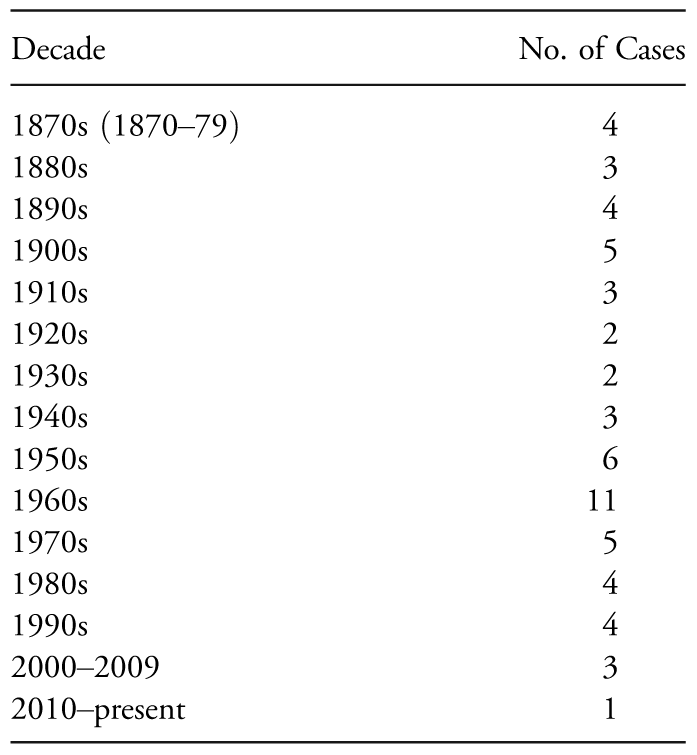
The total number of cases with foreign law citations is low: 63 in nearly 225 years. (For brevity, the term “cases” refers to cases in which the Court’s lead opinion relied on foreign law in deciding a constitutional rights dispute, and “foreign law citations” refers to reliance on foreign law in one of these “cases” so understood.) Foreign law citations were especially rare in the Court’s early history, with the first instance not occurring until 1843 and only two more occurring before 1870.Footnote 10 Even since 1870, the average occurrence has been only .42 cases per year. With just four exceptions, every decade since 1870 has had three, four, or five cases (see table 1). The highest frequency occurred during Earl Warren’s tenure as chief justice (October 2, 1953, through June 23, 1969), with the Court averaging one case per year between 1955 and 1969 (including five in 1961 alone). While the increased frequency of cases during the Warren Court merits further investigation, the most pertinent point for current purposes is that the frequency reached only about one case per year even at its peak, and the rate since the Warren Court has returned to a more typical .41 cases per year. Indeed, the last 3 full decades have leveled out at four, four, and three cases, respectively.
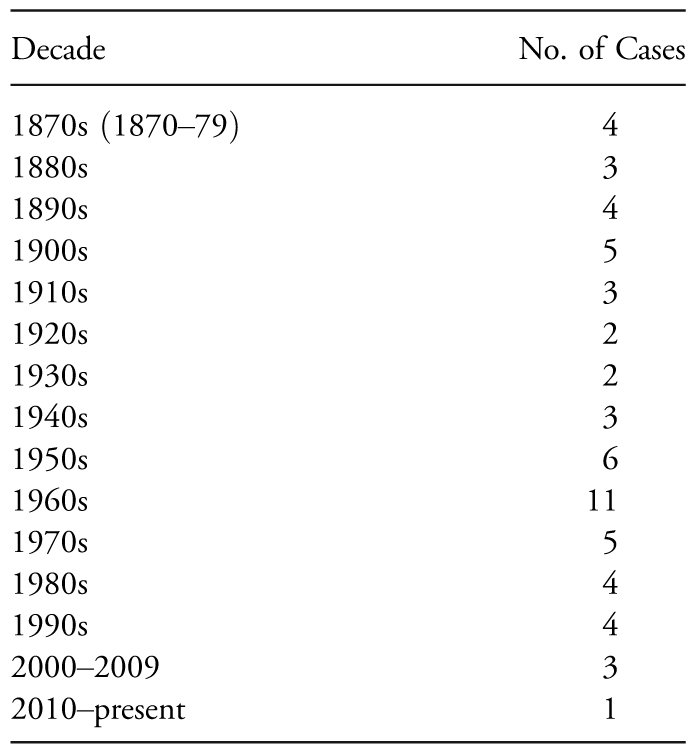
Source.—Westlaw Supreme Court database.
Many observers have the impression that the citation of foreign law has been common in the Court’s jurisprudence, including during the Court’s early period (e.g., Calabresi and Zimdahl Reference Calabresi2005). However, the debate over foreign law has been distorted by inadequate care in defining the subject of interest. The Sturm und Drang over foreign law predominantly has concerned reliance on the practices of other countries to support interpretations of constitutional rights, as in Atkins, Lawrence, and Roper. While this trio of cases often serves as the jumping off point, scholars frequently bring into the discussion a wide range of decisions that have little bearing on the current debate. We gain a more useful perspective by focusing on the class of cases with the greatest relation to the contemporary controversy.
A definition of cases relying on foreign law has two components. The first concerns the class of disputes in which we are interested (i.e., the range of doctrinal issues that the cases address). By including only decisions that address constitutional rights issues, this study eliminates many decisions that other scholars have treated as supporting the historic commonality of reliance on foreign law. In their section on the early Court’s reliance on foreign law, for example, Calabresi and Zimdahl included Rose v. Himely (8 U.S. 241 [1808]), an admiralty case, and Murray v. Schooner Charming Betsy (6 U.S. 604 [1804]), a case laying down a principle of statutory construction. Although such cases are of interest as part of a broader study of the interaction between American and international law, we can sharpen our understandings of the contemporary debate over foreign law by treating such decisions as falling outside the scope of the current empirical investigation.
Regarding what it means for an opinion to rely on foreign law (the second component in defining cases relying on foreign law), I exclude not only references to English law but also references to ancient Roman law or citations of historically authoritative treatises written by non-Americans. Including references to Blackstone, Grotius, or ancient maxims would produce a disconnect between our empirical investigations and the ongoing normative debate. The (inadvisable) inclusion of citations to Roman law and treatises is another factor that has contributed to the misimpression some scholars have regarding the frequency of foreign citations by the early Court (e.g., Calabresi and Zimdahl 2005, 760–63).
While reliance on foreign law is not new, it is misleading to say that the practice has been common throughout the Court’s history. Moreover, notwithstanding an increase in the occurrence of foreign law citations during the Warren Court, it is not the case that Atkins, Lawrence, and Roper reflected a recent spike in the frequency of the Court’s reliance on foreign law. Indeed, the 1980s and 1990s each contained as many cases as the period since 2000. The appropriate focus of our inquiry, then, is not to ask why the Court began citing foreign law more often during the 2000s (which it did not) but, rather, why did Atkins, Lawrence, and Roper provoke so much controversy, even though the practice of citing foreign law was neither new nor increasing in frequency. (This question, discussed briefly above [see Sec. I], is examined in greater detail below [see Sec. IV.A].)
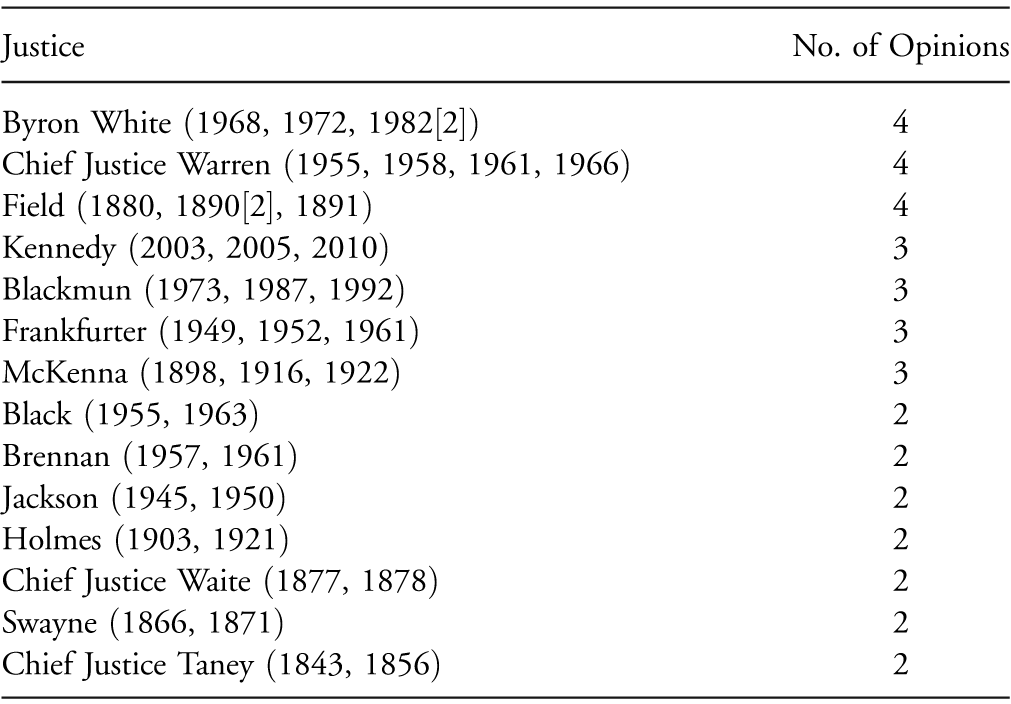
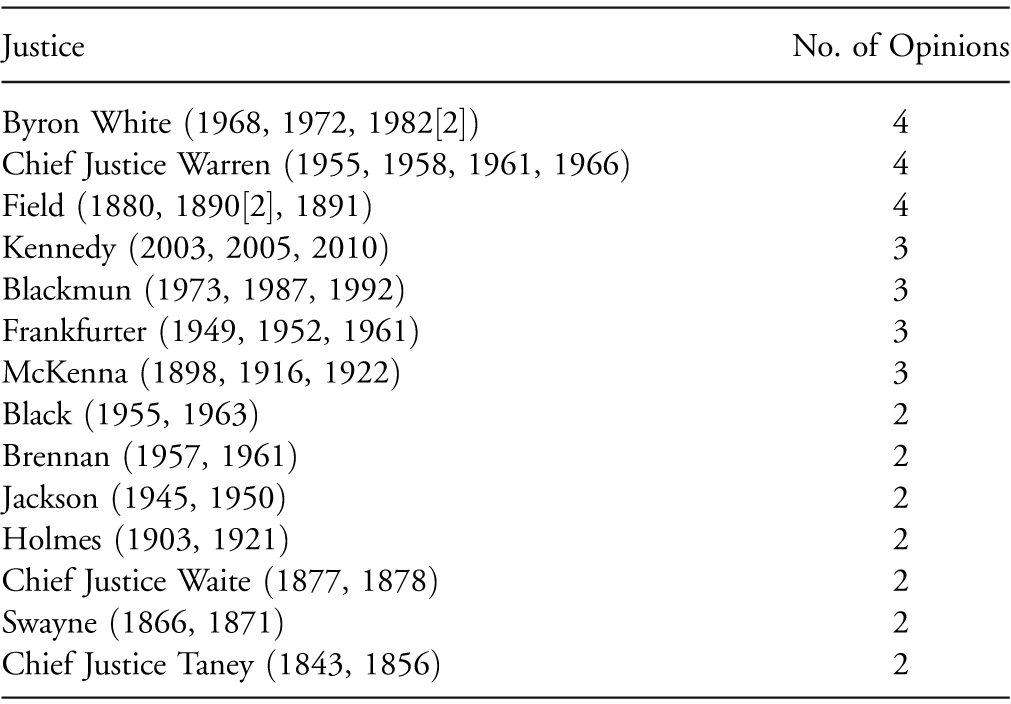
Before turning in the following sections to questions about how the justices have used foreign law, the remainder of this section makes general observations about the pool of cases under consideration. First, while the number of cases is small, they have been authored by too many members of the Court to be written off as the pet method of a few justices. Of the 80 justices who have served on the Court since 1870 for any substantial time, almost half (37) have written at least one opinion employing foreign law, while 14 justices have written the opinion in at least two of the cases (see table 2).
Source.—Westlaw Supreme Court database.
Note.—Only includes justices with at least two opinions; opinion years in parentheses.
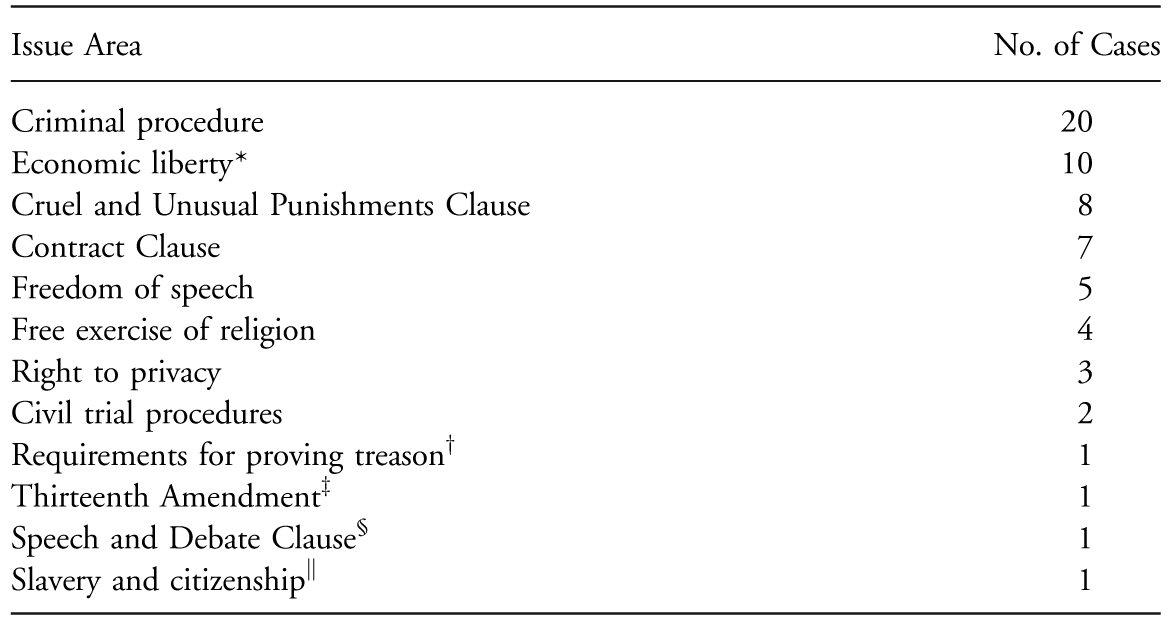
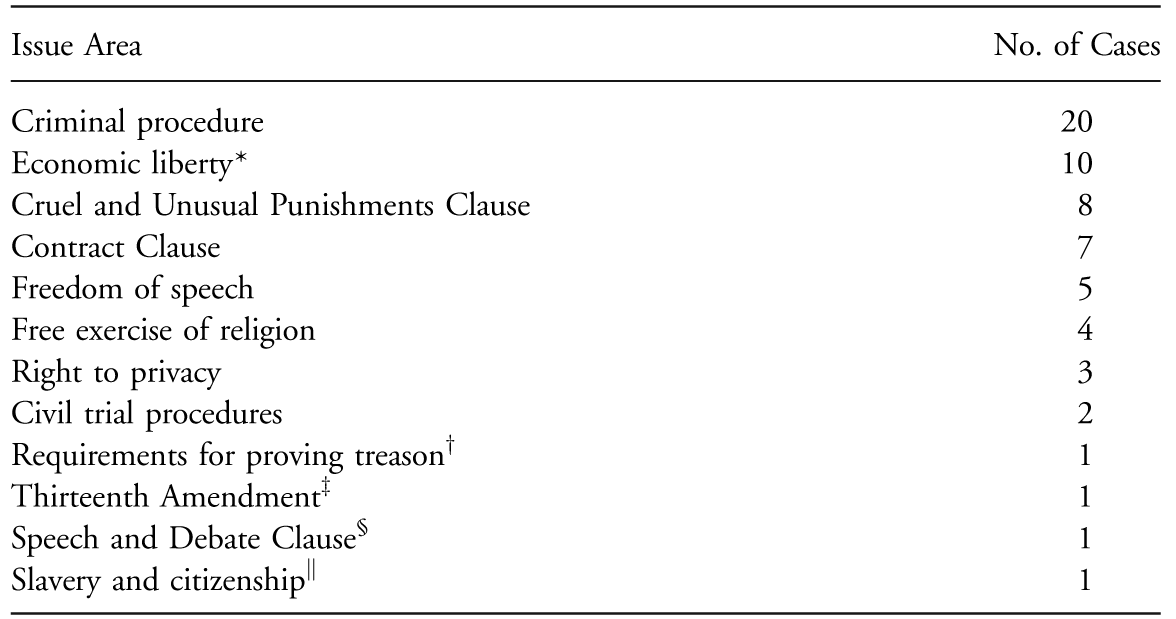
Regarding the governmental acts at issue, nearly two-thirds of the cases (40 of 63) have involved challenges to actions by state or local governments rather than by the federal government. Cases involving federal disputes have been vanishingly rare, with only one of the last 16 cases involving a challenge to a federal law. With respect to the doctrinal areas addressed, nearly one-third of the cases (20) have involved issues of criminal procedure (see table 3). The next most common subjects addressed have been economic liberty (10), the Cruel and Unusual Punishments Clause (8), the Contract Clause (7), freedom of speech (5), free exercise of religion (4), and the right to privacy (3). The predominant issue areas have shifted. The period up to 1935 was dominated by economic liberty and the Contract Clause, which accounted for 68% of the cases (17 of 25). After 1935, none of the cases concerned economic liberty or the Contract Clause, reflecting the Court’s general shift by the late 1930s away from the protection of economic liberties (Gillman 1993, 191–92). The period from 1937 to 1969 was dominated by cases involving criminal procedure, which accounted for 76% of the cases (16 of 21). Since 1972, 82% of the cases (14 of 17) have fallen within one of three issue areas: the Cruel and Unusual Punishments Clause (7), the freedom of speech (4), or the right to privacy (3). Thus, while the common association between reliance on foreign law and the Eighth Amendment is misleading when considered over the Court’s entire history, it is appropriate with respect to contemporary constitutional law, as half of the cases relying on foreign law since the late 1970s have concerned the amendment, including three of the last four cases.
Source.—Westlaw Supreme Court database.
* Cases brought under the Due Process Clause of the Fifth Amendment, or the Due Process or Equal Protection Clauses of the Fourteenth Amendment, claiming that certain kinds of legislation interfered with constitutionally protected economic liberties, such as the liberty of contract; e.g., Muller v. Oregon, 208 U.S. 412 (1908), upholding legislation restricting the working hours of women.
† Article III provides, in part, “Treason against the United States, shall consist only in levying War against them, or in adhering to their Enemies, giving them Aid and Comfort. No Person shall be convicted of Treason unless on the Testimony of two Witnesses to the same overt Act, or on Confession in open Court” (U.S. Const. Art. III, § 3).
‡ Arver v. U.S., 245 U.S. 366 (1918), upholding the constitutionality of military conscription against a challenge that it amounted to involuntary servitude in violation of the Thirteenth Amendment.
§ “The Senators and Representatives shall … be privileged from Arrest during their Attendance at the Session of their respective Houses, and in going to and returning from the same; and for any Speech or Debate in either House, they shall not be questioned in any other Place” (U.S. Const. Art. I, § 6, cl. 1).
∥ Dred Scott v. Sandford, 60 U.S. 393 (1856).
B. The Role of Foreign Law in Justifying Decisions
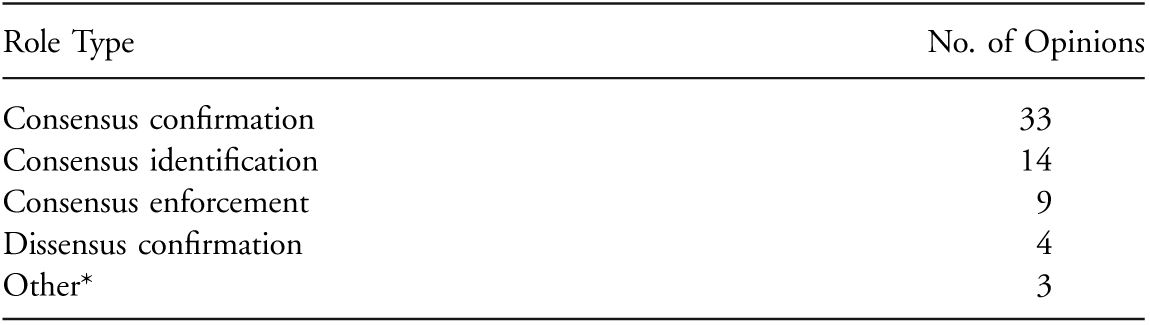
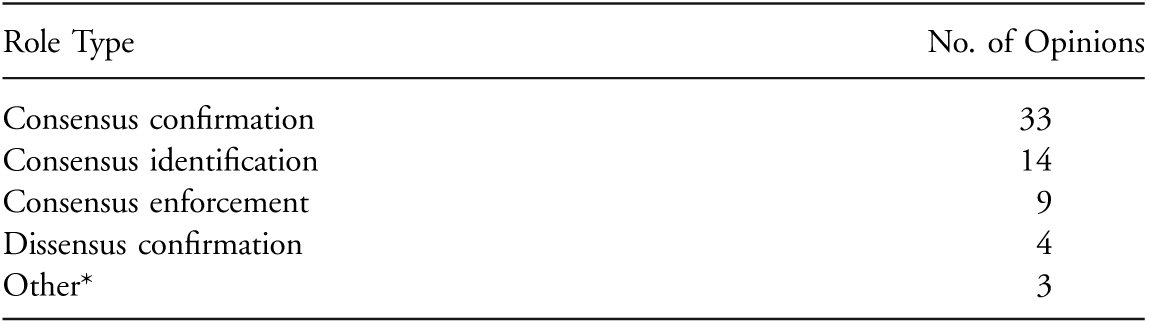
The role of references to foreign law almost always (with only three exceptions) has fallen into one of four categories (see table 4).Footnote 11 Accounting for 52% of the total, the largest category—referred to here as “consensus confirmation”—comprises cases in which the Court has used foreign law to confirm or buttress the existence of consensus on a rule on which consensus already was clear in the United States and that was not at odds with the governmental acts challenged in the case. Opinions in this category establish a consensus in the United States, before noting as additional support that the principle in question also enjoys widespread support outside the United States. In upholding a state law forbidding work on Sundays, for example, the Court noted that the importance of a day of rest was recognized by “the entire civilized world” (Petit v. State of Minn., 177 U.S. 164, 165 [1900]). The reliance on foreign law in these cases is not likely to stir controversy because the reference to laws or practices is not used to contradict American policies.Footnote 12
Source.—Westlaw Supreme Court database.
* Three cases did not fall readily into any of the four categories. In adopting a restrictive interpretation of the requirements for a treason conviction, Cramer v. U.S. (325 U.S. 1, 45–46 [1945]) noted that “foreign nations with defense problems more acute than our own” had adopted legislation that targeted behaviors more specifically than did charges of “treason.” U.S. v. Brewster (408 U.S. 501, 518–19 [1972]) cited Canadian and Australian law in interpreting the Speech and Debate Clause, noting that those legislative systems were more similar in the relevant respects to the US system than was that of England. Rubin v. Coors Brewing Co. (514 U.S. 476, 491 [1995]) noted a policy used in “some other Western nations” to support the availability of policy alternatives that would be less restrictive of speech.
A much smaller set of cases (there are only four), referred to here as “dissensus confirmation,” has referenced foreign law not to confirm an American consensus but to confirm the absence of a consensus on a rule. Each of these opinions has defended the constitutionality of a governmental act, by demonstrating the absence of a consensus on the existence of an allegedly conflicting right. As it happens, all four of the Court’s dissensus confirmation cases rejected an argument that a right of criminal procedure applied against the states via the Fourteenth Amendment’s Due Process Clause. If reasonable people could disagree on the necessity of a certain right, as evidenced by dissensus, then it followed that the right was not so indispensable to liberty that it necessarily bound the states. In these cases, the Court established a dissensus within the United States, which was buttressed by noting dissensus outside the United States as well. When the Court refused to apply the exclusionary rule against the states in Wolf. v. Colorado (338 U.S. 25, 29 [1949]), for example, it noted that a number of American states had not adopted the rule, before adding that the rule also was not followed in “most of the English-speaking world.” Dissensus confirmation cases are no more likely than consensus confirmation cases to engender controversy since they use foreign law merely to reinforce a state of dissensus generally that also exists within the United States.
A third category, “consensus enforcement,” comprises opinions that establish a consensus in the United States, before noting as additional support that the rule in question also enjoys widespread support outside the United States when that rule is at odds with the governmental acts challenged in the case. Like consensus confirmation cases, these cases establish a national consensus before noting that the principle in question also enjoys widespread support outside the United States. In consensus enforcement cases, however, the establishment of consensus is used to strike down an aberrational departure from the generally accepted rule. Slagle v. Ohio (366 U.S. 259 [1961]), for example, overturned the convictions of defendants who had been charged with refusing to answer questions before a state investigative committee, because the Commission did not clearly address the defendants’ objections at the time they were made during the proceedings. The decision turned on the rule that “a clear disposition of the witness objection is a prerequisite to prosecution for contempt,” a rule that, the Court noted, was “supported by long-standing tradition here and in other English-speaking nations” (267; internal quotations omitted). Although the foreign law referenced in consensus enforcement cases is at odds with the challenged act, this use of foreign law still is not likely to be politically provocative since foreign law is used to buttress the widespread acceptance of a principle that, in any event, had “been uniformly recognized in the procedure of both state and federal courts” (267). Adding the nine consensus enforcement cases to the consensus confirmation (33) and dissensus confirmation cases (four), we find that 73% of the cases fall within categories that by their nature are not likely to provoke controversy.
The final category, “consensus identification,” consists of cases in which the Court has referenced foreign law to support the application of a rule for which there was not already an American consensus on the rule. One prominent example is Trop v. Dulles (356 U.S. 86 [1958]), in which the Court held that the sentence of depriving the defendant of his American citizenship (for the crime of desertion), imposed by court martial, violated the Eighth Amendment’s Cruel and Unusual Punishments Clause. In supporting its holding, the Court observed that the “civilized nations of the world are in virtual unanimity that statelessness is not to be imposed as punishment for crime” (102–3), citing a UN study showing that only two of the 84 countries surveyed imposed the sentence of denationalization as punishment for desertion. Unlike cases in the other three categories, consensus identification cases are potentially controversial because they use foreign law to ground a principle for which no American consensus previously has been recognized. Only 14 cases fall in this category. The first consensus identification case did not occur until 1955, and that category has accounted for nearly half of the cases since that time, including the last four. Thus, while the use of foreign law generally is not new, the use of foreign law for potentially controversial purposes has been a relatively recent development in the Court’s jurisprudence.
C. The Form of References to Foreign Law
To understand how the justices have used foreign law, we also must examine the form that references to foreign law have taken. The form of a foreign law reference concerns what it looks like on its face, for instance, whether it describes the reasoning of a foreign ruling or refers to the commonality of a rule in other countries. Although related, the form of a foreign law reference is distinct from the justificatory role that it plays in a decision. For example, a consensus confirmation case could establish an international consensus either by simply asserting such a consensus or by describing judicial rulings from specific countries. Conversely, an opinion might use the general assertion of an international consensus for the purpose of consensus confirmation, consensus enforcement, or consensus identification.
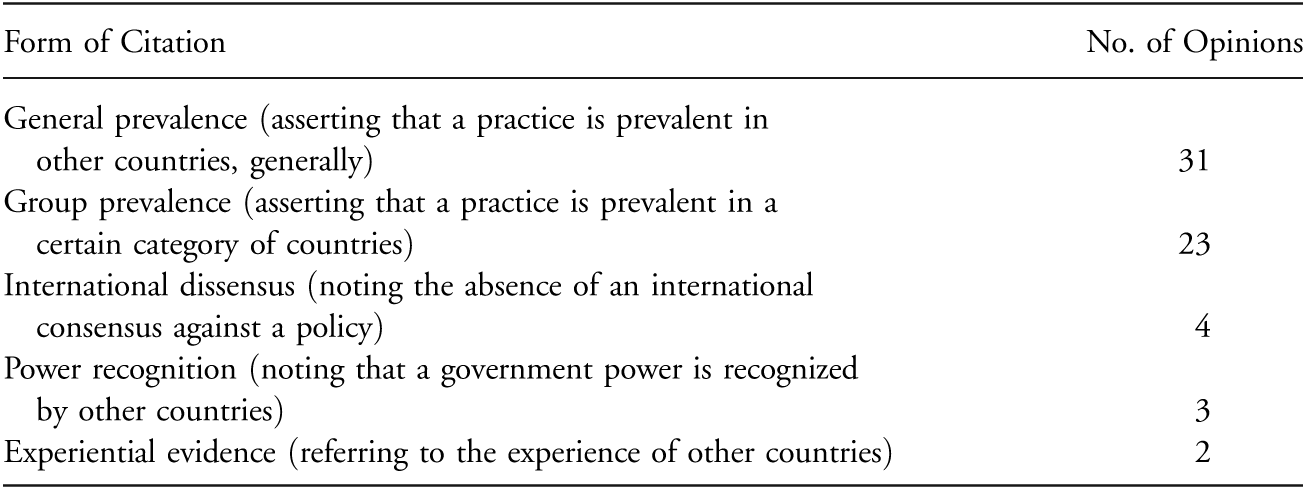
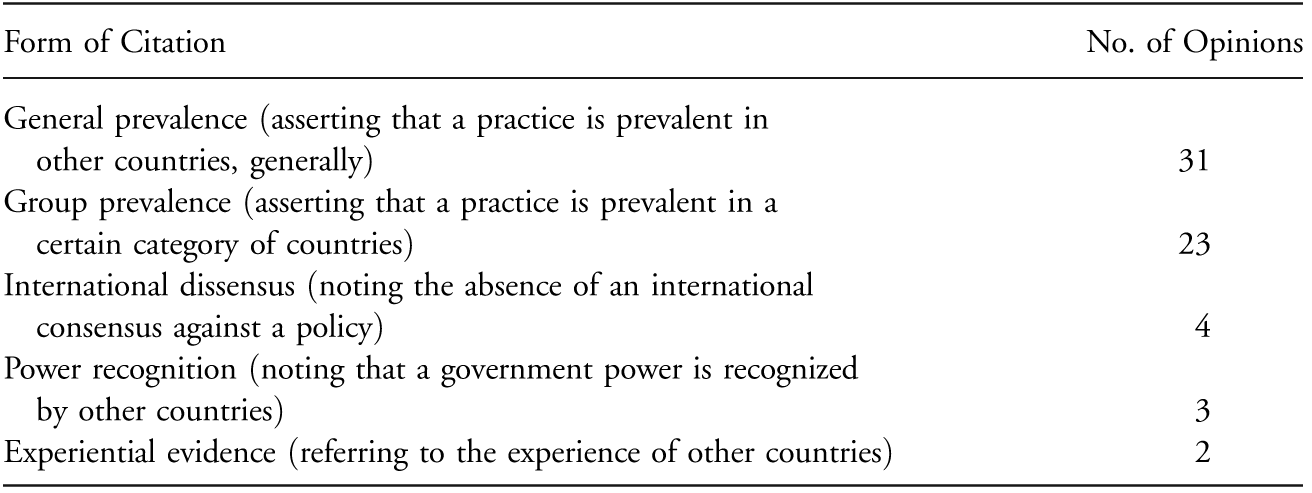
All of the cases fall within one of five categories with respect to the form of the foreign law references (see table 5). The largest category (almost half of the total), referred to here as “general prevalence,” comprises cases asserting that a particular policy or principle is prevalent in other countries generally. Examples of how opinions have expressed general prevalence include claims that a certain principle was recognized “in every civilized community,”Footnote 13 or “throughout the civilized world,”Footnote 14 and characterizations of a rule as the “practice of nations.”Footnote 15 The second largest category (37% of the total), “group prevalence,” comprises opinions asserting that a particular policy or principle is prevalent in a certain group of countries. For instance, some opinions have referred to principles traditionally recognized by “English-speaking nations.”Footnote 16 Other opinions have referred to practices recognized by “the northern and western nations of Europe,”Footnote 17 or “other common law countries.”Footnote 18 Cases in this category most often have not named specific countries, although they have done so on occasion. In Quinn v. U.S., for example, the Court referred to the rule in question as the practice of “other English-speaking nations,” adding a footnote that cited a Canadian case as evidence of that nation’s practice.Footnote 19 Together, the general prevalence and group prevalence categories account for 86% of the total.
Source.—Westlaw Supreme Court database.
Of the nine remaining cases, four may be characterized as “international dissensus”; these are opinions noting the absence of an international consensus on a particular rule. The four cases in this category overlap entirely with the dissensus confirmation cases discussed above. The three opinions falling in the “power recognition” category refer to the fact that a certain governmental power has been recognized by other countries, although without necessarily asserting unanimity on the question.Footnote 20 The two cases in the final category, “experiential evidence,” refer to the approach that other countries have taken to a particular policy problem, as in Rubin v. Coors Brewing Co., which noted a number of policies that “some other western nations” had adopted to minimize the deleterious effects of alcohol advertising without unduly infringing the speech rights of advertisers (514 U.S. 476, 490–91 [1995]).
The most striking thing about these categories is what is missing. Not a single case has discussed the reasoning behind another country’s judicial ruling or enactment. As noted, a number of opinions have referred to the practices of specific countries. These references often have appeared in footnotes in group prevalence cases supporting a general assertion that a practice has been followed in “English-speaking” or “common-law countries.” Even here, however, the opinions have not articulated the reasoning behind the foreign practices; they merely have noted the fact that a practice has been followed in certain jurisdictions.
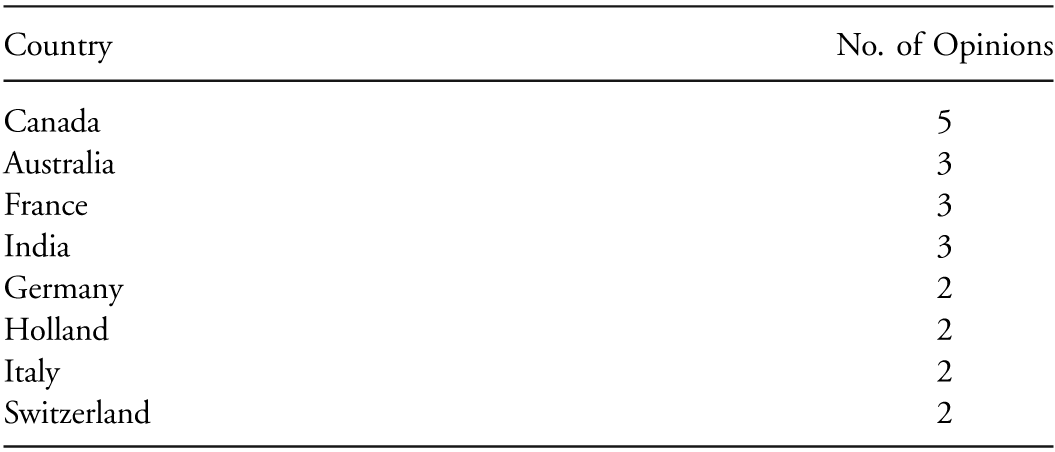
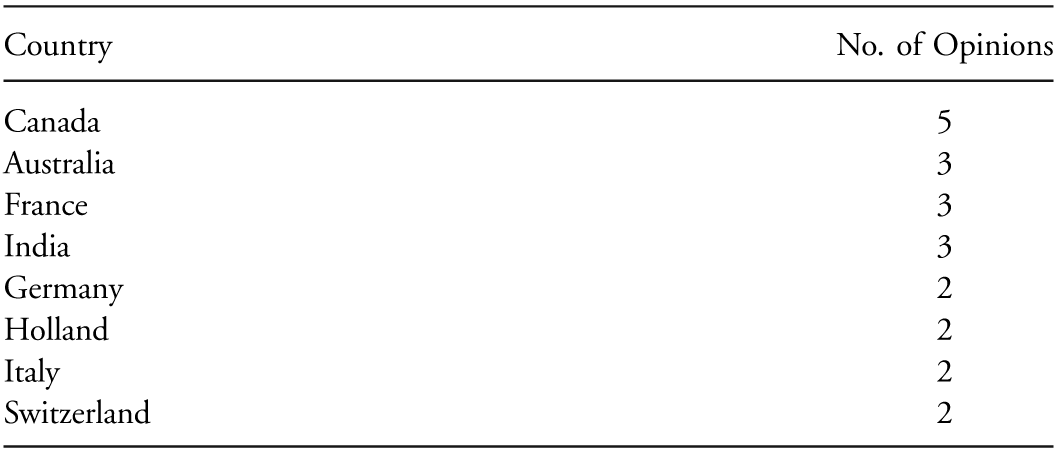
To provide another perspective on the infrequency with which specific countries have been named at all, table 6 indicates how many times individual countries have been identified in the cases. Only four countries have been named three or more times, with four countries having been named twice and just over 20 countries receiving a single mention.
Source.—Westlaw Supreme Court database.
Note.—Excludes the relatively small number of “negative citations” in which the Court has mentioned a country for the purpose of criticizing a principle or rule followed there. Jurisdictions cited one time: Austria, Ceylon, China, Czechoslovakia, Democratic Republic of Congo, Denmark, European Court of Human Rights, Hungary, Iran, Ireland, Israel, Japan, New Zealand, Nigeria, Northern Ireland, Pakistan, Poland, Portugal, Saudi Arabia, “Scandinavian countries,” Spain, Soviet Union, and Yemen.
IV. Discussion and Implications
A. Understanding the Contemporary Controversy
In addressing the controversy sparked by Atkins, Lawrence, and Roper, some scholars have viewed the decisions as troubling manifestations of a significant upsurge in the Court’s reliance on foreign law. In defending the use of foreign law in these cases, others have asserted that the Court’s reliance on foreign law has been common throughout the Court’s history. Empirical investigation with a properly targeted definition of foreign law reveals that both claims are inaccurate. The use of foreign law never has been common, and the frequency of cases has not increased in recent years, with only three or four cases occurring in each of the last 3 decades. That said, defenders of the Court’s use of foreign law are correct in noting that the use of foreign law is not new, which points to a puzzle: If the practice is neither new nor increasing, then why did the trio of cases in the last decade provoke so much controversy?
An answer comes into view when we focus on not only when the Court has used foreign law but also how it has done so. As we have seen, a substantial majority (73%) of the 63 total cases have cited foreign law for purposes that were uncontroversial (such as buttressing an already clear American consensus), while only 14 cases have cited foreign law for the potentially controversial purpose of consensus identification (supporting the application of a rule when there was not already an American consensus on the rule). Atkins, Lawrence, and Roper represented the first occasion since the late 1960s that the Court had used foreign law for consensus identification three times within such a short time span (only 4 years). In addition, Lawrence marked the first time in 30 years that the Court used foreign law for consensus identification in an area of jurisprudence other than the Eighth Amendment.Footnote 21
More significantly, the use of foreign law in Atkins, Lawrence, and Roper was distinctive even in comparison with previous consensus identification cases. Specifically, each of these opinions not only relied on foreign law in support of a rule at odds with the challenged legislation but did so to support the overturning of recent precedents on the basis of intervening changes in societal values. That is, these opinions used international sources to demonstrate an emerging consensus even though dissensus remained within the United States. To begin with Atkins, when the Court held in that case that the execution of persons who were mentally retarded violated the Cruel and Unusual Punishments Clause, it reversed its decision in Penry v. Lynaugh (492 U.S. 302 [1989]) on the basis of changes in public attitudes and practices.Footnote 22 The Court had held earlier that the meaning of the clause evolved, “draw[ing] its meaning from the evolving standards of decency that mark the progress of a maturing society” (Trop, 356 U.S. at 101). At the time of Penry, only two states prohibited the execution of mentally retarded persons, which did not demonstrate inconsistency with evolving standards of decency. By the time of Atkins, however, many more states (18) barred the execution of the mentally retarded, and Justice John Paul Stevens’s opinion emphasized “the consistency of the direction of change” (536 U.S. at 315), as no state that prohibited the execution of the mentally retarded had removed the prohibition. Significantly for present purposes, Justice Stevens also supported the Court’s decision to overturn Penry, with evidence that the challenged punishment was “overwhelmingly disapproved” by the “world community” (536 U.S. at 316 n. 21).
One year later, Lawrence held that a law criminalizing certain intimate acts between persons of the same sex violated the liberty protected by the Fourteenth Amendment’s Due Process Clause. The decision overturned Bowers v. Hardwick (478 U.S. 186 [1986]) on the basis of an “emerging awareness” of the rights at issue in the case (539 U.S. at 571, 578–79). As evidence of that emerging awareness, the Court pointed to a combination of American and foreign sources. Within the United States, for example, the Court noted that in the 17 years since Bowers, the number of states with laws like those at issue in Bowers and Lawrence had dropped from 25 to 13. Internationally, Justice Anthony Kennedy’s opinion observed that the European Court of Human Rights in 1981 invalidated Northern Ireland’s laws criminalizing homosexual acts and that other countries had “taken action consistent with an affirmation of the protected right of homosexual adults to engage in intimate, consensual conduct” (539 U.S. at 573, 577).
Two years later, when the Court held in Roper that the execution of persons under 18 violated the Eighth Amendment, it again overturned a relatively recent decision, Stanford v. Kentucky (492 U.S. 361 [1989]). Justice Kennedy’s opinion stressed that, by the time of the decision, 18 states barred execution of juveniles; since 12 states had no death penalty, this meant that 30 states altogether did not authorize the execution of juveniles. Justice Kennedy also considered sentences in foreign countries, noting that only seven countries other than the United States had executed minors since 1990, and all of them had abolished or disavowed the practice. A number of treaties banned execution of minors, including the UN Convention on the Rights of the Child, and the United States was one of only two countries that had not ratified it. In short, Justice Kennedy wrote, “the United States now stands alone in a world that has turned its face against the juvenile death penalty” (543 U.S. at 577). The Court’s determination that death was disproportionate for minors found “confirmation in the stark reality that the United States is the only country in the world that continues to give official sanction to the juvenile death penalty” (575).
While the Court had used foreign law for consensus identification in 10 cases before 2002, the use of foreign law in Atkins, Lawrence, and Roper was distinctive. Each overturned a decision less than 2 decades old and used foreign law to support recognition of a newly emerging principle, even though considerable disagreement within the United States remained. The use of foreign law in the three cases was more provocative than previous instances of consensus identification because these opinions suggested that attitudes in foreign countries could play a role in altering the interpretation of constitutional rights.
B. Connecting the Normative Debate with the Court’s Practice
As noted above (see Sec. III.C), the Court has not discussed the reasoning behind foreign laws or rulings. Instead, the typical foreign law reference merely has noted that one or more foreign jurisdictions followed a particular rule. This empirical observation has implications for the normative debate because many of the justifications offered by scholars for judicial reliance on foreign law presuppose engagement with the reasoning behind other countries’ laws and practices. However compelling these justifications may be, they cannot serve as a defense of the Court’s reliance on foreign law to date because they bear no relation to how the justices actually have used foreign law.
A number of scholars have defended judicial reliance on foreign law, by stressing that foreign legal sources can provide new ideas, information, insights, and perspectives (e.g., Slaughter Reference Slaughter2004, 77–78; Glensy Reference Glensy2005, 445–46). Scholars also have argued that relying on foreign law improves the process by which judges decide cases. Vicki Jackson, for example, has argued that appealing to foreign law enhances the “deliberative quality of decision-making” by prompting judges to reflect on a broader range of alternative considerations (Reference Jackson2010, 104). It is not only that judges may chance upon a particular new idea in learning about foreign law but also that the very process of considering non-American sources encourages judges to step outside of their ingrained assumptions, affording access to a self-critical vantage point that would not otherwise be available (Tushnet Reference Tushnet1998, 327; Knop Reference Knop2000, 532). Moreover, the argument goes, the deliberative process may be improved through an exchange of views between judges from different countries and cultures (Knop Reference Knop2000, 531; Koh Reference Koh2004, 47; Slaughter Reference Slaughter2004, 65, 75). Since these arguments only pertain when the use of foreign law entails engagement with the reasoning underlying foreign law, however, they cannot justify the Court’s foreign law citations, which have failed to describe the reasoning underlying foreign law.
The results of this study are important for scholars who are interested not only in whether reliance on foreign law can be justified in theory but also in assessing the Court’s use of foreign law in practice. As noted, the failure to engage the reasoning behind foreign law eliminates many theoretical arguments as potential justifications for the Court’s use of foreign law. At the same time, the Court’s reliance in recent cases on the observation that a large number of foreign jurisdictions have adopted a particular rule poses special challenges for the defense of the Court’s practice. The remainder of this section discusses some of these challenges. The aim is neither to defend the Court’s practice nor to attack it but, rather, to connect the normative debate with empirical study by spotlighting particular questions raised by the manner in which the justices actually have used foreign law.
The questions raised by the Court’s use of foreign law are both normative and practical in character. Normatively, the central question is why the observation that foreign jurisdictions follow a particular rule, in itself, should be viewed as lending support to the Court’s adoption of that rule. It is important to note that in cases like Atkins, Roper, and Lawrence, the Court did not indicate that its decisions were mandated by international human rights law, whether in the form of treaties or customary international law. Nor did the Court articulate the argument that the consensus on a particular principle was so overwhelming that it should be incorporated into American constitutional law as a requirement of natural law or universal justice. Instead, the Court relied only on the fact that foreign jurisdictions had followed the rule, without providing an account of why the discerning of shifts in the meaning of American constitutional rights should be linked to this kind of observation about foreign practices.
In the absence of arguments appealing to natural law or the binding force of international law, the type of argument that comes most readily to mind as potentially explaining reliance on predominant practices is one appealing to democratic considerations. It is not uncommon in constitutional rights cases for the Court to make observations about practices that are prevalent in the American states (Gerhardt Reference Gerhardt2008, 741–42; Hills Reference Hills2009, 17; Lain Reference Lain2009). The question of whether the surveying of American state practices should be considered relevant to constitutional rights interpretation is beyond the scope of this article. We can note, though, that a defense of reliance on American practices can appeal to arguments rooted in the consent of the governed in a way that a defense of reliance on foreign practices, presumably, could not (see Alford Reference Alford2004, 58–59). One question raised by a defense of foreign law rooted in democratic considerations, then, concerns the pool of people whose attitudes and preferences should sway decision making.
Even putting that concern aside, questions arise regarding the extent to which foreign practices represent democratically adopted preferences (see Young Reference Young2005, 161–62). We also would want to inquire whether the pronouncements of international institutions represent the popular preferences of the people within their scope of authority (see Ramsey Reference Ramsey2004, 80). Moreover, in the international context there may be no common forum of public discourse or institutional framework that “through the legitimating force of representation and deliberation, could transform the Court’s nose counting into a meaningful democratic conclusion” (Young Reference Young2005, 162). A defense of reliance on predominant foreign practices rooted in democratic considerations would need to address these and related questions regarding the extent to which such practices reflect decisions arrived at in a democratic manner.
Apart from normative considerations, reliance on the prevalence of foreign practices to ground constitutional interpretations also raises concerns of a practical nature. One set of questions concerns the extent to which positions on issues in other countries can be translated to the American context (see McGinnis Reference McGinnis2006, 311–12). Each individual country has its own institutional arrangements, constitutional and other legal texts, and background values, which may complicate attempts to discern the meaning of a discrete judicial opinion or piece of legislation (see Young Reference Young2005, 161–62). The difficulties could be compounded if one seeks to aggregate conclusions drawn from legal developments in disparate nations. The challenge that would be involved in attempting to gather sufficient information about numerous countries to make informed readings of foreign developments calls into question the feasibility of translating international sources into shorthand conclusions that could be applied meaningfully in constitutional interpretation (Ramsey Reference Ramsey2004, 79–80).
Another set of questions concerns the manner in which judges would choose the foreign sources on which to rely and the areas of law in which to consult foreign law (Glensy Reference Glensy2005, 360). Are all countries equally relevant on all issues? If not, how are these choices to be made? The danger is that justices would rely on foreign law only selectively in a way that undermines the credibility of this practice (see Ramsey Reference Ramsey2004, 69–70), a danger that is exacerbated by the practical obstacles to surveying international practices in a sufficiently exhaustive manner (Alford 2004, 58). Indeed, since the justices, even with the support of their clerks, do not have the resources to “find relevant comparative material on [their] own,” the Court is dependent on the foreign sources that counsel chooses to bring to its attention (Breyer Reference Breyer and Borgen2003/2007, 105).
Above, I have discussed challenges in defending the manner in which the Court has used foreign law in recent cases. There may well be satisfying answers to these questions. My intention is not to contend that the manner in which the Court has used foreign law cannot be defended, much less to contend that judicial reliance on foreign law generally cannot be defended. Rather, the aim is to sharpen the debate by bringing attention to the current disconnect between much of the normative literature and the Court’s actual practice.
V. Conclusion
The debate over judicial reliance on foreign law has been distorted by a lack of attention to how the Court actually has used foreign law. The three Supreme Court decisions between 2002 and 2005 that intensified the debate often have served as the point of embarkation in the literature, but scholarship on the subject frequently moves into discussion of justifications for reliance on foreign law disconnected from consideration of the Court’s jurisprudence. To be sure, there is value in the theoretical examination of foreign law in judicial interpretation. Due to the politically charged context of the debate, however, defenses of judicial reliance on foreign law in general may come across as defenses of the Court’s use of foreign law in particular cases, including Atkins, Lawrence, and Roper. The difficulty is that we may be lulled into thinking of the central question as whether judicial reliance on foreign law is good or bad, as if we were confronted with a binary question. The appropriate question, though, is not simply whether judges should or should not cite foreign law but, rather, which ways of using foreign law to support decisions are justified.
This article has focused on two principal ways in which we can enhance our understanding of judicial reliance on foreign law through empirical investigation. First, we can make better sense of the controversy sparked by Atkins, Lawrence, and Roper, by recognizing how those cases used foreign law in a manner that was historically distinctive. While it is true that the Court cited foreign law in constitutional rights cases as early as the first half of the 19th century, it is misleading to dismiss concerns over the Court’s use of foreign law in recent cases on the grounds that the Court has cited foreign law in previous cases. Not all uses of foreign law are equivalent. Thus, one may have no objection to the use of foreign law in one case but be troubled by its use in another. Likewise, one may find the Court’s use of foreign law in particular cases unjustified (or insufficiently explained), without necessarily objecting to all possible uses of foreign law.
Second, we can address a common disconnect in the literature between normative arguments and the empirical reality of how the Court has employed foreign law. Scholars have advanced a wide range of justifications for judges to cite foreign law, but closer inspection reveals that many of these justifications bear no relation to how the justices have used foreign law. It is notable that even justices who have spoken outside the courtroom to defend reliance on foreign law have offered justifications that have nothing to do with how they have used foreign law on the Court. Justice Sandra Day O’Connor, for example, has stated that “there is much to learn from other distinguished jurists who have given thought to the same difficult issues” that the Court faces (Reference Borgen2002/2007, 92). In a similar vein, Justice Stephen Breyer has appealed to the “enormous value in any discipline of trying to learn from the similar experience of others” (Reference Breyer and Borgen2003/2007, 103), and Justice Ruth Bader Ginsburg has emphasized the value of “comparative dialogue, on sharing with and learning from others” (Reference Ginsburg and Borgen2005/2007, 352). As discussed, though, the Court’s use of foreign law has not entailed substantive engagement with ideas from foreign jurisdictions; as a result, the Court’s use of foreign law hardly can be described as dialogue, or learning and sharing with others. Meanwhile, the justices have failed to provide justifications for what the Court’s reliance on foreign law has looked like in practice.
The quality of the discourse would be enhanced by greater attention to the relation between normative arguments and the Court’s practice. For example, the literature would benefit from greater clarity about whether accounts purporting to justify judicial reliance on foreign law are meant to defend how the justices have used foreign law in particular cases. It is one thing to provide an account of judicial reliance on foreign law in the abstract and another to justify the manner in which the justices actually used foreign law in recent cases. This study, of course, is not meant to resolve the important debate that continues over judicial reliance on foreign law but, rather, to begin to provide more solid empirical grounding for that debate. Closer attention to how judicial reliance on foreign law works in practice will help to ensure a stronger connection between the normative literature on foreign law and specific judicial decisions that largely have been responsible for stoking the contemporary debate.