Care givers are an important part of a support and care network in patients with vegetative state (VS) and minimally conscious state (MCS) following acquired brain injury (Italian Ministry of Health, 2011). These clinical conditions are grouped as disorders of consciousness (DOCs) that may occur after both traumatic and non-traumatic acquired severe brain injury. VS is a condition accompanied by no evidence of awareness of oneself, others or one's own environment, even though hypothalamic and brainstem autonomic functions are sufficiently preserved and permit survival with medical and nursing care (The Multi-Society Task Force, 1994). According to the Aspen Consensus Group (Giacino et al., Reference Giacino, Ashwal, Childs, Cranford, Jennett, Katz and Zasler2002; Giacino & Kalmar, Reference Giacino and Kalmar2005), MCS is defined as a condition of severely altered consciousness in which minimal but definite behavioural evidence of self or environmental awareness is demonstrated. Unlike VS, patients with MCS may exhibit reproducible and sustained behaviours.
In Italy, the number of patients with DOC was estimated at around 3000 in 2005 (Apolone et al., Reference Apolone, Boldrini, Avesani, De Tanti, Fogar, Gambini and Taricco2007); nevertheless, there is lack of precise epidemiological data (Leonardi et al., Reference Leonardi, Sattin and Raggi2013). An Italian study with a large sample of patients with DOCs (N = 564) found that they were mainly middle-aged men, with a non-traumatic aetiology, hosted in long-term care centres (Leonardi et al., Reference Leonardi, Sattin and Raggi2013). The care pathway for patients with acquired brain injury in Italy is usually organised in three phases: (1) acute phase (which lasts from few hours to some weeks following the brain injury until the stabilization of vital functions); (2) post-acute or rehabilitative phase (which lasts from some weeks to several months following the injury, from the stabilization of vital functions to the stabilization of residual disabilities); (3) phase of sequelae (which lasts from several months to several years following the injury, from the stabilization of residual disabilities to the maintenance of achieved residual autonomies and prevention of worsening) (Taricco, De Tanti, Boldrini, & Gatta, Reference Taricco, De Tanti, Boldrini and Gatta2006). After the stabilization of clinical conditions, patients could be discharged to home or hospital-based facilities with less intensive medical intervention. In Emilia-Romagna, the region in which the present study was held, approximately 1550 patients were hospitalized in the 2005–2010, a five-year period with a diagnosis of VS. After discharge from rehabilitation hospitals, 67% of patients returned home, 26% were hosted in post-acute wards, and 7% in nursing homes (Ferro & Mazza, Reference Ferro and Mazza2015).
Over the care pathway, the family members also deal with different challenges, from the acute phase characterized by concerns about survival of the loved one, to the chronic stage characterized by worries about duration of DOC and assistance issues (Cruzado & Elvira de la Morena, Reference Cruzado and Elvira de la Morena2013). Taking care of a relative with DOCs is both emotionally and physically difficult due to extremely high physical, psychological, and economic demands. According to the Italian Ministry of Health (2011), psychological support needs to be available for family care givers of people in VS or MCS.
Recently, the psychological impact of caregiving has begun to be explored more extensively in care givers of patients in VS and MCS (Chiambretto & Vanoli, Reference Chiambretto and Vanoli2006; Cruzado & Elvira de la Morena, Reference Cruzado and Elvira de la Morena2013). Chiambretto and colleagues pointed out that care givers of people in a persistent VS had a poor social life and unsatisfactory family relationships (Chiambretto, Rossi Ferrario, & Zotti, Reference Chiambretto, Rossi Ferrario and Zotti2001). Giovannetti et al.’s study highlighted that burden and distress were high for family care givers of people with VS or MCS (Giovannetti, Leonardi, Pagani, Sattin, & Raggi, Reference Giovannetti, Leonardi, Pagani, Sattin and Raggi2013). Pagani et al. (Reference Pagani, Giovannetti, Covelli, Sattin, Raggi and Leonardi2014) reported that care givers of patients with DOCs had lower levels of mental health, with depressive and anxiety symptoms influencing their quality of life both mentally and physically. This is in line with Leonardi et al.’s results: care givers of patients with DOCs had lower scores in mental and physical health as well as higher level of anxiety in comparison with controls, and declared a decrease in leisure time (Leonardi, Giovannetti, Pagani, Raggi, & Sattin, Reference Leonardi, Giovannetti, Pagani, Raggi and Sattin2012). Similarly, Chiambretto and Vanoli (Reference Chiambretto and Vanoli2006) found higher levels of anxiety, depression, and burden in comparison with the normal population, which remained unchanged at a 5-year follow-up. These findings suggest the importance of supporting care givers in managing the psychological distress resulting from caring for their relatives, since care givers represent an important part of the care network.
Stress is one of the central components in the condition of care givers of people with DOCs because they have to manage the emotional paradox of loss without death (Stern, Sazbon, Becker, & Costeff, Reference Stern, Sazbon, Becker and Costeff1988). The concept of stress has evolved over time. According to the stress appraisal model (Lazarus & Folkman, Reference Lazarus and Folkman1984), stress results from the interaction between internal and environmental factors. According to this model, appraisal is a cognitive process to mediate environmental needs and internal resources: an initial evaluation of a stressor is followed by an evaluation of capabilities and coping resources (Folkman, Lazarus, Dunkel-Schetter, DeLongis, & Gruen, Reference Folkman, Lazarus, Dunkel-Schetter, DeLongis and Gruen1986). The crucial role of coping strategies has been highlighted in the literature regarding care givers of patients with DOCs. In this regard, some authors studied the role of coping strategies in mediating overall burden (Chiambretto et al., Reference Chiambretto, Rossi Ferrario and Zotti2001; Stern et al., Reference Stern, Sazbon, Becker and Costeff1988) and in promoting emotional adjustment (Elvira de la Morena & Cruzado, Reference Elvira de la Morena and Cruzado2013). Indeed, problem-focused coping strategies were found to help emotional adaptation and was related to lower levels of distress (Chiambretto et al., Reference Chiambretto, Rossi Ferrario and Zotti2001); on the contrary, emotion-focused coping was associated with emotional distress, anxiety, and depression (Cruzado & Elvira de la Morena, Reference Cruzado and Elvira de la Morena2013; Elvira de la Morena & Cruzado, Reference Elvira de la Morena and Cruzado2013). In accordance with these contributions from the literature, the aim of this study is threefold: (1) to describe the experience of care givers of patients with DOCs hospitalized in a long-term ward, in terms of emotional burden, quality of life, and coping styles, compared to Italian normative data; (2) to explore the relationships between these variables and their associations with socio-demographic features; and (3) to describe their changes over time.
Methods
Participants
This was a prospective observational cohort study approved by the local ethics committee (Bologna-Imola Ethics Committee, ethical approval number 14081). At the beginning of the research (January 2012), all primary family care givers, aged over 18 years, of patients with DOCs hospitalized in Santa Viola Hospital (Bologna, Emilia-Romagna, Italy) were asked to take part in this research. Only one care giver for each patient was enrolled, that is, the closest relative most present in the hospital in terms of time dedicated to visiting or assisting him/her. The diagnosis of VS was based on the definition issued by the Multi-Society Task Force (1994). The diagnosis of MCS was made in accordance with Aspen Consensus Group's criteria (Giacino et al., Reference Giacino, Ashwal, Childs, Cranford, Jennett, Katz and Zasler2002; Giacino & Kalmar, Reference Giacino and Kalmar2005). Both diagnoses were formulated by the medical staff of the original hospital and confirmed by Santa Viola Hospital's medical team. Patients who are not eligible for intensive rehabilitative treatment are admitted to Santa Viola Hospital after discharge from acute and post-acute care wards to stabilize their clinical conditions, to continue less-intensive rehabilitation, and to prevent or minimize secondary and tertiary complications, which may have deleterious effects on recovery and make therapeutic efforts useless.
In line with Guidelines of the Italian Ministry of Health (2011) about the care of patients with DOCs, care givers are considered an important part of the clinical setting. They may enter the hospital until 8 p.m everyday and even stay with their relative during the night in exceptional circumstances. Since patients are hospitalized and treated by a multidisciplinary team, care givers do not have specific tasks to carry out. Nevertheless, they usually spend some hours caring for their relatives with DOCs watching TV, reading a book or simply staying with them. Furthermore, if they wish, and with the permission of medical staff, they may perform some basic tasks, such as mouth cleaning or dressing. A self-help group for care givers is convened monthly in Santa Viola Hospital to provide nonspecific psychological support. It aims to reduce the risk of isolation, and promote socialization and the sharing of a common experience. Its facilitators are a psychiatrist and the chief of the ward.
Measures
The battery was composed of three questionnaires, largely used in studies about care givers of patients with DOCs. Each of them has been validated in an Italian version, with Italian normative data, and good internal consistency and test–retest reliability (Rossi Ferrario, Zotti, Zaccaria, & Donner, Reference Rossi Ferrario, Zotti, Zaccaria and Donner2001; Sica et al., Reference Sica, Magni, Ghisi, Altoe’, Sighinolfi, Chiri and Franceschini2008; Ware & Gandek, Reference Ware and Gandek1998).
Family Strain Questionnaire (FSQ; Rossi Ferrario, Bacchetta, Omarini, & Zotti, Reference Rossi Ferrario, Bacchetta, Omarini and Zotti1998) consists of two parts. The first part is composed of a structured interview investigating socio-demographic features and problems associated with caregiving (e.g., socio-economic problems and resources, leisure time) and information about the patient. The second part is composed of 44 dichotomous items, assessing five aspects: emotional burden (EB) that refers to the perceptions of anxiety, helplessness, anger, and psycho-physiological disturbances caused by the patient's illness; problems of social involvement (SI) that describes the difficulty perceived by the care giver in approaching and maintaining social relationships, as well as personal interests and time for self; need for knowledge (NK) that refers to the need to know as much as possible about the illness and its management; quality of family relationships (FR) well described by its title; and thoughts of death (TD) that describes the sense of loss or anticipated loss. High scores are indicative of the presence of problems, except for FR subscale, in which higher scores indicate good family relationships.
SF-36 Health Survey (SF-36; Apolone & Mosconi, Reference Apolone and Mosconi1998) is a multidimensional questionnaire composed of 36 items, assessing quality of life, intended as mental and physical health, through eight dimensions (Ware & Gandek, Reference Ware and Gandek1998): physical functioning (PF, limitations in performing physical activities such as bathing or dressing); physical role functioning (RP, limitations in work or other daily activities as a result of physical health); bodily pain (BP, how severe and limiting is pain); general health (GH, how general personal health is perceived by the subject); emotional role functioning (RE, limitations in work or other daily activities as a result of emotional problems); mental health (MH, feeling nervous and depressed vs. peaceful, happy, and calm); vitality (VT, feeling tired and worn out vs. feeling energetic); social functioning (SF, interference with normal social activities due to physical and emotional problems). These eight scales can be aggregated into two summary measures: physical component summary (PCS) and mental component summary (MCS). Scores ranges from 0 to 100. Low scores correspond to poorer quality of life.
Coping Orientation to Problems Experienced – Nuova Versione Italiana (COPE-NVI; Sica et al., Reference Sica, Magni, Ghisi, Altoe’, Sighinolfi, Chiri and Franceschini2008) is a 60-item self-report questionnaire. It assesses behavioural strategies in stressful situations: social support (12 items, characterized by seeking comprehension, information, and emotive surge); avoidance strategies (16 items, characterized by using denial, drug abuse, emotional and behavioural detachment); positive attitude (12 items, acceptance, control, and positive reinterpretation of events); problem solving (12 items, characterized by use of active strategies and planning), and turning to religion (8 items, referring to religion and humour lacking). Each item is rated on a Likert scale ranging from 1 to 4. Higher scores suggest higher frequency of strategy utilization.
Procedures
The subjects completed the self-report questionnaires after being introduced by the researcher, who also collected their written informed consent to participate in this study. Participants completed the battery at baseline (T0), after 6 months (T1) and after 12 months (T2) in a time-span between January 2012 and December 2012. During this period of time, participants were present in Santa Viola Hospital as the principal family care givers of inpatients with DOCs.
Analysis
The socio-demographic data of care givers were reported as percentages or means ± standard deviation, as were data about leisure time and characteristics concerning the care of patients. Descriptive statistics were also conducted for some specific items of the structured FSQ interview. In order to test if each variable was normally distributed, Kolmogorov–Smirnoff tests were performed. Due to the restricted number of subjects and not-normally distributed variables, non-parametric tests were used. Spearman tests and Fisher tests were performed to evaluate the association between variables: the former for continuous variables, the latter for dichotomous ones.
One-sample Wilcoxon tests were performed to compare COPE NVI and SF-36 subscales with the Italian normative data available for these scales. In regard to FSQ, the comparison was carried out with an Italian sample of care givers of DOCs patients hosted in a long-term care facility (n = 297) (Giovannetti et al., Reference Giovannetti, Leonardi, Pagani, Sattin and Raggi2013). Fisher tests were used to compare variables expressed in proportions and percentages.
In order to compare the differences between care givers with and without burden and according to Rossi Ferrario et al. (Rossi Ferrario, Baiardi, & Zotti, Reference Rossi Ferrario, Baiardi and Zotti2004), the whole group was divided in two subgroups: one with high emotional burden (EB ≥ 9), called HEB (N = 6) and the other one with normal emotional burden (EB < 9), called NEB (N = 9). Then, a Mann–Withney U test was carried out to verify if there were differences between HEB and NEB subgroups for the considered variables.
The Friedman test was performed for all questionnaires, in order to verify if the variables changed across T0, T1, and T2. Bonferroni correction was used for multiple comparisons. Analyses were performed using SPSS version 19.0. Statistical significance was set at p < .05.
Results
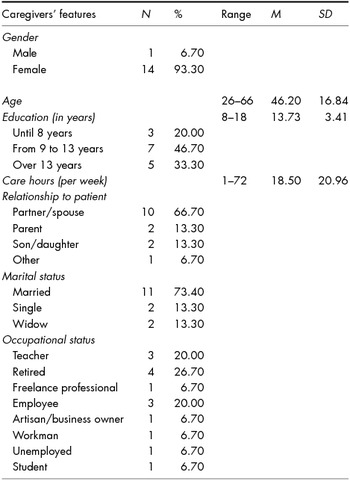
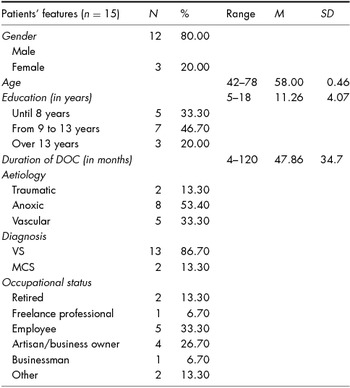
At the beginning of the study, all 19 primary family care givers of patients with DOCs hospitalized in Santa Viola Hospital were asked to take part. Fifteen care givers accepted and completed the battery of questionnaires at T0. Four subjects dropped-out, one of them due to discharge of the patient. Thus, 11 care givers completed the follow-up questionnaires at T1 and T2. Socio-demographic features of care givers and patients are respectively detailed in Tables 1 and 2.
Care Givers’ Features

Patients’ Features

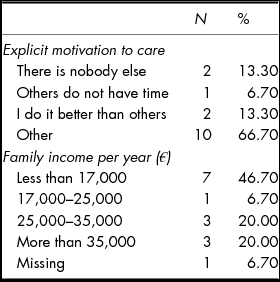
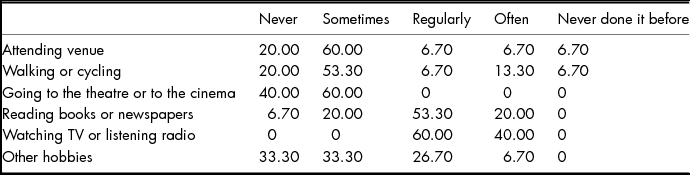
Over 70% of the participants kept their jobs and the majority of the sample (73.33%) declared that their relative's health condition did not cause economic problems for their family. The explicit motivation to be a care giver is reported in Table 3. The time to dedicate to leisure time activities investigated by FSQ is described in Table 4.
Explicit Motivation to Caregiving and Family Income Per Year in EURO (€)

Time to Dedicate to Leisure Activities (Percentages)

At T0 no correlations were found between emotional burden (FSQ-EB) and the following socio-demographic features: patient and care-giver age and care givers’ years of education. There was no correlation at T0 between emotional burden (FSQ-EB) and the following variables: care hours, duration of DOC, possibility of sharing caregiving duties with someone else, the presence of consolation in faith, financial difficulties, marital status, different motivations to care, resignation from job, family income per year, perceived economic status, and degree of kinship (p > .05). Our sample showed lower scores, and thus worse quality of life, in the following subscales of SF-36 questionnaire: mental health (MH), emotional role functioning (RE), social functioning (SF) and mental component summary (MCS) (p = .005) compared to Italian normative data (Apolone & Mosconi, Reference Apolone and Mosconi1998). No differences from the Italian normative sample were detected in COPE-NVI subscales (p > .05).
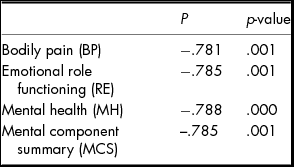
No differences in gender (p = .18) and age (p = .55) were detected between our sample and the one in Giovannetti et al.’s (Reference Giovannetti, Leonardi, Pagani, Sattin and Raggi2013) study. In comparison with the latter, our sample showed a statistically significant higher score in the following variables: FSQ-NK (p = .02), FSQ-TD (p < .01), and FSQ-FR (p < .01). Correlations between FSQ-EB and COPE-NVI subscales were not statistically significant (p = .05). Correlations between FSQ-EB and SF-36 subscales are shown in Table 5.
Correlations Between FSQ-Emotional Burden and SF-36 Subscales

HEB (n = 6) and NEB (n = 9) subgroups differed only in FSQ-TD scores, which were higher in the subgroup with emotional burden. No other differences between HEB and NEB subgroups were detected in respect to SF-36 and COPE scores. Four subjects dropped out at T1; thus, only 11 subjects were considered for statistical analyses over time. Results from the Friedman test revealed no changes in any subscale across T0, T1, and T2 (p > .05).
Discussion
The first aim of this study was to describe the experience of care givers of patients with DOCs hospitalized in a long-term ward, in terms of emotional burden, quality of life, and coping styles, compared to Italian normative data. The majority of our sample was constituted of women, middle-aged and spouses of DOCs patients, with a financial income per year less to € 17,000. This is consistent with Leonardi et al.’s study (Reference Leonardi, Giovannetti, Pagani, Raggi and Sattin2012) and the international literature that reports a high prevalence of women in the care-giver population (Navaie-Waliser, Spriggs, & Feldman, Reference Navaie-Waliser, Spriggs and Feldman2002). Since higher levels of burden and depression have been reported in female care givers in comparison to male care givers (Pinquart & Sorensen, Reference Pinquart and Sörensen2006), the high prevalence of women in our sample is to be taken into account in interpreting the data.
The financial income recorded in our sample was lower than the average family income registered in 2012 from ISTAT (National Statistical Institute). Nevertheless, the care givers also declared that the DOC did not cause financial problems for their family. This is probably attributable to the fact that the costs of hospital care are borne by the National Health system and that patients are managed by staff in a long-term care ward, permitting family care givers to keep their jobs.
A high percentage of care givers answered ‘other’ to explain their motivation for caregiving (Table 3). Their motivation might be more than simply practical, since 73% of the sample could also have the possibility of sharing caregiving duties with someone else. As pointed out elsewhere (Feeney & Collins, Reference Feeney and Collins2003; Kim, Carver, Deci, & Kasser, Reference Kim, Carver, Deci and Kasser2008), we could hypothesize that motivation to care might not be exclusively driven by practical reasons, but also by the psychological features of care givers. Indeed, other authors (Feeney & Collins, Reference Feeney and Collins2003; Kim et al., Reference Kim, Carver, Deci and Kasser2008) have linked different motivation to care to different attachment styles. In this sense, implicit or explicit motivation to care and attachment styles could possibly explain the high variability of care hours (1–72 hours/week), since care givers do not have specific tasks to carry out because of the presence of professionals. Although motivation to care has been studied in care givers facing other medical conditions, such as dementia or cancer (Kim et al., Reference Kim, Carver, Deci and Kasser2008; Quinn, Clare, & Woods, Reference Quinn, Clare and Woods2010), this issue has not been investigated in care givers of patients with DOCs. For this reason, future studies are needed to better investigate motivation to care with specific tools, since this aspect is reported to impact on the care giver's wellbeing (Kim et al., Reference Kim, Carver, Deci and Kasser2008).
As shown in Table 4 and in line with previous studies (Chiambretto & Vanoli, Reference Chiambretto and Vanoli2006; Giovannetti, Covelli, Sattin, & Leonardi, Reference Giovannetti, Covelli, Sattin and Leonardi2015), the subjects declared a lack of time to dedicate to leisure activities and lower social functioning compared to the Italian normative data. Since social activities are conceived as part of wellbeing, one may think that the limitation of this aspect affects the mental component, as confirmed by low MCS and MH in our sample. The results described in Table 4 show how little time care givers usually dedicate to leisure activities. On the contrary, we expected that the hospital setting would theoretically have allowed a gradual restoration of social and leisure activities. This expectation seemed to be contradicted not only by our results, but also by those in Giovannetti et al.’s (Reference Giovannetti, Leonardi, Pagani, Sattin and Raggi2013) study. The latter research found a higher social involvement in care givers of home-based patients compared to care givers of those hosted in long-term care. In line with Bedini and Phoenix (Reference Bedini and Phoenix2004), who underlined that having free time could be still not enough for care givers to access their leisure, we could hypothesize that the little time care givers spend in leisure and social activities might be linked not only to the care setting and care hours, but also to other factors as suggested by Crawford et al. (Crawford, Jackson, & Godbey, Reference Crawford, Jackson and Godbey1991). These authors studied the types of constraints to leisure and individuated the role of psychological (e.g., personality factors, attitudes, psychological conditions, and mood) and interpersonal aspects (e.g., interaction with others) in accessing leisure. These hypotheses are merely speculative. As has already been studied in care givers with other types of brain injury (Bedini & Guinan, Reference Bedini and Guinan1996; Nalder, Fleming, Cornwell, & Foster, Reference Nalder, Fleming, Cornwell and Foster2012; Turner et al., Reference Turner, Fleming, Parry, Vromans, Cornwell, Gordon and Ownsworth2010), further studies are needed to shed light on the psychological conditions and the experience of leisure activities of care givers of patients with DOCs in different contexts of care (e.g., home versus hospital).
Taking the above-cited issues together, one may think that psychological features could have an impact on caregiving behaviours or modulate the effects of caregiving on wellbeing. For instance, burden in care givers of DOCs patients seems to be linked mostly to psychological features of care givers (Cruzado & Elvira de La Morena, Reference Cruzado and Elvira de la Morena2013; Romaniello et al., Reference Romaniello, Farinelli, Matera, Bertoletti, Pedone and Northoff2015), rather than to diagnosis, disease duration or place where the patient is hosted (Giovannetti et al., Reference Giovannetti, Leonardi, Pagani, Sattin and Raggi2013). Actually, the negative effects of caregiving do not affect every care giver indiscriminately, but psychological resources may play a protective role.
In regard to quality of life evaluated with SF-36, we found statistically lower scores in ‘mental health’, ‘emotional role functioning’, ‘social functioning’, and ‘mental component summary’, compared to the Italian normative sample. These results are in line with Leonardi et al. (Reference Leonardi, Giovannetti, Pagani, Raggi and Sattin2012), who found a lower MCS in care givers of patients with DOCs, and Giovannetti et al. (Reference Giovannetti, Covelli, Sattin and Leonardi2015) who pointed out a lower score in ‘social relationships’ and ‘psychological health’, in comparison with the Italian normative sample. Regarding the latter data, though, comparisons should be done with caution because of different measures used. With the exception of the social functioning subscale, the SF-36 subscales that showed lower scores in comparison with the Italian normative sample were those negatively correlated with emotional burden. This result could reflect the link between emotional burden and psychological distress.
The second aim of this study was to explore the relationships between burden, quality of life, and coping styles and their associations with socio-demographic features. Several studies have investigated the relationship between burden and quality of life although in relation to different samples of care givers (e.g., dementia, stroke, renal disease) (McCullagh, Brigstocke, Donaldson, & Kalra, Reference McCullagh, Brigstocke, Donaldson and Kalra2005; Schölzel-Dorenbos, Draskovic, Vernooij-Dassen, & Rikkert, Reference Schölzel-Dorenbos, Draskovic, Vernooij-Dassen and Rikkert2009; Serrano-Aguilar, Lopez-Bastida, & Yanes-Lopez, Reference Serrano-Aguilar, Lopez-Bastida and Yanes-Lopez2006; Wicks et al., Reference Wicks, Milstead, Hathaway, Cetingok, Hickey and Currier1997). All these studies found a negative correlation between burden and quality of life. The present study also found a similar result highlighting a negative correlation between quality of life and emotional burden, understood as a component of the overall burden.
Interestingly, emotional burden was associated with bodily pain, in line with other studies, which have underlined the impact of caregiving on physical health (Pinquart & Sorensen, Reference Pinquart and Sörensen2003; Reference Pinquart and Sörensen2007). Although the age of the present care givers’ sample is quite young (M = 46.2), future analyses on a larger sample are needed to confirm whether or not bodily pain is related to age. Other studies have investigated the physical health of care givers of patients with DOCs, pointing out its poor quality (Leonardi et al., Reference Leonardi, Giovannetti, Pagani, Raggi and Sattin2012; Pagani et al., Reference Pagani, Giovannetti, Covelli, Sattin, Raggi and Leonardi2014). Unfortunately, comparisons with these studies are unsuitable because of the different tools used to evaluate the physical component. Future research about the physical health of care givers of patients with DOCs could help to understand better how and why their physical quality of life is affected.
Dividing the whole group based on high and normal emotional burden (HEB subgroup vs. NEB subgroup), the HEB subgroup showed higher scores on thoughts of death in respect to the NEB subgroup. This result could represent in our sample a clear warning of distress and could highlight the need for psychological and psychiatric evaluation and specific intervention.
Furthermore, no difference in avoidance style of coping was found between HEB and NEB subgroups. This is in contrast with Sica et al's (Reference Sica, Magni, Ghisi, Altoe’, Sighinolfi, Chiri and Franceschini2008) study, in which a correlation between avoidance style and psychological distress was reported. Contrary to other studies, which underlined a link between different coping strategies and emotional distress (Cruzado & Elvira de la Morena, Reference Cruzado and Elvira de la Morena2013; Elvira de la Morena & Cruzado, Reference Elvira de la Morena and Cruzado2013), in the present study, no correlation between any COPE-NVI style and emotional burden was found. Since this represents a discrepancy with previous samples and is based on a small sample size, further studies may be advantageous to clarify this point.
The third aim of this study was to describe the changes of burden, quality of life, and coping styles over time. As revealed by follow-up analyses, no variable changed over the time. These data are in line with Chiambretto and Venoli (Reference Chiambretto and Vanoli2006), who did not find any change in anxiety, depression or emotional burnout at a 5-year follow-up. Nevertheless, data from the literature are still controversial. At a 1-year follow-up, a worsening of family strain, burden, and quality of life was found (Bastianelli, Gius, & Cipolletta, Reference Bastianelli, Gius and Cipolletta2016), as well as an increase of emotional burden measured by FSQ (Moretta et al., Reference Moretta, Estraneo, De Lucia, Cardinale, Loreto and Trojano2014). On the contrary, Giovannetti et al.’s (Reference Giovannetti, Leonardi, Pagani, Sattin and Raggi2013) study highlighted an improvement of mental health status, a trend of deterioration for physical condition and unchanged satisfaction with family relationships. In the above-cited studies, no psychological support was declared.
Despite the care givers’ participation in the self-help group, we expected no changes over time, since no specific psychological support was arranged in the period of the research. We could hypothesize that the nonspecific psychological support, provided by the self-help group, contributed to keep stable the psychological conditions of the care givers of patients with DOCs. Furthermore, the nonspecific support could have helped avoid worsening, which could happen in the absence of psychological intervention (Bastianelli et al., Reference Bastianelli, Gius and Cipolletta2016; Moretta et al., Reference Moretta, Estraneo, De Lucia, Cardinale, Loreto and Trojano2014). However, we did not expect that it could affect a psychological change, normally promoted by a specific psychological support. We therefore considered the self-help group as a valid asset to improve the hospital social environment.
This study has a number of limitations: an important one is the small sample size and its specific socio-demographic features. The provenance from a unique facility and the high variability of caregiving length could represent further limitations of this study. Effectively, psychological results could be impacted by the hospital specific pattern of care and the differing length of the caregiving role. Furthermore, convenience sampling was used; thus, it may not be representative of the population. Due to the small population in Italy (about 3000 patients with DOC according to the Consensus Conference of Verona, 2005) and the importance of clinical repercussions, this pilot study, which was intended to be explorative, was carried out to provide some suggestions to future studies on care givers of patients with DOCs.
Conclusion
To the authors’ knowledge, this is the first longitudinal study to investigate emotional burden, quality of life, and coping styles in care givers of patients with DOCs. These three variables have been studied in samples composed of care givers of patients with DOC (Bastianelli et al., Reference Bastianelli, Gius and Cipolletta2016; Cruzado & Elvira de la Morena, Reference Cruzado and Elvira de la Morena2013; Moretta et al., Reference Moretta, Estraneo, De Lucia, Cardinale, Loreto and Trojano2014), but never their global interaction over time. Furthermore, no study so far has explored the relationship between emotional burden and quality of life in this population. The results need to be confirmed in a further study with a bigger sample.
Nevertheless, together with data from literature, these results highlight the role of psychological and emotional components of care givers in various levels of care. For instance, psychological and emotional components may drive the motivation to care and access to leisure activities, have a protective role from distress (Cruzado & Elvira de La Morena, Reference Cruzado and Elvira de la Morena2013) and be related to both mental and physical components of quality of life (Pagani et al., Reference Pagani, Giovannetti, Covelli, Sattin, Raggi and Leonardi2014). Since care givers represent an important part of the care network in hospital settings, their physical and mental wellbeing is important not only per se, but also for their contribution in caring patients with DOCs. In a biopsychosocial perspective, care givers constitute the environment of patients and their relational context: taking care of them means providing better care and quality of life also for the patients. In light of these results, a specific psychological intervention or support in care givers of patients with DOCs is strongly recommended. Both could be effective in improving quality of life and psychological distress as shown by Corallo et al.’s (Reference Corallo, Bonanno, De Salvo, Giorgio, Rifici, Buono and Marino2015) study and could aim to reinforce those coping strategies related to wellbeing as highlighted elsewhere (Sica et al., Reference Sica, Magni, Ghisi, Altoe’, Sighinolfi, Chiri and Franceschini2008), to reduce levels of emotional distress, and also to prevent possible physical repercussions. As well, gaining more insight into the psychological characteristics of care givers of patients with DOCs may help nurses and other health professionals to better understand the care givers’ experience, to improve mutual collaboration, and to avoid an increase of their burden. Indeed, the failure to understand the care givers’ experience by professionals is reported to increase levels of burden (Wynaden et al., Reference Wynaden, Ladzinski, Lapsley, Landsborough, Butt and Hewitt2006) and negatively impact on the professional–care giver partnership.
The present explorative study was carried out with the aim of continuing on to larger multi-centre research, with a bigger sample size, to confirm the results found in the present study and to perform more powerful statistical analysis. This could be particularly useful to explore the issues remaining to be investigated. These include the motivation to care, the psychological outcome, and the experience of leisure activities of care givers in relation to different contexts of care (home versus hospital), the association between emotional burden and coping strategies, the impact of burden on physical components, and how these variables change over time.
Acknowledgements
The authors are grateful to all care givers for their participation in this study. Authors also thank the Dr. Stephen Williams for providing English revisions and helpful comments.
Financial Support
This research received no specific grant from any funding agency, commercial or not-for-profit sectors.
Conflict of Interest
None.
Ethical Standards
The authors assert that all procedures contributing to this work comply with the ethical standards of the relevant national and institutional committees on human experimentation and with the Helsinki Declaration of 1975, as revised in 2008.