Developing musical understanding: composing and performing
‘Music lessons in English secondary schools are based on the idea that children will learn skills, gain understandings (concepts) and apply knowledge through activities which integrate composing, listening and performing’ (Major, Reference MAJOR2008, p. 307). In its publication Making More of music: Improving the Quality of Music Teaching in Secondary Schools, Ofsted stated that ‘The fundamental challenge for teachers is how better to develop students’ musical understanding’ (Ofsted, 2009, p. 3). However, as Swanwick observed (Reference SWANWICK1998, p. 2), ‘musical processes are inaudible without musical products’. Good practice in formative assessment may appraise musical processes, such as composing and performing, but summative practice in English secondary school classrooms tends still to focus on musical products, such as compositions and performances.
The National Curriculum for music in England stipulated that students should be given opportunities to compose, perform, listen and appraise (DES, 1992). In its original form, Performing and Composing were brought together as one attainment target, with Listening and Appraising as the other, although none of these terms was defined in the National Curriculum statements. The 1995 revision of the National Curriculum for music in England explicitly stated that ‘pupils’ understanding of music should be developed through activities that bring together requirements from both Performing and Composing and Listening and Appraising wherever possible’ (DfE 1995, p. 6; emphasis added). This integrated approach was made even more explicit in the 2007 revision, where ‘knowledge, skills and understanding’ were to be developed ‘through the integration of performing, composing and listening’ (QCA, 2007, p. 18). Paynter made a strong case for the centrality of composing in the music curriculum, viewing composing as ‘the surest way for pupils to develop musical judgement and to come to understand the notion of “thinking” in music’ (Paynter Reference PAYNTER1997, p. 18). Odam commented that the inclusion of composing in music lessons realigns music education not only with the pedagogy of other arts subjects – where creative acts have long been part of the curriculum – but also with ‘a more holistic model much more common in other cultures’, as well as with the practice of music education in Western music up to and including the 18th century (Odam, Reference ODAM2000, p. 111).
This integrated approach presents challenges to teachers and students, however. Some teachers may not themselves have been taught to compose. Berkley (Reference BERKLEY2001, p. 128) noted that ‘many teachers feel challenged when teaching . . . composition, especially those who regard themselves more as specialist performers than composers’. Although music teachers in England who were schooled or trained since at least the advent of the National Curriculum in 1992 may well have more familiarity with composing as a mainstream activity in the music classroom, Ofsted (2009) noted that many music teachers and students still regard composing and performing as separate activities. The National Curriculum for music in England programme of study explicitly described ‘developing knowledge, skills and understanding through the integration of performing, composing and listening’ (QCA, 2007, p. 18; emphasis added). To many musicians, however, composing and performing are two very different spheres of activity: ‘simply put, composing is “making up” music’ (Bunting, Reference BUNTING and Spruce2002, p. 167), whilst performing is the act of expressing these ideas as sound.
The Attainment Target in the National Curriculum for music gave some tacit support for this separation by describing the activities in different sentences. At Level 4, for example,
Pupils identify and explore the relationship between sounds and how music reflects different intentions. While performing by ear and from simple notations, they maintain their own part with awareness of how the different parts fit together and the need to achieve an overall effect. They improvise melodic and rhythmic phrases as part of a group performance and compose by developing ideas within musical structures . . . (QCA, 2007, p. 186; emphasis added)
Another potential problem in an integrated scheme is that students can only compose what they can also perform. Odam (Reference ODAM2000, p. 120) found that ‘49% of pupils felt it was hard to compose if you can't play an instrument well’. Similarly, Zimmerman found that the teenage student's perception of the music she wishes to create ‘can exceed her competence in technical and expressive execution’ (Reference ZIMMERMAN1993, p. 6), implying that the communication of composing ideas may be inhibited by a lack of performing skill. Swanwick and Franca (Reference SWANWICK and FRANCA1999, p. 13), however, found that in composing, students ‘drew on instrumental skills they had mastered’, suggesting that performing skills helped shape the expression of composing ideas: the two skills complemented each other. In more skilled performers, this technical mastery could dominate: Berkley (Reference BERKLEY2001, p. 123) quoted a teacher who felt that ‘strong performers find compositions very hard, they do too much plagiarism. Non-skilled performers are more inventive.’
Composing in the classroom can be approached as a form of problem-solving, albeit the solving of an ‘ill-defined problem . . . where the composer is at liberty to change the nature of the problem as he proceeds’ (Sloboda, Reference SLOBODA1985, p. 115, cited in Berkley). If ‘performing is a natural way for students to express their compositional skills’ (Berkley, Reference BERKLEY2001, p. 131), resourceful students will naturally use the fullest extent of their performing skills to address the creative problem.
Bringing composing and performing together, as many students do quite naturally when given the opportunity, allows ‘the dimension of “musical understanding”, the quality of musical thinking or cognition that is manifested in the activity’ (Swanwick & Franca Reference SWANWICK and FRANCA1999, p. 5) to be revealed and assessed. It is this integrated musicality that the Assessing Pupils’ Progress (APP) Guidelines for Secondary School Music Departments (NAME, 2011) seek to assess. Under Assessment Focus 2, entitled ‘Communicating through creative music making. Demonstrating musicality through performing, composing and listening’, the Level 4 description is that pupils
• sing and play music in parts with a sense of ensemble
• create patterns of melodic and rhythmic ideas within musical structures
• combine different musical elements to achieve intentions
• perform by ear and from simple notations
(NAME, 2011, p. 18)
This study attempts to investigate whether there is evidence that composing and performing are discrete activities, or whether they would be better regarded as different aspects of the same musical trait, that of communicating musical ideas, as the recent APP guidelines suggest.
Because the methodology used inevitably links composing with performing and appraising, there are obvious problems in demonstrating objectivity of the assessments made (Spruce, Reference SPRUCE and Spruce2002). Rather than considering this to be a limitation, however, the subjective nature of the assessments is part of the point of the study, since the focus is on students (and their teacher) assessing their own and each others’ growing abilities as musicians.
Context of the study
A class of Year 7 students in a mixed comprehensive school in County Durham, England, in the next-to-top stream (streamed by general ability but not by musical ability) was given the integrated task of composing and performing a melody in the style of American First Nation flute melodies. Students performed their own compositions, and audio recordings were made of these performances. During the weeks before the recording, students were introduced to conventions of American First Nation music, including use of the pentatonic scale, monophonic flute melody, variety of rhythms, and the capacity of the music to evoke a ‘sense of place’. A variety of different stimuli had been given, in order to encourage a sense of cultural understanding and context for the project. These stimuli included photographs of the North American landscape, video footage of American First Nation musicians performing, recordings of American First Nation flute music, and copies of American First Nation creation myths. By introducing stimuli in different media and a number of guidelines or ‘craftsmanship rules’, the aim was to enable students to engage in creative composition, avoiding the opposing classroom traps of ‘rule-bound composition’ and ‘chaotic noise’ (Hickey, Reference HICKEY and Hickey2003, pp. 42–43). The brief was to compose and perform a (pastiche) piece of American First Nation flute music. One student performed on his flute; all others performed on electronic keyboards, choosing flute timbres.
Out of a class of 31 students, 19 recordings were made on a particular day. Some students were unready to perform on the day; three were absent; there were several paired performances, and one student performed another's composition. Identifying features (e.g. students giving their name, commenting during the performance, or other vocalisations such as characteristic coughing) were removed from the recordings, so as to make the process more anonymous. The recording made on the flute was excluded, for reasons of comparability and anonymity. Nine recordings resulted: these were all the recordings made by a single composer/performer that could be anonymised straightforwardly. Four were by boys, five by girls.
Judging musical composition
Research into performing and its assessment has outweighed research into composing in the study of music education, perhaps reflecting the more newly arrived status of composing in the music curriculum. As Hallam (Reference HALLAM2006, p. 70) acknowledged, ‘there has been relatively little research on creative processes in music’. Major (Reference MAJOR2008) conducted a study of appraising composing in secondary-school music lessons. Quoting the definition of appraising formed by the RAMP project (Pratt & Stephens, Reference PRATT and STEPHENS1995), which was adopted by The National Curriculum Music Working Group, she noted that ‘Appraising is “what happens when children ‘listen purposefully . . . respond thoughtfully . . . think actively . . . [and] make choices and evaluative judgements about music.”’ She also describes the use of children as music critics: ‘In music lessons at Key Stage 3, it is not uncommon for teachers to ask pupils to evaluate their practical work in progress, or at the end of the task’ (Major, Reference MAJOR2008, p. 310).
Concluding one significant large-scale study into the assessment of composing by music teachers in the lower secondary school, Fautley and Savage found that most were using National Curriculum levels. They pointed out that these levels are
a summative assessment tool, designed for use at a single point in the education system, at the end of a key stage. Possibly because no other tool exists, they have been subverted for use in ways for which they were never intended. Teachers are trying to assess composing using NC levels, a tool which was never intended for the task. (Fautley & Savage, Reference FAUTLEY and SAVAGE2011, p. 63)
There seemed little point, therefore, in training student raters to use these National Curriculum levels in order to rate the quality of the compositions they heard; the teacher, however, did use these levels. Swanwick (Reference SWANWICK1994) referred to the ‘intuitive knowledge’ that children bring to music, and Mellor (Reference MELLOR1999), writing about children's appraisals of music, warned against the teaching of musical vocabulary and an emphasis on the music elements to the detriment of intuitive responses to music. Anecdotal evidence from music teachers indicates that most students are sophisticated consumers of music, frequently and confidently making value judgements about the quality of the music they hear. It seemed reasonable to assume, therefore that they might have developed ‘a nose for quality’ (Claxton, Reference CLAXTON1995), and would be able to express an opinion on the relative merits of the compositions they heard. But a rank-order would have been difficult for the students to establish, since they could easily forget earlier compositions when listening to later ones. Instead, a simple rating scale of 1–5 was applied.
Judging musical performance
Judging musical performance is a complex matter. McPherson and Thompson (Reference MCPHERSON and THOMPSON1998, p. 12) found that ‘reliability among assessors is sometimes low and significant biases often influence the results’. Following evaluation of relevant research, care was taken to ensure that the present study avoided recognised problems.
The order in which performances are heard may affect their ranking (those performing near the beginning may have a lower chance of being ranked among the top): Flores and Ginsburgh (Reference FLORES and GINSBURGH1996, p. 102) reported that adjudicators tend to start with ‘higher expectations and more strict rules, and then progressively adapt to the reality of the actual performances’. For this reason student raters were asked to judge compositional quality first, so that by the time they rated performance they were already accustomed to the range and quality of the recordings.
Studies have examined various personal considerations affecting performance, but these have mostly been concerned with more ‘high-stakes’ situations, including graded music examinations and public music competitions (Austin & Vispoel, Reference AUSTIN and VISPOEL1992; Brodsky, Reference BRODSKY1996). Psychological effects, such as how performers think about themselves, and the consistency with which they have prepared for their performances, may all contribute to their efficacy, but such factors are beyond the scope of this study.
Some older studies indicated that characteristics of the evaluators may also influence the outcome of the assessment. Duerksen (Reference DUERKSEN1972) found that assessors are generally more critical of students than of professionals; Hunter and Russ (Reference HUNTER and RUSS1996) and Bergee (Reference BERGEE1992) reported that, without training, students’ assessments of their peers tended to be unrealistic, reflecting their view of the performer's musical ability rather than the quality of the performance. By contrast, Fiske (1978, cited in McPherson & Thompson, Reference MCPHERSON and THOMPSON1998, p. 16) reported that training of assessors did not guarantee above-average rater reliability. Familiarity was found to be significant: assessors tended to be more severe on unfamiliar repertoire. Opportunities for personal bias were most effectively removed using ‘blind’ auditions; Goolsby (Reference GOOLSBY1995) found that recorded performances were appropriate for assessing ‘students in a music program’, and Davidson (Reference DAVIDSON1993) suggested that visual impressions of performers may have a negative or positive effect on an assessment. Some studies have revealed that raters may apply inconsistent criteria when judging performances (Fiske, 1983, cited in McPherson & Thompson, Reference MCPHERSON and THOMPSON1998; Wapnick et al., Reference WAPNICK, FLOWERS, ALEGANT and JASINSKAS1993), and that inter-rater reliability is greatest where there is a large range in the quality of performances. It was beyond the scope of this study to create complex criteria for assessing performance. Mills (Reference MILLS1991) and Swanwick (Reference SWANWICK1994) have argued that perception of musical quality starts with a holistic view, challenging the idea that musical perception moves from consideration of specific criteria first. Spruce (Reference SPRUCE and Spruce2002, p. 124) pointed out that holistic assessment ‘resulted in a greater consensus of opinion than did assessment which was fragmented’. Fautley agreed: ‘the effect of holistic assessment is to say, in essence, that we are able to make informed judgements as to the quality of a performance’ (Fautley, Reference FAUTLEY2010, p. 120). The foundation for this holistic and consensual approach was laid by Amabile, who suggested a ‘consensual definition of creativity’ by stating that ‘a product or response is creative to the extent that appropriate observers independently agree that it is creative’ (Amabile Reference AMABILE1982, p. 1001). The present study uses statistical methods to investigate the extent of the observers’ consensus.
Student raters (Years 8 and 9) in the present study were told that they were hearing compositions and performances by Year 7 (i.e. younger) students but, to minimise gender bias (Button, Reference BUTTON2006), or the distorting effects of friendship peer bias (Hunter & Russ, Reference HUNTER and RUSS1996) they were given no information about the identity or musical experience of the composers/performers, and they were given no training in assessing musical performance or composition, other than their usual aural training in music lessons. Student raters had themselves studied American First Nation music in previous years, and they were played the first three compositions/performances before the rating began, to reduce the problems from a lack of familiarity. The class of students who had composed and performed the music did not rate their own compositions and performances, but they did complete an attitudinal questionnaire on their views of performing and composing.
Method and Discussion
Questionnaire
A student self-report questionnaire was devised to gather students’ attitudes to a range of aspects of composing and performing. Following the literature review by Lietz (Reference LIETZ2010), a number of factors were taken into consideration when constructing the questionnaire. Lietz cited Cronbach (Reference CRONBACH1951) to suggest that 7-point Likert scales give greater discrimination, but Foddy (Reference FODDY1993) said that shorter scales, such as 5-point scales, are preferable where respondents are asked for absolute answers. Since in this study the point of interest was the strength and direction of students’ feelings rather than the ability to discriminate between responses, a five-point Likert scale was adopted, with responses coded as 1 = Disagree strongly; 2 = Disagree; 3 = Neither agree nor disagree; 4 = Agree; 5 = Agree strongly.
Neutral or ‘middle’ options allow respondents not to commit themselves. Lietz (Reference LIETZ2010, p. 261) remarked that ‘Much research . . . has shown that a middle alternative attracts between 6% and 23% of respondents when it is offered’. Across the group of nine students whose compositions/performances were studied, the middle option 3 = ‘Neither agree nor disagree’ accounted for 26.9% of responses; across the whole Year 7 class (31 respondents) this represented 28.5% of the responses. Lietz (Reference LIETZ2010, p. 262) also investigated ‘a phenomenon called “acquiescence” . . . which refers to the tendency of respondents to agree with any statement regardless of its content’. The present study bears this out: the nine performer-composer students ‘agreed’ or ‘agreed strongly’ in 52.7% of the responses (48.6% for the whole class).
Other recommendations by Lietz include that statements should be as short as possible to increase respondents’ comprehension (maxima of between 16 and 20 words were recommended by Brislin, Reference BRISLIN, Lonner and Berry1986, and Oppenheim, Reference OPPENHEIM1992); items in this questionnaire are between four and 14 words long.
The 25 items included 11 on aspects of composing, 10 on performing and four on both composing and performing. Before analysis the four items on both composing and performing were excluded, and three further items were disregarded since they reduced the internal consistency measure of the questionnaire considerably (Cronbach's alpha = 0.766 before removal of these items; 0.839 after removal). Another item was excluded by SPSS since there was no variance in response: all nine respondents ticked ‘4 = agree’.
This left just nine items on attitudes towards composing and nine on attitudes towards performing.
Student ratings
Audio recordings of the nine Year 7 pieces were played to one class of Year 8 students and one class of Year 9 students, a total of 51 students. A large number of raters was chosen to counterbalance the possible subjectivity of the rather arbitrary scale used. A five-point Likert scale was employed, with verbal anchors at the ends (‘1 = Poor’ and ‘5 = Excellent’). Two Year 9 students added their own mid-point verbal descriptions: one chose ‘2 = ok; 3 = good; 4 = great’ and the other chose ‘2 = ok; 3 = average; 4 = good’. To eliminate ‘order effect’, three pieces were played first, so that the student raters could become accustomed to the works. Student raters were first asked to rate their holistic perception of the compositional quality, on a scale of 1–5; each piece was heard once. Then the pieces were played in a different order, and student raters were asked to rate the quality of performance. The differences between ‘composing’ and ‘performing’ were explored with the students before each exercise began. One Year 8 student appeared not to have understood the task (the ratings given were ‘1 1 1 1 1 1 1 1 5; 1 1 1 1 1 1 1 1 5’) and this response was discarded; the other 50 responses were included in the study.
Teacher ratings
Teacher assessment can be prone to error. Sadler (Reference SADLER1987, p. 194) listed a number of common sources of error and bias, including inter-rater discrepancies and the inconsistency of one rater over time, order effects, and the ‘halo’ effect. In order to minimise this, recordings of the compositions and performances were assessed, blind, by the class teacher, using the school's own Music APP materials, derived from statements in the National Curriculum Attainment Target for Music. Levels were given, for the purpose of this study; these levels were made up of a main level and a sub-level (one of three: High, Mid and Low). These levels were converted into values (sub-levels H = 0.8; M = 0.5; L = 0.2); so 4H became 4.8; 3L became 3.2, etc.
Analysis methods and assumptions
Data were analysed using SPSS statistics software. The Kolmogorov–Smirnov test was applied to all the results; four measures reported distributions that were approximately normal, but for the Composing questions in the questionnaire and Teacher Ratings for Performing the distributions appeared non-normal (Kolmogorov–Smirnov results were D(9) = 0.283, p < 0.05 and D(9) = 0.307, p < 0.05 respectively). On another level, there were significantly non-normal distributions among student raters’ results (see below for illustrations). Because these data appeared to be non-parametric (not normally distributed), Kendall's tau was used to investigate correlations. The correlations between the total results given for each of the nine students were found, and their significance was investigated. Reliability values for each of the measures were calculated, using Cronbach's alpha. Since the study set out to investigate whether there was a link between composing and performing in the classroom (a non-directional hypothesis), a two-tailed test was carried out.
If composing and performing are two distinct traits, as some of the views discussed earlier would prefer, then the data should show discriminant validity: that is, if the concepts are not related in theory then they should not be related in practice. If, however, composing and performing are closely related in the classroom, as more recent views in music education would suggest, then the data should show convergent validity: that is, if the two concepts are related in theory then they should be related in practice.
Results and commentary
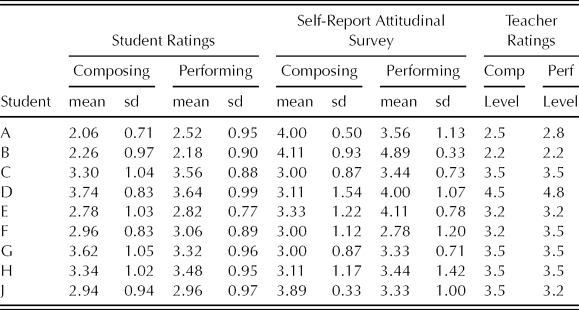
As discussed in the context of this study, a small sample of just nine compositions/performances was produced. This small sample size means that any results and generalisations have to be handled with caution, since they may not be representative of larger populations (Table 1).
Results

Although the mean values of student ratings for composing and performing are similar, standard deviations for performing ratings are lower, showing more agreement among student raters, which could also be interpreted as more uncertainty about composing.
There were some interesting variations among the student raters’ grades. To compare the different distributions, z-scores for skew and kurtosis were calculated (by subtracting the mean and dividing by the standard error); where the z-score was greater than 2.58 the deviation from normal distribution was considered significant at the 1% level. The marks for Student G's composing, for example, showed a significant positive kurtosis (i.e. a pointed distribution, showing agreement centred on one score) and for performing showed negative skew (i.e. a number of high scores). Student B's composing results showed smaller but still significant positive skew (indicating high numbers of low scores), and negative kurtosis, (showing a much flatter distribution), and for performing showing a positive skew (more low scores) but no significant kurtosis.
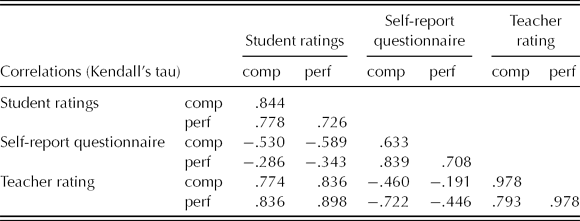
The correlations observed are shown in Table 2. Reliability values for each of the measures were calculated. These appear on the diagonal in Table 2, and represent measures of internal consistency using Cronbach's alpha. In the case of the Teacher Ratings these represent a measure of consistency between the ratings for composing and performing.
Multi-trait multi-measure matrix
Histograms showing student ratings of composing and performing for student G, with significant negative skew and positive kurtosis
Histograms showing student ratings of composing and performing for student B, showing significant positive skew and kurtosis that is negative for composing and positive for performing
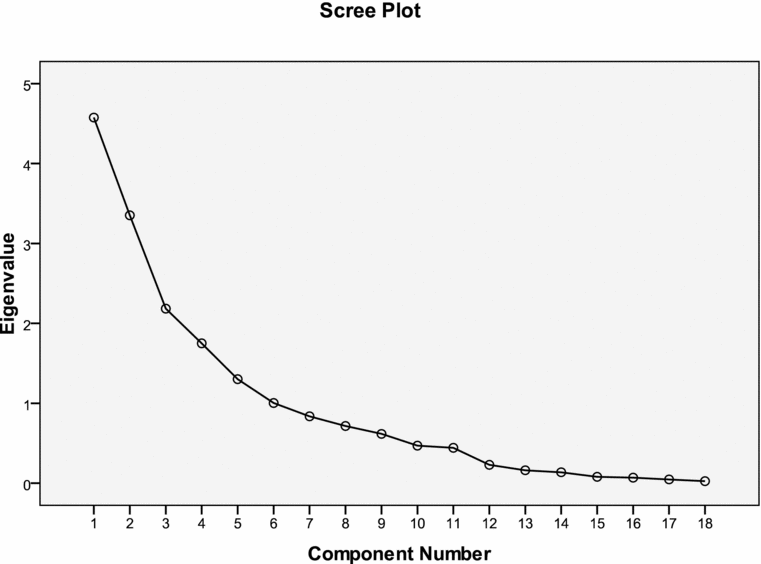
The lack of correlation between results of the questionnaire and the other measures suggests that they may have been measuring different traits. Principal component analysis was carried out on the questionnaire results to examine the number of factors present (Fig. 3).
Scree plot of whole class questionnaire results (18 questions)
Kaiser (1960) suggests retaining all factors with an Eigenvalue greater than 1, which would give up to six factors here, whereas Cattell (1966; both cited in Field, Reference FIELD2009, p. 639–640) ‘argued that the cut-off point for selecting factors should be at the point of inflexion of this curve’, suggesting that there may be two principal factors. The component matrix for this analysis showed that the items contributing most to the first factor are to do with aspects of performing, whereas the main contributors to the second factor are concerned with composing. This analysis suggests that, for the questionnaire, attitudes towards composing and performing may be discrete traits. The positive correlation between the measures of attitudes towards composing and performing, as reported in the questionnaire, may suggest a ‘common method bias’, the tendency of a particular measure to produce similar results independent of the traits it is being used to measure.
Further analysis of the mis-match between these reported attitudes and the other measures was undertaken. It was noticeable that the students who appeared most positive about the composing statements in the questionnaire were those whose teacher and student ratings scored lowest (students A and B). In other words, these students showed strongly positive attitudes to items about composing (and performing, in the case of student B), but did not yet appear to be very good at it. From the music educator's point of view this bodes well, since a positive attitude may well enable the students to improve in future. On investigation, it was found that these two Year 7 students had come from primary schools where musical provision was not strong, so their experience of practical music-making was based on just two terms in secondary school. This might account for both their positive attitude and their relative lack of skill.
For future studies it might be more relevant to adopt a self-report rating system that measured students’ views of their own abilities in composing and performing, rather than their attitudes towards abstract concepts of composition and performance. Next, the results of the questionnaire were excluded from the study.
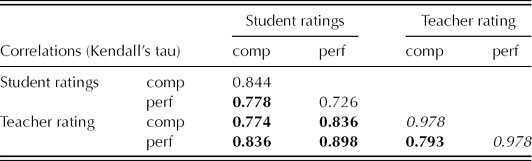
Excluding the student self-report questionnaires gives the set of correlations presented in Table 3.
Multi-trait multi-measure matrix excluding student questionnaire. All these correlations are considered significant at the 1% level
To aid analysis, the following abbreviations will be used: TR = Teacher Rating; SR = Student Rating; C = Composing; P = Performing. Thus TRP = Teacher Rating of Performing, SRC = Student Rating of Composing.
Heterotrait–mono-method correlations were high (SRC/SRP = 0.778; TRC/TRP = 0.793), which may confirm that the traits are closely related; without other evidence, however, they may suggest the presence of a ‘methods factor’: that is, the correlation may have owed more to the use of the same measurement method than to any actual correlation between composing and performing.
Inter-rater reliability in student ratings was greater for composing than for performing (0.844 against 0.726), meaning that there was more agreement between student raters about the quality of the composing they heard. This may suggest that student raters have developed a ‘nose for quality’ when judging composing. Swanwick and Franca (Reference SWANWICK and FRANCA1999) found that assessment of composing activities also typically gave a better indicator of students’ optimal levels of musical understanding than did assessment of purely performing tasks; that is, they allowed students to reveal the extent of their musical understanding more effectively.
Strong correlations between student and teacher ratings of performing (monotrait–hetero-method: SRP/TRP = 0.898) may indicate a shared understanding of performing quality between students and their teacher. This value was higher than for composing (SRC/TRC = 0.774), which may suggest that students and their teacher agree less about what makes a good composition.
A strong correlation between composing and performing, as measured by different methods (heterotrait–heteromethod: SRC/TRP = 0.836) suggests that there is convergent validity: that is, the traits ‘composing’ and ‘performing’ do seem to be related closely in practice in the secondary school classroom, rather than being separate traits.
Conclusions
Correlations between sets of data analysed in this small-scale study suggest evidence for convergent validity between composing and performing in the secondary school classroom: these elements, which many educationalists link in theory, do seem to be closely linked in practice. Composing and performing may well be related aspects of the same musical trait, therefore. This finding gives evidential support to the creation of the trait ‘communication of musical ideas’ in the APP guidelines (NAME, 2011).To put it another way, when listening critically to students performing their own compositions, it may not be possible to separate the elements of ‘composing’ and ‘performing’ in any meaningful way. The next stage in an investigation would be to carry out a larger-scale study, with a more robust student self-report instrument, to investigate these links further. In the meantime, these findings suggest that, in the lower secondary school, students are unable effectively to articulate a distinction between composing and performing when presented with an integrated task, and that it may be fruitful for teachers to focus on ways to develop – and effectively assess – integrated forms of these skills. Recognition that ‘communication of musical ideas’ is one integrated musical construct of performing–composing may encourage teachers to take a more holistic view of students’ musical activities in the classroom.
Andrew Fowler has taught music in a number of English secondary schools. His interest in finding ways to assess pupils’ musical products in the music classroom began with his own practice and was developed through further study at Durham University and through work as Lead Teacher for Assessment in Music in County Durham. He is now Assistant Headteacher with responsibility for the curriculum at Queen Elizabeth Grammar School, Penrith, Cumbria.