INTRODUCTION
Susceptibility to schizophrenia occurs across a spectrum, with schizotypal (personality) disorder as the prototypic spectrum sharing common genetic and biologic substrates with schizophrenia (Siever et al., 2002). Schizotypal (personality) disorder is characterized by odd behavior and attenuated forms of the features seen in schizophrenia without manifestation of overt and sustained psychosis (World Health Organization, 1993; American Psychiatric Association, 1994). Clarifying the neurobiological similarities and differences between established schizophrenia and schizotypal (personality) disorder would potentially discriminate the pathophysiological mechanisms underlying the core features of the schizophrenia spectrum from those associated with overt psychosis.
Psychophysiological studies have found deficits in the startle response, smooth pursuit eye movements, antisaccades, backward masking, and N400 and P300 evoked potentials within schizotypal subjects and patients diagnosed with schizophrenia (for review see Siever & Davis, 2004). Recently, it has been reported that there is evidence of specific genetic linkages with both schizophrenia and schizotypal subjects; catechol-O-methyltransferase (COMT) is a genotype that shows such linkages (for review see, Raine, 2006). The brain abnormalities shared between patients diagnosed with schizotypal disorder and schizophrenia might represent a common denominator in schizophrenia spectrum disorders, whereas the differences might account for the sparing of schizotypal patients from the development of overt psychotic symptoms. Several recent brain structural imaging studies have identified specific structural abnormalities in schizotypal patients similar to those seen inschizophrenia, although generally to a lesser degree and with sparing of certain brain regions (Dickey et al., 2002; Siever & Davis, 2004; Siever et al., 2002). Previous studies (Kawasaki et al., 2004; Siever & Davis, 2004; Suzuki et al., 2005; Takahashi et al., 2006) have shown that decreased volume in temporal structures appears to be a common feature in these two disorders and may be a core defect of schizophrenia spectrum disorders. The literature also suggests that patients diagnosed with schizotypal disorder do not appear to have the decreased frontal volumes that have been reported in schizophrenia. (Kawasaki et al., 2004; Kurachi, 2003; Siever & Davis, 2004; Suzuki et al., 2005).
These differences in brain structure could well be reflected in the differences in cognitive function between schizophrenia and patients diagnosed with schizotypal disorder. Cognitive impairment in patients diagnosed with schizophrenia is well established (for review see, Heinrichs & Zakzanis, 1998). Saykin et al. (1991) were among the first to use a methodologically sound approach to examine neurocognition in schizophrenia. They demonstrated that distinct impairments in patients diagnosed with schizophrenia relative to controls occurred primarily in tasks assessing verbal memory, as well as in tasks assessing attention, abstraction, and cognitive flexibility. Similarly, using a wide variety of neuropsychological tests, Sullivan et al. (1994) reported patients diagnosed with schizophrenia have impairments in memory, executive functions, and motor functions. Censits et al. (1997) applied the neuropsychological test batteries of Saykin et al. (1991) and produced comparable results, which were largely supported by later studies (e.g., Heinrichs & Zakzanis, 1998). Cognitive impairment has also been identified at the onset of the illness (Saykin et al., 1994). Moreover, a recent review indicates that cognitive impairment represents a common factor that is shared across schizophrenia spectrum disorders (Siever & Davis, 2004).
Many of the more recent neuropsychological investigations of schizotypal subjects (e.g., Mitropoulou et al., 2002, 2005; Voglmaier et al., 1997, 2005) have used more comprehensive neuropsychological batteries than those used in earlier studies (e.g., Braff, 1981; Cadenhead et al., 1993). These more comprehensive investigations have identified specific neurocognitive impairments among schizotypal subjects, and differences between schizotypal subjects and healthy control subjects (Mitropoulou et al., 2002, 2005; Voglmaier et al., 1997, 2005). Indeed, studies have shown that unlike patients diagnosed with schizophrenia, who exhibit severe cognitive impairment across numerous cognitive functions, schizotypal subjects exhibit moderate impairment across only a few cognitive domains (Siever & Davis, 2004). Namely, it has been suggested that schizotypal subjects manifest moderate deficits in executive function, working memory, verbal learning, episodic memory, and attention but not in generalized intellectual measures, perceptual, or motor domains (Siever & Davis, 2004). We previously published a preliminary report of findings for schizotypal disorder and schizophrenia based only on the main standardized cognitive tests in Japan; the Japanese versions of the Wechsler Adult Intelligence Scale-Revised (WAIS-R) and the Wechsler Memory Scale-Revised (WMS-R) (Matsui et al., 2004). To date, a comprehensive characterization of the neurocognitive features of Japanese patients diagnosed with schizophrenia spectrum disorder has proved elusive because there are few other Japanese versions of standardized neuropsychological tests.
The present study examined differences within a schizophrenia spectrum disorder population using a wider range of cognitive measures that commonly used in the literature, and compared performance to a control group. We also assessed the influence of a priori identified characteristics on the magnitude of identified effects. To our knowledge, this study provides the first comprehensive assessment of neuropsychological functioning in Japanese patients diagnosed with schizophrenia spectrum disorder. Based on the above literature, we predicted that schizotypal disorder patients would demonstrate abnormalities in temporal lobe-related function similar to those seen in overt schizophrenia, such as verbal memory. In contrast, we expected that performance on tasks involving frontal lobe functions would be better in schizotypal subjects than in patients diagnosed with schizophrenia. Finally, we expected that both patient groups would show better performance on parietal lobe-related tasks, such as spatial organization, than on temporo-frontal lobe-related functions.
METHODS
Participants
Twenty-eight patients (17 males, 11 females) with schizotypal disorder, 37 patients diagnosed with schizophrenia (21 males, 16 females) and 99 control subjects (40 males, 59 females) recruited from January 2002 to September 2006 participated in this study. All subjects were right-handed. After a complete description of the study was given to each subject, written informed consent was obtained. This study was approved by the Committee on Medical Ethics of Toyama University.
Schizotypal disorder group
Participants with schizotypal disorder were recruited from patients manifesting schizotypal features who consulted the clinics of the Department of Neuropsychiatry, Toyama University Hospital because of distress or associated problems in their lives. These patients required clinical care, including medication with low-dose antipsychotics, to treat these problems. Because schizotypal subjects rarely present themselves for clinical care, our clinic-based sample was considered to be somewhat more severely ill than may be expected of schizotypal individuals within the general population. Structured clinical interviews were performed using the Comprehensive Assessment of Symptoms and History (CASH) (Andreasen et al., 1992) and Structured Clinical Interview for DSM-IV axis II disorders (SCID-II) (First et al., 1997). All subjects met the criteria for schizotypal disorder as defined by the International Classification of Diseases, 10th edition (ICD-10: World Health Organization, 1993) as well as the criteria for schizotypal personality disorder in the Diagnostic and Statistical Manual of Mental Disorders, fourth edition (DSM-IV: American Psychiatric Association, 1994). Based on data from the CASH and SCID-II, subjects were diagnosed by a consensus of at least two experienced psychiatrists, and when necessary, the appropriateness of including a specific patient in the study was discussed among the clinical staff involved in the case. None of the subjects was judged to meet the criteria for schizophrenia as defined by either the current or previous versions of ICD-10 or DSM-IV.
Clinical symptoms were rated by a well-trained psychiatrist or psychologist within two weeks of the neuropsychological assessment using the Scale for the Assessment of Negative Symptoms (SANS: Andreasen, 1983) and the Scale for the Assessment of Positive Symptoms (SAPS: Andreasen, 1984). The mean scores for the SANS and SAPS were 44.9 (SD = 22.7, range = 7–83) and 18.3 (SD = 9.7, range = 1–43), respectively. Patients were also assessed using the Brief Psychiatric Rating Scale (BPRS: Overall & Gorham, 1952). Their mean total BPRS score was 35.9 (SD = 8.0, range = 19–53).
All subjects have been under continuous clinical follow-up and none of subjects has developed overt schizophrenia to date and their first-degree relatives are free of a history of psychosis. Although all of the schizotypal subjects in this study fulfilled the DSM-IV criteria of schizotypal personality disorder on Axis II, seven subjects had experienced previous transient quasi-psychotic episodes fulfilling a diagnosis of brief psychotic disorder on Axis I. At the time of their neuropsychological assessment, six patients were neuroleptic–naïve and 22 patients were being treated with low-doses of antipsychotics. Of the treated patients, two patients received typical neuroleptics and 18 patients received atypical neuroleptics. Although the possibility cannot be excluded that the antipsychotic medication prevented the onset of their overt psychotic episodes in some of our schizotypal subjects, they were stable enough to show typical schizotypal features without developing overt psychosis during the more than two years of mean clinical follow-up. Thus, they appear to primarily constitute a distinct category from schizophrenia.
Schizophrenia group
Patients diagnosed with schizophrenia were diagnosed based on the CASH and the Structured Clinical Interview for DSM-IV axis I disorders (SCID-I: First et al., 1996). These participants fulfilled both the ICD-10 and the DSM-IV criteria for schizophrenia. Patients who were actively psychotic and were expected to be unable to participate in the testing were not included. All but one of the patients diagnosed with schizophrenia were receiving neuroleptic medication; seven patients were treated with typical neuroleptics and 29 patients with atypical neuroleptics. The typical and atypical neuroleptic dosages were converted into haloperidol equivalents using the guidelines of Inagaki and Inada (2006). The mean dosages in patients diagnosed with schizophrenia and schizotypal disorder were 11.4 (SD = 8.1) and 4.3 (SD = 4.3) mg/day, respectively (t = 4.11, p < .01). The clinical status of the patients diagnosed with schizophrenia varied; some were in an active psychotic episodes and others were partially remitted or in a residual phase. At the time of neuropsychological assessment, the mean scores for the SANS, SAPS, and total BPRS score in patients diagnosed with schizophrenia were 50.3 (SD = 20.5, range = 4–89), 32.9 (SD = 24.0, range = 0–116), and 41.8 (SD = 11.1, range = 21–83), respectively. All patients diagnosed with schizotypal disorder and schizophrenia were physically healthy, and none had a history of head trauma, neurological illness, serious medical illness or surgical procedures, substance abuse disorder, past substance dependence/abuse, or a premorbid estimated IQ less than 80, as assessed by the Japanese Adult Reading Test (JART: Matsuoka et al., 2002).
Control group
The control participants consisted of healthy volunteers recruited by advertisements from the community, as well as hospital staff and students. They were interviewed by psychiatrists or psychologists using a questionnaire concerning their family and past histories, and presence of current illness based on the SCID non-patient form (First et al., 1996). Subjects were excluded if they had a history of psychiatric illness on an Axis I or II of DSM IV, head trauma, neurological illness, serious medical or surgical illness, substance abuse disorder, or past substance dependence/abuse. Control subjects were also screened for history of psychiatric disorders on an Axis I or II in their first-degree relatives. All control subjects were given the Japanese version of the Minnesota Multiphasic Personality Inventory (New Japanese MMPI Committee, 1993, 1997) because our previous study (Matsui et al., 2002) identified the usefulness of the MMPI subscales in detecting subjects with the schizotypal personality disorder trait. Participants were excluded if they had abnormal profiles; a T-score exceeding 70 for the validity scales or the clinical basic scales. As well, participants were excluded if they had an estimated IQ of less than 80, as assessed by the JART. Six of the 105 candidates for the normal control group were excluded for having an abnormal MMPI profile.
The demographic and clinical characteristics of patients diagnosed with schizophrenia and schizotypal disorder and the control subjects are summarized in Table 1. The three groups were matched in terms of age, parental education, or premorbid estimated IQ by the JART. The difference in the gender ratios among the three groups was statistically significant (χ2 = 7.05, df = 2, p = .029). Using post hoc tests, this difference was found to be because of the control subjects having attained a higher mean level of education than had patients diagnosed with schizophrenia (Tukey test, p < .01), but not patients with schizotypal disorder (Tukey test, n.s.). There was no significant difference in the gender ratio between the patient groups diagnosed with schizophrenia and schizotypal disorder when these two groups were compared directly (χ2 = 1.23, df = 1, p = .268).
Clinical and demographic characteristics of patients with schizophrenia, patients with schizotypal disorder and healthy subjects

The total SAPS score and the total BPRS score for the schizophrenia patients were significantly higher than those for the schizotypal patients (SAPS: t = 2.95, p = .005; BPRS: t = 2.28, p = .027), although there was no significant difference between patients diagnosed with schizophrenia and schizotypal disorder for the total score for SANS (t = .95, p = .341). There was a significant difference in medication dosage (t = 2.95, p = .005); the patients diagnosed with schizotypal disorder took significantly smaller amounts of neuroleptics than did the patients diagnosed with schizophrenia.
Neuropsychological Assessment
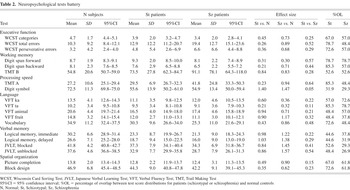
All tests were administered by experienced examiners trained in standardized testing procedures under a senior neuropsychologist's supervision. All participants completed a standard neuropsychological battery assessing executive function, working memory, processing speed, language, verbal memory, and spatial organization (Table 2). It was expected that executive function, working memory, and processing speed would be sensitive to frontal lobe function, verbal memory would be sensitive to temporal lobe function, language would be sensitive to fronto-temporal lobe function, and spatial organization would be sensitive to parietal lobe function (Kolb & Whishow, 2003). The neuropsychological battery included Japanese versions of various WAIS-R (Shinagawa et al., 1990) subtests, as well as the Wisconsin Card Sorting Test (WCST: Nelson, 1976; Heaton et al., 1993), the Japanese version of Logical Memory from the WMS-R (Sugishita, 2001), the Japanese Verbal Learning Test (JVLT: Matsui et al., 2006), Japanese versions of the Verbal Fluency Test (Sumiyoshi et al., 2001, 2004) and Trail Making Tests A and B (Reitan & Wolfson, 1985). The organization of tests into specified domains was supported by factor-analytic studies in normal and psychiatric populations (Nuechterlein et al., 2004).
Neuropsychological tests battery

Raw scores were used as the outcome measures for WAIS-R subtests. WAIS-R subtests administered are followed in parentheses by the domain tested: Digit Span (working memory), Picture Completion and Block Design (spatial organization), Vocabulary (language), and Digit Symbol (processing speed) (Heinrichs & Zakzanis, 1998; Nuechterlein et al., 2004; Saykin et al., 1991; Voglmaier et al., 1997). Total scores of the immediate and delayed recall were measured with the Logical Memory subtest from the WMS-R. We used the short version of WCST cards (Nelson, 1976), adapted from the original instructions and scoring (Heaton et al., 1993) because of considerations of administration time. For the WCST, the number of categories completed, total errors, and perseverative errors were analyzed.
Novel instruments and modifications made for Japanese speakers are described later.
Japanese Verbal Learning Test
The Japanese Verbal Learning Test (Matsui et al., 2006) is composed of a 16-word list based on the work of Gold et al. (1992) and is designed to measure short-term verbal retention and verbal leaning. The blocked list contained four sets of four consecutively presented exemplars from the same taxonomic category (furniture, beasts, musical instruments, and sports). In the unblocked list, four exemplars from each of four categories (seasonings, vehicles, flowers, and countries) were constructed so that related items never appeared consecutively. Thus, the unblocked list is a memory task for implicitly categorized words and provides a measure of semantic organization. The listed words were selected from common Japanese words (Ogawa, 1972), so that the frequency of recall for each word was essentially equivalent. Three trials involving each list were repeated consecutively. The words were presented at a rate of one word per 1 s with a 1 s interstimulus interval. Participants were required to recall the words after each 16-word set was presented. The total number of words recalled over all three trials for each list of the JVLT was measured.
Verbal Fluency Test
The Verbal Fluency Test mainly assesses language function. The instructions for the verbal fluency tasks followed those described by Spreen and Strauss (1998). For both category (semantic association) fluency and letter (phonemic association) fluency, subjects were asked to produce as many words as possible in 60 s. ANIMALS and FRUIT were used in the category fluency task, while “KA” and “TA” were used for the letter fluency task. These letters were chosen based on the Japanese lexical database (Amano & Kondo, 2000); the occurrence of KA in a general publication (16200) was approximately twice as frequent as that of TA (9281). This ratio is analogous to that between “S” and “F” in the FAS form of the English version of the letter fluency task. Responses were recorded verbatim by the examiners in the order generated. The number of each total word generated for both verbal fluency tasks was the outcome measure.
Trail Making Test B
The Trail Making Test B involves alternating between numbers and letters. For letters, we used the Japanese cursive syllabary instead of the alphabet (e.g., 1-/a/, 2-/i/, 3-/u/, etc.) because Japanese people use the Japanese syllabary daily more than the alphabet. This test was selected as a measure of working memory (Lencz et al., 2006;Trestman et al., 1995). The method and measures (i.e., completion time) were entirely consistent with the English version of Trail Making Test B (Reitan, 1958).
Data analysis
To provide a standard unit of measurement, we standardized raw scores for all variables using the means and standard deviations of normal controls, and corrected their z-scores for sex and age through regression analyses based on the control group. We then grouped data into six summary scores by averaging each subject's z-scores on tests assessing the same functional domains. Thus, summary measures were calculated for executive function, working memory, processing speed, language, verbal memory, and spatial organization.
Multivariate analysis of variance (MANOVA) was used to examine the diagnostic groups (schizophrenia, schizotypal disorder, normal control) as the between-groups factor, and neuropsychological domain (executive function, working memory, processing speed, language, verbal memory, spatial organization) as the within-subjects factor. In addition, this analysis was also completed with duration of education entered as a covariate. To investigate the effect of sex, a MANOVA was conducted with the between-groups factors of sex (male, female) and diagnostic group, and the within-subjects factor of neuropsychological domain (using uncorrected z-scores). Cochran's test for homogeneity of variance was satisfied for the MANOVA. This procedure allowed for an overall multivariate test of significance for the three groups along with univariate F tests for each of the six cognitive domains. For F tests indicating significant between group differences, a one-way analysis of variance (ANOVA) for each of the individual measures was conducted between the three groups with contrasts among the three groups. Post-hoc Tukey tests were conducted to further clarify the significant effects of the ANOVAs. The data is also presented using 95% confidence intervals and effect sizes to more accurately describe inter-group differences (Cohen, 1988).
To determine whether there were any correlations among age, duration of illness, drug dose, and neuropsychological domains, Spearman rank correlation coefficients were calculated for the patient groups. Furthermore, correlations between clinical symptom scores and neuropsychological domains were also determined using Spearman rank correlation coefficients. For each neuropsychological function, we report correlations that were significant at the p < .008 level in the total patient cohort, based on a Bonferroni correction for multiple correlations.
RESULTS
Profile Analysis of Neuropsychological Domains
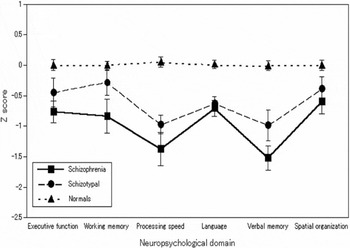
Scores for each neuropsychological domain for the three groups are presented in Table 3. The z score profiles for the six summary scores on the neuropsychological battery are presented in Fig. 1. The standardized means are represented by the zero line, with SD = 1 for all functions. Results of the MANOVA demonstrated a significant main effect of neuropsychological domain (F(5,670) = 8.03, p < .001) and diagnostic group (F(1,134) = 26.68, p < .001). There was also a significant domain by group interaction (F(10,670) = 3.40, p < .001). When duration of education was entered as a covariate, no significant main effect of domain was seen, but the main effect of diagnostic group and the interaction between domain and diagnosis remained significant. Results of the MANOVA that included sex as a between-groups factor indicated no significant main effect of sex (F(1,131) = .005, p = .94) and no significant two-way or three-way interactions (diagnostic group by sex: F(2,131) = 0.05, p = .95; diagnostic group by sex by neuropsychological domain: F(10,655) = 1.16, p = .32).
Univariate analyses of variance and post-hoc tests on neuropsychological domains


Neuropsychological profile for patients diagnosed with schizophrenia (solid squares) and schizotypal disorder (solid circles) relative to the standardized healthy volunteers (solid triangles). Error bars indicate the standard error of the mean.
Results of the univariate ANOVA and the pairwise comparisons between groups for each neuropsychological domain are presented in Table 3. There were significant inter-group differences in all domains of neuropsychological function (verbal memory F(2,161) = 34.99, p < .001; processing speed F(2,161) = 28.54, p < .001; language F(2,161) = 20.39, p < .001; executive function F(2,161) = 8.56, p < .001; working memory F(2,161) = 8.32, p < .01; spatial organization F(2,161) = 5.44, p < .01). As shown in Table 3, follow-up Tukey tests on the summary scores revealed that patients diagnosed with schizotypal disorder performed significantly below controls in verbal memory, language, and processing speed but not in executive function, working memory, and spatial organization. Patients diagnosed with schizophrenia performed significantly below normal controls in all six domains.
Neuropsychological measures
Results of each test score and the effect sizes are shown in Table 2. Designation of effect sizes followed Cohen's (1988) descriptions of “small,” d = .2, “medium,” d = .5, and “large,” d = .8. Patients diagnosed with schizotypal disorder and schizophrenia demonstrated impairment on Logical Memory, JVLT, category fluency, Digit Symbol, and Trail Making Test B when compared with the performance of the control group, as indicated by the large effect sizes. In addition, as indicated by large or medium effect sizes, patients diagnosed with schizophrenia demonstrated impairment relative to controls on the WCST, Digit Span backward, Trail Making Test A, Vocabulary, Picture Completion and Block Design. Patients diagnosed with Schizotypal disorder demonstrated only small effect sizes on these measures.
Correlational analyses
No significant correlations were seen between age, duration of illness, or neuroleptic dose and any of the neuropsychological domains for the patient groups. As well, in examining correlations between symptom severity and test performance, no significant relationships were seen between neuropsychological domains scores and scores on the SANS, SAPS, or BPRS in patients diagnosed with schizophrenia. In patients diagnosed with schizotypal disorder, the only significant correlations were the negative correlations seen between the working memory score and the SANS Affective flattering subscale score (ρ = −.52, p < .008), and the executive function score and the BPRS depression item score (ρ = −.52, p < .008).
DISCUSSION
To our knowledge, this study is the first to report comprehensive neuropsychological results in Japanese schizotypal subjects. A standard neuropsychological battery was administered, and statistical adjustments were made to equate tasks psychometrically. We demonstrated differential impairment (Chapman & Chapman, 1978) in verbal memory against a background of diffuse impairment in patients diagnosed with schizophrenia. This result supports those of previous studies in schizophrenia (Censits et al., 1997; Saykin et al., 1991). We also demonstrated that patients diagnosed with schizotypal disorder showed decrements in cognitive functioning that were similar to, but of lesser magnitude, than those found in the schizophrenic patients. Thus, in the current study, patients diagnosed with schizotypal disorder showed mild general cognitive deficits as well as more specific deficits on measures of processing speed, language, verbal memory, and learning. In addition, patients diagnosed with schizotypal disorder showed intermediate values between patients diagnosed with schizophrenia and normal controls on measures of working memory, executive function, and spatial organization, though no significant differences were seen between normal controls and patients diagnosed with schizotypal disorder on these tests. These results are consistent with our preliminary findings of a significant verbal memory deficit in patients with schizotypal disorder (Matsui et al., 2004).
Consistent with previous neuropsychological studies using English tests (Heinrichs & Zakzanis, 1998; Saykin et al., 1991), the present results suggest that impairment of verbal memory is a common neuropsychological finding in the schizophrenia spectrum. The pattern of cognitive deficits apparent in patients diagnosed with schizotypal disorder in this study is consistent with hypotheses suggesting the involvement of temporal lobe function in schizophrenia spectrum disorder. Findings that problems in verbal learning were identified in patients diagnosed with schizophrenia spectrum disorder support the notion that reduced temporolimbic volume indicates vulnerability, which is necessary but not sufficient for developing schizophrenia (Kurachi, 2003; Siever & Davis, 2004). Although individuals diagnosed with schizotypal disorder are generally spared overt psychosis, this group shows a higher incidence of developing schizophrenia than the general population. Thus, they are assumed to have a greater vulnerability to schizophrenia, but are simultaneously protected from developing full-blown psychosis.
Based on studies concerning cognitive characteristics and brain morphologic changes in patients diagnosed with schizotypal disorder (Siever & Davis, 2004) and schizophrenia (Shenton et al., 2001), it is hypothesized that whereas abnormalities in the temporal regions are common to both groups as a neurobiological basis for vulnerability factors as part of the schizophrenia spectrum, the relative preservation of frontal regions might contribute to the sparing of patients diagnosed with schizotypal disorder from the development of prominent psychosis (Kurachi, 2003; Siever & Davis, 2004). We have demonstrated modest cognitive impairments on various measures in a group of clinically identified patients diagnosed with schizotypal disorder. The finding that performance on tasks involving frontal lobe functions in individuals diagnosed with schizotypal disorder is intermediate between patients diagnosed with schizophrenia and intact controls might be related to the finding of preserved volume in the prefrontal cortical regions of patients diagnosed with schizotypal disorder on MRI (Kawasaki et al., 2004; Suzuki et al., 2005). This differential involvement found in previous MRI studies of the prefrontal cortex in patients diagnosed with schizophrenia as compared to schizotypal disorder (Kawasaki et al., 2004; Suzuki et al., 2005) suggests that prefrontal pathology may contribute to the overt manifestation of psychosis in schizophrenia (Kurachi, 2003; Siever & Davis, 2004), and the present results demonstrating cognitive impairment may support this hypothesis on the MRI results.
The present study focused on similarities and differences in neuropsychological functioning between patients diagnosed with schizophrenia and schizotypal disorder. Although the results show that effect sizes were generally in the small to medium range, it is also clear that patients diagnosed with schizotypal disorder did not perform as well as controls on many tests. This suggests that impairments seen in patients diagnosed with schizotypal disorder on measures of verbal memory may at least partially reflect common characteristics with schizophrenia. The severe deficits apparent in patients diagnosed with schizophrenic disorder may be attributable to a specific disease-related process.
Our results showed there was no significant correlation between clinical symptoms and neuropsychological function in schizophrenia. For patients diagnosed with schizotypal disorder, working memory was related to the negative symptom of affective flattening. According to a review by Addington (2000), cognitive deficits in schizophrenia are stable across different phases of the illness, and are often associated with negative symptoms, but show independence from positive symptoms. However, Addington also noted that negative symptoms only appear to account for a small proportion (approximately 10%) of the variance in cognitive impairment, and concluded that this may account for the overall lack of consistency in previous results. Further studies will be important in elucidating the relationship between psychopathology and cognitive dysfunction. In addition, the finding of a relationship between the BPRS depression score in subjects diagnosed with schizotypal disorder and executive function suggests that nonspecific factors, such as chronic stress, might affect results in the schizotypal group, but not schizophrenia group.
Several limitations to this study indicate that caution is necessary in drawing conclusions. Though the present findings and those of some previous reports (Cadenhead et al., 1999; Laurent et al., 2001) do not demonstrate impairment in executive function and working memory in patients diagnosed with schizotypal disorder, other studies have demonstrated impairment of executive function (Trestman et al., 1995; Voglmaier et al., 1997) and working memory (Roitman et al., 2000). For executive function, one reason that our results may differ from some other studies (Trestman et al., 1995; Voglmaier et al., 1997) may be related to the version of WCST we employed. We adopted the short version of WCST cards (Nelson, 1976) because of administration time considerations. However, this shortened version may not have been sensitive enough to detect executive function deficits in patients diagnosed with schizotypal disorder, and use of the full version of WCST may have produced different results. Test sensitivity will be an important consideration in future studies. In addition, because the frontal lobe mediates various functions, it will be important in future research to distinguish among different types of frontal-systems functions. For working memory, patients diagnosed with schizotypal disorder did not show deficits like those demonstrated by patients diagnosed with schizophrenia. However, performance on the Trail Making Test B in the working memory domain showed a large effect size in patients diagnosed with schizotypal disorder and schizophrenia. Although Trail Making Test B is considered a measure of working memory, processing speed is also a significant component of the test (Nuechterlein et al., 2004). Therefore, patients diagnosed with schizotypal disorder may have appeared to have more difficulties on mixed functional measure than on other measure in working memory.
A broad range of neuropsychological deficits have repeatedly demonstrated in schizophrenia populations at the onset of illness as well as over time. Follow-up studies are needed to determine whether the subjects diagnosed with schizotypal disorder evaluated here will later develop schizophrenia, though a further limitation of the present study is the relatively small sample size of the individuals diagnosed with schizotypal disorder. The present findings require replication in a larger sample of subjects diagnosed with schizotypal disorder, and caution should be exercised in applying the present findings to the general population of people diagnosed with schizotypal disorder. Moreover, to fully understand the neural substrates underlying the impaired cognitive performance in people diagnosed schizotypal disorders, experiments are needed that utilize cognitive assessment combined with functional brain imaging.
In conclusion, comparisons of neuropsychological function in a Japanese population demonstrated similarities and differences between patients diagnosed with schizotypal disorder and those diagnosed with schizophrenia. Impairments in verbal memory, language, and processing speed were common to both patient groups may represent a vulnerability to schizophrenia, whereas impairments in working memory, spatial organization, and executive function were primarily observed in patients diagnosed with schizophrenia and may be features related to the overt manifestation of psychosis. Possible differential contributions of prefrontal and temporolimbic functions to this pattern may provide a scaffold for further studies examining relationships between neuropsychological functions and brain structures/functions.
ACKNOWLEDGMENTS
This study was supported by a Grant-in-Aid for Scientific Research (C) (2), 16530445 from the Japan Society for the Promotion of Science (JSPS). The authors thank Ms. Sachiko Nakayama for help in data arrangement, Ms. Kuniko Tanaka for help in normal data collection, Dr. Michio Suzuki for advice of information of patients and the physicians in charge of patients for care.