Preamble
When I think of language development, two uses of the verb ‘grow’ come to mind: ‘grow’ as a transitive verb, as in He grows apples in his backyard; and ‘grow’ as an intransitive verb, as in Apples grow in his backyard. For me, the two variants of causative alternation of the verb ‘grow’ largely encapsulate the sine qua non of controversies in second language acquisition (SLA) research over how language development takes place. The theoretical perspectives continue to diverge along the following lines:
a. X grows Y.
b. Y grows on its own.
c. Y grows in X.
Here ‘X’ denotes the environment, ‘Y’ the learner language system. With (a), the view is that environment (or an external force such as teaching) drives learning, but with (b) the assumption is that learning takes its own course – environment or external intervention would do little to help it. With (c), the assumption is that learning happens only in a natural environment.
Proponents of the first view (a) are typically those who either take a sociolinguistic or a behaviorist perspective on second language (L2) development. A recent expression of this view can be found in the Douglas Fir Group (2016) publication in the Modern Language Journal. The Douglas Fir Group claimed, inter alia, that social influences on L2 development occur on three levels: a micro level of social activity, a meso level of sociocultural institutions and communities, and a macro level of ideological structures.
Proponents of the second view (b), on the other hand, take an innatist perspective on language development (see, e.g., White, Reference White1989, Reference White2003a; Schwartz, Reference Schwartz1993; Truscott, Reference Truscott1996, Reference Truscott1999). In this view, it is the learner's innate mechanism that enables, and even guides, language development.
In between the two polarized views is the third view (c), according to which language development is possible only where there is an interaction between the environment and the learner-internal mechanism (see, e.g., Krashen, Reference Krashen1982; Gass & Mackey, Reference Gass, Mackey, VanPatten and Williams2007; Long, Reference Long2007). An example thereof, par excellence, is the Monitor Theory (Krashen, Reference Krashen1982), which comprises five hypotheses, including one devoted to the environment known as the Input Hypothesis and one attending to the internal mechanism, the Natural Order Hypothesis.
Furthermore, the three disparate views on what drives language development, in turn, evoke three other, corresponding views on the relationship between explicit knowledge and implicit knowledge (see, e.g., Ellis, Reference Ellis2005; Long, Reference Long2007; Ellis, Reference Ellis, Ellis, Loewen, Elder, Erlam, Philp and Reinders2009). The first view – X grows Y – embodies a strong interface position assuming that explicit knowledge feeds implicit knowledge (see, e.g., Schmidt, Reference Schmidt1990, Reference Schmidt and Robinson2001; DeKeyser, Reference DeKeyser, Doughty and Williams1998), the second view – Y grows on its own – a no-interface position assuming no relation at all between explicit and implicit knowledge (see, e.g., Krashen, Reference Krashen1982; VanPatten, Reference VanPatten2016, Reference VanPatten2017), and the third view – Y grows in X – a weak interface position (see, e.g., Ellis, Reference Ellis2006; Long, Reference Long2014; Ellis, Reference Ellis2019) assuming some relation between explicit and implicit knowledge. For an elaborate discussion uniquely from a within-learner perspective, see Han and Finneran (Reference Han and Finneran2014).
In the conceptual crosshairs is also the question of whether the disparate views apply equally to young and older L2 learners – the infamous issue of age effects. Take the third view as an example. While naturally immersed in the linguistic environment, children seem to automatically acquire the ambient language (Tomasello, Reference Tomasello2000, Reference Tomasello and Bavin2009). But that is clearly not the case with adult learners, who typically exhibit divergent and variable attainment (Johnson & Newport, Reference Johnson and Newport1989; Pinker, Reference Pinker1994; Kellerman, Reference Kellerman, Eubank, Selinker and Sharwood Smith1995; Schachter, Reference Schachter, Brown, Malmkjaer and Williams1996; Lightbown & Spada, Reference Lightbown and Spada1999; Birdsong, Reference Birdsong, Davies and Elder2004, Reference Birdsong2018; Han, Reference Han2004; Sorace, Reference Sorace, Cornips and Corrigan2005), this notwithstanding long-term immersion (e.g., Schumann, Reference Schumann1978; Schmidt, Reference Schmidt, Wolfson and Judd1983; Sorace, Reference Sorace1993; Long, Reference Long, Doughty and Long2003; White, Reference White2003b; Han, Reference Han, Han and Odlin2006; Lardiere, Reference Lardiere2007; Stam, Reference Stam, Han and Cadierno2010). It thus appears that what enables young learners to acquire an additional language may fail to deliver the same outcome for older learners (cf. Bley-Vroman, Reference Bley-Vroman, Gass and Schachter1989, Reference Bley-Vroman2009; Long, Reference Long2007, Reference Long2014; N. Ellis, Reference Ellis, Robinson and Ellis2008; Hulstijn, Reference Hulstijn2012, Reference Hulstijn2019, Reference Hulstijn2020).
Given the disproportionate results for young versus older learners, the bulk of L2 research over the last five decades has centered around creating and investigating pedagogical interventions that can be effective in improving the learning outcome for older learners.
Fast forwarding, in recent years, in the field of applied linguistics, particularly in the research domain known as instructed second language acquisition (ISLA), there has been much promulgation of usage-based learning, usage-based instruction, incidental learning, and functional competence, amping up the role of environmental contributions to learning and making a push for systems thinking (see, e.g., Larsen-Freeman, Reference Larsen-Freeman1997, Reference Larsen-Freeman, VanPatten and Williams2015; de Bot, Lowie, & Verspoor, Reference de Bot, Lowie and Verspoor2007; Han, Reference Han2016; The Douglas Fir Group, 2016; Ortega & Han, Reference Ortega and Han2017). These ideas, among others, have led me to ponder, and advance today, ‘language mining’ as a pedagogical strategy to foster and scaffold organic development among older L2 learners.
Before discussing the concept of language mining, and by way of offering a brief theoretical context, let me touch on several key tenets of usage-based learning (UBL), usage-based instruction (UBI), and systems thinking.
UBL and UBI
Fundamental to UBL is its singular attention to meaning (Tyler, Reference Tyler2010). UBL champions and enacts semantic bootstrapping, that is, using meaning both as an instigator and a catalyst for development of an ability in L2 learners to connect meaning and form. Ample experience with the target language is at the core of UBL. L2 learning is inextricably bound to the quantity and quality of that experience (Ellis & Wulff, Reference Ellis, Wulff, VanPatten and William2015; Ortega, Reference Ortega, Eskildsen and Cadierno2015). Incidental learning is UBL's primary modus operandi whereby attention to language form is subjugated to meaning processing. The unit of learning comprises expressions of meaning and intent, made available through the learner's iterative, communicative use of the L2 (cf. Croft, Reference Croft2001; Bybee, Reference Bybee2007; Goldberg, Reference Goldberg, Hoffman and Trousdale2013).
Accordingly, UBI amounts to providing conditions conducive to UBL. UBI aligns with UBL in its view of language as a tool of communication. Instruction, therefore, should be experience-based, focusing on scaffolding the learner's experience with the target language, including, but not limited to, promoting learning by doing, relating learning to the learner's personal experience, and making meaning front and center to classroom activities (see, e.g., Larsen-Freeman, Reference Larsen-Freeman, Ortega and Han2017; Verspoor, Reference Verspoor, Ortega and Han2017).
Systems thinking in applied linguistics
SLA research arguably began with systems thinking, only that, for much of its history, it has narrowly homed in on learner language as a system of structures (see, e.g., Corder, Reference Corder1967; Nemser, Reference Nemser1971; Selinker, Reference Selinker1972). The last two decades have, however, seen the advent of a much broader perspective, which, drawing on insights from natural sciences, views L2 development as a complex adaptive system (see, e.g., Larsen-Freeman, Reference Larsen-Freeman1997; de Bot, Reference de Bot2008) wherein there is an intersection of learner-external and learner-internal vectors. The ‘transdisciplinary framework for SLA’ put together and put out collectively by the Douglas Fir Group (2016) signals and, in a way, formalizes such a conceptual shift. In her rejoinder to that framework, Han (Reference Han2016) underscores the push for systems thinking, noting:
A system approach is sorely lacking in SLA research in general: Most studies, for example, continue to exhibit what Weaver (Reference Weaver1948), writing on science and complexity, described as the early stage science dealing mostly with ‘two-variable problems of simplicity’ (p. 2). L2 learning, a phenomenon arguably of ‘organized complexity,’ has to be tackled by treating it as a system ‘where factors interrelate into an organic whole’ (p. 5).
The centerpiece of systems thinking is its holistic approach to analyzing a problem by identifying, and tracing the interconnectedness of, its constituent parts.
Two recent publications, among others, showcase latest endeavors to pursue systems thinking in applied linguistics. One is an edited volume titled ‘Complexity theory and language development’ (Ortega & Han, Reference Ortega and Han2017) and the other, likewise an edited volume, titled ‘Profiling learner language as a dynamic system’ (Han, Reference Han2019). The push for systems thinking thus far has been making inroads mostly in the study of learner language, while its relevance to L2 instruction has largely remained off limits. It is the latter void that I hope this paper begins to help fill.
Both UBL and its pedagogical correlate, UBI, sit well with systems thinking (see, e.g., The Douglas Fir Group, 2016; Larsen-Freeman, Reference Larsen-Freeman, Ortega and Han2017). For one thing, they all underscore the importance of a holistic and complex approach to solving developmental problems. This commonality spurs me to consider language mining a promising and viable strategy for scaffolding organic L2 development in the classroom. Specifically, I propose creating a coupled system between reading and writing to enable language mining and using it as a vehicle to drive the development of a functional competence. With that, I will now turn to a brief discussion of the role of reading and writing in L2 development. I then will define ‘language mining.’ After that, I will draw on relevant research as a rational basis for treating reading and writing as a coupled system and for positing language mining as a mediating process. Finally, I will delve into the possibilities of doing this for L2 instruction.
Reading, writing, and Language Mining
Reading and writing each has a unique place in L2 development, especially among older learners. Krashen (Reference Krashen1993, Reference Krashen2004) addresses ‘the power of reading,’ highlighting its potential to lead to both an informational outcome (comprehension) and an acquisitional outcome (acquisition) for L2 learners. Similarly, though not from the same epistemological stance, other researchers have discussed the dual relevance of reading to L2 learners (see, e.g., Sharwood Smith, Reference Sharwood Smith1986; Lee, Reference Lee2002; VanPatten, Reference VanPatten and VanPatten2004). Sharwood Smith (Reference Sharwood Smith1986), for one, outlined two possible ways of processing input, arguing cogently that it is only when input is processed in a bottom-up manner – through textual decoding – that the dual outcome of reading can unfold into a reality. Boiled down, the power of reading points to two lines of developmental affordances for L2 learners while engaged in reading: learning to read for the sake of developing a literacy skill and reading to learn for the sake of developing a linguistic ability.
The power of reading has its parallel in writing. For instance, Manchón's (Reference Manchón2011) entire volume is dedicated to L2 writing as potentially a dual process of learning to write (i.e., developing a literacy skill) and writing to learn (i.e., developing a linguistic ability).
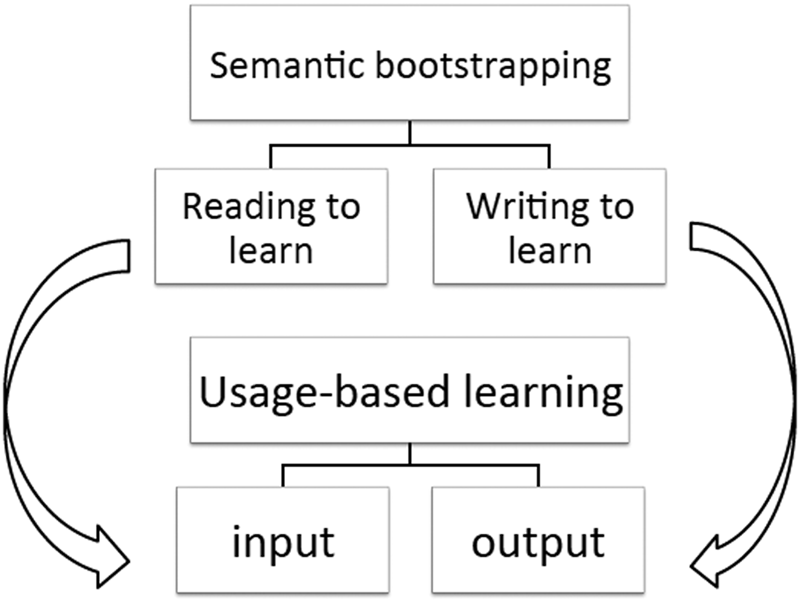
In the present context, I explore the possibility of uniting the acquisitional dimensions of reading and writing, that is, reading to learn and writing to learn, even though an iterative use of this approach may well have the compounding benefits of cultivating both L2 acquisition and development of literacy skills.Footnote 1 Figure 1 illustrates the focus of my pedagogical proposal. Also illustrated in Figure 1 is the dual intention to tie reading to learn and writing to learn under semantic bootstrapping, and, in turn, input and output affordances.
Coupling reading/input and writing/output

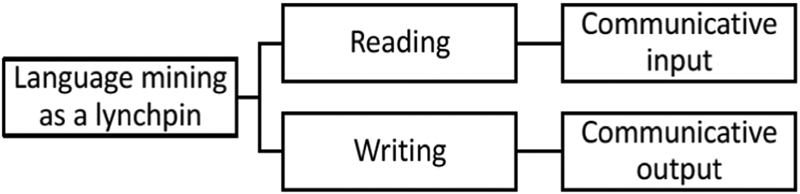
Figure 2 illustrates language mining as a lynchpin to string together reading and writing, and, ultimately, input and output.
Language mining as a lynchpin of the coupled system of reading (input) and writing (output)

What is ‘language mining’? A common use of the word ‘mining’ is found in expressions like ‘gold mining,’ ‘coal mining,’ and by extension, ‘data mining.’ Data mining is the process of discovering patterns in large data sets involving methods at the intersection of machine learning, statistics, and database systems. Dictionary definitions of the verb ‘to mine’ yield three senses: ‘to explore,’ ‘to extract,’ and ‘to utilize.’ Language mining, as I intend it here, is not exactly data mining; rather, it involves exploring language input, extracting expressions, and utilizing them in output production.Footnote 2
As a matter of fact, language mining is a natural and common phenomenon in language use, one that has long caught the attention of psychologists. In the psychology literature, synonyms to language mining abound – ‘structural priming,’ ‘mirroring,’ ‘shadowing,’ ‘mimicking,’ ‘emulating,’ ‘linguistic synchrony,’ ‘linguistic similarity,’ ‘language coordination,’ to name but a few (see, e.g., Pickering & Ferreira, Reference Pickering and Ferreira2008; Taylor & Thomas, Reference Taylor and Thomas2008; Ireland & Pennebaker, Reference Ireland and Pennebaker2010). Ireland and Pennebaker (Reference Ireland and Pennebaker2010), both sociopsychologists, have noted that each human relationship has its own personality. Almost immediately after a social interaction begins, verbal and nonverbal behaviors become synchronized. Even in asocial contexts, individuals tend to produce utterances that match the grammatical structure of sentences they have recently heard or read.
Examples of language mining are ubiquitous in L2 contexts. Meng (Reference Meng and Han2019), examining a longitudinal dataset of dyadic interaction, found that the interlocutors, in this case Dawn, an English as a foreign language (EFL) learner, and Alina, a native speaker of English, frequently co-adapt to, and adopt, each other's expressions, an example of which is given below.
Alina (Email 6, 3/22/2011):
My past couple summer vacations I have spent them taking summer classes so I have not had too many trips.
Dawn (Email 7, 3/22/2011):
I've spent my past couple summer vacations working as a tutor teaching English.
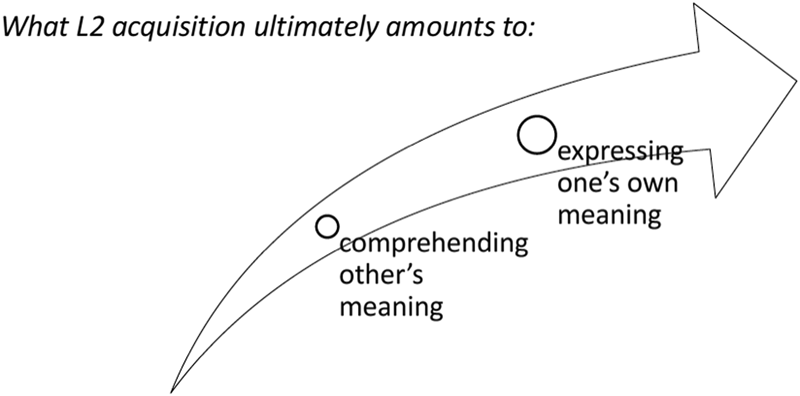
To be sure, language mining, as I intend it, means extracting language constructions from input for meaning expression. In the coupled system of reading and writing, this involves extracting expressions from reading for use in writing or using elements that are comprehended in writing. L2 acquisition, in essence, amounts to comprehending other's meaning and expressing one's own, as shown in Figure 3.
Essence of L2 acquisition

Scientific rationale for coupling reading and writing
Real world communication is rife with the coupling of reading and writing activities – from copying to responding to email to writing a book review – where reading and writing naturally integrate and are interdependent. Scientific research on reading and writing has indeed uncovered connections between the two.
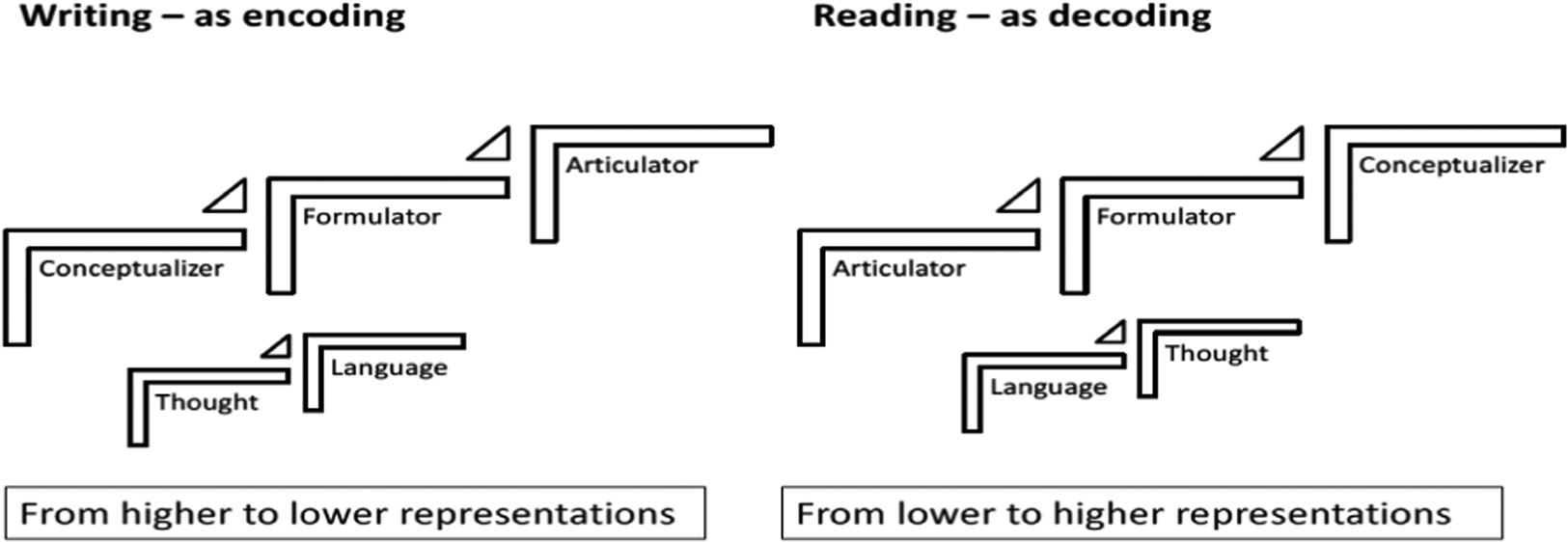
For starters, Levelt's (Reference Levelt1989) speech production model offers a glimpse of a likely linkage between reading and writing. The model posits three levels of cognitive processes in speech production: Conceptualizer – where a communicative message is generated; Formulator – where linguistic devices are assembled for conveying the message; and Articulator – where the communicative message is overtly expressed. The three levels characterize the language production process – applicable to speaking and writing. Language comprehension, as in listening and reading, arguably follows the inverse direction of the three levels of cognitive processes. It thus begins with processing the language first to ultimately derive the communicative message (cf. Gambi & Pickering, Reference Gambi, Pickering, Fernandez and Cairns2018). Simply put, writing is a process of encoding, going from thought to language or from higher to lower representations, while reading is a process of decoding, going from language to thought or from lower to higher representations, as illustrated in Figure 4.
The mirror image of reading and writing

In psycholinguistic research, there is general consensus that production and comprehension are linked, though the nature of the link is open to diverse opinions (see, e.g., Levelt, Reference Levelt1983, Reference Levelt1989; Dell & Chang, Reference Dell and Chang2014; Pickering & Garrod, Reference Pickering and Garrod2014; Gambi & Pickering, Reference Gambi, Pickering, Fernandez and Cairns2018). Gambi and Pickering (Reference Gambi, Pickering, Fernandez and Cairns2018) provided a useful review of theoretical models that posit explicit links between comprehension and production. Most of these models are motivated by the questions of how linguistic representations are acquired and develop over time and how linguistic input shapes the output of the language system. The underpinning premise is that while not isomorphic, comprehension and production feature some degree of sharing. Supported both by behavioral and neural evidence (see, e.g., Pickering & Garrod, Reference Pickering and Garrod2014), most theorists agree that representational parity exists at the semantic and lexico-syntactic levels across reading and writing. According to the integrated framework proposed by Pickering and Garrod (Reference Pickering and Garrod2014), production and comprehension are linked such that, (a) due to shared representations, ‘the collection of cognitive mechanisms underlying prediction during language comprehension coincides with the language production system,’ (b) that ‘grammatical encoding (production) and grammatical decoding (comprehension) are performed by the same processing architecture’ (p. 168), and (c) that ‘the ability to predict during language comprehension is correlated with language production abilities at least in some task contexts’ (p. 169). If we take these insights seriously, we have a rational basis for advocating the linking of reading (input) and writing (output) and for promoting language mining in L2 instruction.
Psychologists, as noted earlier, have long been intrigued by various language mining or language synchrony behaviors mediating reading and writing. Ireland and Pennebaker (Reference Ireland and Pennebaker2010) reported on three projects tracing ‘style matching’ in different discourse contexts. One project was experimental in nature, involving two samples totaling 1,774 college students responding to four essay questions written in very different styles. Students were found to automatically match the language style of the essay questions. In a second project, 74 participants completed different excerpts from popular fiction. Participants, in their writing, exhibited excerpt-response similarity in content – using similar nouns and verbs, and so on. The third project tracked the professional writing and personal correspondence of three pairs of famous writers across their relationships – Sigmund Freud and Carl Jung, Elizabeth Barrett and Robert Browning, and Sylvia Plath and Ted Hughes. Style matching was found to fluctuate, covarying with interpersonal harmony. In sum, all three projects documented language mining or verbal synchrony, despite contextual variation. Importantly, the verbal synchrony was found to happen unconsciously – a phenomenon traceable to many factors, including a common cognitive architecture shared by reading and writing. For our purposes, these types of evidence intimate that input can shape output, and vice versa.
In L2 research, there is emerging interest in linguistic synchrony between reading and writing. Extant research, sparse as yet, has provided significant insights that ‘at a developmental level, reading influences writing through writers mimicking in their writing the models gleaned from reading – or through the increasing complexity of reading content informing the sophistication of how readers write’ (Douglas & Miller, Reference Douglas and Miller2016, p. 2), suggesting, inter alia, that language mining of sort is occurring, leading to a synchrony between reading and writing.
The Douglas and Miller (Reference Douglas and Miller2016) study represented the first endeavor to understand the long-term impacts of adults’ regular reading materials on their writing, hypothesizing a correlation between the content of reading and the lexical and syntactic complexity of writing. The study solicited a cohort of graduate students, aged 23–42, to identify their most frequently-read sources, including online content, newspapers, news magazines, genre and literary fiction, and general non-fiction. The study found strong correlations between lexical and syntactic complexity of student reading materials and students’ writing. For instance, the complexity of their most commonly read sources exerted the strongest influence on the participants’ writing; in contrast, those who read web-only content scored lowest on LexileFootnote 3 and syntactic measures of complexity. In a nutshell, there was reportedly a substantial evidence of ‘linguistic synchrony,’ implicating language mining.
With a much narrower focus and a different intent than that of the Douglas and Miller study, Han (Reference Han2018) examined the L2 English writing samples of three teacher trainees, following their reading of chapters from ‘Doing Task-based Language Teaching’ (Willis & Willis, Reference Willis and Willis2007). While the study was purported not as much to identify linguistic synchrony as to document the teacher trainees’ content and language learning in a task-based teacher education environment, there was clear evidence of language mining occurring, and, importantly, of a ‘developmental trajectory.’ Language mining was seen not happening at the beginning of a ten-week journey of keeping a weekly reading journal nor as a static phenomenon; rather, it began to happen around the second week, continued on for about six weeks – it varied somewhat among the three teacher trainees – and was thereafter on the wane. In this case, the developmental trajectory featured an initially greater dependence on the reading and a lesser dependence later on, signaling a shift away from writing about others’ (i.e., Willis and Willis’) ideas or decoding others’ meaning to writing about one's own or encoding own meaning. An example, given in Figure 5, of one of the participants’ writing at two different times serves to illustrate the transition.
Min's reading journal entries on chapters 4 and 5 of Willis and Willis (Reference Willis and Willis2007)

As seen in the excerpts, four weeks into the longitudinal reading and writing task, Min's writing began to show increasing shift from expressing others’ meaning to her own. While her entry on chapter 4 was still heavily descriptive, hewing closely to what the chapter presented, she did not stop there; instead, she wrote about how she might apply some of the tasks to her own tutee. The proportion of decoding and encoding grew more skewed over time, as seen in her entry on chapter 5. Here, starting out by recalling something she had learned in another class – the difference between foreign and second language learning along with the conditions that typically accompany these two contexts of learning, Min began to wonder whether the conditions for foreign language learning could actually be improved. She then related this idea to the content of the chapter, extrapolating from the project idea therein introduced, and offering her reasoning for why that could help improve the learning conditions for foreign language learners and why it would be feasible for her own students. The transition, as it were, from greater to lesser mining of the reading material, was thus witnessed.
Language mining in L2 reading and writing was evident in yet another light. In their study of written corrective feedback strategies, Hanaoka and Izumi (Reference Hanaoka and Izumi2012) compared the effects of reformulation – native speakers reformulating learners’ writing – and of model text – giving learners a model text to compare their own writing against. As it turned out, the model text strategy was more effective than reformulation. According to Hanaoka and Izumi, ‘the two types of feedback texts were found to play somewhat different roles, as the model text included solutions to overt and covert problems roughly equally, while reformulations offered solutions overwhelmingly to overt problems’ (p. 332). This is a crucial insight from the study. From a language mining perspective, what the model text afforded, which was absent in the reformulation, was an opportunity for the learner to explore, extract, and utilize information – what defines language mining – in the reading text to help plug gaps in their own earlier attempts at writing. Importantly, some of these gaps would otherwise never have been addressed by conventional written corrective feedback strategies such as reformulation, since they ‘overwhelmingly’ treat ‘overt problems.’
More recent studies comparing the effects of written corrective feedback and model text yielded interesting, nuanced findings. For example, Coyle and de Larios (Reference Coyle and de Larios2014), focusing on young (11- and 12-year-old) EFL learners, and Kang (Reference Kang2020), focusing on adolescent (Grade 11) EFL learners, converged on the finding that use of model texts enabled greater content and lexical learning, while error correction led to improved morphosyntactic noticing and accuracy.
Given the emerging insights from L2 research, namely (a) that language mining does happen as well in L2 learners’ reading and writing, (b) that it can be an epiphenomenon of development, and (c) that it can be engineered with options, I now offer some thoughts on how language mining can be cultivated, and what can be expected, in an L2 coupled system of reading and writing.
Promoting Language Mining through coupling reading and writing
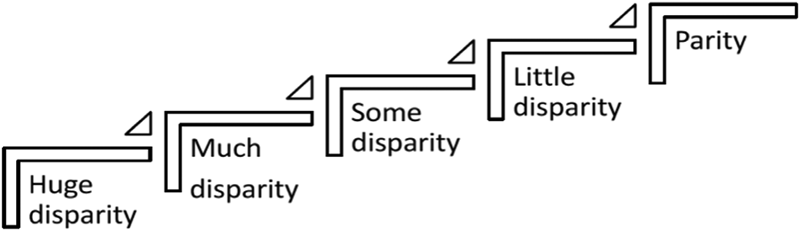
Overall, my assumption is that, given the right task conditions for reading and writing, language mining can be expected to occur, but it takes time to unfold. Initially, for a given learner, true specially of learners at lower levels of proficiency, a yawning disparity is to be expected between what he can read and what he can write. But with increasing proficiency and ability to mine language from reading in writing, that gap is expected to narrow, exhibited as growing parity between his reading and writing, as illustrated in Figure 6.
Reading and writing disparity narrowing over time with increasing language mining ability

This assumption finds support in L2 studies of input processing by ab initio L2 learners (see, e.g., Klein & Perdue, Reference Klein and Perdue1997; Park, Reference Park2011; Han & Rast, Reference Han and Rast2014; Dimroth, Reference Dimroth2018). A relevant, generic finding out of that body of research is that beginning L2 learners are not able to cash in, right away, on the input available to them. Instead, they rely on their own preexisting resources – general semantic and pragmatic principles – to mediate their engagement with the input until they have gained some footing in the L2. As a result, they develop simple and transparent form-to-meaning mappings or what Klein and Perdue (Reference Klein and Perdue1997) referred to as the ‘Basic Variety.’ As it were, they putatively utilize their ‘construction faculty’ before they can use their ‘copying faculty.’ As Dimroth (Reference Dimroth2018) recently summed it up, ‘[b]eginning learners’ grammars are largely independent of the target language’ (p. 865).
But that is the natural course of development, a path that can nevertheless be disrupted by instructional intervention. Instruction coupling reading and writing and promoting language mining may potentially accelerate the otherwise ‘delayed’ capability to learn from input, putting the learner well on the way to harness input toward developing a robust and organic functional competence.
To envision and enliven that potential, it is crucial that reading and writing be seen in a more nuanced light.
To start, L2 research has shown that neither reading comprehension nor writing production is a monolithic process or product. Rather, they implicate different levels of information processing. Citing Cucchiarini and Jaspaert (Reference Cucchiarini and Jaspaert1995), Avermaet and Gysen (Reference Avermaet, Gysen, Van den Branden, Bygate and Norris2009) noted four hierarchical levels: copying, describing, restructuring, and evaluating:
a. At the copying level, the learner simply has to reproduce information without processing it for comprehension.
b. At the descriptive level, the learner has to process the information in the same structure as it is presented.
c. At the restructuring level, the learner has to rearrange and restructure the information provided.
d. At the evaluation level, the learner has to reflect on the language by comparing the information provided in the text with information provided in another text or source.
(p. 158)
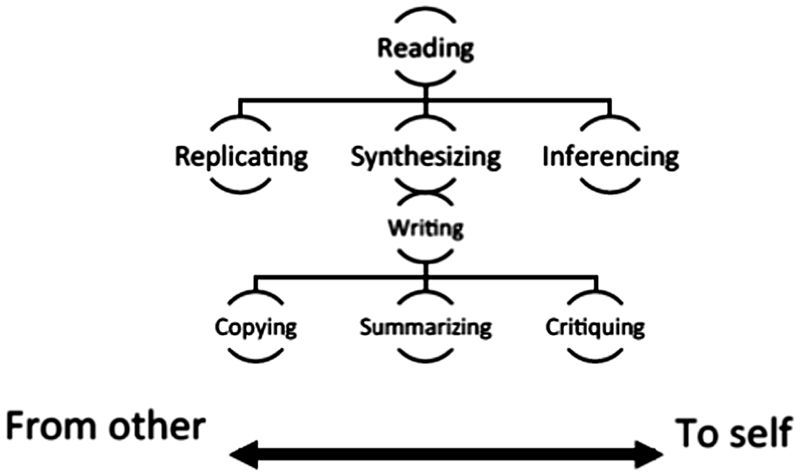
Taken together, the four levels of information processing forge a knowledge transformation process (Skehan, Reference Skehan1998) whereby L2 learners operate to varying extents on the information processed or retrieved. For reading comprehension, this process may translate into three levels, as investigated in Yano, Long, and Ross (Reference Yano, Long and Ross1994), namely, replicating, synthesizing, and inferencing. For writing, it would not be hard at all to conceive of three corresponding levels: copying, summarizing, and critiquing. Figure 7 aligns the two sets of processes, illustrating a common continuum that spans between processing others’ meaning and processing one's own.
Coupling reading and writing and facilitating the transition from comprehending and expressing other's meaning to one's own

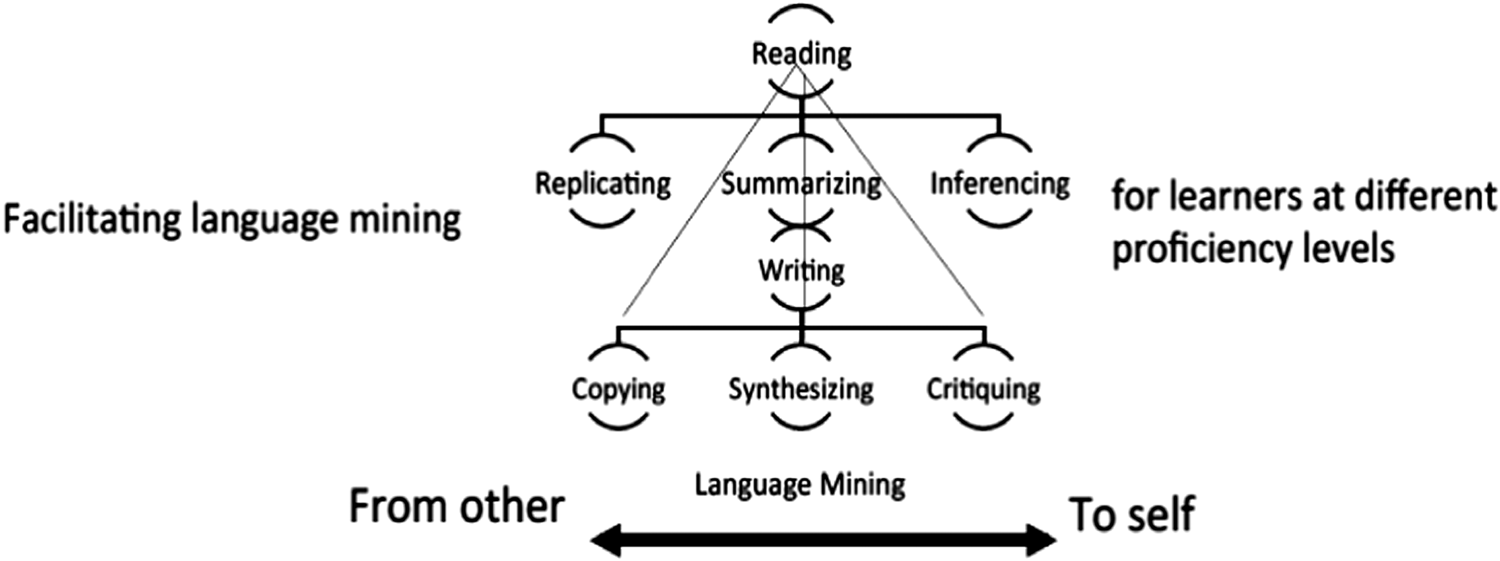
Implicated in Figure 7 is also the potential of a coupled reading and writing system to cater to learners at a variety of proficiency levels, as amplified in Figure 8.
Facilitating language mining for learners at different proficiency levels

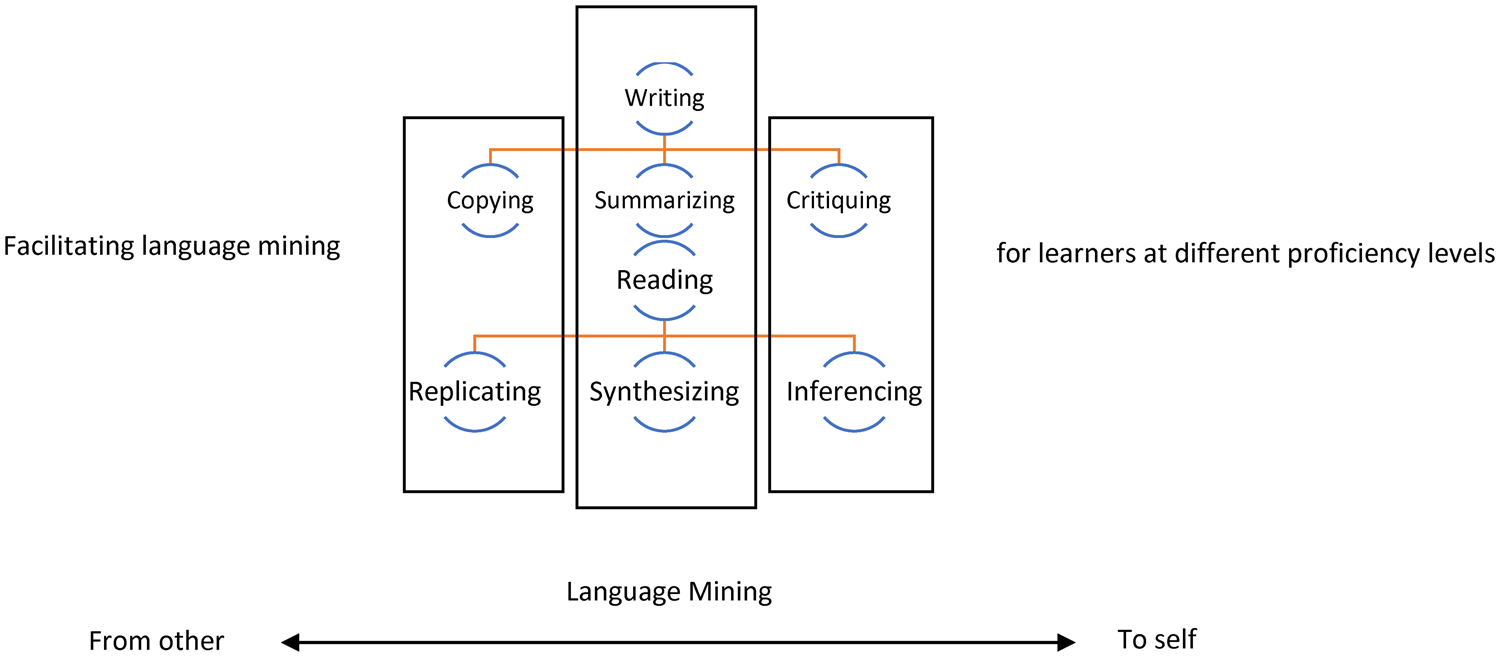
As illustrated in Figure 8, the two sets of processes of reading and writing allow an array of permutations of coupling, which can foster different levels of language mining for learners at different proficiency levels. As shown, reading, for instance, can be held ‘constant,’ by having learners read the same text, but the writing task can vary from copying to summarizing to critiquing. Figure 9 further envisions flexible permutations.
Alternative scenarios of language mining in a coupled reading and writing system

Figure 9 schematizes alternative scenarios of coupling reading and writing to facilitate language mining for learners at different proficiency levels. Broadly, it would make sense to keep both the reading task and the writing task simple for beginning learners by, for instance, allowing them to read aloud expressions in the reading text and then copying them on a piece of paper. But for advanced learners, it would make sense to challenge their reading comprehension by having them read between the lines and draw inferences, and then write a critique of what they have read. In this developmental process, the role of language mining is expected to change, from a greater to a lesser dependence on the reading and, correspondingly, from a lesser to a greater dependence on one's own L2 knowledge, as seen in Han (Reference Han2018). This process, usage-based throughout, is what I believe would be an effective pathway to a natural, organic development of L2 functional competence.
Further along the lines of flexible coupling, the sequence of reading and writing can vary as well.
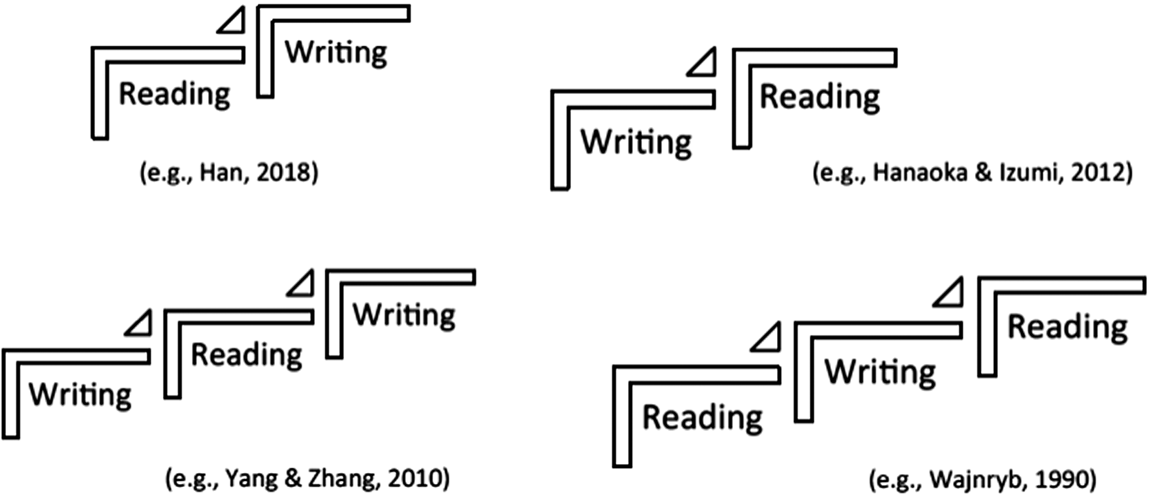
Varying the temporal sequence of coupling reading and writing

Figure 10 offers four different temporal sequences of reading and writing, which provide more pedagogical levers for instructors seeking to accommodate learners at different levels. Besides the prototypical sequence of read-first and then-write, as illustrated in Han (Reference Han2018), the learning sequence can also begin with writing, resulting in two other sequential variants: write-first and then-read, as demonstrated in Hanaoka and Izumi (Reference Hanaoka and Izumi2012), or write-first followed first by reading and then by writing, as in Yang and Zhang (Reference Yang and Zhang2010). Still another possible sequence would be read-first and then-write followed again by reading, similar to a dictogloss task (Wajnryb, Reference Wajnryb1990), a sequence adopted with much success in the Berent, Kelly, Aldersley, and Schmitz (Reference Berent, Kelly, Aldersley and Schmitz2007) interventional study with hearing-impaired learners.
Ultimately, when reading and writing form a continuous loop, it is almost certain to not only benefit L2 acquisition of a functional competence but also L2 literacy skills development (see, e.g., Swales, Reference Swales1990; Byrnes, Reference Byrnes and Sanz2005; Rose & Martin, Reference Rose and Martin2012; Donato, Reference Donato and Cammarata2016; Troyan, Reference Troyan2016), as intimated in Figure 11.
The acquisition-literacy loop

Figure 11 shows that the continuous and iterative loop of coupling reading and writing begins with reading leading to language mining in writing. It then contributes to language acquisition, and, in turn, the ability to predict while reading, and ultimately to reading and writing fluency.
Fundamentally, the language mining process promoted therein would engender deeper processing of the L2 input and facilitate transfer appropriate processing. According to Lightbown (Reference Lightbown and Han2008, p. 30), ‘we remember language better when we process it ‘deeply’ – with frequent exposure, attention to meaning, opportunities for generation and elaboration – than we process it ‘shallowly’ – that is, with attention primarily on the surface form and without the opportunity or the need to generate meaningful utterances that contain the material being learned.’ Lightbown went on: ‘the most effective preparation for understanding and producing language in communicative environments will occur in contexts where learners gain experience in understanding and producing language in communicative environments.’ In a nutshell, the notion of transfer appropriate processing stipulates that learning is facilitated when the conditions for decoding and encoding are similar.
Coda
In this paper I have advocated and outlined a systems approach to foreign language instruction, one that is at once functionally oriented, holistic, and usage-based. Such an approach entails the coupling of reading and writing into a system for the purpose of cultivating language mining – both as a behavior and as an ability. Mining language or being able to mine language from input comes with crucial affordances for the learner to process and internalize form-mining connections. As such, the language mining approach can both serve as a developmental crutch for the L2 learner and be used as a pedagogical scaffolding strategy by the instructor (see, e.g., Troyan, Reference Troyan2016).
Overall, the language mining approach promotes incidental learning (for discussion of incidental learning, see, e.g., Leow, Reference Leow, Loewen and Sato2011; Long, Reference Long2017), where engagement with content is primary and attention to language epiphenomenal. It aims to create an organic and effective pathway for (older) learners to developing a functional, and likely sophisticated, competence in the L2.
This approach would be particularly fitting for any instructional environment that prizes meaning over surface language form, such as Task-based Language Teaching, English for Specific Purposes, English for Academic Purposes, Genre-based Pedagogy, and Content-based Instruction, where the coupling of reading and writing would seem natural, logical, and even communicatively necessary.
Needless to say, the implementation of the language mining approach demands thoughtful planning and design at curriculum, syllabus, and classroom levels. The approach, inter alia, encourages the use of authentic reading materials so that the quality of modeling is good and its impact on writing positive. The key, nonetheless, would be to systematically develop and sequence pedagogic tasks that naturally tie reading and writing together, with affordances made available for language mining to occur as the learner traverses from reading to writing.
The language mining approach outlined here stands in contrast with traditional teaching where isolation, or decoupling, of reading and writing is the norm (see discussion in Troyan, Reference Troyan2016), as are its forcing of early production and excessive attention to discrete language forms. Likewise, the language mining approach sets itself apart from pedagogical approaches that seek to promote explicit learning and knowledge at the expense of, or to the exclusion of, implicit learning and knowledge (see, e.g., Kupferberg & Olshtain, Reference Kupferberg and Olshtain1996; de Graaff, Reference de Graaff1997; R. Ellis, Reference Ellis, Spolsky and Hult2008; Leow, Reference Leow2015; Cox, Reference Cox2017). Further, the language mining approach, by virtue of its reliance on the systematic coupling of reading and writing, fends off concerns over task-based language teaching – chief among them that it provides insufficient target language input for L2 learners (see, e.g., Bruton, Reference Bruton2002; see, however, Long, Reference Long2016). Above all, the language mining approach places the power of learning – a meaning-form mapping process – into the hands of the learner.
Admittedly, what I have delineated about the language mining approach is, in the main, conceptual and conjectural. The detail of the pedagogical approach remains to be fleshed out. And, just as important if not more, large amounts of empirical research are warranted to examine the language mining process as it mediates the coupled system of reading and writing in L2 learners. Of the many questions that can be asked and investigated the following are merely a sample:
1. In the language mining approach, is the influence of reading on writing content-based or language-based?
2. What do learners mine – language, content, or both?
3. Why do learners mine the language the way they do? What does it say about their language ability?
4. Does reading merely give learners content and models for how to write, or does facility in reading reflect some larger verbal sophistication that also impacts writing?
5. How does language mining behavior change over time?
6. What are the cognitive, psycholinguistic, psychological, and sociolinguistic correlates of language mining?
Addressing questions such as these would lead to a tangible understanding of the purported validity of the language mining approach.
Acknowledgments
I am thankful to the editor, Dr. Graeme Porte, and the anonymous reviewers for their constructive reading of an earlier version of this paper. Any errors that remain are my sole responsibility.
ZhaoHong Han is Professor of Applied Linguistics at Teachers College, Columbia University, where she also serves as Chair of the Department of Arts and Humanities and as Director of the Center for International Foreign Language Teacher Education. With an intense interest in learnability and teachability and an acute awareness of the importance of longitudinal research, she has pursued inquiries into a host of issues, including fossilization, cross-linguistic influence, input processing, explicit and implicit knowledge, corrective feedback, input enhancement, repeated reading and vocabulary development, and task-based learning, with learners from various L1 backgrounds – Thai, Korean, Chinese, English – learning languages such as English, Norwegian, Korean, and Chinese, using quantitative and qualitative methodology. At Teachers College, Dr Han has sponsored dissertations on a variety of topics – focus on form in task-based language teaching, learner-generated noticing of L2 input, cross-linguistic influence and ‘universal’ developmental patterns in child SLA, the role of input frequency and distribution, effects of task complexity on written production, the effects of narrow reading on L2 text comprehension and vocabulary acquisition, to name but a few. She was the recipient of the 2003 TESOL International Heinle & Heinle Distinguished Research Award and a repeated recipient of the Teachers College Outstanding Teaching Award.