Introduction
Seclusion is the involuntary confinement of a patient alone in a room or area from which the patient is physically prevented from leaving.Reference Knox and Holloman 1 , 2 It has utility in clinical risk management of patients who pose a high risk of aggression and violence in order to prevent assaults against patients and staff.Reference Khadivi, Patel, Atkinson and Levine 3 This is particularly relevant in forensic psychiatry settings, where the majority of patients have a history of violence; one of the potential consequences of reduced use of seclusion may be an increase in assaults on either clinical staff or patients.Reference Khadivi, Patel, Atkinson and Levine 3 Qualitative research suggests that most nurses support the use of seclusion for the management of violence and aggression.Reference Happell and Harrow 4 While staff may find using seclusion and physical interventions traumatic, they also believe these interventions serve a necessary function.Reference Nelstrop, Chandler‐Oatts and Bingley 5
However, others view seclusion as a form of social control over people already experiencing exclusion from the community, and as frequently harmful and traumatic to patients.Reference Morrall and Muir-Cochrane 6 Patient perspectives include anger with a sense of injustice, and feelings of being rendered powerless and of being degraded.Reference Nelstrop, Chandler‐Oatts and Bingley 5 Other studies have suggested longer term effects such as anxiety and trauma.Reference Frueh, Knapp and Cusack 7 , Reference Bonner, Lowe, Rawcliffe and Wellman 8 Seclusion may also be detrimental to the therapeutic relationship and can result in physical injury to staff. In contrast, effectively implemented seclusion reduction initiatives can lead to decreased rates of staff injury.Reference Frueh, Knapp and Cusack 7 Furthermore, seclusion can be resource intensive, as the secluded patient usually requires a high level of observation.Reference Martin, Krieg, Esposito, Stubbe and Cardona 9 Strategies to reduce seclusion have been identified as a potential method to improve cost-effectiveness of psychiatric services,Reference Boumans, Egger, Souren and Hutschemaekers 10 while implementation of seclusion reduction strategies does not necessarily require additional expenditure.Reference Qurashi, Johnson and Johnson 11
Attempts to reduce seclusion in psychiatric settings date as far back as 1793, when Philippe Pinel advocated liberation from shackles of inmates at Bicêtre and Salpétrière hospitals in France.Reference Strumpf and Tomes 12 Subsequently, the “no-restraint” movement initiated by Connolly and Hill in England in the second half of the 19th century modernized practice in relation to seclusion and restraint.Reference Steinert, Lepping and Bernhardsgrütter 13 Since then, however, the rate of progress has been limited. Why is this so? Systemic and organizational factors certainly play a role. Seclusion practice varies widely between different countriesReference Steinert, Lepping and Bernhardsgrütter 13 and between US states, which may be related to various factors, including the type of system, the geographic location, the philosophy and expectations of the staff and administrators, and even the local traditions.Reference Steel 14
Another critical factor, however, is that developing alternative evidence-based strategies to seclusion is difficult. A longstanding problem has been the lack of controlled data concerning the effectiveness of specific behavioral approaches on subsequent reduction of seclusion. A 2006 systematic review concluded that nonpharmacological practices for the containment of the behaviors of people who are disturbed or violent (excluding restraint and seclusion) were difficult to justify because their use was not supported by evidence from randomized controlled trials (RCTs).Reference Muralidharan and Fenton 15 Many authors have noted that due to their complexity, interventions to reduce seclusion do not lend themselves to evaluation using RCTs (although they are possible,Reference Putkonen, Kuivalainen and Louheranta 16 and a comprehensive cohort study has been identified as a practicable alternativeReference Bergk, Einsiedler and Steinert 17 ).
On the other hand, comprehensive literature reviews have demonstrated considerable non-RCT evidence supporting the use of interventions to reduce the use of seclusion in psychiatric facilities.Reference Gaskin, Elsom and Happell 18 , Reference Stewart, Van der Merwe, Bowers, Simpson and Jones 19 The strategies used were often multifaceted and included state-level interventions, staff integration, increased staff-to-patient ratios, psychiatric emergency response teams, case review procedures, and crisis management initiatives. There have been some promising results in reducing seclusion on a larger scale. An evaluation in a US public psychiatric hospitalReference Donat 20 suggested that identifying critical cases and initiating a clinical and administrative case review were associated with reduction in seclusion. Staff education and treating patients as active participants in statewide seclusion reduction interventions have also been identified as having potential.Reference Smith, Davis and Bixler 21 In the UK, a more recent 5-year evaluation of seclusion practice in a high secure UK hospital revealed reduced rates of seclusion without an increase in adverse incidents.Reference Qurashi, Johnson and Johnson 11 The strategies used in this case included effective use of audit and peer reviews; positive risk management; patient involvement; use of information and transparency; and education and training.
Based on this evidence, we propose that a pragmatic, innovative approach is required to reduce seclusion, particularly in secure settings. This should involve professionals from a range of disciplines and should also have a robust administrative component. In 2015, we implemented such an approach on an acute ward in a high secure hospital in the UK. Here, we outline the current procedures of seclusion on this ward. We discuss how our strategy was introduced, how promising outcomes helped influence hospital-wide implementation, and suggest ways in which our strategies may have implications for other psychiatric settings.
Seclusion and Long-Term Segregation in High Secure Hospitals
Broadmoor Hospital is one of 4 high security hospitals in the UK, catering for a population of 64 million. High security hospitals treat patients who have committed serious offenses and have severe psychiatric conditions, and who therefore pose the highest level of risk to others.Reference Qurashi, Johnson and Johnson 11 The most common diagnosis is schizophrenia, followed by personality disorder. Patients are detained under the UK Mental Health Act 1983 (as amended 2007) and are transferred from less secure hospital units, prisons, or having received a hospital treatment order at sentencing from court. The hospital has wards that are distinguished by the level of “dependency” or risk that the patient poses. This ranges from intensive care or “high dependency” wards, which accommodate patients with complex needs and higher risk of violence to self or others, to rehabilitation wards, from which patients are discharged when much more stable. Patients are discharged primarily to less secure hospitals or repatriated to prison once their treatment is complete.
A number of patients are not responsive to acute interventions to manage their violence and aggression. They present a persistent risk to others over a lengthy period and do not respond to short periods of seclusion. Such patients are typically managed on 1 of 3 high dependency wards, which are equipped with separate seclusion rooms and staffed with sufficient numbers to manage several patients requiring high-intensity nursing. Nurses often use “holds,” which are a form of restraint procedure involving 2 nurses holding the wrists of the patient in the communal area in association time. Holds are used when the patient is thought to be at the highest level of risk, for example, when having recently committed an assault.
At Broadmoor Hospital, patients who are secluded are reviewed regularly by nursing and junior medical staff and on a daily basis by a senior doctor. Any patient who has been secluded continuously for 7 days will have an independent seclusion review to evaluate the continued need for seclusion, offer advice to the patient’s team, and to seek the patient’s view. Following consideration of this independent review, the clinical team may place the patient on “long-term segregation” (LTS) on day 8 if, in their opinion, the patient requires longer-term management of their behavior. Episodes of LTS last from days to several months. Often patients are subject to long-term segregation in 1 room on the ward. Their time “in association” (in the communal areas on the ward) may be limited to less than 1 hour per day. While having a role in risk management, this can be restrictive to the patient’s progress through the high secure treatment pathway, which should include an occupational and psychotherapeutic component. Accordingly, reduction of LTS was recently identified as a key quality improvement target across our healthcare Trust, in line with UK Commissioning for Quality and Innovation (C-QUIN) standards. 22
Introduction of a Novel Seclusion Reduction Strategy
A pilot program for the reduction of LTS was introduced on a high dependency ward (Ascot Ward) at Broadmoor Hospital. The program was devised following a literature review of seclusion reduction strategies, as well as a multidisciplinary team discussion of outcomes from a national meeting on seclusion reduction. The program was formulated by senior clinical staff and presented to all clinical staff on the ward. The program involved 2 core strategies.
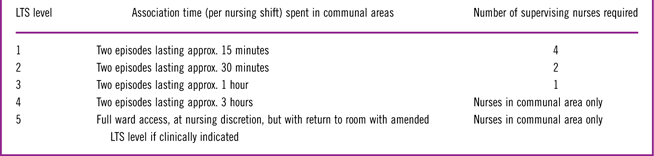
First, a new system was introduced, whereby LTS was stratified according to level of association time and use of precautionary or full “holds.” Each patient’s level of LTS was subject to review and amendment at any time, based on their level of acute risk, engagement with staff, and successful trials of association time. It was the role of nursing staff on the ward to provide an ongoing and dynamic risk assessment of each patient, which we hoped would encourage both a quicker progression from higher levels of LTS and quicker identification of increased risk. This was in addition to our previous practice, where LTS level was reviewed regularly by junior doctors and by a senior doctor on a daily basis. It was hoped that this system would lead to nursing staff feeling more empowered to increase the amount of association time, and to avoidance of prolonged periods of LTS. Details of each “level” of LTS are presented in Table 1.
LTS “level” stratification system

Second, our ward was designated an extra member of staff, with special training in implementing bespoke occupational/vocational programs in high secure settings. This staff member met with each individual on LTS and drew up a timetabled program of activity suited to their needs and preferences. In addition, arrangements were made to ensure that patients subject to LTS could participate in activities that are normally available only to patients not subject to LTS. This was achieved by providing extra staff support and risk assessment for each activity. Such activities included trips to the patient shop and café, the sports center, walks around hospital grounds, and cooking and art sessions. Previously, LTS patients did not have the opportunity to attend these activities, as they were facilitated for groups of patients and deemed to be too risky for those subject to LTS.
As well as dynamic and standard daily reviews, the LTS status of all patients was now to be discussed at each clinical team meeting and at Clinical Improvement Group meetings. Any patient not progressing at a reasonable rate through levels of LTS was to be subject to a further review of treatment strategies. Further, in order to raise awareness among staff and to prioritize increased association time and reduced LTS, regular feedback was given throughout the evaluation period and data were presented at team meetings. Training needs were addressed through educational feedback.
Following collection of data, we compared the total number of hours of association time for each patient in the week prior to introduction of our program and compared this with the equivalent total at 6 weeks and at 12 weeks after the program introduction. We collected qualitative feedback from staff and patients.
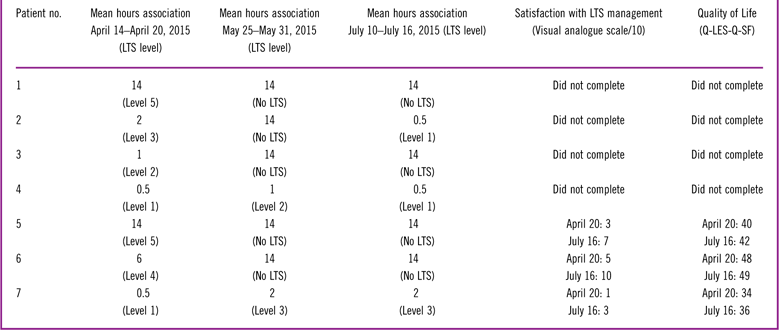
At the commencement of the intervention, there were 11 patients on the ward. Four had full ward access, with 14 hours association time each day (all rooms are locked 10 hours overnight as per standard procedure); 7 were subject to some form of LTS. Mean association time increased at 6 weeks, with a slight decrease from this point at 12 weeks (see Table 2). The increase in association time at 6 weeks was statistically significant compared to baseline (p=.042, paired t-test), while the figure at 12 weeks was also increased compared to baseline, though not significantly (p=.197). Only 3 patients on LTS agreed to participate in feedback about their seclusion management and quality of life. Each patient who participated was more satisfied with LTS management, and slightly with quality of life, at the end of the study period. Statistical analysis was not conducted on qualitative measures due to paucity of these data.
LTS level and association time

In general, feedback from staff was positive. Selected comments included the following:
“Nurses have developed confidence in making decisions about assessing and assigning levels of association to prevent delay by waiting for Clinical Team Meetings.”
“Patients are generally happier; they are more motivated to engage with nursing staff, ward activities, and treatment plans. Meeting patients’ needs is easier when they are not on LTS.”
“Overall, staff and patients feel safer. The stress levels of both the patients and the pressure on the nursing team has reduced.”
“[The system] promotes a culture of positive risk taking—the opportunity to progress is always present.”
Discussion
Reduction in seclusion is a priority for modern psychiatric practice internationally.Reference Gaskin, Elsom and Happell 18 , 22 – Reference Ashcraft and Anthony 25 However, developing effective strategies to reduce seclusion is fraught with practical difficulty and ethical complexity. Comprehensive literature reviewsReference Gaskin, Elsom and Happell 18 , Reference Stewart, Van der Merwe, Bowers, Simpson and Jones 19 and promising outcomes from large scale studiesReference Qurashi, Johnson and Johnson 11 , Reference Smith, Davis and Bixler 21 , 26 suggest that multifaceted, innovative strategies are effective in reduction of seclusion. Randomized controlled trials of seclusion reduction techniques are extremely difficult to implement,Reference Gaskin, Elsom and Happell 18 and evaluation of pragmatic strategies is more likely to have an impact at a clinical level.
In accordance with this view, we report the preliminary findings of a novel pilot program to reduce long-term segregation (LTS) in a high dependency ward of a UK high security hospital. Six weeks after the intervention, the number of patients on LTS had reduced from 7 to 2, and the mean association time for patients had increased significantly. At 12 weeks, there were 4 patients on LTS; mean association time was increased compared to baseline, though not significantly. Thus, there was an overall trend towards reduced LTS and increased association time at 6 weeks, which was maintained after 12 weeks.
While our statistical interpretation of these findings was limited by our small sample size, this is a clinically relevant outcome. Seclusion, short-term or long-term, is highly restrictive to patients and may interfere with provision of other types of care in forensic settings, such as occupational and psychological engagement. From a patient-centered perspective, any strategy that can safely reduce the amount of time in seclusion is to be welcomed. Further, seclusion is also resource-intensive and therefore expensive to services.Reference Martin, Krieg, Esposito, Stubbe and Cardona 9 Hence, reduction may lead to improved cost-effectiveness and improved outcomes for our services. Our pilot intervention had the benefit of demonstrating a novel strategy in a live clinical setting, and we believe it provides a platform for future larger-scale studies in this important area.
We believe the key mechanism that resulted in the trend toward reduced LTS time was a system of stratified “levels” of LTS. Prior to this strategy, LTS status was binary, either in place or not. We concluded that our alternative approach led to LTS being viewed as a more flexible and dynamic process. This was reflected in the progress of patients through levels of LTS, before its termination. Our qualitative data give an insight into how nursing staff found the system beneficial. While some concerns and suggestions for improvement were expressed, most comments were positive and focused on empowerment regarding decision-making and their assessment of a more dynamic process surrounding LTS.
Occupational therapists have been central to the development of novel strategies for reduction in seclusion and have embraced ownership of this difficult challenge. 26 Introduction of an individualized occupational therapy program, provided by an extra member of staff with special training, was another key component of our strategy. The patients on our ward have a range of needs and preferences relating to their occupational engagement. Many focus on “moving on” from LTS and gaining access to ward activities, while others are more focused on longer-term vocational concerns. Hence, our bespoke approach that addressed individual needs was likely to have improved engagement. The increased range of activities, previously only available to patients not subject to LTS, was also likely to have been beneficial. Although we were not able to obtain qualitative feedback from patients on this issue, the proactive and flexible approach adopted was likely to have contributed to patients moving more quickly through the levels of LTS and on to full ward access. Occupational therapy strategies should be considered as a core component of future seclusion reduction interventions where long-term seclusion practices are in place.
Overuse of seclusion may become embedded in practice and hence difficult to change, without effective clinical and administrative leadership.Reference Donat 20 Our pilot was therefore developed on a multidisciplinary basis and discussed and refined at senior clinical-administrative level meetings. Attitudes of staff toward seclusion are an important factor in how seclusion reduction techniques are implemented and delivered. We sought to address these concerns by involving as many staff members as possible in design and application of the pilot strategy. This is reflected by positive staff feedback about involvement in developing the intervention. Staff suggestions for improvement were addressed, and on presentation of final results, the strategy was introduced hospital-wide. Our view that an inclusive and dynamic approach incorporating staff feedback and education, peer review, and transparent sharing of information is supported by service-wide empirical evidence in the last decade.Reference Qurashi, Johnson and Johnson 11 , Reference Smith, Davis and Bixler 21 Such factors are essential to future seclusion reduction practices.
Patient views are also paramount in developing novel management strategies in forensic services. Only 3 patients agreed to participate in before-and-after feedback about their LTS management and quality of life, and we did not attempt to statistically interpret these data. However, all 3 patients reported increased satisfaction with their LTS management. We will continue to attempt to gather as much patient feedback as possible, including qualitative assessment that can be incorporated into management plans.
Our pilot strategy was implemented on a high dependency ward of a high secure hospital. Many of our patients have extensive histories of hospital admissions, assaults on staff and others, and complex and often treatment-resistant illnesses. They often have spent extended periods in seclusion due to concerns about staff safety. Nonetheless, a pragmatic and uncomplicated approach has demonstrated promising outcomes in reducing seclusion. Our preliminary findings therefore have implications for similar settings, where multifaceted strategies could also be feasibly employed. These include general adult psychiatry wards, such as acute general hospital wards and Psychiatric Intensive Care Units (commonly referred to in the UK as PICUs, these units have locked doors, seclusion rooms, and higher staff-to-patient ratios than other general psychiatry wards).Reference Van der Merwe, Bowers, Jones, Muir-Cochrane and Tziggili 27 The majority of our patients have a primary diagnosis of a psychotic illness, which is also most likely to be the primary presentation in these units. Also, nursing staff in these settings will have broadly similar training to nurses on our high dependency ward. Additionally, bespoke occupational therapy as employed in our pilot has also been explored as a novel strategy in learning disability and personality disorder services,Reference Withers, Boulton, Morrison and Jones 28 and may also be applicable to PICU and general wards.
Our pilot study was limited by relatively small numbers of patients and a relatively short follow-up period. We will continue to evaluate the outcomes of our strategy in the longer term, and will adapt the program according to staff and patient feedback as well as quantifiable outcomes. Our evaluation was also limited by its non-randomized design, which did not allow for causal inferences to be drawn about our overall strategy, or about which specific components led to the improvements observed.
Conclusions
While lacking an evidence base at the level of RCTs, innovative, pragmatic strategies are likely to have an impact at a clinical level. A pilot intervention to management of seclusion (LTS) in a high-dependency high secure forensic psychiatry ward showed a trend toward reduction in number of patients on LTS, with an associated increase in association time at 6 weeks, maintained at 12 weeks. A more structured, stratified approach to seclusion, incorporating multidisciplinary feedback, information sharing, and bespoke occupational therapy strategies, may lead to a more effective model of how seclusion is managed and may contribute toward reduction in high secure hospitals and other psychiatric settings. Patient involvement in management strategies is crucial, and continued efforts are required to obtain and incorporate feedback.
Disclosures
The authors do not have anything to disclose.