


Introduction
Revisiting the scene of the traumatic event is often recommended as part of trauma-focused cognitive behavioural therapy (TF-CBT) for post-traumatic stress disorder (PTSD). Prolonged exposure (Foa and Rothbaum, Reference Foa and Rothbaum1998) often includes visits to the trauma site as part of in vivo exposure hierarchies, usually conducted as homework tasks. The stated aim of these visits is to overcome the anxiety associated with reminders of the trauma through a process of habituation (Jaycox and Foa, Reference Jaycox and Foa1996).
Cognitive therapy for PTSD (Ehlers and Clark, Reference Ehlers and Clark2000) also includes returning to the scene of the trauma, usually accompanied by the therapist. As well as exposure to reminders, the site visit is seen as an opportunity to access additional elements of the trauma memory, to conduct behavioural experiments and to gather information relevant to important appraisals of the traumatic event, such as how or why an event occurred, which can facilitate cognitive change and updates to the memory (Ehlers and Clark, Reference Ehlers and Clark2000; Ehlers, Clark, Hackmann, McManus and Fennell, Reference Ehlers, Clark, Hackmann, McManus and Fennell2005). Ehlers and Clark (Reference Ehlers and Clark2000) also recommend discussion about the similarities and differences between the trauma site now and how it appeared at the time of the trauma, in order to promote discrimination between those stimuli that occurred at the time of the trauma and those encountered in the present day.
To date, the only available evidence of the effectiveness of site visits comes from case studies. Tolin and Foa (Reference Tolin and Foa1999) report a case of a police officer who returns to the scene of a road traffic accident accompanied by a psychologist as part of prolonged exposure. Jones and Banks (Reference Jones and Banks2007) report a case study whereby, as part of the successful treatment for PTSD following a car crash, the client visited the site of the trauma with his father and photographed the scene to facilitate later exposure work. The contribution of the site visit to the outcome of treatment is not delineated in either of these studies. Grey, McManus, Hackmann, Clark and Ehlers (Reference Grey, McManus, Hackmann, Clark, Ehlers and Grey2009) describe a site visit as part of a cognitive therapy treatment for PTSD. In this case, the client describes the accident in vivo, thereby accessing further details and updating some of his beliefs. He also tests out a belief that another accident will occur if he returns to the scene of the accident, and the strength of this belief reduces after the visit. In all of these cases the overall treatment proved highly effective, but the specific effects of the site visit are not reported.
These studies together provide limited insight into the usefulness of the site visit, the mechanisms of change, and the service user experience. The present study gathered systematic feedback from participants who had revisited the scene of their trauma as part of TF-CBT. Feedback on the perceived usefulness of the visit was analysed qualitatively, using grounded theory methodology to generate a model of the effects of the site visit. Quantitative data were also gathered in order to assess which of the possible functions of the site visit were endorsed by participants.
Method
Participants
Participants were 25 English-speaking adults receiving a course of TF-CBT for PTSD. Each participant took part in one visit to the site of their trauma during their treatment. Twenty-two visits were conducted in vivo, while three visits were “virtual” using Google Earth and Street view. Twenty-four visits were accompanied by a therapist, with one visit accompanied by a friend of the participant. The site visits were conducted according to a standardized protocol written by clinical psychologists at a specialist NHS outpatient service for PTSD (described in Murray, Merritt and Grey, Reference Murray, Merritt and Grey2015). Participants were asked to complete a feedback questionnaire after the visit to the scene of the trauma, which was returned at their next treatment session.
The decision to revisit the scene of the trauma was made collaboratively with participants, as part of treatment. Not all service users at the participating clinics complete site visits, usually due to client choice, or practical constraints or risks associated with visiting the scene of the trauma. Data on service users who did not conduct site visits during the trial period were not collected.
Data collection
Data were collected over a 2-year period across two adult outpatient services in London: a traumatic stress service, and a specialist centre for anxiety disorders and trauma. The questionnaire completed was specifically designed for this study. It combined quantitative and qualitative items. The qualitative section provided data for the grounded theory analysis, and comprised the following items:
-
1 Please explain what you found helpful or unhelpful about the site visit.
-
2 Do you have any suggestions for what may have made the site visit more helpful?
Participants who took a photograph at the site were also asked:
-
3 If you did find the photo helpful, can you explain what was helpful about it?
The quantitative items comprised 12 statements about the visit, with which participants rated their agreement on a 5-point Likert scale from “strongly disagree” to “strongly agree”. The 12 statements were based on four hypothetical functions of the site visit derived from Ehlers and Clark's (Reference Ehlers and Clark2000) Cognitive Theory of PTSD, namely: 1) then-now discrimination; 2) memory updates; 3) belief change; and 4) behavioural experiments. For example, “During the visit, I noticed differences from the day of the incident”. Three items were designed for each of the four functions; two items were reverse coded to enhance validity.
Analysis
Participants' free-text written responses to the qualitative items were analysed using a grounded theory approach (Glaser and Strauss, Reference Glaser and Strauss1967). The first two authors conducted the analysis together over a series of sessions. Initial analysis took the form of “open coding” (Strauss and Corbin, Reference Strauss and Corbin1990) whereby participants' qualitative responses were broken down into smaller units that the researchers judged to convey specific information about the site visit. The first two authors generated initial categories from these data. These categories were subsequently amended and augmented as further data were added.
As the sample exceeded 20, it was judged “saturation” point had been reached, where no further categories were being generated by additional responses and data collection was stopped. A sample of 59 qualitative items from the data set was then separately categorized by two independent raters, R1 and R2, using the categories generated by the grounded theory coding. Inter-rater reliability statistics were calculated to compare the researchers with R1 [κ = .810, p < .001], researchers with R2 [κ = .860, p < .001] and both independent raters with each other [κ = .762, p < .001]. All Cohen's Kappa statistics showed a level of inter-rater reliability in coding that can be described as substantial (Viera and Garrett, Reference Viera and Garrett2005). A model of the functions of a site visit was then derived from the categories. This enabled the “axial coding” of data (Strauss and Corbin, Reference Strauss and Corbin1990) whereby the researchers drew connections between categories, based on participant responses.
A further method of establishing credibility, member checking (Glaser and Strauss, Reference Glaser and Strauss1967; Strauss and Corbin, Reference Strauss and Corbin1990), whereby the proposed model is checked with some of the participants, was carried out with three participants. The model was slightly adjusted following these discussions.
Quantitative data from the questionnaires were transferred to SPSS for analysis. Descriptive statistics and simple correlation analyses were performed. The number of participants (25) was too low relative to the number of items (12) in the questionnaire to enable factor analysis (see Mundfrom, Shaw and Ke, Reference Mundfrom, Shaw and Ke2005).
Symptom measures were not used to assess the impact of the site visit, but data on the overall outcome of treatment were available for the participants. Most (21/25) achieved significant clinical change during treatment, as defined by Foa, Cashman, Jaycox and Perry (Reference Foa, Cashman, Jaycox and Perry1997). Both clinics used the Posttraumatic Diagnostic Scale (PDS; Foa et al., Reference Foa, Cashman, Jaycox and Perry1997), which has a range of 0–51, as the main outcome measure. At pretreatment, the mean score was 38.74 and at end of treatment 17.13, indicating that the group as a whole responded well to TF-CBT.
Results
Sample
The participants were predominantly male (n = 16; 64%), and ranged in age from 28–65 years (mean = 40.76). The majority of participants were white British (n = 15; 60%), with other ethnicities including Black British (n = 4; 16%), South Asian (n = 3; 12%), Middle-Eastern (n = 1; 4%) and other white background (n = 2; 8%). The index traumas included serious physical assaults (n = 8; 32%), accidents (n = 5; 20%), medical traumas (n = 5; 20%), military trauma (n = 2; 8%), witnessing a murder (n = 2; 8%), domestic abuse (n = 1; 4%), rape (n = 1; 4%) and acts of terrorism (n = 1; 4%). Mean time between the trauma and treatment was 12 years (range 1–26).
Quantitative analysis
The overall perceived helpfulness of the site visit was high; M = 4.40 (SD = .65), on a scale of 1 (extremely unhelpful) to 5 (extremely helpful). Nearly half (n = 12; 48%) of participants rated the site visit as “extremely helpful”, 44% (n = 11) as “helpful”, and 8% (n = 2) as “neither helpful nor unhelpful”. This is broadly in line with participants' qualitative comments that focused on the range of benefits from the site visit. Of 103 items drawn from data corpus, 96 (93.2%) were judged by the researchers as broadly “beneficial”. The remaining 7 (6.8%) formed its own category in the grounded theory model.
On the 12 quantitative items, all were generally positively endorsed (means ranged from 3.2–4.1 / 5; SDs 0.89–1.38). A repeated-measures ANOVA showed no significant differences within participants' ratings across the 12 statements about the site visit, that is, no one feature or item on the questionnaire was endorsed more than any other [F(4.21,42.09) = .993, p > .05].
Mean scores were calculated for the four “clusters” of items from which the 12 statements were derived: 1) then-now discrimination; 2) memory updates; 3) belief change; and 4) behavioural experiments. Three pairwise correlations were performed; between clusters 1, 2 and 3. Cluster 4, behavioural experiments, was excluded from this analysis because too few (n = 12; 48%) participants engaged in a behavioural experiment during the visit. Significant simple correlations were found between means of memory updates and belief change, r = .461 (p = .020, two-tailed), and between then-now discrimination and belief change, r = .430 (p = .032, two-tailed). However, these correlations were no longer significant when a Bonferroni correction was applied to the significance threshold (0.05/3 = 0.017) to account for the number of correlations performed. The correlation between then-now discrimination and memory updates was not significant, r = .127 (p = .544, two-tailed).
Most participants (n = 20; 80%) took a photograph at the site, usually of themselves and often also with the therapist. In general, most described the photograph as helpful, M = 4.28 (SD = .89), on a scale of 1 (extremely unhelpful) to 5 (extremely helpful).
Qualitative analysis
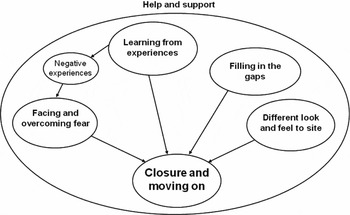
Figure 1 represents a tentative model that emerged from the data. The model describes four main processes that appeared to occur on the site visits, which led to a sense of closure and moving on. The whole process occurred within a context of help and support from another person (in all cases but one, the therapist), which many participants described as integral to the experience.
Proposed model of the process of the site visit

Key processes
Filling the gaps. Six (24%) participants remembered further details on the site visit, helping the memory to feel more complete. Others described the visit as increasing the physical reality of the memory and discovering information that facilitated spatial orientation to the memory. This seems to be a particularly important function for participants whose memories were unclear for some reason. For example, one individual who had very confused memories of a hospital admission commented:
What was helpful for me was finding the bed and positions I was in, in relation to the outside of the building. Getting some kind of orientation has been helpful.
Different look and feel to site. Eight participants (32%) remarked on differences to the site since the time of the trauma and to the trauma memory, both in terms of physical differences at the site and/or as a change of perspective in terms of how they related to the site. In some cases, this seems to have facilitated a sense of moving on. For example:
It was helpful to return after 14 years and find changes in the venue and to see how it has moved on and in doing so it has urged me to do the same.
Learning from experiences. This process encompassed both planned behavioural experiments and spontaneous learning. Sometimes learning occurred through planned activities, such as meeting with a member of staff or carrying out an act of commemoration. One participant, who revisited the memorial to a terrorist attack she had survived, commented:
It showed me that others remember and respect what happened to those people and care. It allowed me the opportunity to say things I wanted to.
Facing and overcoming fear. Six participants (n = 24%) described a sense of achievement about overcoming avoidance by having faced a feared situation. Others commented on a sense of reduced anxiety associated with the site or reminders of the trauma after the visit. For example:
I didn't think that I would be able to go to certain places in London but going there helped me face my fears and realize that it isn't as bad as what I thought it would be.
Negative experiences. Three participants (12%) noted negative experiences related to the site visit. One described anticipatory anxiety: “Before I went there, I had nightmares of how would I feel”. Another noted an increase in PTSD symptoms such as flashbacks after the visit. A third described negative emotional reactions to information learnt on the site visit, as she felt confused about information in her medical records that contradicted her memory of the event.
Help and support. Five participants (20%) commented on the importance of being accompanied on the visit by the therapist or another supportive person, particularly in managing difficult feelings. Overall, it appeared that both the helpful learning experiences, and the negative consequences, were held within this supportive relationship. For example, “having someone with me helped me to focus and manage the difficulties”.
Closure and moving forward. Eight (32%) commented that the result of the visit was a sense of moving on and putting the event in the past, leading to a sense of peace and release. One participant likened the site visit to “closing a big book I had been reading for a long time.”
Another said:
It was the final piece of the puzzle, and delivered so much reassurance, closure and release from the trauma.
Taking a photograph on the site visit
Responses to the question regarding the usefulness of taking a photograph at the site were analysed by the same process described above. Although the original intention had been to create a distinct model of the role of the photograph, the emergent themes bore such a strong similarity to those arising from general comments about the usefulness of the site visit that the photo comments were integrated into the overall model.
In many cases, the role of the photograph was in strengthening and providing a concrete record of the experience of the site visit. Frequently, the photograph seemed to consolidate the experience of the different look and feel to the site, for example:
In the new photos there is no evidence for the past, no big crowd, no police vehicles, fire brigades [sic].
Suggested improvements
The number of suggested improvements was too small to conduct a qualitative analysis. In total, five participants (20%) made suggestions:
-
• One person experienced intense emotion on the visit and suggested:
maybe finding a more private place to retreat to at points so I could release some of the emotion rather than building it up until I got home.
-
• Two comments related to gaining access to the site. One service user who had experienced a road traffic accident, wanted to “visit the actual part of the motorway where the crash occurred” which had not been possible due to safety constraints. For another, the access to the scene was only permitted with a member of staff present. She commented:
I was a bit embarrassed/uncomfortable doing the site tour with [staff member] there. Probably not possible to be allowed to just do it with [therapist] but would have been easier to talk about what I felt if it had just been us.
-
• Another person suggested recording the visit would have been helpful:
Maybe using a video camera to record my whole visit and to be able to replay it back at times.
-
• The last suggested improvement was: “Perhaps going back more than once”.
Discussion
Overall, both the quantitative and qualitative data in this study suggest that the majority of participants found it helpful to return to the scene of the trauma, and take a photograph at the scene, as part of TF-CBT. Only a small minority made any negative comments.
The functions of the site visit appeared to be multiple. Participants quantitatively endorsed all four processes suggested by Ehlers and Clark's (Reference Ehlers and Clark2000) cognitive model of PTSD i.e. 1) then-now discrimination; 2) memory updates; 3) belief change; and 4) behavioural experiments. No significant differences emerged to distinguish any one process as most important in terms of participants' experience. Correlation analysis suggested a possible link between belief change and both then-now discrimination and memory updates, although this relationship disappeared after Bonferroni corrections. Further data would be required to understand whether this is a significant relationship, and the direction of causation. It may be that belief change is an important part of how site visits are effective, a possibility in keeping with the cognitive models of PTSD.
The themes described in the qualitative data have some similarities to the hypothesized processes described above. The theme regarding “different look and feel to the site” described the experience of the site seeming different to the memory, which promoted a sense of moving on. Ehlers and Clark (Reference Ehlers and Clark2000) discuss a similar concept in relation to stimulus discrimination:
When revisiting the site of the event, discussion of similarities and differences between what the scene looked like during the trauma and what it looks like now helps the patient in establishing a time perspective [pp 340].
The process of “filling in the gaps” may suggest that one function of the site visit is elaborating and contextualizing the trauma memory, which according to the Ehlers and Clark (Reference Ehlers and Clark2000) model, would address the fragmentation typical of traumatic memories, and facilitate integration into the autobiographical memory system. It was notable that this function was particularly endorsed by participants who had unclear trauma memories, for example because they had been intoxicated, drugged, or had experienced loss of consciousness during the traumatic incident. In such cases, site visits may be a particularly valuable aspect of therapy.
“Learning from experiences” emerged as a broad category, encompassing planned behavioural experiments, meetings or activities. Other participants described spontaneous learning occurring on the visit, such as the realization that the junction where a crash occurred was clearly a dangerous one, leading to a change in the belief that the individual had been driving dangerously. This category matches two functions of the site visit that emerge from Ehlers and Clark's (Reference Ehlers and Clark2000) model, namely the opportunity to carry out behavioural experiments, and access to previously unretrieved information that can lead to appraisal change. For many participants, the opportunity to carry out certain activities, such as speaking to members of staff at the site, was particularly valuable, and should be included on site visits if appropriate.
A final function of the site visit was described in the category “facing fear and overcoming avoidance”. Despite the anxiety caused by the prospect of revisiting the site of the trauma, many participants felt a sense of achievement at facing it, and noticed that their anxiety decreased as a result. This category matches closely to exposure-based models of PTSD, which suggest that exposure to trauma-related stimuli leads to habituation, and a reduction in fear associated with triggers. The site visit may also function as a behavioural experiment in itself, testing the prediction that returning to the scene of the trauma would be overwhelmingly upsetting, or would result in a further trauma. The disproving of these predictions is likely to have led to a reduction in anxiety.
The importance of help and support while on the visit also emerged. Although therapists may have provided guidance on the site visit in other ways, such as by prompting stimulus discrimination or dropping of safety behaviours, participants primarily commented on the sense of support and being “pushed but not forced” during the visit. Therapist support appeared to have a valuable role in mitigating against negative experiences. It appears that site visits carried out as a treatment session accompanied by the therapist, rather than as a homework task, may have greater potential for facilitated learning, and fewer negative consequences.
Negative experiences were reported in three cases. Each of these participants also commented on positive experiences, and rated the site visit as helpful overall. The negative experiences related to a sense of anticipatory anxiety for one individual, and an increase in symptoms afterwards. Such experiences often occur temporarily in relation to other elements of TF-CBT, such as imaginal reliving (Shearing, Lee and Clohessy, Reference Shearing, Lee and Clohessy2011).
Participants rarely described the benefit of the site visit in terms of any reduction in their PTSD symptoms. Instead, remarks focused consistently on a sense of closure and moving forwards. This may reflect the fact that most of the visits were conducted in the latter stages of treatment, and were often perceived as one of the final tasks in therapy, often demonstrating how far they had progressed. All the processes described above seemed to directly lead to this emotional change. Different processes appeared more relevant to some participants than others. Taking a photograph at the site also seemed a useful task, particularly in consolidating and creating a record of the helpful processes that occurred.
Three of the site visits in this study were virtual or approximated. Numbers were too small to attempt a comparison with “actual” site visits, but as these three visits were rated as “helpful” or “very helpful”, it appears there is a value to attempting virtual site visits when there are practical constraints to accessing the actual location.
Evidence from virtual reality exposure treatment studies supports the suggestion that virtual experiences may be analogous to in vivo site visits. The creation of detailed virtual environments following large-scale traumatic incidents, such as the Iraq War (Rizzo et al., Reference Rizzo, Difede, Rothbaum, Johnston, McLay and Reger2009, Reference Rizzo, Difede, Rothbaum, Reger, Spitalnick and Cukor2010) and the 11 September attacks on the World Trade Centre in the US (Difede et al., Reference Difede, Cukor, Jayasinghe, Patt, Jedel and Giosan2007), have allowed participants to revisit trauma sites virtually as part of an exposure-based treatment programme. Although there is evidence for the efficacy of this technique (Gonçalves, Pedrozo, Coutinho, Figueira and Ventura, Reference Gonçalves, Pedrozo, Coutinho, Figueira and Ventura2012), some potential benefits of the site visit may be difficult to achieve using this format. For example, as the site is recreated as it was at the time of the trauma, rather than as it currently appears, the “then-now” discrimination recommended by Ehlers and Clark cannot be employed. It may also be difficult to recreate the trauma narrative, as the idiosyncratic experience of each trauma survivor would be difficult to model. Furthermore, on a practical level, most clinicians will not have access to the technology required to utilize this methodology in routine clinical practice, and detailed virtual reality environments are unavailable for the majority of trauma sites. However, virtual site visits as carried out in this study were easy and practical to arrange, and in many cases allowed the trauma site to be seen in a recent time.
Limitations
There were several limitations to this study. Numbers were small, and the sample was an uncontrolled convenience sample. Non-English-speakers were not included. This introduces several possible biases. The decision about whether or not to attempt a site visit was made on clinical and practical grounds, so participants were a pre-selected group for whom therapists anticipated that the site visit was likely to be therapeutically beneficial, and who had consented to the session. It is unclear whether the results would generalize to all those in PTSD treatment. A further limitation is the lack of data on symptomatic or functional changes following the site visit. Demonstrating the clinical effectiveness of site visits, rather than service user rated helpfulness, awaits further research.
Implications
Site visits were found to be helpful by most participants, and should be a recommended treatment component. Taking a photo and/or video of the visit is also recommended. A small proportion of participants may experience negative reactions to the visit, but these effects can largely be ameliorated by the support of the therapist.
Future research involving larger numbers may allow the proposed effects of the site visit to be further extrapolated, and to better understand contraindications to conducting such visits. Equally, a factor analysis of quantitative items relating to the proposed functions of the site visit would be useful with a sufficiently large sample. It may also be of interest to compare in vivo to virtual or approximated site visits more systematically.
Acknowledgements
Many thanks to Cathy Green and Alice Kerr for blind ratings. Nick Grey receives salary support from the National Institute for Health Research (NIHR) Mental Health Biomedical Research Centre at South London and Maudsley NHS Foundation Trust and King's College London. The views expressed are those of the authors and not necessarily those of the NHS, the NIHR or the Department of Health.
Conflict of interest: None.



Comments
No Comments have been published for this article.