Executive functions (EFs) are a set of high-level cognitive processes needed for regulating thoughts and actions in goal-directed behavior (Friedman & Miyake, Reference Friedman and Miyake2017). The most commonly discussed EF domains are inhibitory control (IC), working memory updating, and task set-shifting (Friedman & Miyake, Reference Friedman and Miyake2017). According to the unity–diversity model (Miyake et al., Reference Miyake, Friedman, Emerson, Witzki, Howerter and Wager2000), EF domains can be distinguished from one another because of their individual variance, but they also share variance with the common EF component. Factor analytic studies among adults and adolescents have repeatedly suggested that IC shares its variance with the common EF and cannot be distinguished as its own factor, whereas updating and set-shifting functions are more separate processes (Friedman & Miyake, Reference Friedman and Miyake2017). However, research among children is ambiguous. Some studies have found distinguishable EF domains in preschool age (Howard, Okely, & Ellis, Reference Howard, Okely and Ellis2015) and among 7- to 8-year-olds (Huizinga, Dolan, & van der Molen, Reference Huizinga, Dolan and van der Molen2006; Lehto, Juujärvi, Kooistra, & Pulkkinen, Reference Lehto, Juujärvi, Kooistra and Pulkkinen2003), whereas some studies have shown a common EF factor in these age groups (Brydges, Fox, Reid, & Anderson, Reference Brydges, Fox, Reid and Anderson2014; Hughes & Ensor, Reference Hughes and Ensor2008; Visu-Petra, Cheie, Benga, & Miclea, Reference Visu-Petra, Cheie, Benga and Miclea2012; Wiebe et al., Reference Wiebe, Sheffield, Nelson, Clark, Chevalier and Espy2011).
The first signs of IC, the ability to suppress or stop prepotent or initiated responses, emerge very early in development, but the preschool years are the time of its marked development (Garon, Bryson, & Smith, Reference Garon, Bryson and Smith2008). Furthermore, early IC development has been suggested to be of fundamental significance in the development of other more complex EFs later on (Barkley, Reference Barkley1997; Klenberg, Korkman, & Lahti-Nuuttila, Reference Klenberg, Korkman and Lahti-Nuuttila2001). While the status of IC among EFs in childhood remains to be established, tasks measuring IC have had a central role in many studies evaluating the relations between EFs and psychopathology in children and adolescents (Kahle, Utendale, Widaman, & Hastings, Reference Kahle, Utendale, Widaman and Hastings2018; Oosterlaan, Logan, & Sergeant, Reference Oosterlaan, Logan and Sergeant1998; Raaijmakers et al., Reference Raaijmakers, Smidts, Sergeant, Maassen, Posthumus, van Engeland and Matthys2008; Rhoades, Greenberg, & Domitrovich, Reference Rhoades, Greenberg and Domitrovich2009; Schachar et al., Reference Schachar, Crosbie, Barr, Ornstein, Kennedy, Malone and Pathare2005; van Deurzen et al., Reference van Deurzen, Buitelaar, Agnes Brunnekreef, Ormel, Minderaa, Hartman and Slaats-Willemse2012; Vuontela et al., Reference Vuontela, Carlson, Troberg, Fontell, Simola, Saarinen and Aronen2013). In light of the extant literature, we conceptualize IC to reflect the common EF component, although it may also have some specific importance for the development of more complex EF skills (Friedman & Miyake, Reference Friedman and Miyake2017).
The normal development of IC is regarded as essential for the development of self-regulation and for other aspects of mental health (Diamond, Reference Diamond2013; Kochanska, Murray, Jacques, Koenig, & Vandegeest, Reference Kochanska, Murray, Jacques, Koenig and Vandegeest1996; Nigg, Reference Nigg2000). Individual differences in IC skills have been associated with a broad range of psychiatric symptoms in both general and clinical populations in childhood, adolescence, and adulthood (Lipszyc & Schachar, Reference Lipszyc and Schachar2010; Schoemaker, Mulder, Deković, & Matthys, Reference Schoemaker, Mulder, Deković and Matthys2013; White et al., Reference White, Moore, Calkins, Wolf, Satterthwaite, Leibenluft and Gur2017; Wright, Lipszyc, Dupuis, Thayapararajah, & Schachar, Reference Wright, Lipszyc, Dupuis, Thayapararajah and Schachar2014). Meta-analyses of studies examining IC in relation to psychiatric symptoms indicate that IC deficits are neither specific nor sensitive markers of any type of psychopathology but are found across disorders (Lipszyc & Schachar, Reference Lipszyc and Schachar2010; Wright et al., Reference Wright, Lipszyc, Dupuis, Thayapararajah and Schachar2014). However, the understanding of the nature of the relationship and questions of causality between IC and internalizing and externalizing symptoms remains limited.
IC deficits are proposed to be an underlying risk factor for psychopathology. Moreover, longitudinal studies show that IC deficits predict later externalizing (Berlin, Bohlin, & Rydell, Reference Berlin, Bohlin and Rydell2003; Buss, Kiel, Morales, & Robinson, Reference Buss, Kiel, Morales and Robinson2014; Kahle et al., Reference Kahle, Utendale, Widaman and Hastings2018) and internalizing (Kertz, Belden, Tillman, & Luby, Reference Kertz, Belden, Tillman and Luby2016; Riggs, Blair, & Greenberg, Reference Riggs, Blair and Greenberg2003; van Deurzen et al., Reference van Deurzen, Buitelaar, Agnes Brunnekreef, Ormel, Minderaa, Hartman and Slaats-Willemse2012) symptoms and disorders. Deficient IC skills are central to many externalizing disorders, including attention-deficit/hyperactivity disorder (ADHD), oppositional defiant disorder, and conduct disorder (Beauchaine & Hinshaw, Reference Beauchaine and Hinshaw2016). In ADHD, the symptoms (e.g., inattention and hyperactivity) have been proposed to arise from a primary deficit in IC that causes secondary impairments in other abilities, such as working memory and self-regulation (Barkley, Reference Barkley1997). However, while group differences in IC between ADHD patients and healthy controls are certainly found, not all ADHD patients have IC deficits (Willcutt, Sonuga-Barke, Nigg, & Sergeant, Reference Willcutt, Sonuga-Barke, Nigg, Sergeant, Banaschewski and Rohde2008). Some studies suggest relatively low cross-sectional associations between cognitive measures of IC and externalizing problems (Barkley, Edwards, Laneri, Fletcher, & Metevia, Reference Barkley, Edwards, Laneri, Fletcher and Metevia2001; Hinshaw, Carte, Sami, Treuting, & Zupan, Reference Hinshaw, Carte, Sami, Treuting and Zupan2002; Manassis, Tannock, & Barbosa, Reference Manassis, Tannock and Barbosa2000). Therefore, while IC deficits may heighten the risk of externalizing symptoms, IC and externalizing symptoms clearly represent distinct but interrelated cognitive and behavioral domains.
Regarding internalizing disorders, such as depression and anxiety, IC deficits have been suggested to increase their risk by enhancing negative biases in attention and memory and by making it more difficult to control negative thoughts (Disner, Beevers, Haigh, & Beck, Reference Disner, Beevers, Haigh and Beck2011; Kertz et al., Reference Kertz, Belden, Tillman and Luby2016; Nolen-Hoeksema, Reference Nolen-Hoeksema2000). The link between IC deficits and depression has also been proposed to reflect a more comprehensive impairment of the dopaminergic prefrontocortical-striatal pathways (van Deurzen et al., Reference van Deurzen, Buitelaar, Agnes Brunnekreef, Ormel, Minderaa, Hartman and Slaats-Willemse2012). Impairment in these pathways is also associated with blunted reward sensitivity, which has been suggested to contribute to the depression risk (Luking, Pagliaccio, Luby, & Barch, Reference Luking, Pagliaccio, Luby and Barch2016; van Deurzen et al., Reference van Deurzen, Buitelaar, Agnes Brunnekreef, Ormel, Minderaa, Hartman and Slaats-Willemse2012). In addition, IC deficits have been associated with poor social competence (Rhoades et al., Reference Rhoades, Greenberg and Domitrovich2009), which, in turn, poses a risk for later internalizing symptoms (Bornstein, Hahn, & Haynes, Reference Bornstein, Hahn and Haynes2010). Finally, some studies have found that children with good IC skills have better outcomes in high-risk environments than children with IC deficits, suggesting that IC deficits may not be a causal but rather a contributory risk factor for internalizing problems (Davidovich et al., Reference Davidovich, Collishaw, Thapar, Harold, Thapar and Rice2016; Lengua, Reference Lengua2002; Liu, Calkins, & Bell, Reference Liu, Calkins and Bell2018).
Furthermore, an opposite causal relation between IC and psychopathology can be postulated. This complication hypothesis is especially relevant in the context of childhood disorders, as the course of normal brain maturation—especially that of higher cognitive functions with protracted maturation, such as EFs—may be altered by the pathological processes related to internalizing and externalizing symptoms (Berl, Vaidya, & Gaillard, Reference Berl, Vaidya and Gaillard2006). Yet, this hypothesis has been examined less in the past. A recent study of 4-year-old children followed up for 2 years explored the relationship between IC and externalizing symptoms but did not find support for the complication hypothesis (Kahle et al., Reference Kahle, Utendale, Widaman and Hastings2018). In another study of 2- to 4-year-old children, a decline in common EF performance was found to follow from externalizing symptoms, but the effect was only marginal (Hughes & Ensor, Reference Hughes and Ensor2008). Not much previous literature focuses on the complication hypothesis regarding internalizing problems. According to De Raedt and Koster's (Reference De Raedt and Koster2010) model of depression in adults, IC deficits increase with each depressive episode as a result of a cascade of biological processes. The persisting IC deficits further impair the ability to stop rumination, increasing the risk of subsequent depression episodes. So far, evidence of the suggested crucial role of IC in depression among the youth is weak, and the results are mixed; further longitudinal studies and cross-lagged designs have been called for (Kertz, Petersen, & Stevens, Reference Kertz, Petersen and Stevens2019; Nelson et al., Reference Nelson, Kidwell, Nelson, Tomaso, Hankey and Espy2018).
Finally, IC skills may be associated with psychopathology because of a shared cause, other common associations to third variables, or an overlap of the constructs. This gives rise to our third hypothesis, the trait hypothesis. Regarding the associations between IC and psychiatric symptoms, one of the possible factors constituting a shared background is genetics. Individual differences in IC have been claimed to be almost entirely of genetic origin (Friedman et al., Reference Friedman, Miyake, Young, Defries, Corley and Hewitt2008). IC deficits have been found in the unaffected relatives of patients with certain psychiatric disorders (Gkintoni, Pallis, Bitsios, & Giakoumaki, Reference Gkintoni, Pallis, Bitsios and Giakoumaki2017; Miskowiak et al., Reference Miskowiak, Kjærstad, Meluken, Petersen, Maciel, Köhler and Carvalho2017; Rommelse et al., Reference Rommelse, Altink, Oosterlaan, Buschgens, Buitelaar and Sergeant2008; Schachar et al., Reference Schachar, Crosbie, Barr, Ornstein, Kennedy, Malone and Pathare2005), supporting the role of IC deficits as a potential endophenotype, a highly heritable trait associated with illnesses but independent of the clinical state (Miskowiak et al., Reference Miskowiak, Kjærstad, Meluken, Petersen, Maciel, Köhler and Carvalho2017). However, as IC skills are suggested to be fully determined by the genetic input for a common EF, the genetic risk for psychopathology may therefore be associated with a deficit in the common EF rather than in IC specifically (Friedman & Miyake, Reference Friedman and Miyake2017). In contrast, various environmental factors, such as the quality of parenting, being born preterm, being exposed to alcohol or drugs during pregnancy, or socioeconomic status (SES), have been associated with poorer IC (Cheng, Lu, Archer, & Wang, Reference Cheng, Lu, Archer and Wang2017; Derauf et al., Reference Derauf, Lagasse, Smith, Newman, Shah, Neal and Lester2012; Khoury, Milligan, & Girard, Reference Khoury, Milligan and Girard2015; Last, Lawson, Breiner, Steinberg, & Farah, Reference Last, Lawson, Breiner, Steinberg and Farah2018; Orchinik et al., Reference Orchinik, Taylor, Espy, Minich, Klein, Sheffield and Hack2011). These are also known as risk factors for psychopathology (Bøe, Øverland, Lundervold, & Hysing, Reference Bøe, Øverland, Lundervold and Hysing2012; Johnson & Marlow, Reference Johnson and Marlow2014; O'Connor & Paley, Reference O'Connor and Paley2009; Pinquart, Reference Pinquart2017; Williams & Ross, Reference Williams and Ross2007) and are therefore examples of possible shared causes for both IC deficits and psychiatric symptoms.
Examining the associations between IC and psychiatric symptoms at different ages is important because of the ongoing development of IC. During a child's early school years, his/her IC skills are still under development, and his/her performance in IC tasks improves steadily (Brocki & Bohlin, Reference Brocki and Bohlin2004; Lewis, Reeve, Kelly, & Johnson, Reference Lewis, Reeve, Kelly and Johnson2017). For the majority of children, the levels of externalizing and internalizing symptoms are quite stable during these years (Dekker et al., Reference Dekker, Ferdinand, van Lang, Bongers, van der Ende and Verhulst2007; Nivard et al., Reference Nivard, Lubke, Dolan, Evans, St Pourcain, Munafò and Middeldorp2017), whereas those of externalizing behaviors decrease (Fanti & Henrich, Reference Fanti and Henrich2010; Keiley, Bates, Dodge, & Pettit, Reference Keiley, Bates, Dodge and Pettit2000) or those of internalizing symptoms may fluctuate, especially among girls (Toumbourou, Williams, Letcher, Sanson, & Smart, Reference Toumbourou, Williams, Letcher, Sanson and Smart2011). As stated earlier, psychiatric symptoms may have a different effect on IC, depending on the stage of the maturation process a child is in (Berl et al., Reference Berl, Vaidya and Gaillard2006). However, IC deficits may become more significant as a child becomes older and the societal demands for self-regulation increase, posing a greater risk for the child's mental health (Kahle et al., Reference Kahle, Utendale, Widaman and Hastings2018; Thompson, Reference Thompson2011). Previously, age has been found to moderate the associations between IC and psychiatric symptoms (Schoemaker et al., Reference Schoemaker, Mulder, Deković and Matthys2013; Vuontela et al., Reference Vuontela, Carlson, Troberg, Fontell, Simola, Saarinen and Aronen2013; White et al., Reference White, Moore, Calkins, Wolf, Satterthwaite, Leibenluft and Gur2017). The age range in these studies spans from preschool age to adulthood, leaving the moderating effect of age somewhat ambiguous. The period of the early school years is of special interest, as it is a time of developmental transition that is generally suggested to bring forth cascading effects from one domain of child functioning to another (Moilanen, Shaw, & Maxwell, Reference Moilanen, Shaw and Maxwell2010). Furthermore, if the predictive associations between IC and psychiatric symptoms are found in childhood, there is a good possibility that interventions at this age of still ongoing maturation could have potentially far-reaching positive consequences (Kertz et al., Reference Kertz, Petersen and Stevens2019).
A host of studies have detected sex differences in IC (Bezdjian, Baker, Lozano, & Raine, Reference Bezdjian, Baker, Lozano and Raine2009; Else-Quest, Hyde, Goldsmith, & Van Hulle, Reference Else-Quest, Hyde, Goldsmith and Van Hulle2006; Raaijmakers et al., Reference Raaijmakers, Smidts, Sergeant, Maassen, Posthumus, van Engeland and Matthys2008; Yuan, He, Qinglin, Chen, & Li, Reference Yuan, He, Qinglin, Chen and Li2008). When differences have been established, females have usually been found to have better or more effective IC than males from early childhood to adulthood (Else-Quest et al., Reference Else-Quest, Hyde, Goldsmith and Van Hulle2006; Gagne & Saudino, Reference Gagne and Saudino2016; Rubia et al., Reference Rubia, Lim, Ecker, Halari, Giampietro, Simmons and Smith2013; Yuan et al., Reference Yuan, He, Qinglin, Chen and Li2008). As sex differences are evident in terms of symptoms, age of onset, prevalence, and course of psychiatric disorders (Merikangas, Nakamura, & Kessler, Reference Merikangas, Nakamura and Kessler2009; Rutter, Caspi, & Moffitt, Reference Rutter, Caspi and Moffitt2003; Zahn-Waxler, Shirtcliff, & Marceau, Reference Zahn-Waxler, Shirtcliff and Marceau2008), it has been proposed that differences in IC could account for some of the differences in psychopathology (Rubia et al., Reference Rubia, Lim, Ecker, Halari, Giampietro, Simmons and Smith2013; Zahn-Waxler et al., Reference Zahn-Waxler, Shirtcliff and Marceau2008). Sex has also been found to moderate the associations of IC and psychiatric symptoms (Berlin et al., Reference Berlin, Bohlin and Rydell2003; Lonigan et al., Reference Lonigan, Spiegel, Goodrich, Morris, Osborne, Lerner and Phillips2017; Schoemaker et al., Reference Schoemaker, Mulder, Deković and Matthys2013; van Deurzen et al., Reference van Deurzen, Buitelaar, Agnes Brunnekreef, Ormel, Minderaa, Hartman and Slaats-Willemse2012). In many of the studies that have examined the associations between poor IC (or related phenomena) and psychopathology, IC and externalizing symptoms have been more strongly associated among males than among females (Berlin et al., Reference Berlin, Bohlin and Rydell2003; Lonigan et al., Reference Lonigan, Spiegel, Goodrich, Morris, Osborne, Lerner and Phillips2017; Schoemaker et al., Reference Schoemaker, Mulder, Deković and Matthys2013). Other studies have found that IC and internalizing symptoms are associated more strongly among females (Nelson et al., Reference Nelson, Kidwell, Nelson, Tomaso, Hankey and Espy2018; van Deurzen et al., Reference van Deurzen, Buitelaar, Agnes Brunnekreef, Ormel, Minderaa, Hartman and Slaats-Willemse2012).
In summary, the relationship between IC and psychopathology is complex. The associations are presumably both bidirectional and caused by shared origins, as well as very likely to vary by age, sex, and disorder. Cross-lagged models have especially been called for to disentangle the directionality of the associations. The purpose of this study is to model the associations between IC and psychiatric symptoms, namely, externalizing and internalizing, in a population-based sample of 7- to 9-year-old children. First, in line with the underlying risk factor hypothesis, we test whether IC deficits predict an increase in future psychiatric symptoms. Second, in line with the complication hypothesis, we test whether psychiatric symptoms predict an increase in future IC deficits. Third, in line with the trait hypothesis, we test whether psychiatric symptoms and IC are associated with each other regardless of their fluctuation over time. Considering the significance of age and sex on both IC abilities and psychiatric symptoms, we will also examine the moderating role of age and sex on the associations. We advance the current state of research by using a cross-lagged design with random intercepts that considers the traitlike nature of the examined constructs. The design distinguishes the between-person differences of these traitlike constructs from the within-person variance over time, improving the validity of the conclusions about the directionality of the effects.
Method
Sample
The sample was formed for an intervention study examining the effects of a school-based intervention program (“Together at School”) on the promotion of socioemotional skills and mental health among children in a general population sample (Björklund et al., Reference Björklund, Liski, Samposalo, Lindblom, Hella, Huhtinen and Santalahti2014). All Finnish primary schools that had at least two teachers teaching in either the first, second, or third grades and who were willing to participate for the whole 2 years of the study were invited to take part in the study. Ultimately, a total of 79 eligible schools were included, resulting in a nationally representative initial sample of 3,952 children aged 7 to 9 years old. Prior to participation, the children had received information on the study in advance via their parents, as well as at school, and they had been offered the option to refuse to participate. Furthermore, informed consent was obtained from the parents (Björklund et al., Reference Björklund, Liski, Samposalo, Lindblom, Hella, Huhtinen and Santalahti2014; Kiviruusu et al., Reference Kiviruusu, Björklund, Koskinen, Liski, Lindblom, Kuoppamäki and Santalahti2016). In this study, we included all the children with available information on the examined covariates, that is, age, sex, and parent-reported SES (n = 2,874), as well as their parents (n = 2,868). Overall, data were available for 2,508 (87.3%) children and 2,460 (85.6%) parents at Time 1 (T1), 2,759 (96.0%) children and 2,239 (77.9%) parents at Time (T2), and 2,580 (89.8%) children and 1,853 (64.5%) parents at Time 3 (T3). As participation was done at multiple time points, data were available at all three assessment points for 2,184 (76.0%) children and 1,405 (48.9%) parents, at any two assessment points for 605 (21.1%) children and 874 (30.4%) parents, and at any one assessment point for 85 (3.0%) children and 589 (20.5%) parents. The children included in the study (n = 2,874) did not differ from the children excluded (n = 1,078) from the study with regard to sex, χ2 (1) = 0.767, p = .381, or the go/no-go commission rates at baseline, U = 819539.50, p = .105. However, the children included in the study tended to be slightly younger (M = 8.16, SD = 0.82) than the excluded children (M = 8.37, SD = 0.98), t = 5.65, p < .001.
Procedure
The data used in this study were collected in three waves: Autumn term 2013 (T1), Spring term 2014 (T2), and Spring term 2015 (T3). The children's first IC assessments started at the beginning of Autumn term 2013. The children performed the computer-based tasks in the classroom during a school day supervised by the teacher, who had received detailed guidelines from the researchers, or with the assistance of the researchers if the teachers experienced difficulty managing the task. The tasks had been piloted to ensure that the children could perform them without assistance from the teacher. The tasks included short interactive practice trials with animated and narrated instructions before the actual research task. The practice trials were programmed to be repeated if the child did not pass them, ensuring that the children knew how to perform the task. The parents’ questionnaires were collected in Autumn 2013 via e-mail or mail. The parents were sent reminders if they had not completed the questionnaires within the requested time period. The procedure was replicated during Spring term 2014 (T2) and Spring term 2015 (T3). The procedure is presented in more detail in the original description of the Together at School study (Björklund et al., Reference Björklund, Liski, Samposalo, Lindblom, Hella, Huhtinen and Santalahti2014).
Measures
Children's IC
To assess the children's IC, we used the go/no-go task (Vuontela et al., Reference Vuontela, Carlson, Troberg, Fontell, Simola, Saarinen and Aronen2013). The idea in the task is to measure an individual's ability to withhold a prepotent response. It is a computer-based task in which one of two different stimuli (pictures of Donald Duck and Uncle Scrooge in this version) is presented in turn at the center of the computer screen, and the children are instructed to respond as quickly as possible to the appearing go stimulus (90 trials; 75%) and to resist responding when seeing the no-go stimulus (30 trials; 25%). Two types of errors are registered: commission errors (erroneously responding in the case of a no-go stimulus) and omission errors (failure to respond to a go stimulus). In each trial, the stimulus was presented for 500 ms with intervals of 500 ms, 750 ms, and 1,000 ms between the stimuli. The task was divided into two blocks, switching the roles of Donald and Scrooge as go or no-go stimuli. Each block consisted of 45 go conditions and 15 no-go conditions. The blocks and trials with different conditions were presented in a randomized and counterbalanced order. The commission error rate (after excluding anticipatory responses with a response time less than 250 ms) was used as a measure of inhibition errors. Using Tukey's rule for outliers (i.e., 1.5 times the interquartile range below the first quartile), we excluded the commission rates of children with exceptionally few (≤70) responses, implying a discontinuation or a fallacious performance of the task. This resulted in the exclusion of go/no-go data from n = 72 children (2.9%) at T1, n = 41 children (1.5%) at T2, and n = 47 children (1.8%) at T3.
Psychiatric symptoms
We used the Strengths and Difficulties questionnaire as a measure of psychiatric symptoms. It has been assessed as a useful and valid screening tool among the Finnish population (Koskelainen, Sourander, & Kaljonen, Reference Koskelainen, Sourander and Kaljonen2000). It is a 25-item behavioral screening instrument for 3- to 16-year-olds that can be accomplished by parents, teachers, or by the children themselves from age 11 (Goodman, Reference Goodman2014). In the standard scoring, 20 of the items form four problem subscales (emotional symptoms, conduct problems, hyperactivity/inattention, and peer relationship problems, with the scores for each ranging from 0 to 10), which together generate a total difficulties score of 0 to 40, and the 5 other items form a prosocial behavior score. In low-risk samples, the emotional and peer problems subscales can be combined to form a broader internalizing subscale, and the conduct problems and hyperactivity/inattention subscales can be combined to form an externalizing subscale (Goodman, Lamping, & Ploubidis, Reference Goodman, Lamping and Ploubidis2010), which is what we did in our study. As a result, the internalizing subscale includes symptoms describing a depressed mood, somatic symptoms, anxiety, loneliness, withdrawal, and being rejected by other children, whereas the externalizing symptoms subscale includes symptoms describing disobedience, temper tantrums, asocial behavior, hyperactivity, and inattention. The Cronbach's αs were .66–.72 for the internalizing scales and .81–.82 for the externalizing scales at T1, T2, and T3.
SES
We used the sufficiency of household income as an indicator of SES. The question “When including all the income in your household, how easy is it to cover the expenses” was included as a part of a more comprehensive questionnaire on family factors collected at each time point, and it was provided with options on a Likert scale from 1 = very easy to 6 = very difficult. Family SES was defined as the mean of the answers at all three time points. The correlation of SES reports at any two time points was high, rs = .71 to .77, ps < .001. We used SES as a time-invariant covariate in the analyses.
Child's grade level and age
We used both the child's grade level (first, second, or third) and chronological age (in years and months) at each point of assessment (T1, T2, and T3) to indicate the child's developmental stage. In Finland, children typically enter school in August of the calendar year that they turn 7. Hence, there is a very high correlation between a child's age and his/her grade level (r = .92–.93, p < .001; see also the Descriptive Statistics section). We used the child's grade level as a categorical moderator variable and age as a time-variant covariate in the analyses (see the Statistical Analyses section). This was done to establish the moderation analyses using naturally occurring groups (i.e., Grade Level × Child's Sex) and to control for the effects of age variation within the grade levels at each point of assessment (T1, T2, and T3).
Statistical analyses
The longitudinal associations between children's symptoms and IC were modeled using the random intercept cross-lagged panel model (RI-CLPM; Hamaker, Kuiper, & Grasman, Reference Hamaker, Kuiper and Grasman2015). In the RI-CLPM, variance at the within level (i.e., changes within subjects over time) is distinguished from variance at the between level (i.e., average differences between subjects). Therefore, the approach is similar to the multilevel approach, which considers measurements to be nested within individuals and provides more realistic estimates of the cross-lagged effects than more traditional approaches (Hamaker et al., Reference Hamaker, Kuiper and Grasman2015). All analyses were run separately for internalizing and externalizing symptoms.
The first part of the RI-CLPM captures between-level variance by using two random intercepts (one for symptoms and one for IC). The observed variables were the indicators of these factors with fixed loadings of 1.0. The random intercepts represent the trait-level average across time (T1, T2, and T3). The second part models the within-person fluctuations around a person's trait-level average, that is, the deviation from one's expected score. Technically, this is achieved by creating a phantom variable for each observed variable (with a factor loading of 1.0) and constraining the error variance of the observed variables to zero. Consequently, the phantom variables represent individual deviation from their own trait-level average at a certain time point (T1, T2, or T3).
As preliminary analyses, we tested the invariance assumptions of the RI-CLPM over time (T1, T2, and T3) and between the six subgroups consisting of sex (females and males) and grade level (first, second, and third). This was done to facilitate interpretation and to build parsimonious models that produce robust results. Our approach involved testing time invariance assumptions over time. More specifically, we tested the stability of (a) auto-correlations (e.g., T1 IC → T2 IC), (b) cross-sectional correlations (e.g., T1 IC and T1 externalizing symptoms), and (c) cross-lagged effects (e.g., T1 IC → T2 externalizing symptoms). Second, we tested the similarity of (d) autocorrelations and (e) cross-sectional correlations between the six subgroups. Third, we (f) included the child's age (at T1, T2, and T3) and SES as covariates in the model and tested (g) whether their effects on IC and symptoms could be constrained to be the same between the six subgroups. Basing on these tests (a–g), we built the final models.
To test our first and second hypotheses about cross-lagged effects, we tested whether the regression coefficients could be constrained to be zero from T1 to T2 and from T2 to T3. This was done separately for the effects of IC on subsequent symptoms and the effects of symptoms on the subsequent IC. To test our third hypothesis, the trait hypothesis, we examined the significance of the trait-level correlation between symptom and IC random intercepts. Finally, using multigroup analyses, we examined whether a child's grade level and sex moderated the cross-lagged effects or the trait-level correlations. Because of the clustered structure of the data, in all analyses, we used sandwich estimation implemented in Mplus 7.1 (Muthén & Muthén, Reference Muthén and Muthén2014). This method adjusts standard errors according to the level of intraclass correlations within clusters. Basing on the initial analyses, we adjusted the models for classroom clusters that accounted for approximately 3% of the variance in the children's IC. To handle missing values in the data, we used full information maximum likelihood estimation implemented in Mplus. This estimation method produces less-biased estimates than more traditional ways to handle missing values (e.g., listwise deletion; Allison, Reference Allison2003).
Results
Descriptive statistics
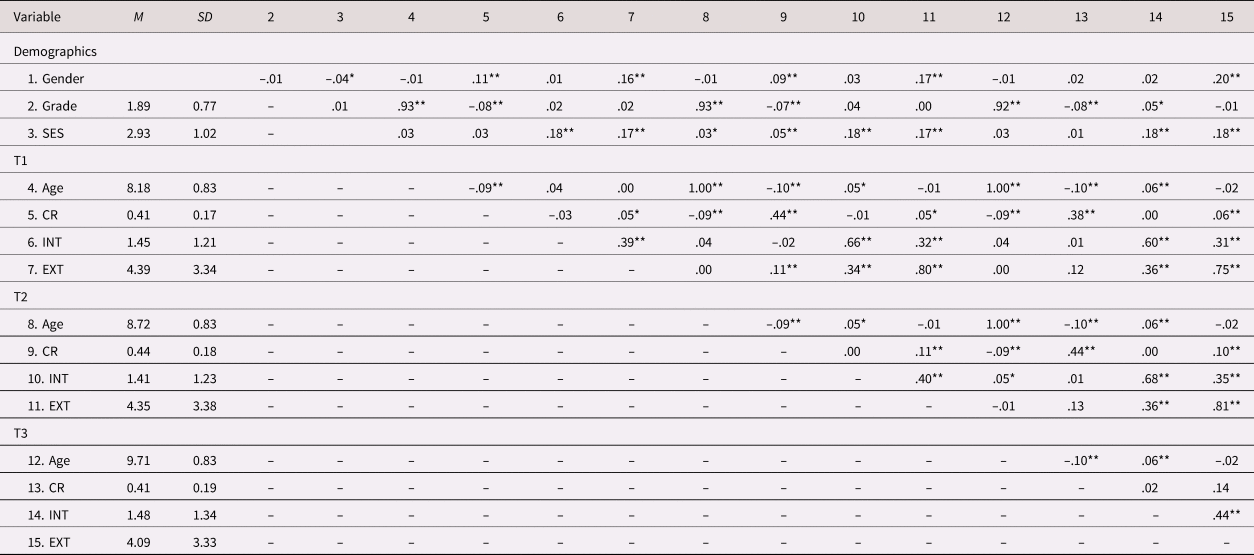
The sample consisted of 2,874 children, 51.5% of whom were female. Of the children, 36.7% were in the first grade (mean age = 7.32, SD = 0.39), 39.0% were in the second grade (mean age = 8.27, SD = 0.38), and 24.4% were in the third grade (mean age = 9.29, SD = 0.39) at the beginning of the study. The means, standard deviations, and correlations of the main variables are presented in Table 1. Additional information on the go/no-go performance test parameters is provided in the online-only Supplemental Appendix S.1.
Descriptive statistics and correlations between study variables

Note: Correlations have been corrected for classroom-level clustering. SES, socioeconomic status. INT, score of the Strengths and Difficulties Questionnaire internalizing subscale (theoretical range 0–20); EXT, score of the Strengths and Difficulties Questionnaire externalizing subscale (theoretical range 0–20). CR, commission rate, that is, the proportion of commission errors in the go/no-go task (range 0–1). *p < .05. **p < .00.
Preliminary analyses
Tests of invariance assumptions showed that for the model of externalizing symptoms and IC, the autocorrelations and cross-sectional correlations, Δχ2 (24) = 36.01, p = .055, as well as the cross-lagged effects, Δχ2 (12) = 14.73, p = .257, were stable over time. Invariance tests further showed that the autocorrelations and cross-sectional correlations were the same regardless of the child's sex or grade level, Δχ2 (35) = 35.15, p = .461. Finally, both SES, Δχ2 (30) = 28.60, p = .539, and the child's age in years and months, Δχ2 (30) = 41.98, p = .072, had similar effects on externalizing symptoms and IC regardless of the child's sex and grade level. In summary, a lower SES predicted higher externalizing symptoms at T1, T2, and T3, B = 0.37 to 0.56, ps < .001, as well as poorer IC at T1, B = 0.01, p = .027, and T2, B = 0.01, p = .033. The child's higher age predicted lower externalizing symptoms at T1, B = −0.61, p = .027, and T3, B = −0.47, p = .005. The combined model had excellent fit, χ2 (199) = 246.51, p = .012, comparative fit index = .990, Tucker–Lewis index = .988, root mean square error of approximation = .02, 95% confidence level [.01, .03], and standard root mean square residual = .04.
For the model of internalizing symptoms and IC, the autocorrelations could be constrained to be the same over time for IC, χ2 (6) = 3.92, p = .687, but not for internalizing symptoms, χ2 (6) = 32.03, p < .001. Furthermore, the cross-lagged effects could not be assumed to be the same over time (i.e., between T1 and T2, and T2 and T3), χ2 (12) = 33.90, p < .001. The autocorrelations and cross-sectional correlations were similar regardless of the child's sex and grade level, χ2 (35) = 28.01, p = .793. Finally, both SES, χ2 (30) = 25.31, p = .710, and the child's age in years and months, χ2 (30) = 22.53, p = .834, had similar effects on internalizing symptoms and IC regardless of the child's sex and grade level. In summary, a lower SES predicted heightened internalizing symptoms from T1 to T3, B = 0.18 to 0.21, ps < .001, and poorer IC from T1 to T3, B = 0.01 to 0.02, ps < .030. The child's higher age predicted higher internalizing symptoms at T1, B = 0.15, p = .043, and better IC at T2, B = −0.04, p < .001, and T3, B = −0.04, p < .001. The combined model had excellent fit, χ2 (196) = 194.59, p = .515, comparative fit index = .999, Tucker–Lewis index = .999, root mean square error of approximation = .01, 95% confidence level [.00, .02], standard root mean square residual = .03.
Externalizing symptoms and IC
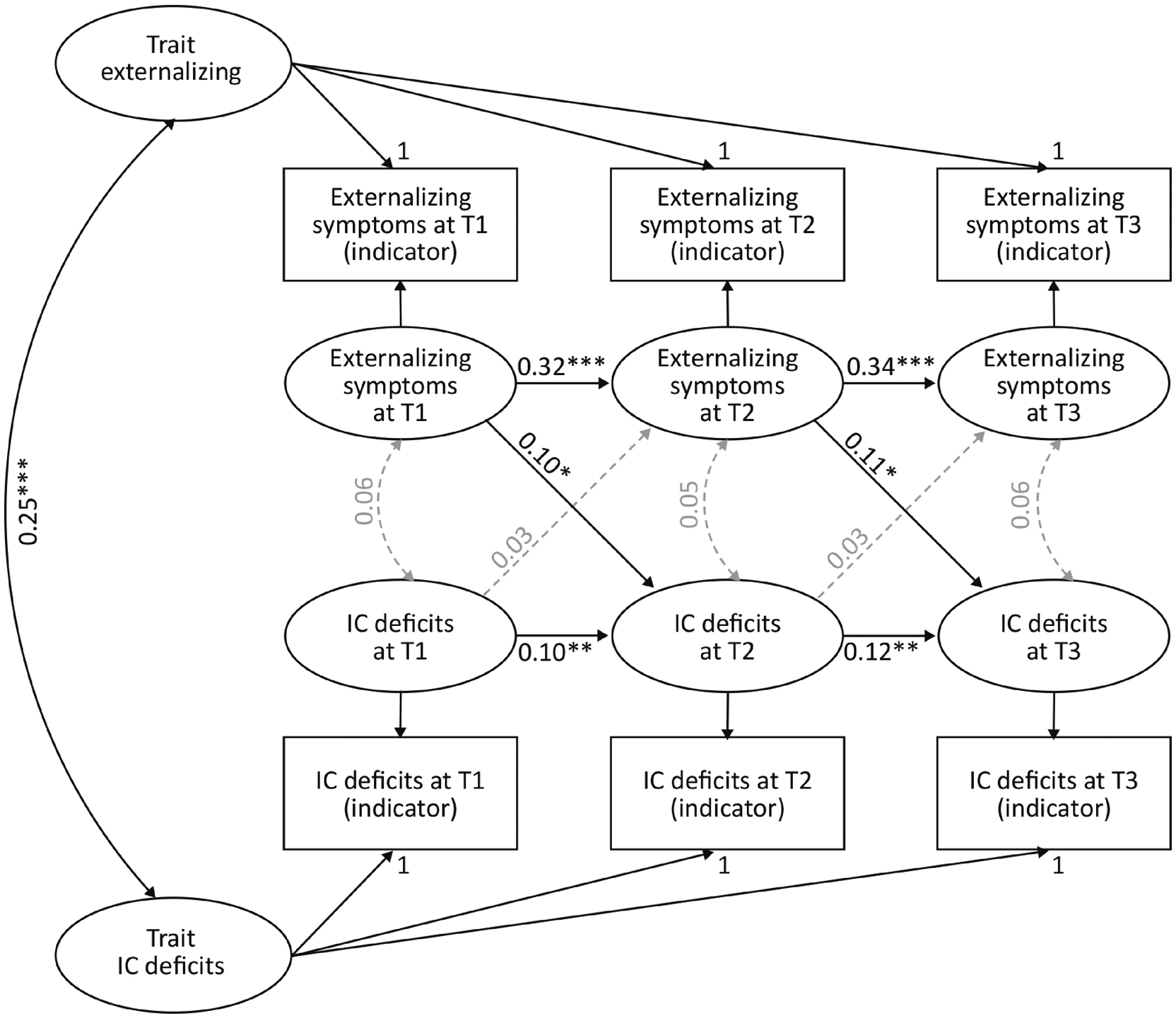
The child's sex or grade level did not moderate the cross-lagged effects of externalizing symptoms on IC, Δχ2 (5) = 9.36, p = .095, or the cross-lagged effects of IC on externalizing symptoms, Δχ2 (5) = 8.58, p = .127. Thus, the hypotheses about cross-lagged effects were tested across all the subgroups (see Figure 1). In line with the complication hypothesis, the changes in externalizing symptoms predicted later changes in IC, Δχ2 (1) = 1.14, p = .008. As shown in Figure 1, elevated externalizing symptoms predicted later poor IC, B std = 0.10, SE = .05, B = 0.01, p = .022. Against the underlying risk factor hypothesis, changes in IC did not predict later changes in externalizing symptoms Δχ2 (1) = 2.15, p = .143. Finally, the child's sex or grade level did not moderate the trait-level association between externalising symptoms and IC, Δχ2 (5) = 2.29, p = .801. As shown in Figure 1, in line with the trait hypothesis, a small to moderate association was observed between trait-level externalizing symptoms and trait-level IC, r = .25, p < .001.
Results from the final RI-CLPM depicting associations between externalizing symptoms and inhibitory control. Note: Values are standardized beta coefficients. Child’s age in years and months at each time point and SES were included as covariates. The final combined model for externalizing symptoms had excellent fit, χ2(19) = 35.50, p = .012, CFI = .997, TLI = 0.993, RMSEA = 0.02, 95% CI [0.01, 0.03], SRMR = 0.01. Dashed gray lines indicate nonsignificant relations. For clarity, the effects of age, SES, and standardized coefficients for fixed loadings are not shown.

Internalizing symptoms and IC
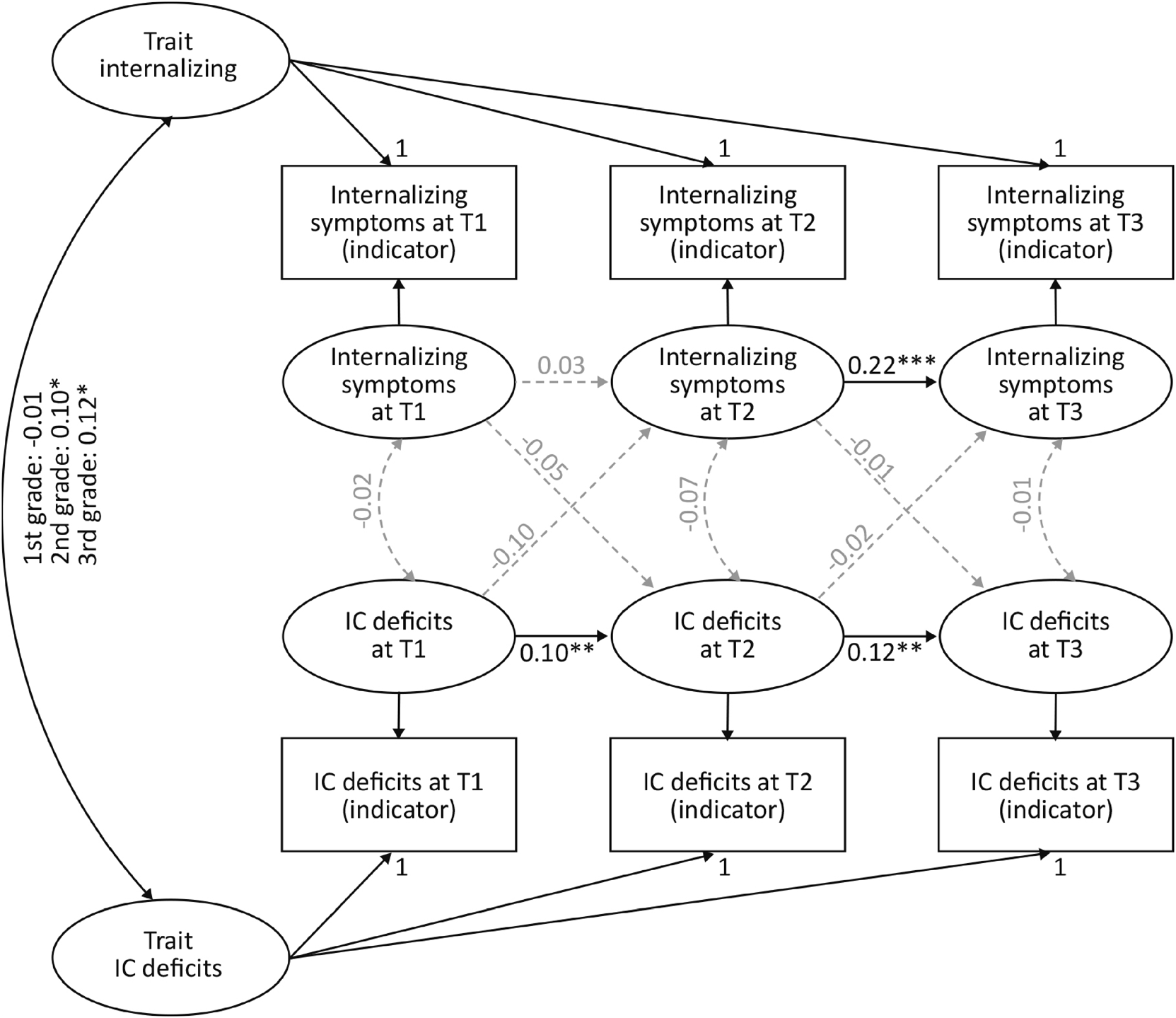
The child's sex or grade level did not moderate the cross-lagged effects of internalizing symptoms on IC, Δχ2 (10) = 6.70, p = .753, or the cross-lagged effects of IC on internalizing symptoms, Δχ2 (10) = 14.44, p = .154. Thus, the hypotheses about cross-lagged effects were tested across all the subgroups (see Figure 2). Against the underlying risk and complication hypotheses, we found that changes in internalizing symptoms did not predict later changes in IC, Δχ2 (2) = 0.66, p = .720, and changes in IC did not predict later changes in internalizing symptoms, Δχ2 (2) = 0.24, p = .885. Finally, the results showed that the child's grade level, Δχ2 (4) = 13.58, p = .009, but not sex, Δχ2 (3) = 3.91, p = .271, moderated the association between trait-level internalizing symptoms and IC. As shown in Figure 2, in line with the trait hypothesis, trait-level internalizing symptoms were associated with trait-level IC deficits among second-grade children, B std = 0.10, B = 0.01, SE = 0.01, p = .041, and third-grade children, B std = 0.12, B = 0.02, SE = 0.01, p = .032, but not among first-grade children, B std = −0.04, B = −0.01, SE = 0.01, p = .418.
Results from the final RI-CLPM depicting associations between internalizing symptoms and inhibitory control. Note: Values are standardized beta coefficients. Child’s age in years and months at each time point and SES were included as covariates. The final combined model for internalizing symptoms had excellent fit, χ2 (16) = 28.66, p = .026, CFI = .996, TLI = 0.990, RMSEA = 0.02, 95% CI [0.01, 0.03], SRMR = 0.01. Dashed gray lines indicate nonsignificant relations. For clarity, the effects of age, SES, and standardized coefficients for fixed loadings are not shown.

Discussion
Using a panel design, we tested the associations between IC and psychopathology in children's early school years. First, we tested whether poor IC in children predicts later externalizing and/or internalizing symptoms, that is, the underlying risk factor hypothesis. It was surprising that this hypothesis was not confirmed for either symptom dimension. Our second hypothesis was that the development of IC is disrupted as a complication of psychopathology. We did find that an increase in externalizing symptoms predicted poorer IC at subsequent assessment points, whereas there was no such longitudinal association between internalizing symptoms and IC. Our third hypothesis, the trait hypothesis, states that there is a trait-level relationship between IC and psychopathology. This hypothesis was confirmed for both externalizing and internalizing symptoms. However, for internalizing symptoms, this trait-level association was present only among older children, that is, only in those children who were, on average, from 8 to 9 years old at the beginning of the study. To our surprise, grade level or sex did not moderate any of the other examined associations.
To our knowledge, this is the first study to use the advanced cross-lagged modeling approach, the RI-CLPM, in order to examine the longitudinal associations between IC and psychiatric symptoms. Previous research has provided evidence of the longitudinal associations between IC and both externalizing and internalizing symptoms (Berlin et al., Reference Berlin, Bohlin and Rydell2003; Buss et al., Reference Buss, Kiel, Morales and Robinson2014; Kahle et al., Reference Kahle, Utendale, Widaman and Hastings2018; Kertz et al., Reference Kertz, Belden, Tillman and Luby2016; Riggs et al., Reference Riggs, Blair and Greenberg2003; van Deurzen et al., Reference van Deurzen, Buitelaar, Agnes Brunnekreef, Ormel, Minderaa, Hartman and Slaats-Willemse2012). However, the majority of such studies have not tested the directionality of the associations. We are aware of three previous studies among the youth that have examined the cross-lagged associations between IC or common EF and psychiatric symptoms (Friedman, du Pont, Corley, & Hewitt, Reference Friedman, du Pont, Corley and Hewitt2018; Hughes & Ensor, Reference Hughes and Ensor2008; Kahle et al., Reference Kahle, Utendale, Widaman and Hastings2018). One of them investigated IC and externalizing symptoms (Kahle et al., Reference Kahle, Utendale, Widaman and Hastings2018), another explored common EF and externalizing symptoms (Hughes & Ensor, Reference Hughes and Ensor2008), and the other examined the common EF, as well as the updating-specific and shifting-specific factors in relation to depressive symptoms (Friedman et al., Reference Friedman, du Pont, Corley and Hewitt2018). However, the limitation of the standard cross-lagged panel model (CLPM) used in these previous studies is that it does not distinguish between the statelike and traitlike associations between IC and psychiatric symptoms. Thus, the studies may have produced misleading longitudinal associations that suggest a causal link between the constructs even when there is only a trait-level association (Hamaker et al., Reference Hamaker, Kuiper and Grasman2015). Because the RI-CLPM distinguishes between within-person and between-person variance, our study was able to overcome this issue.
Our results differ from those of previous CLPM studies that have found IC (Kahle et al., Reference Kahle, Utendale, Widaman and Hastings2018) or the common EF (Hughes & Ensor, Reference Hughes and Ensor2008) to predict later externalizing symptoms, thereby supporting the underlying risk factor hypothesis. While the different results may be due to methodological differences (CLPM vs. RI-CLPM), the age of the children under study may possibly also play some role. Previous studies examined the associations among 2- to 4-year-old and 4- to 6-year-old children, whereas we focused on middle childhood. Deficits in IC or common EF may have a role in the emergence or strengthening of externalizing symptoms among preschool children. By school age, this association might have already become fixed, resulting in a trait-level association, as suggested by our finding, which is discussed further later in this paper.
We are unaware of previous studies that have examined the underlying risk factor hypothesis between IC and internalizing psychopathology in a cross-lagged design among children. However, Friedman et al. used CLPM to assess 439 pairs of twins at 12, 17, and 23 years (measuring the EF at 17 and 23 years) and found that higher levels of depressive symptoms were concurrently but not prospectively associated with poorer common EF skills (Friedman et al., Reference Friedman, du Pont, Corley and Hewitt2018). Our results question the role of IC as an underlying risk factor for internalizing symptoms. It is important to note, however, that while we found no support for the role of IC deficits in the emergence of internalizing symptoms, we did not test for the role of shifting and disengaging attention in the pathogenesis of internalizing disorders (Kertz et al., Reference Kertz, Petersen and Stevens2019). Furthermore, even if the basic cognitive abilities were intact, affective biases, that is, biases influencing cognitive performance in emotional contexts, may still play a role in predicting internalizing disorders (Kilford et al., Reference Kilford, Foulkes, Potter, Collishaw, Thapar and Rice2015).
Regarding the complication hypothesis, we found support with respect to externalizing symptoms. Among a preschool sample in Kahle et al.'s (Reference Kahle, Utendale, Widaman and Hastings2018) study, the hypothesis was not supported, nor was it clearly supported in terms of the common EF in the study by Hughes and Ensor (Reference Hughes and Ensor2008). Again, the relations may possibly be dependent on the child's developmental stage. In the preschool age, children are usually under the close guidance of their primary caretakers and other adults (e.g., daycare personnel), allowing these adults to support them toward actions that promote the development of IC despite their externalizing symptoms (Sameroff, Reference Sameroff2010). Children with more externalizing problems might even get more adults’ attention to help them with their regulatory abilities compared with their peers who are more in control of their behavior. This could compensate for the deficits and prevent the development of complications. Entering school age, children's own choices and actions begin to have an increased role in their development while school also poses increasing requirements for children's regulatory abilities (Sameroff, Reference Sameroff2010). When children have externalizing problems, they may be less able to take part in actions that would support the development of IC, such as normal involvement in the classroom and in peer relations (Metsäpelto et al., Reference Metsäpelto, Pakarinen, Kiuru, Poikkeus, Lerkkanen and Nurmi2015), which could hamper normal development. There are analogous findings in previous studies, as externalizing symptoms have been found to predict poorer academic achievement (Moilanen et al., Reference Moilanen, Shaw and Maxwell2010; Zhang, Zhang, Chen, Ji, & Deater-Deckard, Reference Zhang, Zhang, Chen, Ji and Deater-Deckard2019).
Regarding internalizing symptoms, the complication hypothesis was not confirmed. Despite the suggested model in adults that depressive episodes lead to persistent deficits in IC (De Raedt & Koster, Reference De Raedt and Koster2010), previous studies on the youth that address this hypothesis have been lacking (Kertz et al., Reference Kertz, Petersen and Stevens2019). So far, the lone previous study examining this did not also find support for the complication hypothesis with respect to the common EF (Friedman et al., Reference Friedman, du Pont, Corley and Hewitt2018). Instead, Friedman et al. found that depressive symptoms predict changes in the updating-specific domain of the EF, indicating that the associations between psychiatric symptoms and the EF may be highly domain specific. Furthermore, our study was conducted in a population-based sample among an age group in which major depression is still rare, limiting the conclusions that can be made regarding clinical or high-risk populations.
The trait-level hypothesis was supported for both externalizing and internalizing symptoms. The trait level was more robust for externalizing than for internalizing symptoms, as it appeared across all the age groups of the children, whereas the trait-level association between IC and internalizing symptoms was moderated by grade level and was found only among the two oldest age groups corresponding roughly to the ages of 8 to 9. First, one of the possible explanations for this kind of association is a shared background of the constructs. Based on their study, Friedman et al. (Reference Friedman, du Pont, Corley and Hewitt2018) suggest that common EF and depressive symptoms are associated because of a shared genetic background. The finding of our study possibly reflects the same phenomenon as the traitlike association between the common EF and depressive symptoms in the study of Friedman et al., although our research focused on IC instead of the common EF. Second, some authors have suggested that IC deficits are associated with the chronicity of psychiatric symptoms (Bloemen et al., Reference Bloemen, Oldehinkel, Laceulle, Ormel, Rommelse and Hartman2018). Regardless of the initial cause of symptoms, this kind of association would be detected as a traitlike correlation of the two. Third, an overlap or an even more contiguous relationship between two constructs would result in their correlation. IC, among other EFs, overlaps with self-regulation, that is, one's ability to cope with daily tasks and challenges, which, in turn, is a central element of mental health (Nigg, Reference Nigg2017). This could result in at least a slight overlap of the examined constructs even if a closer relationship would result in greater correlations than those observed in our study. Fourth and finally, as both IC and psychopathology are related to other EF domains (Friedman & Miyake, Reference Friedman and Miyake2017; Snyder, Miyake, & Hankin, Reference Snyder, Miyake and Hankin2015), the detected trait-level associations may reflect these common correlates.
We found surprisingly few moderation effects of age on the examined associations. We did not find that age moderated the association between IC and externalizing symptoms, whereas a meta-analysis focusing on preschool children found that the effect sizes were greater in studies with older children (Schoemaker et al., Reference Schoemaker, Mulder, Deković and Matthys2013). Regarding our findings on internalizing symptoms, the trait-level association between IC and internalizing symptoms was significant only among older children, who were about the age of 8 to 9 years at the beginning of the study. Whilst Vuontela et al. (Reference Vuontela, Carlson, Troberg, Fontell, Simola, Saarinen and Aronen2013) also found that IC and internalizing symptoms were associated in a similar age group as that in our study, which is among children between 8 and 10 years old, the association was not significant among children between 11 and 12 years old. Thus, the finding regarding the moderation effects is in contrast to that of our study, as they found the association among the youngest but not the oldest children. Altogether, the role of age in moderating the association between IC and internalizing symptoms seems complex. Our results support the view that the trait-level association between internalizing symptoms and IC emerges only among older children when the development of IC has stabilized and internalizing symptoms have become more common. Academic and social demands also possibly increase during the later grades, making the trait-level association between internalizing symptoms and poorer IC more likely to emerge.
In the present study, sex did not moderate any of the associations between IC and psychiatric symptoms, although this has been found in other samples (Berlin et al., Reference Berlin, Bohlin and Rydell2003; Lonigan et al., Reference Lonigan, Spiegel, Goodrich, Morris, Osborne, Lerner and Phillips2017; Schoemaker et al., Reference Schoemaker, Mulder, Deković and Matthys2013; van Deurzen et al., Reference van Deurzen, Buitelaar, Agnes Brunnekreef, Ormel, Minderaa, Hartman and Slaats-Willemse2012; White et al., Reference White, Moore, Calkins, Wolf, Satterthwaite, Leibenluft and Gur2017). It has been pointed out that methodological issues may bring forth false sex differences; as externalizing symptoms are less frequent among females and internalizing symptoms are less frequent among males, these less-frequent cases may easily be insufficiently represented in studies, accentuating the associations in the other sex (Rutter et al., Reference Rutter, Caspi and Moffitt2003). The relatively large size of our sample might have helped overcome this issue. However, sex effects were found even in the larger community sample of White et al.'s (Reference White, Moore, Calkins, Wolf, Satterthwaite, Leibenluft and Gur2017) study. They found that the association of better IC and fewer symptoms was mainly stronger in males than in females and that better IC was associated with a larger number of anxious-–misery domain symptoms in females. However, their study was conducted in a sample of individuals aged 8 to 21 years, and they also found that age moderated the associations between IC and symptoms. Thus, the fact that White et al. found significant sex effects but we did not might be related to the different age range of the samples.
Different measures may also explain the differences between our results and those of previous studies. While IC can be assessed by questionnaires, by observation of behavior, or by more direct measurement with tasks specifically developed to assess abilities, the literature is very heterogeneous. Tasks that are often used to measure IC include the go/no-go task and the stop signal task (Snyder et al., Reference Snyder, Miyake and Hankin2015). The advantage of using one or more tasks compared with the use of questionnaires is that they are a more direct measure of the cognitive core process, whereas questionnaire scores are evaluations of parents or teachers who are influenced by the social context. However, the challenge in measuring IC and other EF domains is that the performance in a single task is always dependent on several functions, and differentiating deficits in a specific function is not fully possible (Burgess, Reference Burgess and Rabbitt1997). When different tasks are used, the processes that the tasks tap are somewhat different, which might explain the different associations (Morooka et al., Reference Morooka, Ogino, Takeuchi, Hanafusa, Oka and Ohtsuka2012).
Strengths and limitations
The main strengths of this study include the use of objective neuropsychological data from a large nationally representative sample and an independent report of psychiatric symptoms. This study may therefore have been able to demonstrate associations that have not been found in previous studies because of their smaller sample sizes. As is the case regarding several other factors affecting psychiatric symptoms, the associations detected in the present study are also rather small in magnitude, making them difficult to detect in small samples. Another strength is the use of the RI-CLPM in the examination of the associations. The traditional CLPM has been found to be problematic, as it does not consider the traitlike nature and within-person and between-person differences of the examined constructs, which might lead to wrong conclusions of the directions of the associations (Burns, Crisp, & Burns, Reference Burns, Crisp and Burns2019; Dietvorst, Hiemstra, Hillegers, & Keijsers, Reference Dietvorst, Hiemstra, Hillegers and Keijsers2018; Hamaker et al., Reference Hamaker, Kuiper and Grasman2015). In previous studies that have compared CLPM with RI-CLPM, results between the two methods have differed, but RI-CLPM models have been found to have better fit with the empirical data supporting its use (Burns et al., Reference Burns, Crisp and Burns2019; Dietvorst et al., Reference Dietvorst, Hiemstra, Hillegers and Keijsers2018; Masselink et al., Reference Masselink, Van Roekel, Hankin, Keijsers, Lodder, Vanhalst and Oldehinkel2018; Ponzini et al., Reference Ponzini, Van Kirk, Schreck, Nota, Schofield, Gironda and Elias2019). With the RI-CLPM, we were able to examine the directional dynamics between the two at a within-person level rather than examining associations at a population level. Our research is also one of the few studies that have used a computerized behavioral measure of IC when examining its longitudinal associations with internalizing symptoms (not including the emotional go/no-go paradigm).
However, the results must be interpreted in light of certain limitations. The main limitations are the use of a single task to assess IC and the use of only a parent report as a measure of externalizing and internalizing symptoms of the child. First, previous studies have recommended using several tasks and building latent factors from the task results when measuring the EF to improve both the validity and the reliability of the measures (Friedman et al., Reference Friedman, Miyake, Young, Defries, Corley and Hewitt2008; Miyake et al., Reference Miyake, Friedman, Emerson, Witzki, Howerter and Wager2000). Performance in a single neuropsychological task is always affected also by factors other than the function of interest, such as other abilities and situational factors (Burgess, Reference Burgess and Rabbitt1997), so our results must be interpreted with caution. In this study, the go/no-go task was presented in two blocks, and the go and no-go stimuli were reversed in the second block to make the task more challenging. Because of this, our assessment of IC may also involve some shifting component of the EF. As could be expected, we found a higher commission rate after the block switch (presented in the online-only Supplemental Appendix S.1). The commission rates between the blocks were found to be correlated (rs = .52–.57, p < .001), suggesting that despite the block switch and the increase in demands in the two blocks, the blocks successfully assessed the same EF domain. Furthermore, as we did not measure other aspects of the EF, especially the common EF, we cannot establish whether the results are specific to IC. Second, the assessment of psychiatric symptoms was based only on a parent report, which is not ideal, especially with regard to the internalizing symptoms that may be missed by parents. Consequently, relying on a parent report might have led to underestimated associations between IC and internalizing symptoms. The inclusion of an interview with the child would have increased the sensitivity in detecting internalizing symptoms.
Further, the follow-up period was quite short, which only allows us to look into a very specific time window. The study was conducted in a developmentally stable stage with regard to changes in psychiatric symptoms (Dekker et al., Reference Dekker, Ferdinand, van Lang, Bongers, van der Ende and Verhulst2007; Nivard et al., Reference Nivard, Lubke, Dolan, Evans, St Pourcain, Munafò and Middeldorp2017). It is possible that a wider age range would have revealed more cross-lagged associations or moderating effects of age. The results may therefore not be generalizable to other ages.
Furthermore, in our research design, the time spans from the first to the second assessment and from the second to the third assessment were unequal (6 and 12 months, respectively), whereas in an ideal setting, the time span between assessments should be equal. Finally, defining SES solely based on relative poverty (i.e., experienced unbalance between income and expenses) may also be considered a limitation. Such a way to assess SES does not consider the absolute level of income and thus may indicate poorness even when this is not the case. Nevertheless, this parameter may reflect the effects of SES on everyday family life (e.g., stress) even more accurately than the objective assessment of parents’ education or the absolute income.
Conclusions
Our study did not find support for the role of IC as an underlying risk factor for internalizing or externalizing symptoms in this age group. Instead, our findings support both the trait and complication hypotheses. IC and psychiatric symptoms are associated as traitlike features in middle childhood. Furthermore, externalizing symptoms may hamper the normal development of IC in childhood and preadolescence. We suggest that it may be useful to support children with externalizing symptoms to promote and protect their IC development.
Supplementary material
The supplementary material for this article can be found at https://doi.org/10.1017/S0954579420000176
Acknowledgments
Funding for this study has been received from the nonprofit organizations the Foundation for Paediatric Research (170039) and the Finnish Cultural Foundation (00190668) to Katri Maasalo and from Helsinki University Hospital Research Funds (TYH 2017205, 2018203) to Eeva Aronen.