Polls consistently show that the American judiciary is the most respected branch of the American government (Casey Reference Casey1974; Hibbing and Theiss-Morse Reference Hibbing and Elizabeth1995; Price and Romantan Reference Price and Anca2004) and is among the most legitimate judiciaries in the world (Gibson, Caldeira, and Baird Reference Gibson, Gregory and Vanessa1998). This high standing among the public gives it a unique ability to influence public opinion in ways that other government institutions cannot (Dahl Reference Dahl1957; Gibson, Caldeira, and Spence Reference Gibson, Gregory and Lester2005; Bartels and Mutz Reference Bartels and Diana2009). Scholars have extensively examined two different roles that courts fulfill using this ability: acting as legitimacy-conferring bodies and as “republican schoolmasters.”
When acting as republican schoolmasters, courts fulfill the “role of an educator, molder, or guardian of those manners, morals, and beliefs that sustain republican government” (Lerner Reference Lerner1967, 128). In other words, courts are supposed to educate the public on the benefits of protecting the civil liberties and rights required for sustaining republican government. Doing so requires changing a person’s stance on some issue of public policy—for example, changing a person’s opinion from being against same-sex marriage to being for it. If a court successfully fulfills its role as a republican schoolmaster, the public will come to agree with the policy content of the court’s decision.
Fulfilling the role of a legitimacy-conferring body does not require changing a person’s stance on an issue. All that is required for a court to confer legitimacy on a decision is for the public to respect, follow, and accept the decision (Dahl Reference Dahl1957; Gibson and Caldeira Reference Gibson and Gregory2003; Gibson et al. Reference Gibson, Gregory and Lester2005). The public does not necessarily need to agree with the court’s decision or believe that the decision is the best public policy. They only must believe that the court has the right to make the decision and that the decision should be accepted and not challenged further. In terms of the same-sex-marriage issue, for a court to successfully fulfill its role as a legitimacy-conferring body only requires the public to accept the US Supreme Court decision Obergefell v. Hodges (576 U.S. ___ [2015]) as the final word on that issue. It does not require the public to agree that same-sex marriage is the best public policy.
While not always using precisely the same two terms, other studies have made a distinction between concepts similar to acceptance and agreement (Mondak Reference Mondak1994; Clawson, Kegler, and Waltenburg Reference Clawson, Elizabeth and Eric2001; Gibson et al. Reference Gibson, Gregory and Lester2005; Zink, Spriggs, and Scott Reference Zink and John2009; Kreitzer, Hamilton, and Tolbert Reference Kreitzer, Allison and Caroline2014; Salamone Reference Salamone2014; Gash and Murakami Reference Gash and Michael2015). However, none articulate two separate theories to explain how the psychological processes that lead to acceptance and agreement differ, which subsequently allows the theory to explain why the determinants of acceptance and agreement should differ.
When acting as a republican schoolmaster, court decisions act as source cues, following the processes identified by dual-process models from psychology. In this instance, people’s evaluation of the court’s past policy—usually called “specific support” (Easton Reference Easton1965)—acts as a cue telling them whether they should agree with the court’s current policy. When acting as a legitimacy-conferring body, legitimacy perceptions—sometimes called “diffuse support”—guide acceptance judgments. In this process, the public no longer examines a decision for whether it is the correct policy but instead examines the institution to determine whether it has the moral or legal authority to make the decision. By showing that the processes through which a court decision causes acceptance and agreement differ, this study will show that the type of public support a court requires to fulfill its role as a republican schoolmaster differs from the type of public support it requires to fulfill its role as a legitimacy-conferring body.
Three Types of Studies
This study’s theory relies on the classic distinction between diffuse and specific support theorized by Easton (Reference Easton1965). Diffuse support concerns a long-standing commitment to an institution that is unrelated, in the short term, to the policy outputs of the institution. It is synonymous with other terms like “institutional loyalty” (Gibson et al. Reference Gibson, Gregory and Lester2003) or “perceived legitimacy.” Specific support concerns a person’s evaluation of the policy outputs of the institution. This distinction is commonly made in the literature on public support for courts, and when discussing the two types of support, authors usually propose that specific support has no impact or at least a much smaller impact on public opinion than diffuse support (Gibson and Caldeira Reference Gibson and Gregory1995). The theory presented here does not compare magnitudes of effect but instead compares the type of effect, proposing that specific support affects agreement with the policy components of a court decision while diffuse support affects acceptance of the decision.
The existing studies on the ability of judicial decisions to affect public opinion can be placed into three categories, but as the description of the literature below reveals, the existing studies cannot determine how the effect of specific support on public opinion differs from the effect of diffuse support. Probably the most prevalent type of study involves experiments examining whether a decision attributed to a court has a greater effect on public opinion than a decision attributed to some other institution or political actor. These studies examine both acceptance (Mondak Reference Mondak1990; Clawson et al. Reference Clawson, Elizabeth and Eric2001; Gash and Murakami Reference Gash and Michael2015) and agreement (Baird and Javeline Reference Baird and Debra2007; Bartels and Mutz Reference Bartels and Diana2009; Hume Reference Hume2011; Fontana and Braman Reference Fontana and Donald2012), but irrespective of which type of evaluative judgment is the dependent variable, the studies almost invariably rely on the assumption that courts enjoy a higher level of public support than the alternative political actor. The theoretical backing for these studies comes from dual-process models of attitude change like the elaboration likelihood model (Petty and Wegener Reference Petty and Duane1999) or the heuristic-systematic model (Chaiken, Liberman, and Eagly Reference Chaiken and Alice1989) from social psychology. Both theories predict that an argument or in this case a decision coming from a positively evaluated source is more persuasive than one coming from a neutral or negatively evaluated source. Most of the experiments show that courts are better than other types of institutions at inducing both acceptance of decisions and agreement with the policy outcome. However, the usefulness of these experiments is limited because they cannot determine whether specific support or diffuse support causes their results. They can only determine whether a court that is higher on both specific and diffuse support has a greater effect on public opinion than some other institution that is less positively evaluated.
A second type of study uses polls to examine how public opinion on an issue changes when a court decision is released. These studies examine agreement with the policy outcome of a decision rather than acceptance and are more pessimistic about the ability of courts to shift public opinion to their side. Franklin and Kosaki (Reference Franklin and Liane1989) provide evidence for the structural response theory, which states that rather than a court decision moving the public toward the court’s position, it polarizes the public. Groups that were initially against the court’s chosen policy exhibit a backlash and become even more against the policy, and groups that were in favor of the policy become more favorable toward it. (See Johnson and Martin [Reference Johnson and Andrew1998] and Brickman and Peterson [Reference Brickman2006] for further refinement of that theory; see Hanley, Salamone, and Wright [Reference Hanley and Matthew2012], Kreitzer et al. [Reference Kreitzer, Allison and Caroline2014], and Christenson and Glick [Reference Christenson and David2015] for challenges to it.) As with the first category of studies, the second cannot determine whether that change is caused by specific or diffuse support because the studies do not separately measure these two forms of support, and most do not include any measures of how people evaluate the court.
The third category of studies helps to remedy the main limitation of the first two because it can potentially identify whether diffuse or specific support drives the effects. Identifying which causes the results requires measuring both types of support at the individual level and determining how acceptance or agreement with a decision differs for those high and low in support. Most of the studies in the third category come from the work of Gibson and Caldeira. While the specific court varies, the studies conclude that perceived legitimacy or what they call institutional loyalty affects acceptance of judicial decisions (Gibson Reference Gibson1989; Gibson and Caldeira Reference Gibson and Gregory1995, Reference Gibson and Gregory2003; Gibson et al. Reference Gibson, Gregory and Lester2005), but in all except one study, only legitimacy perceptions are included in the model. Since specific support is correlated with legitimacy perceptions (Gibson et al. Reference Gibson, Gregory and Lester2003), the effect of legitimacy perceptions on acceptance could be an example of omitted-variable bias. If specific support affects acceptance and is excluded from the model, its effect would be picked up by a measure of legitimacy perceptions.
The only study from those authors that includes both specific support and legitimacy perceptions in the model is Gibson and Caldeira (Reference Gibson and Gregory1995), which concerns attitudes toward the European Court of Justice. The results show that specific support affects acceptance, but the effect is much smaller than that of legitimacy perceptions. However, it is somewhat problematic that much of the empirical basis for the importance of legitimacy perceptions over specific support is based on a study involving a court as unique as the European Court of Justice. Gibson and Caldeira (Reference Gibson and Gregory1995) note that the institution has extremely low visibility, is unknown to most European residents, and as a transnational institution “cannot rely upon the ‘presumption of legitimacy’ associated with national institutions” (464). While the current study will not challenge the finding that legitimacy drives acceptance, it strives to put what has become the conventional wisdom on firmer empirical grounding.
Of course, theoretical justifications exist for concentrating on legitimacy perceptions over specific support. Much of it can be summarized in a statement from Easton (Reference Easton1965, 273) that the purpose of diffuse support is to act as “a reservoir of favorable attitudes or good will that helps members to accept or tolerate outputs to which they are opposed.” An essential component of this theoretical justification stems from the greater stability of diffuse support in the face of displeasing outputs. While specific support will rise and fall with a court’s policy output, diffuse support remains relatively stable (Gibson et al. Reference Gibson, Gregory and Lester2003), allowing it to induce acceptance after a court makes a series of displeasing decisions. This, however, only applies if diffuse support rather than specific support causes acceptance. The importance of some form of support should not be solely determined by whether policy agreement affects it but by empirically demonstrating that it has a substantive effect on the political world. If a highly stable form of support has no effect on the political world, it is unimportant and should be ignored.
Processes Causing Acceptance and Agreement
Theoretically, neither the concept of legitimacy nor the concept of acceptance involves any consideration of the policy output of an institution. At their core, both are normative judgments: acceptance is a normative judgment about the role an institution should play in a specific decision and whether that decision should be the final say on a matter, while legitimacy is a normative judgment about the role an institution should play in general. Yet, specific support and agreement are directly related to policy concerns. Specific support involves an evaluation of a court’s past policy output, while policy agreement is an evaluation of the court’s policy in a specific decision. These two evaluations of the court’s policy—specific support and agreement—will be correlated with both diffuse support and acceptance but are conceptually and empirically distinct (Gibson et al. Reference Gibson, Gregory and Lester2003, Reference Gibson, Gregory and Lester2005). As a result, a person can still consider an institution legitimate, even when they disagree with the institution’s policy and without considering that institution a credible source for what should be considered the best public policy. This distinction between policy and normative concerns coincides with the distinction between the republican schoolmaster role, which involves a court affecting policy attitudes, and the legitimacy-conferring role, which involves a court successfully using its authority as the final arbiter of constitutional issues.
The policy and normative aspects of court evaluations are also governed by different psychological processes. Dual-process models from psychology like the elaboration likelihood model and the heuristic-systematic model have a long history and track record of theorizing and accurately predicting what causes a person’s evaluation of some attitude object—for instance, whether someone likes or dislikes restrictions on abortion—to change (see Petty and Wegener [Reference Petty and Duane1999] for a review). Both dual-process models divide information processing into two processes. One involves effortful or systematic information processing while the other involves the use of heuristics or shortcuts. Political science has extensively examined the source cue heuristic, with much of the literature concentrating on the partisan source cue. Studies show that people are more persuaded by a statement attributed to a member of their own party than the exact same statement when attributed to someone from the opposing party (Cohen Reference Cohen2003). This occurs because people have more positive evaluations of their own party members than those in the opposing party and find their own party members more credible (Chaiken et al. Reference Chaiken and Alice1989; Petty and Wegener Reference Petty and Duane1999; Gilens and Marukawa Reference Gilens, Naomi, Delli Carpini, Huddy and Shapiro.2002). The literature on the judiciary follows this and proposes that courts can affect public opinion because they are the most positively evaluated of the three major branches of government (Hoekstra and Segal Reference Hoekstra and Jeffery1996; Bartels and Mutz Reference Bartels and Diana2009).
Lupia and McCubbins (Reference Lupia and Mathew1998) provide a more formal definition of the conditions under which people should find a source credible. First, they must perceive the source as knowledgeable on the subject, and second, they must trust that the source has common interests to them. Both the federal and state supreme courts meet the first criterion concerning knowledge, but not everyone perceives courts to have the same interests as them. Specific support, and not perceived legitimacy, acts as a measure of how much people perceive the courts as having their same interests. Specific support is a measure of how often in the past a person has agreed with a court’s policy output, or in other words, how often in the past a court has advanced the interests of some individual. In contrast, legitimacy perceptions involve an evaluation of whether an institution has the moral or legal authority to make a decision, and just because someone believes that an institution should be able to make policy in an area does not mean that the person must also agree with that policy. The obligation owed to a legitimate institution is not policy agreement but only compliance. Even so, most institutions perceived as legitimate should still be able to change a person’s issue position because a high level of legitimacy is usually associated with a relatively high level of specific support (Gibson et al. Reference Gibson, Gregory and Lester2003). According to the theory presented here, it is the specific support, not legitimacy perceptions, that is directly causing the change in policy positions for this type of institution.
While high levels of legitimacy are usually associated with high levels of specific support, a hypothetical example involving a conservative in 1968 uses an alternative scenario to help further clarify why specific support and not legitimacy perceptions should affect agreement with a court’s decisions. During the previous 2 decades, this conservative encountered a US Supreme Court making many disagreeable liberal policy decisions. In the face of this, the conservative still considers the institution highly legitimate but would not consider the Court a credible source on the merits of a policy. If every important decision in the previous decade has been disagreeable on policy grounds, presumably future decisions will continue to be so. In this instance, the institution is legitimate but not a credible source for policy guidance.
Acceptance
The psychological processes through which legitimacy affects acceptance are different and do not involve dual-process models. Neither legitimacy nor acceptance requires someone to agree with the policy content of a decision, and they do not require someone to believe that an institution will make desirable policy. Instead, both concern a person’s willingness to tolerate outputs that they dislike. When a person is making an acceptance judgment, the question is not whether the institution is making the correct policy but whether he or she should take action to challenge the decision. Multiple things can influence someone’s acceptance judgments. In some circumstances people will decline to challenge a disagreeable decision because it is not worth the effort or they do not want to risk the political capital. However, the current literature suggests that the largest influence on the public’s acceptance of a disagreeable decision is whether the institution should be able to determine policy in that instance. As Gibson and Caldeira (Reference Gibson and Gregory2003, 2) state, “This moral authority—or legitimacy—means that people accept judicial decisions, even those they bitterly oppose, because they view courts as appropriate institutions for making such decisions.” When a court successfully plays its legitimacy-conferring role, it transfers the institution’s legitimacy onto its decisions. As a result, the public comes to accept that policy as an authoritative decision on some issue and does not challenge it any further.
Indirect Effect of Specific Support
Specific support should also affect acceptance but only indirectly through its effect on policy agreement. Virtually no one who agrees with the policy content of a decision will want to challenge it; thus, if specific support changes someone’s issue position, it will have an indirect effect on acceptance through policy agreement. Mondak (Reference Mondak1994) examined this dynamic in an experiment that manipulated whether a new policy was attributed to the US Supreme Court or a less positively evaluated institution. The results show that the US Supreme Court cue increases both policy agreement and acceptance. In addition, it had an indirect effect on acceptance through policy agreement. Thus, both specific support and legitimacy perceptions should affect acceptance but through different psychological processes. Specific support acts as a barometer of the effectiveness of the Supreme Court source cue in changing a person’s stance on a specific policy, which indirectly affects acceptance, and legitimacy perceptions act as a measure of a person’s perception of the proper role of the institution in the constitutional structure, which directly affects acceptance.
Other Influences on Acceptance and Policy Agreement
When a court releases a decision, it is not done in isolation from other political forces. Especially at the US Supreme Court level any relatively salient decision will be accompanied by commentary from both sides of the partisan divide in American politics. Nicholson and Hansford (Reference Nicholson and Thomas2014) provide evidence that the aggregate effect of a partisan cue accompanying a court decision is larger than the aggregate effect of the decision being attributed to the US Supreme Court. However, even if this is true, it is still important to examine the psychological processes that cause a court decision to act as a source cue, in isolation from other influences.
Gaining an understanding of this psychological process allows scholars to determine under which circumstances a court cue should have a large effect and those under which it should have no or even a negative effect. A potential reason that studies examining aggregate changes in public opinion sometimes find little or no effect for court decisions is that the negative effects among some individuals cancel the positive effects among others. Before coming to any conclusions about whether partisan cues or court cues are more powerful, scholars must first understand the psychological processes driving the effect of a court decision on public opinion. With this understanding, they can determine when and for whom a court decision should increase public support for the court’s position and when it should decrease it. Future studies can then compare the effect of a court cue to the effect of a partisan cue under the circumstances when both are expected to be effective.
State versus Federal Courts
This article uses two different surveys to test the hypotheses that legitimacy perceptions drive acceptance and specific support drives policy agreement; one assesses attitudes toward the US Supreme Court and the other toward state supreme courts. This allows the analysis to perform cross-institutional comparisons between state and federal courts, but because the theory described above should apply equally to both state and federal courts, the results are not expected to vary between them. The psychological processes described by dual-process models of opinion change apply broadly across many different types of cues—from partisanship’s effect on issue positions (Cohen Reference Cohen2003) to attractive models in television commercials (Petty and Cacioppo Reference Petty and John1980)—and the extent of that broad applicability includes cues from both federal and state courts. For both, whenever someone encounters a policy proposal from a credible source, they should be more likely to endorse that policy proposal than when it comes from a source that is not credible.
While the effect of specific support on opinion change should not vary based on the type of court, more reasons exist to justify the hypothesis that the relationship between legitimacy and acceptance could vary based on whether a court is federal or state. The most plausible derives from the method used to select judges. While federal judges have lifetime appointments, the majority of state judges face some type of election. While no published research suggests that the legitimacy of elected and appointed courts should have different effects on public opinion, it is possible that the legitimacy of an elected institution affects the public through a different psychological process than the legitimacy of an appointed institution. This possibility is tested in the analysis section, and no differences are found.
Study Design
Two studies of similar design are used to test the hypotheses. Both studies present the subjects with a hypothetical judicial decision on the constitutionality of the juvenile life sentence without the chance of parole.Footnote 1 The subjects are initially asked their opinion on the issue, asked a series of questions concerning the court, and presented with a decision contrary to their previously stated position. Following this, their acceptance of the decision is assessed, and their attitude toward the juvenile life sentence is reassessed. The first study uses a sample of 112 subjects from Mechanical Turk and presents them with a hypothetical decision from the US Supreme Court. Mechanical Turk is a service run by Amazon.com that allows people to complete short tasks for a small amount of money. The representativeness of this sample will be discussed in the section summarizing the results.
The survey was administered between January 8 and January 11 in 2013. The subjects were paid 30 cents to complete the approximately 10-minute survey. It included two questions designed to test whether the subjects were paying attention to the survey and not just answering quickly to receive the small monetary award. The questions began like traditional survey items, and at the end the subjects were instructed to ignore the preceding text and answer in a specific way. Six of the 112 subjects failed one of the two questions and are excluded from the sample. An additional four subjects were not US citizens and are also excluded.
The second study uses a national sample of 931 subjects gathered using YouGov and presents the subjects with a hypothetical decision from the court of last resort in their state (i.e., state supreme courts).Footnote 2 This survey also included a filter question to make sure the subjects were properly completing the survey. About 12% or 112 of the subjects failed and are excluded from the sample. Because of the much lower salience level of the state supreme courts, an additional 2% of the remaining sample or 18 subjects who had never heard of their states’ supreme court are excluded from the analysis. Ordinary least squares is used for both studies. Random effects for each state are added to the study-2 model because the data are multileveled with individuals embedded within states.
Measurements
The measures used across the two studies are virtually identical. The one major difference is the institution name in study 1 is the US Supreme Court, and the institution name in study 2 is the name of the court of last resort in each subject’s home state. Normally, this is “(Name of State) State Supreme Court,” but in the case of a state like New York, where the court of last resort is called the New York Court of Appeals, the official name is used. One other difference in the items is that the individuals composing the court were referred to as justices in study 1 and judges in study 2. The full text of every item is included in the appendix. Also every variable except issue position change is recoded so that 0 is the minimum, 1 is the maximum, and the intermediate values range between 0 and 1.
Issue Position
The subjects are told that a juvenile who was given a life sentence had recently appealed a case to the appropriate supreme court. Next, they are asked which of the following two options best fit their views on that issue: “It should be possible for a juvenile convicted of murder who is at least 16-years-old to be sentenced to life in prison without the chance of parole” or “Any juvenile convicted of murder should have the chance to receive parole and get out of prison later in life.”Footnote 3 Following this item, the subjects are asked the strength of their opinion on a four-point scale and the importance of the issue to them on a four-point scale.
Legitimacy Perceptions
The measure of legitimacy comes from the work of Gibson and Caldeira. It has become the standard measure of judicial legitimacy and is designed to assess whether someone wants to make fundamental changes to the way an institution operates (Gibson et al. Reference Gibson, Gregory and Lester2003). Both studies present the subjects with four statements and ask whether they strongly agree, agree, neither agree nor disagree, disagree or strongly disagree. The four statements are as follows: “If the (institution name) started making a lot of decisions that most people disagree with it might be better to do away with the (institution name) altogether”; “The right of the (institution name) to decide certain types of controversial issues should be reduced”; “The (institution name) should have the right to say what the Constitution means, even when the majority of people disagree with those decisions”; and “People should be willing to do everything they can to make sure that any proposal to abolish the (insert institution name) is defeated.” These items are added together to form the perceived legitimacy index. In both studies, the four items form a unidimensional scale with Cronbach’s alphas of .78 (study 1) and .73 (study 2).
Specific Support
While the definition of specific support—a person’s evaluation of a court’s past policy output—is conceptually simple, Gibson and Nelson (Reference Gibson and Michael2015) describe specific support as a multifaceted concept involving the two components of perceived ideological agreement with the institution and job performance evaluations. Any measure of the overall concept of specific support should include both components to get a complete picture of an individual’s specific support. To assess the latter aspect, the subjects are asked, “How well do you think the (institution name) does its main job in government?” They are then given the four answer options. To assess the former, the subjects are asked, “In general would you say the decisions of the (institution name) are too liberal, too conservative or just about right?” They are given the answer options of “much too liberal,” “somewhat too liberal,” “just about right,” “somewhat too conservative,” and “much too conservative.” The ideological differences variable is folded so that the highest value is “just about right,” and those who said either of the “much too” options are assigned the lowest value. The answers indicating that the subject somewhat disagrees with the court’s ideology are in the middle of those two extremes. The correlations between the two items are .34 in study 1 and .58 in study 2.Footnote 4 Constructing the specific support index requires putting the two variables on similar scales, and this is done by recoding each variable to range from 0 to 1. Next, they are added together to form the specific support index. The correlations between the specific support index and the legitimacy index are .35 for the US Supreme Court data set and .42 for the state court data set.
Court Decision
The court’s decision read, “The (institution name) issued a decision saying the government [can not/can] impose a sentence of life in prison without the chance of parole on 16-year-old juveniles convicted of murder. The justices said this type of penalty [constitutes/does not constitute] cruel and unusual punishment and thus [violates/does not violate] the Constitution.” The sections in square brackets change depending on the subject’s answer to the initial issue position item to make the statement contrary to their stated position.
Postdecision Evaluations
Following the decision, the subjects answer three items designed to assess whether they accept the decision or desire to challenge it. One item asks about acceptance generally, and two items ask whether the subjects support specific methods that could be used to challenge the decision. The general acceptance item reads, “Do you accept this decision and consider it the final word on the matter or do you think there ought to be an effort to challenge it and get it changed?” After indicating which option they prefer, they are asked how strongly they feel about their answer on a four-point scale. Next, they are asked whether they would support or oppose removing the justices who voted for this decision on a seven-point scale that ranges from “strongly support removing them” to “strongly oppose removing them” with a neutral middle option. The third acceptance item asks whether the subjects would “sign a petition in support of a group that was attempting to overturn the decision” and given four answer options that range from “definitely” to “definitely not.” Before constructing the acceptance index, the first item is combined with its strength follow-up question. Following this, each item is recoded to range from 0 to 1, and the three items are added together. In both studies, they form a unidimensional scale with Cronbach’s alphas of .75 (study 1) and .79 (study 2).
The postdecision agreement item comes after the three acceptance items and presents the subjects with the same two answer options as the initial issue position item as well as the same strength follow-up question.
Control Variables
The models in both studies contain a variety of control variables such as education, indicators for race and gender, support for the rule of law, and awareness of the court. The subjects were asked for their ideological self-placement in both studies. This variable is recoded so that it indicates greater ideological disagreement with the decision. If the decision was liberal, higher numbers indicate more conservative individuals and lower numbers more liberal, and vice versa if the decision was conservative. Knowledge of the court is included only in study 1 because it was not measured in study 2. However, court awareness acts as an imperfect proxy for knowledge in study 2. Because study 2 concerns state supreme courts, indicators for the state’s judicial selection method are included in the model. The four categories are partisan elections, nonpartisan elections, retention elections, and appointment systems, and each state’s categorization follows Bonneau and Hall (Reference Bonneau and Melinda2009).
Data Analysis
The analysis examines two dependent variables with each study. The first is the change in a person’s substantive issue position on the juvenile life sentence. This is constructed by combining the initial dichotomous issue position with the strength follow-up question to create an eight-point issue position index for both pre- and postexposure to the court’s decision. The dependent variable is the difference between the post- and predecision issue attitude. It is coded so that higher numbers indicate movement toward the court’s position.
Since the issue position variable has eight points, it theoretically ranges from −7 to 7, but in both studies, more than 95% of the sample falls between −1 and 3 on the scale. In addition, the issue position of 60% of the sample in both studies remained completely unchanged—that is, someone who was somewhat strongly against the juvenile life sentence before the decision remained somewhat strongly against it after.Footnote 5 Among those whose position did shift, more moved toward the court’s policy position than away from it. In study 1, 9% moved further from the court’s position, and 31% moved closer. In study 2, 12% moved further from the court, and 28% moved closer. As a result, in both studies, the mean level of issue position change is positive and significantly different from 0 (in study 1, it is .49; in study 2, it is .38). While overall the sample moved closer to the court’s policy decision, only 11% in study 1 and 9% in study 2 switched their issue position—that is, went from being against the juvenile life sentence to being for it or vice versa. This suggests that usually a court decision lessens the strength of opposition to a policy proposal rather than making people support one they previously opposed.
The second dependent variable is an additive index of the three acceptance items. In both studies, the mean level of acceptance is at approximately the midpoint of the index (study 1, it is .49; in study 2, it is .47). The correlation between issue position change and acceptance is positive and statistically significant at p < .05 for both studies, with r = .28 in study 1 and r = .19 in study 2.
Study 1 Results
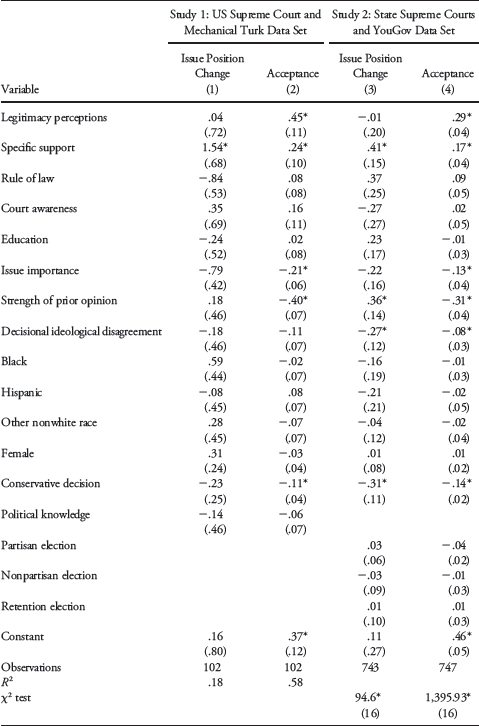
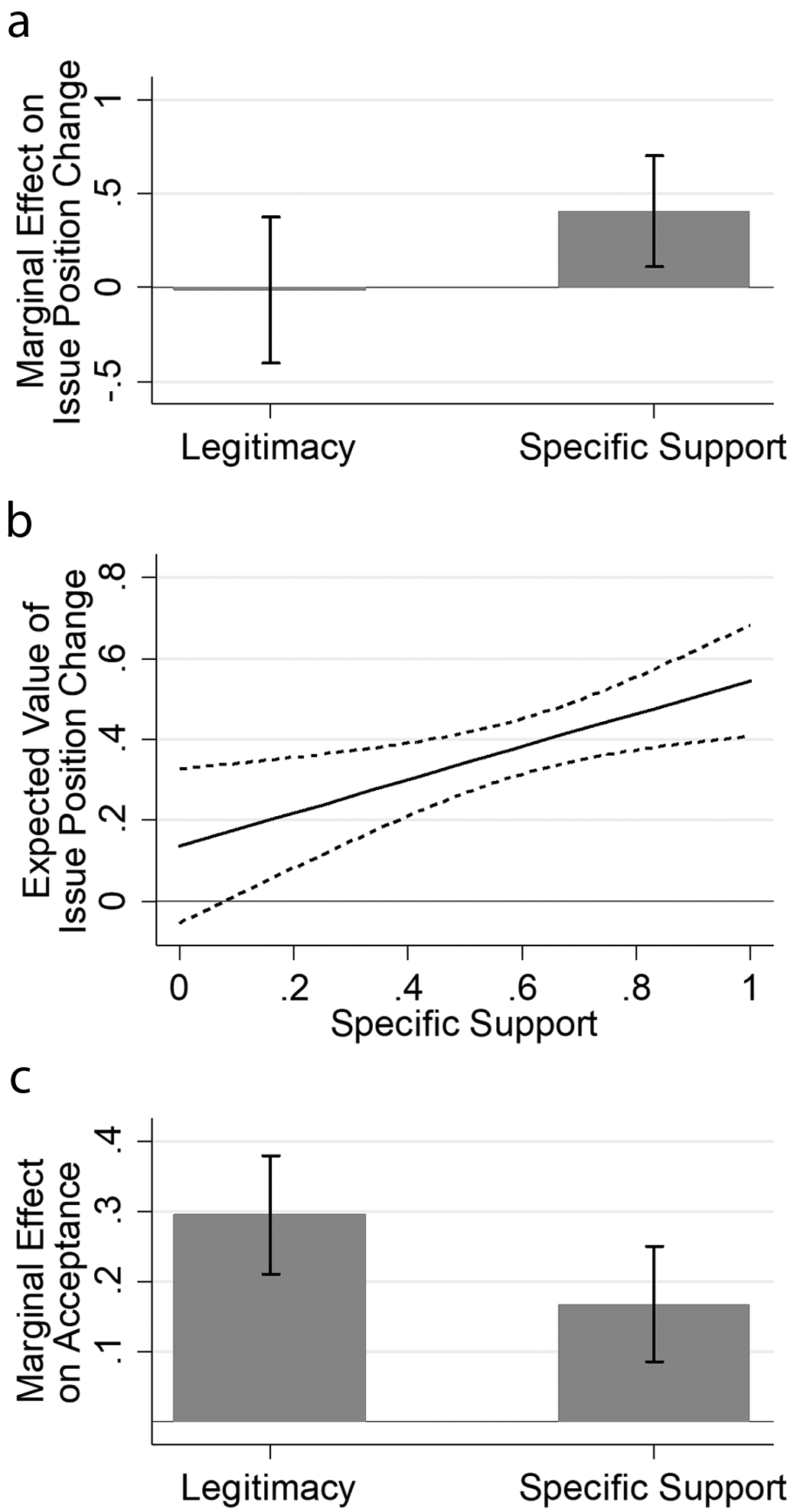
Column 1 of table 1 contains the model with issue position change as the dependent variable for study 1, which uses a Mechanical Turk sample and asks about the US Supreme Court. Figure 1a displays these results graphically. The coefficient for legitimacy perceptions is insignificant and near 0. Only specific support affects issue position change, and the coefficient is positive and significant at p < .05. Figure 1b displays the expected value of issue position change across the range of specific support.Footnote 6 At low levels of specific support, the decision has no effect and is statistically insignificant. The effect of the decision becomes significantly different from 0 at p < .05 for all subjects at .58 and above on the specific support scale, which includes 81% of the sample. Substantively, the effect at high levels of specific support is positive but not overwhelming. At the 95th percentile of specific support (.83), the expected value of issue position change is .75. Since the issue position scale has eight points, this represents 9.4% of the variable’s total range. Another way of thinking about this effect is that people are expected to move almost one point toward the Court’s position—that is, from a strong opinion to a somewhat strong opinion. No other variables reach statistical significance at p < .05.
Determinants of Issue Position Change and Acceptance
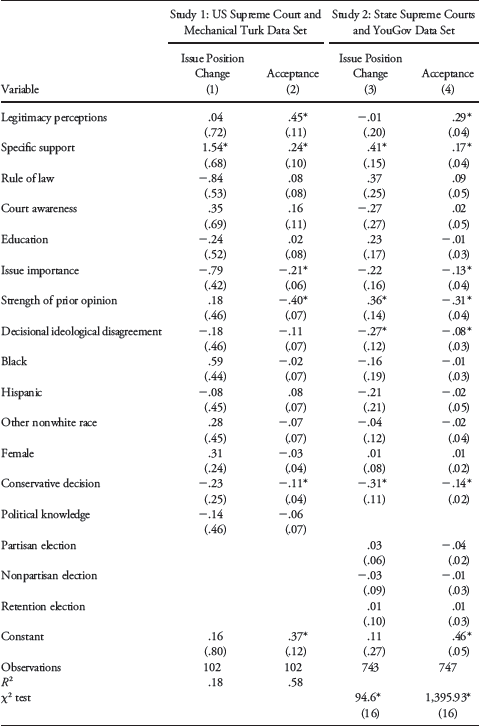
Note.— Standard errors or (in the case of the χ2 test) degrees of freedom in parentheses. The ideological disagreement variable included in these models as a stand-alone variable represents ideological disagreement with the decision. The institutional ideological disagreement item is included as one of the two components of the specific support index.
* p < .05.
Effect of specific support and legitimacy on acceptance and policy agreement for the US Supreme Court. a and c, Coefficients from the models in columns 1 and 2 of table 1; error bars, 95% confidence intervals. b, Expected values of issue position change, holding all other variables at their means, across the range of specific support; dashed lines, 95% confidence intervals.
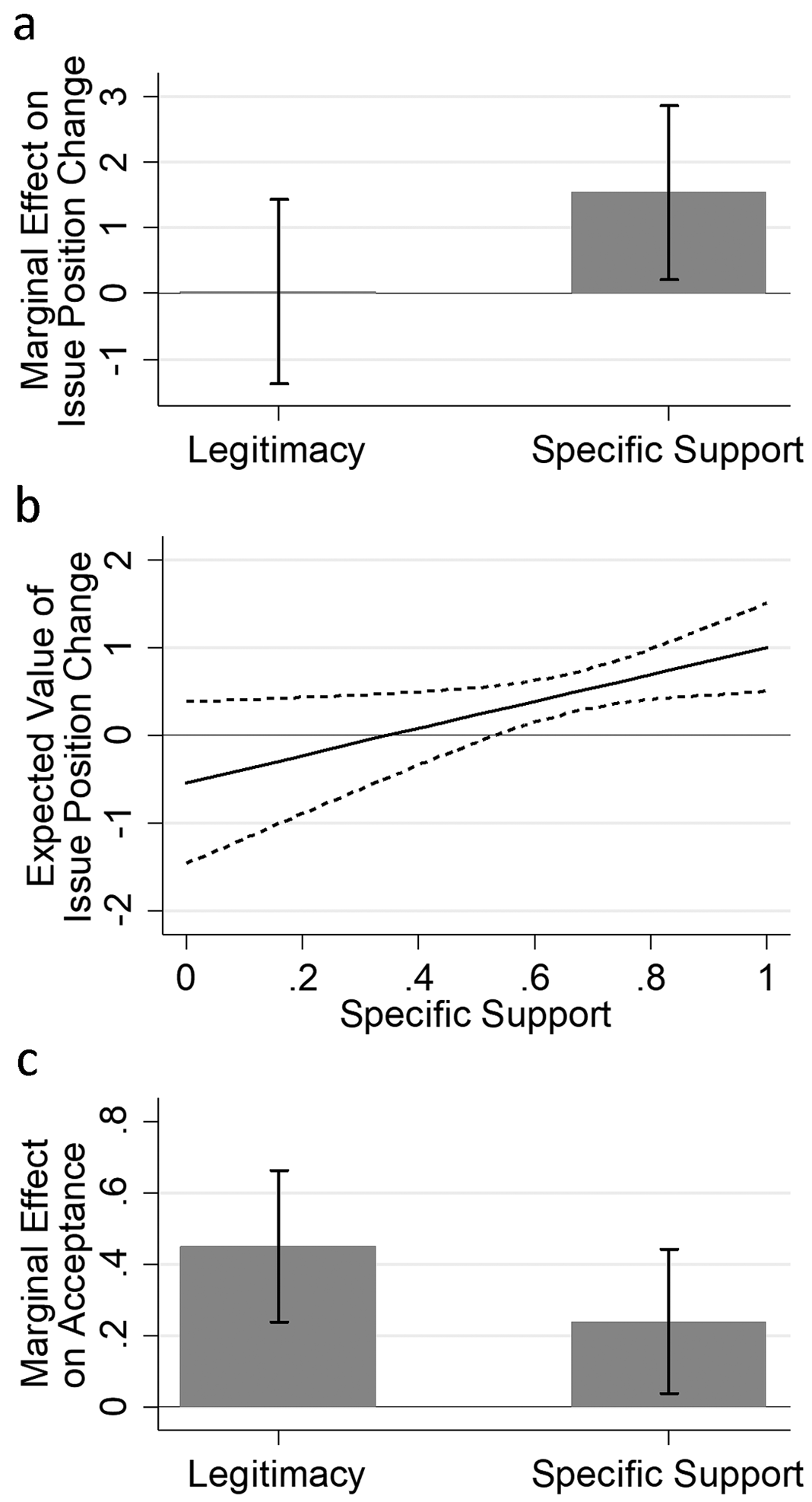
Column 2 of table 1 and figure 1c show the results of the acceptance model for study 1. The coefficients for both legitimacy perceptions and specific support have a positive and significant effect at p < .05, but the substantive effect of specific support is much smaller than that of legitimacy perceptions. At the 5th percentile of legitimacy perceptions (.31), the predicted value of acceptance is .34, and this increases to .65 at the 95th percentile (1). This change represents 31% of acceptance’s total range. At the 5th percentile of specific support (.33), the expected value is .41, and this increases to .53 at its 95th percentile (.83), representing a shift of only 12%. These results suggest that only specific support causes issue position change, and while both specific support and legitimacy perceptions affect acceptance judgments, legitimacy perceptions have a much larger effect. The next section examines study 2.
Study 2 Results
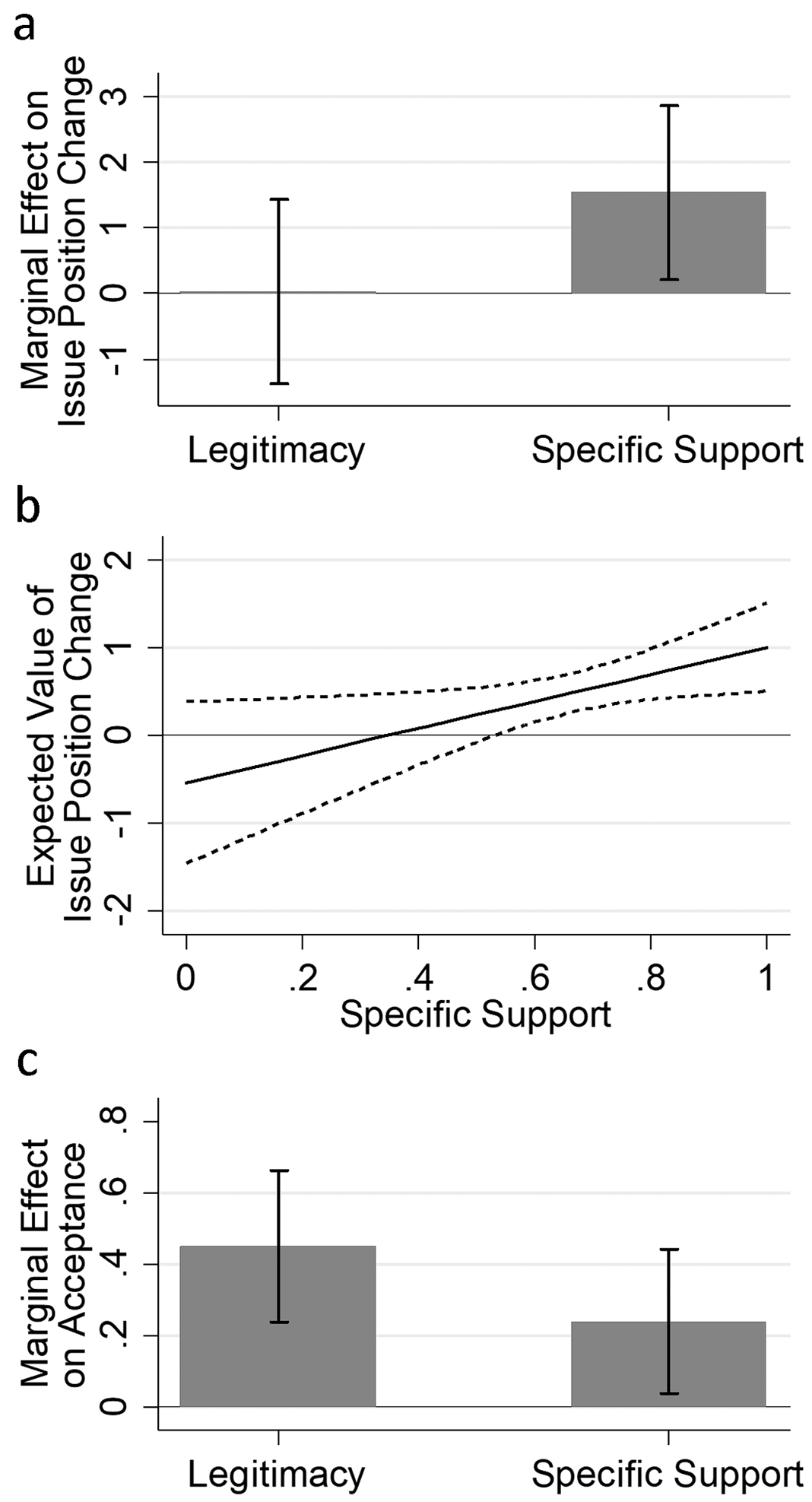
Columns 3 and 4 of table 1 contain the results for study 2, which are almost identical to those for study 1. Column 3 shows the model of issue position change, and figure 2a shows the substantive results. The marginal effect of specific support is significant at p < .05, while the one for legitimacy perceptions is insignificant with a slightly negative coefficient. Figure 2b shows the effect of the decision on a person’s issue position across the range of specific support. At the lowest level of specific support, the expected value of issue position change is not significantly different from 0 (p > .1). When specific support is at .17 and above, the expected value of issue position change becomes significantly different from 0 at p < .05. This applies to 96% of the sample. As specific support becomes more positive, the expected amount of issue position change also becomes more positive. At the 95th percentile of specific support (.83), the expected amount of issue position change is .48.Footnote 7
Effect of specific support and legitimacy on acceptance and policy agreement for state supreme courts. a and c, Coefficients from the models in columns 3 and 4 of table 1; error bars, 95% confidence intervals. b, Expected values of issue position change, holding all other variables at their means, across the range of specific support; dashed lines, 95% confidence intervals.
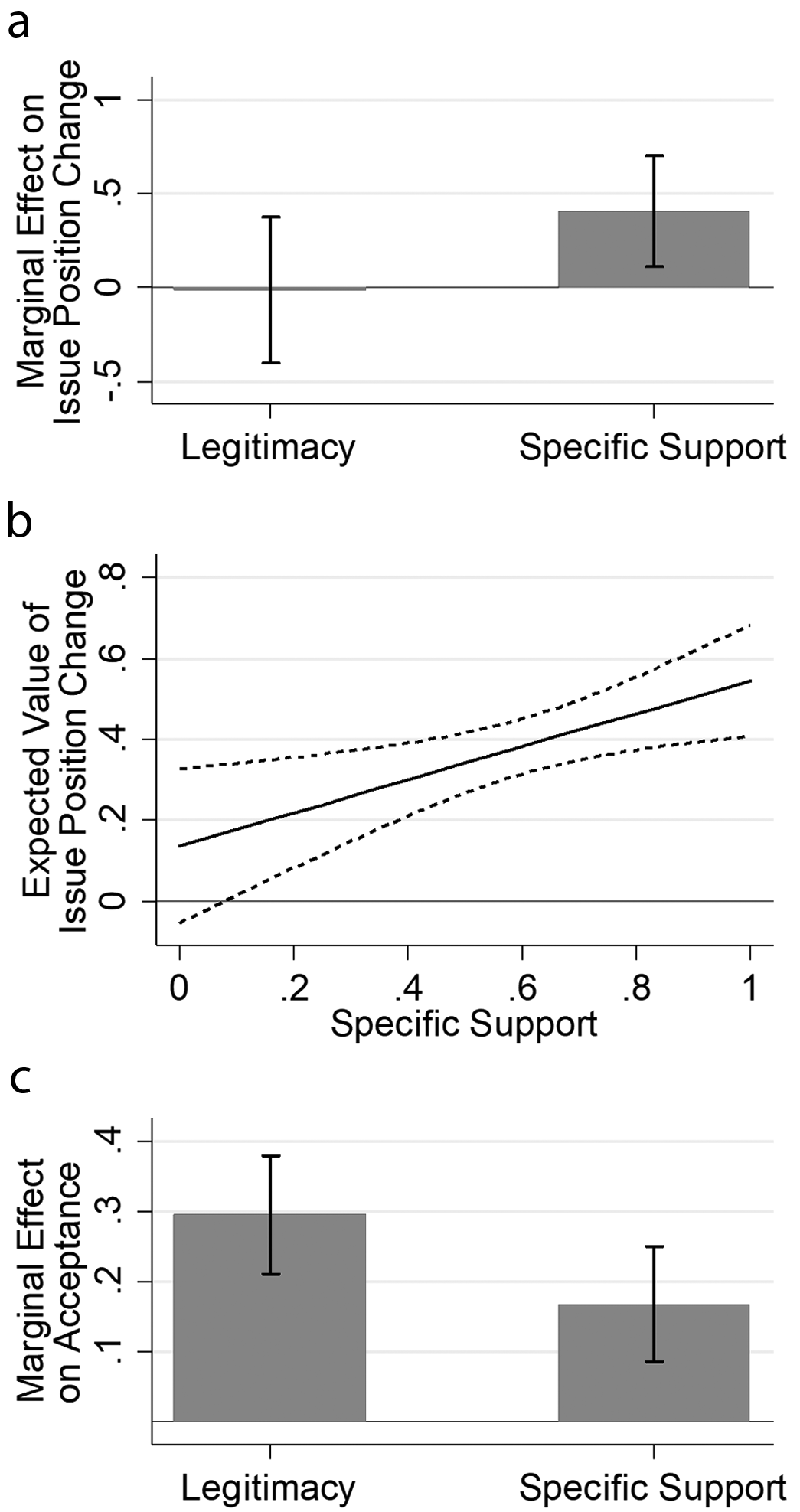
Column 4 of table 1 and figure 2c display the results for the model of acceptance. As with study 1, both legitimacy perceptions and specific support have a positive and significant effect, with p < .05, and the magnitude of the effect is much larger for legitimacy perceptions than for specific support.Footnote 8 At the 5th percentile of perceived legitimacy (.25), the predicted value of acceptance is .36. This increases to .58 at the 95th percentile (1). The effect of specific support is smaller. At the 5th percentile of specific support (.17), the predicted value of acceptance is .39, and it increases to .50 at the 95th percentile (.83). While legitimacy perceptions shift acceptance 22% of its total range, specific support shifts it only 11%.Footnote 9
Judicial Selection Method
This section tests whether the effect of legitimacy perceptions on acceptance and the effect of specific support on issue position change vary based on the method used to select judges in a state. Judicial selection systems are traditionally placed into four different categories: partisan elections, nonpartisan elections, retention elections, and appointment systems (Bonneau and Hall Reference Bonneau and Melinda2009). The existing literature on public opinion and judicial selection systems generally concentrates on whether a system increases or decreases the amount of legitimacy attributed to state courts, with some studies saying elections increase legitimacy (Gibson Reference Gibson2012) while others say that certain types of elections decrease legitimacy (Wenzel, Bowler, and Lanoue Reference Wenzel and David2003; Benesh Reference Benesh2006; Cann and Yates Reference Cann and Jeff2008; Jamieson and Hardy Reference Jamieson and Bruce2008). However, even if elections change the amount of legitimacy, that does not necessarily mean that they change the relationship between legitimacy and acceptance or between specific support and issue position change.
To examine whether selection system moderates the relationship between specific support and issue position change, interaction terms between specific support and the selection system indicators are added to the model from column 3 of table 1 (the complete model is shown in the appendix to conserve space). None of the interaction terms are statistically significant at p < .05, and the difference between the marginal effects in any two categories never reaches significance at p < .05. To examine whether selection system moderates the relationship between legitimacy perceptions and acceptance, interactions terms between each of the indicators for selection system and legitimacy perceptions are added to the model from column 4 of table 1 (see the appendix for the complete model). Again, none of the interaction terms are statistically significant at p < .05, and the difference between the marginal effects in any two categories never reaches statistical significance at p < .05. These results suggest that the relationship between legitimacy perceptions and acceptance as well as between specific support and issue position change does not vary between the four traditional categories of selection systems.
Summary of Results
The results across the two studies and two types of courts are remarkably consistent. Specific support is the main determinant of how a court decision changes a person’s substantive issue position, and legitimacy perceptions have no effect. Both specific support and legitimacy perceptions affect acceptance judgments, but the effect of legitimacy perceptions is much larger.
The one potential difference between the two studies is that the magnitude of the effects in the state supreme court data set using a YouGov sample is somewhat smaller than those for the US Supreme Court using a Mechanical Turk sample. For the effect of legitimacy on acceptance, the marginal effect for state supreme courts is 71% the size of that in the US Supreme Court study, while the effect of specific support on issue position change is about 64% the size. While these differences are too small to make any firm conclusions, they could result from the type of court examined in the study or from the sample used for the study. If the difference results from the former, perhaps the cause is the lower level of knowledge the public has concerning state supreme courts compared to federal courts. Because of this difference in knowledge, people have weaker attitudes toward that court, and weaker attitudes generally have less impact on other political attitudes (Petty and Krosnick Reference Petty and Jon1995).
The different samples used in the two studies could also be the cause of the slight differences between their results. The Mechanical Turk sample was more educated than both the general population and the YouGov sample, and thus the Mechanical Turk sample presumably had a higher level of political knowledge and sophistication. This should lead them to also have stronger political attitudes concerning courts as well.
While this difference in education does not undermine the conclusions, the use of a nonrepresentative convenience sample drawn from Mechanical Turk should be discussed further. These types of samples are beginning to gain acceptance within the judicial politics field, with multiple studies involving the evaluation of courts published in journals like the American Journal of Political Science (Christenson and Glick Reference Christenson and David2015), Political Research Quarterly (Boddery and Yates Reference Boddery and Jeff2014), and American Politics Research (Clark and Kastellec Reference Clark and Jonathan2015). Multiple studies concentrating on the use of Mechanical Turk samples in general have shown that the samples are more diverse than other types of convenience samples (Buhrmester, Kwang, and Gosling Reference Buhrmester and Samuel2011; Berinsky, Huber, and Lenz Reference Berinsky, Gregory and Gabriel2012; Casler, Bickel, and Hackett Reference Casler and Elizabeth2013). In addition, Firth, Hoffman, and Wilkinson-Ryan (Reference Firth and Tess2018) specifically examined the use of Mechanical Turk samples for law and psychology studies. They replicated the findings from multiple classic law and psychology experiments and concluded that these types of studies are useful for advancing the field.
It is not possible to completely dismiss the possibility that the findings may have been different using a representative sample, especially since the data analysis examined the relationship between two observed variables rather than the effect of an experimental manipulation. The relationship between evaluations of a court as an institution (legitimacy and specific support) and evaluations of a court’s decisions (acceptance and policy agreement) could potentially be different in a Mechanical Turk sample than it is in a representative sample. In fact, as pointed out above, the Mechanical Turk sample is more highly educated than the general population, and this difference could be the cause of slight differences between the effect sizes in the two samples.
Standing on its own, the Mechanical Turk sample used for the US Supreme Court study lessens the external validity of the findings to some degree, but that study does not stand alone. Perhaps the most appropriate manner of characterizing the results from the Mechanical Turk study is as secondary evidence confirming the results from the YouGov study that uses a more representative sample. In an era in which many worry about a replication crisis in the social sciences, finding virtually the exact same results using two independent samples is a valuable addition, even if the sample for one of those studies is not optimal.
Conclusion
This article provides insight into the psychological processes that allow courts to influence the public, which helps to determine what caused the findings from the three categories of existing literature mentioned in the introduction. The first category of studies uses experiments to show that a decision coming from a court garners greater support than one from a less positively evaluated institution. The current study shows that if the dependent variable involves opinions on the desirability of the policy, differences in specific support between the two institutions drive the results. If the dependent variable is acceptance, differences in legitimacy perceptions mainly drive the results. The second category of studies uses polling data to examine public opinion on an issue before and after a court releases a decision. Since these studies examine changes in the public’s issue position, any effects are driven by specific support. The third category examines the determinants of acceptance judgments, and the current study confirms those studies’ findings. Legitimacy perceptions are the main determinant of acceptance, and specific support has an additional smaller effect.
One goal of this study is to encourage scholars to examine how various types of support for institutions affect the political world and to determine the importance of some form of support by its effect on the political world. It shows that specific support and perceived legitimacy affect important political attitudes but in different ways. Specific support acts as a cue for whether the institution is a credible source for policy guidance, and as a result, if a court is to act as a republican schoolmaster, it must have a high level of specific support. Legitimacy perceptions, however, are not involved in the republican schoolmaster role but instead are essential for a court’s role as a legitimacy-conferring body.
Knowing what allows courts to fulfill these two roles gives scholars and judges a clearer picture concerning whether a particular court can successfully fulfill them and whether it should attempt to do so. Some courts—most likely those in established democracies—may be highly legitimate, but because of a recent spate of unpopular decisions or a political controversy, they are low in specific support. This type of court could fulfill its role as a legitimacy-conferring body but not act as a republican schoolmaster. The alternative is perhaps more likely in less-established democracies in which courts do not have the same high levels of perceived legitimacy (Gibson et al. Reference Gibson, Gregory and Vanessa1998). It may be difficult for these courts to quickly develop large amounts of legitimacy because legitimacy is based on enduring political values that are resistant to change (Caldeira and Gibson Reference Caldeira and James1992), but if they issue a series of pleasing decisions, they may be able to garner a substantial amount of specific support in a shorter time period. This type of court could act as a republican schoolmaster but would be unable to act as a legitimacy-conferring body. This highlights that the strategy that courts should use to garner support for their decisions depends on the constellation of their various types of institutional support.
While these studies provide evidence for the psychological processes through which courts fulfill their roles as republican schoolmasters and legitimacy-conferring bodies, they also show the limitations of those abilities. In both studies, only approximately 30% of the sample moved closer to the court’s issue position, and approximately 10% switched the direction of their issue position. In addition, the overall level of acceptance in both studies was close to the midpoint of the acceptance scale, indicating that about the same number of people wanted to challenge the decision as wanted to accept it. No single court decision can dramatically shift the balance of support for an issue or decision, but instead multiple court decisions have an incremental and cumulative effect shifting opinion one way or the other based on the psychological processes verified in these two studies.
The contention that the US Supreme Court’s legitimacy is relatively safe from displeasing decisions is widely accepted in the judicial literature (Gibson and Nelson Reference Gibson and Michael2015; but see Bartels and Johnston Reference Bartels and Christopher2013). Based on the prior literature, a corollary to that conclusion would be that the US Supreme Court could fulfill its roles as a republican schoolmaster and as a legitimacy-conferring body since those roles rely on the court maintaining high public standing, but this study shows that that is not necessarily the case. Even if the Court maintains a high level of perceived legitimacy in the face of a series of displeasing decisions, specific support will almost assuredly decrease. This obviously affects the republican schoolmaster role as it relies on only specific support, but it also affects the legitimacy-conferring role. Perceived legitimacy is the largest driver of the court’s ability to induce acceptance, but specific support also has a substantial effect on acceptance that is about half the size of legitimacy’s effect. Thus, even if the Court maintains high perceived legitimacy while bleeding specific support, its legitimacy-conferring ability will be substantially reduced. This again emphasizes how it is important to move beyond a laser-sharp focus on diffuse-support measures like perceived legitimacy and to examine and differentiate between the various forms of support for judicial and other political institutions.