The waves of decolonization that followed the Second World War left newly independent states in Asia and Africa in search of ways to quickly alleviate poverty. Many found a path through programmes for agricultural reform, industrialization, and infrastructure-building. These programmes, which were often framed in the rhetoric of modernization and national destiny, constituted what is now commonly called development. Historians have done much to unpick the image of development as a technocratic phenomenon driven by centralizing planners and advocates of modernization. They have shown that politicians, bureaucrats, and foreign donors all used development projects to push competing and sometimes contradictory agendas.Footnote 1 Engerman in particular has shifted focus from professed ideologies to actual practices.Footnote 2 Yet scholars have done less to ask how development interacted with other major aspects of decolonization, notably the transformation of colonial political subjecthood to postcolonial citizenship. How did development intersect with the emerging politics of decolonizing countries?
Analysis of historical water resources development projects can help to answer this question because they exemplify the appearance of the top-down projection of power. In dry regions, scholars have shown that controlling water flows has enabled states to remodel landscapes and, to an extent, societies. In the US West, Spain, Egypt, Mexico, and elsewhere, scholars have argued that hydraulic systems constituted forms of technocratic spatial control, playing an important part in the establishment of state (and sometimes corporate private) power over territory, and that water-managing bureaucracies have been driven towards large-scale (and usually technocratic) water control by a ‘hydraulic mission’.Footnote 3 Water control, in these readings, lends itself to centralized power across different types of political systems, with varying degrees of democratic or authoritarian governance. In northern South Asia, a region which has limited rainfall but fertile land which can be intensively farmed using water from irrigation canals, and where twentieth-century industrialization generated high demands for hydropower, a boom in dam-building accompanied India's independence from Britain in 1947. Jawaharlal Nehru, India's first prime minister, was a famous proponent of dams as both symbols of the nation and as lynchpins of economic development planning. Despite the country's much-vaunted democratic constitution, scholars have associated Indian dams with central power.Footnote 4 Even attempts to decentralize water provision in India, and increase local participation, have relied on the conception that ‘politics is messy…and therefore not conducive for development’, as Chhotray has argued.Footnote 5
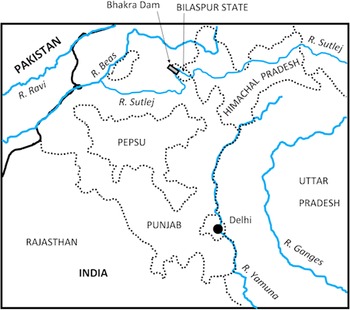
An alternative look at the political processes and debates surrounding dam-building in decolonizing India, however, will show that a major development project could be profoundly bound up with the politics of citizenship, of what India's independence meant for how its people related to the state. In this article, I put forward new empirical research on north India's Bhakra–Nangal dam complex and its irrigation canal network, constructed on the River Sutlej during the 1940s to 1950s, in the former princely state of Bilaspur (now part of Himachal Pradesh State) (Figure 1).
The Bhakra Dam and subnational boundaries, c. 1947–55

The article addresses two open questions in current scholarship on the decolonization of South Asia. First, how significant a break did independence mark in how the state functioned and related to society? Historians and historical geographers of South Asian dams have pointed to a high degree of continuity in the development practices of the late colonial and early postcolonial states.Footnote 6 The period between roughly the 1930s and 1960s was also a distinct, formative period in the history of South Asian citizenship.Footnote 7 Hindu code bills, for example, passed by independent India's legislature between 1955 and 1956, were part of an evolving response to increasing representative government that dated back to colonial political reforms in 1919.Footnote 8 Others, however, have emphasized the ideological and practical changes that independence drove in India, through social responses to the 1950 constitution, the preparation of electoral rolls, and the work of the planning commission.Footnote 9
The second question is: what were the implications of the integration of formerly semi-autonomous princely states, like Bilaspur, into newly independent South Asian nation-states? Barring Jammu and Kashmir, which became the site of successive wars between India and Pakistan from 1948, historians have only recently begun exploring how the integration process actually worked, and what it meant for people who lived in the territories. Even then, attention has focused on examples like Hyderabad in southern India or Kalat in western Pakistan, characterized by tension and postcolonial violence.Footnote 10 States like Bilaspur, and its neighbouring sub-Himalayan ‘hill states’, have been overlooked. In Bilaspur, a struggle played out between provincial-level governments, the national leadership in New Delhi, and Bilaspuris themselves. Each sought to define the meaning of the Bhakra–Nangal project, determine who bore its costs and accrued its benefits, and decide what it meant for the way that Bilaspur integrated into postcolonial India. Moreover, each constituency brought together the languages and practices of both citizenship and development. While the Bhakra–Nangal project represented some continuity with late colonial development, the political context that it took place in – and significantly influenced – was changing radically. The centrality of citizenship and democratic governance to Bilaspuris’ demands showed how strongly, and rapidly, a distinctively postcolonial political culture emerged.
The disputes over Bilaspur and the Bhakra–Nangal project were extensively recorded by the Ministries of States and Home Affairs, now held at the National Archives of India, New Delhi. The politicians and bureaucrats whose writings populate the archive spoke about and for Bilaspuris more than they spoke to them, and there is little direct access to the ‘voices’ of ordinary people. Fortunately, however, the archive includes copies of several petitions and letters from Bilaspur, making it possible to gain a reasonably balanced (if partial) impression of events. Material from the Punjab State Archives, Chandigarh, and the United States National Archives, College Park, Maryland, furnishes additional detail, supplemented by reporting in one of India's major English-language daily newspapers, the Times of India.
The article proceeds chronologically, identifying major phases in the battle for Bilaspur: the transition to postcolonial rule, up to 1949; technocratic arguments over control of the dam project and, by extension, over Bilaspur State from 1950 to 1951; and eventually interventions by Bilaspuris themselves in 1952. During each phase, various central, regional, and local actors came into conflict over the practical and moral ownership of the dam project, articulating claims that drew on the overlapping discourses of development, nationalism and citizenship.
I
Despite the nationalist rhetoric surrounding Bhakra–Nangal, colonial officials had first mooted plans for it during the 1930s. The colonial government had driven the expansion of India's irrigation network since the mid-nineteenth century, and by the end of the colonial period, roughly a quarter of all cropped land in India depended on state-owned irrigation canals.Footnote 11 Water-control infrastructure was also central to colonial governance. State-managed irrigation projects formed the basis of new regimes of landownership, legal codes, and increased bureaucratic control over agricultural production and the lives of producers.Footnote 12 Rather than rejecting a central component of colonial development, however, nationalists adopted dams in their own plans for the future. Meghnad Saha, the independence movement's foremost proponent of centralized economic planning, built them into his recommendations and influenced top nationalist leaders, including Jawaharlal Nehru.Footnote 13 However, a dispute over water allocation between the provincial governments of Punjab and Sindh held up Bhakra–Nangal plans.Footnote 14 Interprovincial negotiations from 1941 to 1942 were inconclusive, but Punjab pressed ahead with plans for the project unilaterally and struck an agreement with Bilaspur's ruler, Raja Anandchand, in 1945.Footnote 15
When independence came in 1947, dams carried great symbolic weight, helping the Indian government assert its modernizing credentials at home and abroad.Footnote 16 Nehru personally, and the broader approach to governance that he represented, staked a great deal on India's ability to quickly overcome problems of poverty and food supply, helping to drive rapid modernization.Footnote 17 Food was central to the politics of citizenship and state legitimacy, giving it political as well as economic ramifications.Footnote 18 The Bhakra–Nangal project, and other dams, became iconic in Indian imaginations through popular Hindi cinema as well as government-produced public information films and pamphlets, demonstrating their reach as symbols.Footnote 19 In practical terms, dams were part of an attempt to attain self-sufficiency in food production, intended to eliminate India's dependence on food imports.Footnote 20 The agricultural sector was also economically important, despite the Nehru era's focus on industrialization (and still constituted 49 per cent of national gross domestic product by 1960).Footnote 21 The Bhakra–Nangal complex was just one among 160 major water-management projects under construction or being planned by 1948.Footnote 22
Apart from its place in the spectacle of nationalist development, Bhakra–Nangal was important to regional politics and economics. The division of the Indus Basin between India and Pakistan in 1947's bloody Partition had cut Indian agriculturists off from the majority of existing canal-irrigated land. As the Government of East (Indian) Punjab put it, Sikh and Hindu peasants had migrated westwards to colonial-era canal colonies where they ‘laboured and toiled for decades in converting the waste lands into granaries of India’. When the Partition boundary placed those lands in Pakistan in 1947, ‘this peasant class had to flee from their homes’ and resettle in India.Footnote 23 At a December 1948 meeting of neighbouring state governments’ chief engineers, East Punjab's representative secured agreement that the scale of the refugee crisis meant it deserved special water rights. The other states also agreed to reserve a substantial amount of land for the resettlement of Punjabi refugees.Footnote 24 East Punjab pushed hard to construct water-control works and develop new lands, an ambition that was a key driver of India's bitter water-rights dispute with Pakistan throughout the 1950s.
The national thrust towards development and the practical problems of refugee settlement in Punjab gave a sense of urgency to Bhakra–Nangal plans. Actually building the dams and allocating their water and power resources was a more complicated matter, with two other major processes of decolonization interrupting. First, Bilaspur State had to be politically and administratively integrated into the Indian Dominion. Bilaspur was only 729 km2 in area, about half the size of Greater London today, with a population of around 130,000.Footnote 25 The integration process was slow, and Bilaspur did not join the Indian Union until 1948. By this time, the coming of the Bhakra Dam already defined Bilaspur's future. The dam was projected to create a 250 km2 reservoir, which would submerge the state's major town and 256 villages, displacing somewhere around 24,000 people.Footnote 26 A. N. Khosla, a leading Government of India hydraulic engineer, played a major part in integration negotiations with Raja Anandchand during summer 1948, highlighting the enmeshing of Bilaspur's political integration and development plans.Footnote 27
Controversy over what integration meant for Bilaspur immediately broke out. Given that more than half of the mountainous states’ habitable land was about to disappear underwater, its prospects as an independent administrative political entity were slight. Elsewhere, the Ministry of States had set about amalgamating contiguous groups of former princely states into new units such as Gujarat, Rajasthan, Himachal Pradesh, and the Patiala and East Punjab States Union (PEPSU). Bilaspur nestled at the intersection between Himachal Pradesh, PEPSU, and East Punjab. As early as May 1948, the East Punjab government lobbied to absorb Bilaspur to ease the construction of the dams.Footnote 28 The centre ruled this out on the grounds that Punjab would acquire a dominating voice in the Bhakra–Nangal project, a risk to the interests of PEPSU and Rajasthan, which both stood to gain water (although Rajasthan eventually received most of its water from a project on the Beas River instead).
New Delhi preferred to maintain direct control over Bilaspur and hence over the dam sites.Footnote 29 For the centre, Bhakra–Nangal was a national project which would help create unity by distributing water and development benefits amongst the quarrelling political units of north-west India. It could encourage state governments to work together, establishing a network of interdependence on a single irrigation system and thereby integrating their economic development programmes.Footnote 30 The Ministry of External Affairs was particularly concerned that East Punjab's attempt to assert dominion over Bhakra–Nangal waters within India would undermine India's argument, deployed against Pakistan in the international Indus Basin dispute, that all Indian territory had an inherent right to a share in Sutlej waters and that Pakistan had none.Footnote 31 The centre therefore maintained, for the moment, direct rule of Bilaspur rather than allocating it to a subnational unit.
The second process was democratization. While New Delhi's motivation was centralized control of the dam project, an important result was to deprive the state of elected local bodies, which other former princely states were acquiring. Princely states had been excluded from the constitutional reforms of 1919 and 1935 which had introduced important elements of representative and elected government at provincial levels in British India. After independence, the new amalgamations of former princely states began to acquire democratic structures in order to catch up. Bilaspur, however, was governed by a chief commissioner who was directly responsible to the central Ministry of States, as were the strategically important border states of Manipur, Tripura, and Kutch.Footnote 32 They had no form of local popular representation, and were without the political weight of a full state government. Bilaspur did have some place in national-level democratic structures: Raja Anandchand had managed to get himself appointed to the Constituent Assembly, which convened to formulate the country's new constitution, in July 1947.Footnote 33 Bilaspur was also allotted part of one joint seat in the council of states, which it shared with neighbouring Himachal Pradesh, though Anandchand complained that the latter's much bigger population meant that Bilaspur's interests would be overlooked.Footnote 34 Direct rule from Delhi suited him, and he resisted the idea that the state should be amalgamated with a neighbouring territory, arguing that Bilaspur should be administered as a Chief Commissioner's Province, with himself as the president of a local advisory council.Footnote 35
The contradiction between the democratization of post-independence India and the realities of continued authoritarian rule in Bilaspur was stark. The idea of India as a representative democracy based on universal adult suffrage was fundamental to political imaginations in the wake of decolonization, and citizens’ associations successfully insisted upon their right to vote in, for example, West Bengal.Footnote 36 More broadly, the ability to articulate and press (if not necessarily receive) rights as citizens was fundamental to popular perceptions of the relationship between state and people in postcolonial South Asia.Footnote 37 In fact, former princely states were slow to acquire representative structures, and it was not until September 1951 that India's parliament passed an act which provided amalgamations such as Himachal Pradesh with limited democratic institutions.Footnote 38 In Bilaspur, however, it was clear that democratization was strictly subordinate to development, and that the Ministry of States would only consider political reform there once the dam question had been settled. The centre's decisions on Bilaspur referred to its stake in the Bhakra–Nangal project and its broader ambition to create a unified, national space of development in north-west India rather than to the place that Bilaspuris had in the new country. Decolonization was emerging as a highly uneven process.
II
Meanwhile, reinforcing the extent to which Bilaspur's future was decided by the exigencies of the dam project, the state governments of East Punjab, PEPSU, and Himachal Pradesh mounted a territorial tussle over the dam sites. ‘Our point of view’, reiterated one Ministry of States official in June 1950, ‘has always been that the Project is essentially an “inter-State Project for the larger good of the Union as a whole”’, but Punjab continued to be a worry.Footnote 39 The ministry was concerned to maintain the centre's stake in ‘optimizing’ the project, echoing the assumption that central intervention could best resolve inter-state conflicts and promote efficient planning.Footnote 40 Since multiple states shared equities in the project, New Delhi could have legally taken control through a statutory authority.Footnote 41 This would have followed the precedent of the Damodar Valley Corporation, incorporated in 1948, which took charge of hydropower generation in West Bengal, or central intervention into disagreements between Madras and Travancore-Cochin over the River Periyar.Footnote 42 Instead, the centre encouraged the states to jointly set up a control board to manage the project. After much wrangling, they did so in November 1950. The board took charge of all technical and financial aspects of construction, including supervising the work done by the chief engineers in each state.Footnote 43 On the face of it, New Delhi's insistence on national development – ‘the larger good of the Union as a whole’ – had won out.
Rather than trust in the board, however, the state governments attempted to wrest territorial control of the dam site for themselves. Such control was important because it would enable governments to extend their authority over the project's water and power resources. While the archive is not clear on the details, presumably the governments believed that the ability to appoint engineers and regulate access to the site would yield the ability to influence the design and management of the dam, ensuring that the state in question received its ‘fair’ share (or, more likely, as a defensive manoeuvre to prevent other states from annexing additional water resources).
The struggle to control Bhakra–Nangal was therefore a contest over the extent to which hydro-development would be a state, regional, or national concern. Part of the battle was fought in public. Dr Gopichang Bhargava, the chief minister of East Punjab, laid the foundation stone for the Bhakra Dam amid much press fanfare in 1951, calling the project a symbol of the new (Indian) Punjab, which had arisen out of the ashes of the old province.Footnote 44 Apart from overlooking the project's location outside Punjab territory, and other states’ claims on its waters, Bhargava's reference to ‘old Punjab’ raised the spectre of partition. His claim was that the new river control system was helping to rebuild the province.
For the most part, though, the struggle over the dam sites took place through thick, fast, and increasingly bitter correspondence amongst politicians and bureaucrats. Sardar Nawab Singh, the East Punjab's chief official, fired a new salvo in the summer of 1952. The core of his argument was technocratic. He argued that the Bhakra–Nangal project made Bilaspur vital to Punjab, a prime beneficiary. His government, he claimed, would have practical difficulties in the construction and administration of the dams unless it could absorb the territory. The whole of the Bilaspur State formed the catchment area of the Bhakra Dam, and conservation of that area was paramount in the dam's interests. East Punjab needed freedom to unilaterally carry out soil-conservation and afforestation measures in the catchment area to stop soil from washing into the reservoir and clogging up the mechanism. But Singh's letter also deployed a cultural-historical claim, opening with a meandering historical justification for Punjab's annexation of Bilaspur. During the seventeenth century, he wrote, the Rajas of Bilaspur also ruled over neighbouring Kulu and Kangra, which had later become parts of Punjab. Given that the history of people in ‘olden times’ used to be the history of their kings, he wrote, modern Bilaspuris’ racial and cultural affinity lay with Punjab.Footnote 45
Though this argument functioned as a veneer over technocratic motivations, Singh's inclusion of it showed that cultural factors were a part of the national conversation on what it meant to belong to both the nation and to subnational units in postcolonial India. Rivalries between religious-political (‘communal’) identities had been at the root of Partition; language was the other key cultural factor in determining subnational senses of belonging in independent India.Footnote 46 During the colonial period, the Indian National Congress had passed a formal resolution in 1920 calling on the government to reorganize the multilingual provinces of British India to reflect discrete language groups. When Nehru became prime minister in 1947, the Congress suspended its interest in linguistic provinces in order to concentrate on general administration, framing the constitution, and dealing with the Kashmir and refugee crises. A Linguistic Provinces Commission, appointed in 1948, found that the interlacing spread of language communities throughout India would make truly homogeneous provinces impossible.Footnote 47 But many Indians disagreed, and in 1953 Potti Sriramalu would starve himself to death to press the cause of a Telugu-speaking Andhra state, reopening the question and ultimately forcing the 1956 redrawing of India's political map along linguistic lines. Singh's 1952 use of a historical argument about Bilaspur's affinity with Punjab highlighted the ways that cultural as well as technocratic arguments could be deployed in development politics.
Other states similarly drew on both the technocratic and cultural registers. V. Isvaran, chief secretary to the Government of PEPSU, followed Singh in suggesting that the Himachal Pradesh government (which the centre supported as the natural inheritor of Bilaspur) had no interest in soil conservation, and indeed might well deforest large areas for the rehabilitation of displaced people and accelerate the process of silting.Footnote 48 Himachal Pradesh itself had designs on Bilaspur, eying the revenues that it could levy by providing water and power to other states, even though its own steep terrain was unsuitable for canal irrigation. Himachal's chief secretary, K. L. Mehta, wrote to the Ministry of States to press its case, condemning Punjab's ‘antiquated’ claim that Bilaspur's royal history represented the modern population, but still argued that the kings in question actually came from Rajputana rather than Punjab. Shifting focus to the present, Mehta asserted that Bilaspur should merge with Himachal Pradesh for reasons of ‘geographical continuity, racial and cultural affinity as also [sic] administrative convenience’, mixing technocratic and cultural justifications. If Punjab's argument for control over Bhakra–Nangal's catchment were ‘carried to its logical conclusion’, he went on, ‘the whole of [Himachal Pradesh] should be dismembered because it provides catchment areas for most of the rest of India!!! [sic]’.Footnote 49 The Ministry of States agreed that Punjab's claim to Bilaspur ‘smack[ed] of extra-territoriality or annexationism simply on the ground that a certain area is important for the economic development of another area’. Footnote 50 This was a sensitive topic in India, given that Pakistan made the similar argument that its dependence on the headwaters of the Chenab River gave it a natural right to territorial control of disputed Jammu and Kashmir.Footnote 51 Singh, Isvaran, and Mehta had tried hydraulic and cultural arguments, all of which articulated the interests of subnational territories and populations rather than national commonality. None of their arguments appeared to sway central policy-makers, who insisted on a vision of a unified national development space.
III
In the end, however, it was not the abstract figure of the nation but the practical problems of rehabilitation for displaced people that came to dominate the question of Bilaspur's future. The Bhakra reservoir flooded, in whole or in part, 375 villages. Of those, 256 were in Bilaspur, accounting for nearly 4,000 rural families, perhaps approximately 20,000 people. The reservoir also flooded Bilaspur town, affecting a further 4,000 people.Footnote 52 The problems connected with displacement and rehabilitation after dam-building in South Asia since the 1990s are well known.Footnote 53 How issues surrounding displacement and rehabilitation played out in India during earlier periods is not, however, well established.
As work at Bhakra got underway, it quickly became clear that Bilaspur could not resettle all of the people that the dam's reservoir was about to displace. By 1950, according to Shrichand Chhabra, Bilaspur's chief commissioner, the population had outgrown available cultivable land even before some was lost to the reservoir. In combination with a decision to increase the height of the dam, meaning that the reservoir would submerge 63,000 acres (a little over 250 km2) rather than the previously proposed 18,000, resettling everybody within Bilaspur was impossible.Footnote 54 Instead, they would have to go elsewhere, and the half-flooded state would need to be incorporated into a larger entity. ‘Obviously it cannot continue by itself’, agreed Nehru in April. ‘Indeed a great part of it will be under water.’Footnote 55 He insisted, though, that management of the dam site – including what to do with displaced people – should not be linked to the political question of the merger.Footnote 56
Regardless, the governments of surrounding states pressed claims that they would best be able to rehabilitate displaced Bilaspuris, still seeking to demonstrate links with the state. This placed the debate firmly on cultural and political, rather than technocratic, lines. PEPSU's bid to take displaced people claimed that one of its constituent parts, the colonial-era Nalagarh State, and Bilaspur had previously been one unit. Bilaspuris had more affinity with Nalagarhis than with people in Punjab or Himachal Pradesh, Isvaran wrote. Nalagarh was also sparsely populated, unlike the adjoining Kangra district of Punjab, and thus offered easier means of rehabilitation.Footnote 57 Similarly, Yashvant Singh Parmar, a Congress member and soon-to-be chief minister of Himachal Pradesh, pressed the central government to merge Bilaspur into his state. He claimed to have received many representations from ‘the people of Bilaspur’ who were worried about rehabilitation. Parmar lobbied to accommodate Bilaspuri displaced people in nearby districts of Himachal Pradesh, which (he said) shared ethnic, cultural, and linguistic ties with Bilaspur. Parmar argued this was far preferable to the alternative possibility of resettling Bilaspuris in the desert tracts of Rajasthan, which would soon receive irrigation water from the new Rajasthan canal. To send Bilaspuris to Rajasthan, Parmar wrote, would be unfair as they were ‘hill people’ who could not thrive in the heat of the plains.Footnote 58
Parmar's concern about the climatic predilections of Bilaspuris echoed colonial stereotypes, since colonial officials had also worried about Bilaspuris’ chances in Rajasthan in 1945.Footnote 59 Around the same time, Mridula Sarabhai, a New Delhi-based social worker and close associate of Nehru, wrote to the latter that some Bilaspuris had asked her to plead the case for displaced people to be resettled in Himachal Pradesh, and not deported to the desert.Footnote 60 Happily for Parmar and Sarabhai, Nehru agreed. ‘Hill people should go to a hill state’, he wrote in one note.Footnote 61 ‘They will not flourish there [in Rajasthan] at all and will be exceedingly unhappy’, he concluded in another, sharing in Parmar's paternalism.Footnote 62 Chief Commissioner Chhabra was no less paternalistic. Bilaspuris, he had told the National Planning Commission in 1951, were illiterate, backward, and dangerously parochial. They needed the administration to ‘provide necessary guidance and enterprise for any progress whether economic, social or cultural’. Development in the parts of Bilaspur that remained above water was inextricable from the rehabilitation of people affected by the reservoir.Footnote 63 An engineer employed by the central government similarly wrote in 1952 that rapid industrialization was the best solution to the problem of rehabilitation.Footnote 64 Even though the concern that Nehru, Parmar, and Chhabra showed was rooted in colonial-era stereotypes and a presumption to know more about Bilaspuris’ needs than the people themselves, it was not universally shared amongst policy-makers. One Ministry of States official wrote dismissively that the problems of rehabilitation were merely ‘incidental to the building of large irrigation dams’ and needed little special attention.Footnote 65 At least Nehru's personal oversight of the Bhakra–Nangal question kept Bilaspuris’ welfare on the agenda.
Bilaspuris themselves, however, were by no means sanguine about their fate. They vigorously debated rehabilitation and the state's future. The archive allows only indirect access to Bilaspuri voices, since only groups with the capacity to transmit their demands to New Delhi are represented, and the extant paper trail itself depends on bureaucratic acts of selection and translation. Yet there is enough evidence to show that Bilaspuris were able to draw on the key nationalist discourses of development and citizenship. Their interventions into arguments over Bilaspur and the Bhakra–Nangal project showed that they well understood how the logics of both development and citizenship impacted on their relationship to the postcolonial state.
During the spring and summer of 1952, as work on the dams proceeded apace, Bilaspuris held public meetings and sent petitions to politicians in New Delhi and elsewhere. The convenors of a public meeting at Mandhali, for example, sent a terse telegram to the Ministry of States in May 1952. ‘5000 people facing watery grave’, it read. ‘Rehabilitation issue paramount.’ Since the reservoir and resettlement needed the direct supervision and assistance of the central government, they ‘Courteously pray[ed] immediate withdrawal of measures’ to merge Bilaspur into Himachal Pradesh.Footnote 66 The archive does not show whether those attending the meeting felt that the dam project was too far underway to contest, or whether they accepted it in the name of development. Either way, the meeting linked the damage that the dam would wreak to a broader coming-to-terms with the political-administrative meaning of independence in the state. Yet it attempted to intervene only in the political-administrative question of the merger, not in the cause of the flood, namely the construction of the dam itself.
In seeking to shape resettlement policy and the state's constitutional future, Bilaspuris partly drew on the paternalistic relationship between the developmental state and population that the colonial state had long since established. In the case of water development, this had often played out through petitions to courts.Footnote 67 But Bilaspuris also deployed the newer language of national development to frame collective rights to resources and to fuller participation in India's expanding democracy. A missive from the Bilaspur Small Town Committee to the Ministry of States in March, for example, argued that the special problems of the dam meant that Bilaspur required central assistance for political and economic growth, invoking the key idea of progress.Footnote 68 In July, a petition from a group calling itself ‘Citizens of Bilaspur’, sent to the central Minister for States Dr K. N. Katju in July, argued that Bilaspuris deserved special consideration on account of the new reservoir. ‘We have no qualms about this impending disaster; on the contrary we feel proud that our sacrifice will bring light and life to millions of our brethren.’Footnote 69 The missive showed that Bilapuris could behave like the kind of development-oriented subjects that the Indian state sought to produce, and were prepared to adopt the language of the common good. These communications all drew on the discourse of development, which the postcolonial authorities wanted to connect to everyday life rather than cordon off as a separate realm of high technocracy. As Menon has recently argued, the Government of India promoted the idea of ‘democratic planning’, aiming to build a society of productive citizens and in the process define ‘what Indian citizenship meant’.Footnote 70 Bilaspuris were able to turn the Nehruvian discourse of development to their own purposes in order to make demands on the state.
Some Bilaspur organizations were in favour of merging with Himachal Pradesh, including the local District Congress Committee, members of which wrote to senior party members in Himachal Pradesh, as well as to leaders in New Delhi.Footnote 71 Others opposed it. The rest of the ‘Citizens of Bilaspur’ petition revealed a determination to hold onto local identity by objecting to the Himachal Pradesh merger, which would shift the local administration and law courts away to Shimla, Himachal Pradesh's capital. The assumption that Bilaspuris were culturally and linguistically similar to Himachalis was, the petition argued, mistaken. Bilaspuri language and culture reflected a long historical engagement with the regions to the state's west and south. Moreover, the petition argued that Bilaspur had historically been an independent unit, claiming that the Mughal emperors and then the Sikh rulers of Punjab had done little to interfere with its internal autonomy; even the British, it went on, signed a treaty which had remained in force until they withdrew from India. The implication was that Bilaspur's unique history demanded unique contemporary policy, not simply being rolled into India's homogenizing legal space. Bilaspuris, in other words, could articulate membership of the developmental Indian nation (bringing benefits to ‘our brethren’ downstream) at the same time as local particularism. Just because the reservoir would submerge Bilaspur's territory, they reasoned, did not mean that Bilaspuri identity should also disappear underwater. The petition argued that the Bhakra reservoir made the state a special case, requiring continued central assistance and supervision. Like technocrats in Punjab, PEPSU, and Haryana, Bilaspuris were able to reconcile the competing postcolonial discourses of development and political belonging, articulating a case against the homogenization of a national development space.
Raja Anandchand also proved adept at deploying discourses of development to oppose the merger, wary of having his influence diluted by loss of access to local decision-makers. A colonial official had written in 1945 that Anandchand was ‘a Ruler who has the interests of his subjects so deeply at heart and is unusually well qualified to protect them’, but he quickly fell out with the post-independence government. His refusal to attend a conference in 1948 to discuss the constitutional future of the sub-Himalayan hill states, claiming a right to special treatment as host of the Bhakra–Nangal project, drew a sharp rebuke from the Ministry of States.Footnote 72 Initially appointed as Bilaspur's chief commissioner, the centre dislodged him from this position and appointed a civil servant in his place in 1949. He rallied his supporters to agitate against this, to no effect.Footnote 73 In the autumn of 1951, Anandchand stood for election to the Lok Sabha, India's lower house of parliament, much to the concern of Parmar, who wrote to Nehru to warn him that the Raja represented an ‘outmoded outlook and reactionary policies’.Footnote 74 Nehru himself referred to Anandchand as ‘a bad hat’, and the Ministry of States was careful not to encourage Anandchand in his political ambitions.Footnote 75 Anandchand had his way, though, and was elected unopposed after three other candidates withdrew the week before the election.Footnote 76
In 1952, as state governments and public meetings debated Bilaspur's future, Anandchand threw himself into opposing a merger with Himachal Pradesh.Footnote 77 In May, a Congress representative, Bhagirathprasad Dixit, cabled Nehru and the Ministry of States to warn that the Raja's ‘hirelings’ were coming to Delhi in a ‘bogus deputation’ in order to press ‘false representations’ against the merger. ‘Please don't be misled’, Dixit finished.Footnote 78 Dixit need not have worried. Similar previous representations from the Raja's supporters to the ministry had achieved nothing. Bilaspur's zaildars, landed gentry who moonlighted as government workers, had also made a similar appeal, with no more success.Footnote 79
Nevertheless, the way that Anandchand framed his interventions on the merger was important. In June, he apparently agreed with the Small Town Committee of Bilaspur, an organization that overlapped in personnel with the Congress party, that the existing political set up of Bilaspur did not fit into ‘free India’. The only solution was to merge with Himachal Pradesh, since a larger state with a popular ministry and legislature would be better able not only to ensure general development but to understand and handle the particular problems of the Bhakra–Nangal project.Footnote 80 A member of the Bilaspur District Congress Committee quickly accused Ananchand of reneging on the agreement and influencing local community organizations to pass resolutions against the merger.Footnote 81 Whatever really passed between Ananchand and the local Congress organization, the key point is that the dam and Bilaspur's political status appeared as conjoined problems. Whether lobbying for or against the merger, Anandchand linked the construction of the dam complex to Bilaspur's territorial status and to the broader national milieu of development, demonstrating the central place that development had come to play in the political discourse of Nehruvian India. Despite disagreements over specifics, the Raja, Bilaspuri citizen groups, and technocrats in other states’ governments all agreed that economic development was the proper object of state action. Several of the statements that emerged from Bilaspur explicitly accepted the construction of the dam as necessary for national development; making claims for Bilaspur's own need for development was a way of linking local claims to a powerful national narrative. Bilaspur's entry into ‘free India’ meant running discursive battles over the relationship between the national good and development in the state.
A final element in popular Bilaspuri representations was a consistent demand for greater local democracy. The ‘Citizens of Bilaspur’ petition, for instance, called for political arrangements in which the administration represented the people. Exactly what the petition was asking for is not clear: presumably, it referred to the lack of local representative structures, since the state had already elected Anandchand to the Lok Sabha. But the petition, as the collective name of the correspondents suggested, explicitly articulated the interests of citizens. Other Bilaspuri missives to the centre, while echoing the form of colonial-era petitions, also articulated the democratic rights of citizens. Representatives of the local branch of the Scheduled Castes Welfare Association argued that the government must respect public opinion in a democracy like India, stressing the right of Bilaspuris to participate in decision-making about local political structures.Footnote 82
If Bilaspuris believed that a local legislature might protect their interests better than direct rule from the centre, they might well have been right. There is no evidence in the available records that central voices argued for Bilaspuris to have a formal voice in deciding the state's constitutional future. On the contrary, an official who worked for the central commission for the nationwide territorial reorganization of states wrote approvingly in 1954 that the Government of India had not consulted the people of Bilaspur on the merger with Himachal Pradesh, because ‘when such wishes come into conflict with the larger interests of the country [i.e. the Bhakra–Nangal complex], the latter must prevail’.Footnote 83 The language of the national interest could be deployed against Bilaspuri demands for representation, as well as in their favour. In that context, claims to political representation were doubly important as an ideological counterweight to big dams’ centralization of state power.
This was not a simple case of a developmental state versus an unwilling people, but a debate about the distribution of the costs and benefits of development in the context of democratization. Whereas the central government had delayed the introduction of representative structures in Bilaspur in order to press ahead with the Bhakra–Nangal project, Bilaspuris themselves put forward the dam's impact on their state as an imperative towards democracy. In practice, though, instead of engagement through full democratic structures, and the ability to hold decision-makers to account through legislative representation, Bilaspuris found only a limited formal voice in resettlement policy through consultations that the Bhakra Rehabilitation Committee, a subsidiary of the inter-state control board, held in late 1952.Footnote 84
IV
In August 1952, Nehru and the Ministry of States made final plans to absorb Bilaspur into Himachal Pradesh once construction on the dam ended, and let the Himachal Pradesh government handle resettlement.Footnote 85 Water began to flow from the project in 1953, bringing some of the promised economic benefits: Hissar district, one of the parched ‘famine districts’ of colonial Punjab, now drew settlers from outside the area to work newly irrigated tracts while the waters pushed up land values, and enabled much higher cropping intensity.Footnote 86 Meanwhile, Bilaspuris were resettled elsewhere. Good figures for the resettlement of Bilaspur displaced persons alone are not available. But for the project as a whole, approximately a third resettled in Himachal Pradesh, a third took cash compensation and organized their own resettlement, and a third resettled in the project irrigation command.Footnote 87 People displaced from Bilaspur town perhaps settled in the new town that was built next to the reservoir. In July 1954, national legislation formally integrated Bilaspur into Himachal Pradesh, at the same time that India fully opened the Bhakra–Nangal canals for the first time.Footnote 88 With Bilaspur merged into Himachal Pradesh, and the survivors of the flood making their way to other places, the battle for Bilaspur ended. Bilaspur remained a single constituency for national elections, and Anandchand continued to represent the territory in the Lok Sabha. Bilaspuris were also now finally able to elect legislators to a state assembly. But the Bhakra–Nangal project continued to provide the central government with both justification and motive for maintaining extraordinary powers to ensure the ‘proper administration and effective implementation’ of the dam complex.Footnote 89 Evidently, the importance of nationalist development continued to outweigh that of India's emerging democratic norms.
This was also clear in the rhetoric that emerged from senior leadership during the mid-1950s, which studiously erased the complexity of the politics that had characterized the planning process and integration of Bilaspur, favouring instead the grand narrative of techno-development for the national good. In 1954, Nehru famously likened dams, ‘these places where human beings labour for the benefit of humanity’, to ‘the temples of today’ during a speech about the Bhakra–Nangal project.Footnote 90 In another speech the following year, he suggested that the authorities should put up a monument to the thousands of the ‘great unknown’ who would build ‘this inspiring harbinger of prosperity’ to the nation.Footnote 91 Nothing was said of the fierce inter-state rivalries that had characterized the planning process, nor of the delay to democracy in Bilaspur that the project had justified. Yet regional politics did not go away, and during the 1960s, as subnational territorial boundaries in north-western India changed several times, the downstream states of Punjab and Haryana began a lasting dispute over ownership of the project. Intensifying the role of popular dissent in hydropolitics, politicians in both states led mass demonstrations and unleashed bitter rhetoric in elected legislatures. The consensus era of Nehruvian post-independence politics was over, and debates about development had shifted from framing in terms of the ‘national good’ to one that foregrounded local territorial-political belonging at the expense of national identity.Footnote 92
V
Neither the strident centralist rhetoric of dam ceremonies nor the later hostility between Punjab and Haryana should cause us to overlook the complexity of the ways that the dam project impacted on local politics, or how its material and symbolic value was deployed in different articulations of what it meant for Bilaspuris to be citizens of free India. Bilaspuris demanded democracy as the right of those who not only lived in India, but lost their homes and lands for the national good, even as the central government denied them representative government in order to smooth the construction of the same project. Making claims on the state in relation to water-resources development was not new to the postcolonial period, but by demanding access to democratic structures as well as development opportunities, Bilaspuris demanded full participation in ‘Free India’. Like the 1950 constitution, which created both motive and opportunity for everyday debate about the meaning of citizenship, the Bhakra–Nangal project created a need for Bilaspuris to articulate rights to rehabilitation and political representation. At the same time, powerful contemporary discourses of development and citizenship provided the language on which they could draw.
Admittedly, the power dynamics were uneven, and local actors with little leverage could only make requests from a position of supplication. Bilaspuris’ representations for compensation were polite and moderate, and national politicians and technocrats in New Delhi largely ignored them. This could lend support to the viewpoint of scholars such as Martinez-Alier who have emphasized ways that the ‘environmentalism of the poor’ in developing countries has pitted marginalized local groups in protest against state and corporate power, which appropriates local space and resources in the name of economic development.Footnote 93 But we have also seen that Bilaspuris were able to mobilize the ideological resources of independent statehood in order to support their arguments in a way that, as I noted above, was central to popular understandings of independence in early postcolonial South Asia. Development was not a rarefied space that escaped politics while extending state power. Instead it was entangled in the broader processes through which subjects of an empire became citizens of a postcolonial state.
Acknowledgements
I am grateful to this journal's co-editor Sarah Pearsall and to the anonymous peer reviewers of this journal for their kindness, patience, and constructive feedback. I also owe thanks to my friends and colleagues Aditya Ramesh, Andrew Flack, Elisabeth Leake, Hannah Charnock, Sarah Ansari, and Su Lin Lewis for comments on recent drafts, and to numerous conference audiences and my university department's ‘dead author’ workshop for comments on earlier versions.