Introduction
Fish species of the genus Brycon are widely spread in neotropical region from Mexico to Argentina, with 21 known species in the Cis-Andean river systems (Lima, Reference Lima2017). Pirapitinga Brycon nattereri Günther, 1864 (Characiformes: Bryconidae) is an endemic species of the rivers basins of Paraná, San Francisco and Tocantins (Rosa & Lima, Reference Rosa, Lima, Machado, Drummond and Paglia2008). This species is under great threat in its natural environment due to factors such as deforestation, pollution and waters impoundment (Lima et al., Reference Lima, Albrecht, Pavanelli and Vono2008), and now belongs to the list of Brazilian species threatened with extinction (Ministry of the Environment ordinance no. 445/2014).
As with many Brazilian native species, little scientific information is available regarding reproductive and development characteristics. According to Lima et al. (Reference Lima, Albrecht, Pavanelli and Vono2008), the size at first maturity in B. nattereri ranged 9.8 at 15.8 cm for males and 11.4 at 18.5 cm for females, depending on the basin in which they were caught. It has been recently reported that the gonad maturation of B. nattereri broodstocks kept in captivity, occurred in autumn–winter, in the colder months of the year (Viveiros et al., Reference Viveiros, Maria, Amaral, Orfão, Isaú and Veríssimo-Silveira2012a; Maria et al., Reference Maria, Orfão, Rizzo, Ninhaus-Silveira and Viveiros2015), and differs from other species of the genus Brycon, which reproduce in spring–summer (Zaniboni-Filho et al., Reference Zaniboni-Filho, Reynalte-Tataje and Weingartner2006). In captivity, the collection of gametes for artificial reproduction of B. nattereri is possible after hormonal induction (Viveiros et al., Reference Viveiros, Maria, Amaral, Orfão, Isaú and Veríssimo-Silveira2012a). In this condition, collected sperm is of high quality (Oliveira et al., Reference Oliveira, Viveiros, Maria, Freitas and Isau2007; Viveiros et al., Reference Viveiros, Maria, Amaral, Orfão, Isaú and Veríssimo-Silveira2012a), however, stripped oocyte quality and consequently hatching rate is still very poor due to a lack of information about this species (Viveiros et al., Reference Viveiros, Maria, Amaral, Orfão, Isaú and Veríssimo-Silveira2012a; Maria et al., Reference Maria, Orfão, Rizzo, Ninhaus-Silveira and Viveiros2015).
Knowledge on reproductive and developmental characteristics provides essential information for a better understanding of B. nattereri and the establishment of conservation measures and captive rearing of this threatened species.
The study of embryogenesis and larval growth is important not only for taxonomic purposes, but also for captive cultivation, especially in determining when yolk sac absorption and mouth opening occurs, indicating the need for exogenous feeding (Sato et al., Reference Sato, Fenerich-Verani, Nuñer, Godinho, Verani, Godinho and Godinho2003a). These studies are a basic tool for captive production because they supply important information relating to incubation processes, larviculture and fry production. Some species of Brazilian fish threatened with extinction such as the B. insignis (Andrade-Talmelli et al., Reference Andrade-Talmelli, Kavamoto, Narahara and Fenerich-Verani2002) and the B. gouldingi (Faustino et al., Reference Faustino, Makino, Neumann and Nakaghi2015), have been the subject of studies on embryonic and larval development.
The aim of this study was to describe, for the first time, embryogenesis and larval growth of B. nattereri. Determination of biological parameters for captive rearing are compared with other species of the same genus.
Materials and methods
Artificial reproduction
Fish used in these experiments were handled following the guidelines for animal experimentation described in Van Zutphen et al. (Reference Van Zutphen, Baumans and Beynen2001). All fish were anesthetized with benzocaine (ethyl aminobenzoate at 60 mg/l in water) before handling.
Experiments were conducted in the Fish Culture Unit of the Hydroelectric Company of Minas Gerais (CEMIG) in city of Itutinga, state of Minas Gerais, Brazil, in the months of June and July, during the reproductive period. During these months, the region is characterized by dry winters with very low rainfall volume, or no rainfall in some years, with temperatures between 14°C and 26°C. The altitude in this region ranges from 910 to 1362 m.
Embryos and larvae of B. nattereri were obtained after induced breeding from adult specimens held in captivity for 4 years. During the experimental period, males showed small hooklets on the anal-fin rays as a secondary sexual characteristic. Males with this characteristic and that released semen under slight pressure of the urogenital papilla and females that possessed swollen abdomen and reddish genital pore were selected for reproduction. Males (n = 10; 329 ± 55g) and females (n = 10; 380 ± 79g) were transferred from a pond to an aquarium with water at 18 ± 1°C and oxygen at 7–8 mg/l, 48 h prior to hormone induction.
Each female received two intramuscular injections of carp pituitary extract (cPE; Argent Chemical Laboratory, Redmond, Washington, USA) at 0.4 and 4.0 mg/kg body weight, with a 12 h interval. Between 14 h and 18 h after the second dose, all females were hand stripped. Males received a single injection of 4.0 mg/kg body weight, at the same time as the second dose in females.
The water temperature of the tank was measured every hour after the second dose of hormone to calculate the degree-hours (average water temperature × number of hours until spawning) and to estimate the time of spawning. Semen and oocyte collection occurred after 292 ± 39 degree-hours (between 14 h and 18 h) and gametes from one male and one female were mixed, totalling 10 artificial fertilizations. Tank water was used to activate the gametes. Eggs were kept in funnel type incubators with a capacity of 200 litres, with controlled water flow and the temperature at 19 ± 0.6°C.
Embryogenesis, larval growth and yolk absorption
To describe the stages of embryonic development, 40 to 50 embryos were collected from incubators every 15 min during the first 3 h and then every 3 h until hatching. After collection, the embryos were analyzed under a stereomicroscope (Stereo Discovery v8, Carl Zeiss MicroImaging GmbH, Göttingen, Germany). The end of each developmental stage was defined as the time at which 50% of the sampled eggs were at the next stage.
To describe the stages of larval development, newly hatched larvae were transferred to plastic boxes with 30 litres of water at 18 ± 1°C. Five larvae were collected per day for growth follow-up from hatching (day 0) to the 15th day of life. After mouth opening, the larvae were fed with brine shrimp (Artemia salina L.). The sizes of larvae and the yolk sac were measured (length and height) using a stereomicroscope equipped with an ocular micrometer. The yolk sac volume (n = 5 larvae) was determined daily according with the equation proposed by Blaxter & Hempel (Reference Blaxter and Hempel1963): VSV = (π/6) L × H2, in which: VSV = volume of the yolk sac (mm3); π = 3.1415; L = length of the yolk sac (mm) and H = height of the yolk sac (mm).
For evaluation of the specific growth rate (SGR), five larvae were measured on days 0, 3, 6, 10, 13 and 15 after hatching; the rate was determined by means of the following ratio: TCE = (ln (Lt) − ln (L0)/t) × 100, in which Lt is the average final length (mm), L0 is the average initial length and t is the growth period (days) (Puvanendran & Brown, Reference Puvanendran and Brown1999).
Results
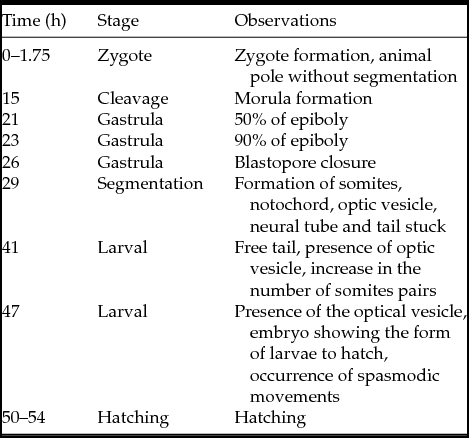
The period of embryonic development of B. nattereri from fertilization up to hatching, was 50–54 h, at ~19°C, corresponding to 1034 degree-hours. The following embryonic development stages were observed: zygote, cleavage, gastrula, segmentation, larval and hatching (Table 1). There was heterogeneity in embryo development because different stages of development were observed at the same time.
Embryonic development of Paraitinga Brycon nattereri

After 1.75 h from fertilization, there was cytoplasmic migration with the animal pole individualization and zygote formation over the yolk. Then, the cleavage stage was characterized by a succession of mitotic divisions without increase in cytoplasmic content, and ending with the beginning of epibolic movement. The gastrula stage was marked by the beginning of the epiboly movement, when blastomeres migrated in the opposite direction to the animal pole, so that at the end of this movement the yolk was completely involuted by the blastoderm. The epiboly movement covering approximately 50% of the yolk was observed 21 h after fertilization; 2 h later, the yolk was 90% covered. The epiboly movement culminated with blastopore closure at 26 h from embryogenesis, when the yolk was completely surrounded by the blastoderm, forming yolk sac. The segmentation stage (29 h) was characterized by the formation of organs such as the optic vesicle, notochord, somites, posterior intestine, prosencephalon, mesencephalon and rhombencephalon, with the consequent growth and elongation of the embryo. At this stage the embryo tail was still attached.
The embryo at the larval stage (41 h) was characterized by the free tail, presence of the optic vesicle, increase in the number of somites pairs, also the embryo already presented the larval form at hatching. The notochord extended from the cephalic region to the tail. Another characteristic of this stage was the occurrence of spasmodic movements by the embryos, which increased with embryonic development. At the moment of hatching, the larvae presented vigorous swimming movements, important for the disruption of the chorion. Hatching of the larvae began at 50 h after the fertilization, and 4 h later it was possible to observe that all larvae that had initiated the hatching process had disrupted the chorion.
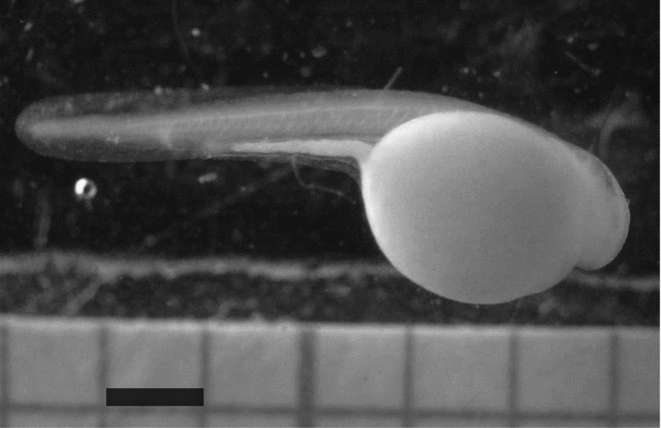
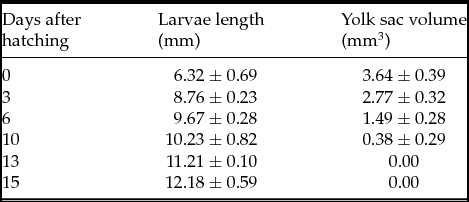
The recently hatched larvae (day 0; yolk sac larval stage) are totally transparent, devoid of mouth, visual acuity and swimming capacity, with a 6.32 ± 0.69 mm average total length (Fig. 1). The yolk sac was ellipsoid with an average volume of 3.64 ± 0.39 mm3; the anal region was defined, but closed (Table 2).
Recently hatched larva of Brycon nattereri. Bar = 1 mm.

Length and volume of the yolk sac (mean ± standard deviation) of Paraitinga Brycon nattereri larvae evaluated between hatching (day 0) and 15 days after hatching

On day 3 after hatching, it was possible to observe that some larvae initiated opening of the mouth, colouring of the eyes and the body, and signs of the branchial arcs. In this period they presented 8.76 ± 0.23 mm in length and a large amount of yolk. On the fourth day these events could be visualized more frequently between the larvae. Up to the fourth day, all larvae were at the bottom of the culture boxes, in lateral decubitus, grouped on their extremities. The probable reasons for this behaviour would be the weight of the yolk sac and the presence of signs of the swim bladder and pectoral fins, preventing them from obtaining balance and moving in the water column. On the fifth day the branchial arcs were more developed. The larvae did not exhibit cannibalism during on the first 15 days of life.
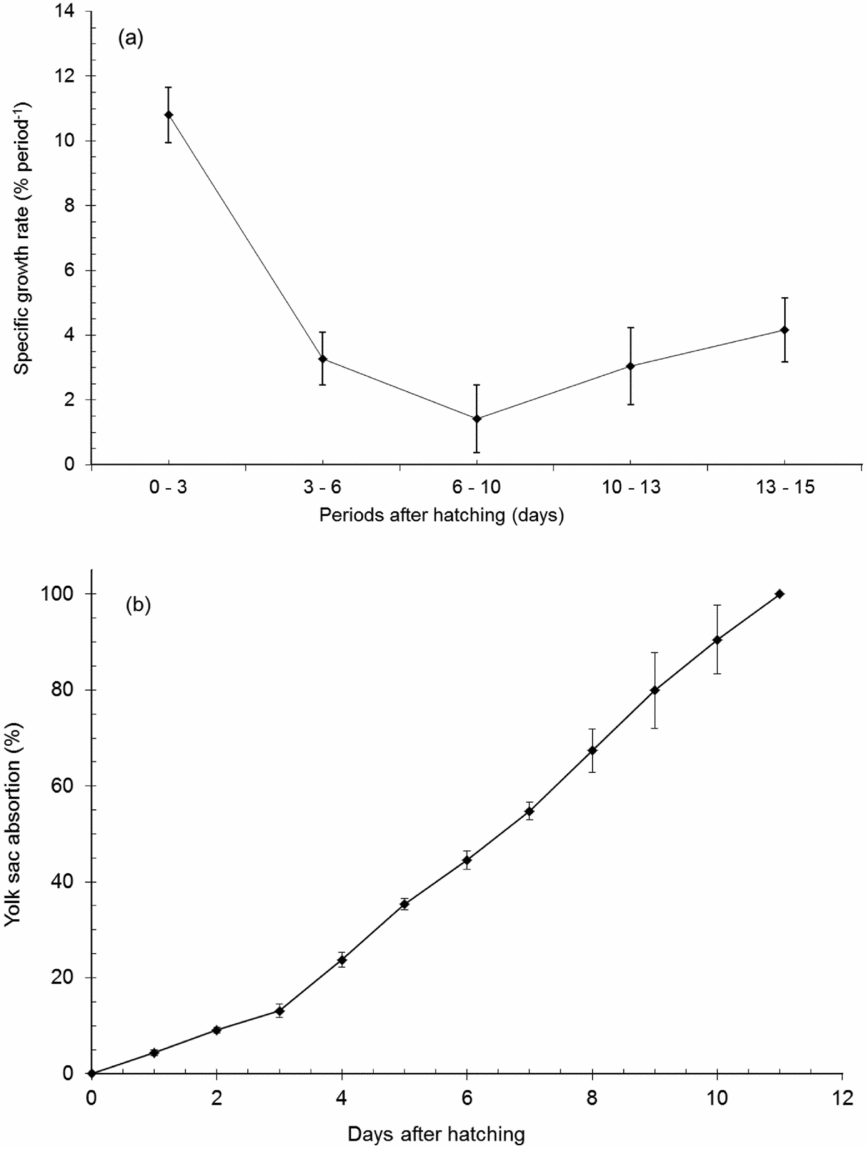
There was a decrease in the growth rate from 10.80% between 0 and 3 days, to 1.42% between 6 and 10 days (Fig. 2 a). During these first 10 days (yolk sac larval stage), the larvae absorbed the yolk, as can be observed in Fig. 2 b. Absorption was slower during the first 3 days. After this period, absorption increased sharply, being concluded on the 11th day, coinciding with the start of the preflexion stage. In this period, the larvae presented intermittent swimming, consisting of short periods of activity followed by long periods of recovery. After the 11th day, the first intestinal content of the larvae was observed; the swim bladder was completely inflated and pigmented; body growth rate resumed, reaching 4.2% in the period 13–15 days (Fig. 2 a). On the 14th day, the start of notochord flexion (flexion stage) was observed.
(a) Specific growth rate of Paraitinga Brycon nattereri larvae (mean ± standard deviation) during five different periods of time after hatching (in days). (b) Daily absorption of the yolk sac.

Discussion
The morphological events registered during embryonic and larval development of B. nattereri followed similar patterns previously reported for other Brycon species (Andrade-Talmelli et al. Reference Andrade-Talmelli, Kavamoto, Romagosa and Fenerich-Verani2001; Nakatani et al., Reference Nakatani, Agostinho, Baumgartner, Bialetzki, Sanches, Makrakis and Pavanelli2001; Alexandre et al., Reference Alexandre, Ninhaus-Silveira, Veríssimo-Silveira, Buzollo, Senhorini and Chaguri2010; Gomes et al., Reference Gomes, Sato, Rizzo and Bazzoli2013; Isaú et al., Reference Isaú, Rizzo, Amaral, Mourad and Viveiros2013), however the developmental stages were slower due to the low water temperature required by the species.
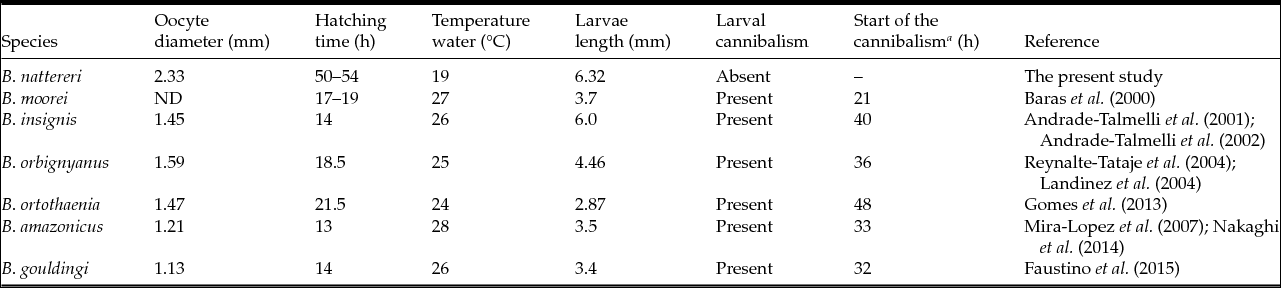
In this study, the closure of the blastopore occurred around 26 h and hatching began after 50 h of fertilization, when incubated at 19°C. This temperature is usually observed in this region during the reproductive period of the species (Viveiros et al., Reference Viveiros, Maria, Amaral, Orfão, Isaú and Veríssimo-Silveira2012a; Maria et al., Reference Maria, Orfão, Rizzo, Ninhaus-Silveira and Viveiros2015), therefore it may be considered as a comfortable temperature for this species. Brycon nattereri embryogenesis can be considered as long compared with other species of the genus Brycon, such as B. cf. erythropterus (Eckmann, Reference Eckmann1984), B. orbignyanus (Nakatani et al., Reference Nakatani, Agostinho, Baumgartner, Bialetzki, Sanches, Makrakis and Pavanelli2001), B. insignis (Andrade-Talmelli et al., Reference Andrade-Talmelli, Kavamoto, Romagosa and Fenerich-Verani2001; Isaú et al., Reference Isaú, Rizzo, Amaral, Mourad and Viveiros2013), B. siebenthalae (Clavijo-Ayala & Arias-Castellanos, Reference Clavijo-Ayala and Arias-Castellanos2004), B. orthotaenia (Gomes et al., Reference Gomes, Sato, Rizzo and Bazzoli2013) and B. cephalus (Alexandre et al., Reference Alexandre, Ninhaus-Silveira, Veríssimo-Silveira, Buzollo, Senhorini and Chaguri2010) in which embryonic development was concluded between 11 and 30 h after fertilization, at 23 to 28°C (Table 3). Temperature is the main factor controlling the development rate of fish (Kamler, Reference Kamler1992). Its action in the embryonic period is connected to variation in the embryogenesis rate, and variation (asynchronicity and malformation) in the development of the embryos (Morrison et al., Reference Morrison, Miyake and Wright2001). The development and growth of fish are interrupted below the minimum temperature limit, whereas mass mortality occurs at temperatures above the maximum limit (Kamler, Reference Kamler1992). In Prochilodus lineatus, the duration of embryonic development at an incubation temperature of 24°C was 1.6 times slower than that at 28°C (Ninhaus-Silveira et al., Reference Ninhaus-Silveira, Foresti and Azevedo2006). Ectothermic animals present accelerated development in higher temperatures due to temperature-induced alterations in enzymatic activities during organogenesis (Ojanguren & Braña, Reference Ojanguren and Braña2003). Besides temperature, the size of the oocyte is another factor that influences incubation time. According to Kamler (Reference Kamler2002), oocyte size is responsible for prolongation of the time of specific ontogenetic phases. Brycon nattereri oocytes are larger than those of other Brycon species (Maria et al., Reference Maria, Orfão, Rizzo, Ninhaus-Silveira and Viveiros2015), leading to a longer incubation period.
Oocyte diameter (mm), hatching time (h), incubation temperature (°C) and larval characteristics observed in species of the Brycon genus

ND, not determined; a Hours after hatching
The hatching rate observed in this study varied from 0.6 to 23.6%. Despite this rate being a low value, it can be considered satisfactory as it refers to a little domesticated species that lacks scientific studies on its artificial reproduction. In other Brycon species, the hatching rates varied from 10.5 to 30% in B. orbignyanus (Belmont, Reference Belmont1994; Zaniboni-Filho & Barbosa, Reference Zaniboni-Filho and Barbosa1996), 24–42% in B. insignis (Andrade-Talmelli et al., Reference Andrade-Talmelli, Kavamoto, Narahara and Fenerich-Verani2002; Viveiros et al., Reference Viveiros, Isaú, Caneppele and Leal2012b) and 40% in B. opalinus (Narahara et al., Reference Narahara, Andrade-Talmelli, Kavamoto and Godinho2002). Funnel type incubators were used in this study, based on the shape of incubators normally used for other species of this genus. However, the low hatching rate observed may be due to the type of incubator used. Funnel type incubators (vertical format) are indicated for species that present free eggs and larvae with vertical movement in the water column (Sato et al., Reference Sato, Fenerich-Verani, Godinho, Godinho and Godinho2003b). These characteristics were not observed in B. nattereri, whose eggs were weakly adhesive, and the larvae, after hatching, did not move vertically in the water column. Sieve-type incubators (horizontal format) are usually used for these species (Sato et al., Reference Sato, Fenerich-Verani, Godinho, Godinho and Godinho2003b).
Knowledge on the development stages and larval growth of fish is important, mainly in the determination of the moment of the yolk sac absorption and mouth opening, indicators of the need for exogenous feeding. In B. nattereri, the volume of the yolk sac was 6 to 10 times larger than that of other tropical species such as B. orbignyanus (0.62 mm3; Reynalte-Tataje et al., Reference Reynalte-Tataje, Zaniboni-Filho and Esquivel2004) and Piaractus mesopotamicus (0.38 mm3; Clavijo-Ayala et al., Reference Clavijo-Ayala, Vetorelli and Portella2006), providing a longer period of endogenous feeding. This situation might be associated with the species’ adaptation strategy for the environment in which it lives. Brycon nattereri spawn in the headwaters region, in clear and cold waters with lower primary productivity (Oliveira et al., 2007; Lima et al., Reference Lima, Albrecht, Pavanelli and Vono2008; Maria et al., Reference Maria, Orfão, Rizzo, Ninhaus-Silveira and Viveiros2015). Water temperature is a factor that influences the period of endogenous feeding of fish larvae because of its direct effects on their oxygen consumption, yolk exhaustion rate, feeding activity and food conversion efficiency (Kamler, Reference Kamler1992; Kamler, Reference Kamler2002; Teletchea & Fontaine, Reference Teletchea and Fontaine2010). In the present study, a lower water temperature contributed to a longer period of endogenous feeding for the B. nattereri larvae.
In this study, a high growth rate of the larvae between 0 and 3 days after hatching, reduction of the growth rate between 3 and 10 days, and resumed of growth rate between 11 and 15 days was observed. The period of growth reduction coincided with the period when the larvae have completely absorbed the yolk. According to Kamler (Reference Kamler1992), the growth reduction of yolk sac discloses energy deficit and tissue absorption. In a study carried out with five species of freshwater fish, it was noted that the energy contained in the yolk was used mainly for tissue growth, less energy was expended in metabolism, and still less in excretion of residual materials (Jaworski and Kamler, Reference Jaworski and Kamler2002). According to these authors, energy partition was similar between different species, regardless of egg size and preference of incubation temperature. After absorption of the yolk by the B. nattereri larvae, body growth was resumed due to the beginning of the exogenous feeding, observed after the 11th day after hatching.
The total length of the B. nattereri larvae after hatching (6.32 mm) was higher than that observed for other species of the genus Brycon, such as B. orbignyanus (4.46 mm; Reynalte-Tataje et al., Reference Reynalte-Tataje, Zaniboni-Filho and Esquivel2004). However, B. nattereri larvae presented slower initial growth in relation to this species. In this study, the B. nattereri larvae presented an average total length of 9.50 mm at 4 days after hatching, and 12.18 mm at 15 days. In B. orbignyanus, an average total length of 7.8 mm was observed at 4 days, and 17.60 mm at 15 days (Reynalte-Tataje et al., Reference Reynalte-Tataje, Zaniboni-Filho and Esquivel2004). The higher length of the B. nattereri larvae in relation to B. orbignyanus at 4 days is due to the higher length of the larvae immediately after hatching, and larger oocyte size. At 15 days these values were the opposite, and the B. nattereri larvae were smaller. This change is probably because B. nattereri needs lower water temperatures, thus resulting in slower development.
Brycon nattereri larvae, after beginning of the exogenous feeding, did not exhibit cannibalism, as do most species of Brycon. Cannibalism starts in B. cephalus (Romagosa et al., Reference Romagosa, Narahara and Fenerich-Verani2001), B. orbignyanus (Reynalte-Tataje et al., Reference Reynalte-Tataje, Zaniboni-Filho and Esquivel2004), B. moorei (Baras et al., Reference Baras, Ndao, Maxi, Jeandrain, Thomé, Vandewalle and Mélard2000), B. siebenthalae (Atencio-García et al., Reference Atencio-García, Zaniboni-Filho, Pardo-Carrasco and Arias-Castellanos2003), B. insignis (Souza, Reference Souza2004) and B. ortothaenia (Gomes et al., Reference Gomes, Sato, Rizzo and Bazzoli2013) between 21 and 72 h after hatching. The incidence of cannibalism between the larvae can reach up to 60% in B. cephalus (Leonardo et al., Reference Leonardo, Hoshiba, Senhorini and Urbinati2008) and is responsible for high mortality during larviculture, which makes its breeding difficult, being a limiting factor for fish production (Leonardo et al., Reference Leonardo, Hoshiba, Senhorini and Urbinati2008). The absence of cannibalism in B. nattereri is a great advantage in the captivity production process, as it facilitates handling, reduces feeding costs and increases survival rate.
These first results of the embryonic development and larval growth of B. nattereri provide important information for the success of captive rearing. This species presents some characteristics that differ sharply from other species of the same genus. Brycon nattereri presents some positive aspects for captive rearing, such as better resistance to handling at low temperatures, absence of cannibalism in its initial phase, and a long period of endogenous feeding. These characteristics, among others, require the development of specific management techniques to increase their survival rate in captivity.
Acknowledgements
The authors wish to thank the Companhia Energética de Minas Gerais (CEMIG, Itutinga Unit, MG) for providing the broodstock and FAPEMIG for financial support (project CVZ-1609/06).