Introduction
In West Africa, grain legumes, especially peanut Arachis hypogaea (L.), cowpea Vigna unguiculata (L.) Walpers and Bambara groundnut Vigna subterranea (L.) Verdcourt, are very important in the diets of rural communities as rich sources of protein (Stanton et al., Reference Stanton, Doughty, Orraca-Tetteh and Steele1966; Lale and Vidal, Reference Lale and Vidal2003). However, because of their high susceptibility to several storage pests, they are out of reach during a long period of the year, and their nutritive potential is therefore underutilized (Sanon et al., Reference Sanon, Ouedraogo, Tricault, Geland and Huignard1998). Bruchids (Coleoptera: Bruchidae) are common storage pests of various grain legumes throughout the world (Huignard, Reference Huignard1985; Giga and Smith, Reference Giga and Smith1987; Shazali, Reference Shazali1989; Tuda et al., Reference Tuda, Choub, Niyomdham, Buranapanichpan and Tateishi2005). In West Africa, Callosobruchus maculatus (F.) mainly develops on cowpea and is considered to be the most serious pest of this crop in storage (Glitho, Reference Glitho1990; Ouédraogo et al., Reference Ouedraogo, Sou, Sanon, Monge, Huignard, Tran and Credland1996; Sanon et al., Reference Sanon, Ouedraogo, Tricault, Geland and Huignard1998; Boeke et al., Reference Boeke, van Loon, van Huis and Dicke2004). The crop is colonized in the field by the females, which lay their eggs on the maturing pods (Ouédraogo and Huignard, Reference Ouédraogo, Huignard and Labeyrie1981; Sanon et al., Reference Sanon, Dabiré, Ouedraogo and Huignard2005). The neonate larvae penetrate the pod wall and seed tegument and reach the cotyledons where they feed and develop. At harvest, < 3% of the seeds contain bruchid larvae (Sanon et al., Reference Sanon, Dabiré, Ouedraogo and Huignard2005). Bruchid development during subsequent generations in storage causes 80–90% losses in 5–6 months in the absence of appropriate control measures (Ouédraogo et al., Reference Ouedraogo, Sou, Sanon, Monge, Huignard, Tran and Credland1996; Sanon et al., Reference Sanon, Ouedraogo, Tricault, Geland and Huignard1998).
Bambara groundnuts are mainly infested by another bruchid species Callosobruchus subinnotatus (Pic.) but are less damaged compared with cowpeas by C. maculatus (Appleby and Credland, Reference Appleby and Credland2001; Lale and Vidal, Reference Lale and Vidal2001). However, during storage, grains of Bambara groundnut can also be occasionally infested by C. maculatus (Haines, Reference Haines1991). The conditions of Bambara groundnut initial infestation by C. maculatus are not clearly established, but colonization could occur when harvested pods and seeds are left in the field to dry (Dike, Reference Dike1994) as it has been observed for peanut infestation by the bruchid Caryedon serratus (Olivier) (Robert, Reference Robert1984). Experiments on stored Bambara concurrently infested by C. maculatus and C. subinnotatus demonstrated that the first performs best causing most of the losses (Lale and Vidal, Reference Lale and Vidal2001, Reference Lale and Vidal2003). However, it is unclear whether this is due to a specific adaptation of C. maculatus to the host plant, or to a reproductive diapause of the concurrent pest species (Appleby and Credland, Reference Appleby and Credland2001). Therefore, we investigated whether C. maculatus, which is already a serious pest of cowpea, could also become a key pest of Bambara groundnut. Understanding the conditions in which a pest develops on a specific host is not only important for pest control but also for predicting whether an insect has the potential of becoming a pest (Tuda et al., Reference Tuda, Choub, Niyomdham, Buranapanichpan and Tateishi2005). Factors that may influence oviposition of insects on a specific host are various and include morphology, nutritional quality in relation to chemical composition, host abundance (or availability), and the absence of predators and/or competitors (Teixeira and Zucoloto, Reference Teixeira and Zucoloto2003). Size, morphology and chemical composition greatly vary between Bambara groundnut and cowpea seeds (Goli, Reference Goli and Heller1997), and could influence their infestation by C. maculatus. Wasserman and Futuyma (Reference Wasserman and Futuyma1981) also demonstrated that the use of a plant by C. maculatus is related to host acceptability (the likelihood of a plant being accepted if it is encountered by an insect) and host suitability (i.e. survival, growth and reproduction).
The aim of the present study was to characterize the changes in the reproductive abilities of a C. maculatus strain that had been selected on cowpea during 1 year and transferred on two varieties of Bambara groundnut. Then, host acceptability and life history characteristics of C. maculatus were compared on cowpea and on the two Bambara groundnut varieties during a continuous rearing of the insect on each of the hosts for eight generations, with the aim of better understanding the conditions of C. maculatus development on Bambara groundnut, and also the possible evolution of its pest status on this occasional host.
Material and methods
Experimental conditions
All the experiments were conducted in the laboratory under fluctuating environmental conditions at the University of Ouagadougou in Burkina Faso. Variations in temperature and relative humidity were recorded daily by a thermo-hygrometer placed on the drainboards, and allowed to establish the minima and maxima and the mean values. The study started in early March 2005 and lasted till the end of October in the same year.
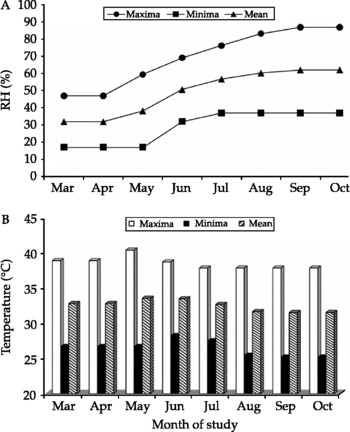
Maxima, minima and mean values of relative humidity and temperatures fluctuated monthly during the period of study (Fig. 1A and B). Mean relative humidity was low at the beginning of the study (30%) but increased over time, up to 60% from August onwards (Fig. 1A). Mean temperatures fluctuated between 33 and 34 °C from March to July and decreased to 32 °C by August onwards (Fig. 1B).
Variations in minima, maxima and mean values of relative humidity (A) and temperature (B) during the study

Host plant material
Seeds of V. unguiculata and V. subterranea used in this study had been harvested in October 2004 in Kamboinsé near Ouagadougou in Burkina Faso. Cowpeas of the Local Moussa variety and Bambara groundnuts of the Local Beige and Local Striped varieties were used. The morphological characteristics of seeds used as hosts for C. maculatus development are summarized in Table 1. Size and weight of the two Bambara groundnut cv. were higher than those of the cowpea cv., while the seed texture was smooth for both cowpea and Bambara seeds.
Morphological characteristics of the seeds of cowpea and Bambara groundnut varieties used as hosts for Callosobruchus maculatus development

Size (wider one for cowpea) and weight were measured on 150 seeds randomly collected for each host.
* Means within columns followed by different letters significantly differ according to the Bonferroni post-hoc test at the 5% level.
For all the varieties, the seeds were sorted to eliminate those carrying eggs or containing nymphs of beetles or those that were perforated. Those remaining were placed in a freezer at a temperature of − 18 °C for 1 week to eliminate any initial infestation.
Insect origin and rearing
The strain of C. maculatus used in this study was obtained from cowpeas (cv. Moussa) collected in the Kamboinsé region in October 2003. Newly emerging adults belonging to the flightless form were put in plexiglas boxes (18 × 11 × 4 cm) containing healthy seeds of the same cowpea variety on which the females could lay their eggs. After 20–32 days, depending on the climatic conditions (Sanon and Ouédraogo, Reference Sanon and Ouedraogo1998), insects of the new generation were used to maintain the strain during at least 1 year prior to the start of experiments.
Oviposition and development of C. maculatus on cowpea and Bambara groundnut varieties
At the start of the study, 60 pairs (males and females) of 1-day-old C. maculatus adults were isolated from the V. unguiculata strain and individual couples were placed into Petri dishes. Then, ten seeds of either cowpea (cv. Moussa) or each of the two Bambara groundnut varieties were offered as hosts for oviposition in the Petri dishes. The experiment was laid out as a randomized factorial block design with three treatments (three types of seed hosts) and 20 replications. The seeds of each type of host (cowpea and the two Bambara groundnut cv.) were renewed each 24 h during the females' lifespan. The removed seeds were isolated and observed until all F1 beetles had emerged. The newly emerged insects were daily sexed, counted and removed from the dishes. Adults of the F1 generation were used for rearing an F2 generation and so on, until the 8th generation of C. maculatus on each type of seed. Each generation was treated and monitored in the same way as the F1 generation.
Data collection and analysis
Host acceptability was determined by the mean number of eggs laid on each type of host (Singer, Reference Singer, Miller and Miller1986; Teixeira and Zucoloto, Reference Teixeira and Zucoloto2003). Suitability was measured by the life history characteristics including female lifespan and the percentage of egg hatching 1 week post-oviposition. Larval survival rate was estimated from the number of emerging adult insects divided by the number of hatched eggs times 100. The duration of pre-imaginal development was also established. These data allowed the determination of the intrinsic rate of natural increase (r m) of C. maculatus populations per day on each host and its variation among the generations. It was estimated according to Howe (Reference Howe1953) and then simplified by Boeke et al. (Reference Boeke, van Loon, van Huis and Dicke2004) using the following formula: r m = ln x/(t+0.5p); where ln is the Naperian logarithm, x is the number of female offspring that emerged, t is the developmental period in days and p is the longevity of the female parent beetle (oviposition period).
For host seeds' influence, data recorded on different hosts at each generation were analysed separately by a one-way ANOVA followed by a Bonferroni post hoc test as used by Boeke et al. (Reference Boeke, van Loon, van Huis and Dicke2004). The generation effect on parameters used, considered to be under influence of environmental variations as well as to an evolution in the acceptability/suitability of the hosts, was submitted to a correlation analysis through a Z-test (Cohen and Cohen, Reference Cohen and Cohen1983). All comparisons were made at the probability level of 5%.
Results
Variations in host acceptability
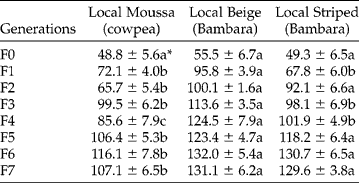
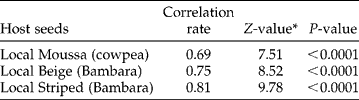
Females laid eggs on the seeds of cowpea and on those of the two Bambara groundnut varieties (Table 2). Fecundity did not significantly differ between females in the presence of the three host types at the start of experiment (F0). However, from the F1 and onwards, fecundities were higher on the seeds of cv. Local Beige compared with cowpea and sometimes also compared with the other Bambara groundnut variety. Fecundities were also larger on cv. Local Striped in comparison with cowpea by the F4 and onwards. Positive and significantly high correlations were recorded between generation number (ranging from F1 to F7) and fecundities on each of the three tested host seeds (Table 3) but did not significantly differ from each other (Z = 0.81; P = 0.209).
Variations in mean number of eggs (±SE) laid by the F0–F7 Callosobruchus maculatus females (host acceptability) on different host seeds
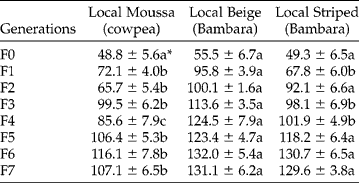
* Means within rows followed by different letters significantly differ according to the Bonferroni post-hoc test at the 5% level.
Correlation analysis of the generation number with the number of eggs laid by Callosobruchus maculatus (host acceptability) on different host seeds
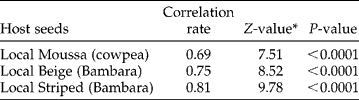
* A Z-test was performed to determine whether correlation rates calculated for each host seed were significant or not. Discrimination was made at the 5% level.
Variations in host suitability
Female lifespan
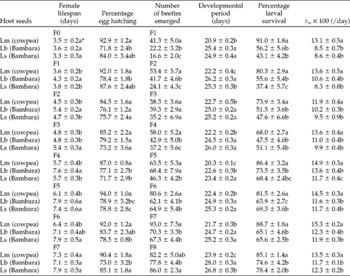
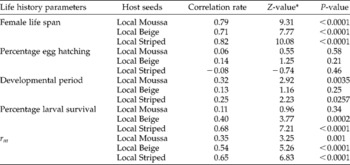
Female lifespan was similar for insects exposed to the three hosts at the beginning and at the end of the experiment (Table 4). The correlation analysis revealed that female longevity increased throughout the study period regardless of the host seeds (Table 5).
Variations in life history parameter values (means±SEM) of Callosobruchus maculatus developing on different host seeds for eight generations

Lm, Local Moussa cowpea variety; Lb, Local Beige Bambara groundnut variety; Ls, Local Striped Bambara groundnut variety; r m, intrinsic rate of natural increase. * Means (+/ − SD) of each parameter are compared in columns for the same generation; different letters indicate significant differences according to the Bonferroni post-hoc test at the 5% level.
Correlation analysis of generation/time-related variations in life history parameters of Callosobruchus maculatus developing on different host seeds

* A Z-test was performed to determine whether correlation rates calculated for each host seed were significant or not. Discrimination was made at the 5% level.
Egg hatching
During the whole period of study, the percentage of egg hatching was relatively high (>70%) regardless of the host seed used (Table 4). Most of the time, egg hatching was highest on cowpea seed variety compared with the Bambara groundnut cv. Differences in egg hatching were not related to a possible time or generation effect, irrespective of the type of host seeds used (Table 5).
Developmental period
Post-embryonic development was shorter for insects developing on cowpea during the whole-study period, regardless of the generation number (Table 4). The developmental time was correlated to generation of insects developing on cowpea (P = 0.0035) and on the Bambara groundnut cv. Local Striped (P = 0.0257; Table 5). On the contrary, the development duration was not affected by the continuous rearing of C. maculatus on Bambara groundnut cv. Local Beige (P = 0.25; Table 5).
Larval survival
For all the generations followed during the study, larval survival was significantly higher for larvae developing on cowpea (Table 4). While the survival of C. maculatus larvae did not vary over generations on the tested cowpea variety (P = 0.34), the correlation analysis revealed an increase of larval survival on both Bambara groundnut cv. with subsequent generations (P = 0.002 and < 0.0001 for Local Beige and Local Striped, respectively; Table 5).
Intrinsic rate of natural increase (r m)
During the study period, the intrinsic rate of natural increase was highest for C. maculatus developing on cowpea compared with the Bambara groundnut cv. irrespective of the generation (Table 4). The correlation analysis revealed a link between r m and time/generation for insects reared on the three host seeds (Table 5), the correlation rates (r = 0.54 and 0.65 for Local Beige and Local Striped, respectively) being significantly higher on both Bambara groundnut varieties (P < 0.0001) in comparison with cowpea.
Discussion
The results of this study suggest that a C. maculatus strain selected on cowpea during 1 year is able to develop on both tested Bambara groundnut varieties for a long period (at least 8 months in the present study). These findings are consistent with field reports on Bambara groundnut infestations by C. maculatus, sometimes concurrently with C. subinnotatus (Haines, Reference Haines1991; Mbata, Reference Mbata1992). In several regions of Burkina Faso, both bruchid species are present in the same environment where cowpea and Bambara groundnut are produced and stored. Then, complex relations may have established between the pests and their potential hosts. In holometabolous insects such as bruchids, where the immature instars have restricted movements, the oviposition behaviour of adults and larval development in the host are decisive factors in terms of host range (Wasserman and Futuyma, Reference Wasserman and Futuyma1981; Carrière, Reference Carrière1998; Teixera and Zucoloto, Reference Teixeira and Zucoloto2003). Studies performed by Tuda et al. (Reference Tuda, Choub, Niyomdham, Buranapanichpan and Tateishi2005) on pest status of the genus Callosobruchus demonstrated the existence of a relatively wide range of host plants for the genus in general and specifically for Callosobruchus chinensis and C. maculatus. The authors argued that specific ecological properties like utilization of a wide range of hosts and expansion of geographical distribution are involved in the ability of Callosobruchus spp. to establish themselves on different hosts across many geographical locations. The developmental plasticity is illustrated in this study by several biological indicators, which gave evidence of an important potential for a relatively rapid adaptation of C. maculatus on the two tested Bambara groundnut varieties, although these appeared initially to be less suitable hosts than cowpea.
The first indicator is host acceptability. As previously indicated by Singer (Reference Singer, Miller and Miller1986), the term is used in the present study rather than preference, because no host choice experiments were performed. The results showed that, by the second generation and onwards, C. maculatus females deposited a larger number of eggs on Bambara groundnut seeds than on cowpea. Host size probably played an important role in female egg laying. In fact, both Bambara groundnut seed types were larger than those of the tested cowpea variety Local Moussa. Previous studies of bruchids have already indicated that host size influences the number of eggs oviposited (Simmonds et al., Reference Simmonds, Blaney and Birch1989). Other factors that strongly affect egg laying are morphological parameters, such as texture (Johnson and Kistler, Reference Johnson, Kistler, Slansky and Rodrigues1987), chemical characteristics of the seed coat (Lale and Makoshi, Reference Lale and Makoshi2000) and nutritional quality (Janz and Nylin, Reference Janz and Nylin1997). The texture of all the three types of host seeds was smooth, and probably only the relative quantity and/or quality of resource available inside the seeds was taken into account by females for deciding on the number of eggs oviposited on the seeds (Cope and Fox, Reference Cope and Fox2003).
Other indicators of C. maculatus adaptability to Bambara groundnut seeds came from the extent of larval survival inside the hosts and the intrinsic rate of natural increase. The latter is an overall fitness parameter (Giga and Smith, Reference Giga and Smith1983). Although both parameters were higher on cowpeas, the increase in the intrinsic rate of increase of C. maculatus was faster and higher when developing on the two Bambara groundnut varieties compared with cowpea. However, larval mortality was important inside Bambara seeds, whatever the number of eggs laid, indicating that acceptability is not always correlated with suitability (Giga and Smith, Reference Giga and Smith1987; Shazali, Reference Shazali1989). The chemistry of seeds may be the most important factors determining interactions between the development of bruchids and their host plants (Tuda et al., Reference Tuda, Rönn, Buranapanichpan, Wasano and Arnqvist2006). Secondary metabolites, such as non-protein amino acids, can serve as chemical defence against herbivores including granivores (Gatehouse et al., Reference Gatehouse, Minney, Dobie, Hilder, Fujii, Gatehouse, Johnson, Mitchel and Yoshida1990; Tuda et al., Reference Tuda, Rönn, Buranapanichpan, Wasano and Arnqvist2006). Primary metabolites (e.g. lectins, proteinase and amylase inhibitors present in leguminous seeds) are also involved in crop plant resistance (Omitogun et al., Reference Omitogun, Jackai and Thottappilly1999). Our results of differential development of C. maculatus on the three host species might be due to differences in the chemical composition of the hosts. The results also suggest that chemical composition may differ between both Bambara groundnut varieties, with cv. Local Striped appearing to be more suitable for C. maculatus development. However, only detailed chemical analyses of the metabolites produced by the three hosts could confirm this hypothesis.
Conclusion
We demonstrated that C. maculatus has the potential to become a serious pest of Bambara groundnut when the insects are exposed to the host seeds over a relatively long period. Evidence of insect adaptation on this occasional host was mainly given by an improvement of larval survival and the intrinsic rates of increase. In West Africa where farmers often store Bambara groundnuts and cowpeas in the same areas, the conditions for pest status change are met. Hence losses in stored Bambara groundnuts due to C. maculatus could increase (Lale and Vidal, Reference Lale and Vidal2001), especially when the pest populations develop without or with limited pressure from the natural enemy fauna, especially parasitoids, associated with bruchids in cowpea stores. More knowledge on the ability of the C. maculatus parasitoid community to adapt to a C. maculatus–Bambara groundnut complex is needed for a better understanding of the possible pest status change in the future.
Acknowledgements
This study was supported by a PhD research grant of the Ministère des Enseignements Secondaire, Supérieur et de la Recherche Scientifique of Burkina Faso and by a CORUS-6072 contract funded by the Ministère de la Coopération Française, which also facilitated collaboration between the Universities of Rennes 1 and Ouagadougou.