Introduction
Projections of the number of elderly people suffering from dementia in Europe show a growth from 6 million in 2010 to 14 million in 2050 (Mura et al., Reference Mura, Dartigues and Berr2010). The majority of people with dementia will spend the last years of their lives in a nursing home and will die there (Mitchell et al., Reference Mitchell, Teno, Miller and Morisson2005; Houttekier et al., Reference Houttekier, Cohen, Bilsen, Addington-Hall, Onwuteaka-Philipsen and Deliens2010); achieving a high quality of dying for nursing home residents with dementia is thus a major challenge.
However, in many countries, there is a lack of high quality data monitoring the current quality of dying and quality of care provided at the end of life for this population. In addition, international studies comparing how nursing home residents with dementia die in different countries are scarce, even though there seems to be considerable variation in the operation of nursing homes across Europe (Meijer et al., Reference Meijer, Van Campen and Kerkstra2000; Damiani et al., Reference Damiani2011; Froggatt et al., Reference Froggatt, Brazil, Hockley, Reitinger, Gott and Ingleton2011). In Belgium, nursing home residents have their general practitioners (GPs) visiting them on a regular basis. GPs remain the treating physicians as is the case in most European countries. Dutch nursing homes employ elderly care physicians and always have one on standby. Because they are based in the nursing home, these physicians can get to know the residents and their families very well during their stay in the home (Munn et al., Reference Munn2007; Gijsberts et al., Reference Gijsberts, van der Steen, Muller and Deliens2008).
Cross-national comparisons could provide important insights into how different systems might produce different outcomes. Earlier studies focus on a single country or area, often outside Europe, report on residents with advanced dementia only, and provide data from a limited number of long-term care settings in specific areas or focus on one specific quality measure such as the satisfaction with care (Aminoff and Adunsky, Reference Aminoff and Adunsky2005; Engel et al., Reference Engel, Kiely and Mitchell2006; Mitchell et al., Reference Mitchell, Kiely, Jones, Prigerson, Volicer and Teno2006, Reference Mitchell2009; Di Giulio et al., Reference Di Giulio, Toscani, Villani, Brunelli, Gentile and Spadin2008; van der Steen et al., Reference van der Steen, Gijsberts, Muller, Deliens and Volicer2009; Cohen et al., Reference Cohen2012; Meeussen et al., Reference Meeussen2012).
Trends were found in the few existing cross-national studies on quality of dying and end-of-life care comparing US nursing homes with those in the Netherlands (van der Steen et al., Reference van der Steen, Gijsberts, Muller, Deliens and Volicer2009; Cohen et al., Reference Cohen2012). The first study, using US data from 1999 and Dutch data from 2005 to 2007, found a more favorable outcome in the Netherlands regarding comfort while dying, satisfaction with end-of-life care, and symptom burden as reported by the relatives. Another study using US data from 2007 to 2009 and Dutch data from 2008 to 2009 found that US relatives reported better outcomes than Dutch relatives based on the same scales, possibly due to improvements in US end-of-life care (Cohen et al., Reference Cohen2012).
In this study, we describe and compare the quality of dying and quality of end-of-life care as judged by relatives of deceased nursing home residents with dementia in Belgium and the Netherlands.
Methods
Study design
We combined data from the Belgian Dying Well with Dementia and the Dutch End Of Life in Dementia (DEOLD) studies both investigating the end-of-life of nursing home residents with dementia.
Belgium
The Dying Well with Dementia (2010) study was a retrospective cross-sectional study in a representative sample of nursing homes in Flanders, the Dutch-speaking part of Belgium where 60% of the population lives. For all nursing home residents who died with dementia over a period of three months, structured questionnaires were sent to the nurse most involved in their care, their GP, their relative, and the nursing home administrator.
A random sample of Flemish nursing homes was taken, stratified by region, type, and size.
Nursing home residents had to meet the criteria used by the Belgian health insurance system: either the person has a category C dementia (experiences disorientation in time and space almost daily), or is completely care dependent or in need of help for bathing, dressing, eating, toileting, continence, and transferring plus showing signs of disorientation of time and space. After this first selection, GPs and nurses had to indicate whether the resident had dementia or a diagnosis of dementia. If so, those whose relative answered the questionnaire after death were included in the analysis.
One contact person per nursing home identified, together with the researcher, all nursing home residents who had died in the past three months.
The relative was a family member or friend who, according to the nursing home administrator, was most closely involved in the resident's care. The contact persons of each home sent the questionnaires and reminders to all participants, ensuring anonymity by using a unique code linked to the nursing home resident.
The Medical Ethical Committee of UZ Brussel (University Hospital of Brussels) approved the study protocol.
The netherlands
The DEOLD study was a combined prospective and retrospective study: data collection (January 2007 and July 2011) was prospectively done in 28 nursing homes. In six nursing homes, data were collected retrospectively, consecutively identifying deceased residents between November 2007 or February 2009 and March 2010. Structured questionnaires were completed by the relative two months after death and by the elderly care physician, beginning at admission (prospective) or within two weeks after death (retrospective).
Nursing homes were recruited with regard to their geographical representativeness and the variables potentially influencing care outcomes and family satisfaction such as religious affiliation or facility size.
Residents were eligible for inclusion if they were on the psychogeriatric wards of a nursing home or in the psychogeriatric unit of a residential home with an elderly care physician as the responsible physician. Residents also had to have a diagnosis of dementia, to be admitted for long-term care and to have a family representative who was able to understand and write in Dutch or English (van Soest-Poortvliet et al., Reference van Soest-Poortvliet2012). Residents who entered the study prospectively were followed from admission until death or the end of the study. For the retrospective part of the study, residents were included shortly after death, regardless whether relatives participated. In this study, only residents who died before the study was closed and whose relative answered the questionnaire after death were included in the analysis.
The elderly care physicians were responsible for data collection within their teams. Staff contacted the relatives and invited them to participate. Prospectively collected data were gathered on residents whose relative agreed to participate at the time of admission. Reports from the elderly care physicians and the relative consisted of a written questionnaire at eight weeks after admission to the nursing home and every six months after that (van Soest-Poortvliet et al., Reference van Soest-Poortvliet2012). The Medical Ethics Committee of the VU University Medical Center in Amsterdam, the Netherlands, provided ethical approval for this study.
Measurement
Relatives were used as proxies for evaluating quality of care and dying since they have privileged insights into the end-of-life care delivered to the resident with dementia.
For Belgian nursing home residents, their gender, age, and length of stay in the nursing home were provided by the nursing home administrator. Scores on the Bedford Alzheimer Nursing Severity-Scale (BANS-S), the Cognitive Performance Scale (CPS), and the Global Deterioration Scale (GDS), and survival time from diagnosis were provided by the nurse. The residents religion and educational level were reported by the relative.
In the Netherlands, information about residents came from the physician questionnaire except religion and educational level, which were provided by the relative.
The quality of dying and quality of end-of-life care were evaluated using validated measurements (Kiely et al., Reference Kiely, Volicer, Teno, Jones, Prigerson and Mitchell2006). For measuring the quality of dying, the Comfort Assessment in Dying End-of-Life in Dementia (CAD-EOLD) was used (Munn et al., Reference Munn2007). The CAD-EOLD has 14 items (range 1–3) and total scores range from 14 to 42, with higher scores signifying more comfort. Relatives not present during the dying process did not answer these questions.
For measuring quality of care in the last month and last week of life, multiple outcome measurements were used. The Satisfaction With Care EOLD (SWC-EOLD; Munn et al., Reference Munn2007) assesses satisfaction with care in the last week of life and uses 10 items (range 1–4, total scores 10–40) with a higher score representing higher satisfaction. The Quality of Dying in Long Term Care (QoD-LTC; Munn et al., Reference Munn2007) is – contrary to its name – not focused on the dying process itself but assesses important care processes and outcomes of the care provided in the last month of life and uses 11 items, ranging from 1 to 5, with higher scores indicating better quality of care.
Finally, the Symptom Management (SM-EOLD) scale measures physical and psychological symptom frequency as an outcome of end-of-life care in the last month of life (Munn et al., Reference Munn2007). Nine items are used (range 0–5, total scores from 0 to 45), with higher scores indicating less symptom frequency.
The EOLD scales and the QoD-LTC were all validated in Dutch (Gijsberts et al., Reference Gijsberts, van der Steen, Muller and Deliens2008; van Soest-Poortvliet et al., Reference van Soest-Poortvliet2012). On all the EOLD scales, item scores were reversed if the items reflected negative conditions.
Analyses
Analyses were done using IBM SPSS Statistics 19 (Release 19.0.0) and StatXact 6 (Cytel Studio Version 6.0).
Differences in means between the countries were calculated using t-tests. Differences in non-continuous outcomes were tested bivariately with Fisher's exact tests or Mann–Whitney U tests. Multivariate analyses, controlling for differences between patient populations in Belgium and the Netherlands (age, gender, religion, BANS-S, and length of stay), were performed using ordinal regression analysis for ordinal outcomes or logistic regression analyses for binary outcomes. Because of non-normality in the data, linear regression was not possible.
Results
Sample description
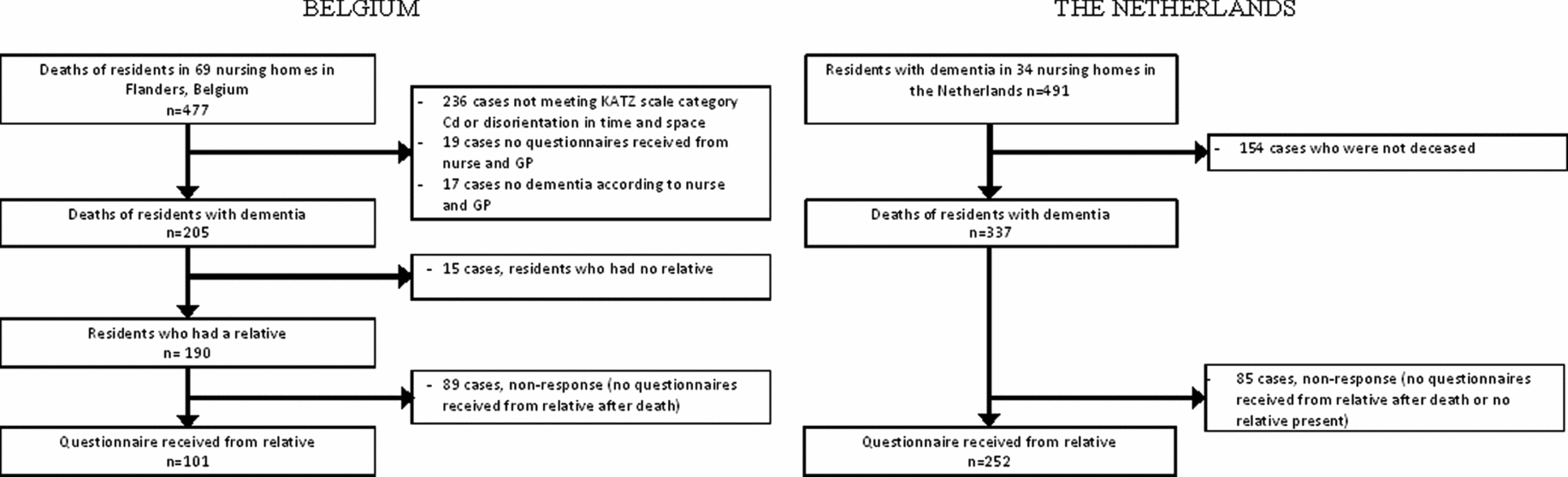
Of the 477 deceased nursing home residents in Belgium, 205 met the inclusion criteria (Figure 1); 15 were excluded because no relative was available. For the remainder, the response rate was 53.2%.
Flowchart of the obtained samples of residents with dementia in Belgium and the Netherlands.

In the Netherlands, 491 residents with dementia were included. Of those, 337 were deceased by the end of the data collection, resulting in a 74.8% response rate.
Using data gathered by professional caregivers, non-response analysis for the Netherlands showed no differences for important resident (age, gender, length of stay, place of death, cognitive status, and disease severity) and care characteristics (end-of-life treatments and nursing care) between participating and non-participating families except for mouth care and peacefulness of death. Residents with participating relatives reached full consensus between staff and family concerning end-of-life treatment decisions more often than those whose family members did not participate (van der Steen et al., Reference van der Steen, Deliens, Ribbe and Onwuteaka-Philipsen2012). None of these characteristics were different for responders and non-responders in Belgium (not in table).
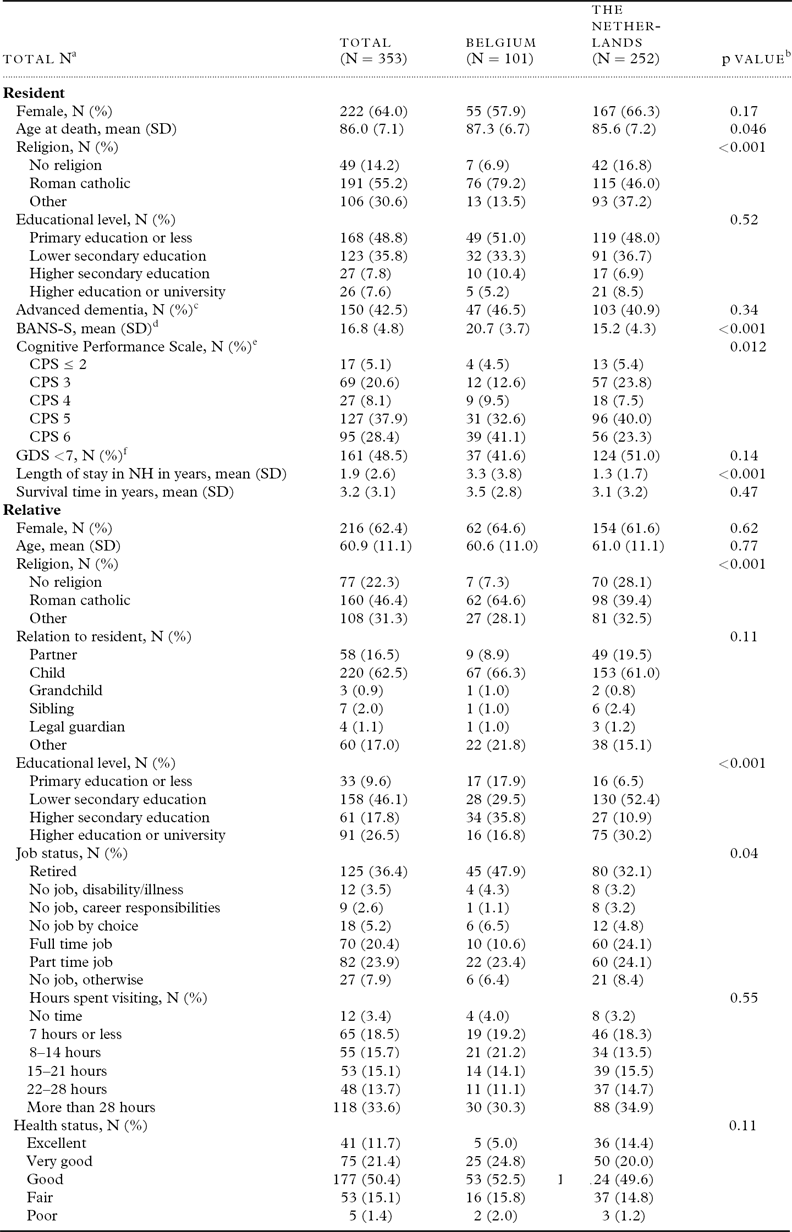
Women made up 57.9% of participants in Belgium and 66.3% (p = 0.03) in the Netherlands (Table 1). The average age of death was 87 years in Belgium and 85 years in the Netherlands (p = 0.046). The BANS-S (range 7–28, higher scores mean greater disease severity) was on average 20.7 for nursing home residents in Belgium and 15.2 for their Dutch counterparts (p < 0.001) while the occurrence of GDS stage 7 did not differ. More Belgian residents had a CPS of 6 (range 0–6, higher scores mean greater impairment) than Dutch residents (p < 0.001). Belgian residents stayed in the nursing home 3.3 years on average, Dutch residents 1.3 years (p < 0.001). Correction for these differences was necessary because of differences in the study designs in both countries.
Residents’ and relatives’ sample description
aMissing values between 0% and 37.6% (N = 0–38) for Belgian residents and, between 0% and 9.1% (N = 0–23) for Dutch residents; bP values were calculated using Fisher's exact test, t-test or Mann–Whitney U test. Significance level at 0.05; cAdvanced dementia CPS ≥ 5 and GDS = 7; dBANS-S = Bedford Alzheimer Nursing Severity-Scale (range 7–28) measured one month before death. Higher scores indicate greater disease severity; eCPS = Cognitive Performance Scale (range 0–6) measured one month before death. A higher score means a higher degree of impairment; fGDS = Global Deterioration Scale (range 1–7) measured one month before death. A GDS score of 7 means the residents can no longer respond to their environment, are not able to have a conversation and ultimately lose control over movement.
SD = standard deviation.
Overall, relatives were most often female (62.4%) and the average age was 60.9 years. In Belgium, relatives were the children of the resident in 66.3% of cases and their partners in 8.9%, 61.0% and 19.5% respectively (p = 0.013) in the Netherlands.
Quality of dying
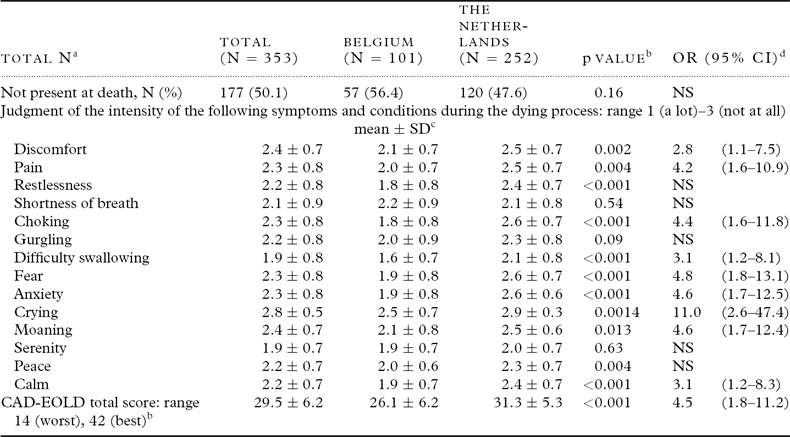
The CAD-EOLD reported significant differences in the quality of dying between Belgian and Dutch nursing home residents with dementia (Table 2, higher scores indicate better outcomes). Total scores for the scale were 26.1 in Belgium and 31.3 in the Netherlands (adjusted OR 4.5, CI 1.8–11.2). The reported level of the discomfort item was 2.1 in Belgium and 2.5 in the Netherlands (OR 2.8, CI 1.1–7.5). Mean pain scores were 2.0 in Belgium and 2.5 in the Netherlands (OR 4.2, CI 1.6–10.9).
Quality of dying of nursing home residents with dementia while dying comparing Belgium and the Netherlands: the Comfort Assessment in Dying with Dementia scale (CAD-EOLD)
aMissing item values between 0% and 3.0% (N = 0–3) for Belgian residents and between 19.4% and 23.0% (N = 49–58) for Dutch residents; bP values were calculated using Fisher's exact test, t-test or Mann–Whitney U test. Significance level at 0.05; cCAD-EOLD = Comfort Assessment in Dying End-of-Life in Dementia, measuring the dying process: a higher score indicates more comfort. The CAD-EOLD total scale is the sum of the items. Missing items scores were imputed with means in case maximally four items of the CAD-EOLD scale were missing. In case the relative was not present at the time of death, the CAD-EOLD scores were not included; dOdds ratios for multivariate ordinal regression analyses using Belgium as a reference category, controlling for country differences in patient characteristics, i.e. age, gender, religion, disease severity (BANS-S), and length of stay. Regression analyses for the total score of the CAD-EOLD were performed by calculating deciles.
SD = standard deviation.
Mean scores regarding choking, difficulty swallowing, fear, anxiety, crying, moaning, and calm were between 1.6 and 2.5 in Belgium, while between 2.1 and 2.9 in the Netherlands (OR ranging between 1.2 and 11.0). Items that did not differ between the countries were restlessness, shortness of breath, gurgling, serenity, peace, and calm.
Quality of end-of-life care
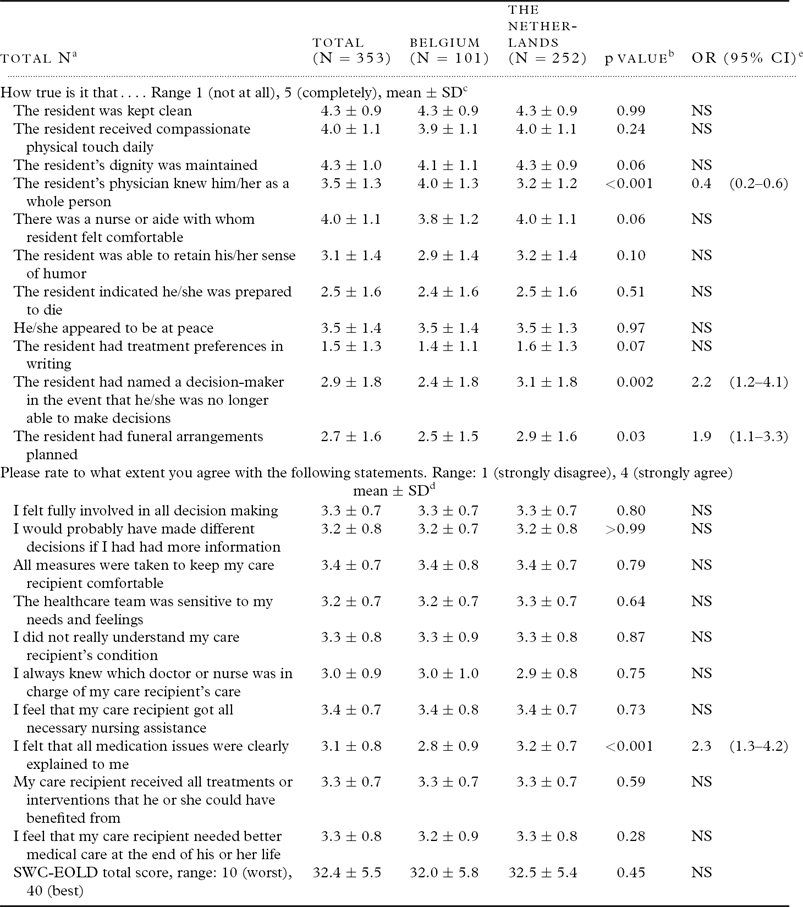
Three items of the QoD-LTC (Table 3, higher scores indicate better outcomes) showed significant differences between the countries: “the resident's physician knew him/her as a whole person” averaged 4.0 for Belgium and 3.2 in the Netherlands (OR 0.4, CI 0.2–0.6). Mean scores for “the resident had named a decision-maker in the event that he/she was no longer able to make decisions” were 2.4 for Belgium and 3.1 for the Netherlands (OR 2.2, CI 1.2–4.1); “the resident had funeral arrangements planned” scored an average of 2.4 for Belgian and 2.9 for Dutch residents (OR 1.9, CI 1.1–3.3).
Evaluation of the quality of care for nursing home residents with dementia delivered in the last month and the last week of life comparing Belgium and the Netherlands: scales QoD-LTC and SWC-EOLD
aMissing item values varied between 0% and 6.9% (N = 0–7) for Belgian residents and varied between 0.4% and 8.3% (N = 1–21) for Dutch residents; bP values were calculated using Fisher's exact test, t-test or Mann–Whitney U test. Significance level at 0.05; cQoD-LTC = Quality of Dying in Long-Term Care, measuring the last month of life: a higher score indicates a better quality of care; dSWC-EOLD = Satisfaction With Care End-of-Life in Dementia, measuring the last week of life: a higher score indicates more satisfaction. The SWC-EOLD total scale is the sum of the items. Missing items scores were imputed with means in case maximally three items of the scale were missing; eOdds ratios for multivariate ordinal regression analyses using Belgium as a reference category, controlling for country differences in patient characteristics, i.e. age, gender, religion, disease severity (BANS-S), and length of stay. Regression analyses for the total score of the SWC-EOLD were performed by calculating deciles.
SD = standard deviation.
The item “I felt that all medication issues were clearly explained to me” of the SWC-EOLD scale showed a mean score of 2.8 for Belgium and 3.2 for the Netherlands (OR 2.3, CI 1.3–4.2; Table 3). No other items on this scale showed significant differences. The average total score was 32.0 in Belgium and 32.5 in the Netherlands (p = 0.45).
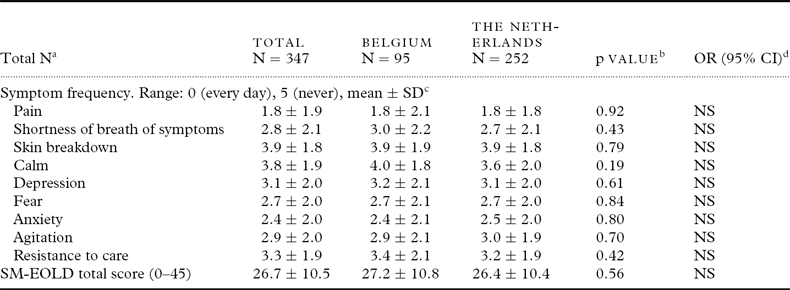
The worst rated symptom on the SM-EOLD (Table 4, higher scores indicate better outcomes) in both Belgium and the Netherlands was pain (1.8). Total score averages were 27.2 in Belgium and 26.4 in the Netherlands (p = 0.56).
Symptom frequency in the last month of life (SM-EOLD) of nursing home residents with dementia comparing Belgium and the Netherlands
aMissing item values varied between 5.9% and 19.8% (N = 6–20) for Belgian residents and varied between 40.9% and 48.4% (N = 103–122) for Dutch residents; bp values were calculated using Fisher's exact test, t-test or Mann–Whitney U test. Significance level at 0.05; cSM-EOLD = Symptom Management End-of-Life in Dementia (measuring the last month of life), a higher score indicates a lower symptom frequency. The SM-EOLD total scale is the sum of the items. Missing items scores were imputed with means in case maximally three items of the SM-EOLD scale were missing; dOdds ratios for multivariate ordinal regression analyses using Belgium as a reference category, controlling for country differences in patient characteristics, i.e. age, gender, religion, disease severity (BANS-S), and length of stay. Regression analyses for the total score of the SM-EOLD were performed by calculating deciles.
SD = standard deviation.
Discussion
Significant differences were found between Belgian and Dutch nursing home residents with dementia regarding comfort while dying, even when correcting for population differences, indicating a higher quality of dying in the Netherlands. However, symptom frequencies measured in the last month of life and satisfaction with care in the last week were rated similarly in the two countries.
To our knowledge, this is the first study that compares two European countries on quality of dying and quality of end-of-life care.
Using identical questions and validated scales in both countries facilitates a reliable study on the differences between Belgium and the Netherlands.
Even though there are differences in the data collection procedures, the elaborate measures of residents’ clinical characteristics such as disease severity made it possible to correct for these differences in the multivariable analyses. Non-response analyses showed no differences between residents whose families did or did not respond, except for a few items in the Netherlands. Belgian nursing homes are representative for Flanders and the Dutch homes are well spread geographically. Using broad selection criteria, it was possible to study residents with various stages of dementia, while previous literature often focused on advanced dementia only. Finally, not only satisfaction with care but also more objective measures such as comfort while dying and symptom frequency were used.
Limitations of the study include the partially prospective inclusion of residents in the Netherlands, where residents who were still alive when the data collection closed did not enter the sample, which excluded residents with a longer length of stay in the nursing home. This implies an underestimation of advanced dementia and length of stay in the Netherlands (van der Steen et al., Reference van der Steen, Ribbe, Deliens, Gutschow and Onwuteaka-Philipsen2013). Because we were aware of this, we corrected for these differences in the multivariate analysis. Secondly, data from relatives used in this study in both countries were collected retrospectively which may lead to memory and recall bias. Memory bias was limited by limiting the time between death and the completion of the questionnaires. However, even though asking proxies such as relatives after death is widely accepted (Teno, Reference Teno2005), a relative's judgment of the care provided is made during bereavement, which might have an impact on responses or response rates (Addington-Hall, Reference Addington-Hall2002).
A striking result of the study is that although important symptoms in the last month of life (SM-EOLD) in both countries were similar, large differences were found in comfort and symptoms experienced while dying (CAD-EOLD). Belgian residents experienced more problems with swallowing, restlessness, anxiety, pain, and other burdensome symptoms, and experience more general discomfort while dying compared with Dutch residents. These findings could not be attributed to large differences between nursing home populations in terms of length of stay or disease severity.
Particularly striking is that symptoms such as pain and anxiety which were measured across the whole of the last month of life did not differ between the countries (SM-EOLD), while relatives in the Netherlands evaluated the same symptoms during the dying process (via CAD-EOLD) better than those in Belgium. One possible explanation might be the presence of an elderly care physician on the nursing home staff in the Netherlands while in Belgium the GP remains the responsible physician. While elderly care physicians provide care 24 hours a day, GPs visit nursing homes regularly but 24-hour care is provided by nurses. A coordinating and advisory physician is present in Belgian nursing homes but she/he is not responsible for making treatment or medication decisions concerning individual residents (Elseviers et al., Reference Elseviers, Vander Stichele and Van2010). Hence, Dutch elderly care physicians might have more knowledge of the resident's condition (Helton et al., Reference Helton, van der Steen, Daaleman, Gamble and Ribbe2006) and might offer better care when difficulties such as pneumonia or eating/drinking problems appear in the last days of life (Vandervoort et al., Reference Vandervoort, Van den Block, van der Steen, Vander, Bilsen and Deliens2012), though Belgian GPs know the person better. The presence of the physician in the Netherlands during the dying phase is also more probable.
The finding of only one difference between the countries regarding satisfaction with care is unsurprising considering that measuring satisfaction might indicate that relatives are equally grateful for the received care, providing a subjective rather than an objective evaluation of the actual care provided. Also, satisfaction is related to expectations of care rather than the actual quality. A recent study showed that relatives of care home residents with dementia rate the quality of care better than relatives of residents without dementia (Department of Health, 2012).
A more objective outcome measure of quality of end-of-life care concerns the extent to which people experience symptoms in the last month of life (SM-EOLD). Symptoms such as pain, anxiety, fear, shortness of breath, or skin breakdown were present in an important percentage of people with dementia. A 2007–2009 study from the United States (Cohen et al., Reference Cohen2012) showed much better scores on overall symptom occurrence (SM-EOLD total score 33.0, EOLD-CAD total score 35.0), suggesting room for improvement in both Belgium and the Netherlands. The management of symptoms and problems relating to the last phase of life of people with dementia remains an important goal both in Belgium and the Netherlands.
In conclusion, although nursing homes differ considerably between Belgium and the Netherlands, the quality of care provided in the last month of life for people with dementia seems comparable according to their relatives. However, Dutch residents experience less discomfort when dying while Belgian residents experience more problems and symptoms in the last days or hours of life. The results suggest the need for an improved symptom management in both countries, particularly for the last days of life in Belgium.
Although this study needs replication in other countries, the findings might have implications for practice and policies beyond the participating countries, particularly considering the relatively slow development of palliative care cultures in these settings in Europe (Froggatt and Reitinger, Reference Froggatt and Reitinger2013). Also, most nursing homes or long-term care facilities in Europe and beyond do not have physicians with 24-hour availability on staff; hence, off-site GPs frequently provide palliative care. Although there may be benefits of GPs knowing the patient better as a whole person compared with physicians only involved after nursing home admission, this might also pose problems to optimally monitor and treat symptoms occurring during the dying phase. Optimizing care structures and procedures aimed at enhancing the quality of dying in long-term care facilities is urgently needed to ensure a good death for the rapidly growing group of people with dementia.
Conflict of interests
None.
Description of the authors’ roles
All the authors had full access to all of the data (including statistical reports and tables) in the study and can take responsibility for the integrity of the data and the accuracy of the data analysis.
L Van den Block (LVDB), JT van der Steen (JTS), A Vandervoort (AV), and Luc Deliens (LD) undertook study conception and design. LVDB, JTS, AV, Robert vander Stichele (RVS), and LD were responsible for the acquisition of data. Nicole van Uden (NVU), LVDB, JTS, Bregje D. Onwuteaka-Philipsen (BOP), AV, RVS, and LD performed analysis and interpretation of data, were responsible for writing the paper, performed critical revision of the paper for important intellectual content, and provided administrative, technical, or material support. NVU and LVDB undertook statistical analysis. LVDB, LD, and JTS were responsible for obtaining funding. LVDB, JTS, BOP, and LD supervised the study.
Acknowledgments
We thank the umbrella organizations for nursing homes (Vereniging van Vlaamse Steden en Gemeenten, Federatie Onafhankelijke Seniorenzorg, and the Federatie van Rustoorden van België), BVGG-Crataegus, CRA-Domus, Belgische Vereniging voor Gerontologie en Geriatrie, Expertisecentrum Dementie, Federation Palliative Care Flanders, and the werkgroep Palliatieve Zorg en Geriatrie for their support given to this study. We also thank Jane Ruthven for English editing and all participating nursing homes and respondents for providing the study data.
Financial disclosure
Belgian data collection was supported by a major grant from the Vrije Universiteit Brussel (GOA HW, VUB) and is part of the Dying Well with Dementia study, the Fund for Scientific Research in Flanders, Belgium (postdoctoral grant to L. Van den Block). The Vrije Universiteit Brussel and the Fund for Scientific Research in Flanders did not have any role in the design and conduct of the study, collection, management, analysis and interpretation of the data or in preparation, review, or approval of this paper.
Data collection in the Netherlands was supported by a career award for JTS of the Netherlands Organisation for Scientific Research (NWO, the Hague; Veni 916.66.073), and by ZonMw the Netherlands Organisation for Health Research and Development, grant number 1151.0001, and the VU University Medical Center, EMGO Institute for Health and Care Research, Department of General Practice and Elderly Care Medicine, and the Department of Public and Occupational Health, Amsterdam, the Netherlands. The funding source did not have any role in the design and conduct of the study, collection, management, analysis and interpretation of the data, or in preparation, review, or approval of this paper.
Ethical approval
In Belgium, the study protocol and anonymity procedures were approved by the ethical review board of the University Hospital of the Vrije Universiteit Brussel. Patient anonymity was preserved and physician confidentiality was maintained through the registration and data entry processes. In the Netherlands, the Medical Ethics Committee of the VU University Medical Center in Amsterdam provided ethical approval for this study.
Collaborators on behalf of EURO IMPACT
Van den Block Lieve, Meeussen Koen, Brearley Sarah, Caraceni Augusto, Cohen Joachim, Costantini Massimo, Francke Anneke, Harding Richard, Higginson Irene, Kaasa Stein, Linden Karen, Miccinesi Guido, Onwuteaka-Philipsen Bregje, Pardon Koen, Pasman Roeline, Pautex Sophie, Payne Sheila, and Deliens Luc.