Introduction
Tobacco smoking is reported to be among the leading causes of disease burden worldwide; it is also the largest preventable cause of morbidity and mortality in most developed nations. However, because of the highly addictive properties of nicotine, attempts at smoking cessation are often met with failure. As such, the economic burden that smoking imposes on society is significant, amounting to approximately $193 billion per year.1 Furthermore, it is important to acknowledge that this disease burden may be even greater in the veterans’ healthcare system, as tobacco use prevalence in the military is greater than that in the general population, estimated in 2005 at 32 per cent.Reference Bray, Hourani, Olmstead, Witt, Brown and Pemberton2 The high prevalence of smoking among veterans costs the Veterans Administration health system over half a billion dollars each year in direct smoking-related disease and $346 million in productivity losses.Reference McKinney, McIntire and Carmody3
In terms of disease burden, cigarette smoking is responsible for 30 per cent of all cancer deaths. One of the most common cancers caused by smoking is head and neck cancer. Data support the conclusion that at least 80 per cent of all head and neck malignancies diagnosed each year are associated with tobacco abuse,Reference Negri, La Vecchia, Franceschi and Tavani4, Reference Schwartz, Ozsahin and Zhang5 and the costs of treating head and neck cancer are immense. The overall burden of illness, including direct medical care, morbidity costs and mortality costs, are projected to be $976 million per year currently.Reference Lee, Turini, Botteman, Stephens and Pashos6 Tobacco exposure is the primary risk factor of such cancer, and it is imperative to reduce the economic burden by employing a tobacco cessation technique with a lasting effect.
It has been proven that tobacco control interventions are more cost-effective than other public health interventions. The literature furthermore shows that self-help and counselling programmes are the most cost-effective interventions, and the most easily dispensed.Reference Kahende, Loomis, Adhikari and Marshall7 Despite this, smoking cessation programmes have low long-term abstinence rates, which lead one to question why programmes are not more effective in helping to substantially lower the smoking rates.
There is a growing body of evidence which shows that financial incentives for smoking cessation programmes could be an important mechanism to increase cessation rates, given the increased utilisation of the aforementioned programmes. A randomised, controlled trial from 2006, conducted at the Philadelphia Veterans Administration, studied 179 reported smokers.Reference Volpp, Gurmankin, Asch, Berlin, Murphy and Gomez8 The patients were divided into incentive and non-incentive groups. Both groups were offered a free smoking cessation class, while the incentive group was additionally offered money for each class attended and ultimate cessation of smoking. In that study, the short-term quit rates were higher in the incentive group (16.3 vs 4.6. per cent at 75 days).Reference Volpp, Gurmankin, Asch, Berlin, Murphy and Gomez8 It is important to note, however, that this effect disappeared at six months, which could be attributed to the fact that financial incentives were outweighed by recurrent addiction behaviour at this time point. Another randomised, controlled trial published in 2009 showed that smoking cessation rates 9–12 months after enrolment were significantly higher in the incentive group than in an ‘information-only’ group (14.7 vs 5.0 per cent).Reference Volpp, Troxel, Pauly, Glick, Puig and Asch9
Cessation of smoking and smokeless tobacco use continues to be one of the Veterans Administration's biggest public health challenges, despite the institution of several smoking cessation programmes through the Office of Public Health Policy and Prevention. The Veterans Administration Clinical Practice Guidelines provides clinical guidance to Veterans Health Administration healthcare providers on a range of evidence-based tobacco use cessation interventions, including brief counselling, pharmacotherapy, telephone counselling and intensive treatment, and recommendations for cessation in specialty populations.Reference Moores10, Reference Schwartz11
The rationale behind the current project is twofold. Firstly, a predominantly lower socioeconomic status group would likely be responsive to financial incentives, thereby promoting enrolment into the study.Reference Lee and Volpp12 Secondly, by promoting an effective tobacco cessation programme, the proposed project will, in the long-term, fulfil the mission of the Veterans Administration, while at the same time saving the Veterans Administration healthcare system a significant amount of money.
In this project, we used a targeted approach to enrol patients at high risk for head and neck cancer and those previously diagnosed with head and neck cancer at the Veterans Administration who continued to smoke. We randomly assigned them to a group that received information only or information plus financial incentives. With a well-designed and appropriately timed approach, we expected that patients with financial incentives would have a higher rate of class enrolment and completion, as well as a significantly higher quit rate. We further expected that by continuing to offer financial incentives up to six months after enrolment, the financial incentives would persist in outweighing the addiction behaviours for a longer term. Through long-term follow up, we assessed the clinical effectiveness and cost-effectiveness of such a strategy in head and neck cancer patients.
Materials and methods
This study was a prospective, randomised clinical trial with two arms. The first (experimental) arm received information about smoking cessation and financial incentives in the form of cash payments at specific time intervals if class attendance or smoking abstinence was confirmed. The second (control) arm received information only, including free enrolment in the smoking cessation classes. Rates of smoking cessation were measured in each group and compared at specific time points over one year of follow up.
Enrolment
The target population was all patients over the age of 18 years that presented to the Otorhinolaryngology – Head and Neck Surgery clinic at the Philadelphia Veterans Affairs Medical Center for evaluation or treatment of a malignant or pre-malignant lesion of the upper aerodigestive tract. In addition, patients with a previous diagnosis of head and neck cancer who had completed treatment or were at that time undergoing treatment were invited to enrol. Patients had to be actively smoking at least, on average, five cigarettes per day. If a patient agreed to enrol in the study, informed consent was obtained in accordance with the protocols and regulations of the Institutional Review Board of the Philadelphia Veterans Affairs Medical Center.
Randomisation
Randomisation was performed, at the time of study enrolment, by the physician or clinical staff (physician assistant), according to a specific schema. Slips of paper were sequentially numbered with integers from 100 to 299, and for each patient enrolling in the study one slip was selected at random. The number on the slip of paper in the envelope became the patient's study identification number. Group assignment was as follows: even numbers were assigned to the control group (information only), while odd numbers were assigned to the experimental group (financial incentives plus information).
Initial assessment
At the time of study enrolment, patient demographic information, medical history and social history (including duration and quantity of tobacco use) were recorded. In addition, diagnosis, location, and staging details of the head and neck cancer or pre-malignant lesion were noted. Previous surgery, chemotherapy or radiation therapy was documented. Lastly, the patient completed the 12-Item Short Form Health Survey (‘SF-12’), a quality of life questionnaire.
Smoking cessation courses
Patients in each study arm were offered free enrolment in a Veterans Administration sponsored smoking cessation course. Attendance was recorded at each of the three classroom sessions. For all patients, a payment of $50 was made for each class attended. Payments for attendance at each class took place at the conclusion of the class on that day.
Thirty-day assessment
At 30 days after study enrolment, patients were contacted by phone. A detailed interval history was taken and patients were asked about their smoking status (i.e. ‘have not smoked in the past 30 days’ or ‘have smoked in the past 30 days’). Patients reporting abstinence were asked to confirm this with a biochemical test in the form of exhaled carbon monoxide (CO), a marker for inhaled tobacco products. If smoking cessation was confirmed by a negative exhaled CO test result, patients in the incentive group received $150. Patients were contacted up to 10 times by phone before being considered lost to follow up. All patients were asked to complete the 12-Item Short Form Health Survey at 30 days.
Three-month assessment
At three months, patients were contacted again. Patients reporting abstinence were asked to confirm this with a biochemical test. In this instance, a urine cotinine test was used as a marker for inhaled tobacco products. This test involved submitting a standard urine sample in a urinalysis cup and subsequent assay for chemical by-products of cigarette smoking. This assay provided similar information as the exhaled CO test, but had the advantage of detecting cigarette use over a longer period (approximately one week). If smoking cessation was confirmed by a negative urine cotinine assay result, patients in the incentive group received $150. Patients were contacted up to 10 times by phone before being considered lost to follow up. All patients were asked to complete the 12-Item Short Form Health Survey at three months.
Final assessment
At six months’ follow up, patients reporting abstinence were asked to confirm this with a urine cotinine test. If smoking cessation was confirmed by a negative urine cotinine assay result, patients in the incentive group received $150. All patients were asked to complete the 12-Item Short Form Health Survey at six months. Any patient randomised to the experimental arm who completed all study landmarks and maintained smoking abstinence for six months received a total of $600 in financial incentives.
Results
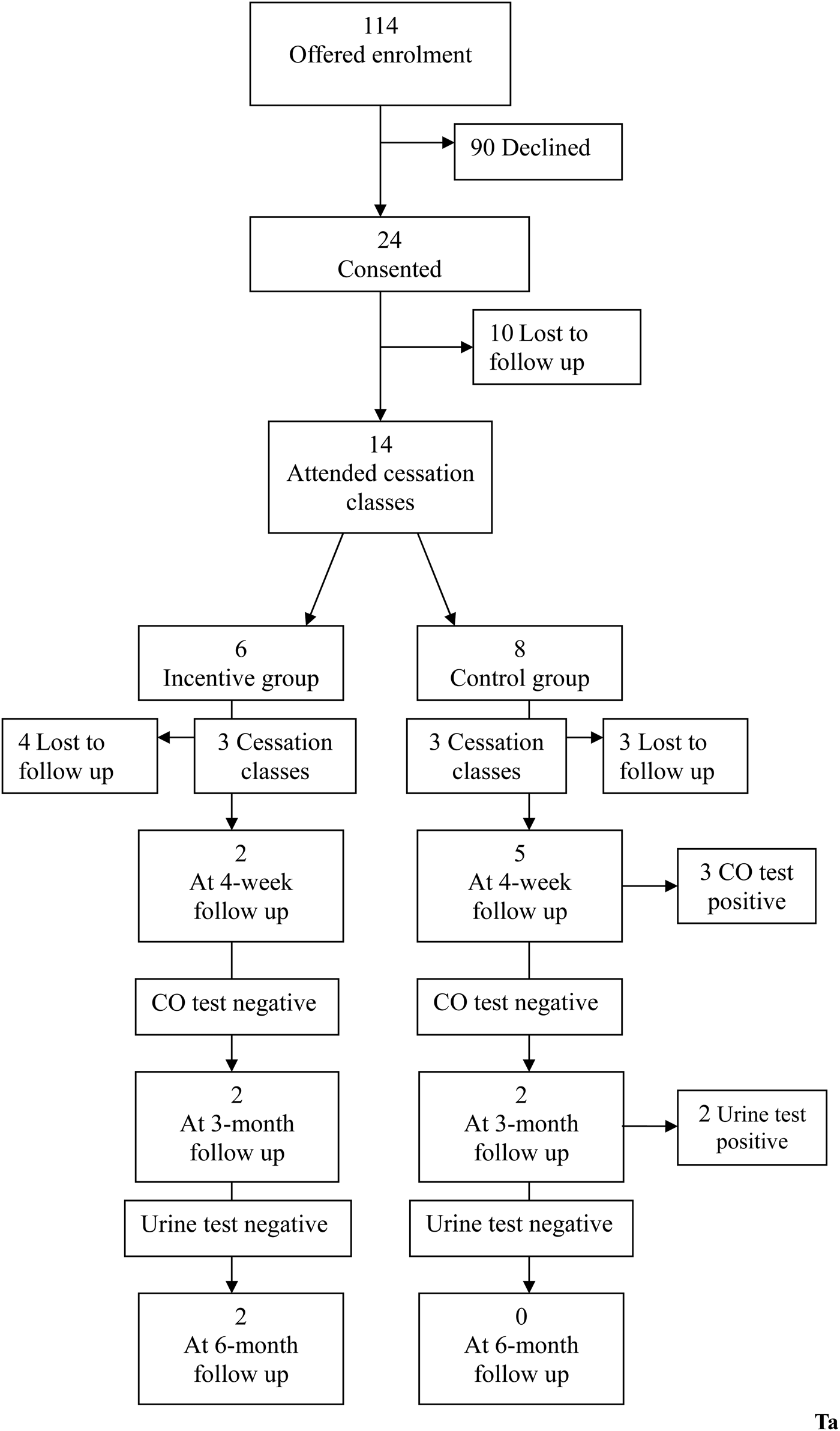
Of the 114 eligible patients who were asked to enrol, 90 patients declined. Of the 24 patients who expressed interest and signed consent forms, 14 attended classes; 8 of the 24 patients never attended a first session and therefore did not participate in the study intervention. Of the 14 patients who attended classes, 6 were incentivised and 8 received information only. Figure 1 shows the numbers of subjects who participated in the study intervention and follow up.
Flow chart illustrating the numbers of subjects who participated in the study intervention and follow up. CO = carbon monoxide

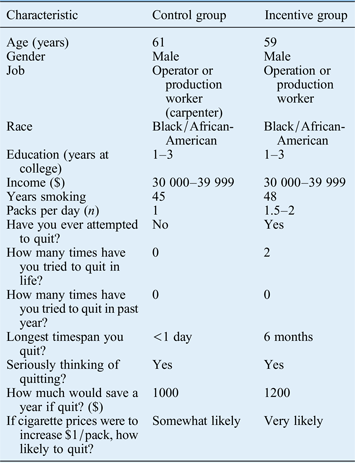
Demographic characteristics, smoking behaviour, degree of nicotine dependence, readiness to quit and health status were similar in the incentive and control groups (Table I).
Patient demographics
Data represent means or majority responses.
The enrolment numbers were in themselves insufficient to power the study and, moreover, the attrition rate was significant. As such, no statistical analyses could be conducted on the data. However, it should be noted that the two patients who completed the study were in the incentive group.
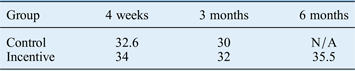
The 12-Item Short Form Health Survey results from each time point were collated and averaged. The results were calculated as a total score, with the highest total score being 48, which reflected being most satisfied with current quality of life. No difference in averaged scores was observed between groups, nor was there a significant change in quality of life as recorded over the six-month period (Table II).
Quality of life data over study period
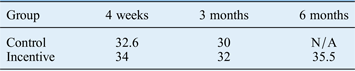
Data represent 12-Item Short Form Health Survey scores (out of a total of 48). N/A = not applicable
Discussion
Of 24 veterans who initially enrolled in the study, only 2 who remained in the study abstained from smoking for all 6 months. These two subjects had been randomised to the incentive group and received a total of $600 by the end of the six months. Although the numbers are not high enough to power this study, the outcome of the investigation serves to highlight two important points with regard to financial incentives.
The first point is that in this particular population, despite a very real threat of recurrence or development of head and neck cancer, the impetus to quit is not particularly tied to financial incentives. This could be because of the lengthy addiction time or the personal stressors that drive the patient to continue smoking. This can be seen in the initial enrolment number: 114 persons were eligible and offered enrolment, but only 24 individuals expressed interest. The other patients flatly refused to participate, despite the substantial financial appeal. Interestingly, all of the patients who enrolled were not actively undergoing treatment for head and neck cancer. The patients fell into two populations: those being treated with ablation and observation of pre-malignant lesions, and those with a history of head and neck cancer who had undergone treatment including surgery and/or chemoradiation more than five years previously. It stands to reason that these patients were clear of active head and neck cancer and so wished to prevent devolution into malignancy, which is the impetus for enrolling. However, given our results, it is clear that smoking was valued far more than financial gain in this population of potential subjects. Further studies in this population are warranted to determine the point at which any incentive (monetary or otherwise) can lead to higher levels of enrolment in, and completion of, smoking cessation programmes, and whether there is a difference between patients with pre-malignant lesions and patients with past malignancy.
Moreover, this study serves to highlight a point that has been alluded to in recent reviews of financial incentives. Only 1 of the 19 trials included in a recent Cochrane review of the effect of incentives on smoking cessation showed higher quit rates at 6 months when incentives were used.Reference Cahill and Perera13 The type and scale of incentive is considered a critical element in the design of a cessation programme. Only the Volpp et al. 2009 trial, which involved very substantial cash payments both for compliance and for prolonged abstinence, demonstrated a sustained beneficial effect.Reference Volpp, Troxel, Pauly, Glick, Puig and Asch9 It is important to note also that this study consisted of participants who were employees of a large American company, predominantly white, and had relatively higher levels of education and income. This success cannot therefore be generalised to other populations of smokers, especially those at the Veterans Administration.
It is also important to note that these quit rates do not last long-term.Reference Volpp, Troxel, Pauly, Glick, Puig and Asch9 Our study highlights this point. Despite offering incrementally larger incentives tied to the completion of a smoking cessation programme and continued biochemical proof of abstinence from smoking over six months, the vast majority of our patients were not able to complete the course. It is significant that the only patients to complete the study successfully were the patients who were given financial incentives. However, the significant attrition rate in this population raises the question of whether these patients will be able to maintain such a hard-won smoke-free status past six months and past when all incentives have been awarded.
A number of factors contributed to the outcome of this study, beyond the effectiveness of financial incentives. The only trial to achieve sustained success rates concentrated resources into incentives rather than a funded smoking cessation programme. Because our institution did not have an established smoking cessation class, we were called upon to create our own class with limited staff. As such, the smoking cessation class attended by the patients was likely unequal to those run by professional therapists and likely less effective as a result. Furthermore, the Veterans Administration population is not particularly mobile, and some patients were daunted by extremely long travel and frequent visits. This could have led to higher rates of recidivism than expected.
• Evidence suggests that financial incentives could increase smoking cessation rates
• This project enrolled smokers at high risk for, or those previously diagnosed with, head and neck cancer
• Patients were randomly assigned to an information-only or an information plus financial incentives group
• Incentive group patients received $150 at each evaluation time (30 days, 3 months and 6 months) if smoking cessation was confirmed
• Of 24 veterans who initially enrolled, only 2 who remained in the study abstained from smoking for all 6 months
• Financial incentives are ineffective as a long-term cessation plan, even in head and neck cancer patients
While some improvements can be made in the current study, the project plays an important role in determining the effectiveness of financial incentives for smoking cessation in a Veterans Administration population, and perhaps sheds light on the ineffectiveness of financial incentives as a long-term cessation plan, even in head and neck cancer patients. Other therapeutic interventions will be required to achieve that goal.