Many researchers have contended the U.S. labor market has grappled with a “skills gap” (e.g., Marshall & Craig, Reference Marshall and Craig2019): a disconnect between the skills employers need and the number of job seekers who possess those skills. Compounded by historically low unemployment rates, this gap has left employers with unfilled jobs and narrow talent pipelines. According to Deloitte (Giffi et al., Reference Giffi, Wellener, Dollar, Manolian, Monck and Moutray2018), the skills gap could result in 2.4 million positions remaining unfilled between 2018 and 2028, with a potential economic impact of $2.5 trillion. The study also found that occupations involving digital talent, skilled production, and operational management may be three times as difficult to fill in the next 3 years.
Some researchers, however, have questioned whether the skills gap is real. For example, Weaver and Osterman (Reference Weaver and Osterman2017) reported results from a nationally representative survey in the manufacturing industry showing that “demand for higher-level skills is generally modest, and … three-quarters of manufacturing establishments do not show signs of hiring difficulties” (p. 275). Modestino et al. (Reference Modestino, Shoag and Ballance2015, Reference Modestino, Shoag and Ballance2016) have argued that, rather than resulting from a lack of requisite skills among potential employees, the skills gap is a function of employers increasing the level of job requirements when unemployment was higher (upskilling) and later reducing requirements when the supply of people needing work waned (downskilling).
Regardless of your stance on the existence of a skills gap in the U.S. economy, few can question concerns regarding underrepresentation of women and minorities in certain sectors of the labor market—particularly occupations in science, technology, engineering, and mathematics (STEM). For example, the percentage of female college students majoring in engineering has grown markedly from the 1% figure observed in 1970 to 17% today, but this figure indicates fewer than two out of every 10 engineering majors (Georgetown University Center on Education and the Workforce, 2018) and those graduating with bachelor’s degrees (Burrelli & Woodin, Reference Burrelli and Woodin2008; Yoder, Reference Yoder2014) are women. The same is true for the technology sector, where 78% of all computer science graduates are male (Burrelli & Woodin, Reference Burrelli and Woodin2008). Conversely, women comprise the majority of the lowest earning fields such as education, where 76% of workers are female (Ingersoll et al., Reference Ingersoll, Merrill, Stuckey and Collins2018). This imbalance, which begins years before students enter the workforce, limits the available talent pool and perpetuates both gender stereotypes and wage disparity. The COVID-19 economy’s impact on skill development will further accelerate talent pipeline gender and compensation differences, placing a premium on personalized interventions that identify and maximize one’s competitive advantages.
For occupations demonstrating long-standing differential representation by men or women, we might ask, “Why the differences? Are there differences in aptitudes/abilities required to do the work? Do different interests among men and women lead them to explore different types of occupations? If the latter, how societally driven are the different interest patterns?”
The relation between aptitudes and interests is, well, interesting. Do we become adept at things in which we have interest, or do we become interested in things we learn we are good at doing? Quite likely, it is both. There is evidence for a substantial genetic component to vocational interests (Betsworth et al., Reference Betsworth, Bouchard, Cooper, Grotevant, Hansen, Scarr and Weinberg1994), and some researchers have argued that they belong in the same discussion as other traits known to have substantial heritable components (Ackerman & Heggestad, Reference Ackerman and Heggestad1997). Of course, there can be little question of environmental influences on interests, as it might prove quite difficult to develop interest in an occupation one knows nothing about. The opposite is also true: A person might find the appearance and surface description of an occupation fascinating but grow disenchanted as the full picture of the job’s requirements is revealed/experienced.
The point is that discrepancies in workforce representation for various key sectors might be mitigated to no small degree if individuals learned they had the aptitudes necessary to perform the jobs in those sectors. The interests might follow, or they might not, but knowing one could succeed in an occupation opens the door to one’s exploring it further (and with a different point of view). In this practice forum, we examine how the traditional interest-only career guidance tools used in education significantly influence the gender-based skills gaps that persist in high-demand careers and introduce YouScience, a company that is helping ameliorate the skills gap by combining measures of aptitudes and interests in a new career discovery platform that is designed to increase the size and diversity of the talent pipeline for all occupations.
Comprehensive career guidance
There is surging, renewed interest in career exploration and guidance in schools. Much of this interest arguably is in response to the Every Student Succeeds Act (ESSA) and reauthorization of the Carl D. Perkins Career and Technical Education Act of 2006 (typically referred to as the Perkins IV, with the most recent reauthorization signed into law on July 31, 2018, referred to as Perkins V). Although ESSA does not focus on “college and career readiness” (that phrase does not appear in the bill), it does encourage schools to demonstrate that students receive a “well-rounded education.” Many schools have opted to fulfill this requirement for a well-rounded education in part by providing career guidance to their students, sometimes beginning in middle school. Indeed, Cajon Valley Union School District in California has begun activities in elementary school oriented around the RIASEC (realistic, investigative, artistic, social, enterprising, and conventional) model of interests (Holland, Reference Holland1959, Reference Holland1997) and the relationships of the RIASEC types to jobs (McHugh, Reference McHughn.d.; Vander Ark, Reference Vander Ark2018). Similarly, a key concept in the Perkins Act is the call to strengthen alignment between career and technical education programs and needs of the labor market. Thus, demand for valid, informative career assessment tools is growing nationwide.
Many factors have been identified as useful predictors of career exploration, choice, and success outcomes. Vocational interest, or the attraction to or preference for a particular career field, is one such predictor that is the focus of most career assessment interventions (Leuty & Hansen, Reference Leuty and Hansen2013). Self-reported and interest-only assessments are the predominant form of “career guidance” in schools today. There is good reason for this, given that interests provide more differentiation between occupations than do measures of abilities, knowledge, skills, tasks, or personality variables (Putka & McCloy, Reference Putka and McCloy2011). Further underscoring the importance of vocational interests for exploring careers are the relationships that they have with important organizational outcomes (Nye et al., Reference Nye, Bhatia, Prasad, Nye and Rounds2019). The literature documents noteworthy relationships between interests and substantive criteria such as occupational choice (Fouad, Reference Fouad, Savickas and Spokane1999; Hansen & Dik, Reference Hansen and Dik2005; Holland et al., Reference Holland, Fritzsche and Powell1994; Savickas & Spokane, Reference Savickas and Spokane1999; Zytowski, Reference Zytowski1974), job knowledge (Reeve & Hakel, Reference Reeve and Hakel2000; Van Iddekinge, Putka, et al., Reference Van Iddekinge, Putka and Campbell2011), job performance (e.g., Azen et al., Reference Azen, Snibbe and Montgomery1973; Hough et al., Reference Hough, Barge, Kamp, Campbell and Knapp2001; McCloy et al., Reference McCloy, Campbell and Cudeck1994; McHenry et al., Reference Yoder1990; Nye et al., Reference Nye, Su, Rounds and Drasgow2012; Oppler et al., Reference Oppler, McCloy, Campbell, Campbell and Knapp2001; Van Iddekinge, Putka, et al., Reference Van Iddekinge, Putka and Campbell2011; Van Iddekinge, Roth, et al., Reference Van Iddekinge, Roth, Putka and Lanivich2011), and career success (Su, Reference Su2012).
However, because interests involve subjective interpretations, they are influenced by external factors, such as societal norms regarding gender roles (Betz, Reference Betz, Denmark and Paludi2007; Fassinger, Reference Fassinger, Walsh and Savickas2005). Therefore, career assessments based solely on interest measures may perpetuate the gender gap in fields traditionally dominated by one gender. For example, high-school-age boys, in general, report higher interest and self-efficacy in traditionally male-dominated fields, such as science, technology, engineering, and mathematics—the STEM fields (Correll, Reference Correll2001). In contrast, high-school-age girls tend to indicate higher interest and self-efficacy in caring professions and education (Rottinghaus et al., Reference Rottinghaus, Betz and Borgen2003).
Aptitude measures—tests assessing human potential to be successful in specific fields or occupations—can serve as a useful complement to interest measures. For one, the literature has long demonstrated the strong relationships between measures of cognitive ability and both job knowledge and job performance (Ghiselli, Reference Ghiselli1973; Hunter, Reference Hunter1986; Hunter & Hunter, Reference Hunter and Hunter1984; McCloy et al., Reference McCloy, Campbell and Cudeck1994; McHenry et al., Reference McHenry, Hough, Toquam, Hanson and Ashworth1990; Schmidt & Hunter, Reference Schmidt and Hunter1998). Different occupations require different knowledge, skills, abilities, and other characteristics (KSAOs), and individuals who show strengths in the KSAOs required by a given field are more likely to succeed and persist in that field (Krane & Tirre, Reference Krane, Tirre, Brown and Lent2012). Also, aptitude assessment results can help adolescents consider careers in which they had little previous interest or to which they had little previous exposure, thus broadening the range of future career options. Consideration of both interests and aptitudes provides a more holistic set of career recommendations, as the results incorporate both subjective reports and objective assessments.
Unfortunately, aptitude assessments have not been used as widely for career assessment as have interest measures, partially due to difficulties in norming such tests, relatively longer test administration times, specialized knowledge needed for results feedback, and administration costs. Even when interests are supplemented with indices of aptitude, ability, or achievement, the indices often do not measure specific abilities directly but rather indirectly through GPAs or scores on standardized tests such as the SAT (Schaefers et al., Reference Schaefers, Epperson and Nauta1997).
YouScience expands integrative career assessment
YouScience, an online, aptitude-based talent discovery program, addresses both interests and aptitudes in evaluating a person’s fit for a particular profession, an approach supported by career guidance research and practice scholarship (Lowman, Reference Lowman1991; Rottinghaus & Eshelman, Reference Rottinghaus, Eshelman, Hartung, Savickas and Walsh2015). Studies have found that both interests and aptitudes have unique advantages to developing career guidance recommendations (Carless, Reference Carless1999; Schaefers et al., Reference Schaefers, Epperson and Nauta1997). In other words, a more holistic and accurate assessment is possible when both factors are taken into consideration. YouScience uses the following measures of interests and aptitudes in its career assessment platform.
Interests
The approach YouScience uses to measure interests is based on the RIASEC model, which identifies six vocational personality types: realistic, investigative, artistic, social, enterprising, and conventional (Holland, Reference Holland1959, Reference Holland1997). Specifically, the YouScience assessment incorporates the short form of the Interest Profiler (Lewis & Rivkin, Reference Lewis and Rivkin1999; Rounds et al., Reference Rounds, Mazzeo, Smith, Hubert, Lewis and Rivkin1999; Rounds et al., Reference Rounds, Su, Lewis and Rivkin2010). Developed by the National Center for O*NET Development, this measure comprises 60 items (10 items per RIASEC dimension), takes only 10 minutes to complete, and possesses solid psychometric characteristics. Despite being a relatively brief measure of the RIASEC dimensions, the scales have demonstrated respectable internal consistency reliability (mean values of .81, .84, and .86 across three samples) and test–retest reliability (ranging from .78 to .86 across scales, with a mean test–retest reliability estimate of .82 using a one-month retest interval; Rounds et al., Reference Rounds, Su, Lewis and Rivkin2010). In addition, it has demonstrated evidence of convergent and discriminant validity in terms of it relationship with RIASEC scales from the Department of Defense’s Interest Finder (now the Find Your Interests inventory; Wall & Baker, Reference Wall and Baker1997), with convergent estimates of .74 to .82 and discriminant estimates of .12 to .48 (Rounds et al., Reference Rounds, Su, Lewis and Rivkin2010).
Aptitudes
YouScience gauges individuals’ abilities through nine required and five optional subtests (Visual Comparison Speed, Vocabulary, Numerical Reasoning, Spatial Visualization, Inductive Reasoning, Sequential Reasoning, Idea Generation, Work Approach, Timeframe Orientation, Numerical Computation, Hand-Eye Coordination, Associative Memory, Visual Memory, and Pattern Memory)Footnote 1 carefully designed to assess a broad range of abilities employers seek. This aptitude battery is an augmented version of the computer-administered Ball Aptitude Battery (BAB; The Ball Foundation, 1995). The BAB was created “to understand how one’s talent and abilities can align or ‘fit’ with different performance environments” (The Ball Foundation, n.d.). It is one of the more well-known and well-researched multiaptitude tests available today and has a longstanding research history demonstrating its utility for predicting such outcomes as school grades, success in training, job performance, and occupational fit (Converse et al., Reference Converse, Oswald, Gillespie, Field and Bizot2004; Dong, Sung, & Dohm, Reference Dong, Sung and Dohm1985; Dong, Sung, & Goldman, Reference Dong, Sung and Goldman1985; Dong et al., Reference Dong, Sung, Goldman and Dohm1986; Neuman et al., Reference Neuman, Bolin and Briggs2000; Tirre & Field, Reference Tirre and Field2002). Its reliability (mean estimate for computerized BAB of .87, median of .89—estimates include internal consistency, test–retest, and split-half) and validity (construct validity via confirmatory factor analysis and measurement invariance analyses for gender and racial/ethnic groups; convergent validity via the Employee Aptitude Survey) are well-documented (The Ball Foundation, 1995, 2002, 2004; cf. also the previous references). The YouScience variation on the BAB involves the addition of two new cognitive tests: Timeframe Orientation and Pattern Memory. These tests assess one’s capacity to generate multiple objects that could be represented by a given stimulus image and the ability to remember and reproduce linear patterns, respectively. Thus, these tests assess well-researched cognitive traits of ideational fluency and memorization/visual memory. They provide additional dimensionality to the abilities often considered when identifying suitable careers.
To ensure that scores were meaningful for the YouScience system and to establish an appropriate inferential base for the two new tests, YouScience conducted a norming study and subsequent measurement invariance analyses to (a) establish the meaning of scores on the YouScience assessment for students who constitute YouScience’s target population (students 16–24 years old with a concentration on students 18–22 years old) and (b) determine whether the same latent structure of abilities could be said to underlie scores across applicant groups (gender, race/ethnicity). Doing so was necessary for establishing that all the previous research could be safely “generalized” to the BAB. That is, by establishing the comparability, we could safely conclude that the YouScience assessment has all of the qualities of the BAB that make it so valuable or use in career counseling.
The norming study involved a nationally representative sample of students to ensure that its results would convey to all future users. A stratified random sample of 918 students was retained to define the norm group for the aptitude tests. Analyses of data from the norming study indicate that the augmented BAB that undergirds YouScience performs the same as the original BAB (e.g., patterns of relationships among the tests are similar; mean test scores are similar, although a bit higher in the YouScience sample). Further, measurement invariance analyses conducted on data from the norming study employing a seven-factor model (Fluency, Math, Memory, Psychomotor/Speed, Reasoning, Spatial, Verbal) demonstrate measurement invariance across gender and partial measurement invariance across race/ethnicity. Thus, a single latent structure can be viewed to account for the relationships among tests across major demographic groups. This, in turn, means the YouScience assessment can be viewed as a trusted means of assessing individual standing on abilities demonstrated to be important for identifying promising career choices.
YouScience has largely addressed the challenges associated with the use of aptitude measures for career exploration by successfully reducing assessment time to 75–90 minutes; moving to an online platform; lowering cost; creating easy-to-read, affirmative feedback; and providing norms for the aptitude test scores. These accomplishments have enabled YouScience to be more cost accessible and time efficient. YouScience can reach wider populations that might not have readily available resources to conduct more traditional career assessment. The online career guidance program (e.g., assessment and career advisory support elements), used in schools across the country with hundreds of thousands of high school students,Footnote 2 identifies and encourages users to explore and pursue careers aligned with their aptitudes and interests.
The YouScience program provides users with in-depth insights and a broad range of career options for which they have the aptitude. The range of career possibilities can help students consider previously neglected occupations and industries as viable options. This is especially meaningful for women with respect to high-demand, traditionally male careers.
Interests versus aptitudes for high-demand careers
This article’s coauthors from the University of Missouri explored gender differences in high school students’ interest and aptitude fit scores for five rapidly growing industries: computer technology, manufacturing, construction, and health care (direct patient care and technical). The study included 7,222 high school students across 14 states with a nearly equal gender distribution: 3,619 (50.1%) female and 3,603 (49.9%) male. The mean age was 16, ranging from 14 to 19 years, and the race/ethnicity profile of the sample reflected national proportions. Several statistical analyses, including analyses of Cohen’s d (Cohen, Reference Cohen1988) and chi-square tests were conducted to explore gender gaps in interest and aptitude for these industries, as well as aptitude–interest incongruence. Students’ vocational interests, aptitudes, and overall fit scores (computed through weighted algorithms based on the nature of tasks and required skill sets for each occupation) were assessed using the YouScience career assessment tool.
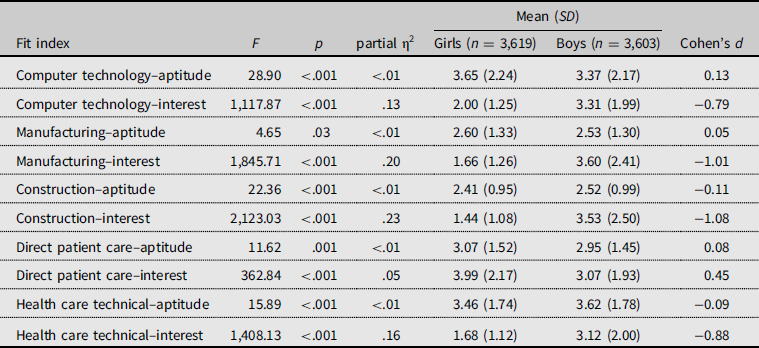
Table 1 presents univariate effects of gender on industry-level aptitude and interest fit scores. The table shows small effect sizes for aptitude scores (ranging from −0.11 to 0.13) but large effect sizes for interests (ranging from −1.08 to 0.45), with boys having higher mean interests in four of the five industries examined (girls had higher mean interests in direct patient care).
Univariate Effects of Gender on Industry-Level Aptitude and Interest Fit Scores–Final Model

Note. Degrees of freedom for each F test were F(1, 7220). A positive effect size indicates a higher mean for girls than for boys.
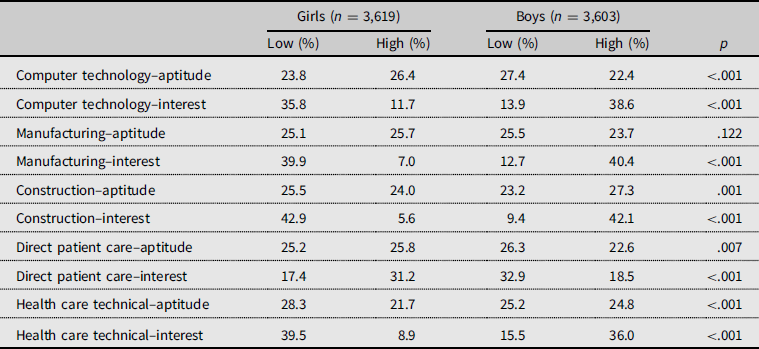
Table 2 presents chi-square tests for industry-level fit scores by gender. Comparisons are made between the percentages of girls for whom fit to a particular industry was low or high and the same percentages for boys. Because of the large sample sizes, all tests but one are significant at p < .01 (the one exception being aptitude for manufacturing). As in Table 1, smaller differences in percentages of girls and boys in low and high fit categories are observed for aptitudes than for interests, again demonstrating similarity of aptitude for work in these high-growth industries despite differential interest.
Chi-Square Tests on Industry-Level Fit Scores by Gender

The results underscore the impact of integrative career assessment when aptitude information complements career interest assessment to improve the quality and utility of career recommendations and guidance overall. These results are elaborated further when examining the top-recommended (i.e., best fitting) occupations for boys and girls when considering their interest and aptitude profiles.
To do this, we examined the percentage of high school boys and girls having a high fit for occupations across the five industry groups. Here, high fit was defined as being in the top quartile (25%) of the sample population. “Fit,” meanwhile, was based on the correspondence between students’ scores on the YouScience tests (i.e., interests, aptitudes) and corresponding requirement profiles generated for O*NET occupations via information available on those occupations in the O*NET content model.
Interest fit and gender differences
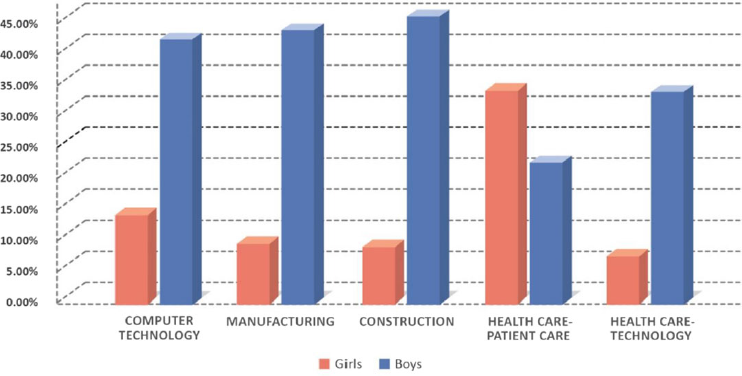
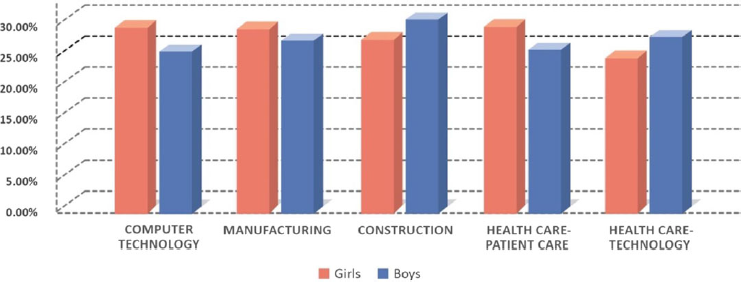
Substantial gender differences in interest fit scores (i.e., fit based solely on the students’ interest profiles) were found across industries (see Figure 1). High school boys showed higher interest fit scores than high school girls for occupations in computer technology, manufacturing, construction, and health care–technical. For instance, for construction, the ratio for the percentage of boys to the percentage of girls in high groups was 7.5 to 1. In contrast, girls indicated far greater interest in health care–direct patient care than did boys. The percentages of girls and boys identified as “high” also varied greatly across industries. The percentages for girls ranged from 5.6% (construction) to 31.2% (health care–direct patient care) and those for boys ranged from 18.5% (health care–direct patient care) to 42.1% (construction).
Percentage of Girls and Boys with High Interest Fit Scores (top quartile).

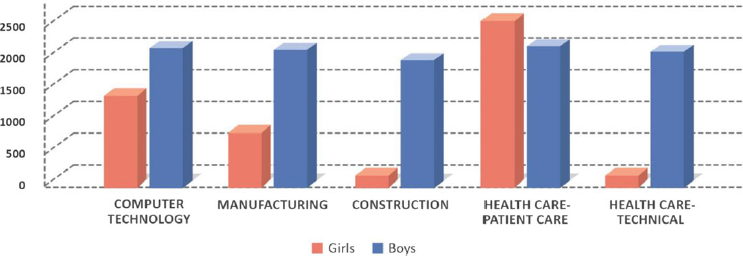
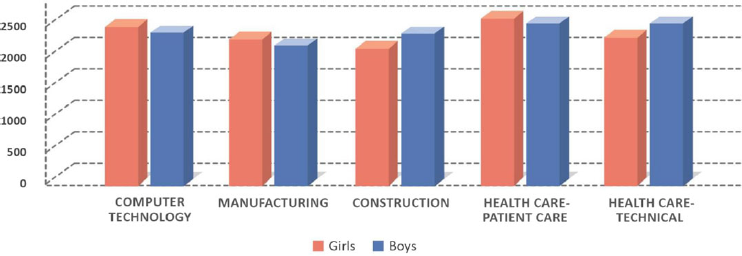
A similar trend was found when the numbers of high school boys and girls with at least one high fit in the occupations within an industry group were calculated. Here, high fit was defined as scoring 8 and above on a 10-point scale. As summarized in Figure 2, a significantly greater number of boys had at least one high fit in computer technology, manufacturing, construction, and health care–technical. In contrast, more girls had at least one high fit in health care–direct patient care. These gender differences were found to have medium to large effect sizes, with Cohen’s d values ranging from 0.45 to 1.08. This suggests that these differences are substantial and may warrant targeted interventions.
Number of Girls and Boys with at Least One High Interest Fit Score.

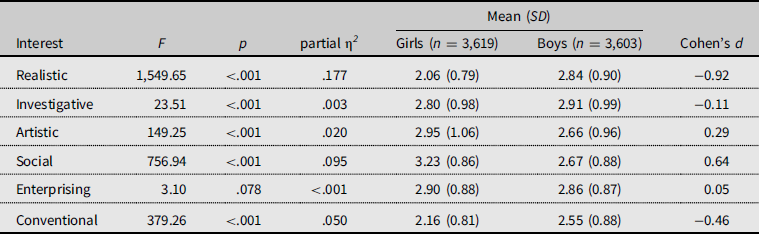
These varying levels of interests can be seen as reflections of gender differences in broader interest areas. A useful framework to understand this is Holland’s (Reference Holland1959, Reference Holland1997) theory of vocational choice, which posits six types for both individuals and work environments: realistic, investigative, artistic, social, enterprising, and conventional (RIASEC). Consistent gender differences have been found in interest in these specific areas, especially realistic (boys higher) and social (girls higher; Falk et al., Reference Falk, Rottinghaus, Casanova, Borgen and Betz2016; Fouad, Reference Fouad2002). This is significant, as STEM occupations, where high-demand careers lie, and which also tend to offer higher incomes, are often associated with realistic and investigative interests.
The current study partially replicated previous studies, finding distinct gender differences in realistic and social interests (see Table 3). Specifically, boys showed significantly higher realistic interests, whereas girls showed higher social interests than their counterparts. However, although statistically significant, the gender difference was small for investigative interest (partial η2 = .003, d = −0.11), another important area for many STEM careers. This suggests that interventions designed to increase girls’ realistic interests and boys’ social interests may be effective in helping them consider occupations that are nontraditional for their respective gender.
Univariate Effects of Gender in Realistic, Investigative, Artistic, Social, and Conventional Scores

Note. Degrees of freedom for each F test were F(1, 7220). A positive effect size indicates a higher mean for girls than for boys.
Aptitude fit and gender differences
Unlike the substantial gender differences found in interest fit scores, high school girls’ and boys’ aptitudes were found to be at comparable levels both in terms of representation in the top quartiles of the test score distributions and numbers of students with at least one high occupation-level fit (see Figures 3 and 4). This is consistent with previous research findings that showed similar natural ability levels across gender (Hyde et al., Reference Hyde, Lindberg, Linn, Ellis and Williams2008). As shown in Figure 3, the percentage of girls identified as high ranged from 21.70%–26.40% and that of boys similarly ranged from 22.40%–27.30%. In addition, as summarized in Figure 4, similar numbers of girls and boys were identified with at least one high fit across all five industries. In other words, the distributions of aptitudes were mostly even across gender and industry.
Percentage of Girls and Boys with High Aptitude Fit Scores (top quartile).

Number of Girls and Boys with at Least One High Aptitude Fit Score.

Industry-level analysis expands talent pool
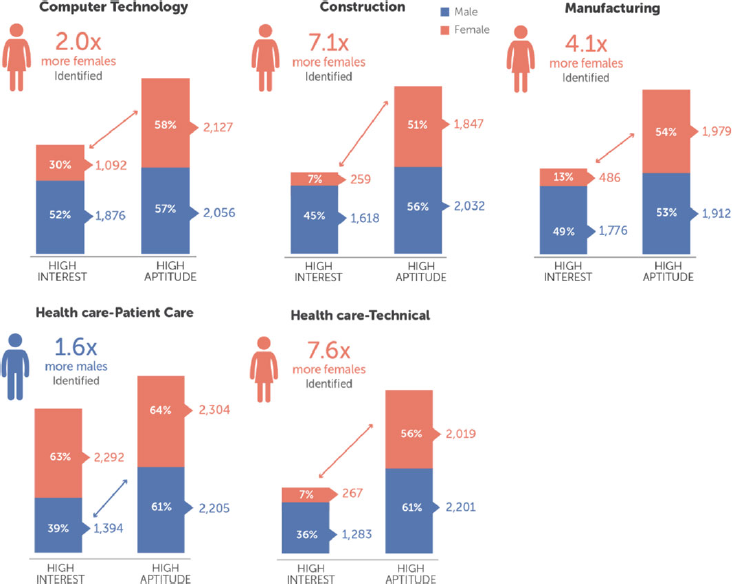
Industry-level analysis showed that the YouScience program identified an increased number of adolescent girls and boys with “career fit” for occupations in computer technology, manufacturing, construction, and health care when their aptitudes were taken into consideration. The graphs in Figure 5 show the number of students who had at least one high-fit career in a particular industry sector.
Percentage representation by gender in high interest and high aptitude score ranges for five rapidly growing industries.

The analysis showed that using aptitude scores to determine high fit resulted in a larger, more diverse high-fit population for each industry. For girls, twice as many were found to have high fit for computer technology when considering their aptitudes as when considering their interests. Even greater discrepancies were found for the construction (7.1 times as many), manufacturing (4.1 times as many), and health care–technical (7.6 times as many) industries. Boys, too, showed a larger number (1.6 times as many) characterized by high fit for the health care–patient care industry than when considering interests. Although aptitudes revealed a substantial increase in the number of students from the less-represented gender in a particular industry, it is important to note that the number of high aptitude-fit students from the predominant gender in an industry increased, as well.
Reducing the skills gap, gender imbalance, and income inequality: A Georgia Case Study
Career guidance in the State of Georgia public schools had become largely a compliance activity with limited impact on student workforce outcomes. With the introduction of dual-degree programs and an increased emphasis on CTAE (Career, Technical, and Agricultural Education), the state’s education leadership needed a way to help students, parents, and educators make more informed decisions about secondary educational pathways. Long term, they want to create a larger, more diverse workforce to support the state’s growing economy. Reducing skill gaps identified by employers and addressing gender income inequality are important employer and overall workforce goals.
The updated Strengthening Career and Technical Education for the 21st Century Act (the aforementioned Perkins V) includes many new provisions. As mentioned previously, Perkins V requires states and local districts to use more data-driven techniques to link CTAE pathways with the needs of the local economy. It also seeks to promote better gender distribution for nontraditional fields. The term “nontraditional fields” refers to occupations or fields of work—such as careers in computer science, technology, and other current and emerging high-skill occupations—for which individuals of one gender constitute less than 25% of employees in that occupation or field of work.
The Georgia Department of Education and the Technical College System of Georgia jointly sponsored a statewide rollout of YouScience. The State of Georgia has 135 CTAE pathways that are available to the more than 500 public high schools. Each high school offers five to 18 of the pathways based on local workforce needs, student demand, faculty availability, and so on. In addition to the integration of aptitude- and interest-based guidance, YouScience’s academic advising tools allow local educators to better guide students toward their best-fit dual-degree and/or CTAE pathways based on aptitude, interest, or a combination of the two. For example, Rome City Schools more than doubled the percentage of students in programming pathways while increasing participation in engineering, health care, and construction.
More than 80% of Georgia high schools and 50% of Georgia middle schools have implemented YouScience in the past 24 months, administering the aptitude and interest measures to more than 200,000 students. About 30% of those schools have utilized the CTAE advising tools (introduced in the 2018–2019 academic year). The State of Georgia and YouScience also have developed tracking mechanisms to measure the guidance impact over the coming academic years. However, Georgia Department of Education and YouScience already track the gender diversity of the career recommendations across in-demand career areas. For example, across the high school student population using YouScience, only 12% of students indicated high interestFootnote 3 for at least one of seven key manufacturing engineering careers, yet 27% of students demonstrated high aptitude. For women, 4.9 times more students had a high aptitude for manufacturing and engineering than had a self-reported interest. For careers with a predominant skew toward women, like health care–patient care, data show 1.5 times more males had a high aptitude for health care–patient care careers than had a self-reported interest.
Dr. Barbara Wall, Georgia State CTAE director, said, “By exposing students to careers and encouraging them to think more deliberately about their education choices earlier, while simultaneously arming our faculty with meaningful insights about students’ individual strengths and abilities, we can lay the foundation for a better-prepared workforce and a stronger future economy” (Wall, Reference Wall2019, slide 18). Georgia’s case is similar to those of many states now using data-driven reports from YouScience to refine, develop, and build CTAE pathways to address skill shortages.
Integrative career assessment is critical to narrowing the gender gap in high-demand careers and improving equal gender representation and wages in the workforce.
Action points
What are we to make of the results just presented? How do we move ahead in the wake of COVID-19 and its impact on the economy? In closing, we offer some thoughts on these matters.
Students, parents, and educators
Given continuing changes in the economy due to technological changes and responses to global crises, students must purposefully reflect on career pathways and strategically increase their knowledge and skills. Effective career guidance will require students, parents, and educators to develop and manage a composite view of a student’s interests and aptitudes, together with job demand information available to them. Lent (Reference Lent2013) emphasized “preparedness” related to these processes and connected to the need for developing core skills and attitudes along with occupational awareness for youth so they can be ready to connect to future opportunities. Teachers and counseling practitioners can facilitate these processes through routine assessments of aptitudes and interests so individuals can proactively reflect on training opportunities and possible career paths. Such ongoing strategic efforts to engage youth and emerging adults in this process can expand their self-knowledge and awareness of linkages between education and skill requirements for in-demand and emerging occupations.
Accentuating this point, our educational system presently requires students to forge such preparedness via identification of aptitudes and vocational interests earlier than ever before. Many school districts currently require middle schoolers to make academic pathway choices as they enter high school. As a result, the transition from middle to high school is the first inflection point where students make career-limiting choices. Given the lack of career exposure, gender gaps are particularly pronounced in middle school. Students will need help to make informed choices of high school pathways. Without parents and educators helping students understand what they have the potential to accomplish, many young women could be guided away from high-demand, high-wage careers for which they have an equal aptitude as young men.
Counselors
In the past, many career counselors focused on matching clients to the “right” jobs, based on the assumption that once people identified such jobs, they could stay in them for the duration of their work life. In the current era, however, career development is rarely a linear process, and people frequently make career transitions. Recognizing this change regarding how people approach their careers, there has been a trend in career counseling in which more attention is given to preparing people to adapt to changing circumstances (“career adaptability”) and navigate them (Creed & Hood, Reference Creed, Hood, Hartung, Savickas and Walsh2015). Knowing one’s strengths (such as aptitudes) can be a great starting point.
Counseling professionals therefore should adapt a strength-based approach, helping students identify and build on their strengths (including their aptitudes). This will bolster students’ preparedness, girding them to be more adaptable and flexible as they encounter the rapidly changing world of work.
The impact of COVID-19
We have all suffered the restrictions, uncertainty, and hardship wrought upon the world by COVID-19. Its effects have invaded nearly every area of our lives. As we have adapted how we perform work and operate as social entities, it is little surprise that the pandemic has had substantial impact on the workplace and economy.
In a post-COVID world, there will be slack in the labor markets. As a result, the risk increases for students as they move from educational pathways to careers. Without making intentional decisions to align aptitudes, interests, educational pathways, and labor market needs, students could suffer real economic harm.
With COVID-19’s impact on unemployment, “upskilling” is a highly possible scenario. Traditional policy and employment practices will further accentuate opportunity barriers, expand talent pipeline imbalances, and continue to perpetuate both gender stereotypes and wage disparity.
As the talent distribution is understood to be more equitable than the opportunity distribution, policy makers need to directly address talent pool imbalances across occupations. Skill supply grows when aptitude feedback provided during middle school is connected to key high school educational gateway decisions. As learners of any age connect to programs utilizing their natural aptitudes, their developing interests have a greater chance of finding flow.
Job seekers in the COVID-19 economy need even more clarity, performance-based feedback, and direction about educational consumer decisions as excess labor expands. Isolated by the “digital by default” workplace, or left without in-demand skills, workers need to build documented portfolios that connect their strongest aptitudes to skill-based outcomes. Recent graduate cohorts affected by the COVID-19 economy need to be more informed and learning consumers, job seekers, and translators of their skill sets to recover from the risks of any late start during their prime work-based learning years.
Recruiters and educators need to collaborate to have a longer, more inclusive view of talent development as the competency outcomes of postsecondary education are questioned. Employers spend significant resources to increase applicant pools and meet special diversity and inclusion targets. However, achievement, legacy, and social capital filters fail to identify key aptitudes candidates should have to thrive and find employment success. Vetting for the core aptitudes needed within “overall fit” options adds recruiting efficiencies, increases candidate self-efficacy, and reduces employee onboarding and training costs.
The pandemic has forced everyone to accept the precarious nature of work. Nevertheless, many ongoing employment trends persist and highlight the need for skills required of these high-demand fields addressed in this analysis. Exploring STEM interest areas is a popular activity promoted by STEM advocates to overcome limited life experience. However, it fails to compensate for understanding the everchanging nature of in-demand skills and skill updating requirements. Without cross-walking natural aptitudes to STEM academic and skill-training programs, learners of all ages are misguided about risk opportunities and distracted from marketplace signals at every level. In addition to this focus on building the pipeline for STEM fields, addressing the lack of health care workers is even more pronounced since the COVID-19 crisis.
The pandemic heightens awareness of uncertainty in our lives, including how individuals approach career planning activities. By recognizing personal strengths and building employability skills, including identity, adaptability, and social and human capital (Fugate et al., Reference Fugate, Kinicki and Ashforth2004), students can be more prepared to capitalize on future opportunities. Accepting that the world is uncertain, but recognizing that much is still within our control can provide flexibility and confidence to engage in career exploration and develop skills required in the future. It is critical for practitioners to establish systemic interventions for individuals and organizations that facilitate reflection on capabilities and the strategic establishment of meaningful educational and career goals.
Summary
Consideration of both a person’s aptitudes (what they can do) and interest (what they like to do) provides a more complete picture of the career paths that person might fruitfully explore. By providing a program that combines aptitude measures with students’ interests, YouScience has demonstrated its capacity to increase occupational recommendations in nontraditional areas, thereby opening doors that might otherwise have remained closed to a wide range of students while increasing the pipeline of viable talent for employers—important at any time but likely crucial in the days ahead.