1. Introduction
Travertine fissure-ridges (Bargar, Reference Bargar1978) are continental carbonate bodies deposited by hydrothermal fluids discharged by tectonically controlled thermal springs (Hancock et al. Reference Hancock, Chalmers, Altunel and Çakir1999). These morphotectonic features are the main linkage between travertine deposition and brittle structures (Altunel and Hancock, Reference Altunel, Hancock, Stewart, Vita-Finzi and Owen1993a ,Reference Altunel and Hancock b ; Hancock et al. Reference Hancock, Chalmers, Altunel and Çakir1999; Atabey, Reference Atabey2002; Brogi & Capezzuoli, Reference Brogi and Capezzuoli2009; Temiz & Eikemberg, Reference Temiz and Eikenberg2011). The travertine deposits are considered tectonic indicators, as the parent bicarbonate-rich hydrothermal fluids are channelled along interconnected fractures forming damaged rock volumes. Nevertheless, permeability tends to decrease as a result of the high mineralizing capability of circulating fluids that, being supersaturated (mainly Ca2+ and HCO3 −), tend to seal fractures through calcite/aragonite deposition. In this view, permeability is time dependent and can maintain high values only for short periods close to tectonic episodes (Curewitz & Karson, Reference Curewitz and Karson1997; Hancock et al. Reference Hancock, Chalmers, Altunel and Çakir1999; Micklethwaite & Cox, Reference Micklethwaite and Cox2004; Anderson & Fairley, Reference Anderson and Fairley2008). Despite the general consensus on the relationships between tectonic activity and travertine deposition (cf. Hancock et al. Reference Hancock, Chalmers, Altunel and Çakir1999), other controlling factors have been proposed. For example the role of climate fluctuation and related water table oscillation are other key elements that may influence travertine deposition (Faccenna et al. Reference Faccenna, Soligo, Billi, De Filippis, Funiciello, Rossetti and Tuccimei2008; Uysal et al. Reference Uysal, Feng, Zhao, Isik, Nuriel and Golding2009; De Filippis et al. Reference De Filippis, Faccenna, Billi, Anzalone, Brilli, Soligo and Tuccimei2013) because it has been documented that fluid flow and travertine deposition took place also during arid periods (cf. Faccenna et al. Reference Faccenna, Soligo, Billi, De Filippis, Funiciello, Rossetti and Tuccimei2008; Brogi et al. Reference Brogi, Capezzuoli, Aquè, Branca and Voltaggio2010, Reference Brogi, Capezzuoli, Buracchi and Branca2012). Climate variations are also factors that may influence the hydrothermal activity and the related travertine deposition (Faccenna et al. Reference Faccenna, Soligo, Billi, De Filippis, Funiciello, Rossetti and Tuccimei2008), but the tectonic/climate interplay is still poorly understood and needs more specific studies. Indeed any one factor may dominate depending of the local conditions.
Nevertheless, independent of the climatic role, travertine fissure-ridges contain key travertine deposits by which to locate faults and reconstruct late Quaternary tectonics, and their possible palaeoseismological history over restricted time spans (cf. Muir-Wood, Reference Muir-Wood1993; Çakir, Reference Çakir1999; Altunel & Karabacak, Reference Altunel and Karabacak2005; Uysal et al. Reference Uysal, Feng, Zhao, Isik, Nuriel and Golding2009), because travertine is suitable for accurate dating via 14C and 230Th–238U radiometric methods (Uysal et al. Reference Uysal, Feng, Zhao, Altunel, Weatherley, Karabacak, Cengiz, Golding, Lawrence and Collerson2007; Brogi et al. Reference Brogi, Capezzuoli, Aquè, Branca and Voltaggio2010; Temiz & Eikenberg, Reference Temiz and Eikenberg2011; Nishikawa et al. Reference Nishikawa, Furuhashi, Masuyama, Ogata, Shiraishi and Shen2012). Some papers present combined geochronological, petrographical and structural data on fissure-ridges in order to highlight their high potential for reconstructing palaeoseismological history. For example Martìnez-Dìaz & Hernàndez-Enrile (Reference Martinez-Diaz and Hernandez-Enrile2001), Altunel & Karabacak (Reference Altunel and Karabacak2005), Piper et al. (Reference Piper, Mesci, Gürsoy, Tatar and Davies2007), Uysal et al. (Reference Uysal, Feng, Zhao, Altunel, Weatherley, Karabacak, Cengiz, Golding, Lawrence and Collerson2007) and Mesci, Gursoy & Tatar (Reference Mesci, Gursoy and Tatar2008) related episodes of growing vertical banded calcite veins (i.e. banded travertine; Altunel & Hancock, Reference Altunel, Hancock, Stewart, Vita-Finzi and Owen1993a ,Reference Altunel and Hancock b ) crossing some fissure-ridges in southern Spain and western Anatolia to large historic earthquakes, therefore emphasizing the strong relationship between seismic events, fluid circulation and travertine deposition. On the other hand, Uysal et al. (Reference Uysal, Feng, Zhao, Isik, Nuriel and Golding2009) and De Filippis et al. (Reference De Filippis, Faccenna, Billi, Anzalone, Brilli, Ozkul, Soligo, Tuccimei and Villa2012, Reference De Filippis, Faccenna, Billi, Anzalone, Brilli, Soligo and Tuccimei2013) did not exclude possible climate control on the hydrothermal circulation and associated banded travertine and fissure-ridge growth, underlining the possible occurrence of periods where climate control may prevail over tectonic activity and earthquakes. The challenge in clearly defining the roles of earthquakes and/or climate fluctuations controlling fissure-ridge growth is the consequence of assumptions and observations performed on inactive fissure-ridges with the aim of reconstructing their evolution.
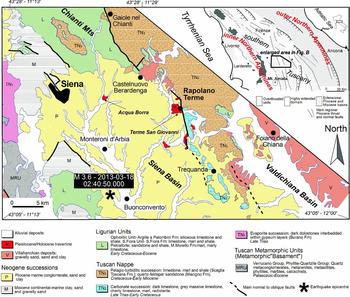
The M = 3.6 earthquake which occurred a few kilometres south of Siena (Central Italy) on 18 March 2013 (Fig. 1) gave us the opportunity to analyse the co-seismic effects on an active hydrothermal system and on a travertine fissure-ridge (the fault-related Terme San Giovanni fissure-ridge; Brogi & Capezzuoli, Reference Brogi and Capezzuoli2009), in terms of fissure propagation and fracturing, hydrothermal fluid flow and consequent travertine deposition. These observations contribute to a better understanding of: (i) the role of tectonic activity in the development of the travertine fissure-ridges; and (ii) the mechanism triggering the progressive growth of fissure-ridges.
Tectonic sketch-map showing the inner Northern Apennines and the northern part of the Siena Basin, where the Rapolano Terme geothermal area is located. The location of the M = 3.6 epicentre is also indicated.

Collected data support the intrinsic role of seismic shocks in the (re-)activation of fluid discharge and therefore carbonate deposition in a travertine depositional system, and more specifically in a fissure-ridge-type travertine depositional event.
2. The Terme San Giovanni fissure-ridge
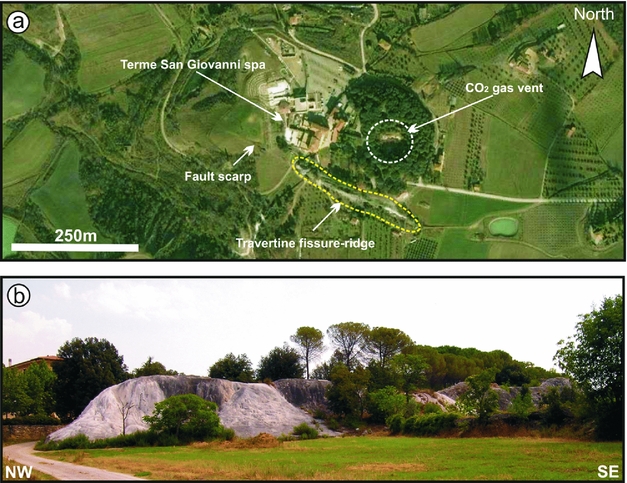
The Terme San Giovanni fissure-ridge is located 1 km southwest of Rapolano Terme (Fig. 2), on the eastern side of the Neogene Siena Basin (Martini & Sagri, Reference Martini and Sagri1993; Brogi, Reference Brogi2011) where pre-Neogene orogenic units and Neogene–Quaternary successions are exposed (Losacco & Del Giudice, Reference Losacco and Del Giudice1958; Bossio et al. Reference Bossio, Costantini, Lazzarotto, Liotta, Mazzanti, Mazzei, Salvatorini and Sandrelli1993; Bambini et al. Reference Bambini, Brogi, Cornamusini, Costantini and Lazzarotto2009, Reference Bambini, Brogi, Cornamusini, Costantini, Foresi and Lazzarotto2010; Arrangoni, Martini & Sandrelli, Reference Arrangoni, Martini and Sandrelli2012). Quaternary travertine deposits are mainly concentrated near Rapolano Terme where they form isolated bodies (Cipriani et al. Reference Cipriani, Ercoli, Malesani and Vannucci1972; Minissale et al. Reference Minissale, Vaselli, Tassi, Magro and Grechi2002; Brogi, Reference Brogi2004) constructed of a range of facies and morphotectonic features (see Guo & Riding, Reference Guo and Riding1992, Reference Guo and Riding1994, Reference Guo and Riding1996, Reference Guo and Riding1998). Travertine deposition was driven by springs of hydrothermal fluids (39°C) rising from a reservoir located at shallow depth consisting of carbonate rocks belonging to the Tuscan Succession (Bambini et al. Reference Bambini, Brogi, Cornamusini, Costantini, Foresi and Lazzarotto2010). The fluids are exploited by a nearby thermal spa by a shallow well (down to 40 m), located 10 m from the fissure-ridge, from which the thermal water, mixed with CO2, H2S and other minor components (Minissale, Reference Minissale2004), naturally discharges with a flow rate of about 18–20 l sec−1 at about 4–5 bar of pressure. General information on the hydrogeological setting of the Rapolano Terme area is reported in Barazzuoli & Micheluccini (Reference Barazzuoli and Micheluccini1982) and Barazzuoli et al. (Reference Barazzuoli, Costantini, Lazzarotto, Micheluccini, Salleolini, Salvadori and Sandrelli1987).
(a) Aerial photograph of the Terme San Giovanni area highlighting the travertine fissure-ridge; (b) panoramic view of the travertine fissure-ridge (western end).

The San Giovanni fissure-ridge (Guo & Riding, Reference Guo and Riding1998) is about 250 m long and 30 m wide, with a maximum height of 10 m. It is developing on the trace of a normal fault dissecting a fluvial terrace (Brogi & Capezzuoli, Reference Brogi and Capezzuoli2009). This morphotectonic feature is part of a larger, broad travertine deposit dated at 24±3 ka to Present (Carrara, Ciuffarella & Paganin, Reference Carrara, Ciuffarella and Paganin1998). In particular, the fissure-ridge is estimated to have developed in the last few thousand years, as indicated by the fact that the faults leading to the fissure-ridge development dissect travertine deposits younger than deposits dated at 9±1.7 ka, at minimum (Brogi, Capezzuoli & Gandin, Reference Brogi, Capezzuoli and Gandin2007).
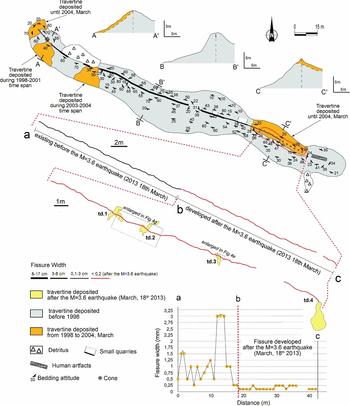
The profile of the ridge is asymmetric, with the northern slope higher than the southern one by about 10 m. At the top of the ridge, along its crest, a straight and continuous fissure occurs, with a maximum width of 30 cm (Fig. 3). The fissure width decreases towards its extremities, where it becomes about 1 mm wide. At the western and eastern ends, the fissure is missing as it is covered by neoformational travertine deposited by waters issuing from small cones aligned along the crest.
Reconstruction of the Terme San Giovanni fissure-ridge and its main features; the reconstruction of the fissure propagated after the M = 3.6 earthquake, as well as the location of the newly deposited travertine are also reported (modified from Brogi & Capezzuoli, Reference Brogi and Capezzuoli2009).

In March 2004, the water flowing from the fissure-ridge and the related travertine deposition ceased as a consequence of progressive flow reduction that began during the last decade as the result of: (i) sealing of the main conduits (i.e. fractures in the bedrock) by calcite precipitation and consequent permeability reduction (Brogi, Reference Brogi2004); (ii) scarce reservoir recharge due to the progressive decrease of meteoric water due to less precipitation (Barazzuoli et al. Reference Barazzuoli, Costantini, Lazzarotto, Micheluccini, Salleolini, Salvadori and Sandrelli1987); and (iii) the spa increasing exploitation and activity.
3. Earthquake effects on fluid flow and the travertine fissure-ridge
On 18 March 2013, at 2.40 a.m., a M = 3.6 earthquake was recorded in the Rapolano Terme area. Its hypocentre was calculated to be at 9.6 km depth (INGV: http://iside.rm.ingv.it/iside/standard/index.jsp) and the epicentre was located 20 km west of Rapolano Terme and 30 km south of Siena town (Lat. 43.142, Long. 11.343) (Fig. 1).
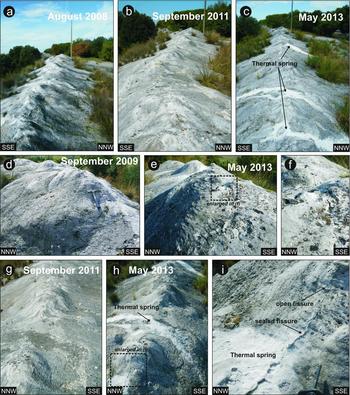
In the Terme San Giovanni area, the seismic event did not change the fluid flow rate and pressure; similarly, no water level change was observed in the well feeding the spa. However, the seismic event produced important effects on the fissure-ridge. After the main shock, the fissure at the top of the ridge propagated a further 22.5 m, affecting recently deposited travertine, mainly in the eastern ridge-end (Fig. 3). In the western ridge-end the fissure propagated a further 4 m. The new fissure locally reaches 0.25 mm in width (Figs 3, 4). Although it is locally irregular and shows millimetre- to centimetre-thick edges, it regularly runs on the top of the ridge and often crosses the already existing travertine cones (Fig. 4). The earthquake-induced fissure propagation was accompanied by the abrupt reappearance of water flow at the eastern end of the ridge (Figs 3, 4), which occurred a few hours after the main seismic shock. From this time, the water flow was about 0.35 l min−1. Water discharge was accompanied by bubbling due to gas emission, consisting of a mixture of mainly CO2 and H2S (Minissale et al. Reference Minissale, Vaselli, Tassi, Magro and Grechi2002) in agreement with the fluid composition. The water flowed along the marginal slopes of the ridge but was localized to four distinct regions, each from 75 to 25 cm long, along the newly developed fracture (Fig. 3). The flowing water promoted new travertine deposition consisting of millimetre-thick calcite crystalline crusts and paper-thin rafts that developed on centimetre-wide small pools mainly located at the top of the ridge. Gas emission affected larger regions of the newly generated fracture but was difficult to monitor due to wide variability in issue location. In some cases whitish sulphate grew along the fissure forming a millimetre-thick crust that tends to seal the fissure (Fig. 4). In September 2013 the fluid flow along the fissure-ridge significantly decreased. Only the easternmost spring was still active, discharging about 0.05 l min−1. Currently (December 2013) the fluids do not flow. Although the fluid pressure in the nearby spa did not change through time, the fluid flow on the fissure-ridge has progressively decreased since the second half of June 2013, thus suggesting the progressive sealing of fractures and associated permeability reduction.
Photographs illustrating the main effects of the M = 3.6 earthquake. (a–c) The eastern side of the San Giovanni fissure-ridge in the indicated years; the photograph in (c) shows the thermal spring activation after the M = 3.6 seismic event. (d–f) Fracture propagating along some cones in the eastern side of the fissure-ridge; (g–i) fluid discharge gives rise to the deposition of carbonate and sulphate along the fissure, which progressively decreases the permeability.

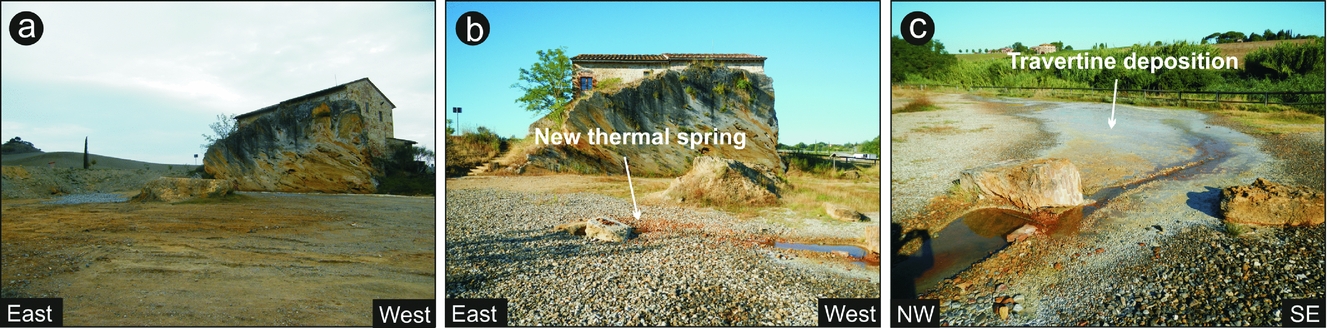
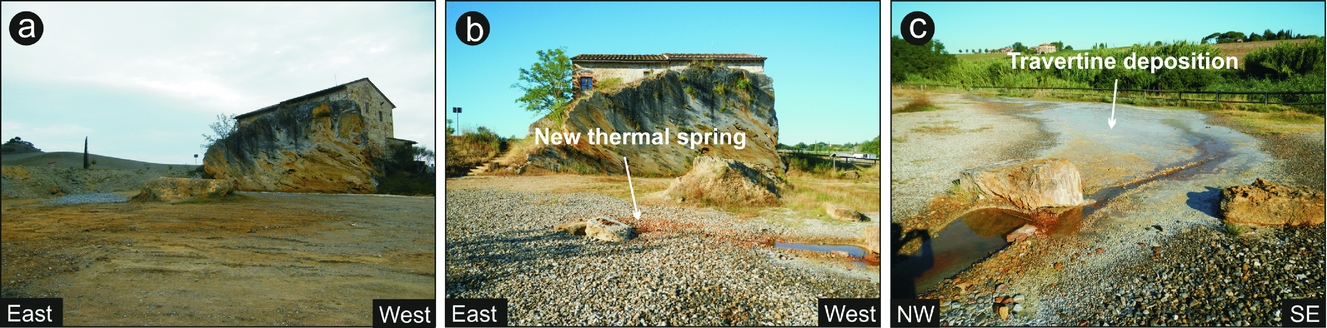
Remarkable consequences of the seismic event were also recorded in the surrounding areas of the Rapolano Terme geothermal system. For example in the adjacent Acqua Borra hydrothermal system, located 15 km west of Rapolano Terme (Fig. 1), a new thermal spring appeared a few hours after the main shock (Fig. 5). This thermal spring was characterized by a water flow of about 1 l min−1, and was located near a travertine deposit (Capezzuoli, Gandin & Pedley, Reference Capezzuoli, Gandin, Pedley, Pascucci and Andreucci2009), along a main buried fault zone which also drives three other thermal springs (38°C) and associated CO2 gas emissions (Minissale, Reference Minissale2004 and references therein). This spring (December 2013) is still active.
Photographs illustrating the location in the Acqua Borra area where a new thermal spring activated after the M = 3.6 earthquake. Fluids are still flowing (September 2013).
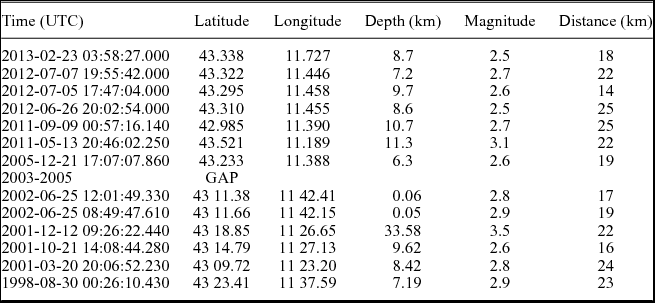
Other small earthquakes (2.5 < M < 3.1) have occurred within 35 km of the study area in the last three years, prior to the occurrence of the M = 3.6 event (Table 1). These events did not produce any noteworthy effects in the Acqua Borra area, whereas some weak effects were recognized in the Terme San Giovanni fissure-ridge, mainly in response to the seismic events that occurred during 2011. In fact, the eastern spring (Fig. 3) was moderately active from May to October 2011, with a fluid flow of 0.1 l min−1. An important correlation of seismic events and travertine deposition occurred in 1998 and 2001 (Fig. 3; Table 1): M2.8–2.9 seismic events occurred in concomitance with thermal spring activation (and travertine deposition) along the fissure-ridge. The M = 6.3 earthquake occurring at L'Aquila on 6 April 2009 (INGV: http://iside.rm.ingv.it/iside/standard/index.jsp), representing the most powerful recent seismic event in Italy, did not give rise to any tangible effects on the geothermal system, probably due to its distance, exceeding 150 km away.
M > 2.5 earthquakes with epicentres located not more than 35 km from Rapolano Terme, recorded during 1998–2002 and 2005–2013

From INGV: http://iside.rm.ingv.it/iside/standard/index.jsp; 1982–2002 Italian seismicity catalogue. The data gap for the 2003–2005 span is due to the lack of a public dataset.
4. Discussion
It has been documented that earthquakes can have a major impact on hydrogeological systems as demonstrated, for example, by abrupt co-seismic and post-seismic changes in water well levels (Briggs, Reference Briggs1991; Wang et al. Reference Wang, Wang and Kuo2004b ; Wang & Manga, Reference Wang and Manga2010). Hydrogeological systems can be dramatically perturbed by transient seismic waves, which are able to (i) promptly increase the pore pressure at depth (Muir-Wood & King, Reference Muir-Wood and King1993; Lee, Liu & Chang, Reference Lee, Liu and Chang2002) or (ii) trigger fluid pressure drops related to instantaneous permeability increases in the rock volumes (Brodsky et al. Reference Brodsky, Roeloffs, Woodcock, Gall and Manga2003; Elkhoury, Brodsky & Agnew, Reference Elkhoury, Brodsky and Agnew2006). In geothermal systems, earthquakes have been observed to perturb/trigger geyser eruptions (Husen et al. Reference Husen, Taylor, Smith and Healser2004), and cause mud-volcano development (Bonini, Reference Bonini2009; Manga, Brumm & Rudolph, Reference Manga, Brumm and Rudolph2009; Rudolph & Manga, Reference Rudolph and Manga2010) or the abrupt activation of thermal springs (Wang et al. Reference Wang, Manga, Dreger and Wong2004a ; Manga & Brodsky, Reference Manga and Brodsky2006).
Our data lead us to conclude that there is a clear relationship between the earthquake-induced shaking and the abrupt propagation of the fissure at the crest of the Terme San Giovanni travertine fissure-ridge, permeability increase and consequent (re-)activation of localized fluid discharge. This demonstrates the notable impact of the M = 3.6 seismic event, even though its epicentre was located about 20–25 km from the Terme San Giovanni and Acqua Borra areas, respectively. In our interpretation, the transient seismic waves increased the permeability (reopened main structural conduits, i.e. fault zones) sealed by previous hydrothermal circulation, thereby connecting the deep reservoir(s) to the surface. The 1998–2001 and 2011–2013 seismicity recorded in the study area (Table 1) highlights how thermal spring activation and related travertine deposition (Fig. 3) are contemporaneous with seismic events, thus strengthening the essential linkage between earthquakes, thermal spring activation and travertine deposition.
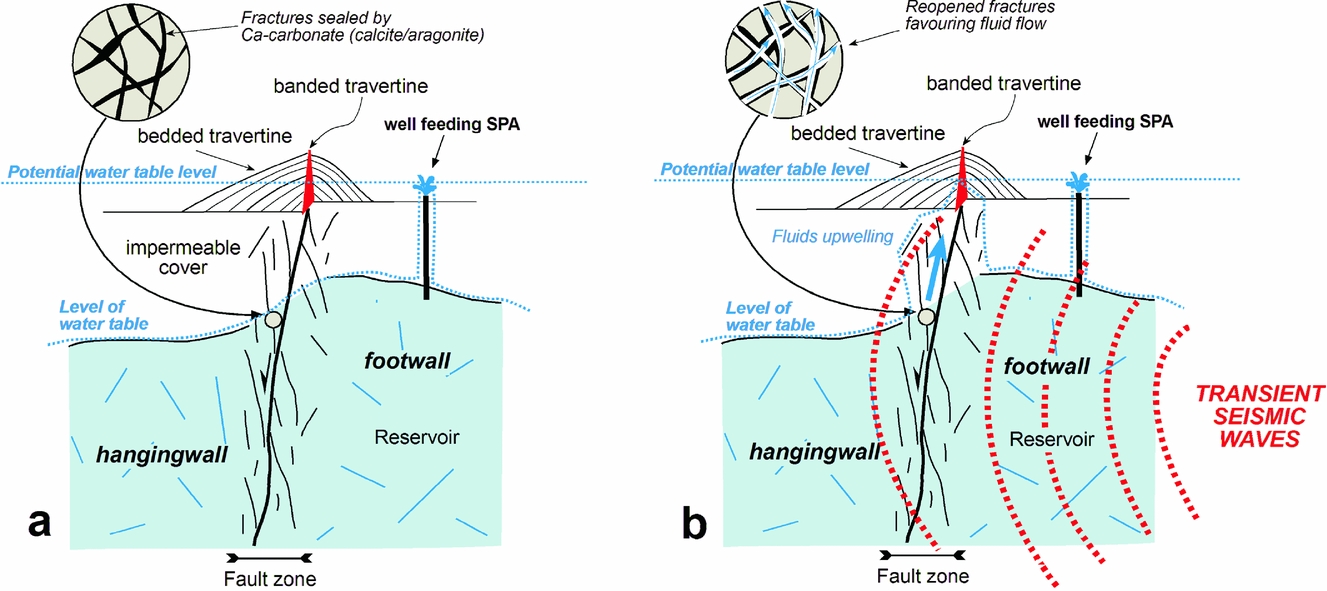
At Terme San Giovanni, the renewed permeability was reflected by the recovery of fluid flow at the eastern end of the fissure-ridge (the less elevated fissure-ridge portion). The main factor controlling water table elevation changes in a geothermal system is the recharge capacity of the reservoir (Barbier, Reference Barbier2002), in which the anthropogenic impact (in terms of fluids exploitation) plays a fundamental role. Nevertheless, climate factors are also important, and water table changes can be induced by fluid pressure fluctuations within the reservoir. Fluid pressure fluctuations can be guaranteed by the CO2 accumulation favouring the ‘uncorked-champagne-bottle-effect’ induced by earthquakes (cf. Uysal et al. Reference Uysal, Feng, Zhao, Isik, Nuriel and Golding2009). In our case, we have documented how transient seismic waves increased permeability without producing measurable fluid overpressure within the reservoir. Figure 6 illustrates the co-seismic effects on the permeability and fluid discharge along the fissure-ridge.
Cartoon illustrating the conceptual model of the effects of transient seismic waves on the Terme San Giovanni hydrothermal system. The water table level is indicated by the shallow well feeding the spa. The permeability increase after the earthquake allowed fluid flow along the previously sealed fault zone; fluid discharge is guaranteed in the fissure-ridge sectors below the water table.
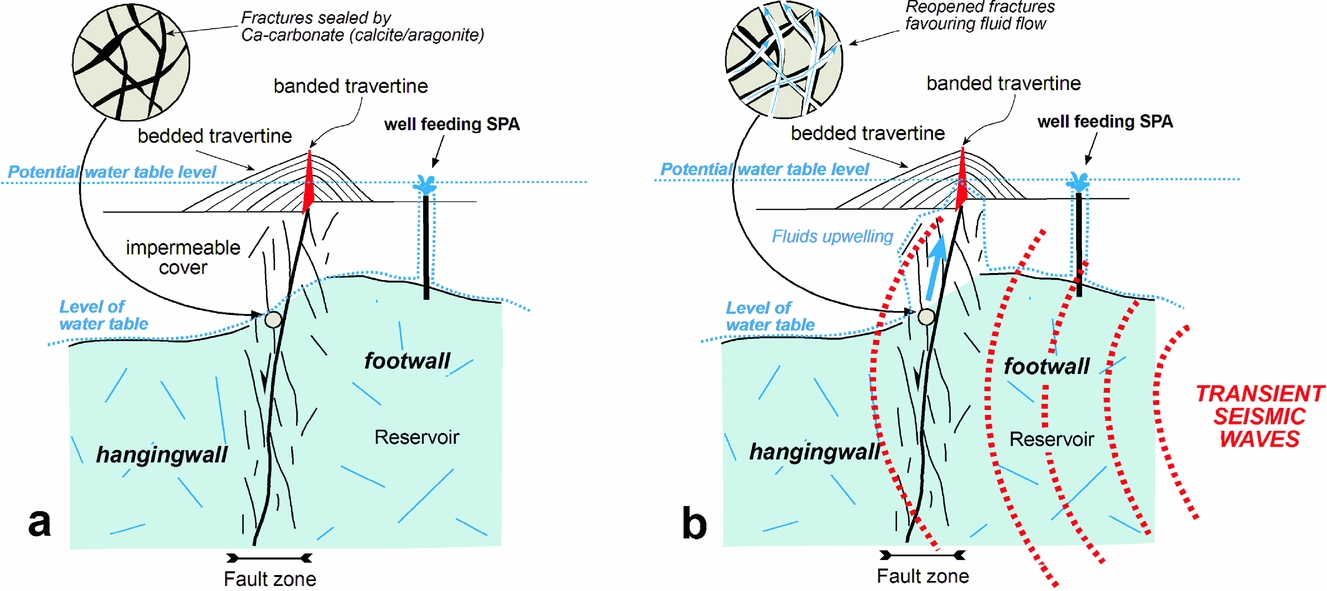
Our observations imply that travertine fissure-ridges are suitable sites for recording the effects of a seismogenic fault not necessarily corresponding to the structure along which the fissure-ridge developed (cf. Brogi & Capezzuoli, Reference Brogi and Capezzuoli2009). This implies that a travertine depositional system can record the effects of a distant earthquake and that their associated transient seismic waves could play a fundamental role in: (i) renewing permeability of distant (sealed) fault zones; (ii) activating new thermal springs or reactivating fluid discharge favouring travertine deposition (bedded travertine); and (iii) propagating the fissure at the top of the fissure-ridges, thus promoting banded travertine growth. At Terme San Giovanni, fluid discharge and related travertine deposition along the fissure-ridge mainly took place in the eastern end of the ridge (Fig. 3), thus suggesting that the fluid pathway is controlled by a compartmentalized permeability along the whole ridge. If this is the case, the banded travertine growth within a fissure-ridge would not be uniform along the whole ridge. This evidence has to be considered if banded travertine is used for reconstructing the palaeoseismological history of an area (see Altunel & Karabacak, Reference Altunel and Karabacak2005 and Uysal et al. Reference Uysal, Feng, Zhao, Altunel, Weatherley, Karabacak, Cengiz, Golding, Lawrence and Collerson2007), as its analyses and age determination could supply incomplete information on the palaeoseismic record. In addition, it is also arguable that banded travertine could reveal transient seismic waves not necessarily triggered by the fault system along which the fissure-ridge developed.
5. Conclusion
A M = 3.6 earthquake occurring 20 km away can induce the propagation of a fissure at the ends of a travertine fissure-ridge of up to 22 m. A rising water table can be a sudden response to the fissure propagation and recovered permeability of the hidden fault zone. Fluid flow may only affect some portions of the ridge, thus favouring the deposition of bedded and banded travertine in localized fissure-ridge sectors. Fluid discharge and travertine deposition (bedded and banded travertine) can abruptly restart after an earthquake, in response to seismic oscillations. Owing to the fact that travertine deposits (and more specifically banded travertine) are suitable materials for age determination (14C and/or 230Th–238U radiometric techniques), travertine fissure-ridges may be useful tools for reconstructing the palaeoseismicity of a region. Nevertheless, a fissure-ridge can record transient seismic waves produced by earthquakes with epicentres located up to 35 km from the travertine depositional system, not directly triggered by the main structure controlling the fissure-ridge development. In this view, we propose that the reconstruction of historical or prehistorical seismic events can be effectively achieved through the radiometric analysis of banded travertine in fossil fissure-ridge sites.
Declaration of interest
None
Acknowledgment
We are indebted to two reviewers (A. Billi and M. Manga) for their fruitful comments and criticisms that helped us to improve this paper. We would like to thank the Editor M. Allen for his kindly assistance. We are grateful to C. Doglioni for the useful suggestions and comments on an earlier version of the text. The management team of the Terme S. Giovanni Spa is also acknowledged for information on the hydrothermal fluid exploitation. This research has been supported by the authors’ personal funds.