


1 Introduction and main results
Let
 $(\Sigma ,g)$
be a compact Riemannian surface with boundary. In this paper, we always assume that
 $\Sigma $
is connected and the boundary of
 $\Sigma $
is nonempty and smooth. Consider the Steklov problem defined in the following way
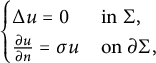 $$ \begin{align*} \begin{cases} \Delta u=0&\text{in } \Sigma,\\ \frac{\partial u}{\partial n}=\sigma u&\text{on } \partial \Sigma, \end{cases} \end{align*} $$
where
 $\Delta =-\operatorname {div}_g \circ \operatorname {grad}_g$
is the Laplace–Beltrami operator and
 $\frac {\partial }{\partial n}$
is the outward unit normal vector field along the boundary. The collection of all numbers
 $\sigma $
for which the Steklov problem admits a solution is called the Steklov spectrum of the surface
 $\Sigma $
. The Steklov spectrum is a discrete set of real numbers called Steklov eigenvalues with finite multiplicities satisfying the following condition (see e.g., [Reference Girouard and PolterovichGP17])
 $$ \begin{align*} 0=\sigma_0(g) < \sigma_1(g) \leq \sigma_2(g) \leq\cdots\nearrow +\infty. \end{align*} $$
The Steklov spectrum enables us to define the following homothety-invariant functional on the set
 $\mathcal {R}(\Sigma )$
of Riemannian metrics on
 $\Sigma $
 $$ \begin{align*} \overline{\sigma}_k(\Sigma,g):=\sigma_k(g)L_g(\partial \Sigma), \end{align*} $$
where
 $L_g(\partial \Sigma )$
stands for the length of the boundary of
 $\Sigma $
in the metric g. The functional
 $\overline {\sigma }_k(\Sigma ,g)$
is called the k-th normalized Steklov eigenvalue. It was shown in [Reference Colbois, El Soufi and GirouardCSG11] (see also [Reference HassannezhadHas11, Reference KokarevKok14]) that if
 $\Sigma $
is an orientable surface, then the functional
 $\overline {\sigma }_k(\Sigma ,g)$
is bounded from above. Moreover, the following theorem holds
Theorem 1.1 [Reference Girouard and PolterovichGP]
Let
 $(\Sigma ,g)$
be a compact orientable surface of genus
 $\gamma $
with l boundary components. Then one has
 $$ \begin{align*} \overline{\sigma}_k(\Sigma,g) \leq 2\pi k(\gamma+l). \end{align*} $$
In this paper, we prove that a similar estimate holds for nonorientable surfaces.
Theorem 1.2 Let
 $\Sigma $
be a compact nonorientable surface of genus
 $\gamma $
with l boundary components. Then one has
 $$ \begin{align*} \overline{\sigma}_k(\Sigma,g) \leq 4\pi k(\gamma+2l). \end{align*} $$
Here, the genus of a nonorientable surface is defined as the genus of its orientable cover.
Remark 1.1 The estimate in Theorem 1.1 has been improved in [Reference KarpukhinKar17] by a bound which is linear in
 $k+\gamma +l$
instead of
 $k(\gamma +l)$
. However, the proof of this result uses orientability in an essential way, see [Reference KarpukhinKar17, Section 6]. It would be interesting to obtain a similar improvement in Theorem 1.2.
Theorems 1.1 and 1.2 enable us to define the following functionals
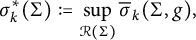 $$ \begin{align*} \sigma^*_k(\Sigma):=\sup_{\mathcal{R}(\Sigma)} \overline{\sigma}_k(\Sigma,g), \end{align*} $$
and
 $$ \begin{align*} \sigma^*_k(\Sigma,[g]):=\sup_{[g]} \overline{\sigma}_k(\Sigma,g). \end{align*} $$
Remark 1.2 Note that we cannot define the functionals
 $\sigma ^*_k(\Sigma )$
and
 $\sigma ^*_k(\Sigma ,[g])$
in higher dimensions. Indeed, it was proved in the paper [Reference Colbois, El Soufi and GirouardCSG19] that if
 $n=\dim M \geq 3$
then the functional
 $\overline {\sigma }_k(M,g):=\sigma _k(g)Vol(\partial M, g)^{1/(n-1)}$
, where
 $Vol(\partial M, g)$
denotes the volume of the boundary with respect to the metric g, is not bounded from above on the set of Riemannian metrics
 $\mathcal R(M)$
. Moreover, it is not even bounded from above in the conformal class
 $[g]$
.
The functional
 $\sigma ^*_k(\Sigma )$
is an object of intensive research during the last decade (see e.g., [Reference Fraser and SchoenFS11, Reference Fraser and SchoenFS16, Reference Colbois, Girouard and RaveendranCGR18, Reference PetridesPet19, Reference Girouard and LagacéGL20, Reference Matthiesen and PetridesMP20a]).
The functional
 $\sigma ^*_k(\Sigma ,[g])$
which is called the kth conformal Steklov eigenvalue is less studied. Let us mention some results concerning
 $\sigma ^*_k(\Sigma ,[g])$
. First, since the disc admits the unique conformal structure one can conclude that
 $\sigma ^*_k(\mathbb D^2,[g_{can}])=\sigma ^*_k(\mathbb D^2),$
where
 $g_{can}$
stands for the Euclidean metric on
 $\mathbb D^2$
with unit boundary length. The value of
 $\sigma ^*_k(\mathbb D^2)$
is known:
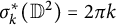 $\sigma ^*_k(\mathbb D^2)=2\pi k$
(see [Reference WeinstockWei54] for
 $k=1$
and [Reference Girouard and PolterovichGP10] for all
 $k \geq 1$
). Let us also mention the resent paper [Reference Fraser and SchoenFS20], where the authors particularly obtain new results about the functional
 $\sigma ^*_k(\mathbb D^2)$
.
The functional
 $\sigma ^*_k(\Sigma ,[g])$
is the main research object of the paper [Reference PetridesPet19].
Theorem 1.3 [Reference PetridesPet19]
For every Riemannian metric g on a compact surface
 $\Sigma $
with boundary one has
 $$ \begin{align} \sigma^*_k(\Sigma,[g]) \geq \sigma^*_{k-1}(\Sigma,[g])+\sigma^*_1(\mathbb{D}^2, [g_{can}]), \end{align} $$
particularly
 $$ \begin{align} \sigma^*_k(\Sigma,[g]) \geq 2\pi k. \end{align} $$
Moreover, if the inequality (1.1) is strict then there exists a Riemannian metric
 $\tilde g\in [g]$
such that
 $\overline \sigma _k(\Sigma ,\tilde g)=\sigma ^*_k(\Sigma ,[g])$
.
New interesting results about the functional
 $\sigma ^*_k(\Sigma ,[g])$
were recently obtained in the paper [Reference Karpukhin and SternKS20].
Remark 1.3 The result analogous to Theorem 1.3 for the conformal spectrum of the Laplace–Beltrami operator on closed surfaces also holds (see [Reference Nadirashvili and SireNS15a, Reference Nadirashvili and SireNS15b, Reference PetridesPet14, Reference PetridesPet18, Reference Karpukhin, Nadirashvili, Penskoi and PolterovichKNPP20]). For further information concerning the spectrum of the Laplace–Beltrami operator on closed surfaces see the surveys [Reference PenskoĭPen13, Reference PenskoĭPen19] and references therein.
It is easy to see that the connection between the functionals
 $\sigma ^*_k(\Sigma )$
and
 $\sigma ^*_k(\Sigma ,[g])$
is expressed by the formula
 $$ \begin{align*} \sigma^*_k(\Sigma)=\sup_{[g]} \sigma^*_k(\Sigma,[g]). \end{align*} $$
One can ask what do we get if we replace
 $\sup _{[g]}$
by
 $\inf _{[g]}$
in this formula? In this case, we get the following quantity
 $$ \begin{align*} I^{\sigma}_k(\Sigma):=\inf_{[g]} \sigma^*_k(\Sigma,[g]), \end{align*} $$
It is an analog of the Friedlander–Nadirashvili invariant of closed manifolds. The first Friedlander–Nadirashvili invariant of a closed manifold was introduced in the paper [Reference Friedlander and NadirashviliFN99] in 1999. The kth Nadirashvili–Friedlander invariant of a closed surface has been recently studied in the paper [Reference Karpukhin and MedvedevKM20].
In the study of functionals like
 $\sigma ^*_k(\Sigma )$
and
 $I^{\sigma }_k(\Sigma )$
, one considers maximizing and minimizing sequences of conformal classes
 $\{c_n\}$
on the moduli space of conformal classes on
 $\Sigma $
, i.e.,
 $\sigma ^*_k(\Sigma ,c_n) \to \sigma ^*_k(\Sigma )$
or
 $\sigma ^*_k(\Sigma ,c_n) \to I^{\sigma }_k(\Sigma )$
as
 $n\to \infty $
. Due to the Uniformization theorem conformal classes on
 $\Sigma $
are in one-to-one correspondence (up to an isometry) with metrics on
 $\Sigma $
of constant Gauss curvature and geodesic boundary. Therefore, any sequence of conformal classes
 $\{c_n\}$
on
 $\Sigma $
corresponds to a sequence of Riemannian surfaces of constant Gauss curvature and geodesic boundary
 $\{(\Sigma ,h_n)\},~h_n\in c_n$
and we can consider the moduli space of conformal classes on
 $\Sigma $
as the set of all
 $(\Sigma ,h)$
, where h is a metric of constant Gauss curvature and geodesic boundary, endowed with
 $C^{\infty }$
-topology (see Section 4). Note that the moduli space of conformal structures is a noncompact topological space. For any sequence
 $\{c_n\}$
there are two possible scenarios: either this sequence remains in a compact part of the moduli space or it escapes to infinity. Let
 $(\Sigma _{\infty }, c_{\infty })$
denote the limiting space, i.e.,
 $(\Sigma _{\infty }, c_{\infty })=\lim _{n\to \infty }(\Sigma ,c_n)$
. We compactify
 $\Sigma _{\infty }$
if necessary. Let
 $\widehat {\Sigma _{\infty }}$
denote the compactified limiting space. It turns out that if the first scenario realizes, then we get
 $\widehat {\Sigma _{\infty }}=\Sigma $
and
 $c_{\infty }$
is a genuine conformal class on
 $\Sigma $
for which the value
 $\sigma ^*_k(\Sigma )$
or
 $I^{\sigma }_k(\Sigma )$
is attained. If the second scenario realizes, then we say that the sequence
 $\{c_n\}$
degenerates. It turns out that in this case there exists a finite collection of pairwise disjoint geodesics for the metrics
 $h_n$
whose lengths in
 $h_n$
tend to
 $0$
as n tends to
 $\infty $
. We refer to these geodesics as pinching or collapsing. They can be of the following three types: the collapsing boundary components, the collapsing geodesics with no self-intersection crossing the boundary
 $\partial \Sigma $
at two points and the collapsing geodesics with no self-intersection which do not cross
 $\partial \Sigma $
. Note that in this case, the topology of
 $\Sigma $
necessarily changes when we pass to the limit as
 $n\to \infty $
, i.e., the compact surfaces
 $\widehat \Sigma _{\infty }$
and
 $\Sigma $
are of different topological types. In particular, the surface
 $\widehat \Sigma _{\infty }$
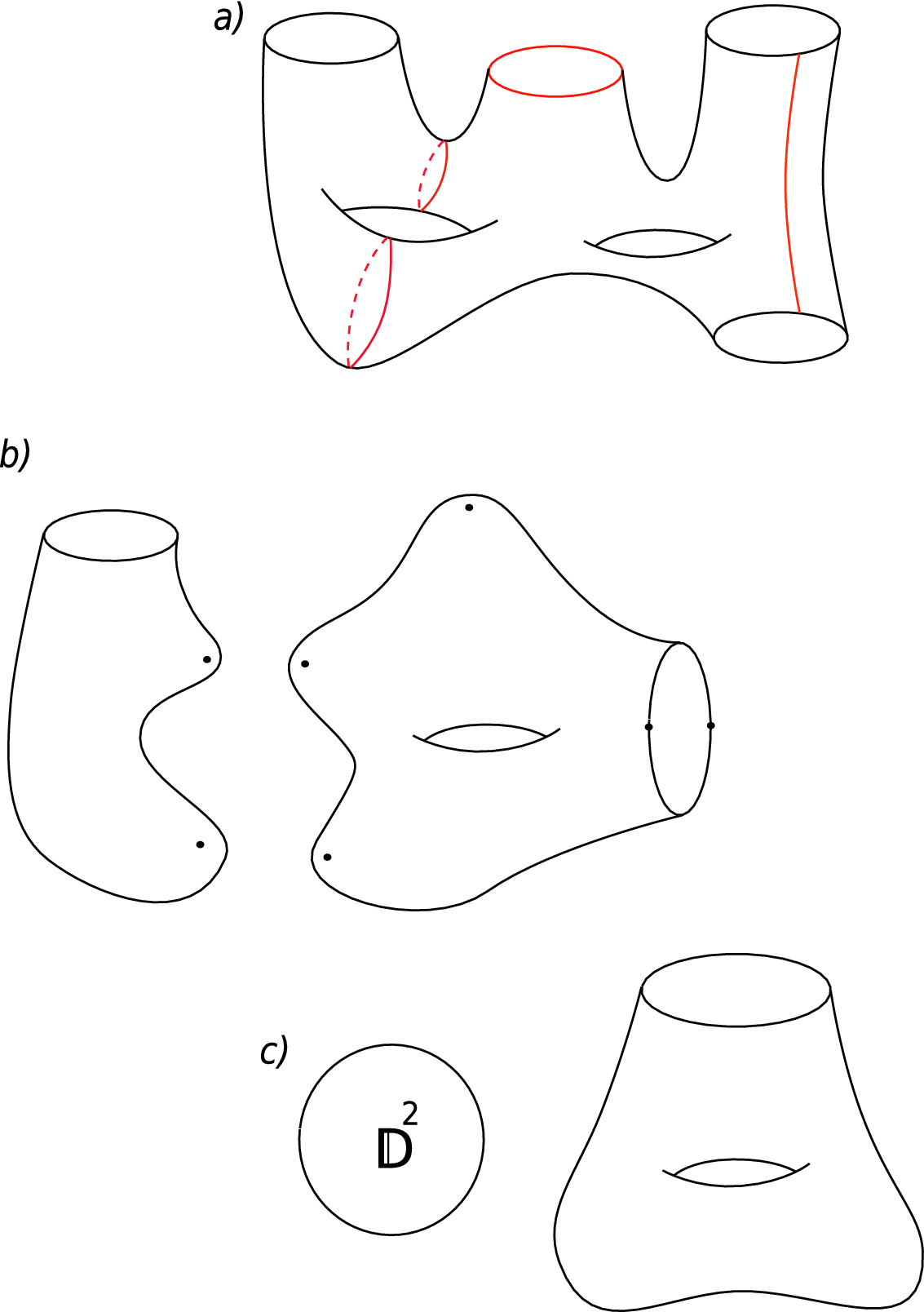
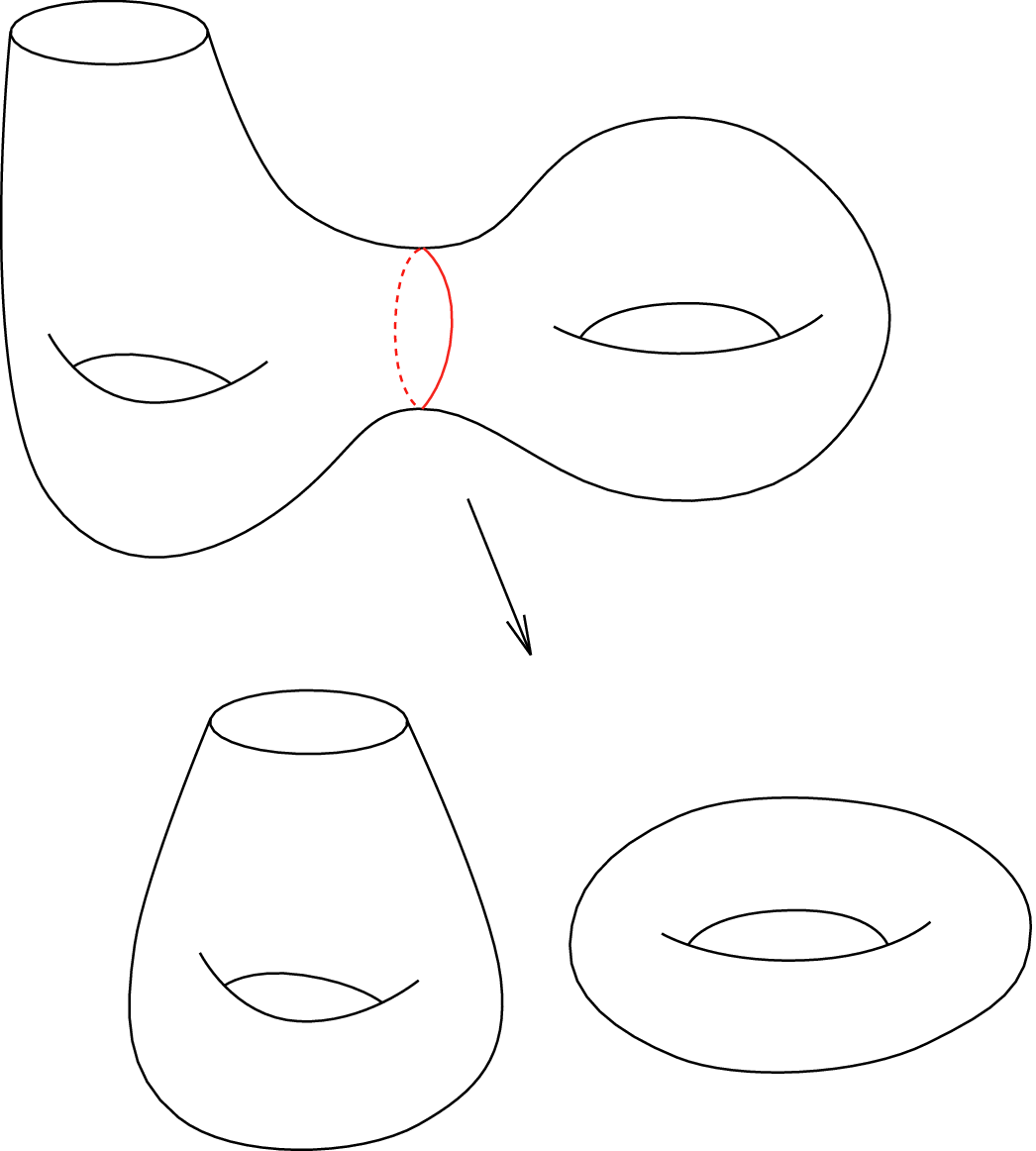
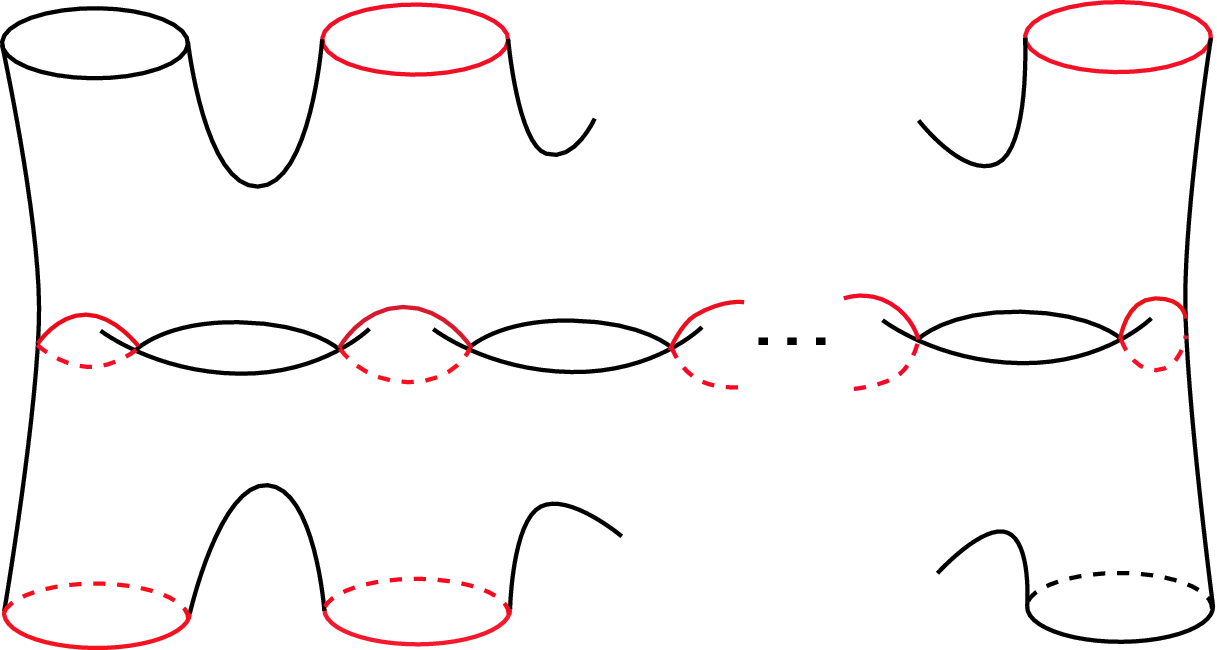
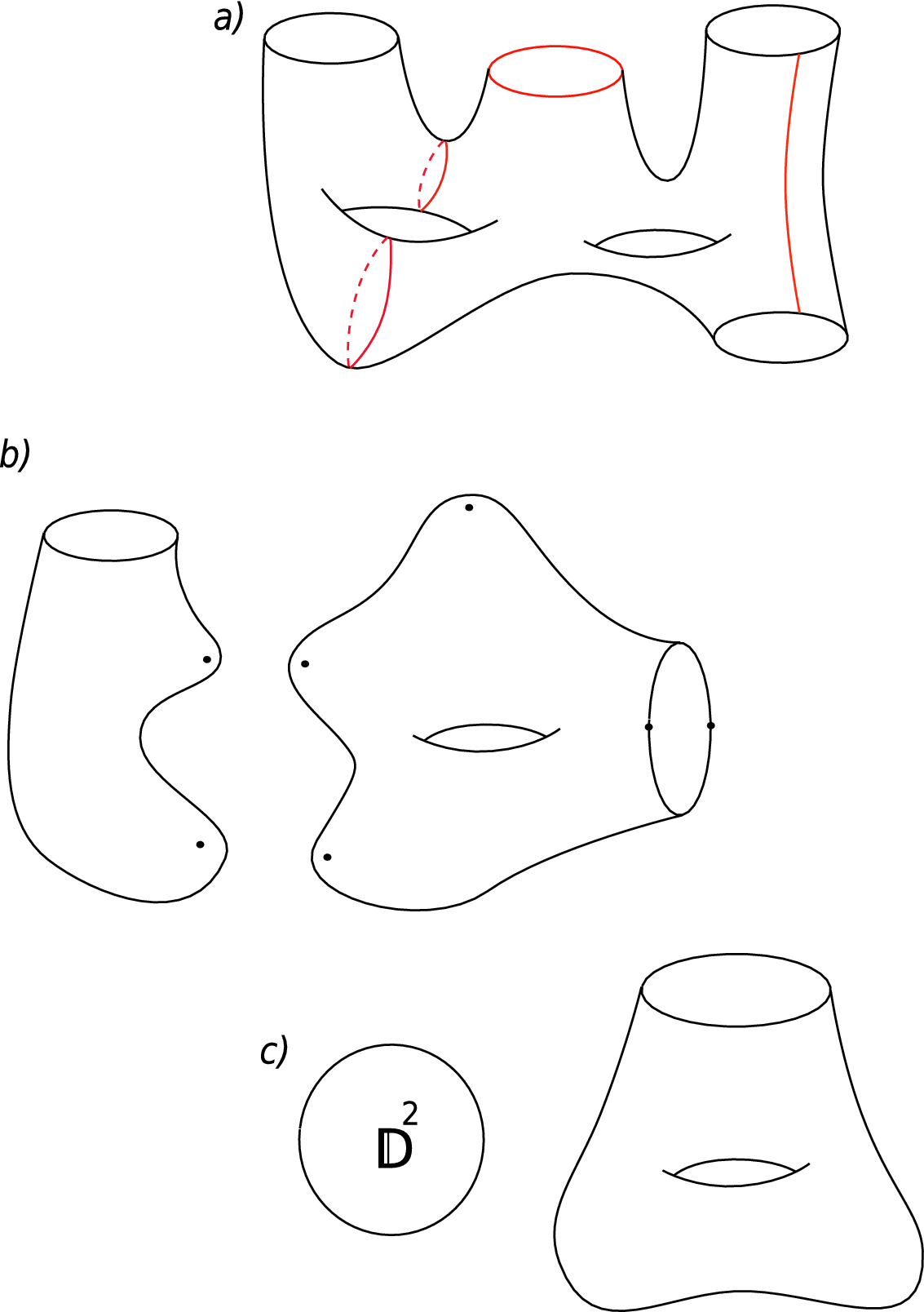
can be disconnected (see Figure 1). We refer to Section 4 for more details.
An example of a degenerating sequence of conformal classes
 $\{c_n\}$
on a surface
 $\Sigma $
of genus
 $2$
with
 $4$
boundary components. (a) The red curves correspond to collapsing geodesics for the sequence of metrics of constant Gauss curvature and geodesic boundary
 $\{h_n\}, ~h_n\in c_n$
corresponding to the degenerating sequence of conformal classes
 $\{c_n\}$
. (b) The compactified limiting space
 $\widehat {\Sigma _{\infty }}$
(see Section 4). The black points correspond to the points of compactification. (c) The surface
 $\widehat {\Sigma _{\infty }}$
is homeomorphic to the disjoint union of a disc and a surface of genus
 $1$
with
 $1$
boundary component.
The following theorem establishes the correspondence between
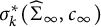 $\sigma ^*_k(\widehat \Sigma _{\infty },c_{\infty })$
and the limit of
 $\sigma ^*_k(\Sigma ,c_n)$
when the sequence of conformal classes
 $c_n$
degenerates (see Section 4 for the definition). It is an analog of [Reference Karpukhin and MedvedevKM20, Theorem 2.8] for the Steklov setting.
Theorem 1.4 Let
 $\Sigma $
be a compact surface of genus
 $\gamma $
with
 $l>0$
boundary components and let
 $c_n\to c_{\infty }$
be a degenerating sequence of conformal classes. Consider the corresponding sequence
 $\{h_n\}$
of metrics of constant Gauss curvature and geodesic boundary. Suppose that there exist
 $s_1$
collapsing boundary components and
 $s_2$
collapsing geodesics with no self-intersection which cross the boundary at two points. Moreover, suppose that
 $\widehat {\Sigma _{\infty }}$
has m connected components
 $\Sigma _{\gamma _{i},l_i}$
of genus
 $\gamma _i$
with
 $l_i>0$
boundary components,
 $\gamma _i+l_i<\gamma +l$
,
 $i=1,\ldots ,m$
. Then one has
 $$ \begin{align*} \lim_{n \to \infty} \sigma^*_k (\Sigma, c_n)= \max \bigg(\sum^{m}_{i=1} \sigma^*_{k_i}(\Sigma_{\gamma_{i},l_i}, c_{\infty})+\sum_{i=1}^{s_1+s_2}\sigma^*_{r_i}(\mathbb{D}^2)\bigg), \end{align*} $$
where the maximum is taken over all possible combinations of indices such that
 $$ \begin{align*} \sum_{i=1}^{m} k_i + \sum_{i=1}^{s_1+s_2} r_i = k. \end{align*} $$
Remark 1.4 Let
 $\Sigma $
denote either cylinder or the Möbius band. Theorem 1.4 particularly implies that if the sequence of conformal classes
 $\{c_n\}$
on
 $\Sigma $
degenerates then we necessarily have:
 $$ \begin{align*} \lim_{n \to \infty} \sigma^*_k (\Sigma, c_n)=2\pi k. \end{align*} $$
Remark 1.5 In Theorem 1.4 the sequence
 $\{h_n\}$
can also have collapsing geodesics not crossing the boundary of
 $\Sigma $
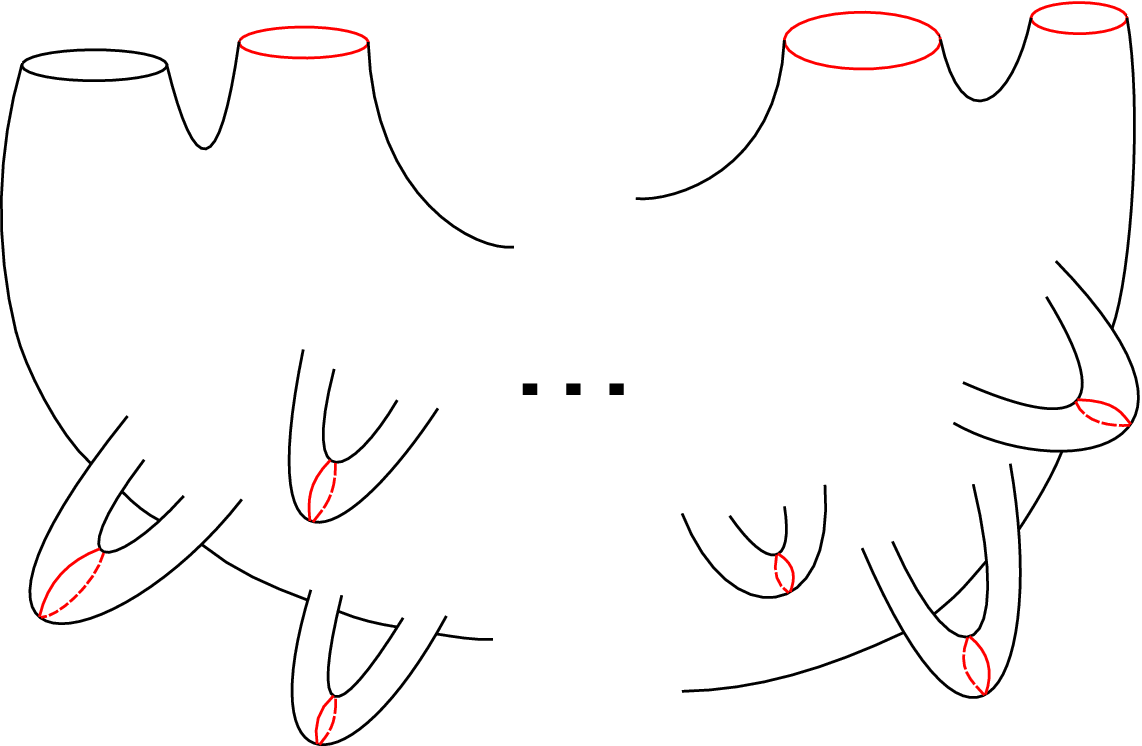
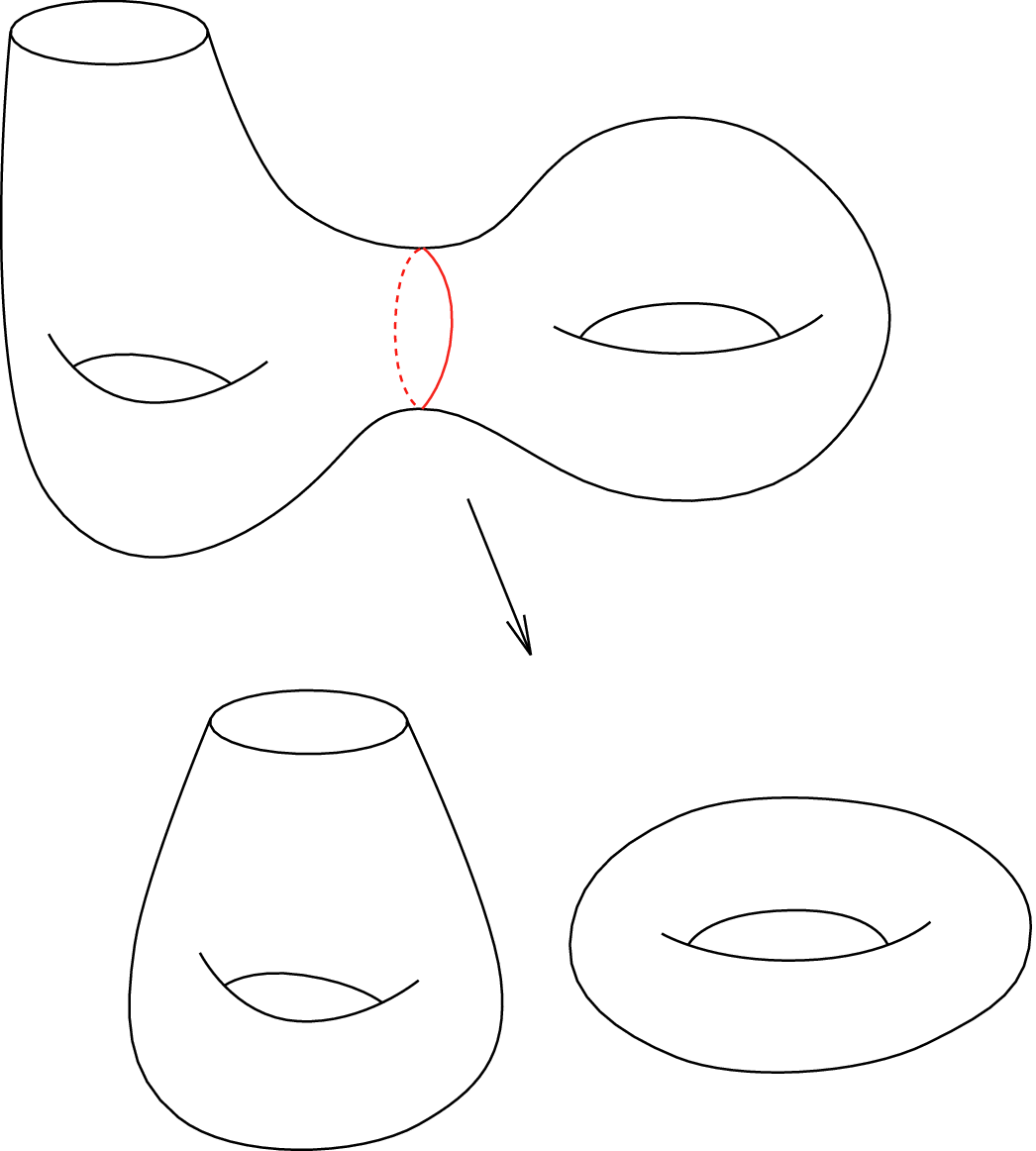
. Moreover, it can happen that the limiting space
 $\widehat {\Sigma _{\infty }}$
has closed components (see Figure 2). Anyway, in Theorem 1.4 we take only components of
 $\widehat {\Sigma _{\infty }}$
which have nonempty boundary.
An example of a degenerating sequence of conformal classes
 $\{c_n\}$
on a surface of genus
 $2$
with
 $1$
boundary components such that the limiting space contains a closed component. In Theorem 1.4, we take only the component on the left which has nonempty boundary. Note that in this case
 $s_1=s_2=0$
.
The main tool that we use in the proof of Theorem 1.4 is the Steklov–Neumann boundary problem also known as the sloshing problem. Let
 $\Omega $
be a Lipschitz domain in
 $(\Sigma ,g)$
such that
 $\overline \Omega \cap \partial \Sigma = \partial ^S\Omega \neq \varnothing $
. Let
 $\partial ^N\Omega =\partial \Omega \setminus \partial \Sigma $
. Then the Steklov–Neumann problem is defined as:
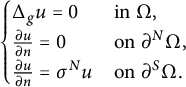 $$ \begin{align*} \begin{cases} \Delta_g u=0&\text{in } \Omega,\\ \frac{\partial u}{\partial n}=0&\text{on } \partial^N\Omega,\\ \frac{\partial u}{\partial n}=\sigma^Nu&\text{on } \partial^S\Omega. \end{cases} \end{align*} $$
The numbers
 $\sigma ^N$
for which the Steklov–Neumann problem admits a solution are called Steklov–Neumann eigenvalues. It is known (see [Reference Banuelos, Kulczycki, Polterovich and SiudejaBKPS10] and references therein) that the set of Steklov–Neumann eigenvalues is not empty and discrete
 $$ \begin{align*} 0=\sigma^N_0(g) < \sigma^N_1(g) \leq \sigma^N_2(g) \leq\cdots\nearrow +\infty. \end{align*} $$
Every Steklov–Neumann eigenvalue admits the following variational characterization:
 $$ \begin{align*} \sigma^N_k(g)=\inf_{V_k\subset \mathcal H^1(\Omega)}\sup_{0 \neq u \in V_k}\frac{\int_{\Omega}|\nabla u|^2dv_g}{\int_{\partial^S\Omega}u^2ds_g}, \end{align*} $$
where the infimum is taken over all k-dimensional subspaces of the space
 $\mathcal H^1(\Omega )=\{u\in H^1(\Omega ,g)~|~\int _{\partial ^S\Omega } uds_g=0\}$
.
Similarly to the case of the Steklov problem we define normalized Steklov–Neumann eigenvalues as
 $$ \begin{align*} \overline\sigma^N_k(\Omega, \partial^S\Omega,g):=\sigma^N_k(g)L_g(\partial^S\Omega). \end{align*} $$
In this notation, we always indicate the Steklov part of the boundary at the second place. Sometimes, we also use the notation
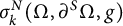 $\sigma ^N_k(\Omega , \partial ^S\Omega ,g)$
for
 $\sigma ^N_k(\Omega ,g)$
to emphasize that the Steklov boundary condition is imposed on
 $\partial ^S\Omega $
.
Remark 1.6 Consider
 $\Omega $
as a surface with Lipschitz boundary. It also follows from [Reference KokarevKok14, Theorem
 ${A}_k$
] that the quantity
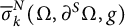 $\overline \sigma ^N_k(\Omega , \partial ^S\Omega ,g)$
is bounded from above on
 $[g]$
and we can define the invariant
 $\sigma ^{N*}_k(\Omega , \partial ^S\Omega ,[g])$
in the same way as the invariant
 $\sigma ^{*}_k(\Sigma ,[g])$
.
Theorem 1.4 enables us to establish the value of
 $I^{\sigma }_k$
.
Theorem 1.5 Let
 $\Sigma $
be a compact surface with boundary. Then one has
 $I^{\sigma }_k(\Sigma )=I^{\sigma }_k(\mathbb D^2)=2\pi k$
.
1.1 Discussion
Let us discuss the estimate obtained in Theorem 1.2. The first estimate on
 $\overline {\sigma }_1(\Sigma ,g)$
where
 $\Sigma $
is a nonorientable surface of genus
 $\gamma $
with boundary was obtained in the paper [Reference SchoenSch13]. It reads
 $$ \begin{align*} \overline{\sigma}_1(\Sigma,g) \leq 24\pi (\gamma+1), \end{align*} $$
if
 $\gamma \geq 1$
and
 $$ \begin{align*} \overline{\sigma}_1(\Sigma,g) \leq 12\pi, \end{align*} $$
if
 $\gamma =0$
. Moreover, it follows from the papers [Reference KokarevKok14, Reference KarpukhinKar16] that
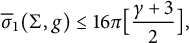 $$ \begin{align} \overline{\sigma}_1(\Sigma,g) \leq 16\pi \big[\frac{\gamma+3}{2}\big], \end{align} $$
where
 $[x]$
stands for the integer part of the number x.
Very recently, in the paper [Reference Karpukhin and SternKS20], estimate (1.3) has been improved and extended for
 $k=2$
: consider
 $\Sigma $
as a domain with smooth boundary on a closed surface M, then one has
 $$ \begin{align} \overline{\sigma}_k(\Sigma,g) \leq \Lambda_k(M),~k=1,2. \end{align} $$
In this estimate,
 $\Lambda _k(M):=\sup _{g\in \mathcal R(M)} \lambda _k(g)\operatorname {Vol}(M,g)$
, where
 $\lambda _k(g)$
is the kth Laplace eigenvalue of the metric g,
 $\operatorname {Vol}(M,g)$
is the volume of M in the metric g and
 $\mathcal R(M)$
is the set of Riemannian metrics on M. Note that estimate (1.4) does not depend on the number of boundary components. Combining estimate (1.4) with our estimate we get
 $$ \begin{align*} \overline{\sigma}_k(\Sigma,g) \leq \min\{\Lambda_k(M), 4\pi k(\gamma+2l)\},~k=1,2. \end{align*} $$
Particularly, for the Möbius band one has
 $$ \begin{align*} \overline{\sigma}_k(\mathbb{MB},g) \leq \min\{\Lambda_k(\mathbb{RP}^2), 8\pi k\},~k=1,2, \end{align*} $$
since
 $\mathbb {MB} \subset \mathbb {RP}^2$
. The value
 $\Lambda _k(\mathbb {RP}^2)$
is known for all k (see [Reference KarpukhinKar20]):
 $\Lambda _k(\mathbb {RP}^2)=4\pi (2k+1)$
. Hence,
 $$ \begin{align*} \overline{\sigma}_k(\mathbb{MB},g) \leq \min\{4\pi(2k+1), 8\pi k\}=8\pi k,~k=1,2. \end{align*} $$
In the paper [Reference Fraser and SchoenFS16] it was shown that
 $\overline {\sigma }_1(\mathbb {MB},g) \leq 2\pi \sqrt {3}$
which is obviously
 $\leq 8\pi $
.
We proceed with the discussion of the functional
 $I^{\sigma }_k$
. Unlike Theorem 1.4 in [Reference Karpukhin and MedvedevKM20], Theorem 1.5 says nothing about conformal classes on which the value
 $I^{\sigma }_k(\Sigma )$
is attained. We conjecture that
Conjecture 1.6 The infimum
 $I^{\sigma }_k(\Sigma )$
is attained if and only if
 $\Sigma $
is diffeomorphic to the disc
 $\mathbb D^2$
.
Note that this conjecture would be a corollary of the following one
Conjecture 1.7 Let
 $\Sigma $
be a compact surface nondiffeomorphic to the disc. Then for every conformal class c on
 $\Sigma $
one has
 $$ \begin{align*} \sigma^*_1(\Sigma,c)>\sigma^*_1(\mathbb D^2)=2\pi. \end{align*} $$
This conjecture is an analog of the Petrides rigidity theorem for the first conformal Laplace eigenvalue [Reference PetridesPet14, Theorem 1]. Recently this conjecture has been confirmed in the case of the cylinder and the Möbius band (see [Reference Matthiesen and PetridesMP20b]). We plan to tackle Conjectures 1.6 and 1.7 in the subsequent papers.
Let us discuss the analogy between the quantity
 $I^{\sigma }_k$
and the Friedlander–Nadirashvili invariant of closed surfaces
 $I_k$
. In the paper [Reference Karpukhin and MedvedevKM20], it was conjectured that
 $I_k$
are invariants of cobordisms of closed surfaces (see Conjecture 1.8). Similarly, one can see that
 $I^{\sigma }_k$
are invariants of cobordisms of compact surfaces with boundary. Let us recall that two compact surfaces with boundary
 $(\Sigma _1,\partial \Sigma _1)$
and
 $(\Sigma _2,\partial \Sigma _2)$
are called cobordant if there exists a three-dimensional manifold with corners
 $\Omega $
whose boundary is
 $\Sigma _1\cup _{\partial \Sigma _1} W \cup _{\partial \Sigma _2}\Sigma _2$
, where W is a cobordism of
 $\partial \Sigma _1$
and
 $\partial \Sigma _2$
(i.e., W is a surface with boundary
 $\partial \Sigma _1\sqcup \partial \Sigma _2$
). Following [Reference Borodzik, Némethi and RanickiBNR16] we denote a cobordism of two surfaces
 $(\Sigma _1,\partial \Sigma _1)$
and
 $(\Sigma _2,\partial \Sigma _2)$
by
 $(\Omega ;\Sigma _1,\Sigma _2,W;\partial \Sigma _1,\partial \Sigma _2)$
. One can easily see that the cobordisms of surfaces with boundary are trivial. Indeed, we can construct the following cobordism of a surface
 $(\Sigma ,\partial \Sigma )$
and
 $(\varnothing , \varnothing )$
:
 $(\Sigma \times [0,1];\Sigma \times \{0\}, \varnothing ,\partial \Sigma \times [0,1]\cup \Sigma \times \{1\};\partial \Sigma , \varnothing )$
. A fundamental fact about cobordisms of surfaces with boundary is Theorem about splitting cobordisms (see [Reference Borodzik, Némethi and RanickiBNR16, Theorem 4.18]) which says that every cobordism of compact surfaces with boundary can be split into a sequence of cobordisms given by a handle attachment and cobordisms given by a half-handle attachment. We refer to [Reference Borodzik, Némethi and RanickiBNR16] for definitions and further information about cobordisms of compact manifolds with boundary. Analysing the proof of Theorem 1.5 one can remark that the value of
 $I^{\sigma }_k$
does not change under handle and half-handle attachments. Since by this procedure any surface
 $\Sigma $
can be reduced to the disc, we get
 $I^{\sigma }_k(\Sigma )=I^{\sigma }_k(\mathbb D^2)=2\pi k$
.
1.2 Plan of the paper
The paper is organized in the following way. In Section 2, we collect all the analytic facts which are necessary for the proof of Theorem 1.4. The main result here is Proposition 2.6. In Section 3, we prove Theorem 1.2 using the techniques developed in the previous section. Section 4 represents the geometric part of the paper. Here, we describe convergence on the moduli space of conformal structures on a surface with boundary. Section 5 is devoted to the proof of Theorem 1.4. In Section 6, we deduce Theorem 1.5 from Theorem 1.4. Finally, Section 7 contains some auxiliary technical results.
2 Analytic background
Here, we provide a necessary analytic background that we will use in the proof of Theorem 1.4 in Section 5. The propositions in this section are analogs of the propositions in [Reference Karpukhin and MedvedevKM20, Section 4]. We postpone the proof of a proposition to Section 7.2 every time when it follows the exactly same way as the proof of an analogous proposition in [Reference Karpukhin and MedvedevKM20, Section 4].
2.1 Convergence of Steklov–Neumann spectrum
We start with the following convergence result.
Lemma 2.1 Let
 $(M, g)$
be a compact Riemannian manifold with boundary. Consider a finite collection
 $\{ B_{\epsilon }(p_i) \}_{i=1}^l$
of geodesic balls of radius
 $\epsilon $
centred at some points
 $p_1,\ldots ,p_l \in M$
. Then the spectrum of the Steklov–Neumann problem
 $$ \begin{align*} \begin{cases} \Delta_gu=0&\text{in } M\setminus \cup^l_{i=1}B_{\epsilon}(p_i),\\ \frac{\partial u}{\partial n}=0&\text{on } \cup^l_{i=1} \partial B_{\epsilon}(p_i) \setminus \partial M,\\ \frac{\partial u}{\partial n}=\lambda^N_k(M \setminus \cup^l_{i=1}B_{\epsilon}(p_i), g) u&\text{on } \partial M \setminus \cup^l_{i=1} \partial B_{\epsilon}(p_i) \end{cases} \end{align*} $$
converges to the Steklov spectrum of
 $(M,g)$
as
 $\epsilon \to 0$
.
Proof For the sake of simplicity, we only consider the case of one ball that we denote by
 $B_{\epsilon }$
centred at
 $p \in M$
. First, we consider the case when
 $B_{\epsilon } \cap \partial M \neq \varnothing $
, i.e.,
 $p\in \partial M$
.
Let
 $\mathcal E(u)$
denote the extension of the function u by the unique solution of the problem
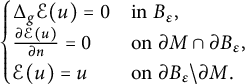 $$ \begin{align*} \begin{cases} \Delta_g\mathcal E(u)=0&\text{in } B_{\epsilon},\\ \frac{\partial \mathcal E(u)}{\partial n}=0&\text{on } \partial M \cap \partial B_{\epsilon},\\ \mathcal E(u)= u&\text{on } \partial B_{\epsilon} \setminus \partial M. \end{cases} \end{align*} $$
Claim 1. The operator
 $\mathcal E(u)$
is uniformly bounded.
Proof The proof is similar to the proof of uniform boundedness of the harmonic continuation operator into small geodesic balls [Reference Rauch and TaylorRT75, Example 1]. Fix
 $0<r<\epsilon $
and let
 $B_r$
denote a geodesic ball of radius r with the same center as
 $B_{\epsilon }$
. One has
 $$ \begin{align} ||\mathcal E(u)||^2_{L^2(B_r,g)} \leq C||u||^2_{L^2(M\setminus B_r,g)}+C||\nabla u||^2_{L^2(M\setminus B_r,g)} \end{align} $$
and
 $$ \begin{align} ||\nabla \mathcal E(u)||^2_{L^2(B_r,g)} \leq C||\nabla u||^2_{L^2(M\setminus B_r,g)}. \end{align} $$
Inequality (2.1) follows from estimate (7.1) and the trace inequality
 $$ \begin{align*} ||\mathcal E(u)||^2_{L^2(B_r,g)} \leq ||\mathcal E(u)||^2_{H^1(B_r,g)} \leq C||u||^2_{H^{1/2}(\partial B_r \setminus \partial M,g)} \leq C||u||^2_{H^1(M\setminus B_r,g)}. \end{align*} $$
Suppose that inequality (2.2) was false. Then, there exists a sequence of functions
 $\{u_n\}$
in
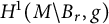 $H^1(M\setminus B_r,g)$
such that
 $$ \begin{align*} ||\nabla u_n||_{L^2(M\setminus B_r,g)} \leq 1/n \end{align*} $$
and
 $$ \begin{align*} ||\mathcal E(u_n)||_{L^2(B_r,g)} \geq 1. \end{align*} $$
Consider
 $\alpha _n=\frac {1}{Vol(M\setminus B_r,g)}\int _{M\setminus B_r}u_ndv_g$
. We show that
 $$ \begin{align*} ||u_n-\alpha_n||_{H^1(M\setminus B_r,g)} \leq C/n. \end{align*} $$
Indeed, by the generalized Poincaré inequality one has
 $$ \begin{align*} ||u_n-\alpha_n||_{L^2(M\setminus B_r,g)} \leq C||\nabla u_n||_{L^2(M\setminus B_r,g)} \leq C/n \end{align*} $$
moreover
 $$ \begin{align*} ||\nabla (u_n-\alpha_n)||_{L^2(M\setminus B_r,g)}=||\nabla u_n||_{L^2(M\setminus B_r,g)} \leq 1/n. \end{align*} $$
Note that
 $\mathcal E(u_n-\alpha _n)=\mathcal E(u_n)-\alpha _n$
. Then, we can prove inequality (2.2)
 $$ \begin{align*} ||\nabla \mathcal E(u_n)||_{L^2(B_r,g)} &=||\nabla \mathcal E(u_n-\alpha_n)||_{L^2(B_r,g)} \leq || \mathcal E(u_n-\alpha_n)||_{H^1(B_r,g)} \\ &\leq ||u_n-\alpha_n||_{H^{1/2}(\partial B_r \setminus \partial M,g)} \leq C||u_n-\alpha_n||_{H^{1}(M\setminus B_r,g)} \leq C/n, \end{align*} $$
where in the second and third inequalities, we have used in order estimate (7.1) and the trace inequality. We got a contradiction. Hence, inequality (2.2) is true.
Note that for any
 $\rho r<\epsilon $
the first inequality scales as
 $$ \begin{align*} ||\mathcal E(u)||^2_{L^2(B_{\rho r},g)} \leq C||u||^2_{L^2(M\setminus B_{\rho r},g)}+C\rho^2||\nabla u||^2_{L^2(M\setminus B_{\rho r},g)}, \end{align*} $$
while the second inequality scales as
 $$ \begin{align*} ||\nabla \mathcal E(u)||^2_{L^2(B_{\rho r},g)} \leq C||\nabla u||^2_{L^2(M\setminus B_{\rho r},g)}. \end{align*} $$
Therefore,
 $||\mathcal E(u)||^2_{H^1(B_{\rho r},g)} \leq C||u||^2_{L^2(M\setminus B_{\rho r},g)}+C||\nabla u||^2_{L^2(M\setminus B_{\rho r},g)}$
for
 $\epsilon $
small enough.▪
Claim 2. One has
 $$ \begin{align*} \limsup_{\epsilon \to 0}\sigma^N_k(M\setminus B_{\epsilon},g) \leq \sigma_k(M,g). \end{align*} $$
Proof We only consider the case of
 $B_{\epsilon } \cap \partial M\neq \varnothing $
. The case of
 $B_{\epsilon } \cap \partial M=\varnothing $
is easier and follows the exactly same arguments. The proof is similar to the proof of [Reference BogoselBog17, Theorem 3.5].
Let
 $V_k$
be a k-dimensional subspace of
 $H^1(M,g)$
and
 $v\in V_k$
such that
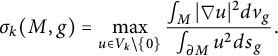 $$ \begin{align*} \sigma_k(M,g)=\max_{u\in V_k\setminus \{0\}}\frac{\int_M|\nabla u|^2dv_g}{\int_{\partial M}u^2ds_g}. \end{align*} $$
Let
 $u_1,\ldots ,u_k$
be an orthonormal basis in
 $V_k$
. We modify the functions
 $u_i, i= 1,\ldots ,k$
as
 $$ \begin{align*} u_{i,\epsilon}=u_i-\frac{1}{L(\partial M \setminus \partial B_{\epsilon})}\int_{\partial M\setminus \partial B_{\epsilon}}u_ids_g. \end{align*} $$
Then,
 $\int _{\partial M\setminus \partial B_{\epsilon }}u_{i,\epsilon }ds_g=0$
. Consider the space
 $V_{k,\epsilon }:=span(u_{1,\epsilon },\ldots ,u_{k,\epsilon })$
. Since
 $\dim V_{k,\epsilon }=k$
one has
 $$ \begin{align*} \sigma^N_k(M\setminus B_{\epsilon},g) \leq \max_{u_{\epsilon} \in V_{k,\epsilon}\setminus\{0\}}\frac{\int_{M\setminus B_{\epsilon}}|\nabla u_{\epsilon}|^2dv_g}{\int_{\partial M\setminus \partial B_{\epsilon}}u_{\epsilon}^2ds_g}. \end{align*} $$
Moreover, since the dimension of
 $V_{k,\epsilon }$
is finite then there exists a function
 $v_{\epsilon }\in V_{k,\epsilon }$
such that
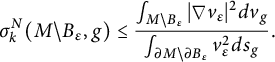 $$ \begin{align} \sigma^N_k(M\setminus B_{\epsilon},g) \leq \frac{\int_{M\setminus B_{\epsilon}}|\nabla v_{\epsilon}|^2dv_g}{\int_{\partial M\setminus \partial B_{\epsilon}}v_{\epsilon}^2ds_g}. \end{align} $$
Let
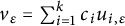 $v_{\epsilon }=\sum ^k_{i=1}c_iu_{i,\epsilon }$
. We build the following function
 $v=\sum ^k_{i=1}c_iu_{i} \in V_k\subset H^1(M,g)$
. Note that
 $\nabla v_{\epsilon }=\sum ^k_{i=1}c_i\nabla u_{i,\epsilon }=\sum ^k_{i=1}c_i\nabla u_{i}=\nabla v$
on
 $M\setminus B_{\epsilon }$
. Thus,
 $\int _{M\setminus B_{\epsilon }}|\nabla v_{\epsilon }|^2dv_g=\int _{M\setminus B_{\epsilon }}|\nabla v|^2dv_g\to \int _{M}|\nabla v|^2dv_g$
as
 $\epsilon \to 0$
. Moreover, it is easy to see that
 $$ \begin{align*} &\int_{\partial M\setminus \partial B_{\epsilon}}v_{\epsilon}^2ds_g=\sum_ic^2_i\bigg(\int_{\partial M\setminus\partial B_{\epsilon}}u^2_idv_g-\frac{1}{L(\partial M\setminus \partial B_{\epsilon},g)}\bigg(\int_{\partial M\setminus \partial B_{\epsilon}}u_ids_g\bigg)^2\bigg)\\ & \quad +\sum_{i\neq j}2c_ic_j\bigg(\int_{\partial M\setminus \partial B_{\epsilon}}u_iu_jds_g-\frac{1}{L(\partial M\setminus \partial B_{\epsilon},g)}\int_{\partial M\setminus \partial B_{\epsilon}}u_ids_g\int_{\partial M\setminus \partial B_{\epsilon}}u_jds_g\bigg), \end{align*} $$
which converges to
 $\int _{\partial M}v^2ds_g$
as
 $\epsilon \to 0$
. Then (2.3) implies
 $$ \begin{align*} \limsup_{\epsilon \to 0}\sigma^N_k(M\setminus B_{\epsilon},g) \leq \limsup_{\epsilon \to 0} \frac{\int_{M\setminus B_{\epsilon}}|\nabla v_{\epsilon}|^2dv_g}{\int_{\partial M\setminus \partial B_{\epsilon}}v_{\epsilon}^2ds_g}= \frac{\int_{M}|\nabla v|^2dv_g}{\int_{\partial M}v^2ds_g} \leq \sigma_k(M,g). \end{align*} $$
▪
Now, we are ready to prove the Lemma. The proof is similar to the proof of [Reference Matthiesen and SiffertMS20, Lemma 3.2]. Let
 $u_{\epsilon }$
be a normalized
 $\sigma ^N_k$
-eigenfunction. By Claim 2
 $u_{\epsilon }$
are uniformly bounded. If
 $B_{\epsilon } \cap \partial M=\varnothing $
, then we take the harmonic continuation into
 $B_{\epsilon }$
. It is known that the operators of harmonic continuation into
 $B_{\epsilon }$
are uniformly bounded (see [Reference Rauch and TaylorRT75, Example 1]). Otherwise we extend
 $u_{\epsilon }$
into
 $B_{\epsilon }$
by
 $\mathcal E(u_{\epsilon })$
. By Claim 1 these operators are also uniformly bounded. Therefore, we get a uniformly bounded in
 $H^1(M,g)$
sequence
 $\{\tilde u_{\epsilon }\}$
. Then there exists
 $\epsilon _l\to 0$
such that
 $\tilde u_{\epsilon _l} \rightharpoonup u$
in
 $H^1(M,g)$
. Thus,
 $\tilde u_{\epsilon _l} \to u$
in
 $L^2(M,g)$
by the Rellich–Kondrachov embedding theorem. The standard elliptic estimates imply
 $u_{\epsilon _l} \to u$
in
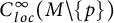 $C^{\infty }_{loc}(M\setminus \{p\})$
. Consider a function
 $\varphi \in C^{\infty }_c(M\setminus \{p\})$
such that
 $supp(\varphi ) \subset M\setminus B_R$
for a ball
 $B_R$
centered at p with R fixed. Extracting a subsequence by Claim 2 one can assume that
 $\sigma ^N_k(M\setminus B_{\epsilon _l},g)\to \sigma $
. Then we have
 $$ \begin{align*} \int_M\langle \nabla u, \nabla \varphi \rangle dv_g &= \lim_{l\to 0}\int_{M\setminus B_R}\langle \nabla u_{\epsilon_l}, \nabla \varphi \rangle dv_g \\ &=\lim_{l\to 0}\sigma^N_k(M\setminus B_{\epsilon_l},g)\int_{M\setminus B_R} u_{\epsilon_l} \varphi dv_g=\sigma\int_Mu\varphi dv_g. \end{align*} $$
Hence, u is an eigenfunction with eigenvalue
 $\sigma $
. Thus all accumulation points of
 $\{\sigma ^N_k(M\setminus B_{\epsilon _l},g)\}$
are in the Steklov spectrum of M. Our aim now is to show that
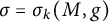 $\sigma =\sigma _k(M,g)$
. We will do this by showing that the u is orthogonal in
 $L^2(\partial M,g)$
to the first
 $k-1$
Steklov eigenfunctions of
 $(M,g)$
. We use the proof by induction.
Let
 $u_{\epsilon }$
be a first Steklov–Neumann eigenfunction of
 $(M\setminus B_{\epsilon },g)$
. We have already shown that
 $\tilde u_{\epsilon } \rightharpoonup u$
in
 $H^1(M,g)$
then by the trace embedding theorem one has
 $\tilde u_{\epsilon } \to u$
in
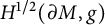 $H^{1/2}(\partial M,g)$
and hence in
 $L^2(\partial M,g)$
. In particular, one has
 $||u_{\epsilon }-{u||_{L^2(\partial M\setminus \partial B_{\epsilon },g)}\to 0}$
as
 $\epsilon \to 0$
. Then
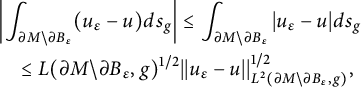 $$ \begin{align*} &\left|\int_{\partial M\setminus\partial B_{\epsilon}}(u_{\epsilon} -u)ds_g\right| \leq \int_{\partial M\setminus\partial B_{\epsilon}}|u_{\epsilon} -u|ds_g \\ &\quad \leq L(\partial M\setminus \partial B_{\epsilon},g)^{1/2}||u_{\epsilon}-u||_{L^2(\partial M\setminus\partial B_{\epsilon},g)}^{1/2}, \end{align*} $$
which converges tp
 $0$
as
 $\epsilon \to 0$
. Since
 $\int _{\partial M\setminus \partial B_{\epsilon }}u_{\epsilon } ds_g=0$
one then has that
 $\lim _{\epsilon \to 0}\int _{\partial M\setminus \partial B_{\epsilon }}uds_g=\int _{\partial M}uds_g=0$
. Therefore, u cannot be a constant and since by Claim 2
 $\limsup _{\epsilon \to 0}\sigma ^N_1(M\setminus B_{\epsilon },g)=\sigma \leq \sigma _1(M,g)$
and
 $\sigma $
belongs to the Steklov spectrum of
 $(M,g)$
we conclude that u is a first Steklov eigenfunction of
 $(M,g)$
and
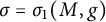 $\sigma =\sigma _1(M,g)$
.
Now suppose that
 $\limsup _{\epsilon \to 0}\sigma ^N_i(M\setminus B_{\epsilon },g)= \sigma _i(M,g)$
for any
 $i<k$
. Let
 $u_{\epsilon }$
be a kth Steklov–Neumann eigenfucntion of
 $(M\setminus B_{\epsilon },g)$
. Since
 $\tilde u_{\epsilon } \rightharpoonup u$
in
 $H^1(M,g),$
then the trace embedding theorem implies that
 $\tilde u_{\epsilon } \to u$
in
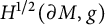 $H^{1/2}(\partial M,g)$
in particular
 $\tilde u_{\epsilon } \to u$
in
 $L^{2}(\partial M,g)$
whence
 $||u_{\epsilon }-u||_{L^2(\partial M\setminus \partial B_{\epsilon },g)}\to 0$
. Let
 $v_{\epsilon }$
be an ith Steklov–Neumann eigenfunction of
 $(M\setminus B_{\epsilon },g)$
with
 $i<k$
. Then
 $\int _{\partial M\setminus \partial B_{\epsilon }}u_{\epsilon } v_{\epsilon } ds_g=0;$
moreover, we have supposed that v is an ith Steklov eigenfunction of
 $(M,g)$
. One has
 $$ \begin{align*} & \left|\int_{\partial M\setminus\partial B_{\epsilon}}(u_{\epsilon} v_{\epsilon} -uv)ds_g\right| \\ &\quad\leq \int_{\partial M\setminus\partial B_{\epsilon}}|u_{\epsilon} v_{\epsilon} -uv|ds_g= \int_{\partial M\setminus\partial B_{\epsilon}}|u_{\epsilon} v_{\epsilon} -u_{\epsilon} v+u_{\epsilon} v-uv|ds_g \\ &\quad\leq \int_{\partial M\setminus\partial B_{\epsilon}}|u_{\epsilon} (v_{\epsilon} -v)|ds_g+\int_{\partial M\setminus\partial B_{\epsilon}}|v (u_{\epsilon} -u)|ds_g \\ &\quad\leq \bigg(\int_{\partial M\setminus\partial B_{\epsilon}}u^2_{\epsilon} ds_g \bigg)^{1/2}\bigg(\int_{\partial M\setminus\partial B_{\epsilon}}(v_{\epsilon}-v)^2 ds_g \bigg)^{1/2} \\ &\qquad+\bigg(\int_{\partial M\setminus\partial B_{\epsilon}}v^2_{\epsilon} ds_g \bigg)^{1/2}\bigg(\int_{\partial M\setminus\partial B_{\epsilon}}(u_{\epsilon}-u)^2 ds_g \bigg)^{1/2}\to 0~\text{as } \epsilon \to 0. \end{align*} $$
Hence,
 $\int _{\partial M\setminus \partial B_{\epsilon }}u_{\epsilon } v_{\epsilon } ds_g\to \int _{\partial M}u v ds_g$
as
 $\epsilon \to 0$
. But
 $\int _{\partial M\setminus \partial B_{\epsilon }}u_{\epsilon } v_{\epsilon } ds_g=0$
for all
 $\epsilon $
. Thus,
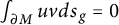 $\int _{\partial M}u v ds_g=0$
. We conclude that u is orthogonal in
 $L^2(\partial M,g)$
to the first
 $k-1$
Steklov eigenfunctions. Thus,
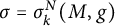 $\sigma =\sigma ^N_k(M,g)$
.▪
We endow the set of Riemannian metrics on
 $\Sigma $
with the
 $C^{\infty }-$
topology. Then the following “continuity” result holds.
Proposition 2.2 Let
 $\Sigma $
be a surface with boundary and
 $\Omega \subset \Sigma $
be a Lipschitz domain. Let the sequence of Riemannian metrics
 $g_m$
on
 $\Sigma $
converge in
 $C^{\infty }-$
topology to the metric g. Then
 $\sigma ^*_k(\Sigma ,[g_m])\to \sigma ^*_k(\Sigma ,[g])$
. Similarly, if
 $h_m|_{\overline \Omega }$
converge to
 $g|_{\overline \Omega }$
in
 $C^{\infty }$
-topology, then
 $\sigma ^{N*}_k(\Omega , \partial ^S\Omega , [h_m|_{\overline \Omega }])\to \sigma ^{N*}_k(\Omega ,\partial ^S\Omega , [g|_{\overline \Omega }])$
.
Proof We provide a proof for the functional
 $\sigma ^*_k(\Sigma ,[g])$
. The proof for the functional
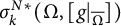 $\sigma ^{N*}_k(\Omega ,[g|_{\overline \Omega }])$
follows the exactly same arguments.
Choose any
 $\varepsilon>0$
and consider m large enough. One has
 $$ \begin{align*} \frac{1}{1+\varepsilon} f g_m(v,v) \leq f g(v,v) \leq (1+\varepsilon) f g_m(v,v),\quad \forall v \in \Gamma(TM\setminus\{0\}), \end{align*} $$
where f is any positive smooth function on
 $\Sigma $
. Then by [Reference Colbois, Girouard and RaveendranCGR18, Proposition 32] one has
 $$ \begin{align*} \frac{1}{(1+\varepsilon)^{6}}\bar \sigma_k(\Sigma,fg_m) \leq\bar \sigma_k(\Sigma,fg) \leq (1+\varepsilon)^{6}\bar \sigma_k(\Sigma,fg_m). \end{align*} $$
Taking the supremum over all f yields
 $$ \begin{align*} \frac{1}{(1+\varepsilon)^{6}}\sigma^*_k(\Sigma,[g_m]) \leq\sigma^*_k(\Sigma,[g]) \leq (1+\varepsilon)^{6}\sigma^*_k(\Sigma,[g_m]), \end{align*} $$
which completes the proof since this inequality holds for any
 $\varepsilon>0$
.▪
2.2 Discontinuous metrics
Let
 $\Sigma $
be a compact surface with boundary. Consider a set of pairwise disjoint Lipschitz domains
 $\{\Omega _i\}^s_{i=1}$
in
 $\Sigma $
such that
 $\Sigma =\bigcup ^s_{i=1} \overline \Omega _i$
. Let
 $C^{\infty }_+(\Sigma ,\{\Omega _i\})$
denote a set of functions on
 $\bigcup ^s_{i=1} \overline \Omega _i$
such that
 $\rho \in C^{\infty }_+(\Sigma ,\{\Omega _i\})$
means that
 $\rho |_{\Omega _i} = \rho _i\in C^{\infty }(\overline \Omega _i)$
are positive for every i. Similarly,
 $C^{\infty }(\Sigma ,\{\Omega _i\})$
denotes a set of “smooth” functions on
 $\bigcup ^s_{i=1} \overline \Omega _i$
. We introduce discontinuous metrics on
 $\Sigma $
defined as
 $\rho g\in [g]$
, where
 $\rho \in C^{\infty }_+(\Sigma ,\{\Omega _i\})$
and g is a genuine Riemannian metric. The set
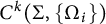 $C^{k}(\Sigma ,\{\Omega _i\})$
of functions which are of class
 $C^k$
in every
 $\overline \Omega _i$
is defined in a similar way. The Steklov spectrum of the metric
 $\rho g$
is defined as the set of critical values of the Rayleigh quotient
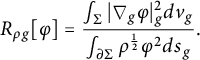 $$ \begin{align*} R_{\rho g}[\varphi]=\frac{\int_{\Sigma} | \nabla_g \varphi|^2_g dv_g}{\int_{\partial \Sigma} \rho^{\frac{1}{2}} \varphi^2 ds_g}. \end{align*} $$
This is the Rayleigh quotient of the Steklov problem with density
 $\rho $
. The Steklov spectrum with density
 $\rho $
is well-defined for any non-negative
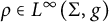 $\rho \in L^{\infty }(\Sigma ,g)$
(see [Reference KokarevKok14, Proposition 1.3]). Elliptic regularity implies that the eigenfunctions are at least
 $1/2$
-Hölder continuous on
 $\partial \Sigma $
. Therefore, Steklov eigenvalues of the metric
 $\rho g$
admit the following variational characterization
 $$ \begin{align*} \sigma_k(\Sigma,\rho g) = \inf_{E_{k+1}} \sup_{\varphi\in E_{k+1}} R_{\rho g}[\varphi], \end{align*} $$
where
 $E_{k+1}$
ranges over all
 $(k+1)$
-dimensional subspaces of
 $C^0(\Sigma )$
.
We introduce the following notation
 $$ \begin{align*} \sigma^*_k(\Sigma,\{\Omega_i\},[g])=\sup \{ \bar\sigma_k(\rho g)~\vert~ \rho \in C^{\infty}_+(\Sigma,\{\Omega_i\})\}, \end{align*} $$
where
 $\bar \sigma _k(\rho g)$
is the normalized kth eigenvalue given by
 $$ \begin{align*} \bar\sigma_k(\rho g) = \sigma_k(\rho g) L_{\rho g}(\partial \Sigma). \end{align*} $$
The following lemma particularly asserts that the quantity
 $\sigma ^*_k(\Sigma ,\{\Omega _i\},[g])$
is well-defined.
Lemma 2.3 Let
 $(\Sigma ,g)$
be a Riemannian surface with boundary. Consider a set of pairwise disjoint Lipschitz domains
 $\Omega _i$
such that
 $\Sigma =\bigcup ^s_{i=1} \overline \Omega _i$
. Then one has
 $$ \begin{align*} \sigma^*_k(\Sigma,\{\Omega_i\},[g])=\sigma^*_k(\Sigma,[g]). \end{align*} $$
Proof The proof follows the same steps as the proof of Lemma 2 in the paper [Reference Friedlander and NadirashviliFN99]. We provide it here.
Since the set of discontinuous metrics is larger than the set of continuous ones, we have
 $\sigma ^*_k(\Sigma ,\{\Omega _i\},[g])) \geq \sigma ^*_k(\Sigma ,[g])$
. Therefore, we have to prove that
 $$ \begin{align*} \sigma^*_k(\Sigma,\{\Omega_i\},[g])) \leq \sigma^*_k(\Sigma,[g]), \end{align*} $$
which is equivalent to
 $$ \begin{align} \sigma_k(\Sigma,\rho g) \leq \sigma^*_k(\Sigma,[g]), \end{align} $$
where
 $\rho \in C^{\infty }_{+}(\Sigma ,\{\Omega _i\})$
and
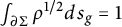 $ \int _{\partial \Sigma } \rho ^{1/2}ds_g =1$
.
Let
 $E_k$
be the eigenspace corresponding to the kth Steklov eigenvalue of the metric
 $\rho g$
. We put
 $$ \begin{align*} S=\left\{u\in H^1(\Sigma,\rho g)~|~u \perp_{L^2(\partial\Sigma, \rho g)} E_0,\dots,E_{k-1}, \int_{\partial\Sigma} \rho^{1/2}u^2 ds_g =1\right\} \end{align*} $$
For any
 $\varepsilon>0$
we consider the functional
 $$ \begin{align*} \mathcal{F}_{\rho} [u]:=\int_{\Sigma}|\nabla_gu|^2dv_g-(\sigma_k(\Sigma,\rho g)-\varepsilon)\int_{\partial\Sigma}\rho^{1/2}u^2ds_g. \end{align*} $$
It immediately follows that
 $\mathcal {F}_{\rho }[u] \geq \varepsilon , \forall u\in S$
.
Let
 $0<a:=\min _{\cup \{\Omega _i\}}\rho $
and
 $\max _{\cup \{\Omega _i\}}=:b<\infty $
. We define a smooth nondecreasing function
 $\chi (t)$
on
 $\mathbb {R}_+$
that equals zero if
 $t<1/2$
and equals 1 when
 $t>1$
and define the following parametrized family of functions:
 $$ \begin{align*} \rho_{\delta}(x) = \begin{cases} \rho(x) &\text{if } x \notin U,\\ \rho(x)\chi \big(\frac{d^2(x)}{\delta}\big)+b\big(1-\chi \big(\frac{d^2(x)}{\delta}\big)\big) &\text{if } x \in U, \end{cases} \end{align*} $$
where d is the distance function from a point
 $x\in \Sigma $
to
 $\cup \{\partial \Omega _i\cap \partial \Omega _j\},~i\neq j$
and U is a sufficiently small tubular neighborhood of
 $\cup \{\partial \Omega _i\cap \partial \Omega _j\},~i\neq j$
where
 $d^2$
is smooth. We have:
-
(i)
 $\big (\frac {a}{b}\big )\rho \leq \rho _{\delta } \leq \big (\frac {b}{a}\big ) \rho $
;
-
(ii)
$\lim _{\delta \to 0} \int _{\partial \Sigma } \rho ^{1/2}_{\delta } ds_g=1$
; and -
(iii)
$\lim _{\delta \to 0} \int _{\partial \Sigma } |\rho ^{1/2}_{\delta } - \rho ^{1/2}|^q ds_g=0, \forall q<\infty $
.



We want to prove that
 $\mathcal {F}_{\rho _{\delta }}[u] \geq 0, \forall u \in S$
.
Consider
 $T=(\sigma _k(\Sigma ,\rho g) -\varepsilon )\sqrt {\frac {b}{a}}$
and divide the set S into two parts
 $S_1$
and
 $S_2$
:
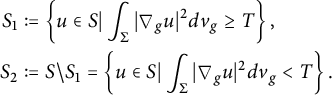 $$ \begin{align*} S_1 &:=\left\{u \in S | \int_{\Sigma} |\nabla_g u|^2 dv_g \geq T\right\}, \\ S_2&:=S \setminus S_1= \left\{u \in S | \int_{\Sigma} |\nabla_g u|^2 dv_g < T\right\}. \end{align*} $$
If
 $u \in S_1$
then
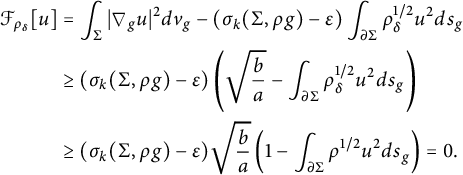 $$ \begin{align*} \mathcal{F}_{\rho_{\delta}}[u] &= \int_{\Sigma}|\nabla_gu|^2dv_g-(\sigma_k(\Sigma,\rho g)-\varepsilon)\int_{\partial\Sigma}\rho_{\delta}^{1/2}u^2ds_g \\ &\geq (\sigma_k(\Sigma,\rho g)-\varepsilon)\left(\sqrt{\frac{b}{a}}-\int_{\partial\Sigma}\rho_{\delta}^{1/2}u^2ds_g\right) \\ &\geq(\sigma_k(\Sigma,\rho g)-\varepsilon)\sqrt{\frac{b}{a}}\left(1-\int_{\partial\Sigma}\rho^{1/2}u^2ds_g\right)=0. \end{align*} $$
Let us show that
 $||u||_{L^p(\partial \Sigma ,g)}$
with
 $p\geq 2$
is bounded for any
 $u \in S_2$
. We consider the following operator
 $L[u]:=\int _{\partial \Sigma }u\rho ^{1/2}ds_g$
. For this operator, one has
 $$ \begin{align*} |L[u]|\leq C\int_{\partial\Sigma}|u|ds_g\leq C||u||_{L^2(\partial\Sigma,g)}\leq C||u||_{H^1(\Sigma,g)}, \end{align*} $$
which implies that
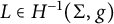 $L\in H^{-1}(\Sigma ,g)$
. Here, we used in order the boundedness of
 $\rho $
, the Cauchy–Schwarz and the trace inequalities. We also used the convention that C denotes any positive constant depending only on
 $\Sigma $
. [Reference Adams and HedbergAH96, Lemma 8.3.1] applied to the operator L implies that there exists a constant
 $C>0$
depending only on
 $\Sigma $
such that
 $$ \begin{align*} ||u||^2_{L^2(\Sigma,g)}\leq C||\nabla u||^2_{L^2(\Sigma,g)}<CT, \end{align*} $$
where we used the fact that
 $L[u]=0~\forall u\in S$
. By the trace theorem one then has
 $$ \begin{align*} ||u||^2_{H^{1/2}(\partial\Sigma,g)}\leq C'||u||^2_{H^{1}(\Sigma,g)}<C", \end{align*} $$
where
 $C"=C'(CT+T)$
. Finally by the Sobolev embedding theorem (see for instance [Reference Di Nezza, Palatucci and ValdinociDNPV12, Theorem 6.9]) we get
 $$ \begin{align*} ||u||_{L^p(\partial \Sigma,g)}\leq C"'||u||_{H^{1/2}(\partial\Sigma,g)}<\tilde C~\forall 2\leq p<\infty, \end{align*} $$
where
 $\tilde C=C"'\sqrt {C"}$
. Therefore, if
 $u \in S_2$
then
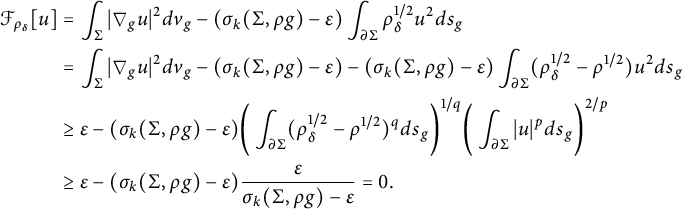 $$ \begin{align*} \mathcal{F}_{\rho_{\delta}}[u] &= \int_{\Sigma}|\nabla_gu|^2dv_g-(\sigma_k(\Sigma,\rho g)-\varepsilon)\int_{\partial\Sigma}\rho_{\delta}^{1/2}u^2ds_g \\ &=\int_{\Sigma}|\nabla_gu|^2dv_g- (\sigma_k(\Sigma,\rho g)-\varepsilon)-(\sigma_k(\Sigma,\rho g)-\varepsilon) \int_{\partial\Sigma} (\rho_{\delta}^{1/2}-\rho^{1/2}) u^2ds_g \\ &\geq \varepsilon-(\sigma_k(\Sigma,\rho g)-\varepsilon) \bigg(\int_{\partial\Sigma} (\rho_{\delta}^{1/2}-\rho^{1/2})^qds_g\bigg)^{1/q} \bigg(\int_{\partial\Sigma}|u|^pds_g\bigg)^{2/p} \\ &\geq \varepsilon-(\sigma_k(\Sigma,\rho g)-\varepsilon)\frac{\varepsilon}{\sigma_k(\Sigma,\rho g)-\varepsilon}=0. \end{align*} $$
In the last inequality, we put
 $$ \begin{align*} \bigg(\int_{\partial\Sigma}(\rho_{\delta}^{1/2}-\rho^{1/2})^qds_g\bigg)^{1/q}\bigg(\int_{\partial\Sigma}|u|^pds_g\bigg)^{2/p}= \frac{\varepsilon}{\sigma_k(\Sigma,\rho g)-\varepsilon} \end{align*} $$
since
 $\int _{\partial \Sigma }(\rho _{\delta }^{1/2}-\rho ^{1/2})^qds_g \to 0$
as
 $\delta \to 0$
and
 $\int _{\partial \Sigma }|u|^pds_g<+\infty $
.
Hence,
 $\mathcal {F}_{\rho _{\delta }}[u] \geq 0, \forall u \in S$
which implies
 $\sigma _k(\Sigma ,\rho _{\delta } g) \geq \sigma _k (\Sigma , \rho g) -\varepsilon $
. We then have
 $$ \begin{align*} \bar\sigma_k(\Sigma,\rho_{\delta} g)=\sigma_k(\Sigma,\rho_{\delta} g)L_{\rho_{\delta} g}(\partial \Sigma) \geq \sigma_k (\Sigma, \rho g) L_{\rho_{\delta} g}(\partial \Sigma) -\varepsilon L_{\rho_{\delta} g}(\partial \Sigma). \end{align*} $$
Therefore,
 $\sigma ^*_k (\Sigma , [g]) \geq \sigma _k (\Sigma , \rho g) L_{\rho _{\delta } g}(\partial \Sigma ) -\varepsilon L_{\rho _{\delta } g}(\partial \Sigma )$
. Letting
 $\delta \to 0$
one then gets
 $\sigma ^*_k (\Sigma , [g]) \geq \sigma _k (\Sigma , \rho g)-\varepsilon $
that implies (2.4) since
 $\varepsilon $
is arbitrary small.▪
Lemma 2.3 implies the following lemma whose proof is postponed to Section 7.2.
Lemma 2.4 Let
 $(\Sigma ,g)$
be a Riemannian surface with boundary. Consider a set of pairwise disjoint domains
 $\Omega _i$
such that
 $\Sigma =\bigcup ^s_{i=1} \overline \Omega _i$
and
 $\Omega _i\cap \partial \Sigma =\partial ^S\Omega _i$
. Let
 $(\Omega ,h) = \sqcup (\overline \Omega _i,g|_{\overline \Omega _i})$
and
 $\partial ^S\Omega =\sqcup \partial ^S\Omega _i$
. Then for all
 $k \geq 0$
one has
 $$ \begin{align*} \sigma^*_k(\Sigma,[g]) \geq \sigma^{N*}_k(\Omega,\partial^S\Omega, [h]). \end{align*} $$
2.3 Steklov–Neumann spectrum of a subdomain
This section is devoted to the following technical lemma
Lemma 2.5 Let
 $\rho _{\delta } \in C^{\infty }_+(\Sigma ,\{\Omega ,\Sigma \setminus \Omega \})$
such that
 $\rho _{\delta }|_{\Omega }\equiv 1$
and
 $\rho _{\delta }|_{\Sigma \setminus \Omega }\equiv \delta $
. Then one has
 $$ \begin{align*} \liminf_{\delta \to 0}\sigma_k(\rho_{\delta} g) \geq \sigma^{N}_k(\Omega,\partial^S\Omega, g), \end{align*} $$
where
 $\sigma ^{N*}_k(\Omega ,\partial ^S\Omega , g)$
is the kth Steklov–Neumann eigenvalue of the domain
 $(\Omega ,g)$
and
 $\partial ^S\Omega =\partial \Sigma \cap \Omega \neq \varnothing $
.
Proof The idea of the proof comes from the proof of [Reference Enciso and Peralta-SalasEPS15, Section 2, Step 2].
Case I. First, we consider the case when
 $\Omega ^c \cap \partial \Sigma \neq \varnothing $
. Let
 $\Omega ^c$
denotes
 $int(\Sigma \setminus \Omega )$
and
 $\partial ^S\Omega ^c=\partial \Omega ^c \cap \partial \Sigma $
. Since by elliptic regularity eigenfunctions of the Steklov problem with bounded density are in
 $H^1$
on the boundary we can restrict ourselves to the space
 $H^1(\partial \Sigma ,g)$
. More precisely, let
 $\psi $
be an eigenfunction with eigenvalue
 $\sigma $
then by elliptic regularity:
 $$ \begin{align*} ||\psi||^2_{H^1(\partial\Sigma,\rho_{\delta} g)} \leq C(||\sigma\psi||^2_{L^2(\partial\Sigma,\rho_{\delta} g)}+||\psi||^2_{L^2(\partial\Sigma,\rho_{\delta} g)}) \leq C(\sigma^2+1)||\psi||^2_{L^2(\partial\Sigma,\rho_{\delta} g)} \end{align*} $$
for some positive constant C. This implies
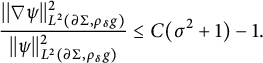 $$ \begin{align*} \frac{||\nabla \psi||^2_{L^2(\partial\Sigma,\rho_{\delta} g)}}{||\psi||^2_{L^2(\partial\Sigma,\rho_{\delta} g)}} \leq C(\sigma^2+1)-1. \end{align*} $$
More generally we see that if
 $\varphi \in \operatorname {span}\langle \psi _0,\ldots ,\psi _k \rangle $
, where
 $\psi _i$
is in the ith eigenspace of
 $(\Sigma ,g_{\delta })$
then there exists a constant
 $C_k>0$
such that
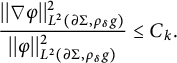 $$ \begin{align*} \frac{||\nabla \varphi ||^2_{L^2(\partial\Sigma,\rho_{\delta} g)}}{|| \varphi ||^2_{L^2(\partial\Sigma,\rho_{\delta} g)}} \leq C_k. \end{align*} $$
Therefore, we set
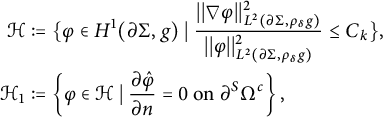 $$ \begin{align*} \mathcal H &:=\{\varphi \in H^1(\partial\Sigma,g)~|~\frac{||\nabla \varphi ||^2_{L^2(\partial\Sigma,\rho_{\delta} g)}}{|| \varphi ||^2_{L^2(\partial\Sigma,\rho_{\delta} g)}} \leq C_k\}, \\ \mathcal{H}_1 &:=\left\{\varphi \in \mathcal H ~|~\frac{\partial\hat\varphi}{\partial n}=0~\text{on } \partial^S\Omega^c\right\}, \end{align*} $$
where
 $\hat \varphi $
stands for the harmonic continuation of
 $\varphi $
into
 $\Sigma $
and
 $$ \begin{align*} \mathcal{H}_2:=\{\varphi \in \mathcal H ~|~\varphi \in H^1_0(\partial^S\Omega^c,g),~\varphi_{|_{\Omega}}=0\}. \end{align*} $$
Claim 1. One has
 $$ \begin{align*} \int_{\Sigma}\langle\nabla \hat\varphi, \nabla \hat\psi \rangle_{\tilde g} dv_{\tilde g}=0, \forall \varphi \in \mathcal{H}_1, \psi \in \mathcal{H}_2, \end{align*} $$
for any metric
 $\widetilde g\in [g]$
.
Proof
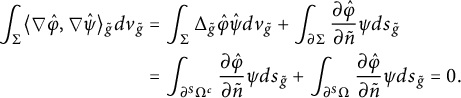 $$ \begin{align*} \int_{\Sigma}\langle\nabla \hat\varphi, \nabla \hat\psi \rangle_{\tilde g} dv_{\tilde g}&=\int_{\Sigma} \Delta_{\tilde g} \hat\varphi \hat\psi dv_{\tilde g}+\int_{\partial \Sigma}\frac{\partial\hat\varphi}{\partial \tilde n}\psi ds_{\tilde g}\\ &=\int_{\partial^S\Omega^c}\frac{\partial\hat\varphi}{\partial \tilde n}\psi ds_{\tilde g}+\int_{\partial^S\Omega}\frac{\partial\hat\varphi}{\partial \tilde n}\psi ds_{\tilde g}=0. \end{align*} $$
▪
For the sake of simplicity, we use the symbols
 $\sigma ^{\delta }_k$
for
 $\sigma _k(\rho _{\delta } g)$
,
 $g_{\delta }$
for
 $\rho _{\delta } g$
and
 $R_{\delta }$
for the Rayleigh quotient
 $$ \begin{align*} R_{\delta}[\varphi]=\frac{\int_{\Sigma}|\nabla \hat\varphi|^2_{g_{\delta}}dv_{g_{\delta}}}{\int_{\partial \Sigma} \varphi^2 ds_{g_{\delta}}}. \end{align*} $$
Claim 2. There exists a constant that we also denote by
 $C_k>0$
such that
 $\sigma ^{\delta }_k \leq C_k$
.
Proof Theorem 1.1 implies that there exists a constant
 $C(k)>0$
such that
 $$ \begin{align*} \sigma^*_k(\Sigma, [g]) \leq C(k). \end{align*} $$
By Lemma 2.3 for every
 $\delta $
one has
 $$ \begin{align*} \sigma^{\delta}_k L_{g_{\delta}}(\partial \Sigma) \leq \sigma^*_k(\Sigma, [g]) \leq C(k). \end{align*} $$
Therefore,
 $$ \begin{align*} \sigma^{\delta}_k \leq \frac{C(k)}{L_{g_{\delta}}(\partial \Sigma)}=\frac{C(k)}{L_{g}(\partial^S\Omega)+ \delta ^{1/2}L_{g}(\partial^S \Omega^c)} \leq \frac{C(k)}{L_{g}(\partial^S \Omega)}=C_k. \end{align*} $$
▪
Let
 $W_k$
be the set of
 $k+1$
-dimensional subspaces of
 $\mathcal H$
satisfying the condition that
 ${R_{\delta }}|_{W_k} \leq C_k$
. Claim 2 particularly implies that the space spanned by the first
 $k+1$
eigenfunctions is in
 $W_k$
, i.e.,
 $W_k\ne \varnothing $
.
Consider the operator
 $\mathcal E$
defined in section 2.1 by
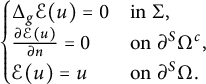 $$ \begin{align*} \begin{cases} \Delta_{g} \mathcal E(u)=0&\text{in } \Sigma,\\ \frac{\partial \mathcal E(u)}{\partial n}=0&\text{on } \partial^S\Omega^c,\\ \mathcal E(u)=u&\text{on } \partial^S\Omega. \end{cases} \end{align*} $$
For a function
 $\varphi \in H^1(\partial \Sigma ,g),$
we fix its decomposition
 $\varphi _1+\varphi _2$
with
 $$ \begin{align*} \varphi_1= \begin{cases} \varphi&\text{on } \partial^S\Omega,\\ \mathcal E(\varphi)&\text{on } \partial^S\Omega^c \end{cases} \end{align*} $$
and
 $\varphi _2=\varphi _1-\varphi $
. Note that
 $\hat \varphi _1=\mathcal E(\varphi _1).$
Claim 3. For every
 $\varphi \in V \in W_k$
there exists a constant
 $C>0$
such that
 $$ \begin{align*} \int_{\partial^S \Omega^c}\varphi^2_2~ds_{g_{\delta}} \leq C\sqrt{\delta} \int_{\partial \Sigma} \varphi^2 dv_{g_{\delta}}. \end{align*} $$
Proof By Claim 1, one has
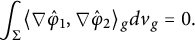 $$ \begin{align*} \int_{\Sigma}\langle\nabla \hat\varphi_1,\nabla \hat\varphi_2 \rangle_{g} dv_{g}=0. \end{align*} $$
Further, since
 $\varphi \in V \in W_k$
, we have
 $$ \begin{align*} C_k \geq R_{\delta}[\varphi]&=\frac{\int_{\Sigma}|\nabla \hat\varphi|^2_{g}dv_{g}}{\int_{\partial \Sigma} \varphi^2 ds_{g_{\delta}}}=\frac{\int_{\Sigma}|\nabla \hat\varphi_1|^2dv_{g}+\int_{\Sigma}|\nabla \hat\varphi_2|^2_{g}dv_{g}}{\int_{\partial \Sigma} \varphi^2 ds_{g_{\delta}}} \\ &\geq \frac{\int_{\Omega^c}|\nabla \hat\varphi_2|^2_{g}dv_{g}}{\int_{\partial \Sigma} \varphi^2 ds_{g_{\delta}}}=\frac{1}{\delta^{1/2}}\frac{\int_{\Omega^c}|\nabla \hat\varphi_2|^2_{g}dv_{g}}{\int_{\partial^S\Omega^c} \varphi^2_2 ds_{g}}\frac{||\varphi_2||^2_{L^2(\partial^S\Omega^c, g_{\delta})}}{||\varphi||^2_{L^2(\partial \Sigma, g_{\delta})}} \\ &\geq \frac{\sigma^D_1(\Omega^c,\partial^S\Omega^c, g)}{\sqrt{\delta}} \frac{||\varphi_2||^2_{L^2(\partial^S\Omega^c, g_{\delta})}}{||\varphi||^2_{L^2 (\partial \Sigma, g_{\delta})}}, \end{align*} $$
where
 $\sigma ^D_1(\Omega ^c,\partial ^S\Omega ^c, g)$
is the first nonzero Steklov–Dirichlet eigenvalue of
 $(\Omega ^c,g)$
(see [Reference Banuelos, Kulczycki, Polterovich and SiudejaBKPS10]).▪
Claim 4. For every
 $\varphi \in V \in W_k$
and for every sufficiently small
 $\delta $
there exists a constant
 $C>0$
such that
 $$ \begin{align*} \int_{\partial \Sigma}\varphi^2~ds_{g_{\delta}} \leq (1+C \delta^{1/4}) \int_{\partial \Sigma} \varphi^2_1 ds_{g_{\delta}}. \end{align*} $$
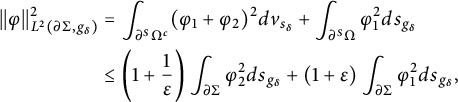
Proof One has
 $$ \begin{align*} ||\varphi||^2_{L^2(\partial \Sigma, g_{\delta})}&=\int_{\partial^S\Omega^c}(\varphi_1+\varphi_2)^2dv_{s_{\delta}}+\int_{\partial^S\Omega}\varphi^2_1ds_{g_{\delta}} \\ &\leq \bigg(1+\frac{1}{\varepsilon}\bigg) \int_{\partial \Sigma}\varphi_2^2ds_{g_{\delta}}+(1+\varepsilon) \int_{\partial \Sigma}\varphi^2_1ds_{g_{\delta}}, \end{align*} $$
for every
 $\varepsilon>0$
. Applying Claim 3, we obtain
 $$ \begin{align*} ||\varphi||^2_{L^2(\partial \Sigma, g_{\delta})} \leq C\sqrt{\delta}\left(1+\frac{1}{\varepsilon}\right) \int_{\partial \Sigma}\varphi^2ds_{g_{\delta}}+(1+\varepsilon) \int_{\partial \Sigma}\varphi^2_1ds_{g_{\delta}}, \end{align*} $$
and hence,
 $$ \begin{align*} \left(1-C\sqrt{\delta} \left(1+\frac{1}{\varepsilon}\right)\right)||\varphi||^2_{L^2(\partial \Sigma, g_{\delta})} \leq (1+\varepsilon) ||\varphi_1||^2_{L^2(\partial \Sigma, g_{\delta})}. \end{align*} $$
Choosing
 $\varepsilon =\delta ^{1/4}$
completes the proof.▪
Claim 5. For every
 $\varphi \in V \in W_k$
and for every sufficiently small
 $\delta ,$
there exists a constant
 $C>0$
such that
 $$ \begin{align*} \int_{\partial^S\Omega^c}\varphi^2_1~ds_{g} \leq C\int_{\partial^S\Omega} \varphi^2_1 ds_{g}. \end{align*} $$
Proof
 $$ \begin{align*} C_k \geq \frac{\int_{\partial\Sigma}|\nabla \varphi|^2_{g_{\delta}}dv_{g_{\delta}}}{\int_{\partial \Sigma} \varphi^2 ds_{g_{\delta}}} \geq \frac{\int_{\partial^S\Omega}|\nabla \varphi|^2_{g}ds_{g}}{\int_{\partial \Sigma} \varphi^2 ds_{g_{\delta}}}=\frac{\int_{\partial^S\Omega}|\nabla \varphi_1|^2_{g}ds_{g}}{\int_{\partial \Sigma} \varphi^2 ds_{g_{\delta}}}, \end{align*} $$
since
 $\varphi =\varphi _1$
on
 $\partial ^S\Omega $
. Then by Claim 4, one has
 $$ \begin{align*} C_k \geq\frac{\int_{\partial^S\Omega}|\nabla \varphi_1|^2_{g}ds_{g}}{\int_{\partial \Sigma} \varphi^2 ds_{g_{\delta}}} \geq \frac{1}{1+C\delta^{1/4}}\frac{\int_{\partial^S\Omega}|\nabla \varphi_1|^2_{g}ds_{g}}{\int_{\partial \Sigma} \varphi_1^2 ds_{g_{\delta}}}, \end{align*} $$
which implies
 $$ \begin{align} \begin{aligned} \int_{\partial^S\Omega}|\nabla \varphi_1|^2_{g}ds_{g} &\leq C_k(1+C\delta^{1/4})\int_{\partial \Sigma} \varphi_1^2 ds_{g_{\delta}} \\ &= C_k(1+C\delta^{1/4})\bigg(\!\int_{\partial^S\Omega} \varphi_1^2 ds_{g}+\delta^{1/2}\int_{\partial^S\Omega^c} \varphi_1^2 ds_{g}\bigg). \end{aligned} \end{align} $$
For the rest of the proof C stands for any positive constant depending possibly on
 $\Sigma $
and g but not on
 $\delta $
or
 $\varphi $
.
Note that
 $\partial ^s\Omega $
has positive capacity (see [Reference Henrot and PierreHP18, pp.102-105]). Applying in order the trace inequality, estimate (7.1), the Sobolev embedding and inequality (2.5) yield
 $$ \begin{align*} ||\varphi_1||^2_{L^2(\partial^S\Omega^c,g)} \leq C||\hat \varphi_1||^2_{H^1(\Sigma,g)} &\leq C||\varphi_1||^2_{H^{1/2}(\partial^S\Omega,g)} \\ &\leq C||\varphi_1||^2_{H^{1}(\partial^S\Omega,g)}=C(||\varphi_1||^2_{L^{2}(\partial^S\Omega,g)}+||\nabla \varphi_1||^2_{L^{2}(\partial^S\Omega,g)}) \\ &\leq C(1+C\delta^{1/4})\big(||\varphi_1||^2_{L^{2}(\partial^S\Omega,g)}+\delta^{1/2}||\varphi_1||^2_{L^{2}(\partial^S\Omega^c,g)}\big), \end{align*} $$
which implies the required inequality for
 $\delta $
small enough.▪
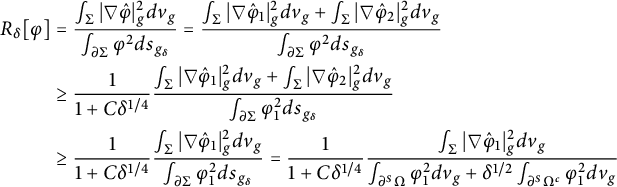
Further, by the fact that
 $\int _{\Sigma }\langle \nabla \hat \varphi _1, \nabla \hat \varphi _2 \rangle _{g} dv_{g}=0$
and by Claim 4 for every
 $\varphi \in V \in W_k$
and one has
 $$ \begin{align*} R_{\delta}[\varphi] &=\frac{\int_{\Sigma}|\nabla \hat\varphi|^2_{g}dv_{g}}{\int_{\partial \Sigma} \varphi^2 ds_{g_{\delta}}}=\frac{\int_{\Sigma}|\nabla \hat\varphi_1|^2_{g}dv_{g}+\int_{\Sigma}|\nabla \hat\varphi_2|^2_{g}dv_{g}}{\int_{\partial \Sigma} \varphi^2 ds_{g_{\delta}}} \\ &\geq \frac{1}{1+C\delta^{1/4}} \frac{\int_{\Sigma}|\nabla \hat\varphi_1|^2_{g}dv_{g}+\int_{\Sigma}|\nabla \hat\varphi_2|^2_{g}dv_{g}}{\int_{\partial \Sigma} \varphi_1^2 ds_{g_{\delta}}} \\ &\geq \frac{1}{1+C\delta^{1/4}} \frac{\int_{\Sigma}|\nabla \hat\varphi_1|^2_{g}dv_{g}}{\int_{\partial \Sigma} \varphi_1^2 ds_{g_{\delta}}}=\frac{1}{1+C\delta^{1/4}} \frac{\int_{\Sigma}|\nabla \hat\varphi_1|^2_{g}dv_{g}}{\int_{\partial^S\Omega} \varphi_1^2 dv_{g}+\delta^{1/2}\int_{\partial^S\Omega^c}\varphi_1^2 dv_{g}} \end{align*} $$
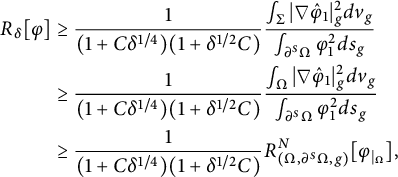
and by Claim 5, we get
 $$ \begin{align*} R_{\delta}[\varphi] &\geq\frac{1}{(1+C\delta^{1/4})(1+\delta^{1/2}C)} \frac{\int_{\Sigma}|\nabla \hat\varphi_1|^2_{g}dv_{g}}{\int_{\partial^S\Omega} \varphi_1^2 ds_{g}} \\ &\geq \frac{1}{(1+C\delta^{1/4})(1+\delta^{1/2}C)} \frac{\int_{\Omega}|\nabla \hat\varphi_1|^2_{g}dv_{g}}{\int_{\partial^S\Omega} \varphi_1^2 ds_{g}} \\ &\geq\frac{1}{(1+C\delta^{1/4})(1+\delta^{1/2}C)} R^N_{(\Omega,\partial^S\Omega, g)}[\varphi_{|_{\Omega}}], \end{align*} $$
where
 $R^N_{(\Omega ,\partial ^S\Omega , g)}$
denotes the Rayleigh quotient for the Steklov–Neumann problem in the domain
 $(\Omega ,g)$
.
Let
 $V=\operatorname {span}\langle \psi _0,\ldots ,\psi _k \rangle $
, where
 $\psi _i$
is in the ith eigenspace of
 $(\Sigma ,g_{\delta })$
. Then
 $$ \begin{align} \begin{aligned} \sigma^{\delta}_k &=\max_{\varphi \in V}R_{\delta}[\varphi] \geq \frac{1}{(1+C\delta^{1/4})(1+\delta^{1/2}C)} \max_{\varphi \in V}R^N_{(\Omega,\partial^S\Omega, g)}[\varphi_{|_{\Omega}}] \\ &\geq \frac{1}{(1+C\delta^{1/4})(1+\delta^{1/2}C)}\sigma^N_k(\Omega,\partial^S\Omega, g), \end{aligned} \end{align} $$
since the restriction to
 $\Omega $
of the functions
 $\psi _i$
form the space of the same dimension by unique continuation. Finally, passing to the
 $\liminf $
as
 $\delta \to 0$
in (2.6) yields the lemma.
Case II. The case when
 $\Omega ^c \cap \partial \Sigma =\varnothing $
is trivial. Indeed, in this case, we have
 $\partial ^S\Omega =\partial \Sigma $
. Then for any function
 $\varphi ,$
one has
 $$ \begin{align*} R_{\delta}[\varphi]=\frac{\int_{\Sigma}|\nabla \hat\varphi|^2_{g}dv_{g}}{\int_{\partial \Sigma} \varphi^2 ds_{g_{\delta}}} \geq \frac{\int_{\Omega}|\nabla \hat\varphi|^2_{g}dv_{g}}{\int_{\partial^S\Omega} \varphi^2 ds_{g}}=R^N_{(\Omega,\partial^S\Omega, g)}[\varphi_{|_{\Omega}}]. \end{align*} $$
Therefore, considering
 $V=\operatorname {span}\langle \psi _0,\ldots ,\psi _k \rangle $
, where
 $\psi _i$
is in the ith eigenspace of
 $(\Sigma ,g_{\delta })$
yields
 $$ \begin{align*} \sigma^{\delta}_k=\max_{\varphi \in V}R_{\delta}[\varphi] \geq \max_{\varphi \in V}R^N_{(\Omega,\partial^S\Omega, g)}[\varphi_{|_{\Omega}}] \geq \sigma^N_k(\Omega,\partial^S\Omega, g). \end{align*} $$
Taking
 $\liminf $
as
 $\delta \to 0$
completes the proof.
Lemma 2.5 is the key ingredient in the proof of the following proposition. We postpone the proof to Section 7.2.
Proposition 2.6 Let
 $(\Sigma ,g)$
be a Riemannian surface with boundary,
 $\Omega \subset \Sigma $
a Lipschitz domain and
 $\partial ^S\Omega =\partial \Sigma \cap \Omega \neq \varnothing $
. Then for all k one has
 $$ \begin{align*} \sigma^*_k(\Sigma,[g]) \geq \sigma^{N*}_k(\Omega,\partial^S\Omega, [g|_{\overline\Omega}]). \end{align*} $$
Similarly, let
 $(\Sigma ,g)$
be a Riemannian surface whose boundary. Let
 $\partial ^S\Sigma $
denote all boundary components with the Steklov boundary condition and
 $\Omega \subset \Sigma $
be a Lipschitz domain such that
 $\partial ^S\Omega \subset \partial ^S\Sigma $
. Then for all k one has
 $$ \begin{align*} \sigma^{N*}_k(\Sigma,\partial^S\Sigma, [g]) \geq \sigma^{N*}_k(\Omega,\partial^S\Omega, [g|_{\overline\Omega}]). \end{align*} $$
As a corollary of Proposition 2.6, we get
Corollary 2.7 Let
 $(M, g)$
be a compact Riemannian surface with boundary. Consider a sequence
 $\{ K_n \}$
of smooth domains
 $K_n \subset M$
such that
-
•
$K_r \subset K_s \ \forall r>s$
and -
•
$\cap _n K_n=\{p_1,\ldots ,p_l\}$
for some points
$p_1,\ldots ,p_l \in M$
.



Then one has
 $$ \begin{align*} \lim_{n \to \infty}\sigma^{N*}_k(M \setminus K_n, \partial M \setminus \partial K_n, [g])= \sigma^*_k(M, [g]). \end{align*} $$
The proof is postponed to Section 7.2.
2.4 Disconnected surfaces
The proofs of two lemmas below follow the exactly same arguments as the proofs of Lemmas 4.9 and 4.10 in [Reference Karpukhin and MedvedevKM20]. Their proofs are postponed to Section 7.2.
Lemma 2.8 Let
 $(\Omega ,g) = \sqcup _{i=1}^s(\Omega _i,g_i)$
be a disjoint union of Riemannian surfaces with Lipschitz boundary. Set
 $\partial ^S\Omega =\sqcup _{i=1}^s\partial ^S\Omega _i$
. Then for all
 $k>0$
one has
 $$ \begin{align*} \sigma^{N*}_k(\Omega,\partial^S\Omega, [g]) = \max_{\sum\limits_{i=1}^s k_i=k,\,\,\,k_i>0}\,\,\sum_{i=1}^s\sigma^{N*}_{k_i}(\Omega_i,\partial^S\Omega_i, [g_i]). \end{align*} $$
Lemma 2.9 Let
 $(\Sigma ,g)$
be a Riemannian surface with boundary. Consider a set of pairwise disjoint Lipschitz domains
 $\{\Omega _i\}^s_{i=1}$
in
 $\Sigma $
such that
 $\Sigma =\bigcup ^s_{i=1} \overline \Omega _i$
and
 $\Omega _i\cap \partial \Sigma =\partial ^S\Omega _i \neq \varnothing $
for
 $1 \leq i \leq s'$
. Then one has
 $$ \begin{align*} \sigma^{*}_k(\Sigma, [g]) \geq \max_{\sum_{i=1}^{s'} k_i=k,\,\,\,k_i \geq 0} \sum^{s'}_{i=1} \sigma^{N*}_{k_i}(\Omega_i,\partial^S\Omega_i, [g]). \end{align*} $$
3 Proof of Theorem 1.2
The proof is inspired by the methods of the papers [Reference Yang and YauYY80, Reference Girouard and PolterovichGP, Reference KarpukhinKar16]. Let
 $\Sigma $
be a nonorientable compact surface of genus
 $\gamma $
and l boundary components. We pass to its orientable cover
 $\pi \colon \widetilde \Sigma \to \Sigma $
. Note that
 $\Sigma $
is of genus
 $\gamma $
and has
 $2l$
boundary components. Let
 $\tau $
denote the involution exchanging the sheets of
 $\pi $
. If h is a metric on
 $\Sigma $
then
 $g:=\pi ^*h$
is a metric on
 $\widetilde \Sigma $
invariant with respect to
 $\tau $
, i.e.,
 $\tau $
is an isometry of g. Let
 $\mathcal D_{\widetilde \Sigma }$
be the Dirichlet-to-Neumann map acting on functions on
 $\widetilde \Sigma $
. Then
 $\tau \circ \mathcal D_{\widetilde \Sigma }=\mathcal D_{\widetilde \Sigma }\circ \tau $
and hence Steklov eigenfunctions are divided into
 $\tau $
-odd and
 $\tau $
-even ones. The corresponding Steklov eigenvalues are also divided into odd and even ones. Let
 $\sigma ^{\tau }_k(\widetilde \Sigma ,g)$
the kth
 $\tau $
-even Steklov eigenvalue. Then
 $\sigma ^{\tau }_k(\widetilde \Sigma ,g)=\sigma _k(\Sigma ,h)$
.
By a well-known theorem of Ahlfors [Reference AhlforsAhl50], there exists a proper conformal branched cover
 $\psi \colon (\widetilde \Sigma ,g) \to (\mathbb D^2,g_{can})$
. The word “proper” means
 $\psi (\partial \widetilde \Sigma )=\mathbb S^1$
. Let d be its degree. Define the following pushed-forward metric
 $g^*$
on
 $\mathbb D^2$
: consider a neighborhood U of a nonbranching point
 $p\in \mathbb D^2$
. Its pre-image is a collection of d neighborhoods
 $U_i, i=1,\ldots ,d$
on
 $\widetilde \Sigma $
. Moreover,
 $\psi _i:=\psi _{|_{U_i}}\colon U_i\to U$
is a diffeomorphism. Then the metric
 $g^*$
is defined on U as
 $\sum (\psi ^{-1}_i)^*g$
. The metric
 $g^*$
is a metric on
 $\mathbb D^2$
with isolated conical singularities at branching points of
 $\psi $
. The following lemma is trivial
Lemma 3.1 For any function
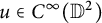 $u\in C^{\infty }(\mathbb D^2)$
one has
 $$ \begin{align*} \int_{\mathbb S^1}udv_{g^*}=\int_{\partial\widetilde\Sigma}(\psi^*u)dv_{g} \end{align*} $$
and
 $$ \begin{align*} d\int_{\mathbb D^2}|\nabla_{g^*} u|^2dv_{g^*}=\int_{\widetilde\Sigma}|\nabla_{g} (\psi^*u)|^2dv_{g}. \end{align*} $$
Further, suppose that there exists an involution
 $\iota $
of
 $\mathbb D^2$
such that
 $$ \begin{align} \psi \circ \tau= \iota \circ \psi. \end{align} $$
Lemma 3.2 The involution
 $\iota $
is an isometry of
 $(\mathbb D^2,g^*)$
.
Proof Indeed, let the neighborhood
 $U\subset \mathbb D^2$
be small enough and do not contain branching points. Then
 $\psi ^{-1}(U)=\sqcup ^d_{i=1} U_i$
and applying
 $\tau $
one gets:
 $\tau (\psi ^{-1}(U))=\sqcup ^d_{i=1} \tau (U_i)$
. Note that condition (3.1) implies
 $\tau (\psi ^{-1}(U))=\psi ^{-1}(\iota (U))$
. Whence
 $\psi ^{-1}(\iota (U))=\sqcup ^d_{i=1} \tau (U_i)$
. Let
 $\widetilde {\psi _i}:=\psi _{\tau (U_i)}$
. Then on U, one has
 $$ \begin{align*} g^* &=\sum^d_{i=1} (\widetilde{\psi_i}^{-1})^*g=\sum^d_{i=1} (\widetilde{\psi_i}^{-1})^*\tau^*g = \sum^d_{i=1} (\widetilde{\psi_i}^{-1}\circ\tau)^*g \\ &= \sum^d_{i=1} (\iota\circ\widetilde{\psi_i}^{-1})^*g = \sum^d_{i=1}\iota^*(\widetilde{\psi_i}^{-1})^*g=\iota^*g^*. \end{align*} $$
▪
Consider a jth
 $\iota $
-even eigenfunction
 $u_j$
on
 $(\mathbb D^2,g^*)$
with corresponding eigenvalue
 $\sigma ^{\iota }_j(\mathbb D^2,g^*)$
. Then the function
 $\psi ^*u_j$
on
 $\widetilde \Sigma $
is
 $\tau $
-even and hence it projects to a well-defined function
 $v_j$
on
 $\Sigma $
. We can construct the following function
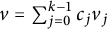 $v=\sum _{j=0}^{k-1}c_jv_j$
. Note that
 $\pi ^*v=\sum _{j=0}^{k-1}c_j\psi ^*u_j=\psi ^*u$
, where
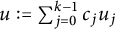 $u:=\sum _{j=0}^{k-1}c_ju_j$
. Further, let
 $w_i$
denote an ith eigenfunction on
 $\Sigma $
with eigenvalue
 $\sigma _i(\Sigma ,h)$
. It is easy to see that one can always find some coefficients
 $c_0,\ldots ,c_{k-1}$
such that
 $\int _{\partial \Sigma }v w_idv_h=0, i=0,\ldots ,k-1$
. Then, we can use v as a test function for
 $\sigma _k(\Sigma ,h)$
:
 $$ \begin{align*} \sigma_k(\Sigma,h) \leq \frac{\int_{\Sigma}|\nabla_{h} v|^2dv_{h}}{\int_{\partial\Sigma}v^2dv_{h}}=\frac{\int_{\widetilde\Sigma}|\nabla_{g} \psi^*u|^2dv_{g}}{\int_{\partial\widetilde\Sigma}(\psi^*u)^2dv_{g}}=d\frac{\int_{\mathbb D^2}|\nabla_{g^*} u|^2dv_{g^*}}{\int_{\mathbb S^1}u^2dv_{g^*}}=d\sigma^{\iota}_k(\mathbb D^2,g^*), \end{align*} $$
where we used Lemma 3.1. Moreover, the second identity in Lemma 3.1 implies
 $L_{g^*}(\mathbb S^1)=L_g(\partial \widetilde \Sigma )=2L_h(\partial \Sigma )$
. Whence
 $$ \begin{align} \overline\sigma_k(\Sigma,h) \leq \frac{d}{2}\sigma^{\iota}_k(\mathbb D^2,g^*)L_{g^*}(\mathbb S^1). \end{align} $$
Consider a conformal map
 $\psi $
between surfaces with involution
 $\psi \colon (\widetilde \Sigma , \tau ) \to (\mathbb D^2, \iota )$
of minimal degree d. The map
 $\psi $
is conformal, moreover, every involution exchanging the orientation on
 $\mathbb D^2$
is conjugate to the involution
 $\iota _0(z):=\bar z$
, where we identify
 $\mathbb D^2$
with the unit disc on the complex plane. Therefore, without loss of generality, we can assume that
 $\iota =\iota _0$
. The fixed point set of
 $\iota _0$
is the diameter
 $\{z\in \mathbb D^2~|~Re(z)=0\}$
. Let
 $H\mathbb D^2$
denote a half-disc for example the right one and
 $\partial ^SH\mathbb D^2$
is the right half-circle. Thus,
 $\sigma ^{\iota _0}_k(\mathbb D^2,g^*)=\sigma ^N_k(H\mathbb {D}^2,\partial ^SH\mathbb {D}^2, g^*)$
and inequality (3.2) implies:
 $$ \begin{align} \begin{aligned} &\overline\sigma_k(\Sigma,h) \leq \frac{d}{2}\sigma^{\iota}_k(\mathbb D^2,g^*)L_{g^*}(\mathbb S^1)=d\overline\sigma^N_k(H\mathbb {D}^2,\partial^SH\mathbb{D}^2, g^*) \\ &\quad \leq d\sigma^{N*}_k(H\mathbb {D}^2,\partial^SH\mathbb{D}^2, [g^*]) \leq d\sigma^{*}_k(\mathbb {D}^2, [g_{can}])=2\pi k d, \end{aligned} \end{align} $$
where in the last inequality, we used Lemma 2.6 and the fact that there exists a unique up to an isometry conformal class
 $[g_{can}]$
on
 $\mathbb D^2$
. We want to estimate d in formula (3.3). It is known that there exists a proper conformal branched cover
 $f\colon (\widetilde \Sigma , g) \to (\mathbb D^2,g_{can})$
of degree
 $d'\leq \gamma +2l$
(see [Reference GabardGab06]). One can construct the following map
 $F(x):=f(x)\bar f(\tau (x))$
. Note that
 $\bar F(x)=F(\tau (x))=\iota (F(x))$
and hence
 $\iota =\iota _0$
. Moreover, F is proper and the degree of F is not greater than
 $2d'=2(\gamma +2l)$
. Hence, there exists a proper map between
 $(\widetilde \Sigma , \tau )$
and
 $(\mathbb D^2,\iota _0)$
of degree not exceeding
 $2d'=2(\gamma +2l)$
satisfying (3.1). Inequality (3.3) then implies
 $$ \begin{align*} \overline\sigma_k(\Sigma,h) \leq 4\pi k (\gamma+2l). \end{align*} $$
4 Geometric background
The aim of this section is the proof of Theorem 1.4. For this purpose, we provide a necessary background concerning the geometry of moduli space of conformal classes on a surface with boundary. We start with closed orientable surfaces.
4.1 Closed orientable surfaces
Let us recall the Uniformization theorem.
Theorem 4.1 Let
 $\Sigma $
be a closed surface and g be a Riemannian metric on it. Then in the conformal class
 $[g]$
, there exists a unique (up to an isometry) metric h of constant Gauss curvature and fixed area. The area assumption is unnecessary except in the case of the torus for which we fix the volume of h to be equal to
 $1$
.
Remark 4.1 It follows from the Gauss–Bonnet theorem that the metric h in the Uniformization theorem is of Gauss curvature
 $1$
in the case of the sphere,
 $0$
in the case of the torus and
 $-1$
in the rest cases.
Recall that a Riemannian metric h of constant Gaussian curvature
 $-1$
is called hyperbolic and a Riemannian surface
 $(\Sigma ,h)$
endowed with a hyperbolic metric h is called a hyperbolic surface. Note also that a hyperbolic surface is necessarily of negative Euler characteristic. We also say that the torus endowed with a metric of curvature
 $h=0$
is a flat torus and the sphere endowed with the metric
 $h=1$
is the standard (round) sphere.
4.2 Hyperbolic surfaces
We recall that a pair of pants is a compact surface of genus
 $0$
with
 $3$
boundary components. The following theorem plays an underlying role in the theory of hyperbolic surfaces.
Theorem 4.2 (Collar theorem (see e.g., [Reference BuserBus92]))
Let
 $(\Sigma ,h)$
be an orientable compact hyperbolic surface of genus
 $\gamma \geq 2$
and let
 $c_1,c_2,\ldots ,c_m$
be pairwise disjoint simple closed geodesics on
 $(\Sigma ,h)$
. Then the following holds
-
(i)
$m \leq 3 \gamma -3$
. -
(ii) There exist simple closed geodesics
$c_{m+1},\ldots ,c_{3 \gamma -3}$
which, together with
$c_1,\ldots ,c_m$
, decompose
$\Sigma $
into pairs of pants. -
(iii) The collars
of widths
$$ \begin{align*} \mathcal{C}(c_i)=\big\{p\in\Sigma~|~ dist(p,c_i) \leq w(c_i)\big\} \end{align*} $$
are pairwise disjoint for
$$ \begin{align*} w(c_i)=\frac{\pi}{l(c_i)}\bigg(\pi-2\arctan\bigg(\sinh\frac{l(c_i)}{2}\bigg)\bigg) \end{align*} $$
$i=1,\ldots ,3 \gamma -3$
.
-
(iv) Each
$\mathcal {C}(c_i)$
is isometric to the cylinder with the Riemannian metric
$$ \begin{align*} \big\{(t,\theta)| -w(c_i)<t<w(c_i),\,\theta\in\mathbb{R}/2\pi\mathbb{Z}\big\} \end{align*} $$
$$ \begin{align*} \bigg(\frac{l(c_i)}{2\pi \cos\big(\frac{l(c_i)}{2\pi}t\big)}\bigg)^2\big(dt^2+d\theta^2\big). \end{align*} $$







The decomposition of
 $(\Sigma ,h)$
into pair of pants which we denote by
 $\mathcal {P}$
is called the pants decomposition. We also say that the geodesics
 $c_1,\ldots ,c_{3 \gamma -3}$
form
 $\mathcal {P}$
.
4.3 Convergence of hyperbolic metrics
We endow the set of hyperbolic metrics on a given surface
 $\Sigma $
with
 $C^{\infty }-$
topology. In this section, we describe the convergence on this topological set which is called the moduli space of conformal classes on
 $\Sigma $
. Essentially, two cases can happen: the injectivity radii of a sequence of hyperbolic metrics do not go to
 $0$
or they do. The first case is described by Mumford’s compactness theorem and the second one is treated by the Deligne–Mumford compactification.
Proposition 4.3 (Mumford’s compactness theorem (see e.g., [Reference HummelHum97]))
Let
 $\{h_n\}$
be a sequence of hyperbolic metrics on a surface
 $\Sigma $
of genus
 $\geq 2$
. Assume that the injectivity radii
 $\operatorname {inj}(\Sigma ,h_n)$
satisfy
 $\limsup \limits _{n\to \infty }\operatorname {inj}(\Sigma ,h_n)>0$
. Then there exists a subsequence
 $\{h_{n_k}\}$
, sequence
 $\{\Phi _k\}$
of smooth automorphisms of
 $\Sigma $
and a hyperbolic metric
 $h_{\infty }$
on
 $\Sigma $
such that the sequence of hyperbolic metrics
 $\{\Phi _k^*h_{n_k}\}$
converges in
 $C^{\infty }$
-topology to
 $h_{\infty }$
.
If
 $\lim \limits _{n\to \infty }\operatorname {inj}(\Sigma ,h_n)=0$
then we say that the sequence
 $\{h_n\}$
degenerates. The thick-thin decomposition implies that if the sequence
 $\{h_n\}$
degenerates then for each n there exists a collection
 $\{c_1^n,\ldots ,c_s^n\}$
of disjoint simple closed geodesics in
 $(\Sigma ,h_n)$
whose lengths tend to
 $0$
and the length of any geodesic in the complement
 $\Sigma _n =\Sigma \backslash (c_1^n\cup \cdots \cup c_s^n)$
is bounded from below by a constant independent of n. We call the geodesics
 $\{c_1^n,\ldots ,c_s^n\}$
“pinching” or “collapsing.” The surface
 $(\Sigma _n, h_n)$
is possibly a disconnected hyperbolic surface with geodesic boundary. Let
 $\widehat {\Sigma _{\infty }}$
denote the surface having the same connected components as
 $\Sigma _n$
, but with boundary component replaced by marked points. Note that each sequence
 $\{c_i^n\}$
corresponds to a pair of marked points
 $\{p_i,q_i\}$
on
 $\widehat {\Sigma _{\infty }}$
,
 $i=1,\ldots ,s$
. Then the punctured surface
 $\widehat {\Sigma _{\infty }}\backslash \{p_1,q_1,\ldots ,p_s,q_s\}$
that we denote by
 $\Sigma _{\infty }$
admits the unique hyperbolic metric
 $h_{\infty }$
with cusps at punctures. Now we are ready to formulate one of the underlying results in the theory of moduli spaces of Riemann surfaces.
Proposition 4.4 (Deligne–Mumford compactification (see e.g., [Reference HummelHum97]))
Let
 $(\Sigma , h_n)$
be a sequence of hyperbolic surfaces such that
 $\operatorname {inj}(\Sigma ,h_n)\to 0$
. Then up to a choice of subsequence, there exists a sequence of diffeomorphisms
 $\Psi _n: \Sigma _{\infty } \to \Sigma _n$
such that the sequence
 $\{\Psi ^*_n h_n\}$
of hyperbolic metrics converges in
 $C_{\mathrm {loc}}^{\infty }$
-topology to the complete hyperbolic metric
 $h_{\infty }$
on
 $\Sigma _{\infty }$
. Furthermore, there exists a metric of locally constant curvature
 $\widehat {h_{\infty }}$
on
 $\widehat {\Sigma _{\infty }}$
such that its restriction to
 $\Sigma _{\infty }$
is conformal to
 $h_{\infty }$
.
We call
 $(\widehat {\Sigma _{\infty }},\widehat {h_{\infty }})$
a limiting space of the sequence
 $(\Sigma ,h_n)$
. We also say that the limit of conformal classes
 $[h_n]$
is the conformal class
 $[\widehat {h_{\infty }}]$
on
 $\widehat {\Sigma _{\infty }}$
.
Remark 4.2 We emphazise that
 $\widehat {h_{\infty }}$
has locally constant curvature, since
 $\widehat {\Sigma _{\infty }}$
is possibly disconnected and different connected components could have different signs of Euler characteristic.
4.4 Orientable surfaces with boundary of negative Euler characteristic
Our exposition of this topic essentially follows the book [Reference JostJos07].
Let
 $\Sigma $
be an orientable surface of genus
 $\gamma $
with l boundary components. Consider its Schottky double
 $\Sigma ^d$
defined in following way. We identify
 $\Sigma $
with another copy
 $\Sigma '$
of
 $\Sigma $
with opposite orientation along the common boundary. We get a closed oriented surface of genus
 $2\gamma +l-1$
. For example, the Schottky double of the disk is the sphere and the Schottky double of the cylinder is the torus. In the rest cases we always get a hyperbolic surface as the Schottky double. We endow the surface
 $\Sigma $
with a metric g. The next theorem plays a role of the Uniformization theorem for surfaces with boundary.
Proposition 4.5 [Reference Osgood, Phillips and SarnakOPS88]
In the conformal class
 $[g]$
of a metric g on the surface
 $\Sigma $
, there exists a unique (up to an isometry) metric of constant Gauss curvature and geodesic boundary. More precisely, this metric is of curvature
 $1$
in the case of
 $\mathbb D^2$
, of the curvature
 $0$
in the case of the cylinder and of curvature
 $-1$
in the rest cases.
Denote the metric of constant Gauss curvature and geodesic boundary from Theorem 4.5 by h. Consider a Riemannian surface with boundary
 $(\Sigma , h)$
. Its Schottky double admits the metric
 $h^d$
defined as
 $h^d_{|_{\Sigma }}=h$
and
 $h^d_{|_{\Sigma }'}=h$
. It is a metric of constant curvature and the involution
 $\iota : \Sigma ^d \to \Sigma ^d$
that interchanges
 $\Sigma $
and
 $\Sigma '$
becomes an isometry with
 $\partial \Sigma $
as the fixed set. Moreover,
 $(\Sigma ,h_n)=(\Sigma ^d,h^d_n)/\iota $
.
Theorem 4.5 also says that the set of conformal classes on the surface
 $\Sigma $
with boundary is in one-to-one correspondence with the set of metrics of constant Gauss curvature and geodesic boundary which is in the one-to-one correspondence with the set of “symmetric” metrics (metrics that go to themselves under the involution
 $\iota $
) of constant curvature on the Schottky double. We endow the set of metrics of constant Gauss curvature and geodesic boundary with
 $C^{\infty }-$
topology. Consider a sequence of conformal classes
 $\{c_n\}$
on
 $\Sigma $
. It uniquely defines a sequence of “symmetric” metrics of constant curvature
 $\{h^d_n\}$
on
 $\Sigma ^d$
. For this sequence, we have the same dichotomy as we have seen in the previous sections. Precisely, either
 $\operatorname {inj} (\Sigma ^d,h^d_n) \nrightarrow 0$
or
 $\operatorname {inj} (\Sigma ^d,h^d_n)\to 0$
. In the first case we get a genuine Riemannian metric on
 $\Sigma ^d$
which is obviously “symmetric” and of constant curvature while in the second case one can find a set of simple closed geodesics
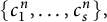 $\{c_1^n,\dots ,c_s^n\},$
where
 $s \leq 6\gamma +3l-6$
whose lengths
 $l_{h^d_n}(c_i^n)\to 0$
. For the geodesics
 $c_i^n$
there exist two possibilities: either
 $\iota (c_i^n)=c_i^n$
or
 $\iota (c_i^n)=c_j^n$
with
 $j \neq i$
. The first possibility implies that the geodesic
 $c_i^n$
crosses
 $\partial \Sigma $
which corresponds to two situations as well: either
 $c_i^n$
has exactly two points of intersection with
 $\partial \Sigma $
or it belongs to
 $\partial \Sigma $
, i.e., it is one of the boundary components. The second possibility implies that
 $c_i^n$
does not crosse
 $\partial \Sigma $
. Taking quotient by
 $\iota $
, we then get three types of pinching geodesics on
 $(\Sigma ,h_n)$
with
 $\operatorname {inj} (\Sigma ,h_n) \to 0$
: pinching boundary components, pinching simple geodesics which have exactly two points of intersection with the boundary and pinching simple closed geodesics which do not cross the boundary.
4.5 Nonorientable surface with boundary of negative Euler characteristic
Let
 $\Sigma $
be a compact nonorientable surface with l boundary components. Note that the Uniformization Theorem 4.5 also holds for nonorientable surfaces. Pick a metric h of constant Gauss curvature and geodesic boundary. We pass to the orientable cover that we denote by
 $\widetilde \Sigma $
. The surface
 $\widetilde \Sigma $
is a compact orientable surface with
 $2l$
boundary components. The pull-back of the metric h that we denote by
 $\tilde h$
is a metric of constant Gauss curvature and with geodesic boundary. Moreover, this metric is invariant under the involution changing the orientation on
 $\widetilde \Sigma $
. Consider a sequence
 $\{h_n\}$
on
 $\Sigma $
of metrics of constant Gauss curvature and geodesic boundary such that
 $\operatorname {inj}(\Sigma ,h_n)\to 0$
as
 $n\to \infty $
. This sequence corresponds to the sequence
 $\{\tilde h_n\}$
on
 $\widetilde \Sigma $
such that
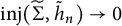 $\operatorname {inj}(\widetilde \Sigma ,\tilde h_n)\to 0$
as
 $n\to \infty $
. As we discussed in the previous section for the sequence
 $\{\tilde h_n\}$
, one can find pinching geodesics of the following three types: pinching boundary components, pinching simple geodesics crossing the boundary at two points and pinching simple closed geodesics which do not cross the boundary. Note that for the geodesics of the second type the points of intersection with the boundary are not identified under the involution. Indeed, if the were identified then the corresponding pinching geodesic had fixed ends under the involution. Applying the involution to this geodesic we would get a pinching closed geodesic crossing the boundary at two points which is not one of the possible types of pinching geodesics. Consider now the geodesics of the third type. For every such geodesic there are two possible cases: either this geodesic maps to itself under the involution changing the orientation or it maps to another simple closed geodesic which does not cross the boundary. Then taking the quotient by the involution changing the orientation we get two types of simple closed geodesics on
 $\Sigma $
which do not crosse the boundary: one-sided geodesics which are the images of the geodesics described in the first case and two-sided geodesics which are the images of the geodesics described in the second case. The collars of one-sided geodesics are nothing but Möbius bands while the collars of two-sided geodesics are cylinders. Therefore, if
 $\operatorname {inj}(\Sigma ,h_n)\to 0$
as
 $n\to \infty $
, then one can find pinching geodesics of the following types: pinching boundary components, pinching simple geodesics which have exactly two points of intersection with the boundary, one-sided pinching simple closed geodesics not crossing the boundary and two-sided pinching simple closed geodesics not crossing the boundary.
4.6 Surfaces with boundary of non-negative Euler characteristic
Here we consider the cases of the disc, the cylinder
 $\mathcal C$
and the Möbius band
 $\mathbb {MB}$
.
It is known that the disc has a unique conformal class (up to an isometry). We denote this conformal class as
 $[g_{can}]$
or
 $c_{can}$
, where
 $g_{can}$
is the flat metric on the disc
 $\mathbb D^2$
with unit boundary length.
Accordingly to Theorem 4.5 in a conformal class on
 $\mathcal C$
there exists a flat metric with geodesic boundary, i.e., a metric on the right circular cylinder. This metric is unique if we fix the length of the boundary. The right circular cylinder is uniquely determined by its height. Therefore, conformal classes on
 $\mathcal C$
are in one-to-one correspondence with heights of right circular cylinders, i.e., the set of conformal classes is
 $\mathbb R_{>0}$
. We will identify conformal classes on
 $\mathcal C$
with points of
 $\mathbb R_{>0}$
. We say that the sequence
 $\{c_n\}$
of conformal classes degenerates if either
 $c_n \to 0$
or
 $c_n\to \infty $
. The case
 $c_n \to 0$
corresponds to a pinching geodesic having intersection with two boundary components (i.e., the generatrix of the right circular cylinder). The case
 $c_n\to \infty $
corresponds to pinching boundary components.
In the case of the Möbius band we also use Theorem 4.5 which implies that in every conformal class on
 $\mathbb {MB}$
there exists a flat metric with geodesic boundary which is unique if we fix the length of the boundary. Passing to the orientable cover and pulling back the flat metric from
 $\mathbb {MB}$
we get a flat cylinder with geodesic boundary. Then the discussion in the previous paragraph implies that the conformal classes on
 $\mathbb {MB}$
are also encoded by
 $\mathbb R_{>0}$
. Identifying again conformal classes on
 $\mathbb {MB}$
with points of
 $\mathbb R_{>0}$
, we get two possible cases for a sequence of conformal classes
 $\{c_n\}$
: either
 $c_n \to 0$
or
 $c_n\to \infty $
. In both cases, we say that the sequence
 $\{c_n\}$
degenerates. The first case corresponds to a pinching geodesic having two points of intersection with boundary. The second case corresponds to the collapsing boundary.
5 Proof of Theorem 1.4
Negative Euler characteristic. Let
 $\Sigma $
be a surface with boundary and
 $c_n\to c_{\infty }$
a degenerating sequence of conformal classes. Consider the corresponding sequence of metrics
 $h_n$
of constant Gauss curvature and geodesic boundary. Then as we have noticed in Section 4.4, one can find
 $s=s_1+s_2+s_3$
pinching geodesics of the following three types:
 $s_1$
pinching boundary components,
 $s_2$
pinching geodesics that have two points of intersection with boundary and
 $s_3$
pinching simple closed geodesics that do not intersect the boundary.
We introduce the following notations
-
•
$\gamma ^n_i$
for collapsing geodesics,
$i=1,\ldots ,s$
. If we do not indicate the superscript then the symbol
$\gamma _i$
stands for the genus; -
•
$\mathcal {C}^n_i$
for collars of collapsing geodesics,
$i=1,\ldots ,s$
. Their widths are denoted by
$w^n_i$
. Moreover,
$\mathcal {C}^n_i:=\{(t,\theta )~|~0 \leq t<w^n_i,~0 \leq \theta \leq 2\pi \}$
for
$1 \leq i \leq s_1$
and
$\mathcal {C}^n_i:=\{(t,\theta )~|~-w^n_i<t<w^n_i,~0 \leq \theta \leq 2\pi \}$
for
$s_1+1 \leq i \leq s$
(if the geodesic is one-sided then we consider
$\mathcal {C}^n_i:=\{(t,\theta )~|~-w^n_i< t<w^n_i,~0 \leq \theta \leq 2\pi \}/\sim $
, where
$\sim $
stands for
$(t,\theta )\sim (-t,\pi +\theta )$
). Note that geodesics correspond to the line
$\{t=0\}$
, the segments
$\{\theta =0\}$
and
$\{\theta =2\pi \}$
are identified for
$1 \leq i \leq s_1$
and for
$s_1+s_2+1 \leq i \leq s$
and they are not identified for
$s_1+1 \leq i \leq s_1+s_2$
and correspond to the segments of intersection with the boundary; -
• for
$0<a<w^n_i$
, we denote
$\mathcal C^n_i(0,a)$
the subset
$\{(t, \theta )\,|~0 \leq t \leq a, 0 \leq \theta \leq 2\pi \}\subset {\mathcal {C}}^n_i$
for
$1 \leq i \leq s_1$
and for
$-w^n_i< a< b< w^n_i$
, we denote
$\mathcal C^n_i(a,b)$
the subset
$\{(t, \theta )\,|~a \leq t \leq b, 0 \leq \theta \leq 2\pi \}\subset {\mathcal {C}}^n_i$
for
$s_1+1 \leq i \leq s$
; -
•
$\Gamma ^n_i:=\{(t,\theta )\in \mathcal {C}^n_i~|~\theta =0$
or
$\theta =2\pi \}$
for
$s_1+1 \leq i \leq s_1+s_2$
; -
• for
$-w^n_i< a< b< w^n_i$
, we set
$\Gamma ^n_i(a,b):=\{(t,\theta )\in \Gamma ^n_i~|~a \leq t \leq b\}$
for
$s_1+1 \leq i \leq s_1+s_2$
; -
•
$\Sigma ^n_j$
for the jth connected component of
$\Sigma \setminus \cup ^s_{i=1} \mathcal {C}^n_i$
. We enumerate
$\Sigma ^n_j$
by
$1 \leq j \leq M$
such that M denotes the number of
$\Sigma ^n_j$
and for all
$1 \leq j \leq m$
one has
$\Sigma ^n_j \cap \partial \Sigma \neq \varnothing $
; -
• let
$\alpha ^n = \cup _{i=1}^{s_1+s_2}\{\alpha ^n_{i,-},\alpha ^n_{i,+}\}$
, where
$0 \leq \alpha ^n_{i,\pm }< w^n_i$
. We denote by
$\Sigma ^n_j(\alpha ^n)$
the connected component of which contains
$$ \begin{align*} \Sigma \setminus \bigg(\bigcup^{s_1+s_2}_{i=1}{\mathcal{C}}_i^n(\alpha^n_{i,-},\alpha^n_{i,+}) \cup \bigcup^{s}_{i=s_1+s_2+1} \gamma^n_i\bigg) \end{align*} $$
$\Sigma _j^n$
;
-
• for
$\alpha ^n = \cup _{i=1}^{s_1+s_2}\{\alpha ^n_{i,-},\alpha ^n_{i,+}\}$
, where
$0 \leq \alpha ^n_{i,\pm }< w^n_i$
we set
$I^n_j(\alpha ^n)=\Sigma ^n_j(\alpha ^n)\cap \partial \Sigma $
and
$I^n_j=\Sigma ^n_j \cap \partial \Sigma $
where
$1 \leq j \leq m$
; -
• we use the notation
$a_n \ll b_n$
for two sequences
$\{a_n\}$
and
$\{b_n\}$
satisfying
$a_n, b_n \to +\infty $
and
$\frac {a_n}{b_n} \to 0$
as
$n \to \infty $
.





























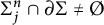

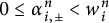



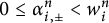

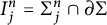





5.1 Inequality
$\geq $

We prove that
 $$ \begin{align} \liminf_{n \to \infty} \sigma^*_k (\Sigma, c_n) \geq \max \bigg(\sum^{m}_{i=1} \sigma^*_{k_{i}}(\Sigma_{\gamma_{i},l_i},c_{\infty})+ \sum_{i=1}^{s_1+s_2}\sigma^*_{r_i}(\mathbb{D}^2) \bigg), \end{align} $$
For this aim we consider the domains
 ${\mathcal {C}}^n_i(0,\alpha _{i,+}^n)$
for
 $1 \leq i \leq s_1$
,
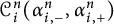 ${\mathcal {C}}^n_i(\alpha _{i,-}^n,\alpha _{i,+}^n)$
for
 $1+s_1 \leq i \leq s_1+s_2$
, where
 $ w^n_i - \alpha _{i,\pm }^n \ll w^n_i$
,
 $\alpha _{i,\pm }^n\to \infty $
and the domains
 $\Sigma _j^n(\alpha ^n)$
for
 $1 \leq j \leq m$
. By Lemma 2.9, we have
 $$ \begin{align} \begin{aligned} &\sigma^*_k(\Sigma, c_n) \geq \max \bigg(\sum^{s_1}_{i=1}\sigma^{N*}_{r_{i}}({\mathcal{C}}^n_i(0,\alpha_{i,+}^n), \gamma^n_i, c_n) \\ &\quad +\sum^{s_1+s_2}_{i=1+s_1}\!\sigma^{N*}_{r_{i}}({\mathcal{C}}^n_i(\alpha_{i,-}^n,\alpha_{i,+}^n),\Gamma^n_i(\alpha_{i,-}^n,\alpha_{i,+}^n), c_n)+\sum^{m}_{j=1}\sigma^{N*}_{k_{j}}\!(\!\Sigma_j^n(\alpha^n), I^n_j(\alpha^n), c_n)\bigg). \end{aligned} \end{align} $$
For
 $1 \leq i \leq s_1$
, we define the conformal maps
 $\Psi _i^n\colon ({\mathcal {C}}^n_i(0,\alpha _{i,+}^n), c_n) \to (\mathbb {D}^2, [g_{can}])$
as
 $$ \begin{align*} \Psi_i^n(t,\theta)= e^{\sqrt{-1}(\theta+\sqrt{-1}t)}. \end{align*} $$
The images of
 $\Psi _i^n$
are the annuli
 $\mathbb D^2 \setminus \mathbb D^2_{e^{-\alpha _{i,+}^n}}$
exhausting
 $\mathbb D^2$
as
 $n \to \infty .$
We also note that
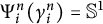 $\Psi _i^n(\gamma ^n_i)=\mathbb S^1$
.
For
 $s_1+1 \leq i \leq s_1+s_2$
, we define the conformal maps
 $\Psi _i^n\colon ({\mathcal {C}}^n_i(\alpha _{i,-}^n,\alpha _{i,+}^n), c_n) \to (\mathbb {D}^2, [g_{can}])$
as
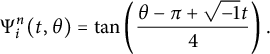 $$ \begin{align*} \Psi_i^n(t,\theta)=\tan\left(\frac{\theta-\pi+\sqrt{-1}t}{4}\right). \end{align*} $$
The images of
 $\Psi _i^n$
that we denote by
 $\Omega _{i}^n$
exhaust
 $\mathbb D^2$
as
 $n \to \infty .$
We also denote the image of
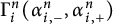 $\Gamma ^n_i(\alpha _{i,-}^n,\alpha _{i,+}^n)$
by
 $\partial ^S\Omega _{i}^n$
. Note that
 $\partial ^S\Omega _{i}^n$
exhaust
 $\mathbb S^1$
as
 $n\to \infty $
.
Finally, we take restrictions of the diffeomorphisms
 $\Psi _n^{-1}$
given by Proposition 4.4 to obtain the conformal maps
 $\check \Psi _j^n\colon ({\Sigma }_j^n(\alpha ^n),c_n)\to (\Sigma _{\infty },\Psi _n^*c_n)$
where
 $1 \leq j \leq m$
. Let
 $\check \Omega _{j}^n \subset \Sigma _{\infty }$
be the the image of
 $\check \Psi _j^n$
and
 $\partial ^S\check \Omega _{j}^n:=\check \Psi _j^n(I^n_j(\alpha ^n))$
. The following lemma holds
Lemma 5.1 Let
 $\Sigma ^{\infty }_j$
be the connected component
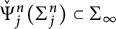 $\check \Psi ^n_j(\Sigma ^n_j)\subset \Sigma _{\infty }$
where
 $1 \leq j \leq m$
. Then the domains
 $\check \Omega _j^n$
exhaust
 $\Sigma ^{\infty }_j$
and
 $\partial ^S\check \Omega _{j}^n$
exhaust
 $\partial \Sigma ^{\infty }_j$
.
Proof Passing to the Schottky double of the surface
 $\Sigma $
, we immediately deduce this lemma from [Reference Karpukhin and MedvedevKM20, Lemma 5.1].▪
Further, we apply the conformal transformations to (5.2) to get
 $$ \begin{align} \begin{aligned} &\sigma^*_k(\Sigma, c_n) \geq \max\bigg(\sum^{s_1}_{i=1}\sigma^{N*}_{r_{i}}(\mathbb D^2 \setminus\mathbb D^2_{e^{-\alpha_{i,+}^n}}, \mathbb S^1, [g_{can}]) \\ &\quad +\sum^{s_1+s_2}_{i=1+s_1}\sigma^{N*}_{r_{i}}(\Omega_{i}^n, \partial^S\Omega_{i}^n, [g_{can}])+\sum^{m}_{j=1}\sigma^{N*}_{k_{j}}(\check\Omega_j^n, \partial^S\check\Omega_{j}^n, [(\Psi^n)^*h_n])\bigg). \end{aligned} \end{align} $$
It follows from Corollary 2.7 that the first two terms on the right hand side converge to
 $\sigma _{r_{i}}(\mathbb D^2, [g_{can}])$
. To complete the proof we will need the following lemma
Lemma 5.2 Let
 $\widehat {\Sigma _j^{\infty }}\subset \widehat {\Sigma _{\infty }}$
be a closure of
 $\Sigma _j^{\infty }$
,
 $1 \leq j \leq m$
. Then for all r one has
 $$ \begin{align*} \liminf_{n\to\infty}\sigma^{N*}_{r}(\check\Omega_j^n,\partial^S\check\Omega_{j}^n, [(\Psi^n)^*h_n]) \geq \sigma^*_r(\widehat{\Sigma_j^{\infty}}, [\widehat{h_{\infty}}]). \end{align*} $$
We postpone the proof to Section 7.3.
Finally, taking
 $\liminf _{n\to \infty }$
in (5.3) completes the proof of (5.1).
5.2 Inequality
$\leq $

We prove the inverse inequality,
 $$ \begin{align} \limsup_{n \to \infty} \sigma^*_k (\Sigma, c_n) \leq \max \bigg(\sum^{m}_{i=1} \sigma^*_{k_{i}}(\Sigma_{\gamma_{i},l_i},c_{\infty})+ \sum_{i=1}^{s_1+s_2}\sigma^*_{r_i}(\mathbb{D}^2) \bigg). \end{align} $$
For this aim we choose a subsequence
 $c_{n_m}$
such that
 $$ \begin{align*} \lim_ {n_m \to \infty} \sigma^*_k (\Sigma, c_{n_m})=\limsup_{n \to \infty} \sigma^*_k (\Sigma, c_n). \end{align*} $$
Then we relabel the subsequence and denote it by
 $\{c_n\}$
. Therefore, one can choose subsequences without changing the value of
 $\limsup $
.
Case 1. Suppose that up to a choice of a subsequence the following inequality holds
 $$ \begin{align*} \sigma^*_k(\Sigma, c_n)> \sigma^*_{k-1}(\Sigma, c_n) +2\pi. \end{align*} $$
Then by [Reference PetridesPet19, Theorem 2] in the conformal class
 $c_n$
there exists a metric
 $g_n$
of unit boundary length induced from a harmonic immersion with free boundary
 $\Phi _n$
to some
 $N(n)$
-dimensional ball
 $\mathbb {B}^{N(n)}$
, i.e.,
 $$ \begin{align*} g_n=\frac{\langle \Phi_n, \partial_{\nu_n}\Phi_n\rangle_{h_n}}{\sigma^*_k(\Sigma, c_n)}h_n \end{align*} $$
and such that
 $\sigma _k(g_n)=\sigma ^*_k(\Sigma , c_n)$
. Here, the metric
 $h_n$
is the canonical representative in the conformal class
 $c_n$
. It is known that for any compact surface the multiplicity of
 $\sigma _k(g_n)$
is bounded from above by a constant depending only on k and the topology of
 $\Sigma $
(see for instance [Reference Fraser and SchoenFS12, Reference Karpukhin, Kokarev and PolterovichKKP14]). Therefore, one can choose the number
 $N(n)$
large enough such that
 $N(n)$
does not depend on n.
Assume that for the sequence
 $\{c_n\}$
the following inequality holds
 $$ \begin{align} \limsup_{n \to \infty} \sigma^*_k (\Sigma, c_n)> \max \bigg(\sum^{m}_{i=1} \sigma^*_{k_{i}}(\Sigma_{\gamma_{i},l_i},c_{\infty})+ \sum_{i=1}^{s_1+s_2}\sigma^*_{r_i}(\mathbb{D}^2) \bigg). \end{align} $$
For
 $1 \leq i \leq s_1$
we consider the conformal map
 $\Psi ^n_i: (\mathcal C^n_i, c_n) \to (\mathbb D^2,[g_{can}])$
defined as
 $\Psi ^n_i(\theta ,t)=e^{\sqrt {-1}(\theta +\sqrt {-1}t)}$
. The image of this map is nothing but
 $\mathbb D^2\setminus \mathbb D^2_{e^{-w^n_i}}$
which exhausts
 $\mathbb D^2$
as
 $n\to \infty $
. The image of a pinching geodesic is
 $\mathbb S^1$
. Then the map
 $\Phi ^n_i:=\Phi _n\circ (\Psi ^n_i)^{-1}: \mathbb D^2\setminus \mathbb D^2_{e^{-w^n_i}}\to \mathbb B^N$
satisfies the bubble convergence theorem for harmonic maps with free boundary [Reference Laurain and PetridesLP17, Theorem 1]. Hence, there exist a regular harmonic map with free boundary
 $\Phi _i: \mathbb D^2 \to \mathbb B^N$
and some harmonic extensions of nonconstant
 $1/2$
-harmonic maps
 $\omega ^i_1,\dots ,\omega ^i_{t_i}: \mathbb D^2 \to \mathbb B^N$
such that
 $$ \begin{align*} \int_{\mathbb D^2}|\nabla \Phi_i|^2dv_{g_{can}}+\sum^{t_j}_{j=1}\int_{\mathbb D^2}|\nabla \omega^j_{t_i}|^2dv_{g_{can}} = \lim_{n\to\infty} \int_{\gamma^n_i}ds_{g_n}. \end{align*} $$
We denote
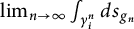 $\lim _{n\to \infty }\int _{\gamma ^n_i}ds_{g_n}$
by
 $m_i$
.
Proposition 5.3 For
 $s_1+1 \leq i \leq s_1+s_2$
there exist integers
 $t_{i} \geq 0$
, non-negative sequences
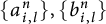 $\{a_{i,l}^n\}, \{b_{i,l}^n\}$
with
 $1 \leq l \leq t_{i}$
and a sequence
 $\{\alpha ^n_i\}$
such that
 $$ \begin{align*} -w_i^n \ll \alpha_{i,-}^n=b_{i,0}^n \ll a_{i,1}^n \ll b_{i,1}^n \ll \cdots \ll a_{i,t_i}^n \ll b_{i,t_{i}+1}^n \ll a_{i,t_{i+1}}^n=\alpha_{i,+}^n \ll w_i^n \end{align*} $$
and
 $$ \begin{align*} m_{i,l}=\lim_{n \to \infty} L_{g_n}(\Gamma_i^n(a_{i,l}^n,b_{i,l}^n))>0. \end{align*} $$
Moreover, there exists a set
 $J \subset \{1,\ldots ,m\}$
such that for every
 $j \in J$
one has
 $$ \begin{align*} m_{j}=\lim_{n \to \infty} L_{g_n}(I_j^n(\alpha^n))>0 \end{align*} $$
satisfying
 $$ \begin{align*} \sum^{s_1}_{i=1} m_{i}+\sum^{s_1+s_2}_{i=1} \sum^{t_i}_{l=s_1+1}m_{i,l}+\sum_{j\in J}m_j=1, \end{align*} $$
with
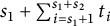 $s_1+\sum ^{s_1+s_2}_{i=s_1+1}t_i$
is maximal.
Proof The proof follows the proofs of Claim 16, Claim 17 by [Reference PetridesPet19]. Precisely, denying the proposition one can construct
 $k+1$
test-functions such that
 $\sigma _k(g_n) \leq o(1)$
which contradicts inequality (1.2). The construction of these functions is given in the proofs of Claim 16, Claim 17 by [Reference PetridesPet19]. Note that these functions equal
 $1$
on
 $\Sigma ^n_j$
for every
 $m+1 \leq j \leq M$
.▪
We proceed with considering a sequence
 $\{d_{i,l}^n\}$
where
 $s_1+1 \leq i \leq s_1+s_2$
and
 $1 \leq l \leq t_i$
such that
 $$ \begin{align*} \lim_{n \to \infty} L_{g_n}(\Gamma_i^n(a_{i,l}^n,d_{i,l}^n))= \lim_{n \to \infty} L_{g_n}(\Gamma_i^n(d_{i,l}^n,b_{i,l}^n))=m_{i,l}/2. \end{align*} $$
Let
 $q^n_{i,l}\ll a^n_{i,l}$
,
 $q^n_{i,l}\to +\infty $
. Consider the conformal maps
 $$ \begin{align*} \Psi_{i,l}^n\colon \big({\mathcal{C}}_i^n(a_{i,l}^n-q^n_{i,l},b_{i,l}^n+ q^n_{i,l}),c_n\big) \to (\mathbb{D}^2,[g_{can}]) \end{align*} $$
defined as
 $$ \begin{align*} \Psi_{i,l}^n(t,\theta)=\tan\bigg(\frac{\theta-\pi+\sqrt{-1}(t-t_{i,l}^n)}{4}\bigg) \end{align*} $$
Let
 $$ \begin{align*} D_{i,j}^n=\Psi_{i,l}^n\big({\mathcal{C}}_i^n(a_{i,l}^n-q^n_{i,l},b_{i,l}^n+ q^n_{i,l})\big) \end{align*} $$
and
 $$ \begin{align*} S_{i,j}^n=\Psi_{i,l}^n\big(\Gamma_i^n(a_{i,l}^n-q^n_{i,l},b_{i,l}^n+ q^n_{i,l})\big) \end{align*} $$
Then
 $D_{i,j}^n$
exhausts
 $\mathbb D^2$
and
 $S_{i,j}^n$
exhausts
 $\mathbb S^1$
as
 $n\to \infty $
. We also set
 $$ \begin{align*} \lim_{n\to\infty} L_{(\Psi_{i,l}^n)_*g_n}(S_{i,j}^n)=m_{i,l}. \end{align*} $$
Consider the map
 $\Phi _{i,l}^n=\Phi _n \circ (\Psi _{i,l}^n)^{-1}\colon (D_{i,j}^n,S_{i,j}^n) \to (\mathbb B^{N},\mathbb S^{N-1})$
. We endow
 $D_{i,j}^n$
with the metric
 $(\Psi _{i,l}^n)_*g_n$
and
 $\mathbb B^{N}$
with the Euclidean metric. Then the map
 $\Phi _{i,l}^n$
is harmonic with free boundary since
 $\Phi _n$
is harmonic with free boundary and
 $\Psi _{i,l}^n$
is conformal. Moreover, it is shown in [Reference PetridesPet19] that the measure
 $\boldsymbol {1}_{S_{i,j}^n}\langle \Phi _{i,l}^n,\partial _{\nu }\Phi _{i,l}^n\rangle _{g_{can}}ds_{g_{can}}$
does not concentrate at the poles
 $(0,1)$
and
 $(0,-1)$
of
 $\mathbb {D}^2$
. Indeed, if the measure concentrated at the poles then one would obtain a contradiction with the maximality of
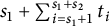 $s_1+\sum ^{s_1+s_2}_{i=s_1+1}t_i$
.
The exactly same procedure can be carried out for components
 $\Sigma _j^n(\alpha ^n)$
,
 $j\in J$
. The only difference is that now we use restrictions of diffeomorphisms
 $\Psi ^n$
given by Proposition 4.4 instead of the explicit harmonic map as above. As a result, one obtains domains
 $\check \Omega ^n_j\subset \Sigma _{\infty }$
and harmonic maps with free boundary
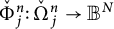 $\check \Phi ^n_j\colon \check \Omega ^n_j\to \mathbb {B}^N$
such that the measure
 $\boldsymbol {1}_{\partial \check \Omega _j^n}\langle \Phi _{i,l}^n,\partial _{\nu }\Phi _{i,l}^n\rangle _{g_{can}}ds_{g_{can}}$
does not concentrate at the marked points of
 $\widehat {\Sigma _{\infty }}$
.
Now thanks to inequality (5.5), we can construct
 $k+1$
well-defined test-functions for the Rayleigh quotient of
 $\sigma _k$
using the limit functions of the sequences of maps
 $\hat \Phi _{i,l}^n$
and
 $\hat \Phi _i^n$
as it was shown in [Reference PetridesPet19]. Precisely, let
 $p_{i}$
be the maximal integers such that
 $$ \begin{align} \frac{\sigma^*_{p_{i}}(\mathbb{D}^2)}{m_{i}}<\limsup_{n\to\infty}\sigma^*_k(\Sigma,c_n), \end{align} $$
where
 $1 \leq i \leq s_1$
,
 $p_{i,l}$
the maximal integers such that
 $$ \begin{align} \frac{\sigma^*_{p_{i,l}}(\mathbb{D}^2)}{m_{i,l}}<\limsup_{n\to\infty}\sigma^*_k(\Sigma,c_n), \end{align} $$
where
 $s_1+1 \leq i \leq s_1+s_2$
and
 $p_j$
the maximal integers such that
 $$ \begin{align} \frac{\sigma^*_{p_{j}}(\widehat{\Sigma_j^{\infty}}, \widehat{c_{\infty}})}{m_{j}}<\limsup_{n\to\infty}\sigma^*_k(\Sigma,c_n),~j\in J. \end{align} $$
Then one has
 $$ \begin{align*} \begin{array}{c} \sigma^*_{p_{i}+1}(\mathbb{D}^2) \geq m_{i}\displaystyle\limsup_{n\to\infty}\sigma^*_k(\Sigma,c_n),~1 \leq i \leq s_1, \\ \sigma^*_{p_{i,l}+1}(\mathbb{D}^2) \geq m_{i,l}\displaystyle\limsup_{n\to\infty}\sigma^*_k(\Sigma,c_n),~s_1+1 \leq i \leq s_1+s_2 \end{array} \end{align*} $$
and
 $$ \begin{align*} \sigma^*_{p_{j}+1}(\widehat{\Sigma_j^{\infty}}, \widehat{c_{\infty}}) \geq m_{j}\limsup_{n\to\infty}\sigma^*_k(\Sigma, c_n),~j\in J. \end{align*} $$
If
 $\sum ^{s_1}_{i=1} (p_{i}+1)+\sum ^{s_1+s_2}_{i=s_1+1} \sum ^{t_i}_{l=1} (p_{i,l}+1)+\sum _{j \in J}(p_j+1) \leq k$
then by inequality (5.5) we have
 $$ \begin{align*} \sum^{s_1}_{i=1} \sigma^*_{p_{i}+1}(\mathbb{D}^2)+\sum^{s_1+s_2}_{i=s_1+1} \sum^{t_i}_{l=1}\sigma^*_{p_{i,l}+1}(\mathbb{D}^2)+ \sum_{j \in J}\sigma^*_{p_{j}+1}(\widehat{\Sigma_j^{\infty}}, \widehat{c_{\infty}})<\limsup_{n\to\infty}\sigma^*_k(\Sigma,c_n), \end{align*} $$
which implies
 $\sum ^{s_1}_{i=1} m_{i}+\sum ^{s_1+s_2}_{i=s_1+1} \sum ^{t_i}_{l=1}m_{i,l}+\sum _{j\in J}m_j < 1$
and we arrive at a contradiction with Proposition 5.3. Hence,
 $\sum ^{s_1}_{i=1} (p_{i}+1)+\sum ^{s_1+s_2}_{i=s_1+1} \sum ^{t_i}_{l=1} (p_{i,l}+1)+\sum _{j \in J}({p_j+1}) \geq k+1$
.
Further, let
 $dv_{g^{i}_{\infty }}=\lim _{n \to \infty } (\Psi _{i}^n)_*dv_{g_n}$
,
 $dv_{g^{i,l}_{\infty }}=\lim _{n \to \infty } (\Psi _{i,l}^n)_*dv_{g_n}$
and
 $dv_{g^j_{\infty }}=\lim _{n \to \infty } (\Psi _j^n)^*dv_{g_n}$
. Denote by
 $\widehat {dv_{g^{i}_{\infty }}}$
,
 $\widehat {dv_{g^{i,l}_{\infty }}}$
and
 $\widehat {dv_{g^j_{\infty }}}$
the measures induced by the compactification on
 $\mathbb {D}^2$
for
 $1 \leq i \leq s_1$
and
 $s_1+1 \leq i \leq s_1+s_2$
and on
 $\widehat {\Sigma _j^{\infty }}$
, respectively. These measures are well-defined due to the nonconcentration argument explained above. Take orthonormal families of eigenfucntions
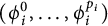 $(\phi ^0_i,\ldots ,\phi ^{p_{i}}_i)$
in
 $L^2(\mathbb {D}^2, \widehat {dv_{g^{i}_{\infty }}}) \ 1 \leq i \leq s_1$
,
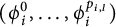 $(\phi ^0_i,\ldots ,\phi ^{p_{i,l}}_i)$
in
 $L^2(\mathbb {D}^2, \widehat {dv_{g^{i,l}_{\infty }}}) \ s_1+1 \leq i \leq s_1+s_2$
and
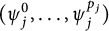 $(\psi ^0_j,\ldots ,\psi ^{p_{j}}_j)$
in
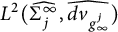 $L^2(\widehat {\Sigma _j^{\infty }}, \widehat {dv_{g^j_{\infty }}})$
such that for
 $0 \leq e \leq p_{i}$
the function
 $\phi ^e_i$
is an eigenfunction with eigenvalue
 $\sigma _e(\widehat {dv_{g^{i}_{\infty }}})$
on
 $\mathbb {D}^2$
, for
 $0 \leq e \leq p_{i,l}$
the function
 $\phi ^e_i$
is an eigenfunction with eigenvalue
 $\sigma _e(\widehat {dv_{g^{i,l}_{\infty }}})$
on
 $\mathbb {D}^2$
and for
 $0 \leq r \leq p_{j}$
the function
 $\psi ^r_j$
is an eigenfunction with eigenvalue
 $\sigma _r(\widehat {dv_{g^j_{\infty }}})$
on
 $\widehat {\Sigma _j^{\infty }}$
. The standard capacity computations (see for instance [Reference PetridesPet19, Claim 1]) imply the existence of smooth functions supported in a geodesic ball of a Riemannian manifold and having bounded Dirichlet energy. More precisely, there exist positive smooth functions
 $\eta _i$
,
 $\eta _{i,l}$
, and
 $\eta _j$
for
 $(\mathbb {D}^2, \widehat {dv_{g^{i}_{\infty }}})$
,
 $(\mathbb {D}^2, \widehat {dv_{g^{i,l}_{\infty }}})$
, and
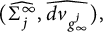 $(\widehat {\Sigma _j^{\infty }}, \widehat {dv_{g^j_{\infty }}}),$
respectively supported in geodesic balls
 $B(x,r)$
centered at the compactification points x of radius r such that
 $\eta \in C^{\infty }_0(B(x,r))$
and
 $\eta =1$
on
 $B(x,\rho _n r)\subset B(x,r)$
, where
 $\rho _n\to 0$
as
 $n\to \infty $
and
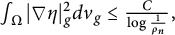 $\int _{\Omega }|\nabla \eta |^2_gdv_g \leq \frac {C}{\log \frac {1}{\rho _n}},$
where
 $\eta $
is one of the functions
 $\eta _i$
,
 $\eta _{i,l}$
and
 $\eta _j$
,
 $(\Omega ,dv_g)$
is one of the corresponding manifolds
 $(\mathbb {D}^2, \widehat {dv_{g^{i}_{\infty }}})$
,
 $(\mathbb {D}^2, \widehat {dv_{g^{i,l}_{\infty }}})$
and
 $(\widehat {\Sigma _j^{\infty }}, \widehat {dv_{g^j_{\infty }}})$
. Moreover, if
 $(\Omega ,dv_g)=(\mathbb {D}^2, \widehat {dv_{g^{i,l}_{\infty }}})$
then we additionally require
 $\rho _n$
to satisfy
 $\partial D^n_{i,l}\setminus S^n_{i,l} \subset B(x,\rho _n r)$
. Then, we define the desired test-functions as
 $$ \begin{align*} \xi^e_i=(\Psi_{i}^n)^{-1}\eta_i\phi^e_i, ~1 \leq i \leq s_1 \end{align*} $$
extended by 0 on
 $\Sigma $
,
 $$ \begin{align*} \xi^e_{i,l}=(\Psi_{i,l}^n)^{-1}\eta_{i,l}\phi^e_i, ~s_1+1 \leq i \leq s_1+s_2 \end{align*} $$
extended by 0 on
 $\Sigma $
and
 $$ \begin{align*} \xi^r_j=\Psi_j^n\eta_j\psi^r_j,~j\in J \end{align*} $$
extended by 0 on
 $\Sigma $
. Note that all these functions have pairwise disjoint supports. Then from the variational characterization of
 $\sigma _k(g_n)$
one gets
 $$ \begin{align*} \sigma_k(g_n) &\leq \max \bigg\{\max_{1 \leq i \leq s_1} \frac{\int_{\Sigma}|\nabla \xi^e_i|^2_{g_n}dv_{g_n}}{\int_{\partial \Sigma} (\xi^e_i)^2 ds_{g_n}}, \max_{s_1+1 \leq i \leq s_1+s_2} \frac{\int_{\Sigma}|\nabla \xi^e_{i,l}|^2_{g_n}dv_{g_n}}{\int_{\partial \Sigma} (\xi^e_{i,l})^2 ds_{g_n}}, \\ & \quad \max_{j \in J} \frac{\int_{\Sigma}|\nabla \xi^r_j|^2_{g_n}dv_{g_n}}{\int_{\partial\Sigma} (\xi^r_j)^2 ds_{g_n}} \bigg\}, \end{align*} $$
and passing to
 $\limsup $
as
 $n\to \infty $
, we get
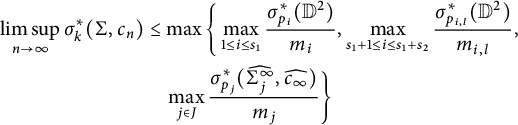 $$ \begin{align*} \limsup_{n\to\infty}\sigma^*_k(\Sigma,c_n) &\leq \max\bigg\{\max_{1 \leq i \leq s_1} \frac{\sigma^*_{p_{i}}(\mathbb{D}^2)}{m_{i}}, \max_{s_1+1 \leq i \leq s_1+s_2} \frac{\sigma^*_{p_{i,l}}(\mathbb{D}^2)}{m_{i,l}},\\ &\quad \max_{j \in J}\frac{\sigma^*_{p_{j}}(\widehat{\Sigma_j^{\infty}}, \widehat{c_{\infty}})}{m_{j}}\bigg\} \end{align*} $$
which contradicts (5.6), (5.7), and (5.8). This means that if inequality (5.5) holds then the sequence
 $\{c_n\}$
cannot degenerate. We arrived at a contradiction and inequality (5.4) is proved.
Remark 5.1 Note that if
 $s_2=0$
, i.e., there are no pinching geodesics having intersection with boundary components, then we take the set J as
 $J=\{1,\ldots ,m\}$
, i.e., we consider
 $\Sigma ^n_j(\alpha ^n)$
, where
 $1 \leq j \leq m$
. If all the boundary components are getting pinched then we set
 $J=\varnothing $
and we only have deal with the functions
 $ \xi ^e_i=(\Psi _{i}^n)^{-1}\eta _i\phi ^e_i$
extended by 0 on
 $\Sigma $
and
 $\sigma ^*_{p_{i}}(\mathbb {D}^2)$
where
 $1 \leq i \leq s_1$
. If
 $s_1=s_2=0$
, i.e., only geodesics of the third type are getting pinched then we only have deal with functions
 $\xi ^r_j=\Psi _j^n\eta _j\psi ^r_j,~j\in J$
extended by 0 on
 $\Sigma $
and
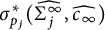 $\sigma ^*_{p_{j}}(\widehat {\Sigma _j^{\infty }}, \widehat {c_{\infty }})$
where
 $J=\{1,\ldots ,m\}$
.
Case 2. Assume that up to a choice of a subsequence the following inequality holds
 $$ \begin{align*} \sigma^*_k(\Sigma, c_n) \leq \sigma^*_{k-1}(\Sigma, c_n) +2\pi \end{align*} $$
then we prove inequality (5.4) by induction.
Consider the case
 $k=1$
then by inequality (1.2)
 $\sigma ^*_1(\Sigma , c_n) \geq 2\pi $
. Suppose that up to a choice of a subsequence one has
 $\sigma ^*_1(\Sigma , c_n)> 2\pi $
. Then the case
 $k=1$
falls under Case 1. Otherwise one has
 $\limsup _{n \to \infty } \sigma ^*_1(\Sigma , c_n)=2\pi $
and the inequality (5.4) reads as
 $$ \begin{align*} 2\pi=\limsup_{n \to \infty} \sigma^*_1(\Sigma, c_n) \leq \max \{\sigma^*_{1}(\Sigma_{\gamma_{i},l_i},c_{\infty});2\pi\}, \end{align*} $$
which is true. The base of induction is proved.
Suppose that the inequality holds for all numbers
 $k'\leq k$
. We show that it also holds for
 $k+1$
. Indeed, one has
 $$ \begin{align*} \sigma^*_{k+1}(\Sigma, c_n) \leq \sigma^*_{k}(\Sigma, c_n)+2\pi=\sigma^*_{k}(\Sigma, c_n)+\sigma^*_1(\mathbb{D}^2) \end{align*} $$
and we get
 $$ \begin{align*} \limsup_{n \to \infty}\sigma^*_{k+1} (\Sigma, c_n) &\leq \max \bigg(\sum^{m}_{i=1} \sigma^*_{k_{i}}(\Sigma_{\gamma_{i},l_i},c_{\infty})+ \sum_{i=1}^{s_1+s_2}\sigma^*_{r_i}(\mathbb{D}^2) \bigg)+\sigma^*_1(\mathbb{D}^2) \\ &\leq \max \bigg(\sum^{m}_{i=1} \sigma^*_{k_{i}}(\Sigma_{\gamma_{i},l_i},c_{\infty})+ \sum_{i=1}^{s_1+s_2}\sigma^*_{r_i}(\mathbb{D}^2) \bigg), \end{align*} $$
where the maximum is taken over all possible combinations of indices such that
 $$ \begin{align*} \sum_{i=1}^{m} k_i + \sum_{i=1}^{s_1+s_2} r_i = k+1, \end{align*} $$
since the term
 $\sigma ^*_1(\mathbb {D}^2)$
can be absorbed by one of the terms inside
 $\max $
using inequality (1.1). The proof is complete.
Zero Euler characteristic. The case of the cylinder was essentially considered in [Reference PetridesPet19, Section 7.1]. Indeed, it was proved that if the sequence of conformal classes
 $\{c_n\}$
degenerates then
 $$ \begin{align*} \lim_{n\to\infty}\sigma^*_k(\mathcal C,c_n) \leq \max_{i_1+\cdots+i_s=k}\sum^s_{q=1}\sigma^*_{i_q}(\mathbb D^2)=2\pi k. \end{align*} $$
Applying then inequality (1.2), one immediately gets that
 $\lim _{n\to \infty }\sigma ^*_k(\mathcal C,c_n)=2\pi k$
.
Consider the case of the Möbius band. If the sequence
 $\{c_n\}$
goes to
 $0$
then it follows from [Reference PetridesPet19, Section 7.1] that
 $$ \begin{align} \lim_{n\to\infty}\sigma^*_k(\mathbb{MB},c_n) \leq \max_{i_1+\cdots+i_s=k}\sum^s_{q=1}\sigma^*_{i_q}(\mathbb D^2)=2\pi k. \end{align} $$
Indeed, we pass to the orientable cover which is a cylinder. Then inequality (5.9) follows from [Reference PetridesPet19, Section 7.1, the case
 ${R}_{\alpha}\to 1$
as
 $\alpha \to +\infty$
in Petrides’ notations].
If the sequence
 $\{c_n\}$
goes to
 $\infty $
then we prove that inequality (5.9) also holds. The proof follows the exactly same arguments as in the proof of inequality (5.4). The analog of the Case 1 for
 $\mathbb {MB}$
corresponds to the case of pinching boundary (see Remark (5.1)).
Therefore, in both cases inequality (5.9) holds. Applying inequality (1.2) once again we then get that
 $\lim _{n\to \infty }\sigma ^*_k(\mathbb {MB},c_n)=2\pi k$
.
6 Proof of Theorem 1.5
For the proof of Theorem 1.5, we will need to choose a “nice” degenerating sequence of conformal classes, i.e., a degenerating sequence of conformal classes such that the limiting space looks as simple as possible.
Lemma 6.1 Let
 $\Sigma $
be a compact surface with boundary of negative Euler characteristic. Then there exists a degenerating sequence of conformal classes such that the limiting space is the disc.
Proof The proof is purely topological.
Assume that
 $\Sigma $
is orientable. Then we consider collapsing geodesics shown in Figure 3. Passing to the limit when the lengths of all pinching geodesics tend to zero and using the one-point cusps compactification we get an orientable surface of genus 0 with one boundary component, i.e., the disc.
Orientable surface with boundary. The lengths of all red geodesics tend to zero.
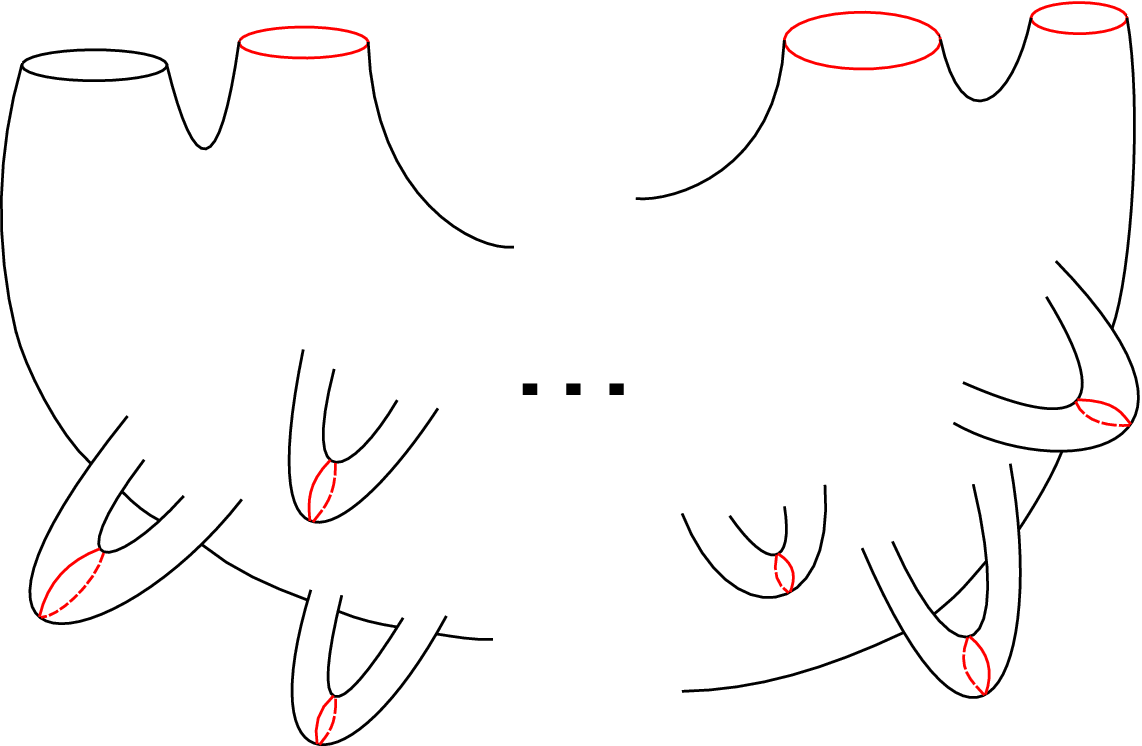
If
 $\Sigma $
is nonorientable then we pass to its orientable cover and we consider collapsing geodesics shown in Figure 4 for genus
 $0$
and Figure 5 for genus
 $\neq 0$
(the pictures are symmetric with respect to the involution changing the orientation, “the antipodal map”). Passing to the limit when the lengths of all pinching geodesics tend to zero and using the one-point cusps compactification, we get a disconnected surface with two connected components which are topologically discs. The involution changing the orientation maps one component to another one and hence passing to the quotient by this involution we get just one disc.▪
Orientable cover of a non-orientable surface of genus
 $0$
with boundary. The lengths of all red geodesics tend to zero.
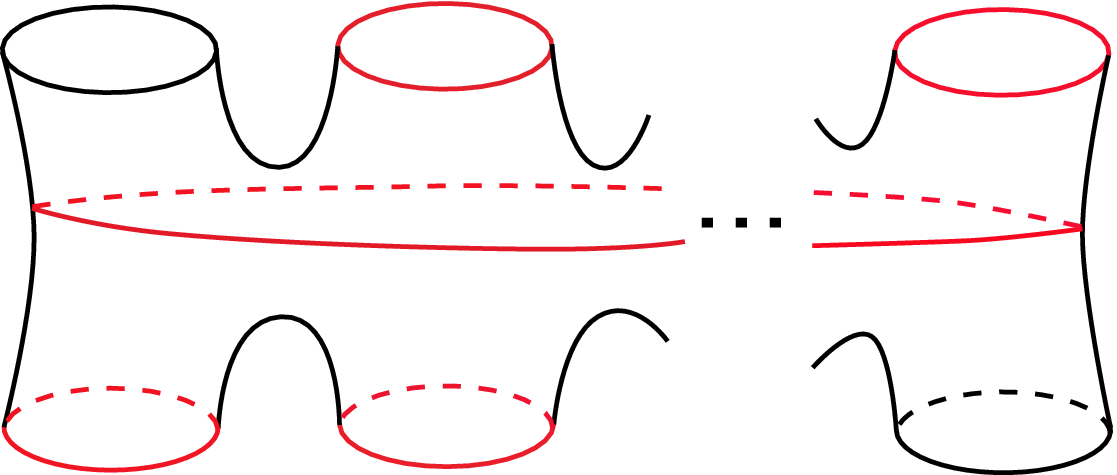
Orientable cover of a non-orientable surface of genus
 $\neq 0$
with boundary. The lengths of all red geodesics tend to zero.
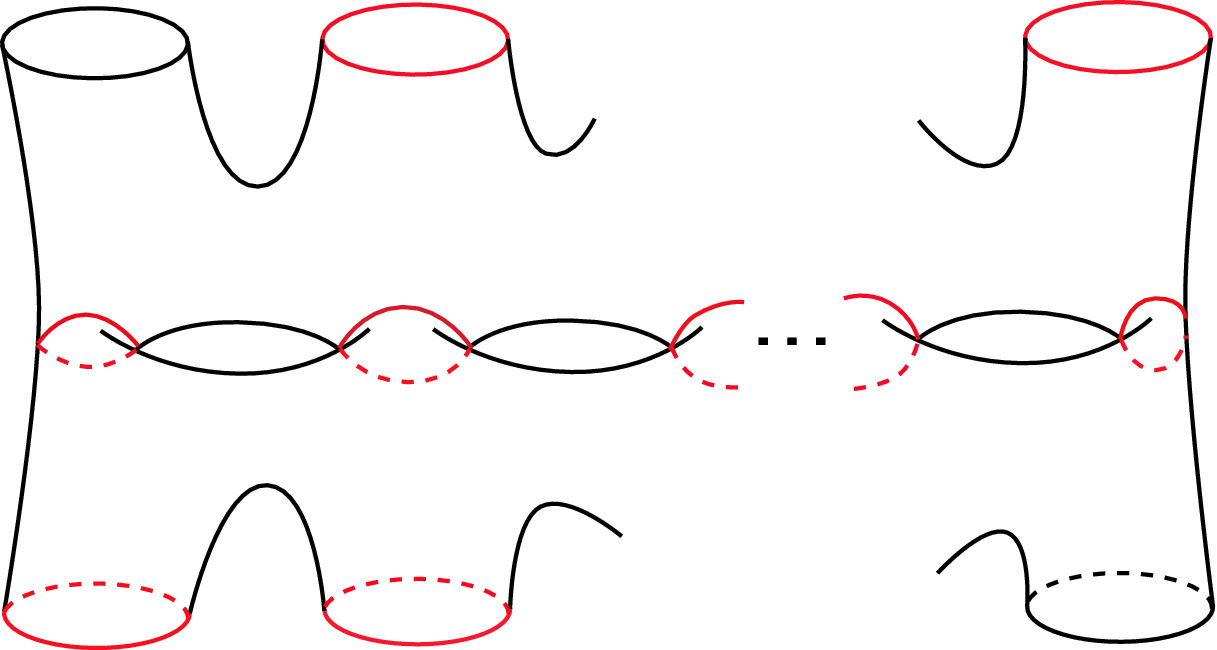
Now we are ready to prove Theorem 1.5.
Zero Euler characteristic. Let
 $\Sigma $
be either the cylinder
 $\mathcal C$
or the Möbius band
 $\mathbb {MB}$
. Then this case immediately follows from Theorem 1.4 by Remark 1.4. Indeed, if
 $\{c_n\}$
denotes a degenerating sequence of conformal classes on
 $\Sigma $
then by Theorem 1.4:
 $$ \begin{align*} I^{\sigma}_k(\Sigma) \leq \lim_{n\to\infty}\sigma^*_k(\Sigma,c_n)=2\pi k. \end{align*} $$
But
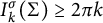 $I^{\sigma }_k(\Sigma ) \geq 2\pi k$
by (1.2). Thus,
 $I^{\sigma }_k(\Sigma )=\lim _{n\to \infty }\sigma ^*_k(\Sigma ,c_n)=2\pi k$
and the degenerating sequence
 $\{c_n\}$
is minimizing.
Negative Euler characteristic. By Lemma 6.1, there exists a sequence of conformal classes
 $\{c_n\}$
such that the limiting space
 $\widehat {\Sigma _{\infty }}$
is the disc. Then by Theorem 1.4, we have
 $$ \begin{align*} \lim_{n\to\infty}\sigma^*_k(\Sigma,c_n) = \max_{\sum k_j=k}\sum\sigma^*_{k_j}(\mathbb{D}^2). \end{align*} $$
Moreover, we know that
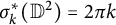 $\sigma ^*_k(\mathbb {D}^2) = 2\pi k$
. Hence,
 $$ \begin{align*} I^{\sigma}_k(\Sigma) \leq \lim_{n\to\infty}\sigma^*_k(\Sigma,c_n) = 2\pi k. \end{align*} $$
Finally, by (1.2) one has
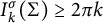 $I^{\sigma }_k(\Sigma ) \geq 2\pi k$
whence
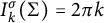 $I^{\sigma }_k(\Sigma )=2\pi k$
which completes the proof.
7 Appendix
7.1 A well-posed problem
In this section, we consider the problem
 $$ \begin{align} \begin{cases} \Delta u=0&\text{in } M,\\ u=g&\text{on } D,\\ \frac{\partial u}{\partial n}=0&\text{on } N, \end{cases} \end{align} $$
where
 $(M,h)$
is a Riemannian manifold with boundary such that
 $\overline D\cup \overline N=\partial M$
and D has positive capacity.
Let G be a smooth function such that
 $G_{|_D}=g$
and consider the function
 $v=G-u$
. Then substituting
 $u=G-v$
into (7.1) implies:
 $$ \begin{align} \begin{cases} \Delta v=\Delta G&\text{in } M,\\ v=0&\text{on } D,\\ \frac{\partial u}{\partial n}=\frac{\partial G}{\partial n}&\text{on } N. \end{cases} \end{align} $$
We introduce the space
 $H^1_D(M,h)$
as the closure in
 $H^1$
-norm of
 $C^{\infty }$
-functions vanishing on D. For a function
 $u \in H^1_D(M,h),$
we have the following coercivity inequality:
 $$ \begin{align} ||u||_{L^2(M,h)} \leq C||\nabla u||_{L^2(M,h)}, \end{align} $$
with the best constant
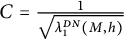 $C=\frac {1}{\sqrt {\lambda ^{DN}_1(M,h)}}$
, where
 $\lambda ^{DN}_1(M,h)$
is the first non zero eigenvalue of the mixed problem
 $$ \begin{align*} \begin{cases} \Delta u=\lambda u&\text{in } M,\\ u=0&\text{on } D,\\ \frac{\partial u}{\partial n}=0&\text{on } N. \end{cases} \end{align*} $$
By the Lax–Milgram theorem and by virtue of the inequality (7.3) the problem (7.2) admits a unique solution on the space
 $H^1_D(M,h)$
. Thus, problem (7.1) also has a solution. Moreover, it is easy to see that this solution is unique.
Our aim now is the following lemma.
Lemma 7.1 Let u satisfy the problem (7.1). Then one has
 $$ \begin{align*} ||u||_{H^1(M,h)} \leq C||g||_{H^{1/2}(D,h)}. \end{align*} $$
Proof The weak formulation of (7.1) reads
 $$ \begin{align*} \int_M\langle\nabla u, \nabla v\rangle dv_h=0,~\forall v\in H^1_D(M,h). \end{align*} $$
Let G be any continuation of the function g into M, i.e.,
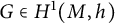 $G\in H^1(M,h)$
is any function such that
 $G_{|_D}=g$
. Then substituting
 $v=u-G$
in the previous identity yields
 $$ \begin{align*} 0=\int_M\langle\nabla u, \nabla u-\nabla G\rangle dv_h=\int_M|\nabla u|^2dv_h-\int_M\langle\nabla u, \nabla G\rangle dv_h, \end{align*} $$
whence
 $$ \begin{align} \int_M|\nabla u|^2dv_h=\int_M\langle\nabla u, \nabla G\rangle dv_h \leq \frac{1}{2}\int_M|\nabla u|^2dv_h+\frac{1}{2}\int_M|\nabla G|^2dv_h. \end{align} $$
Further, it is easy to see that
 $$ \begin{align*} ||u||_{L^2(M,h)} \leq ||u-G||_{L^2(M,h)}+||G||_{L^2(M,h)}. \end{align*} $$
Moreover, since
 $u-G\in H^1_D(M,h)$
one has
 $$ \begin{align*} ||u-G||_{L^2(M,h)} \leq C||\nabla u -\nabla G||_{L^2(M,h)} \leq C(||\nabla u||_{L^2(M,h)}+||\nabla G||_{L^2(M,h)}). \end{align*} $$
Substituting it in the previous inequality, we get
 $$ \begin{align} ||u||_{L^2(M,h)} \leq C(||\nabla u||_{L^2(M,h)}+||\nabla G||_{L^2(M,h)})+||G||_{L^2(M,h)}. \end{align} $$
Plugging (7.4) in (7.5) yields
 $$ \begin{align} ||u||_{L^2(M,h)} \leq C||G||_{H^1(M,h)}. \end{align} $$
 $$ \begin{align} ||u||_{H^1(M,h)} \leq C||G||_{H^1(M,h)} \end{align} $$
for any function
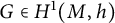 $G\in H^1(M,h)$
such that
 $G_{|_D}=g$
.
Lemma 7.2 The norms
 $$ \begin{align*} \inf_{G\in H^1(M,h),~G_{|_D}=g}||G||_{H^1(M,h)}~\text{and}~||g||_{H^{1/2}(D,h)} \end{align*} $$
are equivalent.
Proof By the trace inequality there exists a positive constant
 $C_1$
such that for every
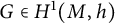 $G\in H^1(M,h)$
one has
 $$ \begin{align*} ||g||_{H^{1/2}(D,h)} \leq C_1||G||_{H^1(M,h)}, \end{align*} $$
which implies:
 $$ \begin{align} ||g||_{H^{1/2}(D,h)} \leq C_1\inf_{G\in H^1(M,h),~G_{|_D}=g}||G||_{H^1(M,h)}; \end{align} $$
Further, we construct a continuation
 $G'\in H^1(M,h)$
of g with the property that there exists a positive constant
 $C_2$
such that for every
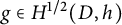 $g\in H^{1/2}(D,h)$
one has:
 $$ \begin{align} ||G'||_{H^1(M,h)} \leq C_2||g||_{H^{1/2}(D,h)}. \end{align} $$
Let
 $\tilde g$
be any continuation of g on
 $\partial M$
such that
 $||\tilde g||_{H^{1/2}(N,h)} \leq ||g||_{H^{1/2}(D,h)}$
. Therefore,
 $||\tilde g||_{H^{1/2}(\partial M,h)} \leq \sqrt {2}||g||_{H^{1/2}(D,h)}<\infty $
and
 $\tilde g\in H^{1/2}(\partial M,h)$
. Then we take the harmonic continuation of
 $\tilde g$
into M as
 $G'$
. By [Reference TaylorTay11, Proposition 1.7] there exists a positive constant that
 $C_3$
such that:
 $$ \begin{align*} ||G'||_{H^1(M,h)} \leq C_3||\tilde g||_{H^{1/2}(\partial M,h)}. \end{align*} $$
Since
 $||\tilde g||_{H^{1/2}(\partial M,h)} \leq \sqrt {2}||g||_{H^{1/2}(D,h)}$
we get (7.9) with
 $C_2=\sqrt {2}C_3$
.
Therefore, (7.8) and (7.9) imply:
 $$ \begin{align*} C_2^{-1}||G'||_{H^1(M,h)} \leq ||g||_{H^{1/2}(D,h)} \leq C_1\inf_{G\in H^1(M,h),~G_{|_D}=g}||G||_{H^1(M,h)}, \end{align*} $$
whence
 $$ \begin{align*} \begin{array}{c} C_2^{-1}\displaystyle\inf_{G\in H^1(M,h),~G_{|_D}=g}||G||_{H^1(M,h)} \leq ||g||_{H^{1/2}(D,h)} \leq \\ \leq C_1\displaystyle\inf_{G\in H^1(M,h),~G_{|_D}=g}||G||_{H^1(M,h)}, \end{array} \end{align*} $$
since
 $$ \begin{align*} ||G'||_{H^1(M,h)} \geq\inf_{G\in H^1(M,h),~G_{|_D}=g}||G||_{H^1(M,h)}. \end{align*} $$
And lemma follows.▪
Finally, taking the infimum over all
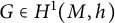 $G\in H^1(M,h)$
such that
 $G_{|_D}=g$
in (7.7) and using Lemma 7.2 complete the proof.▪
7.2 Proofs of propositions of Section 2
This section contains the proofs of propositions in Section 2 analogous to propositions in [Reference Karpukhin and MedvedevKM20, Section 4] whose adaptation to the Steklov setting is rather technical.
Proof of Lemma 2.4 Let
 $h^m\in [h]$
be a maximizing sequence of metrics for
 $\sigma ^{N*}_k(\Omega , \partial ^S\Omega , [h])$
and
 $g^m\in [g]$
be a discontinuous metric on
 $\Sigma $
defined as
 $g|_{\Omega _i} = h_i$
. By the variational characterization of eigenvalues for all k one has
 $\sigma _k(\Sigma ,g^m) \geq \sigma ^N(\Omega ,h^m)$
since the set of test functions for the Steklov–Neumann eigenvalues
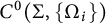 $C^0(\Sigma ,\{\Omega _i\})$
is larger than the set
 $C^0(\Sigma )$
of test functions for
 $\sigma _k(\Sigma ,g^m)$
. Using the fact that
 $L_{g^m}(\partial \Sigma )=\sum _iL_{h^m}(\partial ^S \Omega _i) \geq L_{g^m}(\partial ^S \Omega _i)$
for any i and taking the limit as
 $m\to \infty $
we get
 $$ \begin{align*} \sigma^*_k(\Sigma,\{\Omega_i\},[g]) \geq\sigma_k^{N*}(\Omega, \partial^S\Omega, [h]). \end{align*} $$
Finally by Lemma 2.3 one gets
 $$ \begin{align*} \sigma^*_k(\Sigma,[g]) \geq \sigma^{N*}_k(\Omega,\partial^S\Omega, [h]). \end{align*} $$
▪
Proof of Proposition 2.6 The proof is similar for both cases. The obvious analog of Lemma 2.5 for the second case holds since its proof follows the exactly same arguments as the proof of Lemma 2.5. For that reason we only provide the proof of Proposition 2.6 for the first case.
Take a maximizing sequence of metrics
 $\{h_i~ |~ h_i \in [g|_{\Omega }]\}$
for the functional
 $\sigma ^{N*}_k(\Omega , \partial ^S\Omega , [g])$
, i.e.,
 $$ \begin{align*} \displaystyle\lim_{i\to\infty}\bar{\sigma}^{N}_k(\Omega,\partial^S\Omega, h_i)=\sigma^{N*}_k(\Omega,\partial^S\Omega, [g]) \end{align*} $$
Let
 $h_i=f_i g|_{\Omega }$
, where
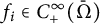 $f_i \in C^{\infty }_+(\bar \Omega )$
. We then define the metric
 $\widetilde {h_i}=\widetilde {f_i} g$
on
 $\Sigma $
, where
 $\widetilde {f_i}$
is any positive continuation of the function
 $f_i$
into
 $\Omega ^c$
. It enables us to consider the metric
 $\rho _{\delta } \widetilde {h_i}$
, where as before
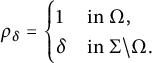 $$ \begin{align*} \rho_{\delta}= \begin{cases} 1&\text{in } \Omega,\\ \delta&\text{in } \Sigma\setminus\Omega. \end{cases} \end{align*} $$
Lemma 2.5 implies
 $$ \begin{align*} \liminf_{\delta \to 0} \sigma_k(\rho_{\delta} \widetilde{h_i}) \geq \sigma^N_k(\Omega,\partial^S\Omega, h_i). \end{align*} $$
Moreover,
 $L_{\rho _{\delta }\widetilde {h_i}}(\partial \Sigma )\to L_{h_i}(\partial ^S\Omega )$
. By Lemma 2.3, we have
 $$ \begin{align*} \sigma^*_k(\Sigma, [g])=\sigma^*_k(\Sigma,\{\Omega,\Sigma\setminus\Omega\},[g]) \geq \liminf_{\delta\to 0}\bar\sigma_k(\rho_{\delta} \widetilde{h_i}) \geq\bar\sigma^N_k(\Omega,\partial^S\Omega, h_i). \end{align*} $$
Therefore, passing to the limit as
 $i \to \infty $
one gets,
 $$ \begin{align*} \sigma^*_k(\Sigma, [g]) \geq \sigma^{N*}_k(\Omega,\partial^S\Omega, [g]). \end{align*} $$
▪
Proof of Corollary 2.7 We show that
 $$ \begin{align*} \sigma^*_k(M, [g]) \leq \liminf_{n \to \infty}\sigma^{N*}_k(M \setminus K_n, \partial M \setminus \partial K_n, [g]). \end{align*} $$
Let
 $g^m$
be a maximizing sequence for the functional
 $\sigma ^*_k(M, [g])$
. For a fixed
 $m,$
we consider geodesic balls
 $B_{\epsilon _n}(p_i)$
of radius
 $\epsilon _n\to 0$
in metric
 $g^m$
centered at the points
 $p_1,\ldots ,p_l \in M$
such that
 $K_n \subset \cup ^l_{i=1}B_{\epsilon _n}(p_i)$
. We see that
 $M\setminus \cup ^l_{i=1}B_{\epsilon _n}(p_i) \subset M\setminus K_n$
. Then by Proposition 2.6 one has
 $$ \begin{align} \begin{aligned} & \sigma^{N*}_k(M \setminus K_n, \partial M \setminus \partial K_n, [g]) \\ &\quad \geq\sigma^{N*}_k(M\setminus \cup^l_{i=1}B_{\epsilon_n}(p_i), \partial M\setminus \cup^l_{i=1}\partial B_{\epsilon_n}(p_i), [g]) \\ &\quad \geq \bar\sigma^{N}_k(M\setminus \cup^l_{i=1}B_{\epsilon_n}(p_i), \partial M\setminus \cup^l_{i=1}\partial B_{\epsilon_n}(p_i), g^m). \end{aligned} \end{align} $$
Note that
 $L(\partial M \setminus \cup ^l_{i=1}\partial B_{\epsilon _n}(p_i), g^m)\to L(\partial M, g^m)$
as
 $n\to \infty $
and by Lemma 2.1 one has
 $\sigma ^{N}_k(M\setminus \cup ^l_{i=1}B_{\epsilon _n}(p_i), \partial M\setminus \cup ^l_{i=1}\partial B_{\epsilon _n}(p_i), g^m)\to \sigma _k(M,g^m)$
. Hence,
 $\bar \sigma ^{N}_k(M\setminus \cup ^l_{i=1}B_{\epsilon _n}(p_i), \partial M\setminus \cup ^l_{i=1}\partial B_{\epsilon _n}(p_i), g^m) \to \bar \sigma _k(M,g^m)$
as
 $n\to \infty $
. Taking
 $\liminf _{n\to \infty }$
in (7.10) one then gets
 $$ \begin{align*} \liminf_{n\to\infty}\sigma^{N*}_k(M \setminus K_n, \partial M \setminus \partial K_n, [g]) \geq \bar\sigma_k(M,g^m). \end{align*} $$
Passing to the limit as
 $m\to \infty $
, we get the desired inequality.
The inequality
 $$ \begin{align*} \limsup_{n \to \infty}\sigma^{N*}_k(M \setminus K_n, \partial M \setminus \partial K_n, [g]) \leq \sigma^*_k(M, [g]) \end{align*} $$
follows from Proposition 2.6. This completes the proof.▪
Proof of Lemma 2.8 Essentially the idea of the proof comes from the paper [Reference Wolf and KellerWK94]. We denote by
 $\partial ^S\Omega $
the part of the boundary with the Steklov boundary condition. We also call
 $\partial ^S\Omega $
“Steklov boundary” and
 $L_g(\partial ^S\Omega )$
“the length of Steklov boundary” in metric g.
Inequality
 $\boldsymbol \geq $
.
Fix the indices
 $k_i>0$
satisfying
 $\sum k_i=k$
and consider a maximizing sequence of metrics
 $\{g_i^m\}$
such that
 $\bar \sigma ^N_{k_i}(\Omega _i,\partial ^S\Omega _i, g^m_i)\to \sigma ^{N*}_{k_i}(\Omega _i,\partial ^S\Omega _i, [g_i])$
. One can assume that
 $\sigma ^N_{k_i}(\Omega _i,\partial ^S\Omega _i, g^m_i)=\sigma ^{N*}_k(\Omega ,\partial ^S\Omega , [g])$
. Then, one has
 $$ \begin{align*} L_{g^m_i}(\partial^S\Omega_i)\to \frac{\sigma^{N*}_{k_i}(\Omega_i,\partial^S\Omega_i, [g_i])}{\sigma^{N*}_{k}(\Omega,\partial^S\Omega, [g])}. \end{align*} $$
Let
 $\{g^m\}$
be a sequence of metrics on
 $\Omega $
defined as
 $g^m|_{\Omega _i}=g^m_i$
. Then for large enough m one has that
 $\sigma ^N_k(\Omega ,\partial ^S\Omega , g^m) = \sigma ^{N*}_k(\Omega ,\partial ^S\Omega , [g])$
, since the spectrum of disjoint union is the union of spectra of each component. By definition of
 $\sigma ^{N*}_k(\Omega , \partial ^S\Omega , [g])$
we also have
 $$ \begin{align*} \sigma^{N*}_k(\Omega,\partial^S\Omega, [g])L_{g^m}(\partial^S\Omega)=\sigma^N_k(\Omega,\partial^S\Omega, g^m)L_{g^m}(\partial^S\Omega) \leq \sigma^{N*}_{k}(\Omega,\partial^S\Omega, [g]), \end{align*} $$
i.e.,
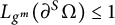 $L_{g^m}(\partial ^S\Omega ) \leq 1$
. Thus, one has
 $$ \begin{align*} 1 \geq L_{g^m}(\partial^S\Omega) = \sum_iL_{g^m_i}(\partial^S\Omega_i)\to \frac{\sum_i \sigma^{N*}_{k_i}(\Omega_i,\partial^S\Omega_i, [g_i])}{\sigma^{N*}_{k}(\Omega,\partial^S\Omega, [g])}. \end{align*} $$
Passing to the limit
 $m\to \infty $
yields the inequality.
Inequality
 $\boldsymbol \leq $
Assume the contrary, i.e.,
 $$ \begin{align} \sigma^{N*}_k(\Omega, \partial^S\Omega, [g])> \max_{\sum\limits_{i=1}^s k_i=k,\,\,\,k_i>0}\,\,\sum_{i=1}^s\sigma^{N*}_{k_i}(\Omega_i, \partial^S\Omega_i, [g_i]). \end{align} $$
Consider a maximizing sequence of metrics
 $\{g^m\}$
of unit total length of Steklov boundary such that
 $\sigma ^N_{k}(\Omega ,\partial ^S\Omega , g^m)\to \sigma ^{N*}_{k}(\Omega ,\partial ^S\Omega , [g])$
. Let
 $g_i^m$
be a restriction of
 $g^m$
to
 $\Omega _i$
and
 $d^m_i$
be the largest number satisfying
 $\sigma ^N_{d^m_i}(\Omega _i,\partial ^S\Omega _i, g_i^m)<\sigma ^{N*}_k(\Omega ,\partial ^S\Omega ,[g])$
and
 $\limsup _{m\to \infty }\sigma ^N_{d^m_i}(\Omega _i, \partial ^S\Omega _i, g_i^m)<\sigma ^{N*}_k(\Omega ,\partial ^S\Omega , [g])$
. Let
 $L^m_i$
denote
 $L_{g^m_i}(\partial ^S\Omega _i)$
. Then, we have
 $d^m_i \leq k$
and
 $L^m_i \leq 1$
. Therefore, up to a choice of a subsequence one can assume that
 $d^m_i = d_i$
does not depend on m and
 $L^m_i\to L_i$
as
 $m\to \infty $
.
We claim that
 $\sum _i(d_i+1) \geq k+1$
. Otherwise, by (7.11) and definition of
 $d_i$
we have
 $$ \begin{align*} \sigma^{N*}_k(\Omega,\partial^S\Omega, [g]) \sum_i L_i &\leq \sum_i \displaystyle\limsup_{m\to\infty}\bar\sigma^N_{d_i+1}(\Omega_i,\partial^S\Omega_i, g^m_i) \\ &\leq \sum_i\sigma^{N*}_{d_i+1}(\Omega_i,\partial^S\Omega_i, [g])<\sigma^{N*}_k(\Omega,\partial^S\Omega, [g]). \end{align*} $$
Moreover,
 $\sum _i L_i=1$
since
 $g^m$
are of unit Steklov boundary length. Thus, we arrive at
 $\sigma ^{N*}_k(\Omega , \partial ^S\Omega , [g])<\sigma ^{N*}_k(\Omega ,\partial ^S\Omega , [g]),$
which is a contradiction.
Therefore, the inequality
 $\sum (d_i+1) \geq k+1$
holds. Since the spectrum of a union is a union of spectra, we have
 $$ \begin{align*} \sigma^N_k(\Omega, \partial^S\Omega, g^m)\in\bigcup_i\{\sigma_0(\Omega_i,g^m_i),\ldots,\sigma_{d_i}(\Omega_i,g^m_i)\}, \end{align*} $$
hence
 $$ \begin{align*} \sigma^{N*}_k(\Omega,\partial^S\Omega, g) &= \limsup_{m\to\infty}\sigma^N_k(\Omega, \partial^S\Omega, g^m) \leq \max_i \limsup_{m\to\infty}\sigma_{d_i}(\Omega_i,g^m_i) \\ &< \sigma^{N*}_k(\Omega,\partial^S\Omega, [g]). \end{align*} $$
Since
 $g^m$
are of unit Steklov boundary length we arrive at a contradiction.▪
Proof of Lemma 2.9 Fix indices
 $k_i \geq 0$
such that
 $\sum _{i=1}^{s'} k_i=k$
and set
 $I = \{i\,|\,k_i>0\}$
. Let
 $\Omega _1 = \cup _{i\in I}\overline \Omega _i\subset \Sigma ,~\partial ^S\Omega _1 = \cup _{i\in I}\partial ^S\Omega _i,~(\Omega _2,h) = \sqcup _{i\in I}(\overline \Omega _i,g_{\overline \Omega _i})$
and
 $\partial ^S\Omega _2 = \sqcup _{i\in I}\partial ^S\Omega _i$
. One gets
 $$ \begin{align*} \sigma^*_k(\Sigma,[g]) &\geq \sigma^{N*}_k(\Omega_1,\partial^S\Omega_1, [g]) \geq \sigma^{N*}_k(\Omega_2, \partial^S\Omega_2, [h]) \\ & \geq \sum_{i\in I} \sigma^{N*}_{k_i}(\Omega_i,\partial^S\Omega_i, [g])=\sum^{s'}_{i=1} \sigma^{N*}_{k_i}(\Omega_i,\partial^S\Omega_i, [g]), \end{align*} $$
where we used in order: Proposition 2.6, Lemmas 2.4 and 2.8 and the fact that
 $\sigma ^{N*}_0(\Omega _j,\partial ^S\Omega _j, [g])=0$
for any j in the last equality.▪
7.3 Proof of Lemma 5.2
Fix
 $\varepsilon>0$
. An application of Corollary 2.7 to a compact exhaustion of
 $\Sigma ^{\infty }_j$
yields the existence of a compact set
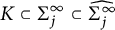 $K\subset \Sigma ^{\infty }_j\subset \widehat {\Sigma _j^{\infty }}$
such that
 $$ \begin{align*} |\sigma^*_r(\widehat{\Sigma_j^{\infty}},[\widehat{h_{\infty}}]) - \sigma^{N*}_r(K, \partial^SK, [\widehat{h_{\infty}}])|<\varepsilon, \end{align*} $$
where
 $\partial ^SK=K\cap \partial \Sigma ^{\infty }_j \neq \varnothing $
. Since
 $\check \Omega _j^n$
exhaust
 $\Sigma ^{\infty }_j$
, then for all large enough n one has
 $K\subset \check \Omega _j^n$
. Then, by Proposition 2.6
 $$ \begin{align*} \sigma^{N*}_{r}(\check\Omega_j^n,\partial^S\check\Omega_j^n, [(\Psi^n)^*h_n]) \geq \sigma^{N*}_{r}(K, \partial^SK,[(\Psi^n)^*h_n]). \end{align*} $$
Taking
 $\liminf $
of both sides in the above inequality and using Proposition 2.2 yields
 $$ \begin{align*} \liminf_{n\to\infty}\sigma^{N*}_{r}(\check\Omega_j^n,\partial^S\check\Omega_j^n, [(\Psi^n)^*h_n]) \geq \sigma^{N*}_{r}(K,\partial^SK, [\widehat{h_{\infty}}])> \sigma^*_r(\widehat{\Sigma_j^{\infty}},[\widehat{h_{\infty}}])-\varepsilon. \end{align*} $$
Since
 $\varepsilon $
is arbitrary, this completes the proof.
Acknowledgment
The author would like to express his gratitude to Iosif Polterovich, Mikhail Karpukhin, Alexandre Girouard, and Bruno Colbois for stimulating discussions and useful remarks during the preparation of the paper. The author is also thankful to the reviewers for valuable remarks and helpful suggestions. This research is a part of author’s PhD thesis at the Université de Montréal under the supervision of Iosif Polterovich.