Introduction
The decision-making behaviours of individual predators and prey can greatly impact the strength of the trophic links between them, and may have important implications for the structure and function of trophic webs. However, a predator's decision to attack and consume a prey item is mediated by a host of factors, including innate behavioural programmes (Huseynov et al., Reference Huseynov, Cross and Jackson2005; Huseynov et al., Reference Huseynov, Jackson and Cross2008), current physiological status (Pruitt et al., Reference Pruitt, DiRienzo, Kralj-Fišer, Johnson and Sih2011), past experience with the prey (Blackledge & Wenzel, Reference Blackledge and Wenzel2001) and access to other food resources (Toft & Wise, Reference Toft and Wise1999; Arnó et al., Reference Arnó, Roig and Riudavets2008). This is especially relevant in the context of biological control, because the foraging strategy that optimizes predator fitness does not necessarily optimize pest suppression. For example, a predator may need to make a decision between pursuing pest or non-pest prey, and the non-pest prey is often the more optimal choice (Madsen et al., Reference Madsen, Terkildsen and Toft2004; Koss & Snyder, Reference Koss and Snyder2005; Symondson et al., Reference Symondson, Cesarini, Dodd, Harper, Bruford, Glen, Wiltshire and Harwood2006; Gavish-Regev et al., Reference Gavish-Regev, Rotkopf, Lubin and Coll2009). Consequently, successful implementation of biological control requires a greater understanding of how non-pest prey influences the interactions between predators and pests.
Alternative prey and other non-pest food resources may have various effects on the pest-suppression capacity of natural enemies. Non-pest foods may serve to distract natural enemies from consuming pest prey, especially, if they are more accessible (Gavish-Regev et al., Reference Gavish-Regev, Rotkopf, Lubin and Coll2009) or of higher nutritional quality than the pest prey (Madsen et al., Reference Madsen, Terkildsen and Toft2004; Symondson et al., Reference Symondson, Cesarini, Dodd, Harper, Bruford, Glen, Wiltshire and Harwood2006). Therefore, in environments with abundant non-pest foods, pests may be released from predation pressure, leading to outbreaks and crop damages (Harwood et al., Reference Harwood, Sunderland and Symondson2004). This is particularly true of pests that are of low nutritional quality for many predators, such as many pest aphids (Hemiptera: Aphididae) (Schmidt et al., Reference Schmidt, Peterson, Lundgren and Harwood2013). It has often been suggested that many generalist predators given the option to forage on aphids or an alternative prey, such as springtails, will prefer to feed on the alternative prey (Gavish-Regev et al., Reference Gavish-Regev, Rotkopf, Lubin and Coll2009). However, only a few behavioural tests of this hypothesis have been conducted, and it remains unclear whether predators will actually display this selective behaviour.
Web-building spiders are an excellent study system for unravelling the effects of alternative prey on natural enemy–pest interactions. The construction of silk webs to ensnare prey allows reasonable estimation and manipulation of prey-encounter rates for field and laboratory studies (Harwood et al., Reference Harwood, Sunderland and Symondson2001; Peterson et al., Reference Peterson, Romero and Harwood2010), and provides a discreet indicator of foraging behaviour and investment (Blackledge & Wenzel, Reference Blackledge and Wenzel2001; Welch et al., Reference Welch, Haynes and Harwood2013b ). Sheet-weaving spiders (Araneae: Linyphiidae) are web-building spiders that feed on a wide variety of prey (Nyffeler, Reference Nyffeler1999). Non-pest prey, particularly detritivorous springtails (Hexapoda: Collembola), are highly abundant in linyphiid microhabitats (Harwood et al., Reference Harwood, Sunderland and Symondson2001; Romero & Harwood, Reference Romero and Harwood2010; Chapman et al., Reference Chapman, Schmidt, Welch and Harwood2013), and are generally high in nutritional quality (Marcussen et al., Reference Marcussen, Axelsen and Toft1999; Bilde et al., Reference Bilde, Axelsen and Toft2000; Schmidt et al., Reference Schmidt, Peterson, Lundgren and Harwood2013). By comparison, aphids are less frequently encountered by spiders (Romero & Harwood, Reference Romero and Harwood2010; Chapman et al., Reference Chapman, Schmidt, Welch and Harwood2013) and are generally low in nutritional quality (Bilde & Toft, Reference Bilde and Toft2001; Toft, Reference Toft2005). The higher abundance and nutritional quality of the non-pest prey in this study system increases the probability that behavioural preferences will diminish the pest-suppression capacity of these spiders. Nevertheless, aphids are still commonly consumed by spiders (Mansour & Heimbach, Reference Mansour and Heimbach1993; Harwood et al., Reference Harwood, Sunderland and Symondson2004; Kerzicnik et al., Reference Kerzicnik, Chapman, Harwood, Peairs and Cushing2012). It is possible that spiders actively seek out uncommon prey, such as aphids, in an effort to improve fitness through dietary diversification, in spite of their overall low nutritional quality (Bilde & Toft, Reference Bilde and Toft2001; Chapman et al., Reference Chapman, Schmidt, Welch and Harwood2013; Welch et al., Reference Welch, Haynes and Harwood2013a ). The well-studied spider–aphid–springtail system therefore, offers a good opportunity to gain insights into how behaviour may influence natural enemy–pest interactions.
Previous research into the effects of alternative prey on pest suppression by linyphiids has yielded conflicting results. Some studies have reported negative effects of springtail prey on aphid consumption (e.g., Harwood et al., Reference Harwood, Sunderland and Symondson2004; Gavish-Regev et al., Reference Gavish-Regev, Rotkopf, Lubin and Coll2009). However, others have reported complementary predation, with no decline in aphid consumption in the presence of springtails (Oelbermann & Scheu, Reference Oelbermann and Scheu2009; von Berg et al., Reference von Berg, Thies, Tscharntke and Scheu2009). Given the overwhelming abundance of springtails in the linyphiid diet, it is possible that spiders actively seek out lower-quality aphid prey because there are fitness benefits of a diversified diet (Toft & Wise, Reference Toft and Wise1999; Bilde & Toft, Reference Bilde and Toft2000; Mayntz et al., Reference Mayntz, Raubenheimer, Salomon, Toft and Simpson2005). Thus, even nutritionally superior alternative prey may not distract a predator from contributing to biological control.
Here, we employ two behavioural assays, in combination with molecular gut-content analysis, to test the hypothesis that the availability of non-pest springtails will distract spiders from feeding on pest aphids. If spiders prefer high-quality non-pest prey over low-quality pest prey, then a reduction in their consumption of aphids should be observed when they have the option of consuming high-quality springtails.
Materials and methods
Experimental animals
Two controlled experiments were conducted to evaluate the behavioural responses of Grammonota inornata (Emerton) (Araneae: Linyphiidae) to pest and non-pest prey. G. inornata is a common web-building spider in grasslands and agricultural fields in the Eastern USA, including central Kentucky. Specimens used in experiments were all adult females collected by hand from crop fields or residential lawns in Lexington, Kentucky, USA. Adult females were used because male spiders are less common and less frequently forage for prey or construct their own webs (Welch, personal observation). After collection, the spiders were kept individually in laboratory incubators in Petri dishes (6 cm diameter × 1.5 cm depth) with a clean, moistened plaster base for at least 48 h, during which water was provided ad libitum, but no food was provided. The photocycle was maintained at 16 L:8 D, and temperature was maintained at 24°C.
The prey used in these trials were Sinella curviseta Brook (Collembola: Entomobryidae), a detritivorous, non-pest springtail that is known to be of high nutritional quality for linyphiid spiders (Schmidt et al., Reference Schmidt, Peterson, Lundgren and Harwood2013); and two species of aphids (Hemiptera: Aphididae): the bird cherry–oat aphid, Rhopalosiphum padi L., a common vector of Barley Yellow Dwarf Virus in winter wheat (D'Arcy & Burnett, Reference D'Arcy and Burnett1995); and the pea aphid, Acyrthosiphon pisum L., a common pest on many agricultural crops. All three preys are palatable for G. inornata, and are readily pursued and consumed (Welch, personal observation). Furthermore, in preliminary work G. inornata were seen to respond similarly to both aphid species. Springtails were reared in 188 ml plastic portion cups, with potting soil as a substrate. Each cup was provisioned with a small wedge of potato and baker's yeast as a food source for springtails. All springtails were maintained in an incubator at 24°C, with a photocycle of 16 L:8 D. R. padi were maintained on virus-free winter wheat (Triticum aestivum L., v. Pembroke red winter wheat, Kentucky Small Grain Growers Association, Eastwood, Kentucky, USA). A. pisum were maintained on fava bean (Vicia faba L., var. Windsor). Both species of aphids were housed in greenhouse enclosures (BugDorm 60 × 60 × 60 cm3 insect rearing tent, MegaView Science, Taichung, Taiwan), with a photocycle of 16 L:8 D. Temperature was 25°C during the photophase and 21°C during the scotophase.
Prey-consumption assays
Assay setup
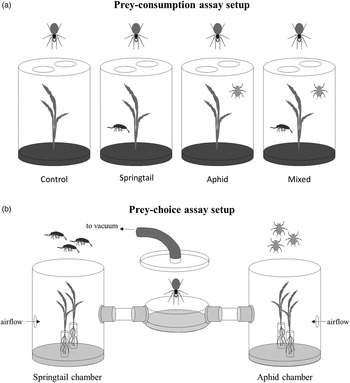
Aphid consumption by spiders was investigated under single-prey and mixed-prey treatments in a controlled experiment using greenhouse microcosms. These microcosms were constructed from cylindrical, clear plastic containers (10.3 cm diameter × 12 cm height), with two screen-covered vents in the lid to allow air circulation (fig. 1a). Smaller holes in the underside of the pots allowed for water drainage. A 3 cm layer of potting soil was placed in each microcosm, and a single, 7-day-old (~15 cm tall) wheat seedling (v. Pembroke) was transplanted into each microcosm 24 h before the preys were introduced. Four prey treatments were prepared in an additive, 2 × 2 factorial designs: springtails (S. curviseta), aphids (R. padi), mixed prey (aphids + springtails) and a control (no prey). Prey density was standardized at 40 individuals per microcosm for each species (thus, the mixed-prey treatment contained 80 total prey individuals). Based on preliminary trials, we expected this density to correlate with an activity-density of 0.2 aphids cm2 day−1 and 0.4 springtails cm2 day−1, which translates into one to two encounters with an aphid, and three encounters with a springtail at a typical-sized G. inornata web (~8 cm2) in a 24 h period. A previously recorded 40% success rate in capturing encountered springtails (Welch et al., Reference Welch, Schofield, Chapman and Harwood2014) ensured that baseline consumption rates of springtails and aphids would be comparable in our trials.
Diagrams of experimental setup. (a) Setup for greenhouse prey-consumption assays, with factorial prey-availability design. (b) Setup for laboratory prey-choice assays, modified from (Welch et al., Reference Welch, Haynes and Harwood2013a , Reference Welch, Haynes and Harwood b ).

Microcosm assays were conducted on seven trial dates. On each trial date, twelve microcosms (three replicates of each prey treatment) were placed simultaneously in the greenhouse, except on one occasion, when only eight microcosms (two replicates of each prey treatment) were placed. In total, each treatment was replicated 20 times. Prey were introduced 24 h after wheat seedlings were transplanted, and allowed a 24 h acclimation period before spiders were introduced. One adult female G. inornata spider was introduced into each microcosm. After 24 h, data were collected on the presence/absence of webs and on the placement of the web (whether attached to the soil, plant stem or microcosm wall). Spiders were collected into 95% ethanol and evaluated for the presence of springtail and aphid DNA in their gut using polymerase chain reaction (PCR) analysis.
Molecular analysis of predation
DNA was extracted from crushed, whole-body spider specimens using QIAGEN DNeasy Tissue Kits (QIAGEN Inc., Chatsworth, California, USA). PCR reactions (25 µl) consisted of 1× Takara buffer (Takara Bio Inc., Shiga, Japan), 2 µl of dNTP solution (2.5 mM of each nucleotide in deionized H2O), 0.5 µl of each primer (10 µM in deionized H2O), 0.15 µl Takara Ex Taq™ and 2 µl template DNA. Reaction success was determined by electrophoresis of 10 µl of PCR product on 3% SeaKem agarose gels stained with ethidium bromide. PCR-cycling protocols differed between the two prey species, so assays were conducted separately for springtail and aphid DNA.
Spider homogenates were assayed for springtail predation using Collembola-specific DNA primers Col4F2d (Chapman et al., Reference Chapman, Schmidt, Welch and Harwood2013) and Col5R (Kuusk & Agusti, Reference Kuusk and Agusti2008), which produce a 180 bp amplicon of the Collembola 18S ribosomal gene. These degenerate primers were previously tested for cross-reactivity against a wide selection of non-targets, and were found to amplify all species of Collembola tested, and no other organisms (Chapman et al., Reference Chapman, Schmidt, Welch and Harwood2013). PCR cycling protocols were 94°C for 1 min followed by 45 cycles of 94°C for 45 s, 65°C for 45 s and 72°C for 30 s.
For detection of aphid DNA in spider homogenates, R. padi-specific primers developed by Chen et al. (Reference Chen, Giles, Payton and Greenstone2000) were used. This primer pair, BcoaCOIIF4 and BcoaCOIIR2, amplifies a 148 bp amplicon of the R. padi COII mitochondrial gene. These primers were tested for cross-reactivity with non-target species, including four other species of aphid: A. pisum, Brevicoryne brassicae L., Hyadaphis foeniculi (Passerini) and Myzus persicae (Sulzer). For the aphid-DNA assays, cycling protocols were 94°C for 1 min followed by 45 cycles of 94°C for 30 s, 55°C for 30 s and 72°C for 45 s.
Prey-choice assays
The prey preferences of spiders were evaluated in two-choice arenas under controlled laboratory conditions. Spiders were introduced into the central chamber of a three-chambered arena, and allowed to choose between the two side chambers simulating microhabitats that were similar in physical and vegetational structure, but differed in prey availability. The arenas and protocols used for these assays are modified from Welch et al. (Reference Welch, Haynes and Harwood2013b ), and briefly summarized here. Arenas were constructed from transparent, plastic containers, with plastic tubes connecting the central chamber to the two side chambers via sockets made of craft foam (fig. 1b). A 0.5 cm layer of plaster was poured into the base of each of the three chambers and allowed to harden. Two 7-day-old fava bean seedlings were transplanted into water-filled 10 µl plastic vials, which were covered with a membrane of Parafilm, and pressed into the hardening plaster of each side chamber of the apparatus. The walls of the two side chambers were lined with vellum paper to facilitate climbing by spiders. A vacuum system was connected to the lid of the central chamber to draw air through screen-covered vents on the opposite sides of the side chambers. Airflow was monitored with Thermo Scientific Gilmont flowmeters (Thermo Fisher Scientific Inc., Waltham, Massachusetts, USA). The experimental protocols followed Welch et al. (Reference Welch, Haynes and Harwood2013a ), with the following modifications. Forty aphids (A. pisum) were introduced into one of the side chambers, and 40 springtails were introduced into the other side chamber, allowing the spiders to choose between the two prey types. Preys were allowed a 24 h acclimation period before the spiders were introduced.
Assays were conducted in a darkroom in blocks of twelve. The physical orientation of the twelve arenas was alternated to avoid effects of any systematic bias in air currents within the room. Spiders were introduced into arenas at 22:00, which coincided with the beginning of the scotophase of the laboratory and greenhouse photocycles. The location of the spider within the arena was recorded immediately after all the spiders had been placed, and again at 30 min intervals throughout one nocturnal period (8 h). Five locations were recognized: central chamber, aphid chamber, springtail chamber and the two connecting tubes. Airflow was also monitored during each observation and maintained at 1.40 ± 0.02 (mean ± SE) l min−1 in all arenas.
Our primary interest was the first side chamber where the spiders entered during the assay period, which is indicative of the relative strength of the spiders’ response to the two prey items. We were also interested in observing the foraging behaviour of spiders as a function of the first side chamber selected. A previous study (Welch et al., Reference Welch, Haynes and Harwood2013a ) showed that linyphiid spiders construct webs to capture springtails, but do not construct webs to capture aphids. Therefore, we constructed a logistic regression model to determine whether chamber selection would impact the decision to construct a web. The model was constructed using the mlogit package (Croissant, Reference Croissant2013) in the statistical software R, version 3.0.2 (R Core Development Team, 2015).
Results
Prey-consumption assays
The effect of non-pest springtails on the consumption of pest aphids (R. padi) was evaluated in microcosm assays, using PCR gut-content analysis. Cross-reactivity testing revealed that the R. padi-specific primers amplified DNA from the aphids M. persicae and B. brassicae; however, these species were not used in this experiment, and were not present in the greenhouse environment during the trials, so there was no risk of false positive results.
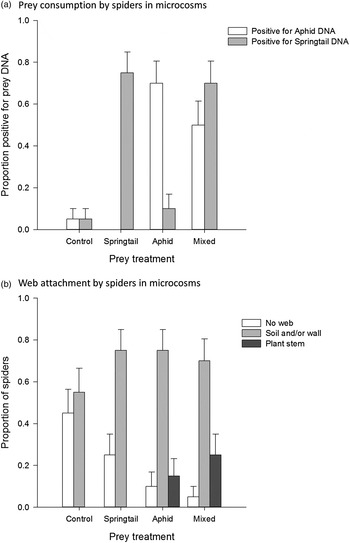
There was no evidence that spiders reduced aphid consumption in the presence of non-pest springtails. In a logistic regression model, the proportion of spiders testing positive for aphid DNA within their gut did not differ significantly between the aphid-only and mixed-prey treatments (log-odds ratio = 0.847, z = 1.28, P = 0.20) (fig. 2a). Six of the 20 spiders (30%) in the mixed-prey treatment tested positive for both prey. However, three spiders tested positive for springtail DNA in treatments where no springtails were added, and one spider in a no-prey treatment tested positive for aphid DNA (fig. 2a). This is attributable to low background populations of R. padi and unidentified springtails in the greenhouse environment. However, springtail consumption by spiders differed significantly between treatments with and without S. curviseta added (fig. 2a), so we are confident that these background populations had negligible influence on prey-consumption results.
Behaviour of G. inornata spiders in greenhouse microcosms. (a) Proportion of spiders having fed on each prey type by treatment, as determined by PCR gut-content analysis. (b) Selection of attachment sites for spider webs by treatment.

Spiders readily constructed webs in all prey treatments (fig. 2b). Nevertheless, while no statistically significant differences in web-construction behaviour were observed, there was evidence that the availability of prey did influence the selection of web attachment structures. In treatments with no aphids present, all spiders constructed webs attached to the soil surface and to the microcosm walls; however, when aphids were present, a minority of spiders (18% in the aphid-only treatment and 22% in the mixed-prey treatment) also attached webs to the wheat seedling (fig. 2b).
Prey-choice assays
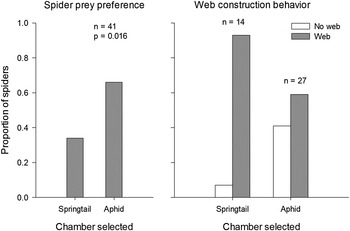
A total of 57 adult female G. inornata were evaluated in two-way choice assays in laboratory arenas, of which 41 entered at least one of the side chambers during the assay period. Spiders did not display a preference for the chamber with high-quality springtail prey (S. curviseta) over the chamber with low-quality aphid prey (A. pisum). In fact, spiders showed a significant preference for aphids (binomial distribution, P = 0.03), with nearly two-thirds of spiders entering the aphid chamber first (fig. 3). Additionally, in a logistic regression model, the initial choice of side chamber significantly influenced the subsequent decision to construct a web: spiders that selected the aphid chamber were less likely to construct webs than spiders that selected the springtail chamber (log-odds ratio = −2.19, t 1 = −1.97, P = 0.048) (fig. 3).
Behaviour of G. inornata spiders in two-way choice assays in which choice of chamber simulates preference for microhabitats with different prey available. (a) Initial chamber selection by spiders. (b) Web construction following initial chamber selection.

Spiders that entered one of the side chambers tended to remain in that side chamber for the remainder of the assay period. However, of 27 spiders that first entered the aphid chamber, seven subsequently exited the chamber, and of 14 that first entered the springtail chamber, one subsequently exited. The difference was not statistically significant (Fisher's exact test: df = 1, P = 0.23), providing no evidence that spiders are more or less likely to abandon an aphid-rich microhabitat than a springtail-rich microhabitat.
Discussion
In two controlled laboratory experiments, we observed no evidence that a linyphiid spider reduces predation on aphids in the presence of high-quality alternative prey. Using PCR gut-content analysis, we demonstrated that spiders continued to feed on aphids at high rates, even when high-quality alternative prey was readily available (fig. 2a). However, these results must be interpreted with caution: as diagnostic PCR is not quantitative, we cannot determine how many aphids were consumed by each spider. Nevertheless, given that prey availability was manipulated to provide just a few encounters with each prey type during the assay period, we can be reasonably confident that most spiders testing positive for a given prey had consumed only one or two individuals of that prey species.
We also observed that spiders showed no preference for springtails over aphids in two-choice assays (fig. 3), indicating that spiders often choose to pursue low-quality aphid prey, even when high-quality alternative prey are available. In combination, these results suggest that the foraging behaviour of G. inornata in the presence of alternative prey is compatible with aphid predation. Previous work has shown that linyphiid spiders are capable of growing, developing and reproducing on a monotypic diet of springtails, including S. curviseta (Marcussen et al., Reference Marcussen, Axelsen and Toft1999; Schmidt et al., Reference Schmidt, Peterson, Lundgren and Harwood2013; Welch et al., Reference Welch, Haynes and Harwood2013b ), whereas aphids appear to be of limited nutritional value for spiders (Bilde & Toft, Reference Bilde and Toft2001; Schmidt et al., Reference Schmidt, Peterson, Lundgren and Harwood2013). It is therefore perplexing that spiders did not display a significant preference for high-quality springtails over low-quality aphids. It is possible that the observed preference for aphids was simply an artefact of naïve spiders responding to a novel prey item; and longer-duration studies may have revealed this aphid predation to be an ephemeral phenomenon. Aversion learning and prey-switching behaviour may begin to occur over longer time intervals than were investigated in this study (Toft & Wise, Reference Toft and Wise1999; Toft Reference Toft2005). However, a long-term experiment conducted by Gavish-Regev et al. (Reference Gavish-Regev, Rotkopf, Lubin and Coll2009) reported that the availability of springtails only disrupted aphid consumption by a linyphiid spider at high springtail densities.
In choice assays, apparent attraction to one item may not necessarily indicate preference for that item over the alternative(s). It is possible that aphids were selected more frequently than springtails because they were more readily detected by spiders in the experimental apparatus, due to differences in the strength or modality of sensory cues emitted. However, previous studies using the same apparatus showed that spiders can locate springtails effectively (Welch et al., Reference Welch, Haynes and Harwood2013a , Reference Welch, Haynes and Harwood b ). Therefore, we are confident that our results represent an actual attraction of spiders to sensory cues from aphids, despite the ostensibly lower nutritional quality of aphid prey.
It is possible that aphids are not so devoid of nutritional value as is commonly thought, or that their nutritional quality as prey is context-dependent (Wilder & Rypstra, Reference Wilder and Rypstra2008). For example, some studies have observed that aphid meals provide subtle nutritional benefits for linyphiids, such as sustaining the spider during periods of low food availability (Toft, Reference Toft1995; Schmidt et al., Reference Schmidt, Peterson, Lundgren and Harwood2013), or balancing nutrient intake when other prey in the diet are also nutritionally sub-optimal (Bilde & Toft, Reference Bilde and Toft2001). Regardless of the ultimate explanation for the spider's behaviour, our results clearly demonstrate that aphids are of some value to spiders, and that spiders (and likely other generalist predators) may still be able to contribute to biological control when high-quality alternative prey are abundant in a field setting. The epigeal habitat of linyphiid spiders is replete with springtail prey, but frequently depauperate in terms of other prey types (Harwood et al., Reference Harwood, Sunderland and Symondson2001; Peterson et al., Reference Peterson, Romero and Harwood2010; Romero & Harwood, Reference Romero and Harwood2010). It is likely that these predators must make a concerted effort to diversify their diets by specifically targeting non-springtail prey. So, our results do not necessarily indicate that spiders prefer aphid prey over springtail prey: our results likely indicate a more generalized effort to diversify the diet. Dietary diversification can play a major role in spider behaviour. For example, some linyphiids, including G. inornata, display alternative foraging tactics, often opting to leave their webs to forage actively (Alderweireldt, Reference Alderweireldt1994), and this tactical shift functions to facilitate predation on aphids (Harwood et al., Reference Harwood, Sunderland and Symondson2004; Chapman et al., Reference Chapman, Schmidt, Welch and Harwood2013; Welch et al., Reference Welch, Haynes and Harwood2013a ). In the present study, similar tactical changes were observed in both experiments. In microcosm experiments, some spiders shifted their web-placement behaviour from the chamber walls to the base of the wheat seedling, where dropping aphids would more likely be intercepted (fig. 2b). In two-choice assays, spiders were less likely to construct webs in the aphid chamber than in the springtail chamber (fig. 3), indicating the use of active hunting tactics to catch sessile aphids and sessile, web-building tactics to catch mobile springtails. The behavioural versatility to selectively target multiple preys is likely a key driver of web-building spider contributions to biological control.
The behaviours we observed in this study are non-intuitive, but provide further support for the notion that generalist predators can be useful agents of biological control. Further work is needed to determine how these behaviours will be regulated under more complex, field conditions, to better understand how to exploit these predator–prey dynamics for biological control.
Acknowledgements
This is publication No. 15-08-007 of the Kentucky Agricultural Experiment Station and is published with the approval of the Director. This work is supported by the National Institute of Food and Agriculture, U.S. Department of Agriculture, McIntire-Stennis project under Accession Number 1007196. Support for this research was also provided by the National Science Foundation Graduate Research Fellowship Programme. Founding stock for springtails colonies were donated by Dr Ann Rypstra (Miami University Ohio), and ultimately derived from the ‘Crossley culture’ maintained by Dr Michael L. Draney (University of Wisconsin-Green Bay). Katelyn Kowles (University of Kentucky) provided founding stock for aphid colonies. Mention of product information does not constitute endorsement by the USDA.