Introduction
Ooencyrtus pityocampae (Mercet) (Hymenoptera: Encyrtidae) is an efficient biological control agent of Thaumetopoea pityocampa (Den. & Schiff.) and T. wilkinsoni (Tams) (Lepidoptera: Notodontidae), which are among the most important defoliators of pine forests throughout the Mediterranean Basin (Buxton, Reference Buxton1983; Battisti et al., Reference Battisti, Ianne, Milani and Zanata1990; Masutti et al., Reference Masutti, Battisti, Milani, Zanata and Zanazzo1993; Tiberi et al., Reference Tiberi, Niccoli and Sacchetti1994; Hódar and Zamora, Reference Hódar and Zamora2004; Zhang et al., Reference Zhang, Li and Huang2005; Binazzi et al., Reference Binazzi, Benassai, Peverieri and Roversi2013; Samra et al., Reference Samra, Ghanim, Protasov, Branco and Mendel2015). Other known hosts of O. pityocampae include Nezara viridula (Linnaeus) Aelia rostrata (Boh), Carpocoris sp., Dolycris baccarum (Linnaeus), Rhaphigaster nebulosa (Poda), Eurydema ventrale (Kolenati), E. oleracea (Linnaeus), Graphosoma lineatum (Linnaeus) Halyomorpha halys (Stål) (Hemiptera: Pentatomidae) and Eurygaster maura (Linnaeus) (Hemiptera: Scutelleridae) (Tiberi et al., Reference Tiberi, Niccoli, Roversi and Saccetti1991, Reference Tiberi, Niccoli and Sacchetti1993; Federico et al., Reference Federico, Francesco, Leonardo, Elena, Lara and Sabbatini Peverieri2016).
Ooencyrtus kuvanae (Howard) (Hymenoptera: Encyrtidae) is a primary egg parasitoid of Lymantria dispar (L.) (Lepidoptera, Lymantriidae) (Howard, Reference Howard1910; Tadic and Bincev, Reference Tadic and Bincev1959; Brown, Reference Brown1984; Hofstetter and Raffa, Reference Hofstetter and Raffa1998; Wang et al., Reference Wang, Liu, Zhang, Wen and Wei2013) but it can also parasitize other hosts, such as Dendrolimus spectabilis Butler (Lepidoptera: Lasiocampidae), Malacosoma americana (Fabricius), M. neustria tartacea (Motschulsky), Euproctis chrysorrhoea (Linnaeus), Hemerocampa leucostigma (Abbot & Smith), Hemerocampa definata (Packard), Lymantria fumida (Butler), Nygmia phaeorrhoea (Donovan), Stilpnotia salicis (Linnaeus) Eriogyna pyreterom (Westwood) (Lepidoptera: Saturniidae), Lycorma delicatula (White) (Hemiptera: Fulgoridae) and H. halys (Stål) (Hemiptera: Pentatomidae) (Huang and Noyes, Reference Huang and Noyes1994; Hofstetter and Raffa, Reference Hofstetter and Raffa1998; Liu, Reference Liu2019; Tunca et al., Reference Tunca, Cosic, Colombel, Venard, Capelli and Tabone2020).
To reduce the costs associated with biological control programs and to ensure the supply of high-quality natural enemies at times of high demand, it is important to improve parasitoid mass-rearing techniques (Spínola-Filho et al., Reference Spínola-Filho, Leite, Soares, Alvarenga, de Paulo, Tuffi-Santos and Zanuncio2014). The encyrtid egg parasitoids O. pityocampae and O. kuvanae can be successfully raised on the host Philosamia ricini (Donovan) (Lepidoptera: Saturnidae) (Tunca et al., Reference Tunca, Colombel, Ben Soussan, Buradino, Galio and Tabone2016, Reference Tunca, Venard, Colombel and Tabone2017). Philosamia ricini can be reared on Ligustrum vulgare (L.) (Amaranthaceae) and Ailanthus altissima (Mill.) Swingle (Simaroubaceae) (Venard et al., Reference Venard, Tunca, Colombel, Martin and Tabone2016), and rearing is straightforward and inexpensive. In addition, P. ricini oviposits more often, and its eggs are larger than those produced using two other known laboratory hosts, N. viridula and H. halys. Although methods for breeding this host are well known and have been optimized, they can be affected by external problems, such as the natural contamination of host plants by bacterial species. Consequently, there are occasional problems related to the production of P. ricini eggs due to high larval mortality, and the rearing of the two parasitoids can be affected.
When inundative release is used as a biological pest control strategy, large numbers of parasitoids are required to rapidly reduce the damaging pest population. However, the major challenge associated with this biological control strategy is the production of a large number of parasitoids of adequate quality (Orr, Reference Orr1988). Several techniques have been used to optimize the large-scale mass production of parasitoids in laboratories. Some of these approaches include, the in vitro development of parasitoids (Strand et al., Reference Strand, Vinson, Nettles and Xie1988; Nettles, Reference Nettles1990; Consoli and Vinson, Reference Consoli and Vinson2004; Shirazi, Reference Shirazi2006; Paladino et al., Reference Paladino, Papeschi and Cladera2010; Kim et al., Reference Kim, Lee, Lim and Hong2018), cold storage of parasitized hosts (Noble, Reference Noble1937; Dass and Ram, Reference Dass and Ram1983; Gautam, Reference Gautam1986; Ganteaume et al., Reference Ganteaume, Tabone and Poinsot-Balaguer1995a, Reference Ganteaume, Tabone and Poinsot-Balaguer1995b; Bayram et al., Reference Bayram, Ozcan and Kornosor2005; Liu et al., Reference Liu, Fu, Lin, Fu, Peng and Jin2014; Tunca et al., Reference Tunca, Yeşil and Çalişkan2014; Kidane et al., Reference Kidane, Yang and Wan2015), cold storage of parasitoids as pupae or adults (Gautam, Reference Gautam1986; Foerster et al., Reference Foerster, Doetzer and Castro2004; Foerster and Doetzer, Reference Foerster and Doetzer2006; Yılmaz et al., Reference Yılmaz, Karabörklü and Ayvaz2007; Mousapour et al., Reference Mousapour, Askarianzadeh and Abbasipour2014; Afshari and Nazari Fandokht, Reference Afshari and Nazari2019; Cira et al., Reference Cira, Santacruz and Koch2021) and cold storage of unparasitized hosts (Corrêa-Ferreira and Moscardi, Reference Corrêa-Ferreira and Moscardi1993; Kıvan and Kılıç, Reference Kıvan and Kılıç2005; Mahmoud and Lim, Reference Mahmoud and Lim2007; Alim and Lim, Reference Alim and Lim2011; Spínola-Filho et al., Reference Spínola-Filho, Leite, Soares, Alvarenga, de Paulo, Tuffi-Santos and Zanuncio2014; Singhamuni et al., Reference Singhamuni, Hemachandra and Sirisena2015; Wong et al., Reference Wong, Walz, Oscienny, Sherwood and Abram2021).
Storing a host at a low temperature can arrest its development at the desired stage and contribute to the rearing of parasitoids. The cold storage technique allows the synchronization of parasitoid release with outbreaks of insect pests (Leopold, Reference Leopold, Hallman and Denlinger1998; Pitcher et al., Reference Pitcher, Hoffmann, Gardner, Wright and Kuhar2002; Colinet and Boivin, Reference Colinet and Boivin2011). Cold storage of P. ricini eggs is important, as it allows for a sufficient number of egg hosts for the rearing of O. pityocampae and O. kuvanae. The objective of this study was to investigate the optimum cold storage conditions of host eggs and to assess the performance of O. pityocampae and O. kuvanae reared on stored P. ricini eggs.
Materials and methods
This study was conducted at the INRAE-PACA Mediterranean Forest and Entomology Unit, Laboratory of Biological Control, Antibes, France. The experimental trials were conducted under laboratory conditions at 25 ± 1 °C and 60 ± 5% relative humidity (RH), with a photoperiod of 18:6 h L:D. P. ricini and O. pityocampae were reared according to Tunca et al. (Reference Tunca, Colombel, Ben Soussan, Buradino, Galio and Tabone2016). O. kuvanae was reared according to Tunca et al. (Reference Tunca, Venard, Colombel and Tabone2017).
Experimental setup
To determine the effect of cold storage of unparasitized P. ricini eggs on O. pityocampae and O. kuvanae rearing parameters, an experiment was carried out in a completely randomized 2 (1- and 2- day old hosts) × 10 (1, 5, 10, 15, 30, 45, 60, 75, and 90 days cold storage and control) × 2 (2 parasitoids, O. pityocampae and O. kuvanae) factorial design, with 10 replicates of each treatment combination. One- and two-day-old eggs were kept at 3°C in a refrigerator during the cold storage period and 40 host eggs were placed in a test tube (1 × 7 cm) with a single mated O. pityocampae or O. kuvanae female for 24 h for oviposition. Five-day-old mated females of O. pityocampae and O. kuvanae were fed honey and used for the oviposition experiments. After oviposition, O. pityocampae and O. kuvanae females were removed from the test tubes. The tubes were incubated at 25 ± 1 °C, with a RH of 65 ± 5% and a 16:8 h L:D photoperiod until parasitoid offspring emerged. Host larvae that hatched from unparasitized eggs were removed, and parasitized eggs were left in the tube.
Exposed eggs were monitored on a daily basis, and the number of emerged adults was recorded. Similarly, the time that elapsed from the exposure until adult emergence of the parasitoids was recorded to account for the developmental time. The emergence rate was calculated as the proportion of parasitized eggs in the tube and expressed as a percentage. To determine adult longevity, the parasitoids were placed in a test tube (1 × 7 cm) with a drop of bio-honey. Longevity was recorded daily until all of the parasitoids died. The fecundities of O. pityocampae and O. kuvanae were determined using one-day-old P. ricini eggs. For this analysis, O. pityocampae and O. kuvanae females (8 and 7 females, respectively) that emerged from stored eggs were chosen randomly. Thirty eggs were supplied on a daily basis to each newly emerged female until the females died, and the parasitoids that emerged from the parasitized eggs were counted every day.
The emergence rate, the development time and adult longevity were analyzed using a general linear model (GLM). Percentage data were normalized using an arcsine transformation (Zar, Reference Zar1999). The means were compared with Duncan's test at a significance level of α = 0.05 (McKenzie and Goldman, Reference Mckenzie and Goldman2005; Minitab Release 14).
Results
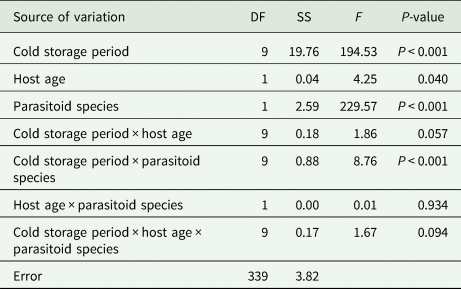
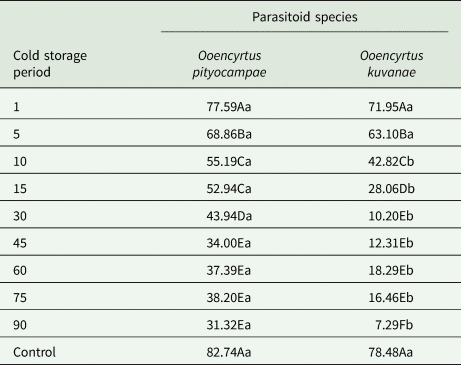
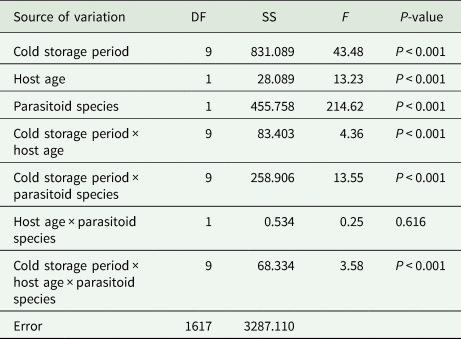
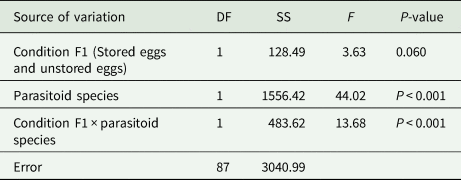
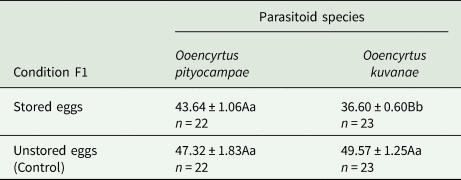
The cold storage period × parasitoid species interaction showed a significant (P < 0.001) effect on the emergence rates of O. pityocampae and O. kuvanae (Table 1). Increasing cold storage periods significantly reduced the emergence rate in both parasitoid species (F = 8.76, df = 9, P < 0.001). The emergence rates of O. pityocampae were higher than those of O. kuvanae at 10, 15, 30, 45, 60, 75 and 90 days of storage (Table 2). The development times of the parasitoids were significantly affected by the interaction of three factors: cold storage period, host age, and parasitoid species (F = 3.58, df = 9, P < 0.001) (Table 3). The development times of both parasitoid species increased compared to those of the corresponding controls for some storage periods (Table 4). The longevity of the parasitoids was affected by the interaction of the F1 condition and parasitoid species (F = 13.68, df = 1, P < 0.001) (Table 5). The longevity of O. pityocampae (43.6 days) was significantly longer than that of O. kuvanae (36.6 days) when reared on stored eggs. Compared with the life span of O. kuvanae reared on unstored eggs (49.5 days), of O. kuvanae reared on stored eggs was shorter (36.6 days) (Table 6). The fecundities of O. pityocampae and O. kuvanae were 54.7 (progeny/per female) and 47.0 (progeny/per female), respectively. The pre-oviposition times of O. pityocapae and O. kuvanae were 1.37 days and 1.28 days, respectively. At the same time, both have post-oviposition periods. The post-oviposition times of O. pityocampae and O. kuvanae were 20.25 days and 14.71 days, respectively.
Results of the GLM analysis of the emergence rate of Ooencyrtus pityocampae and Ooencyrtus kuvanae.

Emergence rate (%) of Ooencyrtus pityocampae and Ooencyrtus kuvanae (Cold storage period × parasitoid species).

Means in each row followed by same lowercase letter do not differ statistically.
Means in each column followed by same capital letter do not differ statistically.
Results of the GLM analysis of the development time of Ooencyrtus pityocampae and Ooencyrtus kuvanae.

Development time (days) of Ooencyrtus pityocampae and Ooencyrtus kuvanae.

Means in each row followed by same lowercase letter do not differ statistically.
Means in each column followed by same capital letter do not differ statistically.
Results of the GLM analysis of the longevity of Ooencyrtus pityocampae and Ooencyrtus kuvanae.

Longevity (days) of Ooencyrtus pityocampae and Ooencyrtus kuvanae.

Means in each row followed by same lowercase letter do not differ statistically.
Means in each column followed by same capital letter do not differ statistically.
Discussion
It is important to rear egg parasitoid species on suitable hosts to ensure the success of biocontrol programs (Consoli et al., Reference Consoli, Parra and Zucchi2010; Masry and El-Wakeil, Reference Masry, El-Wakeil, El-Wakeil, Saleh and Abu-Hashim2020). Additionally, the ability to mass produce a large number of parasitoids is required storing host eggs for different periods could contribute positively to the mass rearing of parasitoids (Bigler, Reference Bigler1986; Vieira and Tavares, Reference Vieira and Tavares1995; Lalitha et al., Reference Lalitha, Jalali, Venkatesan and Sriram2010; Masry and El-Wakeil, Reference Masry, El-Wakeil, El-Wakeil, Saleh and Abu-Hashim2020).
However, longer storage times may result in a decrease in the nutritional quality of host eggs; therefore the performance of parasitoids reared on refrigerated eggs may be reduced (Flanders, Reference Flanders1938; Kostal et al., Reference Kostal, Vambera and Bastl2004, Reference Kostal, Yanagimoto and Bastl2006). For this reason, it is important to take into consideration the host storage period during the rearing of parasitoids (Wong et al., Reference Wong, Walz, Oscienny, Sherwood and Abram2021). Our results showed that the storage of P. ricini eggs caused adverse effects on in the biological parameters of the F1 generation of O. pityocampae and O. kuvanae adults, represented by the rate of adult emergence, development time, longevity and fecundity. These results can be explained as follows: first, lethal effects occur during parasitoid development in low-quality stored eggs, and second parasitoids fail to accept stored eggs as hosts (Wong et al., Reference Wong, Walz, Oscienny, Sherwood and Abram2021).
Lethal effects lead to decreased parasitoid progeny emergence (Mainali and Lim, Reference Mainali and Lim2013; Mahmoud and Lim, Reference Mahmoud and Lim2007; McIntosh et al., Reference McIntosh, Lowenstein, Wiman, Wong and Lee2019; Wong et al., Reference Wong, Walz, Oscienny, Sherwood and Abram2021). In this study, exposure of P. ricini eggs at different ages to low temperatures led to a reduction in the emergence rates of the both parasitoids. Siam et al. (Reference Siam, Zohdy, Abd ELHafez, Eid Moursy and Sherif2019) reported that low-temperature storage of host eggs for different periods had an effect on the efficiency of Trichogramma parasitoids. After 10, 15, 20 and 30 days of storage at 5 °C T. evanescens emergence percentages decreased by 84.91, 80.48, 61.17, and 50.73%, respectively. Rundle Bradely et al. (Reference Rundle, Thomson and Hoffmann2004) and Ozder (Reference Ozder2004) noted that the prolongation of cold storage led to a reduction in the efficiency of F1 female parasitoids. In our study, all the cold storage periods except for 1 day of cold storage (5, 10, 15, 30, 45, 60, 75 and 90 days) affected adult emergence in both parasitoids. In another study, when refrigerated H. halys eggs were stored at 8 °C for up to two months, the emergence rate of Trissolcus japonicus (Ashmead) (Hymenoptera: Scelionidae) decreased significantly (Wong et al., Reference Wong, Walz, Oscienny, Sherwood and Abram2021). Similar results have been reported in other studies for Gonatocerus ashmeadi Girault (Hymenoptera: Mymaridae) (Chen and Leopold, Reference Chen and Leopold2007), Trichogramma acacioi (Brun), T. atopovirilia (Oatman & Platner), T. benneti (Nagaraja & Nagarkatti), T. brasiliensis (Ashmead), T. bruni (Nagaraja), T. demoraesi (Nagaraja), T. galloi (Zucchi), T. pretiosum (Riley), T. soaresi (Nagaraja) (Hymenoptera: Trichogrammatidae) (Spínola-Filho et al., Reference Spínola-Filho, Leite, Soares, Alvarenga, de Paulo, Tuffi-Santos and Zanuncio2014), T. chilonis and T. achaeae (Singhamuni et al., Reference Singhamuni, Hemachandra and Sirisena2015). Tunca et al. (Reference Tunca, Yeşil and Çalişkan2014) noted that Venturia canescens (Gravenhorst) (Hymenoptera: Ichneumonidae) could not develop on Ephestia kuehniella (Zeller) or Plodia interpunctella (Hübner) (Lepidoptera: Pyralidae) stored at 5 °C for 5, 7 and 15 days. Additionally, they did not develop on P. interpunctella larvae stored at 10 °C for 15 days. The low rate of emergence can additionally be explained by the low rate of parasitism by O. pityocampae and O. kuvanae. Neither species may not accept stored P. ricini eggs for parasitization. There were significant reductions in the emergence rates of O. pityocampae and O. kuvanae after 5- days of host storage.
There are two important factors that influence the parasitism of stored host eggs: one is the ability to recognize chemical signals in host eggs, and the other is the level of tolerance to changes in physical characteristics, such as the color, size and shape of the eggs (Stoepler et al., Reference Stoepler, Lill and Murphy2011). Female parasitoids may refuse cold-stored eggs with modified chemical and physical characteristics (Soares et al., Reference Soares, Torres-Gutierrez, Zanuncio, Pedrosa and Lorenzon2009; Goubault et al., Reference Goubault, Cortesero, Paty, Fourrier, Dourlot and Le Ralec2011; Penaflor et al., Reference Penaflor, Erb, Miranda, Werneburg and Bento2011; Stoepler et al., Reference Stoepler, Lill and Murphy2011) Relatedly, Conti et al. (Reference Conti, Jones, Bin and Vinson1996) reported that low-temperature storage modified egg shape and affected host recognition by parasitoids. The parasitism rates of T. semistriatus were decreased when exposed to Dolycoris baccarum (L.), Graphosoma lineatum (L.) and Eurydema ornatum (L.) (Heteroptera: Pentatomidae) eggs stored for three months at 6 °C (Kıvan and Kılıç, Reference Kıvan and Kılıç2005). Chen and Leopold (Reference Chen and Leopold2007) reported that parasitism by Gonatocerus ashmeadi Girault (Hymenoptera: Mymaridae) on eggs of Coagulata homalodisca (Say) (Hemiptera: Cicadellidae) decreased with an increasing cold storage period. Similarly, Karabörklü and Ayvaz (Reference Karabörklü and Ayvaz2007) noted that the emergence rate of and parasitism by T. evanescens adults that emerged from stored host eggs decreased depending on the storage period at 4 °C. A similar result was also obtained for Trichogramma olea reared on Ephestia kuehniella (Zeller) (Lepidoptera: Pyralidae) eggs stored at 4 °C (Gharbi, Reference Gharbi2014).
Compared with those reared on unstored eggs, O. pityocampae and O. kuvanae reared on eggs subjected to cold storage for different periods had longer development times. Chen and Leopold (Reference Chen and Leopold2007) reported that after 70 days of Homalodisca coagulata (Say) (Hemiptera: Cicadellidae) egg storage, the developmental time of the parasitoid G. ashmeadi was delayed. Similarly, the development time of V. canescens was negatively affected by low temperature and storage time (Tunca et al., Reference Tunca, Yeşil and Çalişkan2014). Wong et al. (Reference Wong, Walz, Oscienny, Sherwood and Abram2021) noted that the development time of T. japonicus increased when eggs were refrigerated for long periods. Relatedly, the development time of parasitoids obviously decreased when reared on eggs of H. halys refrigerated for short periods.
The longevity of adult O. pityocampae that emerged from cold-stored eggs did not differ from that of the adult control group. However, the longevity of O. kuvanae was significantly reduced. Kidane et al. (Reference Kidane, Yang and Wan2015) reported that the longevity of Encarsia sophia (Hymenoptera: Aphelinidae) that emerged from host pupae stored for one week at 12 and 8 °C was not affected, although longevity decreased to 66–72% with increasing storage period. The longevity of adult T. evanescens decreased significantly with increased host storage time (Özder and Sağlam, Reference Özder and Sağlam2004). Similarly, Gharbi (Reference Gharbi2014) reported that the longevity of T. oleae adults that emerged from stored pupae decreased significantly with increasing cold storage duration. Siam et al. (Reference Siam, Zohdy, Abd ELHafez, Eid Moursy and Sherif2019), showed that the longevity of female T. evanescens decreased with prolonged Sitotroga cerealella (Olivier) (Lepidoptera: Gelechiidae) cold storage periods.
The cold storage of P. ricini eggs creates unfavorable conditions for the development of both O. pityocampae and O. kuvanae. Ooencytus pityocampae and O. kuvanae showed decreases in fecundity of 18.1 and 31.7%, respectively, when reared on cold-stored P. ricini eggs compared to those reared on fresh eggs (Tunca et al., Reference Tunca, Venard, Colombel and Tabone2017, Reference Tunca, Venard, Colombel and Tabone2019). Similar results were obtained for T. cacoeciae, T. brassicae, T. evanescens (Özder and Sağlam, Reference Özder and Sağlam2004), Gonatocerus ashmeadi (Hymenoptera: Mymaridae) (Chen and Leopold, Reference Chen and Leopold2007) and T. evanescens (Siam et al., Reference Siam, Zohdy, Abd ELHafez, Eid Moursy and Sherif2019).
The healthy storage of host insects is extremely important for mass production. However, storing P. ricini eggs did not lead to the successful rearing of parasitoids. Ooencyrtus kuvanae was more sensitive than O. pityocampae in terms of development on stored eggs. However, the results of this study showed that one- and two- day-old P. ricini eggs could be stored for up to 30 days for the rearing of O. pityocampae and that those stored for up to 10 days at 3 °C could be used for rearing O. kuvanae for the sustainable production of these parasitoids. These results should be considered in the mass production of these two parasitoid species during autumn and winter and for their release in the field during the critical periods of natural pest hosts outbreaks.
Acknowledgements
Great appreciation is extended to Jean Claude Martin (INRAE-Unité Expérimentale Forestière Méditerranéenne) for his critical review of the manuscript.