

Introduction
With the ever-increasing human population, the quest for food security has become one of the critical issues of the developing nations, where protein supplement is abysmally low and usually out of the reach of poor people. This brings to the fore the importance of insects as an alternative and relatively cheap source of protein in the human diet – a practice known as human entomophagy. This practice can also be extended to domestic animals.
Consequently, efforts have been directed at identifying other protein sources, especially among insects, as alternatives for fishmeal in conventional poultry feeds (Ogunleye and Omotoso, Reference Ogunleye and Omotoso2005). This is despite the negative impression some people have towards insects as unhygienic and disease spreading, and that insects are only eaten in times of starvation (DeFoliart, Reference DeFoliart1999; MacEvilly, Reference MacEvilly2000).
In some countries, such as the UK, there is zero tolerance towards the presence of insects in food products. In contrast, the USA has legislation to allow maximum permissible levels of insects in foods (Gorham, Reference Gorham1979; MacEvilly, Reference MacEvilly2000). The inclusion of insects in animal feeds could be an indirect and a healthy way of integrating more insects in the human diet. This study involves evaluating the effects of providing the chicken Gallus gallus domesticus L. (Galliformes: Phasianidae) with insect-enhanced diets. This paper discusses the possibility of introducing this diet in poultry feeds.
Materials and methods
The bird used for this experiment was G. domesticus. The broilers were fed with three different food substrates under similar ambient laboratory conditions (75 ± 4% relative humidity; 27 ± 2 °C). Each experimental unit was made up of one bird that was fed with a particular substrate (the treatment). Each unit was replicated six times in a completely randomized design, i.e. six birds per treatment making a total of 18 birds for the three treatments. The trial was carried out over a period of 13 weeks while feeding the birds with the different food substrates, namely: (i) a blend of Periplaneta americana (L.) (Blattaria: Blattidae) (protein source) and Zea mays L. (Poaceae) (carbohydrate source); (ii) the usual feed, starter mash/finisher (control) and (iii) a combination of P. americana, Z. mays and starter mash/finisher.
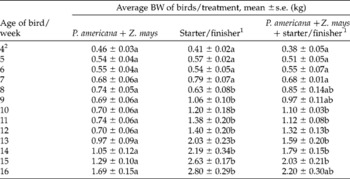
During the early period of growth (week 1–week 3), the chickens were fed on similar diets (starter) to equilibrate them. After this, the chickens were subjected to the different treatments from week 4 onwards. Although the body weights (BW) of the birds were not measured at week 1, they were all measured at week 4, i.e. initial weight before the treatment (Table 1). From week 4 when the different treatment regimens commenced, the food weight used for the first 5 weeks (week 4–week 9) on a daily basis was 100 g with an equal number of ten adults of P. americana in it, irrespective of the treatment. The total food weight was increased to 110 and 120 g from ‘week 10 to week 13’ and ‘week 14 to week 16’, respectively, while keeping the number of adult P. americana constant throughout the experimental period. These cockroaches were sourced from crevices, pit toilets, septic tanks and underneath bags of animal feed in retailers' stores.
BW response of poultry birds fed with different food constituents over 13 weeks

BW, body weight.
Means within a row with the same letters do not differ significantly (P>0.05; Student's t-test).
1 Finisher was introduced at week 7 onwards.
2 Initial BW of birds prior to the treatments.
The commercial feed administered to these birds is made up of cereals: 56% (starter, s) and 63% (finisher, f); peanut 19% (s, f); fishmeal 0–7.5% (s) and 1.8–6% (f); blood meal, dl-methionine 0.03–0.13% (s), dicalcium phosphate 0–2% (s) and 0–1.75% (f), sodium chloride 0.3% (s) and 0.15–0.4% (f) and feed additive (trace minerals and vitamins) 0.3% (starter and finisher) (Oluyemi and Roberts, 1979).
Data (BW) were tested for differences between means using Student's t-test (Table 1). Before the treatment, the homogeneity of these birds was tested using Student's t-test. This is shown in week 4 (Table 1).
Results and Discussion
At the onset of the experiment, there was no significant difference between the chickens of the three treatments. Until week 7, the BW of the broilers did not differ (P>0.05) between the three treatments. However, there was markedly (P < 0.01) higher BW between the treatment P. americana +Z. mays (a) and starter mash/finisher (b) at week 8, and at week 9, the BW was also significantly (P < 0.05) higher in treatment ‘b’ than ‘a’. However, there were no significant (P>0.05) differences in the mean BW throughout the weeks between those fed with ‘b’ and P. americana +Z. mays +starter/finisher (c).
Gallus g. domesticus significantly gained weight from week 9 and 10 when fed on ‘b’ and ‘c’, respectively, to week 16. Although these chickens were not significantly (P>0.05) different from each other, they had significantly (P < 0.01) higher weights than those fed on P. americana +Z. mays (‘a’; cf. Table 1). This may be due to the higher demand for other food components that were not present in treatment ‘a’.
One of the earliest uses of Dictyoptera (Blattodea) in entomophagy was in Cameroun (Bergier, 1941). In 1958, Swent-Ivany observed that insect crop pests had more nutritional values than the crop they infested (Szent-Ivany, 1958). The nuisance potential of cockroaches can also be minimized by utilizing them as food for poultry; after all, Blatella germanica (L.) (Dictyoptera: Ectobiidae) had been reported as an edible insect in Mexico (Ramos-Elorduy and Pino-Moreno, Reference Ramos-Elorduy and Pino-Moreno2002). Since the entire insect body can be used or processed as food, unlike the bones, blood and offal in livestock, which are almost unusable as food (Meyer-Rochow, 2010), this study lends credence to earlier advocacy that insects should be used as food in human diet and as animal feed, particularly in poultry, pig and fish feed (Ashiru, Reference Ashiru1988; DeFoliart, Reference DeFoliart1989; Ogunleye and Omotoso, Reference Ogunleye and Omotoso2005). In this study, G. g. domesticus exhibited similar growth (particularly BW) pattern when fed, separately, with P. americana and the conventional feed at the early stage of development. The use of insects in animal diet could reduce the cost of protein production for man as insects convert food materials into tissue exceptionally well, and their rate of reproduction and fecundity gives them a comparative advantage as a feed source for poultry (Durst and Shono, 2010).
Conclusion
This preliminary study has shown that P. americana could be an alternative source of protein for poultry birds during the early stage of their development. If properly harnessed, this may also reduce the incidence of P. americana in and around human dwellings as people can hunt or kill them, and even keep and breed them for economic returns when the demand for cockroaches becomes high. The relatively low incidence of mortality among birds fed with P. americana could be a result of possible enhancement of their immunocompetences, though this requires further studies.