Introduction
Turkey has been both a receiving and sending country for migrants for over a century.Reference Sirkeci and Yüceşahin1 Modern Turkey is a leading source for international human mobility and in the last three to five decades it has been estimated that three to five million Turks (including 2.3 million Turkish citizens)Reference Biffl2 have settled in Europe with a majority in Germany.3 Modern Turkish migration is rooted around the founding of the Turkish Republic in 1923 and the compulsory exchange of populations that followed the collapse of the Ottoman Empire. More recently, with war and invasion in Iraq, the Syrian crisis and the terror of the Islamic State, movements have resulted in mass influxes of refugee and immigrant populations to Turkey. The Syrian conflict pushed over 2.5 million Syrians to seek refuge in Turkey between 2011 and 2016. We argue that these population movements have been triggered, shaped and moderated by conflicts in TurkeyReference Sirkeci4 and its surrounding neighbours.Reference Sirkeci5
Mass labour migration from Turkey to Europe in the 1960s and 1970s, followed by asylum seeking flows in the 1980s and 1990s, are well recognised and documented in migration literature. The Eurocentrism inherent in this literature overwhelms discussions of other moves in and out of Turkey that are not considered as relevant to the international migration debate. There is also a bias towards discussions of migration that argue for rational, positive outcomes of human mobility and focus on the pulls and pushes of labour markets rather than a discussion of the conflicts that trigger population movements, which are more common in Turkey and the surrounding countries.
The stock of foreign-born population in Turkey has been stagnant at around 900,000 from the 1930s to the late 1980s when Bulgarian Turks arrived en masse escaping from ethnic cleansing.Reference Sirkeci6 The total number of foreign-born people gradually grew to 1.13 million in 1990, to 1.26 million by 2000, and over 1.4 million by 2011.7 The majority of these ‘new’ arrivals now hold Turkish citizenship. Therefore, the number of foreign citizens in Turkey remains relatively low.
The total number of foreign citizens in Turkey by 2000 was reported to be 257,496 people. This figure was estimated to grow by 400,000 in 2013.8 However, the total number of foreign-born people is much larger as it includes Turkish citizens born abroad, totalling 997,676 by 2000. Nevertheless, after mass influxes of Syrian citizens since 2011, the total number of foreign citizens is likely to have officially risen to over 2 million. In addition, there are irregular movers as Turkish security forces apprehended over 900,000 foreigners between 1995 and 2012.Reference Sirkeci and Martin9 According to the UNHCR, prior to the Syrian crisis, from 1995 to 2012, there were about 125,000 asylum applications filed in Turkey.
In this paper, we first discuss the terminology used in migration literature and propose a change to discourse on movement, mobility and movers instead of that on migration and migrants. The following section delineates how we conceptualise the conflict model and culture of migration. We conclude with a discussion of contemporary migration in Turkey in relation to conflicts.
Re-conceptualising Human Mobility
Movers and non-movers make decisions around destinations and mobility in response to conflicts that may not fit the neo-functional, rational models that typically define migration.Reference Sirkeci10 Contemporary migration theories and models are (a) focused on economic rational decision-making; (b) the assumption that a mover’s rational decisions supersede the needs and desires of others; and (c) that migration is a one-time event with a specific geographical pathway to follow. Migration, when approached and defined in rational terms ignores the conflictive decision-making that frames mobility, the dynamic nature of human movements and overlooks the nature of mobility (including the length of a sojourn) which can be for shorter periods and circular and reproduced and repeated over time. Emphasising rational decision-making builds a rosy and hopeful story and assumes that human mobility is always positively-oriented. In other words, a traditional approach to migration argues that movers are in search of ‘a better life’ seeking to improve their economic status, advance their studies, nurture intellectual needs and gain freedoms. Stated briefly, people move towards (and want to move towards) better opportunities. Much contemporary mobility follows a rather less positive model, where it (including much of Turkish mobility) is often driven by conflict. People move away from difficulties, challenges, conflicts, oppression and restraints that range from the small and immediate to the large and long term.
Neo-functional theories of human mobility can be traced to the seminal works of Ravenstein.Reference Ravenstein11 His 11 laws as represented by LeeReference Lee12 and GriggReference Grigg13 are powerful and define migration as a response to labour needs of workers among other things. Contemporary scholarship on migration and theorisation efforts unfortunately often do not go much farther than Ravenstein’s ‘laws’.Reference Dorigo and Tobler14 Ideas revolving around economics to focus on wage differentials and labour market equilibriums are very common. Network and systems theory contribute to the explanation of migration corridors and routes as well as the role of human capital and social capital in human mobility. Massey and colleaguesReference Massey, Hugo and Taylor15 note that these theories and models aim to explain the same phenomenon and while they use radically different terms, assumptions and reference points, the outcomes are quite similar. Neo-classical economic models focus on wage and employment differentials between countries and the cost of migration, while perceiving migration as an individual decision to maximise income. New migration economics on the other hand turns to circumstances in other markets instead of just labour markets. Thus, migration becomes an instrument to reduce the risks on household income and to overcome capital restrictions on household productivity. Dual labour market theory and world systems theory shift the focus to macro level forces and influences. Accordingly, international migration is an inherent structural need in modern industrialised economies. World system theory sees it as a natural consequence of economic globalisation.Reference Massey, Hugo and Taylor15
We describe migration as a ‘process’ that generates its own dynamics. Migration’s dynamic nature warrants a rethinking of the terminology used in migration studies.Reference Anthony16–Reference Findlay and Li19 What makes migration a process is the dynamic nature of human movement, which responds to changes in the environment (broadly defined) and perceptions by individual movers as well as by the people and community around them. To capture the dynamic nature of the process, while also avoiding the politicised and judgement-laden connotations of the terms ‘migration’ and ‘migrant’,Reference Salomonson and Fellesson20, Reference Alexander21 we argue for a focus on the terminology of human mobility and explore the roles of culture and conflicts in outcomes.Reference Cohen and Sirkeci17
Describing migration as mobility captures the dynamic nature of movement and defines two-way flows. Movers are migrants of the old terminology and it is argued that they are better tied to non-movers as the decisions to move are often shaped or influenced by those who stay put. The terms mobility, movement and movers are not new to migration literature. The use of the term ‘movers’ dates as far back as 1906Reference Turner22 and ‘mobility’ is widely used in the literature since the 1920s.Reference Conn and Budington23 Recchi used the term mover in reference to European migrants before the 1960s and 1970s.Reference Recchi24 There are also ‘expats’, a term almost exclusively used to refer to the movers from Western Europe, North America and a few advanced economies imposing a divide between perhaps the ‘undesirable’ migrants and ‘likeable’ movers. Castles argues that because of this dichotomy in discourses over mobility and migration, ‘migration’ represents the terms of current power relations and conflicts.Reference Castles25 He chooses to use the term migration, while we tend to use mobility and movement as this offers a framework where we can break down a variety of human movements by different features, aspects, and processes without dealing with stand-alone categories such as refugees, asylum seekers, expats, and so on.
We argue that movers describe all people who travel between places for short or long periods and for a number of reasons via numerous channels and mechanisms and who may fall under various administrative categories in registers. The terms mobility and movement capture the features such as the ability to move and the process of movement without imposing an end. People may be more or less mobile as their life trajectory continues over time and space while they may settle and become non-movers and vice-versa. This is, in a sense, similar to the argument developed by Castles to challenge the ‘sedentary bias’ in migration discourse. These two terms have been used in developing the conflict model of human mobility which then contributes and shapes the culture of migration.
We combine this language with a model considering conflict as a key driver for human mobility and argue that migration builds upon cultural traditions, household organisation and cumulative causation. There are pull and push factors influencing people’s decisions and networks of varying types; and international political and economic systems contextualising the human behaviour do have an important impact. Nevertheless, the famous question stands ‘why aren’t there many more migrants?’Reference Hammar26 Our answer is because not everyone perceives conflict as an environment of human insecurity and not everyone is able and capable of moving in terms of social, human, and financial capital.
Conflict Model
Our conflict model is based on two key assumptions: (a) conflicts are the key drivers of human mobility; (b) they increasingly drive mobility as they lead to a perception of insecurity.Reference Sirkeci and Martin27 We define conflict in a broad sense to cover a continuum of positions ranging from full cooperation where no conflict exists, to one where conflicts of interest exist even leading to violent conflicts where one can face wars, armed clashes and life threatening risks leading to fear of persecution. Ralf Dahrendorf defines conflict to embrace a range of simple tensions, contests, competitions, disputes, explicit and latent tensions as well as violent clashes and wars arising from incompatible differences in relations.Reference Dahrendorf28 Conflicts can appear between individuals, communities, nation states and other agents and stakeholders in human mobility. Turkey has had its share of these conflicts at various levels throughout its modern history including the war of independence (1918–1922), the Cyprus conflict (1964–1974), and Kurdish conflict (1984–2014) on the domestic side and several wars and civil wars in the neighbourhood ranging from the Iran–Iraq war (1980–1988) to the most recent Syrian crisis (2011–2014). Such major conflicts and tensions often create mass movements, whereas less intense conflicts and tensions may require more time to trigger population movements. Prior to any migration decision made, individuals, first, have to perceive the conflict as an environment of human insecurity.Reference Sirkeci4, Reference Sirkeci10, 29 Nevertheless, human mobility occurs only under a certain combination of abilities (e.g. social and human capital), resources (e.g. financial means), and perception of insecurity. We argue that in situations where insecurity is manageable, one does not encounter increasing migration and this is partly why there are not more migrants globally.
As seen in Figure 1, the conflict continuum and its perceptions, i.e. the continuum of human insecurity runs parallel and determines the migration tendency (i.e. black curved line in the graph). As one moves from cooperation towards violent conflict, the perception tends to move from security to insecurity. When the perception of insecurity meets the conducive circumstances where channels for movement are available and the individuals, families or communities are equipped with the means (material and non-material) enabling movement, movers flee in negotiation with non-movers. Non-movers include household and community members left behind, controlling agents, including visa officers, border patrols, other relevant government officers, smugglers, etc.
Conflict and environment of human insecurity continuums.

What is considered a conflict is varied and includes conflicts between governments with incompatible migration policies (versus, for example, those signing bilateral labour exchange agreements towards the cooperation end in our continuum shown in Figure 1), family feuds, as well as conflicts arising from community pressures on people with non-mainstream ideas, beliefs, and identities, gender inequality, lack of jobs – hence employment and poverty pressures, lack of inspiring environment for artists and high house prices. At the extreme, conflicts experienced by Iraqis and Syrians today lead to mass outflows of people.
Conflicts and Human Mobility as Part of a Culture of Migration
In an attempt to test the influence of conflicts on human mobility, we have used the data collected by Craig Jenkins and colleagues at Ohio State University.Reference Jenkins, Taylor, Abbott, Maher and Peterson30 The data comprises an inventory of news items published by Reuters Business Briefs on 200 countries covering the period from 1 January 1990 to 31 December 2004.31, Reference Maher and Peterson32 For our purpose, we have used the violent event counts (i.e. defined as ‘all violent actions’ in the data set) as a proxy for the environment of insecurity. International migration data for the same period were available from the Migration Policy Institute’s online database. We have tested to see if there are any parallels. We plotted histograms for the count of violent events and migration flows.
We examined two main migration corridors and found similar trends between Pakistani inflows to the UK (a key destination for Pakistanis) and violent event counts in Pakistan, as well as Mexican inflows to the USA and violence counts in Mexico (see Figures 2 and 3) in order to capture the adverse effect of insecurity in the country of destination on immigration flows. A correlation between violent event count and migration inflow in Germany and the UK is demonstrated in Figures 4 and 5. Hence we argue an increasing number of violent events in destination countries lead to a higher perception of insecurity in these countries and therefore immigration flows decline in response. In other words, while conflict (measured by violent event account) at home countries encourages emigration, conflict (measured by violent event count) in destination discourages immigration.
Violence count in Pakistan and Pakistani inflow to the UK, 1991–2002.
Violence count in Mexico and Mexican inflow to USA, 1991–2002.
Violence count in the UK and immigration flow to the UK, 1991–2002.
Violence count in Germany and immigration flow to Germany, 1991–2002.
Our purpose is to show that there is a correlation between conflict and the dynamic patterns of migration flows. Thus, further statistical testing and accurate measures of conflict or insecurity are needed for definitive results. Bearing in mind the limited nature of data and analysis, there is a correlation between the violence counts and migration flows, although a lag is noticeable: The impact on migration flows tends to become clearer in the years following the relevant violent count figure, when there is a sharp rise or decline in violent events. It is also felt that even when violence counts decline migration flows continue to be strong.
It is at this point that a culture of migration can affect outcomes. Once migration becomes a frequently resorted to strategic option, it remains so for as long as the perceptions about human insecurity do not cease to exist overnight, even if the conflict conditions fade. It takes time for people to become convinced that the difficulties, risks, and challenges have declined and thus it is relatively secure to stay put. After lengthy periods of conflict-triggered population movements, a culture of migration develops and it is partly the reason for maintaining flows of movers. These conflicts encountered both at the countries of origin and destination, as well as in transit, are part and parcel of the process of developing cultures of migration.
Towards a Turkish Culture of Migration in a Conflict Perspective
While the volume of movement between Turkey and Germany since 1960 dominates discussions of Turkish mobility, two major conflicts (one ethnic and the other religious) have characterised outflows from the country from the 1980s to 2000s particularly. In response to these conflicts, ethnic Kurds and religious Alevi are over-represented among Turkish migrant populations outside Turkey.
To begin the discussion of Turkish international migration in relation to conflict, it is helpful to understand historic flows in relation to various wars and conflicts in Turkey and during the late Ottoman period. It is estimated that about one fifth of Turkey’s population in the 1920s were displaced (by the wars and Lausanne Treaty that followed the First World War) and approximately 1.5 million non-Muslims left the region while 1 million Muslims were welcomed.Reference Behar33 Although the majority of moves took place in a state-controlled fashion following the Lausanne Treaty (1923), many migrants who had the means and ability to travel relocated independently to destinations as far away as the Americas. The outflows from modern Turkey (particularly ethnic and religious minorities) continued into the 1970s with peak periods corresponding to political shifts including the approval of the Wealth Tax on 11 November 1942;Reference Aktar34 lootings on 6–7 September 1955Reference Zayas35, Reference Güven36 and from 1964–1974 during the Cyprus conflict.Reference Alford37
Turkey embraced rapid economic development in the second half of the twentieth century and the share of the country’s urban population grew from about 25% to 75%.Reference Sirkeci, Cohen and Yazgan38, Reference Hale39 Employment pressures increased as the rural exodus grew and the urban population increased. Bilateral labour exchange agreements between Turkey and Europe (particularly Germany) in the 1960s and 1970s drove a rapid increase in mass labour out-migration and released some of the pressures that came with the country’s changing profile. In the 1980s and 1990s, out-migration transitioned from a labour-based model to a model marked by an escape from political oppression as the country’s Kurds (the largest Muslim minority in Turkey) created the Kurdish diaspora of over a million people scattered around Europe and beyond, again with the largest portion residing in Germany.
We classify population movements from and to Turkey into five periods: (1) early years that lead up to the late 1950s and were dominated by the exodus of non-Muslim populations from Turkey and inflows of Turkic and Muslim minorities from former Ottoman territories;Reference Behar33, Reference Arı40 (2) the 1960s and 1970s were marked by mass labour migration following bilateral exchange agreements between Turkey and Western European countries, Arab countries and Australia; (3) the second half of the 1970s and the early 1980s gave rise to family reunification emigration from Turkey and sizeable returnee moves to Turkey; (4) the 1980s and 1990s were dominated by refugees and asylum seekers; (5) contemporary movement that dates back to the late 1990s is characterised by a rapid increase in internal, international and irregular mobility. Currently, Turkey has become a destination for movers from Africa, Asia, and Europe, including a stream of Turkish origin returnees from Germany and other European countries. We may be in the first stages of a sixth period of migration as this decade comes to be remembered as a period dominated by the arrival of Syrian movers to Turkey.
Our classification reflects administrative and legal categorisation of movers as workers, asylum seekers, refugees and families. Nevertheless, these ‘economic migrants’, ‘family migrants’ and ‘political migrants’ are also reacting to the environment of human insecurity and the challenges that confront them as they make decisions. Sirkeci has interviewed Turkish Kurds who moved from Turkey to Germany from the 1960s to the 1990s, as well as Turkmen fleeing Iraq in the 2000s. In these stories, guest workers of the 1960s and clandestinely arrived asylum seekers in 1999 talk about similar conflicts. The Kurdish conflict in Turkey forced a strong and steady outflow of people.Reference Sirkeci6 Similarly, Iraqi Turkmen and Iraqi Kurds reacted to the Arabisation and other oppressive policies of Saddam Hussein.Reference Sirkeci4 In a more recent study conducted in London, there has been an over-representation of Alevi and Kurdish populations among the movers originally from Turkey.Reference Seker and Sirkeci41 The 2011 Population Census in the UK also showed that Kurds constitute about 30–50% of the Turkey-linked population in England and Wales42 whereas the Kurdish segment living in Turkey is estimated to be only about 18% of the nation’s total population.Reference Sirkeci5
Many movers who settled in Germany having left Turkey in the 1960s and 1970s as guest workers, would testify that the PKK (Kurdistan Workers Party) and other Kurdish nationalist organisations and political mobilisations emerged in the late 1970s and gained prominence in the 1990s.Reference Sirkeci10, Reference Baser43 Even though they appear as guest workers, their personal narratives reflect experiences of ethnic discrimination at the time when the migration decision was made. Similarly, Kurds who arrived as students in the late 1970s and early 1980s turned to ethnic politics and joined the ranks of the PKK and similar organisations. At the same time, other Kurds who arrived in Germany as refugees following the military intervention in Turkey enrolled at universities to study, and saw their migration statuses change. In the 1990s and 2000s, hundreds of thousands more Kurds, Turks and others joined them as ‘illegal migrants’. While we often describe these movers as ‘irregular migrants’, many have set up businesses and become ‘valued ethnic entrepreneurs’.
The shifts in status, mobility and factors that contribute to decision-making, indicate the complexity of migration. However, as we have argued, at the roots of the decision to migrate, there is always some sort of a conflict of interest, whether political, cultural, economic, or personal.
The violent event count data refers mostly to the 1990s, a period characterised by the Kurdish conflict in Turkey. We plot the flows to the UK and counts of violence within Turkey (see Figure 6). There is a similarity in the two lines but possibly not a close correlation. This can be partly explained by the fact that the UK has not been a main destination for movers from Turkey. The correlation is more apparent in Figure 7 and in the case of German migration. Germany has been the main destination for Turkish movers since the 1960s. The culture of migration in this corridor is an established one with a multitude of networks, transnational relations, and a large volume of international traffic, trade and a history of migration spanning over half a century.Reference Sirkeci and Zeynelolu44
Violence count in Turkey and Turkish inflow to the UK, 1991–2002.
Violence count in Turkey and Turkish inflow to Germany, 1991–2002.
Flows from Germany to Turkey
Population movements between Turkey and Germany follow networks that are built over social, family, business and political relations, and over time facilitate further connections and travel between the two countries. Into the present, Turkey’s economic development and relatively stable politics can facilitate and encourages migration of Germans to Turkey. Illustrating the dynamic nature of population movements, the changing attitudes, policies, regulations and economic opportunity structures in Germany, as a traditional immigration destination, encourage first and second generations of Turks in Germany to move to Turkey. Hence migration to Turkey becomes a strategic option to overcome the difficulties faced in Germany. New conflicts due to the rise of xenophobia and hatred against immigrant minorities lead to the emigration of Turks from Germany. The financial crisis and economic downturn, also known as the economic conflict, also increased migration pressures. As a result, the number of Turkish origin movers leaving Germany has exceeded the number of those leaving Turkey for Germany in the second half of the 2000s.Reference Akkoyunlu45, Reference Sirkeci, Cohen and Yazgan38 In the meantime, the number of German citizens visiting Turkey per annum has increased drastically, reaching over 5 million by June 2014.46
This growing human mobility between Turkey and Germany is an indication of an emerging culture of migration that transcends any one ethnic group. One can also find evidence of conflicts underlying these moves from Germany to Turkey. For example, retirement movers prefer warmer climates (i.e. a conflict between older individuals and their physical environment), and they are attracted by lower living costs (i.e. an economic conflict) in Turkey. The Turkish connections (e.g. neighbours, colleagues, business partners, and friends) can at least partly explain why these Germans do not move to some other warmer and cheaper places but to Turkey.
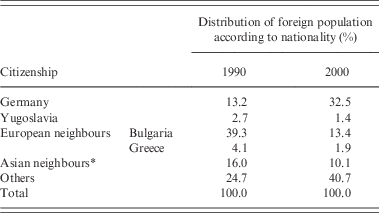
To establish that Turkish–German culture of migration, we can see how the share of Germans and German-born people within the overall foreign population in Turkey has grown over time. Table 1 shows the distribution of immigrant nationalities in Turkey through the 1990 and 2000 censuses. Those who were born in Germany and/or German citizens constituted the largest group in Turkey’s immigrant population. Their share grew from 13% to over 32% in a decade, which can also be partly credited to an emerging culture of migration. In an earlier analysis of the data from the 1990 and 2000 Turkish censuses, movers from Germany are classified by using four variables: citizenship,47 birth place, residence place five years prior to the census day and the current place of residence. A wide array of groups was found to exist in Turkey; including German retirees, returnee first-generation Turkish migrants, second-generation Turks moving to Turkey, long-term holiday makers, German contractors in Turkey, expats, and various categories of short and long-term visitors. Such variety in groups of movers, we believe, results from a culture of migration. Hence, the size of these ‘Germany-linked populations’ has increased from about 306,780 in 1990 to over 400,000 in 2000.Reference Zeyneloglu and Sirkeci48
Foreign citizens in Turkey, 1990, 2000 (de facto population aged 5 and over).

Source: TurkStat 1990 and 2000 Censuses.
* Syria, Iraq, Iran, Azerbaijan, Armenia and Georgia.
Conclusion
In this paper, we have reflected on the current migration scholarship in terms of conceptual models and offered a conceptual framework built upon the culture of migration and conflict model of migration. Then, within this framework, we have offered a brief narrative of Turkish migration focusing on migratory flows between Turkey and Germany.
A conflict-based understanding of population movements is useful to capture the dynamic nature of these flows. When placed within a culture of migration perspective, conflicts and their reflection in perception (i.e. perception of an environment of human insecurity) are correlated with human mobility. Conflicts and insecurity are defined in a broad sense and placed on two parallel continua. This also allows us to link internal and international moves. The culture of migration perspective draws upon the cumulative causation model where, over time, past migration experiences make migration a favourable strategic option for individuals, families and communities. We have also suggested the use of ‘mobility’, ‘movement’, and ‘movers’ instead of ‘migrants’ and ‘migration’ to emphasise the dynamic nature of human mobility while also distancing from negative connotations attributed to the current terminology of ‘migrant’, ‘immigrant’ and ‘migration’.
Turkish migration has revolved around numerous conflicts since the 1910s, and the flows of Muslim and non-Muslim populations to and from Anatolia have continued until the present. Most migration from Turkey targeted Europe and particularly Germany, where sizeable Turkish and Kurdish communities emerged since the 1960s. The increasing interactions of Germans and Turks contributed to the growth of a culture of migration that transcended both countries and linked populations. The outflows from Turkey to Europe since the 1980s were dominantly characterised by the Kurdish conflict but also earlier outflows can be linked to other significant conflicts in the history of modern Turkey. The current crisis in Syria has potentially created a new culture of migration: based upon Turkish-Syrian links and flows. The 2000 Turkish Census reported only 766 Syrian citizens present in Turkey. However, the arrival of over 2.5 million Syrians between June 2011 and January 2016 has changed the Turkish migration geography drastically. Suddenly, the largest immigrant minority in the country became Arabic speaking Syrians. The growth in numbers of immigrants from countries other than Syria also continues. Hence, at the eastern borders of the European Union, Turkey can be seen as an emerging immigration country that plays a key role within the overall spectrum of European migration regime.
Jeffrey H. Cohen is Professor of Anthropology at Ohio State University, Columbus, Ohio, USA. He is founding co-editor of Migration Letters journal. His work focuses on three primary areas: migration, development and nutrition/food. His ongoing studies of economic change, mobility and the outcomes of migration in rural communities in Oaxaca, Mexico, have been supported by the National Science Foundation and the Fulbright programme among other granting agencies and appear in many articles as well as his books: Cooperation and Community: Economy and Society in Oaxaca (1999); and The Culture of Migration in Southern Mexico (2004), The Cultures of Migration: The Global Nature of Contemporary Mobility (2011) written with Ibrahim Sirkeci and named an outstanding book for 2012 by Choice Reviews.
Ibrahim Sirkeci is Ria Financial Professor of Transnational Studies and Marketing and the Director of Regent’s Centre for Transnational Studies at Regent’s University London, UK. Sirkeci studied Political Science, Demography, and Geography. He holds a PhD in Geography from the University of Sheffield (UK) and a BA in Political Science and Public Administration from Bilkent University (Turkey). Prior to his current position he worked at the University of Bristol. Ibrahim Sirkeci specialises in population studies with a focus on migration and transnational movements. He is founding co-editor of Migration Letters journal and Göç Dergisi. He is the author of Transnational Marketing and Transnational Consumers (Springer, 2013), Migration and Remittances during the Global Financial Crisis and Beyond (World Bank, 2012 with J. Cohen and D. Ratha), and Cultures of Migration, the Global Nature of Contemporary Mobility (University of Texas Press, 2011 with J. Cohen).