Hypoplastic left heart syndrome is a serious CHD, and in the past comfort care was the only option. In the recent era, dramatic changes have occurred in the diagnosis, management, and outcomes of this condition. Current expectations are that 70% of infants born with hypoplastic left heart syndrome will reach adulthood.Reference Feinstein, Benson and Dubin 1 In spite of this more optimistic perspective, these children remain at risk of mortality. These factors include a long stay in intensive care,Reference Namachivayam, d’Udekem, Millar, Cheung and Butt 2 microcephaly,Reference Hangge, Cnota and Woo 3 mitral stenosis, and aortic atresia.Reference Furck, Uebing and Hansen 4 Although survival rates are much improved, these patients can develop serious complications, including neurological deficits across a wide spectrum of domainsReference Bordacova, Docolomanska and Masura 5 – Reference Newburger, Sleeper and Bellinger 8 with impaired neurological development, particularly in language.Reference Gunn, Beca and Hunt 7 In addition to microcephaly,Reference Hangge, Cnota and Woo 3 particular risk factors for neurological difficulties include adverse clinical phenomenon and residual, specific cardiac difficulties,Reference Bordacova, Docolomanska and Masura 5 time spent on mechanical ventilation, and other clinical and socio-economic factors in parents.Reference Newburger, Sleeper and Bellinger 8
As clinical care and research continue to evolve, there is a growing interest in the psychological experiences of parents of children with heart disease,Reference Re, Dean and Menahem 9 so that clinicians can better support these parents, and because a parent’s mental health is a key determinant of the mental health of a child over the long term.Reference Hammonds 10
Parents of children born with a CHD contend with many difficulties. They experience many stressors, including social isolation,Reference Lawoko and Soares 11 and have anxiety, particularly at times of surgery.Reference Menahem, Poulakisb and Prior 12 These parents may deal with grief for their “lost child” with no disability, as found in other studies of parents of children with disabilities,Reference Bruce and Schultz 13 – Reference Upham and Medoff-Cooper 15 or they may be prone to “non-finite loss”,Reference Bruce and Schultz 13 where losses continue to emerge over time. Both the parents and the child are at risk of unstable mental health as demonstrated by a study that examined the child and the mother at intervals of 6, 18, and 36 months after birth.Reference Landolt, Ystrom, Stene-Larsen, Holmstrøm and Vollrath 16 Parents are also prone to traumatic stress if they have a child with a CHDReference Re, Dean and Menahem 9 and or where a child has been admitted to an ICU.Reference Cantwell-Bartl and Tibballs 17 Traumatic stress is a risk factor for psychological complications including depression, eating disorders, addictions, and suicide. 18 Distress in these parents may also contribute to later psycho-emotional issues in the child.Reference Re, Dean and Menahem 9
The psychological and the social experience of parents of children with hypoplastic left heart syndrome have not been widely studied. We have published our data previously and linked it to the parents’ experiences at the time of diagnosis,Reference Cantwell-Bartl and Tibballs 19 as well as within the paediatric ICU.Reference Cantwell-Bartl and Tibballs 17 We found that parents live with stress, loss, and traumatic stress but they also use strategies to adapt at these periods. In this article, we link the data to the parents’ experiences at home with their child.
After discharge from hospital, parents of children with hypoplastic left heart syndrome are charged with the responsibility of care of their child, with minimal support and guidance from professionals.Reference Rempel, Ravindran, Rogers and Magill-Evans 20 These parents become vigilant about the child’s health with some parents reporting excessive vigilance.Reference Meakins, Ray, Hegadoren, Rogers and Rempel 21 Parents adapted by attempting to treat their child as a “normal” child without a disability,Reference Lee and Rempel 22 , Reference Rempel and Harrison 23 and they have felt both optimism and vulnerability, while marvelling at the child’s survival.Reference Lee and Rempel 22 These results concur with other studies of parents of a child with hypoplastic left heart syndrome that found parental adjustment,Reference Rempel, Ravindran, Rogers and Magill-Evans 20 , Reference Lee and Rempel 22 – Reference Rempel, Harrison and Williamson 24 coping strategies,Reference Rempel, Ravindran, Rogers and Magill-Evans 20 , Reference Lee and Rempel 22 – Reference Rempel, Rogers, Ravindran and Magill-Evans 26 and joy in the child.Reference Lee and Rempel 22 , Reference Rempel, Harrison and Williamson 24 These studies have demonstrated that in spite of the difficulties in supporting these children parents have recovered with some parents even finding new wisdom.Reference Pelchat, Levert and Bourgeois-Guérin 27
It is important to explore the longer-term experiences of these parents so that clinicians can support them and assist parents in supporting their child. No studies have considered mixed methods – psychological tests and interviews – to examine this phenomenon, and a study of this type will provide more in-depth information about their experiences at home. To date, studies have focussed only upon the experiences of younger children with hypoplastic left heart syndrome.Reference Cantwell-Bartl and Tibballs 17 , Reference Cantwell-Bartl and Tibballs 19 , Reference Rempel, Ravindran, Rogers and Magill-Evans 20 , Reference Lee and Rempel 22 – Reference Rempel, Harrison and Williamson 24 , Reference Rempel, Rogers, Ravindran and Magill-Evans 26
Methods
Design and participants
This mixed methods study combined retrospective narrative and semi-structured interviews, with psychometric testing of 29 parents: 16 mothers and 13 fathers whose children had been discharged home. Potential participants were identified from paediatric ICU records of infants who had undergone a stage I (Norwood) repair for hypoplastic left heart syndrome and had been treated in a tertiary hospital and resided in the state of Victoria, Australia. Parents were invited to take part in the study by letter and subsequently by telephone, if they had not responded. Among them, six couples decided not to participate, two fathers were not involved with the child and were not interviewed, and one father declined to be interviewed “because it would be too emotional”. Consent included permission to audio-tape interviews. At the time of the study, all children had been discharged home. Approval for this study was granted by the Institutional Human Research Ethics Committee.
Interviews
Parents were interviewed once at the location of their choice by the first investigator, a psychologist, who had not been involved in the care of the infants or their parents. Interviews explored stressors, traumatic stress, losses, adaptation of the parents, and their relationship with their infant at key time periods in the child’s treatment trajectory: diagnosis, paediatric ICU, hospital, and at home.
Separate interviews of mothers and fathers were planned as a first preference, with a joint interview as a second preference. Most parents were interviewed separately but some were interviewed together, particularly if English was their second language.
The instruments
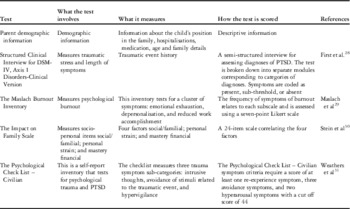
The parents were asked for demographic information about their child’s position in the family, details of hospitalisations, medication, age and family details, and socio-economic information. In addition, we carried out psychosocial testing of these parents: Structured Clinical Interview for DSM-IV, Axis 1 Disorders-Clinical Version,Reference First, Spitzer, Gibbon and Williams 28 The Maslach Burnout Inventory,Reference Maslach, Jackson and Leiter 29 The Impact on Family Scale,Reference Stein and Riessman 30 and The Psychological Check List – Civilian.Reference Weathers, Litz, Herman, Huska and Keane 31 These tests are summarised in Table 1.
Summary psychosocial testing of parents whose child has hypoplastic left heart syndrome.

PTSD=post-traumatic stress disorder
Results
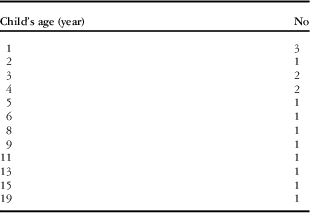
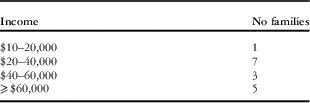
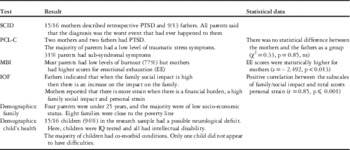
Demographic data and the results of the psychosocial tests are described in Table 4. Table 2 indicates the ages of children. Table 3 describes the parents’ level of income.
Children’s ages and categories of ages.

n=16
Family’s level of income ($AUD).

n=16
Interview results
Losses
In all, 28 parents spoke about one or more experiences of loss, emanating from the time of the diagnosis. Among them, eight parents spoke about the child’s developmental delay. Other losses were the realisation of the child’s restricted capacities and two parents spoke about the “lost child” that they had imagined – for example,
I always thought that we would have a normal child and that we could play footy together … that is something a father and a son should do.
A mother spoke about her grief that her daughter had bypassed many of the “normal joys of childhood” because her daughter’s life was consumed by so many professional visits. Further, six parents talked about inadequate family support, including their emotional isolation, and two mothers mentioned that their immediate family had withdrawn in fear that the child could die. Other losses involved a lack of community support, restricted work opportunities, and social withdrawal by friends. Health problems emerged in some parents, and three parents talked of their physical breakdown; one father seemed to have a particularly high risk of illness related to the impact of his child’s condition:
I’ve got high cholesterol and high blood pressure but I can’t afford the tablets. When we get our finances a bit better, I’ll probably be able to take them again but we have to pay so much money for our child’s medication.
Furthermore, six parents said that they were taking or had taken anti-depressants, and one father said:
I used to be a happy go lucky person ten years ago but my child’s heart defect has turned me into an alcoholic and a heavy smoker.
Stressors
It was noteworthy that there were many unfolding stressors for these parents, and all but one spoke about these. The main stressor mentioned by 15 parents was worry about their child’s health: “I’m always watching to make sure she is alright”. There were difficulties related to the demands of care, including a child that needed nasogastic feeding for 12 months and worry expressed by two parents from rural areas that the local hospital was inadequate in supporting the child. Other worries involved the child’s nutritional status or a fear that their child would die imminently – for example, a mother said:
I don’t know what the future will hold for us. Sometimes when he is sleeping I wake up and I check him to see if he is still alive … I wonder whether he will make it through the night.
Among all, seven parents spoke of their ongoing financial stress. Some parents seemed to be living with significant traumatic symptoms. For example:
My brain goes numb and stops me thinking about certain things … just so you can keep going … but then something triggers it off, like hearing an ambulance siren, it sends me into a spin and I feel anxious all day, and I think what if my boy doesn’t make it (dies).
Furthermore, four parents described traumatic flashbacks stemming from the hospital experience.
Adaptation, recovery, resilience, and bonding
The majority of parents were doing well. Most parents were delighted and grateful to have their child at home – “When he first came it was a wonderful, wonderful day”; eight parents spoke about the flourishing of intimacy at home and the growth of bonding with the child – for example, a mother said, “finally she was mine”.
This gratitude was accompanied by joy and the wonder at the child’s survival. Another father said that when he felt sad and worried about his child he told himself, “Don’t let yourself get worried or sad because (after all) you have your baby”. Parents were assisted by professional, family, and community supports; four parents said that their religious practices helped them. These external sources seemed to assist parents to build their own resources.
Parents called upon inner resources, and there were 37 responses that described adaptation and strength. By far, the most common strategy reported by 18 parents was treating the child as a normal part of the family because as one father said, “You can’t wrap them in cotton wool”. Further, two mothers spoke about looking after their child in honouring the surgeon’s work – for example, “I’m only looking after what is his”, and a mother said she wanted to do her best because “the surgeon had done his best”. Other parents spoke about thinking positively. For example:
I try to find positive information like I don’t want to read stories about children dying with this condition because it is not going to do him any good.
Another father said that he blocked out negative thoughts about what could go wrong with his child. Another mother who was conscious of her child’s limited life capacity said:
Even if I had him for a little while, I thought it was better to have him for that amount than not to have him at all.
Other parents did not talk about being positive, but expressed positive thoughts – for example, a mother said that when life was hard she said to herself:
Just hold on and it’s going to pass. A rainbow will come.
In addition, three parents said that they wanted to respect what life had given them no matter what the outcome. Only a few parents spoke about personal strength or confidence but many parents inferred this. The parents’ strength was likely to be related to their passionate desire to protect the life of their child.
Growth in wisdom
Only four mothers spoke about personal growth and compassion – for example:
Your life has certainly changed and it won’t ever be the same again. But I’ve learnt a lot of positive things out of it as well. I mean that you learn that you can help other people. I am stronger and I wouldn’t change any of our decisions.
Another mother said, “You learn to value life”. Another mother said that she had always been compassionate, but her child’s hypoplastic left heart syndrome focussed on the significance of compassion for others, and one mother said that she had learnt different priorities in living and not to take life for granted. A father echoed these thoughts and said that he had learnt not to be complacent about life, and a mother said that she had become much more appreciative of her family and of the simple joys in the day. She said, “I say goodnight thinking that it’s fantastic that we’ve had another day. You know that’s great”.
Discussion
Most parents spoke about their delight that their child was at home and freed from the constraints of the institution. It was within home that the bond between them seemed to grow into a more robust relationship, although some parents had become increasingly attached to their child while in the hospital.Reference Rempel, Ravindran, Rogers and Magill-Evans 20
Parents combined experiences of stress, commitment, and love in supporting their child with hypoplastic left heart syndrome. This stemmed from their bonding as they learnt to care for and be watchful over their child, with minimal guidance from health professionals, while at the same time attempting to give their child a “normal” life.Reference Rempel, Ravindran, Rogers and Magill-Evans 20 , Reference Lee and Rempel 22 , Reference Rempel, Rogers, Ravindran and Magill-Evans 26 , Reference Pelchat, Levert and Bourgeois-Guérin 27 The objective measure of mastery and personal achievement indicated that parents had done well and had become experts in their child’s care.Reference Rempel, Ravindran, Rogers and Magill-Evans 20 , Reference Lee and Rempel 22 – Reference Rempel, Harrison and Williamson 24 They used strategies to protect themselves against worry and engaged in positive thinking.Reference Lee and Rempel 22 , Reference Rempel, Harrison and Williamson 24 For many parents, the seeds of this adaptation began around the time of the diagnosis and built over time, especially when the child was discharged, when parents found further personal resources. After discharge, the parents’ stress levels were lowered, and most parents considered that they were “ordinary” parents with “ordinary” children. Intimacy with the child grew when away from the hospital and some parents said that their decision to have more children assisted this phenomenon of normalisation. These results concur with the findings of other studies of parents of children with hypoplastic left heart syndrome, where parents combined normalisation and adaptation and adjusted to their child’s condition.Reference Rempel, Ravindran, Rogers and Magill-Evans 20 , Reference Lee and Rempel 22 , Reference Rempel and Harrison 23 in the context of uncertainty.Reference Rempel and Harrison 23 Clinicians need to note the resilience of parents.
Another study on parents of children with hypoplastic left heart syndrome had described parents as being watchful for the unexpected,Reference Rempel, Ravindran, Rogers and Magill-Evans 20 and the present study confirms the results of that study, where parents reported that they could be excessively vigilant;Reference Meakins, Ray, Hegadoren, Rogers and Rempel 21 in fact, in this study, most parents were hypervigilant, which is a manifestation of traumatic stress. On the Psychological Check List – Civilian, the highest subscale scoring was for hypervigilance. It is possible that hypervigilance, although a manifestation of traumatic stress, is also adaptive, in that this level of monitoring could safeguard the child’s life. This type of arousal, however, is also psychologically and physically costly for parents, and depletes resources. As children in this study were mainly young (nine children ⩽5) (Table 2), studies in the future could test-examine how the majority of parents fare over time.
It is noteworthy, as shown in Table 4, that four parents had current post-traumatic stress disorder, and that five parents said that they had traumatic stress symptoms for 12 months or longer. Clinicians should be mindful of this possibility, particularly if the child becomes unwell or requires further surgery, when parents may become traumatically aroused. Many parents had sub-syndronal traumatic stress symptoms, and symptoms were aroused in response to stressors. These findings confer with other studies of marked distress, or of post-traumatic stress disorder in parents after their child’s treatment in the paediatric ICU.Reference Bronner, Peek, Knoester, Bos, Last and Grootenhuis 32 , Reference Colville, Darkins, Hesketh, Bennett, Alcock and Noyes 33
Results of psychosocial testing of parents whose child had hypoplastic left heart syndrome.

IOF=Impact on Family Scale; MIB=Maslach Burnout Inventory; PCL-C=Psychological Check List – Civilian; PTSD=post-traumatic stress disorder; SCID=Structured Clinical Interview for DSM-IV.
Parents lived with many stresses including the worry about their child’s possible death. The quotation of the parent who worried that her child may not make it through the night, even though her child was well, points to arousal as a consequence of trauma. Parents received little psychosocial support, and a few had experienced psychological help. Ongoing psychological help is recommended for parents who need support themselves but also because a parent’s psychological status has an impact on the child. It is recommended that clinician’s listen carefully to parents’ concerns and recognise when worries are not realistic and reassure them when the child is doing well.
Of the 16 children in the study sample, 15 (94%) had a possible neurological deficit, which is confirmation that these children are prone to neurological deficits.Reference Hangge, Cnota and Woo 3 , Reference Bordacova, Docolomanska and Masura 5 , Reference Gunn, Beca and Hunt 7 Parents spoke of their child’s delayed developmentReference Bordacova, Docolomanska and Masura 5 – Reference Newburger, Sleeper and Bellinger 8 or of learning difficulties.Reference Gunn, Beca and Hunt 7 It was significant that one mother did not understand that her child had intellectual limitations but instead thought that her child was lazy. Overall, their reactions to this “delay” was not a cause of stress for most parents in itself, rather stress was caused in dealing with the child’s learning difficulties or challenging behaviour. It was surprising that of the 16 children only three children had been IQ tested, although some children were below the age limit for this test. IQ testing is recommended, and there should be advocacy for educational and psychosocial support for these children, to support optimal growth and development. Future studies could consider the longer-term outcomes for these children related to their capacities, their schooling, and future employment possibilities.
The present study suggested that parents were inadequately prepared for understanding the outcomes of their children’s treatment and for preparation for life with a child with hypoplastic left heart syndrome, although it is possible that information was given and parents did not assimilate it. This information could be staged over time.
A high proportion of parents with children with hypoplastic left heart syndrome had below average incomes (11/15, see Table 3) and most of them were not highly educated. These parents may have chosen to continue supporting their child through pregnancy or after birth because they did not have the same expectation of high life-achievement for their child, or because they were more accepting of hardship in living; however, not all the parents had these difficulties, and the reasons for parents proceeding with treatment are complex. As the majority of parents struggled socio-economically, advocacy for financial and other supports is recommended through a multi-disciplinary framework, including social work and domiciliary home support. The impact on parents’ finances needs to be considered in future studies.
Although researchers have suggested that parents of children with hypoplastic left heart syndrome live with stress,Reference Vandvik and Førde 34 , Reference Weintraut 35 these parents actually live with unfolding and enduring stressors. The Impact on Family Scale (Table 4) demonstrated that where high stressors were present they impacted negatively on their family and social life. These stressors underline the wider difficulties in supporting a child with a serious medical condition.
There was some evidence of psychopathology including burnout, depression, alcoholism, and a physical breakdown that was attributable to stress; however, the number of parents with these was small. It is recommended that long-term psychological counselling is made available for parents after the child’s discharge when parents are dealing with many demands, exhaustion, and the possibility of social isolation.
Some parents spoke about their grief over their “lost child”. This has been observed previously in other studies of parents at the time of diagnosis of their child’s heart diseaseReference Upham and Medoff-Cooper 15 and in response to a child’s disability.Reference Bruce and Schultz 13 , Reference Harris and Winokuer 14 Grief continued to unfold in response to many losses, resulting in “non-finite loss”.Reference Bruce and Schultz 13 Health professionals should be mindful of the possibility of prolonged grieving over time, as well as waves of grief. Clinicians who have knowledge and skills pertaining to the child’s heart abnormality would benefit from learning about parental psychoeducation. This education could involve empathic communication, understanding traumatic stress and the wider parental stresses, and their patterns of grieving and resilience.
Most of the parents’ marriages remained solid, and for many parents the child’s disability was a catalyst for inner growth.Reference Pelchat, Levert and Bourgeois-Guérin 27 Although not all parents spoke of this, it was evident that a number of parents were describing post-traumatic growthReference Tedeschi and Calhoun 36 – a phenomenon in response to a traumatic event where individuals in spite of the hardships they have endured develop closer relationships, feel more connected to others, have an increased sense of strength, and a greater appreciation of life and spirituality. Health professionals should listen carefully to each parent and the likely complexity of emotions and experiences.
Some parents felt a heightened joy in their child.Reference Lee and Rempel 22 In part, they knew in all probability that the child would not have a long life, and this led to their appreciation of the child. Many parents did not speak about the child’s limited life capacity, and this was a strategy that helped them focus on the present and protected them from worry. Most parents found resources within themselves that stemmed from their desire to care for their child. Finally, future studies should consider the experiences and bereavement of parents whose children have died from hypoplastic left heart syndrome.
Conclusion
The parents’ experience in supporting a child with hypoplastic left heart syndrome at home is one of stress, of commitment, and of love. Most parents did well. Health professionals should be aware of the many demands, stressors, and grieving of these parents, as well as their resilience and commitment.
Acknowledgement
The authors wish to thank the parents of children with HLHS, the Paediatric Intensive Care Unit, Royal Children’s Hospital, the Royal Children’s Hospital library staff, Dr Martin Ryan and the Social Work Dept Melbourne University, particularly Professor Louise Harms.
Financial Support
This research received no specific grant from any funding agency, commercial, or not-for-profit sectors.
Conflicts of Interest
None.
Ethical Standards
The authors assert that all procedures contributing to this work comply with the ethical standards of the relevant national guidelines on human experimentation and with the Helsinki Declaration of 1975, as revised in 2008, and has been approved by Institutional Human Research Ethics Committee.