Child-to-Parent Violence (CPV) has attracted great interest in recent years. Although there is still insufficient data and studies on this subject, research is gradually increasing in this regard, as is its prevalence (Calvete, Orue, & Sampedro, Reference Calvete, Orue and Sampedro2011; Coogan, Reference Coogan2011).
The CPV is a type of domestic violence, and is defined as any violent behavior repeated over time, not consisting of an isolated incident, perpetrated against one or both parents or those exercising this role, in order for the minor to obtain whatever he/she wants through control and power (Aroca, Reference Aroca2010). This behavior can be physical (pushing or hitting, kicking or punching), psychological or emotional (threatening, blackmailing, insulting, breaking valuable objects belonging to the parents, intimidating, terrorizing, humiliating, shouting repeatedly) or economic (stealing money and possessions from the parents, incurring debts that parents have to confront; Ibabe, Reference Ibabe2007).
Currently, there is a shortage of data and disparity in the results regarding the prevalence and incidence of CPV behaviors (Aroca, Reference Aroca2010). These percentage differences occur because authors do not differentiate between mild or severe physical abuse or do not include the different types of CPV. Pagani et al. (Reference Pagani, Tremblay, Nagin, Zoccolillo, Vitaro and McDuff2004) found in a community sample that the prevalence of psychological CPV ranged between 45% and 65%, while physical CPV was 11% towards fathers and 13 % towards mothers. In Spain, Calvete, Orue, and Gámez-Guadix (Reference Calvete, Orue and Gámez-Guadix2013) found prevalence rates of physical CPV ranging between 4.6% and 21%, yet when they established more strict criteria to account for CPV, such as repeated commission of assaults, these CPV rates decreased to 3.2% for physical CPV and 14.2% for psychological CPV.
Another factor that explains the disparity of results in CPV studies is the size of the sample used and its origin. Thus, previous research has been based on clinical samples (e.g., Nock & Kazdin, Reference Nock and Kazdin2002; 12.2% prevalence of physical assaults), general population (Calvete, Orue et al., Reference Calvete, Gámez-Guadix, Orue, González-Diez, Lopez de Arroyabe, Sampedro and Borrajo2013; 92.7% and 10.7% prevalence of psychological and physical abuse, respectively), and, especially, forensic samples (juvenile offenders; e.g., Ibabe & Jaureguizar, Reference Ibabe and Jaureguizar2012; 67% of CPV cases consisted of physical and psychological violence, 29% only in physical violence and 4% in psychological violence).
The risk factors that may influence the commission of CPV on behalf of a minor can be divided into 3 categories: social, family and personal. In relation to the social variables, factors such as a poor community integration, frequent exposure to violence within the community or having suffered attacks by a peer group have been linked to the commission of CPV (e.g., Calvete et al., Reference Calvete, Orue and Sampedro2011; Cottrell & Monk, Reference Cottrell and Monk2004; Kennedy, Edmonds, Dann, & Burnett, Reference Kennedy, Edmonds, Dann and Burnett2010).
Regarding the family factors, the educational style is another aspect that is linked to CPV, either because families are permissive or because they exercise too much authority, including corporal punishment (Calvete et al., Reference Calvete, Orue and Sampedro2011; Calvete, Gámez-Guadix, & Orue, Reference Calvete, Gámez-Guadix and Orue2014; García-Linares, García-Moral, & Casanova-Arias, Reference García-Linares, García-Moral and Casanova-Arias2014). Other family factors which have been associated with CPV are single parent families, receiving less emotional support, supervision and cognitive stimulation, the quality of the family environment or the exposure to violent behavior between spouses (Aronson & Huston, Reference Aronson and Huston2004; Calvete et al., Reference Calvete, Gámez-Guadix and Orue2014; Ibabe & Jaureguizar, Reference Ibabe and Jaureguizar2012; Ibabe, Jaureguizar, & Bentler, Reference Ibabe, Jaureguizar and Bentler2013a; Ibabe, Jaureguizar & Bentler, Reference Ibabe, Jaureguizar and Bentler2013b; Jaureguizar & Ibabe, Reference Jaureguizar and Ibabe2012). It has also been argued that alcohol and drug abuse by parents may be associated with their children’s tendency to carry out violent behaviors towards them. According to Ibabe, Jaureguizar, and Díaz (Reference Ibabe, Jaureguizar and Díaz2007), substance abuse by parents could cause inconsistency or high levels in the application of discipline (especially physical), which would increase the risk of confrontation with the child and an escalation of violence. However, to date very few studies have examined this relationship. In this line, Pagani et al. (Reference Pagani, Tremblay, Nagin, Zoccolillo, Vitaro and McDuff2004) found that among parents suffering from substance abuse, 70% of their teenage children had committed physical violence towards them.
In reference to personal factors, studies have found that perpetrators have a number of psychological characteristics in common, such as low self-esteem, anxiety, depression or personality disorders, a low level of school education and a low motivation and commitment to such education (e.g., Contreras & Cano, Reference Contreras and Cano2015; Ibabe & Jaureguizar, Reference Ibabe and Jaureguizar2012; Ibabe et al., Reference Ibabe, Jaureguizar and Bentler2013b; Romero, Melero, Cánovas, & Antolín, Reference Romero, Melero, Cánovas and Antolín2005; Silva, Garrido, & López, Reference Silva, Garrido Genovés and López Latorre2012). Some studies have also found that children who commit CPV have higher levels of aggressiveness and low frustration tolerance (Nock & Kazdin, Reference Nock and Kazdin2002). In relation to alcohol and drug consumption, contradictory results have been found. Certainly, many of the studies have found a link between consumption and CPV (Calvete et al., Reference Calvete, Orue and Sampedro2011; Calvete, Orue, & Gámez-Guadix, Reference Calvete, Orue and Gámez-Guadix2015; Contreras & Cano, Reference Contreras and Cano2015; Cottrell, Reference Cottrell2001; Ibabe et al., Reference Ibabe, Jaureguizar and Bentler2013a). For example, Calvete et al. (Reference Calvete, Orue and Gámez-Guadix2015) conducted a longitudinal study with a sample of 981 adolescent high school students. These authors found that substance abuse predicted both the subsequent psychological CPV in boys and girls, and the physical CPV committed by boys. However, other studies have not found this relationship. For instance, Routt and Anderson (Reference Routt and Anderson2011) found that only one-fifth of the perpetrators had a problematic use of these substances. It is possible that, as in the case of violence of parents towards their children, the consumption of alcohol and drugs by the perpetrator of CPV is not an etiologic factor in this type of violence but it does increase the severity with which this behavior is performed.
In relation to personal factors of the aggressor, Lozano, Estévez, and Carballo (Reference Lozano, Estévez and Carballo2013) conducted a study with a sample of 255 adolescents, aged between 12–18 years, where they analyzed the relationship between child-parental violence and individual variables such as psychological distress, empathy, loneliness feelings, depressive symptomatology, alexithymia, perceived stress, self-concept, and drug abuse. Their results showed that the CPV towards the mother occurs more frequently than towards the father, that girls resource more to psychological violence whereas boys resource to physical violence, and that both resource equally to economic violence. The individual factors such as loneliness, depressive symptomatology, level of life satisfaction, psychological distress, empathy, difficulty in expressing emotions and drug consumption correlated with the existence of CPV.
Among the personal variables, another psychological factor that has been associated with CPV has been the impulsiveness of the minor. Both, Calvete et al. (Reference Calvete, Orue and Sampedro2011) and Contreras and Cano (Reference Contreras and Cano2015) found a relationship between elevated levels of impulsiveness and the commission of violence towards parents. However, in previous studies, impulsiveness has been analyzed in a global manner, without taking into account that it is a multifactorial construct, and that, as Stanford et al. (Reference Stanford, Mathias, Dougherty, Lake, Anderson and Patton2009) recommended, it should be analyzed as such. In addition, these studies have not specifically examined the differences in the role of impulsiveness on the commission of CPV by boys and girls independently, also having studied aggression globally, without distinguishing between violence towards the father or the mother.
Impulsiveness is defined as a predisposition to perform quick and non-reflective actions in response to external and/or internal stimuli despite the negative results that such actions could have on both, itself and other parties (Barratt, Stanford, Kent, & Felthous, Reference Barratt, Stanford, Kent and Felthous1997). Patton, Stanford, and Barratt (Reference Patton, Stanford and Barratt1995) distinguish between three dimensions of impulsiveness: attentional (characterized by an inability to sustain attention and cognitive instability), motor (on motor activation and lack of perseverance) and lack of planning (lack of self-control and difficulties in tasks requiring cognitive complexity). In previous research, for example, a high impulsiveness of the CPV aggressor has been identified with a lack of self-control. However, this deficit in self-control would only correspond to a specific type of impulsiveness (lack of planning). Therefore, as impulsiveness has not been studied as a multidimensional construct, it is not possible to determine the actual role of self-control in CPV.
The present study focuses on the role of the minor’s impulsiveness in the commission of CPV. Specifically, this study aims to verify whether attentional, motor or lack of planning impulsiveness predicts psychological, physical, economic and total violence, both towards the father and the mother. To this end, variables such as age and sex of the child, his/her interest towards studies, and his/her drug or alcohol consumption will be monitored. Furthermore, excessive alcohol consumption and drug use by parents will also be monitored, which, in contrast with the minor’s drug consumption habits, has been much less studied. We hypothesized that high scores on attentional, motor and lack of planning impulsiveness would relate to higher levels of psychological, physical, economic and total violence, both towards the father and the mother. Secondly, this study will examine whether an interaction between impulsiveness and sex of adolescents exists, in order to check whether this impulsiveness has a greater predictive power over the total CPV in boys than in girls, or vice versa. Moreover, we expected to find a difference between boys and girls regarding the intensity of the relationship between impulsiveness and CPV, although we have not proposed any specific hypotheses on this fact.
Method
Participants
The sample of this study consisted of 934 participants (438 boys and 496 girls), aged between 13 and 21 years (M = 16.07; SD = 1.33), from 11 randomly selected secondary school in the South of Spain. Students were enrolled in 3rd, 4th, 5th and 6th year of Secondary Education, and in Vocational Training.
The vast majority of participants (90.5%) were of Spanish nationality. The parents of teenagers were mostly Spanish (84.7% of fathers and 85.1% of mothers). The parents of 70.7% of the adolescents were married, 20% were separated, 4% were cohabiting without being married and 1.9% were single, while 2.5% of households had one parent who had died.
Regarding the educational level of the mothers of the adolescents, 8.9% had no primary education, 38.8% had primary education, 15.3% had secondary level education, 19.3% had vocational training and 16.8% had university studies. As for the fathers, 10% did not have primary education, 40.1% had primary education, 14.3% had secondary level education, 17.7% had vocational training and 15.4% had university studies. Furthermore, 3.7% and 1.1% of fathers of the adolescents in this study had serious physical and mental illnesses respectively, while 4.8% and 1.1% of mothers had physical and mental illnesses.
Instruments
In order to collect the socio-demographic data of the participants, a set of questions relating to the city of origin, sex, age, and drug and alcohol consumption habits of the participants were posed, as well as another set of questions about the country of origin of the father and mother, their alcohol and drug consumption habits, educational level and marital status. Regarding the consumption of alcohol and illegal drugs by the participant, he/she was asked about their type of intake, whether present or past; whereas regarding the consumption of parents, participants were asked about the excessive intake of alcohol or any intake of drugs, whether present or past. On the other hand, the importance participants allocated towards their studies was assessed through 5 questions, answered through a Likert scale ranging from 1 to 5 (e.g., “Education is so important that it is worth putting up with things I don’t like for my studies”). The Cronbach’s alpha coefficient for this scale was .68.
Barratt Impulsiveness Scale (BIS-11; Patton et al., Reference Patton, Stanford and Barratt1995)
It evaluates the presence of a pattern of impulsive behavior maintained over time. In the present study, the Spanish adaptation by Oquendo et al. (Reference Oquendo, Baca-García, Graver, Morales, Montalvan and Mann2001) was used. It is a clinical scale of traits composed of 30 items with a Likert response format (“1 = Rarely / Never, 2 = Occasionally, 3 = Often, 4 = Almost always / Always"). This scale provides information about three dimensions of impulsiveness: attentional impulsiveness (e.g., “Often, when I’m thinking, I have irrelevant thoughts”), motor impulsiveness (e.g., “I act in response to impulses”) and lack of planning impulsiveness (e.g., “I say things without thinking”). The alpha coefficient of the scale in this study was .75, with the coefficients for the different subscales being .64 for attentional, .71 for motor and .67 for lack of planning.
Child-to-Parent Aggression Questionnaire (CPAQ; Calvete, Gámez-Guadix et al., Reference Calvete, Gámez-Guadix, Orue, González-Diez, Lopez de Arroyabe, Sampedro and Borrajo2013)
The CPAQ evaluates CPV through 20 parallel items: 10 in reference to the mother and another 10 in reference to the father. In each block of items, 7 items describe attacks of a psychological type (e.g., “You have blackmailed your mother/father to get what you want”), while the other 3 items describe physical attacks (e.g., “You pushed or struck your mother/father in a fight”). Participants had to indicate how often they had committed such behavior against their mother or their father during the past year, using a Likert scale ranging from 0 to 3: 0 (“Never”), 1 (“It has occurred once or twice”), 2 (“It has occurred between 3 and 5 times”) and 3 (“It has occurred 6 times or more”). The item “You have taken money from your father/mother without permission”, originally part of the Psychological Aggression Scale, was analyzed independently in order to assess the existence of economic violence. On the other hand, a new item was added to the psychological CPV scale: “You have broken valuable and precious objects belonging to your father/mother with intent to annoy them”. The Cronbach’s alpha coefficients in this study were .73 and .74 for psychological CPV, .70 and .74 for physical CPV, and .76 and .77 for total CPV towards fathers and mothers respectively.
Procedure
First, permission was sought from the different schools in order to administer the survey within them. In each center, a first contact with the Guidance Department was carried out in order to communicate the nature and objectives of the research, subsequently applying to the School Board through such Department for the necessary permits. All centers that were offered the opportunity to collaborate in this research responded affirmatively. The questionnaire was applied in 11 public schools in southern Spain.
The children were informed that participating in the study was completely voluntary and anonymous. The confidentiality of data was guaranteed by assigning a numerical code to each questionnaire. Only a 1.64% of the total sample did not complete the questionnaires, for various reasons such as being foreign and not understanding Spanish correctly, refusing to complete it or not filling it out completely. These questionnaires were discarded from the final sample. Once the questionnaires were completed, the authors proceeded to perform in each one of the classrooms a conference on all topics covered in the investigation, in which all the participants’ doubts were resolved.
This study has not used an exclusionary criterion for assessing the existence of CPV. It has evaluated CPV in the form of a scale without using a specific cutoff point by which the frequency with which children perform aggressive behavior towards their parents was assessed. The objective of this was to take into account all the answers to the CPV scale, both those of low and high incidence.
The ex post facto statistical analyzes of this study were conducted using the SPSS statistical package (Statistical Package for Social Sciences) version 20. Analyses of hierarchical multiple linear regression were used (with a probability of entry for F of p = .05) in order to analyze both the relationship between impulsiveness and CPV and the moderating role that the participant’s sex can have on the relationship.
Following the standard protocol (Cohen & Cohen, Reference Cohen and Cohen1983), centered scores were used in order to avoid collinearity issues. The interaction analyses were carried out through Aiken and West’s (Reference Aiken and West1991) procedure. Two analyses of hierarchical multiple regression were conducted to test the hypothesis that the relationship between the impulsiveness scales and the total CPV towards the father and the mother vary according to the sex of the participant.
Results
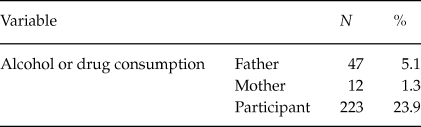
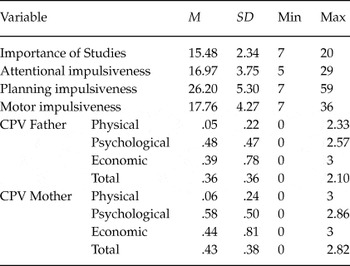
Tables 1 and 2 show the descriptive data of the different impulsiveness scales, the CPV modalities (physical, psychological, economic and total), the consumption of alcohol and drugs and the importance allocated to studies. The percentage of participants with a 0 score in CPV was as follows: 15.6% and 8.5% in psychological CPV towards the father and the mother respectively, 91.8% and 90.5% in physical CPV, 76.3% and 73.1% in economic CPV and 14.8% and 8% in total CPV towards the father and mother respectively.
Alcohol and drug consumption by the father, the mother, and the participant

Importance allocated to studies, impulsiveness, physical, psychological, economic, and total child-parent violence towards the father and the mother

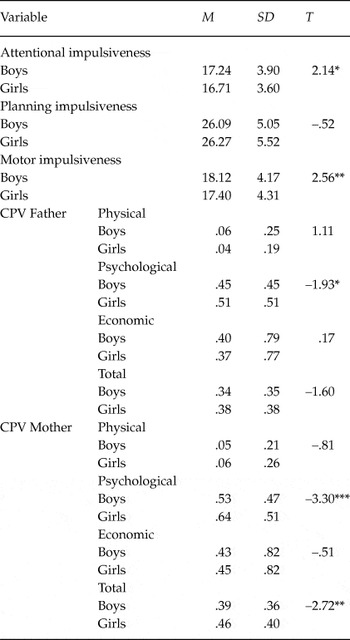
Firstly, a Student t test was performed to compare the mean scores of boys and girls in the different variables of impulsiveness and CPV (Table 3). With regard to impulsiveness, a significantly higher average score was found for boys in attentional and motor impulsiveness. In relation to CPV, results showed higher scores for girls in psychological CPV towards parents, as well as in total CPV towards the mother.
Means comparison between boys and girls in Impulsiveness and Child-parent Violence

Afterwards, the correlations between the 3 impulsiveness subscales were calculated. The correlation of the attentional impulsiveness scale with the lack of planning impulsiveness was r = .263, p < .001, while with the motor impulsiveness it was r = .437, p < .001. The correlation between lack of planning impulsiveness and motor impulsiveness was r = .429, p < .001.
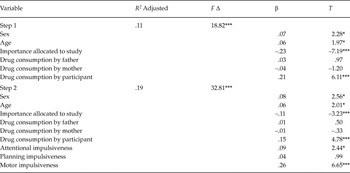
In order to analyze the variables predicting CPV, 8 multiple linear stepwise regression analyses were performed, changing only the dependent variable (total psychological, physical and economic CPV, both towards the father and the mother). In a first step, the following control variables were introduced: sex, age, importance allocated to studies, consumption of alcohol or drugs by the father, the mother or the participant. In order to test the hypothesis that impulsiveness is related to the commission of CPV, the three impulsiveness variables of Barratt’s model (attentional, lack of planning and motor) were introduced into a second step.
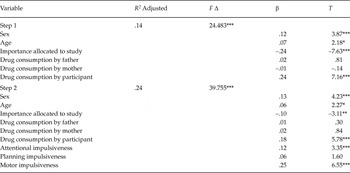
The regression model obtained for the total CPV towards the father, with an adjusted R 2 = .19 (Table 4) showed that this type of violence was positively related to the female gender β = .08 , p < .01, to age β = .06, p < .05, to drug consumption by the participant β = .15, p < .001, to attentional impulsiveness β = .09, p < .05, and especially to motor impulsiveness β = .26, p < .001, and negatively with the importance allocated to studies β = –.11, p < .001. No association between total CPV towards the father and drug consumption by the parents was found, or with lack of planning.
Multiple hierarchical linear regression analysis of the total child-parent violence towards the father, taking into account variables such as age, sex, importance allocated to studies, drug or alcohol consumption and impulsiveness

* p < .05. **p < .01. ***p < .001.
With respect to the total CPV towards the mother, the regression model showed, with an adjusted R 2 = .24 (Table 5), that this violence was predicted by the female sex β = .13, p < .001, the age β = .06, p < .05, the importance allocated to studies β = –.10, p < .01, drug consumption by the participant β = .18, p < .001, attentional impulsiveness β = .12, p < .001, and motor impulsiveness β = .25, p < .001. No association between total CPV towards the mother and the drug consumption by the father or mother was found or with the lack of planning.
Multiple hierarchical linear regression analysis of the total child-parent violence towards the mother, taking into account variables such as age, sex, importance allocated to studies, drug or alcohol consumption and impulsiveness

* p < .05. **p < .01. ***p < .001.
Regarding psychological violence towards the father, results showed that it was predicted by female sex β = .09, p < .01, the participant’s age β = .07, p < .05, the importance allocated to studies β = –.09, p < .01, drug consumption by the participant β = .14, p < .001, attentional impulsiveness β = .08, p < .05, and motor impulsiveness β = .25, p < .001, with these variables explaining 17% of its variance.
In the case of psychological CPV towards the mother, a significant relationship with female gender β = .14, p < .001, age β = .08, p < .05, the importance allocated to studies β = –.09, p < .01, drug consumption by the participant β = .17, p < .001, attentional impulsiveness β = .11, p < .001, and motor impulsiveness β = .23, p < .001 was obtained. This model predicted 21% of the variance in psychological CPV towards the mother.
The regression model obtained for physical CPV towards the father, with an adjusted R 2 = .04, showed that this variable was predicted only by motor impulsiveness β = .13, p < .01. In the case of physical CPV towards the mother, it was found that, with an adjusted R 2 = .05, this variable was predicted only by the importance allocated to studies β = –.08, p < .05, drug consumption by the participant β = .08, p < .05, and motor impulsiveness β = .10, p < .05.
With regard to economic CPV towards the father, a regression model with adjusted R 2 = .13 was obtained, where the CPV was predicted by the importance allocated to studies β = –.11, p < .01, drug consumption by the participant β = .15, p < .001, attentional impulsiveness β = .08, p < .05, and motor impulsiveness β = .14, p < .001.
Finally, the regression model obtained for economic CPV towards the mother with an adjusted R 2 = .16, showed that this type of violence is predicted by the importance allocated to studies β = –.08, p < .05, drug consumption by the participant β = .15, p < .001, attentional impulsiveness β = .08, p < .05 and, especially, motor impulsiveness β = .21, p < .001.
The False Discovery Rate correction (Benjamini & Hochberg, Reference Benjamini and Hochberg1995) was applied to the F values of the eight regression analyses corresponding to the eight types of CPV, in order to reduce the Type 1 errors. After applying such correction, all regression models remained as significant at p < .001.
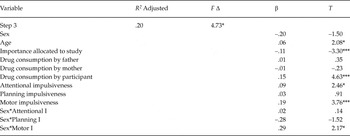
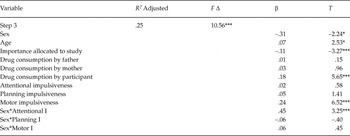
To test the hypothesis that the relationship between impulsiveness and total CPV towards the father and the mother vary according to sex of the participant, two hierarchical multiple regression analyzes were performed. The existence of a moderation relationship is demonstrated by the existence of a significant interaction between the proposed moderator (sex of participant) and the independent variables (attentional impulsiveness, lack of planning and motor impulsiveness) using the total CPV towards the father and the mother as dependent variables. In two of the multiple hierarchical regressions (one for total CPV towards the father and another for CPV towards the mother), the control variables (sex, age, importance of studies, drug consumption of father, mother and participant) were introduced in a first step, the three impulsiveness variables (attentional, lack of planning and motor) in a second step, and the interactions (the products of multiplying each of the 3 impulsiveness variables by the sex of the child) in a third step.
In reference to the total CPV towards the father (Table 6), when the interactions of impulsiveness with sex of the child were introduced as predictors, the existence of an interaction between motor impulsiveness and sex β = .29, p < .05, R 2 Adjusted Δ = .01 was found. Finally, with respect to the total CPV towards the mother (Table 7), an interaction between attentional impulsiveness and sex of the child β = .45, p < .001, R 2 Adjusted Δ = .01 was obtained.
Interaction between sex and impulsiveness in total child-parent violence towards the father

Note: Steps 1 and 2 are shown in Table 3.
* p < .05. **p < .01. ***p < .001.
Interaction between sex and impulsiveness in total child-parent violence towards the mother

Note: Steps 1 and 2 are shown in Table 4.
* p < .05. **p < .01. ***p < .001.
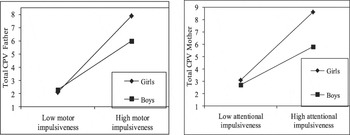
Knowing that relationships between total CPV towards the father and the mother and impulsiveness (attentional and motor) vary depending on the sex of the participant, 2 separate regression analyzes were performed to determine the pattern of the moderating relationships. Attentional impulsiveness (in the case of total violence towards the mother) and motor impulsiveness (in the case of total violence towards the father) were entered as independent variables, dividing the sample according to the sex of the participants.
Regarding the CPV towards the father, the relationship between motor impulsiveness and violence was found to be stronger in the case of women β = .44, p < .001, R 2 Adjusted = .19 than in men β = .31, p < .001, R 2 Adjusted = .10. Finally, in relation to the CPV towards the mother, it was also found that the relationship between attentional impulsiveness in this case and violence is stronger in women β = .39, p < .001, R 2 Adjusted = .15 than in men β = .24, p < .001, R 2 Adjusted = .05 (Figure 1).
Relationships between motor impulsiveness and CPV towards the father and between attentional impulsiveness and CPV towards the mother, according to sex of the aggressor.

Discussion
The present study aimed to deepen the knowledge about the role of attentional, motor, and lack of planning impulsiveness as predictors of violence towards both parents. On the other hand, the differences in the influence of impulsiveness on child-parent violence towards the father and the mother according to sex were studied. For this purpose, variables such as age, interest allocated to studies or drug or alcohol consumption habits by the father, the mother and the participant were controlled for.
In relation to sex, regression analyzes have shown that girls commit more psychological and total CPV towards both parents than boys, while regarding economic and physical violence no differences could be found. These results contradict those found by Gallagher (Reference Gallagher2008) with regard to studies with general population samples, where no significant differences in the violent behavior of girls and boys were found. However, our results concur with other authors that have found these differences, noting that girls exert more psychological violence. Although, in these cases, it was found that boys exerted more physical violence, while in the present study, no differences have been found in this regard (e.g., Ibabe & Jaureguizar, Reference Ibabe and Jaureguizar2012). This may be due to both, the small percentage of physical CPV found, and the high predictive value of impulsiveness in the case of girls in the present study. Regarding the child-parent economic violence, no significant differences between boys and girls have been found, which coincides with the findings of Lozano et al.’s (Reference Lozano, Estévez and Carballo2013) study in which economic violence occurs equally for females and males.
Regarding the age of the participant, it has proven to be significant in the case of psychological and total CPV towards both parents, so that this type of aggression is committed more with increasing age, coinciding with studies such as that of Paulson, Coombs, and Landsverk (Reference Paulson, Coombs and Landsverk1990). In relation to the consumption of alcohol or drugs by participants, analyses have shown that it is associated with a higher probability of committing all types of CPV violence except for physical CPV towards the father. Previous research has also found that substance abuse in children who assault their parents is higher than the consumption that occurs in the general population (Cottrell, Reference Cottrell2001; Ibabe et al., Reference Ibabe, Jaureguizar and Díaz2007; Rechea & Cuervo, Reference Rechea and Cuervo2010). Pagani et al. (Reference Pagani, Tremblay, Nagin, Zoccolillo, Vitaro and McDuff2004), for example, found that the problematic use of substances doubled the likelihood of adolescents undertaking physical or verbal violent behavior towards parents. However, the present study has not found any relationship between drug consumption by parents and the commission of CPV.
With regard to the interest allocated to studies, in this study, a significant relationship in the case of total, psychological and economic CPV towards both parents as well as for physical CPV towards the mother has been found, in the sense that the lower the interest in their studies, the more likely they are to commit child-parent violence. These results are in line with those found by other authors who have pointed out that children who assault their parents usually present a fair or poor academic performance, accompanied by a poor adjustment to the school environment (e.g., Ibabe, Reference Ibabe2007).
With regard to impulsiveness, overall results are consistent with previous studies that have examined the role of this variable as a unidimensional construct (e.g., Calvete et al., Reference Calvete, Orue and Sampedro2011; Contreras & Cano, Reference Contreras and Cano2015). Attentional impulsiveness has been found to be related to the commission of total, psychological and economic CPV towards both parents, probably due to the characteristic cognitive instability of this type of impulsiveness. However, it has not been found to be associated with physical CPV. In relation to physical violence, it is likely that the low percentages of explained variance found in this study are due to the limited presence of it in minors who commit acts of physical violence towards their parents.
On the other hand, motor impulsiveness has been found to be related to all types of child-parent violence, both towards the father and the mother. This result concurs with the motor activation characteristic of this type of impulsiveness, so that adolescents, when faced with a negative from their parents, react negatively, they get angry and act according to those negative emotions, committing acts of child-parent violence.
Finally, with regard to lack of planning, it has not been related with any type of child-parent violence. This lack of correlation between lack of planning and CPV in all its forms may be due to the fact that the commission of such violence generally does not depend on the existence of prior planning by the aggressor. In previous research, when analyzing impulsiveness as a unidimensional construct, there was a tendency to identify the CPV aggressor’s high impulsiveness with a lack of self-control. However, our results have shown that among the components of impulsiveness that relate to CPV, lack of self-control is not found.
The interaction between impulsiveness scales and sex of participants has also been analyzed, confirming the hypothesis that the effects of impulsiveness on the commission CPV towards the father and the mother are dependent on the sex of the offender. Firstly, with respect to the interaction between sex and impulsiveness in the case of total CPV towards the father, the results have shown the existence of a significant interaction between sex and motor impulsiveness. The results have shown that the ratio of motor impulsiveness with total CPV towards the father is stronger in the case of girls than in boys.
Finally, regarding the interaction between sex and impulsiveness in the case of total CPV towards the mother, the results have shown that there is a significant interaction between sex and attentional impulsiveness. Thus, the relationship between attentional impulsiveness and total CPV towards the mother is stronger, again, in the case of girls than in boys. The finding that impulsiveness (motor in the case of CPV towards the father, and attentional in the case of CPV towards the mother) has a greater effect in the case of girls is possibly due to the higher levels of impulsiveness found among the boys of this study, which may be causing a ceiling effect in these cases. These findings indicate the importance of taking into account the impulsiveness of children, especially girls, in preventing violence towards parents.
The present study has encountered some limitations that must be taken into account when interpreting its results. Firstly, the study’s correlational design precludes any causal interpretations. The present findings should be replicated using longitudinal designs where the strength and direction of causal relationships can be examined. Furthermore, the retrospective nature of this study involves a bias risk in the participants’ memory, although several studies support the validity of retrospective self-reports (Cantón, Cortés, & Cantón-Cortés, Reference Cantón, Cortés and Cantón-Cortés2012).
Another limitation of this study is the small number of underage perpetrators of acts of particular severity found, especially regarding physical aggression, which must be taken into account when interpreting the results of this type of CPV. It is likely that the small percentage of variance explained in this type of CPV is due to the scarcity of children who commit acts of physical violence against their parents in this study. The reduced rates of physical CPV found in the present study may be due to the type of sample used. In fact, previous research has shown that the prevalence of this type of child-parent violence is significantly higher in forensic population samples than in general population samples (Calvete et al., Reference Calvete, Orue and Sampedro2011; Kennedy et al., Reference Kennedy, Edmonds, Dann and Burnett2010).
However, despite these limitations, the present study helps to clarify the understanding of the psychological profiles which are characteristic of the different types of CPV. Thus, this study demonstrates the role that drug or alcohol consumption by minors, the importance allocated to studies, and, especially, children’s impulsiveness (analyzed as a multifactorial construct) play in CPV, and notes the important role that attentional and motor impulsiveness also play.