It is not uncommon for children and adolescents to experience comorbid externalizing and internalizing problems (e.g., Capaldi, Reference Capaldi1992; McConaughy & Achenbach, Reference McConaughy and Achenbach1994; Oland & Shaw, Reference Oland and Shaw2005; Reitz, Deković, & Meijer, Reference Reitz, Deković and Meijer2005), often in conjunction with academic problems (Flook, Repetti, & Ullman, Reference Flook, Repetti and Ullman2005; Hinshaw, Reference Hinshaw1992; Maughan, Rowe, Loeber, & Stouthamer-Loeber, Reference Maughan, Rowe, Loeber and Stouthamer-Loeber2003). Although it has been firmly established that externalizing and internalizing problems are negatively associated with children's academic competence concurrently, less is known about their associations over time and whether problem behavior in any of these domains is likely to increase the likelihood of increases in problem behavior in another area of functioning. Multiple transactional models of developmental psychopathology have been postulated to explain how functioning within individual domains of children's adaptation may affect the course of adjustment across domains, with most of these suggesting snowballing or cascading effects (e.g., Capaldi, Reference Capaldi1992; Patterson & Stoolmiller, Reference Patterson and Stoolmiller1991). However, other than a limited number of exceptions in the substance use literature (e.g., Locke & Newcomb, Reference Locke and Newcomb2001), relatively few researchers have actually tested the validity of such models empirically (Burt, Obradović, Long, & Masten, Reference Burt, Obradović, Long and Masten2008; Masten et al., Reference Masten, Roisman, Long, Burt, Obradović and Riley2005). The current study seeks to add to the existing literature on cascading effects by examining the interplay of boys' externalizing and internalizing problems, as well as academic functioning, across two key developmental periods: the transition to formal schooling and the transition from elementary to middle school. Such data are important not only for basic research but also for prevention efforts, because targeting domains of adjustment that will likely lead to problems in other areas may be cost effective in preventing more pervasive psychopathology.
In models that emphasize cascading processes, symptoms of problem behavior in one domain (e.g., externalizing problems) are hypothesized to undermine functioning in one or more other domains (e.g., academic competence), which may exacerbate the risk of the initial type of behavior and possibly other problem behaviors (e.g., internalizing problems; Masten, Burt, & Coatsworth, Reference Masten, Burt, Coatsworth, Cicchetti and Cohen2006). To test the validity of cascading processes, it is therefore optimal to have three or more domains of behavior measured at three or more time points (Cole & Maxwell, Reference Cole and Maxwell2003). Each construct's stability is controlled at each time point, and contemporaneous correlations across domains are also modeled. In essence, this means that predicting behavior across domains is conducted while controlling for within-time covariance across domains and for change in each separate domain over time (Masten et al., Reference Masten, Burt, Coatsworth, Cicchetti and Cohen2006). This provides a more conservative test of transactional hypotheses than that provided by less sophisticated models that do not account for autoregressive effects.
Although several researchers have used cross-lagged analyses to examine interrelationships among different domains of child and adolescent functioning over time (e.g., Beyers & Loeber, Reference Beyers and Loeber2003; Chen, Li, Li, Li, & Liu, Reference Chen, Li, Li, Li and Liu2000; Cole, Martin, Powers, & Truglio, Reference Cole, Martin, Powers and Truglio1996; Kiesner, Reference Kiesner2002; Locke & Newcomb, Reference Locke and Newcomb2001; Mason & Windle, Reference Mason and Windle2002), few longitudinal studies have formally tested the validity of cascading models on multiple dimensions of psychopathology and competence over three or more points in time. Following up and extending recent research by Masten and colleagues (Reference Masten, Roisman, Long, Burt, Obradović and Riley2005), we examined cascading processes among externalizing and internalizing problems and academic competence over five time points from the transition to formal school entry through the transition to middle school with a cohort of boys at risk for problems in all three domains of functioning. Below we review two theoretical perspectives that suggest hypotheses for cascading effects, as discussed by Masten and colleagues (Reference Masten, Roisman, Long, Burt, Obradović and Riley2005). We then discuss how transition points in children's schooling might influence the timing and manifestation of cascading effects at specific ages. We conclude by reviewing evidence for a shared risk model that could also potentially account for the appearance of cascading effects.
Models of Cascading Effects: The Adjustment Erosion Hypothesis
The adjustment erosion hypothesis posits that initial externalizing or internalizing symptoms reduce later academic competence and increase future vulnerability to symptoms from other domains. From this perspective, prior externalizing or internalizing symptoms would lead to later academic difficulties. In the case of a child with initial externalizing problems, such behaviors commonly associated with externalizing problems (e.g., inattention, impulsivity, aggression, or hostility) would limit the opportunities for learning to occur in the classroom, thereby impeding academic competence directly (Chen, Rubin, & Li, Reference Chen, Rubin and Li1997; Dishion, Patterson, Stoolmiller, & Skinner, Reference Dishion, Patterson, Stoolmiller and Skinner1991), and because of the greater probability of social rejection by healthy peers and acceptance by more deviant peers (Dishion, Reference Dishion1990), lead to disinterest in school and indirectly reduce academic achievement (Chen, Rubin, & Li, Reference Chen, Rubin and Li1997; Schwartz, Gorman, Nakamoto, & McKay, Reference Schwartz, Gorman, Nakamoto and McKay2006). At extreme levels, aggression could also increase children's likelihood of school expulsion (Risi, Gerhardstein, & Kistner, Reference Risi, Gerhardstein and Kistner2003), which would remove them from the context in which academic competence is fostered.
Mechanisms also have been proposed for why initial externalizing may lead to subsequent internalizing symptoms. For example, difficulties associated with externalizing problems (e.g., frustration tolerance, attentional difficulties) may increase the likelihood of poor family or peer relationships, both of which may contribute directly to heightened anxiety and lower self worth (Burks, Dodge, & Price, Reference Burks, Dodge and Price1995; Coie, Terry, Lenox, Lochman, & Hyman, Reference Coie, Terry, Lenox, Lochman and Hyman1995), and leave children more vulnerable to depression (Reinherz et al., Reference Reinherz, Giaconia, Pakiz, Silverman, Farst and Lefkowitz1993).
Cascading effects between initial externalizing and later academic or internalizing problems have been found in several previous investigations. For example, boys ages 7–12 years who were diagnosed with externalizing types of disorders such as oppositional defiant disorder or conduct disorder were at increased risk for depression by age 18 (Burke, Loeber, Lahey, & Rathouz, Reference Burke, Loeber, Lahey and Rathouz2005). Capaldi (Reference Capaldi1992) found that twice as many boys with conduct problems in sixth grade reported increases in depressive symptoms at eighth grade, compared to boys with internalizing problems in sixth grade who reported increases in conduct problems by eighth grade, a general pattern of results that has been replicated by other researchers (Lahey, Loeber, Burke, Rathouz, & McBurnett, Reference Lahey, Loeber, Burke, Rathouz and McBurnett2002). In another investigation, boys' alcohol use in late adolescence subsequently predicted elevated symptoms of depression in early adulthood, which in turn predicted problematic alcohol use in middle adulthood (Locke & Newcomb, Reference Locke and Newcomb2001). Early externalizing symptoms have been repeatedly implicated in the establishment of later, poor academic functioning and achievement (Ansary & Luthar, Reference Ansary and Luthar2009; Campbell, Spieker, Burchinal, Poe, & The NICHD Early Child Care Research Network, 2006; Chen et al., Reference Chen, Rubin and Li1997; Maguin & Loeber, Reference Maguin and Loeber1996; Stipek & Miles, Reference Stipek and Miles2008). Notwithstanding, a recent analysis of six large national data sets indicated that, controlling for children's prior academic achievement and attentional problems, high levels of children's externalizing behavior problems around the time of kindergarten entry were weakly associated with low levels of subsequent reading and/or math achievement in only two of the six data sets (Duncan et al., Reference Duncan, Dowsett, Claessens, Magnuson, Huston and Klebanov2007). Specifically, their analysis of data drawn from the Children of the National Longitudinal Survey of Youth—79 indicated that high levels of externalizing problems at kindergarten entry were associated with low levels of reading achievement at age 13–14. The analysis of data drawn from the NICHD Study of Child Care and Youth Development also indicated that low levels of externalizing and attention problems at kindergarten entry were associated with high achievement scores in the fifth grade. Although some inconsistencies are present in the literature, there is a growing body of evidence in support of the notion that children's early behavioral problems impact their subsequent academic competence.
There are also models for suggesting that initial internalizing problems might lead to later academic difficulties or externalizing problems. Internalizing symptoms may undermine academic competence by eroding cognitive functioning (Maughan et al., Reference Maughan, Rowe, Loeber and Stouthamer-Loeber2003), or by interfering with attentional focus and participation during classroom learning activities (Roeser, van der Wolf, & Strobel, Reference Roeser, van der Wolf and Strobel2001). Internalizing symptoms, such as being withdrawn or passive, may also discourage the use of adaptive learning strategies, resulting in poorer academic self-efficacy and performance (Roeser et al., Reference Roeser, van der Wolf and Strobel2001). Initial internalizing problems also have been linked to increases in externalizing problems through two processes. First, children may “mask” depression by acting out and engaging in antisocial activities (Carlson & Cantwell, Reference Carlson and Cantwell1980). Second, because of high rates of peer rejection and isolation, children with initial internalizing problems may be more likely to develop relationships with deviant peers, who would then model and reinforce them for engaging in antisocial activities (Oland & Shaw, Reference Oland and Shaw2005).
Although more consistent relations have been established between initial externalizing problems leading to later academic and/or internalizing difficulties, a few studies have found support for cascading processes in relation to initial internalizing problems. For example, internalizing difficulties have been linked to poor future academic performance (Chen, Rubin, & Li, Reference Chen, Rubin and Li1995; Flook et al., Reference Flook, Repetti and Ullman2005), particularly during the transition to middle school (McGee, Feehan, Williams, & Anderson, Reference McGee, Feehan, Williams and Anderson1992). For example, in a study by Roeser, Eccles, and Sameroff (Reference Roeser, Eccles and Sameroff2000), seventh-grade students experiencing high levels of emotional distress demonstrated poorer academic performance in eighth grade and poorer perceived academic confidence in the ninth grade. In another investigation with a primarily African American sample, highly anxious first-grade students were disproportionately likely to show very low levels of reading and mathematics achievement in the eighth grade (Grover, Ginsburg, & Ialongo, Reference Grover, Ginsburg and Ialongo2007).
Cascading Effects: The Academic Incompetence Hypothesis
The second hypothesis to account for cascading effects suggests that initial failures in academic functioning instigate the development of externalizing or internalizing symptoms, or exacerbate current symptoms of problem behavior (Chen et al., Reference Chen, Rubin and Li1997; Dishion et al., Reference Dishion, Patterson, Stoolmiller and Skinner1991; Maughan et al., Reference Maughan, Rowe, Loeber and Stouthamer-Loeber2003; Williams & McGee, Reference Williams and McGee1994). Deviant peer affiliation is one such mechanism by which academic incompetence has been postulated to lead to externalizing problems (Deater-Deckard, Reference Deater-Deckard2001), with poor school performance often resulting in children being placed in classes with other low-achieving children (Hallinan & Kubitschek, Reference Hallinan and Kubitschek1999) and increasing their probability of associating with deviant peers (Kelly, Reference Kelly1975) and demonstrating subsequent antisocial behavior (Dishion, McCord, & Poulin, Reference Dishion, McCord and Poulin1999).
For externalizing problems, empirical validation for the Academic Incompetence hypothesis has been found in some, but not all instances. An analysis of data from the Early Childhood Longitudinal Study—Kindergarten Class revealed that children who struggled with reading during the 1st grade were more likely to experience externalizing problems in the 3rd grade (Morgan, Farkas, Tufis, & Sperling, Reference Morgan, Farkas, Tufis and Sperling2008). Miles and Stipek (Reference Miles and Stipek2006) revealed similar associations between reading achievement and aggressive behavior in the 3rd and 5th grades. In one recent study, affluent, low-achieving 10th grade students reported particularly high levels of externalizing problems during the 10th, 11th, and 12th grades (Ansary & Luthar, Reference Ansary and Luthar2009). Low academic competence has been found to be associated with elevations in externalizing problems (Dishion et al., Reference Dishion, Patterson, Stoolmiller and Skinner1991; Williams & McGee, Reference Williams and McGee1994), and improvements in school performance have been observed to lead to desistence from delinquent behavior (Maguin & Loeber, Reference Maguin and Loeber1996; Thornberry, Lizotte, Krohn, Smith, & Porter, Reference Thornberry, Lizotte, Krohn, Smith, Porter, Thornberry and Krohn2003). However, Chen and colleagues (1997) did not corroborate this link when studying academic competence among a Chinese sample of school-age children.
Academic problems also have been linked to future internalizing problems. Theoretically, poor academic functioning would be associated with increases in negative affect (Patterson & Stoolmiller, Reference Patterson and Stoolmiller1991) and decreases in positive self-representations, as well as increases in self-deprecation and decreases in perceived control, all of which would be posited to lead to increases in internalizing problems (Herman, Lambert, Reinke, & Ialongo, Reference Herman, Lambert, Reinke and Ialongo2008; Maughan et al., Reference Maughan, Rowe, Loeber and Stouthamer-Loeber2003; Waniel, Priel, & Besser, Reference Waniel, Priel and Besser2006). Finally, doing very poorly in school might also reduce children's positive social status in some cases, which might also lead to negative self-perceptions and subsequent socioemotional problems (Chen et al., Reference Chen, Rubin and Li1997).
Despite strong theoretical premises, validation for academic incompetence leading to later internalizing difficulties is mixed. One longitudinal study indicated that students transitioning to middle school (i.e., seventh graders) who perceived themselves as academically competent and earning good grades were less emotionally distressed by the end of eighth grade than children who perceived themselves to be less academically competent (Roeser et al., Reference Roeser, Eccles and Sameroff2000). Another analysis of data from the Early Childhood Longitudinal Study—Kindergarten Class revealed that children who struggled with reading during the first grade were more likely to display internalizing problems in the third grade (Morgan et al., Reference Morgan, Farkas, Tufis and Sperling2008). A study by Herman and colleagues (2008) demonstrated that academic competence in the first grade was associated with children's depression in the seventh grade via their perceived control assessed during the sixth grade. Conversely, academic competence was not associated with elevations in internalizing problems in three independent samples of older children and young adolescents (e.g., ages 9 and 12: Cole et al., Reference Cole, Martin, Powers and Truglio1996; ages 10 and 9–12: Patterson & Stoolmiller, Reference Patterson and Stoolmiller1991; ages 16–18: Ansary & Luthar, Reference Ansary and Luthar2009).
The Timing and Appearance of Cascading Effects: School Transitions
Although cascading effects from one domain of child functioning to another could occur during any developmental period, there is reason to believe that they would more likely be manifest during developmental transitions. Recently, several preventive interventions have been designed to capitalize on the social and maturational challenges associated with such developmental periods of change, such as the birth of a child (e.g., Olds, Reference Olds2002), the onset of the terrible twos (Shaw, Dishion, Supplee, Gardner, & Arnds, Reference Shaw, Dishion, Supplee, Gardner and Arnds2006), and the transition to adolescence (Dishion & Kavanagh, Reference Dishion and Kavanagh2003). As a large part of school-age children's daily life involves meeting the challenges of school, there is reason to believe that changes in the demands of school might increase the probability that cascading effects from one domain of child functioning to another might be evident. Two of the most pronounced transitional periods associated with the “school-age” period are the transition to formal school entry and the movement from elementary to middle school.
The formal school entry period, which occurs around age 6 for most children, is a period when many children transition from spending most of their day with adults to spending an increasing amount of time with other children (Gross, Shaw, & Moilanen, Reference Gross, Shaw and Moilanen2008; Rimm-Kaufman & Pianta, Reference Rimm-Kaufman and Pianta2000). Even children who have received care from a nonparental caregiver prior to this transition (e.g., preschool, daycare) are vulnerable to experiencing problems (Rimm-Kaufman, Reference Rimm-Kaufman, Tremblay, Barr and Peters2004). Beginning in kindergarten and continuing in first grade, there is a significant increase in the demands made on children's social skills, work-related skills (including compliance to instructions and the ability to work independently), self-regulation, and academic readiness. One study using a large, national sample (N = 3,595) found that based on teachers' reports, almost half of children entering school experienced some difficulty in the transition to formal schooling (Rimm-Kaufman, Pianta, & Cox, Reference Rimm-Kaufman, Pianta and Cox2000). This reality is troubling, because children's school readiness at the entry to kindergarten is a powerful predictor of their subsequent academic achievement (Duncan et al., Reference Duncan, Dowsett, Claessens, Magnuson, Huston and Klebanov2007).
The transition from elementary school to middle school, which coincides with the transition to adolescence, can also be a time of stress from an academic perspective, as children must adjust to the demands of more teachers and classes than they experienced in elementary school (i.e., 7–10 different classes per week). At the same time, from the perspectives of both physical and social maturation, the transition to middle school is a time where hormonal changes and social expectations are high, as youth face multiple challenges in social domains (e.g., social roles, vocational decisions, peer influences) and neurobehavioral changes associated with puberty (Dahl, Reference Dahl2004). Thus, in contrast to the relatively tranquil period between ages 7 to 10, there is reason to suspect that if cascading effects are to be found, they would more likely occur during the transition to formal schooling (following age 6) and the transition to middle school (ages 10–12).
An Alternative Explanation for Cascading Effects: The Shared Risk Hypothesis
Cascading effects may also be a product of “third variable” factors that may place individuals on a path that underlies adjustment in multiple domains of functioning. Such shared risk factors, including low intelligence, low socioeconomic status, or poor parenting may place individuals on a path that underlies low academic competence and/or high levels of symptoms at school entry, which in turn may promote cascading processes among academic functioning and child problem behaviors. Several risk factors have been jointly associated with academic incompetence, and internalizing and externalizing problems, including temperament (Rothbart, Derryberry, & Hershey, Reference Rothbart, Derryberry, Hershey, Molfese and Molfese2000), insecure attachment (Moss et al., Reference Moss, Smolla, Cyr, Dubois-Comtois, Mazzarello and Berthiaume2006), neighborhood adversity (Ingoldsby & Shaw, Reference Ingoldsby and Shaw2002; McLeod & Shanahan, Reference McLeod and Shanahan1996), ineffective parenting (Barber & Olsen, Reference Barber and Olsen1997; Best, Hauser, & Allen, Reference Best, Hauser and Allen1997), and low intelligence (Masten et al., Reference Masten, Hubbard, Gest, Tellegen, Garmezy and Ramirez1999). Thus, before attributing increases in maladjustment across domains to prior academic incompetence or problem behavior, it is important to account for how such common risk factors might increase vulnerability to reduced levels of functioning across domains. In the current study, we focus on three factors, all of which have been linked adjustment problems in both socioemotional and academic functioning: intelligence (Fergusson, Horwood, & Ridder, Reference Fergusson, Horwood and Ridder2005; Rapport, Denney, Chung, & Hustace, Reference Rapport, Denney, Chung and Hustace2001; Schonfeld, Shaffer, O'Connor, & Portnoy, Reference Schonfeld, Shaffer, O'Connor and Portnoy1988), responsive and supportive parenting (Bayer, Sanson, & Hemphill, Reference Bayer, Sanson and Hemphill2006; Dodici, Draper, & Peterson, Reference Dodici, Draper and Peterson2003; Joussemet, Koestner, Lekes, & Landry, Reference Joussemet, Koestner, Lekes and Landry2005; Supplee, Unikel, & Shaw, Reference Supplee, Unikel and Shaw2007), and neighborhood adversity (Chase-Lansdale, Gordon, Brooks-Gunn, & Klebanov, Reference Chase-Lansdale, Gordon, Brooks-Gunn, Klebanov, Brooks-Gunn, Duncan and Aber1997; Connell & Halpern-Felsher, Reference Connell, Halpern-Felsher, Brooks-Gunn, Duncan and Aber1997; Ingoldsby et al., Reference Ingoldsby, Shaw, Winslow, Schonberg, Gilliom and Criss2006; Leventhal & Brooks-Gunn, Reference Leventhal and Brooks-Gunn2000).
True Studies of Cascade Models
As noted above, although examples of cross-lagged effects among different domains of child adjustment exist (e.g., Beyers & Loeber, Reference Beyers and Loeber2003; Chen et al., Reference Chen, Li, Li, Li and Liu2000; Cole et al., Reference Cole, Martin, Powers and Truglio1996; Kiesner, Reference Kiesner2002), true studies of developmental cascade processes that track cross-domain associations among three domains of functioning across three or more time points are few in number. Here we discuss two particularly relevant examples, including one study by Masten and colleagues (Reference Masten, Roisman, Long, Burt, Obradović and Riley2005) and one by Ansary and Luthar (Reference Ansary and Luthar2009).
Masten and colleagues (Reference Masten, Roisman, Long, Burt, Obradović and Riley2005) studied developmental cascades over a 20-year period in a sample of normally developing participants. They found evidence that externalizing problems, assessed between the ages of 8–12, were associated with poorer academic competence (ages 15–19), which in turn were related to increased risk of later internalizing problems. In addition, high levels of academic competence in late adolescence and early adulthood (ages 18–22) predicted better emotional adjustment as participants approached age 30 (ages 28–32). Overall, the authors concluded that externalizing problems in middle childhood appeared to foreshadow problems in all three domains, from an initial pathway to academic problems in adolescence, and from academic to internalizing problems in early adulthood. These associations remained or were strengthened when other potential causes were included in structural models. These findings lend support to the adjustment erosion and academic competence hypotheses tested in the current study.
Ansary and Luthar (Reference Ansary and Luthar2009) studied cross-domain effects over a 3-year period in a sample of affluent youth in Grades 10, 11, and 12. They found that youths who engaged in more serious types of externalizing behaviors (i.e., cluster groups defined by marijuana use and multiple behavioral/emotional problems) during the 10th grade had the lowest academic achievement and poorest classroom adjustment at all three assessments. Furthermore, low-achieving youth during the 10th grade reported the highest levels of drug use and delinquency at each study wave. There were no observed mean differences in internalizing problems by achievement group. Ansary and Luthar (Reference Ansary and Luthar2009) concluded that the cross-domain effects of youth behavioral maladjustment and academic achievement form a cycle that is likely initiated early in development and perpetuated throughout adolescence. Primarily for externalizing problems, these findings with this sample of affluent youth lend additional support to the adjustment erosion and academic competence hypotheses evaluated in this investigation.
The Role of Gender
The sample's design of only including boys, although limiting our ability to examine sex differences, also provided an opportunity to focus more intensively on how cascading processes might develop among males at risk for poor sociodevelopmental adjustment. It is reasonable to expect that the timing, types, and long-term consequences of developmental cascades vary by gender. The early and middle childhood years may be vital periods for the emergence of boys' developmental cascades, as boys show high rates of problem behavior prior to adolescence relative to girls, particularly externalizing problems (Crick & Zahn-Waxler, Reference Crick and Zahn-Waxler2003; Hartung & Widiger, Reference Hartung and Widiger1998). Boys' early conduct problems may undermine academic competence and achievement as early as kindergarten by limiting boys' academic engagement or by adversely affecting teacher–child relationships (Dishion et al., Reference Dishion, Patterson, Stoolmiller and Skinner1991; Stipek & Miles, Reference Stipek and Miles2008). Whereas associations between academic achievement and internalizing problems tend to be stronger for girls, in contrast to associations between academic achievement and externalizing problems being stronger for boys (Duncan et al., Reference Duncan, Dowsett, Claessens, Magnuson, Huston and Klebanov2007; McCarty et al., Reference McCarty, Mason, Kosterman, Hawkins, Lengua and McCauley2008; Pomerantz, Altermatt, & Saxon, Reference Pomerantz, Altermatt and Saxon2002), we expected to find fewer cascades originating from internalizing problems and more consistent cascading effects originating from externalizing or academic problems in the current sample of boys. Boys' tendency toward younger initiation into problem behaviors probably also increases the chance that they will experience spillover effects, such as school drop-out and limited academic achievement by early adulthood (Fergusson & Lynskey, Reference Fergusson and Lynskey1998; Vitaro, Laroque, Janosz, & Tremblay, Reference Vitaro, Laroque, Janosz and Tremblay2001). Thus, it is important to examine childhood-era developmental cascades to see if they are particularly detrimental to boys' behavioral development and academic success. Understanding these processes is vital for the development and implementation of effective prevention and intervention efforts.
The Current Study
The goals of the current study were to both replicate and extend the findings of Masten and colleagues (Reference Masten, Roisman, Long, Burt, Obradović and Riley2005), testing for cascading effects among externalizing, internalizing, and academic problems, and examining the possibility that risk factors common to these three domains of child functioning would account for cascading effects. In contrast to the work by Masten and colleagues (Reference Masten, Roisman, Long, Burt, Obradović and Riley2005), which covered a 20-year period spanning from the school-age period to adulthood, the current study included a more intensive focus on the period between formal school entry and the transition to middle childhood and adolescence. This design of the school-age period allowed us to extend Masten's prior work by investigating whether cascading effects would be more pronounced during times of school transition. Other novel features of the study included the use of a cohort of boys at high risk for demonstrating problem behavior in the three domains of functioning being studied based on their low socioeconomic status and the use of parent, youth, and teacher reports, as well as observations to provide assessments of youth functioning and shared risk factors. We followed Masten and colleagues' (Reference Masten, Roisman, Long, Burt, Obradović and Riley2005) analytic strategy, which involved evaluating a series of nested path models.
Based on prior research (i.e., Masten et al., Reference Masten, Roisman, Long, Burt, Obradović and Riley2005), we expected to find evidence of cascading effects, specifically that externalizing problems would adversely impact academic competence. Our predictions for academic problems to lead to externalizing or internalizing problems were more tentative as such effects were not found during comparable age periods in the Masten study (but have been suggested in others; e.g., Williams & McGee, Reference Williams and McGee1994). Furthermore, we expected to see evidence of such cascading processes more so during the earliest and later assessments of the study period, which coincided with the transition to elementary school (ages 6–8) and the transition to middle school (ages 10–12), respectively. Finally, we expected shared risk factors, such as parenting and IQ, to attenuate but not fully account for cascading effects of early problem behavior and academic functioning.
Method
Participants and procedures
This study used data from a larger project on vulnerability and resiliency in boys growing up in low socioeconomic status families (Shaw, Gilliom, Ingoldsby, & Nagin, Reference Shaw, Gilliom, Ingoldsby and Nagin2003). The sample was restricted to boys because the original intent of the study was to examine precursors of antisocial behavior. Funding did not permit recruitment of a sufficiently large sample of girls who were expected to show serious levels of antisocial behavior. Recruitment took place at Women, Infants, and Children Nutritional Supplement Program clinics throughout the metropolitan Pittsburgh area. Mothers with male infants 6 to 17 months of age were asked to take part in a longitudinal study on child development. Of 421 mothers approached at the Women, Infants, and Children sites, 311 participated in the first assessment when boys were at an average age of 18 months. At the time of the first assessment, mothers ranged in age from 17 to 43 years (M = 27.82, SD = 5.33).
Two-hundred ninety-four families participated in at least one of the assessments (95% of the original sample); of those families, 291 boys, mothers, and teachers provided sufficient data to be included in analyses (i.e., they had data at one or more waves for each construct; 94% of the original sample). The resulting analytic sample was composed primarily of European American (51.9%) and African American boys (38.8%), with a small number of biracial (8.9%) and Hispanic (0.3%) participants. As the vast majority of non-European American boys were part or fully African American, we refer to non-European American boys as African American for the duration of this manuscript. Mean monthly family income at Time 1 (i.e., when the boys were age 6) was $1,662 (SD = $1,167), corresponding to a per capita average of $371 (SD = $293). At Time 1, 69% of the primary caregivers identified themselves as being married or living with a partner; 19% identified themselves as single (never married); and the remaining 12% were separated, divorced, or widowed. Analyses were conducted to compare retained and attrited families on all study characteristics. No significant differences were revealed in terms of demographic characteristics, cascade variables, or common risk factors.
Measures
Study constructs were measured using a combination of self- and observer-reported instruments. Data were collected during home and lab visits, during which research assistants interviewed the participating boys and their primary caregiver (at least 90% of the primary caretakers were mothers at each study time point). Teachers were recruited separately with the permission of the primary caretaker, and they completed questionnaires by mail.
Externalizing problems
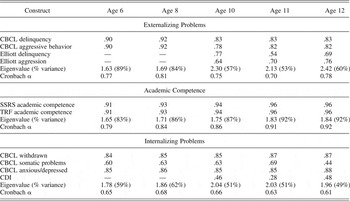
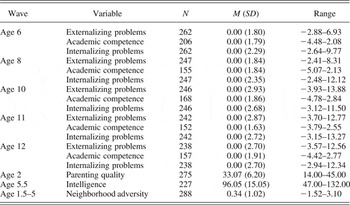
The externalizing problems factors were constructed using two or four scale scores at each study time point. Two maternal-report subscales from the Child Behavior Checklist (CBCL; Achenbach & Edelbrock, Reference Achenbach and Edelbrock1983) were used at all study waves, specifically the 20-item aggressive behavior subscale (average α = 0.90; sample item: “cruelty, bulling, or meanness to others”) and the 13-item delinquent behavior subscale (average α = 0.64; sample item: “runs away from home”). Parents rated each item on a 3-point response scale, ranging from 0 (not true [as far as you know]) to 2 (very true or often true). At ages 10, 11, and 12, boys also reported on their antisocial behavior during the last year using the Self-Reported Delinquency Measure (Elliott, Huizinga, & Ageton, Reference Elliott, Huizinga and Ageton1985). Boys responded to a total of 33 items on a 3-point response scale, ranging from 0 (never) to 2 (more often). Twenty-two of these items were used to form two subscales, including a 9-item aggression subscale (average α = 0.57; sample item: “In the past year, have you on purpose broken or damaged or destroyed something belonging to your parents or other people in the family?”) and a 13-item delinquency subscale (average α = 0.66; sample item: “Since [1 year ago], have you taken something from a car that did not belong to you?”). All subscale scores were calculated by summing the responses to all items, such that high scores correspond to high levels of externalizing problems. All available subscale scores within each time point were standardized before performing principal component analyses and calculating Cronbach alpha values (see Table 1). As these preliminary analyses indicated that these subscales formed consistent factors, improper factor scores were calculated by summing the standardized subscale scores within each time point. Using z scores to compute such factor scores outside of principal components analysis is beneficial when the means and/or standard deviations of the indicator variables vary, as it will ensure that variables with smaller values are not overshadowed by the variables with larger values (C. Garbin, personal communication, June 2, 2009). Descriptive statistics for the standardized externalizing variables and all other study variables are provided in Table 2.
Principal component analysis loadings
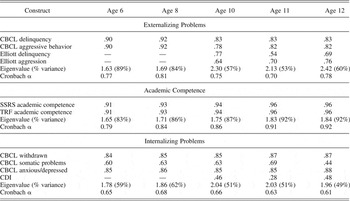
Note: All factor loadings were generated in principal component analysis. The Cronbach alpha values were calculated using standardized scale scores. CBCL, Child Behavior Checklist; SSRS, Social Skills Rating Scale; TRF, Teacher Report Form; CDI, Child Depression Inventory.
Study variable descriptive statistics

Academic competence
The academic competence factors were based on two sources at each time point. The first source was a single factor created using six items from the Social Skills Rating Scale (Gresham & Elliott, Reference Gresham and Elliott1990; average α = 0.88). Items included “uses free time in an acceptable way,” “finishes class assignments within time limits,” “follows your directions,” “puts work materials or school property away,” “attends to your instructions,” and “easily makes transitions from one classroom activity to another.” Teachers responded to these items on a 3-point response scale, with possible responses ranging from 0 (never) to 2 (very often). The second source was a scale score constructed using six items from the Teacher Report Form (TRF; Achenbach & Rescorla, Reference Achenbach and Rescorla2001; average α = 0.91). Items included “fails to finish things he starts,” “difficulty following directions,” “has difficulty learning,” “poor school work,” “underachieving, not working up to potential,” and “fails to carry out assigned tasks.” Teachers responded to the TRF items on a 3-point response scale, and responses ranged from 0 (not true [as far as you know]) to 2 (very true or often true). Each subscale score was computed by summing the items, and high scores correspond to better academic competence. The internal consistency and factor structure of the academic competence variables were examined using the same procedure employed for the externalizing variables. Likewise, these preliminary analyses confirmed that these two indices of academic competence shared significant common variance (see Table 1).
Internalizing problems
At all study waves, the internalizing problems factors were defined by three factors from the CBCL (Achenbach & Edelbrock, Reference Achenbach and Edelbrock1983). These included the 14-item anxious/depressed subscale (average α = 0.80; sample item: “cries a lot”), the 9-item withdrawn subscale (average α = 0.70; sample item: “refuses to talk”), and the 9-item somatic complaints subscale (average α = 0.62; sample item: “overtired”). Parents rated each item on a 3-point response scale, ranging from 0 (not true [as far as you know]) to 2 (very true or often true). At ages 10, 11, and 12, boys also reported on their symptoms of depression during the last 2 weeks using an abbreviated form of the Child Depression Inventory (Kovacs, Reference Kovacs1985; average α = 0.61). Boys were presented with 10 sets of statements corresponding to symptoms of depression, and selected the statement that was most true for them (sample set: “I am sad once in a while,” “I am sad many times,” and “I am sad all the time”). The scale anchors range from zero to two, with zero corresponding to the lowest levels and two corresponding to highest levels of depression. All subscale scores were calculated by summing the responses to all items, such that high scores correspond to high levels of internalizing problems. The internal consistency and factor structure of the internalizing problems variables were examined using the same procedure employed for the externalizing and academic competence variables. Likewise, these preliminary analyses confirmed that these indices of internalizing problems shared significant common variance (see Table 1).
Parenting quality (age 2)
Study examiners completed the 36-item Home Observation for Measurement of the Environment (HOME) Inventory for Families of Infants and Toddlers (Caldwell & Bradley, Reference Caldwell and Bradley1978) during home-based observations and an interview with the mother at age 2 years. This version of the HOME taps dimensions of emotional and verbal responsivity, acceptance of the child's behavior, organization of the environment, provision of play materials, parental involvement with the child, and opportunities for variety. The standard total HOME scale score is the sum of these six factors, and was used in analyses (overall α = 0.82, sample responsivity item: “parent spontaneously praises child at least twice”; sample organization of environment item: “child is taken regularly to doctor's office or clinic”; parental involvement item: “parent keeps child in visual range, looks at often”).
Intelligence (age 5.5)
Child intellectual skills were evaluated at the age 5.5 laboratory assessment using a four-subtest short form of the Wechsler Preschool and Primary Scale of Intelligence—Revised (Wechsler, Reference Wechsler1989), a commonly used measure of children's cognitive abilities. The block design, geometric design, information, and vocabulary subtests from the Wechsler Preschool and Primary Scale of Intelligence were selected because of their high average correlation with overall full-scale IQs and the high test–retest reliability and internal consistency coefficients of these subtests (Sattler, Reference Sattler1990, Reference Sattler1992). Full-scale IQ scores were derived according to prorating procedures described in Sattler (Reference Sattler1990, Reference Sattler1992).
Neighborhood adversity (composite)
Neighborhood adversity was constructed based on US Census data. Families' addresses were geocoded at the block group level, the smallest unit for which all census data are available. Addresses were collected from 1991 to 2003, and were matched to census block groups at each study wave. Based on methods devised by Wikström and Loeber (Reference Wikström and Loeber2000) and adapted by Winslow and Shaw (Reference Winslow and Shaw2007) and Schonberg, Shaw, Beck, Vanderbilt, and McTeague (Reference Schonberg, Shaw, Beck, Vanderbilt and McTeague2005), a composite variable of neighborhood adversity was generated using the following census block group level variables: (a) median family income, (b) percentage of families below poverty level, (c) percentage of households on public assistance, (d) percentage unemployed, (e) percentage of single-mother households, (f) percentage African American, and (g) percentage with a Bachelor's degree or higher. Wikström and Loeber (Reference Wikström and Loeber2000) selected these variables based on previous research investigating associations between neighborhood-level structural characteristics and boys' antisocial behavior (for more details, see Wikström & Loeber, Reference Wikström and Loeber2000). For data from assessments collected between 1990 and 1995, the 1990 census data were used. These individual variables were standardized, summed, and then averaged (after reverse scoring median family income and percent with a bachelor's degree) to create an overall neighborhood adversity factor score for each block group. Past research demonstrates that these variables correlate highly (Ingoldsby, Shaw, Schonberg, & Flanagan, Reference Ingoldsby, Shaw, Schonberg and Flanagan2003; Wikström & Loeber, Reference Wikström and Loeber2000). Preliminary analyses indicated that the neighborhood adversity indices were highly correlated over time (r range = .75–.95). Consequently, neighborhood adversity scores were averaged across time points (i.e., at boys' ages 1.5, 2, 3.5, and 5 years) to generate a composite index of cumulative childhood neighborhood risk.
Analysis plan
Preliminary analyses
Prior to calculating improper factor scores, all variables used to form the three cascade constructs and the observed shared risk factors were screened for normality. Descriptive statistics indicated that almost all variables were normally distributed and within acceptable limits of skewness and kurtosis. The single exception was somatic problems at age 8, which was moderately skewed and kurtotic (skew = 3.70, kurtosis = 22.09). A square-root transformation reduced skew and kurtosis to acceptable levels (skew = 1.06, kurtosis = 0.52), prior to standardizing this subscale and conducting any further analyses.
Missing data
Explorations of missing data patterns were completed with SPSS Missing Values Analysis. The results of this analysis suggested that data were missing completely at random, Little's missing completely at random χ2 (1,926) = 2002.42, p > .05 (Little, Reference Little1988). On average, 45% of teacher-reported academic competence data were missing at each time point (range = 30–57% missing), compared to an average of 17% missing parent- and child-reported internalizing or externalizing scores (range = 10–22% missing). We further examined missing data patterns by exploring mean-level differences between missing and present cases for all study variables. This exploration revealed only one instance in which missing data were associated with levels of that construct at another point in time (i.e., nonrandom missingness): specifically, boys missing academic competence data at age 8 (n = 77; M = –0.34, SD = 1.80) had lower levels of academic competence at age 10 than boys who had teacher-reported academic competence data at age 8 (n = 91; M = 0.28, SD = 1.87), F (1, 166) = 4.72, p < .05, η2 = 0.03. Additional analyses indicated that there were other instances in which boys missing and present differed. Boys missing academic competence data at age 8 had higher levels of externalizing problems at age 8 (n = 103; M = 0.34, SD = 1.85) and internalizing problems (M = 0.41, SD = 2.81) at age 8 compared to boys with teacher-reported academic competence data at age 8 (n = 144; externalizing M = –0.24, SD = 1.79; internalizing M = –0.29, SD = 1.91), externalizing F (1, 245) = 6.05, p < .05, η2 = 0.02, internalizing F (1, 245) = 5.40, p < .05, η2 = 0.02. Boys missing academic competence data at age 8 also had higher levels of parent-reported externalizing problems at age 11 (M = 0.47, SD = 3.18) and poorer home environments at age 2 (n = 129; M = 32.00, SD = 6.63) than those with academic competence data at age 8 (age 11 externalizing n = 144; M = –0.24, SD = 1.79; age 2 parenting n = 146; M = 34.02, SD = 5.64), age 11 externalizing F (1, 240) = 4.83, p < .05, η2 = 0.02, age 2 parenting F (1, 273) = 7.45, p < .01, η2 = 0.03. The same pattern was evidenced for academic competence at age 12, such that boys missing these data (n = 100; M = 0.52, SD = 3.53) had higher levels of parent- and self-reported externalizing problems than boys who had academic competence data (n = 146; M = –0.36, SD = 2.38), F (1, 244) = 5.47, p < .05, η2 = 0.02. Likewise, boys missing academic competence data at age 12 also had higher internalizing problems at age 10 (n = 99; M = 0.54, SD = 3.11) than boys with academic competence data at age 12 (n = 147; M = –0.37, SD = 2.28), F (1, 244) = 7.16, p < .01, η2 = 0.03. Finally, boys missing CBCL data (parent-reported externalizing and internalizing) at age 8 (n = 37; M = 29.84, SD = 7.16) had poorer home environments at age 2 than boys whose parents completed the CBCL at age 8 (n = 238; M = 33.58, SD = 5.89), F (1, 273) = 12.12, p < .001, η2 = 0.04. These analyses suggested that data were missing at random: In only one instance was missingness associated with subsequent levels of the same construct (i.e., academic competence at age 8 with age 10 scores), and in a handful of other instances, missingness was associated with previous or subsequent levels of other study constructs. Of the 289 tests performed, just 9 revealed significant associations (3%). As these few associations were small in magnitude, we interpreted them as largely being due to chance. Consequently, we employed full information maximum likelihood when fitting models, which estimates missing values using all available data and can even be used with data that are not missing at random (for more information, see Enders, Reference Enders2001). Full information maximum likelihood based parameter estimates provide less biased information than ad hoc procedures such as listwise deletion, pairwise deletion, or imputation (Schafer, Reference Schafer1997).
Cascade analyses
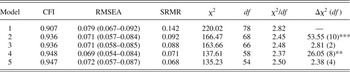
We followed Masten and colleagues' (Reference Masten, Roisman, Long, Burt, Obradović and Riley2005) overall analytic strategy. We initially evaluated a series of nested path models to determine whether the adjustment erosion or competence hypotheses were supported (see Table 3). The first model evaluated each construct's stability and contemporaneous correlations across the three factors. This model provided the basis for all other nested models. Ten cross-domain cascade paths were added in the second model, which modeled the hypothesized developmental cascade. In the third model, 2 additional cross-domain paths were added, corresponding to early academic competence effects. This was followed by the inclusion of paths between the latent externalizing and internalizing dimensions, which required 8 additional paths. Finally, the fifth and final model included paths from internalizing to subsequent academic competence, which required 4 additional paths.
Hierarchically nested cascade path models

Note: Contemporaneous correlations were also included in all models. Ext, externalizing problems; AC, academic competence; Int, internalizing problems.
aIncluded in all subsequent models.
bTotal of 10 cross-domain paths.
cTotal of 12 cross-domain paths.
dTotal of 20 cross-domain paths.
eTotal of 24 cross-domain paths.
Shared risk analyses
Once the best-fitting cascade model was selected, a separate model evaluating the shared risk factors hypothesis was estimated. In this model, the three common risk factor variables were simultaneously regressed upon age 6 externalizing, internalizing, and academic competence, as were their indirect effects via any cascade pathways revealed in the previous stage of modeling. The presence of significant indirect effects indicated that a particular developmental cascade was at least partially attributable to parenting quality, intelligence, or neighborhood adversity. Bootstrapping was employed to estimate the standard errors and 95% bias-corrected confidence intervals of these coefficients (McCartney, Burchinal, & Bub, Reference McCartney, Burchinal and Bub2006).
All analyses were conducted in Mplus version 4.0 (Muthén & Muthén, Reference Muthén and Muthén2004). Model fit was evaluated through the examination of several indices. The fit of a path model was considered acceptable if it had a nonsignificant chi-square fit statistic (χ2), a χ2/df ratio smaller than 3.00, a comparative fit index larger than 0.90, a root mean square error of approximation smaller than 0.05, and a standardized root mean square residual close to 0 (Kline, Reference Kline1998). Changes in chi-square fit values were examined when comparing nested models.
Results
Preliminary analyses
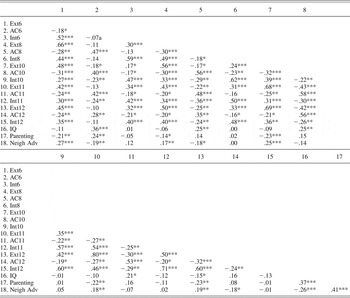
Bivariate correlations between all study variables are presented in Table 4. These suggested moderate to high stability of each longitudinal study construct. The correlations between adjacent scores of externalizing (r range = .56–.80) and internalizing problems (r range = .57–.71) were higher than the adjacent indices of academic competence (r range = .47–.58). There was also evidence for potential cross-lagged pathways. Externalizing and internalizing scores were moderately and negatively correlated with subsequent academic competence values (externalizing r range = −.11 to −.30; internalizing r range = −.13 to −.30). Correlations between contemporaneous internalizing and externalizing scores were also moderate (r range = .30–.46).
Study variable correlations
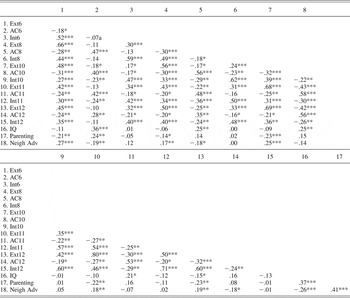
Note: Ext, externalizing problems; AC, academic competence; Int, internalizing problems; IQ, intelligence; Neigh Adv, neighborhood adversity.
*p < .05. **p < .01. ***p < .001.
The shared risk factors were also modestly correlated with some cascade variables. At all time points, externalizing problems were negatively associated with parenting (r range = −.14 to .23) and positively associated with neighborhood adversity (r range = .17–.27). Intelligence was negatively associated with externalizing problems at age 12 only (r = −.15), and was positively associated with academic competence from ages 6 to 11 (r range = .21–.36). Academic competence was also negatively correlated with neighborhood adversity at ages 6, 8, and 12 (r range = −.18 to −.19), and positively correlated with parenting at age 6 only (r = .24). There were no significant correlations between the shared risk factors and internalizing problems.
Cascade analyses
Table 5 shows the model fitting results for the cascade analyses. Models 2 through 5 all fit the data significantly better than Model 1. As evidenced by the significant chi-square change statistic, Model 4 provided a better fit to the data than Models 2 or 3. Consequently, Model 4 was retained for subsequent analyses.
Model fit statistics

Note: CFI, comparative fit index; RMSEA, root mean square error of approximation; SRMR, standardized root mean square residual.
**p < .01. ***p < .001.
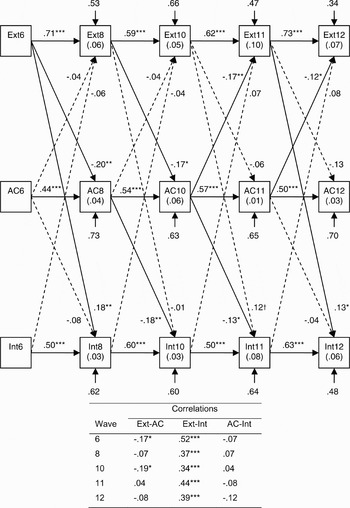
Figure 1 shows the standardized path coefficients for all paths of Model 4. Without exception, all of the within-construct continuity paths were positive and significant (p < .001). On average, the stabilities for externalizing problems were the highest, ranging from 0.59 to 0.73, followed by those for internalizing problems, which ranged from 0.50 to 0.63. Academic competence was also stable, ranging from 0.44 to 0.57. Eight of the directed cascade paths were significant and in the expected direction. Externalizing problems at age 6 and at age 8 were negatively associated with academic competence at age 8 and age 10, respectively, such that high levels of age 6 and 8 externalizing problems were indicative of poorer academic competence at age 8 and 10, controlling for prior academic competence. Externalizing problems at age 6 were positively associated with internalizing at age 8, such that high levels of externalizing problems at age 6 were linked to high levels of internalizing problems at age 8, controlling for prior levels of internalizing problems at age 6. In turn, academic competence at ages 10 and 11 were negatively associated with externalizing at ages 11 and 12: high levels of academic competence were associated with low levels of externalizing problems, controlling for prior problem levels. Likewise, high levels of academic competence at age 10 were linked to low levels of internalizing problems at age 11. Finally, high levels of externalizing problems at age 11 were associated with high levels of internalizing problems at age 12.
The developmental cascade model with externalizing–internalizing links. The inset table contains the model's within-time point correlations/covariances. Dashed arrows indicate nonsignificant pathways. Parenthetical values refer to the total portion of the variance explained by the cross-lagged pathways (ΔR 2 values). Ext, externalizing problems; AC, academic competence; Int, internalizing problems. †p < .10. *p < .05. **p < .01. ***p < .001.

Shared risk analyses
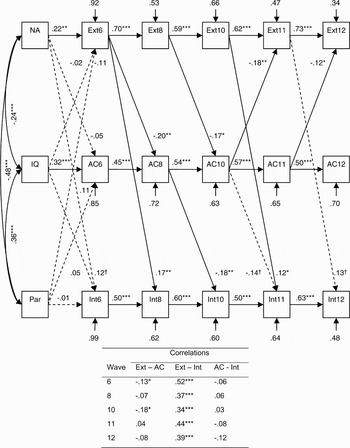
Following Masten and colleagues' (Reference Masten, Roisman, Long, Burt, Obradović and Riley2005) analytic plan, we also evaluated the shared risk factors hypothesis by including three control variables in the model. The goal of these analyses was to see if the shared risk factors had indirect effects on study cascades. This model fit the data reasonably well, χ2 fit (94) = 181.96, p < .001, comparative fit index = 0.94, root mean square error of approximation = 0.057 (95% confidence interval = 0.044–0.069), standardized root mean square residual = 0.071 (see Figure 2). Neighborhood adversity predicted externalizing problems at age 6, such that high levels of early neighborhood risk were indicative of greater externalizing problems (R 2 = .08). High levels of intelligence were associated with higher academic competence at age 6 (R 2 = .15). No shared risk factors were associated with internalizing problems at age 6. Intelligence was indirectly related to externalizing problems at age 11 via academic competence at ages 6 through 10, such that high levels of intelligence at age 6.5 years were associated with lower levels of externalizing problems at age 11 (B = –0.003, SE = 0.001, p < .05). Neighborhood adversity also was indirectly associated academic competence at age 8 via externalizing problems at age 6, such that high levels of neighborhood risk were indicative of low levels of academic competence at age 8 (B = –0.079, SE = 0.039, p < .05). There were no other indirect effects of early risk factors. The addition of shared risk factors had a small effect on three cascade paths. Two weaker pathways present in Model 4 were no longer significant contributors once the shared risk factors were included in the model. These included the cascade pathways from academic competence at age 10 internalizing problems at age 11 (p < .06) and the pathway from age 11 externalizing problems to age 12 internalizing problems (p < .08). The marginally significant pathway from age 10 externalizing problems at age 10 to internalizing problems at age 11 became significant (p < .05).
The shared risk model. The inset table contains the model's additional within-time point correlations/covariances. Dashed arrows indicate nonsignificant paths between shared risk factors and age 6 cascade constructs or marginally significant cascade paths. All other nonsignificant cascade paths included in Figure 1 were also modeled but are omitted for the sake of simplicity. NA, neighborhood adversity; Ext, externalizing problems; IQ, intelligence; AC, academic competence; Par, parenting; Int, internalizing problems. †p < .10. *p < .05. **p < .01. ***p < .001.

Discussion
In the current study, we tested a series of hypotheses to increase understanding of developmental cascade effects in childhood and early adolescence. Consistent with both adjustment erosion and academic incompetence models, there was some evidence to suggest that developmental cascade effects were evident. Externalizing problems were associated with low levels of academic competence and high levels of internalizing psychopathology throughout the study period. Path models suggested that high levels of externalizing problems at ages 6 and 8 were respectively associated with poorer academic competence at ages 8 and 10. In turn, poor academic competence at ages 10 and 11 was related to high levels of externalizing problems at ages 11 and 12. Poor academic competence at age 10 was also linked to high levels of internalizing problems at age 11. High levels of externalizing problems around the time of initial school entry (age 6) and during the transition to middle school and adolescence (age 11) were predictive of high levels of internalizing problems at ages 8 and 12. Finally, shared risk factors measured in early childhood did not markedly alter the developmental cascades evidenced in this study, but intelligence was indirectly related to externalizing problems at age 11 via prior academic competence, and neighborhood adversity was indirectly associated with academic competence at age 8 via age 6 externalizing problems.
Contributions
This is the one of the first known studies to fully test a cascade model and the first we are aware of to evaluate such issues intensively during the school-age period. Additional investigations into developmental cascades appear to be warranted, as this study's findings demonstrated partial convergence with Masten and colleagues' (Reference Masten, Roisman, Long, Burt, Obradović and Riley2005) previous study and other transactional studies (e.g., Ansary & Luthar, Reference Ansary and Luthar2009). In particular, cascading effects first became evident during the transition to primary school when high levels of externalizing problems were associated with poorer subsequent academic competence (consistent with Chen et al., Reference Chen, Rubin and Li1997; Dishion et al., Reference Dishion, Patterson, Stoolmiller and Skinner1991; Masten et al., Reference Masten, Roisman, Long, Burt, Obradović and Riley2005) and higher levels of internalizing problems at age 8 (Capaldi, Reference Capaldi1992). Subsequent cascading effects occurred throughout the study period, with these first cascades followed by significant effects between low academic competence at age 10 and subsequent internalizing problems at ages 10 and 12 (consistent with Masten et al., Reference Masten, Roisman, Long, Burt, Obradović and Riley2005; Morgan et al., Reference Morgan, Farkas, Tufis and Sperling2008; Roeser et al., Reference Roeser, Eccles and Sameroff2000) and externalizing problems at ages 11 and 12 (consistent with Dishion et al., Reference Dishion, Patterson, Stoolmiller and Skinner1991; Maguin & Loeber, Reference Maguin and Loeber1996; Morgan et al., Reference Morgan, Farkas, Tufis and Sperling2008; Williams & McGee, Reference Williams and McGee1994). Notably, these cascades were revealed in an earlier developmental period than the cascades found in Masten and colleagues' (Reference Masten, Roisman, Long, Burt, Obradović and Riley2005) study. They also found direct effects of internalizing difficulties on externalizing problems, but we revealed direct cascading effects from externalizing to internalizing problems. All in all, these discrepancies are likely attributable to the more intensive measurement employed over our shorter study's time span during an earlier phase of development.
The current pattern of results is relatively unique in linking multiple paths from early childhood to adolescence (Bosquet & Egeland, Reference Bosquet and Egeland2006); however, individual paths between domains of functioning are consistent with previous research. For example, an initial path links externalizing problems during middle childhood (ages 6 and 8) to low levels of subsequent academic competence (ages 8 and 10), corroborating a previously found relationship (e.g., Campbell et al., Reference Campbell, Spieker, Burchinal and Poe2006; Capaldi, Reference Capaldi1992; Chen et al., Reference Chen, Rubin and Li1997; Morgan et al., Reference Morgan, Farkas, Tufis and Sperling2008). Likewise, the direct links between externalizing to internalizing symptoms have also been demonstrated elsewhere (e.g., Capaldi, Reference Capaldi1992; Locke & Newcomb, Reference Locke and Newcomb2001; Reinherz et al., Reference Reinherz, Giaconia, Pakiz, Silverman, Farst and Lefkowitz1993). Also consistent with prior work, low levels of academic competence during the transition to adolescence were associated with high levels of subsequent internalizing and externalizing problems (Dishion et al., Reference Dishion, Patterson, Stoolmiller and Skinner1991; Maguin & Loeber, Reference Maguin and Loeber1996; Roeser et al., Reference Roeser, Eccles and Sameroff2000). Finally, the shared risk model revealed associations between the early childhood neighborhood environment with externalizing symptoms at school age, as well as links between intelligence and academic competence, both of which have been found in previous research (Campbell, Shaw, & Gilliom, Reference Campbell, Shaw and Gilliom2000; Fergusson et al., Reference Fergusson, Horwood and Ridder2005; Rapport et al., Reference Rapport, Denney, Chung and Hustace2001; Supplee et al., Reference Supplee, Unikel and Shaw2007; Winslow & Shaw, Reference Winslow and Shaw2007).
Note that all of these significant paths emerged after accounting for autoregressive effects of individual domains, which were moderately high in magnitude in all three domains of child adjustment (i.e., ranging from 0.44 to 0.73 for individual paths). It is noteworthy that despite the use of a conservative analytical approach, 8 of 20 cross-domain paths emerged as significant and a ninth cross-domain path was marginally significant. Furthermore, cascading effects were detectable in ways that were consistent with prior research examining individual paths involving one or two of domains of child functioning (e.g., externalizing problems predicting poor later academic competence).
The current study provided support for the adjustment erosion hypothesis regarding externalizing but not internalizing problems. Externalizing symptoms were linked to poorer academic competence during middle childhood, first from ages 6 to 8, and then again from ages 8 to 10. Behaviors that commonly accompany externalizing problems (e.g., impulsivity or hostility) may directly limit children's opportunities for productive classroom engagement (Chen et al., Reference Chen, Rubin and Li1997; Dishion et al., Reference Dishion, Patterson, Stoolmiller and Skinner1991). For example, boys who struggle with self-regulation may spend much of their time in the classroom showing hostility toward peers instead of acquiring basic academic skills. Their disruptive behavior may lead to their removal from the classroom altogether, thus further reducing children's opportunities to learn or their motivation to achieve. Over time, children with externalizing problems may experience heightened levels of negative arousal while in the school setting, to the point that their negative moods interfere with their school performance (Roeser et al., Reference Roeser, van der Wolf and Strobel2001). The shared risk analyses suggested that neighborhood adversity played a small role in the link between early externalizing problems and academic competence in middle childhood. From an early age, boys who live in adverse neighborhoods may be inundated with socialization messages that simultaneously promote antisocial activities and devalue academic success (Ceballo, McLoyd, & Toyokawa, Reference Ceballo, McLoyd and Toyokawa2004; Huesmann & Guerra, Reference Huesmann and Guerra1997), and these values become entrenched as socialization experiences accumulate. At the same time, academic expectations increase, shifting from basic academic competencies in kindergarten to being required to complete homework on a regular basis by the second grade. These changes in the school environment can make academic experiences even more negative for boys who struggle to control their behavior. Overall, possessing limited academic skills in conjunction with holding antischool beliefs and highly negative feelings about school may interact to make it increasingly difficult for children with behavioral problems to make meaningful gains in academic competence.
These findings are somewhat contradictory to the results revealed in Duncan and colleagues' (2007) analysis of six national longitudinal data sets. We urge readers to carefully consider important methodological similarities and differences when interpreting the current study in light of Duncan and colleagues' (2007) findings. In that investigation, Duncan and colleagues (2007) found small-sized effects of children's externalizing difficulties at school entry on their subsequent academic achievement, and these links were observed in just two of the six data sets analyzed. Most notably, Duncan and colleagues (2007) focused on children's academic achievement, whereas the current investigation focused on children's adaptive classroom behaviors that support academic achievement. Children's externalizing problems might impact academic achievement via classroom behaviors, a possibility that was not examined in the Duncan and colleagues (2007) study. This seems likely, particularly as a recent inquiry suggested that aggressive children are more likely to have conflict with their teachers, which reduces their engagement in the classroom, thus undermining their achievement (Stipek & Miles, Reference Stipek and Miles2008). Furthermore, the selected national data sets differ from each other and from the current study in terms of sample and design characteristics, which also might contribute to the inconsistent pattern of findings. It is intriguing that the two analyses that revealed negative associations between externalizing problems and academic achievement employed measures identical or similar to those used in the current study: in the National Longitudinal Survey of Youth, mothers reported on their young children's problems with attention and externalizing behavior using the Behavior Problems Index (Peterson & Zill, Reference Peterson and Zill1986), a measure that strongly resembles the CBCL (Achenbach & Edelbrock, Reference Achenbach and Edelbrock1983). In the NICHD Study of Child Care and Youth Development data set, teachers reported on children's attention and externalizing problems using the TRF (Achenbach & Rescorla, Reference Achenbach and Rescorla2001). Additional research is required to determine whether observed links between externalizing problems and academic competence/achievement are attributable to the use of the CBCL, TRF, and similar measures.
Externalizing problems were also directly associated with internalizing problems during the early school years (age 6–8) and the transition to adolescence (ages 11–12), both times of school transitions and observed changes in children's self-worth (e.g., Wigfield et al., Reference Wigfield, Eccles, Yoon, Harold, Arbreton and Freedman-Doan1997). To the best of our knowledge, the vast majority of this sample of boys was enrolled in the Pittsburgh public school system, and unless they were retained, they transitioned from elementary to middle school between the fifth and sixth grades. Aggressive boys may establish peer relationships with other children displaying externalizing symptoms, or be rejected by peers when they enter new school settings, when other children may view their acting-out behaviors as objectionable or unpleasant. Peer rejection may lead to reductions in boys' self-worth, contributing to symptoms of depression or anxiety (Burks et al., Reference Burks, Dodge and Price1995; Coie et al., Reference Coie, Terry, Lenox, Lochman and Hyman1995; Morrow, Hubbard, Rubin, & McAuliffe, Reference Morrow, Hubbard, Rubin and McAuliffe2008). This is consistent with the results of other studies (e.g., Capaldi, Reference Capaldi1992; Maguin & Loeber, Reference Maguin and Loeber1996).
We found little support for the adjustment erosion hypothesis for internalizing problems. The current investigation revealed no pathways between internalizing problems and subsequent externalizing behaviors or academic competence. This was somewhat in contrast to the findings of Masten and colleagues (Reference Masten, Roisman, Long, Burt, Obradović and Riley2005), who, in their investigation of developmental cascades between ages 8 and 32 years, revealed that high levels of internalizing symptoms at ages 15–19 were indicative of fewer externalizing problems at ages 18–22. This discrepancy is possibly due to two differences between the two studies. The current investigation focused on cascades during the period of middle childhood to early adolescence in a sample of boys purposely recruited because they were at risk for externalizing difficulties. In contrast, Masten et al. (Reference Masten, Roisman, Long, Burt, Obradović and Riley2005) analyzed data provided by a relatively low-risk community sample followed between middle childhood and early adulthood. Either the focal age range or sample variations could explain these differences. Neither the current study nor Masten and colleagues (Reference Masten, Roisman, Long, Burt, Obradović and Riley2005) supported the notion that internalizing symptoms affected subsequent academic competence. A limited number of investigations have provided tentative evidence for this link (e.g., Flook et al., Reference Flook, Repetti and Ullman2005; Roeser et al., Reference Roeser, Eccles and Sameroff2000), but in these studies prior levels of academic competence have largely not been controlled when exploring relations with internalizing difficulties. It is possible that emotional problems have small impacts on academic competence, but these small effects do not emerge when longitudinal stability in academic competence is controlled.
The academic incompetence hypothesis was supported for externalizing problems, such that low levels of academic competence at ages 10 and 11 predicted high levels of externalizing problems at ages 11 and 12. The shared risk analysis indicated that a small portion of age 11 externalizing problems was attributable to intelligence via academic competence from ages 6 to 10. There are a few possible mechanisms to explain this pattern of results and their timing. As discussed earlier, having low intelligence or doing poorly in school work typically leads to having children placed in classrooms with children who display high levels of externalizing problem behavior, an issue that might become more important during the transition to middle school and adolescence, when children's rates of covert antisocial behavior also begin to increase (Patterson, Shaw, Snyder, & Yoerger, Reference Patterson, Shaw, Snyder and Yoerger2005). Thus, one could imagine modeling of antisocial activities increasing as a result of increased exposure to less academically oriented peers becoming more salient around the age of 10 versus in earlier periods of childhood (Dishion et al., Reference Dishion, McCord and Poulin1999). Boys may increase their rates of disruptive behavior, particularly covert antisocial acts, to gain social acceptance with these peers (Bagwell, Coie, Terry, & Lochman, Reference Bagwell, Coie, Terry and Lochman2000).
The academic incompetence hypothesis was also supported for internalizing problems, such that low levels of academic competence at ages 8 and 10 were predictive of high levels of internalizing symptoms at ages 10 and 11. As a result of low academic attainment in the classroom, boys may experience increases in negative feedback from teachers and parents, which may serve as stressors inducing negative moods (Patterson & Stoolmiller, Reference Patterson and Stoolmiller1991), or to perpetuate the formation or maintenance of poor self-representations or low perceived control (e.g., Herman et al., Reference Herman, Lambert, Reinke and Ialongo2008; Maughan et al., Reference Maughan, Rowe, Loeber and Stouthamer-Loeber2003; Waniel et al., Reference Waniel, Priel and Besser2006). This feedback from others may take on greater importance as boys transition from elementary to middle school and with boys' greater appreciation for their social standing during the latter part of the school-age period. In turn, any or all of these reactions may thus lead to symptoms of anxiety and depression (e.g., Accordino, Accordino, & Slaney, Reference Accordino, Accordino and Slaney2000; Richardson, Bergen, Martin, Roeger, & Allison, Reference Richardson, Bergen, Martin, Roeger and Allison2005).
Study Limitations and Future Directions
Despite advancing our understanding of developmental cascades during the middle childhood and early adolescence, the study has several notable methodological limitations. First, one limitation involved the measurement of study constructs. With the exception of the three shared risk factors (interviewer-based observations of early parenting, a performance-based standardized test of intelligence, and the census-based neighborhood adversity composite), study data were based on questionnaires, which could have resulted in inflated correlations between constructs because of common method variance (Podsakoff, MacKenzie, Lee, & Podsakoff, Reference Podsakoff, MacKenzie, Lee and Podsakoff2003). This limitation can be addressed by including additional objective measurement techniques whenever possible. This should be taken into consideration particularly for academic competence, which did not include any index of academic performance such as standardized achievement test scores in the present study. Likewise, it would also have been useful to have more conclusive information about the timing of boys' school transitions, including whether boys had been academically retained. However, we were able to limit reporter bias by obtaining reports from multiple informants (i.e., teachers provided reports of academic competence, and mothers and sons reported on the son's symptoms of psychopathology). The shared risk factors were assessed at different points of development, which is also a limitation of the current study, as is the relatively low internal consistency of the measures of internalizing problems. Researchers are urged to take deliberate care when planning future studies on developmental cascades (e.g., include multiple reporters, use alternate and reliable methodologies, and measure potential antecedents prior to school entry).
Second, these results should be interpreted with caution, because the path model fit did not fully attain commonly accepted standards. Model modification indices suggested that estimating correlations between concurrent variables' residual variances would improve model fit. The presence of these correlations indicates that variables' measurement errors are correlated (Loehlin, Reference Loehlin2004) or that an underlying common cause is not represented in the model (Klein, 1998). These covariances are to be expected in these types of models, as participants completed the same measures repeatedly over time (Little, Preacher, Selig, & Card, Reference Little, Preacher, Selig and Card2007). Without a specific conceptual reason to estimate such correlations, we chose not to include them in the path models presented here. Researchers interested in studying developmental cascades in other samples may also wish to adopt a hybrid structural equation modeling strategy (i.e., modeling growth in latent variables versus observed factors) versus the path modeling approach used in the current study. Hybrid structural equation modeling permits the estimation of correlations between the residuals of the repeated-measures indicators used to construct the latent factors, which permits the isolation of measurement error. However, parameter estimates from such complex models are not necessarily trustworthy or stable if the study sample is too small or if the latent constructs are modeled with too few indicators (Kline, Reference Kline1998). As both of these were limitations of the current study, we employed a more conservative path modeling approach, which allowed us to fit a relatively complex model despite these practical constraints.
Third, as alluded to briefly above, the study sample was comprised entirely of low-income boys from an urban context who were primarily of European American or African American ethnicity; thus, the current results may be less generalizable to girls, children from nonurban settings, and boys and girls from other ethnicities. This study revealed cascade effects earlier in development (Ansary & Luthar, Reference Ansary and Luthar2009) and over a shorter period of time than has been studied previously (Masten et al., Reference Masten, Roisman, Long, Burt, Obradović and Riley2005). It is possible that developmental cascades occur more or less rapidly than observed in this and other existing samples. Likewise, cascade processes could function entirely differently for girls during childhood and adolescence, as was suggested in a recent investigation on longitudinal cross-lagged associations between delinquency and substance use, a construct that is moderately correlated with antisocial behavior (Mason & Windle, Reference Mason and Windle2002). Cascades could also occur on individual timetables, which may be obscured in variable-focused investigations like the current study. Alternatively and as noted earlier, these earlier cascading effects could be attributable to the timing of measurement, which coincided with important developmental transitions involving school, although cascade effects were not limited to these transition points in the current study. Although the findings are consistent with the hypothesis that transitions at school are likely to be associated with increases in cascade effects, the current study was unfortunately limited in that we did not have precise data on when children made such school transitions. Thus, a practical direction for future research includes determining whether developmental cascades operate in shorter periods and/or are more likely to occur during points of development transition (e.g., the end of high school or the “terrible twos”). This further knowledge may also assist in the construction of appropriate preventive interventions for boys and girls.
Implications for intervention
Overall, the results of this study reiterate the importance of considering cascade effects when intervening to prevent problem behavior or to promote healthy adjustment. If replicated across child gender, ethnicity, socioeconomic background, and similar developmental periods, the current findings could have important implications for early identification and prevention of problem behavior and promotion of academic success. These findings suggest that it may be possible to prevent declines in academic competence and escalations in internalizing and externalizing problems during the transitions to formal schooling and the transition to middle school (and adolescence), as well as during the school-age period (e.g., effects of academic competence on emerging internalizing problems between ages 8 and 10) by intervening early in the developmental cascade. As the shared risk factors considered in the current study and other preexisting qualities appeared to help place youth on stable behavioral and academic trajectories prior to the early elementary school years (e.g., Masten et al., Reference Masten, Hubbard, Gest, Tellegen, Garmezy and Ramirez1999), it appears that it may be possible to prevent detrimental cascades by intervening early in the home or neighborhood. Thus, interventions targeted at improving early cognitive/intellectual development and/or promoting financial investments in struggling urban neighborhoods might be beneficial for promoting academic competence and/or preventing early psychopathology (e.g., the Family Check-Up intervention; Dishion et al., Reference Dishion, Shaw, Connell, Gardner, Weaver and Wilson2008).