

1. INTRODUCTION
A nontoxic antifouling coating for ships has been developed using shark scales as inspiration (Kesel & Liedert, Reference Kesel and Liedert2007), a microrobot has been modeled after the locomotion of water striders (Suhr et al., Reference Suhr, Song, Lee and Sitti2005), and composite beams have been created following the structure of plant stems (Milwich et al., Reference Milwich, Speck, Speck, Stegmaier and Planck2006). These recent outcomes of biomimetic research illustrate only a small proportion of the productivity that can be generated from the circulation of knowledge between biology and engineering (Schmidt, Reference Schmidt, Rossmann and Tropea2005).
It is possible to envisage a much broader use of structures and processes abstracted from nature in solving technical problems, when engineers have better access to existing biological knowledge, in terms of it being structured and interpreted in a way that makes this knowledge better tuned to the needs of the engineer. Even well-known biological solutions can trigger innovative solutions in engineering if the knowledge is available at the right time and in the right form, a common language with which the functionality of both biological and engineered systems could be expressed. Thus, the progress in the development of interfaces between biology and engineering promises to have substantial synergetic benefits. One possible step in that direction is the adaptation of means for systematic solution finding in engineering using biological knowledge. Recent attempts focus on tools belonging to TRIZ, a set of methods for systematic invention, especially contradiction analysis (Hill, Reference Hill2005; Vincent et al., Reference Vincent, Bogatyreva, Bogatyrev, Bowyer and Pahl2006). However, besides TRIZ, results from advanced design research offer further possibilities, for example, representations for structuring design knowledge. Once adapted to capturing functional knowledge about biological systems, these could become powerful means for more systematic biomimetic transfer. In addition, the integration of a flexible approach for biomimetics into design methodologies could encourage more widespread use of biological models. Available approaches span from biomimetics as an important, single tool to be used in the solution-finding process (Vincent et al., Reference Vincent, Bogatyreva, Bogatyrev, Bowyer and Pahl2006) to approaches that offer a complete process for biomimetic design (Hill, Reference Hill2005).
The overall objective of this paper is to understand and support the biomimetic design process, in particular its critical step of biomimetic transfer.Footnote 1 In order to achieve this, we need to understand the essential steps of the biomimetic process and how and at what levels of abstraction of knowledge biomimetic transfer, which is the core of the biomimetic design process, takes place.
To identify the essential steps of the biomimetic design process, various biomimetic design approaches available from the literature are reviewed, and those steps that are common across these processes are identified as essential steps for the biomimetic design process.
To facilitate analysis of biomimetic transfer, the functionality of 20 biomimetic pairs is modeled. A biomimetic pair is defined as the combination of a biological system and the technical system analogically learned from the biological system, for example, the prairie dogs den, in which ventilation is achieved by the Bernoulli effect because of the different heights of the entrances, and a lantern on top of a roof in architecture using the same principle (Nachtigall, Reference Nachtigall2002). The biomimetic pairs are collected from the literature as well as from Internet sources. They are taken from a variety of areas within biomimetics, like materials, fluid dynamics, lightweight structures, locomotion, sensors, communication, and surfaces. The means of modeling used is the SAPPhIRE model of causality (Chakrabarti et al., Reference Chakrabarti, Sarkar, Leelavathamma and Nataraju2005), which is a model that uses multiple levels of abstraction in order to explain how a system works to fulfill its goals. For each biomimetic pair analyzed, the SAPPhIRE model of the biological system is compared with that of the corresponding technical system in order to understand the level of similarity between the two systems. Then, in terms of the SAPPhIRE model, four distinct levels of abstraction at which transfer could take place are formulated. Based on the level of similarity, the biomimetic examples are classified into this classification scheme: each action of the biomimetic examples is assigned to a level of transfer abstraction.
Based on the findings from the above biomimetic transfer analysis, the SAPPhIRE model, and the essential steps for biomimetic design identified in this work, a set of guidelines for a systematic biomimetic design process is proposed. The focus is primarily on supporting the step of biomimetic transfer in this process. The guidelines are evaluated for their effectiveness in inspiring greater fluency in biomimetic design and transfer, using multiple technical design tasks assigned to designers from India and Germany.
2. LITERATURE SURVEY
Even though research on its methodology has started to grow seriously only over the last decade, biomimetics is increasingly being envisaged as a design method with great potential for industrial research and development. Approaches to biomimetics, biomimetic design methodologies, and tools are reviewed.
Nachtigall (Reference Nachtigall2002) distinguishes between two different perspectives on biomimetics: “technical biology” and “biomimetics.” He defines technical biology as “understanding nature with the means of technology” and biomimetics as “learning from nature for technology.” These approaches can be perceived as distinct perspectives, but each contributes to the growth of the other.
Schmidt (Reference Schmidt, Rossmann and Tropea2005) elaborates on the concept of interdisciplinarity and its implications for the philosophy of science, with biomimetics as a primary example. Schmidt points out that biomimetics involves an interdisciplinary circulation of knowledge and that the common idea of “unidirectional transfer” cannot describe a number of aspects of such a circulation: only a part of biology knowledge as well as engineering knowledge is circulable. Thus, biomimetics does not start from biology or from engineering as a discipline, but from a rather undefined center, for example, the communication between an engineer and a biologist. Furthermore, for reasons best illustrated by the difference between map and territory (Korzybski, Reference Korzybski1933), a person will never have nature itself in mind or a technical system, but will instead have ideas of nature and technical systems. The phrase “transfer from nature” obscures that knowledge is instead transferred from a model of nature to a model of a technical system. Of the most importance, the analogy between a model of nature and a model of a technical system does not leave the model of nature unchanged: nature is perceived as technology. Moreover, some models become prototypes for a factual implementation, which also retroacts on the models. Besides model transfer, propositions, operations, methods, standards, and metaphysics diffuse between and beyond the disciplines involved. Schmidt distinguishes three kinds of circulation in recent biomimetics:
1. a circulation of constructions referring to structures, forms, and materials based on a static understanding of nature, for example, honeycombs being used as a prototype for optimization of components;
2. a circulation of functions, in which new functions and processes are learned from nature, for example, the transfer of the self-cleaning function of the lotus leaf to paint (Barthlott & Neinhuis, Reference Barthlott and Neinhuis1997);
3. and a nomological–mathematical circulation abstracting knowledge about processes, information, and chaos based on a dynamic and evolutionary understanding of nature, for example, genetic algorithms.
Schmidt's distinction between construction and function biomimetics seems to become blurred in recent biomimetics as constructions are observed from the point of view of their functions, and from an increasingly more kinematic or even dynamic perspective. However, the description of biomimetics as circulation of knowledge is important to be kept in mind, as most methods and tools for supporting biomimetics focus on unidirectional transfer from biology to technology without mentioning the influence on the perception of nature.
To aid biomimetics projects, Gramann (Reference Gramann2004) proposes a relatively basic and practical procedure beginning with a technical problem (Fig. 1). It has the following steps:
1. Formulate a search objective in terms of a function or constraints.
2. Search for and assign a set of relevant biological systems. This step requires biological knowledge. Gramann offers an association list relating function categories and biological examples to aid search in biological literature.
3. Analyze the biological systems. Often the knowledge available in the literature is not sufficient for carrying out this step, and it may require carrying out new experiments, which is a task of technical biology, as defined by Nachtigall (Reference Nachtigall2002).
a. Afterward, three evaluation steps follow, leading to either a technical implementation or repetition of appropriate portions of the process.
The process model for an iterative biomimetic procedure as proposed by Gramann (Reference Gramann2004). Adapted and translated from Problemmodelle und bionik als methode, PhD Thesis, by J. Gramann, Reference Gramann2004, Technical University Munich. Copyright J. Gramann Reference Gramann2004. Adapted and translated with permission.

Gramman's (2006) procedure focuses on the engineering pole of biomimetics rather than on circulation. It does not include any specification of how “derivation of technical analogies” and “transfer” should be pursued. In the step of analysis, according to Gramann, structural information has to be related to physical explanations. This implies that the kinds of information transferred are structures for which physical explanations were found.
Hill (Reference Hill2005) proposes an orientation model for biomimetics divided into two parts: goal setting and solution identification. Based on contradicting demands identified in the goal setting part, the solution identification part consists of the following steps:
• Determine the basic function(s) underlying the contradicting demands. To support this, Hill provides biological function categories similar to the function categories of Rodenacker (Reference Rodenacker1976): the basic functions of form, change, transfer, store/balk, separate/connect, and support/carry and the basic flows of material, energy, and information.
• Identify relevant biological structures with same or similar functional characteristics. This step is supported by a catalogue of biological structures sorted according to the basic functions.
• Compile the identified biological structures in a table; analyze each to extract the underlying principles and make preliminary solution associations for each biological structure.
• Transfer the preliminary solutions into technical solutions according to the requirements and conditions of the goal (economic, technical–technological, ecological, social, etc.).
• Vary and combine relevant characteristics of these solutions; enlist alternatives of each characteristic (size, number, situation, form, material, surface, transaction type, kind of conclusion) into a morphological table and identify possible combinations of these characteristics.
• Using common evaluation methods, evaluate the solution elements or complete variants and select the best.
• Elaborate the chosen solution.
Hill (Reference Hill2005) mentions that relevant structures have to be transferred, varied, and combined in order to use the underlying biological principles in a suitable technical solution. However, neither the transfer step nor how structures and principles are related is specified in any detail.
Helms et al. (Reference Helms, Vattam and Goel2009) analyzed the processes of biologically inspired design projects, in which the designers had been instructed to carry out the following problem-driven process:
1. Find a problem and define it as a function. Two techniques for structuring the problem:
a. functional decomposition
b. define functions in terms of optimization problems or equations
2. Reframe the problem using biological terms: “How do biological solutions accomplish xyz function?”
3. Perform a biological solution search using four techniques:
a. change constraints: “thermoregulation” instead of “keeping cool”
b. champion adapters: organisms surviving in the most extreme cases of the problem
c. variation within a solution family: correlate differences among similar solutions with differences in the problem space
d. multifunctionality: organisms or systems with single solutions solving multiple problems simultaneously
4. Define the biological solution: Identify structures and mechanisms to understand the complex interactions of the biological system.
a. The functional decomposition of the problem definition might be helpful in deepening the understanding.
5. Principle extraction: Find a solution-neutral formulation of the identified principles and remove as many specific structural and environmental constraints as possible.
6. Principle application: Translate the principles into the new domain by adding new constraints.
Helms et al. (Reference Helms, Vattam and Goel2009) found that in the step “define biological solution” new subfunctions may be identified leading to a further development of the problem decomposition and to solutions combining principles from several biological solutions. Therefore, they developed a conceptual framework of compound analogical design (Vattam et al., Reference Vattam, Helms and Goel2008) that explains the generation of compound solutions through two related processes: analogy and problem decomposition. These interact because of iterations of the problem-driven process: every subfunction formulated due to a new decomposition can again serve as a basis for finding biological analogues. Thus, the problem decomposition of complex design problems is changed because of the solutions found in biology. In this manner, a problem decomposition is developed in which solutions from different biological sources can be combined.
According to this observation, in biologically inspired design both solutions and problem decompositions are transferred.
Vincent et al. (Reference Vincent, Bogatyreva, Bogatyrev, Bowyer and Pahl2006) developed a database of biological effects using the TRIZ set of methods, in particular, contradiction analysis and the system operator methods (Terninko et al., Reference Terninko, Zusman and Zlotin1998; Mann, Reference Mann2001). With the aim of developing a synthesis of TRIZ and biomimetics, they first analyzed biological solutions in terms of the contradiction matrix. For this purpose actions in biology have been described using a logical framework that is based on the substance-field system of TRIZ. This is captured in their idea of “things (substances and structures) do things (requiring energy and information) somewhere (in space and time).” Thus, the basic constructs for describing biological actions are substance, structure, energy, information, space, and time. These constructs are used to reorganize the TRIZ contradiction matrix. The result is a modernized contradiction matrix (called PRIZM) in which the formerly 39 conflicting parameters are categorized by the above six constructs. According to the authors, this has the advantage of being clearer and more logical than the old contradiction matrix as all fields are filled and the constructs of the action representation are used. Nevertheless, the representation is no longer as detailed and precise as before. Using a tool based on this, 2500 conflicts and their resolutions in biology are analyzed. The 40 TRIZ solution principles have been found to be sufficient to describe the biological solutions, but they are now assigned to the conflicts in a different way. The resulting matrix is called BioTRIZ matrix. As the inventive principles are possible to be summarized within the six constructs, Vincent's group has been able to infer the following about the means by which conflicts were resolved in these systems: for scales up to 1 m, information and space are found to be the most common means for conflict resolution in biology, whereas in technology, energy and materials have been used more often. From this, Vincent et al. concluded that a large number of new technical solutions involving information and space can potentially be learned from biology.
In a further step, Vincent et al. (Reference Vincent, Bogatyreva, Bogatyrev, Bowyer and Pahl2006) developed a framework for capturing biological data in a way compatible with technology. Biological data is subdivided corresponding to the technical functionality and its requirements. Auxiliary conflict matrices for biological structures and environments and for causes and limits of actions have been developed for the purpose of taking into account the primary TRIZ components “function,” “effect,” and “conflict.” The resulting chunks are described in terms of object parts, the environment in which the objects operate, the limits and causes of an action, the ultimate purpose of the action, and the resources and auxiliary systems.
The above work aims at making biological principles available in TRIZ solution processes, resulting in a model of the biological functionality for use in databases to support the designer. It does not, however, address the issue of specifying the steps of the transfer process. Although the functional model used in this work allows integration with the contradiction matrix, it does not make any attempt to relate the constructs of the model in a logical manner, for example, how structural attributes, physical effects, and functions relate to one another.
In their work on the use of analogies for developing breakthrough innovations, Schild et al. (Reference Schild, Herstatt and Lüthje2004) propose a systematic approach for finding analogue solutions to a given problem. Their approach has the following steps:
1. Problem formulation at an adequate level of abstraction: To arrive at a practical problem definition, consider the following aspects:
a. Identify general conditions important for the success of a solution.
b. Identify contradictions, break the problem down into subproblems, and consider the relations between the subproblems.
c. Integrate the views of the customer.
2. Evaluation: Is a search for analogies promising? Is the problem a creative problem or is it well structured and can be solved by a known algorithm?
3. Search for analogies by following these steps:
a. Begin with the knowledge of the team.
b. Evaluate: Which search strategy should be used?
c. Search: Ask people in the social network when the problem definition is vague; for more concrete problems, search in existing databases.
4. Verification and evaluation
a. Verification: is the analogue system well understood? Are relevant structures and functions identified?
b. Evaluation regarding transferability: Four levels of transfer are proposed:
• direct transfer of an existing technology to a new context,
• transfer of structure,
• partial transfer of functional principles, and
• use of an analogy as an idea stimulus.
c. Consider technical and commercial success factors to develop a suitable solution.
This process is not necessarily linear; feedback loops or repetition of activities may have to be carried out, for example, when new requirements are discovered.
Although this systematic approach for finding analogue solutions is not specific to biomimetics, it contains two special features that are particularly useful for biomimetic design processes. First, the evaluation of whether a search for analogies is promising is often forgotten in pure biomimetic design processes. Second, the step “verification and evaluation of analogous solutions” specifies analogue transfer by distinguishing four levels of transfer.
2.1. Summary of biomimetic processes
The biomimetic procedures of Gramann (Reference Gramann2004), Hill (Reference Hill1997, Reference Hill2005), Helms et al. (Reference Helms, Vattam and Goel2009), and Schild et al. (Reference Schild, Herstatt and Lüthje2004) are compared in this section. These biomimetic procedures have the following steps in common (Table 1):
• Formulate search objectives
• Search for biological analogues
• Analyze biological analogues
• Transfer
The following steps are different among the procedures. All procedures contain some evaluation phases. However, their positions in the process differ: the procedure of Schild et al. (Reference Schild, Herstatt and Lüthje2004) is the only one that includes an evaluation of whether a search for analogies is promising. In Gramann's (Reference Gramann2004) procedure, an evaluation is conducted only if the derivation of a technical analogy of the biological system fails. Based on the results of this evaluation, he proposes iterations of some of the steps. In Hill's (Reference Hill1997, Reference Hill2005) procedure, analogue solutions are derived from all examples, and an evaluation is conducted only at the end after varying and combining structure elements. Helms et al. (Reference Helms, Vattam and Goel2009) recommend evaluation at every stage of their iterative process, followed by final design, by further problem decomposition, or by a search for analogues.
Comparison of four approaches for the procedure of doing biomimetics

Note: The summary column shows the essential steps abstracted from the steps listed in the same row.
By analyzing the above procedures using the systematic design process of Pahl and Beitz (Reference Pahl and Beitz1996) that is commonly used in engineering design research, we conclude the following. All of the above procedures are intended to support the phase of conceptual design. Hill's (Reference Hill1997, Reference Hill2005) procedure also includes guidelines for problem analysis and for transition to embodiment design. In contrast, the procedure of Schild et al. (Reference Schild, Herstatt and Lüthje2004) provides specifications for problem analysis, but not for embodiment design. Gramann (Reference Gramann2004) as well as Helms et al. (Reference Helms, Vattam and Goel2009) focus on supporting conceptual design. However, both point out that problem definition and solution develop interdependently in an iterative process. The conceptual framework of Vattam et al. (Reference Vattam, Helms and Goel2008) in particular embodies that cognition.
Regarding implementation of the common steps, the following differences are found among the procedures:
• Basis for search for analogues: Gramann (Reference Gramann2004) proposes to use either function or similarities in constraints as the basis for search. Hill's (Reference Hill1997, Reference Hill2005) guidelines recommend identification of contradicting parameters; these are used only to identify an underlying basic function and not as separate search criteria. Helms et al. (Reference Helms, Vattam and Goel2009) suggest that the problem description be expressed in biological terms. Schild et al. (Reference Schild, Herstatt and Lüthje2004) do not specify any search criterion.
• Support for search: Search is supported with an association list based on functions and fields in Gramann's (Reference Gramann2004) approach, and with catalogue sheets sorted according to relatively abstract function-flow combinations in Hill's (Reference Hill1997, Reference Hill2005) approach.
• Analysis: Gramann stresses the necessity of relating structural information to physical explanations, whereas Hill (Reference Hill1997, Reference Hill2005) recommends abstracting the principle of the identified structures; Schild et al. (Reference Schild, Herstatt and Lüthje2004) recommend identification and understanding of relevant structures and functions. Helms et al. (Reference Helms, Vattam and Goel2009) suggest abstraction of principles to a solution-neutral level; in addition, they also recommend analysis of the problem decomposition embodied by the biological solution.
• Transfer: No guidelines are specified in Gramann's (Reference Gramann2004) and Hill's (Reference Hill1997, Reference Hill2005) procedures. Schild et al. (Reference Schild, Herstatt and Lüthje2004) go a bit further by describing the four levels at which transfer may be possible. According to the conceptual framework of Vattam et al. (Reference Vattam, Helms and Goel2008), transfer is guided by the subfunctions that are identified. However, they provide no further detail as to what kind of knowledge is transferred within each single subfunction.
The biomimetic design processes examined above provide some formalization for problem formulation, search of biological analogues, and evaluation of these analogues. The transfer of abstracted principles and structural requirements are also mentioned, and Vattam et al. (Reference Vattam, Helms and Goel2008) offer some support by proposing to guide transfer using subfunctions. However, no specific guidelines have been proposed for systematically supporting the process in the transfer step. Such guidelines should be based on an understanding of what is transferred. Formalizing this step should help advance transfer as well as the other steps of the biomimetic design process.
2.2. Summary regarding databases
There is considerable variation in opinion among researchers as to how a biological database should be structured and used for aiding designers in a biomimetic design process. Vincent (Reference Vincent, Bogatyreva, Bogatyrev, Bowyer and Pahl2006) and Hill (Reference Hill1997) both structure the information in biological examples to develop databases for use in biomimetic design, whereas Gramann questions such an approach because of the vast amount of and variety in biological knowledge. Gramman also argues that descriptions of biological systems can hardly include all the information required for any technical request that may be associated with them. His answer is to not structure the information in biological examples, but simply create an association list relating function–field combinations and terms enabling the search in biology literature.
A similar but more comprehensive approach is proposed by Chiu and Shu (Reference Chiu and Shu2007), who used the enormous amount of biological information that is already available in natural-language format, such as books and journals. They developed a method that uses natural language processing to extract relevant biological phenomena from these existing sources. They use a natural language model (i.e., subject–verb–object) to identify “bridge verbs” to connect biology and engineering lexicons, and bridge cross-domain terminology for searching biological knowledge to support biomimetic design. Once relevant biological phenomena are found, designers can apply analogical reasoning to transfer knowledge from the source domain (i.e., biology) to the target domain (i.e., engineering).
Hill's (Reference Hill1997, Reference Hill2005) catalogue sheets capture knowledge about biological structures and their functions, and the database by Vincent et al. (Reference Vincent, Bogatyreva, Bogatyrev, Bowyer and Pahl2006) describes biological effects more comprehensively. One central problem in this approach is the distribution of biological functionality over several levels of scale and complexity, most often described in a hierarchical fashion. The quest for an appropriate functional representation of biological systems that is suitable for the purposes of engineering design seems to be a central, unresolved issue. In the descriptions in Hill's (Reference Hill1997, Reference Hill2005) catalogue sheets and in Vincent et al.'s (Reference Vincent, Bogatyreva, Bogatyrev, Bowyer and Pahl2006) database, there is no explicit and objectively defendable relationship between function and structure of biological systems. Functional representations from product design, like the SAPPhIRE model used in this work, might be helpful to resolve this issue. The SAPPhIRE model, which is used as a behavioral language in IDEA-INSPIRE (Chakrabarti et al., Reference Chakrabarti, Sarkar, Leelavathamma and Nataraju2005), idea-stimulation software based on biological examples, has been developed with the specific purpose of describing the functioning of both technical systems and natural systems.
Furthermore, the characteristics of transfer and transferred knowledge need to be identified in order to support the transfer process, for example, develop database structures to provide required knowledge.
2.3. Issues addressed
Based on the above literature review, the main issues to be addressed in this work are identified as follows:
• Is the SAPPhIRE model (see Section 3) adequate for capturing the knowledge transferred in biomimetics? The main criterion is whether all the knowledge transferred in biomimetic designs can be represented within the SAPPhIRE structure in a way useful for biologists and engineers.
• What kind of knowledge is transferred in biomimetics? How can the transferred knowledge be classified? The objective is to express this answer in terms of the SAPPhIRE model.
• How can the step “transfer” in the biomimetic design process be specified?
3. RESEARCH METHODOLOGY
Before a formalization of and guidelines for biomimetic transfer can be developed, it is necessary to analyze biomimetic transfer processes and their outcomes. However, although a variety of cases of transfer are reported in research literature and on the Internet, accounts of the transfer processes used in these have rarely been reported. To circumvent this problem, we analyzed these cases to understand the outcomes, which are the biological systems and the artifacts developed with inspiration or learning from these biological systems, and the similarities between them. The assumption has been that the similarity between the two systems would throw light upon the level of abstraction at which transfer took place. The levels of transfer abstraction are then classified, and a guideline is developed from this knowledge to support enhanced fluency of transfer. Finally, a series of design experiments are carried out to evaluate the new guideline, by comparing the performance of designers, when they use this guideline in carrying out biomimetic design, with that when they use a generic guideline based on the essential steps of doing biomimetics extracted from existing approaches (which is taken as the benchmark).
3.1. Modeling biomimetic examples in terms of SAPPhIRE
Note that there is no immediate access to biological systems themselves, but there is to models of biological systems. Therefore, it seems difficult to directly analyze the relationships between biological systems and corresponding analogically developed technical systems. Thus, we compare models of the functionality of the biological systems (i.e., how these systems work to promote survival and reproduction of an organism) and that of the created artifacts using these systems as biological analogues. The source functionality in the biological system as well as the functionality in the correspondingly developed technical system is modeled in terms of the SAPPhIRE model of causality.
The SAPPhIRE model was developed for capturing the functionality of systems in general, which are systems that use physical phenomena for attaining their goals. It was originally developed for supporting product design, by providing causal descriptions of both biological and technical systems as stimuli for inspiring ideation for designers searching for solutions to design problems (Chakrabarti et al., Reference Chakrabarti, Sarkar, Leelavathamma and Nataraju2005). The SAPPhIRE model consists of the following constructs (Srinivasan & Chakrabarti, Reference Srinivasan and Chakrabarti2009):
Parts: a set of physical components and interfaces that constitute the system of interest and its environment
Physical phenomenon: an interaction between the system and its environment
State: a property of the system (or its environment) that is involved in an interaction
Physical effect: a principle of nature that underlies and governs an interaction
Organ: a set of properties and conditions of the system and its environment required for an interaction between them
Input: a physical variable that crosses the system boundary, and is essential for an interaction between the system and its environment
Action: an abstract description or high-level interpretation of an interaction between the system and its environment
The relationships between these constructs are as follows: parts (P) of a system and its surroundings create organs (R), which are the structural requirements for a physical effect (E). A physical effect is activated by various inputs (I) on the organs and creates a physical phenomenon (Ph), and changes the state (S) of the system. The changes of state are interpreted as actions (A), as new inputs, or as changes that create or activate parts (Fig. 2).
The SAPPhIRE model of causality according to Chakrabarti et al. (Reference Chakrabarti, Sarkar, Leelavathamma and Nataraju2005).

Based on the assumption that using the SAPPhIRE constructs, all transferred knowledge can be captured and distinguished into useful and causally related categories; the SAPPhIRE models of the biological and corresponding technical systems are taken as estimators of the biological and the analogically learned technical functionality (Fig. 3).
A prairie dog den has heightened entrances and flat entrances. When the wind is blowing, the static pressure over the heightened entrances decreases, causing ventilation inside the den. Adapted from “Wind-induced ventilation of the burrow of the prairie-dog, Cynomys ludovicianus,” by S. Vogel, C.P. Ellington, and D.L. Kilgore, Reference Vogel, Ellington and Kilgore1973, Journal of Comparative Physiology 85A(1), 1–14. Copyright Springer Science+Business Media 1973. Adapted with permission.

In order to identify and select a reasonable number of examples of such biomimetic pairs, a large number of such cases have been collected from the literature and from popular science descriptions on the Internet. These are then pruned to a final list of 20 example pairs, based on the criterion that the description should be sufficiently detailed to enable creation of SAPPhIRE models of the functionality of the pair. The biomimetic pairs of the final list are modeled using the SAPPhIRE constructs, and Table 2 shows an example pair). In most of the examples, several SAPPhIRE instances have been required for describing the functionality, each instance explaining, for example, how one state change took place in a sequence of state changes embodying a given overall action. Only a part of these SAPPhIRE instances actually describe the functionality under focus in the transfer. The other SAPPhIRE instances provide contextual information. The analysis of similarity and transfer focuses on the 80 pairs of instances describing the functionality in the 20 biological examples and the 20 corresponding technical systems.
The prairie dog dena and the learned ventilation systemb described according to the SAPPhIRE model

Note: The description comprises two instances of the model. The first instance describes how a heightened entrance of the den leads to a pressure minimum above it that is attributable to the Bernoulli effect. The state change in this first instance, “reduction of static pressure on heightened entrance,” becomes the input for the second instance, “pressure difference between entrances.” This leads to an airstream between the entrances of the den.
aSee Figure 3.
bSee Nachtigall (Reference Nachtigall2002).
3.2. Analysis of similarity and transfer in the biomimetic examples
The SAPPhIRE constructs of each biomimetic pair are compared and analyzed in order to assess the role of each single construct in the transfer process. They are classified and labeled according to two classifications.
First, each SAPPhIRE construct of the biological system is compared with the corresponding construct of the technical system to determine how similar the two systems are for that construct. Five different levels are used to express the degree of similarity: different, 0% similarity; somewhat similar, 25% similarity; similar, 50% similarity; very similar, 75% similarity; and same, 100% similarity.
In the example of the prairie dogs den and the analogically developed roof (Table 2), the similarity of the constructs is determined as follows:
• The parts “prairie dogs den: heightened entrance and plain entrance” and “building roof with an opening, opening on the side of the building” are different regarding material and dimension; they share the number of at least two entrances; the heightened entrance and the roof share only a few attributes: a rough shape, a certain configuration relative to their plain surrounding and a hole on the top; the other entrances do not even share their shape. The parts are therefore classified as “somewhat similar.”
• The attribute field (see Section 4.1) stays empty in this case.
• The organs “obstruction created by den” and “obstruction created by building” are qualitatively same and differ considerably regarding quantity. Therefore, they are classified “similar.”
• Regarding their input, both the systems make use of wind. The wind may differ between them regarding strength because of different location and height of the den and the building. It is classified “very similar.”
• The physical effect is the “same” in both cases: the Bernoulli effect.
• The phenomena “reduction of static pressure on heightened entrance” and “… on roof” are the same, but differ quantitatively. The degree of similarity is taken as “very similar.”
• The state changes in this case are similar to the case of the phenomena, and are also classified “very similar.”
• No premise (see Section 4.1 for details) is required.
• The state changes are interpreted into the action “Generate pressure difference between entrances” in both the cases. Actions are compared at a verbal level and are classified the “same.”
As the example shows, the similarity analysis cannot claim objectivity. In each construct the level of similarity has to be determined in a slightly different way. In attributes, organs, inputs, phenomena, and state changes the distinction is relatively straightforward: qualitative difference results in the classification as “different.” The other levels of similarity are used according to quantitative considerations, as in the example above. An example for difference can be found at the organ level of the action “generate signal” in a hair sensor cell and a technical hair sensor: in biology, the organ is “different concentration of osmolytes on the two sides of a membrane of a neuron”; in technology, the organ is the piezoresistive property of a conductive material.
In parts it might be possible to consider an infinite number of attributes and then come to the conclusion that the parts are different in all cases. However, the parts' material and the attributes related to the action under focus were the criteria considered to assess similarity at the parts level. The physical effect can only be “same” or “different.” However, similarity of actions depends on the person interpreting the state change into an action. As the analogy is already drawn when the systems are modeled in terms of SAPPhIRE, high degree of similarity in actions is likely. A biologist, however, could argue that there is nothing like “actions” in biology, because these are a label given by the observer.
Second, an evaluation of the level of transfer abstraction is carried out. Based on the SAPPhIRE model, four classes of transfer are formulated. As the SAPPhIRE model itself describes functionality at several levels of abstraction, the four classes of transfer describe how biomimetic transfer can be carried out at these levels of abstraction:
1. Copy parts: Copying parts is the attempt to mimic a biological system as it is. The same materials are used and arranged in the technical system in the same way as in biology. Copying is restricted by the complexity of biological structures. It may occur only at the molecular level in the development of materials, for example, based on self-organization, and in cases where biological systems use parts of their environment that can also be used by technology, for example, water. Part level transfer is transfer at the lowest level of abstraction. Depending only on the availability of similar inputs in the new context, it may result in a transfer of all the SAPPhIRE instances of a part, even if they are unknown. One may argue that copying parts is not even a transfer, because no abstraction is involved if none of the attributes is changed. Then the biological system itself could be used instead of its copy. Therefore, the distinction between biotechnology and biomimetics is blurred in the processes and results of a part level transfer. An example of a part level transfer is the production of the biological material nacre/mother-of-pearl using technical means (Mayer, Reference Mayer2005).
2. Transfer organs: This involves equipping a technical system with the same or very similar organs as its biological analogue. An organ level transfer results in transfer of all physical effects, phenomena, and state changes related to the organs under focus, given that the corresponding inputs are available. An organ will usually be transferred from a biological system in order to achieve an analogue action of the SAPPhIRE instance under focus, using the physical effect, the phenomenon, and the resulting state changes of that instance. For example, microstructures and chemical properties of plant surfaces have been transferred to technical surfaces in order to achieve the self-cleaning effect of the lotus plant (Barthlott & Neinhuis, Reference Barthlott and Neinhuis1997).
3. Transfer attributes: This involves equipping a technical system with the same or similar attributes (see Section 4.1) as its biological analogue. Attributes are a more generic class than organs: all organs are attributes, but not all attributes are organs. The distinction introduced for the classification of transfers between attributes and organs is that attributes cannot be clearly identified as organs. Possible reasons are that the physical effect is unknown or that the SAPPhIRE instance under focus uses the “fuzzy SAPPhIRE model” (see Section 4.1). An attribute transfer is successful only if the organ for the desired state change is among the attributes transferred. Shaping a car according to the body shape of a box fish (DaimlerChrysler, 2005) is a case of attribute transfer: a drag-reducing effect of the shape is assumed, but the exact organs cannot quite be identified.
4. Transfer a state change: This involves implementing a state change of a biological system by technical means in order to achieve an analogue action. The means used differ from the organs, physical effects, and phenomena of the SAPPhIRE instance of the biological analogue. Computer-aided optimization mimicking the growth of trees to reduce tension peaks in mechanical components (Mattheck & Bethge, Reference Mattheck and Bethge1998) is a result of a state change transfer, where the organs involved in the growth of trees are not at all under focus.
At any level of abstraction, transfer only makes sense if the required inputs are either present in the technical context or if they can be implemented, and if the resulting actions are desirable.
Another class of transfer that is not based on SAPPhIRE completes the classification scheme:
5. Resulting transfer: Many SAPPhIRE instances do not even require a transfer to make them occur in the technical system. This may be the case because the corresponding organs have already been transferred in the preceding instances or because of the organs' usual presence in the expected context of the transferred elements. Furthermore, the input may already be provided by the instances described and transferred earlier in that required sequence of actions. If, for example, the organ “high hydrophoby” were already transferred from the lotus plant to a technical surface in order to prevent dirt adhesion, this organ could also have been used to reduce the wettability by water.
Each SAPPhIRE instance from the example cases is categorized into one of the “four plus one classes of transfer” according to the following criteria:
• Resulting transfer: If everything required to activate the instance is already present because of earlier transfers or their context.
• Part copying: If parts are classified at least “very similar,” the same material is used in the technical system as in the biological example and no “resulting transfer” is found.
• Organ transfer: If at least one organ is found to be at least “similar” to that in the biological example, and no resulting or part transfer is found. This implies that the same physical effect is used.
• Attribute transfer: If at least one attribute is found to be at least “similar” as in the biological example and none of the transfers previously described is found.
• State change transfer: If the state change is classified at least as “similar” to that in the biological example, and none of the transfers previously described are found.
Because the four classes of transfer focus on transfer within any single SAPPhIRE instance, they do not comprehensively describe the kinds of transfer carried out, beyond the single SAPPhIRE instance. Two kinds of such transfers are distinguished:
Transfer a new action: A new action is learned from the biological example. However, transfer of action usually does not occur in biomimetic processes that begin with a technical problem, where the required action is already determined and specified, unless the action originally posed is changed by the designer after seeing actions involved in the biological example for its greater suitability to the goals of the technical problem.
Transfer is carried out within a sequence of SAPPhIRE instances in order to achieve an overall state change or action: If a function includes more than one instance of the SAPPhIRE model, and transfer is carried out in several of these instances, the most important learning might not be about how to achieve single actions using the transfer levels specified above. Moreover, the designer might also learn how to achieve a desirable overall action using a sequence or combination of actions or state changes. In each of these actions the designer might transfer at a different level (among the four levels of transfer specified). As a result, the designer might transfer sequences of state changes involving combinations of organs, attributes, and parts. Transferring a sequence or combination of actions is the SAPPhIRE equivalent of transferring a problem decomposition as specified by Vattam et al. (Reference Vattam, Helms and Goel2008).
4. RESULTS
4.1. Modification of the SAPPhIRE model and an explanatory example
For modeling biomimetic examples, the SAPPhIRE model has been slightly modified. Two additional constructs are added: premises, as introduced by Chakrabarti and Taura (Reference Chakrabarti and Taura2006), and attributes. The SAPPhIRE constructs, including these two new constructs, are used in the way described below. Absorption of infrared radiation in the window cells of the “baby's toes” leaves provides an illustrative example (Nachtigall & Bluechel, Reference Nachtigall and Bluechel2000). These plants are also called “window plants,” and they belong to the genus Fenestraria. They grow in hot areas and are mostly buried by sand. Usually only the transparent upper parts of their voluminous leaves, the so-called windows, jut out. Through these windows, light is transmitted into the inner parts of the leaves. The window cells filter the incoming light. Only that part of the spectrum that is useful for photosynthesis is transmitted to the chloroplasts within the leaf. Concepts of houses were learned from the window plants' functionality, which is one example among the 20 biomimetic pairs.
Parts are a set of physical components and interfaces that constitute the system or its environment. They may therefore belong either to the organism or artifact under consideration or to its environment. A distinction between the organism and its environment would be relatively arbitrary as it is a distinction because of the focus and interest of the observer. In the example, the parts include the aqueous cells on the top of a baby's toes' leaf and the water contained in these cells.
Attributes belong to the parts. These are properties of parts, by which these parts interact with their surrounding. In terms of their logical type, “organs” (see below) are also attributes. However, the attribute field of the SAPPhIRE model is used to categorize only those attributes that are not organs. These are either not essential for activating the physical effect under focus, or are used to replace “organs” in cases where the physical effect cannot be clearly described. There are several reasons why attributes are necessary:
1. Some of the actions may sometimes have to be left out in order to simplify the sequence of actions (and corresponding SAPPhIRE instances) necessary to explain the functioning of a given system. However, the organs related to the actions that are left out might still be interesting parameters for explaining the sequence of actions under focus. An attribute of the baby's toes' leaf is the form of the transparent area on the top; it is not required for the action under focus here: absorption and transmission of light. However, it still substantially affects how much light is absorbed at a given position of the sun and how the light is distributed by refraction within the leaf. This may have to be represented in other SAPPhIRE instances and is currently expressed in the attribute “form of the transparent area on the top” for the action under focus here.
2. The value of an attribute may be enabled by the action under focus, and may contribute to the resolution of conflicts or fulfilment of requirements. An example is the attribute “low weight” for the shell of diatoms, a type of unicellular algae. This attribute is a result of the form of the shell, which is at the same time an organ for equal distribution of stress within the diatom's shell.
3. Although an attribute may contain an organ involved in the state change and action under focus, a clear physical interdependency cannot yet be formulated. The way the SAPPhIRE model is used in these “fuzzy” cases is described below. As mentioned in Section 3, the body shape of the box fish in the action “reduce drag” of the box fish is an example of such an attribute.
Organs are a set of properties and conditions of a system and its environment required for an interaction between them. These are attributes of parts that are necessary for the activation of a physical effect. An organ for absorption of light in the above example is the absorption coefficient for infrared light of the aqueous cells and the water. As the transparency of the material is also necessary for the effect to take place at a depth within the material, the attenuation coefficient is also required. A qualitative specification of the values of both coefficients may also have to be used in absence of quantitative information, such as the absorption coefficient has to be relatively high, while the attenuation coefficient should be low.
Inputs are physical variables that cross the system boundary, and are essential for an interaction between a system and its environment. They are material, energy, or signal flows activating physical effects by acting on organs. In the example, the input is sunlight.
Physical effects are principles of nature that underlie or govern an interaction. The physical effect used in the example is the Beer–Lambert law relating absorption of light to the properties of the material through which the light travels.
Phenomena are interactions between a system and its environment. These are the consequences of the physical effects activated, because of inputs acting on organs as specified before. The absorption effect in the baby's toes' window cells results in transmission and reflection of sunlight, in absorption of infrared light, and increase of (heat) energy in the aqueous cells.
States are the properties of a system at an instant of time that are involved in an interaction. A state change can be expressed in the form “from State1 (before the physical effect was activated) to State2 (afterwards).” The change can be in the input flow or in the parts. Several state changes may have to be described. State changes can be interpreted as actions or new inputs for further SAPPhIRE instances; they can even create or activate parts. In the example, the following state changes are used: from given energy to higher energy in the window cells; from given spectrum of light outside the plant to spectrum with lower infrared intensity inside. The former state change can become an input for a further SAPPhIRE instance on the irradiation of warmth by the window cells, the latter for instances on the processes inside the leaf.
Premises are sometimes necessary to aid in the interpretation of a state change as an action (Chakrabarti & Taura, Reference Chakrabarti and Taura2006). Premises provide an explanation as to how a state change can be interpreted as a specific action, and thereby provides the latitude for a designer to express the needs of the design at any level of abstraction while still being able to solve it at well-posed levels of abstraction such as state changes. In the example of the baby's toes' leaf, no premise is required to interpret the state change into an action. However, in a SAPPhIRE instance describing the decrease in air density because of warming, the premise “surrounding air stays cool” allows one to interpret the state change into the action “increase buoyancy of air.” In many cases the context information provided by a premise could also be mentioned in further actions and corresponding SAPPhIRE instances. However, premises are essential for modeling systems that process information. In such systems, differences between physical states may encode information—but only if they occur in the right context.
Actions are abstract descriptions or high-level interpretations of an interaction between a system and its environment. They often express the purpose of the system, but not always. Sometimes SAPPhIRE instances are even used to describe the problem solved by the system. In these cases the action summarizes the problem. The action taking place in the window cells is to “transmit and filter light” (Chakrabarti et al., Reference Chakrabarti, Sarkar, Leelavathamma and Nataraju2005).
For many biological systems, the physical effects and organs are known only in a broad sense. In order to model such systems in terms of SAPPhIRE constructs, properties of the system that are related to the phenomenon, state change, or action are additionally described in the attribute field. Usually these attributes are assumed to be organs or to contain the organs. However, the physical interdependency is sometimes not clear. The organ field in such cases is left empty. If a simplified physical model allows a vague explanation or description of the phenomenon, or a physical effect is involved only at the molecular scale, and does not help explain the macroscopic phenomenon comprehensively, the effect may still be noted. We call this way of using the SAPPhIRE model the “fuzzy SAPPhIRE model.” It is denoted by italic fonts. A typical example for the use of the fuzzy SAPPhIRE model is the description of a fluid-flow around a complex three-dimensional body. The form of the body is classified as the attribute and Navier–Stokes equations are a law that may enable a numeric calculation of the flow. Thus, the Navier–Stokes equations are mentioned as the effect.
Furthermore, it is sometimes useful to describe a system at a relatively abstract level, when the physical effects' level provides “too much” detail. One example for this is the description of communication among dolphins: it is crucial for the transfer to understand which characteristics of the signal help overcome which problem of underwater communication, but not the specific physical phenomena and effects that are responsible for generating and sensing these signals. In such cases, only parts, inputs, state changes and actions, and occasionally premises and some attributes related to the state change are specified. This adapted model can also be used to summarize several SAPPhIRE instances at the physical level into one SAPPhIRE instance at a more abstract level. This enables organizing functionality in organisms into hierarchies. As descriptions of function usually focus on causality at a certain level of abstraction and within a constrained range of scales, the abstract instances are used to summarize actions where the physical effect is not of interest or at much smaller scales. In these descriptions, only a sequence of state changes or actions and some related inputs and attributes are captured without complete causality or physical explanation up to the lowermost levels of abstraction.
4.2. Results of the analysis
The overall similarity at the level of each SAPPhIRE construct, between the biological and the technical systems considered in the 20 biomimetic transfer cases used in this work, is expressed using a “degree of similarity” scale (0–100%), as explained in Section 3. At each SAPPhIRE level, each SAPPhIRE instance expressing the biological systems in the above cases is compared with the corresponding SAPPhIRE level of the corresponding instance in the technical systems, and based on the degree of similarity between the instances at that SAPPhIRE level, a degree of similarity value is assigned. These values are added up and divided by the number of instances in which the respective construct occur, to obtain the overall similarity between biological and technical systems at that SAPPhIRE level of abstraction. The degree of similarity for each construct is shown in Figure 4. The biggest similarities between biological and technical examples are found to be at the “physical effects” level. Regarding “actions” and “premises” the similarity is also over 90%. The constructs “change of state,” “input,” “organs,” “phenomena,” and “attributes” show similarities between 60% and 80%. The least similarity is found at the “parts” level.
The results from the similarity analysis on the overall similarity (%) of the different SAPPhIRE constructs between the biological and technical descriptions. Error bars indicate standard deviations. [A color version of this figure can be viewed online at journals.cambridge.org/aie]

Several points may explain the high degree of similarity between biological and corresponding technical systems at the “physical effects” level. One criterion for the selection of the examples was that they should involve a biomimetic transfer. A transfer is more apparent in examples where it took place at a lower level of abstraction. Therefore, the chances of selection of an example case were higher for examples in which the physical effects are the same instead of different. Further, the number of possible values of the physical effects field is small: physical effects used by the biological example and the technical system can be either “same” or “different,” and nothing in between. Several circumstances contribute to the similarity in actions. First, SAPPhIRE models of the biological and technical systems in the cases were developed in parallel by the researchers, instead of first modeling both technical system and a biological system and then comparing them. The transfer was already known when the systems were modeled. Thus, only those actions of biological systems were modeled that have a counterpart in the technical system. Second, because of the technical context, the state changes of the biological examples were interpreted into actions in a similar way as in the technical examples. Third, actions are an abstract description. Higher level of abstraction usually results in higher levels of similarity, as details enabling a distinction are left out. Fourth, similarity of actions is a requirement for biomimetic design: if no state change in the biological example can be interpreted as similar to the desired action of the technical solution, a transfer is not worthwhile. However, the similarity does not have to be 100%, because the state change can be interpreted into an action in different ways in biology and in the technical system and yet still could be useful for transfer. Premises, enabling the interpretation of a state change into an action, occurred too seldom to draw conclusions from their similarity. However, the finding of least similarity in “parts” reflects that copying parts usually does not make sense in biomimetics, as biological structures are too complex and requirements and constraints of technical systems differ substantially from those of biological systems.
The parallel modeling of biological systems and technical systems has some implications for the validity of the study. Strictly speaking, the researchers model an analogue function that is worked out in biology as well as in technology, which normally would render this analysis inadequate for drawing conclusions on the formation of biomimetic analogies. However, by using the SAPPhIRE model, the researchers are forced to model the causality as completely as possible, not just the aspects that are transferred. This makes the models adequate for investigating which aspects of the analogue function were transferred.
For each of the “four plus one classes of transfer” (Section 3.2), Figure 5 shows how many SAPPhIRE instances from the 80 instances under focus were classified in each class. The most important findings are that all four classes of transfer proposed in Section 3 took place in these cases, and all instances could be classified within these classes. Most of the transfers have been found to be organ level transfers. Together with the closely related attribute transfers, these account for more than half of the transfers. Resulting transfers took place in 28 instances. Seven state-change transfers are found. Two instances, related to material, are categorized as part level transfers.
The classes of transfer and number of times they occurred in the 80 SAPPhIRE instances of the 20 biomimetic pairs. [A color version of this figure can be viewed online at journals.cambridge.org/aie]

Note that, although there can be similarity at multiple levels of abstraction between the stimulus (i.e., the biological instance) and the target (i.e., the corresponding instance in the resulting technical solution), the transfer class refers to the lowest levels of abstraction among these similar levels. The high number of organ and attribute transfers corresponds to the requirement for the biomimetic pairs that some kind of biomimetic learning should be visible. Visible learning most often involves learning at a physical level. However, several instances of abstract transfers were also found. The small number of transfers at the parts level may further indicate that this is often too difficult or inadequate in solving a technical problem.
5. GUIDELINES
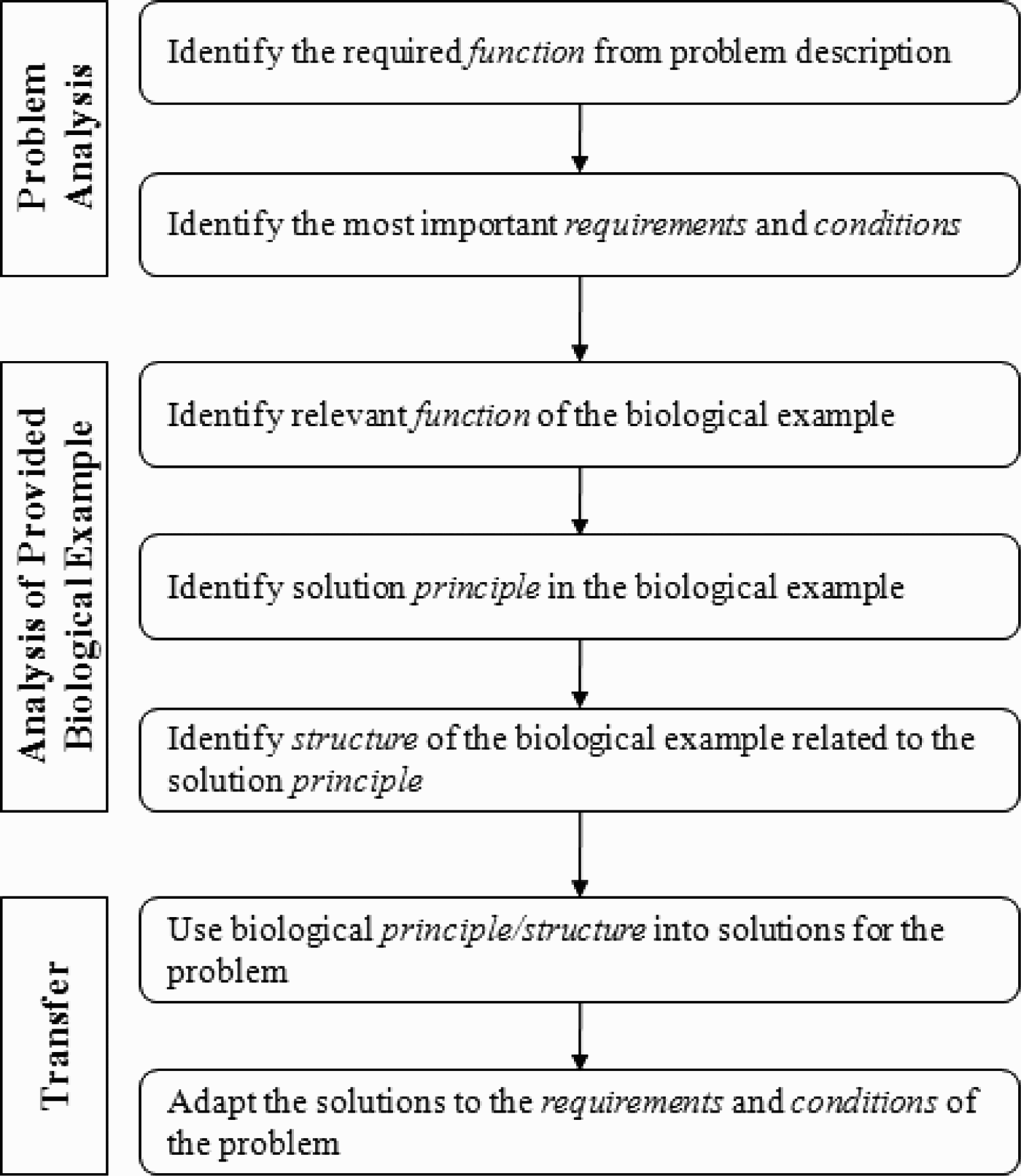
In this section, we describe two sets of guidelines. The “generic guideline” (Fig. 6) was developed to encapsulate the essential steps of carrying out biomimetics, as proposed in Section 2.1, and the recommendations specific to each of these steps as found from existing literature. The “guideline with SAPPhIRE” (Fig. 7) is proposed to follow the same generic steps as in the generic guideline, but with specific guidelines for using SAPPhIRE constructs as part of the process in all the steps. The classes of transfer proposed in this paper in Section 3 are recommended to be systematically used in the analysis and transfer steps. This is hypothesized to lead to a greater number of biomimetic design alternatives. Appendix A contains a glossary of definitions for the terms in Figures 6 and 7.
Generic guideline.
SAPPhIRE guideline.

6. EVALUATION
The two guidelines have been evaluated by a set of design experiments. In each session of these design experiments, designers have been asked to generate as many solutions as possible to a given design problem. The designers have followed one of the guidelines in each session while using a given description of one analogue biological example.
6.1. Experimental setup
Two equivalent design experiments are carried out. Four biomimetics undergraduate students participated in Germany, and four mechanical engineering graduate students undergoing a Masters level product design course took part in India (see Table 3 and Table 4).
Designer's background in India
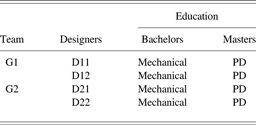
Note: G1, group 1; G2, group 2; D11, D12, D21, D22, designers 11, 12, 21, and 22.
Designers' background in Germany
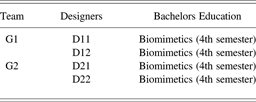
Note: G1, group 1; G2, group 2; D11, D12, D21, D22, designers 11, 12, 21, and 22.
Each of these design experiments is carried out in two consecutive sessions: in Session 1, each designer solves a design problem using the generic biomimetic guideline described in Figure 6. In Session 2, the designer uses the SAPPhIRE guideline proposed in Figure 7. Because the factor experience in solving the same problem could be a factor changing the outcomes of the design experiments if the designer solves the same task in both the sessions, a different design problem is assigned to the designers in the second session. In order to eliminate the influence of the different problem descriptions, both the design experiments, the Indian one and the German one, are carried out as 2 × 2 factorial experiments (Table 5). Two of the four designers individually solve Problem 1 in the first session and Problem 2 in the second session, but the other two designers solve Problem 2 in the first session and Problem 1 in their second session.
Design sessions

Note: G1, group 1; G2, group 2.
aWith generic guideline.
bWith SAPPhIRE guideline.
Even though two designers solve the same problem using the same guideline and biological analogue, each of these designers work individually. In the first session, each designer carries out the design task using a natural language description (Appendix B) of a given, analogue, biological example, and the generic biomimetic guidelines described in Figure 6. In the second session, each designer individually solves the design task using the same description of the biological example as before, as well as an added SAPPhIRE description of the example, and also using the SAPPhIRE-based guidelines described in Figure 7. The SAPPhIRE description of the biological example contains the information from the example description and information that can be inferred from it by persons with an engineering background, provided in a SAPPhIRE structure (see Appendix B). The design problems were developed from biomimetic examples from the examples list discussed earlier. The problems are described in Table 6. Before each session, an introduction to the respective guidelines to be used in the session was given by the researchers, followed by an example problem-solving session coached by the researchers in which all the designers participated; these were to make sure that each designer understood the guidelines involved and what were expected as outcome from their design sessions. The participants were then provided the design problem to be solved and asked to develop as many solutions as possible; no time constraint was imposed. The designers were asked to mark with a unique serial number every description or sketch which they considered as a solution. Although they were not allowed to speak among themselves, the designers could ask researchers, who acted as experiment supervisors, for any clarification. The designers were asked not to speak about the problem they worked on to anyone else during the time between the sessions. The second session took place several weeks after the first session.
Problems and biological examples

The number of biomimetic and feasible solutions for each given problem developed by the designers is taken here as an estimator for the performance of the use of the respective guidelines and associated descriptions of the stimuli. The solutions proposed by the designers are reviewed and classified by a team of three people with engineering background to make sure that the team is able to assess technical feasibility of the solutions and that the review is not biased by a single reviewer. First, the evaluation team decides which of the solutions marked by the designers can be considered a solution. The criterion is whether or not the solution addresses the relevant problem aspects, and whether or not there is any novel solution aspect compared to the previous solutions. Second, for each of the solutions that satisfies the above criterion, the team has to decide whether the solution can be considered a feasible solution in the sense that a technical implementation can be envisaged that would solve the problem. Third, it is decided whether or not the design solution can be classified as biomimetic. Solutions are classified as biomimetic solutions only if there is any aspect of the solution that is not contained in an earlier solution developed by the same designer in the same session, but is learned from the biological example. For any of these decisions, the members of the team have to discuss among themselves until they come to a consensus. In the cases in which consensus cannot be reached, for example, the cases can be classified differently based on different but internally logical interpretations, the respective solutions are classified as half biomimetic or as half-feasible solutions by the evaluation team (see Table 7).
Number of solutions generated by individual designers with generic and SAPPhIRE guidelines

Note: Lightface numbers are those obtained with the generic guideline, and boldface numbers are those obtained with the SAPPhIRE guideline. T, total number of solutions; B, biomimetic solutions; F, feasible solutions; B+F, biomimetic and feasible; P1, problem 1; P2, problem 2.
Because the number of participants is low, the advantages of the factorial design experiment have to be ignored for statistical evaluation: the results from the sessions using the same guidelines in the same country are pooled into one sample, respectively. The influence of the design problem is disregarded. These samples are tested for normal distribution using the normal distribution test of David et al. (Sachs & Hedderich, Reference Sachs and Hedderich2006) at a significance level of 5% (4 degrees of freedom). Each pair of samples from the same country as well as each pair of samples using the same guidelines are tested for the homogeneity of variances using the Siegel–Tukey variance test at a significance level of 5% (two-tailed test). The homogeneity of the mean values for these pairs of samples is evaluated using the t test for independent samples with the same sample size and homogeneous variances at a significance level of α = 20% (two-tailed test, 6 degrees of freedom). This high risk of an α error is accepted in order to increase the power of the test, despite the small sample sizes.
6.2. Results
All but one designer came up with more solutions when using the SAPPhIRE guidelines and a SAPPhIRE description of the biological example, than when using the generic guidelines and a non-SAPPhIRE description of the biological example. Similar trends can be observed for the number of biomimetic and feasible solutions (see Table 7). The overall increase in the number of biomimetic and feasible solution concepts due to the SAPPhIRE model and guidelines was about 60%.
Because attribute is a superset of organs, SAPPhIRE guidelines and design experiments treat transfer at these two levels as the same level of transfer, giving three broad possible transfer levels: parts, attributes/organs, and state changes. Each of these three levels of transfer was carried out in the design experiments in Germany and India (see Table 8). Three example solutions, each embodying one distinct level of transfer for a given problem, are presented in Figure 6, Figure 7, and Figure 8. The stimulus used is shown in Appendix B. The design task was to propose solutions for the climatization of a house in hot areas.
Organ level transfer.

Number of solutions according to categories of transfer with generic and SAPPhIRE guidelines

Figure 8 shows a concept for such a house generated because of transfer of organs: the thick outer wall protects the house from the sun and absorbs most of the heat energy. In the ventilation chimneys heat that is conducted to the inside air, is dissipated by the air. The air then rises up through the ventilation chimneys because of the resulting density change. The rooms inside the thick wall will always remain cool and conditioned. At night, the thick wall that contains heat energy will emit heat and thus prevent the inside room from catching cooler temperature fast.
The following organs are transferred to obtain the solution in Figure 6:
• the heat absorbance of the material,
• the dissipation coefficient and heat capacity of the chimney material, and
• the contact area between the wall and air.
Figure 9 provides an example of transfer at the state change level for the same problem and stimulus, where the walls of the window should get heated because of the sunlight and heat the air inside the room; this would then increase the volume of the air and decrease its density, so the air would tend to rise. In addition, because of the varying cross section of the room, the flow of air would be regulated. With a decrease in area, the air would move faster. The pressure drop created in the living room would try to suck air from the underground room. When the air from the underground room rushes to the living room, outside air would flow into the underground room, resulting in ventilation.
State change level transfer.

The following state changes are transferred to obtain the solution in Figure 7: from given temperature to higher temperature of air and from given density to lower density.
Figure 10 shows an example of part level transfer for the same problem and stimulus. The temperature is regulated because of air motion around the building floor walls.
Part level transfer.

The following parts are transferred:
• the walls of the termites' mound and ventilation chimney;
• the core of the termite's mound, where cool air is sucked in from the cellar; and
• the ventilation chimney, where there is attached material in the chimney and air in the ventilation chimney.
The stimulating effect of the SAPPhIRE support showed almost no variation between Germany and India (see Table 9). In India as well as in Germany, the increase in the number of solutions was statistically significant at a level of significance of 20%. The number of solutions could not be found to differ significantly between designers from both countries. Because of the high level of significance, a further statistical evaluation based on bigger sample size is recommended. The results in the two countries differed strongly regarding the levels of abstraction of the biomimetic transfers. When using the generic guidelines, in India the percentage of part and state change level transfers was very high compared to those in Germany. Although in Germany the use of the SAPPhIRE guidelines led to a substantial increase in the number of state change transfers and only to a slight increase in the number of organ transfers, in India, only the number of organ transfers increased (see Table 8). From the overall summary regarding transfer categories (see Table 10) the increase in organ transfers by more than 100% seems to be the most prominent gain from using SAPPhIRE guidelines.
Number of solutions per country and overall totals generated by individual designers with generic and SAPPhIRE guidelines
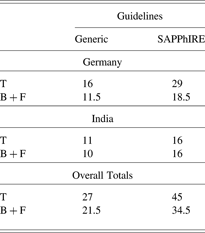
Note: T, total number of solutions; B, biomimetic solutions; F, feasible solutions; B + F, biomimetic and feasible.
Overall number of solutions according to categories of transfer with generic and SAPPhIRE guidelines
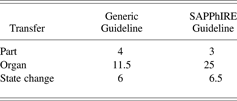
Note that the differences between results from Germany and India could be because of the difference in the problems used (the first problem used in the two countries was different from one another), because of the difference between the backgrounds of the designers, because of the small number of designers involved in the study, or because of differences in the way the experiment was carried out, or because of differences among the evaluators involved in the two countries. However, in the selection of the design problems, we tried to ensure similar difficulties. Further, although the educational background and the academic level of the designers varied, the curricula of both the product design graduate students and the biomimetics undergraduate students covered engineering basics and concept generation techniques. For none of them biomimetic concept generation was an everyday routine and the biological examples were formulated to be easily understandable without biological background. Nevertheless, the difference between the design experiments might account for the deviation in the number of total solutions. The researchers in Germany sorted out infeasible solutions and solutions that were not learned from biology during the evaluation, whereas the researchers in India gave strict instructions to the designers for the experiments regarding the notation of feasible and biomimetic solutions.
7. SUMMARY, CONCLUSIONS, AND FUTURE WORK
The work described in this paper reports the following major outcomes:
1. a generic biomimetic design process,
2. a generic set of biomimetic transfer levels, and
3. a validated set of guidelines to encourage greater ideation fluency in the biomimetic design process.
On the whole, the SAPPhIRE models and SAPPhIRE guidelines, as opposed to the natural language descriptions and generic guidelines, seem to better encourage considering unfamiliar kinds of transfer; in particular, they seem to support transfer and thinking at a physical level that results in a much higher number of organ-level transfers.
The following attributes of the SAPPhIRE model and SAPPhIRE guidelines might account for the increase in the number of biomimetic and feasible solutions vis-à-vis use of natural language descriptions and generic guidelines. SAPPhIRE guidelines describe how to arrive to principles at several levels of abstraction. In addition, different descriptions of the same example may activate a different range of associations. This might be especially valid as the SAPPhIRE models introduce a completely different structuring of the information about a biological system.
However, the following factors may also have influenced the results. The SAPPhIRE guidelines usually were the second guidelines to be tested. If there was a training or fatigue effect because of the first design experiment, it might have caused more or less solutions, respectively. However, a measurable training effect or fatigue effect is unlikely to have occurred because the second session was usually carried out several weeks after the first session.
Furthermore, the introductory explanation and pilot study included an explanation of the SAPPhIRE model as part of the second session. By thinking about the constructs of the model, more areas of the memory of the designers might have been activated in advance.
The detailed analysis of the design experiments points to aspects that could have stirred creativity. It was found in particular that the number of organ transfers increased. Organ-level transfers require a physical understanding of the biological system. Thus, the explanation for the increase in biomimetic and feasible solutions might be that the SAPPhIRE models provide a more detailed physical explanation and the SAPPhIRE guidelines force the designers to explicitly think about the physical effects involved in the biological functions.
Nevertheless, there is still room for improvement of the SAPPhIRE guidelines. They are based on the essential steps for doing biomimetics extracted from literature. Although these steps are essential, further steps or other ways of combining and guiding the steps might be required to develop a design process that is even more helpful. Such a process should also support an iterative development of problem formulation and solution concepts to correspond to cognitive processes in the solution of complex problems (Gramann, Reference Gramann2004). The feature that is unique to the SAPPhIRE guidelines is the distinction of several levels of transfer abstraction. Further design experiments involving a larger number of participants are required to quantify the effect of these levels. In that study, the same description of the stimulus should be used for both the guidelines to be evaluated and the benchmark. The four levels of transfer can also aid further analysis of the processes for doing biomimetics, in particular, biomimetic transfer. Such an analysis could, for example, be based on recording of biomimetic design sessions.
The benefit of the four categories of transfer was demonstrated by the design experiments with the SAPPhIRE guidelines. However, this categorization seems to make sense well beyond increasing design performance. Especially the distinction between part transfers, organ, or attribute transfers and state change transfers can be easily applied onto artifacts in which the biological source function is known. No knowledge about the design process is required. Together with the two additional classes of transfer abstraction involving more than one SAPPhIRE instance, the categorization explains what is transferred in biomimetics. As “biomimetic” is a label increasingly being used for marketing reasons, the question of whether a product really involves biomimetics becomes important. The categories of transfer provide criteria that should be used to decide this; if a transfer took place, these enable its classification, and support identification of transfers at various levels of abstraction. Identification of the transferred knowledge is also useful for further analysis of biomimetic processes and further specification of guidelines. The SAPPhIRE model might for example help to analyze, how analogue relationships between input and organ guide the appropriate placement of organs in the target system.
The resemblance of the distinction between “part transfer,” “organ transfer,” and “state change transfer” with the distinction of Schild et al. (Reference Schild, Herstatt and Lüthje2004) between “transfer of a known technology into a new context,” “transfer of structure,” and “transfer of functional principles” is apparent. However, the constructs of the SAPPhIRE model specify more clearly, compared to terms like “structures” or “functional principles,” as to which kind of knowledge is transferred in biomimetics, for example, “organs” or “(sequences of) state changes,” and of more importance, how these relate to one another.
Furthermore, the SAPPhIRE model turned out as a suitable model for representing knowledge transferred in biomimetics. There are two major advantages of the SAPPhIRE model over models currently used for representation of biological systems. First, it relates structure, behavior, and function in a logical manner, including several levels of abstraction commonly used when thinking and speaking about functionality. Second, it has the potential to be used to organize information in an even more hierarchical manner as demonstrated in Section 4.1. With the fuzzy SAPPhIRE model, it is not necessary to model the physical level if that would be too much in detail. Because of these advantages, the SAPPhIRE model could enable the modeling of complex biological systems. For example, for an ant hill, SAPPhIRE instances could describe individual ant behavior, which can then be summarized into SAPPhIRE instances at a higher level of abstraction, where the accumulation of material due to individual actions becomes visible. Then another action could be used to model how the accumulation creates an organ by providing an obstruction to the wind. State changes due to the corresponding action could again become inputs at the individual ant level, and so on. Currently, the SAPPhIRE model is used in a relatively small database of biological functions at a relatively low level of complexity, within the idea generation software IDEA-INSPIRE (Chakrabarti et al., Reference Chakrabarti, Sarkar, Leelavathamma and Nataraju2005). For compiling a more comprehensive database, the support of technical biologists is required, for they have a functional perspective on biology and can describe biological functions at a physical level of abstraction. As demonstrated by the ant example, SAPPhIRE could become a support in biological research, so that filling a database would also be auspicious for biologists. The next steps toward modeling complex biological systems are modeling trials, as well as integration of quantitative considerations and a representation of time into the SAPPhIRE model. With these, it might become a powerful tool for examining complex systems.
As soon as a database of biological systems is available, any designer who is able to interpret the SAPPhIRE models and use the SAPPhIRE guidelines should be able to carry out biomimetic transfers using the database. We argue that the SAPPhIRE model can provide an adequate language for communication between biologists and designers, and enable biologists to generate descriptions of biological systems that are helpful for designers. As our results show, a designer using such a description and an adequate design process is likely to come out with more possibilities than a designer working with a purely verbal description. The next step toward a biology database usable by designers would be to set up an open access project in order to fill a database, supported by material that explains how to model appropriately using SAPPhIRE model. However, as Schmidt (Reference Schmidt, Rossmann and Tropea2005) explained, such databases cannot replace interdisciplinary biomimetic work, as models of biological systems usually develop along with the technical view in an iterative process.
ACKNOWLEDGMENTS
Special thanks to Professor Labisch and Daniel Matz for their help in the conduction and evaluation of the design experiments and to Paul Bohmke, Katharina Haag, Sebastian Möller, and Nina Sauthoff from Germany, and Pankaj Upadhyay, Urvesh Avinash Bharambe, B.S.C. Ranjan, and Geo Paul from India, for their participation and feedback. The work presented here was primarily carried out at the Centre for Product Design and Manufacturing, Indian Institute of Science (IISc), Bangalore, India. The design experiments carried out in Germany were carried out at the University of Applied Sciences, Bremen.
Julian Sartori graduated from the University of Applied Sciences, Bremen, Germany, with a BS in biomimetics. He has been working at the Institute of Textile Technology and Process Engineering, Denkendorf, Germany, since 2009. Julian's current research interests are biological materials, especially the flight membrane of pterosaurs, biomimetics in textile engineering and architecture, the use of system theories in describing biological interactions, and the methodology of biomimetics.
Ujjwal Pal attained a BE in mechanical engineering from the National Institute of Technology, Durgapur, India, and is currently working on his MS in engineering from the Centre for Product Design and Manufacturing, IISc, Bangalore, India. His research interests include biomimetics, functional synthesis, and conceptual design.
Amaresh Chakrabarti is a Professor at the Centre for Product Design and Manufacturing at IISc, Bangalore. He has a BE in mechanical engineering from Calcutta University, an ME in mechanical design from IISc, and a PhD in engineering design from the University of Cambridge. He led the design synthesis team of the Engineering Design Centre of the University of Cambridge before joining IISc and founded IDeASLab, which is the first design research laboratory in India. His synthesis software FuncSION won an award at the 1994 Morgans–Grampian Competition. Dr. Chakrabarti is an Area Editor for Research in Engineering Design and a Regional Editor for Journal of Remanufacturing. He is on the editorial boards of MM Science and AI EDAM and is on the editorial advisory board for Journal of Engineering Design, as well as the advisory board of the Design Society. His research interests include design synthesis, creativity, collaborative design, ecodesign, knowledge management, design for variety, and design research methodology. Prof. Chakrabarti codeveloped the widely used design research methodology called DRM.
APPENDIX A
A.1. Glossary
Conditions: An arrangement that must exist before something else can happen.
Function: Descriptions of what a system does: it is intentional and at a higher level of abstraction than behavior.
Instance: A (SAPPhIRE) instance is the SAPPhIRE description belonging to one single action.
Relation: A situation of something in comparison to or with respect to another thing, for example, inside, outside, over, and under.
Requirements: Requirements describe what designers try to satisfy with or in their design.
Sequence of actions: Because a certain function may include several SAPPhIRE instances, these instances together specify a sequence of the actions that together describe the function.
APPENDIX B: AN EXAMPLE OF PROBLEM AND RELEVANT BIOLOGICAL EXAMPLES WITH NATURAL LANGUAGE AND SAPPhIRE DESCRIPTIONS
B.1. Problem statement
Develop a concept for the ventilation and acclimatization of a building.
B.2. Biological examples
Biological examples are provided in Figure B.1 and Figure B.2.
An overview of the termites' mound without a ventilation chimney (Turner, Reference Turner2001). [A color version of this figure can be viewed online at journals.cambridge.org/aie]

Schematic illustrations of a ventilation chimney's working principle. [A color version of this figure can be viewed online at journals.cambridge.org/aie]

B.3. Natural language description
Some termite species attach chimneylike constructions to their mounds. Because of solarization these chimneys become very warm over the day. This heat is transmitted to the air within the chimneys. The density of the heated air decreases because of thermal expansion and the air rises and partly leaves the mound through pores. Because of the resulting decrease of pressure air is sucked out of the mound's core (nest) into the chimney and cool air from the “cellar” is sucked into the mound's core. Hot air from the environment and inside the mound refills the cellar and is cooled down there. Thus, ventilation is established and the nest in the mound's core is cooled down to a moderate temperature. The termites regulate this ventilation by changing the chimney's diameter. Therefore, they attach material to the chimney's inner walls and remove it again when required. The airflow through the chimney is correspondingly reduced or increased.
Furthermore, the low thermal conductivity and the high thickness of the walls lead to heat regulation. The walls of the termites' mound become hot during the day because of solarization. However, this takes so much time that the mound is overshadowed before the heat reaches the nest in its core. Then the heat flow changes its direction and the heat is emitted to the environment again.
B.4. SAPPhIRE description
The SAPPhIRE description is provided in Table B.1.
SAPPhIRE description



