Introduction
Cholesteatoma is defined as keratinising squamous epithelium within the middle-ear cleft and mastoid. It carries the risk of significant complications, such as destruction of hearing and balance organs, facial nerve damage, and intracranial infection with or without suppuration.Reference Yung, Tono, Olszewska, Yamamoto, Sudhoff and Sakagami1 As such, management is typically surgical, the aims of which are primarily to achieve a disease-free and dry ear, but also to maintain the hearing mechanism as best as possible or to reconstruct an affected hearing mechanism.
The debate surrounding the optimal surgical technique for primary cholesteatoma surgery is long-standing and generally sets evidence against surgical experience. A canal wall down approach, leaving the patient with an open mastoid cavity, has been the traditional technique employed. This, however, involves significant destruction of middle-ear and mastoid anatomy, which can limit hearing reconstruction options. Such anatomical destruction can also lead to problems associated with the resultant cavity, such as crust accumulation and the need for regular microsuction, water intolerance, intermittent discharge, and calorically-induced vertigo related to either water or air exposure.Reference Mehta and Harris2
More contemporary canal wall up techniques minimise destruction and avoid many of these ramifications, but have been associated with higher rates of disease recidivism.Reference Tomlin, Chang, McCutcheon and Harris3 Primary obliteration and/or reconstruction techniques, in which a canal wall down procedure is performed and the resultant cavity is obliterated or repaired as part of the same procedure, may mitigate against the disadvantages of both canal wall up and traditional canal wall down techniques. Indeed, a recent pooled analysis suggested that the most favourable rates of disease recidivism and post-operative ear discharge were achieved with such techniques.Reference Harris, Mettias and Lesser4 However, these data were mostly derived from retrospective case series. Perhaps surprisingly, there is a dearth of published data directly comparing a canal wall up approach with primary obliteration and/or reconstruction techniques.
This study therefore aimed to directly compare disease recidivism and ear discharge rates between a canal wall down with obliteration technique and a canal wall up mastoidectomy technique, to help inform contemporary surgical decision-making in primary cholesteatoma surgery.
Materials and methods
Ethical considerations
This study was undertaken in accordance with our institution's clinical information and audit department regulations and approval (reference: AC04960). All patient data were kept anonymous and encrypted throughout.
Patients and setting
Patients undergoing mastoid surgery at our institution over a five-year period (2013–2017) were identified retrospectively. Only those undergoing elective primary procedures using either a canal wall down with obliteration technique or canal wall up technique were eligible for inclusion. Patients were included provided there was at least 12 months’ follow-up data.
Electronic hospital records were used to extract the following data: demographics, operative details, complications and clinical outcomes. In relation to clinical outcomes, our primary outcome measure of interest was disease recidivism, defined as the presence of either recurrent or residual disease. Other outcome measures of interest were: presence of post-operative ear discharge (defined as any documented episode of discharge requiring treatment); and hearing outcome, evaluated by the mean pre- and post-operative air–bone gaps across four frequencies (0.5, 1, 2 and 4 kHz) on pure tone audiometry, as recommended by the Committee on Hearing and Equilibrium of the American Academy of Otolaryngology – Head and Neck Surgery Foundation.5
Cases were staged retrospectively according to the European Academy of Otology and Neurotology and Japanese Otological Society joint consensus statement,Reference Yung, Tono, Olszewska, Yamamoto, Sudhoff and Sakagami1 as follows: stage I – cholesteatoma localised to the primary site of origin; stage II – cholesteatoma involving two or more sites; stage III – cholesteatoma with extracranial complications; and stage IV – cholesteatoma with intracranial complications.
For the obliteration procedure, canal wall down mastoidectomy was performed using a standard front-to-back technique with exenteration of all diseased air cells. During the drilling process, autologous bone pâté was harvested using a bone pâté collector (Exmoor Ltd, Taunton, UK) and utilised subsequently to obliterate the resultant cavity. If required, additional bone pâté was harvested from adjacent cortical bone. Typically, a temporalis fascia graft (with or without cartilage overlay) procedure was then performed, with subsequent replacement of ear canal skin to cover the obliterated bowl. Canal wall up mastoidectomy was performed in a standard fashion. Typically, thorough exteriorisation of the mastoid air cells was undertaken and a posterior tympanotomy performed only if there was concern about clearance of disease from the retrotympanum.
Regardless of mastoidectomy technique, routine practice in our department was to offer hearing mechanism reconstruction, if indicated, as a staged procedure, and was not undertaken during primary surgery. Thus, the hearing outcomes presented here represent hearing prior to any such reconstruction.
Data analysis
Data were collated in Excel for Mac 2011 spreadsheet software (Microsoft, Redmond, Washington, USA), and analysed using SPSS statistical software, version 24 (IBM, Armonk, New York, USA). Differences between the two surgical groups in terms of rates of disease recidivism and post-operative ear discharge were compared using chi-square statistics. Hearing outcomes were compared using t-tests and Levene's tests for equality of variances, as data were observed to be normally distributed on visual inspection of the histograms. The significance level for all tests was set at 0.05.
Results
A total of 104 ears (98 patients) were included. The mean follow-up period was 30 months (range, 12–52 months). Fifty-eight patients were male and 40 were female. The mean patient age was 59 years (range, 26–82 years).
A canal wall down with mastoid obliteration procedure was performed in 55 cases and a canal wall up procedure was carried out in 49 cases. Of those cases undergoing a canal wall down with mastoid obliteration procedure, 3 (5.5 per cent) had stage I disease, 49 (89.1 per cent) had stage II disease and 3 (5.5 per cent) had stage III disease (2 cases of labyrinthine fistula and 1 case of post-auricular abscess/fistula) Similarly, of those cases that underwent a canal wall up procedure, 4 (8.2 per cent) had stage I disease, 44 (89.8 per cent) had stage II disease and 1 (2.0 per cent) had stage III disease (labyrinthine fistula).
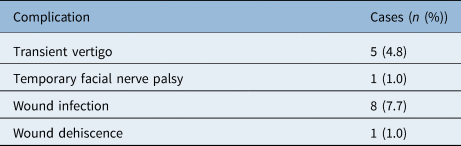
There were no major surgical complications; minor complications are summarised in Table 1. The case of temporary facial nerve paresis was attributed to the effects of the local anaesthetic in the presence of a dehiscent fallopian canal.
Surgical complication rates

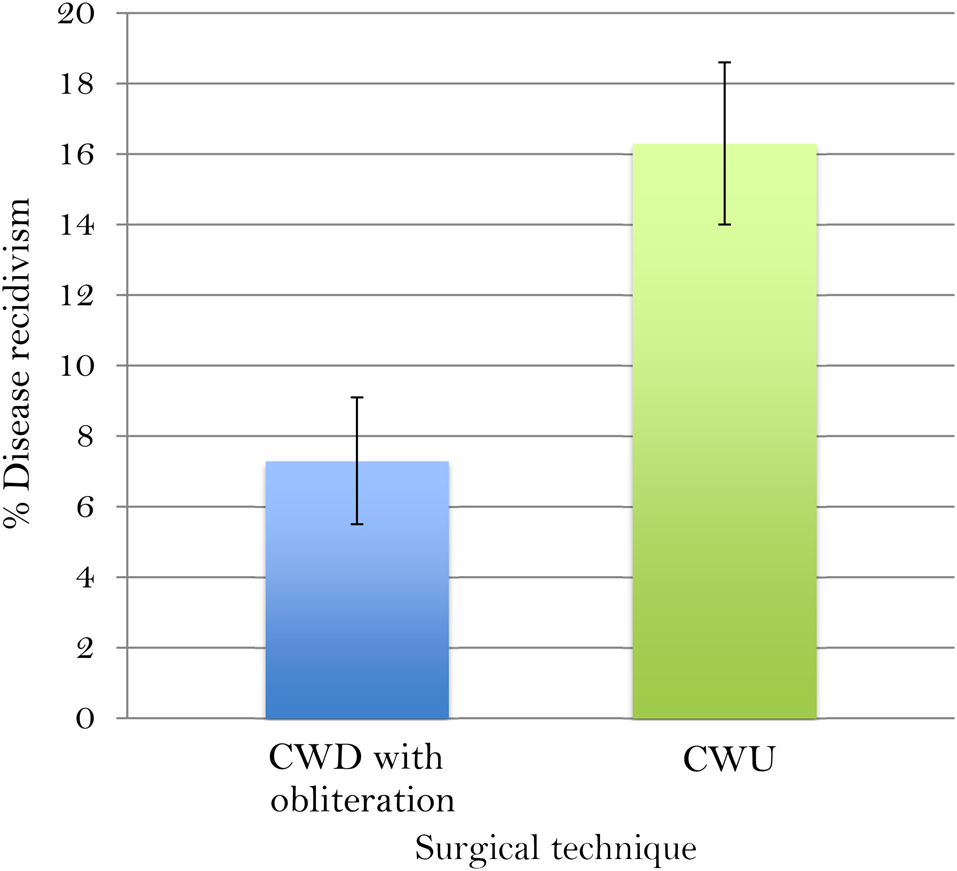
Disease recidivism rates were significantly lower in those undergoing canal wall down mastoidectomy with mastoid obliteration compared with the canal wall up procedure group (7.3 per cent vs 16.3 per cent, p = 0.02; Figure 1). In all cases, disease recidivism was identified on clinical examination and/or radiological imaging following clinical suspicion, and in all cases revision procedures were undertaken.
Disease recidivism rates by surgical technique. Canal wall down (CWD) mastoidectomy with obliteration had a significantly lower recidivism rate than canal wall up (CWU) mastoidectomy (7.3 per cent vs 16.3 per cent, p = 0.02). Error bars represent 95 per cent confidence intervals.

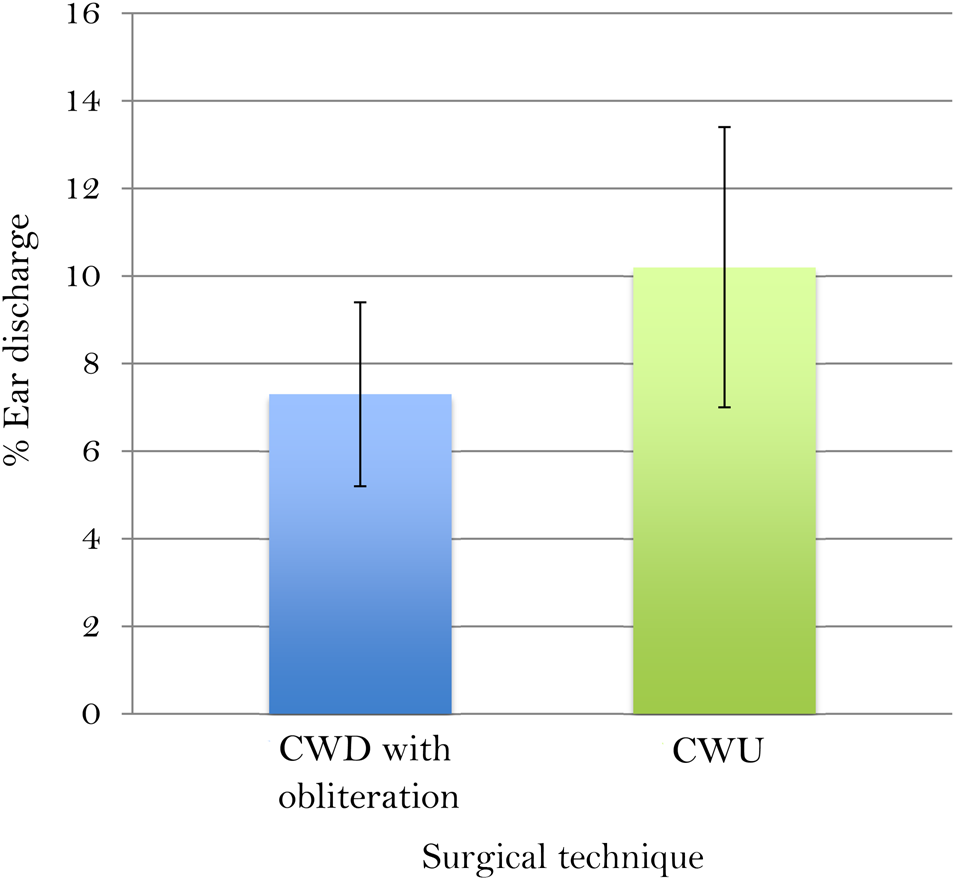
Ear discharge rates were similar between groups (7.3 per cent for canal wall down with obliteration vs 10.2 per cent for canal wall up) (Figure 2), and hearing outcomes were also broadly consistent (Figure 3).
Ear discharge rates by surgical technique. There was no significant difference in ear discharge rates between canal wall down (CWD) mastoidectomy with obliteration and canal wall up (CWU) mastoidectomy (7.3 per cent vs 10.2 per cent respectively, p = 0.24). Error bars represent 95 per cent confidence intervals.

Hearing outcomes by surgical technique as evaluated by the mean pre- and post-operative air–bone gaps (ABG) across four frequencies (0.5, 1, 2 and 4 kHz) on pure tone audiometry. There was no significant difference in hearing outcomes between canal wall down (CWD) mastoidectomy with obliteration and canal wall up (CWU) mastoidectomy (Δ4 dB vs Δ5 dB respectively, p = 0.61). Error bars represent 95 per cent confidence intervals.

Discussion
Key findings
The direct comparative data presented in this study indicate that canal wall down mastoidectomy with obliteration is superior to a canal wall up technique in primary cholesteatoma surgery. The technique appears to provide a lower disease recidivism rate combined with a low post-operative ear discharge rate, whilst largely restoring middle-ear and mastoid anatomy.
Comparison with other studies
Numerous case series have reported favourable outcomes for canal wall down mastoidectomy with obliteration and/or reconstruction, employing a variety of techniques including the use of bone pâté, fascia or muscle grafts, cartilage, or synthetic materials. Whilst the reported disease recidivism rates have varied widely, from 0 per centReference Uzun, Yagiz, Tas, Adali, Koten and Karasalihoglu6–Reference Lee, Choi, Song, Son, Jung and Kim10 to 18 per cent,Reference Haginomori, Takamaki, Nonaka and Takenaka11 those series in which bone pâté has been used as the obliteration and/or reconstruction material have generally observed rates in the order of 5 per cent,Reference Lee, Kim, Lee, Kim, Moon and Byeon8–Reference Lee, Choi, Song, Son, Jung and Kim10,Reference Gantz, Wilkinson and Hansen12 which is in keeping with our rate of 7.3 per cent.
Interestingly, the most recent, and one of the largest, case series reporting outcomes of a bone pâté obliteration technique observed a higher disease recidivism rate, of 12 per cent.Reference Walker, Mowry, Hansen and Gantz13 This higher rate, however, is likely a simple reflection of the heterogeneous patient group studied, in that patients undergoing revision surgery were included, as were both paediatric and adult patients. The issue of distinguishing between paediatric and adult studies is perhaps subtle, but nonetheless important: paediatric cholesteatoma is generally considered to be more aggressive and difficult to treat, with higher rates of disease recidivism, presumed to be the result of distinct disease biology and an elevated grade of cellular proliferation.Reference Edfeldt, Kinnefors, Stromback, Kobler and Rask-Andersen14 Clearly this has implications for outcomes of studies incorporating both adult and paediatric patients, and for comparisons made between studies; it may also mean that the superiority of any particular surgical technique in terms of disease control cannot be extrapolated to other patient groups.
Few studies, however, have provided direct comparative data between CWD mastoidectomy with obliteration and CWU techniques. This is perhaps surprising considering that both of these techniques have been well established for many years. Furthermore, these techniques preserve or reconstruct normal middle-ear and mastoid anatomy, in turn allowing for greater hearing reconstruction options and providing more favourable quality-of-life outcomes compared with the traditional open cavity approach.
Only two previous studies have followed a similar design to that presented here, insofar as they have directly compared these two techniques.Reference Ojala and Palva15,Reference Sanna, Zini, Gamoletti, Delogu, Russo and Scandellari16 Although both studies included a large number of cases, comparative groups were markedly unbalanced in terms of numbers: Ojala et al. reported on outcomes of 463 cases, 432 of which were treated using an obliteration/reconstruction technique,Reference Ojala and Palva15 while Sanna et al. examined outcomes for 538 cases, only 36 of which underwent obliteration/reconstruction surgery.Reference Sanna, Zini, Gamoletti, Delogu, Russo and Scandellari16 Notwithstanding, in keeping with what we have observed in the present study both studies reported more favourable disease control outcomes using obliteration/reconstruction techniques (albeit marginally so in the former study), with recidivism rates of 4.6% and 8.3% respectively for such techniques.Reference Ojala and Palva15,Reference Sanna, Zini, Gamoletti, Delogu, Russo and Scandellari16
A handful of studies have also directly compared all three mastoidectomy techniques in primary cholesteatoma surgery (i.e. traditional canal wall down open cavity vs canal wall up vs canal wall down with obliteration and/or reconstruction),Reference Godinho, Kamil, Lubianca, Keogh and Eavey17–Reference Stangerup, Drozdziewicz, Tos and Trabalzini20 only one of which examined outcomes in an adult patient population.Reference Lau and Tos18 In accordance with our findings, a recent pooled analysis of these studies together with the two aforementioned comparator studies demonstrated propitious disease control rates for the obliteration and/or repair group, with a disease recidivism rate of 5.3 per cent, compared with 29.4 per cent for the canal wall up mastoidectomy group.Reference Harris, Mettias and Lesser4 Again broadly consistent with our findings, the proportion of patients with discharging ears was 18 per cent in the canal wall up group, compared with 11 per cent in the obliteration and/or repair group;Reference Harris, Mettias and Lesser4 this difference is likely a surrogate of the marked distinction in disease recidivism rates.
The hearing outcomes of this pooled analysis were also concordant with our findings. As might be expected in contemporary otology practice, there were no clear differences in pre- and post-operative mean hearing levels with any of the techniques (23 dB pre-operatively vs 22 dB post-operatively for the canal wall up technique, 27 dB pre-operatively vs 27 dB post-operatively for the traditional canal wall down technique, and 44 dB pre-operatively vs 39 dB post-operatively for the obliteration and/or repair technique). As alluded to previously, however, both the canal wall up approach and the obliteration and/or repair technique are more likely to maintain adequate middle-ear depth for subsequent staged hearing reconstruction if indicated, as is routine practice in our department accounting for patient autonomy.
One of the major concerns regarding the obliteration and/or repair technique is the issue of potential reabsorption or atrophy of the reconstruction material over time. Indeed, the fact that so many different techniques using such a variety of materials have been described is testament to this. In our experience with bone pâté, however, we have not observed any instances of significant volume loss of obliteration material over time. Moreover, the findings from the histopathological analysis of temporal bone specimens from patients who had undergone mastoid obliteration surgery lend credence to this.Reference Linthicum21 Specifically, bone pâté was seen to have become encircled by fibroconnective tissue without inflammation, and in the immediate surrounding area new bone deposition was observed.Reference Linthicum21
Study strengths and limitations
The optimal study methodology to reduce bias when comparing clinical interventions is a prospective, randomised, controlled design. As such, the retrospective nature and absence of randomisation in our study are limitations and potential sources of bias. Indeed, individual surgeon decision-making was the determinant of treatment group allocation in our study. It is conceivable that a front-to-back canal wall down with obliteration technique was adopted for cases with more limited disease, with canal wall up mastoidectomy being reserved for more extensive disease throughout the mastoid air cells, which may have significantly influenced outcomes. On the basis of the retrospective notes and imaging reviews, however, the decision regarding surgical approach appeared to be determined predominantly by individual surgeon preference for a particular technique and/or surgical trends at various times during the study period, rather than any particular aspects of individual cases. In accordance with this, the staging of disease was broadly consistent between study groups.
Moreover, our study was quasi-experimental in design, insofar as outcomes in the comparator treatment groups were analysed. It represents one of the few studies to date to directly compare outcomes for canal wall up mastoidectomy with a canal wall down with obliteration and/or repair technique in primary cholesteatoma surgery, particularly in adult patients. We surmise, therefore, that whilst study design was not superlative, the comparator group methodology used still represents a particular strength of our study, particularly when taken in the context of previously published data.
We also acknowledge that the relatively small numbers in our study (104 ears in 98 patients) potentially could be construed as a limitation, with the associated propensity for a type II error. Despite this, however, a statistically significant difference was still identified between the comparator groups with respect to our primary outcome measure of interest, and thus does not appear to have been a true limitation of our study.
A further potential limitation relates to surgical technique in the canal wall up cases. Whilst a standard canal wall up technique was used in our study, we acknowledge that the use of ancillary instruments such the potassium titanyl phosphate (KTP) laser and otoendoscopes may enhance disease recidivism outcomes, which may then be more comparable with canal wall down with obliteration techniques. Indeed, a significant improvement in the rate of complete cholesteatoma removal with KTP laser use has been demonstrated in the setting of a randomised, controlled trial,Reference Hamilton22 whilst use of otoendoscopes has been shown in several studies to improve visualisation in difficult-to-access sites and in turn lower the rate of residual cholesteatoma.Reference Yaniv, Tzelnick, Ulanovski, Hilly and Raveh23,Reference James, Cushing and Papsin24 Direct comparison of these techniques is certainly something that merits further investigation in future studies.
Clinical applicability
Contemporary practice standards for the primary surgical management of cholesteatoma demand not only disease control, but should also account for maximal preservation or restoration of structure and function, and by association post-operative quality of life. Canal wall up and primary obliteration and/or reconstruction techniques respect these surgical tenets more holistically than a traditional canal wall down approach that leaves an open mastoid cavity. As such, it is of significant clinical relevance to directly compare outcomes between these two techniques, to help inform contemporary surgical decision-making in primary cholesteatoma surgery.
• Contemporary practice standards for surgical management of cholesteatoma demand disease control, and preservation and restoration of structure and function
• Canal wall up and primary obliteration and/or reconstruction techniques respect these surgical tenets more holistically than a traditional canal wall down approach
• There are limited comparative data on these mastoidectomy techniques
• This study directly compared treatment outcomes of these techniques in 104 cases to inform decision-making in primary cholesteatoma surgery
• Disease recidivism rates were lower for the canal wall down with mastoid obliteration group, whilst ear discharge rates were similar
• These data support the use of a primary obliteration and/or reconstruction technique to optimise disease control, ear discharge, and middle-ear and mastoid anatomical restoration
Herein, we have presented one of the few direct comparator studies to date, the results of which add to the body of evidence supporting the use of primary obliteration and/or reconstruction techniques to achieve the most favourable rates of disease control and post-operative ear discharge. Dissemination of these data will embolden the continuation of our practice in this regard. We also hope this report will prompt other suitably specialised and motivated departments to consider adopting a primary obliteration approach as part of their surgical armamentarium in primary cholesteatoma surgery and encourage further dissemination of results.
However, the interpretation of data should be made in light of the acknowledged frailties in study design, and we anticipate that our findings will help foster further appraisal in larger, well-designed prospective studies going forward.
Competing interests
None declared