


To rectify a long-entrenched emphasis on scholastic sentences, summae, and philosophical ideas in secondary literature about theology in the High Middle Ages and a correlated assumption that “theology” proper was a movement away from study of the biblical text, some scholars in recent years have devoted considerable attention to biblical commentaries and exegesis of the twelfth century, reviving scholarship of the 1960s.Footnote 1 Scholars frequently cite the classic works of Jean Leclercq and Beryl Smalley, which remain on many a graduate student's required reading list in the field of medieval history.Footnote 2 But these studies of biblical exegesis, though important and extensive compared to anything prior, were limited in scope and did not inspire the kind of sustained investigation by other scholars that would have carried their research forward as much as might have been expected. These works also encouraged a division between studies of monastic culture and that of scholasticism, or the academic culture of “the schools.” In terms of manuscript studies on glossed books, the studies by Patricia Stirnemann have been foundational; meanwhile, in the history of the book and manuscript and codicological studies, Christopher de Hamel's book-length study remains key.Footnote 3 One of the schools studied by Smalley, that of St. Victor in the twelfth century, has recently received significant scholarly attention through the efforts of Franklin T. Harkins, Frans van Liere, and others.Footnote 4 Their work has brought to light and assessed both theological ideas arising from biblical exegesis and methods utilized in reaching them, a layer of scholarly engagement not yet sustained in regard to many other figures and schools of the period, with the exception of certain individuals such as the Benedictine Rupert of Deutz.Footnote 5
Moreover, scholars have revived interest in the school of Laon and the focus of Rupert's disdain, Anselm of Laon (d. 1117). Some of the attention has focused on his life together with intense manuscript research into sententiae, or authoritative teaching opinions on various matters as preserved in various twelfth-century collections. Cédric Giraud's masterful and extensive book has shed light on Anselm and his school in an unprecedented way.Footnote 6 Though largely summarizing other research, Lesley Smith's book on the development of the Glossa ordinaria on the books of the Bible conveys the long-term and widespread impact of the project begun at Laon, including on library holdings by the late twelfth and early thirteenth centuries.Footnote 7 More than anyone, Alexander Andrée and Mark Clark have demonstrated the import of earlier forms of the Glossa ordinaria as a key source for the lectures of major Parisian masters such as Peter Comestor after mid-century.Footnote 8 Even as masters were beginning to utilize Peter Lombard's Sententiae as a textbook in their own classrooms, they, like the Lombard, developed their theological thinking out of reflection on the biblical text, as lectures directly on the Bible remained the norm.Footnote 9
The exegetical work going on in lectures in Paris in the 1160s and later creates an essential piece of the backdrop to the theological developments at the University of Paris in the thirteenth century. Evidence abounds, however, for vigorous activity in many other places outside of Paris as a result of the influence of the school of Laon. In other words, the impact of Laon was more diffuse, not channeled solely via Paris and the masters there. Students who traveled to Laon to study the sacra pagina returned home and brought in tow glossed biblical books, commissioned their copying to make sure their home library had a copy, or acquired them on later journeys through the land of their alma mater. Institutions ranging from reform-minded Benedictine monastic houses to new Cistercian houses to cathedral schools and libraries desired these glossed books on the Bible. Suffice it to say, much scholarly work remains to be done in unpacking the reading practices, theological ideas, and book-copying habits that the books of the Bible inspired.Footnote 10
In this essay, we highlight the constellation of glosses and commentaries on the Gospel of Matthew, all produced in the first half of the twelfth century in the Laon milieu and disseminated near and far, to argue that a certain kind of exegetical world was being forged in that period, outside of and beyond Paris, that prepared the way for the widespread success of the Glossa ordinaria, both as a book form and as a bearer of certain theological ideas and exegetical techniques. That world consisted of active and intertwined practices of biblical interpretation that weaved patristic, Carolingian, and contemporary thinking together in gloss and commentary form; whatever was novel, in form or in content, could likely be more readily accepted because it was enmeshed with traditional and authoritative exegesis and conveyed repeatedly in closely-related commentaries. In addition, close study of twelfth-century manuscript copies of glosses on Matthew permits an identification of earlier and later versions of the gloss, while their wide and rapid dissemination, combined with their interrelationships with contemporary continuous commentaries, justifies editorial attention to the versions of the Gloss prior to the one that served as a source for Parisian lectures of Comestor and others.
Methodologically, we rely not only on philological and paleographical analysis of texts as found in original manuscripts, but also on historical considerations of manuscript production and dissemination. Based on extensive collation and analysis of glosses on Matthew 5, we present evidence for clear, distinct families of manuscripts of earlier versions of these Matthew glosses as well as identify unique glosses that indicate individualized and variously influential engagement with the biblical text. Based on previously published findings about the provenance of sixteen glossed copies of Matthew from the twelfth century and the actors involved in their production and/or dissemination, we consider the glosses not just as a text, authored by someone, but as texts that bear historical witness to a widespread and shared community of exegesis that many individuals and institutions deliberately chose to join.Footnote 11
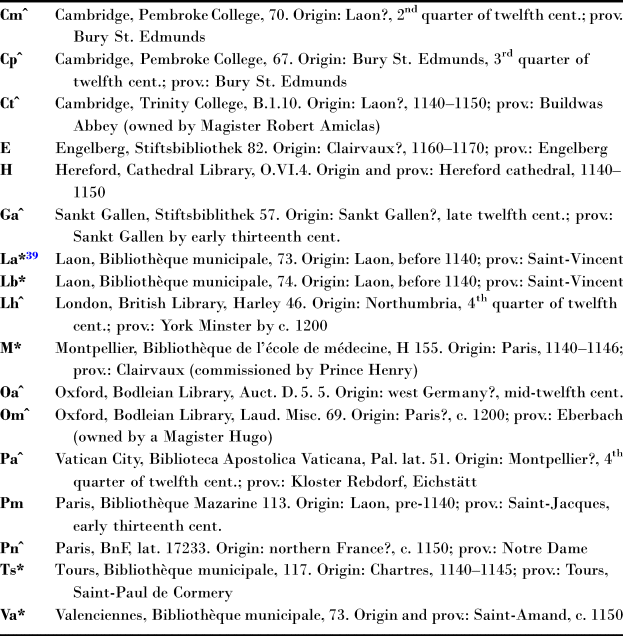
Terminologically, we use “the Gloss” to refer collectively to the set of glosses on a biblical book (in this case, Matthew); this collection underwent changes and growth throughout the century and also beyond, prior to solidifying into what was called the Glossa ordinaria. We will identify below two main stages of development of “the Gloss” in the twelfth century. We use “glosses” to refer to individual instances of commentary or annotation, ranging from a single word to a whole paragraph, that are present in one or more manuscripts and were written to elucidate aspects of particular passages within the biblical text (for example, a gloss in manuscript Pm referencing Matthew 5:16, or shared interlinear glosses in Cp and Cm on a term within Matthew 5:22).
Finally, we add a note of introduction about historiography: previous scholarship on the running commentaries discussed below has devoted an immense amount of ink to questions of authorship (is Anselm the author of one or more of them?) and the textual derivation of one from another. While such questions are not unimportant, our focus is more on presenting the close relationships among the glosses, these commentaries, and patristic and Carolingian forebears. Such an approach allows a greater understanding of the characteristics and the widespread influence of a hermeneutic and forms of annotation in the period, which in turn helps explain how the stage could be set for the massive explosion of copies of the Gloss and the formalized Glossa ordinaria in subsequent decades and for the reception of theological works by Parisian masters that utilized them.Footnote 12
The Status Quaestionis on the Commentaries and Glosses on Matthew
Four commentaries on Matthew from the early twelfth century have received significant attention in the scholarship. The precise textual relationships among them remain unclear, but what is clear is that they originated in the Laon milieu and that they are intertwined with the development of the Gloss. Named by incipit and the sigla assigned by Giraud (often taken from Beryl Smalley, who assigned them primarily based on the manuscript copy she knew), they are: (1) Nomen libri evangelium (“V”, because present in Valenciennes, Bibliothèque municipale 14); (2) Cum post ascensionem (“A”, because present in Alençon, Bibliothèque municipal 26); (3) Euangelium grece latine bonum (“P”, because present in Paris, BnF, lat. 2491); and (4) Dominus ac redemptor (“B”, because attributed to Geoffrey Babion).Footnote 13 Besides these four, Adrian Ballentyne has discussed another commentary closely related to Cum post ascensionem preserved in Durham, Cathedral Library A.1.10, bearing the label Omelie super evangelium Mathei.Footnote 14 Based on the current state of research, however, other copies of that text are not known; the other commentaries exist in multiple manuscripts, have been the object of much study, and receive our attention here.
Nomen libri evangelium is an anonymous abbreviation of Paschasius Radbertus’ ninth-century commentary on Matthew. If the work was ever finished, a full copy does not survive or has yet to be identified. Several copies end after the Pater noster in Matthew 6. The Valenciennes copy received the most attention early on due to the presence of sententiae associated with Anselm and his school in the same codex. Weisweiler identified a very similar copy in Stuttgart, Landesbibliothek, Cod. theol. quart 262, fols. 206r–212v (provenance: Zwiefalten, twelfth cent.) and listed other manuscripts where what he called the “Valenciennes-Stuttgart form” of the work is found.Footnote 15 The opening of this commentary, running two-to-three folios in length, was often appended as a prologue to early twelfth-century copies of Matthew.Footnote 16 The work has a close textual connection with the Gloss, which drew from it (though perhaps not in its earliest state), and with the commentary Cum post ascensionem.Footnote 17 Odon Lottin thought that this could very well constitute an authentic commentary by Anselm of Laon given its placement among confirmed sententiae of Anselm. He studied the section on the gifts of the Holy Spirit in connection to the beatitudes and the various requests of the Pater noster and printed that section of the commentary.Footnote 18 Giraud confirmed the association of the Valenciennes manuscript and its contents with the school at Laon.Footnote 19 In his most recent assessment, Andrée continues to maintain that Nomen libri served as a source for a second or later (‘tardior’) version of the Gloss on Matthew.Footnote 20
Cum post ascensionem is known in the literature primarily from its existence, in complete form, in the manuscript in Alençon (Bibliothèque municipal 26), which also contains other biblical commentaries. Other copies have since been identified, and we add three more copies to the list, all of them digitized online.Footnote 21 Scholars have debated and often discounted the attribution in the Alençon manuscript to Anselm of Laon, but recently Giraud and Andrée, following Ballentyne, have affirmed the attribution as probable. Weisweiler argued that Cum post ascensionem utilized Nomen libri, but also sometimes drew on the Gloss. Since he thought Cum post ascensionem post-dated the Gloss, or later versions of it, he and others had to dismiss the attribution to Anselm.Footnote 22 Ballentyne, Giraud, and Andrée saw no reason to doubt the attribution, and the chronology aligns, especially since that particular manuscript was in part copied by Orderic Vitalis (d. 1142).Footnote 23 Cum post ascensionem and the Gloss could derive from an unknown third source, or the early versions of the Gloss utilized Cum post directly.Footnote 24 It is clear that there is much overlap with Cum post and the glosses.
The third and fourth commentaries from the early twelfth century are closely related. Evangelium grece latine bonum has received considerably less attention than the other commentaries, but it constitutes a substantial work.Footnote 25 Besides Paris, BnF, lat. 2491, it is also extant in Basel, Universitätsbibliothek B VI 17a. It is longer and more detailed, especially on the mystical or spiritual meaning of passages, than the fourth commentary, Dominus ac redemptor noster, but they share an immense amount of text verbatim. Merlette studied the text fairly closely and believed Evangelium grece latine bonum to be Anselmian, if not by Anselm himself, and viewed it as a source for Dominus ac redemptor.Footnote 26 In his own assessment, Andrée links the two commentaries very closely together, which would make Cum post ascensionem a source potentially for both.Footnote 27 Other earlier scholars have agreed that Dominus ac redemptor drew on Cum post.Footnote 28 Dominus ac redemptor noster, at times attributed to Anselm but more firmly attributed to Geoffrey Babion, to whom Peter Comestor also attributed it, became the most copied among the four commentaries. Extant in more than forty copies, it was also printed by Migne and thus has been accessible to scholars for well over a century, which is not the case with the others.Footnote 29 It might not have exercised any direct influence at any stage in the development of the Gloss, but, given this constellation of texts, much that appears in the glosses reads very similarly to what appears in Dominus ac redemptor.
Together, these four commentaries demonstrate a proliferation of works on Matthew originating in the scholarly milieu at Laon, but scholars are equally aware that these continuous commentaries did not constitute the only form in which exegetical work at the school took shape. The question becomes, then, what to make of the glosses, which also bear striking similarities to the other commentaries. And while it might seem feasible to produce an edition of a commentary that survives in a handful of manuscripts, the challenges are much greater when it comes to the glosses on Matthew (not to say anything about the glosses on all the other books of the Bible). On a theoretical level, it would seem desirable to decipher the earliest version of the Gloss produced at Laon by the 1130s. Peter Comestor had commented that neither Anselm nor his brother Ralph had lectured on Mark, suggesting that they had lectured on the other Gospels, and, when commenting on some Matthew glosses derived from Rabanus Maurus but not attributed to him, he claimed that Ralph had arranged the Gloss, but he could not be certain from where Ralph had taken this particular gloss.Footnote 30 Could the version that Ralph “arranged” or “ordered” be reproduced? And is such a scholarly edition worth completing?
The glosses became standardized into what we call the Glossa ordinaria by about the turn of the century, but dozens of copies of the Gloss were produced before that in the twelfth century, and they demonstrate textual development. In contrast to the glosses on John, which provide a much more stable text, the Matthew glosses reveal a comparably greater amount of variation according to Andrée.Footnote 31 More than any other scholar, he has contemplated what kind of edition could reasonably be produced for the Gloss on Matthew and what version of the text scholars should be attempting to reproduce.
Based on his preliminary assessments as he focused on texts and early manuscripts that could be connected to the Laon milieu, Merlette had suggested that scholars could produce a “pre-critical edition.” Such an edition could be based on a small number of the oldest witnesses, where the focus would be on producing an inventory of all the glosses, regardless of whether or not they survived into the Glossa ordinaria, and on identifying their sources.Footnote 32 Such work has since been made more possible as a result of the research of Patricia Stirnemann into the earliest copies of glossed books of the Bible, in which research she has identified manuscripts produced before or around 1140, and, on paleographical grounds, these can also be connected to Laon and houses within Laon's immediate vicinity.Footnote 33 Following Merlette, Andrée previously proposed making an edition of the earliest discernible text of the Gloss, thus replicating something close to what was composed at Laon, on the basis of some carefully selected earliest manuscripts connected to the Laon milieu.Footnote 34 Such an edition should focus more on what glosses are present in certain key manuscripts, along with patristic and recent source material for them, than on textual variants; this he referred to as a “structural approach.”
More recently, in light of the variability within the Matthew glosses, Andrée has questioned whether an edition of them should in fact focus on the earliest stage. Perhaps more valuable would be an edition of a relatively stable text as it existed in Paris in the 1160s and can be attested to indirectly with the citations to the Gloss in Peter Comestor's lectures.Footnote 35 After all, this was an immensely important and active period in the development of theology, and such an edition would contribute to our understanding of the role of biblical exegesis and the glosses in such a formative time among highly influential masters. In this case, what scholars would be editing is what Andrée has termed the glossa ‘tardior,’ or later version of the Gloss (that is, later than what was produced in Laon, but still prior to the Glossa ordinaria). This version is to be distinguished from the glossa ‘primitiua’ and from an intermediate version. Andrée developed this three-stage schema on the basis of his study of nine manuscripts of early glossed copies of Matthew (most dateable to the 1140s).Footnote 36 In his account, the glossa ‘primitiua’ contains a core of material deriving from certain patristic and Carolingian material, but also contains additional glosses that were later removed (for example, in Valenciennes, Bibliothèque municipale 73). In his opinion, an intermediate version took out some material, leaving only the core. Several additions made to this core over the next decade or so resulted in the glossa ‘tardior,’ which formed the text lectured on by Peter Comestor and others in Paris by the 1160s (an example is Montpellier, Bibliothèque de l’école de médecine, H 155). This version received even more additions to form the standardized Glossa ordinaria in the early thirteenth century, and this version (plus additional accretions) was printed by Rusch in the editio princeps of 1480/81.Footnote 37
Although Andrée's findings about stages of development of the Gloss were presented as preliminary, our research leads us to agree substantially with them, with some modification, noted below. The question remains, however, whether it is possible and desirable to discern and reproduce the glossa ‘primitiua,’ which is, after all, the version that would have the closest links with the four commentaries also produced in the Laon milieu and which would help fill out scholars’ understanding of the exegetical activity taking place at Laon. It is our contention that, despite variability of some individual glosses, something approximating the glossa ‘primitiua’ is able to be recovered from the manuscripts, which is an important precondition to the decision of whether to edit it and in some other way prioritize it as an object of study.
Two Main Families of pre-Glossa ordinaria Glossed Matthew Manuscripts
Twelfth-Century Glossed Manuscripts of MatthewFootnote 38

Our examination of pre-Glossa Ordinaria glossed Matthew manuscripts constitutes a sounding, limited only to glosses on Matthew 5, but this sounding covers more glosses on a longer section of text in more manuscripts than anything previously published. As we will show in this section, our findings clearly demonstrate the existence of two distinct manuscript families. Despite the presence of some glosses which are unique to individual manuscripts or clusters of manuscripts, each family possesses a set of glosses that are mutually exclusive of the other. We argue that the first manuscript family (which we will term glossa primitiua in following terminology utilized by Andrée) originated first, in and around the educational milieu of Laon; the second manuscript family (which, following Andrée, we call the glossa tardior) came at a later stage. While the tardior version added some new material and subtracted some old material from the primitiua version, some glosses persisted from the primitiua version into the tardior version. This tardior version, with some persisting primitiua material, eventually developed into what became known as the Glossa Ordinaria. We are thus modifying Andrée's schema by omitting an “intermediate version.”
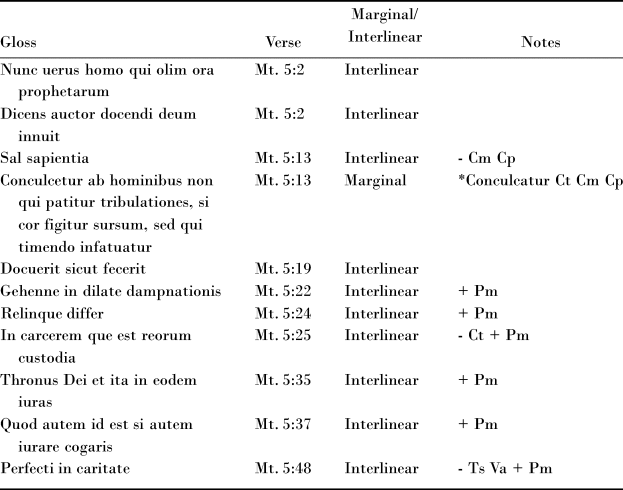
As Table 1 of the Appendix illustrates, there was a core of glossa primitiua material found in all manuscripts (or the significant majority of manuscripts) in the primitiua family (that is, Cm, Cp, Ct, H, La, Lb, Oa, Pn, Ts, and Va), but these glosses do not appear in the other manuscripts (those of the tardior family). On Matthew 5:2, for example, all manuscripts of the primitiua family contain the two interlinear glosses Nunc uerus homo qui olim ora prophetarum and Dicens auctor docendi deum innuit. Likewise, on Matthew 5:13, all primitiua manuscripts contain the gloss Conculcetur [Ct, Cm, and Cp read Conculcatur] ab hominibus non qui patitur tribulationes, si cor figitur sursum, sed qui timendo infatuatur. On Matthew 5:19, all primitiua manuscripts contain the gloss Docuerit sicut fecerit. The gloss on the word “salt” (sal) as allegorically referring to sapientia on Matthew 5:13 is found in all primitiua manuscripts except for Cm and its direct descendant Cp. None of these glosses occur in any manuscript in the tardior family.
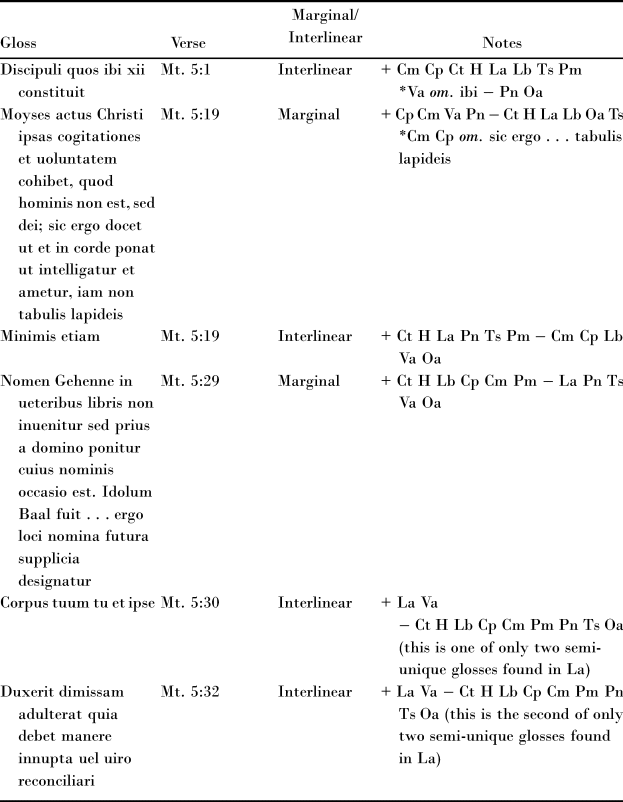
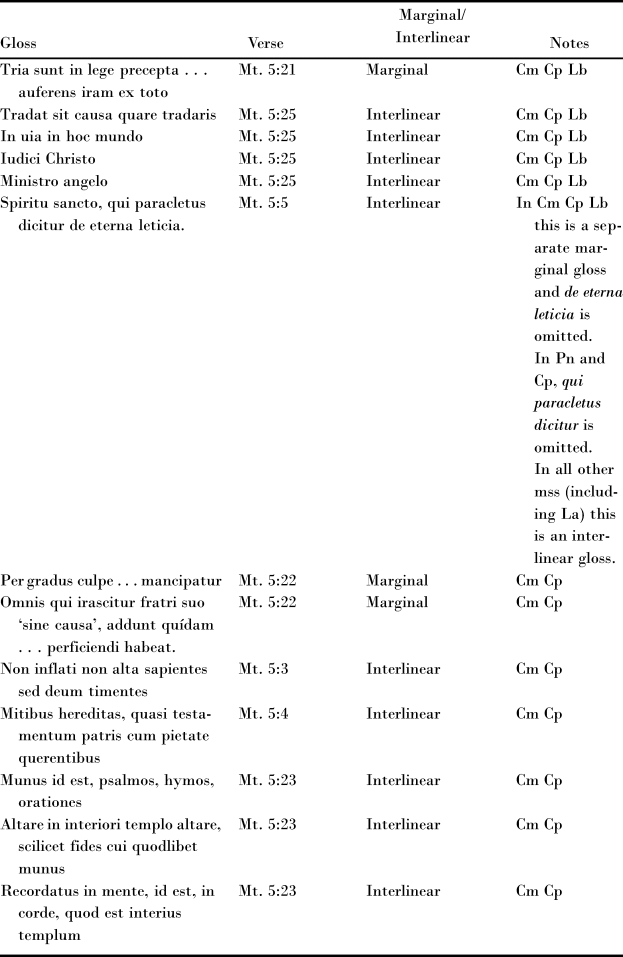
This is not to say, however, that the glossa primitiua was transmitted as a fixed canon of glosses. On the one hand, the scribes who transmitted the glossa primitiua endeavored to preserve a core set of glosses while feeling free to add or omit material as they saw fit, as Table 2 of the Appendix illustrates. For example, most primitiua manuscripts contain the interlinear gloss on Matthew 5:1 discipulis quos ibi xii constituit; Va contains the gloss, but omits ibi; Pn and Oa omit the gloss entirely. Primitiua manuscripts are even more divided in their handling of the Matthew 5:19 marginal gloss Moyses actus Christi ipsas cogitationes et uoluntatem cohibet, quod hominis non est, sed dei; sic ergo docet ut et in corde ponat ut intelligatur et ametur, iam non tabulis lapideis. Va and Pn transmit this gloss in toto; Cm and Cp omit sic through lapideis; and Ct, H, La, Lb, and Oa omit the gloss entirely. On the other hand, some primitiua manuscripts seem to fall into identifiable sub-families, as Table 3 in the Appendix illustrates. In the process of our investigation we realized that Cp was a direct descendant of Cm. Additionally, Cm/Cp and Lb share several glosses (or variants on glosses) which are found in no other manuscripts consulted during our study. The interlinear glosses Tradat sit causa quare tardaris and in uia in hoc mundo on Matthew 5:25 are two examples of this phenomenon.
Based on this textual evidence, we contend that it is indeed possible to identify and reconstruct something approximating the glossa primitiua, even if scholars must allow for some variability among primitiua manuscripts. La, Oa, and Ts would be particularly useful in such a reconstruction, since (as Table 2 illustrates) Oa contains no additional material beyond the core primitiua glosses and La and Ts contain almost no additional material. La contains no unique glosses in Matthew 5, although it shares two short interlinear glosses with Va alone (Va has, as noted below, more unique glosses than most). Whether a separate edition of this version is desirable might remain up to debate, but an edition that included and delineated the primitiua material would, as noted above, contribute to scholars' understanding of the exegetical activity at Laon in the first half of the twelfth century.
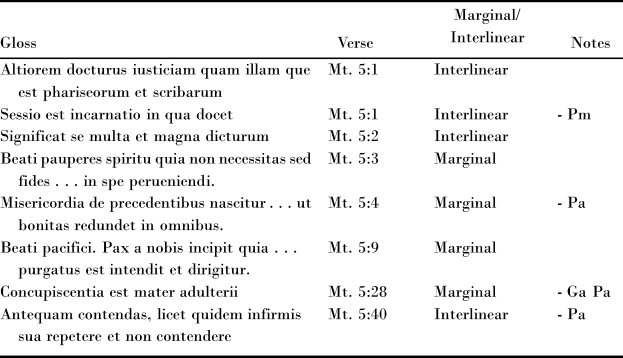
Over against this family of glossa primitiua manuscripts, there is also a family of glossa tardior manuscripts (that is, E, Ga, Lh, M, Om, Pa, and Pm) that contain material that cannot be found in any manuscript of the primitiua family, as Table 5 of the Appendix illustrates. For example, all tardior manuscripts contain the interlinear gloss on Matthew 5:1 Altiorem docturus iusticiam quam illam que set phariseorum et scribarum and the interlinear gloss on Matthew 5:2 Significat se multa et magna dicturum. All tardior manuscripts except for Pa contain the marginal gloss on Matthew 5:4 Misericordia de precedentibus . . . in omnibus and the marginal gloss on Matthew 5:39 Antequam contendas, licet quidem infirmis sua repetere et non contendere. Some of these glosses constitute quite lengthy marginal glosses, such as an extended gloss on the beatitude “blessed are the peacemakers” (Mt. 5:9). Others constitute briefer interlinear glosses (and as such, are not always grammatically complete sentences), such as the one on Matthew 5:40 reading Antequam contendas, licet quidem infirmis sua repetere et non contendere.
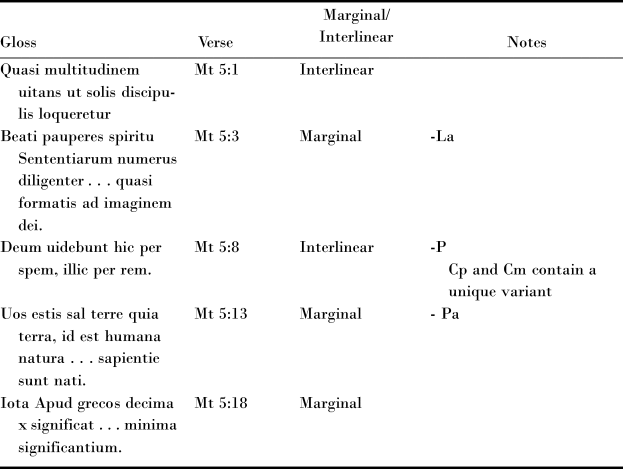
Of course, many glosses persisted throughout the manuscript tradition and can be found both in the primitiua and in the tardior families, as Table 6 of the Appendix highlights. At this stage it is worth noting that, as the gloss on Matthew developed from the primitiua version into the tardior version, interlinear primitiua material was more likely to be dropped from the tradition, whereas marginal primitiua material was more likely to be retained and marginal tardior material was more likely to be added. A quick glance at Tables 1 through 4 shows the high amount of interlinear primitiua-only material compared to marginal primitiua-only material. By contrast, in Tables 5 and 6, the distribution between interlinear and marginal material is more even.
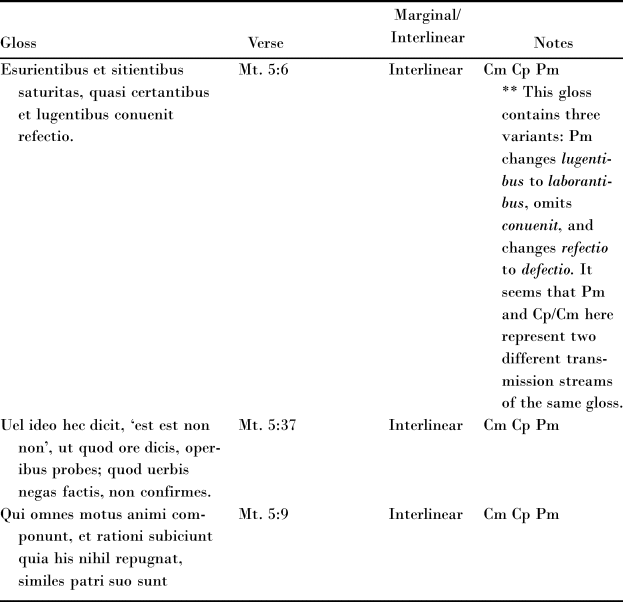
The manuscript Pm provides an intriguing window into the Matthew Gloss's transition from the primitiua version to the tardior version. Though definitely belonging to the tardior family, Pm contains several glosses which can otherwise only be found in primitiua manuscripts; Pm thus seems to represent some kind of intermediate stage in the Matthew Gloss's development from the primitiua version into the tardior version. The fact that it was produced in the Laon environs makes it all the more interesting.Footnote 40 In agreement with every primitiua manuscript, Pm shares the interlinear glosses Gehenne in dilate dampnationis on Matthew 5:22 and Thronus Dei et ita in eodem iuras on Matthew 5:35. Furthermore, Pm contains the interlinear gloss on Matthew 5:25 In carcerem que est reorum custodia, which is absent in Ct; and the interlinear gloss on Matthew 5:48 Perfecti in caritate, which is absent in Ts and Va. As Table 4 of the Appendix begins to show, Pm shares several glosses with Cm/Cp which can be found in no other manuscripts consulted for our study, even though Pm does not share a direct ancestral link to either of these manuscripts. All three manuscripts, for example, contain the interlinear gloss Uel ideo hec dicit, “est est non non,” ut quod ore dicis, operibus probes; quod uerbis negas, factis non confirmes on Matthew 5:37. On Matthew 5:6, all three manuscripts contain the interlinear gloss Esurientibus et sitientibus saturitas, quasi certantibus et lugentibus conuenit refectio; however, Pm reads laborantibus instead of lugentibus, omits conuenit, and changes refectio to defectio.
More attention needs to be given to Pm in order to define more clearly its relationship to the primitiua family. The data leads us to modify Andrée's suggestion that an intermediate stage between the two families existed and consisted of a version that trimmed down the primitiua material before the tardior material was added. Rather, in the case of Pm, it seems that the later tardior-only material was added while the primitiua material was initially retained, at least in some manuscripts. Only later did some primitiua material begin to be omitted. For Andrée, the fact that manuscripts such as Ts do not contain all the primitive glosses pointed toward a truncated intermediate version; in our view, this phenomenon is rather a widely attested characteristic of (almost) all primitiua manuscripts. With the exception of Cp, which is, as noted, a copy of Cm, every manuscript of the primitiua family has its own characteristics and almost all (excepting Oa) have their own additional glosses, some shared with other manuscripts and some not. Ts is no exception: it leaves out some glosses, but contains some additional ones. Ts seemed to Andrée to leave out more primitive glosses than it does because he relied on Va as representative of the glossa primitiua; our research indicates that Va in fact contains many unique glosses, far more unique glosses in addition to the core glossa primitiua than most manuscripts of the primitiua family.Footnote 41 In Ts as in many other manuscripts, additional glosses sometimes appear in a different ink, indicating that they were added later by a different scribe. So, on the phrase in Matthew 5:14, “a city situated on a hill cannot be hidden,” Lb, Cm, and Cp include the interlinear gloss non terreant ruine hostium. Ts contains a different gloss bearing the same idea: terror hostium minimum et securitas amicorum. These glosses do not belong to the glossa primitiua core, but seem to be individualized additions to it, of which there are countless examples and some of which were transmitted into additional manuscripts and some of which were evidently written by their personal user or owner and never transmitted further.
What we have, then, is a period of fluid copying in which scribes, whether students or masters or plain copyists, worked from a fairly stable set of primitiua glosses, but felt welcomed into the glossing activity and did not treat them as a closed canon. In some cases, an external source for such glossing is apparent, as the next section explains; in other cases, the scribe's own mind likely served as the source. And, at some point, one of these amended and expanded versions, something similar to Pm, received some more editing and began to be copied more widely. As noted above, Pm likely was produced still in the Laon milieu before it made its way eventually to Paris, but, especially with the witness of M as one of Prince Henry's books and copied for Clairvaux and the evidence of Peter Comestor's lectures, Paris makes sense as the main locus of that intensified copying.Footnote 42
The Relationship of the Gloss on Matthew to Twelfth-Century and Earlier Commentaries
We do not intend to or pretend to be able to offer a clear account of all the textual relationships between the various continuous Matthew commentaries discussed above and the Gloss on Matthew. The precise intertextual relations in fact may not be historically worth much more investigation. Nevertheless, our research allows us to clarify some points of uncertainty regarding the relationship of Cum post ascensionem to the glosses, and, based on the delineation of the primitiua and tardior versions of the Gloss, to make more secure claims about the usage of certain commentaries at the two main stages of development; we can also illuminate the extent to which the Gloss and these other commentaries relied on patristic and Carolingian commentaries. What does seem of historical use from this research is the picture that emerges of the sheer amount and intertwined nature of the exegesis originating in or stemming from Laon and thus of the impact of this exegesis within Latin Christendom. With that point hopefully sufficiently being made, scholars should find value in beginning to investigate more fully the precise content, methods, and perspectives in the actual texts, studying the commentaries and glosses for their theological and not just philological interest.
Tables 7 and 8 in the Appendix provide the full texts of glosses in the left-hand column, on Matthew 5:1–2 and Matthew 5:38–40, respectively. The first text prefaces the Beatitudes by informing the reader that Jesus climbed a mountain, removing himself from the crowd following him, called the disciples to himself, and then sat down to begin speaking. The latter text comprises Jesus's reference to the famous “eye for an eye, tooth for a tooth” (oculum pro oculo, et dentem pro dente) passage in Old Testament law and his preaching against personal retaliation, forbidding his disciples to return evil for evil. The middle column identifies the gloss as belonging to the primitiua (P) or tardior (T) versions or both (PT) and as either marginal or interlinear (in the majority of manuscripts where it is present). The right-hand column includes related texts from the commentaries of Augustine (on the Sermon on the Mount), Jerome, Paschasius Radbertus, Rabanus Maurus, and the four twelfth-century commentaries discussed above, namely Nomen libri, Cum post ascensionem (CPA), Euangelium grece, and Geoffrey Babion's Dominus ac redemptor.Footnote 43 When there seems to be direct textual borrowing by the glosses, we have underlined the relevant text in the right-hand column.
The data in Tables 7 and 8 support the following claims, much of which can be discerned by examining the tables and require no further explanation: (1) CPA is a significant source for the Gloss in its primitiua stage; (2) Euangelium grece and Dominus ac redemptor share many similarities with the Gloss, especially in its tardior stage, but direct textual borrowings are lacking; (3) Nomen libri constitutes a source of the Gloss in its tardior stage;Footnote 44 (4) unique glosses in manuscripts of the primitiua family can sometimes be demonstrated to have come from CPA or other commentaries, showing that some individual scribe engaged the full commentaries as they were reading the biblical text and glosses; (5) the early glosses drew on patristic sources directly and also indirectly through Rabanus Maurus's commentary (in Matthew 5, Rabanus is the direct source of material in Jerome's commentary); (6) some of the primitiua glosses as well as many of the other glosses that do not seem to have a direct textual relationship, but have substantial overlap with texts in commentaries, are explained if one assumes that all the people creating these glosses and commentaries were reading or heard lectures heavily based on the commentary of Paschasius Radbertus; and finally (7) the phrasing of glosses does often present a truncation or paraphrase of what is expounded at greater length in the continuous commentaries, meaning that the framers of the gloss were intentionally creating shorter, more succinct comments for which the fuller commentaries would sometimes have been necessary for filling out the meaning of the exegesis.
Cum post ascensionem is indeed a direct source for many glosses of the primitiua version, many of which persisted through the development of the Gloss to the tardior and then ordinaria phases; at this point we see no reason to posit a third text that would have served as a source for both. Considering the amount of overlap, — sometimes verbatim and sometimes only in theme or general idea, — and considering that the CPA text sometimes has the appearance of being an expansion of text in the Gloss, it is understandable that scholars such as Beryl Smalley thought CPA utilized the Gloss.Footnote 45 Despite finding that, in the section on the Pater noster, the glosses drew directly from Augustine's De sermone montis and not much from CPA, more recently Andrée has more generally affirmed that “Cum post appears to have been used earlier to provide a core of material that, in some way or another, may be found in most manuscripts, even the earlier and more disparate ones.”Footnote 46 There are textual similarities and parallels between dozens of glosses and sections of CPA within Matthew 5 alone. If Anselm is indeed the author of CPA, this means that, even if Ralph ordered or arranged the glossa primitiua, much of the content derives in some way from lectures of Anselm. Nevertheless, one must differentiate: when borrowing is verbatim, it is in glosses already in the glossa primitiua. When the relationship is broader and vaguer, it is usually in glosses added in the tardior phase, and in many cases closer or equally close parallels are found in other commentaries, whether contemporary or Carolingian.
Cum post ascensionem is also a direct source of unique glosses in Cm and its copy Cp, cementing its import, at least in certain circles, for guiding the interpretation of Matthew. An explanation is easy to decipher: a full copy of CPA is bound in the same codex as the Cm glossed Matthew. An excellent example of such a gloss consists of the interlinear gloss in Table 7 reading Qui olim aperuit ora prophetarum ut qui locutus fuerat Moysi loqueretur apostolis (Cm, fol. 9v), clearly discernible in the manuscript as having been written in a different hand and ink from the majority of the glosses. Several other examples within Matthew 5 could be named. In other manuscripts of the primitiua family, such as Va, the scribe seems to be returning to patristic or Carolingian texts that he knows served as sources for other glosses. In the case of Va, the scribe appears to be drawing on, but not necessarily copying verbatim, texts from Paschasius Radbertus (but note that these texts are not found in Nomen libri, a kind of adapted abbreviation of that commentary). An example is the gloss non tantum tali opere non reddere, sed ad patiendum parati found in Table 8 in the Appendix. Another is the simple interlinear loco et animo on the word accesserunt in Table 7, which evidently relies on a reading of Rabanus Maurus, although it puts that text into as concise a form as possible.
That is in fact the nature of many of the glosses, and the fashioners of them understood the genre. Not unlike marginal notes that we ourselves make, glosses do not always involve complete sentences; many express ideas in a condensed way that is difficult to make sense of without the broader hermeneutical discussion in view. That broader hermeneutical discussion is apparent, however, in the continuous commentaries. An example is the gloss on Matthew 5:40 Prebe ei et alteram, reading, Non tantum non repercutias sed si uult alteram ferire patienter feras. Hoc de iniuria corporis. De necessariis autem, si perdideris unum siue tolli et reliquum, quid ergo de superfluis? The biblical text reads, “If anyone would sue you and take your tunic, let him have your cloak as well.” The gloss, which is retained in the tardior version from the primitiua version, is concise, but somewhat obscure. The opening is easy enough to understand: not only is Jesus telling us not to strike or hit back or give a retort, but to patiently endure someone striking us with a second offense or hit or insult, without retaliation. Then the gloss specifies that this is speaking about physical injuries. Then the picture gets muddy. It turns to “necessary things” and seems to say that, if you lose them, you are to give up also what remains. But then it asks a question, left unanswered, about what to do with “superfluous things.” As one reads in the commentaries on this passage, the murkiness clears somewhat. Those fuller commentaries clarify that a tunica was a necessary part of one's clothing, being closer to one's body; the pallium or cloak was an outer garment that could be dispensed with. CPA called it “less necessary”; Dominus ac redemptor and Euangelium grece used the language of superfluity. Most commentaries, following Rabanus, noted that the expression as found in Luke 6:29 was the more logical, which reversed the order, telling you to be willing to give up even the necessary garment when a superfluous one was sought. There is good reason, then, always to study the glosses in tandem with the wider commentary tradition; not only do sources come to light, but, more significantly, the meaning of the glosses grow more apparent. Sometimes that meaning might become even clearer when one consults commentaries, such as Euangelium grece in this case, that are not directly related to the Gloss in terms of philological derivation.
In conclusion, the sheer volume of material presents an obstacle to research on biblical glosses; that has been and remains the case. We are nonetheless quite confident that enough research has been done on the Matthew glosses to enable a next stage of research on this Gospel for the history of theology and biblical exegesis. That stage would engage in more depth the ideas present in the glosses and show the rise and fall, the insertion and omission, and the revision and overhaul of particular ideas and modes of analysis. This can only be done by studying the glosses, in their primitiua and tardior forms, in conjunction with the twelfth-century commentaries stemming from the Laon milieu, Rabanus and Radbertus's commentaries, and a medley of patristic commentaries, including Augustine and Jerome, but also figures such as Hilary of Poitiers. If the exegetical world active in and emanating from Laon in the first half of the twelfth century is better understood, scholars will also be in a better position to assess the extent and nature of changes in biblical exegesis and theological inquiry in the period that followed. Given the widespread dissemination of both the early glosses and the Laon commentaries, scholars will be able to grasp more firmly the hermeneutical assumptions, practices, and commonplaces that were at work throughout much of Latin Christendom for the entire twelfth century and beyond. Through the presence of these glossed books in libraries around Europe, these texts continued to exert an influence even at a time when everyone knew that Paris (and then also Oxford and Cambridge and then others) was the center for theological study and output.
This was the exegetical world that paved the way for the Glossa ordinaria, ensuring that it could be disseminated and welcomed quickly. Though modified in particulars, because of the earlier glosses transmitted in dozens of manuscripts, the Glossa ordinaria simply offered an updated version of what had already been accepted and perceived as normal. The glossa primitiua, spreading in the hands of the students of Laon, as well as the glossa tardior, spreading in the hands of the students of Laon and Paris, created an expectation that Bibles used for theological study and meditation would include extensive glosses interweaving patristic, Carolingian, and contemporary exegesis, while the gloss format welcomed users to add their own insights or those of modern masters, Carolingian commentators, or the early Church Fathers of which they were aware. The glossed Bible mise-en-page encouraged interactive engagement with the text and codex in a way that the continuous commentaries did not, but the continuous commentaries could be a source for new glosses or the result of reflection on the glosses. For much of the twelfth century, it was these unstandardized forms that exercised influence at least in the Anglo-Norman realm, German-speaking areas, and Italy (and likely in Iberia and elsewhere as well).Footnote 47 While many glosses remained constant and were copied in every manuscript, the insights and reading habits of dozens of nameless individuals remain preserved individually or among a small subset of witnesses in almost all of the primitiua and tardior manuscripts — each one is unique — rendering a return to the manuscripts from the Rusch editio princeps of the Glossa ordinaria always rewarding and surprising.
Nonetheless, editions of these texts would be immensely helpful to scholarship. The commentaries that have not yet been printed (CPA, Nomen libri, and Euangelium grece) deserve editorial attention. Our in-progress digital edition of glosses will help make glosses on Matthew 5 available, preserving individual as well as common glosses. Someone may also decide to print the glossa primitiua in terms of its set of core glosses, which would be beneficial to scholarship and could be completed with collation of a handful of the manuscripts utilized here, including above all La, Oa, and Ts and perhaps Ct, H, and/or Lb. Although the later Glossa ordinaria manuscripts were more elaborate and required more time and monetary investment to produce, it was these earlier glossed manuscripts, filled with scribbles and uneven lines and embellished perhaps with only a single modestly decorated initial, that began the process and had lasting impact in changing how people read, studied, discussed, preached from, copied, and wrote in their Bibles.
Appendix: Tables of Glosses, Manuscripts, and Commentaries
Sample glosses present in all MSS in the primitiua family (Cm, Cp, Ct, H, La, Lb, Oa, Pn, Ts, and Va), which do not appear in the glossa tardior

Sample glosses present in primitiua clusters, which do not appear in the glossa tardior

Sample glosses present in the Cm-Cp-Lb and Cm-Cp primitiua clusters

Sample glosses present in the Cm Cp Pm primitiua cluster

Sample glosses present in manuscripts of the glossa tardior only (E, Ga, Lh, M, Om, Pa, and Pm)

Sample glosses present in all manuscripts, across both families (that is, glosses that persisted from the primitiua to the tardior version)

Comparison of Texts for Glosses on Matthew 5:1–2
P = glossa primitiua
T = glossa tardior
PT = glossa primitiua et tardior (that is, present in primitive form and kept in later form)
M = Marginal (in most manuscripts)
I = Interlinear (in most manuscripts)
*Note: If a gloss is present in one or a few manuscripts only and not pervasive in either family, the manuscript siglum is provided in the “Type” column. Underlined text indicates direct sources. In the case of CPA, it is possible that the text in the glossa primitiua family was the source for it, rather than the reverse, although we consider the reverse relationship more likely. In the case of the glosses in Cm Cp alone, CPA is the direct source.
Mt. 5:1–2: “Uidens autem turbas ascendit in montem et cum sedisset accesserunt ad eum discipuli eius. Et aperiens os suum docebat eos, dicens . . .”

Comparison of Texts for Glosses on Matthew 5:38–40
Mt. 5:38–40: “Audistis quia dictum est, oculum pro oculo et dentem pro dente. Ego autem dico uobis non resistere malo sed si quis te percusserit in dextera maxilla tua praebe illi et alteram. Et ei qui uult tecum iudicio contendere et tunicam tuam tollere remitte ei et pallium.”