Developmental trajectories resulting in emotional and behavioral problems are established early in life and are predicted by numerous prenatal, perinatal, and postnatal risk factors that reflect environmental adversity (e.g., Campbell, Shaw, & Gilliom, Reference Campbell, Shaw and Gilliom2000; Cicchetti & Rogosch, Reference Cicchetti and Rogosch1996; Huijbregts, Seguin, Zoccolillo, Boivin, & Tremblay, Reference Huijbregts, Seguin, Zoccolillo, Boivin and Tremblay2008). Disruptions in functioning of the autonomic nervous system (ANS), consisting of the parasympathetic nervous system (PNS) and the sympathetic nervous system (SNS), are proposed to be one mechanism through which exposure to early adversity affects emotional and behavioral outcomes (McLaughlin et al., Reference McLaughlin, Sheridan, Tiby, Fox, Zeanah and Nelson2015). The prenatal period and first 2 years after birth constitute a sensitive period during which exposure to early adversity is particularly likely to alter the development of the ANS (McLaughlin et al., Reference McLaughlin, Sheridan, Tiby, Fox, Zeanah and Nelson2015; Porges & Furman, Reference Porges and Furman2011). Although there is an increasing number of studies providing evidence for effects of early adversity on infant ANS functioning through measures of heart rate (HR) and PNS activity (Propper & Holochwost, Reference Propper and Holochwost2013), very few studies focused on SNS functioning. Moreover, studies that have examined the effects of early adversity on simultaneous measurements of PNS and SNS functioning in infants are lacking. The present study presents a comprehensive assessment of both PNS and SNS functioning in infants exposed to early adversity and their counterparts from low-risk backgrounds. The resultant findings may provide insight into the mechanisms by which early adversity affects developmental outcomes through altering physiology and eventually may lead to identification of children at risk for psychopathology at an early age.
Stress Regulation Through the ANS
The ANS consists of the PNS and the SNS, which are generally thought to act in complementary ways to respond and adapt to environmental challenges. While the PNS is active during rest and functions to maintain homeostasis, the SNS is activated during periods of perceived threat (fight or flight response) by increasing HR and mobilizing metabolic resources. According to Porges's polyvagal theory (Beauchaine, Reference Beauchaine2001; Porges, Reference Porges2007), disengagement of the PNS during mildly challenging situations marks an evolutionary advance in the control of arousal, which allows individuals to attend to environmental demands without activating the more costly SNS. PNS activity is commonly measured by respiratory sinus arrhythmia (RSA), a component of HR variability influenced by the vagal system and related to rhythmic increase and decrease of HR that coincides with respiration (Beauchaine, Reference Beauchaine2001). Research in infants, toddlers, and preschoolers has demonstrated that high levels of baseline RSA at rest and/or the ability to suppress PNS activity in challenging situations (RSA withdrawal) are related to better state regulation, greater self-soothing, more attentional control, and greater capacity for social engagement (Blair & Peters, Reference Blair and Peters2003; Calkins, Dedmon, Gill, Lomax, & Johnson, Reference Calkins, Dedmon, Gill, Lomax and Johnson2002; Calkins & Keane, Reference Calkins and Keane2004; Degangi, Dipietro, Greenspan, & Porges, Reference Degangi, Dipietro, Greenspan and Porges1991). In contrast, failure to withdraw PNS activity or lower levels of RSA suppression have been related to both externalizing and internalizing behavior problems (Beauchaine, Reference Beauchaine2001; Beauchaine, Gatzke-Kopp, & Mead, Reference Beauchaine, Gatzke-Kopp and Mead2007; Boyce et al., Reference Boyce, Quas, Alkon, Smider, Essex and Kupfer2001; El-Sheikh, Arsiwalla, Hinnant, & Erath, Reference El-Sheikh, Arsiwalla, Hinnant and Erath2011).
An important component that determines whether an individual will activate the PNS or SNS is the perception of threat. An environment perceived as safe allows the expression of the PNS, whereas the evolutionarily more primitive SNS is inhibited. However, the degree to which the PNS and SNS are activated during stressful conditions differs between individuals (Beauchaine, Reference Beauchaine2001), and may depend on early experiences (Oosterman, de Schipper, Fisher, Dozier, & Schuengel, Reference Oosterman, de Schipper, Fisher, Dozier and Schuengel2010).
Effects of Early Adversity on the Developing ANS
During the last trimester and continuing through the first 2 years postpartum, the ANS is rapidly developing (Porges & Furman, Reference Porges and Furman2011). Prenatal exposure to adversity during sensitive periods of fetal development can have lasting effects on neurological development through processes of fetal programming (Barker, Reference Barker1998), and alter maturation of the ANS (Alkon et al., Reference Alkon, Boyce, Linh, Harley, Neuhaus and Eskenazi2014; Jacob, Byrne, & Keenan, Reference Jacob, Byrne and Keenan2009). For example, prenatal exposure to psychosocial risk factors, such as poverty or low social support, has been found to impact ANS trajectories from 6 months to 5 years of age (Alkon et al., Reference Alkon, Boyce, Linh, Harley, Neuhaus and Eskenazi2014). Postnatal exposure to early adversity may exert its influence on the developing ANS either directly or indirectly through limiting the mother's ability to exhibit sensitive parenting behavior. In a recent review, Propper and Holochwost (Reference Propper and Holochwost2013) conclude that prenatal exposure to maternal stress and substance use, and postnatal exposure to a low-quality parent–child relationship, maternal depression, and marital conflict were consistently related to lower basal levels of PNS activity and higher basal HR. Moreover, exposure to these risk factors was associated with increased cardiac arousal and reduced or absent vagal withdrawal in response to challenge (see Conradt & Ablow, Reference Conradt and Ablow2010; Graziano & Derefinko, Reference Graziano and Derefinko2013; Haley & Stansbury, Reference Haley and Stansbury2003).
The literature on the effects of early adversity on early SNS functioning is not as complete as the corresponding literature on the PNS (Propper & Holochwost, Reference Propper and Holochwost2013). Preliminary evidence, using independent measures of SNS activity (e.g., salivary α-amylase or preejection period [PEP]), suggests that exposure to early adversity is associated with heightened SNS reactivity in infancy and early childhood (Frigerio et al., Reference Frigerio, Ceppi, Rusconi, Giorda, Raggi and Fearon2009; Hill-Soderlund et al., Reference Hill-Soderlund, Mills-Koonce, Propper, Calkins, Granger and Moore2008; Oosterman et al., Reference Oosterman, de Schipper, Fisher, Dozier and Schuengel2010; Propper & Holochwost, Reference Propper and Holochwost2013; Repetti, Taylor, & Seeman, Reference Repetti, Taylor and Seeman2002). However, most studies in infancy used HR as a measure of SNS activity (Propper & Holochwost, Reference Propper and Holochwost2013). Because HR is autonomically controlled by both the SNS and PNS, it represents a more global measure of autonomic functioning rather than a specific measure of SNS activation.
PEP represents the sympathetically mediated time between the onset of the heartbeat and ejection of blood into the aorta (Cacioppo, Uchino, & Bernston, Reference Cacioppo, Uchino and Berntson1994). It has been suggested that PEP is a “relatively pure” measure of SNS activity, as the myocardial tissue of the heart's left ventricle is innervated primarily by sympathetic inputs, and shorter PEP indicates increased SNS activity (Randall, Randall, & Ardell, Reference Randall, Randall, Ardell, Zuckerman and Gilmore1991). Although previous research has established PEP as a good indicator of SNS activity in infants and children (Alkon et al., Reference Alkon, Lippert, Vujan, Rodriquez, Boyce and Eskenazi2006; Quigley & Stifter, Reference Quigley and Stifter2006), so far very few studies in infants have included PEP as a measure of SNS activity (Alkon, Boyce, Davis, & Eskenazi, Reference Alkon, Boyce, Davis and Eskenazi2011; Alkon et al., Reference Alkon, Boyce, Linh, Harley, Neuhaus and Eskenazi2014).
Infant Stress Response Patterns to a Social Stress Paradigm
In this study, we investigate infant ANS response patterns to a well-established social stressor, the still face paradigm (SFP), during which the mother is asked to normally interact with the infant (play episode), then withhold interaction holding a neutral expression (still face episode), and then resume interaction (reunion episode; Mesman, van IJzendoorn, & Bakermans-Kranenburg, Reference Mesman, van IJzendoorn and Bakermans-Kranenburg2009; Tronick, Als, Adamson, Wise, & Brazelton, Reference Tronick, Als, Adamson, Wise and Brazelton1978). The SFP has shown to reliably produce a stress response in infants, as reflected in increases in negative affect and HR and decreases in positive affect, gaze, and RSA from baseline or the play episode to the still face episode (Bazhenova, Plonskaia, & Porges, Reference Bazhenova, Plonskaia and Porges2001; Bosquet Enlow et al., Reference Bosquet Enlow, King, Schreier, Howard, Rosenfield and Ritz2014; Conradt & Ablow, Reference Conradt and Ablow2010; Haley & Stansbury, Reference Haley and Stansbury2003; Mesman et al., Reference Mesman, van IJzendoorn and Bakermans-Kranenburg2009; Moore & Calkins, Reference Moore and Calkins2004; Moore et al., Reference Moore, Hill-Soderlund, Propper, Calkins, Mills-Koonce and Cox2009; Weinberg & Tronick, Reference Weinberg and Tronick1996), and increases in cortisol output following the SFP (Bosquet Enlow et al., Reference Bosquet Enlow, King, Schreier, Howard, Rosenfield and Ritz2014; Grant et al., Reference Grant, McMahon, Austin, Reilly, Leader and Ali2009; Haley & Stansbury, Reference Haley and Stansbury2003). The transition from the still face episode to the reunion episode allows us to investigate individual differences in recovery from stress. Although decreases in negative affect and HR and increases in RSA and positive affect have been reported, there is evidence of partial carryover effects of stress into the reunion episode, indicating infants’ stress levels do not always return to baseline play episode levels (Bazhenova et al., Reference Bazhenova, Plonskaia and Porges2001; Bosquet Enlow et al., Reference Bosquet Enlow, King, Schreier, Howard, Rosenfield and Ritz2014; Conradt & Ablow, Reference Conradt and Ablow2010; Mesman et al., Reference Mesman, van IJzendoorn and Bakermans-Kranenburg2009; Moore & Calkins, Reference Moore and Calkins2004; Weinberg & Tronick, Reference Weinberg and Tronick1996). Limited research has been conducted on SNS response patterns across the SFP. One recent study among 35 6-month-old infants found that, using a modified SFP (with an additional still face–reunion sequence), greater infant SNS activation (indexed by T-wave amplitude) during periods of stress was associated with greater maternal insensitivity (Bosquet Enlow et al., Reference Bosquet Enlow, King, Schreier, Howard, Rosenfield and Ritz2014). Another study reported increases in skin conductance levels across the SFP in a sample of 12 5-month-old infants (Ham & Tronick, Reference Ham and Tronick2006). To date, there are no studies that we know of that have examined PEP reactivity across the different episodes of the SFP.
Biobehavioral Associations
Individual variation in ANS recovery patterns on the SFP have been associated with infants’ early emotion regulation in previous studies (Bazhenova et al., Reference Bazhenova, Plonskaia and Porges2001; Haley & Stansbury, Reference Haley and Stansbury2003; Moore & Calkins, Reference Moore and Calkins2004; Weinberg & Tronick, Reference Weinberg and Tronick1996). For example, Conradt and Ablow (Reference Conradt and Ablow2010) reported differential associations between specific aspects of infant regulatory behavior during the reunion episode and changes in cardiac arousal versus PNS activity during recovery from the still face episode, such that greater increases in RSA were associated with infant attention to the mother, whereas resistant behavior was related to greater HR increases. This study provides empirical evidence for Porges’ model of social engagement, a model derived from the polyvagal theory (Beauchaine, Reference Beauchaine2001; Porges & Furman, Reference Porges and Furman2011), describing how individual differences in ANS regulation, specifically vagal regulation, underlie social engagement with the environment. Conversely, when the vagal system is compromised, activation of the SNS mediates the expression of strong negative emotions (Beauchaine et al., Reference Beauchaine, Gatzke-Kopp and Mead2007). However, empirical accounts investigating differential associations between infant PNS versus SNS reactivity and emotion regulation are currently lacking. Moreover, given the vulnerability of the ANS for prenatal and early postnatal adverse influences (Porges & Furman, Reference Porges and Furman2011; Propper & Holochwost, Reference Propper and Holochwost2013), investigating mediating pathways from exposure to adversity to infant emergent emotion regulation capacities through PNS and SNS functioning may contribute to existing theories concerning the physiological underpinnings of emotion (dys)regulation in infants.
The Present Study
Using both SNS and PNS measures, a primary aim of the present study was to examine the effects of exposure to early adversity on infant ANS response to and recovery from stress. To this end, we examined ANS (HR, RSA, and PEP) reactivity across the SFP, and more specifically, in response to and recovery from the still face episode, in a high-risk group of infants exposed to prenatal and early postnatal adversity and a low-risk control group. We hypothesized that infants in the high-risk group, compared to infants in the low-risk group, would show a pattern of ANS reactivity across the SFP indicative of less efficient PNS-mediated regulation of stress. Specifically, in response to the still face episode, infants in the high-risk group were expected to show stronger increases in HR and SNS activity (i.e., larger decrease in PEP) and lower PNS withdrawal (i.e., decreases in RSA). During recovery from the still face episode, infants in the high-risk group were expected to show poorer recovery than their low-risk counterparts, indicated by more limited decreases in HR and SNS activity, and more limited increases in PNS activity. Follow-up analyses within the high-risk group were conducted to examine the associations between cumulative risk (i.e., the sum of maternal risk factors present) and infant ANS response and recovery. In addition, we investigated independent contributions of the PNS and SNS to HR response and recovery. Taking into account that PNS and SNS influences on HR often operate in considerable independence (Cacioppo et al., Reference Cacioppo, Uchino and Berntson1994), and that exposure to early adversity may impact the integrity of the ANS (Porges & Furman, Reference Porges and Furman2011), we hypothesized that the contribution of the PNS and SNS to the change in HR in response to and recovery from stress would be different in infants in the high-risk versus the low-risk group. Because the SFP is a relatively mild stressor, presumably requiring minimal SNS activation, we expected HR response and recovery to be mainly PNS mediated in infants in the low-risk group, while these would be mediated by both the PNS and SNS in infants in the high-risk group.
A secondary aim of our study was to examine associations between ANS response and recovery and emotion regulation during the still face and reunion episodes. We expected that emotion regulation during the still face and reunion episodes, specifically the extent to which infants show negative affective expressions such as whining, fussing, or crying, or the extent to which infants were attending to their mother, would be differentially associated to PNS and SNS response and recovery. We hypothesized that greater PNS withdrawal in response to the still face episode and increases in PNS activity during recovery from the still face episode would be related to more attentional engagement toward the mother during the still face and reunion episodes, respectively. In contrast, we hypothesized that greater increases in SNS activity in response to the still face episode and greater SNS activity during recovery from the still face episode would be related to more negative affect during the still face and reunion episodes, respectively. We also investigated whether the effect of risk status on emotion regulation was mediated through ANS response and recovery. Based on previous research, we expected that infants in the high-risk group, compared to infants in the low-risk group, would exhibit more negative affect and attend less toward their mother during the still face episode and the reunion episode (e.g., Bosquet Enlow et al., Reference Bosquet Enlow, King, Schreier, Howard, Rosenfield and Ritz2014; Conradt & Ablow, Reference Conradt and Ablow2010; Haley & Stansburry, Reference Haley and Stansbury2003). We also expected that these associations would be mediated through less efficient PNS regulation of stress indexed by lower PNS withdrawal and increased SNS activity in response to the still face episode and more limited increases in PNS activity and decreases in SNS activity during recovery from the still face episode, respectively.
Methods
Participants
The present study is part of the Mother–Infant Neurodevelopment Study in Leiden, The Netherlands. The study is a large ongoing longitudinal study into neurobiological and neurocognitive predictors of early behavior problems. The study was approved by the ethics committee of the Department of Education and Child Studies at the Faculty of Social and Behavioral Sciences, Leiden University, and by the Medical Research Ethics Committee at Leiden University Medical Centre. All participating women provided written informed consent. Women were recruited during pregnancy via midwifery clinics, hospitals, prenatal classes, and pregnancy fairs. Dutch-speaking primiparous women between 17 and 25 years old with uncomplicated pregnancies were eligible to participate. We chose to oversample women from a high-risk background (see criteria below) to obtain sufficient variance in children's early behavioral problems.
After completing the prenatal visit in the third trimester of pregnancy, women were allocated to the high-risk or low-risk control group. Classification in the high-risk group was based on the following criteria (Mejdoubi et al., Reference Mejdoubi, van den Heijkant, Struijf, van Leerdam, HiraSing and Crijnen2011; World Health Organization, 2005): positive screening on current psychiatric disorder(s) using the Dutch version of the Mini-International Neuropsychiatric Interview (Van Vliet, Leroy, & Van Megen, Reference Van Vliet, Leroy and Van Megen2000) or substance use (alcohol, tobacco, and drugs) during pregnancy, or presence of two or more of the following psychosocial risk factors: no secondary education, unemployment, self-reported financial problems, limited or instable social support network, single status, and maternal age <20 years. In case only one risk factor was present, other than positive screening for current psychiatric disorder(s) or substance use, women were discussed in a clinical expert meeting to determine whether placement in the high-risk group was appropriate. See Smaling et al. (Reference Smaling, Huijbregts, Suurland, Van der Heijden, Van Goozen and Swaab2015) for a more detailed description of classification criteria used in this study.
The sample for this study consisted of 121 mothers (79 low risk and 42 high risk) and their 6-month-old infants who had completed both the first (prenatal home visit) and second (home visit at 6 months portpartum) waves of the study. A total of 9 women (6.2%) originally enrolled in the study did not participate in the second wave of the study. Attrition was due to emigration or moving house (n = 2), inability to contact (n = 3), refusal (n = 2), and withdrawal due to premature delivery (<36 weeks, n = 2). Sample attrition was unrelated (ps > .10) to demographic variables such as maternal age, marital status, ethnicity, and educational level.
Mean age of the infants (56.2% males) was 27.6 weeks (SD = 2.07, range = 24–38 weeks), and mean age of the mothers was 23.6 years (SD = 2.12, range = 18–27 years). Approximately 93% of the mothers had a partner (84.3% was married or living with a partner), and 29.8% of the mothers had a high educational level (bachelor's or master's degree). Families were predominantly Caucasian (86.8%), 5% Surinam or Antillean, 4.1% mixed (Caucasian and other origin), and 4.1% other origin. There were 71 mothers with no risk factors, 25 mothers with one risk factor (of which 17 mothers were assigned to the high-risk group), 15 mothers with two risk factors, 8 mothers with three risk factors, and 2 mothers with, respectively, four and five risk factors. For an overview of the cumulative prevalence as well as the specific combinations of risk factors present within the total sample, see Table S.1 in the online-only supplementary materials.
Procedures and instruments
Home visits at 6 months postpartum were carried out by trained female experimenters and scheduled at a time of the day when mothers deemed their infant to be most alert. After some time to get familiar with the experimenters, cardiac monitoring equipment was attached to the infant. During a 2-min relaxing movie, baseline ANS measures were taken while the infant was lying on a blanket. Subsequently, the mother–infant dyads participated in the SFP.
SFP
The SFP consists of three 2-min episodes (respectively, play, still face, and reunion). Following the baseline, infants were seated in an infant seat placed on a table. Mothers sat on a chair approximately 1 m from the infant at eye level. Mothers were instructed to play with their child as they normally would (no toys). Immediately following the play episode, the still face episode started. Mothers were instructed to adopt and maintain a neutral facial expression, remain still, and not to touch or respond to their infant. The procedure ended with the reunion episode in which mothers could resume play and respond to their child in any way they felt was appropriate, but without taking the child out of the seat. The beginning and end of each episode was prompted by the experimenter. Mothers were informed that they could terminate the still face episode and resume playing when the child became overly distressed. If the infant was unable to be soothed at any point during the procedure, the SFP was stopped by the experimenter. The entire procedure was recorded with one camera focused on the infant. A wooden frame with a mirror was placed behind the infant seat, through which the mother's facial expression and behavior was recorded.
Infant ANS parameters
Infant ANS parameters were measured with the Vrije Universiteit Ambulatory Monitoring System (De Geus, Willemsen, Klaver, & Van Doornen, Reference De Geus, Willemsen, Klaver and Van Doornen1995; Willemsen, De Geus, Klaver, Van Doornen, & Carroll, Reference Willemsen, De Geus, Klaver, Van Doornen and Carroll1996) during a 2-min baseline and the SFP. After removing oil with alcohol wipes, seven disposable pregelled silver/silver chloride (Ag/AgCl) snap electrodes (ConMed Huggable 1620-001, New York) were attached to the skin. The Vrije Universiteit Ambulatory Monitoring System device continuously recorded electrocardiogram (ECG), and impedance cardiogram measures; basal thorax impedance (Z 0), changes in impedance (dZ), and the first derivative of pulsatile changes in transthoracic impedance (dZ/dt). The ECG and dZ/dt signal were sampled at 1000 Hz, and the Z 0 signal was sampled at 10 Hz. The VUDAMS software suite version 2.0 was used to extract mean values of HR, RSA, and PEP across the baseline and SFP play episode (each lasting 2 min), and per minute across the still face and reunion episodes.
All R-peaks in the ECG, scored by the software, were visually checked and when necessary were adjusted manually. RSA was derived by the peak–trough method (De Geus et al., Reference De Geus, Willemsen, Klaver and Van Doornen1995; Grossman, Van Beek, & Wientjes, Reference Grossman, Van Beek and Wientjes1990), which combined the respiration (obtained from filtered 0.1–0.4 Hz thoracic impedance signal) and interbeat interval (IBI) time series to calculate the shortest IBI during HR acceleration in the inspiration phase and the longest IBI during deceleration in the expiration phase (De Geus et al., Reference De Geus, Willemsen, Klaver and Van Doornen1995). RSA was defined as the difference between the longest IBIs during expiration and shortest IBIs during inspiration. Automatic scoring of RSA was checked by visual inspection of the respiratory signal from the entire recording, leading to rejection of fewer than 6% of the data.
PEP is the time interval between the onset of the ventricular depolarization (Q-wave onset) and the onset of left ventricular ejection of blood into the aorta (B-point on the dZ/dt complex; De Geus et al., Reference De Geus, Willemsen, Klaver and Van Doornen1995). Average dZ/dt waveforms were derived by the software. PEP was automatically scored from the Q-wave onset (opening of the aortic valve) on the ECG and the B-point on the dZ/dt waveform. Each automated scoring was checked and corrected manually when necessary (Riese et al., Reference Riese, Groot, Van den Berg, Kupper, Magnee and Rohaan2003). In case wave forms were morphologically distorted in such a way visual correction of automated scoring was not possible, those wave forms were discarded (fewer than 17% of the wave forms were discarded). Interactive visual scoring was done independently by two trained raters. After scoring, the raters chose a consensus for the points where their judgment did not overlap, and these were retained for the analyses. Interrater reliability (intraclass correlation [ICC]) was 0.949.
Approximately 8% of ANS data were missing across the baseline and SFP episodes. Missing data was due to dyads that did not complete the SFP because the infant became too fussy (n = 3), loose electrodes (n = 2), or equipment failure (n = 4). The remainder of ANS data was missing because of noisy data due to excessive child movement in which case HR data was available but PEP and/or RSA could not be scored. Data were not missing systematically by maternal risk status, ethnicity, infant sex, or maternal educational level. Main analyses were conducted based on the number of infants for which there was data (available data for HR, PEP, and RSA across baseline and SFP episodes presented later).
Coding of infant behavior
Infant negative affect and gaze (reflecting the extent to which infants successfully regulated distress and used other-directed emotion regulation strategies) were coded during the play episode and per minute during the still face and reunion episodes. Coders rated infant behavior with an adapted version of the 4-point global rating scale (0 = absent, 3 = high levels or predominantly present) of the Mother Infant Coding System (Miller, McDonough, Rosenblum, & Sameroff, Reference Miller, McDonough, Rosenblum and Sameroff2002). Negative affect was defined as the intensity of negative affective expressions (e.g., whining, fussing, or crying). Gaze was defined as the extent to which infants were engaged with their mothers through looking at their mother's face or making eye contact. All coders were trained extensively until the ICC was 0.700 or higher on a subset of 20 recordings. A subset of recordings (15% of the sample) was double-coded to assess ongoing interrater reliability. ICC was 0.999 on both dimensions.
Cumulative risk
In order to analyze the effects of cumulative risk within the high-risk group, maternal risk factors present during the third trimester of pregnancy were summed to create a cumulative risk score (maximum number of risk factors was 10), with M = 1.76 and SD = 0.94 (range = 1–5). Because there were only two participants with four and five risk factors, respectively, the presence of three, four, or five risk factors was collapsed into one group with ≥3 risk factors.
Data analysis
All variables were examined for outliers and violations of specific assumptions applying to the statistical tests used. For each variable, observations with values that exceeded 3 SD from the mean were deleted (0.4% of the total number of observations across the ANS variables). Because RSA was skewed at baseline and all episodes of the SFP, its natural logarithm (lnRSA) was used in the analyses.
For all analyses, the second minute of the still face and reunion episodes was chosen as reference to examine the infant stress response and recovery because we found cumulative effects of stress experienced in the still face and reunion episodes, as well as carryover effects of stress into the reunion episode, with group differences being more pronounced during the second minute of the still face and reunion episodes compared to the first minute. More specifically, in line with suggestions made by Mesman et al. (Reference Mesman, van IJzendoorn and Bakermans-Kranenburg2009), we found that it took some time for infants to become stressed during the still face episode, as evidenced by a significant increase in HR from the first to the second minute of the still face, t (113) = –1.83, p = .07, especially for infants in the low-risk group, t (72) = –2.36, p < .05. Further, significant increases in PEP from the first to the second minute of the reunion episode for infants in the low-risk group, t (43) = –2.50, p < .05, indicated that recovery took place mainly during the second part of the reunion episode (see Mesman et al., Reference Mesman, van IJzendoorn and Bakermans-Kranenburg2009). Moreover, we found stress levels to increase across the still face and reunion episodes, as evidenced by a significant (further) decrease in RSA from the first to the second minute of the reunion episode, t (102) = 2.09, p < .05, especially for infants in the high-risk group, t (36) = 2.86, p < .01.
For each infant, difference scores were computed to examine the ANS stress response (Δplay–still face episode), and the ANS stress recovery (Δstill face–reunion episode). Negative values for HR indicate HR acceleration. Positive values for PEP and lnRSA indicate, respectively, SNS activation and PNS withdrawal.
Preliminary analyses
Prior to conducting the main analyses, preliminary analyses (independent t tests, chi-square, and Pearson correlations) were carried out to test for potential covariates (maternal and infant demographic and obstetric characteristics) and to test whether there were effects of risk status (high risk vs. low risk) on baseline ANS measures. In addition, paired t tests were used to compare mean levels of negative affect and gaze across the SFP in order to check the validity of the SFP (i.e., to examine whether infant behavior changed in the expected direction (see meta-analyses in Mesman et al., Reference Mesman, van IJzendoorn and Bakermans-Kranenburg2009) from play to the still face episode, from the still face to the reunion episode, and from the play to the reunion episode.
Risk status and ANS response and recovery
Repeated measure analyses of variance were conducted to examine whether ANS variables (HR, PEP, and lnRSA) changed across the SFP episodes and whether there were effects of risk status on these variables across the SFP. The corrected degrees of freedom using the Greenhouse–Geisser (ε < 0.75) or the Huynh–Feldt (ε > 0.75) correction were reported if the sphericity assumption was violated. Planned contrasts were used to further examine effects of risk status on the ANS stress response (play to the still face episode), the ANS stress recovery (still face to the reunion episode), and ANS activity across the SFP (play to the reunion episode).
Cumulative risk and ANS response and recovery
Spearman rank correlations were used to examine the association between cumulative risk and HR, PEP, and lnRSA response and recovery within the high-risk group.
Risk status and independent contributions of the SNS and PNS to HR response and recovery
To examine whether the independent contributions of the PNS and SNS to the HR response and recovery differed between the high-risk versus the low-risk group, partial correlations were examined between HR response and recovery and both PEP response and recovery and LNRSA response and recovery for the high-risk versus the low-risk group separately. These analyses enabled us to determine the independent contribution to the HR response and recovery of the PNS while controlling for SNS influences and of the SNS while controlling for PNS influences.
Associations between ANS response and recovery and emotion regulation
Pearson correlations were computed among ANS (HR, PEP, and lnRSA) response and recovery variables and behavior (negative affect and gaze) during the still face and reunion episodes to investigate whether ANS response and recovery were associated with emotion regulation.
ANS response and recovery as mediator between risk status and emotion regulation
Using the “indirect” macro designed for SPSS (Preacher & Hayes, Reference Preacher and Hayes2008), bootstrapping procedures with 5,000 bootstrapped samples were applied to test whether the PEP and lnRSA response mediated the effect of risk status on emotion (negative affect and gaze) regulation during the still face episode, and whether PEP and lnRSA recovery mediated the effect of risk status on emotion regulation during the reunion episode. ANS variables that were significantly related to negative affect and gaze during the still face or reunion episodes were added as potential mediators to the model. The bootstrapping strategy quantifies the indirect effect and makes no assumptions of multivariate normal distribution in the sampling of indirect effects. In addition, these bootstrapping analyses can be applied to smaller samples with more confidence, provide a direct test of mediation, and have more power. As discussed elsewhere (Hayes, Reference Hayes2009), it is not necessary for the independent variable to be significantly related with the dependent variable to show mediation. Direct and indirect effects and 95% bias-corrected and -accelerated confidence intervals (CI) are reported. The indirect effect is significant if zero does not fall within the confidence interval.
All analyses were conducted using the Statistical Package for Social Sciences (SPSS for Windows, version 21.0, SPSS Inc., Chicago). Statistical significance was established a priori at p < .05.
Results
Preliminary analyses
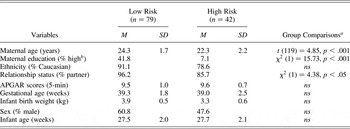
Demographic and obstetric characteristics of the high-risk and low-risk groups are presented in Table 1. Independent t tests showed that there were no baseline differences between the high-risk and low-risk groups on the different ANS measures (ps > .85). Infant's HR, PEP, and lnRSA were not associated with the maternal and infant demographic variables or obstetric characteristics as listed in Table 1 (ps >.10); however, boys were found to have lower PEP values on all episodes of the SFP (ps < .05). Therefore, infant sex was included as a covariate in the analyses with PEP.
Demographic and obstetric characteristics for the high risk and low risk group

a Comparisons with either a t or χ2 test.
b Maternal education (% high) represents the percentage with a bachelor's or master's degree.
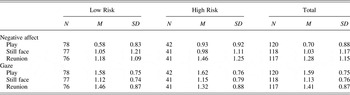
The means and standard deviations for negative affect and gaze across episodes of the SFP for the high-risk and low-risk groups separately and the sample as a whole are presented in Table 2. Paired t tests revealed significant increases in negative affect and decreases in gaze from the play to the still face episode, respectively, t (117) = –3.18, p < .01 and t (117) = 5.14, p < .001, and from the play to the reunion episode, respectively, t (116) = –5.77, p < .001 and t (116) = –1.97, p = .052. From the still face to the reunion episode, infants exhibited significant increases in negative affect, t (116) = –2.46, p < .05, and gaze, t (116) = –2.95, p < .01. These results, except for the increase in negative affect from the still face to the reunion episode, were consistent with the results of the meta-analyses of Mesman et al. (Reference Mesman, van IJzendoorn and Bakermans-Kranenburg2009). However, it should be noted that Mesman et al. (Reference Mesman, van IJzendoorn and Bakermans-Kranenburg2009) reported no significant change in negative affect from the still face to the reunion episode, and significant heterogeneity among studies that included recovery effects for negative affect. For example, a study among infants prenatally exposed to alcohol (Haley, Handmaker, & Lowe, Reference Haley, Handmaker and Lowe2006) reported increases in negative affect from the still face to the reunion episode, suggesting that the extent to which recovery effects are reported for negative affect may be dependent on the nature of the sample included (high vs. low risk).
Means and standard deviations for negative affect and gaze across still face paradigm episodes
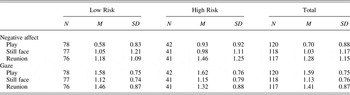
Note: Play, Play episode; Still face, still face episode; Reunion, reunion episode.
Risk status and ANS response and recovery
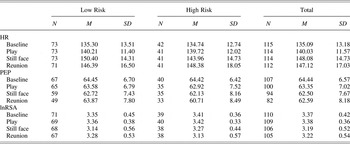
The means and standard deviations for HR, PEP, and lnRSA across episodes of the SFP for the high-risk and low-risk groups separately and the sample as a whole are presented in Table 3. Repeated measure analyses of covariance to examine changes in ANS variables (HR, PEP, and lnRSA) across the different episodes of the SFP (play, still face, and reunion episode), showed significant within-subjects effects for HR and lnRSA, respectively, F (2, 218) = 15.83, p < .001, η2 = 0.13 and F (1.90, 192.23) = 7.93, p < .01, η2 = 0.07. Follow-up planned contrasts from play to the still face and reunion episodes showed significant increases in HR, respectively, F (1, 109) = 24.27, p < .001, η2 = 0.18 and F (1, 109) = 26.17, p < .001, η2 = 0.19, and decreases in lnRSA, respectively, F (1, 101) = 10.94, p < .01, η2 = 0.10 and F (1, 101) = 16.86, p < .001, η2 = 0.14. Planned contrasts for HR and lnRSA from the still face to the reunion episode were not significant, indicating no significant changes during recovery for the whole sample.
Means and standard deviations for HR, PEP, and lnRSA across still face paradigm episodes

Note: HR, Heart rate; PEP, preejection period; lnRSA, natural logarithm of respiratory sinus arrhythmia.
No significant effects for risk status were found. However, significant Risk Status × Episode interactions for HR, F (2, 218) = 4.89, p < .01, η2 = 0.04, PEP, F (2, 138) = 3.63, p < .05, η2 = 0.05, and lnRSA, F (1.90, 192.23) = 3.25, p < .05, η2 = 0.03, indicated that the ANS response patterns of the high-risk and low-risk groups differed significantly. None of the covariate effects for sex were significant (for analyses concerning PEP only).
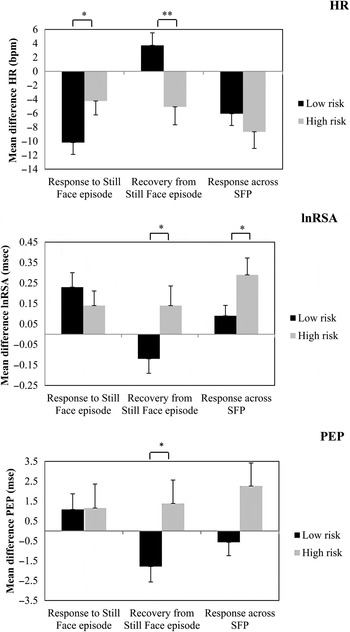
Planned contrasts revealed significant differences between the high-risk and low-risk groups in HR response, F (1, 109) = 5.22, p < .05, η2 = 0.05, and HR recovery, F (1, 109) = 8.20, p < .01, η2 = 0.07, but not for HR activity across the SFP. As illustrated in Figure 1, infants in the low-risk group showed a larger increase in HR from the play to the still face episode compared to infants in the high-risk group. Further, infants in the low-risk group showed a decrease in HR in recovery from the still face episode, whereas infants in the high-risk group showed a further increase in HR. Planned contrasts for lnRSA revealed significant differences between the high-risk and low-risk groups in lnRSA recovery, F (1, 101) = 4.96, p < .05, η2 = 0.05, and lnRSA activity across the SFP, F (1, 101) = 4.27, p < .05, η2 = 0.04, but not for lnRSA response (see Figure 1). Specifically, infants in the low-risk group were found to show increases in lnRSA from the still face to the reunion episode, whereas infants in the high-risk group showed decreases in lnRSA. Furthermore, infants in the high-risk group showed a larger lnRSA decrease across the SFP compared to infants in the low-risk group. Planned contrasts for PEP revealed significant differences between the high-risk and low-risk groups for PEP recovery, F (1, 69) = 6.10, p < .05, η2 = 0.08, but not for PEP response and PEP activity across the SFP. As illustrated in Figure 1, infants in the low-risk group showed an increase in PEP from the still face to the reunion episode, whereas infants in the high-risk group showed a decrease in PEP.
Heart rate (HR), natural log respiratory sinus arrhythmia (lnRSA), and preejection period (PEP) mean differences between infants in the high-risk group versus the low-risk group in response to the still face episode, during recovery from the still face episode, and across the still face paradigm. *p < .05, **p < .01.

Cumulative risk and ANS response and recovery
Cumulative risk was significantly associated with PEP response (r = .418, p < .05), indicating that, within the high-risk group, an increase in the number of risk factors is related to larger decreases in PEP from the play to the still face episode. The correlation between cumulative risk and PEP recovery approached significance (r = –.358, p = .052). The correlations between cumulative risk and HR and lnRSA response and recovery were not significant.
Risk status and independent contributions of the SNS and PNS to HR response and recovery
Partial correlations between HR and lnRSA response, controlling for PEP response and between HR and PEP response, controlling for lnRSA response, showed that for the low-risk group, only the PNS (lnRSA response) made an independent contribution to the HR response (partial r = –.693, p < .001); the SNS (PEP response) did not. For the high-risk group, both the PNS and the SNS made an independent contribution (partial r = –.534, p < .01 and partial r = –.371, p < .05 for the lnRSA response and PEP response, respectively).
The independent contributions of the PNS and SNS to HR recovery also differed between the high-risk and low-risk groups. Although for infants in the low-risk group only the PNS (lnRSA recovery) made a significant contribution to the HR recovery (partial r = –.773, p < .001), both partial correlations were significant for infants in the high-risk group (partial r = –.602, p < .01 and partial r = –.505, p < .01 for the lnRSA recovery and PEP recovery, respectively), indicating independent contributions to HR recovery from both the PNS and the SNS.
Associations between ANS response and recovery and emotion regulation
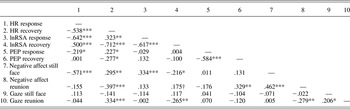
Correlations among ANS response and recovery variables and negative affect and gaze during the still face and reunion episodes are presented in Table 4. Negative affect during the still face episode showed significant correlations with the HR and lnRSA response (r = –.571, p < .001 and r = .334, p < .001, respectively), but not to the PEP response, indicating that larger increases in HR and decreases in lnRSA from play to the still face episode were associated with higher levels of negative affect during the still face episode. There were no significant correlations between gaze during the still face episode and the ANS response variables.
Correlations among HR, PEP, and lnRSA response and recovery and negative affect, and gaze during the still face and reunion episode

Note: HR, Heart rate; PEP, preejection period; lnRSA, natural logarithm of respiratory sinus arrhythmia.
†p < .10. *p < .05. **p < .01. ***p < .001.
Negative affect during the reunion episode was significantly associated with HR and PEP recovery (r = –.397, p < .001 and r = .329, p < .01, respectively), indicating that larger increases in HR and decreases in PEP from the still face to the reunion episode were associated with higher levels of negative affect during the reunion episode. The correlation between negative affect during the reunion episode and lnRSA recovery approached significance (r = –.175, p = .076). Gaze during the reunion episode was significantly associated with HR and lnRSA recovery (r = .334, p < .001 and r = –.265, p < .01, respectively), but not PEP recovery, indicating that larger decreases in HR and increases in lnRSA from the still face to the reunion episode were associated with higher levels of gaze during the reunion episode.
ANS response and recovery as mediator between risk status and emotion regulation
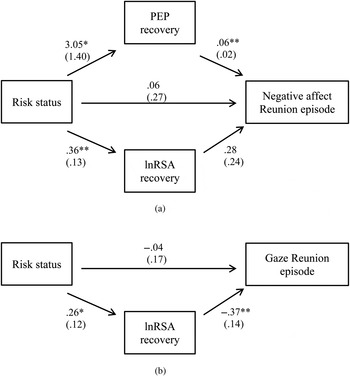
Because there were no significant effects of risk status on the PEP and lnRSA response (see planned contrasts and Figure 1), the mediation model could not be tested for the indirect effect between risk status and emotion regulation during the still face episode through the PEP and lnRSA response. Based on the correlations between the PEP and lnRSA recovery and negative affect and gaze during the reunion episode, bootstrapping procedures were carried out for the indirect effect between risk status and negative affect during the reunion episode through PEP and lnRSA recovery, and for risk status and gaze during the reunion episode through lnRSA recovery.
Although there was no direct effect of risk status on negative affect and gaze during the reunion, the total effect model was significant for both negative affect, F (3, 69) = 3.24, p < .05, R 2 = .08, and gaze, F (2, 101) = 3.84, p < .05, R 2 = .05 (see Figure 2). The mediation model for negative affect showed a significant indirect effect of PEP recovery (95% CI = 0.04, 0.48), indicating that infants in the high-risk group showed larger decreases in PEP from the still face to the reunion episode, which in turn predicted more negative affect during the reunion episode, whereas infants in the low-risk group showed larger increases in PEP from the still face to the reunion episode, which in turn predicted less negative affect during the reunion. The mediation model for gaze showed a significant indirect effect of lnRSA recovery (95% CI = –0.26, –0.01), indicating that infants in the high-risk group showed larger decreases in lnRSA from the still face to the reunion episode, which in turn predicted less gaze during the reunion episode, while infants in the low-risk group showed larger increases in lnRSA from the still face to the reunion episode, which in turn predicted increased gaze during the reunion episode.
Bootstrapping results testing the mediation model for (a) risk status and negative affect during the reunion episode via the preejection period (PEP) and the natural log respiratory sinus arrhythmia recovery (lnRSA) and (b) risk status and gaze during the reunion episode via the lnRSA. Numbers within parentheses are standard errors. *p < .05, **p < .01.

Discussion
The aim of the present study was to examine infant autonomic response to and recovery from emotional challenge, using both PNS and SNS measures, in a sample of infants at risk for the development of psychopathology and a low-risk control sample. A second aim was to investigate associations between ANS response and recovery and emotion regulation, and to examine whether the association between risk status and emotion regulation was mediated by ANS reactivity. Our results showed that maternal risk status was associated with infant ANS response to and recovery from stress. Infants in the high-risk group showed less parasympathetic regulation, indicated by greater RSA withdrawal, and increased SNS activity specifically during recovery from stress compared to infants in the low-risk group. While for infants in the low-risk group HR recovery was primarily mediated by the PNS, for infants in the high-risk group, the (lack of) recovery in HR was both PNS and SNS mediated. Finally, distinct indirect pathways from maternal risk status to infant emotion regulation via infant PNS and SNS regulation were observed.
As expected, our findings showed more efficient PNS-mediated regulation of stress, specifically during recovery, among infants in the low-risk group compared to infants in the high-risk group. Whereas infants in the low-risk group showed decreases in HR and increases in RSA upon recovery from the still face episode, infants in the high-risk group showed the opposite response, that is, HR increased and RSA decreased during recovery, indicating further inhibition of the PNS. These findings are consistent with studies that examined associations between quality of maternal caregiving and infant physiological regulation during the SFP. For example, Conradt and Ablow (Reference Conradt and Ablow2010) and Haley and Stansbury (Reference Haley and Stansbury2003) reported that infants of less sensitive and less responsive mothers were characterized by greater cardiac arousal and less PNS regulation during the reunion episode. It should be noted that these two studies did not include measures of SNS activity, so it remains unclear whether higher levels of cardiac arousal are solely due to reduced PNS input or a joint result of reduced PNS and increased SNS activity.
Infants in the high-risk group showed increased SNS activity from the still face to the reunion episode, indicated by decreases in PEP, while infants in the low-risk group showed decreases in SNS activity. Similar findings were reported by Oosterman et al. (Reference Oosterman, de Schipper, Fisher, Dozier and Schuengel2010) with respect to 2- to 7-year-old foster children with disordered attachment and a background of neglect, who showed increased PEP reactivity across the Strange Situation Procedure, compared to foster children with ordered attachment. Furthermore, Bosquet Enlow et al. (Reference Bosquet Enlow, King, Schreier, Howard, Rosenfield and Ritz2014) reported that greater maternal insensitivity was associated with greater SNS activation during the still face episode relative to the reunion episode on a repeated version of the SFP. Our findings concerning increased SNS activity upon recovery from stress in infants in the high-risk group were corroborated by the observed differences between the high-risk and low-risk groups in contributions of the PNS and SNS to the HR recovery. The decrease in HR during recovery in infants in the low-risk group was mediated by an increase in RSA from the still face to the reunion episode, reflecting efficient vagal regulation. In contrast, the increase in HR upon recovery in infants in the high-risk group was mediated by a (further) decrease in both RSA and PEP, indicating that infants in the high-risk group mobilized additional sympathetic resources when confronted with (prolonged) emotional challenge. The effect sizes in our study were small to medium, which is comparable to other studies investigating physiological measures in clinical and at-risk populations (Graziano & Derefinko, Reference Graziano and Derefinko2013).
A stress response marked by excessive or sustained activation of the SNS is hypothesized to be one of the major harmful components of the stress response (e.g., Nesse & Young, Reference Nesse, Young and Fink2000). Heightened SNS reactivity in children has been linked to a range of negative physical and mental health outcomes including adjustment problems, increased anxiety, greater reactive aggression, and impaired immune functioning (Bakker, Tijssen, van der Meer, Koelman, & Boer, Reference Bakker, Tijssen, van der Meer, Koelman and Boer2009; El-Sheikh, Erath, Buckhalt, Granger, & Mize, Reference El-Sheikh, Erath, Buckhalt, Granger and Mize2008; Hubbard et al., Reference Hubbard, Smithmyer, Ramsden, Parker, Flanagan and Dearing2002; Kiecolt-Glaser & Glaser, Reference Kiecolt-Glaser and Glaser1995). Children born in high-risk families, suffering from early adversity both prenatally and postnatally, are likely to be exposed to risk factors frequently and continuously. If resources offered by the PNS are deficient, those offered by the SNS will be drawn upon, perhaps more heavily than in children born to a less stressful environment.
Contrary to expectations, differences between infants from the high-risk and low-risk groups in RSA and PEP were only found across the SFP and during recovery and not in response to the still face episode. Based on previous research (Graziano & Derefinko, Reference Graziano and Derefinko2013; Propper & Holochwost, Reference Propper and Holochwost2013), we expected to find lower PNS withdrawal in response to stress among infants in the high-risk group. Although we did find a significant difference in HR response, with infants in the low-risk group showing greater cardiac arousal in response to the still face episode compared to infants in the high-risk group, both groups showed RSA withdrawal indicative of parasympathetic regulation. A small number of studies have suggested that children exposed to early adversity show heightened SNS reactivity to stress (Frigerio et al., Reference Frigerio, Ceppi, Rusconi, Giorda, Raggi and Fearon2009; Hill-Soderlund et al., Reference Hill-Soderlund, Mills-Koonce, Propper, Calkins, Granger and Moore2008; Repetti et al., Reference Repetti, Taylor and Seeman2002). Although we did not find evidence for this suggestion in the high-risk versus low-risk comparisons, the partial correlations within the high-risk group showed independent contributions of both the PNS and SNS to the HR response. Moreover, our results suggest that the effects of early adversity on the SNS are more pronounced with higher levels of cumulative risk. In sum, although our findings are not unequivocal, our results support the notion of increased SNS reactivity to stress in infants exposed to early adversity.
Our findings demonstrated significant distinct associations between PNS and SNS recovery and aspects of emotion regulation. Consistent with the polyvagal theory (Porges & Furman, Reference Porges and Furman2011) and previous research (Bazhenova et al., Reference Bazhenova, Plonskaia and Porges2001; Conradt & Ablow, Reference Conradt and Ablow2010), we found that larger increases in PNS activity (and decreases in HR) upon recovery from the still face episode were associated with increased attention toward the mother during the reunion episode, whereas larger increases in HR were associated with increased negative affect. However, none of these studies specifically examined SNS activity. Therefore, a novel finding is that larger decreases in PEP (indicating increases in SNS activity) from the still face to the reunion episode were associated with increased negative affect during the reunion, but not with attentional engagement with the mother.
Evidence for a significant role of the ANS in associations between risk status and behavioral outcomes stems from the results of the mediation analyses. Maternal risk status was associated with infant gaze through RSA recovery, while PEP recovery mediated the effect of maternal risk status on infant negative affect. Infants in the low-risk group showed more efficient PNS mediated regulation of stress by increasing PNS activity upon termination of the still face episode, which was associated with more attentional engagement with the mother during the reunion. The polyvagal theory (Beauchaine, Reference Beauchaine2001; Porges & Furman, Reference Porges and Furman2011) states that social behavior and the capacity to manage emotional challenge are dependent on effective modulation of the PNS. In this regard, more attentional engagement toward the mother may reflect low-risk infants’ capacity to engage and use their mother to regulate arousal following stress. The PNS is only partially developed at birth and continues to develop during the first few months postpartum. As such, the PNS is especially susceptible to adversity during the late prenatal and postnatal period. Infants in the high-risk group exhibited further PNS withdrawal and increased SNS activity in recovery from the still face episode, which was related to less gaze toward the mother and higher levels of negative affect during recovery. The present findings suggest that in infants exposed to early adversity, the development of the PNS may have been compromised, leading to increased activity within the SNS. Without an efficiently working vagal system, negative affective expressions are more frequently exhibited in times of stress, thereby limiting opportunities for these infants to develop effective emotion regulation strategies in interaction with their mother.
We found that boys had lower PEP values on all episodes of the SFP. These results corroborate to some extent with studies reporting sex differences in infant regulation of distress. More specifically, boys have been found to show more irritability and fewer self-regulatory behaviors, such as hand-to-mouth activity and attention skills (Stifter & Spinrad, Reference Stifter and Spinrad2002; Weinberg, Tronick, & Cohn, Reference Weinberg, Tronick and Cohn1999), and were less able to regulate distress physiologically, indexed by decreased RSA withdrawal (Calkins et al., Reference Calkins, Dedmon, Gill, Lomax and Johnson2002). Although we found no sex differences in emotion regulation across the SFP, the results of these studies may reflect increased proneness to distress in boys, explaining increased SNS activity among boys in our study. Although scarce, the available literature on PEP resting and reactivity measures in infancy (6 and 12 months) did not report such sex effects (Alkon et al., Reference Alkon, Lippert, Vujan, Rodriquez, Boyce and Eskenazi2006), and sex-related findings in older child samples are inconsistent (Alkon et al., Reference Alkon, Goldstein, Smider, Essex, Kupfer and Boyce2003, Reference Alkon, Boyce, Davis and Eskenazi2011, Reference Alkon, Boyce, Linh, Harley, Neuhaus and Eskenazi2014; Hinnant, Elmore-Staton, & El-Sheikh, Reference Hinnant, Elmore-Staton and El-Sheikh2011; Matthews, Salomon, Kenyon, & Allen, Reference Matthews, Salomon, Kenyon and Allen2002; Van Dijk, Van Eijsden, Stronks Gemke, & Vrijkotte, Reference Van Dijk, Van Eijsden, Stronks, Gemke and Vrijkotte2012). These contrasting findings may be caused to some extent by differences in samples (age or ethnicity), protocols used to assess physiological reactivity, and design (cross-sectional vs. longitudinal). More research is necessary to shed more light on the role of sex on infant and child PEP developmental trajectories.
In the current study, we used the second minute of the still face and reunion episodes as reference to examine the infants’ stress response and recovery. In line with the meta-analyses of Mesman et al. (Reference Mesman, van IJzendoorn and Bakermans-Kranenburg2009), we found evidence for cumulative effects of stress experienced during the still face and reunion episodes, and carryover effects of stress into the reunion episode. As a result, differences between the low- and high-risk groups were more pronounced during the second minute compared to the first minute. Of note, analysis of the still face and reunion episodes as a whole did not reveal group differences. Although this approach is not uncommon in studies using other stress paradigms than the SFP (e.g., Reijman et al., Reference Reijman, Alink, Compier-de Bock, Werner, Maras and Rijnberk2014), it should be noted that (most) previous work using the SFP examined stress responses during whole episodes (including the first minute), which may limit the possibilities for comparing our results with previous work on the SFP. However, based on our findings, it may be valuable for future studies to examine differences in stress measures between the first and second halves of the still face and reunion episodes because it may provide more insight in individual differences in stress reactivity across the SFP. This study is not without limitations. First, the physiological measures were only assessed at 6 months of age. Although previous studies (e.g., Alkon et al., Reference Alkon, Lippert, Vujan, Rodriquez, Boyce and Eskenazi2006, Reference Alkon, Boyce, Davis and Eskenazi2011) have reported moderate stability of autonomic measures (HR, PEP, and RSA) during resting and challenging conditions from 6 to 60 months, this was not found for reactivity measures (representing the difference between resting and challenging conditions). This indicates that during the first few years of life, autonomic responses to stress are not yet fully developed, and therefore may be influenced by repeated exposure to environmental stressors. Future longitudinal investigations should examine whether the early patterns of decreased vagal regulation and increased sympathetic activation found in this study remain stable across development and whether they are associated with increased risk for later psychopathology (Repetti et al., Reference Repetti, Taylor and Seeman2002). Second, we were not able to assess the effects of timing of exposure (prenatal vs. postnatal) to risk. Although Propper and Holochwost (Reference Propper and Holochwost2013) have shown that a broad range of pre- and postnatal risk factors have been associated with a general pattern of ANS activity characterized by lower basal levels of PNS activity and vagal withdrawal and higher basal HR, there is evidence that prenatal and postnatal exposure adversity may involve distinct causal pathways (Hickey, Suess, Newlin, Spurgeon, & Porges, Reference Hickey, Suess, Newlin, Spurgeon and Porges1995). In addition, we did not differentiate between different types of risk in our analyses. For the results from additional analyses exploring associations between specific maternal risk factors and infant ANS response and recovery, we refer to the online-only supplementary materials (Tables S.2 and S.3). Third, it should be noted that most mothers within the high-risk group had either one or two risk factors, and that approximately 24% had three or more factors (i.e., there were two mothers with four and five risk factors, respectively). Although almost all mothers within the high-risk group had a psychiatric diagnosis or used substances during pregnancy, it is important to emphasize that the relatively low level of cumulative risk within the high-risk group may limit the generalizability of our results to samples with higher levels of cumulative risk. Foruth and finally, previous studies have shown that children's autonomic responses can vary across different challenging tasks (e.g., Bazhenova et al., Reference Bazhenova, Plonskaia and Porges2001; Calkins & Keane, Reference Calkins and Keane2004). We do not know whether the observed pattern of autonomic regulation is dependent on the type of stressor used. Because PNS regulation is associated with social engagement behavior (Porges, Reference Porges2007), it may be possible that the effects found in this study are specific to social situations or to the SFP. However, there is some evidence that other emotion-eliciting tasks yield similar results. For example, less vagal withdrawal in response to a gentle arm restraint task, a well-validated paradigm designed to elicit anger/frustration (Goldsmith & Rothbart, Reference Goldsmith and Rothbart1999), was reported among 9-month-old infants exposed to nicotine compared to nonexposed infants (Schuetze, Eiden, Colder, Gray, & Huestis, Reference Schuetze, Eiden, Colder, Gray and Huestis2013). Although further research using different emotional challenges in different contexts is necessary to replicate our findings, the results of these studies provide some evidence that the results of the current study may be generalizable across contexts and different types of emotional challenges.
Most studies in the field of early adversity and infant ANS functioning have focused on global measures of HR or parasympathetic RSA. One of the strengths of this study is the inclusion of specific measures to assess both PNS and SNS functioning. Our findings show that maternal risk status, as established during pregnancy, is associated with an altered pattern of both PNS and SNS regulation of stress in 6-month-old infants, contributing to less effective regulation of emotional distress. Future empirical studies investigating links between early adversity and ANS functioning, as well as prevention and intervention studies aimed at improving prenatal and postnatal circumstances in order to prevent the development of psychopathology, should therefore take into account measures of the parasympathetic and sympathetic branch of the ANS. Furthermore, given that the maturation of the ANS during the prenatal period and first year(s) of life lays the foundation for adaptive cognitive and emotional functioning (Porges, Reference Porges2003) and that the developing ANS is sensitive to early environmental influences, the findings have important implications for future research and clinical practice, underscoring the importance of identifying women with a high-risk profile during pregnancy in order to offer preventive intervention programs aimed at improving prenatal and postnatal circumstances.
Supplementary Material
To view the supplementary material for this article, please visit http://dx.doi.org/10.1017/S0954579416000456.