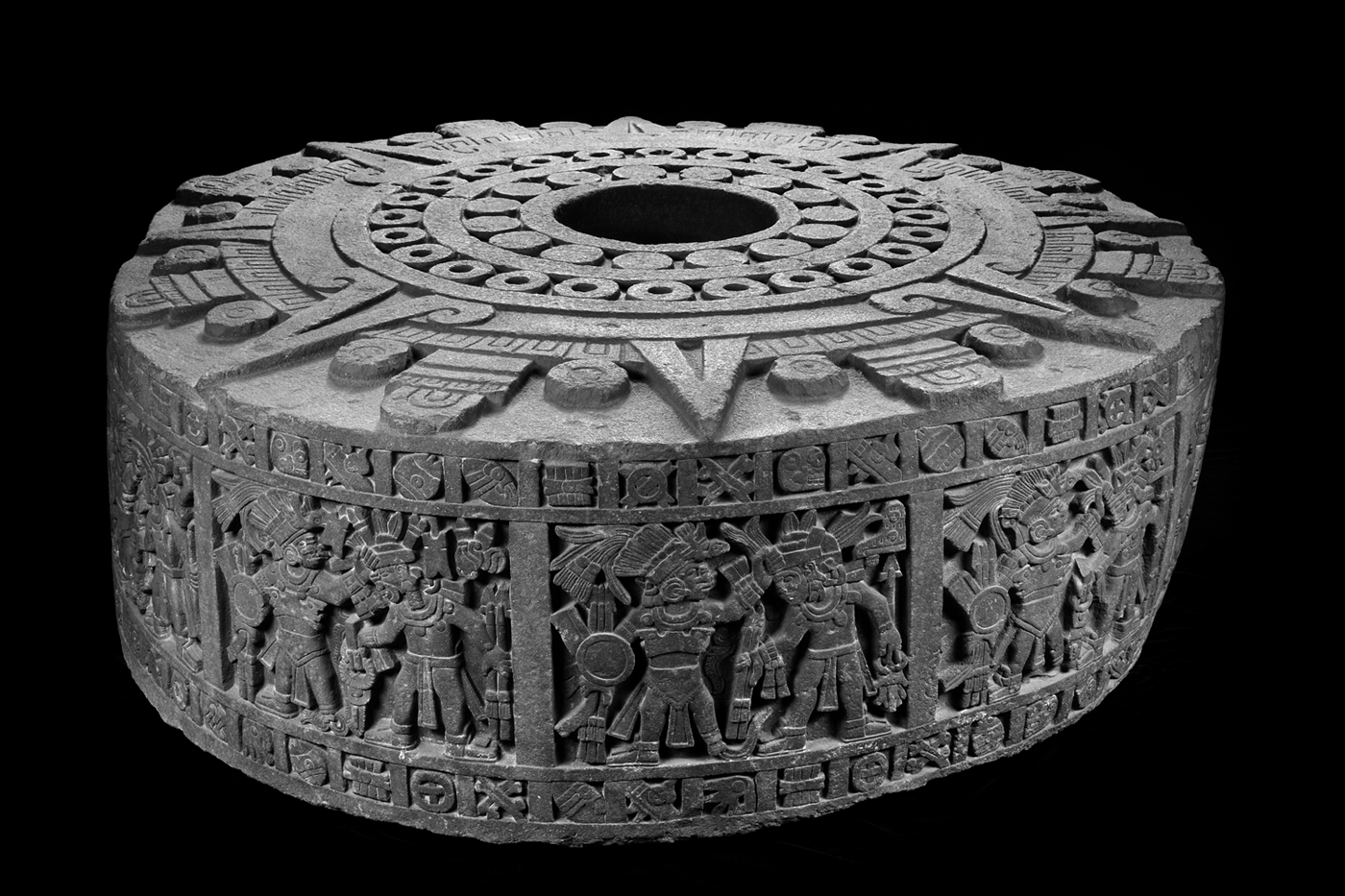
In the ritual heart of the Mexica-Aztec capital of Mexico-Tenochtitlan, the Sun Stone of Motecuhzoma Ilhuicamina was a dramatic platform for gladiatorial combat between Mexica warriors and captive victims (Figure 1). It was also a monument that stood as a graphic advertisement of Mexica military success and a paean to Tezcatlipoca (Smoking Mirror), god of war. Likely carved between a.d. 1440 and 1469 under the patronage of Motecuhzoma Ilhuicamina (or Motecuhzoma I), the fifth Mexica ruler, the broad cylinder of volcanic stone features the sun disk on its top surface and Mexica conquests of 11 enemy polities on its sides. Its great size and the sun disk on its surface call for a comparison with other sun stones, including the well-known monument popularly called the Aztec Calendar Stone. The conquest scenes along its sides, however, align it even more closely with the Stone of Tizoc, which also features scenes of conquests on it sides. Both Motecuhzoma's sun stone and Tizoc's later sun stone were sites of ritual battle, where warriors and victims fought on top of and around the face of the sun, the victims tethered to the stone and hindered by ineffective weapons. The scenes of Mexica conquests on the stones’ sides—11 for Motecuhzoma's stone and 15 for Tizoc's—proclaimed the invincibility of the Mexica armies and their patron deity Huitzilopochtli. These symbolic scenes of military victory are framed in the Tizoc stone by the earth band below and the sky band above. In the earlier stone, however, they are framed by two bands of repeating motifs.
Sun Stone found in the former palace of the Archbishop. MNA 10-393459. CONACULTA-INAH-MEX. Reproduction authorized by the Instituto Nacional de Antropología e Historia.

Our research has focused not on the conquest scenes or the sun disk, on which much has already been written, but instead on the two bands that frame the conquests on the top and bottom of the sides. Solís Olguín is the only previous scholar to pay much attention to these bands. He recognized some patterning to their repeating elements and interpreted the images “as a symbolic exhortation to human sacrifice, as a prayer which is repeated” (Solís Olguín Reference Solís Olguín1991:158). We concur that it is an exhortation and propose that it is a prayer or prayers specifically associated with Tezcatlipoca. We have found the complex pattern to the repeating motifs, which is rhythmic and reflects the discourse structure of Nahuatl high speech.
Within the diverse corpus of Mexican pictography these bands are extraordinary examples of figural texts whose elements are both linearly arranged and sequentially structured. Moreover, these graphic texts parallel and probably cue ritual speech acts. Other sequences of glyphs found on some murals and ceramic vessels in Postclassic central Mexico likely do the same but are short and relatively simple. The bands on the sun stone, in contrast, are both long and complex. They are the best examples yet known among the Mexica of the figural rendering of a specific linguistic discourse.
THE SUN STONE
The stone of Motecuhzoma Ilhuicamina (hereafter Motecuhzoma I) was discovered and revealed in the west patio of the former palace of the Archbishop of Mexico (Calle de la Moneda 4) in 1988 by Pedro Francisco Sánchez Nava, Judith Padilla y Yedra, Guillermo Pérez Castro Lira, and their colleagues in the Departamento de Salvamento Arqueológico of the Instituto Nacional de Antropología e Historia (Padilla y Yedra et al. Reference Padilla y Yedra, Sánchez-Nava and Olguín1989; Pérez Castro Lira et al. Reference Pérez Castro Lira, Francisco Sánchez Nava, Estefan, Padilla y Yedra and Garfías1989; Solís Olguín Reference Solís Olguín1989). Although once thought to been in its original position near the western façade of the Temple of Tezcatlipoca, it was surrounded by colonial era pottery that suggested it had been moved or exposed in the Colonial period. López Austin and López Luján (Reference López Austin and López Luján2011:62, Reference López Austin, López Luján, Boxt and Dillon2012:441–443) subsequently identified it as the stone carved for Motecuhzoma I, which the conqueror Rodrigo Gómez Dávila had moved to the gate of his residence, over which the Archbishop's Palace was later constructed. Its proximity to the Temple of Tezcatlipoca is thus a circumstance of its relocation shortly after the conquest.
A cylinder of basalt measuring 2.24 m in diameter, it is irregular on the bottom and lower part, which makes the stone's actual height vary from 68 to 76 cm. The upper surface is carved as a great solar disk, in the center of which is a circular cavity containing the frontal, upward-looking face of the sun god, Tonatiuh (Pérez Castro et al. Reference Pérez Castro Lira, Francisco Sánchez Nava, Estefan, Padilla y Yedra and Garfías1989:135). This deity's open mouth was originally bridged by a stone crossbar, to which a cord could be tied. This feature identified the stone as a gladiatorial stone, or temalacatl, to which war captives were tethered during ritual combat leading to their death, as during the feast of Tlacaxipehualiztli (Matos Moctezuma Reference Matos Moctezuma and León-Portilla1997:38, Reference Matos Moctezuma, Matos Moctezuma and López Luján2009:120; Padilla y Yedra et al. Reference Padilla y Yedra, Sánchez-Nava and Olguín1989; Solís Olguín Reference Solís Olguín1991:158, Reference Solís Olguín, Matos Moctezuma and Solís Olguín2004:120).
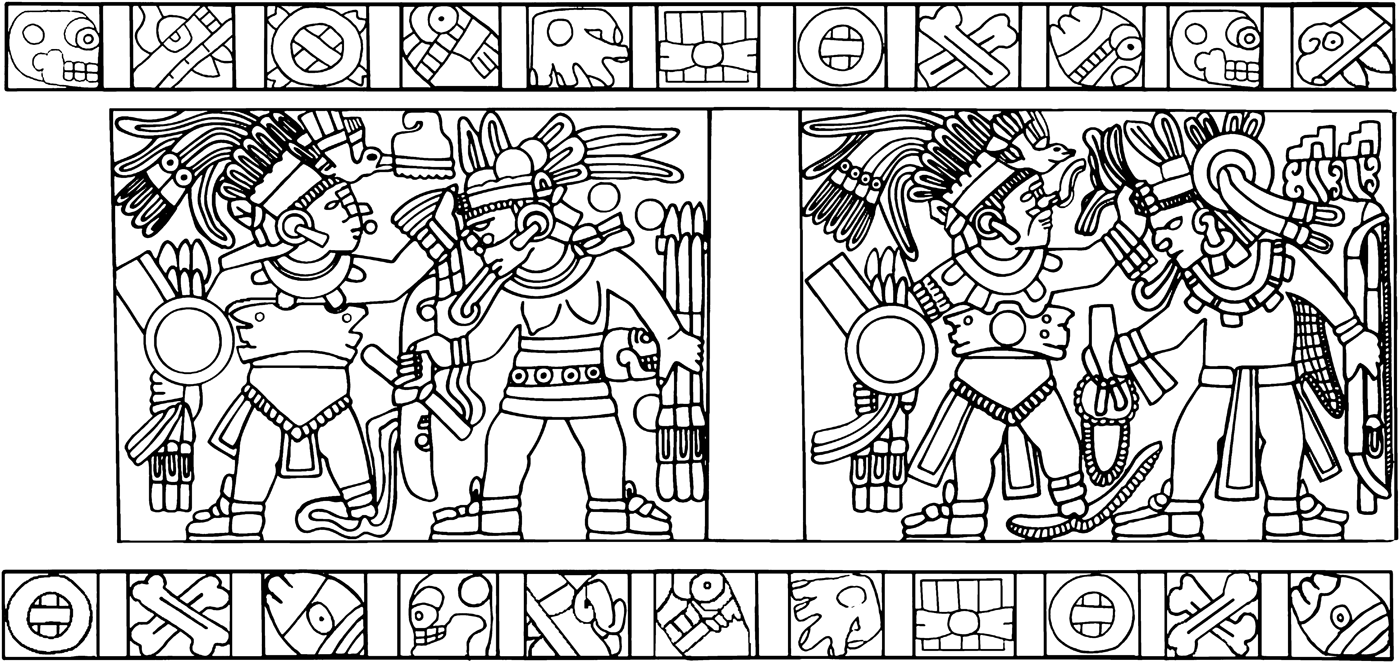
The side of the stone features a band of 11 rectangular cartouches, each of which depicts an unnamed Mexica warrior defeating the god of an enemy polity named with a place sign. The Mexica warrior and enemy gods are costumed very much as they are on the Tizoc Stone, and many of the place signs are essentially the same. Scholars agree that these conquests begin with Culhuacan, which was the first Mexica conquest (for example, as per Codex Mendoza [2r]), and are then sequenced from left to right around the stone. These conquered polities have been identified, with some variations, as Culhuacan, Tenayuca, Xochimilco, Chalco, Tamazulapan, Acolhuacan, Tecaxic or Tepanoaya, Tlatelolco (?), Tonatiuhco, Mixtlan, and Cuetlaxtlan (Solís Olguín Reference Solís Olguín, Franch, León-Portilla and Moctezuma1992, Reference Solís Olguín, Matos Moctezuma and Solís Olguín2004; for variant interpretations of some polities see Graulich Reference Graulich1992:6, 8, Reference Graulich1998:242–243, 246–248; Padilla y Yedra et al. Reference Padilla y Yedra, Sánchez-Nava and Olguín1989; Pérez Castro et al. Reference Pérez Castro Lira, Francisco Sánchez Nava, Estefan, Padilla y Yedra and Garfías1989:143; Solís Olguín Reference Solís Olguín1991:op. 157–158, Reference Solís Olguín, Franch, León-Portilla and Moctezuma1992:228; Umberger Reference Umberger, Berdan, Blanton, Boone, Hodge, Smith and Umberger1996:100). Above and below these conquests are two narrower bands, which, in the Tizoc stone, are a sky band and an earth band; here they are bands of rectangular cartouches that contain a number of repeating images.
Since its discovery, the sun stone has been assigned to Motecuhzoma I (who reigned a.d. 1440–1469) largely because of the conquest scenes, which begin with Culhuacan and end with Cuetlaxtlan (Matos Moctezuma Reference Matos Moctezuma and León-Portilla1997:38; Padilla y Yedra et al. Reference Padilla y Yedra, Sánchez-Nava and Olguín1989; Perez Castro et al. Reference Pérez Castro Lira, Francisco Sánchez Nava, Estefan, Padilla y Yedra and Garfías1989:147; Solís Olguín Reference Solís Olguín1991:158). In addition, Padilla y Yedra and colleagues (Reference Padilla y Yedra, Sánchez-Nava and Olguín1989) observed that the sun ray on the top of the stone that points down, away from the chin of the solar deity, points directly to an image in the top band, an image they identified as a xihuitzolli, the turquoise diadem of Aztec rulers, which appears just above the place sign of Culhuacan (Figure 2). They interpreted this as the name sign for Motecuhzoma I (Padilla y Yedra et al. Reference Padilla y Yedra, Sánchez-Nava and Olguín1989:25; Solís Olguín Reference Solís Olguín1991:158, Reference Solís Olguín, Franch, León-Portilla and Moctezuma1992:227, Reference Solís Olguín, Matos Moctezuma and Solís Olguín2004:120). More specifically, Solís Olguín identified the stone with both a temalacatl (literally “round stone,” a stone for gladiatorial sacrifice) and a cuauhxicalli (literally “eagle vessel,” a container for sacrificial hearts and blood) that the chronicler Diego Durán described as having been carved for Motecuhzoma I (Solís Olguín Reference Solís Olguín, Franch, León-Portilla and Moctezuma1992:230–231). Although Graulich (Reference Graulich1992:7–9, Reference Graulich1998:244–245, 248) assigned the stone to the sixth Mexica ruler Axayacatl, saying that the proposed xihuitzolli glyph referred not to the first Motecuhzoma but more generally to “the rulers of Mexico Tenochtitlan under their aspect of brave warriors” (Graulich Reference Graulich1992:9 [emphasis in original]), Umberger (Reference Umberger, Berdan, Blanton, Boone, Hodge, Smith and Umberger1996:97–102) agreed with the attribution to Motecuhzoma I, suggesting the stone was carved to commemorate his victory over Coixtlahuaca. Matos Moctezuma (Reference Matos Moctezuma and León-Portilla1997) also agreed with the Motecuhzoma attribution but later (Matos Moctezuma Reference Matos Moctezuma, Matos Moctezuma and López Luján2009:325) re-identified the glyph in question not as a xihuitzolli but as a flint with a face and called for more study. López Austin's and López Luján's (Reference López Austin and López Luján2011, Reference López Austin, López Luján, Boxt and Dillon2012) recent identification of Motecuhzoma's stone with that moved by the conqueror Gómez Dávila seems to settle the matter in favor of the original attribution to Motecuhzoma I.
Mexica conquest of the deities of Culhuacan and Tenayucan. Drawing by Anne Bomalaski.

ELEMENTS IN THE SYMBOLIC BANDS
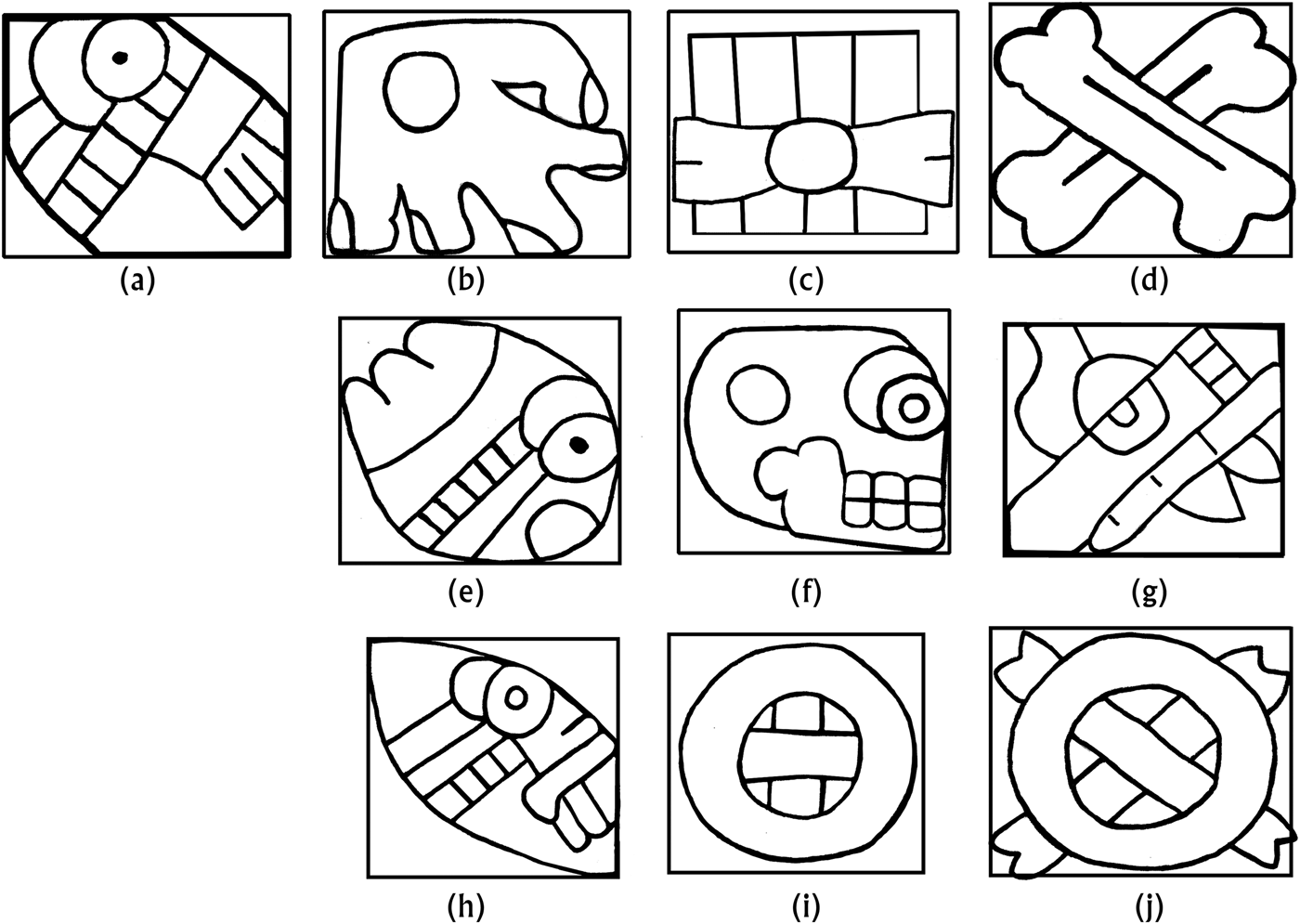
Solís Olguín, whose Reference Solís Olguín, Franch, León-Portilla and Moctezuma1992 study of the sun stone is the most thorough to date, described each of the symbolic elements in the two bands and noted that the top band contains 57 elements, and the lower band 59. He identified one unique symbol and nine others that repeat, and he sequentially listed all those in the top band (Solís Olguín Reference Solís Olguín, Franch, León-Portilla and Moctezuma1992:227). The symbol he identified as being unique is the element in the band just above the place sign of Culhuacan (Figure 2), the element to which the sun ray points. He described this as a xihuitzolli, or copilli, the pointed turquoise diadem of Aztec rulers (see also Pérez Castro Reference Pérez Castro Lira, Francisco Sánchez Nava, Estefan, Padilla y Yedra and Garfías1989:141). Other elements in the bands are a severed hand, bundle, crossed long bones, heart, profile skull, profile cipactli (crocodile) head, flint with fanged face, and two kinds of circles (Figure 3).
Motifs on the Sun Stone: (a) controversial flint, (b) hand, (c) bundle, (d) bones, (e) heart, (f) skull, (g) cipactli, (h) flint, (i) circle with crossed horizontal and vertical bands, (j) circle with obliquely crossed bands. Drawing by Anne Bomalaski.
Common Motifs
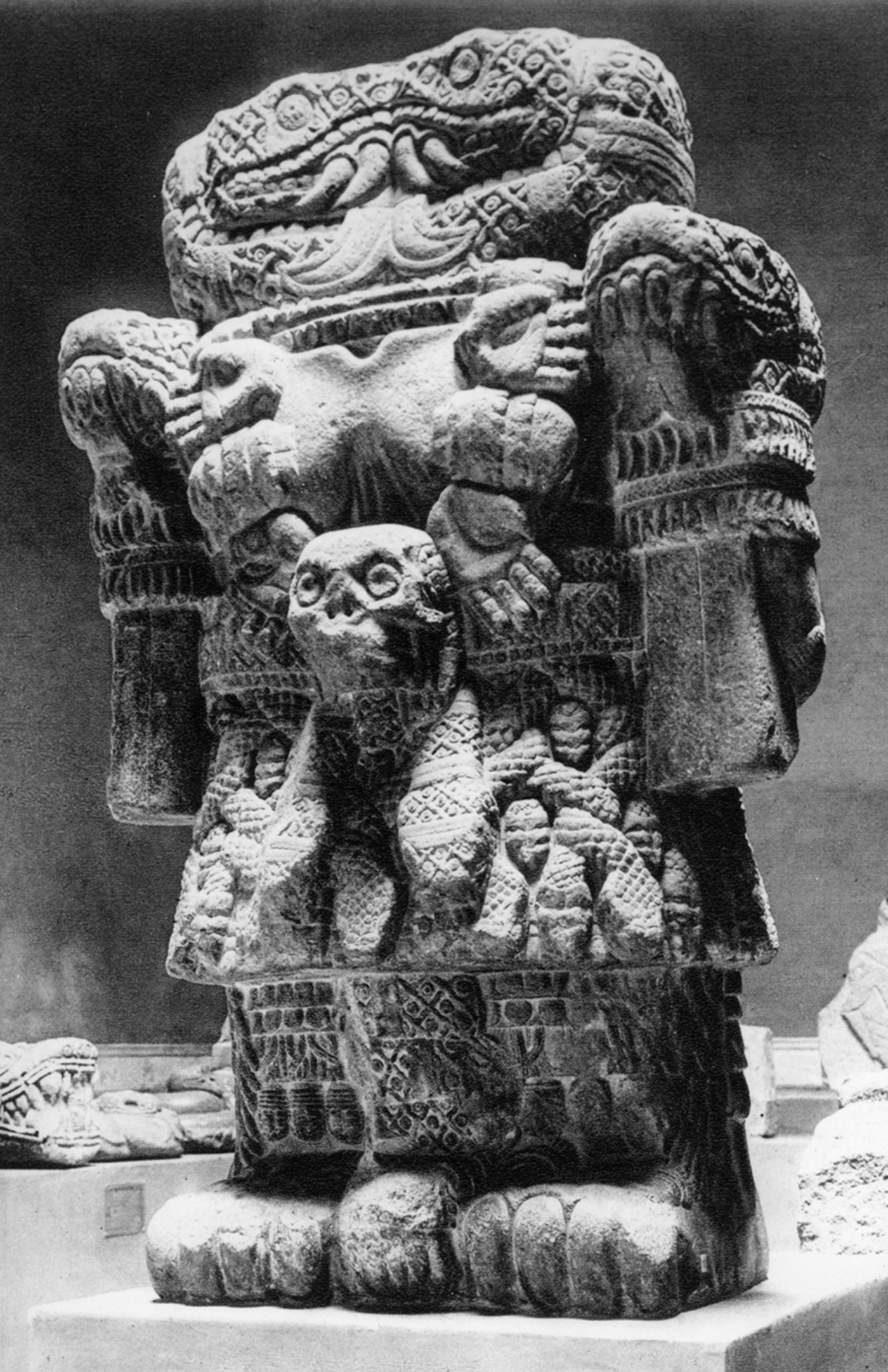
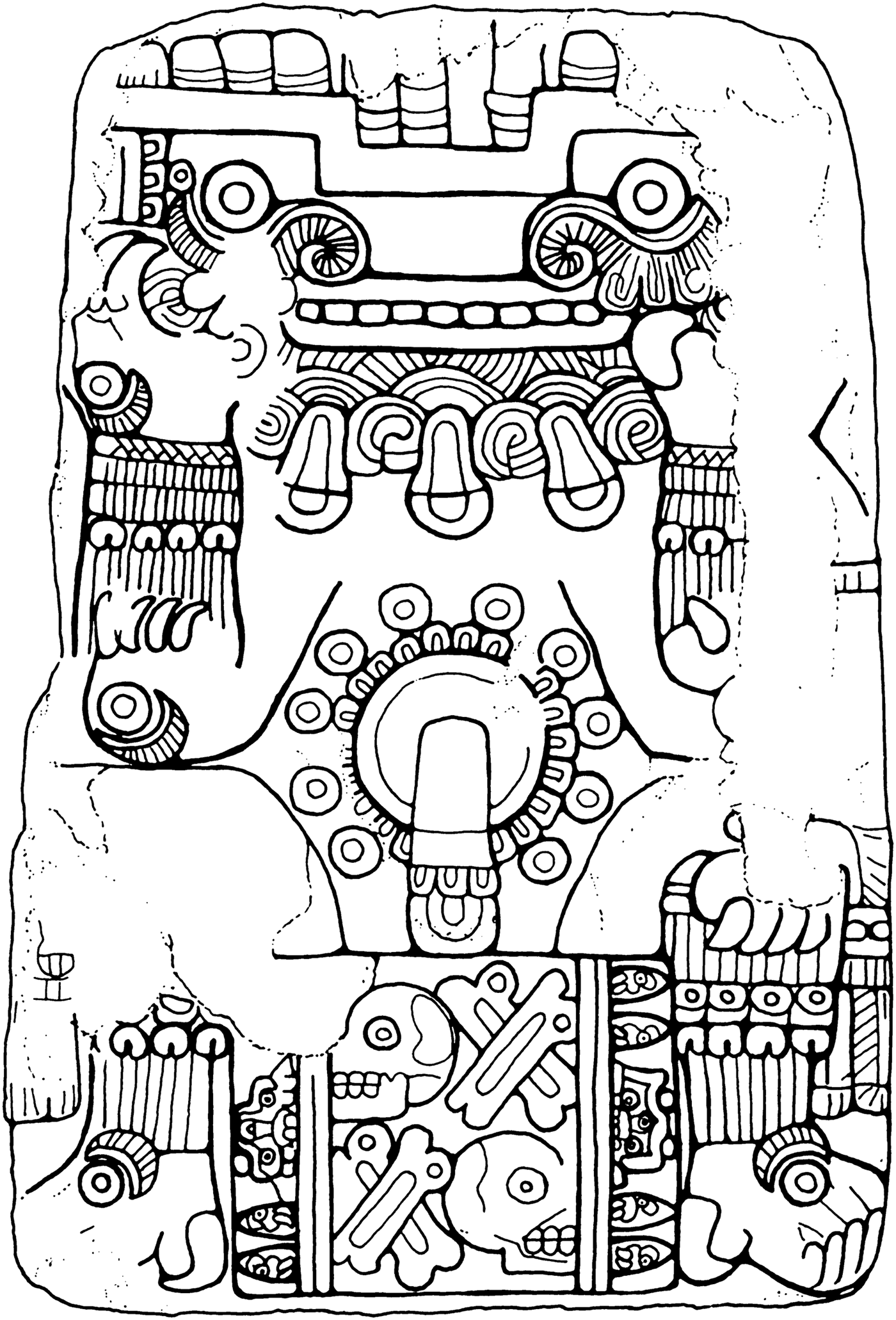
Many of these elements are common motifs in Aztec art (the art of the Triple Alliance empire especially within the Basin of Mexico but also extending outside of it to areas embraced by the empire). These motifs are often found as repeating elements that compose patterns on surfaces and are usually associated with altars of various kinds and with supernaturals related to warfare, death, and the earth. Hands and hearts are represented strung together as necklaces and worn by a sculpted Cihuateotl (a deified woman who died in childbirth), the monumental Yolotlicue and Coatlicue (Figure 4) statues, a ceramic effigy brazier of a deceased warrior, and Tzitzimime pictured in the Codex Magliabechiano (76r) and the Codex Tudela (46r) (Alcina Franch et al. Reference Alcina Franch, León-Portilla and Moctezuma1992:360, 361; Matos Moctezuma and López Luján Reference Matos Moctezuma and López Luján2009:172–173, 220; Matos Moctezuma and Solís Olguín Reference Matos Moctezuma and Solís Olguín2002:Number 137; Solís Olguín Reference Solís Olguín1991:137). Crossed bones and skulls together decorate the “skirts” of Tlaltecuhtli (Earth Lord) reliefs (Figure 5) (Alcina Franch et al. Reference Alcina Franch, León-Portilla and Moctezuma1992:41, 53, 203, 305, 308; Matos Moctezuma and López Luján Reference Matos Moctezuma and López Luján2009:59, 90, 397, 424, 425), the cape worn by the cult image of Tezcatlipoca (Durán Reference Durán, Horcasitas and Heyden1971:109, Plate 9), and the sides of altars (for example, the Tenayuca mural, the Tomb of the Year Bundles, and the Codex Tudela [76r] [Alcina Franch et al. Reference Alcina Franch, León-Portilla and Moctezuma1992:303; Solís Olguín Reference Solís Olguín1991:154]). These altars or stone platforms painted with skulls and crossed bones, it has been argued, represented the sacred capes and skirts that were the essence of the ancient gods (Klein Reference Klein2000). Hands and skulls are combined on the skirt of Cihuacoatl painted in the Codex Tudela (27r; there identified as Tonan); and severed heads, hands, and bones decorated the cape that was spread before the dough image of Huitzilopochtli during the feast of Toxcatl (Sahagún Reference Sahagún, Anderson and Dibble1953–1982:2:72). Flint knives with fanged faces appear as repeating elements on the sandals of a Tlalocoid Chacmool; they appear with “great star” signs on the border of the skirt of some Tlaltecuhtli figures (Figure 5), as well as on a stone box and cylinder and on the sides of the Calendar Stone (Figure 6) (Alcina Franch et al. Reference Alcina Franch, León-Portilla and Moctezuma1992:47, 354; Matos Moctezuma and López Luján Reference Matos Moctezuma and López Luján2009:96, 111, 278–279; Solís Olguín Reference Solís Olguín1991:64). These common images—the hearts, hands, bones, skulls, and flints—usually appear as repeating motifs in Aztec art. The hearts and hands are usually paired together, as are the bones and skulls, whereas the flints usually repeat with themselves or with star motifs. Hearts, hands, crossed bones, and profile skulls also appear in more complex compositions on polychrome vases and the painted altars and side benches of Tizatlan and Ocotelulco. This is discussed more fully below.
Coatlicue sculpture, wearing a necklace of hearts and hands (from Brehme 1923:184).
Tlaltecuhtli with a “skirt” decorated with skulls and crossed bones, and two bordering strips of flints with “great star” motifs. Drawing by Anne Bomalaski.
Band that encircles the sides of the Calendar Stone, representing paired flints alternating with “great star” motifs. Drawing by Anne Bomalaski.
Less Common Motifs
A few individual elements require greater explanation. One has been said to be unique, and others are less common in the Aztec corpus:
“Xihuitzolli”
Perhaps the most controversial of the band elements on the sun stone is the first one, the so-called xihuitzolli (Figure 3a). Although Solís Olguín (Reference Solís Olguín1991:158, Reference Solís Olguín, Franch, León-Portilla and Moctezuma1992:227, Reference Solís Olguín, Matos Moctezuma and Solís Olguín2004:120) considered it unique, Graulich (Reference Graulich1989:8, Reference Graulich1998:244) said there was another on the lower band (below the proper right foot of the Mexica victor capturing the god of Cuetlaxtlan, in the last of the conquest scenes). We agree with Matos Moctezuma (Reference Matos Moctezuma, Matos Moctezuma and López Luján2009:325) that the element is unlikely to be a xihuitzolli, for a fanged face dominates the motif, and the fangs extend down below what would be the head band. Although a small fanged face does appear on a xihuitzolli carved on the front of the Calendar Stone (which Umberger [Reference Umberger, Kathryn Josserand and Dakin1988:350–352] considers to be Motecuhzoma Xocoyotzin's name glyph), that fanged face neither dominates that diadem nor distorts its shape and, thus, is rather different than the fanged face on the sun stone. On the sun stone, the fanged face of the motif on the band—composed of a round eye with prominent supraorbital plate, a tripartite band behind and below the eye, a broad gum- or lip-line, and four fangs—is of the type commonly found on flints (Figure 3a and 3h). Since such fanged faces distinguish all the flints on the sun stone's bands, this first element is surely another flint. The element under the victor of the Cuetlaxtlan conquest mentioned by Graulich is even more clearly a flint, for the pointed curve of the top is clear. There is considerable variation in the carving of the symbolic elements in these bands, and the first element fits the range of the other flints well. Thus, the two bands on the sun stone contain no elements that are iconographically unique, only repeating ones.
Bundle
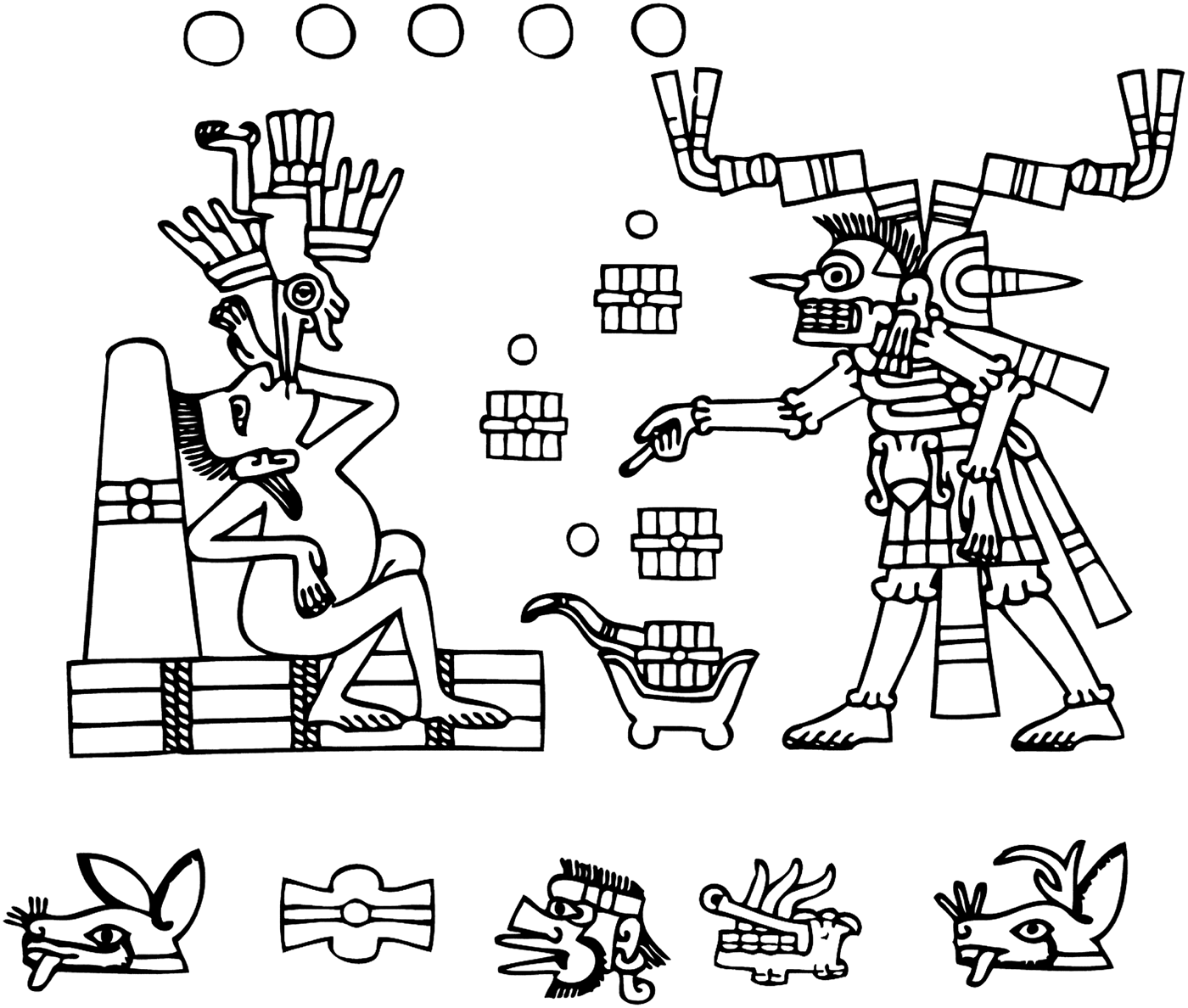
Of the other elements, the bundle (Figure 3c) is probably not a year bundle, as Padilla y Yedra and colleagues (Reference Padilla y Yedra, Sánchez-Nava and Olguín1989:25; see also Pérez Castro et al. Reference Pérez Castro Lira, Francisco Sánchez Nava, Estefan, Padilla y Yedra and Garfías1989:141) originally suggested, because year bundles have more elements being bundled and are bound on both ends (Matos Moctezuma and López Luján Reference Matos Moctezuma and López Luján2009:112; Solís Olguín Reference Solís Olguín1991:155). It has also been described simply as a bundle (Solís Olguín Reference Solís Olguín, Franch, León-Portilla and Moctezuma1992:227). More precisely it can be identified as a bundle or fardel of kindling, composed of four visible pieces of resinous wood, bound with a cord. Similar bundles appear as offerings in the codices of the Borgia Group (Figure 7).
Offerings of bundles of kindling represented in an almanac featuring the death god. Codex Laud 30 (from Anders and Jansen 1994:167). Courtesy of the Akademische Druck- u. Verlagsanstalt, Graz.
Cipactli
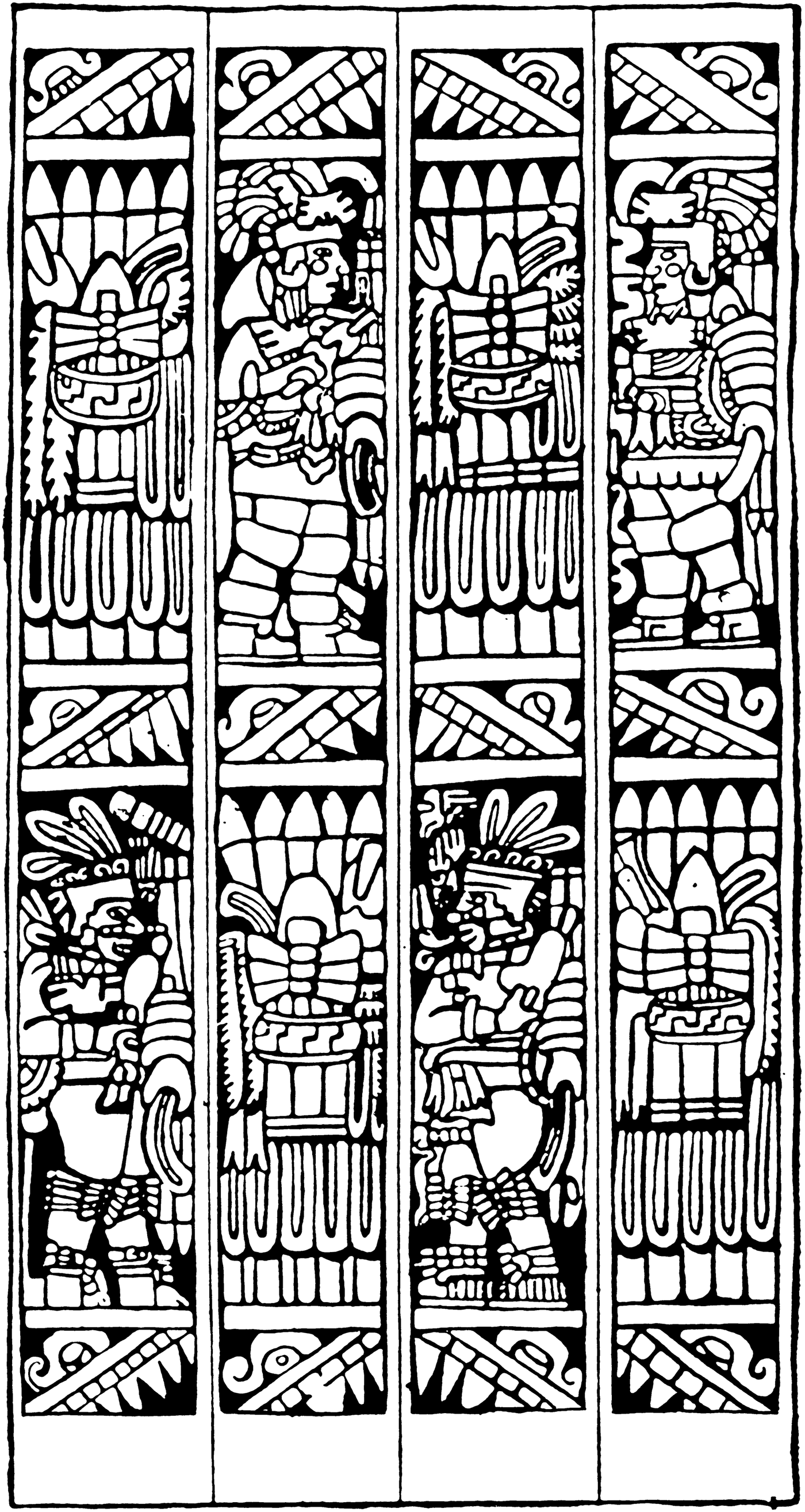
The cipactli element (Figure 3g) is a reduced and abstracted profile of a cipactli (crocodile) head, without the lower jaw but featuring fangs and a prominent supraorbital plate. Such is the manner in which the day sign Cipactli is usually represented in the divinatory codices of the Borgia Group, although not in those codices painted more fully in the Aztec tradition, which feature a cipactli with its lower jaw (see, for example, the codices Borbonicus, Telleriano-Remensis, Magliabechiano, Tudela, and Tonalamatl Aubin); the Calendar Stone features a full-figure Cipactli. We have been unable to find any other examples of this greatly abstracted cipactli head (lacking lower jaw) in the Aztec corpus. However, the piers of Pyramid B at Tula have cipactli images that are nearly identical, carved above and below each of the warriors and dart clusters (Figure 8). On the sun stone, the cipactli is clearly not a sacrificial offering like the bundles; its context at Tula suggests that it might reference the warriors of the Toltec past, as explained more fully below. It may also simply represent the earth, for the earth was conceptualized as a great cipactli, and the earth in the form of Tlaltecuhtli (Earth Lord) was an original sacrifice, torn apart by the creators god Quetzalcoatl and Tezcatlipoca (see the Histoire du Mexique [Tena Reference Tena2002:151–153]).
Piers of Pyramid B, Tula, featuring warriors and bundles of weapons bordered by cipactli heads (from Diehl Reference Diehl1983:Figure 13). Courtesy of Richard Diehl.
Circular motifs
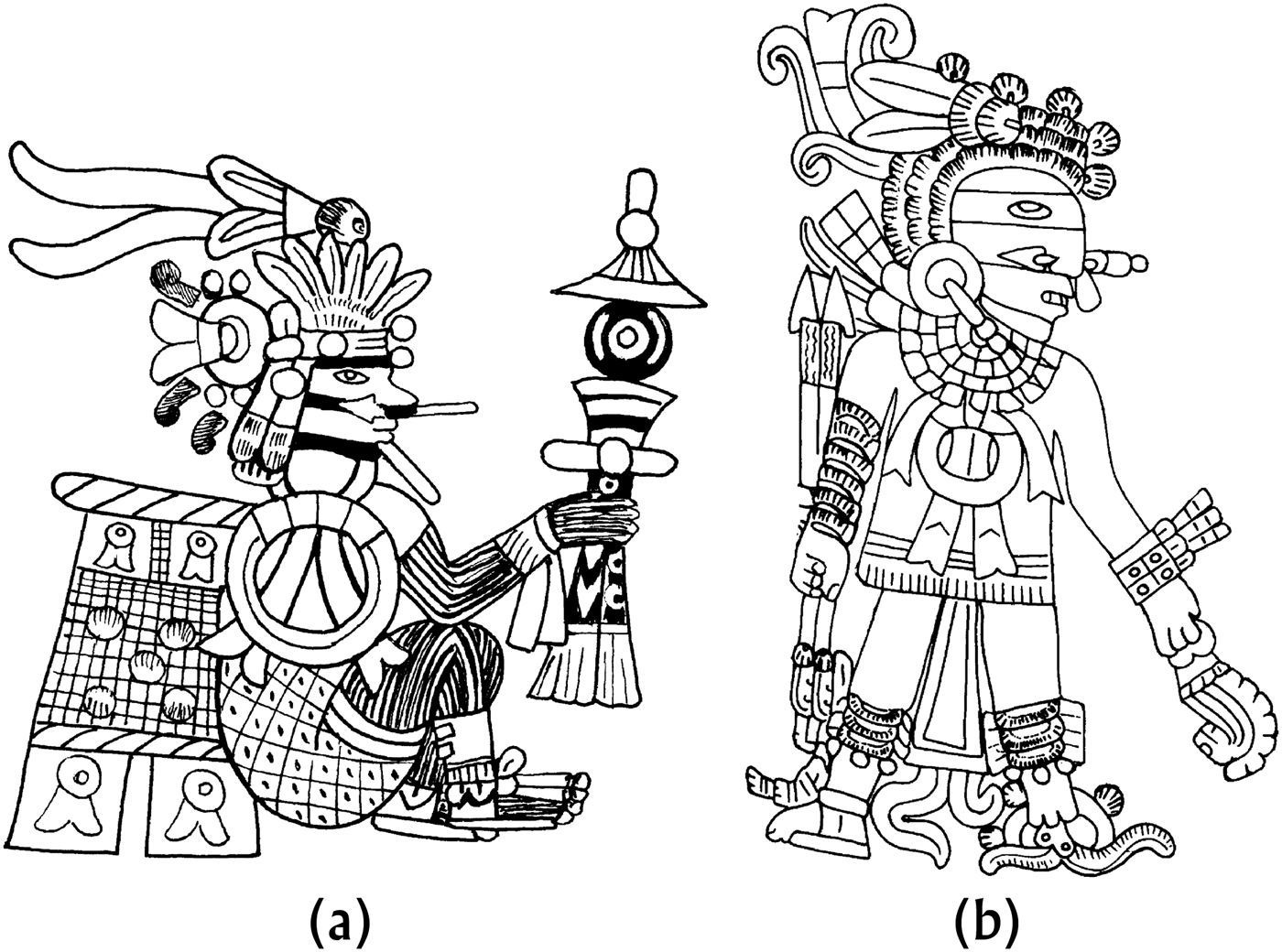
Also unusual are the two motifs composed of a circular band that has crossed bands overlapping across its center (Figure 3i and 3j). One version features bands crossing vertically and horizontally; the other has bands crossed as an ‘X’ and shows the ends of the bands extending outside (behind) the circle into the corners of the rectangular cartouche. These ‘X’ bands usually end with V-shaped cuts. Although there are no exact parallels elsewhere in the Aztec corpus, these circular motifs may be related in some way to accoutrements associated with Tezcatlipoca or Xipe Totec. Solís Olguín (Reference Solís Olguín, Franch, León-Portilla and Moctezuma1992:227) initially likened the first version (with horizontal and vertical bands) to a Greek cross and suggested it symbolized the pectoral of Tezcatlipoca and Huitzilopochtli. This pectoral, or anahuatl, is a circular shell wrapped at the top in red (leather) with two or four ribbons hanging down from the top; these ribbons end in V-shaped cuts (Figure 9). The anahuatl shares with the sun stone's motifs its circular shape and ribbons or bands ending in V-shaped cuts, but it differs from them in other ways—it is wrapped at the top, which the carved motifs on the stone are not, and its ribbons do not intersect each other in the center of the circle. Ribbons with V-shaped ends are also found among the accoutrements of Xipe Totec, where they extend outward from the circular base of his peaked headdress and the solid circular disk of his baton (see, for example, the Codex Magliabechiano [4r, 90r] and the Codex Tudela [12r]).
Tezcatlipoca wearing the anahuatl pectoral—a circle of shell wrapped at the top, with pendant ribbons ending in V-shaped cuts. (a) Codex Tudela (15r) and, (b) funerary urn from the Templo Mayor. Drawings by Rodolfo Ávila and courtesy of Guilhem Olivier.
The Aztec symbol of gold is also vaguely similar to these circular elements, for disks of gold are represented by an encircled cross and disks (most notably on the cheeks of the monumental head of Coyolxauhqui) (Figure 10). However the arms of this cross either display interior lines or are painted in the codices as intersecting looped bands (see, for example, the Codex Magliabechiano [24r]), and on sculptures they do not actually extend to the disk's framing rim. Moreover, the arms of the cross are always flanked within the circle by four disks. This motif for gold is thus quite distinct from the circular motifs on the sun stone.
Symbol for gold as it appears on stone sculptures and painted ceramics. Drawing by Anne Bomalaski.
The precise iconographic meaning of these circular motifs on Motecuhzoma's stone remains unclear. Additionally, there have been divided opinions about whether they represent two distinct motifs or two variants of one motif. Solís Olguín (Reference Solís Olguín, Franch, León-Portilla and Moctezuma1992:227) grouped them together, but Matos Moctezuma (Reference Matos Moctezuma, Matos Moctezuma and López Luján2009:324–325) differentiated them. Below, we propose that they are two variants of one motif. One example on the band (above the captured god of Tonatiuhco) includes both a vertical cross and ends of ribbons on its outer corners that would belong to the X-shaped cross, as if the sculptor began to carve one version and added elements of the other.
With the exception of these circular motifs, the other seven motifs on the sun stone are all associated with a broad realm that embraces death, the earth, sacrificial offering, and warfare. The hearts, hands, skulls, and bones are all human body parts that usually reference the realm of the dead or forces of destruction. Skulls and bones, however, are also associated with regeneration, as Baquedano (Reference Baquedano, Saunders and de Montmollin1988) has noted. Skulls and bones decorate the skirts or capes of the earth lord (Tlaltecuhtli) as well as the warrior gods, Tezcatlipoca and Huitzilopochtli. The flint is an agent of human sacrifice, and the hearts are themselves the ultimate blood offering. The bundle of kindling signifies another kind of common offering. The abstracted cipactli head may reference a range of concepts. One is the primordial sacrifice of Tlaltecuhtli to create the physical world, as López Luján (personal communication Reference López Austin, López Luján, Boxt and Dillon2012) has suggested. Another concept is the earth itself. Because a very similar cipactli motif appears as a framing element for warriors and bundles of weapons at Tula, it may alternatively function on the sun stone in the somewhat same capacity to allude to an aspect of Toltec warfare or to the warriors of the Toltec past. This possible reference to the Toltecs should not be dismissed as particularly far-fetched, for the Mexica warriors in the conquest scenes on the stone are costumed as Toltec warriors, very much like the Atlantean warriors on Pyramid B at Tula. The Mexica warriors on the Stone of Tizoc are costumed the same way. For the Mexica, Tula and the Toltec past were venerable and heroic; they were fundamental to the Mexica's own greatness. As Umberger (Reference Umberger1987:70–82) and López Luján and López Austin (Reference López Luján and López Austin2007) have explained, the Mexica regularly copied Toltec works and expropriated and venerated the sculptures of the Toltec past. The activity of war itself, as practiced by the Mexica, is not explicitly referenced on the symbolic bands of the sun stone, however. There are no spears, atlatls, maquahuitl (obsidian edged clubs), or shields. Of course, these bands frame the eleven explicit scenes of war and conquest, so any actual implements of warfare on the symbolic bands would be redundant.
THE SERIES OF ELEMENTS
We can approach a more precise interpretation of the bands by comparing them, as a series of elements, with other series of similar elements elsewhere. These are found on the murals at Ocotelulco and Tizatlan in Tlaxcala, and on polychrome “codex-style” or Mixteca-Puebla-style pottery from the states of Veracruz, Puebla, Tlaxcala, and Oaxaca, as well as from incense pans from Tenochtitlan. All bear many of the same motifs organized as bands.
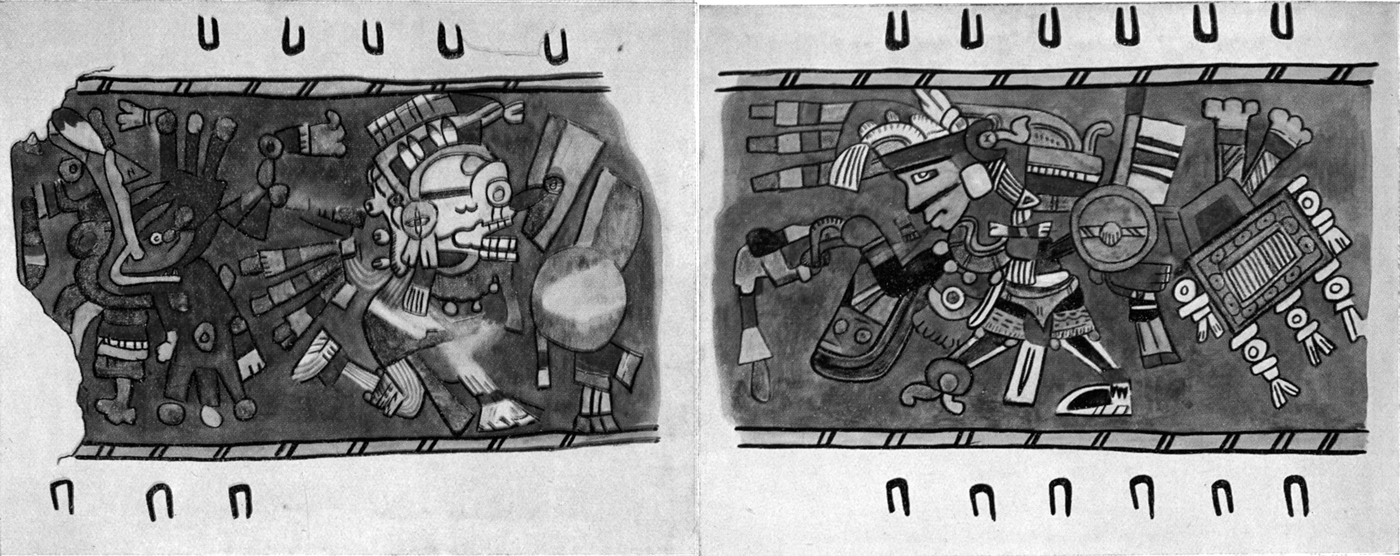
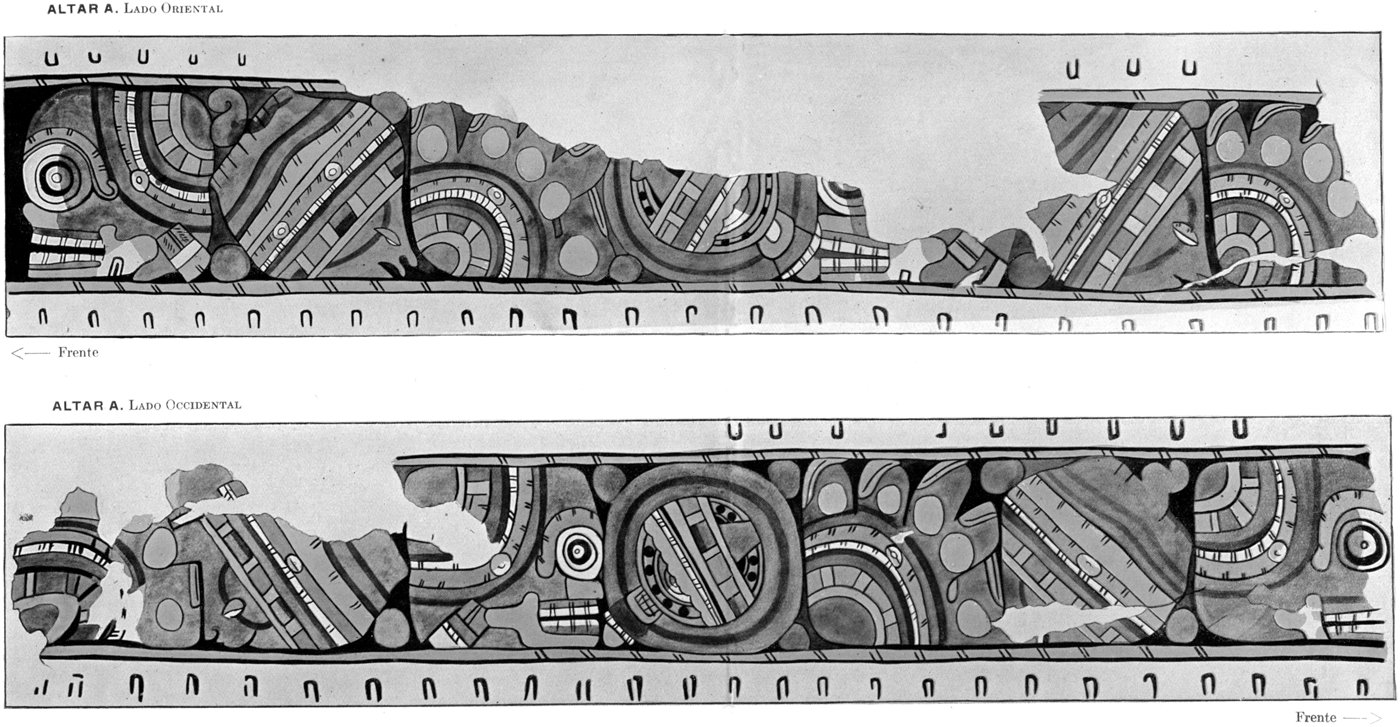
Two differently painted altars were uncovered at Tizatlan in 1927 (Caso Reference Caso1927). Altar A features, on its front, the images of Tlahuizcalpantecuhtli (Venus as Morning Star) and Tezcatlipoca (Figure 11), and on its sides a series of four repeating elements; these are a circular motif containing what Caso (Reference Caso1927:153) identified as an extruded eye, a severed hand, a heart, and a skull. The motifs are organized so that a skull is painted next to the front of the altar on each side (Figure 12). All the skulls face toward the front of the altar and establish the sequence as reading toward the two deities painted on the front.
Representations of Tlahuizcalpantecuhtli (left) and Tezcatlipoca (right) on the front of Altar A, Tizatlan (from Caso Reference Caso1927:Lámina I).
Motifs on the lateral sides of Altar A, Tizatlan (from Caso Reference Caso1927:Lámina II).

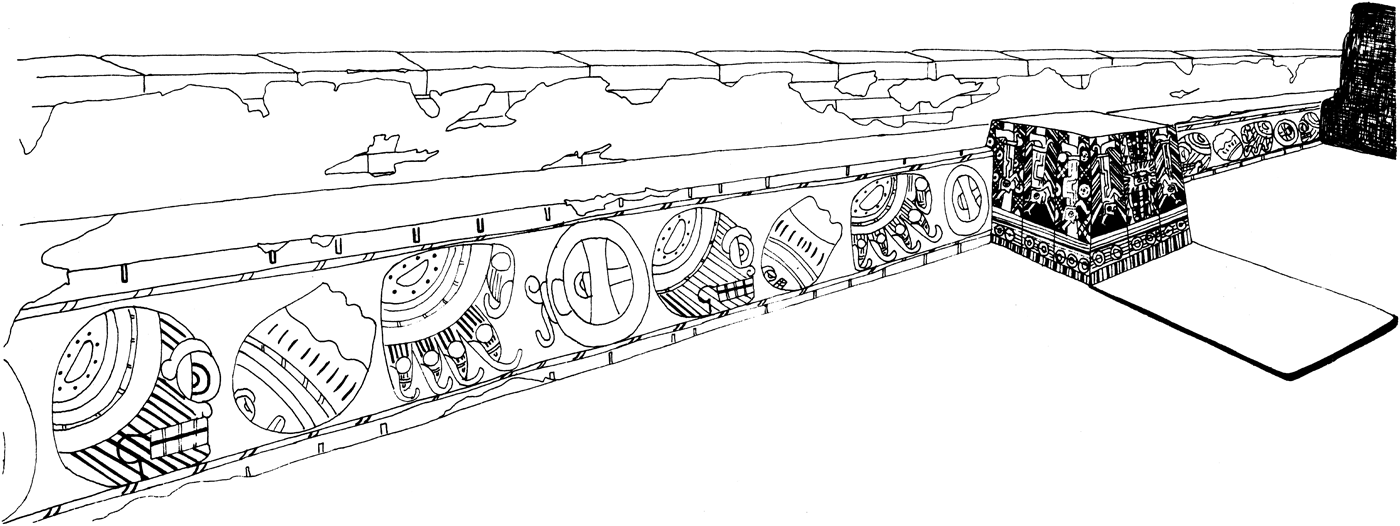
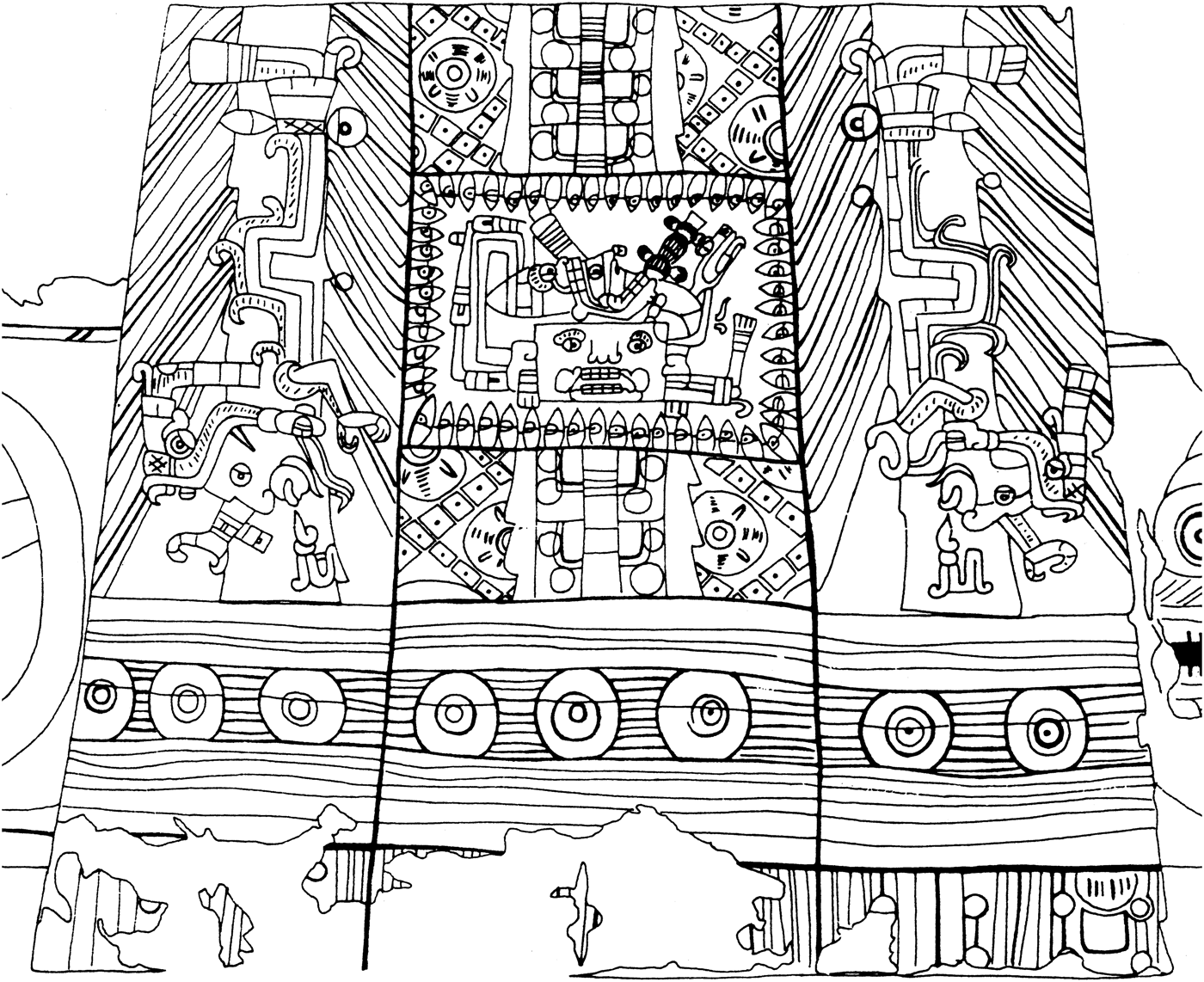
The murals discovered in 1990 at Ocotelulco contain these same motifs, painted on the sides of the benches that flank a central altar (Contreras Martínez Reference Contreras Martínez1992, Reference Contreras Martínez and Reyes García1993, Reference Contreras Martínez, Anders, Jansen and van der Loo1994a, Reference Contreras Martínez, Nicholson and Quiñones Keber1994b) (Figure 13). This central altar is distinguished by eight descending fire serpents, each with the face of a different supernatural emerging from its serpent's mouth (Figure 14). They descend on bands of red that Contreras Martínez (Reference Contreras Martínez and Reyes García1993:55, Reference Contreras Martínez, Anders, Jansen and van der Loo1994a:111) has interpreted as streams of blood. A central scene, bordered by a flinted enclosure, features a large anthropomorphic flint lying horizontally on an anthropomorphic bowl; in the flint's open mouth is the profile face of Tezcatlipoca. On the benches that flank this altar, the motifs are placed in the same relative position to each other as they are at Tizatlan—the right bench has the sequence of encircled eye, hand, heart, and skull, with the skull next to the altar. But on the left side of the altar the series continues right to left as if uninterrupted from the right side, with the encircled eye next to the altar and the other motifs continuing in the same order as on the right side. The orientation of these motifs on the left side is shifted, however; they are all turned to face the altar. This reverses the directional sequence on the left but maintains the orientation toward the altar on each side and achieves a degree of visual symmetry.
Banquettes and altar of Ocotelulco (from Contreras Martínez Reference Contreras Martínez and Reyes García1993:56). Courtesy Universidad Autónoma de Tlaxcala.
Altar at Ocotelulco with central scene of a flint bearing Tezcatlipoca's face (from Contreras Martínez Reference Contreras Martínez and Reyes García1993:61). Courtesy Universidad Autónoma de Tlaxcala.
The individual elements at Tizatlan are more complex than those on the benches at Ocotelulco, but they share the basic features. The hand is embellished at its base (where the hand was severed) with a circle of motifs that generally symbolize preciosity. The skull has a similar circle of preciosity at its back, and a band of similar elements wraps around the heart. In both murals the heart has its aortal end up, facing toward the direction of the sequential flow, and it has an anthropomorphic face painted on the bottom, facing counter to the flow.
The fourth motif, the encircled eye, has been variously interpreted as a shield, a large jade, an extruded eye, and a mirror. In its simplest form this motif has an outer red circle with an inner darker circle, through which passes an extruded eye; this is crossed and partially obscured by a band or sash. In the Tizatlan version, the band or sash has the same elements of preciosity found on the other motifs; at Ocotelulco, the band is painted yellow dotted with red, which Contreras Martínez (Reference Contreras Martínez, Anders, Jansen and van der Loo1994a:111) interpreted as representing bone. A jade tab (at Tizapan) or a turquoise colored volute (at Ocotelulco) breaks out of the circle near the end of the eye. As no similar motif is found in the pictorial codices, Caso (Reference Caso1927:153) suggested the configuration in the Tizapan mural might represent a shield, with the diagonal band representing the handle and the jade tab standing as the atlatl (spearthrower). It has also been tentatively identified as a large ceremonial jade (Solís Olguín Reference Solís Olguín1995:32, 36), a bulging eye (Hernández Sánchez Reference Hernández Sánchez2004:21, 28), and a mirror (Peperstraete Reference Peperstraete2002:23–24, Reference Peperstraete2006:27–28). We are unsure of its precise meaning.
This circular element bears a general similarity to the circular elements in the sun stone, but there are distinct differences as well, which make us hesitate to equate the two exactly. The sun stone's circles are symmetrical, having unadorned bands crossing in the middle of the circle; they lack the extruded eyes and volutes or jade tabs. In contrast, the circular motifs on the Tlaxcalan murals have these extruded eyes and either jade tabs or volutes, and they are asymmetrical. Lacking more evidence, we feel it best to recognize a general similarity between the circular motifs on the sun stone and those on the Tizatlan and Ocotelulco murals but not to insist on an iconographic equation of the two.
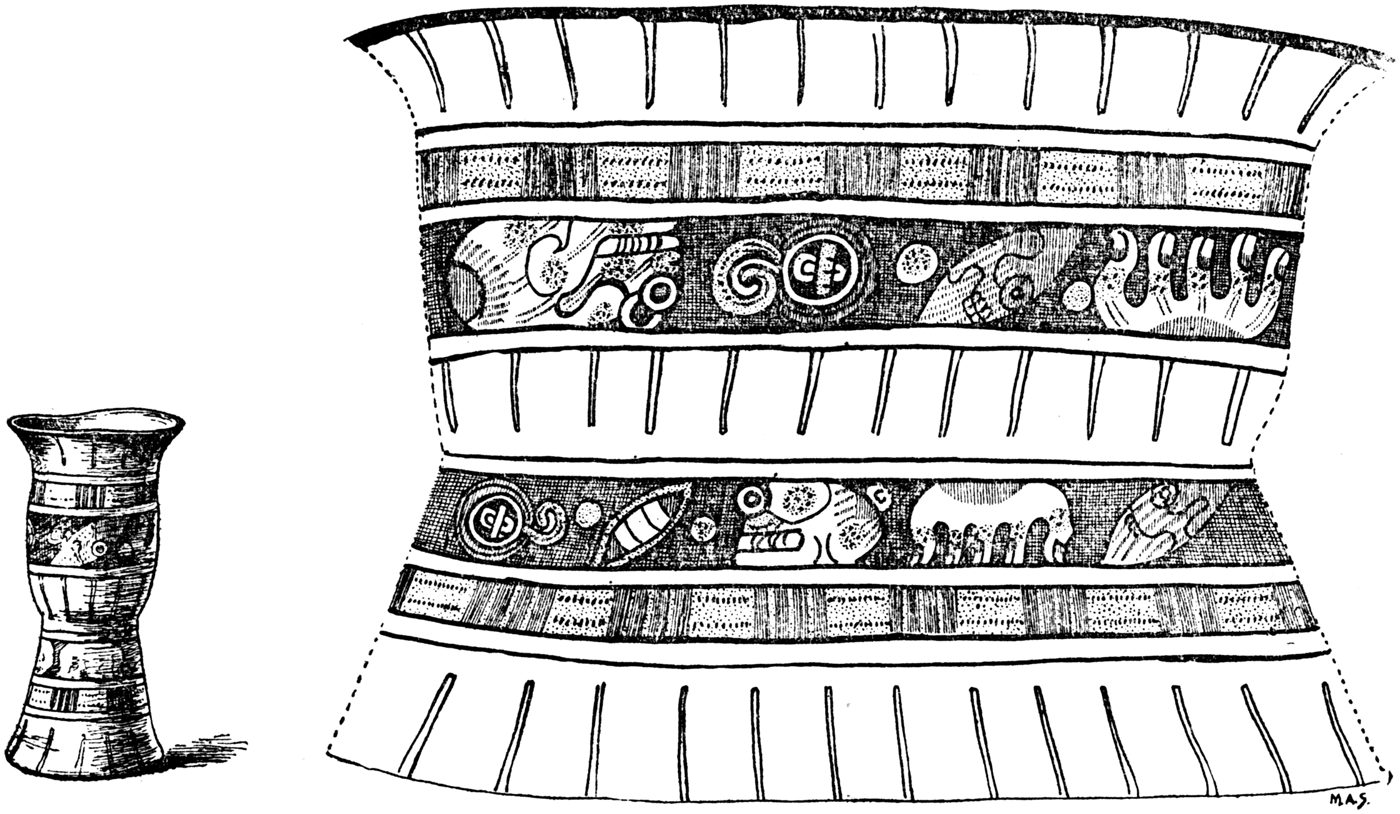
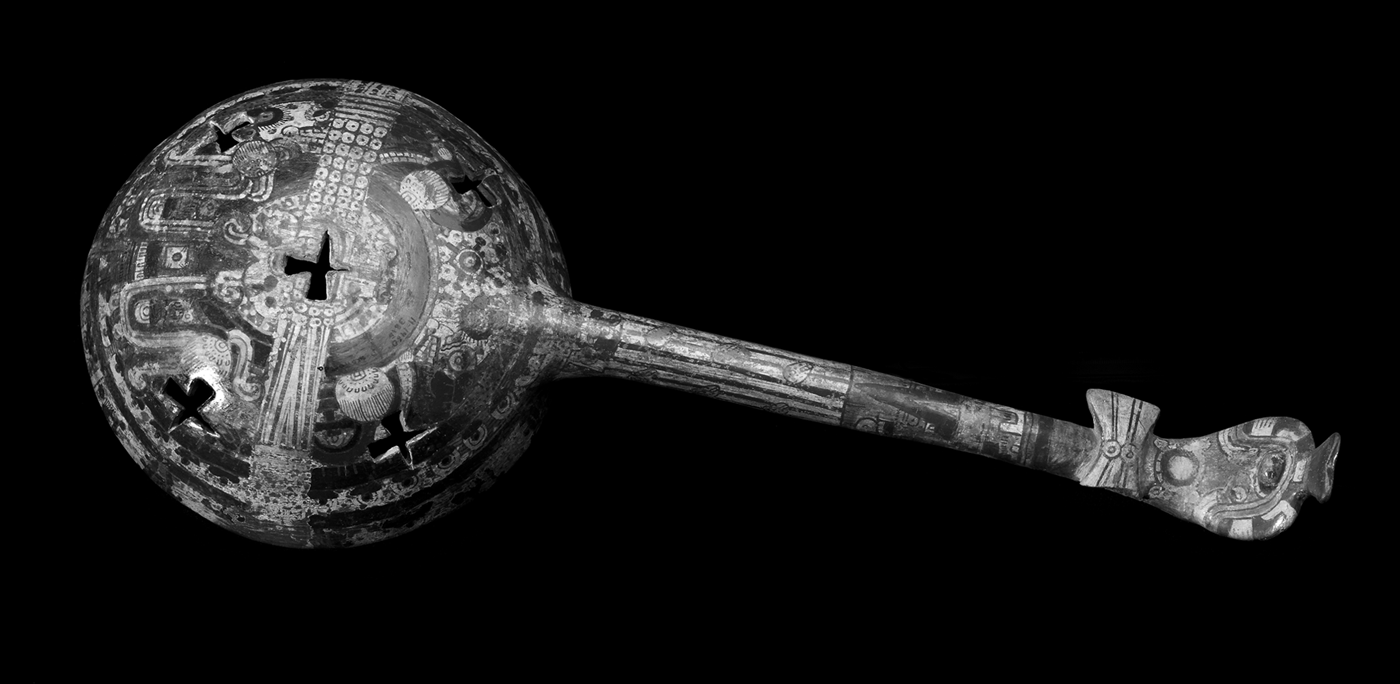
This same group of four elements on the side murals at Tizatlan and Ocotelulco is also found on the bands of polychrome “codex-style” or Mixteca-Puebla-style ceramics. Similar elements appear in two bands around a tall vase from Tlaxcala, including a skull, flint, hand, and the encircled eye (Figure 15), as Caso (Reference Caso1927:151–152) noted. More recently, Hernández Sánchez (Reference Hernández Sánchez2004) has analyzed the symbolic motifs that appear in bands or as individual elements on 405 “tipo-códice” ceramics from sites in the states of Puebla, Tlaxcala, Oaxaca, and Veracruz, as well as Mexico City. She hypothesized that the motifs on the ceramics are “not simply elements copied from the codices to embellish the ceramics but form a pictography, with standardized and organized motifs that refer to the ritual use of the vases” (Hernández Sánchez Reference Hernández Sánchez2004:3). She found that the motifs cluster into specific iconographic themes, the most prominent of which she called “Banda Solar” (Solar Band), “Plegaria a los Difuntos” (Prayer to the Dead), “Ofrenda a la Tierra” (Offering to the Earth), and “Humo y Oscuridad” (Smoke and Darkness). The 17 vessels that cluster with the theme of a Prayer to the Dead (Plegaria a los Difuntos) are predominately tall jars (Figure 15) that feature one or two bands composed of a skull, hand, heart, encircled eye, and sometimes another element that may be an internal organ. According to Hernández Sánchez (Reference Hernández Sánchez2004:21), these 17 examples come from the valleys of Puebla and Tlaxcala and from Veracruz. Peperstraete (Reference Peperstraete2002:23, Reference Peperstraete2006:27) also identified the same motifs on an incense pan from Tenochtitlan (Eggebrecht Reference Eggebrecht1986:Number 170) (Figure 16).
Polychrome vase with bands of motifs (hand, flint, encircled eye, skull) (from Caso Reference Caso1927:151, Figure 10).
Incense pan from Tenochtitlan featuring Tezcatlipoca's smoking mirror, crossed by a horizontal band decorated with elements of his insignia, and ringed by a band of symbolic elements (skull, heart, encircled eye, bones). MNA 10-223661 (11-1460). CONACULTA-INAH-MEX. Reproduction authorized by the Instituto Nacional de Antropología e Historia.
It is striking that the bands on the sun stone share three of the elements (all but the encircled eye) that also repeat on the sides of Altar A at Tizatlan, the benches at Ocotelulco, and the polychrome vessels. The appearance of circular elements in this mix suggests that, although the circular elements in the sun stone are not iconographically the same as those in the murals and ceramics, there is a general contextual similarity. The murals and ceramics arrange their motifs in slightly different orders, which suggests that there was no one preferred sequence.
Scholars have differentially sought the meaning of these sets of motifs. Caso (Reference Caso1927:153–154) made the connection between the elements painted on the sides of Tizatlan Altar A and the so-called “Strip Goddesses” that link and separate the episodes/scenes in the narrative section of the Codex Borgia (Boone Reference Boone2007:176; Nowotny Reference Nowotny, Everett and Sisson2005:268). These “Strip Goddesses” have skull heads and wear the headdresses of death deities; the long torsos of most of them are decorated with flints alternating with other elements: with extruded eyes (Borgia 32), round star eyes (Borgia 39), skulls (Borgia 43), crossed bones (Borgia 44), and hearts (Borgia 45). Caso characterized them as earth goddesses and suggested that the sides of Altar A represented the skirt of the earth goddess. Contreras Martínez (Reference Contreras Martínez, Anders, Jansen and van der Loo1994a:112) interpreted the conjunction of these repeating elements at Ocotelulco as related to the underworld. Peperstraete (Reference Peperstraete2002:24, Reference Peperstraete2006:28) has suggested that the side murals at both Tizatlan and Ocotelulco depict the cloths that would have covered the altars, which are bordered by a fringe similar to that on the skirts of the earth goddess or clothing of other gods. Klein (Reference Klein2000) had earlier made the broader point that motifs painted on the sides of altars represent the skirts of the Tzitzimime. Recognizing the mortuary associations of many of the elements in the bands, Hernández Sánchez (Reference Hernández Sánchez2004:21–33) interpreted the bands as referring to the gods of death and the underworld, composing in effect a Prayer to the Dead. Since other elements on the ceramics—for example, a fringe of white and black stripes—are associated with Tezcatlipoca, she offered the possibility that the prayer invoked that deity (Hernández Sánchez Reference Hernández Sánchez2004:32). We find Hernández Sánchez's interpretation applicable to Motecuhzoma's sun stone.
ASSOCIATION WITH TEZCATLIPOCA
A common feature shared by the sun stone, the Tlaxcalan murals, and the incense pans from Tenochtitlan is the marked association with Tezcatlipoca (Smoking Mirror), patron of rulers and divination and god of war (Olivier Reference Olivier and Besson2003). The Tizatlan and Ocotelulco murals are strongly linked to Tezcatlipoca iconographically. At Tizatlan, Altar A (which bears the repeating motifs discussed above) has on its front the image of Tezcatlipoca facing the image of Tlahuizcalpantecuhtli (Figure 11). In contrast, the other altar at Tizatlan (Altar B) has painted on its front two quite different scenes of deities in association with bodies of water, and its side murals have double registers of very different repeating images, principally featuring scorpions. This suggests that the repeating motifs of the sides of Altar A are not simply generic images that could appear on the sides of any altar, but are specifically related to the images of Tezcatlipoca and Tlahuizcalpantecuhtli on the front.
At Ocotelulco, the mural on the altar itself is also concerned with Tezcatlipoca (Fig. 14). As Peperstraete (Reference Peperstraete2002:13, 20, Reference Peperstraete2006:19, 23) has noted, the altar mural has a black background that is patterned with white disks and white netting, which is identical to the darkly patterned cloth of the loincloth worn by Tezcatlipoca in the Codex Borgia (17, 21). More importantly, the central scene of this altar mural presents an anthropomorphic flint with the face of Tezcatlipoca in its open mouth. This scene has been compared to the birth of Quetzalcoatl from a flint in the Codex Borgia (32), for the scenes share many features, including the central flint on an anthropomorphized bowl and the border of flints that frames the scene (Boone Reference Boone2007:185; Peperstraete Reference Peperstraete2002:20–22, Reference Peperstraete2006:23–25; Pohl Reference Pohl1998:186–188). But the deity in the flint at Ocotelulco clearly has the face paint of Tezcatlipoca as well as the square blue feathered pendant that is often attached to Tezcatlipoca's nose (for example, in the Tizatlan mural, on a polychrome plate from Ocotelulco [Contreras Martínez Reference Contreras Martínez1992:Figure 4, Reference Contreras Martínez, Nicholson and Quiñones Keber1994b:Figure 14; Peperstraete Reference Peperstraete2002:12, 14, Reference Peperstraete2006:23–28], throughout the Codex Borgia [for example, 14, 15, 17, 21, 41, 42, 46, 54, 69], and in the Codex Magliabechiano [33r, 37r] and Codex Tudela [19r]). The presence of Tezcatlipoca's image and attributes led Peperstraete (Reference Peperstraete2002:13, Reference Peperstraete2006:20) to suggest that that a cult image of Tezcatlipoca was likely placed on the Ocotelulco altar.
The ceramics that carry the motifs clustering as a Prayer to the Dead also have other elements (for example, a fringe of white and black stripes) that associate them with Tezcatlipoca (Hernández Sánchez Reference Hernández Sánchez2004:21–24). Moreover the incense pan from Tenochtitlan that has these motifs features Tezcatlipoca's smoking mirror in the center of the bowl (Figure 16). This pan, whose handle ends in a serpent head, is nearly identical to one of the three long-handled incense pans that Batres excavated from the Calle de las Escallerias in 1900, adjacent to the Templo Mayor—specifically the pan with the handle ending in an eagle claw (Batres Reference Batres1902:op. 20). Both incense pans feature prominently on the bottom of their bowls the smoking mirror of Tezcatlipoca, with the symbolic band of motifs ringing it. Extending across the center of this smoking mirror device is a broad band decorated in sections with white discs on a black ground, black and white stripes, and slightly angled black lines on a white ground (Figure 16). These same motifs are also associated with Tezcatlipoca, as Hernández Sánchez (Reference Hernández Sánchez2004:21–24) and Peperstraete (Reference Peperstraete2006:19–20) have noted; most specifically they appear on Tezcatlipoca's loincloth fringe, on the fringe of the device he holds, and on his seat (for example, the Codex Borgia [17, 21], the Codex Magliabechiano [33r], and the Codex Tudela [15r]). This conjunction of the regularly repeating symbolic motifs with the iconography of Tezcatlipoca, and no other deity, is compelling support for the thesis that the bands on the sun stone belong to a visual discourse situated within the realm of Tezcatlipoca.
PRAYERS OF HUMAN SACRIFICE
Tezcatlipoca was not only a creator deity and the patron of rulers and sorcerers, he was the Mexica god of war. On the surface of Motecuhzoma I's sun stone, captive warriors brought back to Tenochtitlan from distant campaigns engaged in gladiatorial combat that eventually led to their deaths before or during heart extraction. Both Motecuhzoma I and Axayacatl had gladiatorial stones carved on which prisoners were sacrificed: Motecuhzoma I's stone was used for prisoners from campaigns in the Huaxteca and the Mixteca, and Axayacatl's stone for captives from the Matlazinca war (Durán Reference Durán and Heyden1994:169–171, 186–192, 263–264, 272–277, 286; Matos Moctezuma Reference Matos Moctezuma, Matos Moctezuma and Solís Olguín2004:29–37; Solís Olguín Reference Solís Olguín1991:230–232; Umberger Reference Umberger, Berdan, Blanton, Boone, Hodge, Smith and Umberger1996:97–99). During the gladiatorial combat that took place on top of Motecuhzoma's stone, the blood of warrior-combatants pooled on its surface and probably streamed down its sides. Solís Olguín (Reference Solís Olguín1991:158) described the stone's bands as containing a symbolic exhortation to human sacrifice. This makes eminent sense given the function of the stone as a platform for gladiatorial sacrifice and a cuauhxicalli that received human blood sacrifices. Moreover the motifs on the bands are consistent with a message specifically about sacrifice.
As Dehouve (Reference Dehouve and Peperstraete2009) has insightfully argued, ritual discourse—composed of both verbal prayers and the nonverbal domain of actions and objects that are manipulated—is governed by a cognitive process of “definition by extension,” by which a concept or a being is most fully referenced by means of an enumeration of its constituents or components. For example, a woman is not only referenced by the difrasismo “the skirt, the blouse,” she is more completely characterized according to an enumeration of the implements and materials she uses to weave, and the difrasismo “the skirt, the blouse” can be seen as an abbreviation of the larger domain (Dehouve Reference Dehouve and Peperstraete2009:21–23). One sees this cognitive process at work in Sahagún's (Sahagún Reference Sahagún, Anderson and Dibble1953–1982:10:23) descriptions of the different groups of people, such as his description of the “brave man:” “The brave man [is] tall, very tall, small, fat, thin, very fat, very thin, somewhat like a stone pillar, moderately capable, good of appearance. The brave man [is] an eagle [or] ocelot warrior, scarred, painted, courageous, brave, resolute.” In this and other instances, Sahagún offers something of a range of qualities that together compose the segment of the population being described. In a similar way, in ritual contexts supernaturals are called forth or created as a physical presence by the accumulation of their attributes; their teotl (sacrality) is defined and manifest through the physical creation of their teixiptli (image), be it a human impersonator, a cult image, or an assemblage of ritual attire arranged on a frame (Boone Reference Boone1989:4, 9; DiCesare Reference DiCesare2009:54–60).
The same principle seems to be in operation on the sun stone's bands, where sacrifice, and specifically human sacrifice, is called up by the accumulation of motifs. Framed in Dehouve's terms, the motifs are the defining extensions of human sacrifice. Four of the motifs—heart, hand, skull, bones—represent major parts of the sacrificed body itself. The skull may additionally reference its display on the tzompantli (skull rack), while the heart stands as the quintessential offering. The flint knife is the very agent of this sacrificial act. The bundle of kindling, as another kind of offering, may then signify the nature of human sacrifice as an offering per se. The cipactli motif may call up any of several references: to the earth as a canonical recipient of sacrifice, to the primordial sacrifice of Tlaltecuhtli, or to some concepts related to the great Toltec warriors and weapons of the past. In any case, it contributes another aspect to the conception of human sacrifice being articulated on the sun stone's bands, a conception of sacrifice within the realm of Tezcatlipoca.
THE RHYTHM OF THE PRAYERS
The bands do more than define sacrifice, however. We propose that they articulate a non-verbal discourse that parallels in general terms the verbal discourse of Nahuatl poetry and song. Solís Olguín (Reference Solís Olguín1991:228) first discovered something of a rhythm in the elements on the symbolic band. Specifically, he identified for the top band two sequences of nine elements that repeated, and other figures that repeat in pairs or in threes without recovering the original sequence. He said that the sequence was less regular on the lower band and implied that this could be due to the sculptors’ adjusting to the irregularity of stone.
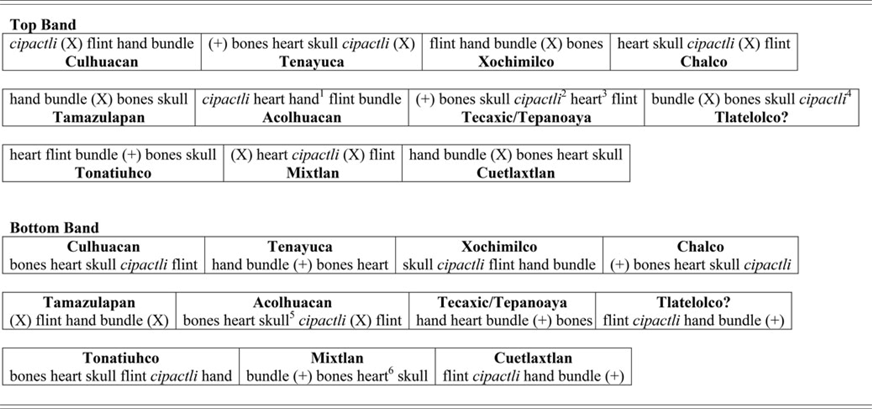
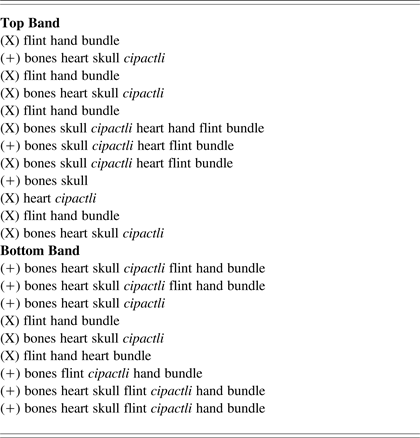
In seeking the rhythm of the prayers, we hypothesized that the bands were organized according to directionality, and that this directionality could be discovered. This would allow us then to identify a possible beginning (and end) to each band. Table 1 recreates on paper the series of motifs in the top and bottom bands and their position vis-à-vis the conquest scenes. We use the motif (+) to signify the circle with vertical cross, and (X) to signify the circle with bands crossed as an ‘X.’ Vertical lines mark the general boundaries of the conquest scenes, although many motifs straddle the dividing frames. In Table 1 we begin the sequence with Culhuacan, where the western sun ray points to the place sign, since this begins the sequence of conquest scenes. Because the conquests are universally accepted as reading left to right, we posed the hypothesis that the bands also read left to right, but then looked to the motifs themselves to test this.
Motifs on the bands, keyed to the conquests (beginning here with Culhuacan, anomalies noted). (X) = encircled bands crossed at an angle; (+) = encircled bands crossed vertically
1Hand has thumb on left side.
2Cipactli faces left.
3Heart angled to the right.
4Cipactli faces left.
5Skull faces right.
6Because the stone's surface is concave in this area, the “roll out” photographs reproduced in Alcina Franch et al. (Reference Alcina Franch, León-Portilla and Moctezuma1992:op. 208) show two skulls, where the stone has only one; the photographs in Matos Moctezuma and Solís Olguín (Reference Matos Moctezuma and Solís Olguín2004:Folio 87), taken at a different angle, show two hearts, where the stone has only one.
Our assumption was also that the actual directionality of the bands could be determined by the direction in which certain motifs faced. We ignored the circular motifs, bones, and bundles as lacking significant directionality. The hearts, flints, and hands carry only a moderate degree of directionality. The hearts and flints are angled obtusely with their bottom points on the right and the top points on the left; the fanged faces of the flints thus all face to the right. The hands are arranged so that the thumb is on the right. In comparison with the Tizatlan and Ocotelulco murals, the hearts favor a right to left directionality, whereas the hands favor the opposite. More revealing, however, are the two profile motifs—skulls and cipactli heads—which by their nature are intensely directional. In the top band the skulls and cipactlis almost always face to the right. In the bottom band they face to the left. If we follow the directionality of the skulls and cipactli heads, we can hypothesize that the top band reads left to right, and the bottom band reads right to left. Directionality often but not always determines sequence in the artistic corpus of Late Postclassic central Mexico. On the Calendar Stone and in the tonalamatl of the Codex Borbonicus the day signs face against the reading order, whereas in the other divinatory codices from the Valley of Mexico and of the Borgia Group, the day signs and deities face in the direction of the calendrical sequence, as do rulers and most protagonists in most of the Aztec annals. On the sun stone, other factors, discussed below, suggest that both bands sequence the same way, left to right.
The few exceptions to the directionality of the motifs, noted in Table 1, all occur above or below the sixth, seventh, and eighth conquest scenes, which are on the other side of the stone from the presumed beginning at Culhuacan. This is the view presented in Figure 1. Above the seventh (Tecaxic/Tepanoaya) and eighth (Tlatelolco?) conquests the cipactlis face to the left, and above Tecaxic/Tepanoaya the heart is angled to the right. Above the sixth conquest (Acolhuacan), the hand's thumb is on the left, and below it, the skull faces to the right. It is possible that this cluster of exceptions on the side of the stone opposite the first conquest, Culhuacan, might be iconographically meaningful, but if so, its meaning is unknown to us. A more likely cause is confusion on the part of the sculptor or sculptors working in this area. There is considerable variation in the carving of the symbolic motifs. For example, the motifs in the bands above and below the conquest of Chalco are particularly well carved, whereas those above and below Cuetlaxtlan and Culhuacan are blockier and less detailed; most of the hearts are represented with a small disk on their banding, but the heart above Chalco has an anthropomorphic face. This variation strongly suggests that the monument was carved by a number of sculptors working as a team.
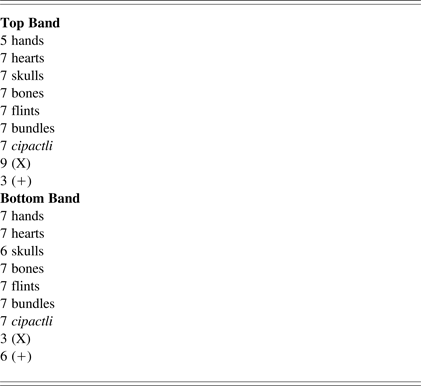
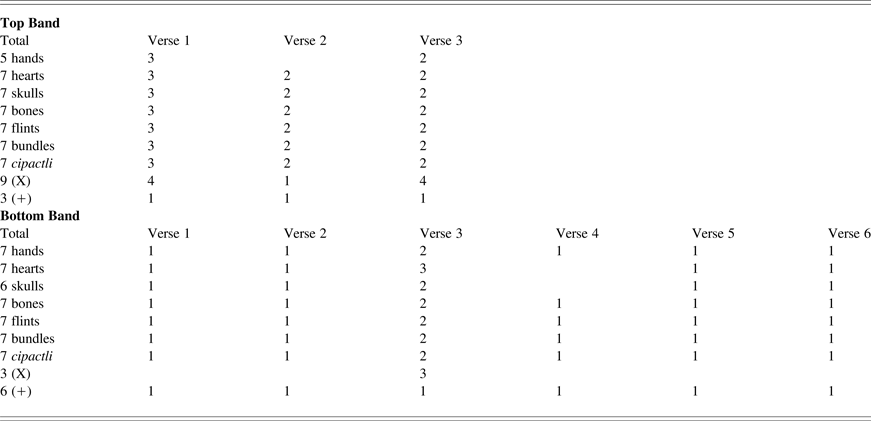
Our effort to pattern out the motifs began with a series of exercises designed to determine numerical and sequential relationships. We first counted the number of times each motif was used in each band (Table 2) and discovered that almost all the motifs repeated seven times on both the top and bottom bands. Exceptions are the hand, which repeats five times on the top band; the skull, which repeats only six times on the bottom; and the circular elements. There are nine (X) circles on the top band and three (+) circles; the bottom band is somewhat the reverse, with three (X) circles and six (+) circles. As these circular elements clearly do not fit the pattern established by the other motifs, we came to see them as anomalies. We additionally noted that these circular motifs are abstract and conventional, whereas the other motifs are iconic, representing otherwise known entities.
Number of times motifs repeat. (X) = encircled bands crossed at an angle; (+) = encircled bands crossed vertically
| Top Band |
| 5 hands |
| 7 hearts |
| 7 skulls |
| 7 bones |
| 7 flints |
| 7 bundles |
| 7 cipactli |
| 9 (X) |
| 3 (+) |
| Bottom Band |
| 7 hands |
| 7 hearts |
| 6 skulls |
| 7 bones |
| 7 flints |
| 7 bundles |
| 7 cipactli |
| 3 (X) |
| 6 (+) |
We then determined which motifs appeared adjacent to which other motifs, and whether they were on the right or left side; patterns began to emerge. For example, the bones motif always appears to the right of one of the circles, and the bundle motif always appears to the left of a circle. The (+) circle always has a bundle on its left and bones on its right, although the (X) circle has more variable neighbors. Recognizing these circular elements as numerically anomalous, we then separated them out from the others, and this helped to clarify the emerging patterns of the iconic motifs. Some short sequences were recognized as appearing with some frequency. Notable are “flint hand bundle” and “bones heart skull cipactli,” which appear multiple times on both bands. We saw that the circles consistently appear at the beginning or end of sequential groupings of the iconic motifs. This led us to propose that these circular motifs signal groupings of motifs.
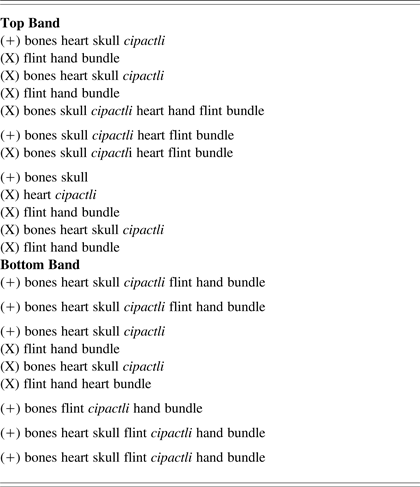
Table 3 shows the relationship of the motifs with the circles located to the left of each sequence. The motifs on both bands are presented with the left/right adjacency they have on the stone. Thus Table 3 begins the top sequence with the (X) circle and the flint above Culhuacan's place sign and continues in a left to right order. For the bottom sequence the first circular motif is the (+) circle on the right side of Cuetlaxtlan where it borders Culhuacan, and the following motifs are presented as they appear left to right on the band. If one were to read this bottom band in the direction in which the skulls and cipactli face, one would read the bottom band in Table 3 from the lower right to the top left. In Table 3, the patterns of sequences appear clearly. The repeating motifs “flint hand bundle” and “bones heart skull cipactli” are the dominant sequences, appearing rhythmically on both the bands. They repeat in the same order on the top and bottom bands, which suggests that both bands carry the same directionality, despite the left facing skulls and cipactli on the bottom band. Table 3 also shows that, on both bands, the bones motif only appears at the beginning of a sequence, and the bundle only appears at the end.
Organization of motifs on the bands (circles on the left of each sequence)
The special relation between the (+) circle and the bones motif, which always appears on its right, and the bundle, which always appears on its left, suggested to us that this (+) circle has a more regular, and thus potentially more important, function than the (X) circle. We hypothesized that the (+) circle functioned as the principal sequence marker, as for a verse in poetry, and that the (X) circle serves as an internal marker, as for a line in poetry. This hypothesis requires that the top band begin with a (+) circle, which means that it cannot begin with “(X) flint” above Culhuacan. We propose that the sequence on the top band begins with “(+) bones” above Tenayuca, the second conquest. Table 4 shows the patterning of the motifs thusly with the (+) circle as the principal sequence marker, and the top band beginning above Tenayuca. The bottom band begins as in Table 3, below the Cuetlaxtlan/Culhuacan border. The top band thus has three verses, and the bottom band six.
Organization of motifs on the bands. (+) functioning as a verse marker, top and bottom bands sequenced as they appear on the stone, left to right
The numerical relationships and sequences created by these groupings appear to be significant and thus meaningful. These relationships and sequences also give credence to the groupings themselves.
Most verses have a consistent number of motifs (Table 5). In the top band the first verse includes three of each of the seven iconic motifs, plus four (X) motifs. The second verse includes two each of all but the hand, plus one (X) circle, and the third verse contains two each of all the iconic motifs plus four (X) circles. The numerical patterns in the bottom band are slightly less regular. The first and last two verses each contain one of all the iconic motifs, and the third verse contains two of each with a third heart.
Number of times motifs repeat in each verse. (X) = encircled bands crossed at an angle; (+) = encircled bands crossed vertically
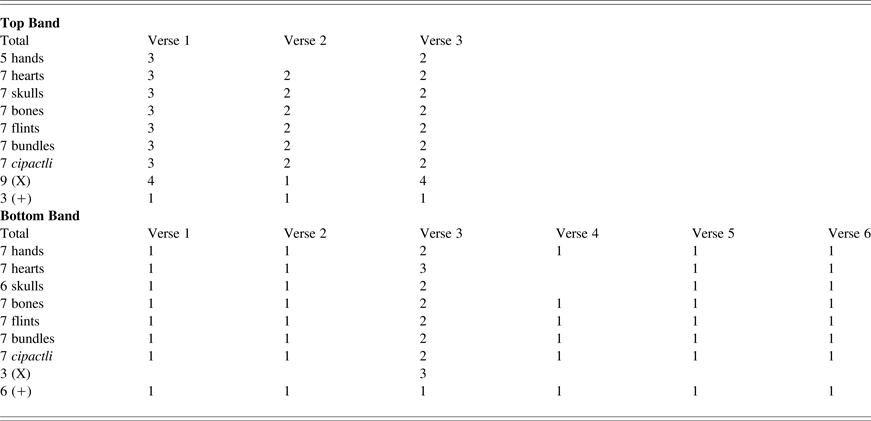
More telling, however, is the rhythm created by the syntactic structure of the verses (see Table 4). The top band has verses of five lines, two lines, and five lines again. The bottom band opens with two identical verses and then closes with two other identical verses, which are slightly transposed versions of the first two. The top band features an alternation of the “bones heart skull cipactli” sequence with the “flint hand bundle” trio, as a pair of couplets. If “bones heart skull cipactli” is A, and “flint hand bundle” is B, the first verse proceeds A, B, A, B, and then as a slightly rearranged version of AB (A₪B), a conjoined couplet with internal variation. The second verse has two lines of A₪B without the hand, another couplet. The final verse has a pair of lines and then ends with the tercet B, A, B. The bottom band begins with two one-line verses of AB (another couplet), followed by a third verse of four lines: A, B, A, B (plus a heart). This is a pair of couplets with variation. The identical fifth and sixth verses are one-line versions of AB, with the fourth and fifth elements (flint and cipactli) transposed (A∿B), forming another couplet. The fourth verse is A∿B without the heart and the skull. The band then ends with the identical fifth and sixth verses of A∿B (with the heart and the skull). Thus the bottom band begins and ends with couplets. Although we propose that the lower band reads left to right, these same relationships pertain (simply in reverse) if the band is read right to left.
The syntactic structure of the bands is strikingly similar to the kinds of syntax that characterize Nahuatl poetry (including prayers, orations, and songs) as it was recorded in alphabetic Nahuatl after the conquest. Nahuatl is known for its binary forms of expression, including difrasismos—expressions of a concept by the metaphorical pairing of two terms (for example, water-fire [in atl in tlachinolli] for war)—and parallelism. Garibay K. (Reference Garibay K.1961:116) considers “this conceptual dualism…one of the most important phenomena of the language.” As he (Garibay K. Reference Garibay K.1961:117, Reference Garibay K.1971:1:65–73) and León-Portilla (Reference León-Portilla1983:29–32, Reference León-Portilla1986:76, Reference León-Portilla1992:53–54) have observed, a principal feature of poetic Nahuatl is its semantic and syntactic parallelism; the repetition of ideas and the expression of sentiment in parallel form, often with the second expression varying slightly from but complementing the first. Paired but interrelated sequences compose the units of expression. In this way, analogies are conveyed, meaning is amplified, and ideas are made more explicit. This parallelism can take the form of two part regularity, such as the sequence of a theme, followed by a refrain, a complementary theme or complimentary expression of the same theme, and then another refrain (Garibay K. Reference Garibay K.1964:1:xxviii, Reference Garibay K.1979:36–37).
In analyzing the Cantares mexicanos and Romances de los señores, Karttunen and Lockhart (Reference Karttunen and Lockhart1980:18) have also noted that whereas the basic unit of Nahuatl poetry is the verse, the most important unit is the pair of verses; these pairs have great stability and regularity and repeat a certain theme. The verse itself is composed of a series of lexical words accompanied by non-lexical material, which can take the form of exclamations–often onomatopoeia such as “aya, iya, or ohuaya”—or other syntactical guides (Karttunen and Lockhart Reference Karttunen and Lockhart1980:22; León Portilla Reference León-Portilla1983:30–37). Verses can vary greatly in length, occupying one written line of manuscript text or as many as six written lines; rarely do these verses have the same number of words or syllables. Each poem also has its own metric structure, which, if it changes, does so in the middle of a verse (Karttunen and Lockhart Reference Karttunen and Lockhart1980:31–33).
Many of these features of Nahuatl poetry as written alphabetically in the early Colonial period also characterize the bands of the sun stone. Principally, we see on the bands the consistent use of parallel expressions, with repeating or alternating couplets. Longer statements (such as “bones heart skull cipactli flint hand bundle”) also divide to become couplets of smaller sequences (“bones heart skull cipactli” and “flint hand bundle”). The transposition of two or more motifs adds variation to the sequences while employing the same iconic elements. The bands on the sun stone are organized according to verses, which vary in length and can be composed of one or multiple lines. Both the lines and verses, however, demonstrate a preference for pairing, either with identical sequences or with slight modifications that add richness to the expression. The meter of the lines, if we can consider the number of iconic motifs to indicate the meter, is also regular within the verses and bands (see Table 5). The longer verses of the top band employ the iconic motifs consistently within the verse (for example, three of each motif, two of each motif, excepting the hand in verse 2), as do almost all of the shorter verses in the bottom band. These features join together to form a rhythmic progression to each prayer. Both bands begin and end with parallel couplets.
CONCLUSION
The two bands that frame the conquest scenes on the sun stone of Motecuhzoma Ilhuicamina are composed of well-defined sequences of nine discrete motifs. Each band contains the same motifs, arranged in slightly different but complementary patterns. Seven of the motifs can be called iconic, because they represent recognizable objects that appear elsewhere in Aztec art: crossed bones, heart, skull, cipactli, flint, severed hand, and bundle of kindling (Figure 3). As individual images they carry generalized meanings related to death, sacrifice, offering, and perhaps also the earth or Toltec warfare. The bands also include two versions of a more abstract circular motif that has not been found elsewhere in Aztec art, although it bears contextual similarity to other circular motifs in sequences on murals and ceramics. It is possible that these circles refer to Tezcatlipoca or to sacrifice in a way we still do not fully understand, but they function on the stone bands as syntactic indicators.
Most of the iconic motifs appear as repeating elements in other contexts in Aztec art. Hearts and hands are strung together as necklaces on the great Coatlicue sculpture and other representations of similar supernaturals; skulls and crossed bones decorate the skirts of Tlaltecuhtli and related deities as well as the sides of some altars; flints occasionally repeat with “great star” motifs or with themselves. Three of the motifs (heart, hand, and skull) repeat with circular extruded eyes on the murals at Tizatlan and Ocotelulco; these mofits and flint are also part of repeating patterns on some Mixtec-Puebla ceramic vessels. Most of these motifs (all but the bundle and cipactli) belong to a group of images in Aztec art that often repeat with themselves or other elements to embellish and characterize surfaces (skirts and altar sides) and strips (necklaces and bands). As such they are accessory and/or framing devices. Although the cipactli is not known elsewhere to appear in a strip, it occupies a framing position on the piers at Tula.
The seriality of the bands on the sun stone is distinctive and thus begs direct comparison with other serial presentations, particularly the painted sequences that flank altars at Tizatlan and Ocotelulco and that ring some ceramic vessels of the Mixteca-Puebla style. The side murals of Altar A at Tizatlan and the bench murals flanking the altar at Ocotelulco employ four motifs—heart, hand, skull, and encircled extruded eye—in a simple repeating sequence oriented toward the altars they frame. The ceramic vessels that Hernández Sanchez (Reference Hernández Sánchez2004:17–22) has identified as clustering in the iconographic theme of a Prayer to the Dead feature these same motifs along with a few others, repeating them also in simple sequences, which can vary from example to example. Although the sun stone's bands employ a wider range of motifs and vary the sequencing of their motifs, they are very similar to these other bands both iconographically and in their role as framing devices.
The sun stone's bands also share with the others a decided association with Tezcatlipoca. Not only is Tezcatlipoca one of the two deities represented on the front of Altar A at Tizatlan, he is the featured deity at Ocotelulco; elements of his accoutrements appear on the ceramic vessels that bear this same cluster of motifs. The sun stone's function as a celebration of ritual and actual warfare naturally associates it with Tezcatlipoca, god of war. Bands of repeating motifs like these seem to be invariably situated within the realm of Tezcatlipoca. The iconography of the motifs—including body parts and elements related to sacrifice and offering—however, indicates that the content of the visual discourse is human sacrifice.
As lines of serial and repeating motifs, the bands represent petroglyphic prayers or exhortations, rendered in visual rather than vocal terms but nonetheless organized in verses and lines. Circular motifs function on the stone as syntactic signifiers for each verse or line; the (+) circle being a verse signifier, and the (X) circle being a line signifier (Table 4). In this way, the bands organize their motifs in rhythmic patterns that employ various forms of parallelism, of the kinds characteristic of Nahuatl poetry. They employ duplication, duplication with variation, and the conjoining and separation of sets of motifs. Each band opens and closes with couplets. The top band and the bottom band also relate to each other as complementary presentations that share some rhythmic features but display variation in others. These visual prayers about human sacrifice are structured much like Nahuatl poetic discourse as it was recorded alphabetically after the conquest.
One of the most important imperial monuments from Mexico-Tenochtitlan, the great sun stone of Motecuhzoma Ilhuicamina was a stage for the dramatic ritual of gladiatorial sacrifice. Even when the stone was not enlivened in ritual, however, the scenes of Mexica victory carved on its sides advertised to all viewers the invincibility of Mexica armies and their gods, and the bands of motifs above and below the conquests proclaimed concepts of sacrifice and warfare. These bands, as petroglyphic texts, are unique in the central Mexican pictographic corpus for their length, complexity, and syntactic patterning. They render figurally a ritual discourse—a prayer or prayers—conceptualized, like speech, in linear and sequential terms. In this way they demonstrate that Mexican pictography could occasionally align with linguistic discourse more closely than has previously been supposed.
RESUMEN
La piedra solar de Motecuhzoma Ilhuicamina constituye uno de los monumentos más importantes descubiertos durante las excavaciones realizadas en el Templo Mayor y sus alrededores desde 1978. En su cara superior exhibe un disco solar y en sus cantos las conquistas mexicas de 11 provincias enemigas. Se trata de una piedra gladiatoria, similar en cuanto a su iconografía y función a la Piedra de Tízoc, un monolito más tardío. Mientras que la piedra de Tízoc presenta las escenas de conquista por encima de una banda terrestre y por debajo una banda celeste, la Piedra de Motecuhzoma tiene dos bandas con motivos repetitivos en la parte superior e inferior de los cantos, las cuales enmarcan las mencionadas conquistas. Estas bandas son extraordinarios ejemplos de textos pictográficos paralelos, que en adelante podrían ser considerados actos rituales discursivos.
La iconografía y los patrones de los motivos revelan que estas bandas eran exhortaciones u oraciones visuales relacionadas con el sacrificio humano asociado con Tezcatlipoca. El complejo patrón de motivos repetitivos es rítmico y refleja la estructura del alto discurso nahuatl. Estas dos bandas están compuestas de secuencias bien definidas de nueve motivos discretos, arreglados en patrones sutilmente diferentes, pero a la vez complementarios. Siete de los motivos—huesos cruzados, corazones, cráneos, cipactli, pedernal, manos cercenadas y un bulto sagrado para encender el fuego—son icónicos, y representan objetos con significados generales relacionados a la muerte, el sacrificio, la ofrenda, y la tierra. Las bandas también incluyen dos motivos circulares abstractos que no han sido registrados en otros ejemplos del arte Azteca. El significado iconográfico de estos motivos circulares es desconocido; sin embargo, en la piedra funcionan como indicadores sintácticos.
La mayoría de los motivos icónicos también aparecen como elementos repetitivos en otros contextos del arte azteca. Los corazones y las manos son ensartados como cuentas de collares usados por la gran Coatlicue y por otros seres supernaturales similares. Los cráneos y los huesos cruzados decoran las faldas de Tlaltecuhtli y de otras deidades relacionadas, así como los cantos de algunos altares. Los pedernales ocasionalmente se repiten junto con los motivos de “la gran estrella” o con ellos mismos. No obstante, es notable que los corazones, las manos y los cráneos, junto con un ojo enmarcado, se repiten en los murales que flanquean el Altar A en Tizatlan y el altar de Ocotelulco. Se encuentran también en las bandas pintadas de las vasijas cerámicas del estilo Mixteca-Puebla que Hernández Sánchez (Reference Hernández Sánchez2004) ha identificado como un grupo bajo el tema iconográfico de las Oraciones a la Muerte. A pesar de que las bandas de esta piedra solar emplean un rango más amplio de representaciones y varían en la secuencia de sus motivos, mantienen similitudes con otras bandas, tanto iconográficamente, como en su rol de dispositivo de enmarcado.
Las bandas de la piedra solar también comparten con otras piedras una importante asociación con Tezcatlipoca. Tezcatlipoca es una de las dos deidades representadas en el frente del Altar A de Tizatlan; es también el dios representado en Ocotelulco. Los elementos de su ajuar aparecen también en las vasijas cerámicas que poseen este mismo agrupamiento de motivos. La función de la piedra solar como una piedra gladiatoria la relaciona implícitamente con Tezcatlipoca, dios de la guerra. Las bandas con motivos como aquellos representados en la piedra solar parecen estar situados invariablemente dentro del reino de Tezcatlipoca. No obstante, la iconografía de estos motivos—incluyendo las partes corporales, los elementos relacionados con el sacrificio y la ofrenda—indica que el contenido del discurso visual es el sacrificio humano.
Las bandas presentan oraciones petroglíficas, representadas más en términos visuales que vocales; sin embargo, éstas se encuentran organizadas en versos y líneas. Los motivos circulares funcionan como significantes sintácticos en cada verso o línea. En este sentido, las bandas organizan sus motivos en patrones rítmicos que emplean varias formas de paralelismos con los tipos característicos de la poesía nahuatl. Éstos emplean duplicación, duplicación con variación, contigüidad y la separación de grupos de motivos. Cada banda abre y cierra con versos pareados. La banda superior y la inferior también se relacionan entre ellas como presentaciones complementarias que comparten algunos rasgos rítmicos, pero que varían en otros. Estas oraciones visuales sobre el sacrificio humano son estructuradas como el discurso poético nahuatl, tal y como fue registrado alfabéticamente después de la conquista.
ACKNOWLEDGMENTS
This article has its origins in a paper Rochelle Collins wrote for the seminar titled “Aztec Art,” in fall 2002 at Tulane University, under the direction of Elizabeth Boone. Collins discovered the basic patterning of the motifs and made several of the fundamental iconographic connections. In consultation with Collins, Boone extended the comparative research, refined the patterning, and drafted the present paper. We are very grateful to Leonardo López Luján, Susan Evans, and an anonymous reviewer for excellent suggestions and comments. Ximena Chavez Balderas was very kind to translate the summary into Spanish. We also thank Guilhem Olivier for the drawings of Figure 9.