The importance of peer leadership has been pointed out due to its influence on variables such as performance (Kim, Reference Kim1992; Price & Weiss, Reference Price and Weiss2011) or group cohesion (Vincer & Loughead, Reference Vincer and Loughead2010). Theoretical advances showed that peer leadership can be well defined by a model composed by a social orientation dimension and a task orientation one (Kozub & Pease, Reference Kozub and Pease2001; Rees & Segal, Reference Rees and Segal1984; Todd & Kent, Reference Todd and Kent2004). Researchers have deepened inside this model, trying to go further on both orientations with the aim of knowing more about them, specially about the social orientation dimension (Loughead, Hardy, & Eys, Reference Loughead, Hardy and Eys2006). A recent approach developed by Torrado and Arce (Reference Torrado and Arce2015) considers a six factors model with empathy, influence on decision-making, sport values, social support composing the social orientation dimension, and training orientation and competition orientation, comprising the task orientation dimension.
Effective peer leadership may contribute not only to increase the performance and the group cohesion of the sport teams but may also significantly contribute to increase the levels of satisfaction and well-being of the athletes preventing them from the symptoms of exhaustion and burnout. Raedeke (Reference Raedeke1997) offered, for the first time, a satisfactory conceptualization of the syndrome of burnout in athletes from the three-dimensional model that Maslach and Jackson (Reference Maslach and Jackson1981) had developed for work settings, proposing the adaptation thereof with a view to attaining significance in the setting of sport. Raedeke initially observed that athletes demonstrate two types of exhaustion: physical, as a consequence of the physical activity they carry out; and, in turn, mental. Consequently, he extended the original factor calling it physical and emotional exhaustion. Depersonalization comes about in the process of relations between the supplier and the receiver of a care service, but in sport there is no such relationship. Thus, in athletes, no process of depersonalization is possible. Consequently, he opted to replace the depersonalization factor with one he denoted devaluation. Prior to acquiring the syndrome, the sport occupied privileged position in athletes’ life values, but once they acquire the syndrome, the sport ceases to be important for them. There is a devaluation of the sport and of participation in sports. Finally, Raedeke also endows personal fulfillment with an approach of specificity, defining it in terms of performance and sporting abilities, and denoting it reduced sense of accomplishment. In parallel to the model, and in order to facilitate the diagnosis of the burnout syndrome in athletes, Raedeke and Smith (Reference Raedeke and Smith2001) developed an instrument called the Athlete Burnout Questionnaire (ABQ) with repeated evidence of validity and transcultural reliability (Altahayneh, Reference Altahayneh2013; Arce, de Francisco, Andrade, Arce, & Raedeke, Reference Arce, De Francisco, Andrade, Arce and Raedeke2010; Arce, De Francisco, Andrade, Seoane, & Raedeke, Reference Arce, De Francisco, Andrade, Seoane and Raedeke2012; Chen & Kee, Reference Chen and Kee2008; De Francisco, Garcés de los Fayos, & Arce, Reference De Francisco, Garcés de los Fayos and Arce2013; Gustafsson, Kenttä, Hassmén, Lundqvist, & Durand-Bush, Reference Gustafsson, Kenttä, Hassmén, Lundqvist and Durand-Bush2007; Isoard-Gautheur, Oger, Guillet, & Martin-Krumm, Reference Isoard-Gautheur, Oger, Guillet and Martin-Krumm2010; Lemyre, Hall, & Roberts, Reference Lemyre, Hall and Roberts2008; Lemyre, Roberts, & Stray-Gundersen, Reference Lemyre, Roberts and Stray-Gundersen2007; Lu, Chen, & Cho, Reference Lu, Chen and Cho2006; Perreault, Gaudreau, Lapointe, & Lacroix, Reference Perreault, Gaudreau, Lapointe and Lacroix2007; Pires, Brandão, & da Silva, Reference Pires, Brandão and da Silva2006; Ziemainz, Abu-Omar, Raedeke, & Krause, Reference Ziemainz, Abu-Omar, Raedeke and Krause2004).
To date, the study of the relationship between leadership and burnout has focused exclusively on the figure of the coach, and the style of leadership he/she adopts, and on attempting to ascertain whether certain behaviors are conducive to a greater or lesser predisposition among athletes, or the coaches themselves, to suffer from the syndrome. Vealey, Armstrong, Comar, and Greenleaf (Reference Vealey, Amstrong, Comar and Greenleaf1998) concluded that perceived coach styles/behavior was predictive of athlete burnout; Castillo, González, Fabra, Mercé, and Balaguer (Reference Castillo, González, Fabra, Mercé and Balaguer2012) and Isoard-Gautheur, Guillet-Descas, and Lemyre (Reference Isoad-Gautheur, Guillet-Descas and Lemyre2012) showed that a controlling style of coaching might expose athletes to higher risks of burnout; Altahayneh (Reference Altahayneh2013) found that autocratic behaviors among coaches evinced a direct relationship with burnout levels among their players, while more democratic behaviors, aimed at training, instruction and the showing of social support, correlated inversely with burnout rates among team members; and Esmaeili, Nowzari, Ghafouri, and Madavani (Reference Esmaeili, Nowzari, Ghafouri and Madavani2012) evinced that some decision-making styles has negative and direct effect on athlete burnout. Moreover, in a study aimed at correlating both constructs among the coaches themselves, Dale and Weinberg (Reference Dale and Weinberg1989) observed an inverse relationship between leadership and burnout; i.e., that coaches most highly valued in leadership scored lower in burnout.
Related to the relationship between peer leadership and burnout, to our knowledge, no studies have been conducted to date on these relationships, although attempts have been made to detect associations between other similar constructs which could help us to formulate hypotheses regarding the relationship which may exist between peer leadership and burnout. Price (Reference Price2011) and Price and Weiss (Reference Price and Weiss2011) found that effective leaders promoted higher levels of cohesion among group members. There is also empirical evidence suggesting that high levels of cohesion within the group are negatively related with burnout rates (Kjormo & Halvari, Reference Kjormo and Halvari2002). Zacharatos, Barling, and Kelloway (Reference Zacharatos, Barling and Kelloway2000) conducted a study with adolescent athletes in which they observed that the existence of acknowledged leaders in the team increased the members’ rates of satisfaction with membership of the group. Recently, some author showed the clear relation between social support and positive group climate with lower levels of burnout in young athletes (DeFreese & Smith, Reference DeFreese and Smith2013; Smith, Gustafsson, & Hassmen, Reference Smith, Gustaffson and Hassmen2010). Kim (Reference Kim1992) and Price and Weiss (Reference Price and Weiss2011) have gone as far as ascertaining that the presence in a team of leaders with high scores significantly increased the other members’ perception regarding the possibilities of performance and collective efficacy.
With a view to supplementing this body of research, the aim of the present study is to evaluate the relationship between peer leadership and the burnout rates experienced by their team-mates, with the hypothesis of that higher leaders’ scores in the leadership capacities will be related to lower levels of burnout experienced by team members. In other words, that leaders perceived as effective by their team-mates may act as suppressors of the development of the burnout syndrome.
Method
Participants
Sample was formed by 219 Spanish male athletes, from two different sports: football (n = 132) and basketball (n = 87). The ages thereof ranged between 17 and 38, with an average age of 24.12 and standard deviation of 5.04. At the time of the research, they were training and competing in leagues organized by their corresponding sports federations. The majority were competing at regional level (79%), but there were also athletes competing at local (1.4%), national (18.7%) and international levels (0.9%). They trained a mean of 3.33 times a week (SD = 0.56) and had been involved in their respective sport for between 3 and 30 years, with a mean of 16.12 years, and a standard deviation of 5.12.
Instruments
To evaluate the peer leadership exercised by certain team members on their team-mates, we used the Sports Peer Leadership Scale (SPLS; Torrado & Arce, Reference Torrado and Arce2015), based on a theoretical model with six primary factors grouped into two larger second-order factors. Four primary factors (empathy, influence on decision making, sports values and social support) comprise the social aspects of sports leadership among peers, and a further two primary factors (training orientation and competition orientation) comprise orientation towards the leadership task. In total, the scale consists of 24 items: four per factor. The measurement model has provided satisfactory fit indices, on an individual level for each item, and on a global level with χ2/df = 2.340, GFI = .90, TLI = .92, CFI = .93, RMSEA = .058 and SRMR = .058. Satisfactory levels of internal consistency have also been found for each of its factors: empathy (α = .76), influence on decision making (α = .86), sport values (α = .81), social support (α = .79), training orientation (α = .83) and competition orientation (α = .78).
The items describe behaviors observable in leaders; for example, “he/she makes a lot of effort during matches“. The participants in the study were asked to think about the team-mate who they thought best exerted leadership within the team, and to evaluate (on a scale from 1 = ”hardly ever” to 5 = ”almost always”) the frequency with which the leader performed each of the behaviors indicated in the items (a total of 24).
In order to evaluate the burnout levels among athletes, we used the ABQ (Raedeke & Smith, Reference Raedeke and Smith2001), in its version adapted to Spanish (Arce et al., Reference Arce, De Francisco, Andrade, Arce and Raedeke2010; Arce et al., Reference Arce, De Francisco, Andrade, Seoane and Raedeke2012). The adaptation replicates the three-dimensional structure of the original version, with a total of 15 items grouped into the same three factors proposed by Raedeke and Smith (Reference Raedeke and Smith2001): physical and emotional exhaustion (5 items), devaluation (5 items) and reduced sense of accomplishment (5 items). Confirmatory factor analyses offered reasonable fit indices for the Spanish version of the ABQ: χ2/df = 2.66, GFI = .94, TLI = .95, CFI = .96, RMSEA = .06 and SRMR = .06. Satisfactory internal consistency indices were also obtained for each of its factors: physical and emotional exhaustion (α = .81), devaluation (α = .77), and reduced sense of accomplishment (α = .71).
The response scale employed was the same as that used by in the original version of the ABQ, a five-point Likert scale ranging from 1 “hardly ever” to 5 “almost always”.
Procedure
The data were collected collectively at the sports facilities of the participating clubs, and pursuant to Spanish privacy and data protection regulations. In all cases, the data were collected during the minutes preceding the start of a training session, where players were furnished with a booklet containing two questionnaires along with a number of questions aimed at defining the sample, providing them with brief, standardized instructions for completing the same. Particular emphasis was placed on the confidentiality and anonymity of the responses.
Data analysis
Statistical analysis began with the calculation of descriptive statistics (minimum, maximum, mean, standard deviation, skewness and kurtosis) for the factors from the SPLS and the ABQ. Then the correlations between the factors of both questionnaires were calculated, and a regression analysis performed. Finally, using the t-test for independent samples, mean burnout comparisons were made between members of teams which had leaders scoring lowest and highest in leadership.
Results
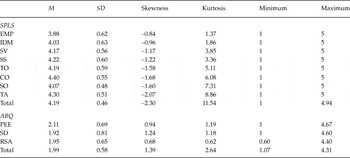
Table 1 shows the descriptive statistics (mean, standard deviation, skewness, kurtosis, minimum, and maximum) for SPLS and ABQ subscales, in addition to the totals.
Descriptive statistics for the SPLS and the ABQ

Note: SPLS = Sports Peer Leadership Scale; EMP = Empathy; IDM = Influence on Decision Making; SV = Sports Values; SS = Social Support; TO =Training Orientation; CO = Competition Orientation; SO = Social orientation; TA = Task Orientation; ABQ = Athlete Burnout Questionnaire; PEE = Physical and Emotional Exhaustion; SD = Sport Devaluation; RSA = Reduced Sense of Accomplishment.
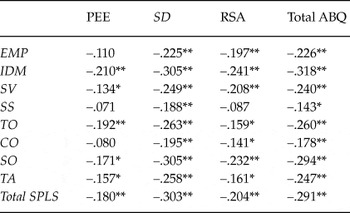
Table 2 shows the Pearson correlation coefficients between the leadership and burnout factors, as well as between the respective totals. All the correlations are negative, and the majority are statistically significant, with only a very few exceptions: the correlations between empathy and physical and emotional exhaustion, between social support and physical and emotional exhaustion, between social support and reduced sense of accomplishment, and between competition orientation and physical and emotional exhaustion. The effect size is, however, low. The Pearson correlation coefficient between the totals for both instruments is –.291 (r 2 xy = .085). The strongest relationship arises between the leadership factor related to influence in decision making and the total score in burnout (r xy = –.318; r 2 xy = .101). A multiple regression analysis with total burnout as dependent variable and social and task orientations as predictors showed standardized regression coefficients of –.241 (p = .010) and –.076 (p = .413), respectively for social and task orientation, being R 2 equal to .089.
Pearson correlations between the factors of the SPLS and those of the ABQ

** The correlation is significant at the level .01.
* The correlation is significant at the level .05.
Note: EMP = Empathy; IDM = Influence on Decision Making; SV = Sports Values; SS = Social Support; TO = Training Orientation; CO = Competition Orientation; SO = Social orientation; TA = Task Orientation; SPLS = Sports Peer Leadership Scale; PEE = Physical and Emotional Exhaustion; SD = Sport Devaluation; RSA = Reduced Sense of Accomplishment; ABQ = Athlete Burnout Questionnaire.
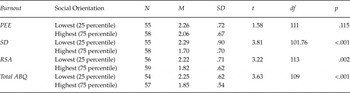
Table 3 shows the results of the statistical comparisons between the burnout means among members of teams with lowest scoring leaders (score < 25 percentile) and highest scoring leaders (score> 75 percentile) in social orientation. The differences are statistically significant in total ABQ score and for two of the factors thereof (sport devaluation and reduced sense of accomplishment). In all cases, the burnout means for team members are lower when leaders score higher on the social orientation scale; i.e., when the leader is perceived as more efficient, the burnout levels are lower among team-mates, and when the leader is perceived as less efficient, burnout levels among team-mates are higher.
Comparison of means in burnout between lowest and highest scores in social orientation

Note: PEE = Physical and Emotional Exhaustion; SD = Sport Devaluation; RSA = Reduced Sense of Accomplishment; ABQ = Athlete Burnout Questionnaire; N = total number of athletes.
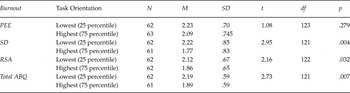
Table 4 shows the same comparisons as the previous table, but now between lowest and highest scores in task orientation. The pattern of the results is similar. When leaders are perceived as more efficient, the burnout scores among team-mates are lower for the same factors of the ABQ (sport devaluation and reduced sense of accomplishment) and for total ABQ score. Nonetheless, no statistically significant differences were obtained for physical and emotional exhaustion.
Comparison of means in burnout between lowest and highest scores in Task Orientation

Note: PEE = Physical and Emotional Exhaustion; SD = Sport Devaluation; RSA = Reduced Sense of Accomplishment; ABQ = Athlete Burnout Questionnaire; N = Total number of athletes.
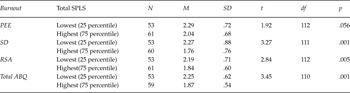
Finally, Table 5 shows the same comparisons between means for total SPLS. The same trend obtained separately for social orientation and task orientation can be observed; i.e., members of teams with leaders perceived as more efficient in leadership score lower in burnout for the same two factors of the ABQ (sport devaluation and reduced sense of accomplishment), as well as for total ABQ; nonetheless, the differences between the means for physical and emotional accomplishment do not reach statistical significance.
Comparison of means in burnout between lowest and highest scores in total leadership (SPLS)

Note: PEE = Physical and Emotional Exhaustion; SD = Sport Devaluation; RSA = Reduced Sense of Accomplishment. ABQ = Athlete Burnout Questionnaire; N = Total number of athletes.
Discussion
The aim of this study was to verify the relationship that may exist between the leadership that certain athletes exert informally on their team-mates and the levels of burnout among the latter. The initial hypothesis assumed that good leadership could have the effect of protecting against the burnout syndrome or, put in another way, that athletes having leaders with high leadership scores would experience lower burnout levels than athletes having leaders with lower scores.
The results provide evidence which is partially favorable towards the stated hypothesis. Statistically significant, negative Pearson correlations were observed between leadership and burnout; i.e., the greater the leadership capacity perceived, the lower the burnout levels, but only in two of their factors: sport devaluation and reduced sense of accomplishment. Similar evidence was obtained when the sample was divided into highest and lowest leadership scores: those athletes who perceived their leaders with higher leadership scores experienced lower levels of burnout than those who perceived their leaders with lower scores. Nonetheless, as in the previous case, these results only came about in the sport devaluation and reduced sense of accomplishment factors. This may mean that leaders have a greater influence on the cognitive component of burnout and less so on the physical and emotional components of the syndrome.
The effect of leadership on physical and emotional exhaustion, which does not reach statistical significance, may be greater if the differences between the groups of athletes classified as high and low in leadership were greater. Although for the comparison we took the 25% of athletes who scored highest in the sample and the 25% who scored lowest, in real terms, the difference between them in leadership scores was slight because of the negative skewness of the distributions. The athletes in the group classified as highest had high leadership scores, but those classified in the lowest group, although lower, also had high scores. This was also true for the total of the scale and, indeed, both for social and task orientation.
Even though there are no prior studies on the relationship between peer leadership and burnout in athletes with which we can compare the results of this study, one could say that they are consistent with the results of numerous other studies which have attempted to relate burnout with constructs which could theoretically be related to leadership. For example, it could be said that the results obtained are consistent with those which pointed that a good peer climate and peer relations are related to lower levels of burnout (DeFreese & Smith, Reference DeFreese and Smith2013; Smith, Gustafsson, & Hassmen, Reference Smith, Gustaffson and Hassmen2010) and also with that offered by Kjormo and Halvari (Reference Kjormo and Halvari2002), which suggest that the higher the team cohesion the lower the levels of burnout among its members. It has been demonstrated that team cohesiveness increases with the presence of highly valued leaders (Price, Reference Price2011; Price & Weiss, Reference Price and Weiss2011). Zacharatos et al. (Reference Zacharatos, Barling and Kelloway2000) found that group member satisfaction correlated positively with leadership. Lastly, results of the present study are also consistent with those obtained by Kim (Reference Kim1992), who found that the best evaluated leaders demonstrated greater expectations of accomplishment, a construct which is inversely related with the reduced sense of accomplishment factor of the ABQ.
Nonetheless, the present research has a number of limitations which need to be addressed. Firstly, we must notice the study is cross-sectional that means the relationships discovered between peers leadership and burnout are not necessarily causal. Secondly, a deeper analysis of the relationships between all the variables involved could be conducted. In the study presented herein, the relationship between leadership among peers and burnout has been analyzed, but other studies have shown that variables such as team cohesiveness or satisfaction with team membership may also have a bearing on burnout levels. Thus, it will need to be ascertained whether the effect of leadership on burnout arises directly or indirectly through cohesion and satisfaction. It would also be interesting to obtain samples in which there is a greater separation in leadership effectiveness, given that, with the sample employed in this study, no great separation was obtained by dividing those with high and low scores. Those athletes scoring low in leadership were the 25% with the lowest scores in the sample, but in truth, their leadership scores were not low in absolute terms.
Finally, in a complementary manner, the research conducted also suggests possible lines for future work, related specifically with the incorporation into the sample of female athletes, to ascertain whether female leadership is similar to or different from male leadership in terms of its effects on burnout. Another idea for future work is related to the segmentation of the sample, based on the different levels of practice and competition of the athletes under study with the aim of identifying similarities and differences in the effects analyzed, according to these levels.