Changing Trends in Forensic Populations
The California Department of State Hospitals (DSH) manages the psychiatric care of almost 7000 patients admitted to any of its five hospitals. Over 90% of these patients have forensic commitments, meaning they have been charged with, or convicted of, a crime. Treating patients with mental illness and criminal behavior reflects a general trend within state psychiatric facilities.Reference Warburton 1 , Reference Fisher, Geller and Pandiani 2 An increase in physical violence toward staff and patients has been attributed to this mandate to care for patients with both severe mental illness and criminal backgrounds.Reference Warburton 1 , Reference Bader, Evans and Welsh 3 , Reference Broderick 4 Addressing violence is a pressing need within state hospital systems, as a safe treatment environment is quintessential to the delivery of effective care.
Treating psychiatric symptoms alone has not been effective in reducing violence associated with severe mental illness.Reference Morgan, Flora, Kroner, Mills, Varghese and Steffan 5 Furthermore, treating patients without considering their violent behaviors is apt to complicate their timely discharge into the community. In addition to symptoms of severe mental illness, criminogenic risk factors perpetuate criminal thinking and behavior.Reference Andrews, Dvoskin, Skeem, Novaco and Douglas 6 These risk factors include, but are not limited to, association with antisocial peers, antisocial attitudes, substance abuse, poor family relations, and difficulties with employment. Research demonstrates that addressing the criminogenic as well as mental health needs of justice-involved patients significantly improves outcomes in terms of criminal behaviors and psychiatric symptoms.Reference Morgan, Flora, Kroner, Mills, Varghese and Steffan 5 Traditionally, criminogenic risks were addressed in correctional treatment settings and the generalizability to other settings is recently being explored in detail.Reference Skeem, Steadman and Manchak 7 A study of the DSH patient population revealed that criminogenic risk clearly exists in many state psychiatric hospital patients.Reference Delgado, Mitchell, Morgan and Scanlon 8 These findings expose a necessary paradigm shift in treatment planning within state psychiatric facilities.
Historically, state psychiatric hospitals were tasked with providing humane psychosocial care for persons diagnosed with severe mental illness, a mindset and practice remaining predominant today. Traditionally, addressing violence risk was not routinely implemented in treatment planning. Given the current and growing forensic patient population, outdated practices to address violent behaviors for the well-being of patients and staff must be amended. A key struggle in these efforts is lack of continuum of care in the state psychiatric system.
Considering a Continuum of Care
Andrews and Bonta’s Risk Needs Responsivity (RNR) Model outlines a system to address criminogenic risk.Reference Andrews, Bonta and Hoge 9 The overarching principles of the RNR model are to deliver treatments based on an empirically solid theory (ie, cognitive and social learning theories) in a humane manner considering idiothetic factors. The Risk aspect of the model suggests that those at highest risk for violence receive more frequent and intense treatment. The Needs aspect highlights that these treatments ought to target the specific risk factors that are associated with criminal behavior. Lastly, the Responsivity aspect emphasizes the importance that these treatments are targeted to the individuals’ cognitive skills, learning style, and motivation.
Those at highest risk for violence require a higher level of care, including more intensive treatment dosing with a physical plant outlay that promotes safety of staff and patients. Treatment is only effective when safety needs are addressed; accordingly, a structured and secure environment is necessary for the provision of effective treatment to those at highest risk for violence. Toward this goal, DSH leadership envisioned an Enhanced Treatment Program (ETP) to provide an additional level of care for patients at greatest risk for violence. Within this program, criminogenic risk is considered for each patient referral and treatment decisions are guided by violence risk factors. Through this novel approach to treatment, DSH aims to create a center of excellence, delivering care in a setting that balances safety and treatment of severely mentally ill patients at highest risk for violence.
Environmental Security: Past, Present, and Future
The juxtaposition of how to efficaciously treat persons diagnosed with serious psychiatric illness who engage in aggressive behaviors “transcends boundaries of time, place, age, diagnostic and criminal justice status.”Reference Sugarman and Dickens 10 The deinstitutionalization movement from the Community Mental Health Act of 1963 resulted in an increasingly forensic psychiatric population in state hospital settings. The role of state hospitals has become one of managing populations deemed inappropriate for other settings.Reference Fisher, Geller and Pandiani 2 Most patients admitted to state hospitals have a history of physical aggression, thus creating an unsafe work environment. In recent years, violence rates have notably increased in state hospital settings both for forensically and civilly committed patients.Reference Warburton 1 Front-line staff, such as psychiatric technicians and nurses, are at heightened risk given their frequent contact with patients. Paralleling this trend, physical violence committed by DSH patients is increasing. In 2016, 1528 physical assaults on staff occurred and 1308 physical assaults were attempted. In 2017, these rates rose to 1650 attempted physical assaults and 1644 incidents where contact on staff occurred.Reference Broderick 4 Given the rising violence, it became imperative that DSH leadership investigate national and international approaches to treating the most violent patients.
A critical first step was to research other practices to understand treatment approaches for violent patients requiring the highest security. From this, a key take-home message was creating treatment units with single bedrooms some with their own bathrooms. Recent research revealed single bedrooms with private bathrooms may be the single most important design intervention for reducing stress and aggression on psychiatric wards.Reference Ulrich, Bogren, Gardiner and Lundin 11 Substantial research in correctional settings and community mental health housing found residing in dormitories reliably correlates with reduced privacy, higher crowding stress, more aggressive behaviors, illness complaints, and social withdrawal.Reference Ulrich, Bogren, Gardiner and Lundin 11
Psychiatric facilities typically have dorm-style housing due to the high-volume of patients. The only way to remove a dangerous patient from others is via seclusion or restraints. Common safety protocols for imminent dangerousness is use of seclusion and restraints. Without such safety procedures, violence increases, and treatment progress deteriorates.Reference Glynn and Mueser 12 , Reference Douglas, Nicholls and Brink 13 This is clearly documented in one of the most comprehensive and successful inpatient programs for chronic institutionalized psychiatric patients conducted by Paul and Lentz.Reference Paul and Lentz 14 Paul and Lentz developed a rigorous social learning inpatient program leading to significant reductions in aggression.Reference Glynn and Mueser 12 , Reference Douglas, Nicholls and Brink 13 Within this program, seclusion was used as a standard safety protocol for imminent dangerousness for violence when needed for a maximum of 48-hours of seclusion. Over 2 years, the program exhibited a reduction from 30 assaults to 10 assaults per week. An unexpected a state mandate reduced the established allotment of 48-hours of seclusion to a maximum of 2-hours. In the following 2 years, assaults skyrocketed in this program from 10-per week to 75 assaults per week.Reference Douglas, Nicholls and Brink 13
Research demonstrates that security is necessary to create an environment that allows for therapeutic work to happen.Reference Crichton 15 The ETP arose aligning with the RNR’s key principal of treating patients at highest risk for violence with the highest dosages of care. The construction of the ETP has been thoughtfully designed to have low social and spatial density, meaning all patients will have their own bedroom and increased square footage in common areas with good line of sight including cameras. Patients will have daily access to outdoor spaces. The ETP staff can lock patient room doors when clinically indicated based on dangerousness. Given the high volume of unpredictable physical violence, the ability to lock doors based on each patient’s risk of violence will greatly reduce the need for use of restraints and seclusion. The ETP has specialized door portals and a no-contact treatment room, which includes a windowed-divider and two separate entrances. This allows for safe delivery of therapeutic intervention to even the most dangerous patients. This unique feature employs a fresh approach to maintain needed physical environmental safety with reduced use of seclusion and restraints. The use of seclusion and restraints can lead to a reactive management of violence as legally patients can only be placed in seclusion or restraints when exhibiting imminent dangerousness. The option of locked door status based on individual violence risk factors affords a preventative approach to violence. The ETP will continue to review and use environmental design in programming to create a safe atmosphere to deliver evidenced-based practices to the most challenging patients.
From Idea to Implementation
The process of developing an ETP from a theoretical idea to a sustainable program involved the communication, strategic planning, and execution of the vision of this program. As aforementioned, a recognition of a needed paradigm shift as needed to adequately treat patients at the highest risk for violence. This recognition lead to taking the vision of providing care for patients at highest risk of violence into an action plan.
The first step was to secure the support of involved stakeholders. One of the first stakeholder groups enlisted was the labor unions. Due to the increased employee violence the labor unions were keenly aware of the need for a structured and secure treatment environment in which their members could work without the fear of violence. The support of the labor unions was key in securing the sponsorship of a California legislator in the writing and passing of legislation (ETPs, Assembly Bill No. 1340).Reference Achadjian 16 This process was arduous and took bold leadership from within DSH, labor unions, and other California State legislators. It was this assembly bill that secured funding for the structural changes needed on the ETP units and allowed the use of locked doors based on clinical indicators for highest risk of violence, initiating a preventative approach to violence beyond just the criteria of imminent dangerousness. Furthermore, the ETP was funded for staffing at an enhanced level compared with the standard treatment environment.
Following passage of the legislation, clinical and administrative employees of DSH were enlisted for support. Psychiatric technicians and registered nurses were overwhelmingly the most supportive. These employees are routinely exposed to violence on the units and welcomed the development of a space where they could safely treat highly dangerous patients. The support of DSH staff was utilized in the formation of numerous workgroups to identify key tasks needed for the successful implementation of the ETP. These tasks included: the development of a forensic focused treatment plan, selecting evidenced based treatment modalities, writing of policies, development of unit operational procedures, and development and execution of an extensive training for ETP staff. Utilizing DSH staff in the planning of the ETP was paramount in the successful implementation of the program vision.
Violence Risk Informed Treatment Planning
The next stage of development was to create a specific treatment framework to tackle the need of reducing violence in our forensic population. Current scientific literature indicates the initial phase of informed treatment includes implementation of a comprehensive violence risk assessment that determines the typology of aggression and violence risk factors.Reference Warburton 1 , Reference Andrews, Dvoskin, Skeem, Novaco and Douglas 6 , Reference Douglas and Skeem 17 There is a longstanding trend in the field of violence risk assessment focusing on identifying dynamic violence risk factors as theoretically they are amenable to change (eg, via treatment), and can reduce violence potential if altered.Reference Dvoskin and Heilbrun 18 –Reference De Vries Robbe, De Vogel, Douglas and Nijman 20 Recent research has provided evidence for the categorization of aggression perpetrated within psychiatric facilities into three types based on motivation and etiology (psychotic, impulsive, and organized), and the need to target treatments based on these categories.Reference Quanbeck 21 , Reference Stahl, Morrissette and Cummings 22 In order to determine typology and identify dynamic risk factors for the ETP, Structured Professional Judgment instruments including the Historical Clinical Risk Management 20 Version 3 (HCR20v3),Reference Douglas, Hart, Webster and Belfrage 23 Short-Term Assessment of Risk and Treatability,Reference Webster, Nicholls, Martin, Desmarais and Brink 24 and Hare Psychopathy Checklist-RevisedReference Hare 25 were selected. These instruments have garnered empirical support for their use in the justice-involved and forensic populations in determining typology and dynamic risk factors with regard to violence prediction and treatment planning.Reference Penney, Marshall and Simpson 26 –Reference Hogan and Olver 28
Final considerations regarding the implementation of a comprehensive risk assessment within the ETP included the bifurcation of treatment provider and violence risk assessor and the need for repeated assessment of violence risk.Reference Douglas and Skeem 17 , Reference Watt, Storey and Hart 29 Given the myriad issues that arise when treatment providers are tasked with forensic evaluations of their patients, the Forensic Needs Assessment Team was developed to serve as independent evaluators providing risk assessments on a repeated schedule.Reference Warburton 1 , Reference Achadjian 16 , Reference Greenberg and Shuman 30
Treatment to Address Violence Risk
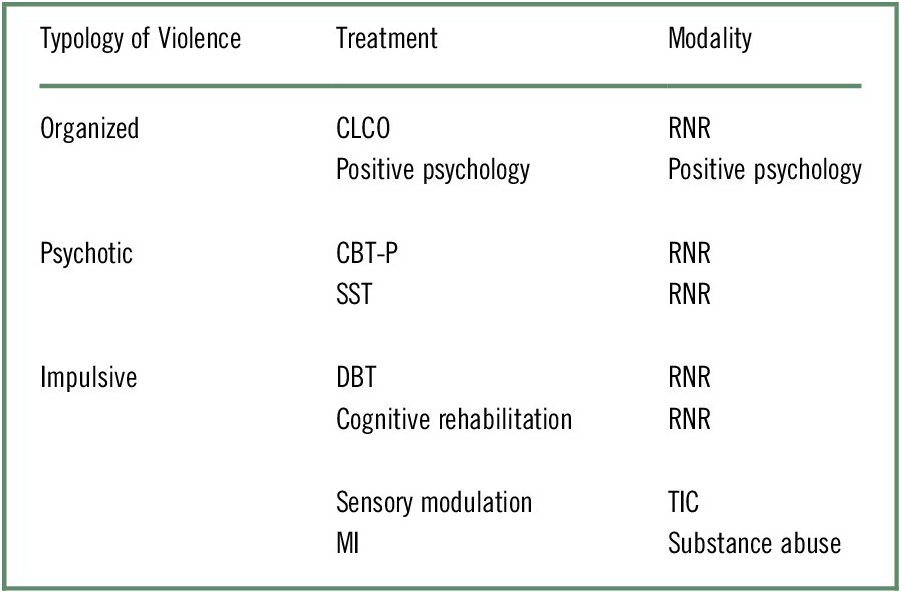
Research indicates that consideration of psychosocial treatments, modalities, and theories that elicit the greatest probability for producing change and reducing violence be considered following the assessment of violence risk.Reference Douglas, Nicholls, Brink and Kleespies 31 However, there is currently a dearth of interventions specifically to reduce violence with the mentally ill population. Much of the scientific literature focuses on criminal recidivism more broadly with justice-involved persons, and only a few investigating interventions specifically targeting violence recidivism in persons with serious mental illness (SMI).Reference Andrews, Dvoskin, Skeem, Novaco and Douglas 6 , Reference Skeem, Steadman and Manchak 7 , Reference Douglas, Nicholls and Brink 13 Theoretical modalities and associated interventions with empirical support for their use with either the SMI and justice-involved population were therefore considered. We also considered how these interventions would address the typology of violence and dynamic risk factors identified in the comprehensive risk assessment. These included the RNR treatment model and numerous interventions that fall within the cognitive-behavioral and social-learning theory principles.Reference Andrews, Dvoskin, Skeem, Novaco and Douglas 6 , Reference Douglas, Nicholls and Brink 13 Other frameworks of treatment, including Positive Psychology, Trauma Informed Care (TIC), and Motivational Interviewing (MI) were considered given their utility in treating aspects related to violence (eg, trauma, substance abuse) and compatibility with RNR principles (eg, responsivity, attitudes toward treatment). These frameworks of treatment were part of the trending zeitgeist with various pilot programs demonstrating promising outcomes in the DSH system. Table 1 illustrates the relationship between typology of violence and treatments provided in the ETP.
Typologies of Violence and Treatment Modalities in the ETP

Research indicates that treatment programs and interventions adherent to the principles of RNR are the most effective on recidivism outcomes.Reference Andrews, Dvoskin, Skeem, Novaco and Douglas 6 , Reference Skeem, Steadman and Manchak 7 , Reference Viljoen, Cochrane and Jonnson 32 Given the strength of support found in the literature, interventions selected for the ETP were ones that were consistent with RNR principles. Some of the major interventions selected for the ETP included Changing Lives Changing Outcomes (CLCO),Reference Morgan, Kroner and Mills 33 Cognitive Behavioral Therapy for Psychosis (CBT-P),Reference Kingdon and Turkington 34 Dialectical Behavioral Therapy (DBT),Reference Linehan 35 and restorative- and social cognition-based cognitive rehabilitation interventions. These include Social Cognition and Interaction Training (SCIT)Reference Roberts, Penn and Combs 36 and BrainHQ, which is a computer-based cognitive restoration treatment program with strong empirical support.Reference Shah, Weinborn, Verdile, Sohrabi and Martins 37
The CLCO model is purported to be a treatment intended for use with persons involved in the criminal justice system and concurrently diagnosed with a mental illness.Reference Morgan, Kroner and Mills 33 The model integrates best practices in both social learning and cognitive behavioral theories with the goals of enhancing quality of life, improving mental health status, and reducing criminal and psychiatric recidivism. Although the fact that CLCO is relatively new in the field, there is promising data to support its use in producing positive outcomes for justice-involved mentally ill persons.Reference Morgan, Kroner, Mills, Bauer and Serna 38
Unlike CLCO, the other RNR-consistent treatments listed have not been specifically designed for persons in the criminal justice system. These treatments have historically been used to treat mentally ill persons and are theoretically tied to various dynamic risk factors and types of aggression. However, they have only recently garnered support for their use in forensic populations.Reference Douglas, Nicholls and Brink 13 , Reference Douglas, Nicholls, Brink and Kleespies 31 DBT was originally developed to treat parasuicidal behaviors in women diagnosed with borderline personality disorder. A meta-analysis of existing research also illustrated the efficacy of DBT in reducing physical aggression among persons with histories of violence and violent offending.Reference Frazier and Vela 39 CBT-P was originally developed for persons experiencing symptoms of psychosis. One study of CBT-P on persons in treatment (both inpatient and outpatient) with histories of violence demonstrated promising findings in the reduction of violence.Reference Haddock, Barrowclough, Shaw, Dunn, Novaco and Tarrier 40 Cognitive rehabilitation has been utilized to treat neurocognitive and neurodevelopmental disorders to increase functioning. In a study of cognitive rehabilitation in forensic patients, O’Reilly and colleaguesReference O'Reilly, Donohoe and O'Sullivan 41 supported the use of cognitive rehabilitation interventions to improve several cognitive functions and reduce risk (eg, moved to lower security unit). Persons with schizophrenia often display social deficits.Reference Kern, Glynn, Horan and Marder 42 Social Skills Training (SST) for schizophrenia is a well-established evidence-based treatment for social dysfunctions.Reference Bellack, Mueser, Gingerich and Agresta 43 Improved social functioning often lead to better interpersonal relationships, which may help reduce a person’s aggressive behaviors.
Also included in the ETP are interventions demonstrating merit in reducing violence in this population but without clear theoretical connections to the RNR model. These interventions (TIC, MI, positive psychology) are not necessarily adversarial to the RNR model, and in many ways align with those principles. Substance abuse disorders have been indicated as having the strongest relationship to violence, in general.Reference Warburton 1 MI has traditionally been used to treat substance use disorders and to enhance motivation for internal change, including behavioral change.Reference Miller and Rollnick 44 As the primary goal of the ETP is to promote behavioral change (ie, reduce violence), it stands to reason that MI would be included especially when considering the support for its use in justice-involved populations.Reference Ginsburg, Mann, Rotgers, Weekes, Miller and Rollnick 45 Behavior modification generally requires replacing maladaptive behaviors with more adaptive ones. Positive psychology attempts to foster the development of novel behaviors and potentially replace antisocial behaviors with prosocial ones.Reference Barlett and Desteno 46 Trauma has been identified as a violence risk factor and appears conceptually related to the impulsive typology of aggression.Reference Swanson, Van Dorn, Swartz, Smith, Elbogen and Monahan 47 In this study, persons who were exposed to early victimization had childhood conduct problems and were diagnosed with a schizophrenia-spectrum disorder, were more likely to engage in violent behaviors as adults.
Data Collection of Clinical Outcomes
The final step of developing the ETP was to include a methodology for data collection of clinical outcomes in order to evaluate its effectiveness in reducing violence.Reference Warburton 1 Some of the variables to be collected include incidence of violence, as well as its typology and severity. Collecting this data allows for a systematic approach to evaluate the effectiveness of not only an individual treatment plan, but the broader treatment program.
Conclusion
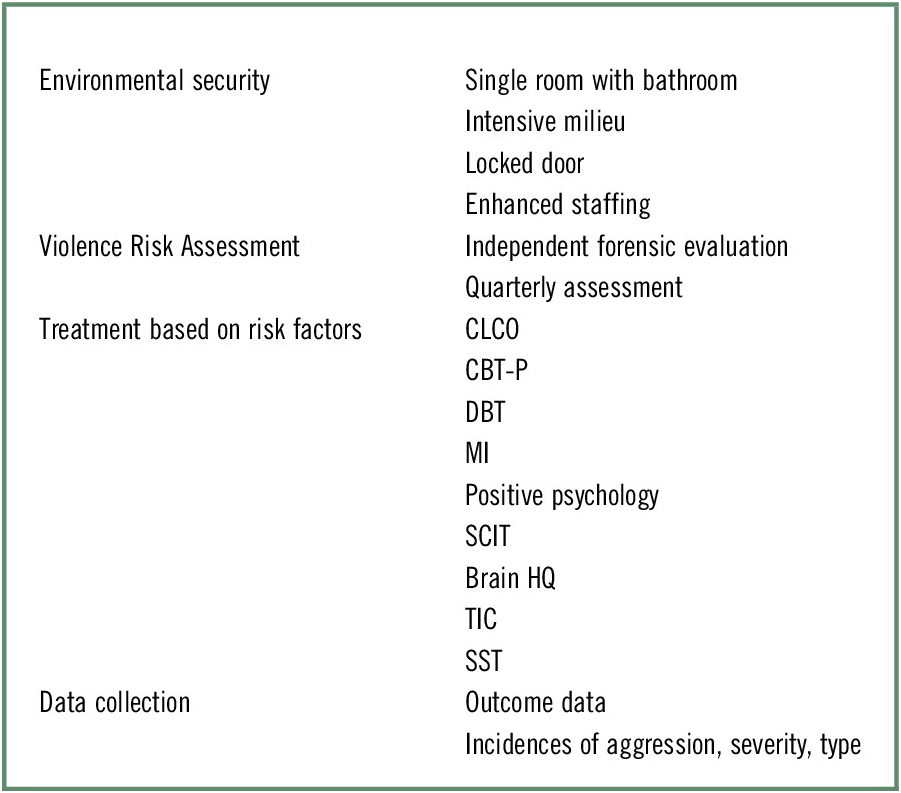
Treatment of forensic patients who are at the highest risk of perpetuating violence requires an innovative model for adequate assessment and treatment of this population (Table 2). Working with stakeholders across state entities provided DSH the opportunity to design and implement an innovative treatment program to address the changing safety, security, and treatment needs in a state psychiatric facility. This unique treatment program seeks to reduce the perpetration of violence within a forensic population, allowing for a safer environment for residents and staff members while simultaneously increasing the efficacy of treatments. Extensive data collection is essential to evaluating outcomes in terms of the program’s effectiveness. Some questions pertaining to the nature of pathologies of referred patients, their specific treatment needs, and the response to treatment remain and will be addressed in future publications.
ETP Model of Treating Violence in Forensic Facilities

Declaration
The author(s) are entirely responsible for the scientific content of the article. Implementation of a specialized treatment program to reduce violence in a forensic population.
Disclosure
Dr. Velasquez, Dr. Bauchowitz, Dr. Pyo, and Dr. Pollock have no conflicts of interest to disclose.
Acknowledgments
Maria L. Ventura, PhD, UC Davis School of Medicine, Department of Psychiatry and Behavioral Sciences; Department of State Hospitals.