Religion is the key of history.
Lord Acton
INTRODUCTION
An influential new body of research has turned to the European Middle Ages (500–1500) to identify the roots of the “Rise of Europe” (e.g., Acemoglu, Johnson, and Robinson, Reference Acemoglu, Johnson and Robinson2001; Acemoglu et al. Reference Acemoglu, Johnson, Robinson and Yared2008; Stasavage Reference Stasavage2010; Reference Stasavage2011; Reference Stasavage2016; Fukuyama Reference Fukuyama2011; Van Zanden, Buringh, and Bosker, Reference van Zanden, Buringh and Bosker2012; Blaydes and Chaney Reference Blaydes and Chaney2013; Kokkonen and Sundell Reference Kokkonen and Sundell2014; Salter Reference Salter2015; Abramson and Boix Reference Abramson and Boix2017; Dincecco and Onorato Reference Dincecco and Onorato2018; Salter and Young, Reference Salter and Youngforthcoming). There is much to praise in this scholarship, which among other things has broken new ground by collecting large-N data that allow quantitative analysis of long-term processes of state-building, economic development, and regime change. However, a striking feature of this research is that it has largely ignored what generations of medieval historians have emphasized as the defining aspect of the medieval environment, namely the ubiquitous presence and pervasive influence of the Catholic Church (Ullmann Reference Ullmann1970[1955]; Southern Reference Southern1970; Tierney Reference Tierney1982; Berman Reference Berman1983; Monahan Reference Monahan1987; Kay Reference Kay2002; Oakley Reference Oakley2010; Reference Oakley2012; Reference Oakley2015; see also Mann Reference Mann1986, Chapter 12; Finer Reference Finer1997a).Footnote 1
Take the three developments most consistently associated with the Rise of Europe: the advent of the European multistate system, medieval parliaments, and early bureaucratic institutions. Recent attempts to explain why the European multistate system equilibrated on balance of power have ignored that this owes much to the Church's attempt to hinder any secular ruler from gaining hegemony over Latin Christendom (e.g., Hui Reference Hui2005; Kaufman, Little, and Wohlforth Reference Kaufman, Little and Wohlforth2007; for an overview of this literature, see Nexon Reference Nexon2009). Recent work on medieval parliaments has analyzed developments in lay polities virtually without any reference to the fact that the practices of representation and consent were first developed within the Catholic Church and that the Church was active in spreading them (e.g., Stasavage Reference Stasavage2010; Reference Stasavage2011; Blaydes and Chaney Reference Blaydes and Chaney2013; Boucoyannis Reference Boucoyannis2015; Abramson and Boix Reference Abramson and Boix2017; for an overview of this literature, see Stasavage Reference Stasavage2016). Recent attempts to understand the relationship between warfare and medieval and early modern state-building have ignored that many early bureaucratic offices and practices were first adopted at the papal curia in Rome and Avignon (e.g., Tilly Reference Tilly1990; Karaman and Pamuk Reference Karaman and Pamuk2013; Gennaioli and Voth Reference Gennaioli and Voth2015; Dincecco and Onorato Reference Dincecco and Onorato2018; for an overview of this literature, see Kaspersen and Strandsbjerg Reference Kaspersen and Strandsbjerg2017).
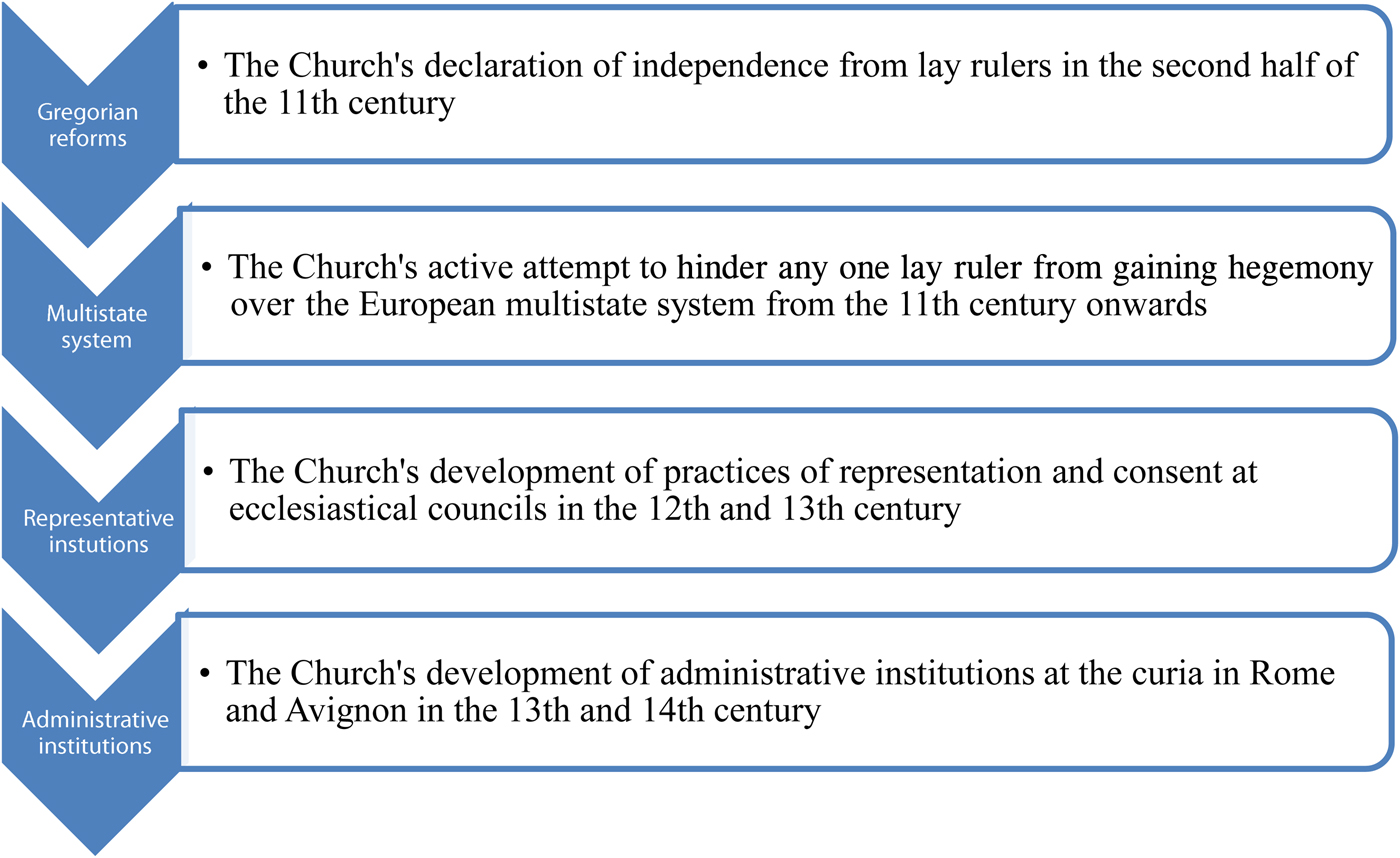
In what follows, I argue that to genuinely understand the staggering developments that allowed a set of hitherto backward countries on the Atlantic seaboard to colonize much of the globe in the period after 1500 A.D., we need to factor in the role of the Church in medieval state formation. More particularly, I use prior work of historians to show how the 11th century “crisis of church and state” set in train a series of key developments in interstate relations, political institutions, and state-building (see Figure 1). The note ends by discussing how future research can further increase our understanding of ecclesiastical influences on the Rise of Europe.
The church and the rise of Europe

THE CHURCH AND THE MEDIEVAL ENVIRONMENT
Southern (Reference Southern1970, 24) defines the Middle Ages as “the period in western European history when the church could reasonably claim to be the one true state, and when men (however much they might differ about the nature of ecclesiastical and secular power) acted on the assumption that the church had an overriding political authority.” Morris (Reference Morris1989, 34) argues that “[i]t is not possible in studying the medieval world to distinguish clearly between the history of the church and that of secular society”. In The History of Government, Finer (Reference Finer1997a, 857) notes that “Medieval Europe was saturated in Christian values…It was wholly removed from the thought-world of secular values we inhabit today.” Striking a similar note, Mann (Reference Mann1986) stresses that in the medieval context the “most powerful and extensive sense of social identity was Christian” (381), and he places the later rise of capitalism within this social environment (379–390). The overriding importance of the Church is also the premise for Oakley's (Reference Oakley2010, Reference Oakley2012, Reference Oakley2015) new three-volume appraisal of the emergence of Western political thought (see also Tierney Reference Tierney1982; Berman Reference Berman1983; Monahan Reference Monahan1987; Black Reference Black1992; Kay Reference Kay2002).
I have quoted at length to hammer home a simple point: political and economic developments as well as state-building in Europe before 1500 A.D. cannot be understood without reference to ecclesiastical infrastructure and the religious teaching of the Catholic Church. Medieval Europe was shot through with Catholic values, and the Church had a ubiquitous presence, not only via its religious activities but also because clergymen partook in lay administration and as “all learning and thought were functions of the church” (Southern Reference Southern1970, 22, 38). Finally, the Church had its own political agenda, which it ruthlessly pursued (Morris Reference Morris1989, 179–180).
More particularly, any proper understanding of the Rise of Europe must take the 11th and 12th century “crisis of church and state” as the starting point (Bisson Reference Bisson2009, 8; Oakley Reference Oakley2012, 26). In the 9th, 10th, and early 11th century, Western monarchs had perceived themselves as both religious and secular rulers, and they had controlled church affairs in their realms, including most importantly the investing of bishops (Ullmann Reference Ullmann1970[1955], 244–262; Southern Reference Southern1970, 100; Oakley Reference Oakley2010). This changed in the second half of the 11th century due to a string of “reform popes,” beginning with Leo IX (r. 1049–1054) (Oakley Reference Oakley2010, 221). The reform movement climaxed in the 1170s under Pope Gregory VII (r. 1073–1085); hence the terms “Gregorian reforms” or the “Gregorian Revolution.” Gregory published two documents, Dictatus Papae (1075) and Libertas ecclesiae (1079), that established the Church's power over ecclesiastical investiture and the pope's right to depose and excommunicate monarchs. The result was what Berman (Reference Berman1983, 15–19) refers to as the “Papal Revolution of 1075–1122” (see also Oakley Reference Oakley2010, 218). While the popes came to terms with Western monarchs over investiture (the French King in 1107, the English King in 1108, and the German Emperor in 1122), the conflict of church and state was to dominate European politics for almost two centuries (Oakley Reference Oakley2012, 37; Reference Oakley2015, 4). More particularly, it set in train a series of developments of profound importance for those studying the Rise of Europe.
THE MULTISTATE SYSTEM
There is a broad consensus that European patterns of state formation and regime change owe much to the relentless pressure of the European multistate system, which incentivized state-builders to implement political and administrative reforms that increased taxes, enabled public deficit finance, and eased military mobilization (Tilly Reference Tilly1975; Reference Tilly1990; Jones Reference Jones2008[1981]; Hall Reference Hall1986; Mann Reference Mann1986; Ertman Reference Ertman1997; Finer Reference Finer1997a; Van Zanden, Buringh and Bosker, Reference van Zanden, Buringh and Bosker2012, 846; Karaman and Pamuk Reference Karaman and Pamuk2013; Gennaioli and Voth Reference Gennaioli and Voth2015; Dincecco and Onorato Reference Dincecco and Onorato2018). However, much of this research has ignored that the European multistate system with its ubiquitous competition is the world-historical exception rather than the rule (Hui Reference Hui2005; Kaufmann, Little and Wohlforth Reference Kaufman, Little and Wohlforth2007; Nexon Reference Nexon2009; Møller Reference Møller2014). To genuinely comprehend the European development, we therefore need to understand why the European multistate system came to equilibrate on balance so that generalized geopolitical competition became a general condition of state formation and regime change.
This is where the Catholic Church comes to the fore. In Europe, generalized geopolitical competition can at least be dated back to the 12th century (Ertman Reference Ertman1997, 25–28; Myers Reference Myers1975, 56; Maddicott Reference Maddicott2010, 106; Stasavage Reference Stasavage2011, 9; Dincecco and Onorato Reference Dincecco and Onorato2018). The medieval Church contributed to this environment by actively hindering any one secular monarch gaining preeminence (Spruyt Reference Spruyt, Kaspersen and Strandsbjerg.2017). It did so by proclaiming and supporting the maxim that a king “does not recognize a superior in temporal matters” (Black Reference Black1992, 113), that is, kings are not beholden to emperors or for that matter to other kings (Ullmann Reference Ullmann1970[1955], 454; Spruyt Reference Spruyt, Kaspersen and Strandsbjerg.2017, 85). The main aim was to put a stop to the attempts of 11th and 12th century Salian emperors and 13th and 14th century Hohenstaufen emperors to create a hegemony over the Latin west. More generally, the Church helped establish “the modern doctrine of the equality of states in international law” (Oakley Reference Oakley2012, 3; see also Black Reference Black1992, 116).
The Church's policy was dictated by the fact that it could not rely on its own military strength to safeguard the jurisdictional control over ecclesiastical affairs that the Gregorian declaration of independence from secular rulers had given it—or for that matter its territorial control over what was to become the Papal States in Italy. It had to resort to the sanction of excommunication, and this was only effective if it created opposition against the targeted ruler. In other words, the Church needed the “consent and cooperation of secular rulers” (Southern Reference Southern1970, 20, see also 125–127). Had one power managed to roll up the multistate system, this cooperation would not have been forthcoming.
Meanwhile, the Church helped bolster the individual polities in a way that made it more difficult for the German emperors to dominate the system. The Church was thus a key agent behind the development of the practices of primogeniture and female inheritance, which stabilized European political units and eased territorial consolidation after these practices won the day in most European realms in the high and late middle ages (Finer Reference Finer1997b, 1269; Kokkonen and Sundell Reference Kokkonen and Sundell2014; Gorski and Sharma Reference Gorski., Sharma, Kaspersen and Strandsbjerg2017). The reason the Church sundered kin relations in this way was not to stabilize what was to become the European territorial states or due to theological considerations but because it stood to profit from it economically (via testamentary bequests) (Goody Reference Goody1984; Fukuyama Reference Fukuyama2011). At the same time, the Church hierarchy provided an attractive alternative career path for disinherited younger sons of nobles and monarchs, which served to remove some of the resistance against the adoption of primogeniture (Gorski and Sharma Reference Gorski., Sharma, Kaspersen and Strandsbjerg2017).
The Catholic Church finally provided the cultural integration and common institutions that eased diffusion of ideas and institutions within the European multistate system. In the high Middle Ages, the Church developed a transnational system of education and law, adding to its transnational religious system (Berman Reference Berman1983, 161; Black Reference Black1992, 87–89; Morris Reference Morris1989, 2–3). As Mann (1986, Chap. 12) describes, the Church provided the normative common factor that bound the multistate system and secured that competition would prove dynamic (see also Hall Reference Hall1986, 110–144). This integration explains why the political and administrative ecclesiastical innovations described in the next two sections could diffuse so quickly to lay polities.
MEDIEVAL PARLIAMENTS
The Church led the way in developing two constitutionalist practices that have been identified as vital for the later Rise of Europe, namely political consent and political representation (Tierney Reference Tierney1982; Kay Reference Kay2002; Oakley Reference Oakley2012; Boucoyannis Reference Boucoyannis2015; Stasavage Reference Stasavage2016). These practices came together in that quintessentially medieval political innovation: representative institutions or parliaments. Parliaments began to crop up in the 13th century, and on the eve of the great voyages (around 1500), they were virtually ubiquitous in Latin Christendom but not found elsewhere (Myers Reference Myers1975; Van Zanden, Buringh, and Bosker Reference van Zanden, Buringh and Bosker2012; Stasavage Reference Stasavage2016).
Representation and consent were first introduced within the Catholic Church in the 12th and 13th centuries (Tierney Reference Tierney1982; Kay Reference Kay2002). The 11th century Gregorian reforms and the lay-religious conflicts they sparked facilitated the systematization of Canon law and the revival of Roman law (Oakley Reference Oakley2012, 69). Representation and consent were lifted out of revived Roman law to give the 12th century Church ways to enable and deal with the papal centralization and ecclesiastical autonomy that the Gregorian reforms had occasioned (Monahan Reference Monahan1987, 112–113, 116; Oakley Reference Oakley2012, 148–149, 152–153). These practices presented a way to handle the flood of litigation that was being addressed to ecclesiastical courts from across the Latin west in the 12th century (Oakley Reference Oakley2012, 148–149). However, medieval lawyers soon took a crucial step; they expanded the use of the notion of corporation by treating
the universal church and, indeed, the general council representing it as corporate entities “in a very technical sense’. They were led, as a result, to extend the now-established mechanism of representation by explicit legal delegation from the restricted realm of private law to the broader public constitutional sphere (Oakley Reference Oakley2012, 153–164; see also Tierney Reference Tierney1982, 21–28; Monahan Reference Monahan1987, 109; Kay Reference Kay2002, 98–103).”
In the 14th and 15th centuries, this ecclesiastical fusion between representation and consent would produce one of the great constitutionalist currents of the West, namely conciliarism (Black Reference Black and Allmand1998; Oakley Reference Oakley2003; Reference Oakley2012). Here, Canon law played an important role. The Church had a long-standing communitarian tradition, based on a conciliar mode of governance, and Canon law included a clause that a heretic pope could be deposed (Monahan Reference Monahan1987, 43–47; Oakley Reference Oakley2003, 106–109). It was a small step to argue that heretic popes could be deposed at church councils based on consent and representation, not least since the broadening of the notion of corporation meant that the clergy—including the pope—was arguably bound by the laws of the corporation. Moreover, reference was made to certain places in scripture, including Galatians 2:11–15 where Peter was corrected by Paul, that is, the pope was corrected by the community of believers (Meyjes Reference Meyjes1999, 104–105).
Conciliarists thereby developed and spread “a theory of the intrinsic supremacy of a representative assembly that was far more explicit, and was argued for in more detail, than anything previously put forward on behalf of secular institutions” (Black Reference Black and Allmand1998, 78).Footnote 2 They were also the first to distinguish between a religious and a secular sphere, thereby abandoning the older notion of the fusion of religious and political power (Oakley Reference Oakley2012, 18). However, long before this ideological export, the practices of political representation and political consent had diffused to the lay-political sphere (see Kay Reference Kay2002; Bradford and McHardy Reference Bradford and McHardy2017, 15–17; Møller Reference Møller2018).
EARLY BUREAUCRATIC INSTITUTIONS
The investiture conflict finally gave the main impetus to a large-scale building of administrative institutions within the Church, first in Rome and then—during the so-called Babylonian Captivity (1309–1376)—in Avignon, as the popes attempted to grapple with their new role and its administrative implications. This state-building was merely the culmination of the role the clergy had long performed in medieval polities. First, the ecclesiastical infrastructure in itself served as a kind of surrogate state apparatus in a situation where there was little in the way of a secular apparatus (Morris Reference Morris1989, 18). Most important were the bishoprics, which were an integrated component of medieval government (Southern Reference Southern1970; Ullmann Reference Ullmann1970[1955], 296). Moreover, the lack of a steady public taxation meant that even lay administrative functions were largely financed from the one source of regular public income, namely tithes. Church benefices thereby funded 11th and 12th century royal administrations, such as they were. Second, these rudimentary royal administrations were themselves staffed by clerics. This was the case at the royal household where clerics would serve as, for example, chancellors, but it was also the case at a more local level, such as the administration of sheriffs in England (Southern Reference Southern1970, 130; Monahan Reference Monahan1987, 43).
Medieval administration was thus very much an ecclesiastical affair. It is therefore unsurprising that a number of important institutions of the modern state were invented within the Church, only later to be imported by lay rulers (Ullmann Reference Ullmann1970[1955]; Tierney Reference Tierney1982; Berman Reference Berman1983; Genet Reference Genet1992, 126). The medieval papacy has even been proclaimed the first modern state (Berman Reference Berman1983, 113). The papal administration was a hierarchically organized entity—independent of lay rulers—that legislated, administrated, and exercised judicial powers. It had access to the vast papal archives, and it employed skilled administrators in the form of lawyers educated at law schools such as Bologna.
The aforementioned increase in litigation was the main reason behind the growth of the papal administration in the 12th, 13th, and 14th centuries (Southern Reference Southern1970, 121). The corporate stratum of jurists first arose in the universities—whose corporate rights were sanctioned by the papacy and whose teachers and students were mostly ecclesiastics—“in response to the need to reconcile the conflicts that raged within the church, between the church and the secular authorities, and among and within the various secular polities” (Berman Reference Berman1983, 160). Likewise, the very notion that one can distinguish between the individual and his office came from the Church and was based on the doctrine of apostolic succession: “The seat does not die” (Black Reference Black1992, 190).
ILLUSTRATING THE GAPS IN RECENT RESEARCH
I have argued that the Church must be factored in to genuinely understand the Rise of Europe. Left is only to further illustrate how these insights are missing from the new social science literature, even though historians have long recognized them. The best illustration is probably the recent work of Boucoyannis (Reference Boucoyannis2015) and Stasavage (Reference Stasavage2016) on representation and consent. Boucoyannis and Stasavage correctly argue that to understand the origins of medieval representative institutions, we need to understand how—in the 12th and 13th centuries—the judicial practices of representation and consent came to be applied to political communities. However, they both ignore that, as mentioned above, this development took place within the Catholic Church in the 12th century, crystalizing at the Fourth Lateran in 1215 and the French church council of Bourges in 1225 (see Tierney Reference Tierney1982; Kay Reference Kay2002; Møller Reference Møller2018). Boucoyannis (Reference Boucoyannis2015) and Stasavage (Reference Stasavage2016) thus construe an ecclesiastical development as a lay development, which makes it all but impossible to understand how these practices, derived from revived Roman private law, could become political principles used at assemblies of the realm.
Likewise, the recent literature on war and state-building has little or nothing to say about the way the Church nurtured geopolitical competition and how the Church developed early bureaucratic institutions. This scholarship largely takes a multistate system and the availability of new administrative technologies as a given, thereby artificially treating these factors as exogenous to the European development of strong states (see, e.g., Karaman and Pamuk Reference Karaman and Pamuk2013; Gennaioli and Voth Reference Gennaioli and Voth2015; Dincecco and Onorato Reference Dincecco and Onorato2018).
A similar objection can be made against Acemoglu, Johnson, and Robinson's (Reference Acemoglu, Johnson and Robinson2001) and Acemoglu et al.'s (Reference Acemoglu, Johnson, Robinson and Yared2008) seminal work on the colonial transplantation of European institutions. This work has preciously little to say about the origins of these institutions. Acemoglu et al. (Reference Acemoglu, Johnson, Robinson and Yared2008, 813; emphasis in the original) simply remark that these institutions must be traced back to “some critical junctures during the last 500 years” and in another paper it is only vague phrases such as “European-like institutions” (Acemoglu, Johnson, and Robinson Reference Acemoglu, Johnson and Robinson2001, 1374) that betray the origins of what are sometimes referred to as “institutions of constraints,” sometimes “inclusive institutions.” However, to know which European colonizers could transplant these institutions, we need to demarcate the area that they arose in and spread to. This is implicitly recognized by this scholarship, as Russian and Ottoman colonization is not included as engines for spreading inclusive institutions. By factoring in the Church, we can make sense of this. Practices such as representation and consent—which probably make up the core of the institutions Acemoglu et al. have in mind—were confined to the Latin west, never reaching Russia or the Ottoman Empire, for the simple reason that these institutions were developed, spread, and legitimized by the Catholic Church.
Finally, the new large-N research on how primogeniture stabilized European states (Kokkonen and Sundell Reference Kokkonen and Sundell2014) is also silent on the fact that this development was enabled and to some extent sponsored by the Catholic Church (Goody Reference Goody1984; Gorski and Sharma Reference Gorski., Sharma, Kaspersen and Strandsbjerg2017). While this does not undermine the findings of this literature, it does leave a blank spot as no attempt is made to explain why the new rules about succession that were to bolster European states were introduced in the first place—and, it follows, no attempt is made to discuss whether the change in succession orders was endogenous to lay state-building or an exogenous effect of ecclesiastical doctrines regarding marriage and inheritance (see Goody Reference Goody1984).
CONCLUSIONS
The Rise of Europe has again become a hot topic in political science. However, this new scholarship has largely ignored the role of the Catholic Church. The Church's role was not confined to creating the multistate system and, as a downstream effect, the generalized geopolitical competition that came to characterize medieval and early modern Europe. The Church also led the way in developing two sets of innovations that the late American sociologist Charles Tilly (Reference Tilly1975, Reference Tilly1990) associated with this geopolitical pressure: constitutionalist and early bureaucratic institutions. More generally, a focus on the Catholic Church promises to shed light on the fact that many of these innovations only occurred in the Latin west and not elsewhere.
However, to understand ecclesiastical influences on the Rise of Europe much remains to be done, both theoretically and empirically. First, it is unclear whether the 11th century “crisis of church and state” makes up a genuine critical juncture or not. Many scholars have described the lay-ecclesiastical relations in the period leading up to the 11th century Gregorian reforms as a version of the Rex-Sacerdos model in which lay and religious authority are fused; the model that has also been used to describe the Byzantine Empire (Ullmann Reference Ullmann1970[1955]; Berman Reference Berman1983, 88–91; Oakley Reference Oakley2010, 165–173; Reference Oakley2012, 1). However, at the same time, it is clear that the reformers saw themselves as restorers and that they could in fact point back to a number of older church practices (see Ullmann Reference Ullmann1970[1955]; Oakley Reference Oakley2012). As historians recognize, it is therefore difficult to decide whether we are dealing with revolution or evolution (see Oakley Reference Oakley2010, 220–221). This also means that it is unclear whether we can treat the Church's effects on the multistate system, regime change, and state-building as exogenous.
Second, we need more and better theory about the effects of the Church. The big issue is to what extent—or maybe more precisely when—we are dealing with a religious/theological variable and when we are dealing with an institutional variable. Take the ecclesiastical invention of representation; this notion was mainly found in revived Roman law and not in Canon law. Likewise, with the effect of the doctrine of apostolic succession on impersonal government offices as an exception, there are no theological elements lurking behind the Church's role in building administrative institutions—or for that matter the way it promoted female inheritance and primogeniture by sundering kinship ties. However, the invention of consent was facilitated by important elements from Canon law regarding what to do when confronting a heretic pope. Likewise, the Church's initial challenge of secular monarchs was based on the 11th century reform popes’ understanding of the sacral monopoly of the Church. More generally, the Gregorian Reforms obviously depended on theological teachings; so did 14th and 15th century conciliarism, which was based on the claim that Christ had intended his church to be governed by councils in general and was bolstered by reference to, for example, Galatians 2:11–15 (Black Reference Black1992, 169–171; Meyjes Reference Meyjes1999: 104–105). These teachings also had wider repercussions for the political theory that was to migrate to secular spheres, which was based on the notion that rulers were bound by Christian law (Tierney Reference Tierney1982; Berman Reference Berman1983, 145; Finer Reference Ertman1997, 863–864; Oakley Reference Oakley2012; Reference Oakley2015).
Third, we need to further analyze the way in which institutions and political tenets were spread from the ecclesiastical domain to the lay domain, whether inadvertently or purposely. This was facilitated by what Tierney (1982, 13) terms the lay-religious “areas of interaction”, which were ubiquitous in a context where there was no “clear area of separate governmental responsibilities which could be firmly labelled as secular” (Morris Reference Morris1989, 18). However, there is much we do not know about these areas and interactions (see also Oakley Reference Oakley2012, 155; Oakley Reference Oakley2015, 210).
The good news is that several generations of historians working on the Catholic Church have provided ample data, which social scientists are well placed to process. Indeed, the Church is probably the most studied subject in medieval history. Thus, it should be possible to make further progress on all of these fronts. However, this requires that scholars working on the Rise of Europe stop looking solely at developments in secular domains; something that in any case is awkward in the context of the medieval Latin west where ecclesiastical influences were everywhere.