Introduction
Glyphosate-resistant (GR) soybean was first grown commercially in the United States in 1996 and in Canada in 1997 (Cerdeira and Duke Reference Cerdeira and Duke2006; Soltani et al. Reference Soltani, Shropshire and Sikkema2006). The adoption of this technology has been rapid in both regions. Soybeans are a large-acreage crop in the United States, with approximately 36.1 million ha planted to glyphosate-resistant soybean in 2018 (US Department of Agriculture 2019). Adoption of this technology has also been rapid in Canada, with adoption rates in Ontario nearly equivalent to those observed in the United States (Deen et al. Reference Deen, Hamill, Shropshire, Soltani and Sikkema2006). New, early-maturing soybean cultivars have presented a novel, low-input cropping option for western Canadian producers and crop adoption has been rapid. Within western Canada, more than 340,000 and 925,000 ha were planted with glyphosate-resistant soybean in 2017 across Saskatchewan and Manitoba, respectively (Statistics Canada 2018). In fact, soybean production has increased 10-fold in the province of Manitoba over the past decade and is now the third most widely grown crop in that province behind canola and wheat (Triticum aestivum L.).
GR canola, a widely grown crop in western Canada, is also a prevalent volunteer weed emerging in subsequent crops. Volunteer canola ranked as the twelfth most abundant weed in western Canada in 2005 (Leeson et al. Reference Leeson, Thomas, Hall, Brenzil, Andrews, Brown and Van Acker2005). In part, this is due to substantial amounts of seed being returned to the soil seed bank due to pod shattering and seed spillage from field equipment (Beckie and Owen Reference Beckie and Owen2007; Gulden et al. Reference Gulden, Shirtliffe and Thomas2003b). In addition, Gulden et al. (Reference Gulden, Shirtliffe and Thomas2003a) reported harvest losses of 5.9%, adding approximately 3,000 viable seeds m−2 to the soil seed bank. In the United Kingdom, it was even higher, at 10,000 seeds m2 (Lutman Reference Lutman1993). Furthermore, volunteer canola seeds can be induced into secondary seed dormancy, which further contributes to higher seedbank persistence and volunteer seedling recruitment (Gulden et al. Reference Gulden, Shirtliffe and Thomas2003a). GR canola also has potential to exchange genes with feral canola populations; GR canola has been found in 88% of roadside populations in southern Manitoba (Knispel et al. Reference Knispel, McLachlan, Van Acker and Friesen2008).
Volunteer canola is an economically important weed that greatly affects crop yield potential. For example, volunteer canola reduced wheat yield by up to 49% at densities of 50 plants m−2 (O’Donavan et al. Reference O’Donavan, Harker and Dew2008). Volunteer canola caused an average wheat yield loss of 0.22% per canola plant, increasing to 0.41% when volunteer canola plants were mature (Seerey and Shirtliffe Reference Seerey and Shirtliffe2010). Although these experiments demonstrated that volunteer canola causes substantial yield loss in wheat crops, yield losses in soybean have not been determined.
Volunteer GR canola poses a challenge for soybean production because many growers who choose to grow GR soybean also grow GR canola, and glyphosate alone will not control GR canola in GR soybean. There are several herbicides registered for the control of volunteer GR canola in GR soybean in eastern Canada, but very few herbicide options are registered in western Canada. Furthermore, only very limited information exists regarding the efficacy of these products on volunteer canola in soybean crops. Use of tillage to control early flushes of weed is not an option for these cropping systems in western Canada, because most soybean crops are grown in no-till systems.
Despite few published studies regarding control of volunteer GR canola in GR soybean crops, studies in soybean found that sequential applications of metribuzin plus chlorimuron PRE followed by (fb) chlorimuron, flumiclorac, fomesafen, or 2,4-D POST were effective in controlling volunteer GR cotton (Gossypium hirsutum. L.) (York et al. Reference York, Stewart, Vidrine and Culpepper2004). Glyphosate mixtures with quizalofop-p-ethyl, clethodim, or fenoxaprop-p-ethyl effectively controlled volunteer GR corn (Zea mays L.) and caused no injury to soybean (Deen et al. Reference Deen, Hamill, Shropshire, Soltani and Sikkema2006). A similar study reported clethodim, fenoxaprop-p-ethyl, fluazifop-p-butyl, and quizalofop-p-ethyl mixed with glyphosate provided good control (75% to 90%) of volunteer GR corn with no yield reduction in soybean (Soltani et al. Reference Soltani, Shropshire and Sikkema2006).
Experiments were also carried out on controlling other weeds in GR soybean with resistance to glyphosate. PRE mixtures of glyphosate plus saflufenacil or saflufenacil/dimethenamid-p and glyphosate mixtures with metribuzin, cloransulam-methyl, or flumetsulam provided 87% control of GR Canada fleabane [Conyza canadensis (L.) Cronquist] and did not injure soybean (Byker et al. Reference Byker, Soltani, Robinson, Tardif, Lawton and Sikkema2013). GR giant ragweed (Ambrosia trifida L.) was controlled in GR soybean with 2,4-D ester, cloransulam-methyl, and saflufenacil applied alone or as a mix with glyphosate (Vink et al. Reference Vink, Soltani, Robinson, Tardif, Lawton and Sikkema2012). Although injury levels reported by Vink et al. (Reference Vink, Soltani, Robinson, Tardif, Lawton and Sikkema2012) were greater than the acceptable threshold, fomesafen mixed with glyphosate provides control of some GR weeds in soybean, including GR giant ragweed (Brabham et al. Reference Brabham, Johnson, Loux and Dobbels2011) and GR common ragweed (A. artemisiifolia L.) (Van Wely et al. Reference Van Wely, Soltani, Robinson, Hooker, Lawton and Sikkema2015).
The prevalence of GR volunteer canola in western Canada, as well as the lack of information regarding management of GR canola in GR soybean, presents a formidable challenge for producers. Producers need better options for managing GR canola volunteers in GR soybean crops. Particularly, the use of both PRE and POST herbicides to control multiple flushes of volunteer canola is not well established. Therefore, we conducted an experiment to evaluate the efficacy of various combinations of PRE plus POST herbicides applied to volunteer GR canola in GR soybean.
Materials and Methods
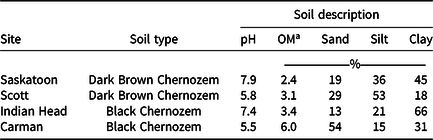
Field experiments were conducted at the Kernen Crop Research Farm (52.15°N, 106.53°W) at Saskatoon, Saskatchewan; at the Western Applied Research Corporation Research Farm (52.21°N, 108.49°W) in Scott, Saskatchewan; at the Indian Head Agricultural Research Foundation (50.31°N, 103.39°W) Research Farm at Indian Head, Saskatchewan; and at the University of Manitoba Research Farm (49.30°N, 98.00°W) at Carman, Manitoba, in 2014 and 2015. Saskatoon and Scott are located on a Dark Brown Chernozem soil; Indian Head and Carman are located on a Black Chernozem soil (Table 1).
Soil classification and descriptions for each site location in Canada: Kernen Crop Research Farm (52.15°N, 106.53°W), Saskatoon, Saskatchewan; Western Applied Research Corporation (52.21°N, 108.49°W), Scott, Saskatchewan; Indian Head Agriculture Research Foundation (50.31°N, 103.39°W), Indian Head, Saskatchewan; and the University of Manitoba Research Farm (49.30°N, 98.00°W), Carman, Manitoba.

a Abbreviation: Organic matter.
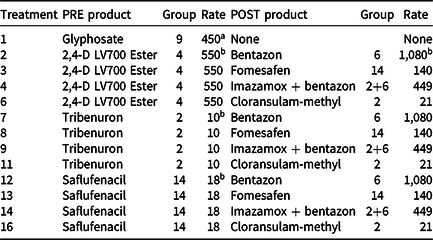
The experiment was a randomized complete block design with 16 treatments and four replications. Treatments were 15 different combinations of PRE and POST herbicides, and 450 g ae ha−1 glyphosate applied alone as a control treatment (herbicide standard; Table 2). Plots at Saskatoon and Scott were 2-m wide by 6-m long, plots at Indian Head measured 4-m wide by 10.7-m long, and plots at Carman were 2.5-m wide by 8-m long. Border plots were seeded along the sides of the trial at all locations. Soil samples were taken at depths of 0 to 15, 15 to 30, and 30 to 60 cm to determine nutrient levels in the soil, as well as pH and organic matter. No fertilizer was added, because the nutrient levels in the soil were adequate at the time of sampling at all site-years. To simulate volunteer canola, canola (cv. Dekalb 72-65 RR; Bayer Crop Science Canada, Calgary, Canada) was broadcast seeded across the trial at a target density of 40 plants m−2 to supplement the established seedbank and to allow for emergence of canola prior to application of the PRE herbicide treatments. Additional supplementation of the canola seed bank was carried out at 20 seeds m−2 after application of the PRE herbicide treatments. Soybean was direct seeded at Saskatoon using a Monosem Vacuum Planter (Monosem Inc. Edwardsville, Kansas) with disc openers, whereas plot seeders equipped with hoe openers (Scott and Indian Head) or disc openers (Carman) were used at other locations.
PRE and POST herbicides and application rates for volunteer glyphosate-resistant (GR) canola control in GR soybean.

a g ae ha−1.
b g ai ha−1.
PRE herbicide treatments were applied when volunteer canola reached the one- to two-leaf stage. Soybean was then sown 5 to 7 d after PRE herbicide applications at a target density of 444,600 plants ha−1 (40 plants m−2) and 3-cm seeding depth. POST herbicide treatments were applied at the one- to two-trifoliate soybean crop stage (Table 2). All PRE and POST treatments were tank mixed with 450 g ae ha−1 glyphosate. Merge® (50% surfactant blend; 50% petroleum hydrocarbons solvent; BASF Canada, Mississauga, ON, Canada) was added to all saflufenacil treatments at 0.5 L ha−1. Urea ammonium nitrate (28-0-0) was added to all imazamox plus bentazon and cloransulam-methyl treatments at 2 L ha−1. Agral 90 (92% nonylphenoxy polyethoxy ethanol; Syngenta Canada, Guelph, ON, Canada) was added to all fomesafen and cloransulam-methyl treatments at recommended rates. All herbicides were applied with a tractor-mounted sprayer calibrated to deliver a volume of 100 L ha−1 through Agrotop Airmix 100-015 nozzles (Agrotop Germany GmbH, Köferinger, Germany) spaced 50-cm apart at 275 kPa.
Volunteer-canola control efficacy was assessed by visual ratings made 7 to 10 and 21 to 28 d after the treatment (DAT). Visual ratings were made by comparing treated plots with check plots that had only been sprayed with glyphosate. Ratings were conducted using the Canadian Weed Science Society (CWSS) 0% to 100% scale (Canadian Weed Science Society 2018), according to which values greater than 80% indicate acceptable control. Soybean phytotoxicity was evaluated by visually rating plots on the CWSS scale at 7 to 10 and 21 to 28 DAT. Ratings were determined by comparing treated plots with check plots that had only been sprayed with glyphosate and assessing any crop damage (e.g., chlorosis, stunting) after herbicide applications. Each treatment was assigned a rating from 0% to 100% with a rating of 0% indicating no injury and 100% indicating complete death. Initial damage of up to 10% is considered acceptable.
Soybean and volunteer canola biomass sampling were conducted at the pod stage of canola development. Shoot biomass samples (both species) were collected in two 0.5-m2 quadrats per plot from the front and back of each plot. Canola and soybean samples were cut just above the ground surface and placed in paper bags separately. All material was oven dried at 80 C for 72 h and weighed. Plots were harvested with a plot combine and all samples were dried, with yields adjusted to 14% moisture content. Dried samples were cleaned and weighed to determine final yield. Volunteer canola seeds cleaned from soybean samples were also weighed to determine volunteer canola seed contamination.
Statistical Analysis
Data from Indian Head (2015) were omitted from analysis because of missing values. In addition, flooding occurred at Indian Head in 2014 and we were unable to collect biomass and harvest data on the third and fourth replications. Thus, only data from the remaining two replications were collected that year.
The Shapiro-Wilk statistic in PROC UNIVARIATE (SAS Institute, Cary, NC) was used to assess normality and the Levene test was used to assess homogeneity of variance to ensure the residuals met the assumptions of ANOVA. Additional analysis of the distribution of residuals and variance homogeneity was conducted by using the RESIDUAL statement in PROC GLIMMIX (SAS Institute 2014). For the one-way ANOVA, treatment was considered a fixed effect, and random effects were site-year, block nested within site-year, and site-year by treatment interactions. Covariance parameters were examined using the COVTEST command of PROC GLIMMIX to determine if site-years could be combined and if conclusions could be drawn from a broader (population-based) inference space. Means for soybean biomass and yield were separated using Fischer protected LSD0.05 values. Because there were many zeros in the data set, canola biomass and canola seed production (i.e., contamination) did not have a normal distribution. Modelling canola biomass and seed contamination in PROC GLIMMIX as a log-normal distribution with an identity link resulted in a significantly lower Akaike information criterion than the original model and corrected for normality and heterogeneity. Canola biomass means were separated using Fischer’s protected LSD0.05 values. Means were back-transformed for the purpose of reporting.
Because phytotoxicity ratings are proportional data relative to a control, data are typically skewed. As such, phytotoxicity ratings were analyzed using the PROC GLIMMIX procedure in SAS using a beta distribution with a log-link function (Bowley Reference Bowley2015). Means were separated with the Fischer’s protected LSD test using a P < 0.05 to declare significant differences. Data were back-transformed for presentation of results.
Results and Discussion
Environmental Conditions
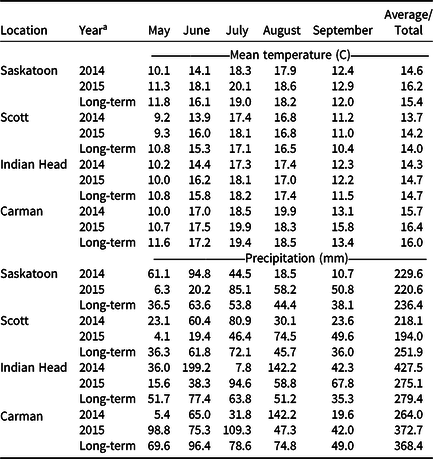
Average air temperature was lower (0.2 to 0.8 C) than the long-term average temperature at all sites in 2014 (Table 3). Total precipitation was lower than the long-term average in 2014 with the exception of Indian Head, which was much higher than average. Average temperature was higher (0.2 to 0.8 C) than the long-term average at all sites in 2015, with the exception of Indian Head, which was similar to the long-term average temperature (Table 3). Rainfall was variable across sites throughout all summer months when compared with the long-term average. Total precipitation was slightly lower at Saskatoon and slightly higher at Scott and Carman when compared with the long-term average in 2015.
Mean monthly air temperature, precipitation, and long-term averages for Saskatoon, Scott, and Indian Head, in Saskatchewan, and Carman, Manitoba, Canada, in 2014 and 2015 (Environment Canada 2016).

Volunteer Canola Efficacy and Soybean Phytotoxicity
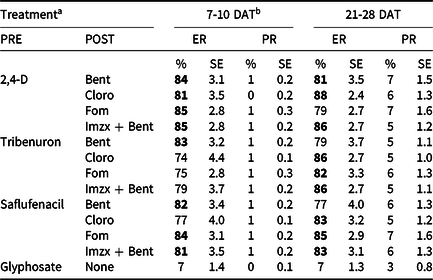
At 7 to 10 DAT, all the POST herbicides in combination with the three PRE herbicides were effective in controlling volunteer GR canola. All these herbicides provided greater than 74% control, and most of them provided greater than 80% control (Table 4). At 7 to 10 DAT, all POST herbicide combinations following the PRE application of 2,4-D had greater than 80% control efficacy. However, with the PRE application of tribenuron and saflufenacil, some of the POST application combinations provided less than 80% control, and generally only bentazon provided greater than 80% control. Under both PRE applications of tribenuron and saflufenacil, the POST application of cloransulam-methyl was comparatively less effective, providing less than 80% control.
Volunteer glyphosate-resistant (GR) canola control and soybean visible injury in response to herbicide treatments in Saskatoon, Indian Head, and Scott (Saskatchewan), and Carman, Manitoba, Canada, in 2014 and 2015.

a Abbreviations: Bent, bentazon; Cloro, cloransulam-methyl; DAT, days after treatment; ER, efficacy rating; Fom, fomesafen; Imzx + Bent, imazamox + bentazon; PR, phytotoxicity rating.
b Values are derived from beta analysis of visual ratings at individual site years. Any phytotoxicity rating < 10% is considered acceptable crop injury. Efficacy ratings between 60% and 79% indicate suppression; ratings > 80% are considered good control and are in bold type.
The efficacy of fomesafen and imazamox plus bentazon following both the PRE herbicides of 2,4-D and saflufenacil was greatest, whereas it was low with the PRE application of tribenuron. This was likely due to the rapid bleaching and desiccation characteristics of Group 14 herbicides (Duke et al. Reference Duke, Lyndon, Becerril, Sherman, Lehnen and Matsumoto1991). At 21 to 28 DAT, all herbicide combinations provided greater than 77% efficacy. At 21 to 28 DAT, efficacy was greater with herbicide treatments containing Group 2 products, especially cloransulam-methyl and imazamox plus bentazon, which provided more than 80% weed control following all the PRE herbicides. Group 2 herbicides inhibit amino acid synthesis and thus have slower herbicidal activity that takes several days to develop (Peterson et al. Reference Peterson, Thompson, Shoup and Jugulam2015). On the other hand, POST application of bentazon was comparatively less effective (<80%) following the PRE application of tribenuron and saflufenacil at 21 to 28 DAT, This contrasted with observations at 7 to 10 DAT (Table 4).
All herbicide treatments showed excellent crop tolerance throughout the growing season (i.e., <10%) (Table 4). Treatments containing imazamox and bentazon as POST herbicides had the lowest phytotoxicity rating (5% to 6%), whereas fomesafen preceded by 2,4-D and saflufenacil had higher phytotoxicity rating values (7%), indicating moderately lower crop tolerance (Table 4).
Soybean Biomass and Seed Yield
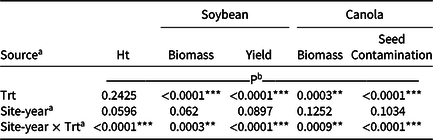
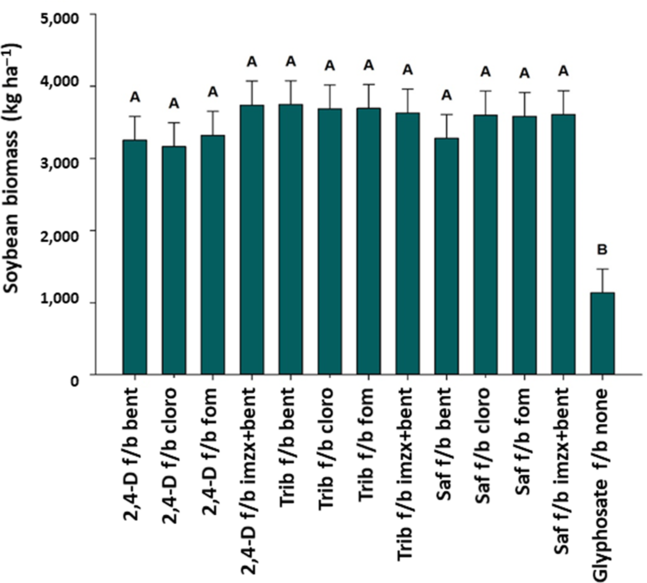
Site-years were combined for soybean-shoot biomass data analysis because the contribution of the site-year by treatment covariance parameter estimate was less than 7% of the total variance (Table 5). Significant effects (P < 0.0001) were observed among herbicide treatments for soybean shoot biomass and seed yield. All the herbicide combinations had greater biomass and seed yield compared with the glyphosate-only control treatment (Figures 1 and 2). None of the herbicide combinations differed for canola biomass production. However, the highest numerical soybean-shoot biomass (3,748 ± 575 kg ha−1) was observed in treatment tribenuron followed by (fb) bentazon, which produced 230% more soybean shoot biomass than the glyphosate-only control treatment (1,132 ± 573 kg ha−1) (Figure 1). Of the four numerically lowest shoot biomass values among herbicide combinations, three were observed when 2,4-D was applied as the PRE herbicide. Treatments of 2,4-D fb cloransulam-methyl resulted in 15% lower soybean shoot biomass (584 kg ha−1) compared with tribenuron fb bentazon, which had the greatest soybean shoot biomass.
ANOVA results for soybean height (Ht), biomass, and yield; and canola biomass and seed contamination.

a Abbreviation: Trt, treatment.
b **P = 0.01;***P = 0.001. P values for random effects were assessed using the Wald Z Test (COVTEST in SAS).
Soybean shoot biomass in response to PRE and POST herbicide treatments. Error bars represent the SE of the means. Means not sharing the same letters are significantly different by the LSD test at the 5% level of significance. Abbreviations: bent, bentazon; cloro, cloransulam-methyl; f/b, followed by; Fom, fomesafen; imzx+bent, imazamox + bentazon; Saf, saflufenacil; Trib, tribenuron.

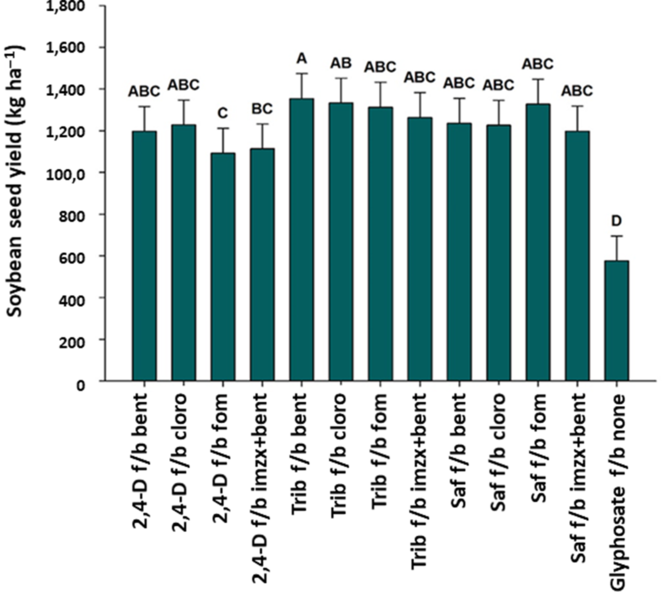
Soybean seed yield in response to PRE and POST herbicide treatments. Error bars represent the SE of the means. Means not sharing the same letters are significantly different by the LSD test at the 5% level of significance. Abbreviations: bent, bentazon; cloro, cloransulam-methyl; f/b, followed by; Fom, fomesafen; imzx+bent, imazamox + bentazon; Saf, saflufenacil; Trib, tribenuron.

There was a significant site-year by treatment interaction (P < 0.001) for soybean seed yield (Table 5), but the contribution of site-year by treatment covariance parameter estimates of total variance was relatively low (<10%). Therefore, site-years were combined for analysis. There were differences among herbicide treatments for soybean seed yield, with the lowest seed yield in the glyphosate-treated control (Figure 2). All the other herbicide treatments had greater yields than the control, indicating better weed control. Of the herbicide combinations, the lowest seed yield was found in 2,4-D fb fomesafen (1,093 kg ha−1), and 2,4-D fb bentazon plus imazamox (1,114 kg ha−1), which were significantly different from the tribenuron fb bentazon treatment, which produced the greatest soybean seed yield (1,354 kg ha−1). After the latter treatment, greatest soybean yield was obtained with the tribenuron fb cloransulam-methyl, saflufenacil fb fomesafen, tribenuron fb fomesafen, and tribenuron fb imazamox plus bentazon treatments, which were 174%, 176%, 177%, and 178% greater, respectively, than herbicide treatment of glyphosate applied alone (576 kg ha−1).
Soybean is not resistant to 2,4-D and can cause crop injury and subsequent yield decline (Johnson et al. Reference Johnson, Fisher, Jordan, Edmisten, Stewart and York2012; de Oliveira et al. Reference de Oliveira, Kusano, Pacheco, Nardelli, Da Rui, Da Silva, Teodoro and da Silva Junior2015). Therefore, 2,4-D has the potential to cause unacceptable crop injury when the crop is seeded too soon after PRE application of this product. Although unacceptable visual injury was not observed, soybean biomass and yields after 2,4-D application in our study were likely lower than with other PRE treatments because of soil and environmental conditions. 2,4-D degrades slower in soils with low organic matter, low microbial biomass, and low pH (Voos and Groffman Reference Voos and Groffman1997; Kah et al. Reference Kah, Beulke and Brown2007). All the sites in Saskatchewan had relatively low organic matter content, ranging from 2.4% to 3.5%, whereas Carman (in Manitoba) had an organic matter content of 6% (Table 1). 2,4-D degradation also tends to be slower in cold, dry soils, whereas warm soils with adequate moisture tend to degrade 2,4-D faster (Foster and McKercher Reference Foster and McKercher1973; Johnson et al. Reference Johnson, Lavy and Gbur1995). In 2014, the average temperature was lower than the long-term average at all sites, and precipitation was lower at most sites. Cold, dry soils and low organic matter content at many sites likely slowed the degradation of 2,4-D and may have contributed to below-expected yields.
Volunteer Canola Biomass and Seed Contamination
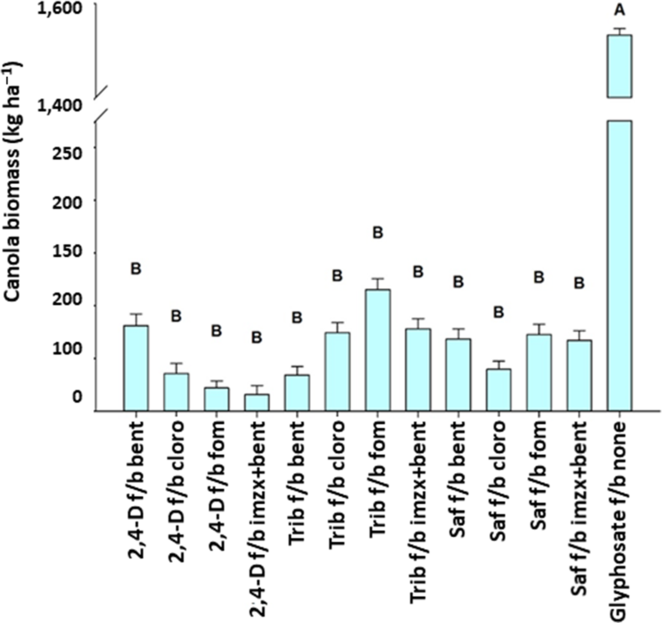
Significant site-year by treatment interactions for volunteer canola-shoot biomass and seed contamination were primarily due to low volunteer canola-shoot biomass values and nonsignificant treatment differences at Indian Head in 2014 (Table 5). Volunteer canola-shoot biomass was greatest in the glyphosate treated control (1,533 kg ha−1), which was expected because glyphosate alone will not control GR volunteer canola. Compared with the control, all the other herbicide mixtures provided greater than 92% canola biomass reduction. Yet, none of the herbicide treatments exhibited any differences between each other with regard to canola biomass. Volunteer canola-shoot biomass was numerically greatest in treatments containing tribenuron fb fomesafen, 2,4-D fb bentazon, and tribenuron fb bentazon plus imazamox (Figure 3). Still, these treatments resulted in 115, 81, and 78 kg ha−1 of volunteer canola shoot biomass, respectively, which is a 92%, 94%, and 95% reduction, respectively compared with the control.
Volunteer canola biomass in response to PRE and POST herbicide treatments. Error bars represent the SE of the means. Means not sharing the same letters are significantly different by the LSD test at the 5% level of significance. Abbreviations: bent, bentazon; cloro, cloransulam-methyl; f/b, followed by; Fom, fomesafen; imzx+bent, imazamox + bentazon; Saf, saflufenacil; Trib, tribenuron.

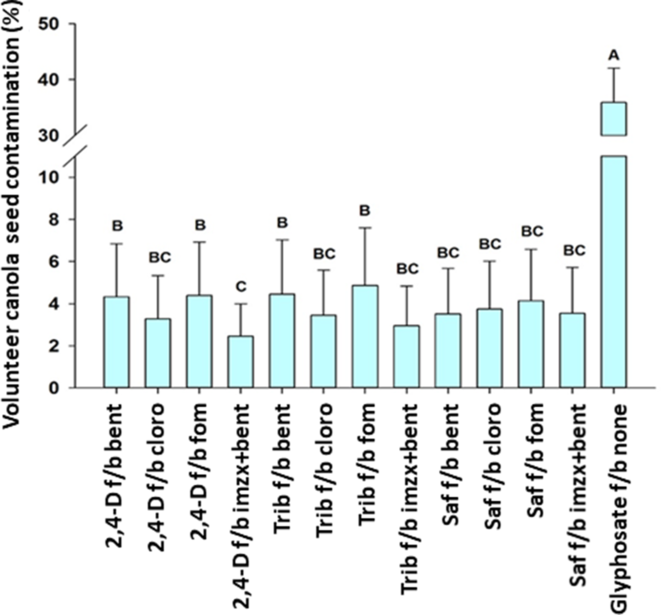
The trend for canola seed contamination was similar to that of volunteer canola-shoot biomass, in which treatments of glyphosate alone had the highest percentage of canola seed present in the harvested sample (36%) (Figure 4). All the herbicide combinations had significantly lower canola seed contamination than the glyphosate-treated control. The fewest volunteer canola seeds were present in the 2,4-D fb bentazon plus imazamox treatment (2%). This treatment also had very high soybean-shoot biomass and low volunteer canola-shoot biomass and differed with treatments of 2,4 D fb bentazon or fomesafen, as well as tribenuron fb bentazon or fomesafen treatments.
Volunteer canola seed contamination in response to PRE and POST herbicide treatments. Error bars represent the SE of the means. Means not sharing the same letters are significantly different by the LSD test at the 5% level of significance.

Germination of weed seeds such as volunteer canola depends heavily on environmental conditions in the spring. In years when spring conditions are not conducive to early weed emergence, the majority of volunteer canola likely will not have emerged by the time of PRE herbicide applications (Lawson et al. Reference Lawson, Van Acker and Friesen2006). Therefore, a POST herbicide application is critical to control most of the volunteer canola that has emerged after the PRE application, and to control multiple flushes of volunteer canola throughout the growing season. When GR volunteer canola is present in GR soybean crops, applying both a PRE and POST herbicide is necessary. This will likely result in a higher herbicide cost for growers, but PRE applications alone may not sufficiently control volunteer canola. Moreover, volunteer canola densities may be too high by the time the POST herbicide is applied to rely solely on POST applications.
Volunteer canola-seed contamination is an important issue because it may cause dockage in a soybean crop, thereby reducing the grade of soybean. It can also contribute to seedbank replenishment and further perpetuation of the volunteer canola population. Volunteer canola can persist in low densities in soil 4 to 5 y after seed production (Simard et al. Reference Simard, Légère, Pageau, Lajeunesse and Warwick2002). We found that treatments of glyphosate alone resulted in canola-seed contamination of 36%, which would effectively replenish and expand the seedbank. In contrast, most of the other herbicide treatments resulted in low levels of volunteer canola-seed contamination (2% to 5%), likely due to a reduction in seed production per unit area. It is evident that effective control of volunteer canola in soybean is critical not only to avoid soybean yield losses but also to reduce canola seedbank inputs.
All the PRE and POST mixtures used in this study provided effective control of volunteer canola compared with the glyphosate-only control. However, based on herbicide costs alone, the most cost-effective options for producers are tribenuron fb cloransulam-methyl or saflufenacil fb cloransulam-methyl, because both combinations cost approximately $42 ha−1. However, cloransulam-methyl is currently not registered in western Canada and thus cannot be used. Tribenuron fb imazamox plus bentazon, as well as saflufenacil fb imazamox plus bentazon, cost approximately $51 and $52 ha−1, respectively. Considering this, the most efficacious and economical options registered for use would be tribenuron fb bentazon and tribenuron fb imazamox plus bentazon.
Although many of the herbicide combinations we studied were both efficacious and economical for control of volunteer canola, producers in western Canada need to consider management of other weed species when making their herbicide decisions. For example, weed species that have developed resistance to both Group 9 and Group 2 herbicides will not be controlled in-crop by POST applications of cloransulam-methyl and glyphosate, regardless of PRE herbicide. Kochia [Bassia scoparia (L.) A. J. Scott] resistant to Group 2 and 9 herbicides has been reported in the prairies (Beckie et al. Reference Beckie, Gulden, Shaikh, Johnson, Willenborg, Brenzil, Shirriff, Lozinski and Ford2015). Moreover, wild oat (Avena fatua L.), green foxtail [Setaria viridis (L.) P. Beauv.] and cleavers (Galium aparine L.) are predicted to be the next weed species to develop glyphosate resistance (Beckie Reference Beckie2010). Resistance to Group 2 herbicides on the prairies has already been reported in all three of these weed species (Beckie Reference Beckie2014). In our study, two of the herbicides used were Group 2 herbicides (tribenuron and cloransulam-methyl). However, there are options from other herbicide groups with different modes of action. Bentazon is a Group 6 photosynthetic-inhibitor herbicide and there are no currently reported cases of Group 6–resistant weeds in western Canada. In addition, saflufenacil is a Group 14 protoporphyrinogen-inhibiting herbicide. Currently, the only reported case of Group 14 resistance is in wild oat in Manitoba (Beckie Reference Beckie2014). Evans et al. (Reference Evans, Tranel, Hager, Schutte, Wu, Chathamb and Davis2016) found that mixing herbicide groups was strongly linked in reducing selection for glyphosate resistance in weeds and mixing three or more modes of action annually resulted in delayed herbicide resistance. Fields receiving herbicide mixes containing three modes of action were also 51 times less likely to have GR weeds than fields on which herbicides with only two modes of action were used. The herbicide combinations in our study that contained at least three modes of action were treatments in which glyphosate was tank-mixed with a POST application of imazamox plus bentazon (Groups 2 and 6). Including saflufenacil as a PRE herbicide with this combination would mean four different modes of action were applied in a single year, which is beneficial for resistance management. Furthermore, evolution of resistance for POST herbicides is faster than for the PRE herbicides (Somerville et al. Reference Somerville, Powles, Walsh and Renton2017). Use of PRE herbicide in combination with POST herbicides can delay the development of resistance in weeds for the POST due to early control of weeds (Karla et al. Reference Karla, Ronald and Walters2019).
In conclusion, volunteer canola control generally ranged from suppression to control across most herbicide treatments used in this study. Most treatments included in the study provided good control of volunteer canola and low level of crop injury, with similar seed yield. However, the lowest cost was observed in the tribenuron fb cloransulam-methyl treatment. Unfortunately, cloransulam-methyl is currently only registered for use in eastern Canada and cannot be used in western Canada at this time. Considering this, the next most efficacious and economical options for producers would be tribenuron fb bentazon and tribenuron fb imazamox plus bentazon, both of which are currently registered for use in western Canada.
Acknowledgments
The authors thank the Western Grains Research Foundation, the Agriculture Development Fund of the Saskatchewan Ministry of Agriculture, Pioneer Hi-Bred, and Monsanto for graciously funding the research. We also thank the University of Saskatchewan for in-kind support, including facilities and technical support staff. This work would not have been possible with the collective efforts of all technical support staff at the various locations. No conflicts of interest have been declared.