I. INTRODUCTION
François Quesnay is generally considered as a founder of economics, though his view of industry as a “sterile” sector is criticized by many scholars. Adam Smith ([Reference Smith, Campbell and Skinner1776] 1976, pp. 663–688) evoked the physiocratic system and the Tableau. Karl Marx (Reference Marx2000, p. 319) considered that the idea of representing the economy through a tableau “was an extremely brilliant conception” and gave his own version of the Tableau.Footnote 1 Léon Walras (Reference Walras1988, pp. 601–606) examined the physiocratic doctrine in his Éléments d’Économie politique pure. Wassily Leontief (Reference Leontief1941) acknowledged a relation between his input-output table and Quesnay’s Tableau. Quesnay’s Tableau also influenced Piero Sraffa (Reference Sraffa1960, p. 93) and growth models of Harrod-Domar type (Eltis Reference Eltis, Rampa, Stella and Thirlwall1998).
Some scholars still wonder about the feasibility of the exchanges described by the Tableau or even criticize Quesnay (Blaug Reference Blaug1973, p. 35; Samuelson Reference Samuelson, Bradley and Howard1982, p. 68). Relying on Philosophie rurale (Mirabeau, Quesnay, and Butré Reference Riqueti Victor, Quesnay and Butré1763, Reference Riqueti Victor, Quesnay, Dupuy and Le Masne2014), we show that the Tableau is indeed a coherent construction. The Tableau evolved and reached a mature form only in Philosophie rurale and in later texts, Elémens de la Philosophie rurale (Mirabeau and Quesnay Reference Riqueti Victor and Quesnay1767) and Physiocratie (Quesnay Reference Quesnay and Du Pont1767–68). Long misunderstood, Philosophie rurale has been the object of a progressive rediscovery beginning with Ronald Meek (Reference Meek1963).
Meek (Reference Meek1963, pp. 138–149) provided clarification on the Tableau of Philosophie rurale, as later did Steven Pressman (Reference Pressman1994), Walter Eltis (Reference Eltis1996, Reference Eltis2002), and Lars Herlitz (Reference Herlitz1996). Christine Théré, Loïc Charles, and Jean-Claude Perrot (editors of the 2005 Œuvres de Quesnay) analyzed the manuscripts of Philosophie rurale and highlighted the contribution that Charles Richard de Butré made to the book. Albert Steenge and Richard van den Berg (Reference Steenge and van den Berg2007) relied on Philosophie rurale to make an input-output analysis à la Quesnay. In the 2014 re-edition of Philosophie rurale, the first critical re-edition since the eighteenth century (with the name of Butré on the book cover), editors Romuald Dupuy and Pierre Le Masne (Reference Dupuy, Le Masne, Mirabeau and [Richard de]2014) provided explanations on the forty tableaux of the book. Branko Milanovic (Reference Milanovic2015) used chapter VII of Philosophie rurale for measuring the distribution of income, and his study shows the interest of Quesnay’s data.
In the present article, we extend the rediscovery of Philosophie rurale. We show how the Grand Tableau is deducted from chapter VII of Philosophie rurale. The accounts of chapter VII and the Grand Tableau are transposed in two ways: first, into two input-output tables that explain the treatment of intermediate consumptions; and, second, into three double-entry accountings that allow a better understanding of the exchanges along the year.
The transposition of Quesnay’s Tableau into input-output tables leads us to establish relations between physiocratic accounting and modern national accounting. Though Quesnay’s accounting focuses on net product (“produit net”) and national accounting focuses on value added, it is possible to move from the former to the latter. The details of the Tableau are understandable, but it is necessary to choose a definite tableau and avoid mixing details from different tableaux. We ask precise questions on the Grand Tableau of Philosophie rurale: What are the various advances made of—original advances (“avances primitives”), annual advances (“avances annuelles”), sterile advances (“avances stériles”)? How are intermediate consumptions introduced? What could be the equivalent of Quesnay’s net product and interest (“intérêt”) in modern national accounting? Do farmers and agricultural workers consume industrial products; and do the members of the sterile class? What is the amount of money supply and how does it circulate during a year? Our answers introduce several elements complementary to another work (Le Masne Reference Le Masne2016) dedicated to the similarities between Quesnay’s Tableau and Leontief’s model.
The three classes are called “class of proprietors,” “productive class,” and “sterile class.” In the accounts of Philosophie rurale, the productive class is broken down into two sub-groups, farmers and agricultural wage-earners, and we use this decomposition.
The first section contains a presentation of the zigzag Grand Tableau. It shows the difference between the Grand Tableau and the “Précis,” a new form of tableau introduced in Philosophie rurale. In the second section, we transpose the accounts of chapter VII into two input-output tables, the second of which corresponds to Quesnay’s Tableau. We analyze precisely the composition of the agricultural advances and explain the way Quesnay treats intermediate consumption. We show that Quesnay’s economy is as a modern economy, with salaries and agricultural or industrial products purchased on markets. The third section transposes Quesnay’s Tableau into three double-entry accountings (proprietors, farmers, and artisans). The exchanges are followed all year long. We demonstrate that these exchanges are possible and that the money supply indicated by Quesnay (two billion livres tournois) is sufficient.
II. THE EVOLUTION OF QUESNAY AND THE TABLEAU OF PHILOSOPHIE RURALE
The Successive Versions of the Tableau
The history of the Tableau is convoluted, with different tableaux and different forms.Footnote 2 The first zigzag version (Quesnay Reference Quesnay, Théré, Charles and Perrot2005, pp. 397–403) was developed in late 1758, the second zigzag version in early 1759 (Quesnay Reference Quesnay, Théré, Charles and Perrot2005, pp. 404–411), and the third zigzag version in summer 1759 (Quesnay Reference Quesnay, Théré, Charles and Perrot2005, pp. 412–438). The fourth version, Tableau oeconomique avec ses explications, was published in 1760 (Quesnay Reference Quesnay, Théré, Charles and Perrot2005, pp. 412–438). The fifth version given in Philosophie rurale (1763) introduced a new form of the Tableau, the Précis. A last form of the Tableau (Analyse de la formule arithmétique du Tableau) appeared in Elémens de la Philosophie rurale (Mirabeau and Quesnay Reference Riqueti Victor and Quesnay1767) and Physiocratie (Quesnay Reference Quesnay, Théré, Charles and Perrot2005, pp. 545–635) but the economy remains the same as in Philosophie rurale. “Physiocratie” refers to chapter VII of Philosophie rurale (Quesnay Reference Quesnay, Théré, Charles and Perrot2005, p. 556). Quesnay’s successive modifications of the Tableau did reflect difficulties, which he tried to correct. Considering the various changes in hypotheses, no single tableau can constitute a synthesis of all of them (Lars Herlitz Reference Herlitz1961, Reference Herlitz1996).
In 1763, Philosophie rurale provided important changes. Detailed accounts of agriculture were introduced. While the Tableau Économique avec ses explications took account of foreign trade (Quesnay Reference Quesnay, Théré, Charles and Perrot2005, p. 453), Philosophie rurale did not (PR Footnote 3 1763, p. 126; 2014, p. 256). Furthermore, the reflection on intermediate consumption was deepened. The Tableau of Philosophie rurale considered only the economic operations that contribute to the creation of net product.
The Grand Tableau and the Précis of Philosophie rurale
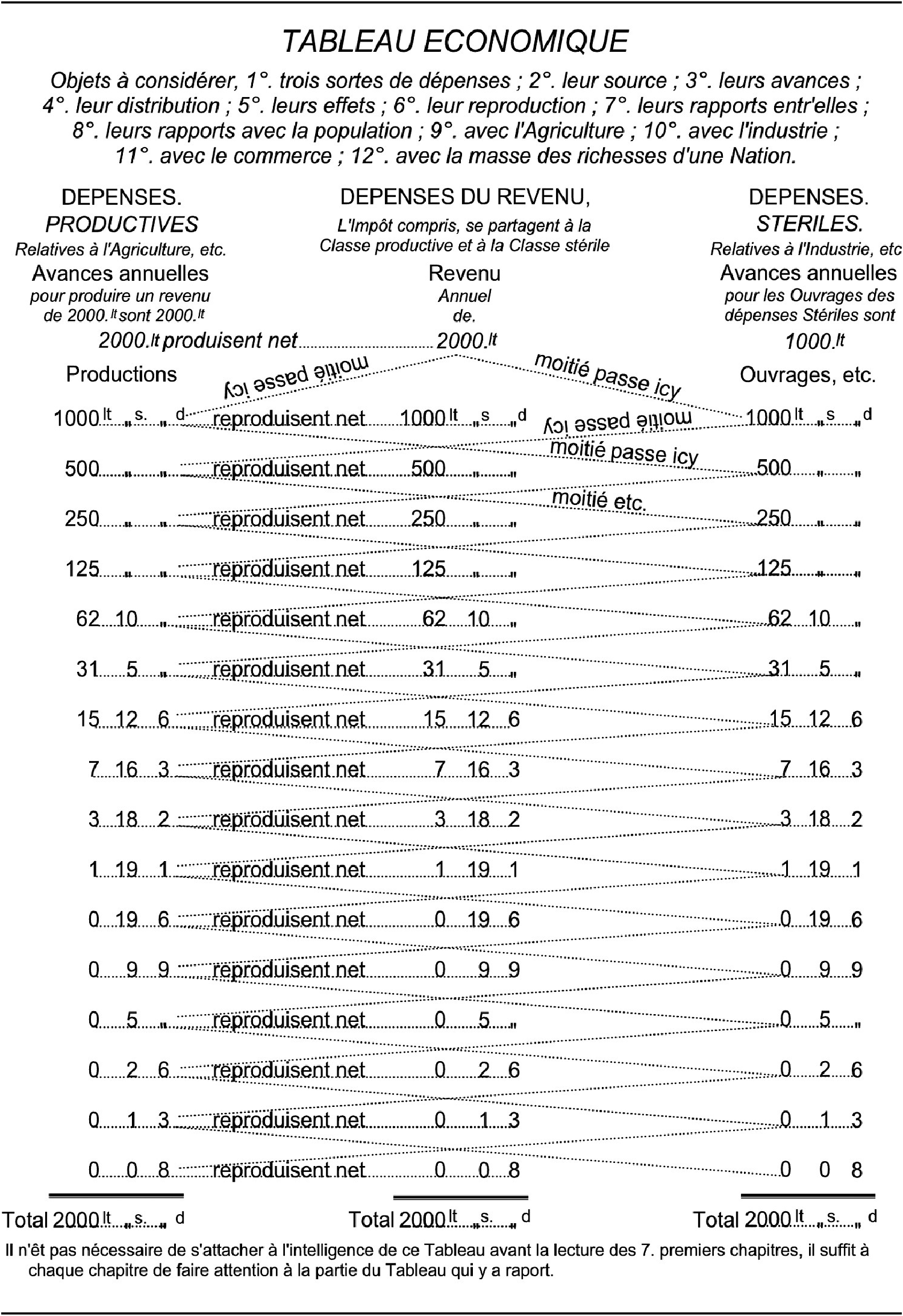
The Grand Tableau of Philosophie rurale (Table 1) is represented under a zigzag from the French economy, more precisely its essential part that gives net product (“produit net” or “revenu”). The title of the central column of proprietors, “Dépense du revenu” (“expenditure of net product”), indicates that the net product and its circuit are at the core of analysis. The Tableau distinguishes “production” and “circulation,” and focuses on “circulation.” The “production” is mentioned with horizontal dotted lines starting from the advances of the productive class and leading to the net product.Footnote 4 The advances of the sterile class are not connected to the column of proprietors. These advances have no productive dimension for Quesnay.
THE GRAND TABLEAU Of PHILOSOPHIE RURALE (2,000 LIVRES OF NET PRODUCT)

The Tableau constitutes a model of potential national income (Paul Studenski Reference Studenski1958, p. 62). Agriculture has a gross production of 5,000 million (livres tournois) and a net product of 2,000 million. The transition to large-state cultivation is achieved with a net product rate (net product/annual advances) of 100%.
At the beginning of the year, the annual advances of the farmers consist of a money capital of 2,000, which will be paid to proprietors and then recovered progressively by farmers during the year. According to the Tableau, these advances paid to proprietors launch the economic circuit (PR 1763, p. 23; 2014, p. 100). Proprietors spend 1,000 in favor of the productive class and 1,000 in favor of the sterile class.
The productive class and the sterile class exchange their products via money payments. The advances of the sterile class (1,000) are fixed to a quarter of the sum of the advances of the productive class (2,000) and of the net product (2,000) (PR 1763, p. 117; 2014, p. 241).Footnote 5 The original advances of the sterile class are not considered.Footnote 6
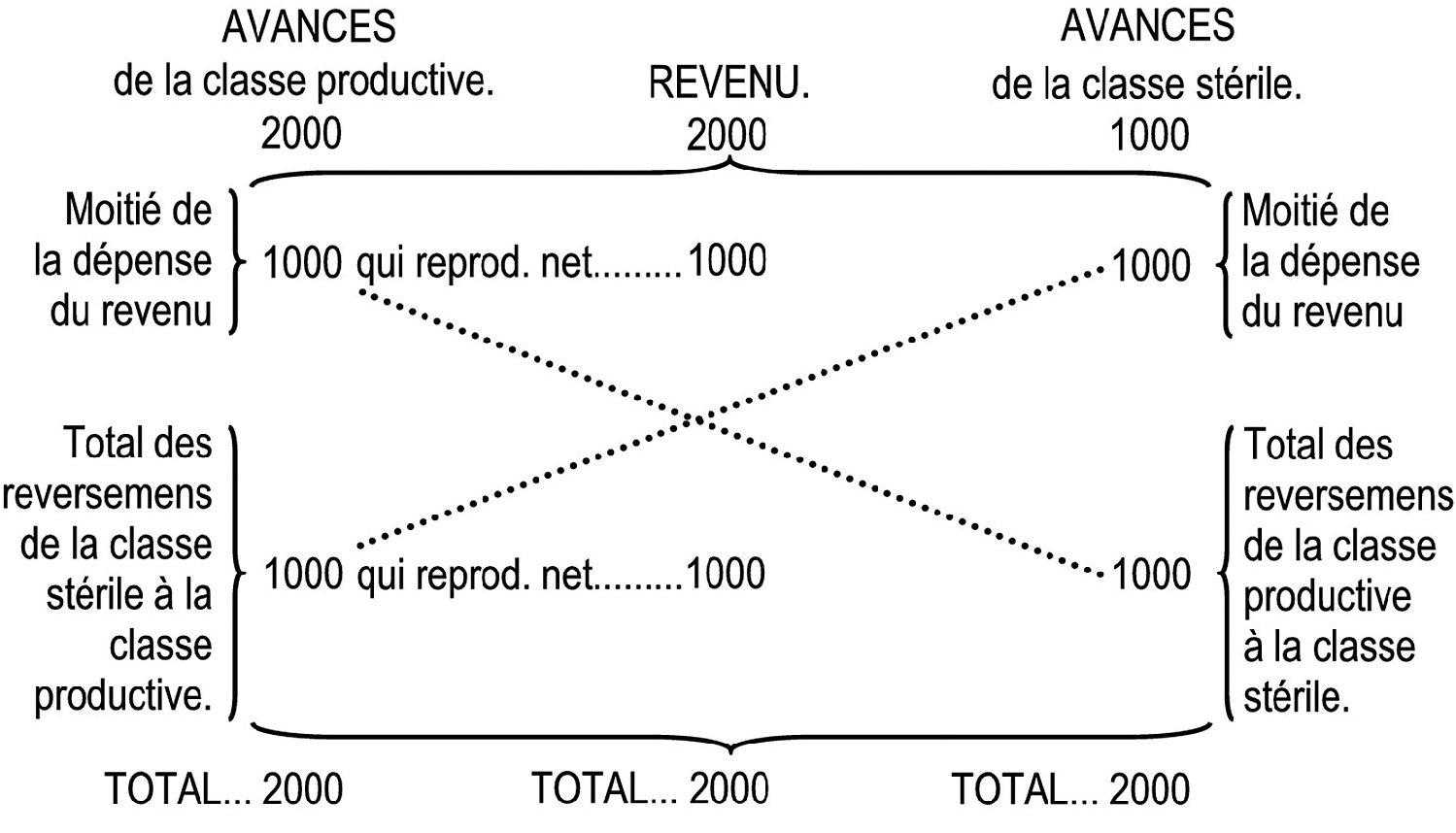
The Précis of Philosophie rurale (Table 2) is composed of a main part and two additional parts that add elements that were absent in the Grand Tableau.
PRÉCIS OF PHILOSOPHIE RURALE (2,000 LIVRES OF NET PRODUCT, CHAPTER IV)
PRÉCIS DES RESULTATS DE LA DISTRIBUTION REPRESENTEE DANS LE TABLEAU

La reproduction totale est égale à toutes les sommes qui se réunissent et se dépensent à la classe productive, Sçavoir ;

The main part of the Précis shows the Grand Tableau in a simplified form. The top line of the Précis displays the advances of the productive class (2,000), the net product (“revenu”) for proprietors (2,000), and the advances of the sterile class (1,000). The numbers between the two bold horizontal braces represent the flows between the three classes of society. The left-hand flows are regarding the productive class. The top number (1,000) represents the purchases of proprietors to the productive class. The bottom number (1,000) represents the purchases of the sterile class to the productive class, made with the 1,000 sales of the sterile class to proprietors.
The first additional part of the Précis explains in detail the total reproduction. The reproduction of 5,000 is the agricultural production of the year. A second additional part appears at the bottom of the Précis with the title “Total Mass of the Riches of the Tableau.” The total riches of the economy (8,000) are the sum of agriculture reproduction (5,000), money to pay the net product (2,000), and advances of the sterile class (1,000).
III. TRANSPOSITION OF THE ACCOUNTS OF PHILOSOPHIE RURALE INTO TWO INPUT-OUTPUT TABLES
The Accounts of Philosophie rurale
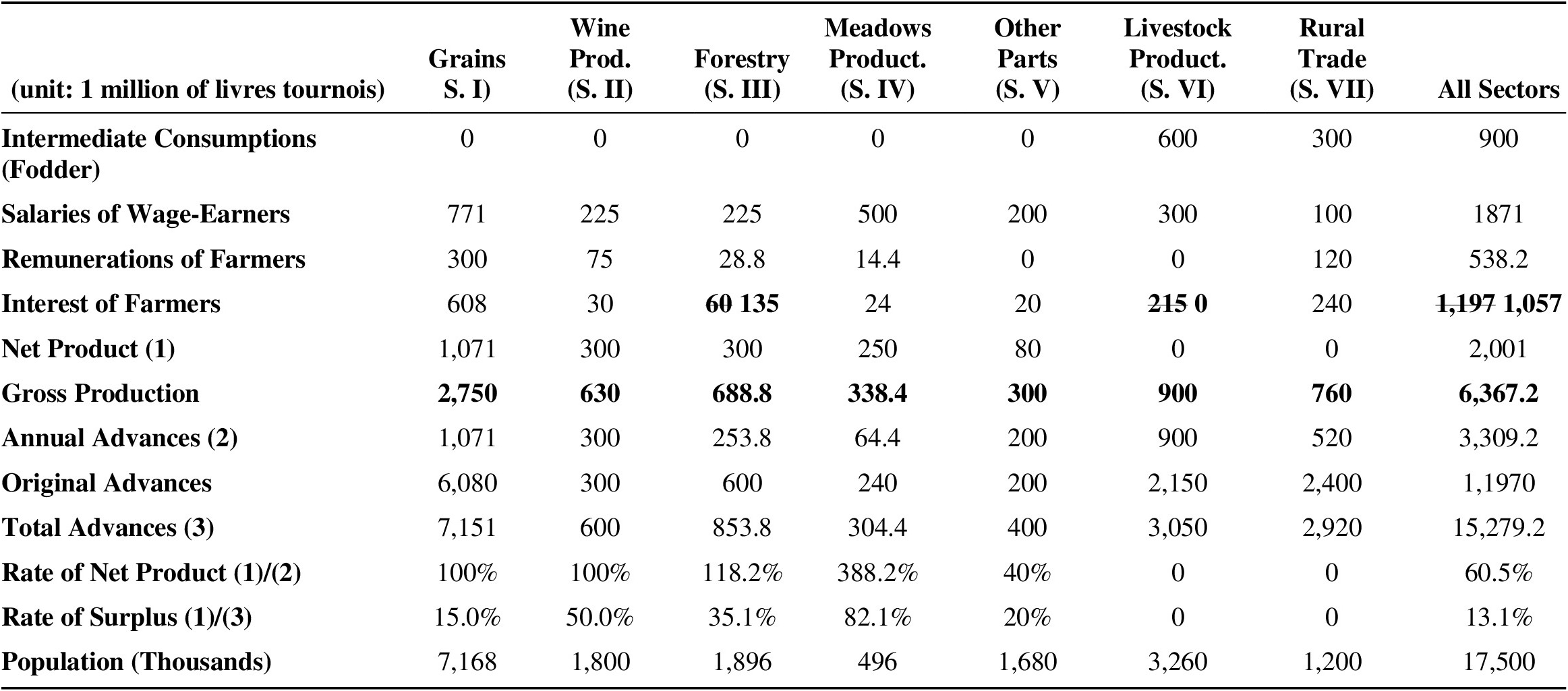
The accounts of chapter VII of Philosophie rurale are given in the modern form of a dozen tables (PR 1763, pp. 128–140; 2014, pp. 259–280) relative to the seven sectors of agriculture and to the general resources and uses of agriculture. The sectors of agriculture are: Grains, Wine Production, Forestry, Meadows Production, Other Parts (Mining and Fishing), Livestock Production, and Rural Trade. Philosophie rurale gives the elements of the gross production of each sector and the total gross production of 6.3672 billion (livres).
Considering the fodder expenditures as intermediate consumptions, a distribution of the expenditures into five elements is given: intermediate consumptions, salaries of the wage-earners, remunerations (“rétributions”) of the farmers, interest of the farmers, and net product.Footnote 7 We can easily reconstitute the accounts of five sectors, but two sectors contain errors: Forestry and Livestock Production. Box 1 explains the errors. Our corrections are made to keep the total gross production of 6.3672 billion (PR 1763, p. 139; 2014, p. 278). Other Parts and Livestock Production do not deliver remunerations to the farmers.Footnote 9 Before our corrections, Table 3 is very similar to the accounts of Branko Milanovic (Reference Milanovic2015).Footnote 10 Annual advances represent 21.6% of total advances.
The Accounts of Agriculture (Chapter VII) and Corrections Made
The first error affects Forestry (PR 1763, p. 134; 2014, pp. 271–272): an amount of 75 is lacking in the 688.8 total. The second error concerns Livestock Production (PR 1763, pp. 136–137; 2014, pp. 274–275): the gross production of 900 million is the total of fodder (600) and salaries (300). This sector also includes an interest that cannot be pulled out of the 900 million. Philosophie rurale asserts that this interest can be found in other sectors (PR 1763, p. 137; 2014, p. 274), which is wrong. The 215 interest is in fact included in the total interest of farmers (1,197) but not in the interest of the other six sectors.
On the one hand, an amount of 75 is missing in Forestry, and on the other hand an interest of 215 is not registered in Livestock Production. Both errors are partly compensated. An amount of 75 interest is registered in Forestry and the Forestry interest grows from 60 to 135.Footnote 8 The 215 interest of Livestock Production has now a counterpart for 75. An interest of 140 remains without counterpart: therefore, the total interest of farmers is reduced by 140 (1,057 instead of 1,197). The amended figures in Table 3 are crossed out and replaced by new figures.
Quesnay noticed an error in the accounts of chapter VII, which he tried to correct in Elémens de la Philosophie rurale. The correction appears by comparing Elémens (Mirabeau and Quesnay Reference Riqueti Victor and Quesnay1767, p. 170) to Philosophie rurale (PR 1763, p. 138; 2014, p. 277). Quesnay introduced collective meadows (“dépaîtres”) in order to find a new resource, but the correction is not satisfactory.
ACCOUNTS OF AGRICULTURE (CHAPTER VII, PHILOSOPHIE RURALE)

Transposition of the Accounts of Chapter VII and of the Tableau into Input-Output Tables
The idea to transpose Quesnay’s Tableau into an input-output table dates back to Almarin Phillips (Reference Philipps1955). Phillips, who relies on the Tableau of Physiocratie, makes no distinction between intermediate and final flows. Tibor Barna (Reference Barna1975) considers that Phillips’s presentation is not in accordance with Quesnay, particularly because intermediate and final flows are aggregated. Barna provides detailed accounts (from the summer 1759 Tableau) and distinguishes intermediate and final flows. Barna’s input-output table represents important progress.
The transposition by Paul Samuelson (Reference Samuelson, Bradley and Howard1982), based on Philosophie rurale and Physiocratie, leads to a three-sectors input-output table. Samuelson (Reference Samuelson, Bradley and Howard1982, pp. 57–58) rightly considers that proprietors do not produce and nevertheless have a final consumption. But he merges intermediate and final flows (of the productive and sterile class), so that one does not know what the final consumptions of these two classes are. However, Philosophie rurale, to which Samuelson refers, specifies that wage-earners receive salaries (1,871 million, see Table 3) and that farmers receive remunerations (538.2 million). How can they spend their salaries and remunerations without final consumption? While neglecting the final consumption (of the productive and sterile class), Samuelson departs from Quesnay’s economic model.
Our transposition is similar to Barna’s on several points, but we examine the intermediate consumptions in more detail. We also consider that part of the farmers’ investment is coming from industry.
Productive and sterile classes are active (PR 1763, pp. 24, 49, 265; 2014, pp. 100, 145, 468). Proprietors are not active (Quesnay Reference Quesnay, Théré, Charles and Perrot2005, p. 218) and they receive a transfer income from the farmers. Thus, we consider only two activity sectors: Agriculture and Industry. Within Agriculture, we distinguish, as Philosophie rurale does, farmers (who receive remunerations) from wage-earners (who receive salaries). Farmers and wage-earners buy agricultural and industrial products. The sterile class has receipts allowing them to buy agricultural and industrial products. However, their production of industrial products for themselves is not recorded in the Tableau: it does not in fact generate net product.
Original advances represent the capital necessary for a farmer who settles down in a farm for around ten years (a nine-years lease plus a ten-month period until harvest time). In most French regions, the new farmer arrives at the farm on November 11 (Saint Martin’s Day, calendar year n), while the previous farmer sowed in October and will come back to harvest for himself in July (n + 1). The new farmer will sow in October (n + 1) and harvest his first wheat in July (n + 2) (see PR 1763, p. 240; 2014, p. 429; Butré Reference Butré[Richard de]1781, pp. 23–26). Original advances represent the necessary elements for the farmer to live until summer (n +2): subsistences, fodder, and seeds for October (n + 1).Footnote 11 Original advances also include the household furnishings of the farmer and the capital necessary for the exploitation of the farm. They consist in industrial instruments such as plows or leather harnesses as well as horses, oxen, or sheep (PR 1763, pp. 29–30; 2014, pp. 109–110). Livestock represents the greater part of exploitation capital (PR 1763, p. 33; 2014, p. 115). To maintain original advances, farmers use their “interest.” Interest is a part of production.
“Interest” has a specific sense, and the Physiocrats consider that agriculture alone generates interest (PR 1763, p. 105; 2014, pp. 225–226). Every year, farmers literally pull out of the ground “their costs, their remunerations and the interest of their advances” (PR 1763, p. 80; 2014, p. 191). The interest, which represents 10% of the farmer’s advances, is not a freely available income but a reserve. It is at the same time resource and use (Mirabeau and Quesnay Reference Riqueti Victor and Quesnay1767, pp. 230–231). The maintenance of original advances represents 5% (PR 1763, pp. 139–140; 2014, pp. 280), but this reserve may also be used for the other 5% in case of illness of the farmer (PR 1763, p. 80; 2014, pp. 190–191) or occasional loss (PR 1763, p. 406; 2014, p. 681). If there is no loss, the other 5% may be added to the original advances. The maintenance of original advances depends on circumstances, and correspondence with a depreciation expense or consumption of fixed capital is not simple. A great part of original advances consists of the livestock, whose maintenance depends on such events as sudden epidemics. In case of an epidemic, the whole interest is used to maintain the original advances. Let us assume that the interest is entirely (10%) a consumption of fixed capital (CFC).Footnote 12 The third section of the article deals with this assumption.
Farmers’ annual advances are expenditures made each year on the farm. They include wage-earners’ salaries, farmers’ remunerations, and other expenditures that we call today “intermediate consumptions.”
Seeds are not considered in Philosophie rurale as annual advances.Footnote 13 Fodder is an annual advance that we consider as intermediate consumption (of horses and oxen), also necessary for rural trade (PR 1763, p. 124; 2014, pp. 253–254).
Philosophie rurale uses two accounting systems. The first one encompasses all the economy’s expenditures, while the second gives only the elements concerning net product. The authors (PR 1763, p. 125; 2014, pp. 254–255)
distinguish the distribution of expenditures in the different types of exploitation from the expenditures of proprietors’ revenue [i.e., net product], and from the expenditures originating in the remuneration of the agents of the productive class and of the sterile class, as it is related in the Tableau. The Tableau confines to the expenditure of the Nation’s revenue and to related expenditures.
The first system displays an extended account of the French economy, with a gross production of 6.3672 billion (livres). Livestock ProductionFootnote 14 and Rural Trade have expenditures (in particular fodder) but do not have net product (PR 1763, pp. 139; 2014, pp. 277–278).
The second accounting system gives a gross production of five billion (livres) only. This reduced system is the basis of the Grand Tableau. The operations concerning Livestock Production and Rural Trade are neutralized, as these sectors do not contribute to net product (PR 1763, p. 137; 2014, pp. 275–276):
These last parts of the productive class which take part in the production of income but which do not produce income (livestock for profit and expenditures related to rural trade) are not included in the Tableau. This Tableau only features the order of the distribution of expenditures and of the reproduction of income by the expenditure of income itself. As they do not produce any income, they cannot enter the Tableau of the distribution and reproduction of incomes. They are only evaluated and added to the mass of annual reproduction in order to complete the detailed and general calculation of products and expenditures.
There are three kinds of commerce between the classes (PR 1763, p. 38; 2014, p. 125): the commerce of proprietors with the productive and sterile classes, the commerce between the productive class and the sterile class, and other exchanges within the productive class (between farmers and wage-earners). Farmers pay wage-earners, and the latter buy agricultural products on various markets. The members of the sterile class buy agricultural and industrial products. The shoemaker buys agricultural subsistence products for his family, and also leather to produce shoes. With the money from shoe sales, he buys industrial products. But the Grand Tableau does not supply an account of the industrial purchases of the sterile class because these purchases have no effect on the net product.
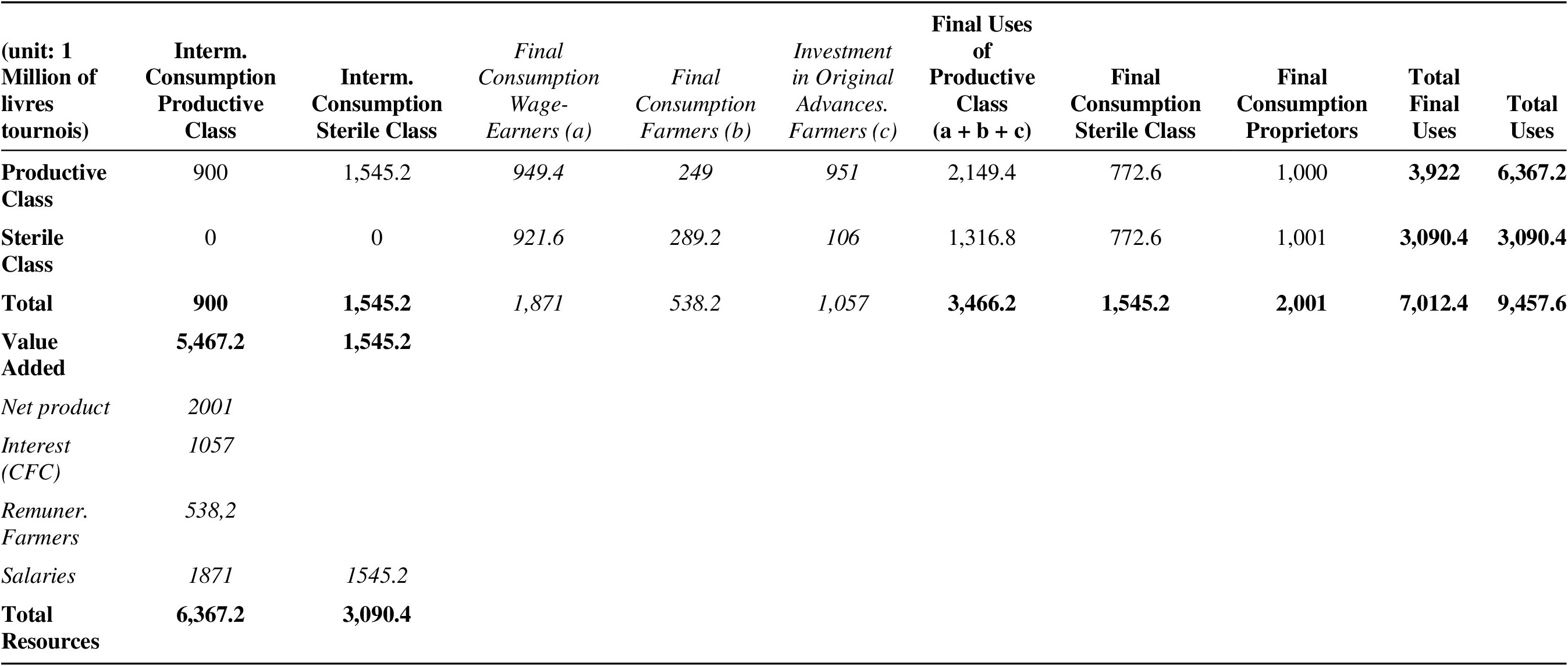
Table 4 and Table 5 give the two input-output tables corresponding to the two systems of accounts (6.3672 billion and five billion). Details are given in Appendix 1 and in Le Masne (Reference Le Masne2016).
INPUT-OUTPUT TABLE OF THE FRENCH ECONOMY (DEVELOPED SYSTEM OF ACCOUNTS)

INPUT-OUTPUT TABLE RELATIVE TO THE GRAND TABLEAU (AGRICULTURAL GROSS PRODUCT OF 5,000)

In relation to Table 3 and Appendix 1, Table 4 gives the input-output table corresponding to the developed system of accounts of Philosophie rurale. Investment is nevertheless derived from Elémens de la Philosophie rurale. In Philosophie rurale, annual investment entirely originates from agriculture without industrial investment. In Elemens de la Philosophie rurale, the authors claim the necessity of an industrial investment to buy new plows (Mirabeau and Quesnay Reference Riqueti Victor and Quesnay1767, pp. 52–53). The accounts of the large-state cultivation farm of Lisoir (northern France), given in Philosophie rurale (PR 1763, pp. 238–239; 2014, p. 426), point out that industrial investment is nearly 10% of total investment. We adopt this proportion.
The resources of the productive class (6,367.2) consist of agricultural intermediate consumptions (900) and of value added (5,467.2): net product (2,001), consumption of fixed capital (1,057), salaries (1,871), and retributions (538.2). The resources of the sterile class (3,090.4) consist half of labor (value added) and half of agricultural raw materials.
The productive class delivers agricultural products to the sterile class as intermediate consumptions (1,545.2) and as subsistences (772.6). It also delivers subsistences to proprietors (1,000). The final consumption of farmers is equal to their remunerations and the final consumption of wage-earners is equal to their salaries.Footnote 15
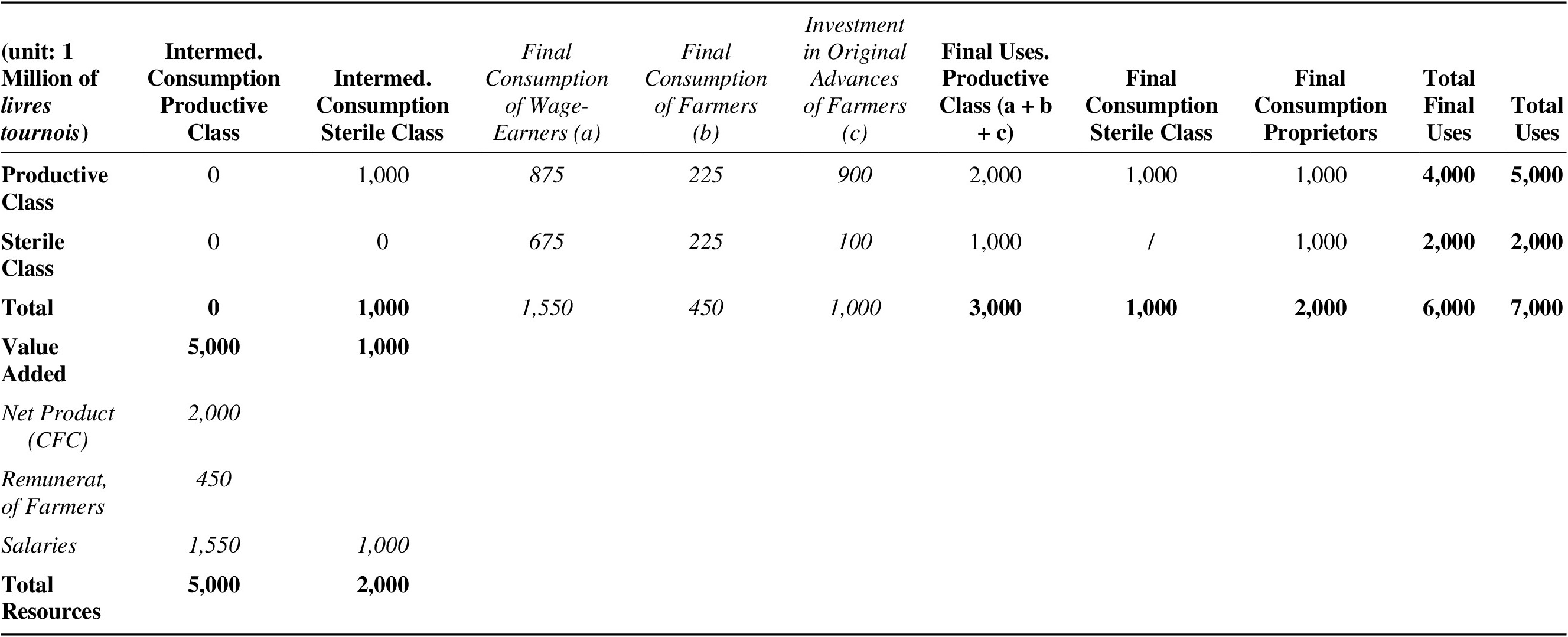
Table 5 gives an input-output table corresponding to the Grand Tableau. The agricultural sector has no intermediate consumptions anymore. Agricultural value added breaks down into salaries (1,550), remunerations (450), consumption of fixed capital (CFC, 1,000), and net product (2,000). The uses of agriculture are the intermediate consumptions of industry (1,000) and the final uses of 4,000 (2,000 for the productive class and 1,000 for each of the two other classes).Footnote 16 The resources of the sterile class (2,000) are its own labor (1,000) and agricultural intermediate consumptions (1,000). The sterile class has total uses of 2,000, delivered to the proprietors (1,000) and to the productive class (1,000). The final consumption of the sterile class in agricultural products is 1,000. Its final consumption of industrial products is not included in Table 5.Footnote 17 Industry does not generate net product: the value of its work equals the cost of the raw materials plus the means of subsistence of its members. The industrial products delivered by the sterile class to the productive class (1,000) concern the investment of farmers (100) and the final consumption of farmers (225) plus agricultural wage-earners (675).
Quesnay’s accounting can be analyzed from the vantage point of today’s national accounting. Without using the term, Quesnay understands the notion of intermediate consumptions. He is consequently close to the notion of value added (difference between gross production and intermediate consumption).Footnote 18 The concept of net product is equally close to “net operating surplus” in national accounting.
The difference between Quesnay’s accounting and national accounting is that the former focuses on net product as the latter focuses on value added. But we can pass from Quesnay’s accounting to national accounting, taking the Grand Tableau given in Table 5 as an illustration:
— The gross value added (GVA) of agriculture (5,000) includes three elements: net product (2,000, net operating surplus or NOS), interest (1,000), and salaries and remunerations (2,000). If the interest is completely used for consumption of fixed capital (CFC), we can write:
GVA (5,000) = NOS (2,000) + CFC (1,000) + (Salaries and Remunerations) (2,000).
— The gross value added of industry (1,000) corresponds to the salaries of the members of the sterile class. The net operating surplus of industry is null. Industry is “sterile” in terms of net product but not in terms of value added.
— The gross value added of the economy is 6,000: net operating surplus (2,000), consumption of fixed capital (1,000), salaries and remunerations (3,000). The total resources of the economy are 7,000, gross value added (6,000), and intermediate consumptions (1,000).
— The share of salaries and remunerations in the gross value added is 40% for agriculture (2,000/5,000) and 50% for the whole economy.
In the Grand Tableau (Table 5), the authors distinguish two kinds of activities: agricultural production giving net product, and industrial production for proprietors and the productive class, without net product. Table 4 entails two other kinds of production, which do not appear in the Grand Tableau: agricultural production without net product (Livestock Production and Rural Trade), and industrial production for the members of the sterile class.Footnote 19
IV. THE GRAND TABLEAU AND DOUBLE-ENTRY ACCOUNTING
Problematic, Progress of the Year, and Structure of Advances
How do exchanges take place during the year? Do the purchasers have at their disposal enough money to pay? Do the sellers have the available products? Time plays an important role in Quesnay’s economy (Schumpeter Reference Schumpeter1954, pp. 238–243; Eltis Reference Eltis, Rampa, Stella and Thirlwall1998), but this does not appear in an input-output table.
Theodor Schmalz (Reference Schmalz1826) produced a double-entry accounting relative to the Tableau. Schmalz’s attempt interested Karl Marx, who wrote to his friend Friedrich Engels:Footnote 20 “A propos! If it can be done in all briefness, without making heavy demands on you, I would wish a paradigm (plus an explanation) of Italian book-keeping. It would be useful in the illumination of the ‘Tableau Economique’ of Dr Quesnay.” Marx did not carry out the idea, but he understood the interest of double-entry accounting to shed light on the Tableau. Schmalz’s accounting is unique. In relation to Table 5, we give the accounting of proprietors, the sterile class, and farmers.Footnote 21
The time span of the three accountings is an agricultural year (n) beginning on November 1 and ending on October 31.Footnote 22 Money supply, called in Table 2 “money of income” (“argent du revenu”) and sometimes “pécule,” amounts to 2,000. The pécule is equal to the net product (PR 1763, p. 396; 2014, p. 666): an amount greater than net product is not necessary for the exchanges.
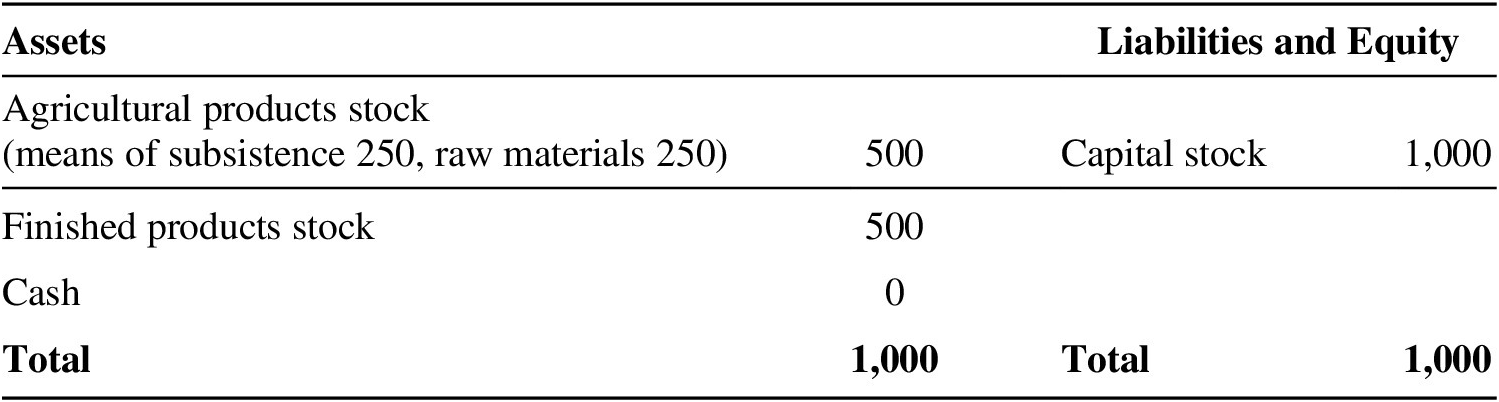
The composition of sterile advances (1,000) must be explained. The money supply of 2,000 is entirely necessary for the payment of the farm rent at the beginning of the year: consequently, sterile advances do not include money at the beginning of the year. Philosophie rurale (PR 1763, p. 406; 2014, p. 681) specifies that annual sterile advances are a “a heap of commodities that the sterile class has to work, of finished products, and of means of subsistence before remuneration.” We assume that sterile advances consist at the beginning of the agricultural year of means of subsistence (250, three months of final consumption), agricultural raw materials (250, three months of stock), and industrial finished products (500, three months of stock). Other amounts are possible.
When are farm rents paid to proprietors? It is usually supposed that farmers pay 2,000 at the beginning of the economic year, in a single payment: in the Grand Tableau, a line connects the net product of farmers (2, 000) to the income of proprietors (2,000). Actually, the reason is not economic but related to the presentation of the Tableau, which Quesnay wants to be as simple as possible. We will stick to this presentation for the moment, supposing that farm rents are paid at the beginning of the year in a single payment. We will reconsider this assumption later.
This assumption introduces a monetary constraint. At the beginning of the year, farmers hold the whole money supply. Proprietors and the sterile class have no liquidity. When farmers have paid farm rents, the productive class and the sterile class have no more liquidity, and proprietors dispose of the whole pécule.
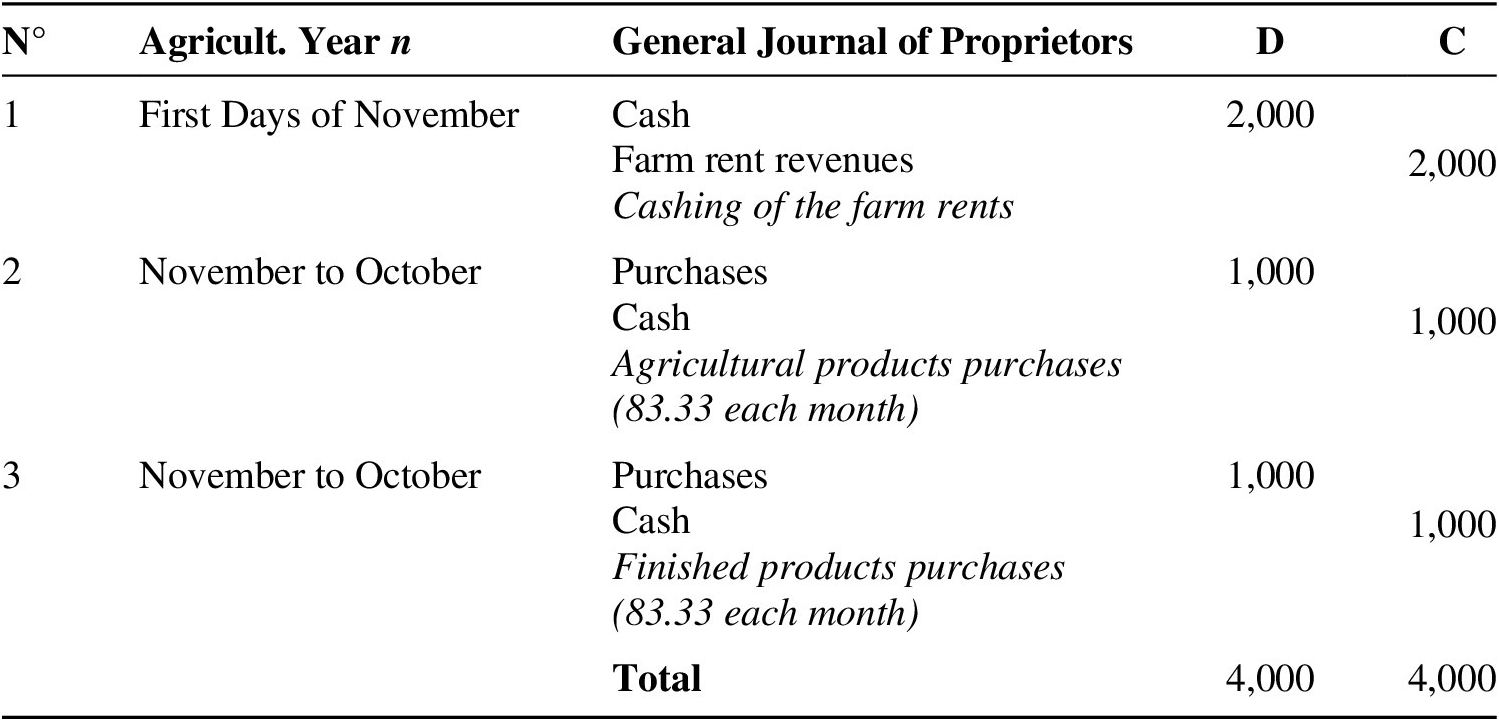
In the first days of November, proprietors receive the farm rent (2,000). They then buy agricultural products from farmers and industrial products from artisans, 83.33 each month: this means, during the whole year, 1,000 to farmers and 1,000 to artisans. These sales constitute receipts for both active classes, which permit their exchanges. Farmers pay wage-earners, and the latter buy means of subsistences; farmers receive remunerations. As soon as they sell finished products, artisans can buy new means of subsistence.
In summer, wheat is harvested. The grape harvest takes place next. The whole harvest, stored at the end of October, has a market value of 5,000 (livres).
The three accountings of an agricultural year (n) are given successively with, for each of them, the names of the accounts and the General Journal. The stocks are computed with the periodic inventory method; stocks inventory is done at the beginning and at the end of the year, but stock accounts are not modified during the year. Purchases of the members of the productive class and of the sterile class on various markets are not registered in the General Journal of farmers and artisans. The purchases of proprietors are registered in the General Journal, considering that their economic activity consists in consuming. For farmers, we write the cash balance after the operations on the right side of the General Journal.
Proprietors and Artisans
Proprietors dispose of three accounts: cash, purchases, and farm rent revenues. On November 1, their cash balance is null.Footnote 23 In the first days of November, the farm rent (2,000) is paid by farmers to proprietors.Footnote 24 Proprietors start buying agricultural products regularly in November: 83.33 each month, 1,000 a year. They also start buying industrial products from the artisans in November: 83.33 each month, 1,000 a year. After these 2,000 worth purchases, the Cash balance of proprietors is brought back to zero (Table 6).
GENERAL JOURNAL OF PROPRIETORS

Artisans dispose of seven accounts: capital stock, cash, agricultural products stock, finished products stock, agricultural products purchases, wages paid, and sales of finished products. The balance sheet of artisans at the beginning of the year (November 1) is given in Table 7.
BALANCE SHEET OF ARTISANS ON NOVEMBER 1

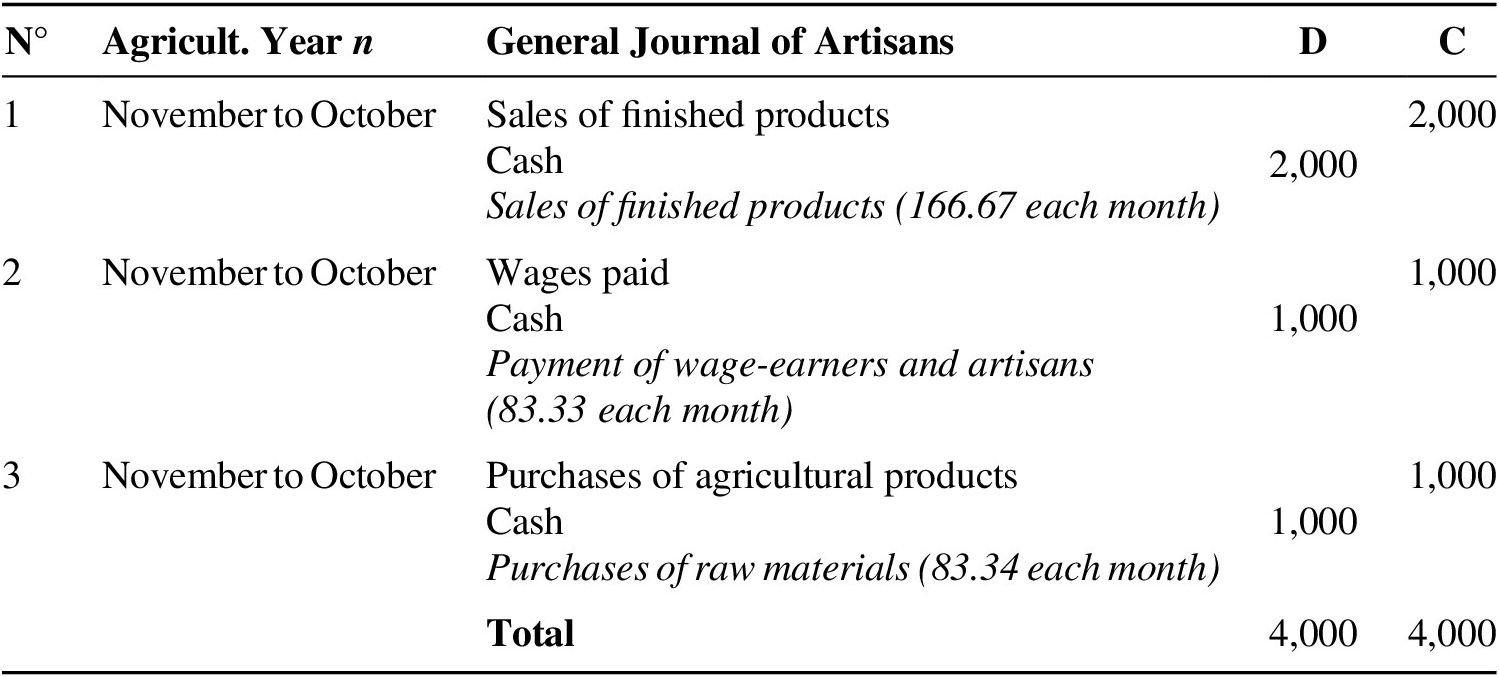
Artisans sell finished products to proprietors: 83.33 each month, 1,000 a year. Artisans sell also to the members of the productive class: 83.33 each month, 1,000 a year (900 for final consumption and 100 for investment). Their sales amount to a total of 2,000, with 166.67 each month (Table 8). Artisans pay salaries: 83.33 each month, 1,000 a year. The replacement of the agricultural raw materials leads also to purchases: 83.34 each month, 1,000 for the year. The artisans aquire cash 166.67 each month and spend the same amount. Their cash balance is null at the end of each month and at the end of the year.
GENERAL JOURNAL OF ARTISANS

The stocks of agricultural and finished products are the same on November 1 and October 31. Artisans have incomes worth 2,000 (sales of finished products) and expenses worth 2,000 (salaries of 1,000 and purchases of agricultural raw materials) a year. They have no economic surplus.
Farmers
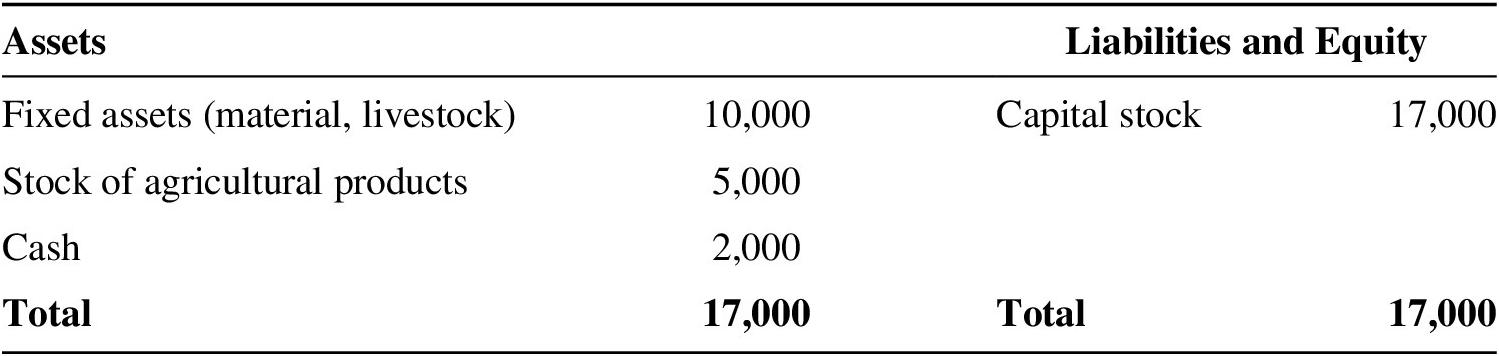
Farmers dispose of nine accounts: capital stock, fixed assets (material, livestock), stock of agricultural products, cash, wages and remunerations paid, farm rent expenses, depreciation expenses, sales of agriculture products, and production transformed into assets. The balance sheet of farmers on November 1 is given in Table 9. Farmers have 10,000 in fixed assets (original advances), a stock of 5,000 in agricultural products, and 2,000 in cash (annual advances). Assets amount to a total of 17,000, corresponding to 10,000 in original advances (not given in the Tableau but that exist besides) and 7,000 in exploitation riches.
BALANCE SHEET OF FARMERS ON NOVEMBER 1

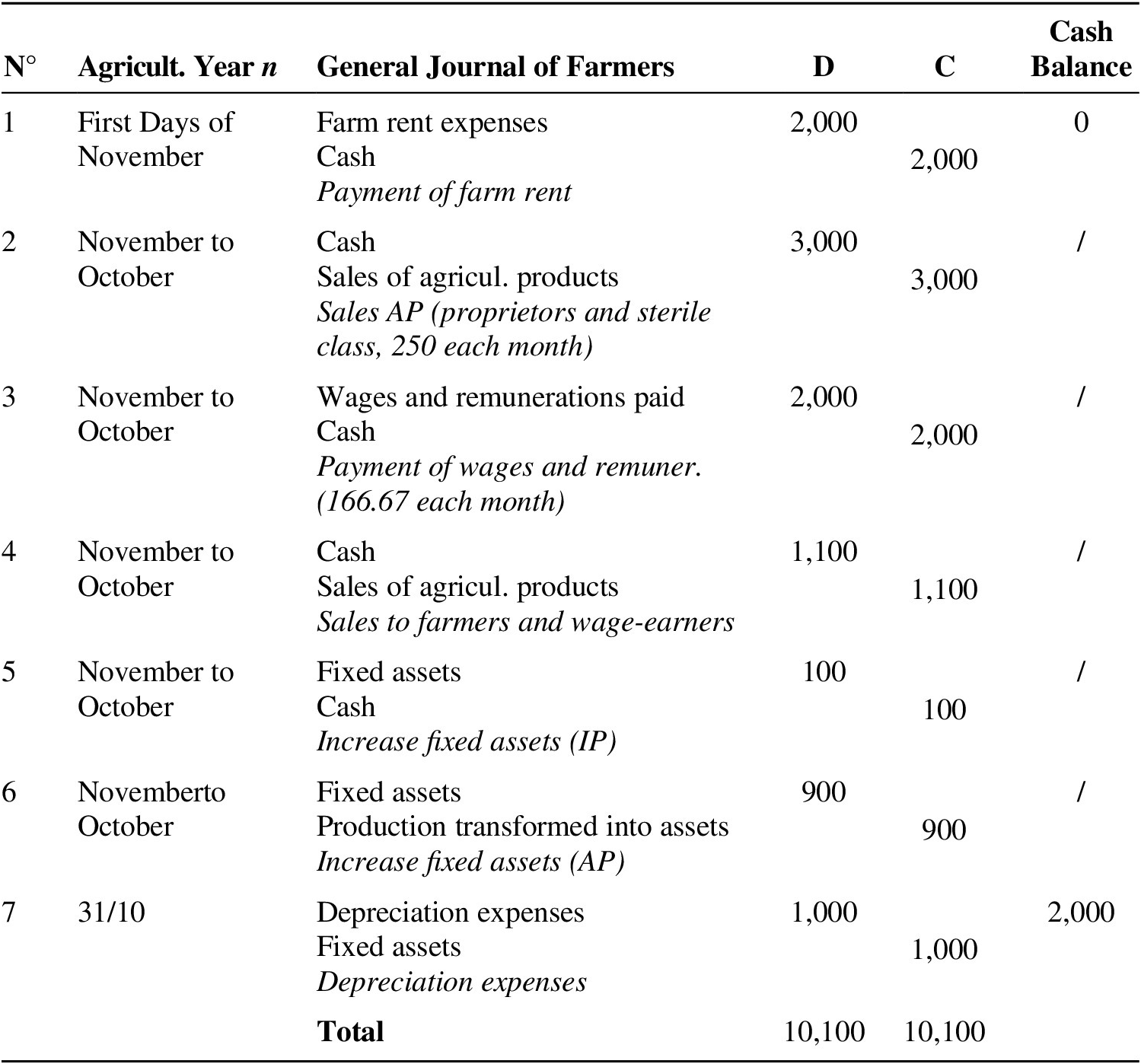
Farmers pay on the first days of November a 2,000 farm rent to proprietors (Table 10). They regularly sell subsistence goods to proprietors (1,000 during the year) and to the members of the sterile class (1,000), and equally raw materials (1,000) to the artisans: the total amounts are 3,000 a year (and 250 a month). With these receipts, salaries and remunerations are paid, 166.67 a month and 2,000 a year. Farmers sell also agricultural products (91.67) to themselves and to wage-earners for final consumption every month: 1,100 a year. Farmers buy industrial equipment from artisans: 8.33 a month, 100 a year. The receipts of farmers amount to 341.67 (250 + 91.67) a month and their payments to 175 (166.67 + 8.33): their cash balance increases each month by 166.67 (341.67 – 175). After twelve months, they have recovered their initial cash, with an amount of 2,000, and they will be able to pay the following year’s farm rent.
GENERAL JOURNAL OF FARMERS

The investment of 1,000 is composed of agricultural products (900, AP)Footnote 25 and industrial products (100, IP). On October 31, a 1,000-worth depreciation expense of fixed assets is registered.Footnote 26 An inventory shows that the stock of agricultural products is always 5,000: the stocked production of the preceding year has been exhausted but an equivalent production is registered. The balance sheet on October 31 is identical to the balance sheet on November 1.
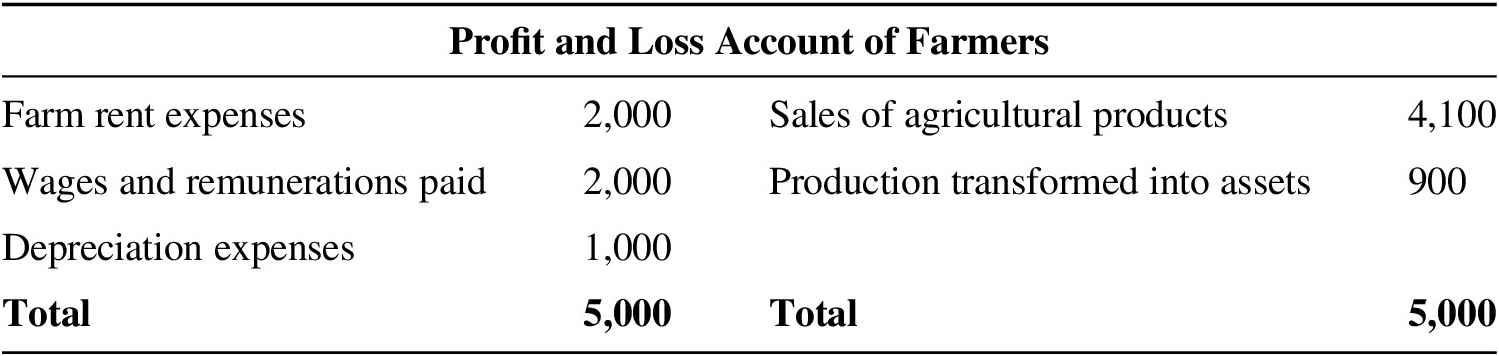
The Profit and Loss account of farmers is given in Table 11. Farmers’ incomes amount to 5,000 (sales of 4,100 and production transformed into assets of 900). The expenses are farm rents (2,000),Footnote 27 salaries and remunerations (2,000), and depreciation (1,000). Incomes and expenses amount to 5,000: farmers have no economic surplus, as we supposed that depreciation absorbs the interest entirely.
PROFIT AND LOSS ACCOUNT OF FARMERS

Exchanges can take place, according to Quesnay’s assumptions. They should, however, be regular, and monetary tensions appear at the beginning of the year. Members of the productive class may have difficulties disposing of the necessary liquidities for their purchases. These difficulties would be suppressed if farm rent was paid in several payments.
Complementary Remarks
Relying on Philosophie rurale, we assumed a payment of the farm rent in one payment, at the beginning of the year. Sometimes, the authors move away from that supposition. They assert that the zigzag Tableau is a presentation trick (PR 1763, p. 43; 2014, p. 132): “what appears here gradual and goes by steps is only a fictional order of clarification, necessary in order to present on a regular and fixed aspect the decisive results of the real order, which is free and confused.” Real exchanges take place differently from the presentation of the Tableau. The circuit may be launched for a part by expenditures of annual advances of farmers. The proprietors receive the farm rent in several payments (PR 1763, pp. 215–216; 2014, p. 391).
Generally, a farmer paid the farm rent in one payment. Nevertheless, all farmers did not pay at the same time. Farm rent was sometimes paid on Saint Michel’s Day (September 29) in regions like Brittany (with few vineyards). Butré (Reference Butré[Richard de]1759, p. 173) mentions a farm rent paid half for Christmas and half in June. With farm rent paid from October until December, liquidities remain available during this period for farmers and artisans: the monetary constraint disappears.
We have supposed a bad agricultural year—for example, with epidemics: the interest, 10% of the original advances, was then entirely used to maintain these advances. The authors (PR 1763, pp. 139–140; 2014, p. 280) suppose more precisely a maintenance of the advances on a basis of 5%; the other 5% is used mainly for casual losses. Without casual loss, the interest of 1,000 is split between depreciation (500) and surplus (500). The surplus is the opportunity for farmers to increase original advances (capital) as noted by Marx (Reference Marx and Engels1972, p. 235). Chapter IX of Philosophie rurale develops this growth logic.
CONCLUSION
Philosophie rurale was written two and a half centuries ago, at a time when national accounting did not exist. Mirabeau and Quesnay (Reference Riqueti Victor and Quesnay1767, pp. ciij–cv) admit that Philosophie rurale presents defects. To give an example, the composition of sterile advances is defined in different ways at the beginning and at the end of the book.Footnote 28 We have chosen the last definition because it is an improvement on the first definition. The sterile class needs means of subsistence to live on, and the first definition does not tackle the problem. Other analysts would choose the first definition, arguing that Quesnay does not understand the necessity of means of subsistence for the sterile class. We have adopted a comprehensive attitude that does not insist on the defects of Philosophie rurale and that tries to understand its general logic, also replacing the Tableau in its institutional context.
In Quesnay’s economy, the three classes have access to agricultural and industrial products, in a monetary and market economy. It is possible to depict the progress of exchanges along the year. The Tableau gives a simplified representation of the economy, centered on the search for net product (for proprietors and the sovereign). Quesnay relies on empirical data (Perrot Reference Perrot1992), as it already was the case in Grains (Quesnay Reference Quesnay, Théré, Charles and Perrot2005, pp. 161–212) and Théorie de l’impôt (Mirabeau and Quesnay Reference Riqueti Victor and Quesnay1760).
Paul Studenski (Reference Studenski1958, pp. 61–62) considers Quesnay as an important pathfinder in the field of national accounting and “a forerunner of the modern practice of constructing models of potential national income under varying conditions.” Quesnay’s Tableau anticipates national accounting by giving expenditures and surplus by sector accounts, as well as tables of total resources and uses. The Tableau is derived from accounts; similarly the input-output table of a country is today connected to national accounts. Precise relationships may be established between Quesnay’s concepts and national accounting concepts. Quesnay understands the notion of intermediate consumption and comes closer to the concept of value added.
Philosophie rurale remains the best text to study the Tableau. Even if some excerpts of Philosophie rurale have been translated into English (Meek Reference Meek1963; Steenge and van den Berg Reference Steenge and van den Berg2007), a full translation of the book would permit a larger access to this important text.
Appendix 1: Details on the Input-Output Tables
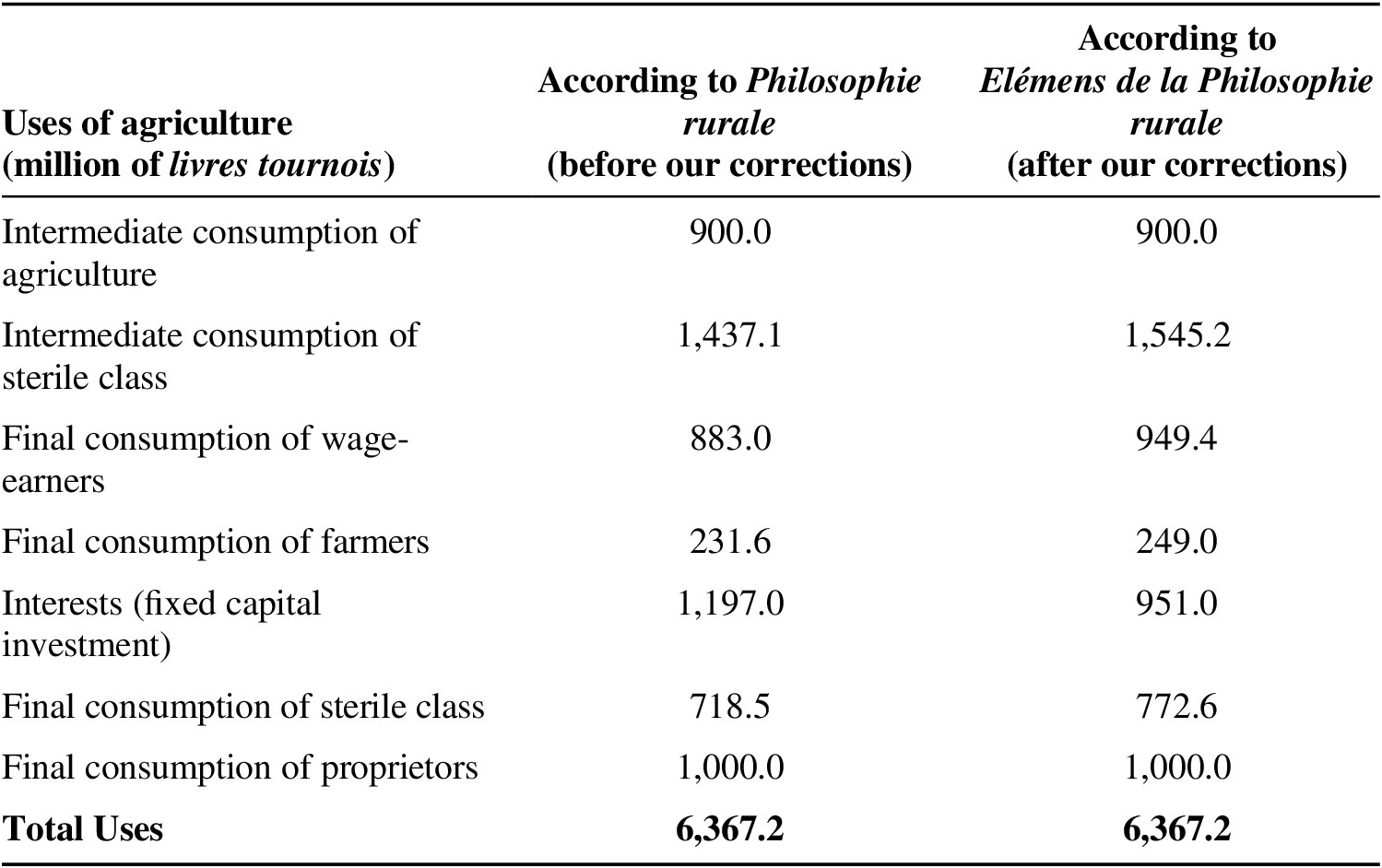
Total uses of agriculture in Philosophie rurale are given in the first column of Table A1. As the figures of the original text include an error on interest (see Box 1), these uses are corrected before juxtaposing them with resources (in order to elaborate a table of uses and resources).
USES OF AGRICULTURE

In Philosophie rurale, the annual investment of 1,197 (first column of Table A1) originates entirely from agriculture, without any industrial investment. However, in Philosophie rurale, the large-state cultivation farm of Lisoir uses industrial fixed capital (PR 1763, pp. 238–239; 2014, p. 426). Elémens de la Philosophie rurale argues later that investment has an industrial component: it is necessary to buy plows back (Mirabeau and Quesnay Reference Riqueti Victor and Quesnay1767, pp. 52–53). Following Elémens de la Philosophie rurale, an industrial investment (based on the Lisoir farm—PR 1763, pp. 238–239; 2014, p. 426) is introduced. Original advances of the Lisoir farm are essentially made of agricultural goods but industrial goods represent 9.3% of the total (PR 1763, pp. 29, 33; 2014, pp. 109, 115). Rounding off to 10%, the investment of the productive class (1,057) includes agricultural goods for 951 (90%) and industrial goods for 106 (10%). The second column of Table A1 corrects the agricultural uses of Philosophie rurale so as to elaborate Table 4.
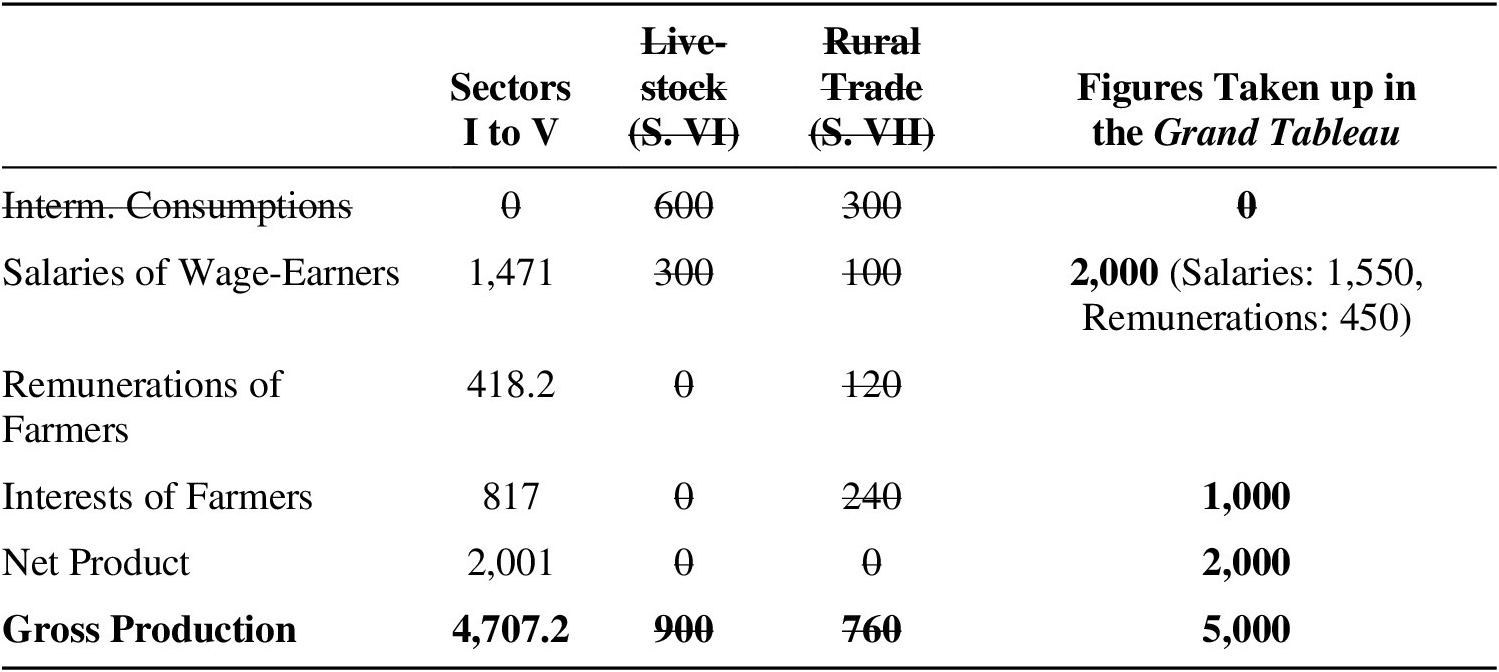
To deduct the Grand Tableau from the accounts of Philosophie rurale, Table A2 merges sectors I to V of Table 3. As sectors VI (Livestock Production) and VII (Rural Trade) have no net product, the corresponding columns are suppressed. We add a last column, corresponding to the figures of the Grand Tableau. The figures of this column are rounded. Without rounding, it would be impossible, starting from a set of accounts, to arrive at the physiocratic proportions, for example, to annual advances equal to net product, or to original advances equal to five times the annual advances (PR 1763, p. 34; 2014, p. 117). Gross production increases from 4,707.2 to 5,000; the net product decreases from 2,001 to 2,000. The salaries of wage-earners amount to 1,550 and the remunerations of the farmers to 450,Footnote 1 with annual advances totalling 2,000.
Accounts of Agriculture (Reduced System of Accounts)