INTRODUCTION
The failure to allocate appropriate economic values to environmental services provided by biodiversity is considered as one important cause of biodiversity loss and environmental service degradation (ten Brink et al. Reference ten Brink, Berghöfer, Schröter-Schlaack, Sukhdev, Vakrou, White and Wittmer2009). To counteract this market failure, incentive- or market-based mechanisms (Jack et al. Reference Jack, Kouskya and Sims2008) are increasingly advocated as instruments for achieving conservation goals in agricultural landscapes and to compensate farmers for the provision of environmental services (Kroeger & Casey Reference Kroeger and Casey2007). Against this background, payments for environmental services (PES) have recently emerged as a promising policy instrument for creating economic incentives for the provision of environmental services in both developed and developing countries (Wunder Reference Wunder2007; Jack et al. Reference Jack, Kouskya and Sims2008). Incentive-based PES schemes generally involve a voluntary agreement between at least one provider (farmer) and one recipient (paying conservation agency) over a well-defined environmental service (Wunder Reference Wunder2007). A further key criterion of PES schemes is that they are conditional on a measurable and well-defined environmental service, and payments to farmers are fully dependent on this service provision. In output-based PES schemes targeted at agricultural land, participating farmers supply environmental services by linking their land management to the level of environmental service required.
To purchase environmental services from farmers within a PES approach, competitive bids for conservation contracts may deliver environmental services more cost effectively than fixed flat-rate payments (Naidoo et al. Reference Naidoo, Balmford, Ferraro, Polasky, Ricketts and Rouget2006; Schilizzi & Latacz-Lohmann Reference Schilizzi and Latacz-Lohmann2007). The potential benefit of such a procurement auction approach is the possibility of adjusting conservation contract payments to the individual opportunity costs that farmers face in order to meet obligatory scheme requirements. These opportunity costs are usually unknown to the paying conservation agency, a phenomenon referred to as information asymmetry. In this context, opportunity costs of conservation are those associated with the benefit foregone from alternative land use activities (Wunder et al. Reference Wunder, Engel and Pagiola2008). In farming systems, opportunity costs vary spatially with the considered production system and region but they are, however, crucial for the willingness to accept a conservation contract (Jack et al. Reference Jack, Leimona and Ferraro2009). Within an auction procedure, each farmer submits a sealed bid with an associated individual bid price he is willing to accept for the provision of a predefined environmental service. By creating a competitive temporary market, conservation procurement auctions act as a cost-revealing mechanism and have the potential to generate decentralized incentives for farmers to offer bids close to their individual opportunity costs (Connor et al. Reference Connor, Ward and Bryan2008). Against this background, discriminative-price procurement auctions, in which farmers submit a sealed bid for a specific environmental service, have been suggested to reveal differences in farmers’ opportunity costs and enable a paying conservation agency to pay farmers according to their individual costs (Latacz-Lohmann & van der Hamsvoort Reference Latacz-Lohmann and Van der Hamsvoort1997; Cason & Gangadharan Reference Cason and Gangadharan2005). The potential for a discriminative-price procurement auction to increase cost-effectiveness thus depends on the degree to which bid prices actually reflect these opportunity costs (Stoneham et al. Reference Stoneham, Chaudhri, Ha and Strappazzon2003).
A PES scheme using a discriminative-price conservation procurement auction creates incentives for farmers to provide arable plant diversity on their agricultural land. In Western Europe, the abundance and diversity of annual, arable weed species declined substantially with many species now being threatened or already extinct (Gerowitt et al. Reference Gerowitt, Bertke, Hespelt and Tute2003). However, recent studies have indicated that specific weed species might provide a direct resource for plant-feeding and pollinating insect species (Carreck & Williams Reference Carreck and Williams2002), serve as an indirect resource for predatory species and add structural value within crops (Hawes et al. Reference Hawes, Haughton, Osborne, Roy, Clark, Perry, Rothery, Bohan, Brooks, Champion, Dewar, Heard, Woiwod, Daniels, Young, Parish, Scott, Firbank and Squire2003). In addition, flowering weeds provide considerable aesthetic value within arable landscapes. Arable plant diversity might therefore provide multiple environmental services that could be of high value both to the farmer and the society. By adoption of wildlife-friendly farming practices (such as reduction in pesticide and fertilizer application), the farmer may enhance the diversity of arable plant populations on his field. However, linking land management to the level of environmental service (arable plant diversity) required may be associated with a reduction in agricultural profit due to decreased crop yield and quality. In the context of European agri-environment schemes (AES), the conservation of in-field arable plant diversity has received limited attention. Given the current rapid decline in arable biodiversity and associated environmental services, payment schemes that offer appropriate economic incentives to farmers to conserve biodiversity are therefore urgently needed to complement existing AES, which are mainly based on command-and-control regulations.
We present the implementation and evaluation of such a PES scheme in arable cropping systems in Germany. By matching arable fields that were participating in the PES scheme to control fields that were not enrolled in the PES scheme, we particularly addressed two critical key characteristics related to PES scheme design and implementation. Firstly, we addressed the characteristic of additionality by evaluating whether fields for which PES were issued had significantly higher arable plant diversity than the matched control fields. Because the cost-effectiveness of a conservation auction increases if payments compensate just farmers’ opportunity costs (in terms of forgone production), we secondly evaluated whether bid prices of participating farmers were closely related to their individual opportunity costs. To our knowledge, both the question of whether PES schemes achieve additionality in service provision and the relation between submitted bid prices and individual opportunity costs of farmers within a conservation auction have so far not been addressed and evaluated in an operational payment scheme for environmental services from agricultural land. Practical experience with and research on these two major issues is urgently needed (Ferraro & Pattanayak Reference Ferraro and Pattanayak2006) and improves understanding of incentive-based mechanisms for both policymakers and practitioners involved in PES scheme design and implementation.
METHODS
Design of the PES scheme
The PES scheme was set up in the administrative district of Northeim in Lower Saxony (Germany). The study region is dominated by agricultural land use and can be regarded as a typical agricultural region of Western Europe. The implemented scheme was based on a conceptual framework for PES schemes that was previously established for biodiversity conservation in managed grasslands (Klimek et al. Reference Klimek, Richter gen. Kemmermann, Steinmann, Freese and Isselstein2008). Before the implementation of the scheme, regional stakeholders were explicitly involved through a participatory process (Gerowitt et al. Reference Gerowitt, Bertke, Hespelt and Tute2003; Klimek et al. Reference Klimek, Richter gen. Kemmermann, Steinmann, Freese and Isselstein2008). These stakeholders were representatives from the relevant major local groups and initiatives such as government agencies, nature conservation and farmers’ groups. In cooperation with natural and social scientists that were in charge of the general administration of the scheme, the regional stakeholders defined and expressed the demand for environmental services. Moreover, they identified the environmental services that were to be addressed by the conservation auction. The financial budget for the conducted auctions was provided by third-party funding. Because arable plant diversity in German conventional farming systems has become increasingly scarce and valuable (Gerowitt et al. Reference Gerowitt, Bertke, Hespelt and Tute2003), the regional stakeholders decided to allocate the available budget towards the conservation of arable plant diversity and the associated environmental services on conventionally-managed fields in the study region. Within the scheme, farmers received payments for their arable fields only if a conservation threshold of ten different arable plant species assessed in plots of 100 m2 was achieved. This threshold was defined by the regional stakeholders based on their expert knowledge and was underpinned by scientific studies on arable plant species richness in the project region (Ulber et al. Reference Ulber, Steinmann, Klimek and Isselstein2009). To allow for control of highly competitive grass species on the fields, thresholds referred only to dicotyledonous arable plant species and not to monocotyledonous species. For simplicity, we will refer to the prevalence of a number of species equal or above the defined threshold as an environmental service, while a total number of species below that threshold is considered non-delivery of the desired service.
Implementation of the PES scheme
To facilitate transactions between providers (farmers) and buyers (conservation agency) of environmental services, we established a market for environmental services in the study region. We performed two discriminative-price conservation procurement auctions with a sealed-bid approach and a fixed total budget of €50 000 (€1 = US$ 1.43, April 2011). The first auction was carried out in 2007/2008 and the second in 2008/2009. A reserve price, that defines the maximum permissible price level that the paying conservation agency is willing to accept, was not set. In the study region, all 984 officially registered farmers were eligible to participate in the auctions and were encouraged to submit bids for environmental services for a one-year contract period. In advance of the first auction, information sessions were held in order to improve farmers’ understanding of the demand for environmental services and the auction procedure. Although farmers were informed about the general scheme requirements, no indications on the calculation of bid prices were provided. Within each auction, farmers submitted a sealed bid by mail with a corresponding bid price per hectare for the delivery of the environmental services on their fields. Information on the size of the fields, their location and contact information had to be included in the bids. Several bids could be submitted by a single farmer. For both auctions the period to submit bids comprised six weeks. At the end of the entry deadline, received envelopes containing the bids were opened. Bid prices were then accepted from the lowest bid upwards until the budget was exhausted. In the subsequent week, farmers were informed whether their bids were accepted. Farmers received the payment stated in their accepted bid only if the defined performance threshold was passed at the end of the contract period. However, penalties for non-compliance with statutory requirements were not applied.
To verify whether the contracted farmers complied with the statutory requirements, plots of 100 m2 were located randomly in the field centre by the conservation agency. Monitoring was conducted at the end of the contract period of each of the two auctions. The number of plots per field was adjusted for field size to ensure that the whole arable field was sampled. Monitoring of participating fields revealed that 73% and 90% of the bids were successful in achieving the defined service threshold in the first and second auction, respectively. Farmers were informed whether they successfully met the statutory requirements before the beginning of the second auction. Only those farmers who completely complied with the requirements received their stated bid price. Payments were made annually immediately after compliance monitoring of participating fields. No correlation between bid prices and likelihood of success in meeting the statutory requirements was observed.
Evaluation of the effectiveness of the PES scheme
In order to evaluate the effectiveness of the PES scheme, we used a quasi-experimental design by matching arable fields that were participating in the PES scheme to control fields that were not enrolled in the scheme (Ferraro & Pattanayak Reference Ferraro and Pattanayak2006). Matched pairs of winter wheat fields were composed of 14 fields participating in the first conservation procurement auction (PES fields) and 14 conventionally managed fields from the same farmer used as a ‘business-as-usual’ control (BAU fields). BAU fields were identified and matched to PES fields after acceptance of bids. Fields within a pair were similar in shape, size, soil and landscape context and therefore exhibited a comparable level of agricultural productivity and net return. We tested for additionality in environmental service provision by quantifying the difference in arable plant species richness between paired PES and BAU fields. At each field, we assessed plant species richness in the 100 m2 monitoring plots. Fields within one pair were sampled for plant species richness on the same day by members of the conservation agency.
To test the potential for the PES scheme to be cost-effective, we estimated farmers’ opportunity cost for participating in the scheme. These individual opportunity costs included the decrease of crop revenue due to reduced crop production, costs related to potential management changes and any offsetting benefits caused by for example reduced input of pesticides and fertilizers (Rolfe et al. Reference Rolfe, Windle and McCosker2009). For the calculation of opportunity costs, management data of the matched field pairs participating in the first auction were retrieved from farmers by standardized face-to-face interviews. Based on those management data, we first calculated gross margin per hectare for each PES and BAU field, defined as gross financial revenue minus variable costs per hectare (Sinden Reference Sinden2004). Variable costs for crop production include costs for crop seeds, fertilizers, plant protection products (herbicides, fungicides and insecticides), machinery and cleaning and drying of harvested grain. However, no information on individual costs of harvest, cleaning and drying of winter wheat grain could be gained in the course of the interviews. Standard values were therefore used for the BAU fields (KTBL [Kuratorium für Technik und Bauwesen in der Landwirtschaft] 2009). For PES fields, increased costs for drying were assumed to be due to higher arable plant abundance. Therefore, we assumed that the harvested crop on PES fields required a humidity reduction of 6% compared to a reduction of 3% on BAU fields. Similarly, 20% additional costs for impeded harvest operations were considered for PES fields. After assessing the gross margin of each field, we calculated opportunity costs for each pair as the difference (Δ) in gross margin between PES and BAU fields. The measurement of transaction costs was not within the scope of this study, and was thus not performed.
RESULTS
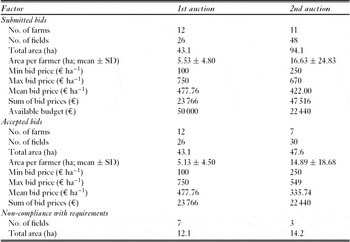
In the first auction, 12 farmers participated and submitted a total of 26 bids (Table 1). These bids comprised a total area of 43 ha and bid prices summed to € 23 766. Bid prices were € 100–750 ha−1 with an average bid price of € 478 ha−1. Because the available budget was not exhausted and no reserve price had been set, all bids were accepted.
Summary statistics of the submitted and accepted bids and compliance with the statutory requirements in the two conservation auctions for arable plant diversity conducted in 2007/2008 (1st auction) and 2008/2009 (2nd auction). SD = standard deviation.

The level of the winning bids in the first auction were not revealed before the second auction. As the farm enterprises of participating farmers were located relatively distant from each other and no communication network exists in the region, we assume that the auction information was not widely communicated among farmers participating in the first auction. Seventy-five per cent of the farmers who participated in the second auction also participated in the first auction. The fields in the first auction could be re-enrolled by participating farmers in the second auction. Eleven farmers participated in the second auction, submitting 48 bids in total. These bids summed up to € 47 516 and comprised an area of 94 ha. Most of those farmers who already participated in the first auction enrolled substantially more land in the second auction. The mean bid price was € 422 ha−1. In the second auction, only 30 bids could be contracted, as the sum of bid prices exceeded the available budget (Table 1). Those farmers who submitted bids for the same fields both in the first and second auction on average did not submit significantly higher bid prices in the second auction. The mean difference in bid prices across all fields that were enrolled both in the first and second auction was € 14 (Standard deviation: 43; min: € −50; max: € 90). The average difference at the farm level for those farmers who participated in both auctions was € 9 (Standard deviation: 35; min: € −30; max: € 82).
Monitoring of service provision
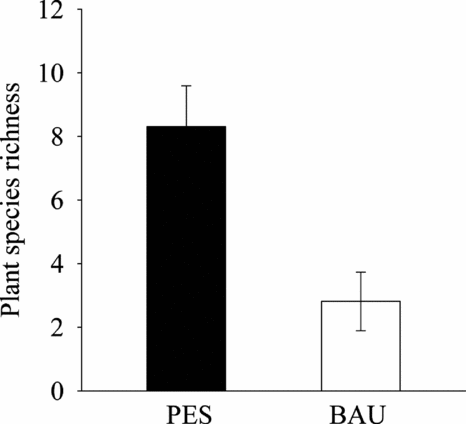
In the first auction, a total of 45 and 26 different arable plant species were detected on the surveyed paired PES and BAU fields respectively. Compared to BAU fields, plant species richness was almost three times higher on PES fields (Wilcoxon ranked test, p < 0.0001; Fig. 1). Interviews with farmers revealed that this difference was mainly attributable to reduced input of fertilizer and broad-spectrum herbicides on PES fields. Because fields within one pair were chosen to have similar soil and landscape context, management changes adjusted to the delivery of environmental services in arable systems resulted in an immediate enhancement of environmental service supply.
Number of arable plant species (mean ± SEM) on paired payment for environmental services (PES) and business-as-usual (BAU) fields.

Assessment of the cost-effectiveness
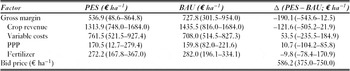
Opportunity costs per field ranged from € 12.5 to € −543.6 ha−1 with an average of € 190.1 ha−1 (Table 2). Opportunity costs were mainly associated with reduced crop yields on PES fields, which accounted for 65% of overall opportunity costs and also differed widely among farmers. Average differences in crop revenue between PES and BAU fields amounted to € −121.6 ha−1. Mean variable costs were higher on PES fields and made up 28% of the total opportunity costs. On the one hand, farmers were able to reduce costs for fertilizers on PES fields, which might have partially offset the increase in opportunity costs generated by lower yields. On the other hand, variable costs for plant protection products were higher on fields participating in the scheme.
Opportunity costs (difference in gross margin, Δ) of farmers participating in the PES scheme, underlying differences in crop revenue, variable costs and costs for plant protection products (PPP) and fertilizer between PES and BAU (business-as-usual) winter wheat fields, as well as bid prices submitted for PES fields. Mean and range of values are given.

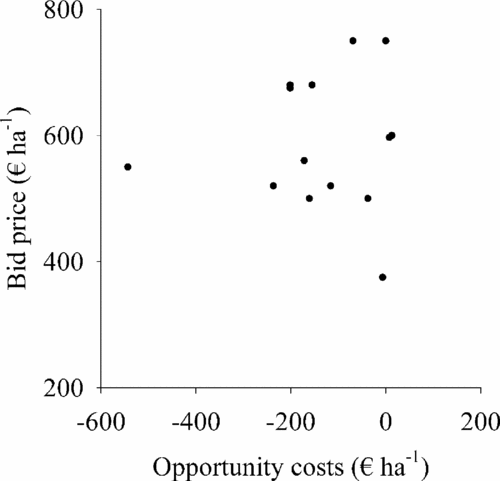
Farmers` bid prices submitted in the first auction generally exceeded the estimated opportunity costs (Table 2). In addition, there was no significant relationship between opportunity costs and bid prices (r = 0.05, p = 0.9; Fig. 2).
Opportunity costs and submitted bid prices of farmers participating in the payment for environmental services (PES) scheme. Opportunity costs were calculated as the difference in gross margin between paired PES and BAU fields.

DISCUSSION
Our implemented PES scheme, notably the auction mechanism, was new and challenging to farmers within the project region. Hence, the uptake of the scheme by farmers in both auctions was low. However, although participation did not increase from the first to the second auction, farmers enrolled more land in the second auction. This may be interpreted as a growing interest and acceptance of the PES scheme.
Does the PES scheme achieve additionality in service provision?
Our PES scheme proved to be highly effective in ensuring environmental services delivery through enhancing arable plant diversity on participating fields. However, the timescale of our PES scheme was limited to one-year conservation contracts. This is likely to threaten the long-term delivery of environmental services as farmers might return to their previous conventional practice after expiration of the scheme (Bräuer et al. Reference Bräuer, Müssner, Marsden, Oosterhuis, Rayment, Miller and Dodoková2006). From an ecological point of view, a timescale of one year seems sufficient, as arable plants under the adopted management are allowed to reproduce and therefore be sustained in the soil seed bank of the fields. Importantly, interviews with participating farmers revealed that the short timescale of the scheme was particularly attractive. Although our scheme clearly achieved additionality in service provision, we did not account for a potential difference in the ecological quality of the environmental services delivered by farmers. For example, our PES scheme did not explicitly account for the presence of threatened arable plant species (Aavik & Liiraa Reference Aavik and Liiraa2009). Out of all species encountered during on-the-spot monitoring, only two species were listed in the Red List of Threatened Species of Lower Saxony (Garve Reference Garve2004). Hence, most species encountered on PES fields belonged to a set of common species that can be found in a wide range of arable habitats (Heard et al. Reference Heard, Hawes, Champion, Clark, Firbank, Haughton, Parish, Perry, Rothery, Scott, Skellern, Squire and Hill2003). In this context, conservation thresholds for environmental services that are not only defined by a fixed threshold of arable plant species but by a certain number of threatened arable plant species might have provided a more targeted approach for the conservation of threatened plant species.
The high rate of non-compliance with the scheme requirements, especially in the first auction, indicates that farmers might have faced management problems regarding the successful provision of the environmental service. This is partially because some uncertainty may arise from the production of environmental services. For example, the production of environmental services may be exposed to external risk factors (such as extreme weather events) that are not within the control of the farmer (Rollett et al. Reference Rollett, Haines-Young, Potschin and Kumar2008).
Do bid prices in a conservation auction reflect farmers’ opportunity costs?
Estimation of farmers’ individual opportunity costs revealed that farmers faced heterogeneous costs for the delivery of environmental services. Individual opportunity costs included decreased crop revenue due to reduced crop production and variable costs related to potential management changes. The observed average differences in crop revenues in our study are in accordance with the results of Mettepenningen et al. Reference Mettepenningen, Verspecht and van Huylenbroeck(2009), indicating an average decrease in crop revenue of € 176.8 ha−1 for participation in European arable agri-environment schemes. In our scheme, variable costs, as another component of farmers’ opportunity costs, differed to a lower extent between PES and BAU fields (Table 2). Higher variable costs on participating fields could mainly be attributed to different and more expensive herbicide products used on PES compared to BAU fields. Contrary, a study measuring costs of farmers participating in European AES showed that application of AES resulted in 4.1–9.9% cost savings for manure, fertilizer and plant protection products (Mettepenningen et al. Reference Mettepenningen, Verspecht and van Huylenbroeck2009). Costs arising from scheme participation therefore seemed to be strongly influenced by individual field- and management-specific conditions.
Because bid prices submitted in our PES conservation procurement auction exceeded individual farmers’ opportunity costs substantially, bid prices also seemed to be determined by other socioeconomic factors, such as individual risk preferences, transaction costs or former experiences with agri-environment schemes. It could be further assumed that the employed auction format (price-discriminative procurement auction) partly failed to reveal farmers’ true individual opportunity costs. However, in laboratory experiments, McKee and Berrens (Reference McKee and Berrens2001) and Cason and Gangadharan (Reference Cason and Gangadharan2005) found that discriminative-price conservation procurement auctions were less costly than uniform-price conservation procurement auctions for a given environmental service. In an auction that allowed bid revisions, Cummings et al. (Reference Cummings, Holt and Laury2004) asserted that average bid prices were initially lower in the discriminative-price conservation procurement auction, but the difference disappeared as bidders revised their offers. In contrast, using agent-based modelling of multi-unit conservation procurement auctions, Hailu and Thoyer (Reference Hailu and Thoyer2006) stated that overbidding made the discriminative-price conservation procurement auction more expensive than a uniform-price conservation procurement auction. Consequently, the choice between payment formats is still controversial in practice and further research is required to analyse whether informational rents are actually higher under a uniform-price payment format or under a discriminative-price payment format.
Because our PES scheme was targeted at a defined region, it addressed only a limited number of farmers. In our first auction, the pool of bidders (farmers) and consequently competition was evidently insufficient and the cost-effective advantage of competitive auctions could therefore not be fully exploited. The high available budget and lack of a previously set reserve price meant extremely high bid prices had to be accepted. However, the number of submitted bids was significantly higher in the second auction, thus competition between bids occurred and bids had to be rejected. As a consequence, average accepted bid prices were lower in the second auction (Table 1). Farmers were more familiar with the auction procedure after the first auction, and were therefore also able to improve the effectiveness of their management measures to provide the environmental service.
Our results indicate that the size of the available budget and competition between participants in conservation auctions has an enormous impact on accepted bid prices and related cost-effectiveness. In this context, the setting of a reserve price, as an upper limit of the amount the conservation agency is willing to pay for a unit of an environmental service, should overcome the problem of accepting bid prices above a certain level. Furthermore, setting a reserve will provide incentives encouraging farmers to bid closer to their costs in auctions following, even when competition is limited (Windle & Rolfe Reference Windle and Rolfe2008). Bids in conservation auctions may always include some information rent (Rolfe et al. Reference Rolfe, Windle and McCosker2009). This is supported by evidence from the US Conservation Reserve Program, in which estimated information rents constituted 10–40% of the programme's rental payout (Kirwan et al. Reference Kirwan, Lubowski and Roberts2005). Therefore, paying information rents might at least partly be required to increase farmers` incentive to enrol in a PES scheme (Kirwan et al. Reference Kirwan, Lubowski and Roberts2005; Rolfe et al. Reference Rolfe, Windle and McCosker2009). Farmers may also have faced difficulties in calculating their bids. Although bidders in conservation procurement auctions are assumed to have profound knowledge of their costs and consequently use this information to calculate their bids (Latacz-Lohmann & Van der Hamsvoort Reference Latacz-Lohmann and Van der Hamsvoort1997; Stoneham et al. Reference Stoneham, Chaudhri, Ha and Strappazzon2003), interviews with farmers participating in our PES scheme revealed that they had only limited information about potential costs arising from scheme participation. Moreover, farmers stated that the auction process was unfamiliar to them and they were therefore hardly able to calculate a reasonable bid price for the provision of environmental services.
Farmers might also have demanded a risk premium on top of their opportunity costs in order to compensate for unexpected foregone income, for example caused by increased costs for control of higher arable plant infestations in subsequent years or environmental conditions that could impact on the success of contract compliance (Wätzold & Schwerdtner Reference Wätzold and Schwerdtner2005). Moreover, there is evidence that procurement auctions for environmental services might result in substantial transaction costs, not only for scheme implementation and monitoring, but also for the participating farmers (Wätzold & Schwerdtner Reference Wätzold and Schwerdtner2005). Transaction costs may include ex ante search and information costs, decision-making costs, costs for hiring of advice (such as consultants) and ex post monitoring costs (Mettepenningen et al. Reference Mettepenningen, Verspecht and van Huylenbroeck2009). In European AES, up to 20% of the payment is allocated for transaction costs (Rollett et al. Reference Rollett, Haines-Young, Potschin and Kumar2008). A study of ten European AES found mean transaction costs for individual farmers were c. € 40 yr−1 (including wages) and accounted for 14% of farmers’ total participating costs (Mettepenningen et al. Reference Mettepenningen, Verspecht and van Huylenbroeck2009). Although our calculation of opportunity costs did not account for individual transaction costs, it seems likely that farmers included some transaction costs within their bid price, for example for the individual planning of the most appropriate management measures.
CONCLUSIONS
The PES scheme we proposed and implemented provided farmers with financial incentives to deliver environmental services in addition to the production of food and fibre (Klimek et al. Reference Klimek, Richter gen. Kemmermann, Steinmann, Freese and Isselstein2008). By accomplishing additionality, our scheme was highly effective in ensuring environmental services delivery. Moreover, the incentive-based PES scheme provided farmers with maximum flexibility to adopt innovative conservation management practices to deliver a desired level of environmental services. Our scheme was not intended to substitute command-and-control measures within existing European AES schemes, but was rather aimed at complementing them by compensating farmers directly for undertaking management changes that increase the delivery of environmental services in arable systems.
Bid prices submitted in our PES scheme exceeded estimated farmers’ opportunity costs enormously. Against this background, the potential of the proposed conservation auction to raise cost-effectiveness has to be questioned. We have argued that bid prices were strongly influenced by socioeconomic factors other than opportunity costs, such as low participation rates, farmers’ profit expectation, risk preferences or former experiences with agri-environment schemes (Ferraro Reference Ferraro2008; Jack et al. Reference Jack, Kouskya and Sims2008; Zabel & Roe Reference Zabel and Roe2009). Because farmers facing competition are less likely to ‘overbid’ their costs (Latacz-Lohmann & Schilizzi Reference Latacz-Lohmann and Schilizzi2007; Zabel & Roe Reference Zabel and Roe2009), the number of submitted bids might have been too small to allow for sufficient competition. Although several studies have demonstrated that discriminative-price conservation auctions can reduce informational rents by acting as a cost-revealing mechanism, especially when multiple bidding rounds are employed (Windle & Rolfe Reference Windle and Rolfe2008; Jack et al. Reference Jack, Leimona and Ferraro2009), the budget of our auctions might have been too high for the number of participating farmers. In addition, in-depth knowledge on the relative importance of factors influencing farmers’ bidding behaviour and willingness to participate in PES schemes is still limited. Additional rigorous research, objective monitoring and evaluation of pilot PES schemes is therefore required to determine whether conservation auctions facilitate the cost-effective allocation of environmental service provision.
ACKNOWLEDGEMENTS
We thank Annett Gummert for help with the interviews and monitoring of the fields, all participating farmers for their unrestricted willingness to answer numerous questions and the regional stakeholders for their participation. The insightful comments and suggestions raised by the Editor-in-Chief, the Associate Editor and three reviewers have greatly improved the quality of the manuscript. The research was funded by the Deutsche Bundesstiftung Umwelt and the German Federal Ministry of Education and Research.