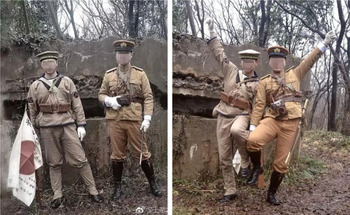
On 20 February 2018, two young Chinese men, dressed in Japanese military uniforms, took exuberant photographs of themselves at the Zijinshan 紫金山 Anti-Japanese Fort in Nanjing (see Figure 1).Footnote 1 The site is sensitive: during the Nanjing Massacre 80 years earlier, Japanese troops engaged in six weeks of mass slaughter of Chinese soldiers and innocent civilians. One of the two young men, furthermore, had previously posed for photos dressed as an imperial Japanese soldier at Comic Con 2015 in Chengdu, mixing in with other J-pop cosplay (“costume play”) enthusiasts. On 22 February 2018, two days after the Zijinshan photos were taken and posted online, Nanjing police arrested the two men in Sichuan and Jiangsu and detained them for 15 days.Footnote 2
“Spiritually Japanese” in Nanjing, 20 February 2018
Source:
This image was downloaded from huanqiu.com on 5 March 2020, http://china.huanqiu.com/article/2018-02/11612573.html?agt=61#frame_content. For this and the three subsequent images, every effort has been made to trace the copyright holder but it has not been possible to obtain formal permission to reproduce the image. We would be grateful for any information about the rights holder and will be happy to change the acknowledgement notice if formal permission is obtained.
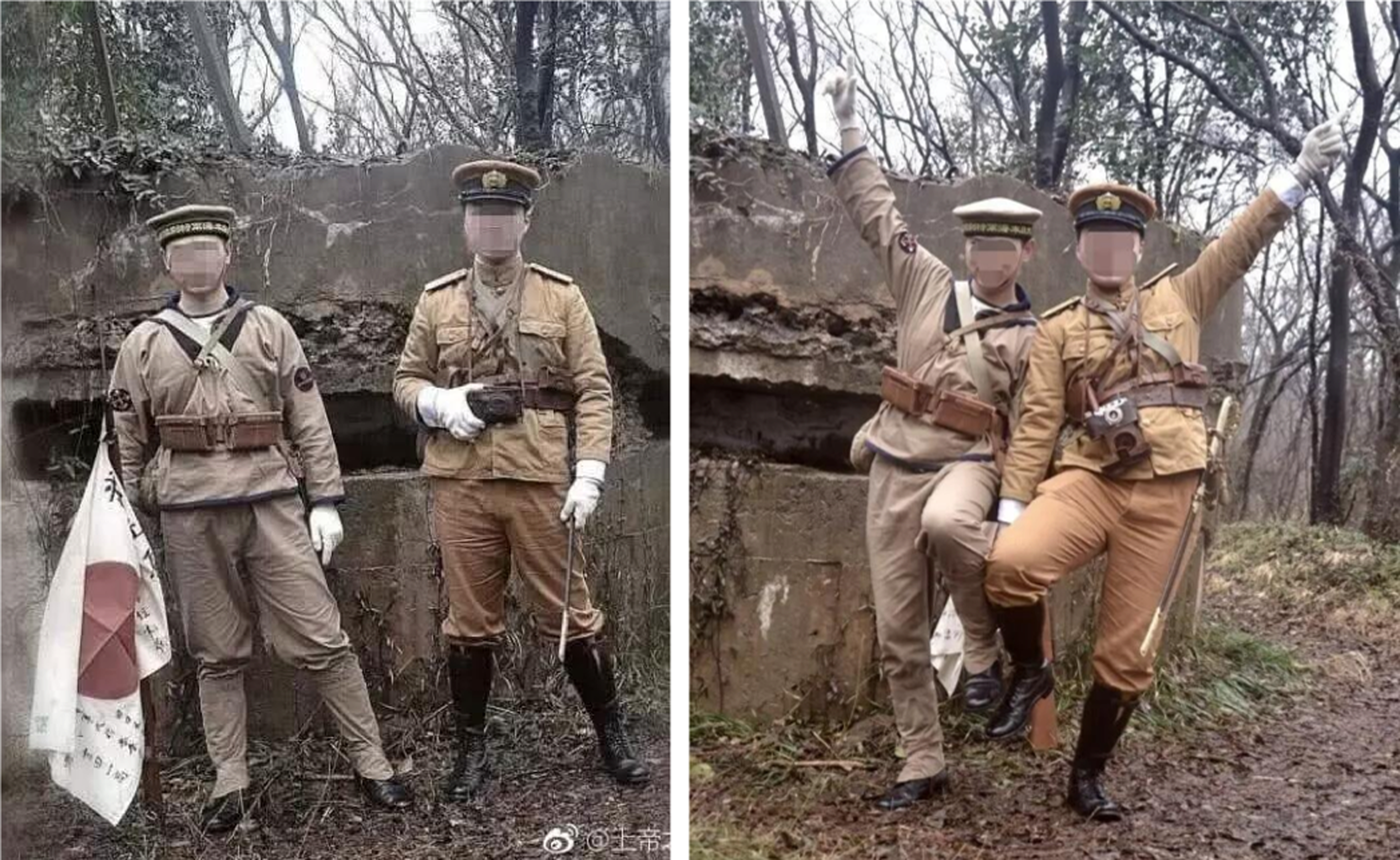
The Zijinshan photos were posted on Weibo and the public reaction against such young Chinese who style themselves Japanese – the “spiritually Japanese” (jingshen Ribenren 精神日本人, or jingRi 精日) – was fast and furious. A desire for retribution was widespread. “Why pixelate?” one netizen asked. “Let everyone clearly see the ugly faces of these two scumbags!”Footnote 3 A “human flesh search” (renrou sousuo 人肉搜索) kicked into high gear as online vigilantes initiated a manhunt. They sought to rectify a perceived injustice through revenge.
Many cybernationalists directed their ire elsewhere. “China should prepare to invade Japan!” a netizen wrote on Pheonix TV's ifeng.com.Footnote 4 More demanded that their own government act. “Legislation and moral education have failed to keep pace,” read a 21 February reproach on huanqiu.com, the online edition of the nationalist Global Times (Huanqiu shibao 环球时报). “More work needs to be done in these areas.”Footnote 5
Journalists, lawyers and scholars quickly mobilized, especially in Nanjing. The Nanjing newspaper Modern Express (Xiandai kuaibao 现代快报) played a leading role in reporting “spiritually Japanese” incidents. Nanjing lawyers and scholars also participated in a public discussion of how to proscribe the “spiritually Japanese.” Writing for the Global Times on 27 February, a Zhejiang University legal scholar argued that the jingRi were promoting militarism. Theirs was not speech that should be protected, but an “extremism” (jiduan zhuyi 极端主义) that violates China's Criminal Law.Footnote 6
The Chinese Communist Party (CCP) heard these angry voices. The National People's Congress (NPC) quickly passed a new Law of the People's Republic of China on the Protection of Heroes and Martyrs (Zhonghua renmin gongheguo yingxiong lieshi baohufa 中华人民共和国英雄烈士保护法) on 27 April 2018. It proscribed “publicizing or beautifying the war of invasion” (xuanyang, meihua qinlüe zhanzheng 宣扬、美化侵略战争).
Just two months after the two young men had taken their cosplay photos, the wearing of Japanese wartime uniforms and the promotion of Japanese militarist culture had become illegal. China's netizens had demanded legislation – and the party-state had given it to them.
Given the widespread view of authoritarian legislatures as top-down “rubber stamps” for decisions already made by authoritarian elites, how and why was the NPC so responsive to bottom-up citizen demands? Bridging the literatures on authoritarian responsiveness/ representation, intermediary groups and nationalist legitimation, this article argues that because of the increasing centrality of nationalism to the CCP's claim to legitimate rule, CCP elites may be as responsive to popular nationalist demands as they are to everyday public complaints over issues like education and healthcare. Ironically, while the CCP has become decidedly more authoritarian under Xi Jinping's 习近平 leadership, his promised “China dream” (Zhongguo meng 中国梦) appears to make the CCP more responsive to popular nationalist demands.
Our theoretic focus will be on extending existing scholarship on authoritarian representation in China with an exploration of both how and when it occurs. We will interrogate two mechanisms: 1) the role of intermediary groups in facilitating the transmission of vital information and expertise up from the masses to CCP elites, and 2) the role of elite performances of responsive rule. We also expand the scope conditions of when authoritarian representation occurs to include nationalist legitimation.
The article begins with a brief review of the literatures on authoritarian representation, intermediary groups and nationalist legitimation in China. It then reviews the rapid rise of the jingRi as a national sensation in 2017–2018 China, focusing first on popular nationalist indignation against them and then on how Nanjing journalists and lawyers conveyed popular demands to the CCP elite's attention. The section after that interrogates authoritarian representation with a case study of Chinese People's Political Consultative Conference (CPPCC) member He Yun'ao 贺云翱, who worked closely with Nanjing journalists and lawyers to craft the legislation the NPC so quickly passed. The article concludes with thoughts on authoritarian responsiveness and legitimation in China today, and their implications for the resilience of CCP rule and the future of Chinese nationalism.
Authoritarian Representation and Legitimation
Greg Distelhorst has recently noted an “informational turn” in studies of domestic Chinese politics.Footnote 7 Much research on authoritarian responsiveness in China explores the various institutions that help the CCP gather information about public preferences, resolving the “principal-agent problem” that plagues dictatorships. Given an information asymmetry where the authoritarian subject (agent) typically has more information about local conditions than the CCP cadre (principal), the “problem” is that the Party is not always well enough informed to get what it wants on the ground. Recent studies of petitions,Footnote 8 protests,Footnote 9 environmental policy networks,Footnote 10 online comments to healthcare reformsFootnote 11 and investigative reportingFootnote 12 all focus on how these political institutions and practices supply the CCP with the information it badly needs to overcome information asymmetry and implement good governance.
In Making Autocracy Work, Rory Truex argues that authoritarian legislatures like the NPC play a similar role, gathering information about public preferences and sharing it with the Party leadership. Authoritarian representation helps the CCP overcome the principal-agent challenge to good autocratic governance. Earlier work elsewhere has argued that authoritarian regimes with legislative institutions were more durable than those without them,Footnote 13 and that in hybrid authoritarian regimes with real elected oppositions, legislatures facilitate policy concessions to opposition elites.Footnote 14 Truex shifts attention both to a closed, single-party authoritarian system (China) with an unelected legislature (the NPC), and to the public (rather than opposition elites). He convincingly shows that although they are unelected, legislators in China nonetheless represent their constituents on “everyday issues” like education and healthcare. Although sensitive issues are off limits, on “nonpolitical” issues, Truex argues, “representation within bounds” is commonplace. “Democracies,” in short, “do not have a monopoly on responsive governance.”Footnote 15
Truex is right that although unelected, legislators in China nonetheless engage in meaningful authoritarian representation. Here, we further explore its mediators and moderators: the mechanisms and scope conditions of authoritarian representation. First, how does authoritarian representation work? We examine both intermediary groups and elite public performances. Intermediary groups channel public demands, providing needed information and expertise to the party-state. Given their need for both expertise and information, the NPC and the CPPCC, the two major institutions of political representation in the Chinese political system, cannot always directly respond to citizen grievances. The jingRi case shows how intermediary groups of local lawyers and journalists can play a vital role in facilitating authoritarian representation.
Western scholarship on intermediary groups and civil society in China sometimes celebrates their emancipatory potential for China's reform and even democratization.Footnote 16 It also, however, laments their inability to constrain state power, as they have in the West. Literature on state corporatism has highlighted the party-state's tight grip over intermediary groups, squeezing out space for autonomous action.Footnote 17 For some, Chinese non-governmental organizations (NGOs) are so embedded within the CCP party-state that they are best thought of as government organized non-governmental organizations (GONGOs).Footnote 18 Chinese social organizations are often depicted as state-dominated and only partially autonomous – a “semi-civil society.”Footnote 19 The jingRi case reveals that intermediary groups of journalists and lawyers can facilitate authoritarian representation and resilience, but that they can expand, rather than limit, state power.
Another mechanism of authoritarian representation is public performance. Greg Distelhorst and Diana Fu have argued that Chinese citizens today perform their subjecthood, appealing to the moral duties of officials to provide for the public good.Footnote 20 We similarly suggest that China's authoritarian elite also perform their rightful rule, seeking the consent of their subjects. The jingRi case highlights how Chinese elites like the foreign minister Wang Yi 王毅 and a number of CCPCC deputies took advantage of the public spotlight to perform responsible representation, boosting their own nationalist credentials and legitimating CCP rule in the process.
Second, moderators or scope conditions: when or under what circumstances does authoritarian representation occur? According to Truex, authoritarian legislators are “politically aloof” – “reticent on sensitive issues core to the authoritarian state.”Footnote 21 Authoritarian representation in China, therefore, remains “within the bounds” of everyday apolitical issues like education and healthcare. The jingRi case, however, suggests that authoritarian representation also occurs beyond the bounds of everyday issues; the NPC can also be responsive on politically sensitive issues like nationalism. The CCP, we argue, is responsive to popular nationalist demands because it claims legitimate rule in part based upon its nationalist credentials.
The nationalist politics of state legitimation is common to many authoritarian regimes. Despite a widespread Western view that reduces authoritarian politics to brute force, “authoritarian legitimation” is no oxymoron. Persuasion is cheaper than coercion, so closed single-party authoritarian regimes rely on a variety of legitimation strategiesFootnote 22 including heroic foundational myths, strong man charismatic leadershipFootnote 23 and postcolonial nationalisms.Footnote 24
From its birth in 1949, the CCP has utilized all three strategies to legitimize its rule. Heroic mythologies about the “Long March” (changzheng 长征, 1934–1935) justified the hardships of Mao's revolution. Mao's “cult of personality” consolidated power in his hands during the Cultural Revolution (wenhua dageming 文化大革命, 1966–1976), imbuing him with a god-like charismatic authority. And the CCP's claim to rightful rule at “Liberation” (jiefang 解放, 1949) accentuated nationalism: “The Chinese people have stood up!” against Western and Japanese imperialism, Mao the nationalist famously declared in Tiananmen Square on 1 October 1949.Footnote 25
The CCP launched a “patriotic education” (aiguozhuyi jiaoyu 爱国主义教育) campaign in the early 1990s, doubling down on its nationalist claim to legitimate rule.Footnote 26 More recently, President Xi Jinping's promised “China dream” of national rejuvenation and glory has helped him to consolidate his power – but it has also empowered popular nationalists to demand results. The nationalist public can utilize the party-state's own nationalist grammar to pressure the CCP to respond,Footnote 27 not just with tougher JapanFootnote 28 and other foreign policies but also, as the jingRi case reveals, with domestic law-making.
The ‘Spiritually Japanese’ Provoke Popular Indignation
The jingRi are a tiny group of young Chinese who imagine themselves to be Japanese rather than Chinese. Many consider the Japanese to be racially and culturally superior to the Chinese. Some embrace the historical revisionism of the Japanese right, rationalizing Japanese imperialism as an effort to liberate Asia from white colonialism. On the whole, they are more politically extreme than the much larger apolitical group of young Chinese Japanophiles (haRizu 哈日族), who embrace J-pop culture, from manga (manhua 漫画) and anime (アニメ) to cosplay.
We can only speculate about the jingRi's motives. Cynical about life in China today and frustrated with China's socio-political problems, they romanticize life in neighbouring Japan. Kevin Carrico has thoughtfully argued that for Han chauvinists in China today, the tension between the mundane daily grind of urban life and a promised national glory finds its release in a racially pure imagined past, a neo-traditionalism where the Han reign supreme.Footnote 29 It could be that for the jingRi, that release from the daily grind is found not in an invented Chinese past but in what social psychologists call “social mobility” or “exit” from a perceived negative identity (Chinese) to a perceived positive one (Japanese).Footnote 30 It can be seen as an example of what Chinese nationalist Wang Xiaodong 王小东 criticized nearly two decades ago as “reverse racism” (nixiang zhongzuzhuyi 逆向种族主义), favouring foreigners over fellow Chinese.Footnote 31 Unlike other far-right groups in China, the jingRi embrace rather than reject a foreign identity.
Over a decade ago, very small groups of young Japanese-at-heart Chinese began gathering in bulletin board open forums like Baidu tieba 百度贴吧 and on private online spaces, such as QQ groups. The “Pacific War” tieba (Taipingyang zhanzheng ba 太平洋战争吧) was established in 2005 and had grown to 24,119 members by 2016.Footnote 32 “A Japanese home” tieba (Riben no jia ba 日本の家吧) was established in 2007 and had 1,382 members in 2011.Footnote 33 In February 2013, the “Self-defence force of imperial Japan” (Da Ribenguo huangxie ziweidui 大日本国皇协自卫队) QQ group was created. “Let's establish a greater East Asia co-prosperity sphere,” it urged, “and attack China!”Footnote 34 These tiny online communities used the internet to gather and translate stories from Japanese print and social media and existed largely in peripheral areas of Chinese cyberspace, eluding CCP censorship.
They did not fail to anger Chinese cybernationalists, however. “Jap freaks” (Riza 日杂) and cybernationalists clashed on the internet. As early as 2012, angry netizens “reported” (jubao 举报) “A Japanese home” to both Baidu and the government, demanding action.Footnote 35 Neither responded.Footnote 36 Some netizens then angrily circulated a conspiracy theory that Baidu left it open because of Japanese ownership of Baidu stock.Footnote 37
This lack of authoritarian responsiveness is noteworthy. Without the facilitating role of journalists to amplify popular nationalist demands, the CCP appears to have only paid scant and inconsistent attention to the Riza. Without intermediary groups, the principal-agent problem may not always be easy to overcome.
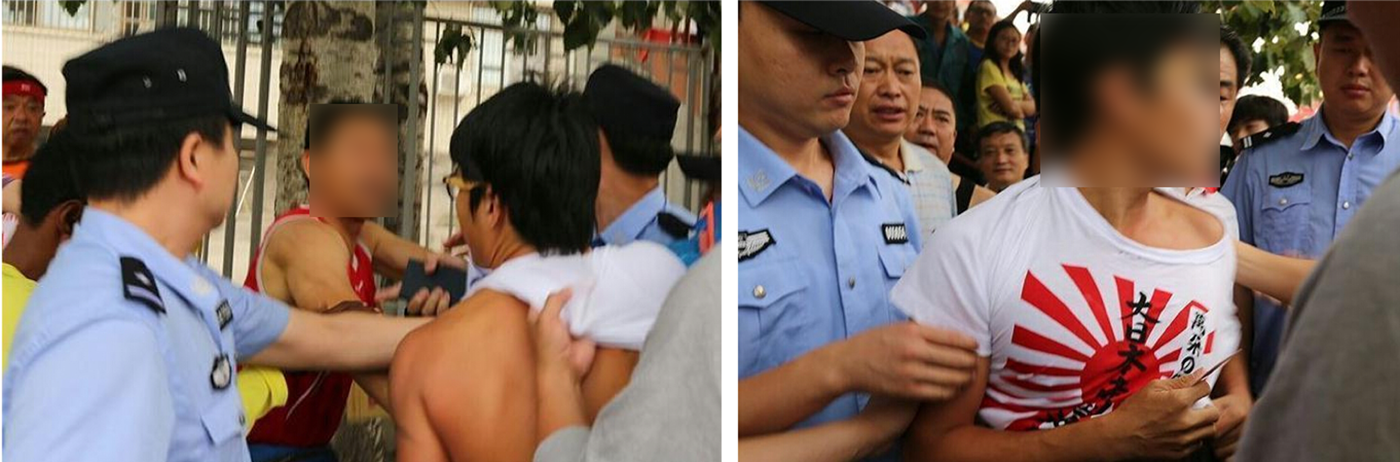
Meanwhile, the controversy continued to simmer. “Jap freaks” began venturing offline. At a Mountaineering Festival held in Taishan 泰山 in September 2014, a young man wore a t-shirt with the imperial Japanese flag on it. He was attacked before being arrested (see Figure 2).Footnote 38
Provoking Nationalist Ire, Taishan, September 2014
Source:
This image was downloaded from people.cn on 5 March 2020, http://world.people.com.cn/n/2014/0907/c157278-25619028.html.

In April 2015, at the Chengdu Comic Con mentioned above, several young men wearing Japanese wartime military uniforms appeared near the pavilion. Local netizens posted their photos and the government disciplined the event organizers.Footnote 39 But, the CCP still did not systematically deal with the jingRi issue.
The jingRi only began to attract national attention in 2017. On 3 August, four young Chinese men, wearing Japanese military uniforms, took photos outside the Sihang 四行 Warehouse patriotic education base in Shanghai. One posted the photos on his QQ blog and referred to the “Shanghai incident” (Shanghai shibian 上海事变), a euphemism some Japanese use to refer to the bloody 1937 Japanese attack on Shanghai.
Online opinion was indignant. “The police need to deal with these Chinese traitors and scum,” a netizen demanded on NetEase. “Please expel these people, rescinding their citizenship,” another implored. “Put them on a national blacklist of Chinese traitors.” The Shanghai police took two of the men into “administrative detention” (xingzheng juliu 行政拘留) and “educated and admonished” (jiaoyu xunjie 教育训诫) the other two, who were under 18.Footnote 40
The jingRi sensation reached a climax in late February 2018 with two major national controversies. As mentioned above, the two jingRi at Shanghai Zijinshan were arrested just two days after taking their photos on 20 February. Traditional and social media paid much more attention to the Zijinshan incident than previous jingRi controversies, nationalizing the issue. The day after their arrest, on 23 February, a 35-year-old Shanghai man named Meng 孟 posted “Killing 300,000 in Nanjing was too few” on his WeChat group. He was reported to the Shanghai police and detained for five days. But just a few days after his release, on 3 March, Meng took a video in front of the Memorial Hall of the Victims of the Nanjing Massacre (Qinhua Rijun Nanjing datusha yu'nan tongbao jinianguan 侵华日军南京大屠杀遇难同胞纪念馆) in which he mocked “only 300,000,” and then uploaded it online. He was then detained for another eight days.Footnote 41
Popular nationalists were again outraged – and not just at Meng. “Five days is too short,” one netizen wrote on guancha.cn (The Observer). “We need to enact new laws.” Others agreed. The state “must legislate!” one demanded. “Punish these Jap-loving national scum” (meiRide minzu bailei 媚日的民族败类).Footnote 42
The next month, on 19 April 2018, Tian Jialiang 田佳良, a graduate student at Xiamen University, wrote “You Chinks stink” on her Weibo account, using the Japanese slur shina 支那, a word jingRi and the Japanese right often use to express their contempt for China.Footnote 43 She later referred to patriotic Chinese as “pink pigs” (fenhong tun 粉红豚).Footnote 44
Online opinion was again incensed. “As a Chinese, I was outraged to hear the word ‘shina’,” one wrote. “Shockingly, it came from the mouth of a Chinese – and a Communist Party member!”Footnote 45 Another demanded action: “She should be expelled immediately.”Footnote 46
And so she was. On 23 April 2018, Xiamen University officially expelled Tian and rescinded her Party membership.Footnote 47
Popular indignation against the jingRi revealed a widespread anxiety about open challenges to the anti-Japanese nationalism mainland Chinese are socialized into today. Although the jingRi had existed for more than a decade in China without a formal response from the government, once the jingRi became a highly public and national phenomenon, the party-state and other sub-elites quickly responded.
Intermediary Groups Facilitate Legislation
Nanjing journalists and lawyers played a central role in both publicizing citizen grievances and facilitating the legislation that would eventually become the national law proscribing “spiritually Japanese” activities. Jessica Teets’ work on environmental networks in China has shown how policy networks can provide elite policymakers with the information and expertise needed to address local concerns. The jingRi case is similar: journalists helped to gather and disseminate information about popular grievances, while lawyers provided much needed legal expertise to craft the legislation. The journalists and lawyers thus acted as vital intermediaries between an indignant public and legislators, enabling authoritarian representation. They transmitted information and expertise up from the grassroots, actively advocating policy and legal changes that would strengthen authoritarian rule.
Nanjing lawyers organized to provide much needed know-how. On 27 December 2017, the Nanjing Lawyer's Association (Nanjing shi lüshi xiehui 南京市律师协会, NLA hereafter) and the Nanjing Legal Aid Foundation (Nanjing shi falü yuanzhu jijinhui 南京市法律援助基金会, NLAF hereafter) together established the Alliance of Lawyers for Protecting the Truth about the Nanking Massacre (Weihu Nanjing datusha lishi zhenxiang lüshi dalianmeng 维护南京大屠杀历史真相律师大联盟, ALPT hereafter). Its mission is to address legal issues related to the Nanjing Massacre, including assisting in civil litigation.Footnote 48 The ALPT was one of the leading organizations that advocated for legislation to deal with the jingRi.
After the February 2018 Shanghai Zijinshan incident, Nanjing lawyers began publicly advocating for the legal punishment of jingRi activities. The ALPT organized a discussion about whether such behaviour violated the PRC Criminal Code,Footnote 49 and sought to initiate public interest litigation.Footnote 50 On 28 February, Nanjing lawyer Tan Zhen 谈臻 told the media that the ALPT was considering forwarding a draft bill to the Standing Committee of the Nanjing Municipal People's Congress for its consideration. Local Nanjing law could then serve as a model for national legislation.Footnote 51
Local journalists also got involved. On 7 March 2018, The Modern Express and the NLA co-hosted a “joint forum” of journalists, scholars, lawyers and museum professionals in Nanjing to advance legislation proscribing the “spiritually Japanese.” Chief editor Zhao Lei 赵磊 declared that they sought to “facilitate” (tuidong 推动) national legislation. Qiu Lufeng 邱鹭风, a Nanjing University law professor, suggested adding prohibitions against fascism and racism to the Criminal Law as a way to proscribe jingRi activities.Footnote 52
Museum professionals also participated, emphasizing the need for greater education about the war. Wu Xianbin 吴先斌, director of the Nanjing Civil Resistance against Japan Museum, suggested organizing historical and social activities to teach young Chinese the correct view of Japan. Zhang Jianjun 张建军, director of the Memorial Hall to the Victims of the Nanjing Massacre, lamented that the existence of “spiritually Japanese” Chinese youth “exposed problems in our education system.”Footnote 53 Two days earlier, on 5 March, the official Weibo account of the Memorial Hall had reacted to Meng's mocking video by calling for legislation: “mild administrative punishments are insufficient. We need to enact new laws to draw a legal red line and prevent the similar incidents in the future.”Footnote 54
It was practising Nanjing lawyers, however, who took centre stage at the joint forum. Some suggested utilizing existing laws. The ALPT's Tan Zhen and Liu Wei 刘伟 suggested that the Supreme People's Court and the Supreme People's Procuratorate reinterpret extant legislation on the “crime of picking quarrels and provoking troubles” (xunxin zishi zui 寻衅滋事罪) to include “spiritually Japanese” behaviour. Wu Mingxiu 吴明秀 suggested that they similarly interpret extant laws against “extremism” (jiduanzhuyi 极端主义) to proscribe hated pro-Japanese behaviour.Footnote 55
Other Nanjing lawyers at the joint forum also advanced ideas for new legislation. NLA president Zhang Lijun 张利军 suggested learning from countries like Turkey which have laws proscribing “insulting national dignity” (wuru guoge 侮辱国格). Echoing Tan Zhen's earlier remarks to the press, Chen Lie 陈烈 suggested writing and enacting legislation locally first, to then serve as a model and impetus for national legislation.Footnote 56
These journalists, museum professionals and lawyers made a difference. Compared to the failed 2012 netizen efforts to “report” on the “Jap freaks,” in 2018 these organized legal and media professionals successfully brought the issue to the attention of the CCP elite, providing much needed information and expertise. Legislation banning jingRi activities quickly followed.
From Bill to Law: Performing and Legislating Authoritarian Responsiveness
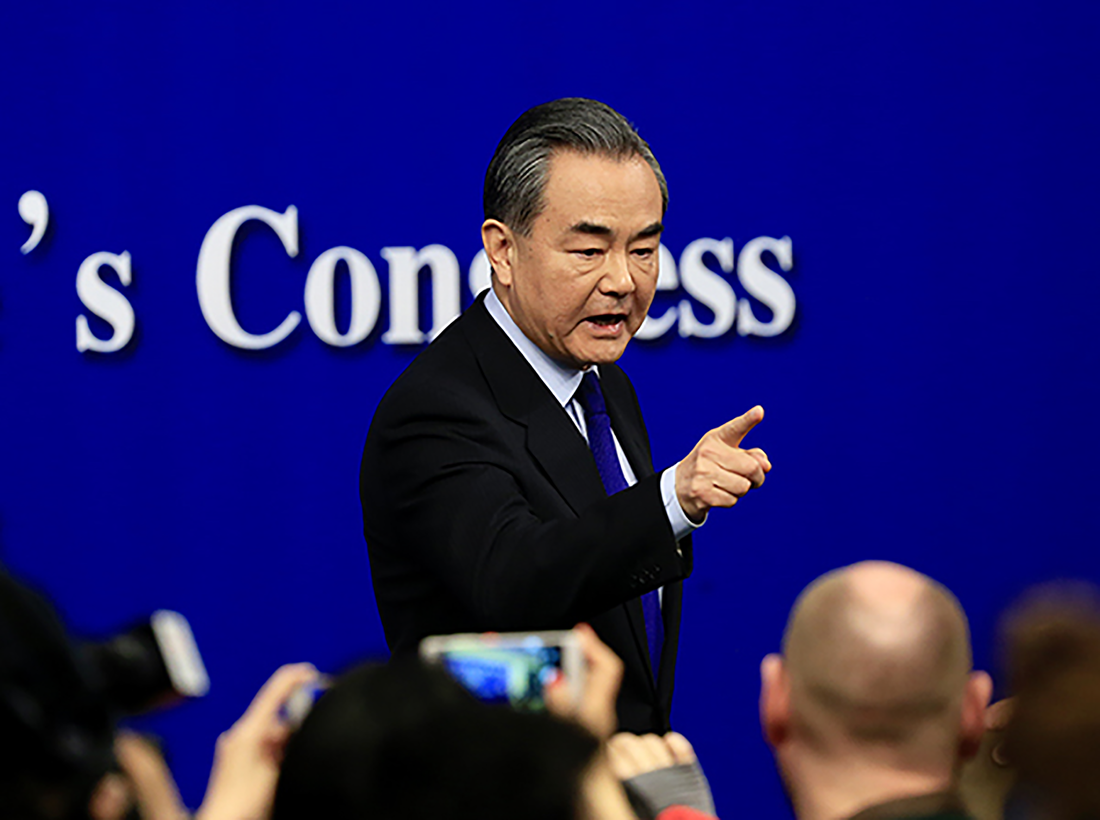
At a national press conference on 8 March 2018, the day after the joint forum in Nanjing, a Modern Express journalist asked the PRC foreign minister Wang Yi what he thought of the jingRi. Wang had not heard of the term. Those who, like Meng, “humiliate the victims of the Nanjing Massacre,” the reporter explained. “They regard themselves as Japanese.”
A widely circulated video clip of the exchange reveals that Wang's demeanour abruptly changed as he came to understand. “Chinese scum!” (Zhongguoren de bailei 中国人的败类!), he angrily declared, and marched off (see Figure 3).Footnote 57 Insulting Meng had gone from the online to the real worlds, and from popular nationalists to the CCP elite. Socially sanctioned righteous indignation was now visibly reflected in the party-state.
“Chinese Scum!” Foreign Minister Wang Yi Publicly Insulting the “Spiritually Japanese,” 8 March 2018
Source:
This image was downloaded from https://www.thepaper.cn/newsDetail_forward_2022046 on 5 March 2020.

Directly gazing at the camera, Wang Yi performed his disapproval for public consumption. And it was a successful performance: the video was looped and widely disseminated and viewed on Chinese social media. Why? We suggest that Wang's performance successfully publicized the authoritarian elite's responsiveness to popular grievances. As noted above, Distelhorst and Fu have argued that Chinese today perform their subjecthood, beseeching officials to act in the public interest.Footnote 58 Wang's performance suggests that China's authoritarian elite also perform their benevolent governance, seeking to legitimate authoritarian rule through publicizing their responsive rule.
The CCP did not just perform its nationalist indignation against the “spiritually Japanese”; it also delivered the goods through legislation. This section will explore authoritarian representation through the actions of CPPCC members like He Yun'ao, who reached out to the Nanjing lawyers and journalists discussed above, enabling the bottom-up transmission of information about popular nationalist grievances and legal expertise to the party-state.
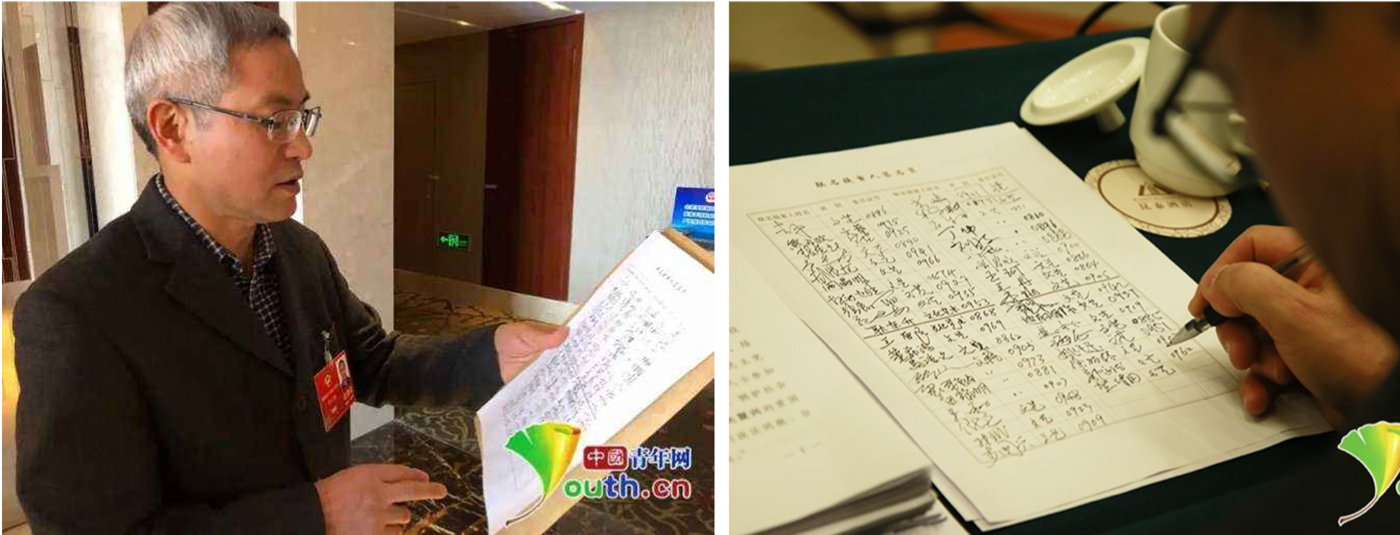
It was also on 8 March that He Yun'ao submitted his proposal (ti'an 提案) at the CPPCC session of the 2018 “two sessions” (lianghui 两会). The CPPCC is an advisory body that submits bills (yian 议案) to the NPC, which can then be made into laws. He Yun'ao had gathered signatures on his proposed bill (see Figure 4) from 38 other CPPCC deputies, including movie star Jackie Chan and other actors and actresses such as Zhang Guangbei 张光北 and Zhang Kaili 张凯丽. The bill would proscribe any behaviour “promoting Japanese militarism, fascism, and Bushido” and any public insult to the “dignity of the Chinese race.”Footnote 59
Authoritarian Representation: He Yun'ao Gathers Signatures on His CPPCC Bill
Source:
This image was downloaded from youth.cn on 5 March 2020, http://news.youth.cn/2018qglhyc/201803/t20180308_11484470.htm.

Just two days later on 10 March, at the NPC meeting of the “two sessions,” Jiangsu legislators submitted a bill legally proscribing jingRi activities. A new national law was approved the very next month on 27 April 2018.
Why did He Yun'ao and these other CPPCC deputies respond to popular nationalist anger against the jingRi? Media interviews provide some insight into their motives. News about the jingRi personally offended He. “This is an insult to our national character and national dignity,” he told the Beijing Youth Daily (Beijing qingnian bao 北京青年报).Footnote 60 Public indignation may also have motivated him. He viewed responsiveness to public opinion as his job. “As a member of the CPPCC, I am first and foremost a citizen,” he told the Guangming Daily (Guangming ribao 光明日报). “I should respond to the demands of the people.”Footnote 61 The positive feedback he had received from around the country, he later told Nanjing's Modern Express, revealed that the Chinese people are “united as one” (wanzhong yixin 万众一心), a “patriotic predisposition” (aiguozhuyi de qizhi 爱国主义的气质) that moved him deeply.Footnote 62
He Yun'ao was not alone. Other CPPCC members who signed He's bill also publicly performed their patriotism. “If we don't love our country, are we still Chinese?” actor and CPPCC deputy Zhang Guangbei rhetorically asked a Guangming Daily journalist. “So I felt that legislation was necessary.” In 2006, Zhang starred in the famous War of Resistance against Japan (KangRi zhanzheng 抗日战争) TV drama, Drawing Swords (Liangjian 亮剑). “The Nanjing Massacre is a history of the Chinese people's blood and tears,” actress and CPPCC member Zhang Kaili similarly told a journalist. “How can anyone trample on our feelings so casually?”Footnote 63 As noted above, Jackie Chan was another celebrity CPPCC deputy who very publicly backed He's bill.
It is the public nature of these performances, rather than the genuineness of their patriotism, that is of consequence. By publicly performing authoritarian representation, these CPPCC deputies helped to legitimate CCP rule.
Media interviews with CPPCC deputy He Yun'ao also highlight the mediating role that Nanjing intermediary groups played in proscribing the jingRi. Nanjing journalists, He claimed, played a major role in the passing of the legislation. “From Nanjing to Beijing,” he told the Modern Express, “you have always covered all of our work on the proposal. This had a great impact.” The media, in his view, did not just make CCP elites like himself and the foreign minister Wang Yi aware of the jingRi, it also helped convey the people's will to the CCP.Footnote 64
Deputy He also saw lawyers and legal scholars as playing a vital role in providing expert professional advice. “Legal professionals, especially in Nanjing, first argued that simply condemning the jingRi was pointless; there needed to be legal punishment,” He told the Beijing Youth Daily. “So [the lawyers] proposed a new law.” “The facilitation of legal professionals and academic experts,” He similarly told the Modern Express, was central to the “writing and rewriting of the CPPCC proposal.”Footnote 65
In short, with the help of Nanjing journalists and lawyers who provided needed information and expertise, He Yun'ao and other CPPCC deputies crafted and shepherded a bill to the NPC, which then passed a law proscribing the jingRi. These intermediary groups facilitated authoritarian representation and policy change on the politically sensitive issue of anti-Japanese nationalism.
Conclusion: Authoritarian Representation and Nationalist Legitimation in China Today
The “spiritually Japanese” are a tiny group of a few thousand young Chinese contrarians whose motives are unclear, perhaps even to themselves. This article has focused not on them but on how and why the CCP responded so quickly and publicly to the popular nationalist demand in 2018 that jingRi activities be legally proscribed.
Over the past decade, Xi Jinping has consolidated his personal power and the CCP's authoritarian rule. To head off opposition, the CCP has paid greater attention to evidence of social dissatisfaction. It has also added the maintenance of social stability to economic development as a promotion criterion for local cadres, incentivizing them to be responsive to popular discontent.
China scholars have followed these developments closely, paying greater attention to authoritarian responsiveness in China.Footnote 66 Much of the literature seeking to explain authoritarian resilience in China has focused on how the CCP uses various institutions and practices, from protests to petitions to policy networks, to gather the local information they need to overcome the “principal-agent problem” that plagues highly centralized authoritarian political systems. Local information is then used to govern more effectively, helping to account for authoritarian resilience.
China's NPC is one such institution. Truex has convincingly argued that the NPC is not simply a top-down “rubber stamp” for decisions made by CCP elites; it also conveys information about local grievances bottom-up to the CCP leadership. “Within the bounds” of everyday apolitical issues from education to healthcare access, Truex persuasively demonstrates, “authoritarian representation” is no oxymoron.
The rapid CCP response to popular nationalist indignation against the jingRi, passing legislation in the NPC proscribing “publicizing or beautifying the war of invasion,” is a good example of authoritarian representation. With the help of local Nanjing journalists, CPPCC deputy He Yun'ao conveyed vital information about citizen preferences to the NPC. And, with the help of local Nanjing lawyers, He also provided needed expertise to write the new law. Deputy He thus contributed to responsive authoritarian governance.
The curious case of the jingRi contributes to our theoretic understanding of both how (mechanisms) and when (under what conditions) authoritarian representation occurs in China today. Mechanisms include intermediary groups and elite performances. In 2018, Nanjing lawyers and journalists played a vital mediating role between the party-state and its subjects, transmitting needed expertise and information up from the grassroots. Without the involvement of such intermediary groups, the CCP did not respond to similar popular nationalist grievances against “Jap freaks” in 2012. Given the sheer size of the Chinese population and the number and complexity of its socio-political challenges, intermediaries are often needed to overcome the “principal-agent problem” and facilitate authoritarian representation.
Another mechanism of authoritarian representation in China is public performance. Simply being responsive may not be enough; the appearance of responsiveness may be equally important. Foreign Minister Wang Yi's very public declaration of the jingRi to be “Chinese scum!” was a performance of rulership before the Chinese public, helping to legitimize CCP rule. CPPCC deputies also publicly performed their indignation against the traitorous jingRi. Building on the work of Distelhorst and Fu, we argue that just as ordinary Chinese perform their citizenship in China today to cajole cadres into doing their duty, CCP elites perform their benevolent and responsive rulership to persuade the Chinese people to consent to CCP governance – and indeed to their privileged political positions. Public performance may be particularly important on highly politicized issues like nationalism, which requires ongoing and visible production and reproduction to legitimize authoritarian rule.
The curious case of the jingRi also contributes to our theoretic understanding of when authoritarian representation occurs. The scope of authoritarian representation may be broader than Truex suggests, beyond the bounds of everyday apolitical issues like education and healthcare. The CCP has been making a nationalist claim to legitimate rule since its founding in 1949 under Mao. Seventy years later, a “China dream” of “national rejuvenation” and glory has become even more central to Xi and the CCP's claims to legitimate rule. This has created ever more space for popular nationalists to utilize the CCP's own grammar of authoritarian legitimation against the Party. Popular nationalist indignation against jingRi incidents also included pointed criticisms of the CCP for failing to proscribe such behaviour. Deputies like He Yun'ao worked hard to represent their constituents’ desires on this issue not just because they saw themselves as “patriotic” but also because they felt a responsibility to represent the people's will on an issue that the CCP itself champions as a basis for its legitimate governance.
Finally, the curious case of the jingRi also contributes to our empirical understanding of Chinese nationalism today. The pervasiveness and intensity of popular nationalist outrage against the “spiritually Japanese” in 2018 reveals just how successful “patriotic education” has been in post-Tiananmen China. Much of that socialization, whether through history textbooks,Footnote 67 excursions to museums and other “patriotic education bases,” or TV shows or video games based on the War of Resistance against Japan,Footnote 68 explicitly depicts a China confronting foreign enemies like Japan and the US. Consequently, this education is less about promoting the love of China (patriotism) than about fostering fear or hatred of other nations (nationalism). In mainland China today, the term “Japanese devils” (Riben guizi 日本鬼子) is redundant: everyone knows that unspecified “devils” are Japanese. Contrarian Chinese like the jingRi, who buck the trend and associate themselves with the hated “devils,” will not be tolerated.
The CCP may become a victim of its own success in socializing so many Chinese to hate Japan and other “imperialists.” Authoritarian responsiveness can be progressive if it means responding to popular demands for healthcare, education and a clean environment. However, authoritarian responsiveness to popular nationalism can be dangerous when it leads not just to tougher laws against perceived traitors within China (for example, the “spiritually Japanese”) but also tougher foreign policies against perceived enemies abroad, such as Japan and the US. Given that those countries are also experiencing rising nationalism, greater authoritarian responsiveness in China today may not bode well for peace in the 21st century.
Acknowledgements
Both authors would like to thank Lee Kai Hung for his generous endowment of the Manchester China Institute, which made this research possible. The first author would also like to thank David Stroup and Jessica Teets for their thoughtful comments.
Conflicts of interest
None.
Biographical notes
Peter GRIES is the Lee Kai Hung Chair and founding director of the Manchester China Institute, and professor of Chinese politics at the University of Manchester. He studies the political psychology of international affairs, with a focus on China and the US.
Yi WANG is assistant professor in the Faculty of Political Science and Economics, Waseda University. His research focuses on the politics of memory and identity in China.