INTRODUCTION
In naturally occurring environmental settings, carbon is usually contained in complex mixtures that reflect different sources, processes, ages, chemical composition, and chemical reactivities (Schuur et al. Reference Schuur, Carbone, Hicks Pries, Hopkins, Natali, Schurr, Druffel and Trumbore2016; Hanke et al. Reference Hanke, Gagnon, Reddy, Lardie Gaylord, Cruz, Galy, Hansman and Kurz2023). In radiocarbon (14C) science, a greater insight into these mixtures can lead to improved chronological records, or better understanding of the environmental cycling of carbon, by isolating the components of a mixed sample that relate to specific events or processes (Hajdas et al. Reference Hajdas, Ascough, Garnett, Fallon, Pearson, Quarta, Spalding, Yamaguchi and Yoneda2021). Numerous methodologies have been established, and continue to be developed, to isolate specific fractions for radiocarbon analysis, including chemical (e.g., acid-base-acid washes) and physical (e.g., density separation) treatments (Hajdas et al. Reference Hajdas, Ascough, Garnett, Fallon, Pearson, Quarta, Spalding, Yamaguchi and Yoneda2021). More recently, techniques such as liquid and gas chromatography have been used to extract compounds or compound classes for 14C dating (e.g., Blattmann et al. Reference Blattmann, Montluçon, Haghipour, Ishikawa and Eglinton2020; Casanova et al. Reference Casanova, Knowles, Bayliss, Dunne, Barański, Denaire, Lefranc, di Lernia, Roffet-Salque and Smyth2020). An approach that has been increasingly applied over recent years involves the radiocarbon analysis of samples that are fractionated according to the temperature of thermal decomposition of their constituent carbon-bearing components (Hemingway et al. Reference Hemingway, Galy, Gagnon, Grant, Rosengard, Soulet, Zigah and McNichol2017; Hanke et al. Reference Hanke, Gagnon, Reddy, Lardie Gaylord, Cruz, Galy, Hansman and Kurz2023). Compounds such as polysaccharides (e.g., cellulose), lignins, polyaromatic carbon, and carbonates thermally breakdown at different temperatures, and therefore can be isolated on the basis of their decomposition according to the temperature of a pyrolysis or oxidation reaction (Manning et al. Reference Manning, Lopez-Capel, White and Barker2008; Sanderman and Grandy Reference Sanderman and Grandy2020). Also, the temperature of thermal breakdown can be used to determine activation energy to provide insights into preservation and protection of organic matter (Hemingway et al. Reference Hemingway, Rothman, Grant, Rosengard, Eglinton, Derry and Galy2019; Sanderman and Grandy Reference Sanderman and Grandy2020), and to appraise relative lability or recalcitrance, for example, with the carbon reactivity index (Smeaton and Austin Reference Smeaton and Austin2022).
No single technique to thermally fractionate samples for radiocarbon analysis has been universally adopted, and methods have included stepped combustion (McGeehin et al. Reference McGeehin, Burr, Jull, Reines, Gosse, Davis, Muhs and Southon2001), ramped pyrolysis/oxidation (RPO; Rosenheim et al. Reference Rosenheim, Day, Domack, Schrum, Benthien and Hayes2008) and ramped oxidation/combustion (Hanke et al. Reference Hanke, Gagnon, Reddy, Lardie Gaylord, Cruz, Galy, Hansman and Kurz2023). Typically, these methods involve incremental heating, or ramped temperature increase, of the sample material in a furnace and collection of the evolved gases over a specific temperature range. The gases are subsequently purified to extract the sample carbon as carbon dioxide (CO2), and then processed further using standard 14C techniques to prepare the sample carbon for 14C measurement by accelerator mass spectrometry (AMS).
During the sequential heating steps of the above processes, the amount of sample material that is thermally decomposed can be quantified, typically by using either gravimetric methods (e.g., Manning et al. Reference Manning, Lopez-Capel, White and Barker2008) or direct measurement of the CO2 concentration using a CO2 sensor (e.g., infrared gas analyser; IRGA). The resulting plots of the CO2 concentration versus temperature, often termed a thermogram (e.g., Plante et al. Reference Plante, Beaupré, Roberts and Baisden2013), provide an indication of the composition of the sample material, and can be used to identify the temperature ranges to target for 14C analysis. The sample composition is generally interpreted on the basis of activation energy (Hemingway et al, Reference Hemingway, Galy, Gagnon, Grant, Rosengard, Soulet, Zigah and McNichol2017), for example with carbon from compounds such as polysaccharides and lipids evolved at lower temperatures, and carbon from phenols, heterocyclic, and polyaromatic compounds evolved at correspondingly higher temperatures (Sanderman and Grandy Reference Sanderman and Grandy2020). Clearly, it is essential that complete oxidation of the carbon released during thermal decomposition occurs, and thus most systems incorporate a secondary oxidation step (Manning et al. Reference Manning, Lopez-Capel, White and Barker2008; Hanke et al. Reference Hanke, Gagnon, Reddy, Lardie Gaylord, Cruz, Galy, Hansman and Kurz2023), although this does not avoid problems that have been reported from charring effects (Williams et al. Reference Williams, Rosenheim, McNichol and Masiello2014; Keaveney et al. Reference Keaveney, Barrett, Allen and Reimer2021).
All radiocarbon analyses are subject to some level of contamination during processing, and so a key consideration for radiocarbon analysis of thermally fractionated samples must be the quantification of the contamination associated with the processing of a sample i.e., the radiocarbon blank or background (Fernandez et al. Reference Fernandez, Santos, Williams, Pendergraft, Vetter and Rosenheim2014; Hemingway et al. Reference Hemingway, Galy, Gagnon, Grant, Rosengard, Soulet, Zigah and McNichol2017). Contributions to the background can potentially come from every stage of sample processing, including pretreatment, combustion, graphitisation and also from the instrument used for the 14C measurement. The ideal is for the background contamination to be as low as possible, or at least to be a consistent and quantifiable amount, which is small compared to the amount of sample carbon so that it can be mathematically accounted for using standard protocols (e.g., Donahue et al. Reference Donahue, Linick and Jull1990). A fundamental prerequisite for any radiocarbon technique is the correct measurement of standard materials of known 14C content, sourced preferably from international standards agencies or laboratory intercomparison studies. If a technique correctly determines the 14C content of standards of known 14C content, this is a strong indication that it can be reliably used to 14C date samples of unknown age (especially if the samples are broadly similar in composition to the standard material).
Recognizing the potential scientific benefits that thermally fractionating samples could offer, we resolved to build apparatus for the ramped combustion of radiocarbon samples that could be applied to a range of materials including sediments and soils, which would allow a more detailed and valuable examination of the radiocarbon composition of complex mixtures than can be afforded by measurement of bulk samples alone. Here, we describe our new instrumentation and procedures for the radiocarbon analysis of samples using the approach of ramped oxidation. We present the results for quality assurance standards used to test the equipment and discuss the advantages, and challenges, of the approach.
METHODS
Description of the Ramped Combustion System
Samples are combusted in a carrier gas of high purity oxygen (N5.5, BOC, UK) at a constant flow rate (ca. 30 mL/min) that is set using a metering valve (Swagelok, USA). The carrier gas passes through a CO2 scrub (cartridge containing zeolite molecular sieve Type 13X, Sigma-Aldrich; Garnett et al. Reference Garnett, Newton and Ascough2019) and then, via Ultra-Torr vacuum fittings (Swagelok, USA), into the primary combustion vessel where sample oxidation is performed. The primary combustion vessel is constructed from a quartz tube (identical to ones used in the lab for sealed quartz tube combustion (Boutton et al. Reference Boutton, Wong, Hachley, Lee, Cabrera and Klein1983) of samples; 12 mm o/d × 130 mm wide end and 6 mm o/d × 130 mm narrow end) and is placed inside a tube furnace (MTF 10/15/130 1000ºC, Carbolite, UK) with a temperature ramp feature. Sample material is held inside a quartz insert which is placed inside the primary combustion vessel.
After the carrier gas exits the primary combustion vessel it enters the secondary combustion vessel, joined using Ultra-Torr vacuum fittings (Swagelok, USA). The secondary combustion vessel is used to ensure complete oxidation of sample carbon to CO2 (in case of volatiles and carbon monoxide) and is also constructed from a standard quartz combustion tube, held inside a second furnace (MTF 10/15/130 1000ºC, Carbolite, UK). This quartz tube contains ca. 1–2 cc of platinised wool (Platinum 5% on Triton kaowool, BDH Chemicals Ltd, UK) and is heated to a constant temperature of 950ºC.
Upon leaving the secondary combustion vessel the carrier gas is dried in a quartz tube (10 mm o/d × 150 mm) containing magnesium perchlorate (ca. 60 mm length in tube; Elemental Microanalysis, UK). The gas next enters a custom-built unit that contains sensors that communicate with an Arduino Uno microcontroller (www.arduino.com). A non-dispersive infrared sensor is used to determine the CO2 concentration of the carrier gas (SprintIR®-WF-5, Gas Sensing Solutions, UK). The flow rate of the carrier gas is measured using an air flow sensor (AWM3300V, Honeywell, USA), and the temperature of the primary combustion vessel is measured using a K-type thermocouple (TCMK150AQ150, TC Ltd, UK) connected to the Arduino via a thermocouple breakout board. The Arduino microcontroller gathers the measurements from each of the sensors and, at intervals of one second, passes the data via a serial connection to a computer which logs the values using custom software written in Processing open-source language (www.processing.org).
The carrier gas exits the sensor unit and connects to a three-way valve (Swagelok, USA) which is used to direct the gas flow to one of two sampling ports. Before a sample is processed, one of the gas ports is connected to an SBA-5 CO2 analyser (PPsystems, USA) which is used to test for leaks in the system and to verify that the carrier gas does not contain significant levels of CO2. After the initial set up, the SBA-5 can be disconnected, and the two gas sampling ports used for connecting foil pouch bags (5 L spout pouch bag, https://www.pouchshop.co.uk) which are used to store the samples. Foil bags are sealed with one-hole rubber bungs (Fisher-Scientific, UK) installed with 6 mm o/d stainless steel tubing (Swagelok, USA) connected to an auto-shutoff coupling (Colder Products Co, USA) via a 5 cm length of Isoversinic tubing (Saint Gobain, France). The three-way valve is used to switch the gas port during sample processing, enabling the collection of sample into multiple foil bags, and therefore partitioning of samples based on the temperature of the primary combustion vessel. A Weloc clip (Scandinavia Direct, UK) placed across the Isoversinic tubing on the foil bag provides an additional seal after sample collection is completed. Figure 1 shows a schematic and photograph of the ramped combustion kit.
Photograph (top) and schematic diagram (bottom) of the ramped oxidation kit. Before a sample is processed the kit is tested by replacing Bag 1 with an SBA-5 CO2 sensor (as in the photograph).

Operation of the Ramped Oxidation Kit
All quartz glassware from the primary and secondary combustion vessels (including the platinised wool) is combusted at 900ºC for at least 2 hr before processing each sample. Ultra-Torr connectors are washed in carbon-free detergent (Decon 90), rinsed with Milli-Q water and dried in a drying cabinet. Sample material is weighed into a quartz insert which is then placed inside a quartz combustion tube before being installed in the primary combustion furnace. Care is taken to ensure that the sample material is placed consistently within the central part of the tube furnace (zone of uniform temperature), which is aided by mounting the furnaces on an incline (Figure 1). Before each use, foil pouch bags are cleaned by filling with ca. 1 L high purity oxygen and emptying, three times over a period of at least 2 days to aid outgassing of residual CO2 and tested with the SBA-5.
Prior to processing a sample for 14C analysis the ramped oxidation kit is cleaned by flushing with high purity oxygen carrier gas at 30 mL/min for at least 30 min. The platinum catalyst is also heated at the same time to drive off any trapped carbon dioxide. The carrier gas is vented via the SBA-5 CO2 analyser which is used to verify that the system is ready for sample processing and then replaced with a gas sampling bag. Immediately before processing a sample the SprintIR®-WF-5 CO2 sensor is calibrated by setting its zero point with the carrier gas at 0 ppm CO2. Ramped combustion begins by starting the logging software and switching on the primary combustion furnace which is pre-set to ramp from room temperature (to usually 800 or 900ºC) at a ramp rate of 5ºC/min.
After combustion has been completed, the sample CO2 in the foil pouch bags is cryogenically purified on a vacuum rig using slush (–78ºC; dry ice and industrial methylated spirits) and liquid nitrogen (–196ºC) traps, taking care to avoid formation of liquid oxygen in liquid nitrogen traps by maintaining sufficient vacuum. The pure CO2 is split into one aliquot for δ13C analysis using isotope ratio mass spectrometry (IRMS; Delta V, Thermo-Fisher, Germany) and a second for graphitisation (Slota et al. Reference Slota, Jull, Linick and Toolin1987) followed by AMS 14C measurement (SUERC AMS Facility, East Kilbride UK; Xu et al. Reference Xu, Anderson, Bryant, Cook, Dougans, Freeman, Naysmith, Schnabel and Scott2004). Following convention (Stuiver and Polach, Reference Stuiver and Polach1977), radiocarbon results are normalised to a δ13C of –25‰ using the IRMS values, and results reported as percent modern (pMC = fraction modern x 100) and conventional radiocarbon age (years BP, where 0 BP = AD 1950) based on:
 $${\rm{Fraction\ modern}} = 14{\rm{C}}/13{{\rm{C}}_{{\rm{S/}}}}14{\rm{C}}/13{{\rm{C}}_{{\rm{Ox}}}}$$
Where 14C/13C represents the 14C/13C ratio of the unknown sample or standard (S) and oxalic acid international radiocarbon reference (Ox). Background correction of the results is performed following Donahue et al. (Reference Donahue, Linick and Jull1990):
 $${\rm{F}} = {\rm{Fm }}\left( {1 + {\rm{f}}} \right)-{\rm{f}}$$
Where F is the background-corrected fraction modern of the sample, and Fm and f are the raw fraction modern values (normalised to δ13C of –25‰) of the ramp-combusted sample and the background correction for the process (based on measurements of a 14C-dead anthracite standard), respectively.
Quality Assurance tests to verify the reliability of thermograms and radiocarbon measurements obtained via operation of the new ramped oxidation system
A series of quality assurance tests were performed to verify the accuracy and reproducibility of data produced from operation of the new ramped oxidation kit described above. Three main aspects of the operation were tested and verified and are described below.
Test to determine whether ramped combustion of replicate standard materials generate consistent thermograms
If the ramped oxidation kit is to be used to reliably thermally separate samples, it is important that the thermograms that are generated from the same homogenous material are consistent and repeatable. We therefore undertook replicate combustions of three different radiocarbon standard materials, varying the weight of sample that was combusted over a range from 1–8 mg. The standard materials used were an internal laboratory background standard (Anthracite; n=5), barleymash from the Third International Radiocarbon Intercomparison (TIRI barleymash, n=3; Gulliksen and Scott Reference Gulliksen and Scott1995) and an internal laboratory humin standard (96H humin, n=3; Xu et al. Reference Xu, Anderson, Bryant, Cook, Dougans, Freeman, Naysmith, Schnabel and Scott2004). These standards were chosen to provide a range of material, from ones containing a high proportion of biomass-derived carbon, to material containing a high proportion of thermally-resistant polyaromatic carbon, and also material that contained a mixture of carbon compounds across this range in varying proportions. All tests were performed using the routine procedures described above.
Tests to assess the reliability of foil pouch bags for the storage of radiocarbon samples
Foil bags have previously been used to store radiocarbon samples of CO2 (Zhou et al. Reference Zhou, Niu, Wu, Xiong, Hou, Wang, Feng, Cheng, Du and Lu2020), methane (Garnett et al. Reference Garnett, Hardie and Murray2012) and dissolved inorganic carbon (Bryant et al. Reference Bryant, Henley, Murray, Ganeshram and Shanks2013; Castrillejo et al. Reference Castrillejo, Hansman, Graven, Lester, Bollhalder, Kündig and Wacker2023). Use of foil bags for temporary storage of ramped combustion samples is very convenient and greatly simplifies the operation of the ramped combustion kit, however, they must be capable of reliable sample storage over a suitable time period to allow accurate analysis. We therefore tested the bags using two approaches. First, we measured the ingress of CO2 into the bags over different storage times. Replicate bags were filled with 1 L of high purity oxygen gas and the CO2 concentration measured using an infrared gas analyser (EGM-5, PPsystems, USA) after storage of between 1 and 28 days. Second, we stored radiocarbon CO2 standards in foil bags for 5 days before cryogenically recovering the CO2 and preparing it for AMS 14C measurement as described above. These test gases were created to simulate typical ramped oxidation samples and were composed of ca. 2.5 mL of pure CO2 added to a foil pouch bag prefilled with 1 L of the same high purity oxygen as used on the ramped combustion rig. We used laboratory near-background (0.23 ± 0.08 pMC; APUP2; Air Products, UK) and known 14C content (77.88 ± 0.23 pMC; AP1; Air Products, UK) internal laboratory CO2 standards.
Measurement of the 14C content of background and known age radiocarbon standards processed using the ramped oxidation system
We combusted background and known age radiocarbon standards using the ramped oxidation equipment with our routine procedures and recovered the CO2 for 14C analysis as described above. Two sets of tests were performed using the Anthracite, TIRI barleymash and 96H humin standards. First, because we could not assume that the standards had thermally homogenous 14C concentrations (i.e., that each thermal fraction of the material would be identical to the bulk value), the total gas produced was collected into a single foil pouch bag and the entire recovered CO2 14C-dated. Since we collected the total gas produced, we expected that the 14C content of the recovered sample would match the consensus value for the standard. Second, we repeated the combustion of the standards, but this time split the evolved gases into two different foil pouch bags based on a low and a high temperature combustion range. For these tests we expected that combining the 14C results for the low and high temperature fractions, weighted by CO2 volume in each fraction, would produce a 14C value that matched the consensus values for the known age standards. We used the results of the Anthracite standards to quantify the background of the ramped combustion method, which was used to background-correct the known age standards (Equation 2; Donahue et al. Reference Donahue, Linick and Jull1990).
RESULTS
Test to determine whether ramped combustion of replicate standard materials generates consistent thermograms
Thermograms for replicate combustions of the three radiocarbon standards are presented in Figure 2, with the panels on the right showing the results after normalising for different sample sizes by scaling the CO2 measurements based on the peak CO2 concentration. The results show that overall, there is a high degree of consistency between the replicate thermograms of a single material. The thermograms of the five anthracite standards are all extremely similar with a large overlap and very little difference in the temperature of the peak CO2 concentration (mean ± SD = 503 ± 3ºC). The three TIRI barleymash replicate thermograms also show a high degree of consistency; slight variation in the patterns of evolved CO2 from this standard is likely due to the nature of the material, with varying proportions of biomass components that have significant chemical differences (polysaccharides, lipids, lignins, etc) throughout. This contrasts with the highly polyaromatic and more homogeneous internal chemical structure of the anthracite coal. The three replicates of the standard 96H humin also showed overall consistency in their thermograms, verifying that the major composition of this material was reproducible. Slight variations were apparent in the 96H humin thermograms, which we again attribute to varying contributions from the different classes of compounds in the material that are slightly different between aliquots. This can be seen in the fact that the relative heights of the two largest peaks in CO2 concentration show variation, however, there is very low variation in the absolute temperature at which these two peaks are evolved between aliquots. Several small peaks in CO2 concentration were observed above 500ºC in the 96H humin samples, but not consistently in each of the replicates. We attribute these to the presence of a very small amount of relatively resistant carbon in the material, which would be consistent with polyaromatic carbon from a pyrogenic source within the humin.
Thermograms of radiocarbon standards processed using the ramped oxidation kit, showing anthracite (top), TIRI barleymash (middle) and 96H humin (bottom). Left panels display the thermograms as the concentration of evolved CO2 in the carrier gas, and right panels provide the normalised CO2 concentration as a percentage of the peak CO2 value.

Tests to assess the reliability of pouch bags for the storage of radiocarbon samples
Foil bags containing 1 L of high purity oxygen accumulated a very small amount of CO2 that was detectable with a sensitive infrared gas analyser. The accumulation rate of CO2 was initially 0.0013 ± 0.0003 mg CO2-C per day (Figure 3), and even after 3 days storage the total CO2 had only increased to 0.0021 ± 0.0003 mg CO2-C. These amounts represent a very small proportion of the carbon in the total background of the ramped combustion method as calculated from the 14C measurements of Anthracite (see below) and provide evidence that the foil pouch bags are a reliable method of collecting and storing sample CO2 generated by the ramped combustion kit. The 14C measurements of CO2 from the in-house APUP2 background standard that had been stored in the foil bags for 5 days had a radiocarbon concentration of 0.51–0.61 pMC (n=3). This is slightly higher compared to the usual value of 0.23 ± 0.08 pMC for APUP2 when measured without storage in the foil bags (Table 1). The 14C measurements of the known-age AP1 CO2 standard after being stored for 5 days in the foil bags (n=3) returned radiocarbon measurements within 1 σ of the internal laboratory consensus value for this standard (77.88 ± 0.23 pMC; Table 1).
Performance of foil pouch bags for the storage of ramped combustion samples. Black data points show the accumulation of CO2 over time in bags (n = 3) containing 1 L of high purity oxygen, expressed as CO2-C mg with 1 σ error bars. These data points produced an r2 of 0.9476, but a linear regression performed after log transforming both axes produced a better fit (r2 = 0.9841) and was used to model the accumulation of CO2 in the foil pouch bag over time for a 1 mg CO2-C sample (red curve). The horizontal grey lines indicate the mean (solid) and ± 1 σ (dashed lines) of the background of the ramped oxidation method as calculated from the 14C results of the five anthracite standards (with 1 day storage), and which is used to background correct the sample results. The graph suggests that storage times of <3 days contributes <¼ of the total background of the method (or equivalent to less than the 1 σ uncertainty of the applied background correction).

Storage test of foil pouch bags for radiocarbon samples. Ramped oxidation samples were simulated by adding ca. 2.5 mL of internal laboratory CO2 standards to pouch bags that had been pre-filled with 1 L of high purity oxygen gas. Bags were stored for 5 days before the CO2 was recovered as described in the text. Internal laboratory consensus values for APUP2 and AP1 CO2 standards are 0.23 ± 0.08 pMC and 77.88 ± 0.23 pMC, respectively. As expected, 14C values for the stored APUP2 background standard were slightly elevated, but the 14C results for the stored AP1 were < 1.1 σ from the reference value. CO2 volume is at standard temperature and pressure.

Measurement of the 14C content of background and known age radiocarbon standards using the ramped combustion kit
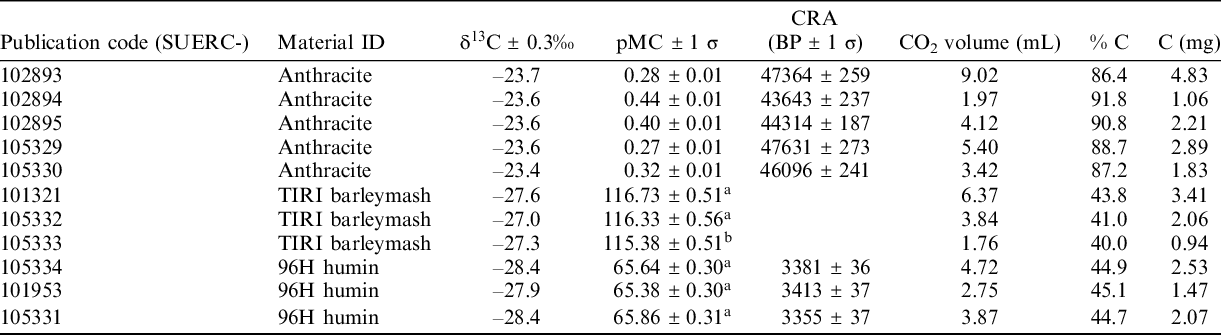
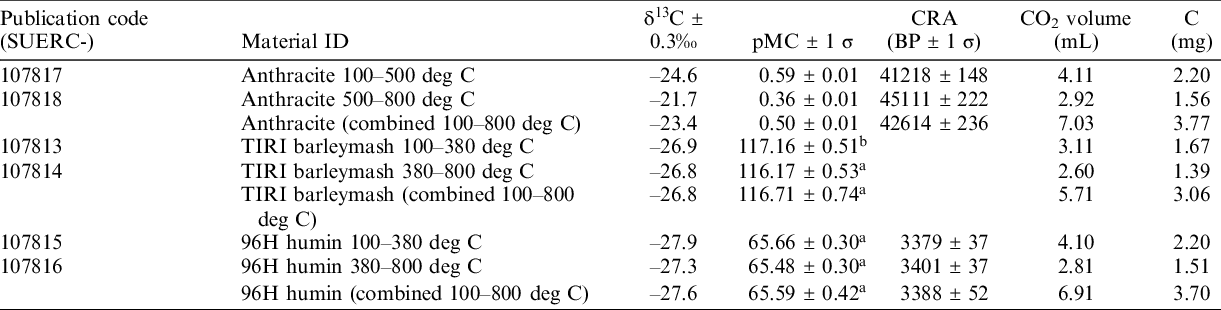
Whole samples of the Anthracite background standard combusted in the ramped oxidation kit gave radiocarbon concentrations of between 0.27 and 0.44 pMC for sample sizes of 1 and 5 mg C (mean 0.34 ± 0.08 SD pMC; Table 2). The mean 14C and standard deviation of the five anthracites was used for the background correction of the known age standards, noting that, although the small number of standards suggested a possible size-dependent trend (Figure 4), all five anthracites had 14C concentrations well within the 2 σ range of the applied background correction. Radiocarbon results for the whole samples of TIRI barleymash and 96H humin standards were all within 2 σ of the consensus values, with five out of six results being within 1 σ of the consensus (Table 2). For split samples, the low temperature fraction of the Anthracite was 14C-enriched compared to the high temperature fraction and was >2 σ 14C-enriched compared to the background correction (Table 3). However, when the 2 fractions were combined, the overall 14C concentration was just within 2 σ of the background correction. For the known age standards the low temperature fractions also had higher pMC values compared to the high temperature portions, but all were within 2 σ of the consensus values. When combined using isotope mass balance, the 14C results for both samples were within 1 σ of the consensus values (Table 3).
Results for radiocarbon standards processed in the ramped oxidation kit (whole samples). The 14C-dead anthracite was used to determine the radiocarbon background of the method. Consensus values for TIRI barleymash and 96H humin are 116.35 pMC and 65.63 pMC, respectively, and measured values were either within 1 σ (a) or 2 σ (b) of the consensus values. CO2 volume is at standard temperature and pressure.

Relationship between radiocarbon concentration of the anthracite background standard versus sample size when processed with the ramped oxidation kit. Error bars on 14C measurements are ± 1 σ. Shaded boxes represent the background correction (0.34 ± 0.08 pMC) applied for known age standards, with the orange and blue boxes representing the 1 and 2 σ range of the applied background correction, respectively.

Results for radiocarbon standards that were thermally fractionated using the ramped oxidation kit. The exhaust gases from the ramped oxidation kit were directed into two different foil pouch bags to provide a low and high temperature fraction. Results are presented for the separate temperature fractions, and when the fractions are mathematically combined weighted by sample size. The 14C-dead anthracite was used to assess the radiocarbon background for split samples when using the method. Consensus values for TIRI barleymash and 96H humin are 116.35 pMC and 65.63 pMC, respectively, and measured values were either within 1 σ (a) or 2 σ (b) of the consensus values. CO2 volume is at standard temperature and pressure.

DISCUSSION
Rationale for the design and approach of the ramped combustion kit
We undertook the construction of our ramped oxidation kit in response to a growing interest in the scientific community in the radiocarbon analysis of thermally separated samples (Hemingway et al. Reference Hemingway, Galy, Gagnon, Grant, Rosengard, Soulet, Zigah and McNichol2017; Hanke et al. Reference Hanke, Gagnon, Reddy, Lardie Gaylord, Cruz, Galy, Hansman and Kurz2023). Our primary considerations were that the system would consistently separate samples based on the temperature of oxidation, and above all, be reliable for radiocarbon analysis of the separated fractions. We discuss these issues, and the tests undertaken with the kit to assess them, in the next section. However, we reflect here on other considerations that influenced the design of our ramped oxidation kit.
First, we chose not to directly link our ramped combustion line to a cryogenic purification rig as reported for other systems (e.g., Rosenheim et al. Reference Rosenheim, Day, Domack, Schrum, Benthien and Hayes2008; Keaveney et al. Reference Keaveney, Barrett, Allen and Reimer2021; Hanke et al. Reference Hanke, Gagnon, Reddy, Lardie Gaylord, Cruz, Galy, Hansman and Kurz2023). This was partly in response to reports of sample contamination during ramped combustion and CO2 recovery from leaks in vacuum-connected systems (though subsequently resolved; Keaveney et al. Reference Keaveney, Barrett, Allen and Reimer2021), which are avoided or mitigated in our approach because the combustion and sample collection are undertaken in a carrier gas at positive pressure relative to atmosphere. Additionally, separating the CO2 recovery from the combustion by using temporary sample storage vessels has operational advantages. Typically, ramp combustion of one sample takes about 3 hours and therefore only 1 or 2 samples can be processed on the ramped combustion kit per day. However, one operator can cryogenically recover in a single day CO2 from 3–4 days’ worth of thermally separated samples. Therefore, efficiencies can be made by undertaking several days of ramped combustion sample processing, followed by a single day of cryogenically purifying the sample CO2. Other advantages of this approach include the fact that the same existing vacuum rigs being used for processing other sample types can be used for the CO2 recovery of ramped combustion samples with minimal modification, thus avoiding using additional lab space and expense to create a dedicated vacuum rig for the ramped oxidation system. Furthermore, while considerable training is required to undertake cryogenic purification of radiocarbon samples on a vacuum rig, operation of our ramped combustion setup requires much less training, meaning that visiting students/researchers can be taught to safely combust their samples without the need to spend a large amount of time learning to use a cryogenic vacuum rig.
Initially, we planned to use molecular sieve traps for collection of the ramped combustion samples because of their handling convenience and because they can reliably store CO2 samples for radiocarbon analysis over many months (Garnett et al. Reference Garnett, Newton and Ascough2019). However, we chose against the use of these traps because we recognized that long-term (>1 week) storage of ramped oxidation samples was not necessary, and because the operator time for processing molecular sieve traps was greater compared to using foil gas bags. Moreover, the performance of the foil pouch bags for 14C samples was found to be significantly better compared to the molecular sieve traps. This is demonstrated by the 14C content of background standards processed using the ramped combustion kit which range from 0.27 to 0.44 pMC and is less than half that of the background of the molecular sieve method (1.0 ± 0.5 pMC; Garnett et al. Reference Garnett, Newton and Ascough2019). It should be noted, however, that the use of foil bags for sample storage does have limitations as we found a small amount of CO2 ingress into bags over time (Figure 3). Thus, our current protocols limit storage of ramped combustion samples in foil bags to less than 3 days to ensure that this CO2 represents a small fraction of the total 14C background. It should also be noted that, although being confirmed as reliable for storage of radiocarbon samples, some foil bags have been reported to be vulnerable to damage and to be relatively expensive (Castrillejo et al. Reference Castrillejo, Hansman, Graven, Lester, Bollhalder, Kündig and Wacker2023). The foil pouch bags used in our study were specifically chosen because they are robust, and although they are also inexpensive, we have found that they can be reused multiples times without damage or loss in performance (the results reported here are for bags that had already been used multiple times).
We built our system to perform ramped oxidation of samples using a carrier gas of high purity oxygen. This was initially partly out of convenience because of access to an existing oxygen supply. However, it was also by design in an attempt to avoid charring effects which have previously been reported for ramped pyrolysis-oxidation systems (Williams et al. Reference Williams, Rosenheim, McNichol and Masiello2014; Keaveney et al. Reference Keaveney, Barrett, Allen and Reimer2021). A systematic investigation to determine whether our approach suffers charring effects, which can produce artefacts by making thermally labile material less available before oxidation, has yet to be performed, though the similarity in the thermograms of different amounts of the same standard material argues against the presence of significant charring effects (Figure 2).
Our ramped combustion system was relatively inexpensive to construct because initially we were able to assemble almost the entire kit using components that were already available to us, many of which would be similarly accessible in other radiocarbon laboratories (e.g., furnaces, vacuum fittings, quartz combustion tubes). Additionally, we consider that the low-cost CO2 sensor (SprintIR®-WF-5, Gas Sensing Solutions, UK) that we use to monitor CO2 concentration in the carrier gas is more than adequate for producing detailed thermograms (Figure 2), although we find that our more sensitive (and higher cost) SBA-5 infrared gas analyser to be beneficial for ensuring that the lines are free of significant contamination prior to processing a sample. Nevertheless, we suggest that our approach could provide a relatively inexpensive route for other labs to thermally separate samples prior to radiocarbon analysis.
Reliability of the ramped oxidation kit for radiocarbon analysis of thermally separated samples
Our aim was to separate samples into different fractions solely on the temperature of combustion, so that the different fractions could be 14C dated. For reliable operation, it is important that this is achieved consistently and repeatably, and for example, is not prone to produce different results depending on sample size. We therefore standardised the design and operation of the ramped combustion kit, and among other things, included a sensor to ensure consistent flow of carrier gas.
The flow rate of the carrier gas that we selected represented a compromise. On the one hand, we wished to minimise the volume of carrier gas used because it is a potential contributor to the 14C background. However, the flow rate needed to be sufficient to transfer combustion products out of the primary combustion vessel and on to the CO2 sensor, at a rate that would enable high resolution thermograms, that were consistent for samples of different sizes. The close agreement of the thermograms for different size replicates of the same standard materials (Figure 2), suggest that we have achieved our aim of thermally separating samples in a repeatable way. Clearly, there is greater variation in the replicates of the TIRI barleymash and 96H humin, compared to the anthracite, which may reflect the more diverse nature of the former materials, in terms of potentially containing a greater range of compounds or being less homogenous due to a greater range in particle size.
To ensure that our ramped combustion approach is reliable for 14C analysis we performed a suite of tests using our laboratory 14C background and known age standards. The anthracite background standard processed using our ramped oxidation methods produced an average of 0.34 +/–0.08 pMC for samples between 1 and 5 mg C and is double (but overlapping at <1 σ) the long-term mean radiocarbon content of anthracite when processed using the sealed quartz tube combustion method in our laboratory (0.17 +/– 0.10 pMC). We suspect that this higher 14C content for anthracite processed using ramped oxidation is due to small amounts of additional contamination from the oxygen carrier gas, platinum catalyst and foil bags, which may themselves have varying 14C values. Assuming the background contamination is 100 pMC, this suggests that our ramped combustion method (including all steps, not just the combustion) contributes 8.1+/–3.3 µg C, which is higher than the 3.7 +/–0.6 µg C reported by Hemingway et al. (Reference Hemingway, Galy, Gagnon, Grant, Rosengard, Soulet, Zigah and McNichol2017), but very similar to the equivalent value of 8.8 +/–4.4 µg C reported by Fernandez et al. (Reference Fernandez, Santos, Williams, Pendergraft, Vetter and Rosenheim2014).
We used the 14C results from the five ramp-combusted anthracite standards (Table 2) to calculate the background correction (0.34+/–0.08 pMC) to apply to the known age standards using the approach described by Donahue et al. (Reference Donahue, Linick and Jull1990). Although the results suggest a possible size-dependent relationship with the amount of 14C contamination (Figure 4), this approach is justified for samples > 1 mg C because all results for the anthracites easily fell within the 2 σ uncertainty of the background correction. Indeed, using this approach all six whole samples (Table 2), and all six thermally fractionated samples (Table 3), provided 14C results that are within 1 or 2 σ of the 14C consensus. These results indicate that the new ramped combustion method correctly determined the 14C concentration of these standards, and therefore, it is reliable for determining the 14C age of thermally fractionated samples.
Future Developments
Based on the results presented here, we believe that the performance of our ramped combustion system is acceptable for samples (or thermal fractions of samples) that yield at least 2 mL CO2 (ca. 1 mg C), which is near the minimum volume recommended by the laboratory for routine AMS radiocarbon analysis plus measurement of δ13C by IRMS. We acknowledge that a greater understanding of the ramped combustion background is required, for example, to quantify the background across different temperature ranges through analysis of alternative standard materials. Future development will involve the analysis of more 14C dead standards to better define the background of the method and investigate possible size-dependency. To use the kit for smaller samples, or those that are close to the 14C detection limit, a reduction in the contamination introduced during processing would be beneficial. We will seek to identify and mitigate sources of contamination, for example, through testing alternative catalysts for the secondary combustion furnace.
Currently, the system is entirely manual and requires an operator to be present at the appropriate time to ensure that the temperature fractions are collected into different foil bags. This provides opportunity for human error, for example, if the operator is distracted at the specific moment that a change in sample collection is required. To overcome this, and maximize sampling efficiency, we will install automated valves to direct the sample into designated foil bags, triggered by the temperature of the primary combustion furnace according to a pre-set program. It is anticipated that the availability of this ramped oxidation system will allow environmental samples to be routinely investigated for radiocarbon dating of thermally separated organic pools, thereby improving our understanding of the timescales of carbon cycling.
ACKNOWLEDGMENTS
We thank all staff at the NEIF Radiocarbon Laboratory and colleagues at the Scottish Universities Environmental Research Centre. We also thank T Wagner, B Bowler, J Bischoff, and D Manning for support during earlier discussions of this work. We are grateful to the UK Natural Environment Research Council for funding NEIF (grant NE/S011587/1). RP acknowledges support to the BOOGIE project from the ERC under the European Union’s Horizon 2020 research and innovation program (grant number 949495). We thank two reviewers for their suggestions.