Introduction
Globally, falling fertility rates and increasing life expectancies are giving rise to ageing populations. While 9 per cent of the global population was aged 65 years or older in 2019, this number is expected to rise to approximately 16 per cent by 2050 (United Nations, 2019). China has the largest population of older adults in the world; the number of Chinese people aged 65 years and above reached 191 million in 2020, accounting for approximately 13.5 per cent of China's total population (National Bureau of Statistics of China, 2021). In 2050, approximately a quarter of the global population aged 80 years and older will live in China (United Nations, 2007). The growing number of older adults in China evidences the need for social policies, research and interventions founded on deep understanding of the social determinants of healthy ageing in the Chinese context; specifically, this work can support the life expectancy and quality of life of older adults. Given that China is the largest developing country in the world and home to the largest population of older adults, evidence from the Chinese context can significantly inform the development of older adult care policies and interventions in areas with similar social, cultural and economic contexts.
Self-rated health (SRH) is a crucial subjective indicator of an individual's general health (Idler and Benyamini, Reference Idler and Benyamini1997). Notably, SRH has been found to independently affect mortality across different countries, even when controlling for objective health indicators (Idler and Benyamini, Reference Idler and Benyamini1997; Godaert et al., Reference Godaert, Godard-Sebillotte, Allard Saint-Albin, Bousquet, Bourdel-Marchasson, Fanon and Dramé2018). Sociodemographic characteristics, socioeconomic status and physical health status are significant social determinants of SRH (Wu et al., Reference Wu, Wang, Zhao, Ma, Wu, Yan and He2013; Ehsan et al., Reference Ehsan, Klaas, Bastianen and Spini2019). According to the resource hypothesis, individuals tend to assess their health status based on their morbidity conditions and the supportive resources they can access from their social networks, such as their community and family (Idler and Benyamini, Reference Idler and Benyamini1997; Wolinsky and Tierney, Reference Wolinsky and Tierney1998). Along these lines, the social capital embedded in the social networks of older adults may be a potential modifiable determinant of SRH (Lu et al., Reference Lu, Lou, Zuo and Chi2017, Reference Lu, Xu and Zhang2021; Ehsan et al., Reference Ehsan, Klaas, Bastianen and Spini2019).
However, most studies on social capital and SRH have been conducted in developed countries (Ng and Eriksson, Reference Ng, Eriksson, Nyqvist and Forsman2015). Considering the disparities that exist across social, economic and cultural contexts, new empirical evidence from developing countries is required to develop indigenous social policies and interventions. Moreover, only a limited number of relevant studies have simultaneously examined how social capital rooted in the community and family (hereafter termed ‘community and family social capital’) can sustain or improve SRH in older adults (Lu et al., Reference Lu, Xu and Zhang2021). To date, most relevant studies have tested the direct effects of community social capital on SRH; the potential moderators of this association are understudied. Given that community social capital is a contextually dependent concept, it may differently affect SRH in older adults with different functional health levels and behaviours. This study aimed to better understand the role of community social capital in the SRH of older adults in urban Chinese contexts and the potential moderating effects of difficulty with instrumental activities of daily living (IADLs) and smoking in this association.
Literature review
Social capital framework
The concept of social capital has attracted considerable attention in social policy and health research, largely due to its protective influence on individual wellbeing across age groups and countries (Ehsan et al., Reference Ehsan, Klaas, Bastianen and Spini2019). Although scholars have not reached a consensus on how to define and measure social capital (Putnam et al., Reference Putnam, Leonardi and Nanetti1993; Portes, Reference Portes1998), it can be conceptualised and measured at both the collective and individual levels (Agampodi et al., Reference Agampodi, Agampodi, Glozier and Siribaddana2015). First, from a collective perspective, social capital can be measured based on levels of trust and reciprocity and the frequency of social participation in the living environment, such as the community (Putnam et al., Reference Putnam, Leonardi and Nanetti1993). For example, promoting collective action and social trust in local communities may have a protective effect on residents' health outcomes. Second, from the individual perspective, social capital can be considered an important supportive resource for the individual that emerges from their social connections with other individuals who share common cultural values and social norms as well as trust and reciprocity (Portes, Reference Portes1998).
While schools and workplaces are important social groups for young adults, communities and families are particularly important sources of supportive resources for older adults, e.g. older adults may depend on their communities or families to fulfil their social and medical needs. Individual-level community social capital can take different forms, which can be categorised based on their cognitive and structural dimensions (Portes, Reference Portes1998; Agampodi et al., Reference Agampodi, Agampodi, Glozier and Siribaddana2015). ‘Cognitive social capital’ represents how individuals feel about their social connections, such as whether they trust or perceive themselves as engaging in reciprocal relationship with residents in their local communities. ‘Structural social capital’ reflects the structure and intensity of an individual's social connections, such as their membership in organisations and social participation. Meanwhile, ‘family social capital’ is built upon supportive resources and networks as well as shared values and norms in the family system (Alvarez et al., Reference Alvarez, Kawachi and Romani2017). Accordingly, this kind of social capital is frequently measured based on the structure, interaction patterns and quality of relationships within the family system (Alvarez et al., Reference Alvarez, Kawachi and Romani2017). Notably, the quality of relationships and support more heavily impact health in later life than family structure (Alvarez et al., Reference Alvarez, Kawachi and Romani2017).
The ageing process is often accompanied by various losses, including, but not limited to, declines in health, the loss of significant others and social withdrawal (Zhang and Zhang, Reference Zhang and Zhang2015; Appau et al., Reference Appau, Awaworyi, Smyth and Zhang2022). In these circumstances, social capital plays an important role in supporting older individuals in achieving their instrumental and universal goals, such as social and physical wellbeing (Steverink et al., Reference Steverink, Lindenberg and Ormel1998). In other words, high levels of social capital indicate sufficient supportive resources from the community and family, which can be used to fulfil older adults' long-term care needs, help them adapt to life challenges, and sustainably balance gains and losses (Steverink et al., Reference Steverink, Lindenberg and Ormel1998; Lou et al., Reference Lou, Lu, Xu and Chi2013). Furthermore, high levels of neighbourhood trust and reciprocity and active social engagement in community activities may affect how older adults use social resources and handle losses.
Older adults in low- and middle-income countries may face limited health and financial resources; in light of such limited support, social capital may significantly affect their wellbeing (Ng and Eriksson, Reference Ng, Eriksson, Nyqvist and Forsman2015). In China, the family has historically been perceived as the main source of long-term care for older adults. However, over the last few decades, demographic shifts have changed approaches to older adult care. Specifically, the traditional multigenerational household structure has been replaced by a nuclear family structure (National Bureau of Statistics of China, 2021) and the rise of a floating population (characterised by millions of working-age adults moving from rural to urban regions for better income and job opportunities) has widened the geographical distances between different generations of the same family. Together, these trends have weakened the degree to which older adults in China are supported by their families, especially in terms of instrumental support. Under such circumstances, China has started to develop a national long-term care system (Wu et al., Reference Wu, Cohen, Cong, Kim and Peng2021). Given the decline of traditional family-based approaches to older adult care, community social capital may be playing an important compensatory role in meeting the long-term care needs of older Chinese adults. In light of China's rapidly ageing population, it is important to investigate the association between social capital and SRH among older populations in China and other developing countries to obtain up-to-date evidence for designing social policies and interventions in these social and economic contexts.
Community social capital and SRH
Existing literature has linked community social capital to wellbeing among older adults (Alvarez et al., Reference Alvarez, Kawachi and Romani2017; Ehsan et al., Reference Ehsan, Klaas, Bastianen and Spini2019). Although extensive research has been conducted to test the effects of community social capital on SRH in the general adult population, only a limited number of studies have focused on older adults. Notably, these studies have established that individual-level community social capital indicators are positively associated with SRH among older adults in both high- and low-/middle-income countries, including Finland, Poland, Spain (Koutsogeorgou et al., Reference Koutsogeorgou, Nyqvist, Nygård, Cerniauskaite, Quintas, Raggi and Leonardi2015), Australia (Yiengprugsawan et al., Reference Yiengprugsawan, Welsh and Kendig2018), South Africa (Lau and Ataguba, Reference Lau and Ataguba2015), Japan (Ichida et al., Reference Ichida, Kondo, Hirai, Hanibuchi, Yoshikawa and Murata2009) and China (Shen et al., Reference Shen, Yeatts, Cai, Yang and Cready2014; Lu and Zhang, Reference Lu and Zhang2019; Zhang et al., Reference Zhang, Xu and Lu2019).
Several studies have reported positive associations between cognitive social capital and SRH in different countries. Using the World Value Survey, Glanville and Story (Reference Glanville and Story2018) found that particularised trust has a larger effect on SRH than generalised trust. Meanwhile, measures of individual-level social capital (e.g. trust and reciprocity) were found to be positively associated with SRH among adults aged 60 years and older in the United States of America (USA) and Germany (Pollack and von dem Knesebeck, Reference Pollack and von dem Knesebeck2004). Similarly, Yiengprugsawan et al. (Reference Yiengprugsawan, Welsh and Kendig2018) found that poor trust was associated with a higher likelihood of poor SRH among middle-aged and older adults in Australia. O'Doherty et al. (Reference O'Doherty, French, Steptoe and Kee2017) reported that trust and social networks were positively associated with SRH among people aged 50 years and older in England.
However, other studies have reported mixed findings. A meta-analysis of social capital and SRH revealed that reciprocity and trust had the greatest effects on SRH. Social participation also significantly increased the likelihood of reporting good SRH (Gilbert et al., Reference Gilbert, Quinn, Goodman, Butler and Wallace2013) and was notably more significantly associated with health outcomes than trust and civic participation in a Canadian sample (Veenstra, Reference Veenstra2000). Meanwhile, community service group membership was associated with SRH in South Africa (Lau and Ataguba, Reference Lau and Ataguba2015), whereas a lack of social participation increased the likelihood of poor SRH in Germany (Pollack and von dem Knesebeck, Reference Pollack and von dem Knesebeck2004). In contrast, Hibino et al. (Reference Hibino, Takaki, Ogino, Kambayashi, Hitomi, Shibata and Nakamura2012) found that social trust – but not social participation – was negatively associated with poor SRH in Japan. The association between structural social capital and SRH was also statistically non-significant in some Chinese studies (Yip et al., Reference Yip, Subramanian, Mitchell, Lee, Wang and Kawachi2007; Norstrand and Xu, Reference Norstrand and Xu2011). Last, Coll-Planas et al. (Reference Coll-Planas, Del Valle Gómez, Bonilla, Masat, Puig and Monteserin2017) found that a social capital intervention did not significantly promote SRH among older adults in Spain.
Furthermore, research on social capital (especially structural social capital) and SRH faces an endogeneity issue. Individuals with poor SRH may be less likely to engage in formal social activities, such as volunteering. Only a few studies have used an instrumental variable approach to test the association between social capital indicators and SRH, particularly in older populations. For example, using this approach, Arezzo and Giudici (Reference Arezzo and Giudici2017) concluded that structural social capital was positively associated with SRH in later life in European countries. Additionally, Fiorillo and Nappo (Reference Fiorillo and Nappo2017), who also used this approach, uncovered that one component of structural social capital (i.e. volunteering) was significantly associated with SRH among respondents aged 16 years and older in the United Kingdom. Other relevant studies that used this approach also found significant causal relationships between social capital and other health indicators (i.e. mental health, cognition and smoking behaviour), evidencing the important role of structural social capital in health outcomes (Islam et al., Reference Islam, Folland and Kaarbøe2017; Gupta, Reference Gupta2018; Dai and Gu, Reference Dai and Gu2021). For example, by using an instrumental approach to analyse a nationally representative sample from the USA, Gupta (Reference Gupta2018) found that volunteering, a structural social capital indicator, significantly impacts cognitive decline in later life.
In summary, while existing empirical evidence generally suggests that SRH is more strongly associated with cognitive social capital than with structural social capital (Gilbert et al., Reference Gilbert, Quinn, Goodman, Butler and Wallace2013; Ehsan et al., Reference Ehsan, Klaas, Bastianen and Spini2019), scholars have also identified non-significant and negative associations between these factors (Villalonga-Olives and Kawachi, Reference Villalonga-Olives and Kawachi2017; Ehsan et al., Reference Ehsan, Klaas, Bastianen and Spini2019). Future studies are needed to examine how different aspects of community social capital influence SRH in later life. Examining intergroup differences could enable a better understanding of this link.
The roles of difficulty with IADLs and smoking
Individuals' personal characteristics not only directly affect their SRH but also influence how social capital affects their SRH (Verropoulou, Reference Verropoulou2012; Villalonga-Olives and Kawachi, Reference Villalonga-Olives and Kawachi2017). IADLs are associated with SRH in later life (Verropoulou, Reference Verropoulou2012) and play an important role in measuring functional health, e.g. difficulties in performing IADLs are often used to assess older adults' performance in daily life. Compared to activities of daily living (ADL), IADLs are more complex – they involve higher-level functions, such as shopping and meal preparation (Lawton and Brody, Reference Lawton and Brody1969). By sustaining their ability to perform IADLs, older adults can live independently in their local communities and, relatedly, actively participate in reciprocal exchanges with their neighbours. Notably, citizenship activity is another structural social capital indicator that may be particularly important for older adults with IADL difficulties (e.g. community safety and food delivery); by engaging in citizenship activity, older adults can solve common problems in their communities. Therefore, we propose that IADLs moderate the association between social capital and SRH.
Finally, the link between health behaviours (e.g. not smoking) and health outcomes (e.g. SRH, cognitive impairment and premature mortality) is well established in the literature (Lee et al., Reference Lee, Back, Kim, Kim, Na, Cheong, Hong and Kim2010; Gellert et al., Reference Gellert, Schöttker and Brenner2012; Sargent-Cox et al., Reference Sargent-Cox, Cherbuin, Morris, Butterworth and Anstey2014). For example, smoking is associated with poor SRH over time among older adults aged 60–64 years in Australia (Sargent-Cox et al., Reference Sargent-Cox, Cherbuin, Morris, Butterworth and Anstey2014). However, little is known about the potential moderating role of smoking in the association between social capital and SRH in older adults.
A systematic review conducted by Villalonga-Olives and Kawachi (Reference Villalonga-Olives and Kawachi2017) highlighted the role of social capital in promoting behavioural contagion; specifically, certain behaviours (healthy or unhealthy) may spread among participants in social activities and organisations. Notably, membership in an organisation was associated with a higher risk of unhealthy behaviours in the general Danish population (Seid et al., Reference Seid, Hesse and Bloomfield2015). In some social organisations, such as recreational clubs, smoking and drinking may be a normal pastime – in these contexts, older adults may be encouraged to smoke and drink or may be exposed to second-hand smoke. This effect may be more severe among older adults with a history of smoking. However, social organisations can also promote healthy behaviours, e.g. they can discourage smoking through anti-smoking regulations and sharing information about the health risks of smoking. Smokers may benefit more from participating in these activities than non-smokers. The deeper point here is that older adults may pick up both healthy and unhealthy behaviours by participating in certain social activities. Therefore, we reasoned that the association between structural social capital and SRH may vary according to individuals' health-related behaviours.
In summary, we proposed the following hypotheses:
• Hypothesis 1: Community social capital is positively associated with SRH among older adults in China, even when controlling for family social capital and its covariates.
• Hypothesis 2: Difficulty with IADLs moderates the association between community social capital and SRH.
• Hypothesis 2.1: The positive association between cognitive social capital and SRH is stronger among older adults who do not experience difficulty in performing IADLs.
• Hypothesis 2.2: The positive association between structural social capital and SRH is stronger among those who experience difficulties in performing IADLs.
• Hypothesis 3: Smoking moderates the association between community social capital and SRH.
• Hypothesis 3.1: Older adults with a history of smoking benefit more than non-smokers from participating in activities that discourage smoking.
• Hypothesis 3.2: Participation in social activities that encourage smoking is negatively associated with SRH among older adults with a history of smoking.
Methodology
Sample
We analysed data from a 2020 community survey – titled ‘Social Capital, Intergenerational Solidarity, and Mental Health Among Chinese Older Adults’ (SCIENCE) – conducted in Shijiazhuang and Tianjin, two major cities in northern China. Approximately five million older adults aged 60 years and older live in these two cities and account for approximately one-fifth of the local populations.
Using a quota sampling approach, ten communities were randomly selected from five districts in each city. A total of 800 respondents were recruited from the 20 selected communities through advertisements and recommendations from local community committees (we sampled 40 respondents in each community). The inclusion criteria were as follows: (a) local household registration status, (b) aged 60 years or older, (c) residence in one of the selected communities for at least 180 days in the past year, and (d) willing to provide informed consent before data collection. We matched the age and sex ratios of the sample with those of representative samples from the population census in the localities.
Trained interviews were conducted face-to-face in either community centres or the respondents' homes. Each interview took around 40–60 minutes. The questionnaire collected detailed information on respondents' sociodemographic characteristics, family social capital, community social capital, mental health and physical health. The response rates were above 90 per cent in both cities (Tianjin: 92.8%; Shijiazhuang: 94.7%). After deleting cases with missing values for key demographic variables, such as age, the final analytical sample size was 793. Ethical approval was obtained from the Ethics Committee of the University of Hong Kong.
Measurement
Outcome variable
The outcome variable, SRH, was measured using a single item: ‘How do you rate your present health status?’ Response options included 1 = very poor, 2 = poor, 3 = fair, 4 = good and 5 = excellent. Given the positive skewness in the distribution of SRH, it was further dichotomised (0 = very poor, poor or fair; 1 = good or excellent). A similar approach was used in previous research (Lou et al., Reference Lou, Lu, Xu and Chi2013).
Social capital variables
This study situated community social capital as a multi-dimensional concept, including its cognitive and structural dimensions (Grootaert et al., Reference Grootaert, Narayan, Jones and Woolcock2004; De Silva et al., Reference De Silva, Huttly, Harpham and Kenward2007; Agampodi et al., Reference Agampodi, Agampodi, Glozier and Siribaddana2015). Cognitive social capital was assessed based on trust, reciprocity and sense of belonging. Specifically, respondents were asked to indicate their perceptions of trust, reciprocity and belonging by indicating the degree to which they agreed with different statements using a five-point scale, in which 1 = strongly disagree, 2 = disagree, 3 = neutral, 4 = agree and 5 = strongly agree. Regarding trust, participants were asked whether they agreed that they could trust the other residents in their local communities. Regarding reciprocity, they were asked whether they agreed that (a) the residents helped each other when necessary and (b) the residents not only sought personal benefits but also respected others' interests. Regarding their sense of belonging, respondents were asked whether they agreed that the local community was a family and they belonged to this family.
Structural social capital was assessed based on the respondents' number of organisational memberships, social participation, citizenship activities and volunteering. Regarding the number of organisational memberships, respondents were shown a list of social organisations, including political parties, religious groups, labour unions, women's groups, community associations (e.g. entertainment and interest groups), sports groups, charity groups, professional associations, universities for older citizens and neighbourhood committees, and were asked to state whether or not they belonged to these groups (0 = no, 1 = yes; the summed scores ranged from 0 to 10). Social participation was assessed based on the frequency of participation in social activities held by organisations. Respondents were asked to report how frequently they participated in such activities by selecting from the following options: 1 = never, 2 = once per year or less, 3 = several times per year, 4 = 1–3 times per month, 5 = once per week and 6 = twice or more per week. Volunteering was assessed based on whether the respondents had participated in any volunteer activities in the past month, including supporting vulnerable groups and improving the community environment. Citizenship activities were assessed using a single item: ‘Did you work with other residents to handle common problems in your communities in the last year?’ Respondents were asked to answer by selecting from the following options: 1 = never, 3 = occasionally and 5 = participated in almost all activities.
Family social capital was measured using the family subscale of the Multidimensional Scale of Perceived Social Support (Zimet et al., Reference Zimet, Dahlem, Zimet and Farley1988). This four-item scale included the following statements: (a) ‘My family members are willing to support me when necessary’, (b) ‘I can receive emotional support from my family members’, (c) ‘I can discuss my problems with my family members’ and (d) ‘My family members are willing to help me make decisions on crucial life events’. Response options ranged from 1 = strongly disagree, 3 = neutral to 5 = strongly agree. The average scores were calculated to represent the level of family social capital (Cronbach's alpha = 0.848).
Moderators and covariates
Difficulty with IADLs was measured using the seven-item Lawton Instrumental Activities of Daily Living Scale (Lawton and Brody, Reference Lawton and Brody1969). Respondents were asked to report their level of difficulty with each IADL (e.g. shopping, handling medication and finances, housekeeping, using transportation and the telephone, preparing food) by selecting from the following options: 0 = no difficulty, 1 = some difficulty and 2 = very difficult. The average score for each respondent represented his or her level of difficulty with IADLs, with higher scores indicating higher levels of difficulty (Cronbach's alpha = 0.860). Furthermore, respondents were asked whether they had a history of smoking (0 = never smoked, 1 = smoked or still smoke). Age was calculated based on the respondents' birth years. The number of living children and log value of household income per month were also calculated. Sex (0 = male, 1 = female), marital status (0 = no, 1 = yes), educational attainment (0 = secondary school or lower, 1 = high school or higher), living alone (0 = no, 1 = yes), residence (0 = Tianjin, 1 = Shijiazhuang) and drinking (0 = have not consumed alcohol in the past 12 months, 1 = have consumed alcohol in the past 12 months) were dichotomised. Chronic disease diagnoses, including heart disease; diabetes; arthritis; asthma; and diseases of the lungs, liver, kidneys and stomach, were self-reported (0 = no, 1 = yes) and totalled for each respondent.
Data analysis
Because we treated SRH as a dichotomous variable, we used binary logistic regression models to test the associations between community social capital and SRH and the moderating effects of difficulty with IADLs and smoking in the above associations. SPSS (version 26.0) was used to analyse the data. Odds ratios (OR) and corresponding 95 per cent confidence intervals (CI) were calculated for social capital and the covariates. The Hosmer–Lemeshow test was applied to test the model fit.
First, respondents' sociodemographic characteristics and physical health variables were entered into a statistical model. In the second stage, family and community social capital variables were entered into the model. In the third stage, all the two-way interaction terms for IADL difficulty and separate community social capital variables were entered into the model to test whether the association between community social capital and SRH varied according to the level of family social capital. Using a backward elimination method, interaction terms with non-significant coefficients were deleted from the statistical model. The same procedure was used to test the moderating effects of smoking on the association between community social capital and SRH. In the final stage, we included social capital variables, covariates and the four significant interaction terms in the final statistical model, and then reran the model to test whether the four interaction terms remained simultaneously significant. As the missing rates of all variables were less than 5 per cent (no social capital variables, except one of reciprocity indicator ‘Care both interests’ (i.e., the residents care about both their benefits and others' interests; N = 1), demonstrated missingness), we used listwise deletion in the analysis.
Results
Sample characteristics
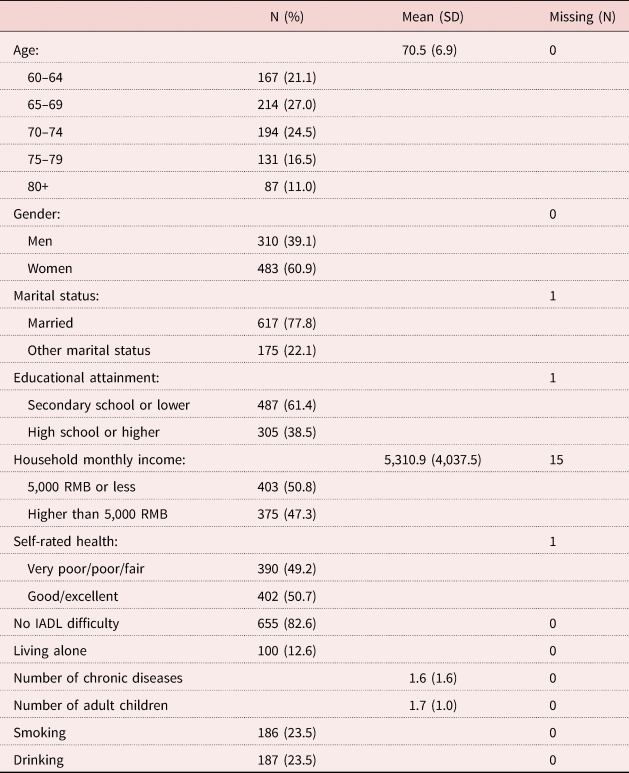
Table 1 presents the respondents' sociodemographic characteristics. Approximately 27.5 per cent of the respondents were aged 75 years and older, 60.9 per cent were female, nearly 80 per cent were married and 12.6 per cent lived alone at the time of the survey. On average, the respondents had 1.6 children. Less than 40 per cent of the respondents had completed high school or higher education. Approximately half of the participants reported a monthly household income of 5,000 RMB or less.
Characteristics of the participants

Notes: N = 793. SD: standard deviation. IADL: instrumental activity of daily living.
Regarding SRH, 50.7 per cent of the respondents reported a good or excellent health status, and approximately 80 per cent had no difficulty completing IADLs. Each respondent had an average of 1.6 chronic diseases. Approximately one-fifth of respondents had a history of smoking. Finally, 23.5 per cent of respondents reported that they had consumed alcohol in the past year.
Logistic regression models
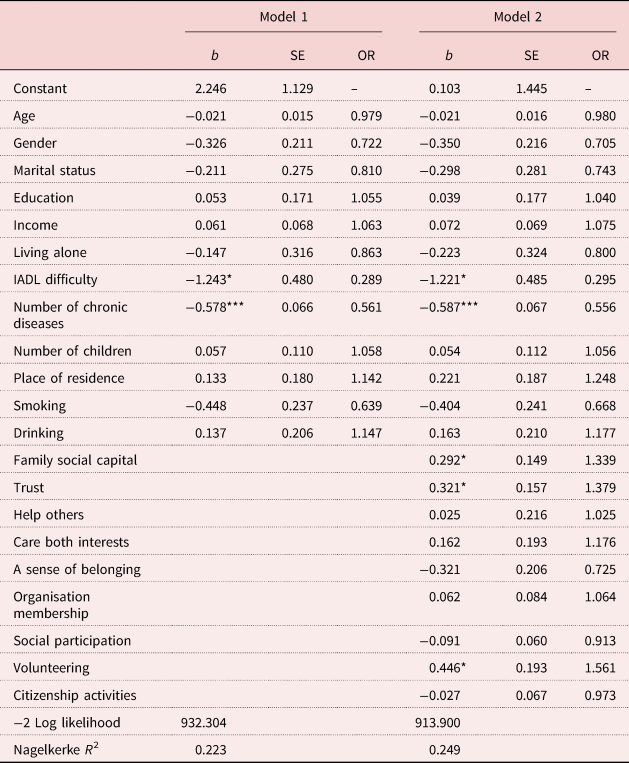
Table 2 shows the results of the logistic regression model for SRH. The covariates were entered into Model 1, the community and family social capital variables were entered into Model 2, and the interaction terms between the moderators and community social capital variables were entered into Model 3. In all three models, the likelihood ratio chi-square test was statistically significant (Model 1: χ2 (12) = 141.856, p < 0.001; Model 2: χ2 (9) = 18.404, p = 0.031; Model 3: χ2 (4) = 16.694, p = 0.002) and the Hosmer–Lemeshow tests were statistically non-significant (Model 1: χ2 (8) = 12.141, p = 0.145; Model 2: χ2 (8) = 7.774, p = 0.456; Model 3: χ2 (8) = 8.699, p = 0.368), indicating good model fit. The estimates of the variance inflation factor were lower than 10, indicating that multicollinearity was not a problem in the logistic regression models. Moreover, the Nagelkerke R 2 estimates increased from 0.223 in Model 1 to 0.249 in Model 2 and 0.273 in Model 3.
Logistic regression model for self-rated health

Notes: Model 1: Hosmer–Lemeshow χ2 (8) = 12.141, p = 0.145; Model 2: Hosmer–Lemeshow χ2 (8) = 7.774, p = 0.456. SE: standard error. OR: odds ratio. IADL: instrumental activity of daily living. Care both interest: the residents care about both their benefits and others' interests.
Significance levels: * p < 0.05, *** p < 0.001.
The results of Model 1 showed that, compared with respondents without difficulty with IADLs and no chronic diseases, respondents with higher levels of difficulty with IADLs and chronic diseases were less likely to report good SRH (difficulty with IADLs: OR = 0.289, p < 0.05; number of chronic diseases: OR = 0.561, p < 0.01). In Model 2, the level of family social capital increased the likelihood of reporting good SRH (OR = 1.339, p < 0.05). Older adults with higher levels of social trust towards residents in local communities were 1.379 times more likely to report good SRH than their counterparts with poor social trust (OR = 1.379, p < 0.05), even after controlling for family social capital, structural social capital and other covariates. Finally, compared to those who had not participated in volunteer activities in the past 30 days, those who had volunteered were more likely to report good SRH (OR = 1.561, p < 0.05) when controlling for family social capital and cognitive social capital. There were no significant associations between the other social capital variables and SRH (p > 0.05).
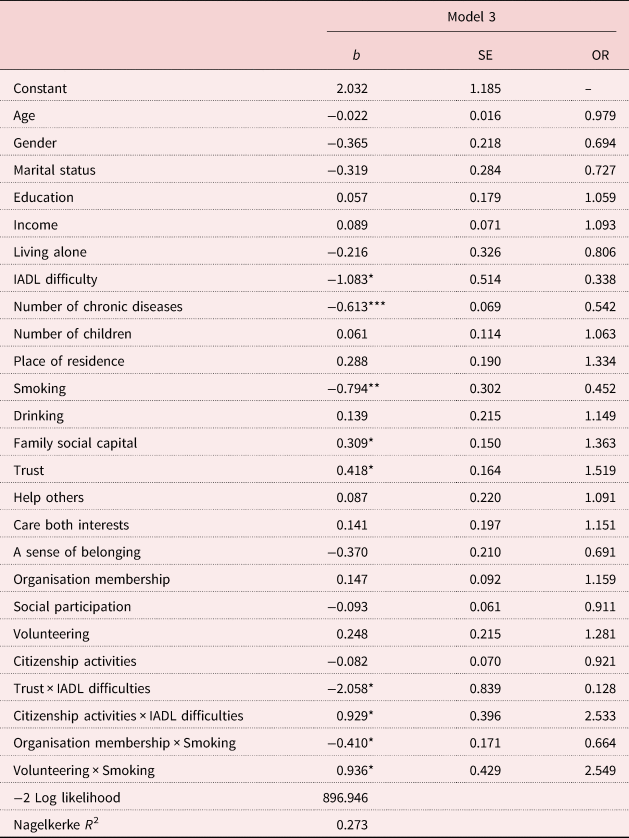
In Model 3, the four interaction terms were mean-centred to reduce multicollinearity. The moderating effects of IADL difficulty on the associations among social trust, citizenship activities and SRH were statistically significant (trust: b (standard error (SE)) = −2.058 (0.839), p < 0.05; citizenship activities: b (SE) = 0.929 (0.396), p < 0.05). Specifically, the positive effect of social trust on SRH decreased and the positive association between citizenship activities and SRH increased when the respondents experienced more difficulty with IADLs. In other words, compared to those without IADL difficulties, the positive association between citizenship activities and SRH was stronger among respondents with more IADL difficulties. Furthermore, smoking moderated the association between the number of organisational memberships, volunteering and SRH (organisation membership: b (SE) = −0.410 (0.171), p < 0.05; volunteering: b (SE) = 0.936 (0.429), p < 0.05). We conducted an additional analysis by rerunning Model 2 with two separate smoking groups. The results revealed non-significant associations between the number of organisational memberships, volunteering and SRH among respondents with no history of smoking. However, among respondents with a history of smoking, the number of organisational memberships significantly decreased the likelihood of reporting good SRH (OR = 0.659, p = 0.05). In contrast, volunteering significantly increased the likelihood of reporting good SRH (OR = 3.919, p < 0.01). No other moderating effect tests were statistically significant (all p > 0.05). The results of the moderation tests are presented in Table 3.
Logistic regression model for self-rated health with interaction terms

Notes: Model 3: Hosmer–Lemeshow χ2 (8) = 8.699, p = 0.368. SE: standard error. OR: odds ratio. IADL: instrumental activity of daily living. Care both interests: the residents care about both their benefits and others' interests.
Significance levels: * p < 0.05, ** p < 0.01, *** p < 0.001.
Discussion
This study is one of the first to test the moderating roles of difficulty with IADLs and smoking in the association between community social capital and SRH among older adults in an urban Chinese context. This study not only enriches existing theoretical understandings of the role of social capital in later life but also provides new empirical evidence for community social capital policies and interventions for good SRH among older adults.
Consistent with the findings of previous studies (Lou et al., Reference Lou, Lu, Xu and Chi2013; Shen et al., Reference Shen, Yeatts, Cai, Yang and Cready2014; Lu and Zhang, Reference Lu and Zhang2019; Zhang et al., Reference Zhang, Xu and Lu2019), the results of this study confirm that community and family social capital play an important role in sustaining SRH among older adults in the Chinese context. Specifically, the findings revealed a significant association between trust and SRH, even after controlling for family and structural social capital. In response to mixed results across previous studies regarding the association between structural social capital and SRH, this study used multiple indicators to assess structural social capital; ultimately, we found that volunteering is significantly associated with SRH when controlling for family social capital and other community social capital indicators. Several mechanisms may explain community social capital's protective effects on SRH. First, community social capital facilitates information channels and enhances the diffusion of health-related knowledge and skills. Community social capital can also improve health service utilisation rates among older adults. Furthermore, individuals with rich community social capital tend to have relatively high levels of social trust in government and health policies and may be more likely to respond to physician recommendations and public health policies. Furthermore, community social capital is recognised as a social value and norm that promotes collective and co-operative action. In this case, individuals with more community social capital are more likely to follow health-related regulations and appreciate the social benefits of healthy behaviours, such as not smoking. Older adults' active engagement in citizenship activities and social participation in other formal community activities also allows them to express their social needs and solve common problems. Furthermore, feelings of belonging to local communities may positively affect the neuroendocrine states of local residents (Wilkinson et al., Reference Wilkinson, Kawachi and Kennedy1998), further improving their general health.
This study contributes to the literature by revealing the moderating roles of difficulty with IADLs and smoking in the association between community social capital and SRH. We found that two structural social capital indicators – organisation membership and volunteering – influenced the likelihood of reporting good SRH among older adults with a history of smoking. This may be because volunteering, an important structural social capital indicator, is generally managed by formal organisations. Participation in such activities requires older volunteers to conform to certain regulations and social norms, and consider themselves beneficial to other residents. In this case, volunteer activities may enhance the impact of anti-smoking regulations, i.e. they may further discourage smoking behaviour and reduce exposure to second-hand smoke (Rocco and d'Hombres, Reference Rocco and d'Hombres2014). However, the measure of organisation memberships included recreational clubs and interest groups, with club activities and informal gatherings among group members that might encourage the use of tobacco and could be harmful for older adults' general health status.
Notably, this study found that cognitive social capital was particularly beneficial for older adults with a low level of difficulty with IADLs and that citizenship activities were more beneficial for those with a higher level of difficulty with IADLs. Individuals with higher levels of trust are more willing to exchange resources and support their neighbours for mutual benefit (Brehm and Rahn, Reference Brehm and Rahn1997; Lindstrom, Reference Lindstrom2004). The ability to perform IADLs independently allows older adults to engage actively in social exchanges, which further promotes their health. Furthermore, a higher level of difficulty with IADLs represents a higher level of dependency. For older adults who experience significant difficulty in performing IADLs, participation in citizenship activities allows them to express their views on community-based services and activities. Moving forward, these activities could be modified to better fulfil their individualised social and medical needs.
This study's findings have implications for policies and interventions. First, future social capital policies and interventions to promote older adult health should focus on nurturing social trust in local neighbourhoods, enabling older adults to volunteer, and strengthening the relationship quality and support dimensions of family social capital. Specifically, social trust can be nurtured by encouraging older adults to become more engaged and build stronger relationships with their local communities, families and institutions. Meanwhile, opportunities for older adults to volunteer can be created by establishing accessible spaces for and ways of volunteering. Finally, the two key dimensions of family social capital can be strengthened by enhancing intergenerational exchanges and interactions among family members.
Second, different aspects of social capital may differently affect SRH across older adults with varied levels of difficulty with IADLs and health behaviours. In some cases, social capital may negatively affect SRH by spreading unhealthy behaviours. Therefore, future social capital interventions to improve older adult SRH should be based on needs assessments rooted in difficulty with IADLs and health behaviours. For example, health knowledge campaigns and health policies (e.g. anti-smoking regulations) may serve as important components of structural social capital interventions, especially for older adults with difficulty with IADLs and a history of smoking. In communities with a large proportion of older adults, the needs of older adults with IADL difficulties should be considered important goals that call for collective action. Smoking prevention programmes should be incorporated into activities held by both recreational and interest groups and volunteer organisations. Given that peer influence plays an important role in smoking behaviour (Rocco and d'Hombres, Reference Rocco and d'Hombres2014), the level of peer compliance with anti-smoking regulations in public places may significantly affect smoking behaviour in older adults. Accordingly, social capital agendas should consider both the personal characteristics and social environment of the target population.
The limitations of this study are as follows. First, we used a cross-sectional survey design to collect data, which did not allow us to test the causality of the associations between social capital indicators and SRH. However, we provided a theoretical rationale for the role of social capital in SRH in later life. A panel survey design can be applied in future studies to further test the causal relationships and potential moderators and mediators. Second, we did not use a random sampling method to recruit respondents. The data were collected from two large cities in northern China; these social contexts differ from those in other regions of China, and further studies should be done to explore whether the setting may influence how social capital affects SRH later in life. Accordingly, the sampling method may limit the generalisability of the findings. Third, most key variables were self-reported; the results may have suffered from information inaccuracy. Finally, this study did not investigate collective-level community social capital but focused only on the role of individual-level social capital. Future multilevel analyses should be conducted based on larger sample sizes to obtain a more comprehensive understanding of the interactions between different levels of social capital and SRH in the Chinese context.
Ultimately, this study presents several notable findings. For example, it revealed that volunteering and trust more strongly affected SRH among older adults than family social capital. Furthermore, it found that the association between community social capital and SRH in later life varied according to the level of difficulty with IADLs and smoking status. Although trust had a greater effect on the likelihood of good SRH among the respondents with lower levels of difficulty with IADLs, citizenship activities significantly increased the likelihood of good SRH among older adults experiencing difficulty with IADLs. Furthermore, volunteering was positively associated with SRH among respondents with a history of smoking. In contrast, the number of organisational memberships was negatively associated with SRH among these respondents. Future community social capital policies and interventions should not only focus on promoting trust and volunteering among older adults in urban Chinese communities but also on establishing individualised services to fulfil the social and medical needs of older adults with different functional health levels and health-related behaviours.
Data
The datasets analysed during the current study are available from the corresponding author upon reasonable request.
Acknowledgements
We would like to thank Prof. Lou from the University of Hong Kong for all the support, instruction and encouragement she gave.
Author contributions
QS planned the study, performed statistical analysis, wrote and revised the paper. NL contributed to study design and paper writing and revision. Both authors have contributed significantly to the work and approved the final manuscript.
Financial support
This work was supported by a project of the National Social Science Foundation of China (grant number 18CSH008). The funding body had no role in the design of the study and collection, analysis, and interpretation of data and in writing the manuscript.
Competing interests
The authors declare no competing interests.
Ethical standards
The study was performed in accordance with the Declaration of Helsinki. All methods were performed in accordance with the relevant guidelines and regulations. Ethical approval was obtained from the Ethics Committee of the University of Hong Kong (reference number EA2003026). The data used in this study were anonymised before use. Informed consent was obtained from all participants. The consent from study participants was obtained in writing.