Introduction
Malignant lymphomas make up approximately 5 per cent of all malignant neoplasms of the head and neck.Reference Boring, Squires and Tong1 They are the third most common neoplasm in the head and neck region (after squamous cell carcinoma and salivary gland tumours).Reference Kolokotronis, Konstantinou, Christakis, Papadimitriou, Matiakis and Zaraboukas2 Hodgkin's disease and non-Hodgkin's lymphoma are the two main types of malignant lymphoma, and are differentiated by the presence or absence of Reed–Sternberg cells.Reference Hanna, Wanamaker, Adelstein, Tubbs and Lavertu3 However, non-Hodgkin's lymphoma displays a wide range of appearances comparable with Hodgkin's disease.Reference King, Lei, Richards and Ahuja4
The incidence of malignant lymphoma has risen steadily worldwide in recent years. Although this rise is largely unexplained, several factors may play an important role in the aetiology of this disease, such as the increasing proportion of elderly people, immunosuppression, genetics, viruses, medical conditions, pesticides, solvents, hair dyes and diet.Reference Urquhart and Berg5, Reference Weisenburger6
The head and neck region is the second most frequent anatomical site of extranodal lymphomas (after the gastrointestinal tract).Reference Vega, Lin and Medeiros7 These tumours can occur in areas such as Waldeyer's ring (i.e. the tonsils, pharynx and the base of the tongue), the salivary glands, the orbit, the paranasal sinuses and the thyroid gland.Reference Jacobs and Hoppe8
Previous studies have suggested that the incidence of non-Hodgkin's lymphoma varies in different countries and ethnic groups.Reference Ekstrom-Smedby9
Considering these variations and the disease's relatively high prevalence in the head and neck, we retrospectively studied the clinicopathological features of patients with extranodal non-Hodgkin's lymphoma of the head and neck who had been diagnosed in the past 10 years at Ruijin Hospital, Shanghai, China. We also analysed these patients' treatment, survival and prognostic factors.
Materials and methods
We reviewed the medical records of patients with extranodal non-Hodgkin's lymphoma who were treated in Ruijin Hospital, Shanghai, China, between 1999 and 2009. We considered primary non-Hodgkin's lymphoma patients who presented with disease involving any organ or tissue other than the bone marrow, multiple lymph nodes or spleen. The head and neck is one of the most common sites for extranodal lymphoma.Reference Economopoulos, Asprou, Stathakis, Fountzilas, Pavlidis and Papaspyrou10 For patients diagnosed with non-Hodgkin's lymphoma of the head and neck, we recorded the following data from the medical records: sex, age, clinical presentation, lesion site, extent of disease, pathological subtype, disease stage and original treatment. All patients underwent a staging evaluation, and we collected resultant data including history and physical examination findings, surgical reports, biochemical profile, bone marrow biopsy, and reports for ultrasonography and computed tomography. For the purpose of the study, each patient's diagnosis and histological subtype were re-evaluated by two pathologists. When indicated, information on fever, night sweats and weight loss was also collected. The study used the current classification of malignant lymphomas proposed by the World Health Organization (WHO) and the commonly used Ann Arbor lymphoma staging system (developed in 1971 for Hodgkin's lymphoma and adapted for staging non-Hodgkin's lymphoma).Reference Moormeier, Williams and Golomb11
All statistical analyses were performed using the SPSS version 13.0 software program (SPSS Inc, Chicago, Illinois, USA). Survival curves were obtained by the Kaplan–Meier method and comparisons were made using the log-rank test. Multivariate analyses of survival were performed using the Cox regression model. A p value of less than 0.05 was considered statistically significant.
Results
Clinical and pathological characteristics
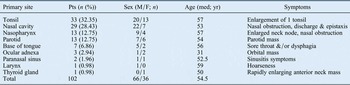
Over the 10-year study period, we identified 102 patients with head and neck non-Hodgkin's lymphoma. There were 66 males and 36 females, giving a male to female ratio of 1.83:1. The median patient age was 54.5 years, with a range of 7 to 86 years; the diagnosis was most frequent in patients aged 50–70 years.
Patients' clinical and laboratory findings are summarised in Table I. The tonsil was the most frequent anatomical site.
Patient clinical characteristics

Pts = patients; M = male; F = female; med = median; yr = years
The most common clinical presentation was clinical swelling and lymphadenopathy; these are non-specific symptoms and have no value in the diagnosis of extranodal non-Hodgkin's lymphoma in the head and neck.
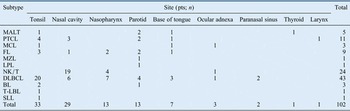
All the patients' histopathology slides were reviewed and reclassified according to the most recently proposed WHO classification criteria. Of the 102 patients with a complete histological report using the WHO classification criteria, 64.71 per cent had B-cell lymphomas while 35.29 per cent had T-cell lymphomas. Diffuse large B-cell lymphoma was the most common pathological subtype, accounting for 42.16 per cent (43/102) of the lymphomas. The next most common subtype was extranodal natural killer/T-cell lymphoma, which accounted for 23.53 per cent (24/102) of the lymphomas. The distribution of cases by histological type is shown in Table II.
Histological subtypes

Pts = patients; MALT = mucosa-associated lymphoid tissue lymphoma; PTCL = peripheral T-cell lymphoma; MCL = mantle cell lymphoma; FL = follicular lymphoma; MZL = marginal zone lymphoma; LPL = lymphoplasmacytic lymphoma; NK/T = natural killer/T-cell lymphoma; DLBCL = diffuse large B-cell lymphoma; BL = Burkitt's lymphoma; T-LBL = T-cell lymphoblastic lymphoma; SLL = small lymphocytic lymphoma
Survival and prognostic factors
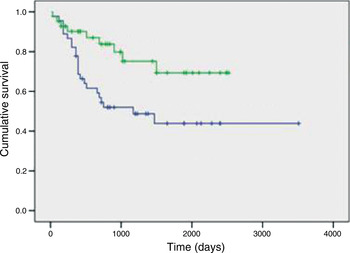
Survival curves were plotted for patients diagnosed between 1999 and 2009. Forty-five patients in our study were treated with chemotherapy alone, while 14 were treated with chemotherapy plus radiotherapy. The remaining 43 patients were treated with a combination of chemotherapy plus immunotherapy in the form of rituximab, a new, humanised anti cluster of differentiation 20 protein antibody. Figure 1 shows that the cumulative survival of the chemotherapy plus rituximab group was superior to that of the chemotherapy group (p = 0.014).
Cumulative survival rates of patients treated with rituximab plus chemotherapy (green) and chemotherapy alone (blue), showing a statistically significant difference (p = 0.014).

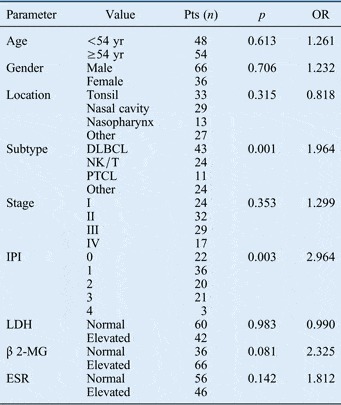
Table III shows the predictive value for survival of various clinical characteristics and biochemical parameters, as assessed by Cox regression analysis. Factors thought to potentially increase the risk of death include age, gender, disease location, histological subtype, stage, International Prognostic Index, lactate dehydrogenase, β 2-microglobulin and erythrocyte sedimentation rate. The International Prognostic Index is determined by multiple factors including patient age, performance status, serum lactate dehydrogenase level, tumour stage, and extranodal and bone marrow involvement. In our patient group, we found that age, gender, disease location, stage, lactate dehydrogenase, β 2-microglobulin and erythrocyte sedimentation rate had no statistically significant effect on survival. However, histological subtype and International Prognostic Index did significantly influence patients' overall survival in this series: the odds ratio for death was 1.96 for histological subtype (p = 0.001) and 2.96 for International Prognostic Index (p = 0.003), suggesting that the latter may be an especially important predictive factor.
Potential prognostic factors*

See text for information on International Prognostic Index (IPI) calculation.
* Cox regression analysis. Pts = patients; OR = odds ratio for death; yr = years; DLBCL = diffuse large B-cell lymphoma; NK/T = natural killer/T-cell lymphoma; PTCL = peripheral T-cell lymphoma; LDH = lactate dehydrogenase; β 2-MG = β 2-microglobulin; ESR = erythrocyte sedimentation rate
Discussion
In this study of Chinese patients with extranodal non-Hodgkin's lymphoma of the head and neck, patients had a median age of 54.5 years and a male predominance, which is roughly similar to previous studies from Western countries.Reference Etemad-Moghadam, Tirgary, Keshavarz and Alaeddini12 The most common pathological type of lymphoma was diffuse large B-cell (42.16 per cent), followed by natural killer/T-cell (23.53 per cent). This pattern differs from previous reports in Western countries: a higher proportion of natural killer/T-cell lymphomas was seen than in similar patient groups from Europe and the USA.Reference Anderson, Armitage and Weisenburger13
Waldeyer's ring has been reported as a common site of primary extranodal non-Hodgkin's lymphoma in the head and neck, with the tonsils being the most commonly involved tissue. In our study, we observed extranodal non-Hodgkin's lymphoma mainly in Waldeyer's ring, especially the tonsils, similarly to previous reports.Reference Hanna, Wanamaker, Adelstein, Tubbs and Lavertu3, Reference Economopoulos, Asprou, Stathakis, Fountzilas, Pavlidis and Papaspyrou10
Dysphagia, sore throat and asymptomatic enlargement of one tonsil are common symptoms in non-Hodgkin's lymphoma patients; however, they are non-specific and have no diagnostic value. Some authors consider routine excision of abnormally large, asymmetrical tonsils to be advisable.Reference Oluwasanmi, Wood, Baldwin and Sipaul14
Diffuse large B-cell lymphoma is the predominant histological subtype in Waldeyer's ring (i.e. the tonsils, nasopharynx and base of the tongue).Reference Kolokotronis, Konstantinou, Christakis, Papadimitriou, Matiakis and Zaraboukas2 In our patient group, diffuse large B-cell lymphoma accounted for 42.16 per cent of all lymphomas. The aetiology of diffuse large B-cell lymphoma remains unknown. Potential risk factors include immunosuppression (including acquired immunodeficiency syndrome and iatrogenic factors related to transplantation and autoimmune disease), ultraviolet radiation, pesticides, hair dyes and diet.Reference Blinder and Fisher15 Diffuse large B-cell lymphoma remains a curable lymphoma, with improved outcomes due in large part to incorporation of rituximab into standard treatment regimens. Despite the success of rituximab, a significant minority of patients with advanced stage disease and clinical risk factors will not be cured by therapy combining rituximab, cyclophosphamide, doxorubicin, vincristine and prednisone (known as ‘R-CHOP'). Friedberg and Fisher believed that the treatment of diffuse large B-cell non-Hodgkin's lymphoma could be greatly improved by adding bortezomib, a novel, targeted agent, into the standard treatment regime.Reference Friedberg and Fisher16 Bortezomib is a proteasome inhibitor that has demonstrated significant single-agent activity in mantle cell lymphoma.Reference Friedberg and Fisher16 Another agent, enzastaurin, a protein kinase C β inhibitor, is currently under investigation as a potential maintenance therapy agent for patients with high-intermediate and high risk diffuse large B-cell lymphoma, following standard combination treatment with rituximab, cyclophosphamide, doxorubicin, vincristine and prednisone. The target for enzastaurin was identified by gene expression profiling studies which suggested that patients with refractory disease over-expressed protein kinase C β.Reference Shipp, Ross, Tamayo, Weng, Kutok and Aguiar17, Reference Robertson, Kahl, Vose, de Vos, Laughlin and Flynn18 A further agent, lenalidomide, an analogue of thalidomide, has pleotropic effects, including immunomodulatory activities and antiangiogenic effects.Reference Wiernik, Lossos, Tuscano, Justice, Vose and Cole19
Natural killer/T-cell lymphoma is the second most common pathological form of lymphoma of the head and neck. Aetiologically, nasal natural killer/T-cell lymphoma is almost always associated with Epstein–Barr virus. Harabuchi and colleagues demonstrated the presence of Epstein–Barr virus DNA, Epstein–Barr virus oncogenic proteins and the clonotypic Epstein–Barr virus genome within nasal natural killer/T-cell lymphoma.Reference Harabuchi, Imai, Wakashima, Hirao, Kataura and Osato20, Reference Harabuchi, Yamanaka, Kataura, Imai, Kinoshita and Mizuno21 Lymphomas that manifest outside of the nose have a strong association with Epstein–Barr virus in Asian patients but not Caucasian patients.Reference Aozasa, Ohsawa, Tajima, Sasaki, Maeda and Matsunaga22 Epidemiologically, nasal natural killer/T-cell lymphoma is rare in the USA and Europe but common in Asia and South America.Reference Lee, Suh, Park, Ko, Bang and Lee23–Reference Gaal, Sun, Hernandez and Arber26 Clinically, this lymphoma is characterised by progressive necrotic lesions mainly in the nasal cavity, with rapid progression into distinct organs heralding a poor prognosis. Nasal obstruction and/or bloody rhinorrhoea are the most common symptoms at the time of diagnosis. Systemic symptoms such as prolonged fever and weight loss are also commonly seen.Reference Yamanaka, Harabuchi, Sambe, Shido, Matsuda and Kataura27, Reference Wu, Li, Zhao, Yang, Wang and Yang28 Histologically, due to limited knowledge of the pathology of natural killer/T-cell lymphoma, a variety of terms have been used including polymorphic reticulosis, pseudolymphoma, midline granuloma syndrome and lethal midline granuloma. The histological features of the disease are characterised by angiocentric and polymorphous lymphoreticular infiltrates with ischaemic necrosis, resulting in diagnostic difficulty (and a plethora of terms for these lesions). Natural killer/T-cell lymphomas are very aggressive tumours that cause bone destruction and may extend into the paranasal sinuses and alveolar bone. The clinical outcome is poor: in the present study, patients' reported median survival was 675 days, compared with 960 days for other types. The major recommended treatment for nasal natural killer/T-cell lymphoma is a combination of chemotherapy, radiotherapy and intrathecal prophylaxis. New protocols have been shown to be effective, but these have only been used in a small number of patients. High-dose chemotherapy with autologous or allogeneic hematopoietic stem cell transplantation has been reported to be effective in some patients with advanced disease.Reference Takenaka, Shinagawa, Maeda, Makita, Kozuka and Ashiba29–Reference Suzuki, Suzumiya, Nakamura, Kagami, Kameoka and Sakai31
• Incidence of extranodal head and neck non-Hodgkin's lymphoma varies worldwide
• In this Chinese patient group, diffuse large B-cell (especially) and natural killer/T-cell lymphoma were the commonest subtypes
• Incidence of the latter was higher than in the USA
• Rituximab plus chemotherapy had better outcomes than chemotherapy alone
• Prognosis was strongly associated with International Prognostic Index (especially) and histological subtype
Imaging evaluation is necessary for the staging of head and neck non-Hodgkin's lymphoma. Contrast-enhanced computed tomography is routinely performed, and is especially useful for detecting bony destruction when extranodal lymphoma arises in areas close to the bone. Blood analysis, including lactate dehydrogenase levels, β 2-microglobulin levels and erythrocyte sedimentation rate, can yield complementary information regarding organ involvement. Increases in serum alkaline phosphatase and calcium may indicate bone infiltration. Elevated serum lactate dehydrogenase has been shown to be an independent predictor of both survival and progression risk, consistent with previous data on both cutaneous and systemic lymphoma.Reference Shipp, Harrington, Anderson, Armitage, Bonadonna and Brittinger32, Reference Vidulich, Talpur, Bassett and Duvic33
A number of studies have demonstrated that prognosis is predominantly dependent upon tumour histopathology, being influenced only secondarily by clinical parameters (e.g. patient age, performance status and tumour stage) and tumour cell biology (e.g. lactate dehydrogenase level and β 2-microglobulin production). Well-validated prognostic systems are essential for identifying patient risk groups and for comparing new treatment strategies among these groups. The two most useful prognostic scores are the International Prognostic Index for lymphoma and the Follicular Lymphoma International Prognostic Index for indolent disease (especially follicular lymphoma). The following factors have been found to correlate significantly with survival: age of more than 60 years; abnormally raised serum lactate dehydrogenase level; Eastern Cooperative Oncology Group performance status of two or more; Ann Arbor clinical stage III or IV; and one or more involved extranodal disease site(s). In the International Prognostic Index system, one point is given for each of the above characteristics, summing to a total score ranging from 0 to 5 and representing increasing risk as follows: a score of 0 or 1 represents low risk; a score of 2 low-intermediate risk; a score of 3 high-intermediate risk; and a score of 4 or 5 high risk. In our study, overall patient survival was significantly associated with both histopathology and International Prognostic Index. The odds ratio for survival for International Prognostic Index (2.96) was much larger than that for histological subtype (1.96), suggesting the former as an especially important predictive factor. Our results also suggest that patients at high-intermediate risk (i.e. an International Prognostic Index score of 3 or more) or with natural killer/T-cell lymphomas have a worse prognosis and need to be treated more aggressively.
Conclusion
The head and neck region is the second most frequent site of extranodal non-Hodgkin's lymphoma. This condition affects a considerable number of individuals worldwide, and additional epidemiological data from different countries are needed. Our study evaluated the characteristics, treatment and prognostic factors for extra-nodal non-Hodgkin's lymphoma of the head and neck in Chinese patients. Diffuse large B-cell lymphoma was the most common pathological subtype; the incidence of natural killer/T-cell lymphoma (the second commonest subtype) was higher than that reported in the USA. Treatment with a combination of rituximab and chemotherapy was associated with better outcomes than chemotherapy alone. Patient prognosis was associated with both International Prognostic Index and histological subtype, the former being especially strongly associated with poor survival.