Introduction
Trematode species of the genus Platynosomum Looss, 1907 are parasites of the liver, pancreas and biliary system of birds and mammals, and are distributed worldwide (Pojmańska, Reference Pojmańska, Bray, Gibson and Jones2008). While more than 30 nominal species of these flukes have been described, high intraspecific morphological variation has resulted in a complex taxonomy of this genus. Several authors have considered the class of the parasite's host to be a major taxonomic criterion. Therefore, the diversity of the Platynosomum species is most likely overestimated. Furthermore, the same species of this genus may be circulating among birds and mammals, which is an issue that has not been investigated.
After more than half a century of studies conducted on the occurrence of Platynosomum spp. in birds and mammals, Rodrigues (Reference Rodrigues1963) performed a detailed morphological study of fluke specimens recovered from birds and reviewed all of the species of the genus known at that time. Significant morphological differences between Platynosomum illiciens (Braun, Reference Braun1901) and Platynosomum fastosum Kossack, Reference Kossack1910 found in birds and mammals, respectively, were not observed, and the two species were synonymized (Rodrigues, Reference Rodrigues1963). The former species, described as Dicrocoelium illiciens from Brazilian birds (Braun, Reference Braun1901), was included in the genus Platynosomum by Kossack (Reference Kossack1910). Possibly considering the class of the host as a taxonomic trait and unaware of the intraspecific morphological variations in Platynosomum species, Kossack (Reference Kossack1910) did not realize that P. fastosum found in mammals could be a junior synonym of P. illiciens. The synonymy between P. fastosum and P. illiciens proposed by Rodrigues (Reference Rodrigues1963) has often been ignored, but several recent studies by South American authors have also used the name P. illiciens to describe parasites that cause infections in mammals (Castro & Albuquerque, Reference Castro and Albuquerque2008; Lenis et al., Reference Lenis, Fernando Navarro and Vélez2009; Leal et al., Reference Leal, Campos, Rodrigues, Botelho and Labarthe2011; Silva et al., Reference Silva, Silva and Pereira2012; Azevedo et al., Reference Azevedo, Veiga, Scott, Correia, Fernandes and Verocai2013; Pinto et al., Reference Pinto, Mati and Melo2014; Mati et al., Reference Mati, Pinto and Melo2015).
Given the high intraspecific morphological variation in Platynosomum species and the absence of molecular studies comparing parasites from different host groups, the evaluation of the susceptibility of mammalian and avian species to experimental infections by Platynosomum species is a promising approach to determine host specificity in these dicrocoeliids. This study presents the first experimental evidence that the same species of Platynosomum may infect both mammalian and avian hosts.
Materials and methods
Specimens of the tropical house gecko, Hemidactylus mabouia (Moreau de Jonnès, 1818), were collected from a garden located in an urban area of Belo Horizonte, Minas Gerais, Brazil. The occurrence of P. illiciens in naturally infected mammals (e.g. cats and marmosets) was known in this location (unpublished data), although birds were never found harbouring this parasite. Metacercariae obtained from the bile ducts of the naturally infected lizards were counted and fed to five specimens of Australian parakeets, Melopsittacus undulatus (Shaw, 1805) (n= 100 metacercariae/animal). One group of mice (n= 5), experimental mammalian hosts that are known to be susceptible to P. illiciens (Maldonado, Reference Maldonado1945; Pinto et al., Reference Pinto, Mati and Melo2014), was infected as a positive control. The processes of obtaining the P. illiciens metacercariae from lizards and experimentally infecting the parakeets and mice with the parasite were performed according to Pinto et al. (Reference Pinto, Mati and Melo2014). Faecal examinations were performed in a series by spontaneous sedimentation (Lutz, Reference Lutz1919).
To recover the parasites, the animals were euthanized 105 days after being infected. The parasites were killed in water at 70°C, fixed in formalin, and stained and mounted on permanent slides. Morphological analyses of the parasites were performed using light microscopy, and measurements were obtained using a micrometer eyepiece.
Results and discussion
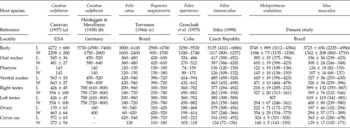
Platynosomum eggs were visualized 61 and 65 days after the Australian parakeets and mice were infected, respectively. Of the five M. undulatus that were experimentally infected with P. illiciens, only one specimen (20%) had eggs in its faeces. Two adult flukes were recovered from the liver of the parakeet that showed positive parasitological tests. All of the mice in the control group had mature eggs in their faeces, and 37 ± 12 (18–48) adult parasites were recovered during the necropsy. The general morphology of both parasites obtained from the Australian parakeet was similar to that described for P. illiciens. Moreover, the flukes from the birds and the flukes from the mice were similar, except that the flukes from the birds had lower reproductive development (i.e. the testicles were smaller and there were fewer eggs in the uterus). Measurements of P. illiciens obtained from M. undulatus (n= 2) and mice (n =30) that were experimentally infected, as well as data corresponding to this species that have been reported in some avian and mammalian hosts by different authors, are presented in table 1.
Morphometrics of Platynosomum illiciens from the Australian parakeet, Melopsittacus undulatus, and the laboratory mouse, Mus musculus, compared with those reported by previous authors. Length (L) and width (W) measurements are given in μm; in the present study mean values, standard deviations and ranges, included in parentheses, are given; in some previous reports, this species was originally described as Platynosomum proxillicens (a), Platynosomum fallax (b) or Platynosomum fastosum (c).

Despite significant differences in the prevalence and intensity of infection, P. illiciens was successfully obtained from the livers of both the bird and mammal experimental model hosts used in the present study. This finding suggests that host specificity, which has been widely used as a criterion for describing Platynosomum species found in birds and mammals, does not occur in P. illiciens and lends additional support for the synonyms previously proposed by Rodrigues (Reference Rodrigues1963).
Since P. illiciens was first described in Brazilian birds in the early 20th century, it has been recorded in several bird species distributed throughout the Americas and Europe. Interestingly, low prevalences (0.86–3.27%) and mean intensities of infection (5.5–14) were reported in different species of birds of prey naturally infected with P. illiciens (Denton & Rausch, Reference Denton and Rausch1949; Kinsella et al., Reference Kinsella, Foster and Forrester1995; Sitko, Reference Sitko1998; Ferrer et al., Reference Ferrer, Molina, Adelantado and Kinsella2004). Exceptions to this include the reports of P. illiciens in Cacatua spp., where 80–156 parasites were found in specimens of these psittaciforme birds in Germany and the USA (Heidigger & Mendheim, Reference Heidegger and Mendheim1938; Kazacos et al., Reference Kazacos, Dhillon, Winterfield and Thacker1980; Quesenberry et al., Reference Quesenberry, Tappe, Greiner, Allen, Hines and Kollias1986).
The high intensity of infection by P. illiciens reported in cockatoos may be considered to be surprising. These birds are omnivorous, and their diet includes seeds, nuts, fruit and insects (Harcourt-Brown & Chitty, Reference Harcourt-Brown and Chitty2005; Seibert & Sung, Reference Seibert, Sung and Tynes2010), foods that are not related to the transmission of Platynosomum. However, it is possible that free-ranging cockatoos find and ingest terrestrial isopods – the second intermediate hosts of Platynosomum – on the ground. The hypothesis that cockatoos become infected by ingesting arthropods is in accordance with results showing that lizards are not obligatory hosts involved in the life cycle of P. illiciens (Pinto et al., Reference Pinto, Mati and Melo2014). Additional data may also indicate a greater susceptibility of cockatoos to this parasite, which is difficult to confirm because the studies reporting P. illiciens in these avian hosts are case reports that lack information regarding parasite prevalence. Thus, further studies evaluating the potential of a higher susceptibility of invertebrate-eating birds to Platynosomum species need to be conducted. Furthermore, the use of parakeets in this study proved to be qualitatively satisfactory for the proposed goal.
In addition to Rodrigues (Reference Rodrigues1963), the descriptions, measurements and illustrations of specimens identified as P. illiciens and P. fastosum, respectively, from birds and mammals (Travassos, Reference Travassos1944; Brenes-Madrigal & Arroyo-Sancho Reference Brenes-Madrigal and Arroyo-Sancho1962; Travassos et al., Reference Travassos, Freitas and Kohn1969; Groschaft et al., Reference Groschaft, Tenora and Valle1975; Sitko, Reference Sitko1998; Arceo et al., Reference Arceo, Farid, Alvarado and Cruz1999; Basu & Charles, 2014) do not reveal morphological differences to support the notion that these taxa are distinct species. The morphological polymorphism of dicrocoeliids, which likely results from factors such as the age of the parasites, the host species (phenotypic plasticity), and differences in the techniques used to fix and mount the trematodes, is related to the variations observed in the measurements reported by different authors (Sitko, Reference Sitko1998). These factors may be related to the previous descriptions of Platynosomum species that were later synonymized. In fact, in addition to P. fastosum found in mammals, several Platynosomum species described from birds were synonymized with P. illiciens (Rodrigues, Reference Rodrigues1963). Moreover, the morphology and measurements of the parasites obtained experimentally from Australian parakeets overlap with those reported by different authors for P. illiciens. The presence of less-developed reproductive structures is most likely a result of phenotypic plasticity or delayed growth, and requires further study.
From the point of view of avian experimental models, the difficulties related to obtaining avian hosts infected with Platynosomum (mostly birds of prey) and maintaining them in a laboratory should be emphasized. Moreover, studies on birds experimentally infected with Platynosomum are scarce and limited to the Japanese quail, Coturnis coturnix japonica (Temminck & Schlegel, 1849), which were not susceptible to the parasite (Taylor, Reference Taylor1975). Accordingly, the use of M. undulatus, a species that is small, easy to handle and maintain in a laboratory, and is a relative of Catatua spp., avian hosts reportedly infected with Platynosomum in the Americas, was shown to be satisfactory for use in this study. Thus, it is possible that birds are less susceptible to P. illiciens than mammals, although this assumption requires further study.
Considering the current taxonomic knowledge on Platynosomum and the absence of morphological differences between P. illiciens and P. fastosum, the only criterion that could be applied to split these two putative species would be the class of the definitive host. However, the experimental infection of birds and mammals with the same isolate of P. illiciens performed in this study supports the hypothesis that host specificity is not an appropriate taxonomic criterion of these trematodes. In fact, the host specificity of dicrocoeliids is low, and there are reports of bird and mammal species infected with Athesmia heterolecithodes (Braun, 1899) (Travassos, Reference Travassos1944; Freitas, Reference Freitas1962; Travassos et al., Reference Travassos, Freitas and Kohn1969), a situation likely to be similar to that occurring with P. illiciens. Moreover, the specificity of Platynosomum to mammalian hosts has already been considered to be low (Maldonado, Reference Maldonado1945; Eckerlin and Leigh, Reference Eckerlin and Leigh1962).
Birds of prey are the main avian hosts of P. illiciens in South America (Travassos et al., Reference Travassos, Freitas and Kohn1969), Central America (Brenes-Madrigal & Arroyo-Sancho, Reference Brenes-Madrigal and Arroyo-Sancho1962; Groschaft et al., Reference Groschaft, Tenora and Valle1975), North America (Denton & Rausch, Reference Denton and Rausch1949) and Europe (Kinsella et al., Reference Kinsella, Foster and Forrester1995; Sitko, Reference Sitko1998). These birds feed on lizards and amphibians, which are cold-blooded paratenic hosts related to the transmission of Platynosomum (Maldonado, Reference Maldonado1945; Eckerlin & Leigh, Reference Eckerlin and Leigh1962; Pinto et al., Reference Pinto, Mati and Melo2014). Furthermore, the areas of occurrence of P. illiciens in birds overlap with records of the parasite in felines. This finding reveals that both groups of hosts may be exposed to the same species of Platynosomum. Therefore, the possibility that P. illiciens occurs in different mammals (e.g. felines, primates and marsupials) and birds is supported here for the first time by an experimental infection study.
The diversity of species belonging to the genus Platynosomum needs to be re-evaluated because of their high intraspecific and morphological variability. The use of molecular tools may contribute to a better understanding of factors related to the taxonomy, phylogeny and evolution of Platynosomum species. The sequencing of molecular markers of parasites obtained from naturally infected birds and mammals can confirm the non-specificity of P. illiciens or the existence of cryptic species within this group of trematodes. However, in addition to the classical taxonomic viewpoint, which is the only approach currently available to describe Platynosomum spp., the experimental data presented in this study support consideration of P. illiciens and P. fastosum as synonyms.
Financial support
We would like to thank The National Council for Technological Development (CNPq) for financial support.
Conflict of interest
None.
Ethical standards
The authors assert that all experimental procedures contributing to this work were conducted in accordance with the ethical standards precepts recommended by local ethics committees on animal experimentation, CETEA, UFMG.