Background
Since the coronavirus disease 2019 (COVID-19) was first reported in Wuhan, China in late 2019, no consensus treatment has been developed or accepted in the world. Reference Edwards, Biddle, Gray and Sollis1–Reference Luo4 The arrival of COVID-19 vaccines was regarded as the key to ending the pandemic. As of August 7, 2021, more than 4 billion doses of the COVID-19 vaccine had been administered globally, with an average vaccination rate of 52 doses for 100 people. 5,Reference Zhang6 However, there is great inequity in the distribution of the COVID-19 vaccines in developed countries and developing countries. Reference Hyder, Hyder, Nasir and Ndebele7–Reference Bhopal and Nielsen10 COVID-19 vaccination is a great challenge to the government of China, a country with a population of 1.4 billion. Reference Gao11–15
Initially, due to the scarcity of COVID-19 vaccines, the public was usually eager to get vaccinated. Reference Trogen and Pirofski16 However, with the COVID-19 vaccine production being ramped up, vaccine hesitation is becoming a new obstacle in the COVID-19 pandemic. Considering that the COVID-19 vaccine is 1 of the fastest vaccines ever developed, citizens from many countries have expressed their skepticism about its safety, efficacy, and side effects. Reference Guidry, Laestadius and Vraga17–Reference Cordina, Lauri and Lauri19 With an increasing number of negative reports about COVID-19 vaccines being published, many people have been expressing hesitancy about vaccination, or even refusing to be vaccinated. Reference Pullan and Dey20,Reference Sallam, Dababseh and Eid21 Vaccine hesitancy is defined as the reluctance or refusal to vaccinate despite its accessibility. Reference Larson, Jarrett and Schulz22,Reference Murphy23 Studies have shown that COVID-19 vaccine hesitation is a widespread phenomenon worldwide. Reference Lazarus, Ratzan and Palayew24,25 By implementing strict border controls, contact tracing, and personal protection measures, China has become 1 of the countries to control the spread of COVID-19 successfully. Reference Han26 The number of COVID-19 infections in China was relatively small from May 2020. Reference Han26 Therefore, Chinese people generally believe they are safe, making them less willing to get vaccinated, Reference Wu27,Reference Gan, Chen and Hu28 however, COVID-19 vaccine hesitancy is a serious barrier to achieve herd immunity.
As medical students work as frontline health care workers, they are at a greater risk for COVID-19 exposure. Once COVID-19 vaccines become widely available, a high vaccination rate must be achieved for this group. Medical students are future health care workers and important influencers among laypeople and their communities. That is, they will be trusted by vaccine-hesitant people to provide recommendations and counseling on COVID-19 vaccines. At present, research on COVID-19 vaccine hesitancy has mainly focused on health care workers, ethnic minority groups, religious believers, and black Americans. Reference Gagneux-Brunon, Detoc and Bruel29–Reference Bogart, Dong and Gandhi37 To our knowledge, there have been no studies of COVID-19 vaccine hesitancy among medical students in China, therefore, our study aimed to fill this gap by exploring the level of COVID-19 vaccine hesitancy among Chinese medical students and identifying the factors and barriers associated with decision to vaccinate.
Methods
Study design and participants
We conducted a cross-sectional survey using an online questionnaire. Medical students from 6 universities in Wuhan were selected to participate through convenience sampling. We chose a teacher from each university as a liaison for our study. Questionnaires were distributed to students’ cell phones through the liaisons. Prior to the study, the liaisons provided them with an electronic informed consent form. All students received information about the study purpose, and they were told that participation was voluntary and anonymous. This study was approved by the Institutional Review Board at [blinded for review].
Inclusion criteria were participants who, (a) were medical undergraduates or postgraduates in Wuhan, (b) were eligible for COVID-19 vaccines, and (c) had volunteered to participate in this study. Exclusion criteria were participants who, (a) were infected with COVID-19, (b) were pregnant or breastfeeding women, and (c) were diagnosed with diseases that prevented them from receiving the COVID-19 vaccines. In total, 711 medical students completed our questionnaire from February to March 2021. The government of Wuhan has been providing COVID-19 vaccines for college students since April 2021. Thus, none of the participants in this study have received COVID-19 vaccines. In total, 99 incomplete questionnaires were excluded, and finally 612 questionnaires were analyzed.
Survey questionnaire
The survey questionnaire contained 3 parts, and it took the students approximately 6 minutes to complete the survey.
Demographic characteristics
Medical students’ demographic characteristics were collected, these included gender (male, female), nation (non-minority, minority), monthly household income (less than $780, $780 – $1561, more than $1561), family address (in Wuhan, not in Wuhan), education level (undergraduate, postgraduate), training related to COVID-19 vaccines (trained, untrained), college (clinical medicine, nursing, preventive medicine, pharmacy, basic medicine), history of respiratory diseases in the past year (yes, no), history of influenza vaccination (vaccinated, unvaccinated), religious belief (non-religious, religious). Household income in our questionnaire was recorded in Chinese currency (less than 5000 RMB, 5000 – 10000 RMB, more than 10000 RMB) and converted to U.S. dollars for reporting purposes.
Knowledge about COVID-19 vaccine
A self-design, 14-item questionnaire was employed to evaluate the medical students’ knowledge about COVID-19 vaccine (e.g., types of vaccines, vaccination eligibility, common side effects, and precautions after vaccination). The questionnaire was developed through a literature review and group discussion. After 2 rounds of expert consultation, the pre-test questionnaire was developed. A total of 126 medical students were pilot tested. The results show that the Cronbach’s α coefficient was 0.743. The content validity index was 0.961, and the reliability index was 0.788. When a question was answered correctly, the student received 1 point while incorrect answers were not scored. The scores on all questions were summed to obtain the total score. Higher total scores indicate a better understanding of COVID-19 vaccines. Furthermore, we investigated the sources of students’ knowledge about COVID-19 vaccine.
Vaccine hesitancy scale
Zhang established the Vaccine Hesitancy Scale (VHS) in 2020. Reference Zhang38 Participants were asked to answer 8 questions related to their vaccine hesitancy on a 5-point Likert scale (1 = strongly disagree, 2 = disagree, 3 = neither agree nor disagree, 4 = agree, 5 = strongly agree). The scores on the 8 questions were summed to obtain the total score; higher total scores indicated higher vaccine hesitancy. The Cronbach’s α coefficient of the scale was 0.705. The content validity index was 0.830, and the reliability index was 0.696. Furthermore, the reasons hindering COVID-19 vaccination among medical students were also investigated (e.g., side effects of vaccine, vaccine safety, convenience, vaccine efficacy, and underestimating the risk of exposure to COVID-19).
Statistical methods
We used IBM SPSS Statistics 26.0 (IBM Corp., Armonk, New York) for statistical analysis. The Kolmogorov Smirnov analysis was applied, and the result showed that VHS was normal distribution. Reference Su39,Reference Li40 Multicollinearity was measured by the variance inflation factor (VIF). After testing, values of VIF were all lower than 10, so there is no multicollinearity. The correlation between COVID-19 vaccine knowledge and VHS was analyzed using Pearson correlation analysis. The comparison of different demographic medical students’ COVID-19 vaccine hesitancy was analyzed by univariate analysis. Multiple-factor analysis of VHS was analyzed using multiple regression analysis. The value of P < 0.05 was considered statistically significant.
Results
Scores of COVID-19 vaccine hesitancy
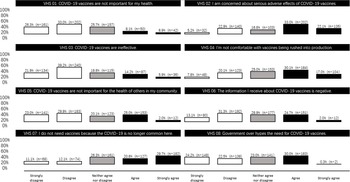
The average VHS score among medical students was 22.81 ± 5.91, and the mean score rate was 57.0%. The maximum score of VHS was 36, and the minimum was 12. A total of 58.2% of medical students scored at least 24 points on the VHS. As shown in Figure 1, only 15% of students agreed that ‘COVID-19 vaccines are not important for my health’ (Question 1). More than half of the students reported concern regarding the adverse effects of COVID-19 vaccines (Question 2). Moreover, 47.1% of the students agreed with the statement that ‘I am uncomfortable getting a vaccine that was rushed into production’ (Question 4). About 50% of the students agreed with the statement that ‘I do not need vaccines because COVID-19 is no longer widespread locally’ (Question 7). For all questions, “neither agree nor disagree” is not the most selected option.
Distribution of answers to the 8 items of vaccine hesitancy scale (n = 612).
*Annotation: Black bars indicate answers that are reflecting a negative attitude to vaccination, white as positive attitude and gray as doubtful (‘‘neither agree nor disagree”).

Medical students’ knowledge about COVID-19 vaccine
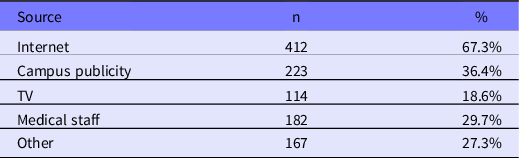
The average COVID-19 vaccine knowledge score among medical students was 9.82 ± 2.83, with an average accuracy rate of 70.1%. The maximum score of COVID-19 vaccine knowledge was 14, and the minimum was 6. The COVID-19 vaccine knowledge score was negatively correlated with VHS score (P < 0.01). As shown in Table 1, medical students’ primary sources of knowledge about COVID-19 vaccine were the Internet (67.3%), campus publicity (36.4%), and medical staff (29.7%).
Sources of medical students’ knowledge about COVID-19 vaccine (n = 612)

Medical students’ demographic characteristics associated with COVID-19 vaccine hesitancy
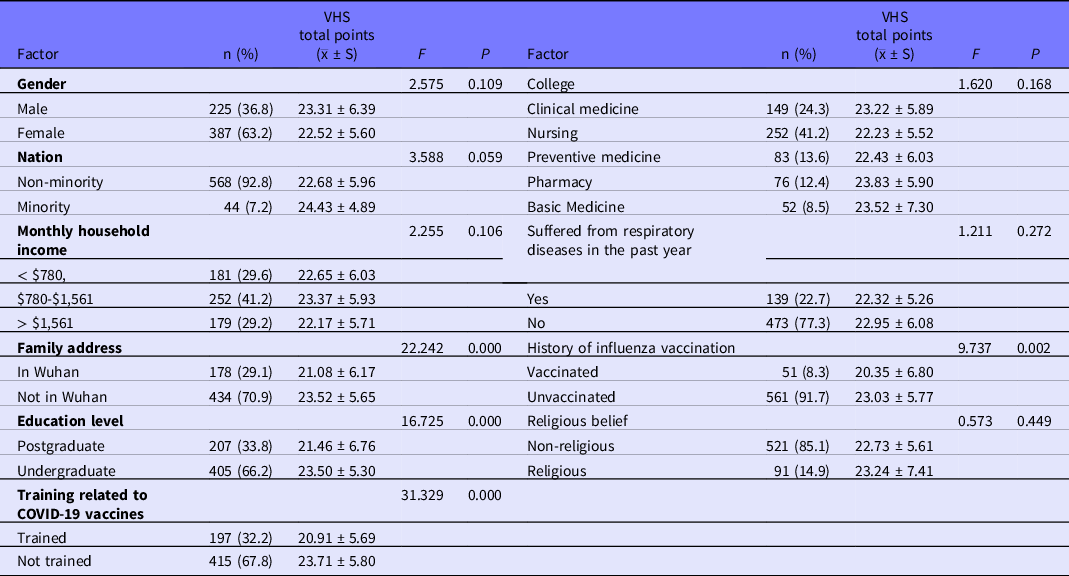
As shown in Table 2, COVID-19 vaccine hesitancy among medical students in Wuhan were significantly associated with their family address, education level, training related to COVID-19 vaccines, and history of influenza vaccination (P < 0.05).
Medical students’ demographic characteristics associated with COVID-19 vaccine hesitancy (n = 612)

Annotation: VHS= Vaccine Hesitancy Scale
Multiple-factor analysis of COVID-19 vaccine hesitancy among medical students
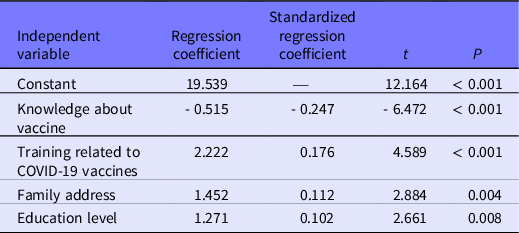
As shown in Table 3, the main factors associated with medical students’ COVID-19 vaccine hesitancy were their knowledge about COVID-19 vaccine, training related to COVID-19 vaccines, family address, and education level. Therefore, the negative factors were lack of knowledge about COVID-19 vaccine, lack of related training, not living in Wuhan, and lower education level.
Multiple-factor analysis of COVID-19 vaccine hesitancy among medical students in Wuhan, China (n = 612)

Annotation: R Reference Gao, Wang and Kong2 = 0.147, adjusted R2 = 0.142, F = 26.208, P < 0.05
Barriers to COVID-19 vaccination among medical students
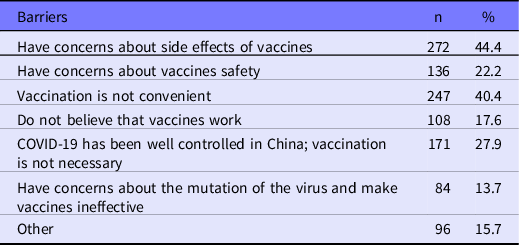
As shown in Table 4, the most common reasons hindering COVID-19 vaccination among medical students in Wuhan were worrying about the side effects of vaccines (44.4%), uncertainty about the safety of vaccines (40.4%), and underestimating the risk of exposure to COVID-19 (27.9%).
Barriers of COVID-19 vaccination among medical students in Wuhan, China (n = 612)

Discussion
Vaccination is an effective way to prevent and control COVID-19. However, there are still many people in some countries who continue to refuse or delay vaccination. Reference Lazarus, Ratzan and Palayew24 Medical students are often ignored in the promotion of COVID-19 vaccines, hence to the best of our knowledge, this study is the first to investigate COVID-19 vaccine hesitancy among medical students in China.
COVID-19 vaccine hesitancy among medical students
Typically, a VHS score of 24 or higher indicates vaccine hesitancy. Reference Zhang38 In our survey, 58.2% of the medical students scored at least 24 points on the VHS, indicating that a large proportion of Chinese medical students are hesitant to receive COVID-19 vaccines. We inferred 4 reasons that may explain this phenomenon. First, it is possible that some medical students underestimated the risk of the COVID-19 pandemic. Since January 2020, China has adopted a series of effective prevention and control measures and successfully controlled the spread of the epidemic. Reference Liu, Tan, Li, Li, Cai and Wang41 Apart from some imported cases of COVID-19, there have been very few domestic infections in China since May 2020. Reference Han26 Furthermore, to protect the safety of students, almost all universities in Wuhan implemented closed management, whereby outsiders were prohibited from entering campuses without special permission. Therefore, many medical students believed that their probability of being infected with COVID-19 was very low. Second, several vaccine incidents might affect medical students’ trust in Chinese vaccines. In recent years, several vaccine incidents have emerged in China, such as the DPT vaccine incident in Wuhan, tetanus vaccine incident in Changchun, and influenza vaccine incident in Shandong. Reference Gao, Zhang and Kong42,Reference Zhu43 In the DPT vaccine incident that occurred in 2017, the Wuhan Institute of Biological Products did not follow the production regulation and produced a batch of invalid DPT vaccines. These invalid vaccines were administered to approximately 144000 people. The Wuhan Institute of Biological Products is also 1 of the 3 leading manufacturers of COVID-19 vaccines in China. Reference Chen44 As medical students are usually familiar with these vaccine incidents. It is likely that this negative information influenced their unwillingness to be vaccinated. Third, vaccination is not convenient for most medical students. In China, most vaccination services are provided by community health centers. Reference Hu, Chen, Wang, Liang and Lv45 However, community health centers are mainly located in urban areas, while most universities in Wuhan are in suburb areas, which have fewer community health centers. Consequently, access to vaccines was not very convenient for many medical students. Finally, 1 year after the COVID-19 outbreak, China’s research institutions and enterprises have been developing and producing COVID-19 vaccines on a large scale. Reference Chen44 Unlike the typical duration for producing traditional vaccines, COVID-19 vaccines were developed in the shortest period. Therefore, many medical students were worried about the safety, side effects, and effectiveness of COVID-19 vaccines. Although medical students understood the importance of being vaccinated, some students planned to wait for a while to observe the effectiveness of the vaccines on others.
Factors associated with COVID-19 vaccine hesitancy among medical students
Our study demonstrated that the main factors associated with medical students’ COVID-19 vaccine hesitancy were their knowledge about COVID-19 vaccine, training related to COVID-19 vaccines, family address, and education level. First, medical students’ knowledge about COVID-19 vaccine was closely related to their vaccine intention. Previous study also demonstrated that people who knew more about COVID-19 vaccines were more likely to get vaccinated. Reference Thaker46 Since the target group of this survey was medical students, we expected that they would have better knowledge of vaccines. However, participants’ average accuracy of COVID-19 vaccine knowledge in this study was merely 70.1%, indicating that knowledge about COVID-19 vaccine is not provided in the current medical curriculum. Second, we found that medical students who had received relevant training were more willing to receive COVID-19 vaccines. Previous studies have also demonstrated that relevant training can improve students’ adherence, attitude, and knowledge about vaccinations. Reference Barello, Nania, Dellafiore, Graffigna and Caruso47–Reference Marotta, Raia and Ventura49 Nevertheless, in our survey, only 32.2% of the students had received relevant training. Training related to COVID-19 vaccines should be offered to medical students as soon as possible. Third, medical students who lived in Wuhan were more willing to receive COVID-19 vaccines compared to those who were not living in Wuhan. This is likely because Wuhan residents experienced the rapid spread of COVID-19 in the first quarter of 2020. Thus, their awareness of epidemic prevention was generally high. Finally, we found that undergraduate students were more likely than postgraduate students to hesitate about vaccination. This may be because postgraduates have more medical knowledge than undergraduates, so they understand the importance of COVID-19 vaccines better. Moreover, according to the graduation requirements of universities in China, medical postgraduates are generally required to complete 1 year or more in professional practice in hospitals, center for disease control and prevention, or other medical institutions. Postgraduates know that they are at a higher risk of exposure to COVID-19 and are, thus, more likely to receive the vaccine.
Limitations
This study has several limitations. First, considering the limited number of universities that participated in this study, our sample was relatively small. Thus, our findings must be further verified using a larger sample size. Second, the VHS uses standardized questions and a Likert scoring format, which make it easy to analyze data. However, it masks the heterogeneity of the students. Future study should employ other methods, such as interviews, that can explore potential motivations in greater depth. Third, as a cross-sectional survey, our study only evaluated the status of COVID-19 vaccine hesitancy at a specific time point without conducting a follow-up observation of the medical students. Finally, in addition to the factors included in this study, there may also be other factors associated with medical students’ COVID-19 vaccine hesitancy.
Recommendations
Considering these findings, we suggest the following to improve medical students’ intention to vaccinate. First, prior to conducting vaccine training or awareness campaigns, health department should conduct surveys on students’ intention to vaccinate against the COVID-19. Universities should actively communicate with vaccine-hesitant students, and identify the reasons hindering their intent to vaccinate, based on which targeted measures should be taken. Second, given that the COVID-19 pandemic will last for a long time, medical students’ hesitation about vaccines may also continue. Thus, universities should establish and promote a standardized COVID-19 vaccine course. This course can also be disseminated via TikTok, Twitter, and online public classes. Third, governments should supply on-campus vaccination services to improve students’ accessibility to COVID-19 vaccines.
Conclusion
In the past year, there have been very few COVID-19 infections in China, which has resulted in gross underestimation of infection risk among Chinese people. Reference Wu27 Our study is the first to focus on COVID-19 vaccine hesitancy among medical students in China. More than half of the medical students reported COVID-19 vaccine hesitancy, and the main factors associated with vaccine hesitancy were knowledge about COVID-19 vaccine, training related to COVID-19 vaccines, family address, and education level. Once most countries achieve herd immunity and resume trade and tourism, many vaccine-hesitant medical students in China may be exposed to a greater risk for infection. The government, health department, and universities in China need to work together and actively communicate with vaccine-hesitant students, establish a standardized COVID-19 vaccine course, and provide vaccination services on campus.
Author contributions
Xudong Gao and Wen Zeng conceived and designed the subject. Haiyan Li and Wenjie He collected and analyzed data. Xudong Gao, Haiyan Li, Wenjie He and Wen Zeng were involved in writing the paper. All authors read and approved the final version of the manuscript.
Funding statement
The study was funded by Hubei Higher Education Teaching Reform Research Project (2020509).
Conflict(s) of interests
The authors declare no potential conflicts of interest with respect to the research, authorship, and/or publication of this article.
Ethical standards
Ethical approval was granted from the Institutional Review Board of Wuhan Polytechnic University.