Introduction
Patients receiving maintenance dialysis are at increased risk for severe acute respiratory syndrome coronavirus 2 (SARS-CoV-2) infection and severe outcomes from COVID-19, including death.Reference Williamson, Walker, Bhaskaran, Bacon, Bates and Morton1–Reference Hsu, Weiner, Aweh, Miskulin, Manley and Stewart3 During the COVID-19 pandemic, rates of SARS-CoV-2 infection and death due to COVID-19 among dialysis patients followed seasonal patterns similar to those of the general U.S. population. However, the rates of SARS-CoV-2 infection among dialysis patients of all ages were higher than among persons in the general population aged ≥65 years, illustrating the increased risk of infection in this population.Reference Navarrete, Barone, Qureshi, Woods, Barbre and Meng4
The risk of SARS-CoV-2 infection among dialysis patients varies by the setting in which they receive dialysis. Studies conducted during the first year of the pandemic found that patients receiving hemodialysis at outpatient centers were at increased risk for infection compared to those receiving dialysis at home.Reference Hsu, Weiner, Aweh, Miskulin, Manley and Stewart3,Reference Salerno, Messana, Gremel, Dahlerus, Hirth and Han5,Reference Yau, Muller, Lin, Siddiqui, Neskovic and Shokar6 Various factors likely contribute to this difference in risk. Patients receiving hemodialysis in outpatient centers spend hours in close proximity to other patients and facility staff members during treatment sessions.Reference Ikizler7 Social distancing may also be difficult for patients who rely on shared transportation to visit dialysis facilities.Reference Yau, Muller, Lin, Siddiqui, Neskovic and Shokar6 However, the national rates of SARS-CoV-2 infection for patients receiving hemodialysis in outpatient centers compared to those receiving hemodialysis or peritoneal dialysis at home have not been assessed beyond December 2020.
In December 2020, the Centers for Medicare & Medicaid Services (CMS) began requiring outpatient dialysis facilities to report weekly aggregate COVID-19 case data among all patients (both home dialysis patients and those receiving hemodialysis in outpatient centers) to the Centers for Disease Control and Prevention’s (CDC) National Healthcare Safety Network (NHSN). The requirement ended at the conclusion of the COVID-19 Public Health Emergency on May 11, 2023.Reference Karen and Tritz8 This study aimed to assess the differences in SARS-CoV-2 infection rates between patients receiving hemodialysis treatment at outpatient centers compared to those receiving home dialysis treatment (including both home hemodialysis and peritoneal dialysis) from December 29, 2020, through May 9, 2023.
Methods
We conducted a retrospective cohort analysis using data submitted by dialysis facilities to NHSN. Dialysis facilities in the U.S. submitted aggregate data on patient census and incident SARS-CoV-2 infections among maintenance dialysis patients by dialysis setting (in an outpatient center or at home) to NHSN each week during the study period of December 29, 2020, through May 9, 2023. Data did not include patients with acute kidney injury admitted to an acute care hospital or patients receiving treatment while hospitalized. Dialysis facilities also reported facility-level characteristics including staff census and number of certified dialysis stations annually. Patients receiving hemodialysis treatment at an outpatient center were categorized as “in-center patients,” and patients affiliated with an outpatient center but receiving hemodialysis or peritoneal dialysis at their home were categorized as “home patients.” NHSN data accounted for >95% of all U.S. patients receiving in-center hemodialysis and >95% of patients receiving home dialysis during the study period. Infection with SARS-CoV-2 was defined as a reported or laboratory-confirmed SARS-CoV-2 infection in a patient undergoing dialysis therapy. A total of 16 facility-weeks with reported patient censuses of >750 patients were excluded due to implausibly large patient counts.
We used a two-step process to categorize all weeks during the study period into categories defined by level of transmission and predominant circulating variant lineage. Weeks in which the rate of SARS-CoV-2 infection among dialysis patients was above the median weekly infection rate of 1.83 per 1000 patient-weeks were categorized as surge; weeks in which the rate of SARS-CoV-2 infection was at or below the median were categorized as non-surge. Surge weeks were further categorized by the variant lineage that accounted for ≥50% of the circulating variants during that week, based on recent published literature Reference Topf, Sheppard, Marx, Wiegand, Link-Gelles and Binder9 in conjunction with the CDC’s COVID-19 variant genomic surveillance data.Reference Ma, Shirk, Lambrou, Hassell, Zheng and Payne10,Reference Lambrou, Shirk, Steele, Paul, Paden and Cadwell11 Categories to describe the predominant variant were defined as follows: B.1 & Other (December 29, 2020 through March 9, 2021); Delta (August 4, 2021 through October 5, 2021); and the intermittent Omicron periods [BA.1 (December 15, 2021 through February 22, 2022); BA.2 & BA.5 (May 11, 2022 through September 20, 2022); and BQ.1 & XBB.1.5 (October 26, 2022 through January 31, 2023 with one intervening non-surge week ending on November 15, 2022)].
A negative binomial regression model with generalized estimation equations was constructed to examine the SARS-CoV-2 infection rate ratio by dialysis setting. The count of SARS-CoV-2 infections was regressed on dialysis setting, category (non-surge weeks and surge weeks categorized by the predominant variant lineage), and the interaction of dialysis setting and category with logarithm of total patients as an offset. We used this model to estimate rate ratios (RR) comparing the rates of SARS-CoV-2 infection between in-center and home patients within each category and relative rate ratios (RRR) comparing the RRs from each variant predominance category to the non-surge category. All analyses were conducted in SAS 9.4 (SAS Institute, Cary, NC). This activity was reviewed by CDC, deemed not research, and conducted consistent with applicable federal law and CDC policy (See e.g., 45 C.F.R. part 46, 21 C.F.R. part 56; 42 U.S.C. §241(d); 5 U.S.C. §552a; 44 U.S.C. §3501 et seq).
Results
A total of 7974 facilities representing 54,582,246 patient-weeks for in-center dialysis patients and 9,349,592 patient-weeks for home dialysis patients were included in the analysis. A total of 171,338 SARS-CoV-2 infections, 155,499 among in-center dialysis patients and 15,839 among home dialysis patients, were reported (Table 1). The pooled mean SARS-CoV-2 infection rate for the entirety of the study timeframe was 2.85 infections per 1000 patient-weeks among in-center dialysis patients and 1.69 infections per 1000 patient-weeks among home dialysis patients. SARS-CoV-2 infection rates were higher among patients receiving in-center dialysis than among patients receiving home dialysis during almost all weeks of the study period (Figure 1).
Weekly incidence of SARS-CoV-2 infection among in-center and home dialysis patientsa by variant predominance categoryb—National Healthcare Safety Network, United States, December 29, 2020-May 9, 2023. aPatients receiving hemodialysis treatment at an outpatient center were categorized as in-center patients, and patients affiliated with an outpatient center but receiving hemodialysis or peritoneal dialysis at their home were categorized as home patients. bWeeks in which the rate of SARS-CoV-2 infection among dialysis patients was above the median weekly infection rate of 1.83 per 1000 patient-weeks were categorized as surge; weeks in which the rate of SARS-CoV-2 infection was at or below the median were categorized as non-surge. Surge weeks were further categorized by the variant lineage that accounted for ≥50% of the circulating variants during that week: B.1 & Other (December 29, 2020 through March 9, 2021); Delta (August 4, 2021 through October 5, 2021); the intermittent Omicron periods [BA.1 (December 15, 2021 through February 22, 2022); BA.2 & BA.5 (May 11, 2022 through September 20, 2022); and BQ.1 & XBB.1.5 (October 26, 2022 through January 31, 2023 with one intervening non-surge week ending on November 15, 2022)].

SARS-CoV-2 infection rates and facility-level characteristics among in-center and home dialysis patientsa by variant predominance categoryb—National Healthcare Safety Network, United States, December 29, 2020–May 9, 2023

Total staff census for the B1 & Other category is italicized because this information was only collected once during this predominance category.
a Patients receiving hemodialysis treatment at an outpatient center were categorized as in-center patients, and patients affiliated with an outpatient center but receiving hemodialysis or peritoneal dialysis at their home were categorized as home patients.
b Weeks in which the rate of SARS-CoV-2 infection among dialysis patients was above the median weekly infection rate of 1.83 per 1,000 patient-weeks were categorized as surge; weeks in which the rate of SARS-CoV-2 infection was at or below the median were categorized as non-surge. Surge weeks were further categorized by the variant lineage that accounted for ≥50% of the circulating variants during that week: B.1 & Other (December 29, 2020 through March 9, 2021); Delta (August 4, 2021 through October 5, 2021); the intermittent Omicron periods [BA.1 (December 15, 2021 through February 22, 2022); BA.2 & BA.5 (May 11, 2022 through September 20, 2022); and BQ.1 & XBB.1.5 (October 26, 2022 through January 31, 2023 with one intervening non-surge week ending on November 15, 2022)].
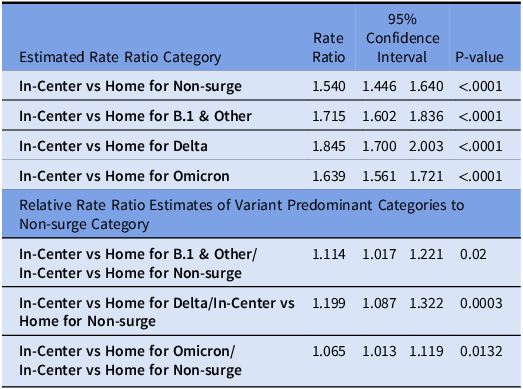
The pooled mean infection rate was highest during the B.1 & Other category (6.20 and 3.40 per 1000 patient-weeks for in-center and home patients, respectively) and lowest during the non-surge category (1.15 and 0.74 per 1000 patient-weeks for in-center and home patients, respectively) (Table 1). Rates of SARS-CoV-2 infection were higher among in-center dialysis patients compared to home dialysis patients during all categories, including the Delta variant category (rate ratio (RR) = 1.85, CI: 1.70–2.00), the combined Omicron variant category (RR = 1.64, CI: 1.56–1.72), the B.1 & Other surge category (RR = 1.72, CI: 1.60–1.84), and the non-surge category (RR = 1.54, CI: 1.45–1.64). The estimated SARS-CoV-2 infection relative rate ratio (RRR) between in-center and home patients – compared to the non-surge category – was heightened during the Delta (RRR = 1.20, CI: 1.09–1.32), B.1 & Other (RRR = 1.11, CI: 1.02–1.22), and Omicron (RRR = 1.07, CI: 1.01–1.12) categories (Table 2).
Rate ratios and relative rate ratio estimates comparing SARS-CoV-2 infection rates among in-center and home dialysis patientsa by variant predomiance categoryb—National Healthcare Safety Network, United States, December 29, 2020–May 9, 2023

a Patients receiving hemodialysis treatment at an outpatient center were categorized as in-center patients, and patients affiliated with an outpatient center but receiving hemodialysis or peritoneal dialysis at their home were categorized as home patients.
b Weeks in which the rate of SARS-CoV-2 infection among dialysis patients was above the median weekly infection rate of 1.83 per 1,000 patient-weeks were categorized as surge; weeks in which the rate of SARS-CoV-2 infection was at or below the median were categorized as non-surge. Surge weeks were further categorized by the variant lineage that accounted for ≥50% of the circulating variants during that week: B.1 & Other (December 29, 2020 through March 9, 2021); Delta (August 4, 2021 through October 5, 2021); the intermittent Omicron periods [BA.1 (December 15, 2021 through February 22, 2022); BA.2 & BA.5 (May 11, 2022 through September 20, 2022); and BQ.1 & XBB.1.5 (October 26, 2022 through January 31, 2023 with one intervening non-surge week ending on November 15, 2022)].
Discussion
Between December 29, 2020, and May 9, 2023, SARS-CoV-2 infection rates were higher among patients receiving in-center hemodialysis than among patients receiving home dialysis treatments. This difference was heightened during all surge categories compared to the non-surge category, regardless of SARS-CoV-2 variant predominance.
Our finding that patients receiving in-center hemodialysis had SARS-CoV-2 infection rates 50-85% higher than home dialysis patients is consistent with studies conducted earlier in the pandemic.Reference Hsu, Weiner, Aweh, Miskulin, Manley and Stewart3,Reference Salerno, Messana, Gremel, Dahlerus, Hirth and Han5,Reference Perl, Thomas, Tang, Yeung, Ip and Oliver12–Reference Quintaliani, Reboldi, Di Napoli, Nordio, Limido and Aucella14 Of note, a provincial study from Ontario, Canada, found rate ratios between dialysis patient settings that closely resemble the results of the present study.Reference Perl, Thomas, Tang, Yeung, Ip and Oliver12 The present study shows that these differences persisted throughout the COVID-19 Public Health Emergency and increased during surge weeks.
Compared to patients receiving in-center hemodialysis, it is easier for home dialysis patients to limit their potential exposures to COVID-19 by, for example, physically distancing from other persons during treatment and avoiding public transportation.Reference Corbett15 Home dialysis patients also benefited from CMS actions that reduced SARS-CoV-2 exposures. Beginning in March 2020 and continuing throughout the Public Health Emergency, CMS waived the requirements for quarterly in-center visits for patients receiving dialysis at homeReference Silberzweig, Kliger, Nissenson, Fine, Mehrotra and Zaritsky16 and allowed dialysis centers to conduct telemedicine visits instead of in-person clinic visits.Reference Lew, Wallace, Srivatana, Warady, Watnick and Hood17–19
Differences in testing practices may have influenced infection detection for patients receiving in-center hemodialysis in the US. Although there was no mandate for SARS-CoV-2 testing among patients in outpatient dialysis facilities, CDC issued guidance in December 2020 stating that outpatient dialysis facilities should evaluate all patients for signs or symptoms of COVID-19 and identify asymptomatic patients reporting any possible exposure to facilitate testing and decrease risk of transmission within dialysis facility.20 Dialysis facilities following these recommendations may have increased infection detection among asymptomatic or minimally symptomatic in-center patients compared to home patients. The study conducted in Canada, mentioned previously, found that patients receiving in-center dialysis were tested for SARS-CoV-2 more than three times as often as those receiving home dialysis.Reference Perl, Thomas, Tang, Yeung, Ip and Oliver12 However, in the same study, home dialysis patients had a lower burden of COVID-19-related hospitalization, mortality, and ICU admission compared to those receiving dialysis in an outpatient center. Differences in these metrics suggest that testing practices alone might not account for higher rates of SARS-CoV-2 infection among in-center compared to home dialysis patients; rather, these results may indicate a real difference in infection rates between the two groups.
Although most (80–87%) dialysis patients are medically eligible for home dialysis therapiesReference Mendelssohn, Mujais, Soroka, Brouillette, Takano and Barre21,Reference Bonenkamp, Reijnders, van Eck van der Sluijs, Hagen, Abrahams and van Ittersum22 and utilization of home dialysis treatments has increased in recent years, only 14.1% of dialysis patients in the US in 2021 received dialysis at home.23 Ensuring patients receive education on the different dialysis modalities is critical to ensure they are able to make well-informed decisions regarding which modality is best for their lifestyle and health goals. One potential benefit of home dialysis that could be discussed with patients is reduced exposure to communicable diseases.
This study is subject to a few limitations. First, CMS only required surveillance reporting among outpatient dialysis facilities; this requirement did not include acute kidney injury patients admitted to acute care hospitals and patients receiving dialysis treatment while hospitalized. Although pediatric outpatient dialysis facilities were required to report to NHSN, pediatric patients make up <0.5% of the dialysis patient population in the U.S. and data about this population may be incomplete. Therefore, these results may not be generalizable to hospitalized or pediatric patients. Second, NHSN collects data aggregated to the facility level. The lack of patient-level data limited our ability to assess the impact of patient-level factors associated with infection incidence. The lack of patient-level data also meant that this study could not account for factors such as age or comorbidities that have been shown to differ between in-center and home dialysis patients. Third, due to changes in definitions of vaccination status over the course of the study period, we did not include vaccination coverage of patients or healthcare personnel in the model. Given that only 54% of dialysis patients had received any COVID-19 vaccination beyond the primary series as of September 2022,Reference Navarrete, Barone, Qureshi, Woods, Barbre and Meng4 it is possible that improved vaccination coverage would have reduced infection rates among all dialysis patients. Fourth, this study could not assess if patients who undergo dialysis in a facility setting are generally more mobile and apt to have more opportunities for exposure to SARS-CoV-2 in the community. Finally, our study did not account for differences in SARS-CoV-2 testing and reporting between dialysis patients receiving in-center and home dialysis treatment. A higher rate of SARS-CoV-2 testing among dialysis patients, particularly of in-center hemodialysis patients compared to home dialysis patients, might have affected the results of this study.Reference Perl, Thomas, Tang, Yeung, Ip and Oliver12
This analysis found significant differences in rates of SARS-CoV-2 infection between in-center hemodialysis patients and home dialysis patients. These differences persisted across nearly all weeks of the study period and increased significantly during surges in infection rates among the entire study group. These findings improve our understanding of the epidemiology of SARS-CoV-2 infection among patients receiving dialysis in an outpatient center and those receiving dialysis at home. They also highlight opportunities for future exploration of the potential benefit of home dialysis therapies in reducing the risk of exposure to respiratory viruses as part of a multi-faceted strategy for infection prevention in persons receiving dialysis.
Supplementary material
To view supplementary material for this article, please visit https://doi.org/10.1017/ice.2025.10305
Financial support
This study was conducted as part of the official duties of the authors; no outside funding was received.
Competing interests
All authors report no conflicts of interest relevant to this article.
Disclaimer
The findings and conclusions in this report are those of the authors and do not necessarily represent the official position of the Centers for Disease Control and Prevention.